
IMC 2005 Q24
24. The figure shows a cube of side 1 on which all twelve face diagonals have been drawn – creating a network with 14 vertices (the original eight corners, plus the six face centres) and 36 edges (the original twelve edges of the cube plus four extra edges on each face). What is the length of the shortest path along the edges of the network which passes through all 14 vertices?
- A \(1 + 6\sqrt{2}\)
- B \(4 + 2\sqrt{2}\)
- C 6
- D \(8 + 6\sqrt{2}\)
- E \(12 + 12\sqrt{2}\)
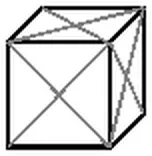
Intermediate Mathematical Challenge 2005, Question 24. © UK Mathematics Trust. Original paper on ukmt.org.uk
Answer: A \(1 + 6\sqrt{2}\)
Figure (i) shows a net of the cube on which a possible path has been drawn, while figure (ii) shows a diagram of the cube on which the same path has been drawn. Each edge of the network which joins a corner to a face centre has length \(1/\sqrt{2}\), while each edge which joins two adjacent corners has length 1. So the length of the path shown is \(1 + 12 \times 1/\sqrt{2}\), that is \(1 + 6\sqrt{2}\). This is the length of the shortest path along the edges of the network which passes through all 14 vertices. To prove this, we first note that to connect the 14 vertices we need a minimum of 13 edges, so the length of the shortest path must be at least \(13 \times 1/\sqrt{2}\). A path of this length would move alternately between corners and face centres, but as there are 8 corners and 6 face centres this is impossible. At least one of the edges on the shortest path, therefore, must join two corners. So the length of the shortest path must be at least \(1 + 12 \times 1/\sqrt{2}\). The diagrams show that such a path does exist so we are able to conclude that \(1 + 6\sqrt{2}\) is indeed the length of the shortest path.
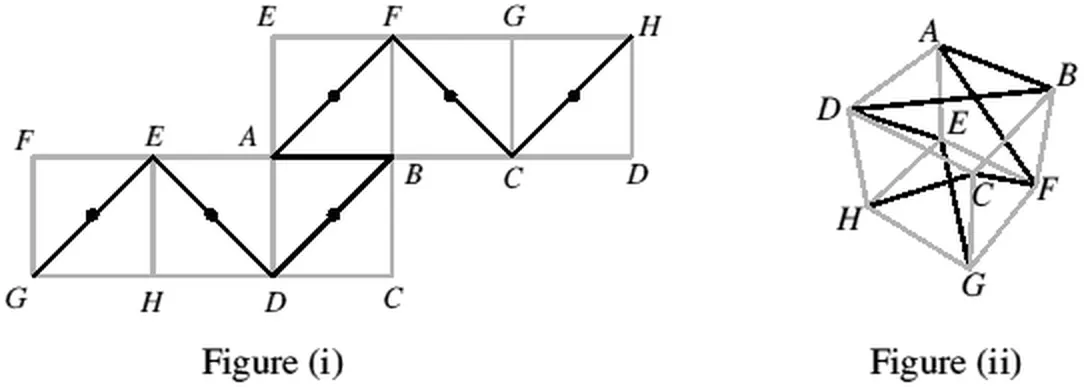
Solution © UK Mathematics Trust, from the IMC 2005 solutions.