
IMC 2014 Q25
25. The diagram shows two concentric circles with radii 1 and 2 units, together with a shaded octagon, all of whose sides are equal.
What is the length of the perimeter of the octagon?
- A \(8\sqrt{2}\)
- B \(8\sqrt{3}\)
- C \(8\sqrt{3}\pi\)
- D \(2\sqrt{5 + 2\sqrt{2}}\)
- E \(8\sqrt{5 - 2\sqrt{2}}\)

Intermediate Mathematical Challenge 2014, Question 25. © UK Mathematics Trust. Original paper on ukmt.org.uk
Answer: E \(8\sqrt{5 - 2\sqrt{2}}\)
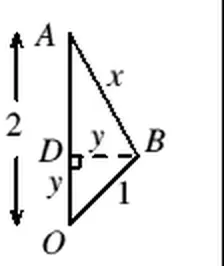
Let each side of the octagon have length \(x\). The octagon may be divided into eight triangles by joining the centre of the circle to the vertices of the octagon. One such triangle is shown. Each of these triangles has one side of length 1 (the radius of the smaller circle), one side of length 2 (the radius of the larger circle) and one side of length \(x\). So all eight triangles are congruent. Therefore \(\angle AOB = 360^\circ \div 8 = 45^\circ\).
Let \(D\) be the foot of the perpendicular from \(B\) to \(AO\). Then triangle \(BDO\) is an isosceles right-angled triangle.
Let \(OD = DB = y\). Applying Pythagoras' Theorem to triangle \(BDO\):
\(y^2 + y^2 = 1\). So \(y = \tfrac{1}{\sqrt{2}}\).
Applying Pythagoras' Theorem to triangle \(ADB\):
So the length of the perimeter is \(8x = 8\sqrt{5 - 2\sqrt{2}}\).
(Note that the length of AB may also be found by applying the Cosine Rule to triangle OAB.)
Solution © UK Mathematics Trust, from the IMC 2014 solutions. Longer versions with investigations: Solutions and investigations (PDF).