
IMC 2018 Q25
25. The diagram shows two equilateral triangles. The distance from each point of the smaller triangle to the nearest point of the larger triangle is \(\sqrt{3}\), as shown.
What is the difference between the lengths of the edges of the two triangles?
- A \(2\sqrt{3}\)
- B \(4\tfrac{1}{2}\)
- C \(3\sqrt{3}\)
- D 6
- E \(4\sqrt{3}\)
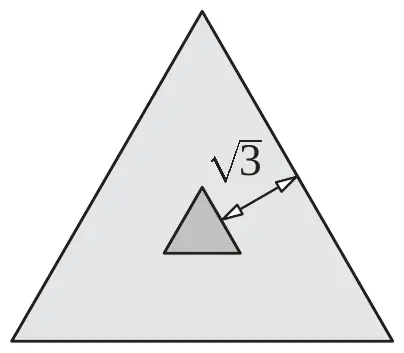
Intermediate Mathematical Challenge 2018, Question 25. © UK Mathematics Trust. Original paper on ukmt.org.uk
Answer: D 6
In the diagram shown, \(F\) is the foot of the perpendicular from \(D\) to \(AB\), \(G\) is the foot of the perpendicular from \(D\) to \(AC\) and \(H\) is the foot of the perpendicular from \(E\) to \(AB\). So \(DF = DG = EH = \sqrt{3}\). Consider triangles \(AFD\) and \(AGD\). Edge \(AD\) is common to both triangles, \(DF = DG\) and angles \(AFD\) and \(AGD\) are both right angles. So the triangles are congruent (RHS). Therefore \(\angle DAF = \angle DAG = 60° \div 2 = 30°\).
So in triangle \(AFD\), \(\tan 30° = \dfrac{DF}{AF}\).
Therefore \(AF = \sqrt{3} \div \left(1/\sqrt{3}\right) = \sqrt{3} \times \sqrt{3} = 3\). The same argument shows that \(BH = 3\). It is clear that \(FH = DE\), so \(AB - DE = AF + BF = 3 + 3 = 6\).
Therefore the difference between the lengths of the edges of the two triangles equals 6.

Solution © UK Mathematics Trust, from the IMC 2018 solutions. Longer versions with investigations: Solutions and investigations (PDF).