(i) Work out the value of \(P\) when \(g = 3\) and \(h = 5\) (2)
(ii) Work out the value of \(g\) when \(P = 38\) and \(h = 3\) (2)
\(V = 3r - q\)
(b) Work out the value of \(V\) when \(r = -3\) and \(q = 2\) (2)
Mark scheme (a)(i)
Answer
Mark
Mark scheme
26
M1
for substitution eg \(2 \times 3 + 4 \times 5\) or \(6 + 20\)
A1
cao
Mark scheme (a)(ii)
Answer
Mark
Mark scheme
13
M1
for substitution eg \(38 = 2g + 4 \times 3\)
or a complete numerical method eg \((38 - 4 \times 3) \div 2\) or for a correct first step to rearrange eg \(P - 4h = 2g\) or \(\dfrac{P}{2} = g + \dfrac{4h}{2}\) oe
28 The number of days, \(d\), that it will take to build a house is given by
\[d = \frac{720}{n}\]
where \(n\) is the number of workers used each day.
Ali’s company will take 40 days to build the house. Hayley’s company will take 30 days to build the house.
Hayley’s company will have to use more workers each day than Ali’s company.
How many more? (3)
Mark scheme
Answer
Mark
Mark scheme
6
M1
for \(720 \div 40\ (= 18)\) or \(720 \div 30\ (= 24)\)
M1
for a complete process eg \((720 \div 30) - (720 \div 40)\) or \(\text{``}18\text{''} \times 4/3 - \text{``}18\text{''}\) or \(\text{``}24\text{''} - \text{``}24\text{''} \times 3/4\)
15 You can use this rule to work out the total hire charge, in pounds (£), for hiring a 3D printer for a number of weeks.
Total hire charge (£) \(=\) number of weeks \(\times\ 70 + 50\)
Mia wants to hire a 3D printer for 4 weeks.
(a) Work out the total hire charge. (2)
Zahir hires a 3D printer. The total hire charge is £680
(b) For how many weeks does Zahir hire the 3D printer? (2)
Mark scheme (a)
Answer
Mark
Mark scheme
330
M1
for \(4 \times 70 + 50\) oe
A1
cao
Additional guidance
May be seen as sum of four 70s and a 50 \(n \times (70 + 50)\) or ambiguous working gets 0 marks
Mark scheme (b)
Answer
Mark
Mark scheme
9
M1
for use of inverse operations eg \((680 - 50) \div 70\) OR rearranges an equation to solve eg \(70x + 50 = 680\) rearranged to isolate \(x\) term. OR ft (a) eg \(((680 - \text{``}330\text{''}) \div 70) + 4\)
A1
cao or ft their (a)
Additional guidance
Need not have brackets; can be written in an incorrect order if the intention is clear A correct but embedded answer gets 1 mark
for \(4 \times 5\) and \(3 \times -2\), the substitution may be seen in two separate calculations, eg \(4 \times 5\ (= 20)\) and \(3 \times -2\ (= -6)\)
A1
cao
Mark scheme (b)
Answer
Mark
Mark scheme
\(4e^2 + 8e\)
B2
for \(4e^2 + 8e\)
(B1
for \(4e^2\) or \(8e\))
Additional guidance
Note: \(4e^2 + 8e = 12e^3\) for example gets B1 only
Mark scheme (c)
Answer
Mark
Mark scheme
11
M1
for a correct first step eg \(3 \times m - 3 \times 4 = 21\) oe or \(m - 4 = 21 \div 3\ (= 7)\) oe
A1
cao
Additional guidance
Showing \(\div 3\) by each side of equation is sufficient
23 The body mass index, \(B\), for a person of mass \(m\) kg and height \(h\) metres is given by the formula
\[B = \frac{m}{h^2}\]
Usman has a mass of 50 kg. He has a height of 1.57 m.
(a) Work out Usman’s body mass index. Give your answer correct to one decimal place. (2)
Tom’s height is 1.80 m. He wants his body mass index to be 21
(b) Work out the mass that will give Tom a body mass index of 21 (2)
Tom is a ski jumper. The maximum length of skis he can use is 145% of his height. Tom’s height is 1.80 m.
(c) Work out the maximum length of skis Tom can use. (3)
Mark scheme (a)
Answer
Mark
Notes
20.3
2
M1 for \(\dfrac{50}{1.57^2}\) oe A1 for answer in range 20.2 to 20.3
Mark scheme (b)
Answer
Mark
Notes
68.04
2
M1 for \((m =)\ 1.8^2 \times 21\) oe A1 cao
Mark scheme (c)
Answer
Mark
Notes
2.61
3
M2 for a complete method to find 145% of 1.8, eg. \(\frac{145}{100} \times 1.80\) oe (M1 for a method to find 45% of 1.8, eg. \(\frac{45}{100} \times 1.80\) (= 0.81) or for a multiplication factor of 1.45) A1 cao
6 The body mass index, \(B\), for a person of mass \(m\) kg and height \(h\) metres is given by the formula \[B = \frac{m}{h^2}\]
Usman has a mass of 50 kg. He has a height of 1.57 m.
(a) Work out Usman’s body mass index. Give your answer correct to one decimal place. (2)
Tom’s height is 1.80 m. He wants his body mass index to be 21
(b) Work out the mass that will give Tom a body mass index of 21 (2)
Tom is a ski jumper.
The maximum length of skis he can use is 145% of his height. Tom’s height is 1.80 m.
(c) Work out the maximum length of skis Tom can use. (3)
Mark scheme (a)
Answer
Mark
Notes
20.3
2
M1 for \(\dfrac{50}{1.57^2}\) oe A1 for answer in range 20.2 to 20.3
Mark scheme (b)
Answer
Mark
Notes
68.04
2
M1 for (\(m\) =) \(1.8^2 \times 21\) oe A1 for 68.04
Mark scheme (c)
Answer
Mark
Notes
2.61
3
M2 for a complete method to find 145% of 1.8, eg. \(\dfrac{145}{100} \times 1.80\) oe (M1 for a method to find 45% of 1.8, eg. \(\dfrac{45}{100} \times 1.80\) (= 0.81) or for a multiplication factor of 1.45) A1 cao
M1 for collecting the terms in \(x\) or the number terms in an equation, eg. \(5x - x + 4 = 14\) or \(5x = 14 - 4 + x\) A1 for 2.5 oe (accept \(\tfrac{10}{4}\))
(a) \(L = 3a + 2c\) \(a = 5\) \(c = 8\) Work out the value of \(L\). (2)
(b) Kirsty buys some buns. She buys \(x\) packs of currant buns and \(y\) boxes of iced buns. There are 6 currant buns in a pack of currant buns. There are 8 iced buns in a box of iced buns. Write down an expression, in terms of \(x\) and \(y\), for the total number of buns Kirsty buys. (2)
Mark scheme (a)
Answer
Mark
Notes
31
2
M1 for \(3 \times 5 + 2 \times 8\) or 15 and 16 A1 cao
Mark scheme (b)
Answer
Mark
Notes
\(6x + 8y\)
2
M1 for \(6x\) or \(8y\) A1 for \(6x + 8y\) oe as final answer
12 You can change temperatures from °F to °C by using the formula \[C = \frac{5(F - 32)}{9}\]
\(F\) is the temperature in °F. \(C\) is the temperature in °C.
The minimum temperature in an elderly person’s home should be 20°C.
Mrs Smith is an elderly person. The temperature in Mrs Smith’s home is 77°F.
*(a) Decide whether or not the temperature in Mrs Smith’s home is lower than the minimum temperature should be. (3)
(b) Make \(F\) the subject of the formula \[C = \frac{5(F - 32)}{9}\] (3)
Mark scheme (a)
Answer
Mark
Notes
No, temp is 25°C
3
M1 for substitution of 77 into the RHS of the formula A1 for 25 cao or for 225/9 and 180/9 cao C1 (dep on M1) for conclusion (ft) following from working shown
OR
M1 for substitution of 20 into LHS of formula and correct process to find F A1 for 68 cao C1 (dep on M1) for conclusion (ft) following from working shown
Mark scheme (b)
Answer
Mark
Notes
\(F = \dfrac{9}{5}C + 32\)
3
M1 for expansion of the brackets (eg \(5 \times F - 5 \times 32\)) or an attempt to multiply both sides by 9, or divide both sides by 5 as the first step. M1 (dep) for a correct second step A1 for \(F = \dfrac{9}{5}C + 32\) oe
10 You can use these rules to change temperatures from \(^\circ\)C to \(^\circ\)F.
approximate rule
Multiply the \(^\circ\)C temperature by 2 and then add 30
exact rule
Multiply the \(^\circ\)C temperature by 1.8 and then add 32
Amy uses the approximate rule to change 20\(^\circ\)C to \(^\circ\)F. Dan uses the exact rule to change 20\(^\circ\)C to \(^\circ\)F.
(a) Work out the difference between Amy’s result and Dan’s result. (4)
Jade uses the approximate rule to change a temperature from \(^\circ\)C to \(^\circ\)F. The result is 110\(^\circ\)F.
(b) What \(^\circ\)C temperature did Jade change to \(^\circ\)F? (3)
Mark scheme (a)
Answer
Mark
Notes
2
4
M1 for 20 × 2 + 30 (=70) M1 for 20 × 1.8 + 32 (=68) M1 (dep on M1) for “70” – “68” A1 cao
Mark scheme (b)
Answer
Mark
Notes
40
3
M1 for 110 – 30 ÷ 2 or 110 = ? × 2 + 30 or 110 – 30 or ÷ 2 seen as second operation M1 for “(110 – 30)” ÷ 2 A1 cao NB accept reverse flowcharts for inverse operations SC if exact rule used: B2 for “(110 – 32)” ÷ 1.8
*14 Angela and Michelle both work as waitresses at the same restaurant.
This formula is used to work out the total amount of money each waitress gets.
Total amount = £6.50 × number of hours worked + tips
The table shows the number of hours Angela and Michelle each worked last Saturday. It also shows the tips they got.
Number of hours worked
Tips
Angela
8
£12
Michelle
7
£15
Who got the higher total amount of money last Saturday?
You must show clearly how you got your answer. (4)
Mark scheme
Answer
Mark
Notes
Correct statement
4
M1 for 6.50 × 8 + 12 or 6.50 × 7 + 15 M1 for 6.50 × 8 + 12 and 6.50 × 7 + 15 A1 for 64 and 60.5(0) C1 (dep on first M1) for correct statement ft their figures OR M1 for 6.50 × (8−7) or 15−12 M1 for 6.50 × (8−7) and 15−12 A1 for 6.5(0) and 3 C1 (dep on first M1) for correct statement ft their figures [SC If no working shown B1 for 64 and 60.5(0) or B1 for 6.5(0) and 3]
M1 for correct method to clear fraction or remove square root sign M1 (dep) for a fully correct method to both clear fraction and remove square root sign A1 for \(k = 4m^2 - 1\) or \(k = (2m + 1)(2m - 1)\)
13 You can use this rule to work out the total cost of hiring a car.
Total cost = £4 per hour plus £12
Arun hires a car for 5 hours.
(a) Work out the total cost. (2)
Raj hires a car. The total cost is £40
(b) Work out how many hours Raj hires the car for. (3)
Mark scheme (a)
Answer
Mark
Notes
32
2
M1 for \(4 \times 5 + 12\) oe A1 cao
Mark scheme (b)
Answer
Mark
Notes
7
3
M1 for \(40 - 12\) or 28 seen M1 (dep) for \('28' \div 4\) A1 cao OR M1 for \(12 + 4 + 4 + \ldots\) M1 for \(12 + 7 \times 4\) oe A1 cao OR M1 for \(12 + 4x = 40\) oe M1 for \(4x = 40 - 12\) oe A1 cao NOTE: A correct embedded answer scores M2 A0 OR M1 ft for \('32' + 4\ldots\) or \(40 - '32'\) M1 ft for \(5 + 1 \ldots\) oe A1 ft Note: Do not follow through from part a an answer of 40
M1 for \(110 - 30\) (=80) M1 (dep) for \(\text{`}80\text{'} \div 8\) or A1 cao OR M1 for \(110 - 62\) (= 48) M1(dep) for \(\text{`}48\text{'} \div 8 = 6\) A1 cao
15 The table shows the minimum distance and the maximum distance people should sit from different sized TV screens when watching TV.
TV screen size (inches)
Minimum distance (feet)
Maximum distance (feet)
28
3.5
7
30
3.75
7.5
32
4
8
36
4.5
9
38
4.75
9.5
40
5
10
42
5.25
10.5
James has a TV with a screen size of 32 inches. He is going to watch his TV.
(a) What is the minimum distance James should sit from the screen? feet (1)
Sheraz has a TV with a screen size of 38 inches. He is going to watch his TV.
(b) Work out the difference between the minimum distance and the maximum distance Sheraz should sit from the screen. feet (2)
You can use this rule to work out the maximum distance to sit from a TV screen.
Maximum distance in feet = screen size in inches \(\div\) 4
Clare has a TV with a screen size of 24 inches. She is going to watch her TV.
(c) Use the rule to work out the maximum distance Clare should sit from the screen. feet (1)
Richard should sit a maximum distance of 12 feet from his screen.
(d) Work out the screen size of Richard’s TV. inches (2)
Mark scheme (a)
Answer
Mark
Notes
4
1
B1 cao
Mark scheme (b)
Working
Answer
Mark
Notes
\(9.5 - 4.75 =\) OR \(9.5 \div 2 =\)
4.75
2
M1 for \(9.5 - 4.75\) or \(9.5 \div 2\) or \(4.75 - 9.5\) A1 cao
Mark scheme (c)
Answer
Mark
Notes
6
1
B1 cao
Mark scheme (d)
Working
Answer
Mark
Notes
\(12 \times 4 =\)
48
2
M1 for \(\times 4\) seen or identifying \(+ 0.5\) for every 2 inches or \(12 + 12 + 12 + 12\) oe or build up method eg 12, 24, 36, 48 allow one error A1 cao
explain why there is only one value of \(x\) for which \(y\) is negative. [3 marks]
Mark scheme
Answer
Mark
Comments
When \(x = 2\), \((y =)\ 24\) or when \(x = 2\), negative (\(\times\)) negative (\(\times\)) positive = positive
B1
oe
When \(x = 4\), \((y =)\ {-10}\) or when \(x = 4\), positive (\(\times\)) negative (\(\times\)) positive = negative
B1
oe
When \(x = 6\), \((y =)\ 36\) or when \(x = 6\), positive (\(\times\)) positive (\(\times\)) positive = positive
B1
oe SC1 correct value of \(y\) for any positive even value of \(x\) greater than 6
Additional guidance
SC1 should only be considered when the response scores B0B0B0
Ignore any other evaluation attempts or written statements alongside correct responses
A value of \(x\) may be implied by consistent substitution into the equation eg \((2 - 3)(2 - 5)(2 + 6) = 24\) implies \(x = 2\)
B1
For any response using negative/positive, \(x = 2\) can be implied by stating ‘below 4’ and \(x = 6\) can be implied by stating ‘above 4’, or equivalent
For any response using negative/positive, multiplication must be shown, referred to or implied, and the sign of the result must be stated
\(5^2 + 7 \times 5 - c\) or \(60 - c\) and \(3 \times 5 + d\) or \(15 + d\)
M1
oe
\(25 + 35 - c = 15 + d\) or \(60 - c = 15 + d\) or \(c = 60 - y\) and \(d = y - 15\) and \(c + d = 60 - y + y - 15\)
M1dep
oe equation with squaring and multiplications correctly completed
45
A1
Alternative method 2
\(x^2 + 7x - c = 3x + d\) or \(x^2 + 7x - c - (3x + d) = 0\) or \(x^2 + 7x - c - 3x - d = 0\) or \(3x + d - (x^2 + 7x - c) = 0\) or \(3x + d - x^2 - 7x + c = 0\)
26 Given that \(\quad a \times 60 = b \quad\) work out the value of \(\quad \dfrac{4b}{a}\) [2 marks]
Mark scheme
Answer
Mark
Comments
\(60 \times 4\) or \(4(a \times 60)\) or \(4a \times 60\) or \(\dfrac{b}{a} = 60\) or \(\dfrac{4b}{b/60}\) or \(4b = 240a\) or \(\dfrac{240a}{a}\)
M1
accept any multiplication signs
240
A1
Condone \(\dfrac{240}{1}\)
Additional guidance
Correct answer found by substituting appropriate values for \(a\) and \(b\)
M1A1
Incorrect answer found by substituting appropriate values for \(a\) and \(b\)
M0A0
Award M1 for \(60 \times 4\) or 240 in working, either as individual expressions or as part of longer expressions eg \(4 \times 60 = 240\), answer \(240b\) eg \(\dfrac{4 \times 60 \times a}{4b}\)
M1A0 M1A0
Do not award M1 for 240 within a list of multiples of 60 that continues beyond 240
7 Given that \(\quad a \times 60 = b \quad\) work out the value of \(\quad \dfrac{4b}{a}\) [2 marks]
Mark scheme
Answer
Mark
Comments
\(60 \times 4\) or \(4(a \times 60)\) or \(4a \times 60\) or \(\dfrac{b}{a} = 60\) or \(\dfrac{4b}{b/60}\) or \(4b = 240a\) or \(\dfrac{240a}{a}\)
M1
accept any multiplication signs
240
A1
Condone \(\dfrac{240}{1}\)
Additional guidance
Correct answer found by substituting appropriate values for \(a\) and \(b\)
M1A1
Incorrect answer found by substituting appropriate values for \(a\) and \(b\)
M0A0
Award M1 for \(60 \times 4\) or 240 in working, either as individual expressions or as part of longer expressions eg \(4 \times 60 = 240\), answer \(240b\) eg \(\dfrac{4 \times 60 \times a}{4b}\)
M1A0 M1A0
Do not award M1 for 240 within a list of multiples of 60 that continues beyond 240
(a) Write down the value of \(\quad 2a - b\) [1 mark]
(b) Write down the value of \(\quad 2b - 4a\) [1 mark]
(c) You are given that \(\quad 4a - 2b = 10 \quad\) and \(\quad a + c = 3\)
Write an expression in \(a\), \(b\) and \(c\) that is equal to 23
Give your answer in its simplest form.
You must show your working. [2 marks]
Mark scheme (a)
Answer
Mark
Comments
5
B1
Additional guidance
Condone \(10 - 5 = 5\)
B1
Condone \(x = 5\)
B1
\(\dfrac{10}{2}\)
B0
Mark scheme (b)
Answer
Mark
Comments
\(-10\)
B1
Mark scheme (c)
Answer
Mark
Comments
Unsimplified expression in \(a\), \(b\) and \(c\) which would evaluate to 23
M1
eg \(2(4a - 2b) + a + c\) or \(8a - 4b + a + c\) or \(11(a + c) - (4a - 2b)\) or \(11a + 11c - 4a + 2b\)
Simplified expression in \(a\), \(b\) and \(c\) which would evaluate to 23
A1
eg \(9a - 4b + c\) \(7a + 2b + 11c\) SC2 Values assigned to \(a\), \(b\) and \(c\) which satisfy original equations and expression given which has value 23 eg \(a = 3, b = 1, c = 0\) and \(7a + 2b + c\)
Additional guidance
There are infinitely many correct solutions. Allow solutions where the coefficients are not integers if initial working is shown. eg \(3(4a - 2b) - \dfrac{7}{3}(a + c) = \dfrac{29}{3}a - 6b - \dfrac{7}{3}c\)
M1A1
\(5a - 2b + c + 10 = 23\)
M1A1
Condone ‘= 23’ after the expression
Answer using only two variables eg \(2.3(4a - 2b)\)
Work out the value of \(\quad \dfrac{a}{b} - a^b\) [3 marks]
Mark scheme
Answer
Mark
Comments
3.5 or \(3\dfrac{1}{2}\) or 49 or \((49 =)\ \dfrac{98}{2}\)
M1
\(3.5 - 49\) or \(49 - 3.5\) or \(3\dfrac{1}{2} - 49\) or \(49 - 3\dfrac{1}{2}\) or \(\dfrac{7}{2} - \dfrac{98}{2}\) or \(\dfrac{98}{2} - \dfrac{7}{2}\)
M1dep
45.5 (oe) implies M2
\(-45.5\) or \(-45\dfrac{1}{2}\) or \(-\dfrac{91}{2}\)
15 A company uses this formula to work out the cost, £\(A\), of a taxi ride.
\[A = 4 + 1.8m + b\]
£4 is a fixed charge \(m\) is the number of miles travelled £\(b\) is a charge for booking online
(a) Clare books a taxi online and travels 8 miles.
She pays £20 altogether.
How much is the charge for booking online? [3 marks]
(b) A different company
has a fixed charge of £3 charges £1.90 per mile has no charge for booking online.
Write a formula for the cost, £\(C\), of a taxi ride with this company. [1 mark]
Mark scheme (a)
Answer
Mark
Comments
Alternative method 1
\(1.8(0) \times 8\) or 14.4(0)
M1
implied by 5.6(0) or 18.4(0)
\(20 -\) their \(14.4(0) - 4\) or \(20 - 18.4(0)\) or 1.6
M1dep
1.60
A1
condone £1.60p
Alternative method 2
\(b = A - 4 - 1.8m\)
M1
oe correct formula with \(b\) as the subject
\(20 - 4 - 1.8(0) \times 8\) or 1.6
M1dep
1.60
A1
condone £1.60p
Additional guidance
\(1.8(0) \times 8\) may be within an incorrect calculation eg \(4 + 1.8(0) \times 8 + 20\)
M1
Mark scheme (b)
Answer
Mark
Comments
\(C = 3 + 1.9(0)m\)
B1
oe formula with \(C\) as subject accept \(C = 3 + 1.9(0) \times m\) condone \(+ 0\) or \(+ 0b\)
Additional guidance
\(3 + 1.9m\)
B0
Do not accept eg \(A = \ldots\) for \(C = \ldots\)
B0
Allow \(m\) to be \(\times\) mile(s) but not a different letter unless defined eg1 \(C = 3 + 1.9(0) \times\) miles eg2 \(C = 3 + 1.9(0)\) miles eg3 \(C = 3 + 1.9(0)\) per mile or \(C = 3 + 1.9(0)\)pm eg4 \(C = 3 + 1.9(0)x\)
B1 B0 B0 B0
Ignore £ inserted in part or all of equation eg \(C = 3 + £1.90m\)
B1
Correct formula followed by substitution (and evaluation)
\(\dfrac{2 - 12}{2}\) or one correctly evaluated trial with correct substitutions for \(x = 2\) or 5 and \(y = 3\) or 12 or two correct values from \(-\dfrac{10}{2},\ -\dfrac{1}{2},\ -\dfrac{7}{5},\ \dfrac{2}{5}\) oe or two correct values from \(-5,\ -0.5,\ -1.4,\ 0.4\) oe
M1
\(\dfrac{2 - 3}{2} = -\dfrac{1}{2}\) oe or \(\dfrac{5 - 12}{5} = -\dfrac{7}{5}\) oe or \(\dfrac{5 - 3}{5} = \dfrac{2}{5}\) oe
\(-\dfrac{10}{2}\) or \(-5\)
A1
Additional guidance
Two separate correct values can be in either fraction or decimal form
\(2 - 12 \div 2 = -5\) (recovered)
M1A1
\(2 - 12 \div 2\)
M0A0
An example of an incorrect substitution with different values of \(x\) eg \(\dfrac{5 - 12}{2} = -\dfrac{7}{2}\)
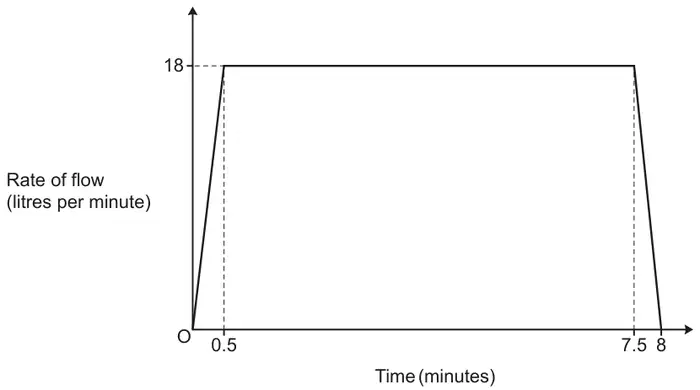
20 A container takes 8 minutes to be filled with water.
The graph shows the rate of flow, in litres per minute, of the water into the container during the 8 minutes.
Not to scale
(a) Show that 126 litres of water flows into the container between 0.5 minutes and 7.5 minutes. [1]
(b) Work out the average rate of flow, in litres per minute, of water into the container during the 8 minutes. [4]
Mark scheme (a)
Answer
Marks
Part marks and guidance
18 × (7.5 – 0.5) or 18 × 7
1
126/18 = 7 only scores if 7 is related to the context 126/7 = 18 only scores if 18 is related to the context
Mark scheme (b)
Answer
Marks
Part marks and guidance
16.87[5] or 16.88 or 16.9 oe
4
M3 for \(\frac{126 + 2 \times \frac{1}{2} \times 0.5 \times 18}{8}\) oe or M2 for \(126 + 2 \times \frac{1}{2} \times 0.5 \times 18\) oe may be implied by 135 or M1 for \([2\ \times]\ \frac{1}{2} \times 0.5 \times 18\) oe may be implied by 4.5 for one triangle or 9 for two triangles
If 0 scored, SC1 for \(\frac{126 + 2 \times 9}{8}\) or \(\frac{126 + 18}{8}\)
e.g. \(\frac{\frac{1}{2} \times (7 + 8) \times 18}{8}\)
e.g. \(\frac{1}{2} \times (7 + 8) \times 18\) or \(18 \times 8 - 2 \times \frac{1}{2} \times 0.5 \times 18\)
12 You may use these kinematics formulae to answer this question.
\(v = u + at\) \(s = ut + \frac{1}{2}at^2\)
where \(a\) is the constant acceleration, \(u\) is the initial velocity, \(v\) is the final velocity, \(s\) is the displacement and \(t\) is the time taken.
A particle has an initial velocity of 2 m/s. After 6 seconds the particle has a velocity of 11 m/s. The particle had constant acceleration.
Work out the distance the particle has travelled in the 6 seconds. [4]
Mark scheme
Answer
Marks
Part marks and guidance
39
4
B2 for [\(a\) =] 1.5 oe or M1 for \(11 = 2 + 6a\) or better
M1 for \(2 \times 6 + \frac{1}{2} \times\) their a \(\times 6^2\) or better
(a) Show that the formula \(v = u + at\) can be rearranged to \(a = \dfrac{v - u}{t}\). [1]
(b) Use the formula \(a = \dfrac{v - u}{t}\) to find the acceleration, \(a\) m/s\(^2\), when a particle takes 4 seconds to increase from an initial velocity of 3 m/s to a final velocity of 9 m/s. [2]
Mark scheme (a)
Answer
Marks
Part marks and guidance
\(v - u = at\) seen as single statement
1
Accept e.g. \(-v + u = -at\) but not e.g. \(\dfrac{v - u}{t} = at \div t\)
Mark scheme (b)
Answer
Marks
Part marks and guidance
1.5 oe
2
M1 for correct substitution \(\dfrac{9 - 3}{4}\) oe
e.g. \(1\frac{1}{2}\) or \(\frac{6}{4}\) or \(\frac{3}{2}\)
For M1 accept a two-step evaluation with an arithmetic slip eg \(9 - 3 = 5\) followed by \(5 \div 4\) Do not accept \(\dfrac{3 - 9}{4}\) for M1
Use of (0, 2) scores 0 but may be replaced with another point (ie do not treat as a choice)
Examples of intermediate steps
\(4 = 2k - 2^2 + 2\) then \(4 = 2k - 4 + 2\) is a sufficient int step or \(4 = 2k - 2\) is a sufficient int step or \(6 = 2k\) is a sufficient int step \(3 = k\)
Mark scheme (b)
Answer
Marks
Part marks and guidance
0.4 and 2.6
2
B1 for 0.4 or 2.6
or
M1 for line \(y = 3\) drawn or for (0.4, 3) and (2.6, 3) indicated
Line to cut curve twice Treat \(x = 3\) drawn or multiple horizontal lines as choice unless \(y = 3\) clearly chosen Condone good freehand line eg circled or lines drawn down to \(x\)-axis
(a) Rearrange this formula to make \(u\) the subject.\[v^2 = u^2 + 2as\] [2]
(b) A rocket accelerates at 90 m / s2 and travels 270 km. The rocket’s final velocity is 8000 m / s.
Using part (a), or otherwise, calculate the rocket’s initial velocity in m / s. [3]
Mark scheme (a)
Answer
Marks
Part marks and guidance
\(u = [\pm]\sqrt{v^2 - 2as}\) as final answer
2
M1 for [\(u^2\) =] \(v^2 - 2as\)
Mark scheme (b)
Answer
Marks
Part marks and guidance
3924 to 3924.3
3
M2 for \(\sqrt{8000^2 - 2 \times 90 \times 270000}\)
or
M1 for \(\sqrt{8000^2 - 2 \times 90 \times \text{figs } 27}\) or \(8000^2 - 2 \times 90 \times 270000\) or \(8000^2 = u^2 + 2 \times 90 \times 270000\) or for correct substitution seen of \(v = 8000\), \(a = 90\) and \(s\) = figs 27 in their final answer to part (a)
If 0 scored SC1 for 7996 to 7997 as final answer
Condone 3920 as final answer for full marks, following M2
14 The number of bees, \(P\), in a colony is given by the formula
\[P = ab^x\]
where \(x\) is the number of months after the start of July.
At the start of July, there were 25 000 bees in the colony. After one month, there were 23 500 bees in the colony.
Find the value of \(a\) and the value of \(b\). Give the value of \(b\) as a decimal. [4]
Mark scheme
Answer
Marks
Part marks and guidance
[\(a\) = ] 25 000 [\(b\) = ] [0].94
4
B1 for 25 000
AND
B3 for 0.94 oe or B2 for \(\frac{23500}{25000}\) or 94% oe or \(\frac{25000 - 23500}{25000}\) or 0.06 oe or M1 for 23500 = \(ab^{[1]}\) or 23500 = \(25000b^{[1]}\)
(a) A car accelerates at 4.06 m/s2 for 10.1 seconds from an initial velocity of 2.93 m/s.
Harper rounds each value to 1 significant figure. Harper uses the rounded values and the formula
\[s = ut + \tfrac{1}{2}at^2\]
to estimate the distance travelled in the 10.1 seconds. Harper’s answer is 430 metres.
Using Harper’s method, show that their answer is wrong. [4]
(b) Rearrange this formula to make \(t\) the subject.\[s = \tfrac{1}{2}at^2\]
[3]
Mark scheme (a)
Answer
Marks
Part marks and guidance
\(s = 230\) with 4, 3 and 10 or 100 seen
4
B2 for 4, 3 and 10 or 100 or B1 for two correct
For all marks condone e.g. 3.00, 4.0, 10.0 used These values may be written in the stem of the question
AND M1 for \((3 \times 10) + \tfrac{1}{2}(4 \times 10^2)\) or correct substitution of unrounded or incorrectly rounded values
If 0 scored then SC1 for sight of 230
For M1 e.g. allow a mixture \((2.93 \times 10.1) + \tfrac{1}{2}(4.1 \times 10^2)\)
Mark scheme (b)
Answer
Marks
Part marks and guidance
\(t = [\pm]\sqrt{\dfrac{2s}{a}}\) oe final answer
3
Square root must dip below fraction line in final answer unless \(\left(\frac{2s}{a}\right)\) bracketed For 3 marks oe e.g. \(t = [\pm]\sqrt{\dfrac{2 \times s}{a}}\), \(t = \sqrt{\dfrac{s}{\frac{1}{2}a}}\)
M2 for first two steps correctly completed e.g. \(\frac{2s}{a} = t^2\) or answer \([\pm]\sqrt{\dfrac{2s}{a}}\) (no \(t =\) )
M2 for e.g. \(\dfrac{s}{\frac{a}{2}} = t^2\), \(\dfrac{s}{\frac{1}{2}a} = t^2\), \(\dfrac{s}{0.5a} = t^2\)
or M1 for first step correctly completed e.g. \(2s = at^2\) or \(\frac{s}{a} = \frac{1}{2}t^2\)
Allow M1 for \(\frac{s}{0.5} = at^2\) oe
If 0 scored, SC1 for final answer \(t = [\pm]\sqrt{\dfrac{\frac{1}{2}s}{a}}\) oe
Write \(z\) in terms of \(x\). Give your answer in its simplest form. [4]
Mark scheme
Answer
Marks
Part marks and guidance
\(z = 17 - 2x^2\) final answer
4
B3 for answer \(17 - 2x^2\) OR M3 for \(7 = 4\left(\dfrac{x^2 - 5}{2}\right) + z\) oe or \(2x^2 + z = 17\) oe or \(x^2 - 2\left(\dfrac{7 - z}{4}\right) = 5\) or better
Correct unsimplified formula in \(x\) and \(z\)
or M2 for \(y = \dfrac{2x^2 - 10}{4}\) oe or \(y = \dfrac{7 - z}{4}\) oe or \(4y = 2x^2 - 10\) or \((2x^2 - 4y) + (4y + z) = 10 + 7\) oe
M2 sets up for substitution with \(y\) explicit or for method for elimination by equating coefficients of \(y\) and correct method to eliminate \(y\)
or M1 for \(2x^2 - 4y = 10\) or \(-2y = 5 - x^2\) or \(4y = 7 - z\) or better
M1 equates coefficients of \(y\) or first step in rearrangement to eliminate
16 The following kinematics formulas may be used in this question.
\[v = u + at \qquad s = ut + \tfrac{1}{2}at^2 \qquad v^2 = u^2 + 2as\]
The initial velocity of a particle is 20 m/s. The acceleration of the particle is −8 m/s². After \(t\) seconds, the particle has travelled 25 m.
(a) Show that \(4t^2 - 20t + 25 = 0\). [3]
(b) Solve \(4t^2 - 20t + 25 = 0\). [3]
(c) Show that the particle is stationary when it has travelled 25 m. [3]
Mark scheme (a)
Answer
Marks
Part marks and guidance
Subst into correct formula (may be implied) and partial simplification
2
B2 for \(25 = 20t - \frac{1}{2} \times 8 \times t^2\) oe or \(25 = 20t + (-4)t^2\) or B1 for subst eg \(25 = 20t + \frac{1}{2}(-8)t^2\)
Only accept \(25 = 20t - 4t^2\) if subst seen For B1 condone ambiguity caused by missing brackets
\(25 = 20t - 4t^2\) seen and correct completion to \(4t^2 - 20t + 25 = 0\)
1dep
Dep on previous 2 marks
Mark scheme (b)
Answer
Marks
Part marks and guidance
2.5 oe
3
M2 for \((2t - 5)(2t - 5)\) or M1 for any two factors that give two correct terms when expanded or for partial factorisation \(2t(2t - 5) - 5(2t - 5)\)
OR M2 for [\(t =\)] \(\dfrac{20 \pm \sqrt{400 - 400}}{8}\) or better or M1 for [\(t =\)] \(\dfrac{-(-20) \pm \sqrt{(-20)^2 - 4 \times 4 \times 25}}{2 \times 4}\) with at most one error
eg a sign error, short fraction line, short root, but condone missing brackets
Mark scheme (c)
Answer
Marks
Part marks and guidance
Shows \(v = 0\) and concludes “stationary”
3
M1 for [\(v^2 =\)] \(20^2 + 2(-8)25\) or [\(v =\)] \(20 + (-8) \times\) their (b) A1 \(v = 0\)
If 0 scored, instead award SC2 for \(v = 0\) and other values substituted into a relevant equation as a correct check or SC1 for \(v = 0\)
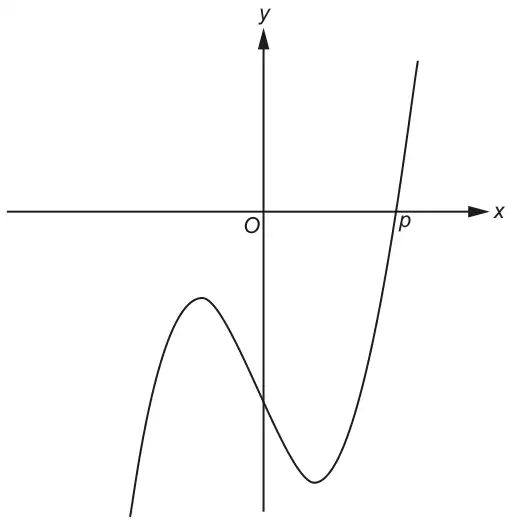
9 The graph of \(y = x^3 - 7x - 12\) is shown below. The root of the equation \(x^3 - 7x - 12 = 0\) is \(p\).
(a) Calculate \(y\) when \(x = 3\). [1]
(b) Show that \(3 \lt p \lt 4\). [2]
(c) Find a smaller interval that contains the value of \(p\). You must show calculations to support your answer. [3]
Mark scheme (a)
Answer
Marks
Part marks and guidance
−6
1
Mark scheme (b)
Answer
Marks
Part marks and guidance
[\(x = 4\),] \(y = 24\)
Change of sign, so \(p\) lies between 3 and 4 oe
2
B1 for 24 seen
If using \(3.27 \lt x \lt 4\) rather than 4: SC2 evaluate \(y\) correctly (see table in (c)), state change of sign oe and that because \(3 \lt p \lt\) their \(x\)-value, then so \(3 \lt p \lt 4\). 0 for just evaluating y.
After \(x = 4\), \(y = 24\) scored: Examples just sufficient for second mark include: change of sign \(-6 \lt 0 \lt 24\) \(x = 3\) gives an answer < 0 and \(x = 4\) gives an \(\gt 0\) Examples insufficient for second mark: so \(p\) lies between 3 and 4
Mark scheme (c)
Answer
Marks
Part marks and guidance
Examples: when \(x = 3.5\), \(y = 6.4\), so \(3 \lt p \lt 3.5\) when \(x = 3.1\), \(y = -3.9\), so \(3.1 \lt p \lt 4\) when \(x = 3.1\), \(y = -3.9\) and when \(x = 3.5\), \(y = 6.4\), so \(3.1 \lt p \lt 3.5\)
3
M2 for one further value of \(y\) evaluated correctly, possibly rot to 2 or more sf, for a value of \(x\) such that \(3 \lt x \lt 4\)
OR
M1 for working shown to calculate one further value of \(y\) for a value of \(x\) such that \(3 \lt x \lt 4\)
Note after SC considered in (b): if SC2 was awarded then they must use a value of \(x\) that produces a smaller interval than \(3 \lt x \lt\) their x-value in (b); if SC2 was not awarded then \(3 \lt x \lt 4\) applies
If 0 scored, award SC1 or SC2 if evidence for M1 or M2 has not yet been credited in (b)
Solution is approx. 3.2670
Common values:
\(x\)
\(y\)
3.1
−3.909
3.2
−1.632
3.25
−0.422
3.26
−0.174
3.27
0.0758
3.3
0.837
3.4
3.504
3.5
6.375
3.6
9.456
3.7
12.75
3.75
14.48
3.8
16.27
3.9
20.02
A correct narrower range scores 0 unless accompanied by the relevant correct calculation(s). eg M2 only for when \(x = 3.1\), \(y = -3.9\) so \(3.1 \lt p \lt 3.5\) (as 3.5 has not been correctly justified) Calculations in support of \(x = 3\) or \(x = 4\) need not be repeated from parts (a) or (b).
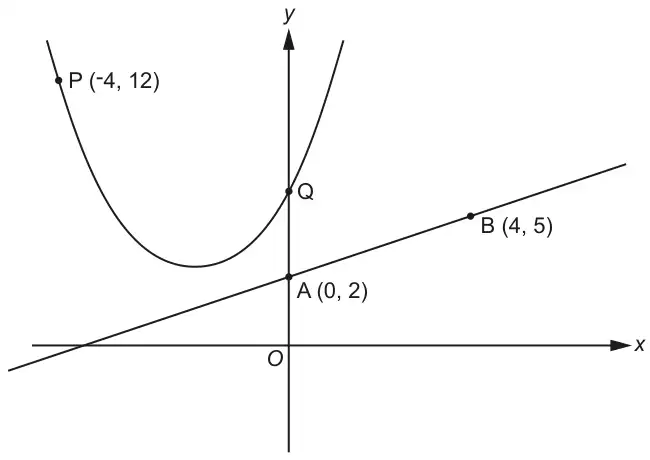
5 The diagram shows a straight line that passes through points A and B, and a curve that passes through points P and Q.
Not to scale
(a) Find the equation of the straight line. [3]
(b) The equation of the curve is \(y = x^2 + kx + 8\).
Find the value of \(k\). [3]
(c) Diann draws line BQ. She says
Triangle ABQ is isosceles.
Is Diann correct? You must show all your working. [4]
Mark scheme (a)
Answer
Marks
Part marks and guidance
\(y = 0.75x + 2\) oe
3
B2 for \(y = 0.75x\) [\(+ c\)] or answer \(0.75x + 2\)
OR
ISW after a correct equation if attempting rearrangement
Accept oe throughout eg B2 for \(4y = 3x\)
M1 for attempt at \(\dfrac{\text{change in } y}{\text{change in } x}\) soi by \(\dfrac{\pm(5 - 2)}{\pm(4 - 0)}\) or ±0.75
and
B1 for \(y = kx + 2\) with \(k \ne 0\)
Examples: M1B1 for \(y = -0.75x + 2\) M1B0 for 0.75, \(0.75x\), −0.75, \(-0.75x\) If gradient inverted: M0B1 for \(y = 1.3x + 2\) M0B0 for \(1.3x + 2\), \(y = 1.3x\)
Condone poorly written \(\frac{3}{4}x\) unless clearly 3 over \(4x\).
Mark scheme (b)
Answer
Marks
Part marks and guidance
3 nfww
3
M2 for \(12 = 16 - 4k + 8\) or better
OR
M1 for \(12 = -4^2 + -4 \times k + 8\) or sign errors in \(12 = 16 - 4k + 8\) or better or \(k = \dfrac{y - x^2 - 8}{x}\)
Condone −4 not in brackets but \(12 = -4^2 + k - 4 + 8\) with no times sign or dot between \(k\) and −4 scores 0 unless subsequently clarified.
Mark scheme (c)
Answer
Marks
Part marks and guidance
Using symmetry:
Q is (0, 8)
1
dep mark is always dependent on 3 marks being achieved
For first mark in all methods, condone [Q =] 8 or [QA =] 8-2 or 6, seen in working or on diagram.
Midpoint, M, of AQ is at (0, 5)
1
Accept implied symmetry
eg 8 – 5 = 3 and 5 – 2 = 3 so B is in the middle of A and Q May see “midpoint” or any other letter for M
MB is perpendicular to QA
1
So isosceles/Diann is correct
1dep
OR
Using Pythagoras:
Q is (0, 8)
1
\(\text{AB}^2 = 4^2 + 3^2\) oe or AB = 5 nfww or \(\text{QB}^2 = 4^2 + (\textit{their } 8 - 5)^2\) or QB = 5 nfww
1
AB = 5 and QB = 5 or \(\text{AB}^2 = 25\) and \(\text{QB}^2 = 25\)
1
AB = QB or “two sides are equal” oe so isosceles/Diann is correct
1dep
OR
Using trig:
Q is (0, 8)
1
tan BAQ = 4/3 [=53.1]
1
tan BQA = 4/3 [= 53.1]
1
BAQ = BQA or “two angles are equal” oe so isosceles/Diann is correct
1dep
Alternative: using gradients, vectors or descriptions of translations
1 for Q is (0, 8)
1 for gradients/vectors/descriptions of translations for both AB and QB (must be seen together in part (c)): eg gradients: AB = 3/4 and QB = −3/4 (may be implied from the equations of the two lines) descriptions: AB is 4 along (treat as in positive sense) and 3 up and QB is 4 along and 3 down oe
To score more than 2 marks, the approach needs to be developed to justify isosceles, such as by switching to the 3rd and 4th marks of the Pythagoras or trig methods.
Condone poor notation, such as missing vector brackets or fraction lines in vectors if intention is clear.
eg gradient AB = ¾ and gradient QB = −3/4 scores a max of 1 1 0 0 eg gradient AB = ¾ and gradient QB = −3/4, so triangle is isosceles also scores a max of 1 1 0 0
Warnings: dimensions of triangle shown as (8 – 2), 4, 4 and isosceles stated is B1 only; blank answer space but BQ drawn on diagram is 0 not NR.