1. In a pile of 200 coins, 2% are gold coins and the rest are silver. Simple Simon removes one silver coin every day until the pile contains 20% gold coins. How many silver coins does Simon remove?
The number of gold coins in the original pile is \(0.02 \times 200 = 4\). These form 20% of the final pile. Therefore there are \(4 \times 5 = 20\) coins left. Hence the number of silver coins Simon removes is \(200 - 20 = 180\).
2. The value of the expression \(1 + \dfrac{1}{1 + \dfrac{1}{1 + \dfrac{1}{5}}}\) is \(\dfrac{a}{b}\), where \(a\) and \(b\) are integers whose only common factor is 1. What is the value of \(a + b\)?
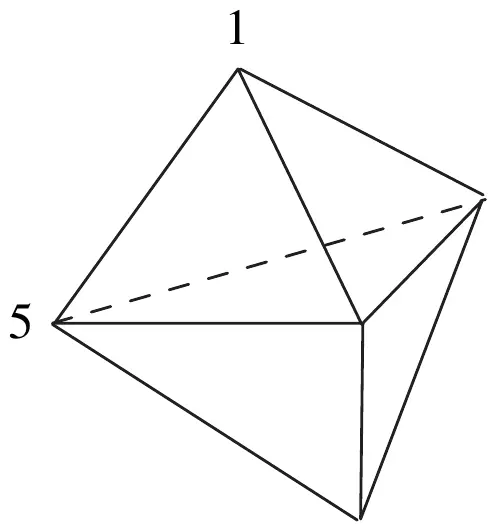
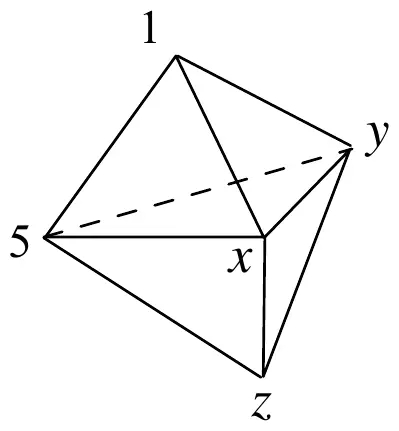
3. The diagram shows a solid with six triangular faces and five vertices. Andrew wants to write an integer at each of the vertices so that the sum of the numbers at the three vertices of each face is the same. He has already written the numbers 1 and 5 as shown.
What is the sum of the other three numbers he will write?
Let the three missing integers be \(x\), \(y\) and \(z\), as shown. Consider the ‘top’ three faces. Since the sum of the three numbers at the vertices of each face is the same, we have \[1 + 5 + x = 1 + x + y = 1 + 5 + y\] and hence \(x = y = 5\). Therefore the sum of the numbers on a face is equal to \(5 + 5 + 1 = 11\). But \(x + y + z\) is equal to the sum of the numbers on a face. Hence the sum of the other three numbers that Andrew will write is 11.
4. A box contains two white socks, three blue socks and four grey socks. Rachel knows that three of the socks have holes in, but does not know what colour these socks are. She takes one sock at a time from the box without looking. How many socks must she take for her to be certain she has a pair of socks of the same colour without holes?
The first six socks Rachel takes out could consist of three different coloured socks and the three socks with holes in, in which case she would not have a pair of socks the same colour without holes in. However, whatever colour her next sock is, she must then complete a pair. Hence she must take seven socks to be certain of getting a pair of socks the same colour without holes in.
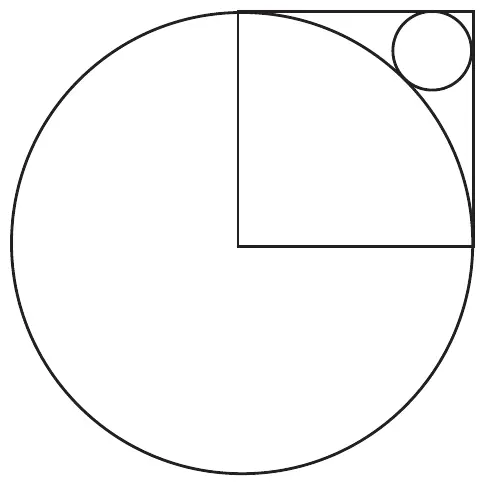
5. The diagram shows two circles and a square with sides of length 10 cm. One vertex of the square is at the centre of the large circle and two sides of the square are tangents to both circles. The small circle touches the large circle. The radius of the small circle is \((a - b\sqrt{2})\) cm.
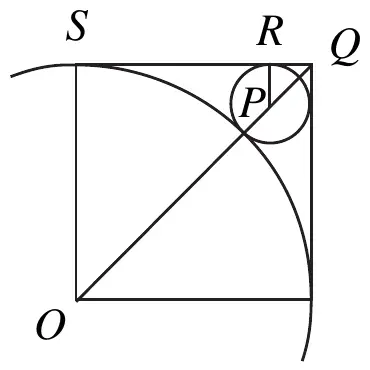
Let \(O\) and \(P\) be the centres of the large and small circles respectively and label points \(Q\) and \(S\) as shown in the diagram. Let the radius of the small circle be \(r\) cm. Draw line \(PR\) so that \(R\) is on \(QS\) and \(PR\) is parallel to \(OS\). Draw in line \(OQ\). Since triangle \(OQS\) is right-angled and isosceles, \(OQ^2 = 10^2 + 10^2\) by Pythagoras. Hence \(OQ = 10\sqrt{2}\) cm. Similarly, since triangle \(PQR\) is right-angled and isosceles, \(PQ = r\sqrt{2}\) cm. Note that angle \(OQS\) = angle \(PQS = 45°\) so \(OPQ\) is a straight line. Therefore \(10\sqrt{2} = 10 + r + r\sqrt{2}\). This has solution \[r = \dfrac{10(\sqrt{2} - 1)}{\sqrt{2} + 1} = \dfrac{10(\sqrt{2} - 1)(\sqrt{2} - 1)}{(\sqrt{2} + 1)(\sqrt{2} - 1)} = \dfrac{10(2 + 1 - 2\sqrt{2})}{2 - 1} = 30 - 20\sqrt{2}.\] Hence the radius of the small circle is \((30 - 20\sqrt{2})\) cm and the value of \(a + b\) is \(30 + 20 = 50\).
6. The median of a set of five positive integers is one more than the mode and one less than the mean. What is the largest possible value of the range of the five integers?
Let the five integers be \(p\),\(q\),\(r\), \(s\) and \(t\) with \(p \leqslant q \leqslant r \leqslant s \leqslant t\). The median of the list is \(r\) and, since the mode is one less than the median, \(p = q = r - 1\) and \(r < s < t\). The mean is one more than the median and hence the total of the five integers is \(5(r + 1)\). Therefore \(r - 1 + r - 1 + r + s + t = 5r + 5\) and hence \(s + t = 2r + 7\). Since the smallest possible value of \(s\) is \(r + 1\), the maximum value of \(t\) is \(r + 6\). Hence the largest possible value of the range of the five integers is \(r + 6 - (r - 1) = 7\).
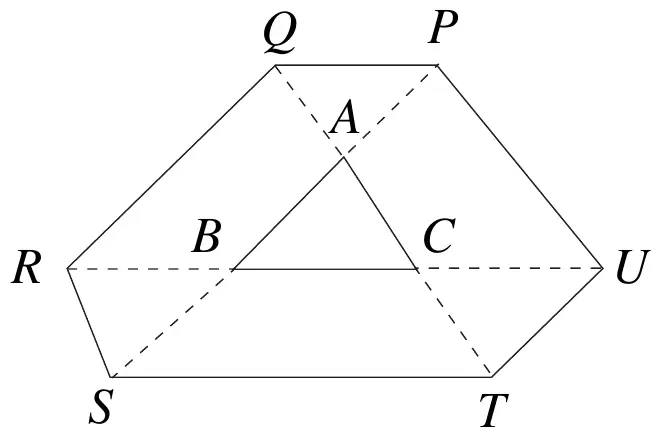
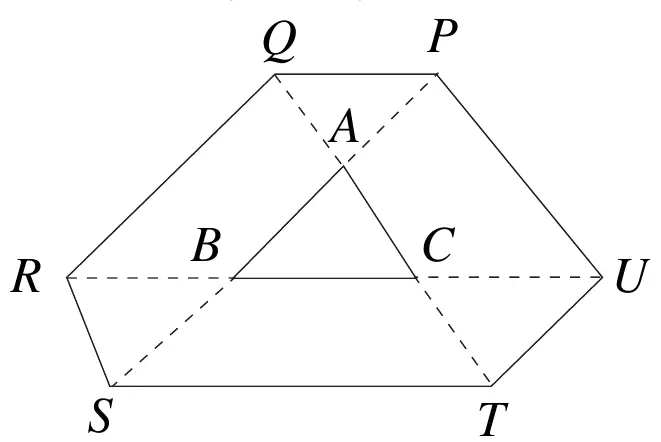
7. The diagram shows a triangle \(ABC\) with area 12 cm2. The sides of the triangle are extended to points \(P\),\(Q\),\(R\),\(S\), \(T\) and \(U\) as shown so that \(PA = AB = BS\), \(QA = AC = CT\) and \(RB = BC = CU\).
Consider triangles \(ABC\) and \(AST\). Angles \(CAB\) and \(TAS\) are equal because they are the same angle, \(SA = 2BA\) and \(TA = 2CA\). Hence triangles \(ABC\) and \(AST\) are similar. The ratio of their sides is \(1 : 2\) and hence the ratio of their areas is \(1^2 : 2^2 = 1 : 4\). Therefore the area of triangle \(AST\) is \(4 \times 12\) cm2 = 48 cm2 and hence the area of \(BSTC\) is \((48 - 12)\) cm2 = 36 cm2. In a similar way, it can be shown that each of the areas of \(CUPA\) and \(AQRB\) is also 36 cm2. Next consider triangles \(ABC\) and \(APQ\). Angles \(BAC\) and \(PAQ\) are equal using vertically opposite angles, \(AB = AP\) and \(AC = AQ\). Hence triangles \(ABC\) and \(APQ\) are congruent (SAS) and so the area of triangle \(APQ\) is 12 cm2. In a similar way, it can be shown that the each of areas of triangles \(BRS\) and \(CTU\) is also 12 cm2. Hence the total area of hexagon \(PQRSTU\) in cm2 is \((3 \times 36 + 4 \times 12) = 156\).
8. A mob of 2015 kangaroos contains only red and grey kangaroos. One grey kangaroo is taller than exactly one red kangaroo, one grey kangaroo is taller than exactly three red kangaroos, one grey kangaroo is taller than exactly five red kangaroos and so on with each successive grey kangaroo being taller than exactly two more red kangaroos than the previous grey kangaroo. The final grey kangaroo is taller than all the red kangaroos. How many grey kangaroos are in the mob?
The first grey kangaroo has only one red kangaroo smaller than itself. Apart from that, each grey kangaroo can be grouped with two red kangaroos whose heights lie between its height and that of the previous grey kangaroo. The number of such groups is \((2015 - 2) / 3 = 671\). Hence there are 672 grey kangaroos in the mob.
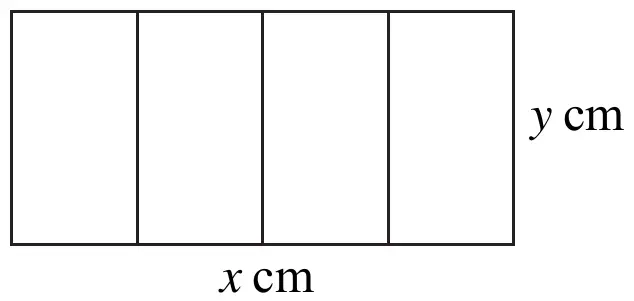
9. A large rectangle is divided into four identical smaller rectangles by slicing parallel to one of its sides. The perimeter of the large rectangle is 18 metres more than the perimeter of each of the smaller rectangles. The area of the large rectangle is 18 m2 more than the area of each of the smaller rectangles. What is the perimeter in metres of the large rectangle?
Let the length of the original rectangle be \(x\) metres and let the height be \(y\) metres. Without losing any generality, assume the rectangle is sliced parallel to the height, as shown. The information in the question tells us that \(2x + 2y = 2\left(\dfrac{x}{4}\right) + 2y + 18\) and that \(xy = \left(\dfrac{x}{4}\right)y + 18\). From the first equation, we have \(\dfrac{3x}{2} = 18\) which has solution \(x = 12\). Substitute this value into the second equation to obtain \(12y = 3y + 18\), which has solution \(y = 2\). Hence the perimeter of the large rectangle in metres is \(2 \times 12 + 2 \times 2 = 28\).
10. Katherine and James are jogging in the same direction around a pond. They start at the same time and from the same place and each jogs at a constant speed. Katherine, the faster jogger, takes 3 minutes to complete one lap and first overtakes James 8 minutes after starting. How many seconds does it take James to complete one lap?
Katherine catches James after 8 minutes when she has jogged \(\tfrac{8}{3}\) laps. In that time, James will have jogged one lap fewer so will have jogged \(\tfrac{5}{3}\) laps. Therefore, James jogs \(\tfrac{5}{3}\) laps in 8 minutes which is the same as 480 seconds. Hence he will jog \(\tfrac{1}{3}\) of a lap in 96 seconds and so he jogs a whole lap in 288 seconds.
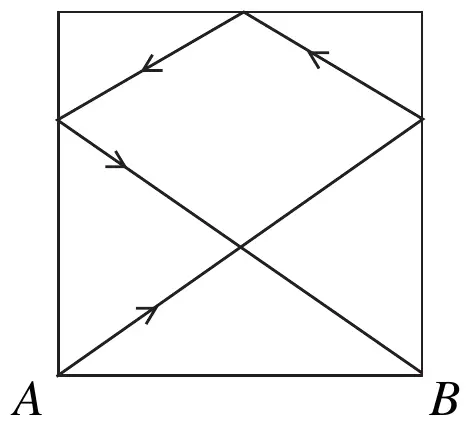
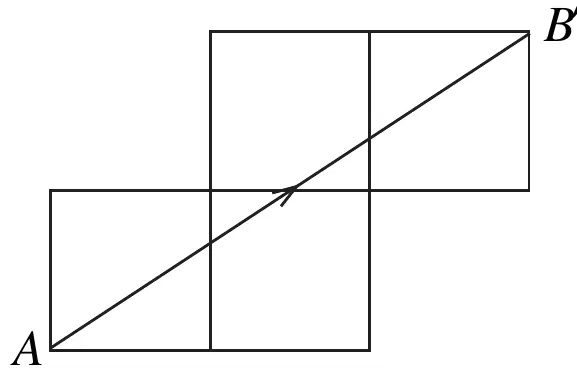
11. A ball is propelled from corner \(A\) of a square snooker table of side 2 metres. After bouncing off three cushions as shown, the ball goes into a pocket at \(B\). The total distance travelled by the ball is \(\sqrt{k}\) metres. What is the value of \(k\)?
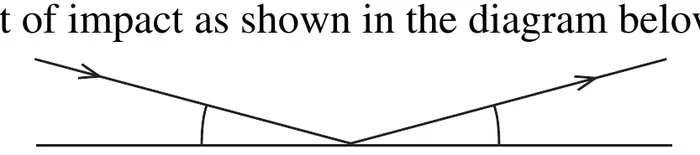
(Note that when the ball bounces off a cushion, the angle its path makes with the cushion as it approaches the point of impact is equal to the angle its path makes with the cushion as it moves away from the point of impact as shown in the diagram below.)
A solution can be obtained by reflecting the square repeatedly in the cushion the ball strikes. The path of the ball is then represented by the line \(AB'\) in the diagram. The length of the path can be calculated using Pythagoras Theorem. We have \((AB')^2 = (3 \times 2)^2 + (2 \times 2)^2\). Therefore \((AB')^2 = 36 + 16 = 52\) and so \(AB' = \sqrt{52}\) metres and hence the value of \(k\) is 52.
12. Chris planned a 210 km bike ride. However, he rode 5 km/h faster than he planned and finished his ride 1 hour earlier than he planned. His average speed for the ride was \(x\) km/h. What is the value of \(x\)?
Chris's time for the ride when he rode at an average speed of \(x\) km/h was \(\dfrac{210}{x}\) hours. His planned speed was \((x - 5)\) km/h when his time would have been \(\dfrac{210}{x - 5}\) hours. The question tells us that he completed the ride 1 hour earlier than planned, so \(\dfrac{210}{x - 5} - \dfrac{210}{x} = 1\). Therefore \(210x - 210(x - 5) = x(x - 5)\) and hence \(1050 = x^2 - 5x\). Thus \(x^2 - 5x - 1050 = 0\) and hence \((x - 35)(x + 30) = 0\). Therefore, since \(x\) is positive, \(x = 35\).
13. Twenty-five people who always tell the truth or always lie are standing in a queue. The man at the front of the queue says that everyone behind him always lies. Everyone else says that the person immediately in front of them always lies. How many people in the queue always lie?
Assume the man at the front of the queue is telling the truth and that everyone behind him always lies. However, then the person in third place in the queue would be telling the truth when he says that the person in second place always lies. This contradicts the original assumption and so the man at the front of the queue is lying. In this case, the man in second place is telling the truth, the man in third place is lying etc. Hence, every other person, starting with the first, is lying and so there are \(1 + \tfrac{1}{2} \times 24 = 13\) people in the queue who always lie.
14. Four problems were attempted by 100 contestants in a Mathematics competition. The first problem was solved by 90 contestants, the second by 85 contestants, the third by 80 contestants and the fourth by 75 contestants. What is the smallest possible number of contestants who solved all four problems?
The smallest number of contestants solving all four problems correctly occurs when the contestants who fail to solve individual problems are all distinct. In that case, the number failing to solve some question is \(10 + 15 + 20 + 25 = 70\) and the number solving them all is \(100 - 70 = 30\).
First note that \(165 = 3 \times 5 \times 11\). Hence, for ‘\(XX4XY\)’ to be exactly divisible by 165, it must be exactly divisible by 3, 5 and 11. A number is divisible by 3 if and only if the sum of its digits is divisible by 3 so \(3X + 4 + Y\) is divisible by 3 and hence \(4 + Y\) is divisible by 3. A number is divisible by 5 if and only if its last digit is 5 or 0 so \(Y = 5\) or 0. Since \(4 + Y\) is divisible by 3 then \(Y = 5\). A number is divisible by 11 if and only if the sum of its digits with alternating signs is divisible by 11 so \(X - X + 4 - X + Y\) is divisible by 11. Hence \(9 - X\) is divisible by 11 and so \(X = 9\). Hence the value of \(X + Y\) is \(9 + 5 = 14\).
Since adjacent digits differ by 1, each time the number has a digit that is a 1 or a 3, there is only one choice for the next digit as it must be a 2 whereas each time the number has a digit that is a 2, there are two choices for the next digit, namely 1 or 3. Consider all 10-digit numbers starting in a 1. There is only one choice for the second digit since it must be a 2, then two choices for the third digit, then one for the fourth etc. Altogether there are \(1 \times 2 \times 1 \times 2 \times 1 \times 2 \times 1 \times 2 \times 1 = 16\) such numbers. Similarly there are 16 such numbers starting in 3. However, if we consider numbers starting in 2, there are two choices for the second digit then only one choice for the third then two for the fourth etc. Altogether there are \(2 \times 1 \times 2 \times 1 \times 2 \times 1 \times 2 \times 1 \times 2 = 32\) such numbers. Hence there are \(16 + 16 + 32 = 64\) such numbers with the required property.
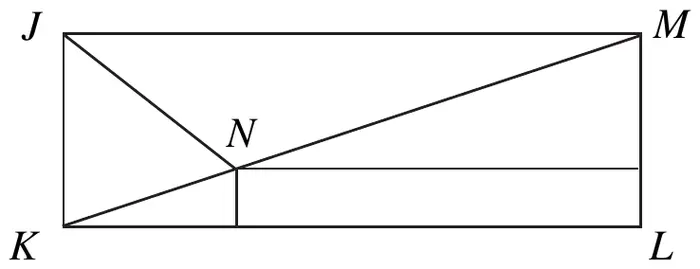
17. In rectangle \(JKLM\), the bisector of angle \(KJM\) cuts the diagonal \(KM\) at point \(N\) as shown. The distances between \(N\) and sides \(LM\) and \(KL\) are 8 cm and 1 cm respectively. The length of \(KL\) is \((a + \sqrt{b})\) cm. What is the value of \(a + b\)?
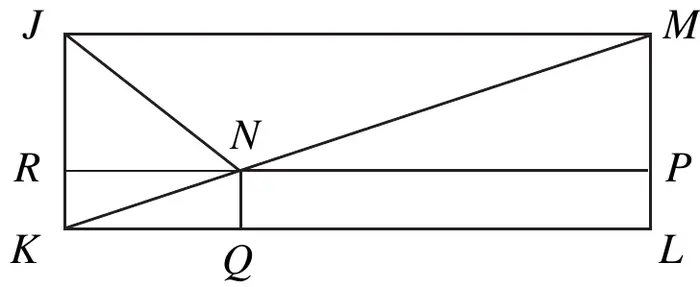
Let points \(P\) and \(Q\) be the points where the perpendiculars from \(N\) to \(ML\) and \(KL\) meet the lines and extend line \(PN\) so it meets \(JK\) at \(R\), as shown in the diagram. Since \(JN\) is the bisector of angle \(MJK\), angle \(NJR = 45°\). Since angle \(JRN\) is 90°, triangle \(JRN\) is isosceles and \(JR = RN\). Let the length of \(RN\) be \(x\) cm. Hence the lengths of \(JR\) and \(PM\) are also \(x\) cm. Observe that triangles \(NKQ\) and \(MNP\) are similar since they have the same angles. Therefore \(\dfrac{1}{x} = \dfrac{x}{8}\) and so \(x = \sqrt{8}\) since \(x\) is positive. The length of \(KL\) is equal to the sum of the lengths of \(NP\) and \(NR\). Therefore, the length of \(KL\) is \((8 + \sqrt{8})\) cm. Hence, the value of \(a + b\) is 16.
18. Numbers \(a\), \(b\) and \(c\) are such that \(\dfrac{a}{b + c} = \dfrac{b}{c + a} = \dfrac{c}{a + b} = k\). How many possible values of \(k\) are there?
Consider the equation \(\dfrac{a}{b + c} = \dfrac{b}{c + a}\). Multiply each side by \((b + c)(c + a)\) to get \(a^2 + ac = b^2 + bc\) and so \(a^2 - b^2 + ac - bc = 0\). Therefore \((a - b)(a + b + c) = 0\). Hence \(a = b\) or \(a + b + c = 0\). Similarly, if we consider the equations \(\dfrac{b}{c + a} = \dfrac{c}{a + b}\) and \(\dfrac{c}{a + b} = \dfrac{a}{b + c}\), then \(b = c\) or \(a + b + c = 0\) and \(c = a\) or \(a + b + c = 0\) respectively. Therefore, the possible values of \(k\) when all three equations are satisfied simultaneously occur when \(a = b = c\), giving \(k = \tfrac{1}{2}\), or when \(a + b + c = 0\), giving \(k = -1\). Hence there are two possible values of \(k\).
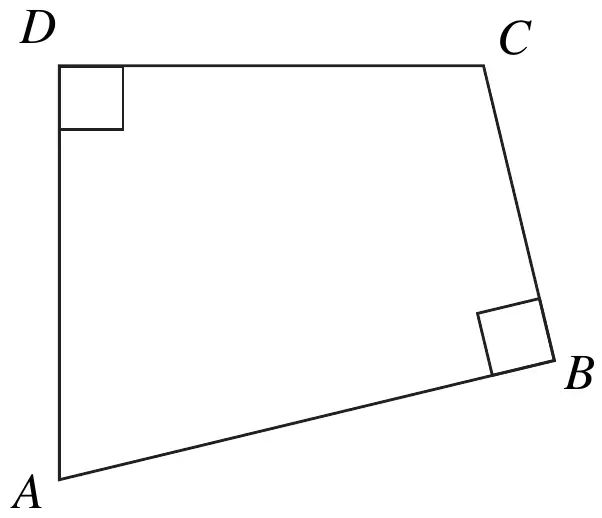
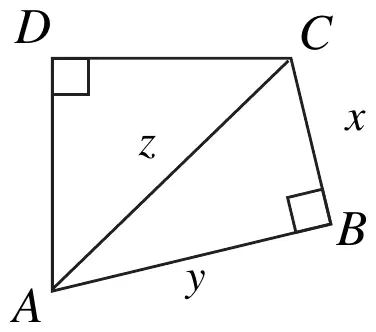
Let the lengths of \(BC\), \(AB\) and \(AC\) be \(x\), \(y\) and \(z\) centimetres respectively. Let the area of \(\triangle ACD\) be \(U\) cm2 and let the area of \(\triangle ABC\) be \(V\) cm2. Note that \(\triangle ACD\) is one quarter of the square which has \(AC\) as an edge. Hence \(U = \tfrac{1}{4}z^2\). Next, using Pythagoras, \(z^2 = x^2 + y^2 = (x + y)^2 - 2xy = 20^2 - 4V\). Hence \(U = \tfrac{1}{4}(400 - 4V) = 100 - V\). Therefore the area in cm2 of \(ABCD\) is \(U + V = 100\). (Note: Since the answer to the problem is independent of x and y, one could observe that the given properties of quadrilateral ABCD are satisfied by a square of side 10 cm which has area 100 cm2and conclude that this is therefore the required answer.)
First factorise \(N\) twice using the difference of two squares i.e. \(N = 3^{16} - 1 = (3^8 - 1)(3^8 + 1) = (3^4 - 1)(3^4 + 1)(3^8 + 1) = 80 \times 82 \times (3^8 + 1)\). This shows that both 80 and 82 are divisors of \(N\) in the required range. The question tells us that 193 is a divisor of N and, since 193 is prime, it must be a divisor of \(3^8 + 1 = 81 \times 81 + 1 = 6562\). Now observe that \(6562 = 2 \times 3281\) and that \(3281 \div 193 = 17\). Therefore \(N = 80 \times 82 \times 2 \times 17 \times 193\) or \(N = (2^4 \times 5) \times (2 \times 41) \times 2 \times 17 \times 193\). Next consider the integers from 75 to 85 inclusive to see which could be divisors of \(N\). Because \(N\) has no prime factors of 3 or 7, we know that 75, 77, 78, 81 and 84 are not divisors of \(N\) while the initial argument established that 80 and 82 are divisors of \(N\). Both 79 and 83 are prime and \(76 = 4 \times 19\) so, since \(N\) does not have a prime factor of 79, 83 or 19, these must also be excluded. This only leaves 85 to be considered. Note that \(85 = 5 \times 17\) and both 5 and 17 are prime factors of \(N\) so 85 is a divisor of \(N\). Hence the divisors of \(N\) in the required range are 80, 82 and 85 with sum 247.
We'd like to use Google Analytics cookies to count visits and see which pages help most. They're optional, and the site works exactly the same either way. Privacy policy