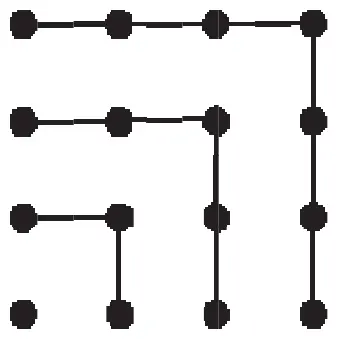
We observe that in all but the rightmost column the value in the second row is ten larger than the value in the first row. There are 10 such columns. Therefore the sum of the leftmost ten elements of the second row is 100 more than the corresponding sum in the first row. To achieve the same total in each row, * will need to be 100 less than the value above it. Therefore * = 950.
3. Andrew has two containers for carrying water. The containers are cubes without tops and have base areas of 4 dm2 and 36 dm2 respectively. Andrew has to completely fill the larger cube with pond water, which must be carried from the pond using the smaller cube. What is the smallest number of visits Andrew has to make to the pond with the smaller cube?
We first observe that any pair of cubes are mathematically similar. These cubes' surface areas are in the ratio 1:9, so that their lengths are in ratio 1:3 and that their volumes are in ratio 1:27. Therefore Andrew may fill the larger cube in 27 visits, provided the smaller cube is completely filled on each occasion.
The number will be of the form ‘abcd’ where \(a\), \(b\) and \(c\) are any odd digits and \(d = 5\). Hence there are 5, 5, 5 and 1 possibilities for \(a\),\(b\), \(c\) and \(d\) respectively. Therefore there are \(5 \times 5 \times 5 \times 1 = 125\) such numbers.
5. The notation \(|\,x\,|\) is used to denote the absolute value of a number, regardless of sign. For example, \(|\,7\,| = |-7\,| = 7\). The graphs \(y = |\,2x\,| - 3\) and \(y = |\,x\,|\) are drawn on the same set of axes. What is the area enclosed by them?
The enclosed area is a concave quadrilateral with vertices at \((-3,\ 3)\),\((0,\ 0)\), \((3,\ 3)\) and \((0,\ -3)\). Considering this as two conjoined congruent triangles we find the area as \(2 \times \tfrac{1}{2} \times 3 \times 3 = 9\).
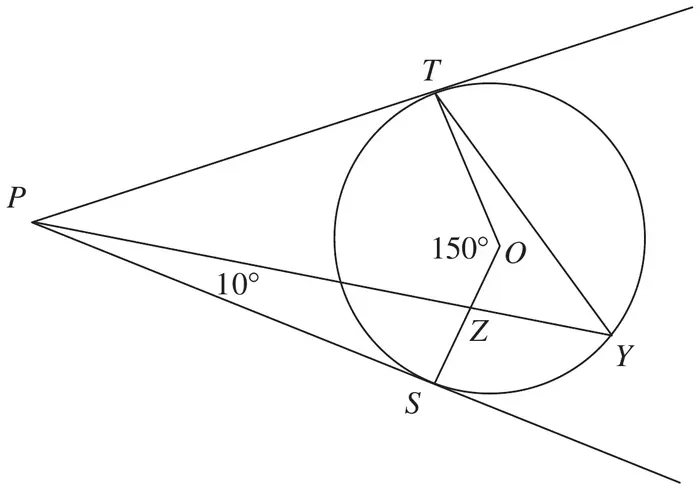
6. In the diagram, \(PT\) and \(PS\) are tangents to a circle with centre \(O\). The point \(Y\) lies on the circumference of the circle; and the point \(Z\) is where the line \(PY\) meets the radius \(OS\).
Also, \(\angle SPZ = 10°\) and \(\angle TOS = 150°\).
How many degrees are there in the sum of \(\angle PTY\) and \(\angle PYT\)?
The tangent-radius property gives \(\angle PSO = \angle PTO = 90°\). From the angle sum of quadrilateral \(PTOS\) we may conclude that \(\angle TPS = 30°\) and therefore that \(\angle TPY = 20°\). By considering the angle sum of triangle \(PTY\) we conclude that the required total is 160°.
7. Bav is counting the edges on a particular prism. The prism has more than 310 edges, it has fewer than 320 edges and its number of edges is odd. How many edges does the prism have?
Suppose that the cross-section of the prism is an \(N\)-gon with \(N\) edges. The prism will have \(N\) edges in each of its ‘end’ faces and a further \(N\) edges connecting corresponding vertices of the end faces. Therefore the number of edges is \(3N\) and hence is a multiple of 3. The only multiples of 3 in the given range are 312, 315 and 318. Since we know the total is odd, the prism has 315 edges.
8. The real numbers \(x\), \(y\) and \(z\) are a solution \((x,\ y,\ z)\) of the equation \((x^2 - 9)^2 + (y^2 - 4)^2 + (z^2 - 1)^2 = 0\). How many different possible values are there for \(x + y + z\)?
Since squares of real numbers are non-negative, the sum can only be 0 if each expression in brackets is zero. Therefore the solutions of the equation are \(x = \pm 3\), \(y = \pm 2\) and \(z = \pm 1\). We observe that the maximum and minimum values for \(x + y + z\) are 6 and \(-6\), and that since \(x + y + z\) is the sum of one even and two odd numbers, that \(x + y + z\) itself will be even. It suffices to show that each even total between \(+6\) and \(-6\) can be attained.
\((+3) + (+2) + (+1) = +6\)
\((+3) + (+2) + (-1) = +4\)
\((+3) + (-2) + (+1) = +2\)
\((+3) + (-2) + (-1) = 0\)
\((-3) + (+2) + (-1) = -2\)
\((-3) + (-2) + (+1) = -4\)
\((-3) + (-2) + (-1) = -6\)
Hence there are seven possible values for \(x + y + z\).
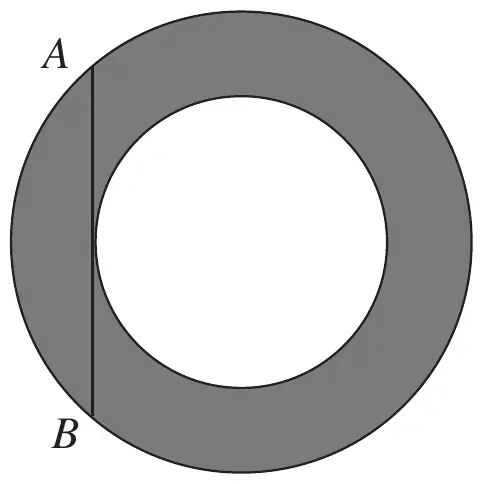
9. The diagram shows two concentric circles. Chord \(AB\) of the larger circle is tangential to the smaller circle. The length of \(AB\) is 32 cm and the area of the shaded region is \(k\pi\) cm2. What is the value of \(k\)?
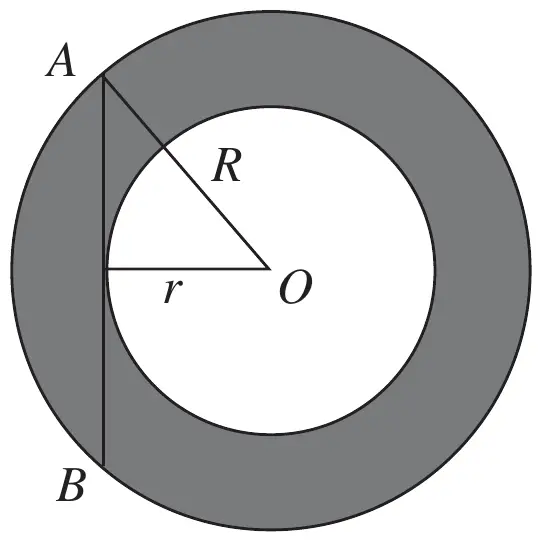
Let the radii of the larger and smaller circles be \(R\) and \(r\) respectively. Draw radius \(OA\) of the larger circle and drop the perpendicular from \(O\) to \(AB\). By the tangent-radius property this perpendicular will be a radius of the smaller circle. Now the area of the shaded region = area of larger circle − area of smaller circle. The area of the shaded region \(= \pi R^2 - \pi r^2 = \pi(R^2 - r^2)\). But \(R^2 - r^2 = 16^2 = 256\) (by Pythagoras' theorem), hence the area of the shaded region \(= 256\pi\) and therefore \(k = 256\).
10. Consider the expression \(1 * 2 * 3 * 4 * 5 * 6\). Each star in the expression is to be replaced with either ‘+’ or ‘×’. \(N\) is the largest possible value of the expression. What is the largest prime factor of \(N\)?
Note that \(6! = 1 \times 2 \times 3 \times 4 \times 5 \times 6 = 720\). We observe that if any multiplication sign, other than the first, is replaced by an addition sign then each remaining product is at most 360. Therefore we retain each multiplication sign except the first which may be replaced by an addition sign to obtain a maximal value of 721. The prime factors of 721 are 7 and 103, of which 103 is the largest.
11. Stephanie enjoys swimming. She goes for a swim on a particular date if, and only if, the day, month (where January is replaced by ‘01’ through to December by ‘12’) and year are all of the same parity (that is they are all odd, or all are even). On how many days will she go for a swim in the two-year period between January 1st of one year and December 31st of the following year inclusive?
We first observe that exactly one odd year and exactly one even year are under consideration. In an odd year we need only consider odd months. January, March, May and July each has 16 odd days while September and November has 15. Therefore the number of days Stephanie will swim in the odd year is \(4 \times 16 + 2 \times 15 = 94\). In an even year we need only consider even months. April, June, August, October and December has 15 even days and February has 14 (regardless of whether or not it is a leap year). Therefore the number of days Stephanie will swim in the even year is \(5 \times 15 + 14 = 89\). Hence she will swim for \(94 + 89 = 183\) days over the two years.
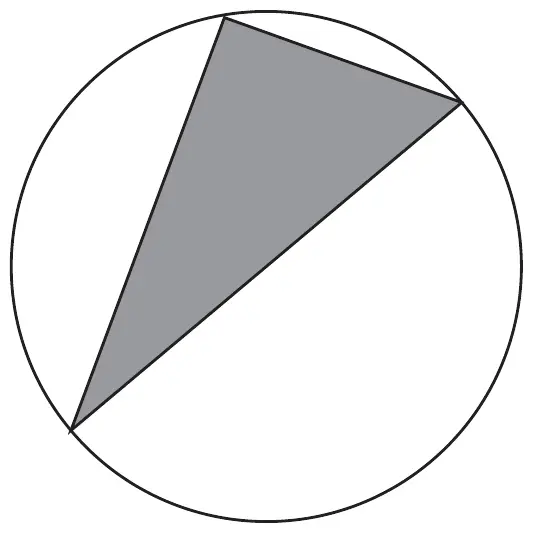
The regular 18-gon has a circumcircle, that is, a circle passing through all of its vertices. This is also the circumcircle of each right-angled triangle formed. In order for one of these triangle's angles to be a right angle, the opposite side needs to be a diameter, There are 9 possible choices of diameter. For each choice of diameter, there are 8 vertices on each side for the right angle, making 16 choices overall. For each choice of diameter there are 16 choices for the third vertex of the right-angled triangle.
13. This year, 2016, can be written as the sum of two positive integers \(p\) and \(q\) where \(2p = 5q\) (as \(2016 = 1440 + 576\)). How many years between 2000 and 3000 inclusive have this property?
For a year \(Y\) to be expressible as as the sum of two positive integers \(p\) and \(q\) where \(2p = 5q\) we require \(p + q = Y\) and \(2p = 5q\). From the first of these, it follows that \(2p + 2q = 2Y\) and hence \(5q + 2q = 2Y\). Therefore \(7q = 2Y\) from which it follows that \(Y\) is also divisible by 7 (since 2 and 7 are coprime). We observe that \(q = \tfrac{2Y}{7}\) will be an integer less than \(Y\) for all \(Y\) that are multiples of 7. Then \(p = Y - q\) will also be an integer. We now must count all the multiples of 7 between 2000 and 3000 inclusive. Since \(1995 = 285 \times 7\) and \(2996 = 428 \times 7\) there are \(428 - 285 = 143\) multiples of 7 between 2000 and 3000 and hence there are 143 such years.
14. The lengths of the sides of a triangle are the integers 13, \(x\),\(y\). It is given that \(xy = 105\). What is the length of the perimeter of the triangle?
Assume, without loss of generality, that \(x \leqslant y\). Since \(x\), \(y\) are positive integers and \(xy = 105\), the possible values of \((x,\ y)\) are \((1,\ 105)\),\((3,\ 35)\),\((5,\ 21)\),\((7,\ 15)\). Since we require \(13 + x > y\) for the triangle to exist, we may eliminate the first three of these possibilities, leaving only \((7,\ 15)\) and conclude that the perimeter is \(13 + 7 + 15 = 35\).
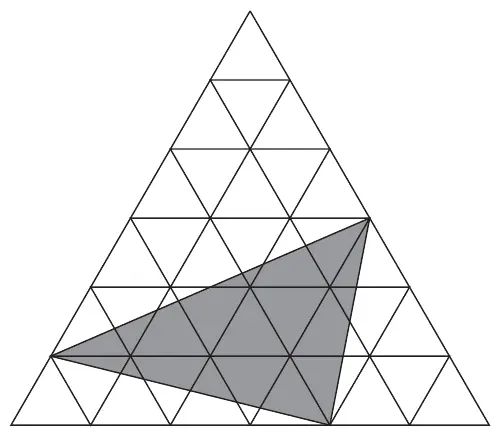
15. The large equilateral triangle shown consists of 36 smaller equilateral triangles. Each of the smaller equilateral triangles has area 10 cm2. The area of the shaded triangle is \(K\) cm2. Find \(K\).
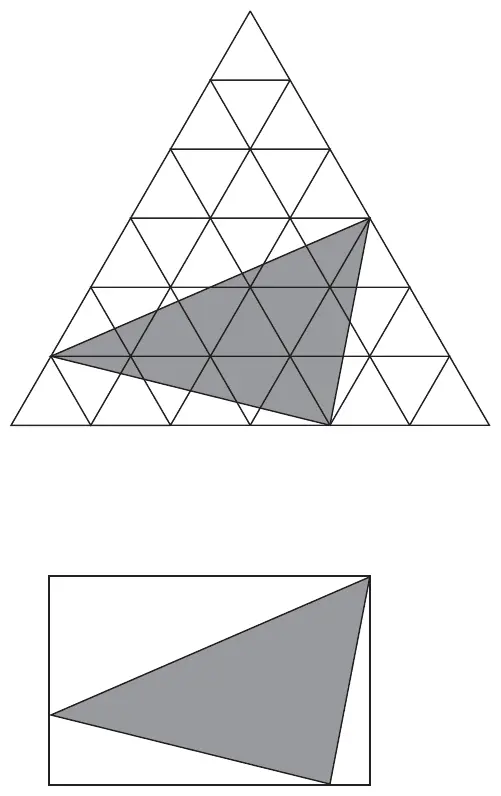
For each small equilateral triangle, let the length of each side be \(x\) and the perpendicular height be \(h\). We may trap the shaded triangle in a rectangle as shown, where one vertex is coincident with one of the vertices of the rectangle and the other two vertices lie on sides of the rectangle. The rectangle has width \(4x\) and height \(3h\). Therefore the rectangle's area is \(12xh\). The three additional (unshaded) right-angled triangles in the rectangle have areas \(\tfrac{1}{2} \times 4x \times 2h = 4xh\), \(\tfrac{1}{2} \times \tfrac{1}{2}x \times 3h = \tfrac{3}{4}xh\) and \(\tfrac{1}{2} \times \tfrac{7}{2}x \times h = \tfrac{7}{4}xh\). Therefore their total area is \(4xh + \tfrac{3}{4}xh + \tfrac{7}{4}xh = \tfrac{13}{2}xh\). Therefore \(K = 12xh - \tfrac{13}{2}xh = \tfrac{11}{2}xh\). Each of the 36 smaller equilateral triangles has area \(\tfrac{1}{2}xh\) so we know that \(\tfrac{1}{2}xh = 10\) and therefore that \(xh = 20\). Therefore \(K = \tfrac{11}{2} \times 20 = 110\).
The function \(f(x)\) has the property that \(3f(x) + 7f\left(\dfrac{2016}{x}\right) = 2x\). First observe that \(\dfrac{2016}{8} = 252\). Therefore \(3f(8) + 7f(252) = 16\) and \(3f(252) + 7f(8) = 2 \times 252\). Let \(f(8) = V\) and \(f(252) = W\). Therefore \(3V + 7W = 16\) and \(3W + 7V = 504\). When these equations are solved simultaneously, we obtain \(V = 87\) and \(W = -35\) so that \(f(8) = 87\).
17. Students in a class take turns to practise their arithmetic skills. Initially a board contains the integers from 1 to 10 inclusive, each written ten times. On each turn a student first deletes two of the integers and then writes on the board the number that is one more than the sum of those two deleted integers. Turns are taken until there is only one number remaining on the board. Assuming no student makes a mistake, what is the remaining number?
We observe that the total of all integers on the board at the start of the process is \(10(1 + 2 + 3 + 4 + 5 + 6 + 7 + 8 + 9 + 10) = 550\). On each turn this total is increased by 1. Since we start with one hundred integers on the board and at each turn this number of integers is decreased by one, then 99 turns will be required to complete the process. Therefore the total of all integers on the board will increase by 99 over the course of the process. Hence the remaining number will be \(550 + 99 = 649\).
18. The sum of the squares of four consecutive positive integers is equal to the sum of the squares of the next three consecutive integers. What is the square of the smallest of these integers?
When an odd number is subtracted from an odd square, an even (and hence composite) number is obtained. Similarly, when a multiple of 3 (or 7) is subtracted from a square of a multiple of 3 (or 7), a multiple of 3 (or 7) is obtained which is also composite. Therefore we need only consider three-digit squares that are neither odd nor a multiple of 3 (or 7). Hence the only squares we need to consider are \(16^2 = 256\),\(20^2 = 400\), \(22^2 = 484\) and \(26^2 = 676\) which yield differences of 235, 379, 463 and 655 respectively. It is easy to see that 235 and 655 are multiples of 5 and hence composite. Therefore only 379 and 463 remain as possible primes satisfying the given condition. After checking divisibilty by 11, 13, 17 and 19 for both, both are indeed seen to be prime and their mean is 421.
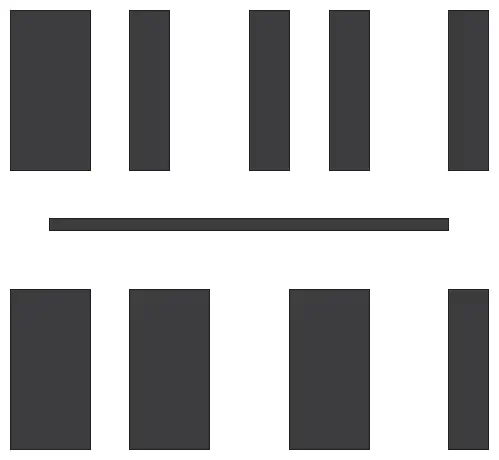
20. A barcode of the type shown in the two examples is composed of alternate strips of black and white, where the leftmost and rightmost strips are always black. Each strip (of either colour) has a width of 1 or 2. The total width of the barcode is 12. The barcodes are always read from left to right. How many distinct barcodes are possible?
Any code will start with a black strip and a white strip followed by a shorter barcode. Let \(C(m)\) be the number of distinct barcodes of width \(m\). Those codes which start with BW will be followed by a code of width \(m - 2\); so there will be \(C(m - 2)\) of these. Likewise, there will be \(C(m - 3)\) codes starting BBW, the same number starting BWW, and \(C(m - 4)\) starting BBWW; and that exhausts the possibilites. So it follows that \(C(m) = C(m - 2) + 2C(m - 3) + C(m - 4)\). When \(m \leqslant 4\), it is simple to list all possible barcodes; namely B, BB, BWB and BBWB, BWBB, BWWB. Therefore \(C(1) = C(2) = C(3) = 1\) and \(C(4) = 3\). We can now calculate \(C(m)\) for \(m > 4\). Thus \(C(5) = C(3) + 2C(2) + C(1) = 1 + 2 + 1 = 4\), and continuing like this, we get \(C(6) = 6\),\(C(7) = 11\),\(C(8) = 17\),\(C(9) = 27\),\(C(10) = 45\),\(C(11) = 72\),\(C(12) = 116\).
We'd like to use Google Analytics cookies to count visits and see which pages help most. They're optional, and the site works exactly the same either way. Privacy policy