
SK 2016 Q15
15. The large equilateral triangle shown consists of 36 smaller equilateral triangles. Each of the smaller equilateral triangles has area 10 cm2.
The area of the shaded triangle is \(K\) cm2. Find \(K\).
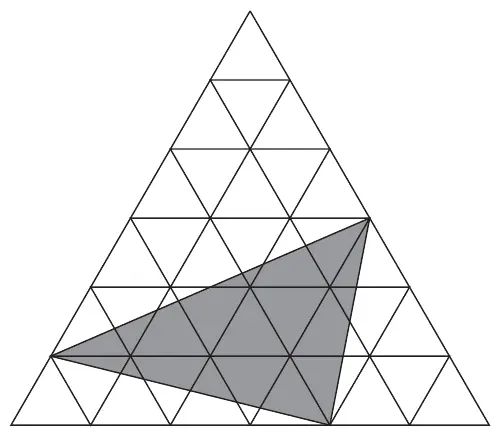
Senior Kangaroo 2016, Question 15. © UK Mathematics Trust. Original paper on ukmt.org.uk
Answer: 110
For each small equilateral triangle, let the length of each side be \(x\) and the perpendicular height be \(h\).
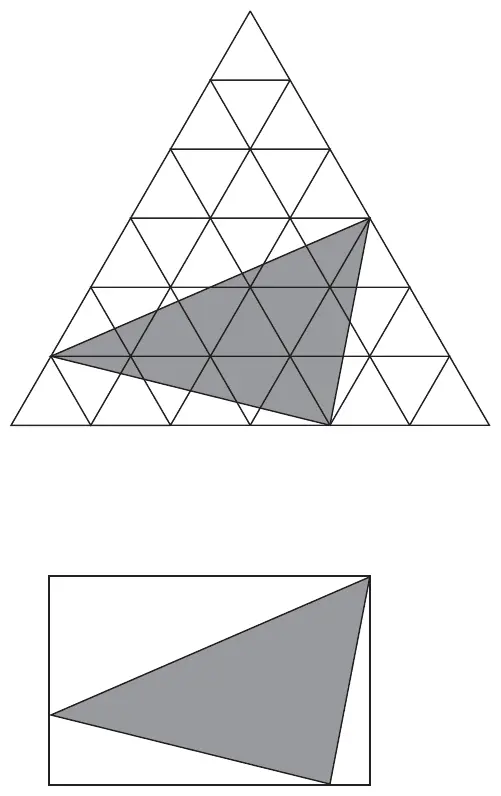
We may trap the shaded triangle in a rectangle as shown, where one vertex is coincident with one of the vertices of the rectangle and the other two vertices lie on sides of the rectangle.
The rectangle has width \(4x\) and height \(3h\). Therefore the rectangle's area is \(12xh\).
The three additional (unshaded) right-angled triangles in the rectangle have areas \(\tfrac{1}{2} \times 4x \times 2h = 4xh\), \(\tfrac{1}{2} \times \tfrac{1}{2}x \times 3h = \tfrac{3}{4}xh\) and \(\tfrac{1}{2} \times \tfrac{7}{2}x \times h = \tfrac{7}{4}xh\).
Therefore their total area is \(4xh + \tfrac{3}{4}xh + \tfrac{7}{4}xh = \tfrac{13}{2}xh\).
Therefore \(K = 12xh - \tfrac{13}{2}xh = \tfrac{11}{2}xh\).
Each of the 36 smaller equilateral triangles has area \(\tfrac{1}{2}xh\) so we know that \(\tfrac{1}{2}xh = 10\) and therefore that \(xh = 20\).
Therefore \(K = \tfrac{11}{2} \times 20 = 110\).
Solution © UK Mathematics Trust, from the SK 2016 solutions.