1. My age is a two-digit number that is a power of 5. My cousin’s age is a two-digit number that is a power of 2. The sum of the digits of our ages is an odd number.
My age must be 25. My cousin’s age is a two-digit power of two, so is 16, 32 or 64. The sums of the digits of our ages would then be 14, 12 and 17 respectively. Since this sum must be odd my cousin’s age must be 64. Therefore the product of the digits of our ages is \(2 \times 5 \times 6 \times 4 = 240\).
We may rewrite the inequality as \((n^2)^{100} < (5^3)^{100} = 125^{100}\). It follows that \(n^2 < 5^3 = 125\). The maximum integer value of \(n\) is therefore 11. Therefore \(K = 11\) and \(10K = 110\).
Let \(\angle ABC = \theta\). By the sine rule, \(\dfrac{\sin\theta}{5\sqrt{2}} = \dfrac{\sin 30}{5}\), which simplifies to \(\dfrac{0.5}{5}\). And so \(\sin\theta = \dfrac{0.5 \times 5\sqrt{2}}{5} = \dfrac{\sqrt{2}}{2}\). Therefore \(\theta = 45, 135\) and so the largest possible value of \(\theta\) is 135.
4. In a list of five numbers, the first number is 60 and the last number is 300. The product of the first three numbers is 810 000, the product of the three in the middle is 2 430 000 and the product of the last three numbers is 8 100 000.
Let the list be \(60, x, y, z, 300\). (i) Since \(60xy = 810\,000\) we find that \(xy = 13\,500\). (ii) Since \(xyz = 2\,430\,000\) and \(xy = 13\,500\), we find that \(z = 180\). (iii) Since \(300yz = 8\,100\,000\) and \(z = 180\), we find that \(y = 150\). We may also find \(x = \tfrac{13\,500}{150} = 90\). As \(y\) is the middle number in the list the answer to the problem is 150.
We use \(R\) to denote the event ‘Rachel wins a game’; \(S\) to denote ‘Steven wins a game’; and \(D\) to denote ‘a game is drawn’. We use \(\overline{R}\) to denote the event ‘Rachel does not win a game’, with \(\overline{S}\) defined similarly.
Event \(R, D\) has probability \(0.6 \times 0.1 = 0.06\).
Event \(R, S, \overline{S}\) has probability \(0.6 \times 0.3 \times 0.7 = 0.126\).
Event \(D, R, \overline{R}\) has probability \(0.1 \times 0.6 \times 0.4 = 0.024\).
Event \(D, S, \overline{S}\) has probability \(0.1 \times 0.3 \times 0.7 = 0.021\).
Event \(S, D\) has probability \(0.3 \times 0.1 = 0.03\).
Event \(S, R, \overline{R}\) has probability \(0.3 \times 0.6 \times 0.4 = 0.072\).
Event \(D, D\) has probability \(0.1 \times 0.1 = 0.01\).
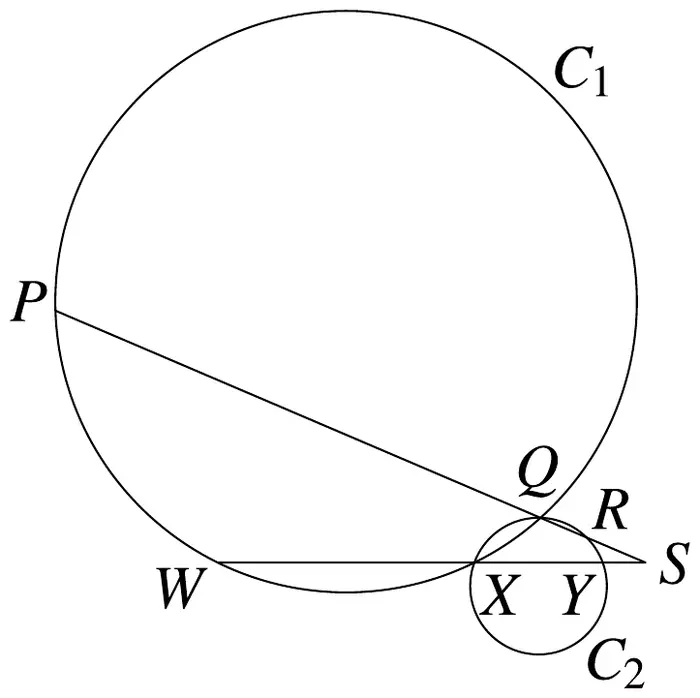
6. The line segments \(PQRS\) and \(WXYS\) intersect circle \(C_1\) at points \(P\),\(Q\), \(W\) and \(X\).
The line segments intersect circle \(C_2\) at points \(Q\),\(R\), \(X\) and \(Y\). The lengths \(QR\), \(RS\) and \(XY\) are 7, 9 and 18 respectively. The length \(WX\) is six times the length \(YS\).
What is the sum of the lengths of \(PS\) and \(WS\)?
Use the intersecting chords theorem on each circle. Let \(a\) be the length of \(SY\). Then, in circle \(QXYR\), \(a(a + 18) = 9(9 + 7)\) giving solutions of \(a = 6, -24\). Since \(a > 0\) we conclude \(a = 6\). In circle \(PWXQ\),\(24(24 + 6 \times 6) = 16(16 + z)\). The solution is \(z = 74\). Therefore \(PS + WS = 74 + 7 + 9 + 36 + 18 + 6 = 150\).
7. The volume of a cube in cubic metres and its surface area in square metres is numerically equal to four-thirds of the sum of the lengths of its edges in metres.
What is the total volume in cubic metres of twenty-seven such cubes?
Let each of the twelve edges of the cube have length \(x\) metres. Then \(x^3 + 6x^2 = \tfrac{4}{3} \times 12x\). This simplifies to \(x^3 + 6x^2 - 16x = 0\) or \(x(x - 2)(x + 8)\) which has solutions \(x = -8, 0, 2\). However \(x\) must be positive and so \(x = 2\). Then 27 such cubes have a volume of \(27 \times 2^3 = 27 \times 8 = 216\).
8. An integer \(x\) satisfies the inequality \(x^2 \leq 729 \leq -x^3\). \(P\) and \(Q\) are possible values of \(x\). What is the maximum possible value of \(10(P - Q)\)?
We observe that \(729 = 3^6\). First consider \(x^2 \leq 729\). This has solution \(-27 \leq x \leq 27\). Now consider \(729 \leq -x^3\). This may be rearranged to give \(x^3 \leq -729\) with solution \(x \leq -9\). These inequalities are simultaneously satisfied when \(-27 \leq x \leq -9\). The maximum value of \(P - Q\) is therefore \(-9 - (-27) = 18\). So the answer to the question is \(10 \times 18 = 180\).
In 7A there are 15 boys and 15 girls; in 7B there are 25 boys and 5 girls. All the girls have a total score of \(20 \times 60 = 1200\). Girls in 7A have a total score of \(15 \times 48 = 720\). Hence girls in 7B have a total score of \(1200 - 720 = 480\) and a mean of 96. All pupils have a total score of \(60 \times 60 = 3600\). Hence the 40 boys have a total score of 2400 and a mean of 60. The 15 boys in 7A have a mean of \(\tfrac{96}{2} = 48\) and total score of 720. Hence the 25 boys in 7B have a total score of \(2400 - 720 = 1680\) and a mean of \(\tfrac{1680}{25}\). Hence the required number is \(\tfrac{1680}{25} \times 10 = 672\).
10. The function \(\mathrm{SPF}(n)\) denotes the sum of the prime factors of \(n\), where the prime factors are not necessarily distinct. For example, \(120 = 2^3 \times 3 \times 5\), so \(\mathrm{SPF}(120) = 2 + 2 + 2 + 3 + 5 = 14\).
The sequence is \(2, 1, 3, 4, 5, 6, 7, 8, 11, 9, 13, 10, 17, 12, 19, 14, 23, 15, 29, \ldots\) so that \(U_{18} = 15\) and \(U_{19} = 29\). These are the first two consecutive terms with a difference greater than 10. Therefore \(k = 18\) and \(k \times U_k = 18 \times 15 = 270\).
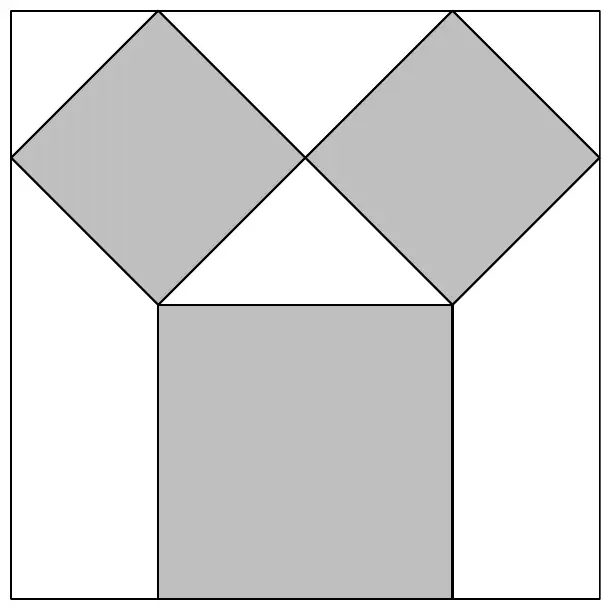
12. The diagram shows a 16 metre by 16 metre wall. Three grey squares are painted on the wall as shown.
The two smaller grey squares are equal in size and each makes an angle of 45° with the edge of the wall. The grey squares cover a total area of \(B\) metres squared.
The wall has a width of 16 metres so the diagonal of each smaller grey square is 8 metres. Let the side-length of each smaller grey square be \(x\) metres. Then, by Pythagoras’ Theorem, \(x^2 + x^2 = 8^2\), giving \(x = \sqrt{32}\). Therefore each smaller grey square has an area of 32 m2. The side-length of the larger grey square is equal to the length of the diagonal of one of the smaller grey squares. Therefore the larger grey square has area \(8^2 = 64\) m2. Hence the total area covered by the grey squares, \(B\), is \(32 + 32 + 64 = 128\) m2.
None of the digits in the number may be zero since we know that their product is non-zero. As they sum to 10, we know the digits must be eight 1s and one 2, in some order. It remains to check the eight possible odd integers for divisibility by seven. Of those, only 112 111 111 has zero remainder when divided by seven, and to three significant figure this number is 112 million. Therefore the answer is 112.
15. In the sequence \(20, 18, 2, 20, -18, \ldots\) the first two terms \(a_1\) and \(a_2\) are 20 and 18 respectively. The third term is found by subtracting the second from the first, \(a_3 = a_1 - a_2\). The fourth is the sum of the two preceding elements, \(a_4 = a_2 + a_3\). Then \(a_5 = a_3 - a_4\),\(a_6 = a_4 + a_5\), and so on.
What is the sum of the first 2018 terms of this sequence?
The sequence is \(20, 18, 2, 20, -18, 2, -20, -18, -2, -20, 18, -2, 20, 18, \ldots\). This is periodic and will repeat every twelve terms. The sum of the first twelve terms is 0. Note also that \(2018 = 12 \times 168 + 2\). Therefore the first 2018 terms will consist of 168 cycles of the first twelve terms with zero sum, followed by \(a_{2017} = 20\) and \(a_{2018} = 18\). Therefore the sum of the first 2018 terms is \(168 \times 0 + 20 + 18 = 38\).
16. A right-angled triangle has sides of integer length. One of its sides has length 20. Toni writes down a list of all the different possible hypotenuses of such triangles.
What is the sum of all the numbers in Toni’s list?
Consider a hypotenuse of length 20. Let the shortest side be of length \(a\). For integer side-lengths we require \(20^2 - a^2\) to be a square. We observe that of \(20^2 - 1^2, 20^2 - 2^2, 20^2 - 3^2, \ldots, 20^2 - 19^2\) only \(20^2 - 12^2 = 256\) and \(20^2 - 16^2 = 144\) are squares. Therefore a hypotenuse of length 20 is possible. Now we consider that one of the shorter two sides has length 20. Let the hypotenuse and the other shorter side be of lengths \(h\) and \(b\) respectively. By Pythagoras’ Theorem \(20^2 = h^2 - b^2\), yielding \((h - b)(h + b) = 400\). We now consider factor pairs \((m, n)\), \(m \leq n\) of 400 to find \((h - b, h + b)\).
\((m, n) = (1, 400)\) gives \((h, b) = (200.5, 199.5)\) which are non-integers.
\((m, n) = (2, 200)\) gives \((h, b) = (101, 99)\) with hypotenuse 101.
\((m, n) = (4, 100)\) gives \((h, b) = (52, 48)\) with hypotenuse 52.
\((m, n) = (5, 80)\) gives \((h, b) = (42.5, 37.5)\) which are non-integers.
\((m, n) = (8, 50)\) gives \((h, b) = (29, 21)\) with hypotenuse 29.
\((m, n) = (10, 40)\) gives \((h, b) = (25, 15)\) with hypotenuse 25.
\((m, n) = (16, 25)\) gives \((h, b) = (20.5, 4.5)\) which are non-integers.
\((m, n) = (20, 20)\) gives \((h, b) = (40, 0)\) which is a degenerate case, that is it includes a side of zero length.
Therefore the possible hypotenuses are 101, 52, 29, 25 and 20 with sum 227.
17. Sarah chooses two numbers \(a\) and \(b\) from the set \(\{1, 2, 3, \ldots, 26\}\). The product \(ab\) is equal to the sum of the remaining 24 numbers.
The sum of the numbers in the set is \(\tfrac{1}{2} \times 26 \times 27 = 351\). Numbers \(a\) and \(b\) will satisfy the equation \(351 - a - b = ab\). Therefore \(352 = ab + a + b + 1 = (a + 1)(b + 1)\). We now search for a factor pair \((a + 1, b + 1)\) of 352 with \(a, b \leq 26\) and \(a \leq b\). The only such pair \((a + 1, b + 1)\) is \((16, 22)\). Therefore \(a\) and \(b\) are 15 and 21 respectively and their difference is 6.
Each zero at the end of \(N!\) must be generated by a \((2 \times 5)\) in its prime factorisation. In general \(N! = 2^a \times 5^b \times K\). For all values of \(N\), \(a\) will be greater than \(b\). We therefore determine the value of \(b\) in each of \(2018!\), \(30!\) and \(11!\). In \(2018! = 1 \times 2 \times \ldots \times 2018\) there are
403 multiples of five;
80 multiples of \(5^2 = 25\), each contributing one additional five;
16 multiples of \(5^3 = 125\), each contributing one further additional five; and
3 multiples of \(5^4 = 625\), each contributing one yet further additional five.
Therefore, for \(2018!\),\(b = 403 + 80 + 16 + 3 = 502\). In \(30!\) there are 6 multiples of five and 1 multiple of 25. So, for \(30!\),\(b = 6 + 1 = 7\). In \(11!\) there are 2 multiples of five. So, for \(11!\),\(b = 2\). Therefore the power of five in the fraction \(\dfrac{2018!}{30! \times 11!}\) is \(502 - 7 - 2 = 493\) and so there are 493 zeros at the end of the number.
19. Shan solves the simultaneous equations \[xy = 15 \text{ and } (2x - y)^4 = 1\] where \(x\) and \(y\) are real numbers. She calculates \(z\), the sum of the squares of all the \(y\)-values in her solutions.
From \((2x - y)^4 = 1\) we know \((2x - y)^2 = \pm 1\). Since any squared quantity must be non-negative, we know \((2x - y)^2 = 1\) from which \(2x - y = \pm 1\). Consider the case \(2x - y = 1\). Multiplying by \(y\) gives \(2xy - y^2 = y\), but \(xy = 15\) and so \(30 - y^2 = y\). Therefore \(y = -6, 5\). Consider the case \(2x - y = -1\). Multiplying by \(y\) gives \(2xy - y^2 = -y\), but \(xy = 15\) and so \(30 - y^2 = -y\). Therefore \(y = -5, 6\). Hence \(z = (-6)^2 + 5^2 + (-5)^2 + 6^2 = 122\).
20. Determine the value of the integer \(y\) given that \(y = 3x^2\) and \[\dfrac{2x}{5} = \dfrac{1}{1 - \dfrac{2}{3 + \dfrac{1}{4 - \dfrac{5}{6 - x}}}}\]
We'd like to use Google Analytics cookies to count visits and see which pages help most. They're optional, and the site works exactly the same either way. Privacy policy