Senior Kangaroo (SK): Geometry & Angles

26 Senior Kangaroo questions from every year we have, newest year first. Use Difficulty › Position in the paper to practise the early (easier) or late (harder) questions, or the Year filter for one year.

Whole paper 2020 2019 2018 2017 2016 2015

Questions and solutions © UK Mathematics Trust, shown with permission. Papers and more at ukmt.org.uk.

SK 2020

SK 2019

SK 2018

SK 2017

SK 2016

SK 2015

SK 2020 Q4

4. Two identical cylindrical sheets are cut open along the dotted lines and glued together to form one bigger cylindrical sheet, as shown. The smaller sheets each enclose a volume of 100. What volume is enclosed by the larger sheet?
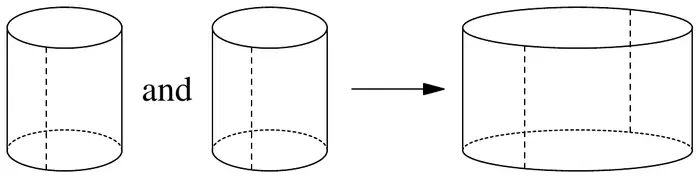
Two identical cylinders with dotted vertical cut lines, and an arrow to a wider cylinder formed by joining them

Senior Kangaroo 2020, Question 4. © UK Mathematics Trust. Original paper on ukmt.org.uk

SK 2020 Q9

SKCurrent spec5 marksGeometry & Angles

9. The radii of two concentric circles are in the ratio \(1 : 3\).
\(AC\) is a diameter of the larger circle. \(BC\) is a chord of the larger circle and is tangent to the smaller circle. \(AB\) has length 140.
What is the radius of the larger circle?

Senior Kangaroo 2020, Question 9. © UK Mathematics Trust. Original paper on ukmt.org.uk

SK 2020 Q11

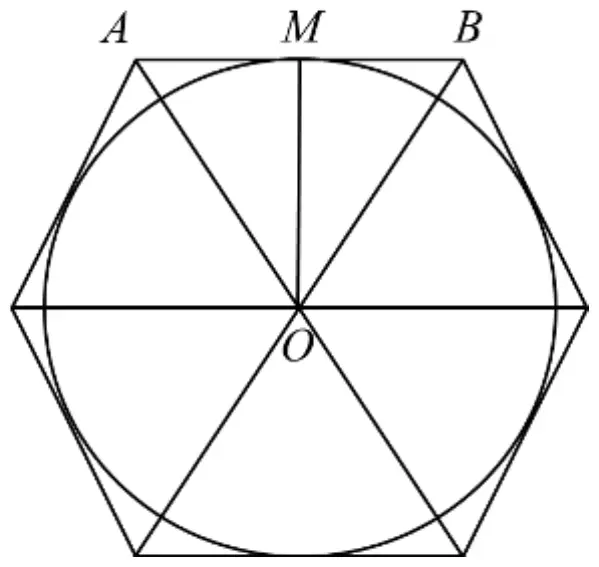
11. A circle is drawn inside a regular hexagon so that it touches all six sides of the hexagon.
The area of the circle is \(\pi \times 64\sqrt{3}\). What is the area of the hexagon?

Senior Kangaroo 2020, Question 11. © UK Mathematics Trust. Original paper on ukmt.org.uk

SK 2020 Q16

SKCurrent spec5 marksGeometry & Angles

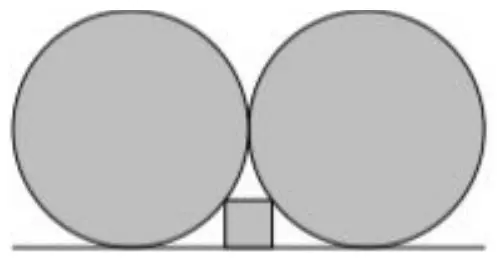
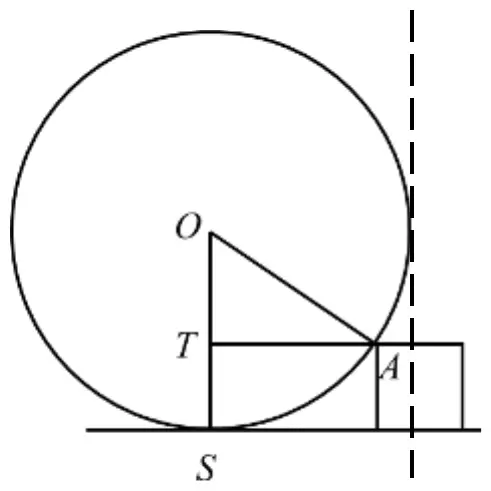
16. A square fits snugly between the horizontal line and two touching circles of radius 1000, as shown. The line is tangent to the circles.
What is the side-length of the square?

Two touching grey circles resting on a horizontal line with a small square between them under the point where they touch

Senior Kangaroo 2020, Question 16. © UK Mathematics Trust. Original paper on ukmt.org.uk

SK 2020 Q20

20. Each square in this cross-number can be filled with a non-zero digit such that all of the conditions in the clues are fulfilled. The digits used are not necessarily distinct.
What is the answer to 3 ACROSS?

12
34
5
ACROSSDOWN
1. A multiple of 71. A multiple of a square of an odd prime; neither a
  square nor a cube
3. The answer to this Question2. The internal angle of a regular polygon;
  the exterior angle is between \(10^o\) and \(20^o\)
5. More than 104. A proper factor of 5 ACROSS but
  not a proper factor of 1 DOWN

Senior Kangaroo 2020, Question 20. © UK Mathematics Trust. Original paper on ukmt.org.uk

SK 2019 Q5

SKCurrent spec5 marksGeometry & Angles

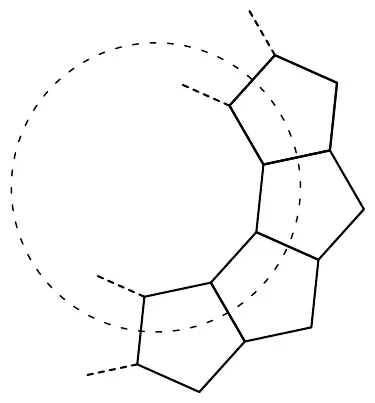
5. Identical regular pentagons are arranged in a ring. The partially completed ring is shown in the diagram. Each of the regular pentagons has a perimeter of 65. The regular polygon formed as the inner boundary of the ring has a perimeter of \(P\). What is the value of \(P\)?

Part of a ring of regular pentagons, with a dashed circle showing where the ring continues

Senior Kangaroo 2019, Question 5. © UK Mathematics Trust. Original paper on ukmt.org.uk

SK 2019 Q11

SKCurrent spec5 marksGeometry & Angles

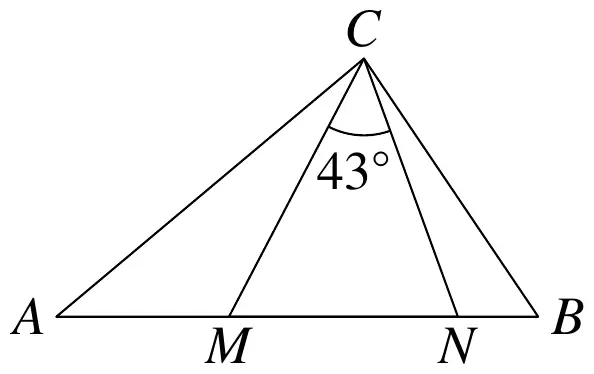
11. In the triangle \(ABC\) the points \(M\) and \(N\) lie on the side \(AB\) such that \(AN = AC\) and \(BM = BC\).

We know that \(\angle MCN = 43°\).

Find the size in degrees of \(\angle ACB\).

Triangle ABC with points M and N on AB; angle MCN is 43 degrees

Senior Kangaroo 2019, Question 11. © UK Mathematics Trust. Original paper on ukmt.org.uk

SK 2019 Q17

SKCurrent spec5 marksGeometry & Angles

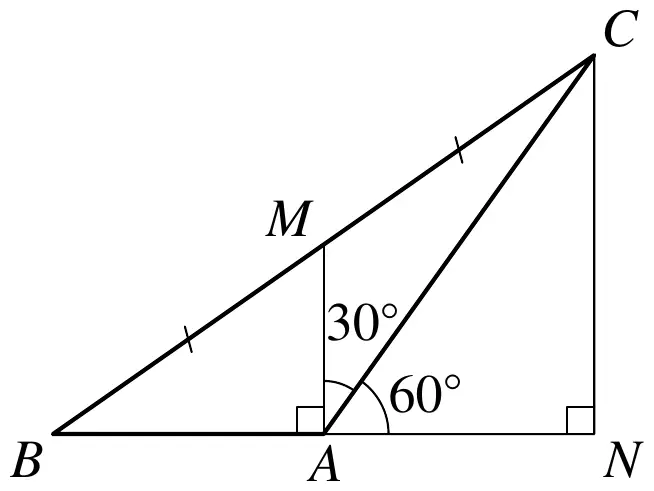
17. In triangle \(ABC\), \(\angle BAC\) is 120°. The length of \(AB\) is 123. The point \(M\) is the midpoint of side \(BC\). The line segments \(AB\) and \(AM\) are perpendicular.
What is the length of side \(AC\)?

Senior Kangaroo 2019, Question 17. © UK Mathematics Trust. Original paper on ukmt.org.uk

SK 2019 Q19

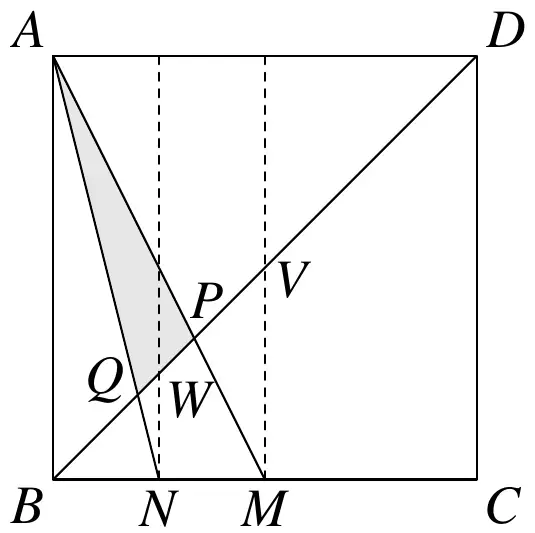
19. The square \(ABCD\) has sides of length 105. The point \(M\) is the midpoint of side \(BC\). The point \(N\) is the midpoint of \(BM\). The lines \(BD\) and \(AM\) meet at the point \(P\). The lines \(BD\) and \(AN\) meet at the point \(Q\).
What is the area of triangle \(APQ\)?

Senior Kangaroo 2019, Question 19. © UK Mathematics Trust. Original paper on ukmt.org.uk

SK 2018 Q3

SKCurrent spec5 marksGeometry & Angles

3. In triangle \(ABC\), we are given that \(AC = 5\sqrt{2}\), \(BC = 5\) and \(\angle BAC = 30°\).

What is the largest possible size in degrees of \(\angle ABC\)?

Senior Kangaroo 2018, Question 3. © UK Mathematics Trust. Original paper on ukmt.org.uk

SK 2018 Q6

SKCurrent spec5 marksGeometry & Angles

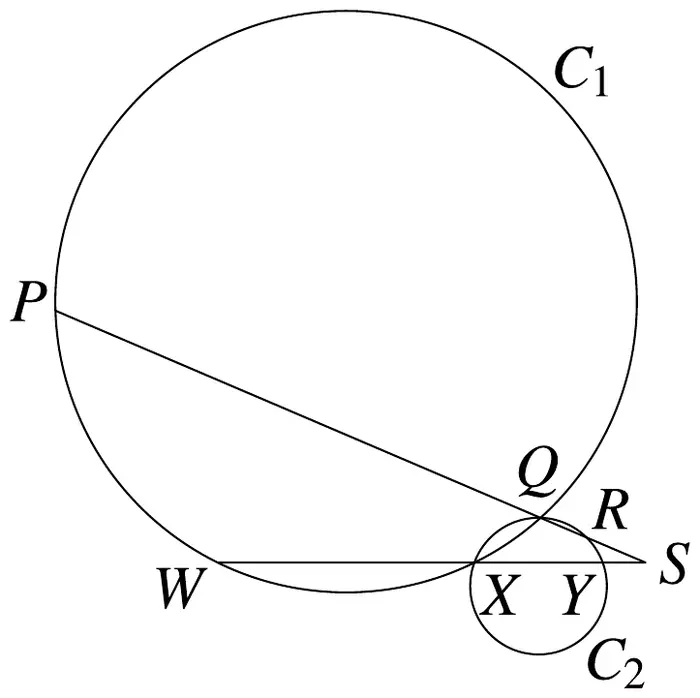
6. The line segments \(PQRS\) and \(WXYS\) intersect circle \(C_1\) at points \(P\), \(Q\), \(W\) and \(X\).

A large circle C1 and a small circle C2 meeting at Q and X; line PQRS crosses both circles and line WXYS crosses both circles, the lines meeting at S

The line segments intersect circle \(C_2\) at points \(Q\), \(R\), \(X\) and \(Y\). The lengths \(QR\), \(RS\) and \(XY\) are 7, 9 and 18 respectively. The length \(WX\) is six times the length \(YS\).

What is the sum of the lengths of \(PS\) and \(WS\)?

Senior Kangaroo 2018, Question 6. © UK Mathematics Trust. Original paper on ukmt.org.uk

SK 2018 Q14

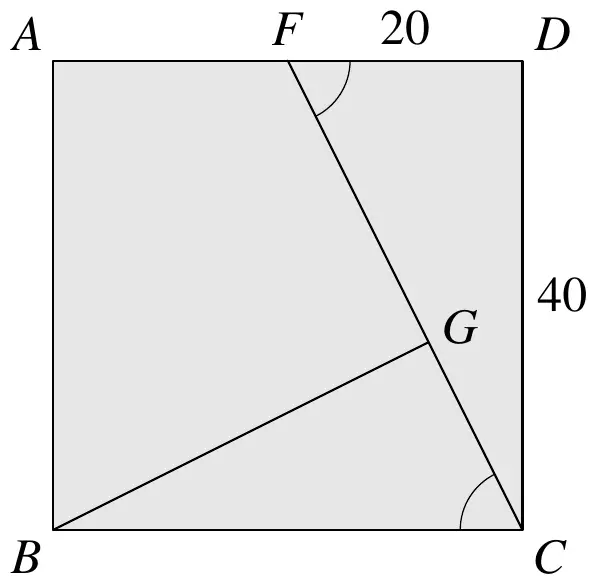
14. A square \(ABCD\) has side 40 units. Point \(F\) is the midpoint of side \(AD\). Point \(G\) lies on \(CF\) such that \(3CG = 2GF\).

What is the area of triangle \(BCG\)?

Senior Kangaroo 2018, Question 14. © UK Mathematics Trust. Original paper on ukmt.org.uk

SK 2018 Q16

16. A right-angled triangle has sides of integer length. One of its sides has length 20. Toni writes down a list of all the different possible hypotenuses of such triangles.

What is the sum of all the numbers in Toni’s list?

Senior Kangaroo 2018, Question 16. © UK Mathematics Trust. Original paper on ukmt.org.uk

SK 2017 Q4

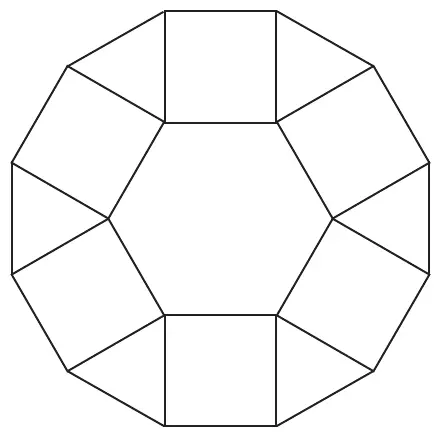
4. The figure shows a shape consisting of a regular hexagon of side 18 cm, six triangles and six squares. The outer perimeter of the shape is \(P\) cm. What is the value of \(P\)?

A regular hexagon with a square on each side and a triangle filling each gap between adjacent squares

Senior Kangaroo 2017, Question 4. © UK Mathematics Trust. Original paper on ukmt.org.uk

SK 2017 Q5

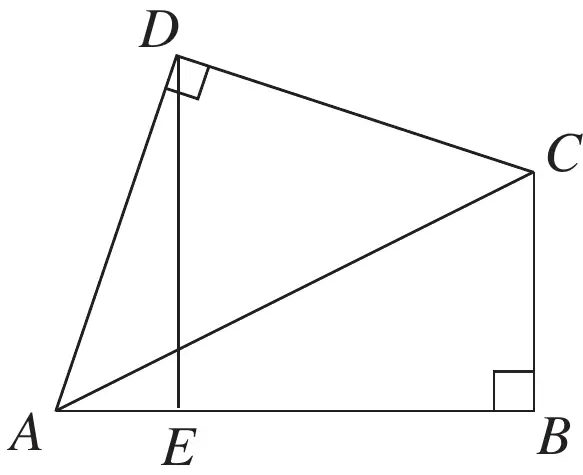
5. The figure shows a quadrilateral \(ABCD\) in which \(AD = DC\) and \(\angle ADC = \angle ABC = 90°\). The point \(E\) is the foot of the perpendicular from \(D\) to \(AB\). The length \(DE\) is 25. What is the area of quadrilateral \(ABCD\)?

Quadrilateral ABCD with right angles at D and B, diagonal AC, and the perpendicular DE from D to AB

Senior Kangaroo 2017, Question 5. © UK Mathematics Trust. Original paper on ukmt.org.uk

SK 2017 Q8

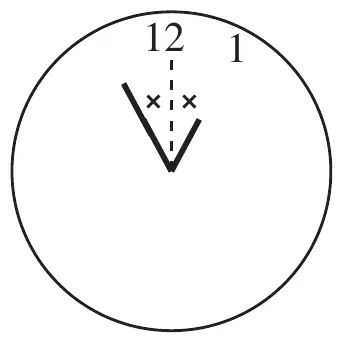
8. Priti is learning a new language called Tedio. During her one hour lesson, which started at midday, she looks at the clock and notices that the hour hand and the minute hand make exactly the same angle with the vertical, as shown in the diagram. How many whole seconds remain until the end of the lesson?

A clock face shortly before one o'clock with the hour and minute hands making equal angles with the vertical

Senior Kangaroo 2017, Question 8. © UK Mathematics Trust. Original paper on ukmt.org.uk

SK 2017 Q16

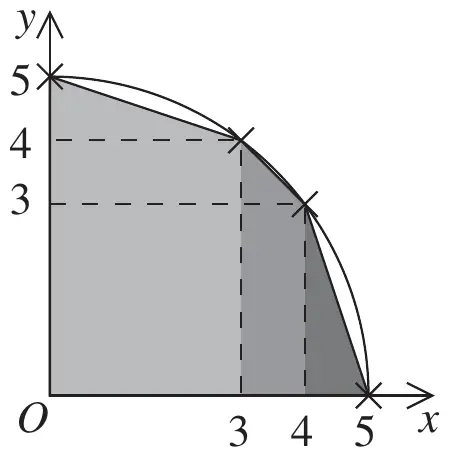
16. The curve \(x^2 + y^2 = 25\) is drawn. Points on the curve whose \(x\)-coordinate and \(y\)-coordinate are both integers are marked with crosses. All of those crosses are joined in turn to create a convex polygon \(P\). What is the area of \(P\)?

Senior Kangaroo 2017, Question 16. © UK Mathematics Trust. Original paper on ukmt.org.uk

SK 2017 Q18

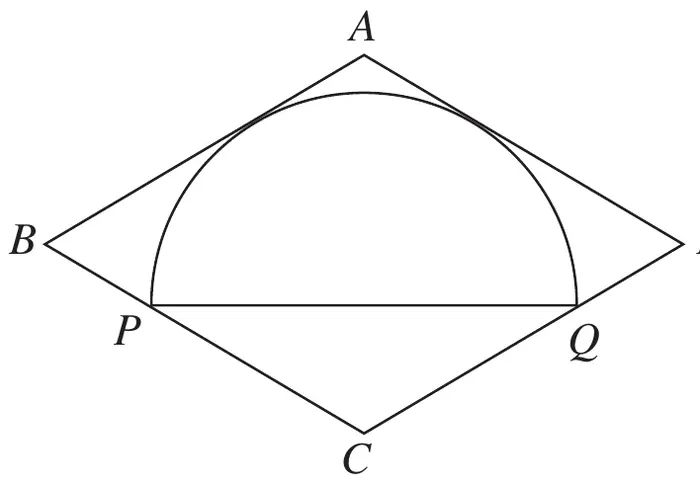
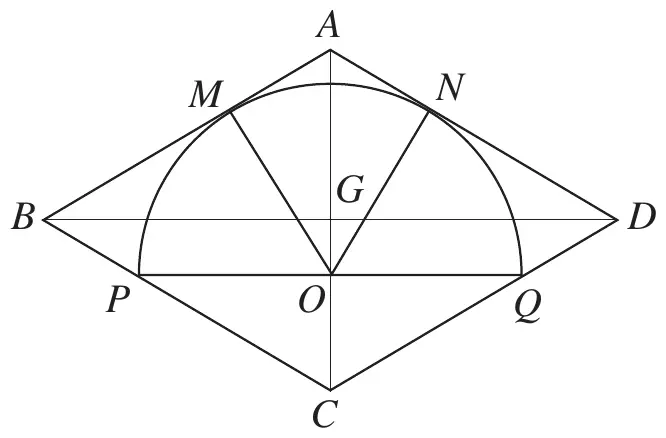
18. The diagram shows a semicircle with diameter \(PQ\) inscribed in a rhombus \(ABCD\). The rhombus is tangent to the arc of the semicircle in two places. Points \(P\) and \(Q\) lie on sides \(BC\) and \(CD\) of the rhombus respectively. The line of symmetry of the semicircle is coincident with the diagonal \(AC\) of the rhombus. It is given that \(\angle CBA = 60°\). The semicircle has radius 10. The area of the rhombus can be written in the form \(a\sqrt{b}\) where \(a\) and \(b\) are integers and \(b\) is prime. What is the value of \(ab + a + b\)?

Rhombus ABCD with a semicircle on diameter PQ, where P is on BC and Q is on CD, touching sides AB and AD

Senior Kangaroo 2017, Question 18. © UK Mathematics Trust. Original paper on ukmt.org.uk

SK 2016 Q6

SKCurrent spec5 marksGeometry & Angles

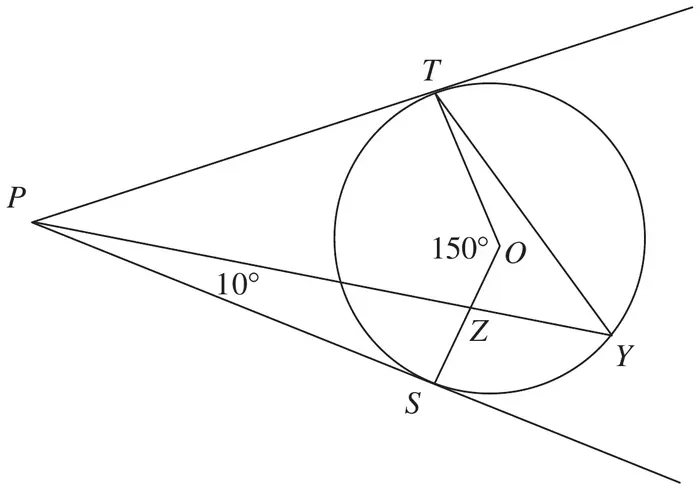
6. In the diagram, \(PT\) and \(PS\) are tangents to a circle with centre \(O\). The point \(Y\) lies on the circumference of the circle; and the point \(Z\) is where the line \(PY\) meets the radius \(OS\).

Also, \(\angle SPZ = 10°\) and \(\angle TOS = 150°\).

How many degrees are there in the sum of \(\angle PTY\) and \(\angle PYT\)?

Tangents PT and PS to a circle with centre O; the line PY crosses radius OS at Z; angle SPZ is 10 degrees and angle TOS is 150 degrees

Senior Kangaroo 2016, Question 6. © UK Mathematics Trust. Original paper on ukmt.org.uk

SK 2016 Q9

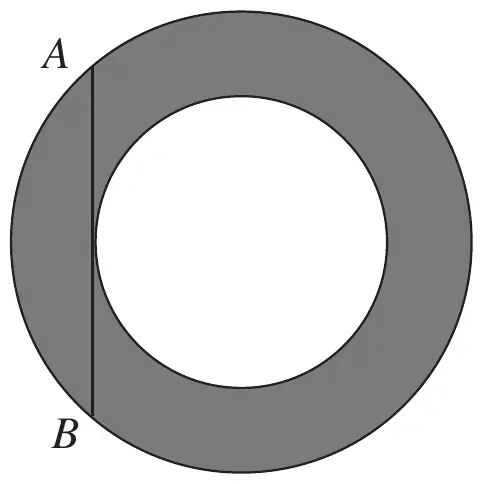
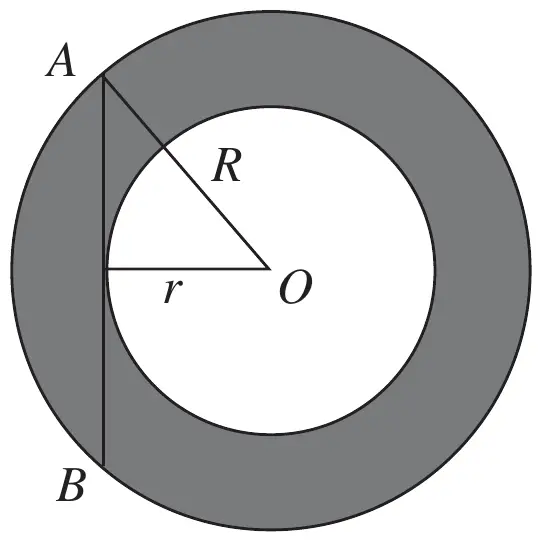
9. The diagram shows two concentric circles. Chord \(AB\) of the larger circle is tangential to the smaller circle.
The length of \(AB\) is 32 cm and the area of the shaded region is \(k\pi\) cm2.
What is the value of \(k\)?

Two concentric circles with the ring between them shaded; chord AB of the larger circle touches the smaller circle

Senior Kangaroo 2016, Question 9. © UK Mathematics Trust. Original paper on ukmt.org.uk

SK 2016 Q12

12. Delia is joining three vertices of a square to make four right-angled triangles.
She can create four triangles doing this, as shown.

A square followed by the four right-angled triangles formed by joining three of its vertices

How many right-angled triangles can Delia make by joining three vertices of a regular polygon with 18 sides?

Senior Kangaroo 2016, Question 12. © UK Mathematics Trust. Original paper on ukmt.org.uk

SK 2016 Q14

14. The lengths of the sides of a triangle are the integers 13, \(x\), \(y\). It is given that \(xy = 105\). What is the length of the perimeter of the triangle?

Senior Kangaroo 2016, Question 14. © UK Mathematics Trust. Original paper on ukmt.org.uk

SK 2015 Q5

SKCurrent spec5 marksGeometry & Angles

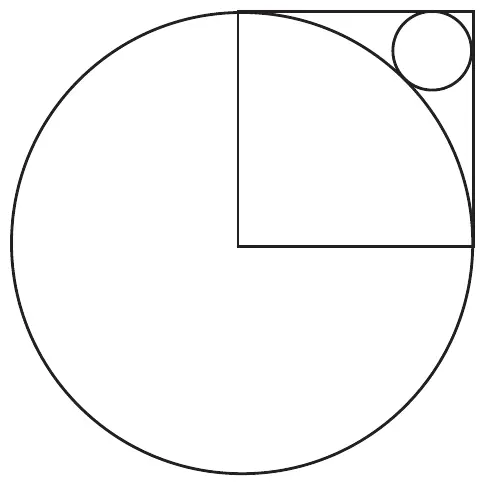
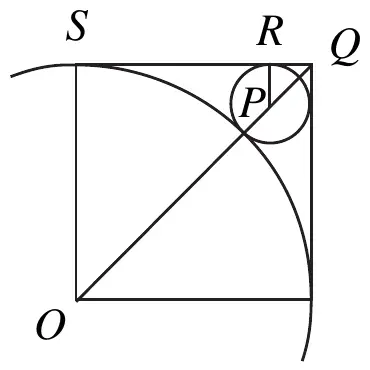
5. The diagram shows two circles and a square with sides of length 10 cm. One vertex of the square is at the centre of the large circle and two sides of the square are tangents to both circles. The small circle touches the large circle. The radius of the small circle is \((a - b\sqrt{2})\) cm.

A large circle with a square whose bottom-left vertex is at the centre of the circle; a small circle sits in the top-right corner of the square touching the large circle

What is the value of \(a + b\)?

Senior Kangaroo 2015, Question 5. © UK Mathematics Trust. Original paper on ukmt.org.uk

SK 2015 Q11

SKCurrent spec5 marksGeometry & Angles

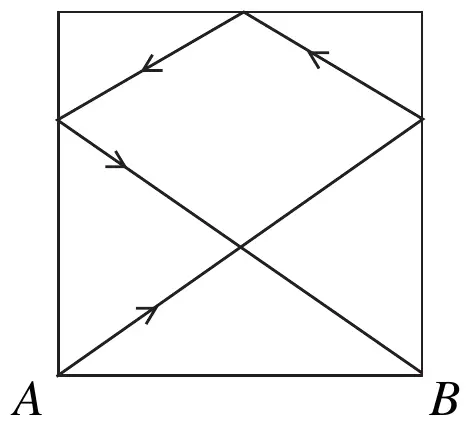
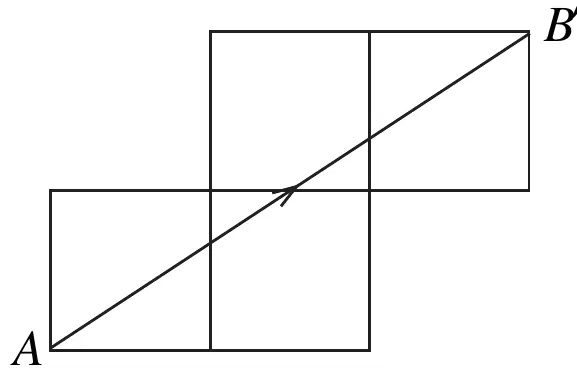
11. A ball is propelled from corner \(A\) of a square snooker table of side 2 metres. After bouncing off three cushions as shown, the ball goes into a pocket at \(B\). The total distance travelled by the ball is \(\sqrt{k}\) metres. What is the value of \(k\)?

A square table with corners A and B at the bottom; the ball's path from A bounces off the right, top and left cushions and ends at B

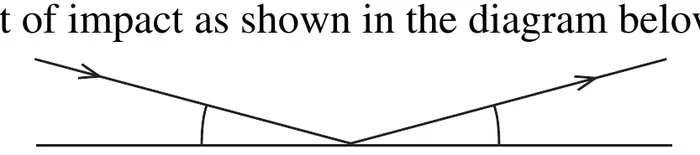
(Note that when the ball bounces off a cushion, the angle its path makes with the cushion as it approaches the point of impact is equal to the angle its path makes with the cushion as it moves away from the point of impact as shown in the diagram below.)

A path bouncing off a line, making equal angles with the line on either side of the point of impact

Senior Kangaroo 2015, Question 11. © UK Mathematics Trust. Original paper on ukmt.org.uk

SK 2015 Q17

SKCurrent spec5 marksGeometry & Angles

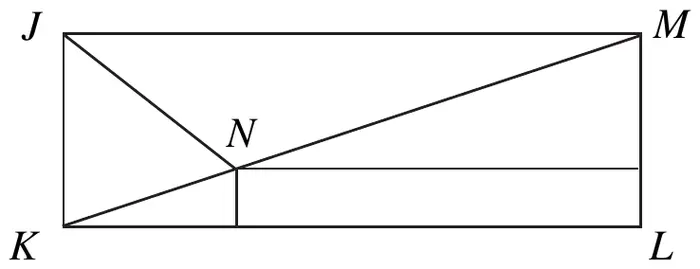
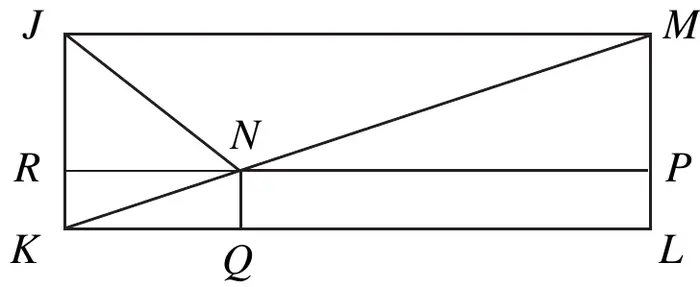
17. In rectangle \(JKLM\), the bisector of angle \(KJM\) cuts the diagonal \(KM\) at point \(N\) as shown. The distances between \(N\) and sides \(LM\) and \(KL\) are 8 cm and 1 cm respectively. The length of \(KL\) is \((a + \sqrt{b})\) cm. What is the value of \(a + b\)?

Rectangle JKLM with diagonal KM and the bisector of angle KJM meeting it at N; a horizontal line from N to side LM

Senior Kangaroo 2015, Question 17. © UK Mathematics Trust. Original paper on ukmt.org.uk

SK 2015 Q19

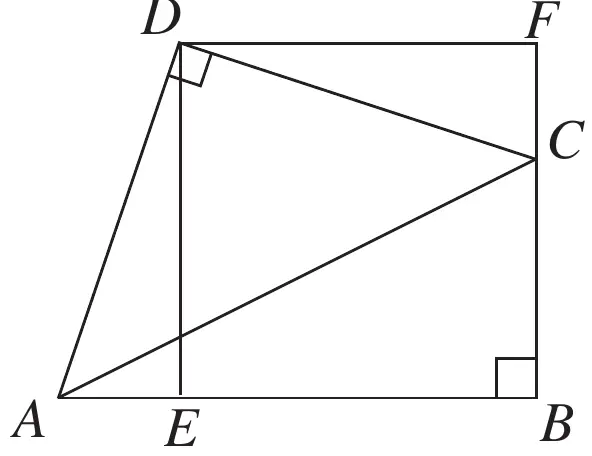
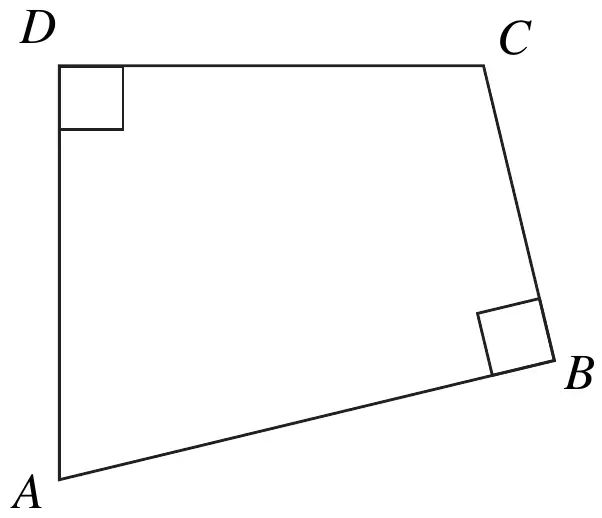
19. In quadrilateral \(ABCD\), \(\angle ABC = \angle ADC = 90°\), \(AD = DC\) and \(AB + BC = 20\) cm.

Quadrilateral ABCD with right angles at D and B

What is the area in cm2 of quadrilateral \(ABCD\)?

Senior Kangaroo 2015, Question 19. © UK Mathematics Trust. Original paper on ukmt.org.uk