We may assume that \(x \leq y\) as the expressions \(yx^2 + xy^2\) and \(x^4 + y^4\) are symmetrical in \(x\) and \(y\). If \(x \geq 4\) (and so \(y \geq 4\)) then \(yx^2 + xy^2 \geq 2 \times 4^3 = 128 > 70\). So \(x\) must be one of 1, 2, 3. When \(x = 2\) we obtain the equation \(4y + 2y^2 = 70\) which has the integer solution \(y = 5\). The analogous equations in \(y\) obtained for \(x = 1, 3\) do not have integer solutions. Therefore, \(x = 2\), \(y = 5\) and \(x^4 + y^4 = 2^4 + 5^4 = 16 + 625 = 641\).
The sum \(5^1 + 4^2 + 3^3 + 2^4\) is equal to \(5 + 16 + 27 + 16 = 64 = 2^6\). The positive integer solutions \((x, y)\) to the equation \(x^y = 64\) are \((64, 1)\),\((8, 2)\), \((4, 3)\) and \((2, 6)\). There are also two further solutions involving negative integers, namely \((-8, 2)\) and \((-2, 6)\). Therefore there are six distinct integer solutions.
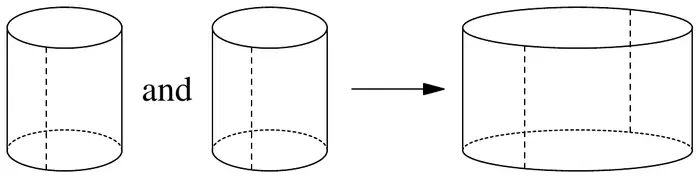
4. Two identical cylindrical sheets are cut open along the dotted lines and glued together to form one bigger cylindrical sheet, as shown. The smaller sheets each enclose a volume of 100. What volume is enclosed by the larger sheet?
Since the circumferences of the smaller cylinder and the larger cylinder are in the ratio \(1 : 2\), the radii of their cross-sections are also in the ratio \(1 : 2\). Therefore the areas of their cross-sections are in the ratio \(1^2 : 2^2 = 1 : 4\). As the cylinders have the same perpendicular height, the volumes they enclose will also be in the ratio \(1 : 4\). Therefore the larger cylinder encloses a volume of \(4 \times 100 = 400\).
Complete the square on \(x^2 - 600x + 369\) to obtain \((x - 300)^2 - 300^2 + 369\). The minimum value of this expression will occur when \((x - 300)^2 = 0\). This is when \(x = 300\).
7. Margot writes the numbers 1,2,3,4,5,6,7 and 8 in the top row of a table, as shown. In the second row she plans to write the same set of numbers, in any order. Each number in the third row is obtained by finding the sum of the two numbers above it. In how many different ways can Margot complete row 2 so that every entry in row 3 is even?
For an entry in row 3 to be even we need the corresponding entry in row 2 to have the same parity as the entry in row 1 (that is: both are odd or both are even). Columns 1, 3, 5 and 7 must therefore have odd entries in row 2. There are four odd numbers to arrange in these cells, with \(4 \times 3 \times 2 \times 1 = 24\) ways to arrange these. Similarly, columns 2, 4, 6 and 8 must have even entries in row 2. There are four even numbers to arrange in these cells, with \(4 \times 3 \times 2 \times 1 = 24\) ways to arrange these. Therefore there are \(24 \times 24 = 576\) ways in which Margot can complete the table in this way.
The number \(\left(2^{222}\right)^5 \times \left(5^{555}\right)^2 = 2^{1110} \times 5^{1110} = 10^{1110}\). The number \(10^{1110}\) is 1111 digits long, so \(Q = 1111 = 11 \times 101\). Both 11 and 101 are prime. Hence the largest prime factor of 1111 is 101.
9. The radii of two concentric circles are in the ratio \(1 : 3\). \(AC\) is a diameter of the larger circle. \(BC\) is a chord of the larger circle and is tangent to the smaller circle. \(AB\) has length 140. What is the radius of the larger circle?
Let \(O\) be the centre of the circles, let \(T\) be the point where the chord \(BC\) meets the smaller circle and let \(r\) be the radius of the smaller circle. \(\angle CTO = 90°\) by the tangent-radius theorem. \(\angle CBA = 90°\) by the angle in a semicircle theorem. Therefore, \(\triangle CTO\) is similar to \(\triangle CBA\) since both are right-angled and they share \(\angle OCT\). Now, \(OT : AB = CO : CA = 1 : 2\). However, \(AB = 140\), so \(r = 70\) and the radius of the larger circle is \(3 \times 70 = 210\).
The powers of 2 (namely \(2, 4, 8, 16, 32, 64, \ldots\)) have units digits which follow a sequence \(2, 4, 8, 6, \ldots\) which repeat every four terms. We may calculate that \(2^{100}\), \(2^{101}\) and \(2^{102}\) have units digits of 6, 2 and 4 respectively. Therefore the first 3-digit power of 2 which is one less than a multiple of 5 is \(2^{102}\).
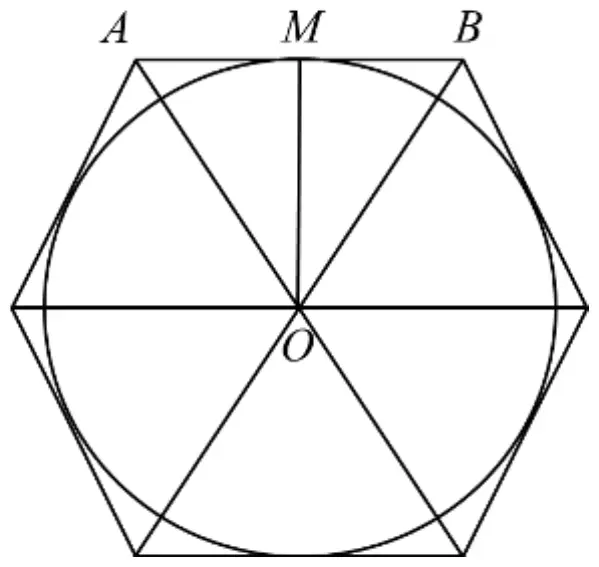
11. A circle is drawn inside a regular hexagon so that it touches all six sides of the hexagon. The area of the circle is \(\pi \times 64\sqrt{3}\). What is the area of the hexagon?
Let \(O\) be the centre of the hexagon. Let \(AB\) be an edge of the hexagon with midpoint \(M\). For the circle we have \(\pi r^2 = \pi \times 64\sqrt{3}\). Therefore \(r^2 = 64\sqrt{3}\). In \(\triangle OMB\),\(OB = \tfrac{OM}{cos30°} = \tfrac{2r}{\sqrt{3}}\). The area of the equilateral \(\triangle OAB\) is \(\tfrac{1}{2} \times AB \times OM = \tfrac{1}{2} \times OB \times OM\), since \(AB = OB\). Therefore, area \(\triangle OAB = \tfrac{1}{2} \times \tfrac{2r}{\sqrt{3}} \times r = \tfrac{r^2}{\sqrt{3}}\) The area of the hexagon is \(6 \times \tfrac{r^2}{\sqrt{3}} = 6 \times \tfrac{64\sqrt{3}}{\sqrt{3}} = 6 \times 64 = 384\).
Let \(y = 20202020\). We may express the quantity under the square-root as \((y + 10000) \times (y + 1) - (y + 10001) \times y = y^2 + 10001y + 10000 - y^2 - 10001y = 10000\). The square root of 10000 is 100.
Note that \(1024 = 2^{10}\), so we require \(yz\) to be a factor of 10. Hence the solutions are \((1024, 1, 1)\),\((32, 2, 1)\),\((32, 1, 2)\),\((4, 5, 1)\),\((4, 1, 5)\),\((2, 10, 1)\),\((2, 1, 10)\),\((2, 5, 2)\),\((2, 2, 5)\).
14. Let \(a\),\(b\), \(c\) and \(d\) be distinct positive integers such that \(a + b\), \(a + c\) and \(a + d\) are all odd and are all square. Let \(L\) be the least possible value of \(a + b + c + d\). What is the value of \(10L\)?
The numbers \(a\),\(b\), \(c\) and \(d\) are distinct, so \(a + b\), \(a + c\) and \(a + d\) must also be distinct. The smallest three odd squares which may be formed in this way are 9, 25 and 49. Therefore, \((a + b) + (a + c) + (a + d) = 9 + 25 + 49 = 83\). We may write \(L = a + b + c + d = 83 - 2a\). So we may minimise \(L\) by maximising \(a\). Since \(a + b = 9\), the largest possible value for \(a\) is 8. This means that \(L = 83 - 2 \times 8 = 67\). We must check that a solution exists. The values \(a = 8\),\(b = 1\), \(c = 17\) and \(d = 41\) satisfy all the conditions provided. If one started with a different set of odd squares, then at least one would be 81 or larger. However, \(a + b + c + d\) is greater than each of the odd squares involved. Hence 67 is indeed the least possible value. Therefore \(L\) is indeed 67 and \(10L = 670\).
15. On an island, kangaroos are always either grey or red. One day, the number of grey kangaroos increased by 28% while the number of red kangaroos decreased by 28%. The ratios of the two types of kangaroos were exactly reversed. By what percentage did the total number of kangaroos change?
Let the initial populations of grey and red kangaroos be \(G\) and \(R\) respectively. After the change, the new populations are \(1.28G\) and \(0.72R\) respectively. As the ratios are reversed, we have \(\tfrac{1.28G}{0.72R} = \tfrac{R}{G}\). Therefore \(R^2 = \tfrac{128}{72} \times G^2 = \tfrac{16G^2}{9}\) and hence \(R = \tfrac{4G}{3}\). The ratio of new population:old population is \((1.28G + 0.72R) : (G + R) = (1.28 + 0.72\tfrac{R}{G}) : (1 + \tfrac{R}{G}) = (1.28 + 0.72 \times \tfrac{4}{3} : (1 + \tfrac{4}{3})\) \(= (3.84 + 2.88) : (4 + 3) = 6.72 : 7 = 0.96 : 1\). Therefore there is a reduction of 4% in the population.
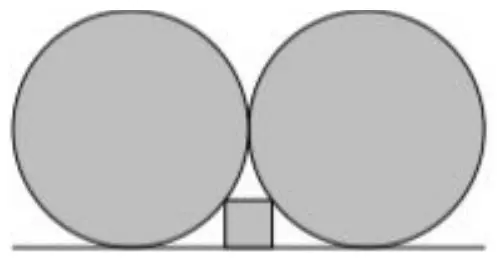
16. A square fits snugly between the horizontal line and two touching circles of radius 1000, as shown. The line is tangent to the circles. What is the side-length of the square?
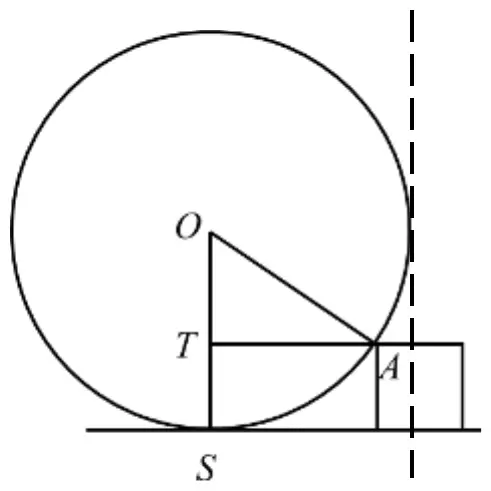
Let \(O\) be the centre of the left circle, \(A\) be the top-left vertex of the square, \(S\) be the point at which the left circle meets the tangent and \(T\) be the foot of the perpendicular from \(A\) to \(OS\). Let the square have side \(2x\). For simplicity, we let \(r\) denote the radius 1000 of the circles. The line \(AT\) has length \(r - \tfrac{1}{2} \times 2x = r - x\), since the common tangent to the circles (shown) is a line of symmetry of the square. Considering \(\triangle OAT\), we have \(r^2 = (r - x)^2 + (r - 2x)^2\). This leads to the quadratic \(0 = (5x - r)(x - r)\), which has solutions \(x = r\) and \(x = 0.2r\). Since \(x < r\), we have \(x = 0.2r = 0.2 \times 1000 = 200\). Therefore the square has side-length \(2 \times 200 = 400\).
17. How many solutions does equation \(|||x - 1| - 1| - 1| = 1\) have? The modulus function \(|x|\) evaluates the absolute value of a number; for example\(|6| = |-6| = 6\).
18. The operation \(\diamond\) is defined on two positive whole numbers as the number of distinct prime factors of the product of the two numbers. For example \(8 \diamond 15 = 3\). What is the cube of the value of \((720 \diamond 1001)\)?
We have the prime factorisations \(720 = 2^4 \times 3^2 \times 5\) and \(1001 = 7 \times 11 \times 13\). Therefore \(720 \times 1001\) will have 6 distinct prime factors (namely 2, 3, 5, 7, 11 and 13). The cube of \((720 \diamond 1001)\) is \(6^3 = 216\).
19. A random number generator gives outputs of 1, 2, 3, 4 and 5 with equal probability. The values of \(a\), \(b\) and \(c\) are each chosen by running the generator once. The probability that \(a \times b + c\) is even can be written as a fraction in its lowest terms as \(\tfrac{N}{D}\). What is the value of \(10N + D\)?
The expression \(a \times b + c\) is even if \(ab\) and \(c\) are either both odd, or both even. The product \(ab\) is odd only if \(a\) and \(b\) are both odd. This occurs with probability \(\tfrac{3}{5} \times \tfrac{3}{5} = \tfrac{9}{25}\). Therefore the probability that both \(ab\) and \(c\) are odd is \(\tfrac{9}{25} \times \tfrac{3}{5} = \tfrac{27}{125}\). The product \(ab\) is even with probability \(1 - \tfrac{9}{25} = \tfrac{16}{25}\). Therefore the probability that both \(ab\) and \(c\) are even is \(\tfrac{16}{25} \times \tfrac{2}{5} = \tfrac{32}{125}\). The total probability that \(ab + c\) is even is \(\tfrac{27}{125} + \tfrac{32}{125} = \tfrac{59}{125}\). Therefore \(N = 59\), \(D = 125\) and \(10N + D = 10 \times 59 + 125 = 715\).
20. Each square in this cross-number can be filled with a non-zero digit such that all of the conditions in the clues are fulfilled. The digits used are not necessarily distinct. What is the answer to 3 ACROSS?
1
2
3
4
5
ACROSS
DOWN
1. A multiple of 7
1. A multiple of a square of an odd prime; neither a square nor a cube
3. The answer to this Question
2. The internal angle of a regular polygon; the exterior angle is between \(10^o\) and \(20^o\)
5. More than 10
4. A proper factor of 5 ACROSS but not a proper factor of 1 DOWN
2 DOWN has possible answers of 162, 165 and 168. 1 ACROSS must end with a ’1’ so can only be 21 or 91. 1 DOWN must start with a ’2’ or a ’9’. The squares of odd primes are 9, 25, 49. The only multiples of these which are neither square nor cube and which start ’2’ or ’9’ are 90 (which cannot be correct since 3 ACROSS cannot start with a 0), 98 and 99. Hence 1 ACROSS is 91. 5 ACROSS could start with a ’2’, ’5’ or ’8’. However, the first digit cannot be ’2’ since none of 21 . . . 29 (for 4 DOWN) has a proper factor which is two digits long and shares the same units digit. Similarly, the first digit cannot be ’5’ since none of 51 . . . 59 (for 4 DOWN) has a proper factor which is two digits long and shares the same units digit. Hence 2 DOWN is 168. Of 81 . . . 89 the only number to have a proper factor which is two digits long and shares the same units digit is 84 with the factor 14. So 5 ACROSS is 84 and 4 DOWN is 14. For 1 DOWN we now know that 14 cannot be a factor, so this is 99. Therefore the answer to 3 ACROSS is 961.
We'd like to use Google Analytics cookies to count visits and see which pages help most. They're optional, and the site works exactly the same either way. Privacy policy