2. When I noticed that \(2^4 = 4^2\), I tried to find other pairs of numbers with this property. Trying 2 and 16, I realised that \(2^{16}\) is larger than \(16^2\). How many times larger is \(2^{16}\)?
Label the quadrilateral \(ABCD\) and let \(AC = 14\) and \(BD = 30\). Let \(M\) be the intersection of \(AC\) and \(BD\). Let \(AM = a\),\(BM = b\), \(CM = c\) and \(DM = d\). Then the sum of the areas is \(\tfrac{1}{2} \times (ab + ad + cb + cd) = \tfrac{1}{2} \times (a + c) \times (b + d) = \tfrac{1}{2} \times 14 \times 30 = 210\).
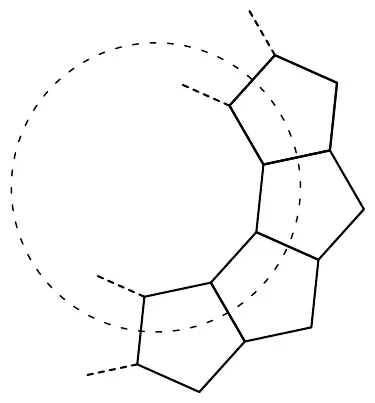
5. Identical regular pentagons are arranged in a ring. The partially completed ring is shown in the diagram. Each of the regular pentagons has a perimeter of 65. The regular polygon formed as the inner boundary of the ring has a perimeter of \(P\). What is the value of \(P\)?
Let the regular \(N\)-gon at the centre of the figure have interior angles of size \(x\) degrees. The interior angle of a pentagon is 108°. By angles at a point we have \(x + 2 \times 108 = 360\), so \(x = 144\). The exterior angle of the \(N\)-gon is \(180 - 144 = 36\). Therefore, the \(N\)-gon has \(\tfrac{360}{36} = 10\) sides. As each side has length \(\tfrac{65}{5} = 13\), the perimeter is \(10 \times 13 = 130\).
We can write \(2019 = (a + b)(a - b)\). The integers \(a + b\) and \(a - b\) must be a factor pair of 2019. There are two such factor pairs: 2019, 1 and 673, 3. These yield \((a, b) = (1010, 1009)\) and \((a, b) = (338, 335)\) respectively. As the answer must be at most 999, we conclude that \(a = 338\).
For \(\tfrac{n+1}{3}\) to be a three-figure integer we require \(99 < \tfrac{n+1}{3} < 999\). This simplifies to \(297 < n + 1 < 2997\), that is \(296 < n < 2996\). For \(3n + 1\) to be a three-figure integer we require \(99 < 3n + 1 < 999\). This simplifies to \(98 < 3n < 998\), that is \(\tfrac{98}{3} < n < \tfrac{998}{3}\). These inequalities are simultaneously solved when \(296 < n < \tfrac{998}{3} = 332\tfrac{2}{3}\). For every integer value of \(n\) between 297 and 332 it is clear that \(3n + 1\) will be a three-figure integer. However, \(\tfrac{n+1}{3}\) will only be an integer for those values of \(n + 1\) which are divisible by 3. These are 299, 302, 305, 308, 311, 314, 317, 320, 323, 326, 329 and 332. There are 12 numbers in this list.
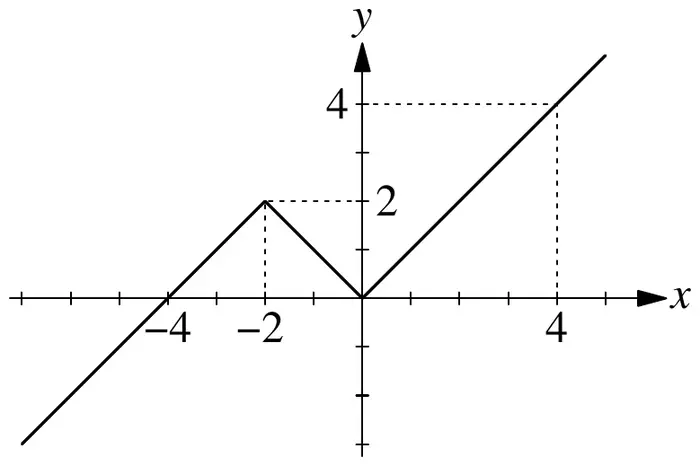
8. The function \(J(x)\) is defined by: \[J(x) = \begin{cases} 4 + x & \text{for } x \leq -2, \\ -x & \text{for } -2 < x \leq 0, \\ x & \text{for } x > 0. \end{cases}\]
How many distinct real solutions has the equation \(J(J(J(x))) = 0\)?
The only solutions to \(J(x) = 0\) are \(x = 0, -4\). Since \(J(0) = 0\), both will also be solutions of \(J(J(J(x))) = 0\). Any solution to \(J(x) = -4\) will also be a solution to \(J(J(x)) = 0\). The only solution to \(J(x) = -4\) is \(x = -8\). Since \(J(x) = 0\), \(x = -8\) is also a solution of \(J(J(J(x))) = 0\). Any solution to \(J(x) = -8\) will also be a solution to \(J(J(J(x))) = 0\). The only solution to \(J(x) = -8\) is \(x = -12\). Therefore, there are four distinct solutions, \(x = 0, -4, -8\) and \(-12\).
9. What is the smallest three-digit number \(K\) which can be written as \(K = a^b + b^a\), where both \(a\) and \(b\) are one-digit positive integers?
As the problem is symmetrical in \(a, b\) we assume \(a \leq b\) without loss of generality. If \(a = 1\) then the maximum value of \(a^b + b^a\) is \(1^9 + 9^1 = 1 + 9 = 10\). This is not a three-digit number, so cannot be a value of \(K\). If \(a = 2\) then possible values for \(K\) include \(2^9 + 9^2 = 512 + 81 = 593\),\(2^8 + 8^2 = 256 + 64 = 320\), \(2^7 + 7^2 = 128 + 49 = 177\) and \(2^6 + 6^2 = 64 + 36 = 100\). As 100 can be attained then 100 is the smallest three-digit number \(K\).
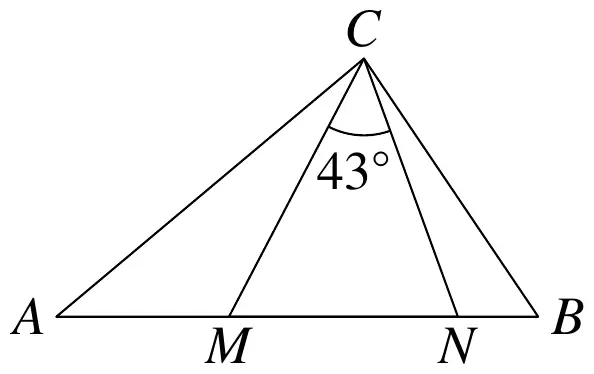
Let \(\angle ACM = x°\) and \(\angle BCN = y°\). Using the base angles property of isosceles triangles \(ACN\) and \(BCM\), we have \(\angle ANC = 43 + x\) and \(\angle BMC = 43 + y\). In triangle \(CMN\),\(43 + (43 + x) + (43 + y) = 180\). Therefore, \(\angle ACB = x + 43 + y = 94\).
13. The real numbers \(a\) and \(b\), where \(a > b\), are solutions to the equation \(3^{2x} - 10 \times 3^{x+1} + 81 = 0\). What is the value of \(20a^2 + 18b^2\)?
In the equation \(3^{2x} - 10 \times 3^{x+1} + 81 = 0\), replace \(3^x\) with \(y\). The equation becomes \(y^2 - 10 \times 3 \times y + 81 = 0\). This factorises as \((y - 3)(y - 27) = 0\) with solutions \(y = 3, 27\). This means \(3^x = 3\) or \(3^x = 27\). The \(x\)-values are 1, 3 respectively, so \(a = 3\) and \(b = 1\). The value of \(20a^2 + 18b^2 = 20 \times 9 + 18 \times 1 = 198\).
Let the three distinct prime factors of \(N\) be \(p\), \(q\) and \(r\). Therefore, \(N^5 = p^5 \times q^5 \times r^5\). Each factor of \(N^5\) may be written as \(p^a \times q^b \times r^c\), where \(a, b, c \in \{0, 1, 2, 3, 4, 5\}\). Since there are 6 choices for the value of each of \(a, b, c\) there are \(6 \times 6 \times 6 = 216\) distinct factors of \(N^5\).
15. Five Bunchkins sit in a horizontal field. No three of the Bunchkins are sitting in a straight line. Each Bunchkin knows the four distances between her and each of the others. Each Bunchkin calculates and then announces the total of these distances. These totals are 17, 43, 56, 66 and 76. A straight line is painted joining each pair of Bunchkins. What is the total length of paint required?
Each line’s length will be announced twice; once by each of the two Bunchkins at its ends. By adding up the total of the numbers announced we will therefore include the length of each line exactly twice. The total length of paint required is \(\tfrac{1}{2} \times (17 + 43 + 56 + 66 + 76) = \tfrac{258}{2} = 129\).
16. The real numbers \(x\) and \(y\) satisfy the equations: \[xy - x = 180 \qquad \text{and} \qquad y + xy = 208.\] Let the two solutions be \((x_1, y_1)\) and \((x_2, y_2)\). What is the value of \(x_1 + 10y_1 + x_2 + 10y_2\)?
Subtracting the two equations yields \(y + x = 28\). Substituting \(y = 28 - x\) into \(xy - x = 180\) leads to the quadratic equation \(0 = x^2 - 27x + 180\). This has solutions 12, 15. The solution sets are therefore \((15, 13)\) and \((12, 16)\). The value of \(x_1 + 10y_1 + x_2 + 10y_2\) is \(15 + 10 \times 13 + 12 + 10 \times 16 = 317\).
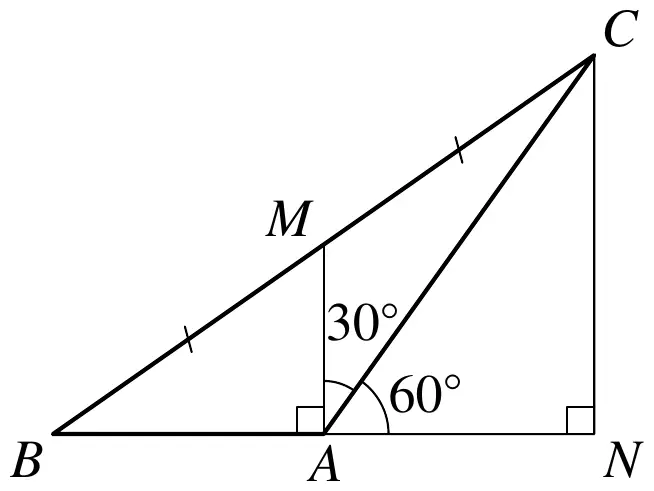
17. In triangle \(ABC\), \(\angle BAC\) is 120°. The length of \(AB\) is 123. The point \(M\) is the midpoint of side \(BC\). The line segments \(AB\) and \(AM\) are perpendicular. What is the length of side \(AC\)?
Extend the line \(BA\). Draw a line through \(C\), parallel to \(MA\), meeting the extended line \(BA\) at point \(N\). By the intercept theorem, \(BA = AN = 123\), because \(BM = MC\). In triangle \(NAC\),\(\cos 60 = \tfrac{1}{2} = \tfrac{123}{AC}\). Therefore, \(AC = 246\).
18. An integer is said to be chunky if it consists only of non-zero digits by which it is divisible when written in base 10. For example, the number 936 is Chunky since it is divisible by 9, 3 and 6. How many chunky integers are there between 13 and 113?
For a two-digit number \(N =\) “\(ab\)” we may write \(N = 10a + b\). If \(N\) is Chunky, then \(N\) will be divisible by \(a\) and therefore \(b = N - 10a\) will also be divisible by \(a\). It is therefore sufficient to check only those two-digit numbers which have a units digit divisible by their tens digit. Following checking, 15, 22, 24, 33, 36, 44, 48, 55, 66, 77, 88 and 99 are the only two-digit Chunky numbers (excluding 11 and 12, which are not under consideration). Of those three-digit numbers under consideration, only 111 and 112 are Chunky. The answer is 14.
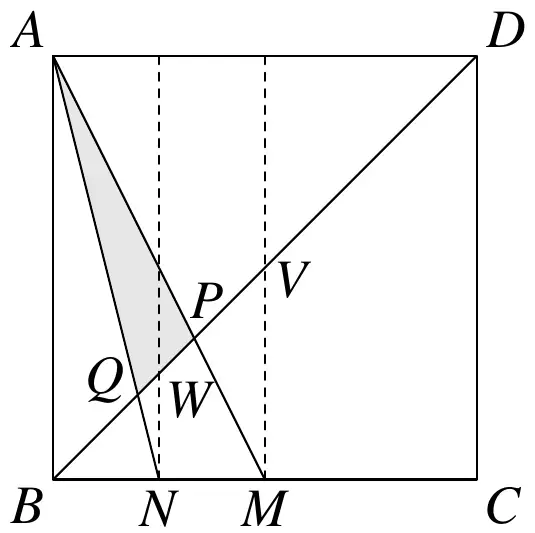
19. The square \(ABCD\) has sides of length 105. The point \(M\) is the midpoint of side \(BC\). The point \(N\) is the midpoint of \(BM\). The lines \(BD\) and \(AM\) meet at the point \(P\). The lines \(BD\) and \(AN\) meet at the point \(Q\). What is the area of triangle \(APQ\)?
Let \(V\) be the centre of the square \(ABCD\). Let \(W\) be the intersection between \(BD\) and the line through \(N\) parallel to \(AB\). Triangles \(APB\) and \(MPV\) are similar, with \(BP : PV = AB : MV = \tfrac{1}{2}\). Therefore, \(BP = \tfrac{2}{3} \times BV = \tfrac{2}{3} \times \tfrac{1}{2} \times 105\sqrt{2} = 35\sqrt{2}\). Similarly, triangles \(AQB\) and \(NQW\) are similar, with \(BQ : QW = AB : NW = \tfrac{1}{4}\). Therefore, \(BQ = \tfrac{4}{5} \times BW = \tfrac{4}{5} \times \tfrac{1}{4} \times 105\sqrt{2} = 21\sqrt{2}\). The area of \(APQ\) is \(\tfrac{1}{2} \times QP \times VA = \tfrac{1}{2} \times \left(35\sqrt{2} - 21\sqrt{2}\right) \times \tfrac{1}{2} \times 105\sqrt{2} = \tfrac{1}{2} \times 14\sqrt{2} \times \tfrac{1}{2} \times 105\sqrt{2} = 735\).
20. Each square in this cross-number can be filled with a non-zero digit such that all of the conditions in the clues are fulfilled. The digits used are not necessarily distinct. What is the answer to 3 ACROSS?
1 Across may be either 77 or 91. The only possibility for 1 Down with 7 or 9 as its first digit is 72. So 1 Across is 77 and 1 Down is 72. In the clues for 5 Across and 4 Down we see that \(p, q\) must be 2, 3 in some order, since if any larger prime were used then \(pq^3\) and \(qp^3\) would not both be two-digit. Therefore, 5 Across and 4 Down are \(3 \times 2^3 = 24\) and \(2 \times 3^3 = 54\) in some order. We know that 3 Across is not a palindrome (so may not end in a 2). Therefore, 5 Across is 24 and 4 Down is 54. The only three-digit multiples of 9 beginning with a 7 are 702 and 792. As every digit in the completed crossnumber must be non-zero we have 2 Down is 792 and 3 Across is 295.
We'd like to use Google Analytics cookies to count visits and see which pages help most. They're optional, and the site works exactly the same either way. Privacy policy