16 Senior Kangaroo questions from every year we have, newest year first. Use Difficulty › Position in the paper to practise the early (easier) or late (harder) questions, or the Year filter for one year.
The sum \(5^1 + 4^2 + 3^3 + 2^4\) is equal to \(5 + 16 + 27 + 16 = 64 = 2^6\). The positive integer solutions \((x, y)\) to the equation \(x^y = 64\) are \((64, 1)\),\((8, 2)\), \((4, 3)\) and \((2, 6)\). There are also two further solutions involving negative integers, namely \((-8, 2)\) and \((-2, 6)\). Therefore there are six distinct integer solutions.
Let \(y = 20202020\). We may express the quantity under the square-root as \((y + 10000) \times (y + 1) - (y + 10001) \times y = y^2 + 10001y + 10000 - y^2 - 10001y = 10000\). The square root of 10000 is 100.
2. When I noticed that \(2^4 = 4^2\), I tried to find other pairs of numbers with this property. Trying 2 and 16, I realised that \(2^{16}\) is larger than \(16^2\). How many times larger is \(2^{16}\)?
9. What is the smallest three-digit number \(K\) which can be written as \(K = a^b + b^a\), where both \(a\) and \(b\) are one-digit positive integers?
As the problem is symmetrical in \(a, b\) we assume \(a \leq b\) without loss of generality. If \(a = 1\) then the maximum value of \(a^b + b^a\) is \(1^9 + 9^1 = 1 + 9 = 10\). This is not a three-digit number, so cannot be a value of \(K\). If \(a = 2\) then possible values for \(K\) include \(2^9 + 9^2 = 512 + 81 = 593\),\(2^8 + 8^2 = 256 + 64 = 320\), \(2^7 + 7^2 = 128 + 49 = 177\) and \(2^6 + 6^2 = 64 + 36 = 100\). As 100 can be attained then 100 is the smallest three-digit number \(K\).
15. Five Bunchkins sit in a horizontal field. No three of the Bunchkins are sitting in a straight line. Each Bunchkin knows the four distances between her and each of the others. Each Bunchkin calculates and then announces the total of these distances. These totals are 17, 43, 56, 66 and 76. A straight line is painted joining each pair of Bunchkins. What is the total length of paint required?
Each line’s length will be announced twice; once by each of the two Bunchkins at its ends. By adding up the total of the numbers announced we will therefore include the length of each line exactly twice. The total length of paint required is \(\tfrac{1}{2} \times (17 + 43 + 56 + 66 + 76) = \tfrac{258}{2} = 129\).
We may rewrite the inequality as \((n^2)^{100} < (5^3)^{100} = 125^{100}\). It follows that \(n^2 < 5^3 = 125\). The maximum integer value of \(n\) is therefore 11. Therefore \(K = 11\) and \(10K = 110\).
4. In a list of five numbers, the first number is 60 and the last number is 300. The product of the first three numbers is 810 000, the product of the three in the middle is 2 430 000 and the product of the last three numbers is 8 100 000.
Let the list be \(60, x, y, z, 300\). (i) Since \(60xy = 810\,000\) we find that \(xy = 13\,500\). (ii) Since \(xyz = 2\,430\,000\) and \(xy = 13\,500\), we find that \(z = 180\). (iii) Since \(300yz = 8\,100\,000\) and \(z = 180\), we find that \(y = 150\). We may also find \(x = \tfrac{13\,500}{150} = 90\). As \(y\) is the middle number in the list the answer to the problem is 150.
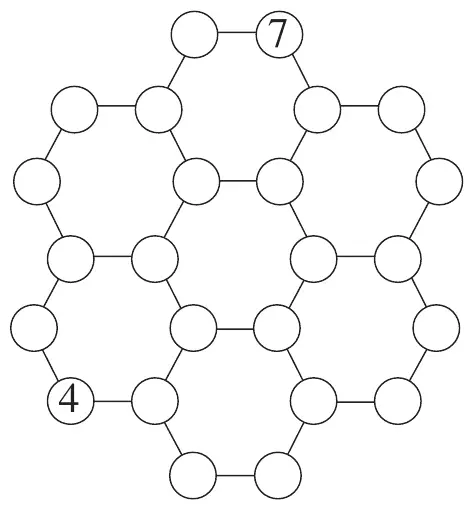
1. An integer is to be written in each circle of the network shown. The integers must be written so that the sum of the numbers at the end of each line segment is the same. Two of the integers have already been written. What is the total of all the integers in the completed diagram?
Each circle immediately adjacent to the initial ‘4’ must contain the same integer, \(x\) say, in order for the sum of those numbers at the end of each line segment to be the same. Those circles immediately adjacent to those with the integer \(x\) must contain the integer 4 to preserve the sum of those numbers at the end of each line segment. Continuation of this pattern throughout the network eventually yields that the circle marked with a ‘7’ must contain the integer \(x\). Therefore \(x = 7\). The completed network contains twelve ‘4’s and twelve ‘7’s with a total of \(12 \times 4 + 12 \times 7 = 132\).
We observe that in all but the rightmost column the value in the second row is ten larger than the value in the first row. There are 10 such columns. Therefore the sum of the leftmost ten elements of the second row is 100 more than the corresponding sum in the first row. To achieve the same total in each row, * will need to be 100 less than the value above it. Therefore * = 950.
10. Consider the expression \(1 * 2 * 3 * 4 * 5 * 6\). Each star in the expression is to be replaced with either ‘+’ or ‘×’. \(N\) is the largest possible value of the expression. What is the largest prime factor of \(N\)?
Note that \(6! = 1 \times 2 \times 3 \times 4 \times 5 \times 6 = 720\). We observe that if any multiplication sign, other than the first, is replaced by an addition sign then each remaining product is at most 360. Therefore we retain each multiplication sign except the first which may be replaced by an addition sign to obtain a maximal value of 721. The prime factors of 721 are 7 and 103, of which 103 is the largest.
17. Students in a class take turns to practise their arithmetic skills. Initially a board contains the integers from 1 to 10 inclusive, each written ten times. On each turn a student first deletes two of the integers and then writes on the board the number that is one more than the sum of those two deleted integers. Turns are taken until there is only one number remaining on the board. Assuming no student makes a mistake, what is the remaining number?
We observe that the total of all integers on the board at the start of the process is \(10(1 + 2 + 3 + 4 + 5 + 6 + 7 + 8 + 9 + 10) = 550\). On each turn this total is increased by 1. Since we start with one hundred integers on the board and at each turn this number of integers is decreased by one, then 99 turns will be required to complete the process. Therefore the total of all integers on the board will increase by 99 over the course of the process. Hence the remaining number will be \(550 + 99 = 649\).
We'd like to use Google Analytics cookies to count visits and see which pages help most. They're optional, and the site works exactly the same either way. Privacy policy