33 Senior Kangaroo questions from every year we have, newest year first. Use Difficulty › Position in the paper to practise the early (easier) or late (harder) questions, or the Year filter for one year.
We may assume that \(x \leq y\) as the expressions \(yx^2 + xy^2\) and \(x^4 + y^4\) are symmetrical in \(x\) and \(y\). If \(x \geq 4\) (and so \(y \geq 4\)) then \(yx^2 + xy^2 \geq 2 \times 4^3 = 128 > 70\). So \(x\) must be one of 1, 2, 3. When \(x = 2\) we obtain the equation \(4y + 2y^2 = 70\) which has the integer solution \(y = 5\). The analogous equations in \(y\) obtained for \(x = 1, 3\) do not have integer solutions. Therefore, \(x = 2\), \(y = 5\) and \(x^4 + y^4 = 2^4 + 5^4 = 16 + 625 = 641\).
Complete the square on \(x^2 - 600x + 369\) to obtain \((x - 300)^2 - 300^2 + 369\). The minimum value of this expression will occur when \((x - 300)^2 = 0\). This is when \(x = 300\).
Let \(y = 20202020\). We may express the quantity under the square-root as \((y + 10000) \times (y + 1) - (y + 10001) \times y = y^2 + 10001y + 10000 - y^2 - 10001y = 10000\). The square root of 10000 is 100.
14. Let \(a\),\(b\), \(c\) and \(d\) be distinct positive integers such that \(a + b\), \(a + c\) and \(a + d\) are all odd and are all square. Let \(L\) be the least possible value of \(a + b + c + d\). What is the value of \(10L\)?
The numbers \(a\),\(b\), \(c\) and \(d\) are distinct, so \(a + b\), \(a + c\) and \(a + d\) must also be distinct. The smallest three odd squares which may be formed in this way are 9, 25 and 49. Therefore, \((a + b) + (a + c) + (a + d) = 9 + 25 + 49 = 83\). We may write \(L = a + b + c + d = 83 - 2a\). So we may minimise \(L\) by maximising \(a\). Since \(a + b = 9\), the largest possible value for \(a\) is 8. This means that \(L = 83 - 2 \times 8 = 67\). We must check that a solution exists. The values \(a = 8\),\(b = 1\), \(c = 17\) and \(d = 41\) satisfy all the conditions provided. If one started with a different set of odd squares, then at least one would be 81 or larger. However, \(a + b + c + d\) is greater than each of the odd squares involved. Hence 67 is indeed the least possible value. Therefore \(L\) is indeed 67 and \(10L = 670\).
17. How many solutions does equation \(|||x - 1| - 1| - 1| = 1\) have? The modulus function \(|x|\) evaluates the absolute value of a number; for example\(|6| = |-6| = 6\).
We can write \(2019 = (a + b)(a - b)\). The integers \(a + b\) and \(a - b\) must be a factor pair of 2019. There are two such factor pairs: 2019, 1 and 673, 3. These yield \((a, b) = (1010, 1009)\) and \((a, b) = (338, 335)\) respectively. As the answer must be at most 999, we conclude that \(a = 338\).
For \(\tfrac{n+1}{3}\) to be a three-figure integer we require \(99 < \tfrac{n+1}{3} < 999\). This simplifies to \(297 < n + 1 < 2997\), that is \(296 < n < 2996\). For \(3n + 1\) to be a three-figure integer we require \(99 < 3n + 1 < 999\). This simplifies to \(98 < 3n < 998\), that is \(\tfrac{98}{3} < n < \tfrac{998}{3}\). These inequalities are simultaneously solved when \(296 < n < \tfrac{998}{3} = 332\tfrac{2}{3}\). For every integer value of \(n\) between 297 and 332 it is clear that \(3n + 1\) will be a three-figure integer. However, \(\tfrac{n+1}{3}\) will only be an integer for those values of \(n + 1\) which are divisible by 3. These are 299, 302, 305, 308, 311, 314, 317, 320, 323, 326, 329 and 332. There are 12 numbers in this list.
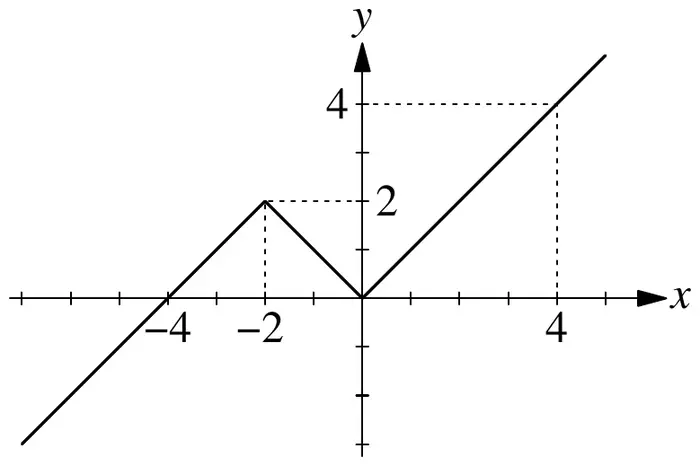
8. The function \(J(x)\) is defined by: \[J(x) = \begin{cases} 4 + x & \text{for } x \leq -2, \\ -x & \text{for } -2 < x \leq 0, \\ x & \text{for } x > 0. \end{cases}\]
How many distinct real solutions has the equation \(J(J(J(x))) = 0\)?
The only solutions to \(J(x) = 0\) are \(x = 0, -4\). Since \(J(0) = 0\), both will also be solutions of \(J(J(J(x))) = 0\). Any solution to \(J(x) = -4\) will also be a solution to \(J(J(x)) = 0\). The only solution to \(J(x) = -4\) is \(x = -8\). Since \(J(x) = 0\), \(x = -8\) is also a solution of \(J(J(J(x))) = 0\). Any solution to \(J(x) = -8\) will also be a solution to \(J(J(J(x))) = 0\). The only solution to \(J(x) = -8\) is \(x = -12\). Therefore, there are four distinct solutions, \(x = 0, -4, -8\) and \(-12\).
13. The real numbers \(a\) and \(b\), where \(a > b\), are solutions to the equation \(3^{2x} - 10 \times 3^{x+1} + 81 = 0\). What is the value of \(20a^2 + 18b^2\)?
In the equation \(3^{2x} - 10 \times 3^{x+1} + 81 = 0\), replace \(3^x\) with \(y\). The equation becomes \(y^2 - 10 \times 3 \times y + 81 = 0\). This factorises as \((y - 3)(y - 27) = 0\) with solutions \(y = 3, 27\). This means \(3^x = 3\) or \(3^x = 27\). The \(x\)-values are 1, 3 respectively, so \(a = 3\) and \(b = 1\). The value of \(20a^2 + 18b^2 = 20 \times 9 + 18 \times 1 = 198\).
16. The real numbers \(x\) and \(y\) satisfy the equations: \[xy - x = 180 \qquad \text{and} \qquad y + xy = 208.\] Let the two solutions be \((x_1, y_1)\) and \((x_2, y_2)\). What is the value of \(x_1 + 10y_1 + x_2 + 10y_2\)?
Subtracting the two equations yields \(y + x = 28\). Substituting \(y = 28 - x\) into \(xy - x = 180\) leads to the quadratic equation \(0 = x^2 - 27x + 180\). This has solutions 12, 15. The solution sets are therefore \((15, 13)\) and \((12, 16)\). The value of \(x_1 + 10y_1 + x_2 + 10y_2\) is \(15 + 10 \times 13 + 12 + 10 \times 16 = 317\).
We may rewrite the inequality as \((n^2)^{100} < (5^3)^{100} = 125^{100}\). It follows that \(n^2 < 5^3 = 125\). The maximum integer value of \(n\) is therefore 11. Therefore \(K = 11\) and \(10K = 110\).
4. In a list of five numbers, the first number is 60 and the last number is 300. The product of the first three numbers is 810 000, the product of the three in the middle is 2 430 000 and the product of the last three numbers is 8 100 000.
Let the list be \(60, x, y, z, 300\). (i) Since \(60xy = 810\,000\) we find that \(xy = 13\,500\). (ii) Since \(xyz = 2\,430\,000\) and \(xy = 13\,500\), we find that \(z = 180\). (iii) Since \(300yz = 8\,100\,000\) and \(z = 180\), we find that \(y = 150\). We may also find \(x = \tfrac{13\,500}{150} = 90\). As \(y\) is the middle number in the list the answer to the problem is 150.
7. The volume of a cube in cubic metres and its surface area in square metres is numerically equal to four-thirds of the sum of the lengths of its edges in metres.
What is the total volume in cubic metres of twenty-seven such cubes?
Let each of the twelve edges of the cube have length \(x\) metres. Then \(x^3 + 6x^2 = \tfrac{4}{3} \times 12x\). This simplifies to \(x^3 + 6x^2 - 16x = 0\) or \(x(x - 2)(x + 8)\) which has solutions \(x = -8, 0, 2\). However \(x\) must be positive and so \(x = 2\). Then 27 such cubes have a volume of \(27 \times 2^3 = 27 \times 8 = 216\).
8. An integer \(x\) satisfies the inequality \(x^2 \leq 729 \leq -x^3\). \(P\) and \(Q\) are possible values of \(x\). What is the maximum possible value of \(10(P - Q)\)?
We observe that \(729 = 3^6\). First consider \(x^2 \leq 729\). This has solution \(-27 \leq x \leq 27\). Now consider \(729 \leq -x^3\). This may be rearranged to give \(x^3 \leq -729\) with solution \(x \leq -9\). These inequalities are simultaneously satisfied when \(-27 \leq x \leq -9\). The maximum value of \(P - Q\) is therefore \(-9 - (-27) = 18\). So the answer to the question is \(10 \times 18 = 180\).
15. In the sequence \(20, 18, 2, 20, -18, \ldots\) the first two terms \(a_1\) and \(a_2\) are 20 and 18 respectively. The third term is found by subtracting the second from the first, \(a_3 = a_1 - a_2\). The fourth is the sum of the two preceding elements, \(a_4 = a_2 + a_3\). Then \(a_5 = a_3 - a_4\),\(a_6 = a_4 + a_5\), and so on.
What is the sum of the first 2018 terms of this sequence?
The sequence is \(20, 18, 2, 20, -18, 2, -20, -18, -2, -20, 18, -2, 20, 18, \ldots\). This is periodic and will repeat every twelve terms. The sum of the first twelve terms is 0. Note also that \(2018 = 12 \times 168 + 2\). Therefore the first 2018 terms will consist of 168 cycles of the first twelve terms with zero sum, followed by \(a_{2017} = 20\) and \(a_{2018} = 18\). Therefore the sum of the first 2018 terms is \(168 \times 0 + 20 + 18 = 38\).
17. Sarah chooses two numbers \(a\) and \(b\) from the set \(\{1, 2, 3, \ldots, 26\}\). The product \(ab\) is equal to the sum of the remaining 24 numbers.
The sum of the numbers in the set is \(\tfrac{1}{2} \times 26 \times 27 = 351\). Numbers \(a\) and \(b\) will satisfy the equation \(351 - a - b = ab\). Therefore \(352 = ab + a + b + 1 = (a + 1)(b + 1)\). We now search for a factor pair \((a + 1, b + 1)\) of 352 with \(a, b \leq 26\) and \(a \leq b\). The only such pair \((a + 1, b + 1)\) is \((16, 22)\). Therefore \(a\) and \(b\) are 15 and 21 respectively and their difference is 6.
19. Shan solves the simultaneous equations \[xy = 15 \text{ and } (2x - y)^4 = 1\] where \(x\) and \(y\) are real numbers. She calculates \(z\), the sum of the squares of all the \(y\)-values in her solutions.
From \((2x - y)^4 = 1\) we know \((2x - y)^2 = \pm 1\). Since any squared quantity must be non-negative, we know \((2x - y)^2 = 1\) from which \(2x - y = \pm 1\). Consider the case \(2x - y = 1\). Multiplying by \(y\) gives \(2xy - y^2 = y\), but \(xy = 15\) and so \(30 - y^2 = y\). Therefore \(y = -6, 5\). Consider the case \(2x - y = -1\). Multiplying by \(y\) gives \(2xy - y^2 = -y\), but \(xy = 15\) and so \(30 - y^2 = -y\). Therefore \(y = -5, 6\). Hence \(z = (-6)^2 + 5^2 + (-5)^2 + 6^2 = 122\).
20. Determine the value of the integer \(y\) given that \(y = 3x^2\) and \[\dfrac{2x}{5} = \dfrac{1}{1 - \dfrac{2}{3 + \dfrac{1}{4 - \dfrac{5}{6 - x}}}}\]
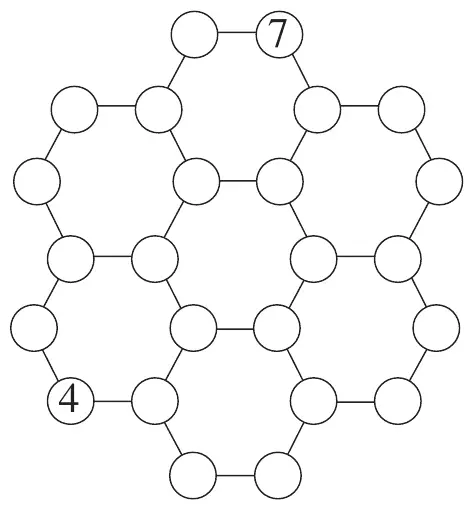
1. An integer is to be written in each circle of the network shown. The integers must be written so that the sum of the numbers at the end of each line segment is the same. Two of the integers have already been written. What is the total of all the integers in the completed diagram?
Each circle immediately adjacent to the initial ‘4’ must contain the same integer, \(x\) say, in order for the sum of those numbers at the end of each line segment to be the same. Those circles immediately adjacent to those with the integer \(x\) must contain the integer 4 to preserve the sum of those numbers at the end of each line segment. Continuation of this pattern throughout the network eventually yields that the circle marked with a ‘7’ must contain the integer \(x\). Therefore \(x = 7\). The completed network contains twelve ‘4’s and twelve ‘7’s with a total of \(12 \times 4 + 12 \times 7 = 132\).
11. An infinite arithmetic progression of positive integers contains the terms 7, 11, 15, 71, 75 and 79. The first term in the progression is 7. Kim writes down all the possible values of the one-hundredth term in the progression. What is the sum of the numbers Kim writes down?
The difference between any two terms is either 4 or is a multiple of 4. So the term-to-term difference in the progression must be a divisor of 4. Since all the terms of the progression are integers the only feasible differences are 1, 2 and 4. If the term-to-term difference is 1 then the one-hundredth term will be \(7 + 99 \times 1 = 106\). If the term-to-term difference is 2 then the one-hundredth term will be \(7 + 99 \times 2 = 205\). If the term-to-term difference is 4 then the one-hundredth term will be \(7 + 99 \times 4 = 403\). The sum of these numbers is 714.
19. The sequence of functions \(F_1(x)\),\(F_2(x)\), … satisfies the following conditions: \[F_1(x) = x, \qquad F_{n+1}(x) = \dfrac{1}{1 - F_n(x)}.\] The integer \(C\) is a three-digit cube such that \(F_C(C) = C\). What is the largest possible value of \(C\)?
\[F_1(x) = x;\ F_2(x) = \dfrac{1}{1 - x};\ F_3(x) = \dfrac{1}{1 - \frac{1}{1 - x}} = 1 - \dfrac{1}{x};\ F_4(x) = \dfrac{1}{1 - \left(1 - \frac{1}{x}\right)} = x.\] Hence we have, \(F_1(x) = F_4(x) = F_7(x) = \ldots = F_{3k-2}(x)\). Therefore we are required to solve \(F_{3k-2}(3k - 2) = 3k - 2\) where \(3k - 2\) is a three-digit cube (given). The cubes are 125, 216, 343, 512, 729. The only one of the format \(3k - 2\) for some positive integer \(k\) is 343.
5. The notation \(|\,x\,|\) is used to denote the absolute value of a number, regardless of sign. For example, \(|\,7\,| = |-7\,| = 7\). The graphs \(y = |\,2x\,| - 3\) and \(y = |\,x\,|\) are drawn on the same set of axes. What is the area enclosed by them?
The enclosed area is a concave quadrilateral with vertices at \((-3,\ 3)\),\((0,\ 0)\), \((3,\ 3)\) and \((0,\ -3)\). Considering this as two conjoined congruent triangles we find the area as \(2 \times \tfrac{1}{2} \times 3 \times 3 = 9\).
8. The real numbers \(x\), \(y\) and \(z\) are a solution \((x,\ y,\ z)\) of the equation \((x^2 - 9)^2 + (y^2 - 4)^2 + (z^2 - 1)^2 = 0\). How many different possible values are there for \(x + y + z\)?
Since squares of real numbers are non-negative, the sum can only be 0 if each expression in brackets is zero. Therefore the solutions of the equation are \(x = \pm 3\), \(y = \pm 2\) and \(z = \pm 1\). We observe that the maximum and minimum values for \(x + y + z\) are 6 and \(-6\), and that since \(x + y + z\) is the sum of one even and two odd numbers, that \(x + y + z\) itself will be even. It suffices to show that each even total between \(+6\) and \(-6\) can be attained.
\((+3) + (+2) + (+1) = +6\)
\((+3) + (+2) + (-1) = +4\)
\((+3) + (-2) + (+1) = +2\)
\((+3) + (-2) + (-1) = 0\)
\((-3) + (+2) + (-1) = -2\)
\((-3) + (-2) + (+1) = -4\)
\((-3) + (-2) + (-1) = -6\)
Hence there are seven possible values for \(x + y + z\).
13. This year, 2016, can be written as the sum of two positive integers \(p\) and \(q\) where \(2p = 5q\) (as \(2016 = 1440 + 576\)). How many years between 2000 and 3000 inclusive have this property?
For a year \(Y\) to be expressible as as the sum of two positive integers \(p\) and \(q\) where \(2p = 5q\) we require \(p + q = Y\) and \(2p = 5q\). From the first of these, it follows that \(2p + 2q = 2Y\) and hence \(5q + 2q = 2Y\). Therefore \(7q = 2Y\) from which it follows that \(Y\) is also divisible by 7 (since 2 and 7 are coprime). We observe that \(q = \tfrac{2Y}{7}\) will be an integer less than \(Y\) for all \(Y\) that are multiples of 7. Then \(p = Y - q\) will also be an integer. We now must count all the multiples of 7 between 2000 and 3000 inclusive. Since \(1995 = 285 \times 7\) and \(2996 = 428 \times 7\) there are \(428 - 285 = 143\) multiples of 7 between 2000 and 3000 and hence there are 143 such years.
The function \(f(x)\) has the property that \(3f(x) + 7f\left(\dfrac{2016}{x}\right) = 2x\). First observe that \(\dfrac{2016}{8} = 252\). Therefore \(3f(8) + 7f(252) = 16\) and \(3f(252) + 7f(8) = 2 \times 252\). Let \(f(8) = V\) and \(f(252) = W\). Therefore \(3V + 7W = 16\) and \(3W + 7V = 504\). When these equations are solved simultaneously, we obtain \(V = 87\) and \(W = -35\) so that \(f(8) = 87\).
18. The sum of the squares of four consecutive positive integers is equal to the sum of the squares of the next three consecutive integers. What is the square of the smallest of these integers?
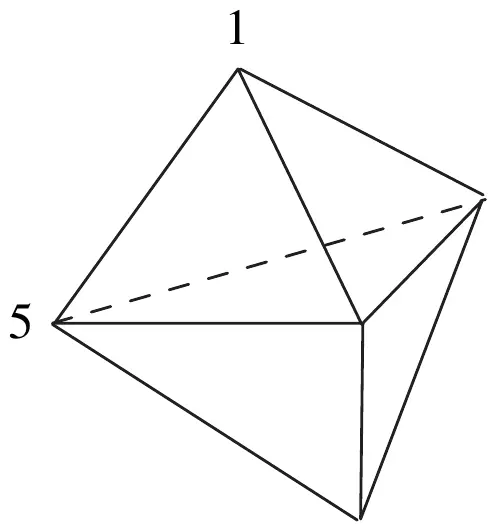
3. The diagram shows a solid with six triangular faces and five vertices. Andrew wants to write an integer at each of the vertices so that the sum of the numbers at the three vertices of each face is the same. He has already written the numbers 1 and 5 as shown.
What is the sum of the other three numbers he will write?
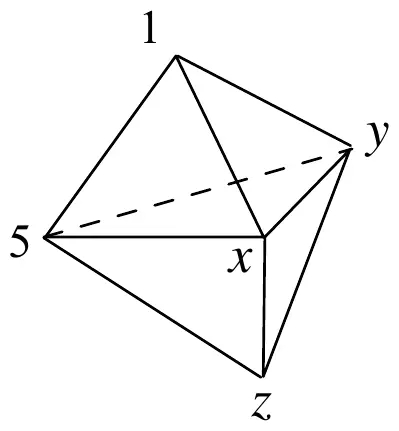
Let the three missing integers be \(x\), \(y\) and \(z\), as shown. Consider the ‘top’ three faces. Since the sum of the three numbers at the vertices of each face is the same, we have \[1 + 5 + x = 1 + x + y = 1 + 5 + y\] and hence \(x = y = 5\). Therefore the sum of the numbers on a face is equal to \(5 + 5 + 1 = 11\). But \(x + y + z\) is equal to the sum of the numbers on a face. Hence the sum of the other three numbers that Andrew will write is 11.
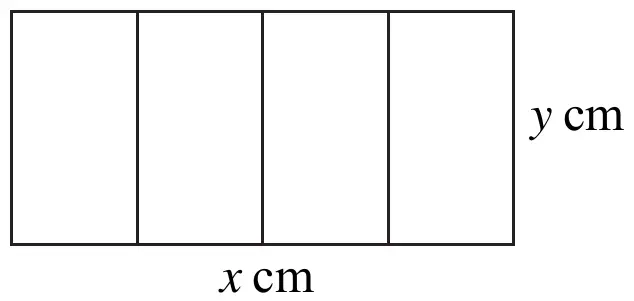
9. A large rectangle is divided into four identical smaller rectangles by slicing parallel to one of its sides. The perimeter of the large rectangle is 18 metres more than the perimeter of each of the smaller rectangles. The area of the large rectangle is 18 m2 more than the area of each of the smaller rectangles. What is the perimeter in metres of the large rectangle?
Let the length of the original rectangle be \(x\) metres and let the height be \(y\) metres. Without losing any generality, assume the rectangle is sliced parallel to the height, as shown. The information in the question tells us that \(2x + 2y = 2\left(\dfrac{x}{4}\right) + 2y + 18\) and that \(xy = \left(\dfrac{x}{4}\right)y + 18\). From the first equation, we have \(\dfrac{3x}{2} = 18\) which has solution \(x = 12\). Substitute this value into the second equation to obtain \(12y = 3y + 18\), which has solution \(y = 2\). Hence the perimeter of the large rectangle in metres is \(2 \times 12 + 2 \times 2 = 28\).
12. Chris planned a 210 km bike ride. However, he rode 5 km/h faster than he planned and finished his ride 1 hour earlier than he planned. His average speed for the ride was \(x\) km/h. What is the value of \(x\)?
Chris's time for the ride when he rode at an average speed of \(x\) km/h was \(\dfrac{210}{x}\) hours. His planned speed was \((x - 5)\) km/h when his time would have been \(\dfrac{210}{x - 5}\) hours. The question tells us that he completed the ride 1 hour earlier than planned, so \(\dfrac{210}{x - 5} - \dfrac{210}{x} = 1\). Therefore \(210x - 210(x - 5) = x(x - 5)\) and hence \(1050 = x^2 - 5x\). Thus \(x^2 - 5x - 1050 = 0\) and hence \((x - 35)(x + 30) = 0\). Therefore, since \(x\) is positive, \(x = 35\).
18. Numbers \(a\), \(b\) and \(c\) are such that \(\dfrac{a}{b + c} = \dfrac{b}{c + a} = \dfrac{c}{a + b} = k\). How many possible values of \(k\) are there?
Consider the equation \(\dfrac{a}{b + c} = \dfrac{b}{c + a}\). Multiply each side by \((b + c)(c + a)\) to get \(a^2 + ac = b^2 + bc\) and so \(a^2 - b^2 + ac - bc = 0\). Therefore \((a - b)(a + b + c) = 0\). Hence \(a = b\) or \(a + b + c = 0\). Similarly, if we consider the equations \(\dfrac{b}{c + a} = \dfrac{c}{a + b}\) and \(\dfrac{c}{a + b} = \dfrac{a}{b + c}\), then \(b = c\) or \(a + b + c = 0\) and \(c = a\) or \(a + b + c = 0\) respectively. Therefore, the possible values of \(k\) when all three equations are satisfied simultaneously occur when \(a = b = c\), giving \(k = \tfrac{1}{2}\), or when \(a + b + c = 0\), giving \(k = -1\). Hence there are two possible values of \(k\).
We'd like to use Google Analytics cookies to count visits and see which pages help most. They're optional, and the site works exactly the same either way. Privacy policy