6 Senior Kangaroo questions from every year we have, newest year first. Use Difficulty › Position in the paper to practise the early (easier) or late (harder) questions, or the Year filter for one year.
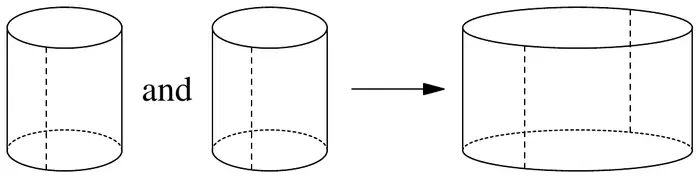
4. Two identical cylindrical sheets are cut open along the dotted lines and glued together to form one bigger cylindrical sheet, as shown. The smaller sheets each enclose a volume of 100. What volume is enclosed by the larger sheet?
Since the circumferences of the smaller cylinder and the larger cylinder are in the ratio \(1 : 2\), the radii of their cross-sections are also in the ratio \(1 : 2\). Therefore the areas of their cross-sections are in the ratio \(1^2 : 2^2 = 1 : 4\). As the cylinders have the same perpendicular height, the volumes they enclose will also be in the ratio \(1 : 4\). Therefore the larger cylinder encloses a volume of \(4 \times 100 = 400\).
15. On an island, kangaroos are always either grey or red. One day, the number of grey kangaroos increased by 28% while the number of red kangaroos decreased by 28%. The ratios of the two types of kangaroos were exactly reversed. By what percentage did the total number of kangaroos change?
Let the initial populations of grey and red kangaroos be \(G\) and \(R\) respectively. After the change, the new populations are \(1.28G\) and \(0.72R\) respectively. As the ratios are reversed, we have \(\tfrac{1.28G}{0.72R} = \tfrac{R}{G}\). Therefore \(R^2 = \tfrac{128}{72} \times G^2 = \tfrac{16G^2}{9}\) and hence \(R = \tfrac{4G}{3}\). The ratio of new population:old population is \((1.28G + 0.72R) : (G + R) = (1.28 + 0.72\tfrac{R}{G}) : (1 + \tfrac{R}{G}) = (1.28 + 0.72 \times \tfrac{4}{3} : (1 + \tfrac{4}{3})\) \(= (3.84 + 2.88) : (4 + 3) = 6.72 : 7 = 0.96 : 1\). Therefore there is a reduction of 4% in the population.
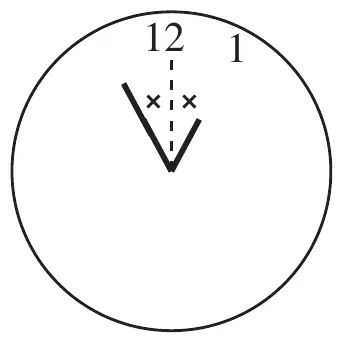
8. Priti is learning a new language called Tedio. During her one hour lesson, which started at midday, she looks at the clock and notices that the hour hand and the minute hand make exactly the same angle with the vertical, as shown in the diagram. How many whole seconds remain until the end of the lesson?
Let the angle that each hand makes with the vertical be \(x\) degrees and let the current time be \(s\) seconds after midday. In one complete hour the hour hand will turn 30°. There are \(60 \times 60 = 3600\) seconds in an hour so it takes \(3600 \div 30 = 120\) seconds for the hour hand to turn one degree. Therefore \(s = 120x\). In one complete hour the minute hand will turn 360°. There are 3600 seconds in an hour so it takes \(3600 \div 360 = 10\) seconds for the minute hand to turn 1°. But the minute hand has turned clockwise through an angle of \((360 - x)°\). Therefore \(s = 10(360 - x)\). Equating the two expressions we have obtained for \(s\) we obtain the equation \(120x = 10(360 - x)\). The solution to this equation is \(x = \dfrac{360}{13}\). Therefore the number of seconds elapsed since midday is \(120 \times \dfrac{360}{13} = \dfrac{43200}{13} = 3323\dfrac{1}{13}\). The number of whole seconds remaining is \(3600 - 3324 = 276\).
3. Andrew has two containers for carrying water. The containers are cubes without tops and have base areas of 4 dm2 and 36 dm2 respectively. Andrew has to completely fill the larger cube with pond water, which must be carried from the pond using the smaller cube. What is the smallest number of visits Andrew has to make to the pond with the smaller cube?
We first observe that any pair of cubes are mathematically similar. These cubes' surface areas are in the ratio 1:9, so that their lengths are in ratio 1:3 and that their volumes are in ratio 1:27. Therefore Andrew may fill the larger cube in 27 visits, provided the smaller cube is completely filled on each occasion.
10. Katherine and James are jogging in the same direction around a pond. They start at the same time and from the same place and each jogs at a constant speed. Katherine, the faster jogger, takes 3 minutes to complete one lap and first overtakes James 8 minutes after starting. How many seconds does it take James to complete one lap?
Katherine catches James after 8 minutes when she has jogged \(\tfrac{8}{3}\) laps. In that time, James will have jogged one lap fewer so will have jogged \(\tfrac{5}{3}\) laps. Therefore, James jogs \(\tfrac{5}{3}\) laps in 8 minutes which is the same as 480 seconds. Hence he will jog \(\tfrac{1}{3}\) of a lap in 96 seconds and so he jogs a whole lap in 288 seconds.
12. Chris planned a 210 km bike ride. However, he rode 5 km/h faster than he planned and finished his ride 1 hour earlier than he planned. His average speed for the ride was \(x\) km/h. What is the value of \(x\)?
Chris's time for the ride when he rode at an average speed of \(x\) km/h was \(\dfrac{210}{x}\) hours. His planned speed was \((x - 5)\) km/h when his time would have been \(\dfrac{210}{x - 5}\) hours. The question tells us that he completed the ride 1 hour earlier than planned, so \(\dfrac{210}{x - 5} - \dfrac{210}{x} = 1\). Therefore \(210x - 210(x - 5) = x(x - 5)\) and hence \(1050 = x^2 - 5x\). Thus \(x^2 - 5x - 1050 = 0\) and hence \((x - 35)(x + 30) = 0\). Therefore, since \(x\) is positive, \(x = 35\).
We'd like to use Google Analytics cookies to count visits and see which pages help most. They're optional, and the site works exactly the same either way. Privacy policy