
SK 2018 Q12
12. The diagram shows a 16 metre by 16 metre wall. Three grey squares are painted on the wall as shown.
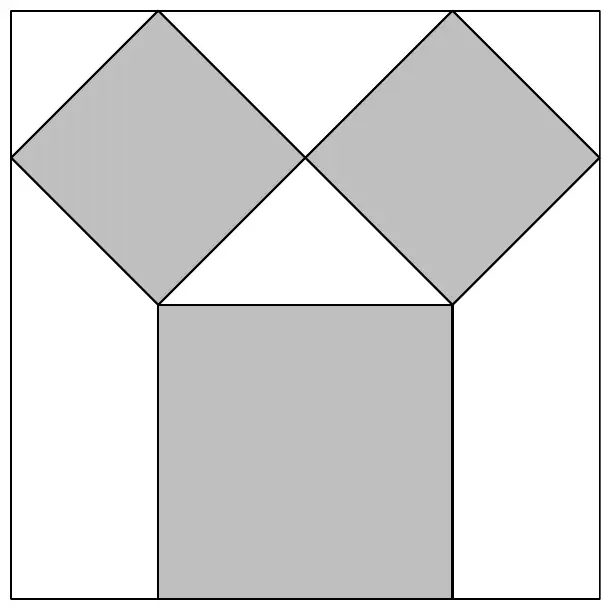
The two smaller grey squares are equal in size and each makes an angle of 45° with the edge of the wall. The grey squares cover a total area of \(B\) metres squared.
What is the value of \(B\)?
Senior Kangaroo 2018, Question 12. © UK Mathematics Trust. Original paper on ukmt.org.uk
Answer: 128
The wall has a width of 16 metres so the diagonal of each smaller grey square is 8 metres. Let the side-length of each smaller grey square be \(x\) metres. Then, by Pythagoras’ Theorem, \(x^2 + x^2 = 8^2\), giving \(x = \sqrt{32}\). Therefore each smaller grey square has an area of 32 m2.
The side-length of the larger grey square is equal to the length of the diagonal of one of the smaller grey squares. Therefore the larger grey square has area \(8^2 = 64\) m2.
Hence the total area covered by the grey squares, \(B\), is \(32 + 32 + 64 = 128\) m2.
Solution © UK Mathematics Trust, from the SK 2018 solutions.