
SK 2015 Q7
7. The diagram shows a triangle \(ABC\) with area 12 cm2. The sides of the triangle are extended to points \(P\), \(Q\), \(R\), \(S\), \(T\) and \(U\) as shown so that \(PA = AB = BS\), \(QA = AC = CT\) and \(RB = BC = CU\).
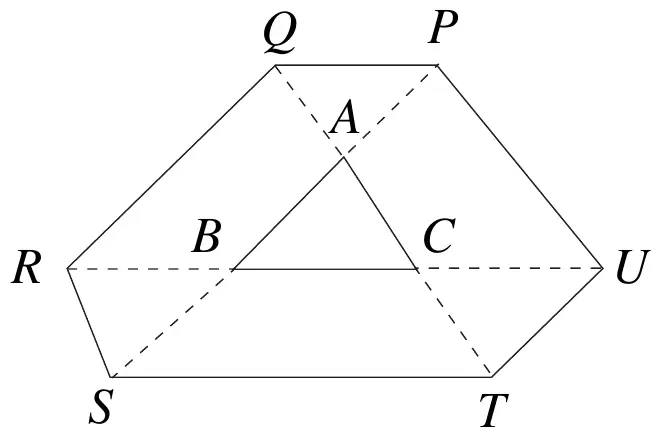
What is the area (in cm2) of hexagon \(PQRSTU\)?
Senior Kangaroo 2015, Question 7. © UK Mathematics Trust. Original paper on ukmt.org.uk
Answer: 156
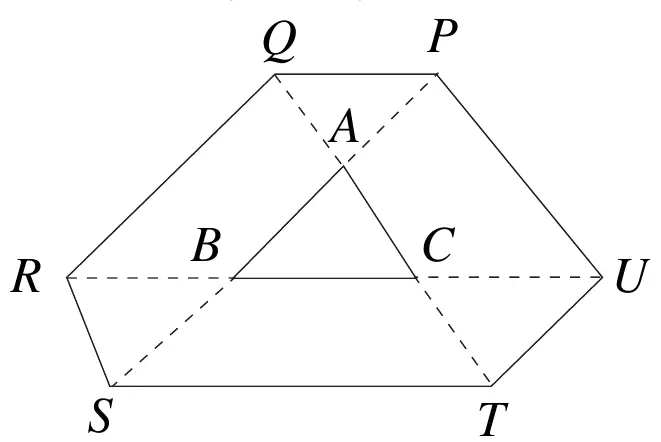
Consider triangles \(ABC\) and \(AST\). Angles \(CAB\) and \(TAS\) are equal because they are the same angle, \(SA = 2BA\) and \(TA = 2CA\). Hence triangles \(ABC\) and \(AST\) are similar. The ratio of their sides is \(1 : 2\) and hence the ratio of their areas is \(1^2 : 2^2 = 1 : 4\). Therefore the area of triangle \(AST\) is \(4 \times 12\) cm2 = 48 cm2 and hence the area of \(BSTC\) is \((48 - 12)\) cm2 = 36 cm2. In a similar way, it can be shown that each of the areas of \(CUPA\) and \(AQRB\) is also 36 cm2. Next consider triangles \(ABC\) and \(APQ\). Angles \(BAC\) and \(PAQ\) are equal using vertically opposite angles, \(AB = AP\) and \(AC = AQ\). Hence triangles \(ABC\) and \(APQ\) are congruent (SAS) and so the area of triangle \(APQ\) is 12 cm2. In a similar way, it can be shown that the each of areas of triangles \(BRS\) and \(CTU\) is also 12 cm2. Hence the total area of hexagon \(PQRSTU\) in cm2 is \((3 \times 36 + 4 \times 12) = 156\).
Solution © UK Mathematics Trust, from the SK 2015 solutions.