23 Ben is trying to make \(m\) the subject of \(p = \dfrac{m}{3} + 5\)
Here is his working.
\[\begin{aligned} p - 5 &= \frac{m}{3} \\ 3 \times p - 5 &= m \\ m &= 3p - 5 \end{aligned}\]
Ben’s answer is wrong.
(a) What mistake has Ben made? (1)
(b) Factorise fully \(2x^3y + 4xy^2\) (2)
Mark scheme (a)
Answer
Mark
Mark scheme
Mistake identified
C1
for identifying the mistake
Acceptable examples \(p - 5\) should be multiplied by 3 (\(-\))5 should be multiplied by 3 All of left side / everything should be multiplied by 3 He failed to multiply the 5 as well He should have / didn’t put brackets around the \(p - 5\) (The \(3p - 5\)) should be \(3p - 15\) (The \(-5\)) should be \(-15\) / (the 5) should be 15 (The answer should be) \(m = 3p - 15\) / \(m = 3(p - 5)\) He only times the \(p\) by 3
Not acceptable examples The first line should be \(3p = m + 5\) He should have multiplied everything Ben didn’t divide \(p - 5\) by 3 He failed to multiply the \(p - 5\) He failed to multiply the (\(-\))5 He only times the \(p\) He should have multiplied by 3 first He only multiplied one side by 3 He needs to get rid of the fraction Should have used brackets Just circling the \(3 \times p - 5\) and / or the \(m = 3p - 5\) Needs to multiply the 5 by \(-3\) He should have done \(p - 5 \times 3\)
Mark scheme (b)
Answer
Mark
Mark scheme
\(2xy(x^2 + 2y)\)
B2
for \(2xy(x^2 + 2y)\) oe eg \(2(x^2 + 2y)xy\)
(B1
for \(2x(x^2y + 2y^2)\) or \(2y(x^3 + 2xy)\) or \(xy(2x^2 + 4y)\) or for correctly identifying the HCF in the factorisation of the form \(2xy(ax^2 \pm \ldots)\) or \(2xy(\ldots \pm by)\) where \(a\) and \(b\) are integers or \((x^2 + 2y)\) as a factor eg \(2x(x^2 + 2y)\))
Additional guidance
\(\ldots\) can be numerical or algebraic but not equal to 0 or absent
2 Ben is trying to make \(m\) the subject of \(p = \dfrac{m}{3} + 5\)
Here is his working.
\[\begin{aligned} p - 5 &= \frac{m}{3} \\ 3 \times p - 5 &= m \\ m &= 3p - 5 \end{aligned}\]
Ben’s answer is wrong.
(a) What mistake has Ben made? (1)
(b) Factorise fully \(2x^3y + 4xy^2\) (2)
Mark scheme (a)
Answer
Mark
Mark scheme
Mistake identified
C1
for identifying the mistake
Acceptable examples \(p - 5\) should be multiplied by 3 (\(-\))5 should be multiplied by 3 All of left side / everything should be multiplied by 3 He failed to multiply the 5 as well He should have / didn’t put brackets around the \(p - 5\) (The \(3p - 5\)) should be \(3p - 15\) (The \(-5\)) should be \(-15\) / (the 5) should be 15 (The answer should be) \(m = 3p - 15\) / \(m = 3(p - 5)\) He only times the \(p\) by 3
Not acceptable examples The first line should be \(3p = m + 5\) He should have multiplied everything Ben didn’t divide \(p - 5\) by 3 He failed to multiply the \(p - 5\) He failed to multiply the (\(-\))5 He only times the \(p\) He should have multiplied by 3 first He only multiplied one side by 3 He needs to get rid of the fraction Should have used brackets Just circling the \(3 \times p - 5\) and / or the \(m = 3p - 5\) Needs to multiply the 5 by \(-3\) He should have done \(p - 5 \times 3\)
Mark scheme (b)
Answer
Mark
Mark scheme
\(2xy(x^2 + 2y)\)
B2
for \(2xy(x^2 + 2y)\) oe eg \(2(x^2 + 2y)xy\)
(B1
for \(2x(x^2y + 2y^2)\) or \(2y(x^3 + 2xy)\) or \(xy(2x^2 + 4y)\) or for correctly identifying the HCF in the factorisation of the form \(2xy(ax^2 \pm \ldots)\) or \(2xy(\ldots \pm by)\) where \(a\) and \(b\) are integers or \((x^2 + 2y)\) as a factor eg \(2x(x^2 + 2y)\))
Additional guidance
\(\ldots\) can be numerical or algebraic but not equal to 0 or absent
21 Make \(a\) the subject of the formula \(\quad p = 3a - 9\) (2)
Mark scheme
Answer
Mark
Mark scheme
\(a = \dfrac{p+9}{3}\)
M1
for correct first step to rearrange eg \(\;p + 9 = 3a - 9 + 9\;\) or \(\;\dfrac{p}{3} = \dfrac{3a - 9}{3}\;\) oe or answer ambiguously shown eg \(\;a = p + 9 \div 3\) or given as \(\dfrac{p+9}{3}\) oe
A1
oe
Additional guidance
May be seen in different equivalent forms but must be carried out, not just intention seen.
28 The number of days, \(d\), that it will take to build a house is given by
\[d = \frac{720}{n}\]
where \(n\) is the number of workers used each day.
Ali’s company will take 40 days to build the house. Hayley’s company will take 30 days to build the house.
Hayley’s company will have to use more workers each day than Ali’s company.
How many more? (3)
Mark scheme
Answer
Mark
Mark scheme
6
M1
for \(720 \div 40\ (= 18)\) or \(720 \div 30\ (= 24)\)
M1
for a complete process eg \((720 \div 30) - (720 \div 40)\) or \(\text{``}18\text{''} \times 4/3 - \text{``}18\text{''}\) or \(\text{``}24\text{''} - \text{``}24\text{''} \times 3/4\)
Here is Spencer’s method to make \(q\) the subject of the formula.
\(2 \times T = q + 5\) \(q = 2T - 5\)
What mistake did Spencer make in the first line of his method? (1)
Mark scheme
Answer
Mark
Mark scheme
Mistake identified
C1
for a correct mistake identified Acceptable examples all three terms should be multiplied by 2 and not just two of them the 5 should be multiplied by 2 it should be \(2 \times T = q + 2 \times 5\) should subtract 5 first (before multiplying by 2) Not acceptable examples Should remove the 5 first \(2 \times T\) should be \(2T\) should have got rid of the denominator
19 Make \(x\) the subject of the formula \(y = 2x + 4\) (2)
Mark scheme
Answer
Mark
Mark scheme
\(x = \dfrac{y - 4}{2}\)
M1
for correct first step to rearrange eg \(y - 4 = 2x + 4 - 4\) or \(\dfrac{y}{2} = \dfrac{2x + 4}{2}\) or ambiguously shown eg \(x = y - 4 \div 2\) or answer given as \(\dfrac{y - 4}{2}\)
A1
oe
Additional guidance
For the M1: May be seen in different equivalent forms but must be carried out, not just intention seen. Could be shown as a flow diagram but must have correct inverse operations
(c) Make \(m\) the subject of the formula \(v = \sqrt{\dfrac{2E}{m}}\) (3)
Mark scheme (a)
Answer
Mark
Notes
\(\dfrac{3}{x + 1}\)
1
B1 oe
Mark scheme (b)
Answer
Mark
Notes
\(-2.5\)
3
M1 for attempting to multiply both sides by 5 as a first step and cancelling the LHS (can be implied by equations of the form \(15 - x = 15x + ?\) or \(15 - x = ?x + 55\)) M1 for method to isolate terms in \(x\) and number terms from \(ax + b = cx + d\) A1 for \(-2.5\) oe OR M1 for splitting the LHS correctly into two parts \(\dfrac{15}{5} - \dfrac{x}{5} = 3x + 11\) M1 for method to isolate terms in \(x\) and number terms from \(ax + b = cx + d\) A1 for \(-2.5\) oe
Mark scheme (c)
Answer
Mark
Notes
\(m = \dfrac{2E}{v^2}\)
3
M1 for a method to remove square root or clear fraction as a first step M1 for a method to remove square root and clear fraction A1 for \(m = \dfrac{2E}{v^2}\)
23 The body mass index, \(B\), for a person of mass \(m\) kg and height \(h\) metres is given by the formula
\[B = \frac{m}{h^2}\]
Usman has a mass of 50 kg. He has a height of 1.57 m.
(a) Work out Usman’s body mass index. Give your answer correct to one decimal place. (2)
Tom’s height is 1.80 m. He wants his body mass index to be 21
(b) Work out the mass that will give Tom a body mass index of 21 (2)
Tom is a ski jumper. The maximum length of skis he can use is 145% of his height. Tom’s height is 1.80 m.
(c) Work out the maximum length of skis Tom can use. (3)
Mark scheme (a)
Answer
Mark
Notes
20.3
2
M1 for \(\dfrac{50}{1.57^2}\) oe A1 for answer in range 20.2 to 20.3
Mark scheme (b)
Answer
Mark
Notes
68.04
2
M1 for \((m =)\ 1.8^2 \times 21\) oe A1 cao
Mark scheme (c)
Answer
Mark
Notes
2.61
3
M2 for a complete method to find 145% of 1.8, eg. \(\frac{145}{100} \times 1.80\) oe (M1 for a method to find 45% of 1.8, eg. \(\frac{45}{100} \times 1.80\) (= 0.81) or for a multiplication factor of 1.45) A1 cao
(b) Make \(y\) the subject of the formula \[p = \sqrt{\frac{x + y}{5}}\] (3)
Mark scheme (a)
Answer
Mark
Notes
\(10a^5b^4\)
2
B2 cao (B1 for any two of 10, \(a^5\), \(b^4\) in a product)
Mark scheme (b)
Answer
Mark
Notes
\(y = 5p^2 - x\)
3
M1 for a correct first step to either remove the square root, eg. \(p^2 = \dfrac{x + y}{5}\) or clear the fraction, eg. \(\sqrt{5}\,p = \sqrt{x + y}\) M1 (dep) for a method to remove the square root and a method to clear the fraction, eg. \(5p^2 = x + y\) A1 for \(y = 5p^2 - x\)
(a) Write as a single fraction in its simplest form \(\dfrac{5}{2 - x} - \dfrac{4}{x}\) (3)
(b) Make \(y\) the subject of the formula \[t = \frac{2 - 3y}{y + 2}\] (4)
Mark scheme (a)
Answer
Mark
Notes
\(\dfrac{9x - 8}{x(2 - x)}\)
3
M1 for method to use a common denominator, e.g. \(\dfrac{5(x) - 4(2 - x)}{x(2 - x)}\) M1 (dep on M1) for correct expansion of brackets and combination of numerators e.g. \(5x - 8 + 4x\) \((= 9x - 8)\) A1 for \(\dfrac{9x - 8}{x(2 - x)}\) or \(\dfrac{9x - 8}{2x - x^2}\)
Mark scheme (b)
Answer
Mark
Notes
\(y = \dfrac{2 - 2t}{t + 3}\)
4
M1 for intention to multiply both sides by \(y + 2\) as a first step e.g. \(t \times y + 2 = 2 - 3y\) M1 for intention to correctly isolate their \(y\) terms on one side and the other terms on the other side, e.g. \(ty + 3y = 2 - 2t\) M1 for intention to factorise, e.g. \(y(t + 3)\) \((= 2 - 2t)\) A1 for \(y = \dfrac{2 - 2t}{t + 3}\) oe
20 Make \(a\) the subject of the formula \(p = \dfrac{3a + 5}{4 - a}\) (4)
Mark scheme
Answer
Mark
Notes
\(a = \dfrac{4p - 5}{3 + p}\) or
4
M1 for multiplying both sides by \(4 - a\) as the first step M1 (dep) for isolating their two terms in \(a\) M1 (dep) for factorising their two term expression in \(a\) A1 for \(a = \dfrac{4p - 5}{3 + p}\) or \(a = \dfrac{5 - 4p}{-p - 3}\)
(c) Make \(a\) the subject of the formula \(f = \dfrac{a + 1}{2}\) (2)
Mark scheme (a)
Answer
Mark
Notes
\(e(3e + 5)\)
1
B1 for \(e(3e + 5)\)
Mark scheme (b)
Answer
Mark
Notes
4
3
M1 for intention to expand brackets eg \(7k - 21\) or division of all terms on RHS by 7 as a first step M1 for correct method to isolate terms in \(k\) in an equation A1 cao
Mark scheme (c)
Answer
Mark
Notes
\(a = 2f - 1\)
2
M1 for a correct first step eg intention to multiply both sides by 2 A1 cao
M1 for putting LHS over a common denominator with at least one correct numerator (ignore signs) or for showing an intention to multiply each term on both sides by \(R\) or \(v\) or \(b\) M1 for rearranging correctly to isolate terms in \(m\) M1 for factorising with common factor \(m\) from 2 terms A1 for \(m = \dfrac{tv(R - b)}{b(R - v)}\) oe
12 You can change temperatures from °F to °C by using the formula \[C = \frac{5(F - 32)}{9}\]
\(F\) is the temperature in °F. \(C\) is the temperature in °C.
The minimum temperature in an elderly person’s home should be 20°C.
Mrs Smith is an elderly person. The temperature in Mrs Smith’s home is 77°F.
*(a) Decide whether or not the temperature in Mrs Smith’s home is lower than the minimum temperature should be. (3)
(b) Make \(F\) the subject of the formula \[C = \frac{5(F - 32)}{9}\] (3)
Mark scheme (a)
Answer
Mark
Notes
No, temp is 25°C
3
M1 for substitution of 77 into the RHS of the formula A1 for 25 cao or for 225/9 and 180/9 cao C1 (dep on M1) for conclusion (ft) following from working shown
OR
M1 for substitution of 20 into LHS of formula and correct process to find F A1 for 68 cao C1 (dep on M1) for conclusion (ft) following from working shown
Mark scheme (b)
Answer
Mark
Notes
\(F = \dfrac{9}{5}C + 32\)
3
M1 for expansion of the brackets (eg \(5 \times F - 5 \times 32\)) or an attempt to multiply both sides by 9, or divide both sides by 5 as the first step. M1 (dep) for a correct second step A1 for \(F = \dfrac{9}{5}C + 32\) oe
(b) Make \(m\) the subject of \[g - 3m = am + 5\] (3)
Mark scheme (a)
Answer
Mark
Notes
\((2x + 3)(2x - 3)\)
1
B1 cao
Mark scheme (b)
Answer
Mark
Notes
\(m = \dfrac{g - 5}{a + 3}\)
3
M1 for correct processes to isolate terms in \(m\) from other terms M1 for taking \(m\) out as a common factor A1 for \(m = \dfrac{g - 5}{a + 3}\) or \(m = \dfrac{5 - g}{-a - 3}\)
18 Make \(p\) the subject of the formula \[y = 3p^2 - 4\] (3)
Mark scheme
Working
Answer
Mark
Notes
\(3p^2 = y + 4\) \(p^2 = \dfrac{y + 4}{3}\)
\(p = \sqrt{\dfrac{y + 4}{3}}\)
3
M1 for clear intention to add 4 to both sides or divide all terms by 3 (with at least 3 terms) M1 for clear intention to find the square root from \(p^2\) = (expression in \(y\)) A1 for \(p = \sqrt{\dfrac{y + 4}{3}}\) oe (accept \(\pm\) a correct root)
M1 for correct method to clear fraction or remove square root sign M1 (dep) for a fully correct method to both clear fraction and remove square root sign A1 for \(k = 4m^2 - 1\) or \(k = (2m + 1)(2m - 1)\)
M1 for intention to multiply both sides by \(4 + t\) eg \(p \times 4 + t = 3 - 2t\) M1 for intention to correctly move their \(t\) terms to one side, and correctly move their other terms to the other side eg \(p \times 4 + t - 4p + 2t = 3 - 2t + 2t - 4p\) M1 for intention to factorise eg \(t(p \pm 2)\) A1 for \(t = \dfrac{3 - 4p}{p + 2}\) oe
(c) Make \(h\) the subject of the formula \(t = \dfrac{gh}{10}\) (2)
Mark scheme (a)
Answer
Mark
Notes
\(6y - 15\)
1
B1 cao
Mark scheme (b)
Answer
Mark
Notes
\(4x(2x + y)\)
2
B2 cao (B1 for \(x(8x + 4y)\) or \(2x(4x + 2y)\) or \(4(2x^2 + xy)\) or \(4x(ax + by)\) where \(a\), \(b\) are positive integers or \(ax(2x + y)\) where \(a\) is a positive integer or \(4x(2x\ \ y)\) )
Mark scheme (c)
Working
Answer
Mark
Notes
\(10t = gh\) \(h = \dfrac{10t}{g}\)
\(\dfrac{10t}{g}\)
2
M1 for clear intention to multiply both sides of the equation by 10 (eg. \(\times 10\) seen on both sides of equation) or clear intention to divide both sides of the equation by \(g\) (eg. \(\div g\) seen on both sides of equation) or \(10t = gh\) or \(\dfrac{t}{g} = \dfrac{h}{10}\) or fully correct reverse flow diagram eg. \(\leftarrow \times 10 \leftarrow \div g \leftarrow\) A1 for \(\dfrac{10t}{g}\) oe
B1 for \(2d - 2t\) or \(2t + \dfrac{7}{2}\) oe M1 for rearranging 4 terms correctly to isolate terms in \(t\) e.g. ‘\(2d\)’ – 7 = \(4t\) + ‘\(2t\)’ or \(2d - 7 = 6t\) or \(-6t = 7 - 2d\) seen A1 for \(\dfrac{2d - 7}{6}\) oe
(c) Make \(h\) the subject of the formula \(t = \dfrac{gh}{10}\) (2)
Mark scheme (a)
Answer
Mark
Notes
\(6y - 15\)
1
B1 cao
Mark scheme (b)
Answer
Mark
Notes
\(4x(2x + y)\)
2
B2 cao (B1 for \(x(8x + 4y)\) or \(2x(4x + 2y)\) or \(4(2x^2 + xy)\) or \(4x(ax + by)\) where \(a\), \(b\) are positive integers or \(ax(2x + y)\) where \(a\) is a positive integer or \(4x(2x - y)\))
Mark scheme (c)
Working
Answer
Mark
Notes
\(10t = gh\) \(h = \dfrac{10t}{g}\)
\(\dfrac{10t}{g}\)
2
M1 for clear intention to multiply both sides of the equation by 10 (eg. ×10 seen on both sides of equation) or clear intention to divide both sides of the equation by \(g\) (eg. \(\div g\) seen on both sides of equation) or \(10t = gh\) or \(\dfrac{t}{g} = \dfrac{h}{10}\) or fully correct reverse flow diagram eg. ← ×10 ← \(\div g\) ← A1 for \(\dfrac{10t}{g}\) oe
18 Rearrange \(\quad y = \dfrac{x + 8}{x} \quad\) to make \(x\) the subject. [3 marks]
Mark scheme
Answer
Mark
Comments
\(xy = x + 8\) or \(y = 1 + \dfrac{8}{x}\)
M1
oe equation with fraction eliminated or oe equation with single fraction split into two terms eg \(y \times x = x + 8\) or \(y = \dfrac{x}{x} + \dfrac{8}{x}\)
oe equation with \(x\) the subject eg \(-\dfrac{8}{1 - y} = x\)
Additional guidance
Up to M2 may be awarded for correct work with no answer or incorrect answer, even if this is seen amongst multiple attempts
Correct answer in working with answer repeated on answer line without \(x =\) eg \(x = \dfrac{8}{y - 1}\) seen in working with answer \(\dfrac{8}{y - 1}\)
M1M1A1
Do not allow incorrect simplification after correct answer seen eg \(x = \dfrac{8}{y - 1} \qquad x = \dfrac{8}{y} - 8\)
M2A0
\(xy - x - 8 = 0\) with no further correct working
25 Rearrange \(\quad g = 3h - 1 \quad\) to make \(h\) the subject. [2 marks]
Mark scheme
Answer
Mark
Comments
\(3h = g + 1\) or \(g + 1 = 3h\) or \(h - \dfrac{1}{3} = \dfrac{g}{3}\) or \(\dfrac{g}{3} = h - \dfrac{1}{3}\) or \(\dfrac{g + 1}{3}\) or \(\dfrac{g}{3} + \dfrac{1}{3}\)
16 Rearrange this formula to make \(a\) the subject.
\(p = \dfrac{a + 2b}{3 - a}\) [4]
Mark scheme
Answer
Marks
Part marks and guidance
\(a = \frac{3p - 2b}{1 + p}\) final answer
4
For 4 marks accept \(a = \frac{2b - 3p}{-p - 1}\) as final answer If answer \(a\) = 3\(p\) – 2\(b\)/1 + \(p\) check working and if seen written correctly allow 4 marks
M1 for \(p(3 - a) = a + 2b\) or better
M1 for expanding bracket
Each method step FT previous step \(3p - pa = a + 2b\) if correct, implies M1M1
M1 for isolating terms in \(a\)
\(3p - 2b = a + pa\) if correct Dep on at least two terms in \(a\) when fraction removed
M1 for removing \(a\) as a factor and dividing by bracket to the answer
(a) Show that the formula \(v = u + at\) can be rearranged to \(a = \dfrac{v - u}{t}\). [1]
(b) Use the formula \(a = \dfrac{v - u}{t}\) to find the acceleration, \(a\) m/s\(^2\), when a particle takes 4 seconds to increase from an initial velocity of 3 m/s to a final velocity of 9 m/s. [2]
Mark scheme (a)
Answer
Marks
Part marks and guidance
\(v - u = at\) seen as single statement
1
Accept e.g. \(-v + u = -at\) but not e.g. \(\dfrac{v - u}{t} = at \div t\)
Mark scheme (b)
Answer
Marks
Part marks and guidance
1.5 oe
2
M1 for correct substitution \(\dfrac{9 - 3}{4}\) oe
e.g. \(1\frac{1}{2}\) or \(\frac{6}{4}\) or \(\frac{3}{2}\)
For M1 accept a two-step evaluation with an arithmetic slip eg \(9 - 3 = 5\) followed by \(5 \div 4\) Do not accept \(\dfrac{3 - 9}{4}\) for M1
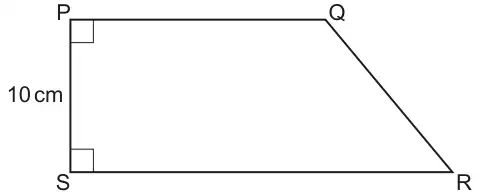
SR is 6 cm longer than PQ. The area of quadrilateral PQRS is \(A\) cm2.
Write a simplified expression for the length PQ in terms of \(A\). You must show your working. [5]
Mark scheme
Answer
Marks
Part marks and guidance
\(\frac{A}{10} - 3\) or \(\frac{1}{10}(A - 30)\) or \(\frac{A - 30}{10}\) with correct working
or other simplified equivalents
5
B4 for \(\frac{A\text{cm}^2}{10} - 3\) etc with correct working
OR
The below assumes PQ = \(x\). Mark similarly use of SR = \(x\).
M2 for \(10x + \frac{1}{2} \times 6 \times 10\) or \(\frac{10(x + x + 6)}{2}\) oe or for \(10x\) and 30, may be indicated on diagram A1 for [\(A\) =] \(10x + 30\) or \(10(x + 3)\)
or
M1 for lengths \(x\) and \(x + 6\) oe or for area \(10x\) or area 30
AND
M1FT for \(10x = A - 30\) or \(x + 3 = \frac{A}{10}\)
If 0 or 1 scored, instead award SC2 for \(\frac{A}{10} - 3\) or \(\frac{1}{10}(A - 30)\) or \(\frac{A - 30}{10}\) with no or insufficient working
‘Correct working’ requires evidence of at least M2
Condone use of PQ, PQ + 6 etc instead of \(x\) and \(x + 6\)
Working may be on diagram
For M2 accept area \(A - 30\) for area \(10x\)
For A1 accept equivalents such as \(\frac{A}{5} = 2x + 6\), \(2A = 20x + 60\)
For M and A marks, both lengths must be in terms of the same variable eg PQ and PQ + 6, not \(x\) and \(y\) unless \(y = x + 6\) subsequently seen
FT \(ax + b = A\) or \(a(x + b) = A\) (\(a \ne \pm 1\) or 0, \(b \ne 0\))
(a) Rearrange this formula to make \(u\) the subject.\[v^2 = u^2 + 2as\] [2]
(b) A rocket accelerates at 90 m / s2 and travels 270 km. The rocket’s final velocity is 8000 m / s.
Using part (a), or otherwise, calculate the rocket’s initial velocity in m / s. [3]
Mark scheme (a)
Answer
Marks
Part marks and guidance
\(u = [\pm]\sqrt{v^2 - 2as}\) as final answer
2
M1 for [\(u^2\) =] \(v^2 - 2as\)
Mark scheme (b)
Answer
Marks
Part marks and guidance
3924 to 3924.3
3
M2 for \(\sqrt{8000^2 - 2 \times 90 \times 270000}\)
or
M1 for \(\sqrt{8000^2 - 2 \times 90 \times \text{figs } 27}\) or \(8000^2 - 2 \times 90 \times 270000\) or \(8000^2 = u^2 + 2 \times 90 \times 270000\) or for correct substitution seen of \(v = 8000\), \(a = 90\) and \(s\) = figs 27 in their final answer to part (a)
If 0 scored SC1 for 7996 to 7997 as final answer
Condone 3920 as final answer for full marks, following M2
M1 for \(p + 5 = 3r\) or for \(\dfrac{p}{3} = r - \dfrac{5}{3}\) or for answer \(\dfrac{p + 5}{3}\) or \(\dfrac{p}{3} + \dfrac{5}{3}\) or for correct step to answer after incorrect first step shown
(a) A car accelerates at 4.06 m/s2 for 10.1 seconds from an initial velocity of 2.93 m/s.
Harper rounds each value to 1 significant figure. Harper uses the rounded values and the formula
\[s = ut + \tfrac{1}{2}at^2\]
to estimate the distance travelled in the 10.1 seconds. Harper’s answer is 430 metres.
Using Harper’s method, show that their answer is wrong. [4]
(b) Rearrange this formula to make \(t\) the subject.\[s = \tfrac{1}{2}at^2\]
[3]
Mark scheme (a)
Answer
Marks
Part marks and guidance
\(s = 230\) with 4, 3 and 10 or 100 seen
4
B2 for 4, 3 and 10 or 100 or B1 for two correct
For all marks condone e.g. 3.00, 4.0, 10.0 used These values may be written in the stem of the question
AND M1 for \((3 \times 10) + \tfrac{1}{2}(4 \times 10^2)\) or correct substitution of unrounded or incorrectly rounded values
If 0 scored then SC1 for sight of 230
For M1 e.g. allow a mixture \((2.93 \times 10.1) + \tfrac{1}{2}(4.1 \times 10^2)\)
Mark scheme (b)
Answer
Marks
Part marks and guidance
\(t = [\pm]\sqrt{\dfrac{2s}{a}}\) oe final answer
3
Square root must dip below fraction line in final answer unless \(\left(\frac{2s}{a}\right)\) bracketed For 3 marks oe e.g. \(t = [\pm]\sqrt{\dfrac{2 \times s}{a}}\), \(t = \sqrt{\dfrac{s}{\frac{1}{2}a}}\)
M2 for first two steps correctly completed e.g. \(\frac{2s}{a} = t^2\) or answer \([\pm]\sqrt{\dfrac{2s}{a}}\) (no \(t =\) )
M2 for e.g. \(\dfrac{s}{\frac{a}{2}} = t^2\), \(\dfrac{s}{\frac{1}{2}a} = t^2\), \(\dfrac{s}{0.5a} = t^2\)
or M1 for first step correctly completed e.g. \(2s = at^2\) or \(\frac{s}{a} = \frac{1}{2}t^2\)
Allow M1 for \(\frac{s}{0.5} = at^2\) oe
If 0 scored, SC1 for final answer \(t = [\pm]\sqrt{\dfrac{\frac{1}{2}s}{a}}\) oe
Write \(z\) in terms of \(x\). Give your answer in its simplest form. [4]
Mark scheme
Answer
Marks
Part marks and guidance
\(z = 17 - 2x^2\) final answer
4
B3 for answer \(17 - 2x^2\) OR M3 for \(7 = 4\left(\dfrac{x^2 - 5}{2}\right) + z\) oe or \(2x^2 + z = 17\) oe or \(x^2 - 2\left(\dfrac{7 - z}{4}\right) = 5\) or better
Correct unsimplified formula in \(x\) and \(z\)
or M2 for \(y = \dfrac{2x^2 - 10}{4}\) oe or \(y = \dfrac{7 - z}{4}\) oe or \(4y = 2x^2 - 10\) or \((2x^2 - 4y) + (4y + z) = 10 + 7\) oe
M2 sets up for substitution with \(y\) explicit or for method for elimination by equating coefficients of \(y\) and correct method to eliminate \(y\)
or M1 for \(2x^2 - 4y = 10\) or \(-2y = 5 - x^2\) or \(4y = 7 - z\) or better
M1 equates coefficients of \(y\) or first step in rearrangement to eliminate
12 Rearrange this formula to make \(w\) the subject.
\[P = 2h + 2w\]
[2]
Mark scheme
Answer
Marks
Part marks and guidance
\(w = \dfrac{P - 2h}{2}\) oe
2
M1 for \(\dfrac{P - 2h}{2}\) oe or correct first step e.g. \(P - 2h = 2w\) or \(\dfrac{P}{2} = \dfrac{2w}{2} + \dfrac{2h}{2}\) or for next correct step towards isolating \(w\) following first error
Note \(w = \dfrac{2h - P}{-2}\) oe is correct May be \(\dfrac{P}{2} = w + h\)
e.g. Following \(2w = P + 2h\) \(w = \dfrac{P + 2h}{2}\)