for isolating \(k\) terms, eg \(5k = 26 + 4\) or \(5k = 30\) or \(k - \dfrac{4}{5} = \dfrac{26}{5}\) oe or \(26 + 4 \div 5\)
A1
cao
Additional guidance
For M mark step must be carried out not just intention shown. For example, if you see \(5k - 4 = 26\) \(+4 \qquad +4\) award M1 for \(5k = r\) where \(r \gt 26\)
11 Write \(\dfrac{(6x^5y^3)^2}{3x^2y^7 \times 4xy^{-3}}\) in the form \(ax^by^c\) where \(a\), \(b\) and \(c\) are integers. (3)
Mark scheme
Answer
Mark
Mark scheme
\(3x^7y^2\)
M1
for full evaluation of numerator or denominator with at least 2 of 3 terms correct in a product, eg \(36x^{10}y^6\) or \(12x^3y^4\)
or full evaluation of \(\dfrac{6x^5y^3}{3x^2y^7}\) or \(\dfrac{6x^5y^3}{4xy^{-3}}\) with at least 2 of 3 terms correct in a product, eg \(2x^3y^{-4}\) or \(1.5x^4y^6\)
M1
for correct evaluation of numerator and denominator,
eg \(36x^{10}y^6\) and \(12x^3y^4\)
or for full evaluation of numerator and denominator with no more than one error and a final answer of the form \(ax^by^c\) with two of \(a\), \(b\) and \(c\) correct or for correct evaluation of \(\dfrac{6x^5y^3}{3x^2y^7}\) and \(\dfrac{6x^5y^3}{4xy^{-3}}\) eg \(2x^3y^{-4}\) and \(1.5x^4y^6\)
or for full evaluation of \(\dfrac{6x^5y^3}{3x^2y^7}\) and \(\dfrac{6x^5y^3}{4xy^{-3}}\) with no more than one error and a final answer of the form \(ax^by^c\) with two of \(a\), \(b\) and \(c\) correct
for any two of \(12 \div 6\ (= 2)\), \(x^{7-3}\ (= x^4)\), \(y^{3-1}\ (= y^2)\) in a single product or written as a fraction with complete and correct cancelling of at least two terms
(c) Simplify fully \(\dfrac{e \times e \times e \times f}{e \times e \times f \times f}\) (2)
Mark scheme (a)
Answer
Mark
Mark scheme
\(7ab\)
B1
for \(7ab\)
Mark scheme (b)
Answer
Mark
Mark scheme
\(y^3\)
B1
cao
Mark scheme (c)
Answer
Mark
Mark scheme
\(\dfrac{e}{f}\)
M1
for a correct first step, eg. numerator of \(e^3 \times f\) or denominator of \(e^2 \times f^2\) OR \(e \div f\) or \(e \times f^{-1}\) OR relevant crossings out for all the \(e\)’s and all the \(f\)’s
Work out the values of \(a\), \(b\) and \(c\). [3 marks]
Mark scheme
Answer
Mark
Comments
\(2ax^3 + 2x^2 + 4x - 10\) and \(bx^2 + cx\) or \(2ax^3 + (2 + b)x^2 + (4 + c)x - 10\) or \(2a = 12\) or \(a = 6\)
M1
oe correct expansions
allow \(2ax^3 = 12x^3\)
\(2 + b = 7\) or \(b = 5\) or \(4 + c = 3\) or \(c = -1\)
M1
oe equation
\(a = 6\) and \(b = 5\) and \(c = -1\)
A1
SC2 any two of \(a = 6\) and \(b = 5\) and \(c = -1\)
Additional guidance
One correct value without working only scores one mark eg \(a = 6\) and \(b = -5\) and \(c = 1\) with no working eg \(a = -6\) and \(b = 5\) and \(c = 1\) with no working
M1M0A0 M0M1A0
Condone an incorrect \(-10\) in the expansion if A1 is awarded
(a) Write down the value of \(\quad 2a - b\) [1 mark]
(b) Write down the value of \(\quad 2b - 4a\) [1 mark]
(c) You are given that \(\quad 4a - 2b = 10 \quad\) and \(\quad a + c = 3\)
Write an expression in \(a\), \(b\) and \(c\) that is equal to 23
Give your answer in its simplest form.
You must show your working. [2 marks]
Mark scheme (a)
Answer
Mark
Comments
5
B1
Additional guidance
Condone \(10 - 5 = 5\)
B1
Condone \(x = 5\)
B1
\(\dfrac{10}{2}\)
B0
Mark scheme (b)
Answer
Mark
Comments
\(-10\)
B1
Mark scheme (c)
Answer
Mark
Comments
Unsimplified expression in \(a\), \(b\) and \(c\) which would evaluate to 23
M1
eg \(2(4a - 2b) + a + c\) or \(8a - 4b + a + c\) or \(11(a + c) - (4a - 2b)\) or \(11a + 11c - 4a + 2b\)
Simplified expression in \(a\), \(b\) and \(c\) which would evaluate to 23
A1
eg \(9a - 4b + c\) \(7a + 2b + 11c\) SC2 Values assigned to \(a\), \(b\) and \(c\) which satisfy original equations and expression given which has value 23 eg \(a = 3, b = 1, c = 0\) and \(7a + 2b + c\)
Additional guidance
There are infinitely many correct solutions. Allow solutions where the coefficients are not integers if initial working is shown. eg \(3(4a - 2b) - \dfrac{7}{3}(a + c) = \dfrac{29}{3}a - 6b - \dfrac{7}{3}c\)
M1A1
\(5a - 2b + c + 10 = 23\)
M1A1
Condone ‘= 23’ after the expression
Answer using only two variables eg \(2.3(4a - 2b)\)
Do not ignore further incorrect algebraic simplification for B3 \(2a^2 + 15a - 1 = 17a - 1\)
B2
Do not ignore further incorrect algebraic simplification for B2 \(2a + 15a - 1 = 17a - 1 = 16a\) \(2a^2 + 15a - 1 = 17a - 1 = 16a\)
B1
Mark scheme (b)
Answer
Mark
Comments
\(4y(6y - 5)\) or \(-4y(5 - 6y)\)
B2
B1 \(2y(12y - 10)\) or \(-2y(10 - 12y)\) or \(y(24y - 20)\) or \(-y(20 - 24y)\) or \(4(6y^2 - 5y)\) or \(-4(5y - 6y^2)\) or \(2(12y^2 - 10y)\) or \(-2(10y - 12y^2)\)
Additional guidance
Ignore any ‘solutions’ seen eg \(4y(6y - 5)\) in working with 0 and \(\dfrac{5}{6}\) on answer line
B2
Condone \(4y \times (6y - 5)\)
B2
Condone \(y \times (24y - 20)\)
B1
\((4y + 0)(6y - 5)\)
B1
Do not ignore further incorrect algebraic simplification for B2
(a) Write an expression for \(e\) in terms of \(d\). [1 mark]
(b) Write an expression for \(f\) in terms of \(d\). [1 mark]
(c) Work out \(\quad e - f\)
Simplify your answer. [2 marks]
Mark scheme (a)
Answer
Mark
Comments
\(d + 3\) or \(3 + d\)
B1
must be seen in (a)
Additional guidance
Condone \(e = d + 3\) or \(e = 3 + d\)
B1
\(d = e - 3\)
B0
Mark scheme (b)
Answer
Mark
Comments
\(d - 5\)
B1
must be seen in (b)
Additional guidance
Condone \(f = d - 5\)
B1
\(d = f + 5\)
B0
Mark scheme (c)
Answer
Mark
Comments
their \((d + 3) -\) their \((d - 5)\) or \(3 - -5\) or chooses values for \(d\), \(e\) and \(f\) with \(e\) 3 more than \(d\) and \(f\) 5 less than \(d\) and subtracts \(f\) from \(e\) or chooses values for \(e\) and \(f\) with \(e\) 8 more than \(f\) and subtracts \(f\) from \(e\)
M1
oe eg \(d + 3 - d + 5\) or \(3 + d + 5 - d\) ft their expressions in (a) and (b) if both in terms of \(d\) and at least one has a numerical term may be implied by eg \(f = e - 8\)
8
A1ft
correct or ft their expressions in (a) and (b) if both in terms of \(d\) and at least one has a numerical term
Additional guidance
8
M1A1
\((d = 10,)\ e = 13\) and \(f = 5\) and \(13 - 5\)
M1
Only condone missing brackets if recovered
\(d + 3 - d - 5\) and no recovery
M0
\(d + 3 - d - 5\) and answer 8
M1A1
\(d + 3\) in (a), \(5 - d\) in (b) and \(2d - 2\) in (c)
(B1B0)M1A1ft
\(3d\) in (a), \(d - 5\) in (b) and \(2d + 5\) in (c)
(a) For each of the algebraic statements below decide whether it is an equation or an identity.
\((x - 1)(x - 2) = 12\)
is an ..........................
\((x - 1)(x - 2) = x^2 - 3x + 2\)
is an ..........................
\(x^2 = 3x + 10\)
is an ..........................
[1]
(b) A straight line is parallel to \(y = 3x\) and passes through the point \((2, 11)\).
Find the equation of the line in the form \(y = mx + c\). [3]
Mark scheme (a)
Answer
Marks
Part marks and guidance
Equation Identity Equation
1
Mark scheme (b)
Answer
Marks
Part marks and guidance
\(y = 3x + 5\) as final answer
3
B2 for final answer \(3x + 5\) or for a correct equation but not in required form isw
OR
M2 for using \((2, 11)\) correctly in \(y = 3x + c\) oe or M1 for “\(y = 3x + c\)” or for \(y = 3x + k\) oe where \(k\) is any numerical value except 0 or 5 or for correctly substituting \((2, 11)\) in \(y = mx + c\) oe \((m \ne 3)\)
B2 for e.g. \((y - 11) = 3(x - 2)\) or \(y - 3x = 5\) or \(3x - y + 5 = 0\) as the answer B2 for \(y = 3x + 5\) seen in working and subsequently spoilt (excluding changing to a perpendicular gradient)
(a) For each of the algebraic statements below decide whether it is an equation or an identity. [1]
\((x - 1)(x - 2) = 12\)
is an
\((x - 1)(x - 2) = x^2 - 3x + 2\)
is an
\(x^2 = 3x + 10\)
is an
(b) A straight line is parallel to \(y = 3x\) and passes through the point (2, 11).
Find the equation of the line in the form \(y = mx + c\). [3]
Mark scheme (a)
Answer
Marks
Part marks and guidance
Equation Identity Equation
1
Mark scheme (b)
Answer
Marks
Part marks and guidance
\(y = 3x + 5\) as final answer
3
B2 for final answer \(3x + 5\) or for a correct equation but not in required form isw
B2 for e.g. \((y - 11) = 3(x - 2)\) or \(y - 3x = 5\) or \(3x - y + 5 = 0\) as the answer B2 for \(y = 3x + 5\) seen in working and subsequently spoilt (excluding changing to a perpendicular gradient)
OR
M2 for using (2, 11) correctly in \(y = 3x + c\) oe or M1 for “\(y = 3x + c\)” or for \(y = 3x + k\) oe where \(k\) is any numerical value except 0 or 5 or for correctly substituting (2, 11) in \(y = mx + c\) oe \((m \ne 3)\)
e.g. \(11 = 3 \times 2 + c\) e.g. \(11 = \frac{1}{3} \times 2 + c\)
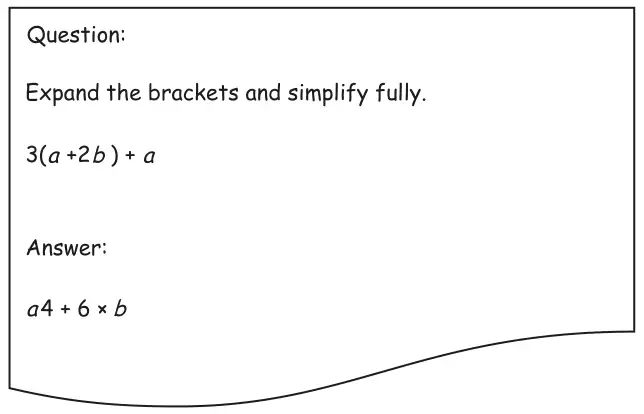
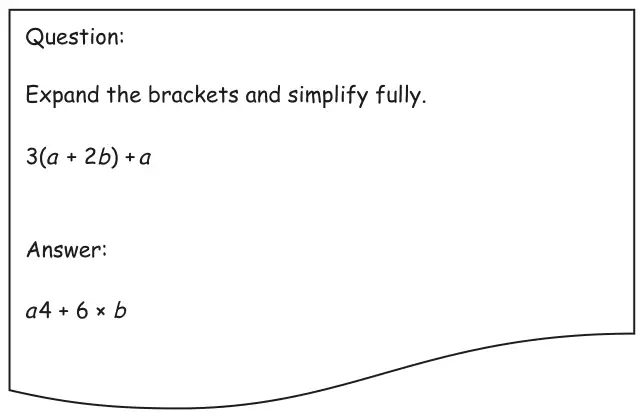
Reason includes a4 should be written as \(4a\) oe or the 4 is written after the \(a\) oe
and
\(6 \times b\) should be written as \(6b\) oe or the 6 and \(b\) should not be separated oe
2
B1 for correct explanation for one term a4 should be written as \(4a\) oe or the 4 is written after the \(a\) oe
or
\(6 \times b\) should be written as \(6b\) oe or the 6 and b should not be separated oe
or
correct expression written \(4a + 6b\)
Must refer to error in each term for 2 marks Incorrect statements apply penalty 1 mark if 2 marks earned
See appendix 3
Appendix
APPENDIX 3 Question 20
Answers that imply the brackets have been multiplied incorrectly treat as incorrect statements Do not accept for 2 marks \(4a + 6b\) alone without some explanation but allow for B1
Response
Mark
A
He didn’t put the 6 and the \(b\) together to show it is multiplied. He put the 4 after the \(a\) when it should be before (oe)
2
B
Because they separated the \(b\) from the 6 and put the a in front of the 4
2
C
In algebra the 4 should come before the a so it is \(4a\), the multiplication sign is not needed so it should be \(6b\) \(4a + 6b\) should not be simplified so the answer is \(2a + 3b\) (penalty 1 after correct explanation for 2 marks then incorrect statement)
1
D
It is correct \(4a + 6b\)
B1
E
It is not written correctly, it should be \(4a + 6b\) (B1 for \(4a + 6b\))
B1
F
The answer is \(4a + 6b\)
B1
G
Because numbers have to be placed in front of letters BOD for term in \(a\) term in \(b\) not explained
B1
H
Shows \(4a + 6b\) in working and then ‘because they can further simplify the answer by \(2(2a + 3b)\)’
B1
I
It should be \(4a + 6b\), the student has not timesed the 6 and the b together
B1
J
It is \(6b\) not \(6 \times b\) – it has not been fully simplified
B1
K
a4 is incorrect as 4 is the coefficient – it should be \(4a\)
B1
L
The answer should be \(4a + 6b\), he did the \(2b\) calculation wrong he should have multiplied them together by 3 to get the answer
B1
M
The number must be before the letter \(4a + 6b\)
B1
N
\(4a + 6b\) written above answer lines and answer line blank
B1
O
She has put 4 after the \(a\) and has only multiplied the number 2 by 3 without the \(b\) (one correct statement about \(a\))
B1
P
He has put \(4a\) as a power and \(6 \times b\) should be \(6b\), should be \(4a + 6b\) (B1 for \(4a + 6b\))
B1
Q
They should not be separating the 6 and the \(b\) it should be \(6b\)
B1
R
The contents of the bracket were not expanded correctly it should be \(2 \times 3b = 6b\) (not explained error how term is written)
0
S
He has written \(a\)4 and \(6 \times b\) (further explanation about the error needed)
Reason includes \(a4\) should be written as \(4a\) oe or the 4 is written after the \(a\) oe
and
\(6 \times b\) should be written as \(6b\) oe or the 6 and \(b\) should not be separated oe
2
B1 for correct explanation for one term \(a4\) should be written as \(4a\) oe or the 4 is written after the \(a\) oe
or
\(6 \times b\) should be written as \(6b\) oe or the 6 and b should not be separated oe
or
correct expression written \(4a + 6b\)
Must refer to error in each term for 2 marks Incorrect statements apply penalty 1 mark if 2 marks earned
See appendix 2
Appendix 2: Question 8
Answers that imply the brackets have been multiplied incorrectly treat as incorrect statements Do not accept for 2 marks 4a + 6b alone without some explanation but allow for B1
Response
Mark
A
He didn’t put the 6 and the b together to show it is multiplied. He put the 4 after the a when it should be before (oe)
2
B
Because they separated the b from the 6 and put the a in front of the 4
2
C
In algebra the 4 should come before the a so it is 4a, the multiplication sign is not needed so it should be 6b 4a + 6b should not be simplified so the answer is 2a + 3b (penalty 1 after correct explanation for 2 marks then incorrect statement)
1
D
It is correct 4a + 6b
B1
E
It is not written correctly, it should be 4a + 6b (B1 for 4a + 6b)
B1
F
The answer is 4a + 6b
B1
G
Because numbers have to be placed in front of letters (BOD for term in a, term in b not explained)
B1
H
Shows 4a + 6b in working and then ‘because they can further simplify the answer by 2(2a + 3b)’
B1
I
It should be 4a + 6b, the student has not timesed the 6 and the b together
B1
J
It is 6b not 6 x b – it has not been fully simplified
B1
K
a4 is incorrect as 4 is the coefficient – it should be 4a
B1
L
The answer should be 4a + 6b, he did the 2b calculation wrong he should have multiplied them together by 3 to get the answer
B1
M
The number must be before the letter 4a + 6b
B1
N
4a + 6b written above answer lines and answer line blank
B1
O
She has put 4 after the a and has only multiplied the number 2 by 3 without the b (one correct statement about a)
B1
P
He has put 4a as a power and 6 x b should be 6b, should be 4a + 6b (B1 for 4a + 6b)
B1
Q
They should not be separating the 6 and the b it should be 6b
B1
R
The contents of the bracket were not expanded correctly it should be 2 x 3b = 6b (not explained error how term is written)
0
S
He has written a4 and 6 × b (further explanation about the error needed)
15 In this question all measurements are in centimetres.
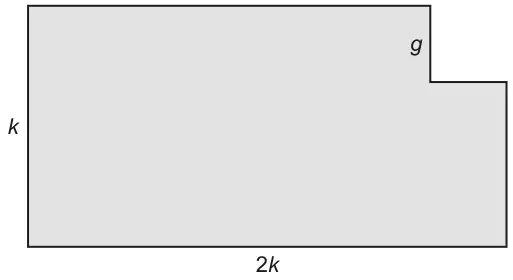
The shaded shape is made by cutting a square from the corner of a rectangle.
The width of the rectangle is \(k\). The length of the rectangle is \(2k\). Each side of the square is \(g\).
(a) Write down the relationship between the length and the width of the rectangle. [1]
(b) Find an expression for the area of the shaded shape. Give your answer in its simplest form. [2]
(c)
(i) Find an expression for the perimeter of the shaded shape. Give your answer in its simplest form. [3]
(ii) Find the value of \(k\) when the perimeter of the shaded shape is 62.4. [2]
Mark scheme (a)
Answer
Marks
Part marks and guidance
The length is twice the width oe or The width is half the length
1
“Twice” or “double” or “half” is not enough unless it is clear that length = 2 × width
Accept \(2k\) is double \(k\) oe or \(L = 2W\) oe
Do not accept values or length = \(2 \times k\)
Mark the best response as long as it is not contradictory or has an incorrect statement
Mark scheme (b)
Answer
Marks
Part marks and guidance
\(2k^2 - g^2\) final answer
2
M1 for \(2k \times k - g \times g\) oe
Ignore units if included oe for M1 may be e.g. \(2k \times k - g^2\)
Mark scheme (c)
Answer
Marks
Part marks and guidance
(i) \(6k\) final answer
3
B2 for correct answer unsimplified or B2 for \(6k - 2g\) [\(+ g + g\)] or M2 for \(2k + k + 2k - g + k - g\) [\(+ g + g\)] oe or M1 for [height =] \(k - g\) or [length =] \(2k - g\)
Condone \(6k + 0\)[\(g\)] for 3 marks Accept in any order Accept e.g. \(2g\) for \(g + g\)
Identified or seen on diagram in correct position
(ii) 10.4 nfww
2
M1 for their part (i) = 62.4 or \(\frac{62.4}{6}\)
Their part (i) must be algebraic in terms of \(k\) or \(k\) and \(g\) Their (a) can be rearranged
Note: \(6k - 2g = 62.4\) scores M1 but does not score the second mark as from wrong working
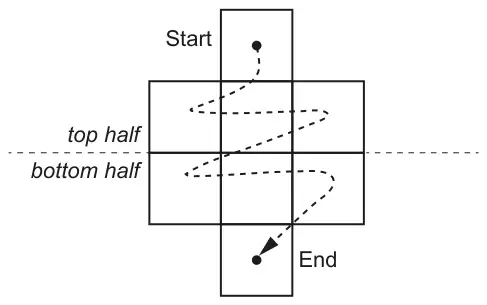
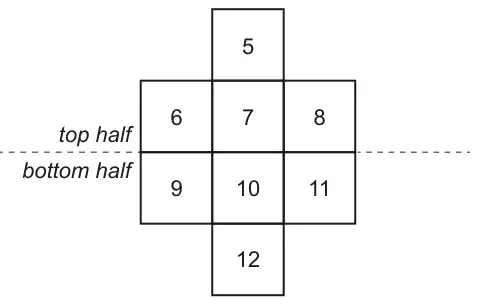
10 Eight consecutive numbers are written in ascending order in this grid, starting from the top and working left to right.
(a) Kareem writes the numbers 5 to 12 in the grid.
Show that for Kareem’s grid, the sum of the numbers in the top half of the grid is 16 less than the sum of the numbers in the bottom half of the grid. [1]
(b)Use algebra to prove that for any set of eight consecutive numbers written in this grid in the same way, the sum of the numbers in the top half of the grid is 16 less than the sum of the numbers in the bottom half of the grid. [5]
Mark scheme (a)
Answer
Marks
Part marks and guidance
(9 + 10 + 11 + 12) – (5 + 6 + 7 + 8) = 16
1
May be shown in stages Accept 42 – 26 = 16
May be explained via sum of differences of paired cells eg 4 × 4 from (9 – 5), (10 – 6) etc
For M2 and M1 FT expressions of form \(an + b\), \(b \ne 0\) eg. Top half: \(2n + (2n + 1) + (2n + 2) + (2n + 3) = 8n + 6\) Bottom half: \((2n + 4) + (2n + 5) + (2n + 6) + (2n + 7) = 8n + 22\) Accept unsimplified or simplified for M marks
M2 for algebraic sums for top half and bottom half of grid or M1 for algebraic sum for top half or bottom half of grid
AND
A1dep for sum of bottom half – sum of top half = 16 shown algebraically or explained from correct working.
A1 is dep on B2M2 scored Condone \(\begin{array}{r} 4n + 22 \\ [-]\ 4n + 6 \\ \hline 16 \end{array}\) A0 for \(4n + 22 - 4n + 6\) or for just 22 – 6 or for use of \(2n\), \(2n + 1\), \(2n + 2\) etc as their algebraic terms
Alternative method for pairs of numbers B2 as above AND M2 for the difference of four pairs of algebraic terms from top and bottom calculated or M1 for the one pair of algebraic terms from top and bottom calculated AND A1dep for all four differences summed to 16 shown numerically or explained from correct working
eg. “difference between \(n\)+4 and \(n\) is 4”
If 0 scored, allow SC1 for a correct numerical or described example showing an overall difference of 16
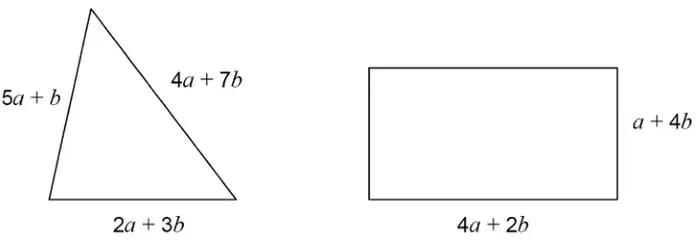
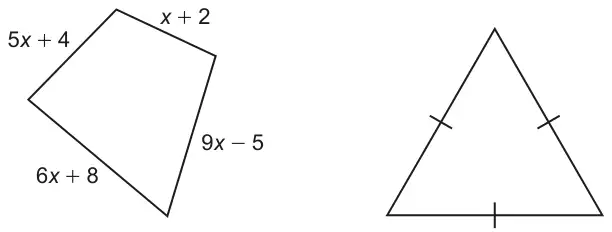
16 The diagram shows a quadrilateral and an equilateral triangle. The perimeter of the quadrilateral is equal to the perimeter of the equilateral triangle.
Not to scale
Find an expression for the length of one side of the equilateral triangle. Give your answer in terms of \(x\) in its simplest form. [4]
Mark scheme
Answer
Marks
Part marks and guidance
\(7x + 3\) final answer
4
M2 for \(21x + 9\) isw or M1 for \(5x + 4 + x + 2 + 9x - 5 + 6x + 8\)
M1 for their \((21x + 9) \div 3\)
Must be an algebraic expression in the form \(ax + b\) \(b \ne 0\)
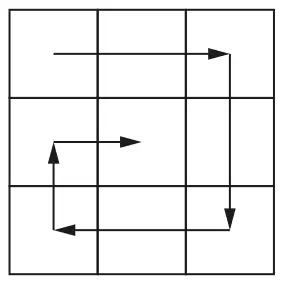
10 Nine consecutive numbers are written on a 3-by-3 grid. They are arranged, in ascending order, in a spiral as shown.
(a) Karen writes the numbers 3 to 11 on her grid.
3
4
5
10
11
6
9
8
7
The total of the first column is \(3 + 10 + 9 = 22\).
Karen says
The total of the first column is one less than the total of the second column.
Show that this is correct for Karen’s grid. [1]
(b) Victor says
If any nine consecutive numbers are arranged in ascending order in this spiral on a 3-by-3 grid, the total of the first column will always be one less than the total of the second column.
Prove that Victor is correct. [5]
Mark scheme (a)
Answer
Marks
Part marks and guidance
4 + 11 + 8 = 23 seen
1
Accept written as a sum in a column
Mark scheme (b)
Answer
Marks
Part marks and guidance
e.g. First column: \(n + (n + 7) + (n + 6) = 3n + 13\)
B2 for consistent algebraic terms for at least first two columns of the grid or B1 for at least 3 algebraic terms for consecutive numbers seen
AND
M1 for algebraic sum of first or second column shown M1 for algebraic sum of first and second columns shown and correctly simplified A1 for sum of second column – sum of first column = 1 calculated or explained from correct working
or
M1 for difference of one pair of algebraic terms from first and second column shown M1 for differences of two further pairs of algebraic terms from first and second column, with all three pairs correctly simplified A1 for each difference found as +1 or –1 oe and summed/explained to a difference of +1. Correct algebra and reasoning throughout
If 0 scored, allow SC1 for a correct numerical or descriptive example using either method and stating an overall difference of 1
e.g. \(n\), \((n + 7)\), \((n + 6)\) and \((n + 1)\), \((n + 8)\), \((n + 5)\)
e.g. \(n\), \((n + 1)\), \((n + 2)\)
e.g. \(n + (n + 7) + (n + 6)\) or in column e.g. \(n + (n + 7) + (n + 6) = 3n + 13\)
A1 for e.g. \(3n + 14\) and \(3n + 13\) and “second column is 1 more than the first” but A0 for e.g. \(3n + 14\) and \(3n + 13\) and “difference of 1” or for \((3n + 14) - 3n + 13 = 1\)
e.g. “the difference between \(n + 1\) and \(n\) is 1” e.g. “\(n + 1\) is 1 more than \(n\)”
13 Prove that the mean of any four consecutive even integers is an integer. [4]
Mark scheme
Answer
Marks
Part marks and guidance
\(\dfrac{(2x) + (2x + 2) + (2x + 4) + (2x + 6)}{4}\) \(= \dfrac{8x + 12}{4}\) \(= 2x + 3\) which is an integer
OR
\((2x) + (2x + 2) + (2x + 4) + (2x + 6)\) \(= 8x + 12\) \(= 4(2x + 3)\) which is divisible by 4 oe
4
M1 for \(2x\), \(2x + 2\), \(2x + 4\) and \(2x + 6\) seen and M1 for adding their four terms in \(x\), e.g. \((2x) + (2x + 2) + (2x + 4) + (2x + 6)\) and M1 for their \((8x + 12) \div 4\) or better, condoning lack of brackets, or for \(4(2x + 3)\) and A1dep (dep on M0M1M1 or M1M1M1) for correct algebraic mean for their four terms and conclusion, e.g. \(2x + 3\) is an integer or \(4(2x + 3)\) which is divisible by 4
If 0 scored, allow SC1 for a numerical example with any 4 consecutive even integers with mean correctly calculated
Or equivalent algebraic representations of 4 consecutive even numbers. In this case, \(x\) does not need to be defined as being an integer.
Using \(x\), \(x + 2\), \(x + 4\), \(x + 6\) oe does not score the first M mark unless \(x\) stated as even integer, but can score up to 3 marks for \((x) + (x + 2) + (x + 4) + (x + 6)\), their \((4x + 12) \div 4\) or better, or for \(4(x + 3)\) and the relevant conclusion
Using \(x + 1\), \(x + 3\), \(x + 5\), \(x + 7\) oe does not score the first M mark unless \(x\) stated as odd integer but can score up to 3 marks similar to above.
13 In this question, assume all dimensions are in centimetres.
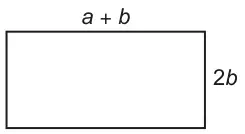
Jess and Pete have many rectangular tiles. Each tile has length \(a + b\) and width \(2b\).
Not to scale
(a) Jess joins three tiles together to make a larger rectangle, as shown.
Not to scale
(i) Write an expression for the perimeter of her rectangle. Give your answer in its simplest form. [2]
(ii) An expression for the area of her rectangle is \(6ab + 6b^2\).
Factorise this expression fully. [2]
(b) Pete joins some tiles together to make a different rectangle. The area of his rectangle is \(8ab + 8b^2\).
Draw a possible arrangement of tiles for Pete’s rectangle. Write down expressions for the length and for the width of the rectangle. [5]
Mark scheme (a)
Answer
Marks
Part marks and guidance
(i) \(6a + 10b\) or \(2(3a + 5b)\) final answer
2
M1 for \(6(a + b) + 2 \times 2b\) oe
If 0 scored SC1 for \(3a + 5b\) as final answer
M1 for EG \(a + b + a + b + a + b + a + b + a + b + a + b + 2b + 2b\) or \(2 \times (3a + 3b + 2b)\) etc
(ii) \(6b(a + b)\) final answer
2
B1 for \(6(ab + b^2)\) or \(b(6a + 6b)\) or \(3(2ab + 2b^2)\) or \(3b(2a + 2b)\) or \(2(3ab + 3b^2)\) or \(2b(3a + 3b)\)
Mark scheme (b)
Answer
Marks
Part marks and guidance
4 by 1 rectangle with \(4a + 4b\) and \(2b\) or 2 by 2 rectangle with \(2a + 2b\) and \(4b\) or 1 by 4 rectangle with \(a + b\) and \(8b\) stated or marked on rectangle
5
B4 for \(4a + 4b\) and \(2b\) or \(2a + 2b\) and \(4b\) or \(a + b\) and \(8b\) or B3 for rectangle drawn as (4 by 1) or (2 by 2) or (1 by 4) or B2 for one of \(2a + 2b\) or \(4a + 4b\) or \(4b\) or \(8b\) or
B1 for any rectangle of 3 or more tiles drawn with \(a+b\) or \(2b\) marked on individual tiles
Accept unsimplified throughout Once correct expression(s) seen, ignore incorrect simplification to answer line In answer space or intended as final length and width
Must clearly be answer
May be in attempt to factorise EG \(4b(2a + b)\) Accept unsimplified EG \(a+b + a+b\)
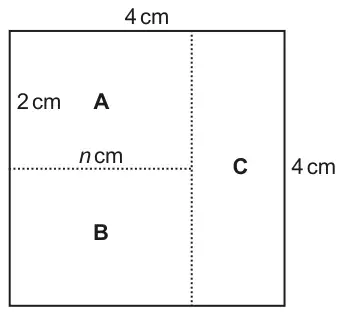
\(\dfrac{16}{6}\) or \(\dfrac{8}{3}\) or \(2\dfrac{4}{6}\) or \(2\dfrac{2}{3}\) or 2.6[6…] or 2.7
3
M1 for \(4(4 - n)\) oe or \(4 \times 4 \div 3\) or better And M1 for their \(4(4 - n) = 2n\) or better or \(2n = \dfrac{16}{3}\) oe or \(4(4 - n) = \dfrac{16}{3}\) oe
Isw Accept eg \(5\dfrac{1}{3}\) or 5.33[…] for \(\dfrac{16}{3}\)