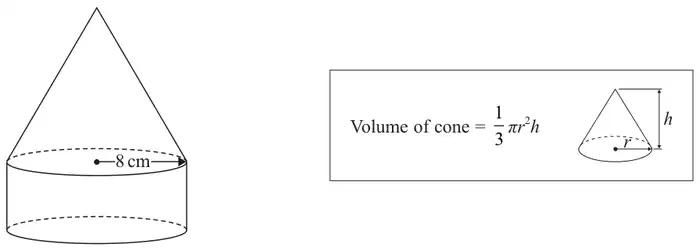
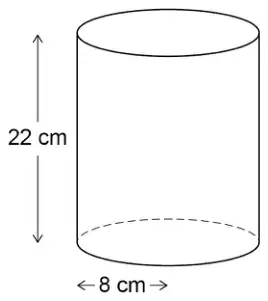
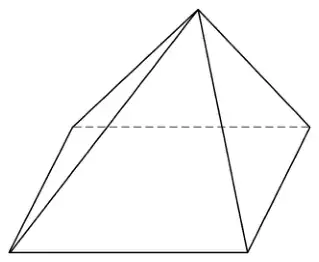
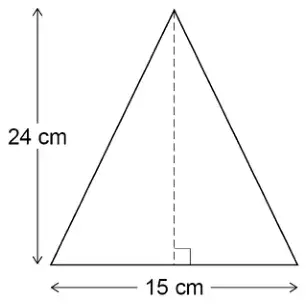
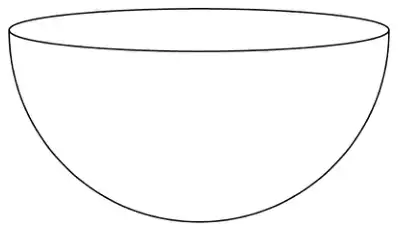
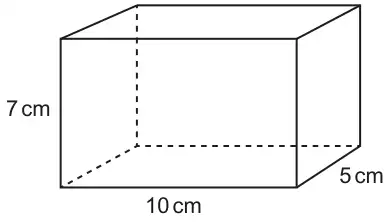
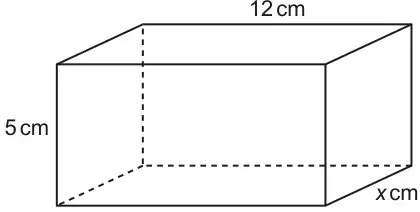
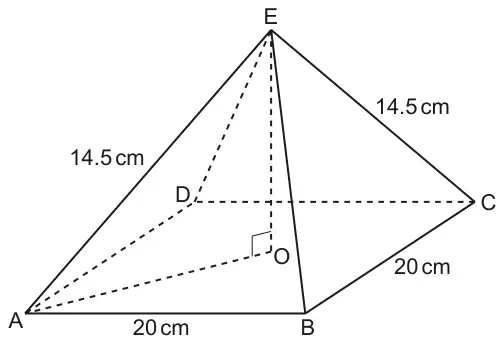
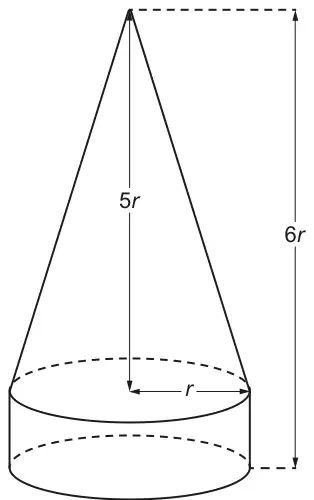
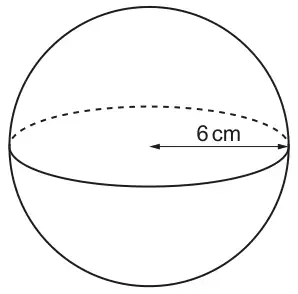
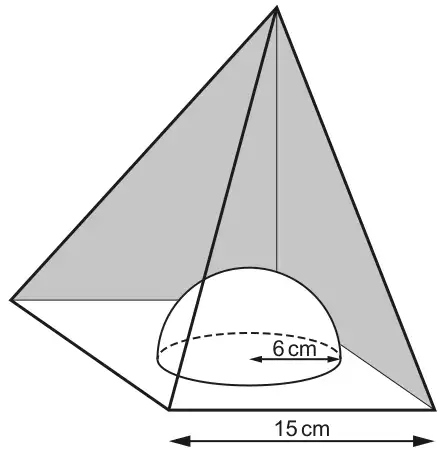
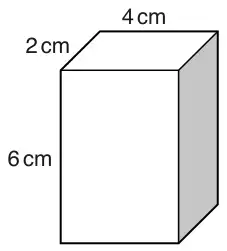
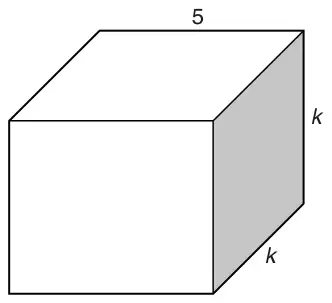
\(h\) = height of the cone \(H\) = height of the cylinder \(x\) = total height of the shape Allow any letter for \(h\), \(H\) and \(x\), does not have to be defined for the award of the marks The award of all marks requires the substitution of \(r = 8\), allow this to be done at a later stage in the question
A correct equation implies the first P1 Allow inconsistent use of \(\pi\) within their equation provided the correct volumes are seen previously
Can be an equation in the form \(ah = p\) or \(bH = q\) or \(cx = r\) where \(a\) or \(b\) or \(c\) is an integer
Award 0 marks for a correct answer with no (or incorrect) supportive working
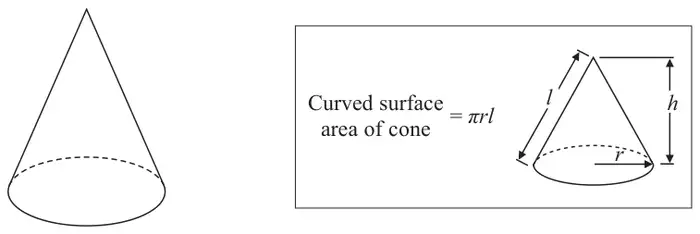
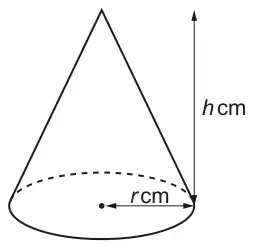
The radius of the base of the cone is \(\dfrac{3}{4}\) of the height of the cone. The total surface area of the cone is \(54\pi\) cm2
Work out the height of the cone. (4)
Mark scheme
Answer
Mark
Mark scheme
6
P1
for starting process, by defining height, radius and using Pythagoras to form an equation for the slant height \(l\) eg height \(= h\), radius \(= \frac{3}{4}h\) and \(l^2 = h^2 + \left(\dfrac{3h}{4}\right)^2 \left(= \dfrac{25}{16}h^2\right)\) or \((l =) \sqrt{h^2 + \left(\dfrac{3h}{4}\right)^2} \left(= \dfrac{5}{4}h\right)\) oe eg \(r = 3x\) and \(h = 4x\) and \(l^2 = (3x)^2 + (4x)^2\)
P1
(dep P1) for process to form a correct expression for the curved surface area in terms of a single variable, eg \(\pi \times \dfrac{3}{4}h \times \text{``}\dfrac{5}{4}h\text{''} \left(= \dfrac{15}{16}\pi h^2\right)\) or \(\pi \times 3x \times \text{``}5x\text{''}\) where \(h = 4x\)
P1
for forming and simplifying a correct equation to find height, eg \(\dfrac{24\pi}{16}h^2 = 54\pi\)
A1
cao
Additional guidance
Can use any other letter than \(h\) provided it is defined eg height \(= x\)
May include area of circle eg \(\pi \times \left(\dfrac{3}{4}h\right)^2 + \pi \times \dfrac{3}{4}h \times \text{``}\dfrac{5}{4}h\text{''} \left(= \dfrac{24}{16}\pi h^2\right)\)
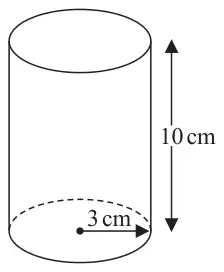
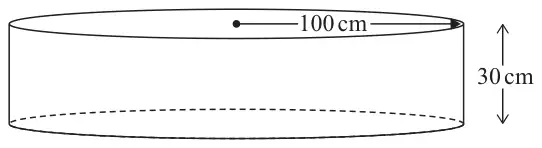
The pool has radius 100 cm. The pool has depth 30 cm.
The pool is empty. It is then filled with water at a rate of 250 cm3 per second.
Work out the number of minutes it takes to fill the pool completely. Give your answer correct to the nearest minute. You must show all your working.(4)
Mark scheme
Answer
Mark
Mark scheme
63
P1
for process to find volume, eg \(\pi \times 100^2 \times 30\ (= 300\,000\pi \text{ or } 942\,477(.796\ldots))\)
P1
for process to find time in seconds, eg \(\text{``}942\,477(.796\ldots)\text{''} \div 250\ (= 1200\pi \text{ or } 3769(.911\ldots))\) or \([\text{volume}] \div 250\) or for converting rate to minutes, eg \(250 \times 60\ (= 15\,000)\)
P1
for complete process, eg \(\text{``}3769(.911\ldots)\text{''} \div 60\ (= 20\pi)\) or \(\text{``}942\,477(.796\ldots)\text{''} \div \text{``}15\,000\text{''}\ (= 20\pi)\)
A1
for answer in the range 62 to 63
Additional guidance
(volume =) 942 478 implies P1
(time =) 3770 implies P2
[volume] \(\ne\) 30, 60, 100, 250
A correct answer with no supportive working gets 0 marks If an answer is shown in the range in working and then incorrectly rounded award full marks
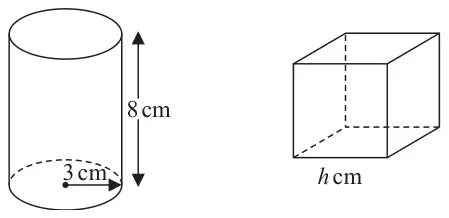
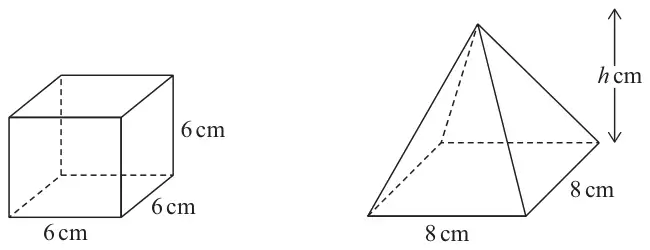
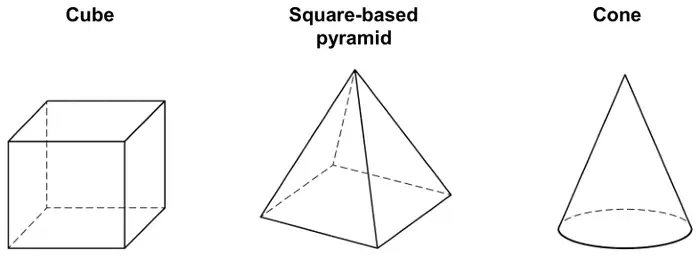
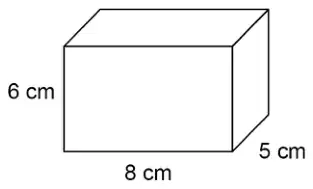
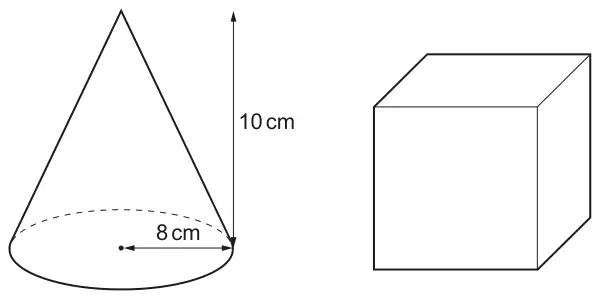
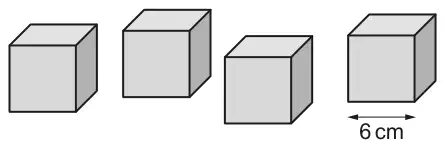
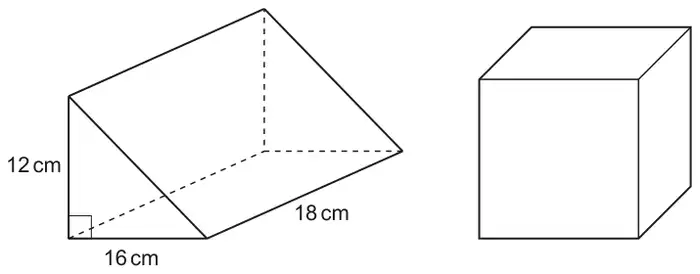
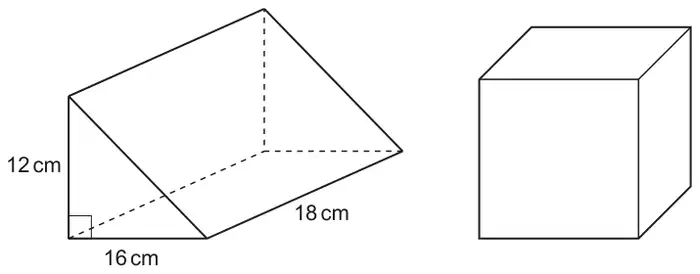
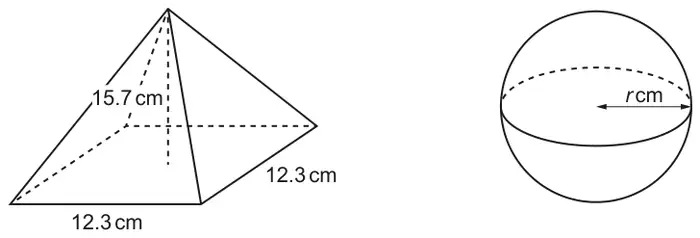
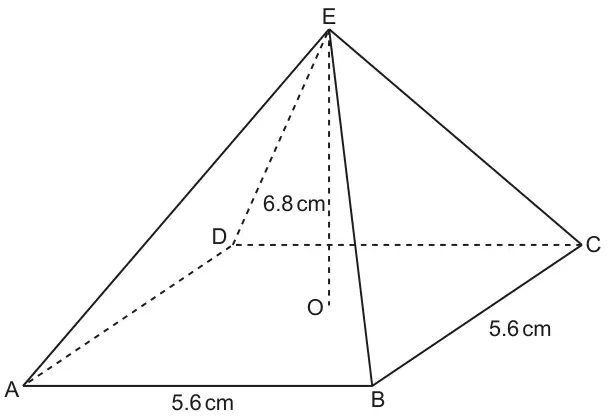
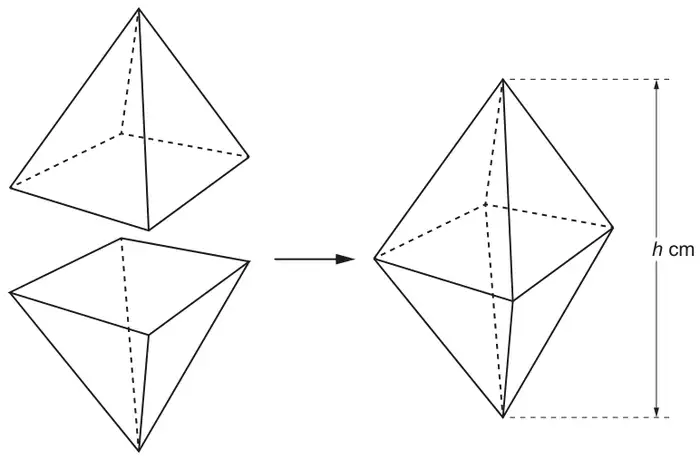
9 The diagram shows a cube and a square-based pyramid.
The volume of the cube is equal to the volume of the pyramid.
Work out the perpendicular height, \(h\) cm, of the pyramid. (3)
Mark scheme
Answer
Mark
Mark scheme
10.125
P1
for process to find volume of at least one of the cube or the pyramid, eg \(6 \times 6 \times 6\ (= 216)\) oe or \(k \times 8 \times 8 \times h\ (= \tfrac{64}{3}h)\) oe
P1
for process to form an equation, eg \(6 \times 6 \times 6 = k \times 8 \times 8 \times h\) or \(\text{``}216\text{''} = \tfrac{64}{3}h\) or for process to find \(h\) eg \(\text{``}216\text{''} \div 8^2 \div k\)
A1
for 10.125 oe mixed number
Additional guidance
Check diagram for working Throughout \(0 \lt k \leqslant 1\)
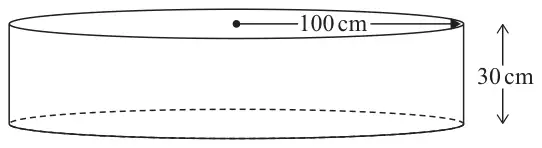
The pool has radius 100 cm. The pool has depth 30 cm.
The pool is empty. It is then filled with water at a rate of 250 cm3 per second.
Work out the number of minutes it takes to fill the pool completely. Give your answer correct to the nearest minute. You must show all your working. (4)
Mark scheme
Answer
Mark
Mark scheme
63
P1
for process to find volume, eg \(\pi \times 100^2 \times 30\ (= 300\,000\pi\) or \(942\,477(.796...))\)
P1
for process to find time in seconds, eg \(\text{``}942\,477(.796...)\text{''} \div 250\ (= 1200\pi\) or \(3769(.911...))\) or \([\text{volume}] \div 250\) or for converting rate to minutes, eg \(250 \times 60\ (= 15\,000)\)
P1
for complete process eg \(\text{``}3769(.911...)\text{''} \div 60\ (= 20\pi)\) or \(\text{``}942\,477(.796...)\text{''} \div \text{``}15\,000\text{''}\ (= 20\pi)\)
A1
for answer in the range 62 to 63
Additional guidance
(volume =) 942 478 implies P1
(time =) 3770 implies P2
\([\text{volume}] \neq 30, 60, 100, 250\)
A correct answer with no supportive working gets 0 marks If an answer is shown in the range in working and then incorrectly rounded award full marks
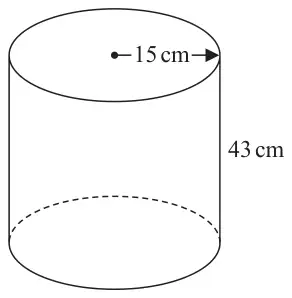
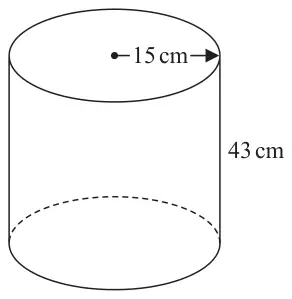
28 The diagram shows an empty tank in the shape of a cylinder.
The cylinder has radius 15 cm and height 43 cm.
Water flows into the tank at a rate of 0.47 litres per minute.
Calculate the number of minutes it will take to completely fill the tank. Give your answer correct to the nearest minute. (4)
Mark scheme
Answer
Mark
Mark scheme
65
P1
for a full process to find the volume of the container, eg \(\pi \times 15^2 \times 43\ (= 30\,394.9\ldots)\)
P1
for a process to convert between cm3 and litres, eg \(\text{``}30\,394.9\ldots\text{''} \div 1000\ (= 30.39\ldots)\) or \([\text{volume}] \div 1000\) or \(0.47 \times 1000\ (= 470)\)
P1
for a complete process to find the time taken, eg \([\text{volume}] \div 0.47\) or \([\text{volume}] \div \text{``}470\text{''}\)
A1
answer in the range 64.6 to 65
Additional guidance
These steps may be completed in a different order
First P1: accept \(9675\pi\)
Second P1: accept \(9.675\pi\) or \(\dfrac{387}{40}\pi\)
[volume] can be any value they believe to be the volume that might have been incorrectly converted (or not at all)
If an answer is given in the range in working and then rounded incorrectly award full marks.
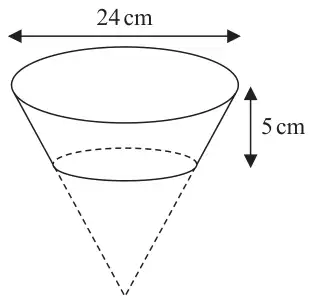
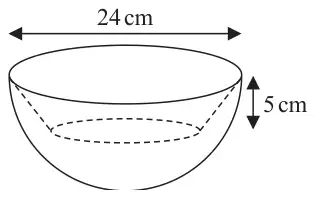
The diagram above shows a frustum F of a cone. The frustum is made by removing a cone with height 10 cm from a solid cone with height 15 cm and base diameter 24 cm.
The solid S is made by removing F from a solid hemisphere as shown in the diagram below.
The hemisphere has diameter 24 cm.
Calculate the volume of solid S. Give your answer correct to 3 significant figures. (4)
Mark scheme
Answer
Mark
Mark scheme
2030
P1
for process to find diameter of base of small cone, eg 16 seen as diameter or 8 seen as radius or for scale factor (length) is \(\tfrac{2}{3}\) oe or \(\tfrac{3}{2}\) oe
P1
for process to find the volume of one cone, eg \(\tfrac{1}{3} \times \pi \times 12^2 \times 15\ (= 720\pi\) or \(2261.946\ldots)\) or \(\tfrac{1}{3} \times \pi \times \text{``}8\text{''}^2 \times 10\ \left(= \tfrac{640}{3}\pi\right.\) or \(\left.670.206\ldots\right)\)
or for process to find the volume of the hemisphere, eg \(\tfrac{2}{3} \times \pi \times 12^3\ (= 1152\pi\) or \(3619.114\ldots)\) or for scale factor (volume) is \(\left(\tfrac{2}{3}\right)^3\) oe
P1
for full process to find volume of frustum and hemisphere, eg \(\text{``}2261.946\ldots\text{''} - \text{``}670.206\ldots\text{''}\ \left(= \tfrac{1520}{3}\pi\right.\) or \(\left.1591.740\ldots\right)\) or \(\text{``}2261.946\ldots\text{''} \times \left(1 - \left(\tfrac{2}{3}\right)^3\right)\) and \(\left(\tfrac{4}{3} \times \pi \times 12^3\right) \div 2\) oe \((= 1152\pi\) or \(3619.114\ldots)\)
A1
for answer in the range 2026 to 2030
Additional guidance
If an answer is shown in the range in working and then incorrectly rounded award full marks.
7 The diagram shows an empty tank in the shape of a cylinder.
The cylinder has radius 15 cm and height 43 cm.
Water flows into the tank at a rate of 0.47 litres per minute.
Calculate the number of minutes it will take to completely fill the tank. Give your answer correct to the nearest minute. (4)
Mark scheme
Answer
Mark
Mark scheme
65
P1
for a full process to find the volume of the container, eg \(\pi \times 15^2 \times 43\ (= 30\,394.9\ldots)\)
P1
for a process to convert between cm3 and litres, eg \(\text{``}30\,394.9\ldots\text{''} \div 1000\ (= 30.39\ldots)\) or \([\text{volume}] \div 1000\) or \(0.47 \times 1000\ (= 470)\)
P1
for a process to find the time taken, eg \([\text{volume}] \div 0.47\) or \([\text{volume}] \div \text{``}470\text{''}\)
A1
answer in the range 64.6 to 65
Additional guidance
These steps may be completed in a different order Accept \(9675\pi\)
Accept \(9.675\pi\) or \(\dfrac{387}{40}\pi\)
[volume] can be any value they believe to be the volume that might have been incorrectly converted (or not at all)
If an answer is given in the range in working and then rounded incorrectly award full marks.
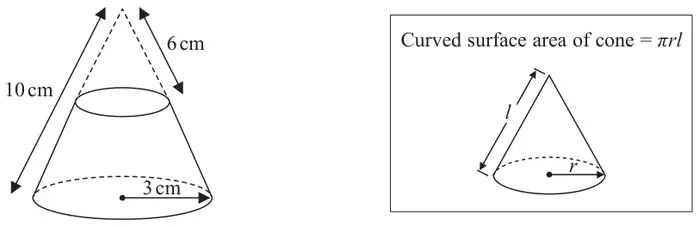
18 A solid frustum is made by removing a small cone from a large cone as shown in the diagram.
The slant height of the small cone is 6 cm. The slant height of the large cone is 10 cm. The radius of the base of the large cone is 3 cm.
Calculate the total surface area of the frustum. Give your answer correct to 3 significant figures. (5)
Mark scheme
Answer
Mark
Mark scheme
98.8
P1
for process to find the radius of the top of the frustum eg \(6 \div 10 \times 3\ (= 1.8)\)
P1
for process to find the curved surface area of the frustum eg \(3 \times \pi \times 10 - \text{``}1.8\text{''} \times \pi \times 6\ (= 60.3\ldots)\)
P1
for process to find the area of either circular face eg \(\pi \times 3^2\ (= 28.27\ldots)\) or \(\pi \times {\text{``}1.8\text{''}}^2\ (= 10.1\ldots)\)
P1
for a process to find the curved surface area + the area of at least one circular face eg \(3 \times \pi \times 10 - \text{``}1.8\text{''} \times \pi \times 6 + \pi \times 3^2\ (= 88.5\ldots)\) or \(3 \times \pi \times 10 - \text{``}1.8\text{''} \times \pi \times 6 + \pi \times {\text{``}1.8\text{''}}^2\ (= 70.49\ldots)\)
A1
for an answer in the range 98.7 to 98.8
Additional guidance
Accept rounded or truncated values Accept multiples of \(\pi\) for process marks.
If a correct answer within the range is shown in working but incorrectly rounded award full marks.
or for setting up an equation, eg \(\dfrac{3}{8} \times 4\pi r^2 = 75\pi\) or \(\dfrac{3}{8} \times 4r^2 = 75\)
P1
for process to find \(r^2\), eg \((r^2 =)\ \dfrac{\text{``}200\pi\text{''}}{4\pi}\) oe or \((r^2 =)\ \dfrac{75\pi}{4\pi} \times \dfrac{8}{3}\) oe or \(r^2 = \text{``}50\text{''}\)
P1
for process to find radius, eg \((r =)\ \sqrt{\dfrac{\text{``}200\pi\text{''}}{4\pi}}\) oe or \(\sqrt{\text{``}50\text{''}}\) or \(5\sqrt{2}\) or for \((2r =) = \sqrt{\text{``}200\text{''}}\)
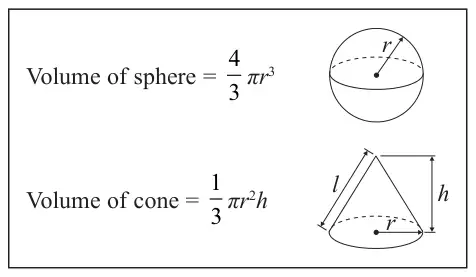
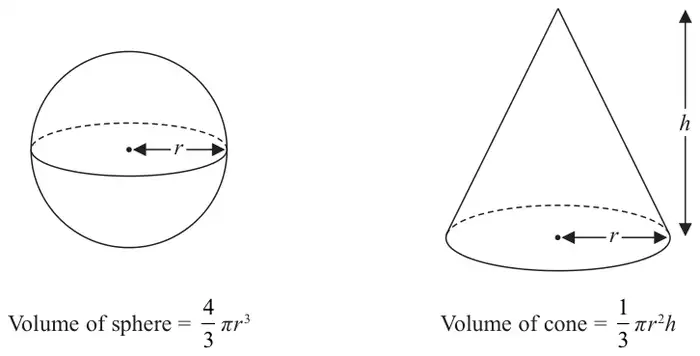
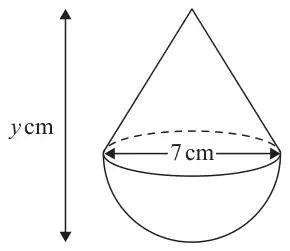
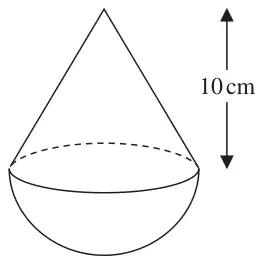
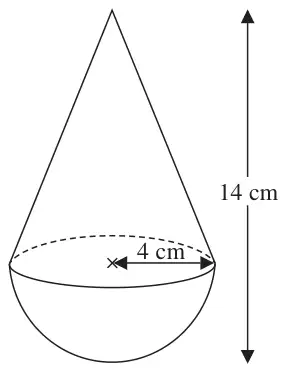
17 A solid cone is joined to a solid hemisphere to make the solid T shown below.
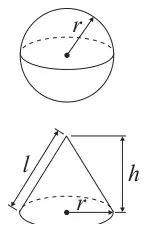
Volume of sphere = \(\dfrac{4}{3}\pi r^3\)
Volume of cone = \(\dfrac{1}{3}\pi r^2 h\)
The diameter of the base of the cone is 7 cm. The diameter of the hemisphere is 7 cm.
The total volume of T is \(120\pi\) cm3 The total height of T is \(y\) cm.
(a) Calculate the value of \(y\). Give your answer correct to 3 significant figures. (4)
The diameter of the base of the cone and the diameter of the hemisphere are both increased by the same amount. Assuming the total volume of T does not change,
(b) explain the effect this would have on your answer to part (a). (1)
Mark scheme (a)
Answer
Mark
Mark scheme
25.9
P1
for process to find volume of hemisphere, eg \(\dfrac{1}{2} \times \dfrac{4}{3} \times \pi \times 3.5^3\ (= 89.797\ldots)\ \left(\dfrac{343\pi}{12}\right)\) or for a correct expression for the volume of the cone, eg \(\dfrac{1}{3} \times \pi \times 3.5^2(y - 3.5)\) or \(\dfrac{1}{3} \times \pi \times 3.5^2 \times h\)
P1
for setting up an equation linking all three aspects, eg \(\dfrac{1}{2} \times \dfrac{4}{3} \times \pi \times 3.5^3 + \dfrac{1}{3} \times \pi \times 3.5^2(y - 3.5) = 120\pi\) or \(\text{``}89.797\ldots\text{''} + \text{``}12.828\ldots\text{''}(y - 3.5) = \text{``}376.99\ldots\text{''}\) or \(\text{``}28.5833\ldots\text{''}\pi + \text{``}4.0833...\text{''}\pi(y - 3.5) = 120\pi\)
P1
for process to isolate \(y\) or \((y - 3.5)\) or \(h\) in their equation, eg \(\dfrac{120\pi - \dfrac{1}{2} \times \dfrac{4}{3}\pi 3.5^3 + \dfrac{1}{3}\pi 3.5^3}{\dfrac{1}{3}\pi 3.5^2}\) or \(\dfrac{\text{``}376.99...\text{''} - \text{``}89.797...\text{''} + \text{``}44.898...\text{''}}{\text{``}12.828...\text{''}}\) or \(\dfrac{120\pi - \text{``}28.583...\text{''}\pi + \text{``}14.291...\text{''}\pi}{\text{``}4.083...\text{''}\pi}\) oe
A1
for answer in range 25.8 to 26.3
SCB3 for an answer in the range 22.3 to 22.8 or \(\dfrac{1097}{49}\)
Additional guidance
‘\(y - 3.5\)’ may be seen as a new variable, but cannot be just \(y\) Condone missing brackets Accept decimals rounded or truncated to 1dp
\(120\pi - \text{``}89.797...\text{''} = 287.193...\) or \(\dfrac{1097\pi}{12}\)
\(\pi\) may be missing throughout Award of this mark implies award of the previous May be seen in multiple steps
If an answer is given in the range in working and then rounded incorrectly award full marks.
Mark scheme (b)
Answer
Mark
Mark scheme
explanation
C1
for explanation, eg Acceptable examples the height would decrease the height would be 0 at 14.227 \(y\) would be smaller it would decrease Not acceptable examples the height would increase
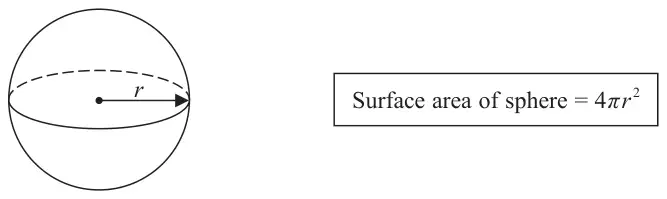
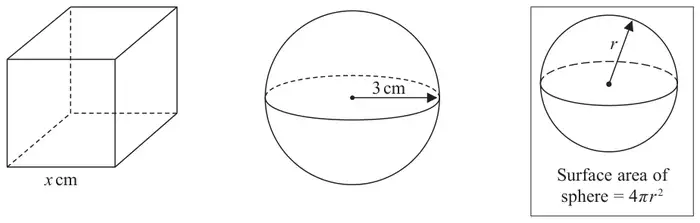
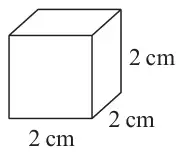
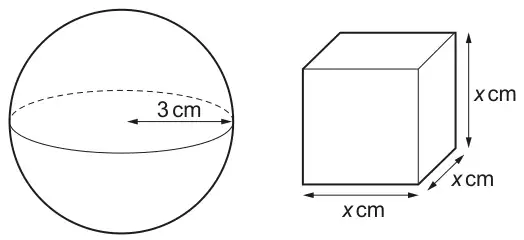
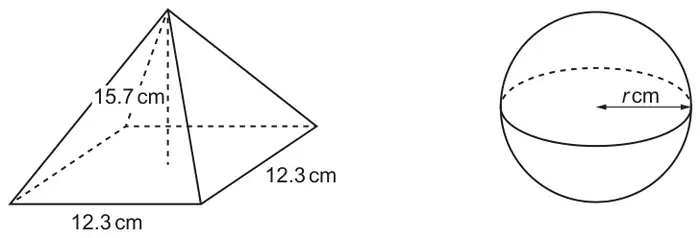
26 The diagram shows a cube with edges of length \(x\) cm and a sphere of radius 3 cm.
The surface area of the cube is equal to the surface area of the sphere.
Show that \(x = \sqrt{k\pi}\) where \(k\) is an integer. (4)
Mark scheme
Answer
Mark
Mark scheme
Shown
M1
for a correct expression for the area of one face of the cube, eg \(x^2\) or a correct expression for the surface area of the cube, eg \(6 \times x^2\)
M1
for a correct expression for the surface area of the sphere, eg \(4 \times \pi \times 3^2\ (= 36\pi)\)
M1
for forming a suitable equation, eg \(6 \times x^2 = 4 \times \pi \times 3^2\) or \(6x^2 = \text{``}36\pi\text{''}\)
A1
for completing the method to \(x = \sqrt{6\pi}\) or \(k = 6\)
Additional guidance
No marks for \(x = \sqrt{6\pi}\) without any working.
The volume of sphere \(A\) is 125 cm\(^3\) The volume of sphere \(B\) is 27 cm\(^3\)
The ratio of the radius of sphere \(B\) to the radius of sphere \(C\) is \(1 : 2\)
Work out the ratio of the surface area of sphere \(A\) to the surface area of sphere \(C\). (3)
Mark scheme
Answer
Mark
Mark scheme
25 : 36
P1
for \(\sqrt[3]{125}\ (= 5)\) and \(\sqrt[3]{27}\ (= 3)\) oe OR for correct process to find the radius of A and radius of B (3.10… and 1.86…)
P1
for method to find values in ratio of length between \(A\) and \(C\) eg 5 and \(2 \times 3\ (= 6)\) oe or \(\text{``}3.10\ldots\text{''}\) and \(\text{``}1.86\ldots\text{''} \times 2\ (= 3.72\ldots)\) OR 25 and 36 OR for correct process to find SA of A and SA of C (120.(8…)) and (174.(0…))
A1
for 25 : 36 oe eg 1 : 1.44
Additional guidance
Accept scale factors expressed as fractions or decimals eg 1.66, 1.67, 0.6 or better Ignore units throughout
For both P marks the lengths need not be written as a ratio
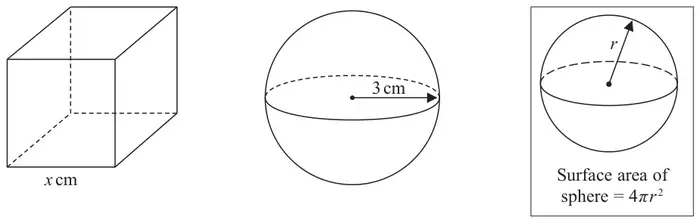
7 The diagram shows a cube with edges of length \(x\) cm and a sphere of radius 3 cm.
The surface area of the cube is equal to the surface area of the sphere.
Show that \(x = \sqrt{k\pi}\) where \(k\) is an integer. (4)
Mark scheme
Answer
Mark
Mark scheme
Shown
M1
for a correct expression for the area of one face of the cube, eg \(x^2\) or a correct expression for the surface area of the cube, eg \(6 \times x^2\)
M1
for a correct expression for the surface area of the sphere, eg \(4 \times \pi \times 3^2\ (= 36\pi)\)
M1
for forming a suitable equation, eg \(6 \times x^2 = 4 \times \pi \times 3^2\) or \(6x^2 = \text{``}36\pi\text{''}\)
A1
for completing the method to \(x = \sqrt{6\pi}\) or \(k = 6\)
Additional guidance
No marks for \(x = \sqrt{6\pi}\) without any working.
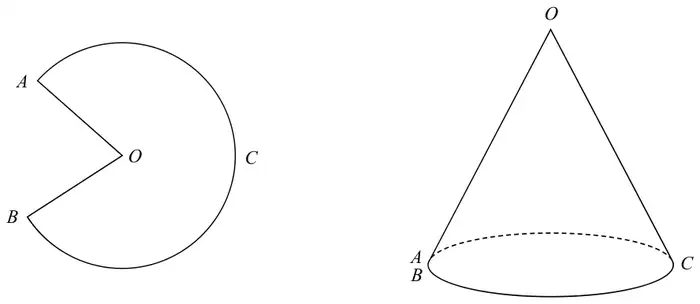
23 The diagram shows a sector \(OACB\) of a circle with centre \(O\). The point \(C\) is the midpoint of the arc \(AB\).
The diagram also shows a hollow cone with vertex \(O\). The cone is formed by joining \(OA\) and \(OB\).
The cone has volume 56.8 cm3 and height 3.6 cm.
Calculate the size of angle \(AOB\) of sector \(OACB\). Give your answer correct to 3 significant figures. You must show all your working. (5)
Mark scheme
Answer
Mark
Mark scheme
264
P1
correct substitution into the volume formula, eg \(56.8 = \dfrac{1}{3} \times \pi \times r^2 \times 3.6\)
P1
completes process to find base radius or the value of \(r^2\), eg \(r = \sqrt{\dfrac{56.8 \times 3}{\pi \times 3.6}}\ (= 3.88158\ldots)\) or \(r^2 = \dfrac{56.8}{1.2\pi}\ (= 15.066)\)
P1
Uses Pythagoras to find the sloping length, eg \(\sqrt{\text{``}3.88\ldots\text{''}^2 + 3.6^2}\ (= 5.29\ldots)\)
P1
process to find an equation in \(AOB\), eg \(\pi \times \text{``}3.88\text{''} \times \text{``}5.29\text{''} = \dfrac{AOB}{360} \times \pi \times \text{``}5.29\text{''}^2\) or \(\dfrac{AOB}{360} \times \pi \times 2 \times \text{``}5.29\text{''} = 2 \times \pi \times \text{``}3.88\text{''}\) or \(\dfrac{AOB}{360} \times \text{``}5.29\text{''} = \text{``}3.88\text{''}\)
A1
answer in the range 263.9 to 264.1
Additional guidance
\(AOB\) does not need to be the subject of the equation
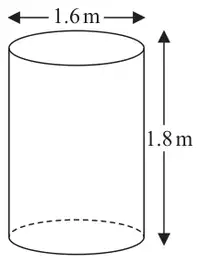
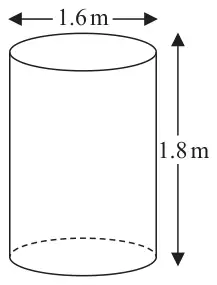
29 Jeremy has to cover 3 tanks completely with paint.
Each tank is in the shape of a cylinder with a top and a bottom. The tank has a diameter of 1.6 m and a height of 1.8 m.
Jeremy has 7 tins of paint. Each tin of paint covers 5 m2
Has Jeremy got enough paint to cover completely the 3 tanks? You must show how you get your answer. (5)
Mark scheme
Answer
Mark
Mark scheme
No Supported
P1
for finding the area of a circle eg \(\pi \times 0.8^2\ (= 2.01...)\)
P1
for finding the curved surface area eg \(2\pi \times 0.8 \times 1.8\ (= 9.047\ldots)\)
P1
for use of the coverage information with an area eg \(\text{``}2.01\ldots\text{''} \div 5\ (= 0.402\ldots)\) or \(\text{``}4.02\ldots\text{''} \div 5\ (= 0.804\ldots)\) or \(\text{``}9.047\ldots\text{''} \div 5\ (= 1.8095\ldots)\) or \(\text{``}11.058\text{''} \div 5\ (= 2.2116..)\) or \(\text{``}13.069\ldots\text{''} \div 5\ (= 2.6138\ldots)\) OR for process to find total coverage for comparison eg \(5 \times 7\ (= 35)\)
P1
(dep P1) for finding total surface area for 3 tanks eg [total surface area] \({} \times 3\ (= 39.2\ldots)\) OR for complete process to find the number of tins needed for total area of 3 tanks eg \(\text{``}13.069\text{''}... \times 3 \div 5\ (= 7.84...)\) OR for complete process to find coverage needed from each tin eg \(\text{``}13.069\text{''}... \times 3 \div 7\ (= 5.6...)\)
C1
for conclusion “No” supported by accurate figures eg 8 tins or 7.84 (\(\gt 7\)) or \(39.2 \gt 35\) or 5.6 (\(\gt 5\))
Additional guidance
For the first P1: Must be area of circle and not part of a volume, eg \(\pi r^2 h\) May be seen as \(2\pi r^2\)
For the second P1: May be seen from \(2\pi rh\) or from \(\pi dh\)
For the third P1: Accept numbers without working written to no less than 2dp Do not award if a volume has been used as part of the calculation. An independent mark for \(5 \times 7\)
For the fourth P1: [total surface area] must come from the addition of two attempts at area, but not from volume.
For the C1: Clear statement that there is not enough paint supported by correct figures for comparison. NB: \(2.6 \times 3 = 9\) tins needed is inaccurate 8 or 7.84 tins is sufficient without restating the 7, 5.6 m2 is sufficient without restating the 5 but 39.2 and 35 are needed for comparison. A statement of “No, 8 tins” alone gets 0 marks without supporting working.
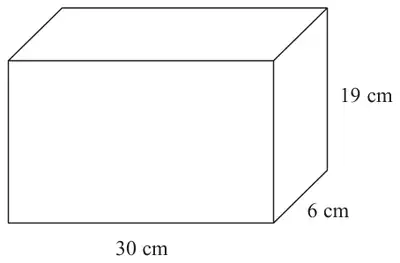
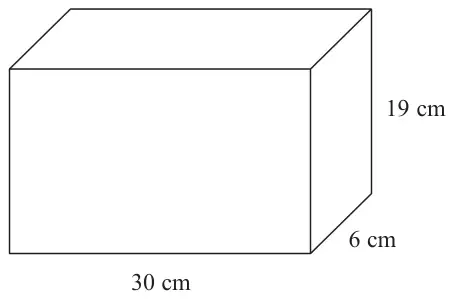
What is the greatest number of cups that can be completely filled with water from the container? (4)
Mark scheme
Answer
Mark
Mark scheme
8
P1
for working with volume of the cuboid, eg \(30 \times 6 \times 19\ (= 3420)\) OR for using \(\frac{2}{3}\) with one dimension, eg. \(30 \times 2 \div 3\ (= 20)\)
P1
for \(\text{``}3420\text{''} \times 2 \div 3\ (= 2280)\) or \(\text{``}3420\text{''} \div 3\ (= 1140)\) OR \(\text{``}20\text{''} \times 6 \times 19\ (= 2280)\) OR \(\text{``}3420\text{''} \div 275\ (= 12.4\ldots = 12\) cups\()\)
P1
(dep on P2) for \(\text{``}2280\text{''} \div 275\ (= 8.29..)\) or \(\text{``}1140\text{''} \div 275\ (= 4.14..)\) OR \(\text{``}12\text{''} \times 2 \div 3\) OR for \(275 \times 8\ (= 2200)\) or \(275 \times 9\ (= 2475)\)
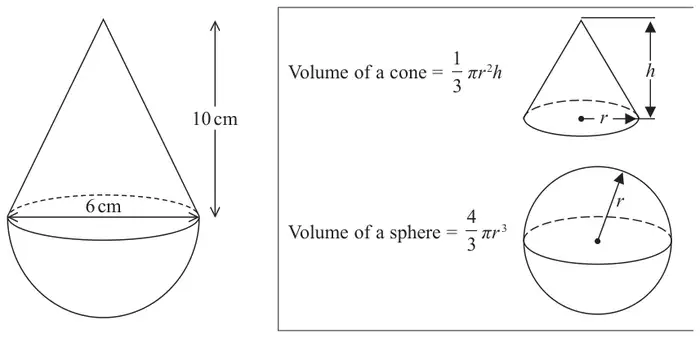
15 The diagram shows a solid shape. The shape is a cone on top of a hemisphere.
The height of the cone is 10 cm. The base of the cone has a diameter of 6 cm. The hemisphere has a diameter of 6 cm.
The total volume of the shape is \(k\pi\) cm3, where \(k\) is an integer.
Work out the value of \(k\). (4)
Mark scheme
Answer
Mark
Mark scheme
48
M1
for method to use a volume formula with correct substitution for the cone, sphere or hemisphere eg \(\dfrac{1}{3} \times \pi \times 3^2 \times 10\) or \(\dfrac{4}{3} \times \pi \times 3^3\) or \(\dfrac{2}{3} \times \pi \times 3^3\) oe
M1
for complete method to find total volume eg \(\dfrac{1}{3} \times \pi \times 3^2 \times 10 + \dfrac{2}{3} \times \pi \times 3^3\)
M1
(dep first M1) for correct partial simplification, eg \(30\pi\) or \(18\pi\)
A1
cao
SC B2 for answer of 264 or \(264\pi\)
Additional guidance
May work without \(\pi\) or with an approximation of \(\pi\); must use the correct radius of 3 (and 10) in substitution
6 Jeremy has to cover 3 tanks completely with paint.
Each tank is in the shape of a cylinder with a top and a bottom. The tank has a diameter of 1.6 m and a height of 1.8 m.
Jeremy has 7 tins of paint. Each tin of paint covers 5 m2
Has Jeremy got enough paint to cover completely the 3 tanks? You must show how you get your answer. (5)
Mark scheme
Answer
Mark
Mark scheme
No Supported
P1
for finding the area of a circle eg \(\pi \times 0.8^2\) (= 2.01...)
P1
for finding the curved surface area eg \(2\pi \times 0.8 \times 1.8\) (= 9.047…)
P1
for use of the coverage information with an area eg \(\text{``}2.01\ldots\text{''} \div 5\) (= 0.402…) or \(\text{``}4.02\ldots\text{''} \div 5\) (= 0.804…) or \(\text{``}9.047\ldots\text{''} \div 5\) (= 1.8095…) or \(\text{``}11.058\text{''} \div 5\) (= 2.2116..) or \(\text{``}13.069\ldots\text{''} \div 5\) (= 2.6138…) OR for process to find total coverage for comparison eg \(5 \times 7\ (= 35)\)
P1
(dep P1) for finding total surface area for 3 tanks eg [total surface area] \(\times 3\) (= 39.2…) OR for complete process to find the number of tins needed for total area of 3 tanks eg \(\text{``}13.069\ldots\text{''} \times 3 \div 5\) (= 7.84…) OR for complete process to find coverage needed from each tin eg \(\text{``}13.069\ldots\text{''} \times 3 \div 7\) (= 5.6...)
C1
for conclusion “No” supported by accurate figures eg 8 tins or 7.84 (> 7) or 39.2 > 35 or 5.6 (> 5)
Additional guidance
Must be area of circle and not part of a volume, eg \(\pi r^2 h\) May be seen as \(2\pi r^2\)
May be seen from \(2\pi rh\) or from \(\pi dh\)
Accept numbers without working written to no less than 2dp Do not award if a volume has been used as part of the calculation. An independent mark for 5 × 7
[total surface area] must come from the addition of two attempts at area, but not from volume.
Clear statement that there is not enough paint supported by correct figures for comparison. NB: 2.6 × 3 = 9 tins needed is inaccurate 8 or 7.84 tins is sufficient without restating the 7, 5.6 m2 is sufficient without restating the 5 but 39.2 and 35 are needed for comparison. A statement of “No, 8 tins” alone gets 0 marks without supporting working.
What is the greatest number of cups that can be completely filled with water from the container? (4)
Mark scheme
Answer
Mark
Mark scheme
8
P1
for working with volume of the cuboid, eg \(30 \times 6 \times 19\ (= 3420)\) OR for using \(\dfrac{2}{3}\) with one dimension, eg \(30 \times 2 \div 3\ (= 20)\)
P1
for \(\text{``}3420\text{''} \times 2 \div 3\ (= 2280)\) or \(\text{``}3420\text{''} \div 3\ (= 1140)\) OR \(\text{``}20\text{''} \times 6 \times 19\ (= 2280)\) OR \(\text{``}3420\text{''} \div 275\) (= 12.4… = 12 cups)
P1
(dep on P2) for \(\text{``}2280\text{''} \div 275\) (= 8(.29...)) or \(\text{``}1140\text{''} \div 275\) (= 4(.14...)) OR \(\text{``}12\text{''} \times 2 \div 3\) OR for \(275 \times 8\ (= 2200)\) or \(275 \times 9\ (= 2475)\)
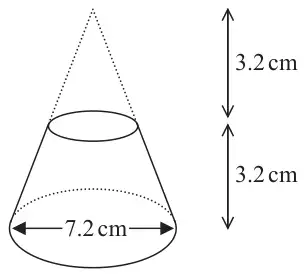
The diagram shows that the frustum is made by removing a cone with height 3.2 cm from a solid cone with height 6.4 cm and base diameter 7.2 cm.
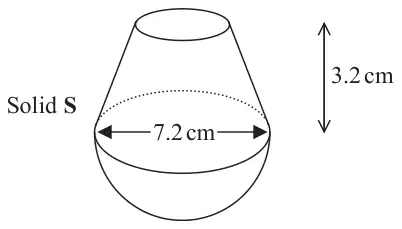
The frustum is joined to a solid hemisphere of diameter 7.2 cm to form the solid S shown below.
The density of the frustum is 2.4 g/cm\(^3\) The density of the hemisphere is 4.8 g/cm\(^3\)
Calculate the average density of solid S. (5)
Mark scheme
Answer
Mark
Mark scheme
3.75
P1
works to find vol of frustum eg \(1/3\pi(3.6)^2 \times 6.4 - 1/3\pi(1.8)^2 \times 3.2\) or \(86.858.. - 10.857\ldots\) \((= 24.192\pi\) or \(76.00..)\)
P1
works to find vol of hemisphere eg \(\dfrac{1}{2} \times \dfrac{4}{3}\pi \times 3.6^3\) \((= 31.104\pi\) or \(97.7....)\)
P1
mass of frustum as [vol]\(\times\)density eg \(\text{``}76.00\text{''} \times 2.4\ (= 182.4..)\) or mass of hemisphere as [vol]\(\times\)density eg \(\text{``}97.7....\text{''} \times 4.8\ (= 469.037...)\)
P1
mean density as total mass \(\div\) total volume eg \((\text{``}182.4..\text{''} + \text{``}469.037\text{''}) \div (\text{``}76\ldots\text{''} + \text{``}97.7..\text{''})\) or \(\text{``}651.4..\text{''} \div \text{``}173.7....\text{''}\)
A1
answer in the range 3.7 to 3.8
Additional guidance
781.7… by use of diameter does not get the mark
[vol] is their volume which could be ft using the radius, using the diameter, or could be another value as long as it is stated as being the volume, or clearly intended from working.
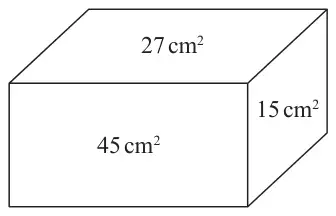
The areas of three of the faces are marked on the diagram. The lengths, in cm, of the edges of the cuboid are whole numbers.
The metal cuboid is melted and made into cubes. Each of the cubes has sides of length 2.5 cm.
Work out the greatest number of these cubes that can be made. (5)
Mark scheme
Answer
Mark
Mark scheme
8
P1
process to start the problem eg \(xy = 45\) and \(xz = 15\) and \(yz = 27\) or \(5 \times 9\) (=45) and \(3 \times 9\) (=27) and \(3 \times 5\) (=15) or 3, 5 and 9 stated
P1
for \(3 \times 5 \times 9\) (=135) or 2 of \(\text{``}9\text{''} \div 2.5\) (=3.6) or \(\text{``}5\text{''} \div 2.5\) (=2) or \(\text{``}3\text{''} \div 2.5\) (=1.2)
P1
for \(2.5^3\) (=15.625) or all of \(\text{``}9\text{''} \div 2.5\) (=3.6) and \(\text{``}5\text{''} \div 2.5\) (=2) and \(\text{``}3\text{''} \div 2.5\) (=1.2)
P1
for a complete process to find the number of cubes possible eg [volume] \(\div\ \text{``}15.625\text{''}\) (=8.64) or \(\text{``}3.6\text{''} \times \text{``}2\text{''} \times \text{``}1.2\text{''}\) (=8.64)
A1
cao
Additional guidance
Maybe seen on diagram
[Volume] must come from multiplying together what they clearly indicate as the 3 dimensions of the cuboid. The three dimensions cannot be 45, 27 and 15
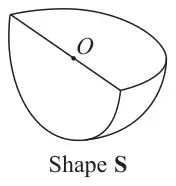
19 Shape S is one quarter of a solid sphere, centre \(O\).
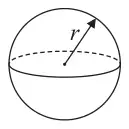
Volume of sphere \(= \dfrac{4}{3}\pi r^3\)
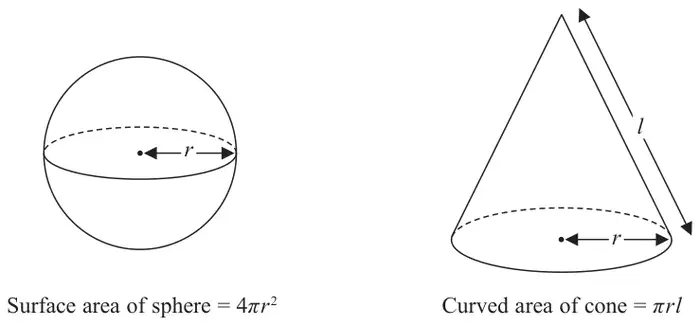
Surface area of sphere \(= 4\pi r^2\)
The volume of S is \(576\pi\) cm3
Find the surface area of S. Give your answer correct to 3 significant figures. You must show your working. (5)
Mark scheme
Answer
Mark
Mark scheme
905
P1
for correct use of formula for the volume of a sphere eg \(\dfrac{1}{4} \times \dfrac{4}{3} \times \pi \times r^3\) (= \(576\pi\) or 1809…) OR \(576\pi \times 4\) or \(2304\pi\) or 7238…\(\left(= \dfrac{4}{3} \times \pi \times r^3\right)\)
P1
for a complete correct process to find \(r\), eg \(r = \sqrt[3]{\dfrac{576 \times 4 \times 3}{4}}\) or \(r = 12\)
P1
for a process to find the curved surface area eg \(\dfrac{4 \times \pi \times [\text{radius}]^2}{4}\) (\(=144\pi\) or 452…) OR the surface area of both flat surfaces eg \(\left(2 \times \dfrac{\pi \times [\text{radius}]^2}{2}\right)\) OR complete expression for the total surface area eg \(\dfrac{4\pi r^2}{4} + \dfrac{\pi r^2}{2} \times 2\) oe
P1
for process to find the complete surface area eg \(\dfrac{4 \times \pi \times [\text{radius}]^2}{4} + \left(2 \times \dfrac{\pi \times [\text{radius}]^2}{2}\right)\)
A1
answer in the range 904.7 – 905 or \(288\pi\)
(SCB2 for an answer in the range 358.1 – 359.2)
Additional guidance
P1 (volume): We do not need to see what is in the brackets to award this mark. The contents of the bracket alone would score P0
P1 (find \(r\)): Could be shown in several stages \(\sqrt[3]{\dfrac{576 \times 4 \times 3}{4}} = \sqrt[3]{1728}\)
P1 (curved surface area): Radius used must be clearly identified as their radius of the solid
If an answer is given in the range but then incorrectly rounded, award full marks.
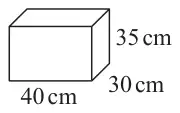
She is going to use the van to deliver boxes. Each box is a cuboid, 40 cm by 30 cm by 35 cm.
The space for boxes in the van has
maximum length
2.4 m
maximum width
1.5 m
maximum height
1.4 m
The space for boxes is empty. Chloe wants to put as many boxes as possible into the van.
She can put 3 boxes into the van in one minute. Assume that the space for boxes is in the shape of a cuboid.
(a) Work out how many minutes it should take Chloe to put as many boxes as possible into the van. (4)
The space for boxes might not be in the shape of a cuboid.
(b) Explain how this could affect the time it would take Chloe to put as many boxes as possible into the van. (1)
Mark scheme (a)
Answer
Mark
Notes
40
P1
for the start of a process to find the number of boxes that will fit along one edge, eg. \(240 \div 40\ (= 6)\) or \(150 \div 30\ (= 5)\) or \(140 \div 35\ (= 4)\) or \(240 \div 30\ (= 8)\) or \(240 \div 35\ (= 6.85\ldots\) ie 6 boxes), etc. or for a process to find a volume, eg. \(40 \times 30 \times 35\ (= 42000)\) or \(0.4 \times 0.3 \times 0.35\ (= 0.042)\) or \(240 \times 150 \times 140\ (= 5040000)\) or \(2.4 \times 1.5 \times 1.4\ (= 5.04)\) NB: condone incorrect or no conversion between m and cm
P1
for a complete process to find the maximum number of boxes, eg. \(\text{``}6\text{''} \times \text{``}5\text{''} \times \text{``}4\text{''}\ (= 120)\) or \(\text{``}5040000\text{''} \div \text{``}42000\text{''}\ (= 120)\) or \(\text{``}5.04\text{''} \div \text{``}0.042\text{''}\ (= 120)\)
P1
(dep on P1) for (their number of boxes) \(\div\, 3\), eg. \(120 \div 3\ (= 40)\)
A1
cao
Mark scheme (b)
Answer
Mark
Notes
explanation
C1
for explaining that it could take more time or it could take less time with an appropriate reason, eg. “less space means less number of boxes which will take less time” or “it will take more time since a different arrangement would be required”
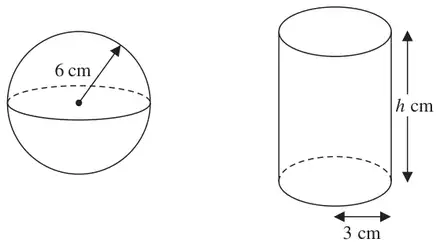
27 The diagram shows a sphere and a solid cylinder.
Diagram NOT accurately drawn
The sphere has radius 6 cm. The solid cylinder has a base radius of 3 cm and a height of \(h\) cm.
The total surface area of the cylinder is twice the total surface area of the sphere.
Work out the ratio of the volume of the sphere to the volume of the cylinder. Give your answer in its simplest form. You must show all your working. (5)
Mark scheme
Answer
Mark
Notes
32 : 45
5
M1 for a correct expression for surface area of the cylinder (\(=2 \times \pi \times 3^2 + 6\pi h\)) or surface area of the sphere (\(=4 \times \pi \times 6^2\)) M1 (dep) for equating ‘surface area of cylinder’ and ‘2 \(\times\) surface area of sphere’, \(2 \times \pi \times 3^2 + 6\pi h = 2 \times 4 \times \pi \times 6^2\) M1 (dep) for a method to isolate \(h\) M1 for \(\pi \times 3^2 \times \text{‘}45\text{’}\) oe and \(\dfrac{4}{3} \times \pi \times 6^3\) oe A1 cao
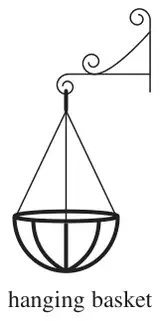
*21 Anne wants to fill 12 hanging baskets with compost.
Each hanging basket is a hemisphere of diameter 40 cm.
Anne has 4 bags of compost. There are 50 litres of compost in each bag.
Has Anne got enough compost to fill the 12 hanging baskets? (4)
Mark scheme
Answer
Mark
Notes
No with explanation and supportive working
4
M1 for method to find the volume of compost needed to fill one or more baskets eg \(\dfrac{2}{3} \times \pi \times 20^3\) (= 16755(.16…)) Or \(\dfrac{4}{3} \times \pi \times 20^3\) (= 33510(.32…)) M1 for appropriate use of 1 litre = 1000 cm\(^3\), eg \(4 \times 50 \times 1000\) (= 200000) or \(\text{``}16755\text{''} \div 1000\) M1 for complete method to find values needed to make decision C1 for conclusion supported by correct values, eg 200000 and 201061(.92...) (accept 201000 to 201120) or 16666(.66…) and 16755(.16…) or 11.9(36...)
The diagram shows a solid shape. The solid shape is made from a hemisphere and a cone. The radius of the hemisphere is equal to the radius of the base of the cone.
The cone has a height of 10 cm. The volume of the cone is \(270\pi\) cm\(^3\).
Work out the total volume of the solid shape. Give your answer in terms of \(\pi\). (5)
Mark scheme
Answer
Mark
Notes
\(756\pi\)
5
M1 for \(\tfrac{1}{3}\pi r^2 \times 10\) \((= 270\pi)\) A1 for \(r = 9\) M1 (dep on M1) for \(\dfrac{1}{2} \times \dfrac{4}{3}\pi \times \text{``}9\text{''}^3\) \((= 486\pi)\) M1 for \(270\pi + \text{``}486\pi\text{''}\) oe A1 cao
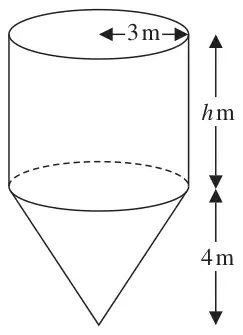
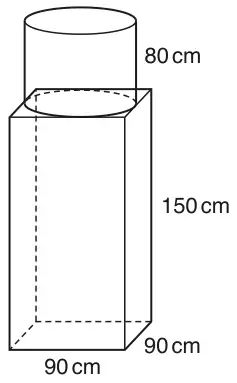
The container is a cylinder on top of a cone. The cylinder has a radius of 3 m and a height of \(h\) m. The cone has a base radius of 3 m and a vertical height of 4 m.
The container is empty. The container is then filled with grain at a constant rate.
After 5 hours the depth of the grain is 6 metres above the vertex of the cone. After 9 hours the container is full of grain.
Work out the value of \(h\). Give your answer as a fraction in its simplest form.
You must show all your working.(5)
Mark scheme
Answer
Mark
Notes
\(\dfrac{14}{3}\)
5
M1 for correct substitution into a volume formula for a cylinder or a cone, eg. \(\tfrac{1}{3} \times \pi \times 3^2 \times 4\) \((= 12\pi)\) or \(\pi \times 3^2 \times (6 - 4)\) \((= 18\pi)\) or \(\pi \times 3^2 h\) \((= 9\pi h)\) or \(\pi \times 3^2 (h - 2)\) M1 for method to find volume after 5 hours, eg. \(\text{``}12\pi\text{''} + \text{``}18\pi\text{''}\) \((= 30\pi)\) M1 (dep on M1) for use of a correct ratio, eg. \(\text{``}30\pi\text{''} \times \tfrac{9}{5}\) \((= 54\pi)\) or \(\text{``}30\pi\text{''} \times \tfrac{4}{5}\) \((= 24\pi)\) M1 for deriving an equation in \(h\), eg. \(\text{``}54\pi\text{''} = \text{``}9\pi h\text{''} + \text{``}12\pi\text{''}\) A1 for \(\dfrac{14}{3}\) or equivalent fraction
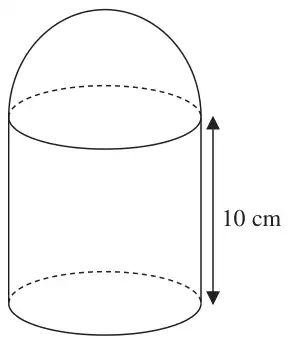
The solid shape is made from a cylinder and a hemisphere. The radius of the cylinder is equal to the radius of the hemisphere. The cylinder has a height of 10 cm. The curved surface area of the hemisphere is \(32\pi\) cm\(^2\).
Work out the total surface area of the solid shape. Give your answer in terms of \(\pi\). (5)
Mark scheme
Answer
Mark
Notes
\(128\pi\)
5
M1 for \(\dfrac{4\pi r^2}{2} = 32\pi\) oe A1 for \((r =)\) 4 M1 for \(2 \times \pi \times \text{``}4\text{''} \times 10\) \((= 80\pi)\) or \(\pi \times \text{``}4\text{''}^2\) \((= 16\pi)\) or ft their \(r\) M1 for \(32\pi + \text{``}80\pi\text{''} + \text{``}16\pi\text{''}\) oe or 402.1 − 402.3 or ft their \(r\) A1 cao
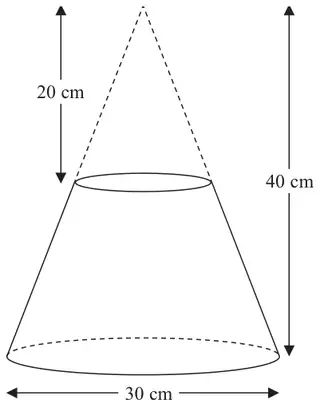
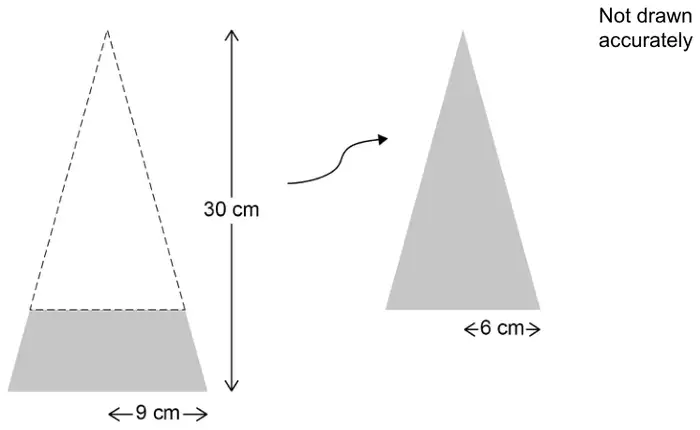
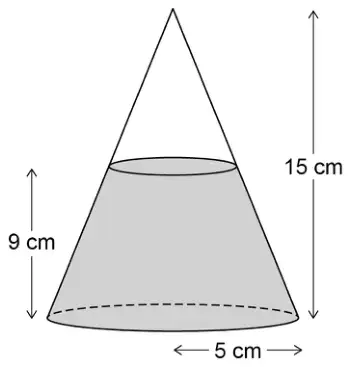
B1 for 15cm as diameter or 7.5 cm as radius of smaller cone (may be marked on diagram or used in a formula) M1 for a numerical expression for the volume of one cone eg. \(\frac{1}{3} \times \pi \times 15^2 \times 40\) (=9424...) or \(\frac{1}{3} \times \pi \times 7.5^2 \times 20\) (=1178...) M1 for \(\frac{1}{3} \times \pi \times 15^2 \times 40\) oe − \(\frac{1}{3} \times \pi \times 7.5^2 \times 20\) oe A1 for answer in the range 8240 − 8250 OR B1 for \(2^3\) M1 for a numerical expression for the volume of the large cone eg. \(\frac{1}{3} \times \pi \times 15^2 \times 40\) (=9424...) M1 volume of frustrum = \(\frac{7}{8} \times \frac{1}{3} \times \pi \times 15^2 \times 40\) oe A1 for answer in the range 8240 − 8250
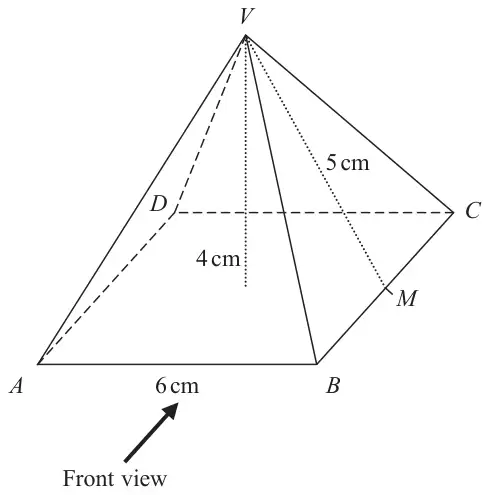
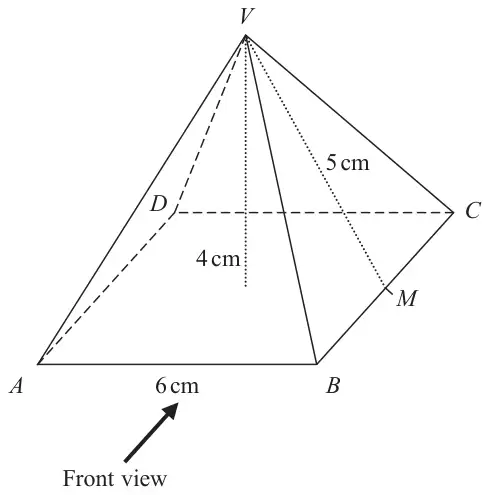
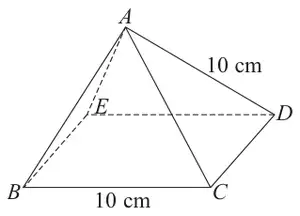
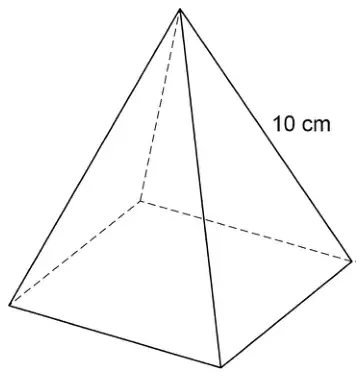
The other faces of the pyramid are equilateral triangles with sides of length 10 cm.
(a) Calculate the volume of the pyramid. Give your answer correct to 3 significant figures. (4)
(b) Find the size of angle \(DAB\). (2)
Mark scheme (a)
Working
Answer
Mark
Notes
Let \(O\) be the centre of the base. \(OB^2 + OC^2 = 10^2\) ; \(OB^2 = 50\) \(AO^2 = AB^2 - OB^2 = 50\) Vol \(= \frac{1}{3} \times 10^2 \times \sqrt{50}\) OR Let \(M\) be the midpt of side \(BC\) and let \(O\) be the centre of the base. \(AM^2 + MC^2 = 10^2\) ; \(AM^2 = 75\) \(AO^2 = AM^2 - MO^2 = 50\) Vol \(= \frac{1}{3} \times 10^2 \times \sqrt{50}\)
236
4
M1 correct method to start to find \(BD\) or \(BO\) using triangle \(OBC\) or triangle \(BCD\) (oe) Eg. \(OB^2 + OC^2 = 10^2\) or \(BO^2 = 50\) or \(BO = \sqrt{50}\) (=7.07..) or \(BO = \dfrac{\sqrt{200}}{2}\) or \(10^2 + 10^2 = BD^2\) or \(BD^2 = 200\) or \(BD = \sqrt{200}\) (=14.1..) M1 (dep) correct method to find height of pyramid using triangle \(AOB\) Eg. \(AO^2 = 10^2 -\) ‘\(\sqrt{50}\)’\(^2\) or \(AO^2 = 50\) or \(AO = \sqrt{50}\) (=7.07..) M1 (indep) \(\frac{1}{3} \times 10^2 \times\) ‘\(\sqrt{50}\)’ (but not \(\frac{1}{3} \times 10^2 \times 10\)) A1 235 – 236 OR M1 correct method to start to find height of a face using triangle \(AMC\) (oe) Eg. \(AM^2 + 5^2 = 10^2\) or \(AM^2 = 75\) or \(AM = \sqrt{75}\) (=8.66...) M1 (dep) correct method to find height of pyramid using triangle \(AOM\) Eg. \(AO^2 =\) ‘\(\sqrt{75}\)’\(^2 - 5^2\) or \(AO^2 = 50\) or \(AO = \sqrt{50}\) (=7.07..) M1 (indep) \(\frac{1}{3} \times 10^2 \times\) ‘\(\sqrt{50}\)’ (but not \(\frac{1}{3} \times 10^2 \times 10\)) A1 235 – 236 OR M1 for \(\sin 45 = \dfrac{x}{10}\) or \(\cos 45 = \dfrac{x}{10}\) M1 for \(h = 10 \times \sin 45\) or \(h = 10 \times \cos 45\) (=7.07..) M1 (indep) \(\frac{1}{3} \times 10^2 \times\) ‘7.07...’ (but not \(\frac{1}{3} \times 10^2 \times 10\)) A1 235 – 236
Mark scheme (b)
Working
Answer
Mark
Notes
Angle \(ABO = 45^\circ\) Angle \(DAB = 180 - 45 - 45\) OR In \(\Delta BAD\), \(\cos A = \dfrac{10^2 + 10^2 - \text{‘}\sqrt{200}\text{’}^2}{2 \times 10 \times 10} = 0\) OR In \(\Delta BOA\), \(\cos B = \dfrac{\text{‘}\sqrt{50}\text{’}}{10}\) Angle \(BAD = 180 -\) ‘45’ – ‘45’ OR \(\sin A = \dfrac{\text{‘}\sqrt{50}\text{’}}{10}\) \(A = 45\) Angle \(BAD = 2 \times\) ‘45’
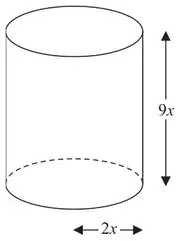
M1 for sub. into \(\pi r^2h\) eg. \(\pi \times (2x)^2 \times 9x\) oe M1 for \(\pi \times (2x)^2 \times 9x = \frac{4}{3}\pi r^3\) oe A1 oe eg. \(\sqrt[3]{\dfrac{36x^3}{\frac{4}{3}}}\) NB : For both method marks condone missing brackets around the \(2x\)
oe eg \(\dfrac{\;\dfrac{20}{3}\;}{10}\) or \(\dfrac{20}{3} \div 10\) must be seen consistently with or without \(\pi\) to match cylinder formula dep on 2nd M1
\(\dfrac{2}{3}\) with M3 awarded
A1
oe fraction eg \(\dfrac{20}{30}\)
Alternative method 2: uses a value for \(r\)
Method to calculate the cylinder length using their value of \(r\)
M1
their value of \(r\) must be stated or may be implied on the diagram or from their working eg \(r = 1\) and cylinder length = 10
Substitutes the same value of \(r\) and their cylinder length into \((\pi)r^2h\)
M1dep
the substitution must be shown accept without use of \(\pi\) eg \(\pi \times 1^2 \times 10\) or \(1^2 \times 10\)
Substitutes the same value of \(r\) into \(5 \times \dfrac{4}{3}(\pi)r^3\) and writes a fraction with their volume for the 5 spheres over their volume for the cylinder
M1dep
the substitution must be shown must be seen consistently with or without \(\pi\) to match cylinder formula eg \(5 \times \dfrac{4}{3} \times \pi \times 1^3\) and \(\dfrac{\;\dfrac{20\pi}{3}\;}{10\pi}\) dep on M2
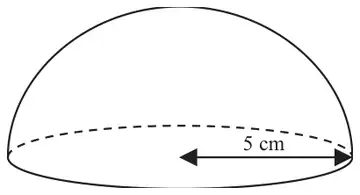
Volume of a sphere \(= \dfrac{4}{3} \times \pi \times r^3\) where \(r\) is the radius
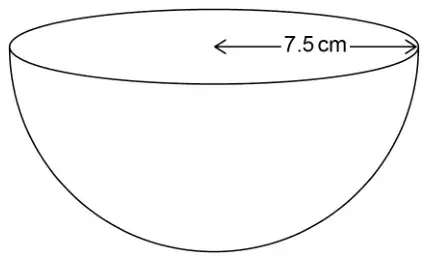
Ria works out the volume of this hemisphere in terms of \(\pi\)
Here is her work.
\[\text{Volume of a hemisphere} = \dfrac{4}{3} \times 7.5 \times 3 \div 2 = 15\]
Write down two mistakes she has made. [2 marks]
Mark scheme
Answer
Mark
Comments
Any two of the following statements
not using \(\pi\) in the calculation
not cubing 7.5
no units
B2
oe B1 for one correct statement
Additional guidance
Ignore irrelevant statements for B1 or B2
Ignore incorrect statements or incorrect values with correct reasons, unless contradictory, for B1
Need to do \(\pi \times 7.5^3\) (calculation shows 2 mistakes)
B2
The answer should be \(281.25\pi\) (doesn’t show mistakes but a correct answer in terms of \(\pi\))
B1
Need to do \(\pi \times 7.5^3\) to get 883.6 (883.6 is not an answer in terms of \(\pi\))
B1
The answer should be [883.5, 884]
B0
15 is wrong
B0
Statements about not using \(\pi\) in the calculation She hasn’t multiplied by \(\pi\) / pi Used 3 for \(\pi\) Hasn’t used 3.14 The answer is not in terms of \(\pi\) It is not in terms of \(\pi\)
B1 B1 B0 B0 B0
Statements about not cubing 7.5 She should have done \(7.5^3\) She hasn’t cubed the radius She multiplied it by 3 Hasn’t cubed a number
B1 B1 B1 B0
Statements about no units She hasn’t given any units She should have written cm\(^3\)
\(\sqrt[3]{\text{their } \dfrac{125}{8}}\) or \(\dfrac{5}{2}\) or 2.5
M1dep
oe eg \((L = 2)\ \sqrt[3]{\text{their } \dfrac{125}{64}}\) or \(\dfrac{5}{4}\) or 1.25
\(2 \times 3 \times\) their \(2.5 + 2 \times 4 \times\) their 2.5 \(+\ 2 \times 5 \times\) their 2.5 \(+\ 3 \times 12 \times\) their 2.5
M1dep
oe eg \((L = 2)\) \(2 \times 6 \times\) their \(1.25 + 2 \times 8 \times\) their 1.25 \(+\ 2 \times 10 \times\) their 1.25 \(+\ 3 \times 24 \times\) their 1.25
150
A1
SC4 [119, 119.1]
Alternative method 2: works out a value of \(a\), \(b\), \(c\) or \(d\)
Correct expression for volume in terms of \(a\) or \(b\) eg \(\dfrac{1}{2} \times a \times \dfrac{4a}{3} \times \dfrac{12a}{3}\) or \(\dfrac{8a^3}{3}\) or \(\dfrac{1}{2} \times \dfrac{3b}{4} \times b \times \dfrac{12b}{4}\) or \(\dfrac{9b^3}{8}\)
M1
oe in terms of \(c\) or \(d\) eg \(\dfrac{1}{2} \times \dfrac{3c}{5} \times \dfrac{4c}{5} \times \dfrac{12c}{5}\) or \(\dfrac{72c^3}{125}\) or \(\dfrac{1}{2} \times \dfrac{3d}{12} \times \dfrac{4d}{12} \times d\) or \(\dfrac{d^3}{24}\) may be implied by an equation eg \(a \times \dfrac{4a}{3} \times \dfrac{12a}{3} = 1125 \times 2\)
\(a^3 = 1125 \div\) their \(\dfrac{8}{3}\) or \(a^3 = \dfrac{3375}{8}\) or \(b^3 = 1125 \div\) their \(\dfrac{9}{8}\) or \(b^3 = 1000\)
M1dep
oe eg \(c^3 = 1125 \div\) their \(\dfrac{72}{125}\) or \(c^3 = \dfrac{15\,625}{8}\) or \(d^3 = 1125 \div\) their \(\dfrac{1}{24}\) or \(d^3 = 27\,000\)
\(a = \sqrt[3]{\text{their } \dfrac{3375}{8}}\) or \(a = 7.5\) or \(b = \sqrt[3]{1000}\) or \(b = 10\)
M1dep
oe eg \(c = \sqrt[3]{\text{their } \dfrac{15\,625}{8}}\) or \(c = 12.5\) or \(d = \sqrt[3]{27\,000}\) or \(d = 30\)
\(2 \times\) their \(a + 2 \times \dfrac{4}{3} \times\) their \(a\) \(+\ 2 \times \dfrac{5}{3} \times\) their \(a + 3 \times \dfrac{12}{3} \times\) their \(a\) or \(2 \times \dfrac{3}{4} \times\) their \(b + 2 \times\) their \(b\) \(+\ 2 \times \dfrac{5}{4} \times\) their \(b + 3 \times 3 \times\) their \(b\)
M1dep
oe correct method using their \(c\) or their \(d\)
150
A1
SC4 [119, 119.1]
Additional guidance
Up to M3 may be awarded for correct work with no answer or incorrect answer, even if this is seen amongst multiple attempts
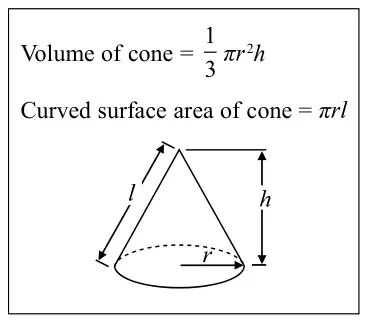
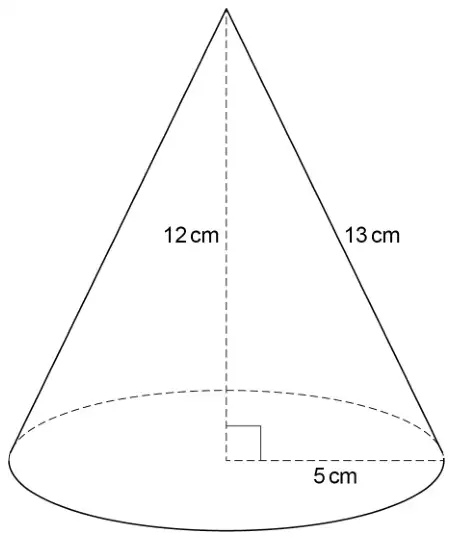
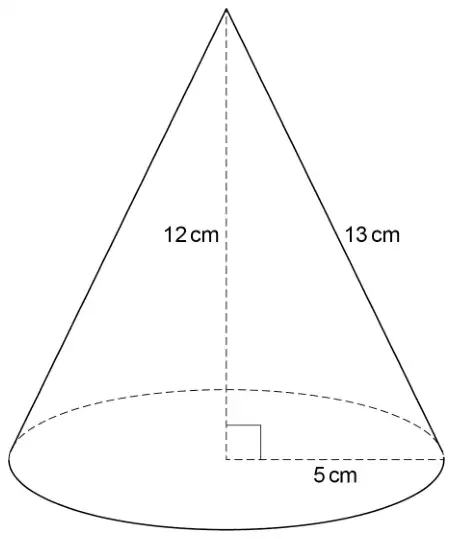
Curved surface area of a cone \(= \pi r l\) where \(r\) is the radius and \(l\) is the slant height
Beth tries to work out the curved surface area in terms of \(\pi\)
Curved surface area of the cone \(= \pi \times 5 \times 12\) \(= 60\pi\) cm\(^2\)
What mistake has she made? [1 mark]
(b) Adam uses \(\pi = 3\) to estimate the area of the base of the cone.
Work out his estimate. [2 marks]
(c) Beth uses \(\pi = 3.14\) to estimate the area of the base of the cone.
Is Beth’s estimate more than or less than Adam’s estimate?
Tick a box.
More than
Less than
Give a reason for your answer. [1 mark]
Mark scheme (a)
Answer
Mark
Comments
Correct statement
B1
eg she used the height instead of the slant height or she used the vertical height or she used 12 (instead of 13)
Additional guidance
Check diagram
For ‘vertical’ accept anything that implies she has used the wrong height
Condone ‘length’ to mean ‘height’ or ‘slant height’
12 or 13 circled on the diagram must be accompanied by a supporting statement
Indicates ‘12’ in the calculation
B1
She should have done \(\pi \times 5 \times 13\)
B1
It should be \(65\pi\)
B1
She used the wrong height / the (value of) \(l\) is wrong
B1
She hasn’t used the slant height (she used the (vertical) height)
B1
She hasn’t used the 13
B1
She hasn’t used the 13 and should be \(5 \times 12 \times 13 \times \pi\)
B0
The multiplication used the wrong number(s)
B0
She hasn’t used a value for \(\pi\)
B0
An incorrect statement with a correct statement eg she used 13 instead of 12 and didn’t square the radius
B0
Mark scheme (b)
Answer
Mark
Comments
\(\pi \times 5 \times 5\) or \(25\pi\) or \(3 \times 5 \times 5\)
M1
oe accept [3.14, 3.142] or \(\dfrac{22}{7}\) for \(\pi\)
75
A1
Additional guidance
\(\pi 25\)
M1
Mark scheme (c)
Answer
Mark
Comments
‘More than’ indicated or implied by statement and valid reason
B1
eg valid reasons 3.14 is greater (than 3) Beth’s number is bigger (than Adam’s) (the correct answer is) 78.5 (with their answer to (b) less than 78.5)
Additional guidance
If calculations are used, the outcomes must be correct
Accept 78 or 79 for 78.5 unless from incorrect working
‘Less than’ indicated
B0
Do not penalise use of the same incorrect formula in (b) and (c) eg \(3 \times 10 = 30\) in (b) and \(3.14 \times 10 = 31.4\) in (c) with ‘More than’ ticked
B1
Ignore a non-contradictory reason with a correct reason eg 3.14 is bigger than 3 and nearer the true value of pi
B1
Acceptable reasons
Adam has rounded (pi) down / Adam only used 3
B1
There is an extra 0.14 to multiply by
B1
Her number has decimal places
B1
Her number is to more significant figures
B1
Non-acceptable reasons
3.14 will give a bigger answer / 3.14 is more accurate
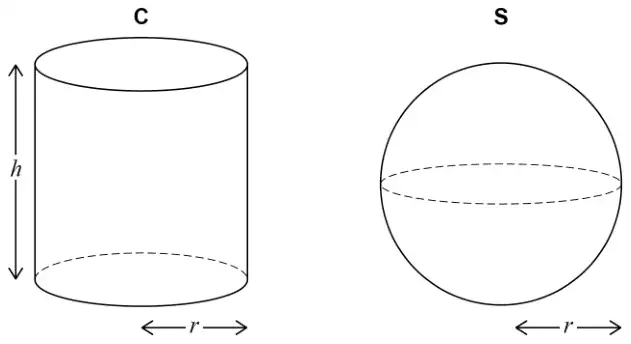
21 A cylinder, C, and a sphere, S, each have radius \(r\)
C has height \(h\)
Volume of a sphere \(= \dfrac{4}{3}\pi r^3\) where \(r\) is the radius
(a) volume of C \(=\) volume of S
Work out the ratio \(\quad r : h\)
You must show your working. [3 marks]
(b) A different cylinder has radius \(3r\) and height \(2h\).
How many times bigger is the volume of this cylinder than the volume of C? [2 marks]
Mark scheme (a)
Answer
Mark
Comments
Alternative method 1
\(\dfrac{4}{3}\pi r^3 = \pi r^2 h\)
M1
\(\dfrac{4}{3}r = h\) or \(4r = 3h\)
M1dep
oe equation with \(\pi\) and \(r^2\) cancelled
3 : 4 with M2 awarded
A1
oe ratio eg \(\dfrac{3}{4} : 1\) or \(1 : \dfrac{4}{3}\) accept 1.33 or better for \(\dfrac{4}{3}\)
Alternative method 2
\(\dfrac{4}{3}\pi r^3 = \pi r^2 h\) or substitution of the same value of \(r\) into \(\dfrac{4}{3}\pi r^3\) and \(\pi r^2 h\)
M1
the substitution must be shown
Substitution of the same value of \(r\) into \(\dfrac{4}{3}\pi r^3\) and \(\pi r^2 h\) and correct value of \(h\) for their value of \(r\)
A1
the substitution must be shown their \(h\) should be exactly \(\dfrac{4}{3} \times\) their \(r\) eg \(r = 2\) and \(h = \dfrac{8}{3}\) (oe fraction) do not allow rounded values
3 : 4 with M1A1 awarded
A1
oe ratio eg \(\dfrac{3}{4} : 1\) or \(1 : \dfrac{4}{3}\) accept 1.33 or better for \(\dfrac{4}{3}\)
Additional guidance
Accept \(h : r = 4 : 3\) for final mark with M2 or M1A1 awarded
Mark scheme (b)
Answer
Mark
Comments
\((\pi)(3r)^2(2h)\) or \(3^2 \times 2\)
M1
oe ft their formula for a cylinder from part (a) in the form \(k\pi r^2 h\) with \(k\) as a positive constant
18
A1
Additional guidance
Answer 18 from choosing values for \(r\) and \(h\) eg \(\pi \times 3^2 \times 4 = 36\pi\) and \(\pi \times 9^2 \times 8 = 648\pi\) and \(648\pi \div 36\pi = 18\)
Curved surface area of a cone \(= \pi r l\) where \(r\) is the radius and \(l\) is the slant height
Beth tries to work out the curved surface area in terms of \(\pi\)
Curved surface area of the cone \(= \pi \times 5 \times 12\) \(= 60\pi\ \text{cm}^2\)
What mistake has she made? [1 mark]
(b) Adam uses \(\quad \pi = 3 \quad\) to estimate the area of the base of the cone.
Work out his estimate. [2 marks]
(c) Beth uses \(\quad \pi = 3.14 \quad\) to estimate the area of the base of the cone.
Is Beth’s estimate more than or less than Adam’s estimate?
Tick a box.
More than
Less than
Give a reason for your answer. [1 mark]
Mark scheme (a)
Answer
Mark
Comments
Correct statement
B1
eg she used the height instead of the slant height or she used the vertical height or she used 12 (instead of 13)
Additional guidance
Check diagram
For ‘vertical’ accept anything that implies she has used the wrong height
Condone ‘length’ to mean ‘height’ or ‘slant height’
12 or 13 circled on the diagram must be accompanied by a supporting statement
Indicates ‘12’ in the calculation
B1
She should have done \(\pi \times 5 \times 13\)
B1
It should be \(65\pi\)
B1
She used the wrong height / the (value of) \(l\) is wrong
B1
She hasn’t used the slant height (she used the (vertical) height)
B1
She hasn’t used the 13
B1
She hasn’t used the 13 and should be \(5 \times 12 \times 13 \times \pi\)
B0
The multiplication used the wrong number(s)
B0
She hasn’t used a value for \(\pi\)
B0
An incorrect statement with a correct statement eg she used 13 instead of 12 and didn’t square the radius
B0
Mark scheme (b)
Answer
Mark
Comments
\(\pi \times 5 \times 5\) or \(25\pi\) or \(3 \times 5 \times 5\)
M1
oe accept [3.14, 3.142] or \(\dfrac{22}{7}\) for \(\pi\)
75
A1
Additional guidance
\(\pi 25\)
M1
Mark scheme (c)
Answer
Mark
Comments
‘More than’ indicated or implied by statement and valid reason
B1
eg valid reasons 3.14 is greater (than 3) Beth’s number is bigger (than Adam’s) (the correct answer is) 78.5 (with their answer to (b) less than 78.5)
Additional guidance
If calculations are used, the outcomes must be correct
Accept 78 or 79 for 78.5 unless from incorrect working
‘Less than’ indicated
B0
Do not penalise use of the same incorrect formula in (b) and (c) eg \(3 \times 10 = 30\) in (b) and \(3.14 \times 10 = 31.4\) in (c) with ‘More than’ ticked
B1
Ignore a non-contradictory reason with a correct reason eg 3.14 is bigger than 3 and nearer the true value of pi
B1
Acceptable reasons
Adam has rounded (pi) down / Adam only used 3
B1
There is an extra 0.14 to multiply by
B1
Her number has decimal places
B1
Her number is to more significant figures
B1
Non-acceptable reasons
3.14 will give a bigger answer / 3.14 is more accurate
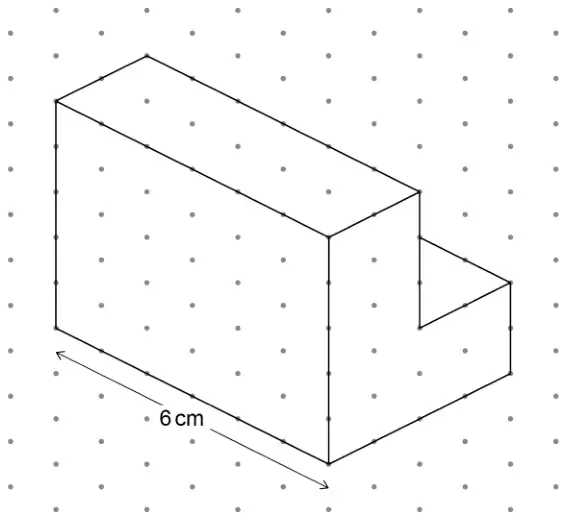
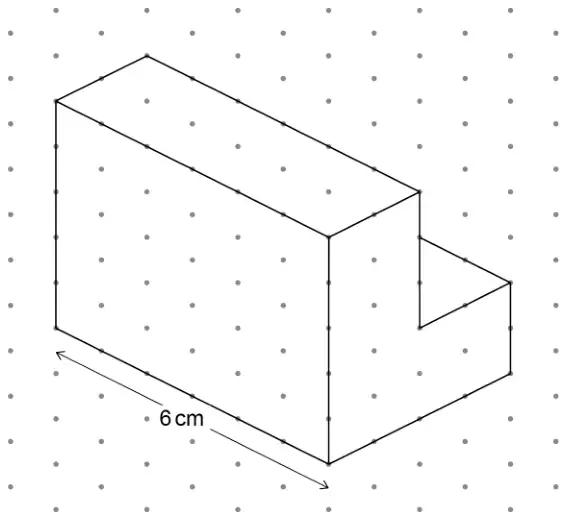
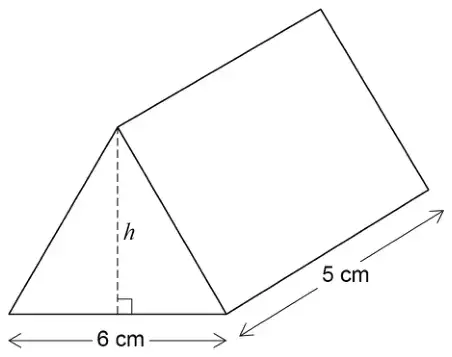
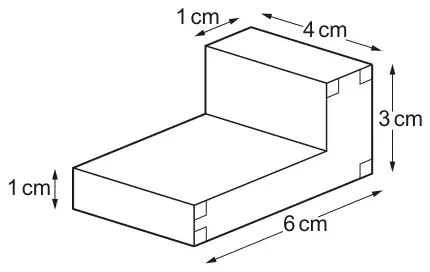
Correct method or evaluation of the area of any face or correct method or evaluation of the volume of any relevant cuboid of length 6 cm
M1
eg \(5 \times 6\) or 30 or \(2 \times 6\) or 12 or \(3 \times 6\) or 18 or \(4 \times 6\) or 24 or \(2 \times 5 + 2 \times 2\) or \(10 + 4\) or 14 or \(2 \times 5 \times 6\) or 60 or \(2 \times 2 \times 6\) or 24 or \(2 \times 3 \times 6\) or 36 or \(4 \times 2 \times 6\) or 48 or \(5 \times 4 \times 6\) or 120
Correct method for volume of prism
M1dep
eg \(2 \times 5 \times 6 + 2 \times 2 \times 6\) or \(60 + 24\) or \(14 \times 6\)
84
A1
Additional guidance
The first M1 may be awarded even if this is seen amongst multiple attempts
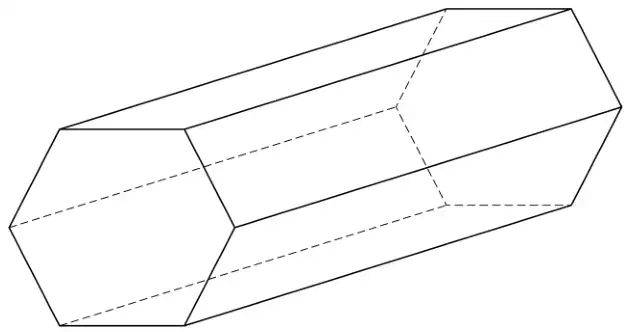
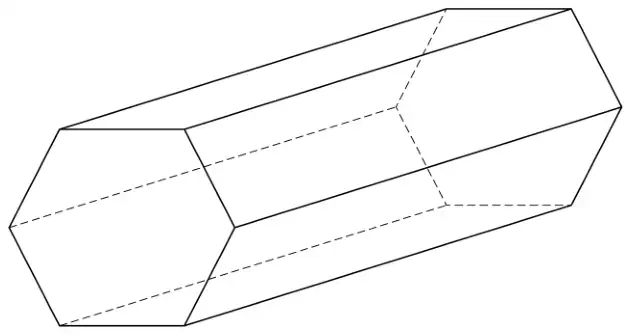
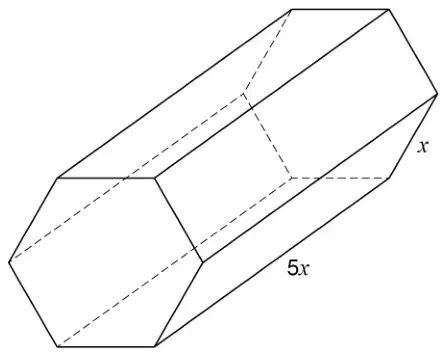
23 A chocolate box in the shape of a prism is being designed.
All lengths are in centimetres.
The cross section is a regular hexagon with side \(x\) The length is \(5x\)
An expression for the area of the cross section, in cm\(^2\), is \(\;\dfrac{3\sqrt{3}}{2}x^2\)
The total surface area of the box must be less than 650 cm\(^2\)
Work out the largest possible integer value of \(x\).
You must show your working. [4 marks]
Mark scheme
Answer
Mark
Comments
\(x \times 5x\) or \(5x^2\)
M1
oe may be implied eg \(30x^2\)
\(2 \times \dfrac{3\sqrt{3}}{2}x^2 + 6 \times x \times 5x\) or \(3\sqrt{3}\,x^2 + 30x^2\)
M1dep
oe eg \(35.19(6…)x^2\) or \(35.2x^2\)
\(650 \div (3\sqrt{3} + 30)\) or [18.4, 18.5] or [4.2, 4.3] or \(3\sqrt{3} \times 4^2 + 30 \times 4^2\) or 563.(…) and \(3\sqrt{3} \times 5^2 + 30 \times 5^2\) or 879.(…) or 880
M1dep
oe dep on M2 calculation or [18.4, 18.5] may be seen in a square root
trials \(x = 4\) and \(x = 5\) ignore substitution of other integer values of \(x\)
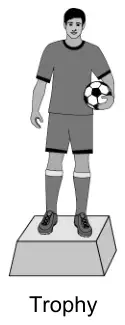
14 A solid trophy consists of a stand and a player.
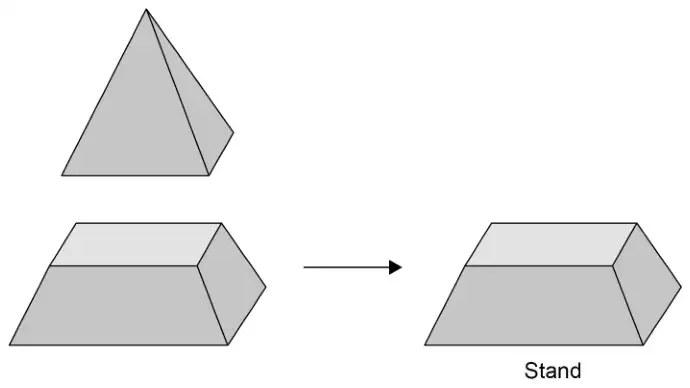
The stand is made by removing a small pyramid from a large pyramid.
Large pyramid Square base, edge 8 cm Perpendicular height 16 cm Small pyramid Square base, edge 5 cm Perpendicular height 10 cm
Volume of a pyramid \(= \dfrac{1}{3} \times\) area of base \(\times\) perpendicular height
(a) Show that the volume of the stand is 258 cm\(^3\) [2 marks]
(b) The trophy is made from a metal of density 7.5 grams per cm\(^3\)
The total mass of the trophy is 2340 grams.
Work out the volume of the player. [2 marks]
Mark scheme (a)
Answer
Mark
Comments
\(\dfrac{1}{3} \times 8 \times 8 \times 16\) or \(\dfrac{1024}{3}\) or 341.3… or \(\dfrac{1}{3} \times 5 \times 5 \times 10\) or \(\dfrac{250}{3}\) or 83.3…
oe eg \(\dfrac{1024}{3} - 258 = \dfrac{250}{3}\) must see method or values for both pyramids must use same number of decimal places for both pyramids so their answer is exactly 258
Additional guidance
\(341.3 - 83.3 = 258\)
M1A1
\(341.33 - 83.3 = 258.03\)
M1A0
\(341 - 83 = 258\) with no correct method seen
M0A0
Mark scheme (b)
Answer
Mark
Comments
\(2340 = 7.5 \times V\) or \(\dfrac{2340}{7.5}\) or 312 or \(2340 - (7.5 \times 258)\) or \(2340 - 1935\) or 405
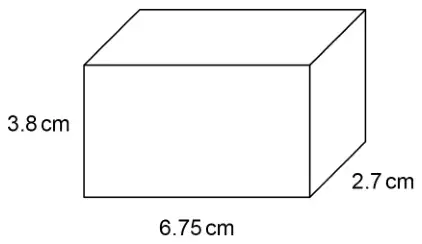
B1 \(3.8 \times 6.75 \times 2.7\) oe or \(\dfrac{13\,851}{200}\) or 69.25(5) or 69.2(6) or correct rounding to 1 dp of a number to 2 dp or more, other than 6.75
Correct method or evaluation of the area of any face or correct method or evaluation of the volume of any relevant cuboid of length 6 cm
M1
eg \(5 \times 6\) or 30 or \(2 \times 6\) or 12 or \(3 \times 6\) or 18 or \(4 \times 6\) or 24 or \(2 \times 5 + 2 \times 2\) or \(10 + 4\) or 14 or \(2 \times 5 \times 6\) or 60 or \(2 \times 2 \times 6\) or 24 or \(2 \times 3 \times 6\) or 36 or \(4 \times 2 \times 6\) or 48 or \(5 \times 4 \times 6\) or 120
Correct method for volume of prism
M1dep
eg \(2 \times 5 \times 6 + 2 \times 2 \times 6\) or \(60 + 24\) or \(14 \times 6\)
84
A1
Additional guidance
The first M1 may be awarded even if this is seen amongst multiple attempts
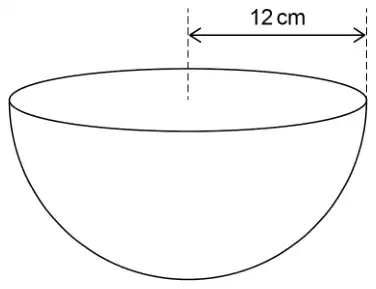
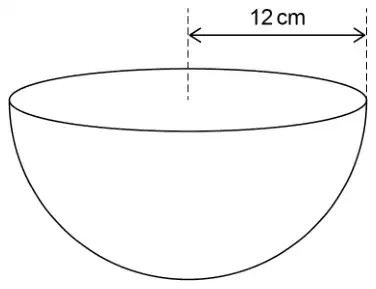
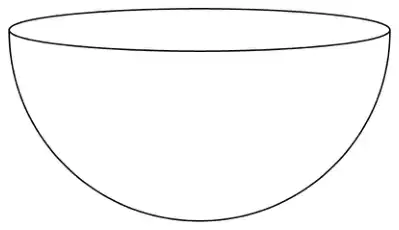
at a rate of 325 cm\(^3\) per second for 8 seconds.
Does the water fill more than 70% of the bowl?
You must show your working. [4 marks]
Mark scheme
Answer
Mark
Comments
Alternative method 1 Compares 70% of volume of hemisphere with volume of water
\(\dfrac{4}{3} \times \pi \times 12^3\) or \(2304\pi\) or [7216, 7239.2] or \(\dfrac{2}{3} \times \pi \times 12^3\) or \(1152\pi\) or [3581, 3638]
M1
oe eg \(\dfrac{4}{3}\pi \times 1728\) allow without any multiplication signs eg \(\dfrac{4}{3}\pi 12^3\)
\(0.7 \times\) their \(1152\pi\) or \(806.4\pi\) or [2506, 2547]
M1dep
oe \(0.7 \times\) their [3581, 3638] or \(\dfrac{4032}{5}\pi\) must be using volume of hemisphere
\(325 \times 8\) or 2600
M1
oe
[2506, 2547] and 2600 and Yes
A1
oe
Alternative method 2 Works out volume of water as proportion of volume of hemisphere
\(\dfrac{4}{3} \times \pi \times 12^3\) or \(2304\pi\) or [7216, 7239.2] or \(\dfrac{2}{3} \times \pi \times 12^3\) or \(1152\pi\) or [3581, 3638]
M1
oe eg \(\dfrac{4}{3}\pi \times 1728\) allow without any multiplication signs eg \(\dfrac{4}{3}\pi 12^3\)
\(325 \times 8\) or 2600
M1
oe
their \(2600 \div\) their \(1152\pi\) or [0.71, 0.73]
M1dep
oe eg their \(2600 \div\) their [3581, 3638] or 72% dep on M2 must be using volume of hemisphere
[71, 73](%) and Yes
A1
oe eg 0.72 and 0.7 and Yes
Alternative method 3 Works out time to fill 70% of volume of hemisphere
\(\dfrac{4}{3} \times \pi \times 12^3\) or \(2304\pi\) or [7216, 7239.2] or \(\dfrac{2}{3} \times \pi \times 12^3\) or \(1152\pi\) or [3581, 3638]
M1
oe eg \(\dfrac{4}{3}\pi \times 1728\) allow without any multiplication signs eg \(\dfrac{4}{3}\pi 12^3\)
\(0.7 \times\) their \(1152\pi\) or \(806.4\pi\) or [2506, 2547] or their \(1152\pi \div 325\) or [11, 11.2]
M1dep
oe \(0.7 \times\) their [3581, 3638] or \(\dfrac{4032}{5}\pi\) or their \([3581, 3638] \div 325\) must be using volume of hemisphere
\(0.7 \times\) their \(1152\pi \div 325\) or \(0.7 \times\) their \([3581, 3638] \div 325\) or [7.7, 7.84]
M1dep
oe their \([2506, 2547] \div 325\) or \(0.7 \times\) their [11, 11.2]
[7.7, 7.84] and Yes
A1
oe
Additional guidance
Up to M3 may be awarded for correct work with no answer or incorrect answer, even if this is seen amongst multiple attempts
Allow 1.33(…) for \(\dfrac{4}{3}\)
Allow 0.66(…) or 0.67 for \(\dfrac{2}{3}\)
\(\pi\) may be seen as [3.14, 3.142] eg Alt 1 \(\dfrac{2}{3} \times 3.14 \times 12^3\)
M1
If a number (or calculation) in terms of \(\pi\) is seen but \(\pi\) is subsequently omitted, treat as a miscopy for M marks eg Alt 1 \(1152\pi\) \(0.7 \times 1152 = 806.4\) \(325 \times 8 = 2600\) Yes
M1 M1dep M1A0
Yes cannot be implied by inequalities
Alts 1 and 2 325 cm\(^3 \times 8\) seen is M1 even if evaluated incorrectly \(325^3 \times 8\) seen is M0 unless recovered to 2600
Do not allow misreads of the given formula unless recovered eg1 using \(12^2\) instead of \(12^3\) eg2 using \(\dfrac{3}{4}\) instead of \(\dfrac{4}{3}\)
For \(0.7 \times\) their \(1152\pi\), do not accept \(70\% \times\) their \(1152\pi\) unless recovered
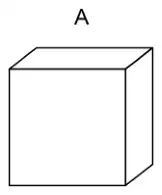
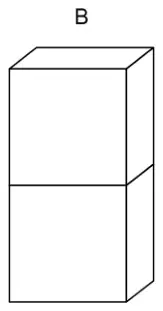
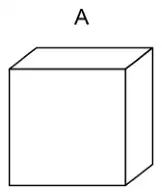
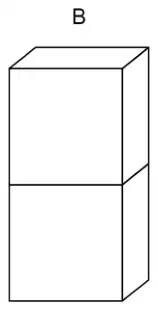
“surface area of A : surface area of B must be 1 : 2 because B is made of 2 of A.”
Is Matthew correct?
Tick one box.
Yes
No
Cannot tell
Give a reason for your answer. [2 marks]
Mark scheme
Answer
Mark
Comments
No ticked and correct reason or correct evaluation of the surface areas for any numerical or algebraic values or correct ratio of the surface areas
B2
eg 2 faces are hidden B1 No ticked
Additional guidance
Ignore irrelevant reasons or evaluations alongside a correct reason or evaluation, unless contradictory
“No” may be implied by a correct reason
Accept reasoning that uses A as a cube
No ticked and A has 6, B has 10 (condone sides for faces) A has 3, B has 5 A has 6 sides, on B each cube only has 5 Ratio is 3:5 (accept equivalent ratios) The bottom and the top are missing (or covered) When they are put together you lose two faces You wouldn’t count two sides (condone sides for faces) Some of the faces are covered You cannot see one side because they are stacked together One face covered Part of the area of A is covered where it joins B Both touching sides
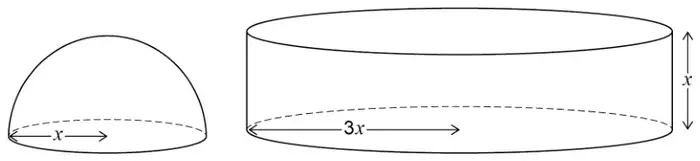
A solid cylinder has radius \(3x\) and height \(x\).
Surface area of a sphere \(= 4\pi r^2\) where \(r\) is the radius
Work out the ratio
total surface area of the hemisphere : total surface area of the cylinder
Give your answer in its simplest form.
You must show your working. [3 marks]
Mark scheme
Answer
Mark
Comments
Alternative method 1 – expressions in \(x\)
\(4\pi x^2 \div 2\) or \(2\pi x^2\) or \(\pi x^2\) or \(\pi(3x)^2\) or \(9\pi x^2\) or \(2 \times \pi(3x)^2\) or \(18\pi x^2\) or \(2\pi x(3x)\) or \(6\pi x^2\)
M1
oe area of curved face of hemisphere oe area of flat face of hemisphere oe area of one flat face of cylinder oe area of both flat faces of cylinder oe area of curved face of cylinder
\(4\pi x^2 \div 2 + \pi x^2\) or \(3\pi x^2\) or \(\pi(3x)^2 + \pi(3x)^2 + 2\pi x(3x)\) or \(9\pi x^2 + 9\pi x^2 + 6\pi x^2\) or \(24\pi x^2\)
M1dep
oe total surface area of the hemisphere
oe total surface area of the cylinder
\(3\pi x^2\) and \(24\pi x^2\) and 1 : 8
A1
either order
Alternative method 2 – substituting a value for \(x\)
Substitutes a value for \(x\) and works out the area of at least one of area of curved face of hemisphere area of flat face of hemisphere area of one flat face of cylinder area of both flat faces of cylinder area of curved face of cylinder
M1
eg using \(x = 5\), at least one of \(50\pi\) \(25\pi\) \(225\pi\) \(450\pi\) \(150\pi\)
Substitutes a value for \(x\) and works out an expression for the total surface area of the hemisphere or the cylinder
M1dep
eg using \(x = 5\) total surface area of hemisphere \(= 25\pi + 50\pi\) or \(75\pi\) or total surface area of cylinder \(= 225\pi + 225\pi + 150\pi\) or \(600\pi\)
Both correct total surface areas for their value of \(x\) and 1 : 8
A1
either order
Additional guidance
1 : 8 or 8 : 1 without correct working or values
M0M0A0
Condone \(\pi\) missing consistently for all marks
Allow ‘correct’ and consistent values of \(\pi\) throughout (eg 3, 3.14, \(\dfrac{22}{7}\))
Condone use of \(r\) for \(x\) throughout
Do not allow \(3\pi x^2\) from \(3x \times \pi \times x\) oe
Alternative method 1 Compares 70% of volume of hemisphere with volume of water
\(\dfrac{4}{3} \times \pi \times 12^3\) or \(2304\pi\) or [7216, 7239.2] or \(\dfrac{2}{3} \times \pi \times 12^3\) or \(1152\pi\) or [3581, 3638]
M1
oe eg \(\dfrac{4}{3}\pi \times 1728\) allow without any multiplication signs eg \(\dfrac{4}{3}\pi 12^3\)
\(0.7 \times\) their \(1152\pi\) or \(806.4\pi\) or [2506, 2547]
M1dep
oe \(0.7 \times\) their [3581, 3638] or \(\dfrac{4032}{5}\pi\) must be using volume of hemisphere
\(325 \times 8\) or 2600
M1
oe
[2506, 2547] and 2600 and Yes
A1
oe
Alternative method 2 Works out volume of water as proportion of volume of hemisphere
\(\dfrac{4}{3} \times \pi \times 12^3\) or \(2304\pi\) or [7216, 7239.2] or \(\dfrac{2}{3} \times \pi \times 12^3\) or \(1152\pi\) or [3581, 3638]
M1
oe eg \(\dfrac{4}{3}\pi \times 1728\) allow without any multiplication signs eg \(\dfrac{4}{3}\pi 12^3\)
\(325 \times 8\) or 2600
M1
oe
their \(2600 \div\) their \(1152\pi\) or [0.71, 0.73]
M1dep
oe eg their \(2600 \div\) their [3581, 3638] or 72% dep on M2 must be using volume of hemisphere
[71, 73](%) and Yes
A1
oe eg 0.72 and 0.7 and Yes
Alternative method 3 Works out time to fill 70% of volume of hemisphere
\(\dfrac{4}{3} \times \pi \times 12^3\) or \(2304\pi\) or [7216, 7239.2] or \(\dfrac{2}{3} \times \pi \times 12^3\) or \(1152\pi\) or [3581, 3638]
M1
oe eg \(\dfrac{4}{3}\pi \times 1728\) allow without any multiplication signs eg \(\dfrac{4}{3}\pi 12^3\)
\(0.7 \times\) their \(1152\pi\) or \(806.4\pi\) or [2506, 2547] or their \(1152\pi \div 325\) or [11, 11.2]
M1dep
oe \(0.7 \times\) their [3581, 3638] or \(\dfrac{4032}{5}\pi\) or their \([3581, 3638] \div 325\) must be using volume of hemisphere
\(0.7 \times\) their \(1152\pi \div 325\) or \(0.7 \times\) their \([3581, 3638] \div 325\) or [7.7, 7.84]
M1dep
oe their \([2506, 2547] \div 325\) or \(0.7 \times\) their [11, 11.2]
[7.7, 7.84] and Yes
A1
oe
Additional guidance
Up to M3 may be awarded for correct work with no answer or incorrect answer, even if this is seen amongst multiple attempts
Allow 1.33(…) for \(\dfrac{4}{3}\)
Allow 0.66(…) or 0.67 for \(\dfrac{2}{3}\)
\(\pi\) may be seen as [3.14, 3.142] eg Alt 1 \(\dfrac{2}{3} \times 3.14 \times 12^3\)
M1
If a number (or calculation) in terms of \(\pi\) is seen but \(\pi\) is subsequently omitted, treat as a miscopy for M marks eg Alt 1
\(1152\pi\)
M1
\(0.7 \times 1152 = 806.4\)
M1dep
\(325 \times 8 = 2600\) Yes
M1A0
Yes cannot be implied by inequalities
Alts 1 and 2 325 cm\(^3 \times 8\) seen is M1 even if evaluated incorrectly \(325^3 \times 8\) seen is M0 unless recovered to 2600
Do not allow misreads of the given formula unless recovered eg1 using \(12^2\) instead of \(12^3\) eg2 using \(\dfrac{3}{4}\) instead of \(\dfrac{4}{3}\)
For \(0.7 \times\) their \(1152\pi\), do not accept \(70\% \times\) their \(1152\pi\) unless recovered
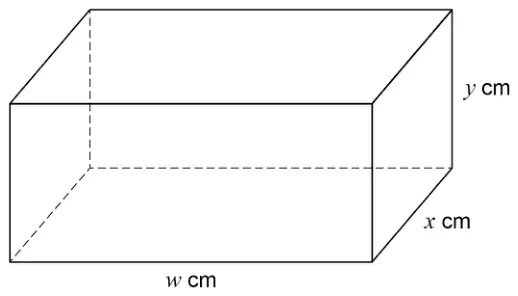
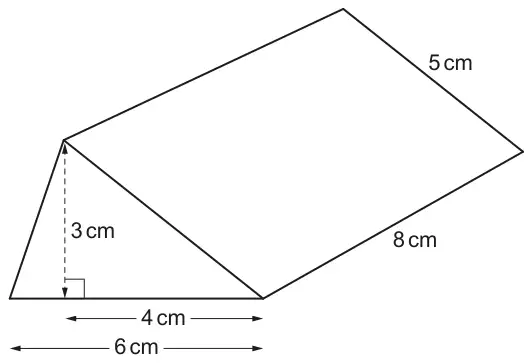
\(w\), \(x\) and \(y\) are different whole numbers.
The total length of all the edges of the cuboid is 80 cm
The volume is greater than 200 cm\(^3\)
Work out one possible set of values for \(w\), \(x\) and \(y\). [2 marks]
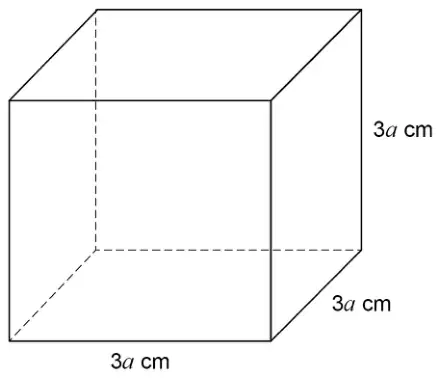
(b) Here is a solid cube.
Circle the expression for the total surface area in cm\(^2\) [1 mark]
\(36a\)
\(54a\)
\(36a^2\)
\(54a^2\)
Mark scheme (a)
Answer
Mark
Comments
11 5 4 or 10 7 3 or 10 6 4 or 9 8 3 or 9 7 4 or 9 6 5 or 8 7 5
B2
any order B1 answer of three positive numbers in any order with sum 20 eg 17 2 1 or \(9\tfrac{1}{2} \quad 8\tfrac{1}{2} \quad 2\) or 10 5 5 or \(6\tfrac{2}{3} \quad 6\tfrac{2}{3} \quad 6\tfrac{2}{3}\) or correct equation in \(w\), \(x\) and \(y\) eg \(4w + 4x + 4y = 80\) or \(w + x + y = 20\)
Additional guidance
Ignore attempts to work out the volume or surface area eg 10 5 5 volume calculated as 500
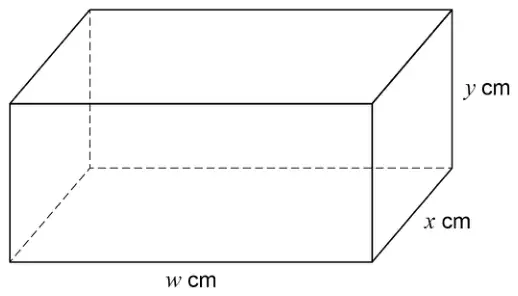
\(w\), \(x\) and \(y\) are different whole numbers.
The total length of all the edges of the cuboid is 80 cm
The volume is greater than 200 cm3
Work out one possible set of values for \(w\), \(x\) and \(y\). [2 marks]
(b) Here is a solid cube.
Circle the expression for the total surface area in cm2[1 mark]
\(36a\)
\(54a\)
\(36a^2\)
\(54a^2\)
Mark scheme (a)
Answer
Mark
Comments
11 5 4 or 10 7 3 or 10 6 4 or 9 8 3 or 9 7 4 or 9 6 5 or 8 7 5
B2
any order B1 answer of three positive numbers in any order with sum 20 eg 17 2 1 or \(9\dfrac{1}{2}\) \(8\dfrac{1}{2}\) 2 or 10 5 5 or \(6\dfrac{2}{3}\) \(6\dfrac{2}{3}\) \(6\dfrac{2}{3}\) or correct equation in \(w\), \(x\) and \(y\) eg \(4w + 4x + 4y = 80\) or \(w + x + y = 20\)
Additional guidance
Ignore attempts to work out the volume or surface area eg 10 5 5 volume calculated as 500
accept in words eg 120 million SC1 [480, 481] or [0.048, 0.0481]
Additional guidance
Do not award A mark if incorrect further work is seen
Mark scheme (b)
Answer
Mark
Comments
It could be less than or greater than Virat’s estimate (3rd box ticked) and statement that area is larger but depth is smaller
B2
B1 It is less than Virat’s estimate (1st box ticked) and statement that depth is smaller or It is greater than Virat’s estimate (2nd box ticked) and statement that area is larger or It could be less than or greater than Virat’s estimate (3rd box ticked) and statement that depth is smaller or It could be less than or greater than Virat’s estimate (3rd box ticked) and statement that area is larger
Additional guidance
For B2 their statement must refer to larger area and smaller depth
For B1 their statement must correctly refer to larger area or smaller depth for their box ticked
Examples of statements implying actual depth is smaller: height is less depth is lower it is shallower Virat’s estimate of the depth is bigger
Examples of statements implying actual area is larger: the width is bigger cross section is bigger shape is greater Virat’s estimate of the area is smaller
\(\pi\) may be seen as any value in the interval [3.14, 3.142]
Do not allow any misreads of formulae unless recovered eg \(\pi \times 24^2 \times 117\) and \(\dfrac{2}{3} \times \pi \times 24^2\)
M0
Allow dots for multiplication
For A marks allow eg \(22\,464 \times \pi\) or \(\pi \times 31\,680\)
\(31\,680\pi\) followed by incorrect evaluation attempt
M1A1M1A1
\(31\,680\pi\) followed by further work
M1A1M1A0
31 680 only
M0A0M0A0
\(\dfrac{1}{3} \times \pi \times 24^2 \times 117 = 4725 \qquad \dfrac{2}{3} \times \pi \times 24^3 = 28\,952\) \(4725 + 28\,952\) (even though 4725 is wrong the method for \(\dfrac{1}{3} \times \pi \times 24^2 \times 117\) is seen)
M1A1 M1
Mark scheme (b)
Answer
Mark
Comments
Alternative method 1 Uses volume scale factor
\(24 \div 2\) or 12
M1
oe eg \(12 \times 2 = 24\)
(their \(12)^3\)
M1dep
oe eg \(24^3 \div 2^3\) or \(13\,824 \div 8\)
1728
A1
condone 1 : 1728 or 1728 : 1 SC2 \(\dfrac{1}{1728}\)
Alternative method 2 Compares volumes of cornets (ie compares total volumes)
\(24 \div 2\) or 12
M1
oe eg \(12 \times 2 = 24\) may be implied eg (height of cone) 9.75 or (volume of cone) \(13\pi\) or (volume of cone) [40.8, 40.85] or (total volume) \(\dfrac{55}{3}\pi\) or [57.4, 57.7]
condone 1 : 1728 or 1728 : 1 SC2 \(\dfrac{1}{1728}\)
Alternative method 3 Compares volumes of cones
\(24 \div 2\) or 12
M1
oe eg \(12 \times 2 = 24\) may be implied eg (height of cone) 9.75 or (volume of cone) \(13\pi\) or (volume of cone) [40.8, 40.85] or (total volume) \(\dfrac{55}{3}\pi\) or [57.4, 57.7]
their volume of cone from (a) \(\div \left(\dfrac{1}{3}\pi \times 2^2 \times \dfrac{117}{\text{their } 12}\right)\)
M1dep
oe eg their volume of cone from (a) \(\div\) [40.8, 40.85]
1728
A1
condone 1 : 1728 or 1728 : 1 SC2 \(\dfrac{1}{1728}\)
Alternative method 4 Compares volumes of hemispheres
their volume of hemisphere from (a) \(\div \left(\dfrac{2}{3}\pi \times 2^3\right)\)
M2
oe eg their volume of hemisphere from (a) \(\div\) [16.7, 16.8]
1728
A1
condone 1 : 1728 or 1728 : 1 SC2 \(\dfrac{1}{1728}\)
Additional guidance
\(\pi\) may be seen as any value in the interval [3.14, 3.142]
Answer \(\times 1728\) or \(1728 \times\)
M1M1A1
Answer 12
M1M0A0
Answer \(12^3\) with 1728 seen
M1M1A1
Answer \(12^3\) without 1728 seen
M1M1A0
Alts 2, 3 and 4 Allow if an incorrect volume formula from (a) is used in (b) eg Alt 4 (a) \(\dfrac{1}{2} \times \dfrac{2}{3} \times \pi \times 24^3 = 4608\pi\) (b) \(\dfrac{1}{2} \times \dfrac{2}{3} \times \pi \times 2^3 = \dfrac{8}{3}\pi\) \(4608\pi \div \dfrac{8}{3}\pi\) 1728
M2 A1
Alts 2 and 3 Allow \(\dfrac{55}{3}\) rounded to 1dp or better eg allow 18.3
Alt 4 Allow \(\dfrac{16}{3}\) rounded to 1dp or better eg allow 5.3
Alts 2 and 3 2nd M1 – allow consistent omission of \(\pi\)
Alt 4 M2 – allow consistent omission of \(\pi\)
Alts 2, 3 and 4 Answer 1728 is M1M1A1 unless it comes from rounding or truncating
eg1 Alt 2 \(99\,525.655 \div 57.595 = 1728\)
M1M1A1
eg2 Alt 2 \(99\,525.655 \div 57.595 = 1728.03\) Answer 1728
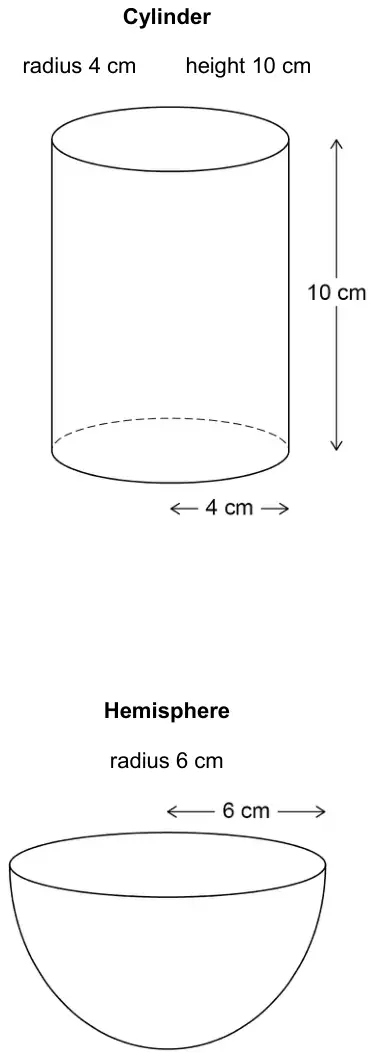
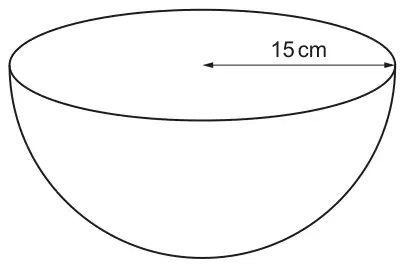
volume of a hemisphere \(= \dfrac{2}{3}\pi r^3 \quad\) where \(r\) is the radius
Which solid has the greater volume?
You must show your working. [4 marks]
Mark scheme
Answer
Mark
Comments
Alternative method 1: working in terms of π
\(\pi\ (\times)\ 4^2\ (\times)\ 10\) or \(160\pi\) or [502, 503]
M1
oe accept 3 or better for \(\pi\) accept 480 or 496
\(\dfrac{2}{3}\ (\times)\ \pi\ (\times)\ 6^3\) or \(144\pi\) or [452, 453]
M1
oe accept 3 or better for \(\pi\) accept 0.66 or 0.67 or better for \(\dfrac{2}{3}\) accept 432 or 446(.4)
\(160\pi\) and \(144\pi\) or [502, 503] and [452, 453]
A1
oe values accept 480 and 432 or 496 and 446(.4)
\(160\pi\) and \(144\pi\) and cylinder or [502, 503] and [452, 453] and cylinder or cylinder is \(16\pi\) greater
A1ft
ft correct decision for their \(160\pi\) and their \(144\pi\) with M1M1 scored accept 480 and 432 and cylinder or 496 and 446(.4) and cylinder
Alternative method 2: working without π
\(4^2\ (\times)\ 10\) or 160
M1
oe
\(\dfrac{2}{3}\ (\times)\ 6^3\) or 144
M1
oe accept 0.66 or 0.67 or better for \(\dfrac{2}{3}\)
160 and 144
A1
oe values
160 and 144 and cylinder
A1ft
ft correct decision for their 160 and their 144 with M1M1 scored
Additional guidance
Better than 3 for \(\pi\) could be 3.1, 3.14, 3.142 or \(\dfrac{22}{7}\)
\(160\pi\) with incorrect method for hemisphere
M1M0A0A0
\(144\pi\) with incorrect method for cylinder
M0M1A0A0
\(160\pi\) and \(144\pi\) with incorrect decision or no decision
M1M1A1A0
160 and 144 with incorrect or no decision
M1M1A1A0
Accept values given as fractions for the first A mark, but for the second A mark, they must have a common denominator. eg \(160\pi\) and \(\dfrac{432\pi}{3}\) and cylinder eg \(\dfrac{480}{3}\) and \(\dfrac{432}{3}\) and cylinder
M1M1A1A0 M1M1A1A1
Working with \(\pi\) for one value but not the other can only score M1 eg \(160\pi\) and 144 (with or without a decision)
M1 only
Do not allow M1 for a correct formula as part of an incorrect formula eg \(\dfrac{1}{3} \times \pi \times 4^2 \times 10\)
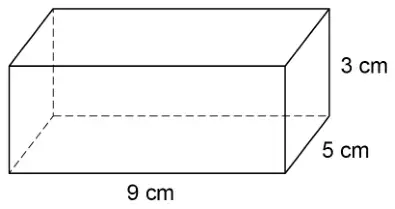
Is the total blue area greater than the total green area?
You must show your working. [3 marks]
Mark scheme
Answer
Mark
Comments
\(9 \times 5\) or 45 or \(9 \times 3\) or 27 or \(5 \times 3\) or 15
M1
may be multiplied by 2 implied by 90 or 54 or 30 or (total =) 174 or 90 + 54 + 30 = 174
\(9 \times 5 \times 2\) or 90 and \(9 \times 3 \times 2 + 5 \times 3 \times 2\) or \(54 + 30\) or 84 or \(9 \times 5\) or 45 and \(9 \times 3 + 5 \times 3\) or \(27 + 15\) or 42
M1dep
accept blue = 90 and (total =) 174 or green = 84 and (total =) 174
90 and 84 and Yes or 45 and 42 and Yes
A1
oe condone incorrect units
Additional guidance
Yes may be seen by the question or implied by eg blue is bigger
Ticking or circling blue or 90 without a comment does not imply Yes
Allow M1 even if not subsequently used
Allow M1 even if seen among other calculations for eg perimeter or volume
Works out the area of a face and then uses this for the ‘volume’ eg \(5 \times 3 = 15\), \(15 \times 9 = 135\) or \(5 \times 3 = 15\), \(15 \times 15 = 225\)
M1M0A0
Only works out a ‘volume’ with correct or incorrect method eg \(5 \times 3 \times 9 = 135\) or \(5 \times 3 \times 5 \times 3 = 225\)
M0M0A0
Ignore incorrect subtraction eg 90, 84 and Yes blue is 8 greater
M1M1A1
90 + 54 + 30 = 174 \((174 \div 2 = 87)\) 90 is more than half so Yes or 84 is less than half so Yes
M1
M1A1
Only 90 and 174 without identifying 90 as the blue area
volume of a hemisphere \(= \dfrac{2}{3}\pi r^3 \quad\) where \(r\) is the radius
Which solid has the greater volume?
You must show your working. [4 marks]
Mark scheme
Answer
Mark
Comments
Alternative method 1: working in terms of \(\pi\)
\(\pi\ (\times)\ 4^2\ (\times)\ 10\) or \(160\pi\) or [502, 503]
M1
oe accept 3 or better for \(\pi\) accept 480 or 496
\(\dfrac{2}{3}\ (\times)\ \pi\ (\times)\ 6^3\) or \(144\pi\) or [452, 453]
M1
oe accept 3 or better for \(\pi\) accept 0.66 or 0.67 or better for \(\dfrac{2}{3}\) accept 432 or 446(.4)
\(160\pi\) and \(144\pi\) or [502, 503] and [452, 453]
A1
oe values accept 480 and 432 or 496 and 446(.4)
\(160\pi\) and \(144\pi\) and cylinder or [502, 503] and [452, 453] and cylinder or cylinder is \(16\pi\) greater
A1ft
ft correct decision for their \(160\pi\) and their \(144\pi\) with M1M1 scored accept 480 and 432 and cylinder or 496 and 446(.4) and cylinder
Alternative method 2: working without \(\pi\)
\(4^2\ (\times)\ 10\) or 160
M1
oe
\(\dfrac{2}{3}\ (\times)\ 6^3\) or 144
M1
oe accept 0.66 or 0.67 or better for \(\dfrac{2}{3}\)
160 and 144
A1
oe values
160 and 144 and cylinder
A1ft
ft correct decision for their 160 and their 144 with M1M1 scored
Additional guidance
Better than 3 for \(\pi\) could be 3.1, 3.14, 3.142 or \(\dfrac{22}{7}\)
\(160\pi\) with incorrect method for hemisphere
M1M0A0A0
\(144\pi\) with incorrect method for cylinder
M0M1A0A0
\(160\pi\) and \(144\pi\) with incorrect decision or no decision
M1M1A1A0
160 and 144 with incorrect or no decision
M1M1A1A0
Accept values given as fractions for the first A mark, but for the second A mark, they must have a common denominator. eg \(160\pi\) and \(\dfrac{432\pi}{3}\) and cylinder eg \(\dfrac{480}{3}\) and \(\dfrac{432}{3}\) and cylinder
M1M1A1A0 M1M1A1A1
Working with π for one value but not the other can only score M1 eg \(160\pi\) and 144 (with or without a decision)
M1 only
Do not allow M1 for a correct formula as part of an incorrect formula eg \(\dfrac{1}{3} \times \pi \times 4^2 \times 10\)
Volume of a sphere \(= \dfrac{4}{3}\pi r^3 \quad\) where \(r\) is the radius
Volume of a cone \(= \dfrac{1}{3}\pi r^2 h \quad\) where \(r\) is the radius and \(h\) is the perpendicular height
A sphere has radius \(2x\) cm
A cone has
radius \(3x\) cm perpendicular height \(h\) cm
The sphere and the cone have the same volume.
Work out radius of cone : perpendicular height of cone
Give your answer in the form \(\quad a : b \quad\) where \(a\) and \(b\) are integers. [4 marks]
Mark scheme
Answer
Mark
Comments
\(\dfrac{4}{3}\pi(2x)^3\) or \(\dfrac{1}{3}\pi(3x)^2h\)
M1
oe
\(\dfrac{4}{3}\pi(2x)^3 = \dfrac{1}{3}\pi(3x)^2h\) or \(\dfrac{4}{3}\pi 8x^3 = \dfrac{1}{3}\pi 9x^2h\)
M1dep
oe Sets up equation
\(32x = 9h\) or \(x = \dfrac{9}{32}h\) or \(h = \dfrac{32}{9}x\) or \(\dfrac{32}{3}r = 9h\) or \(r = \dfrac{27}{32}h\) or \(h = \dfrac{32}{27}r\) or \(27h = 32r\) or \(\dfrac{27}{32}h : h\) or \(3x : \dfrac{32}{9}x\) or \(\dfrac{27}{32} : 1\) or \(3 : \dfrac{32}{9}\) or 0.84… : 1 or 3 : 3.55…
The crate is a cuboid measuring 2.5 m by 2 m by 1.2 m Each box is a cube of length 50 cm
He does these calculations.
volume of crate
=
2.5 × 2 × 1.2
=
6 m3
volume of one box
=
0.5 × 0.5 × 0.5
=
0.125 m3
number of boxes
=
6 ÷ 0.125
=
48
He claims,
“I can put 48 boxes in the crate.”
Evaluate Ashraf’s method and claim. [2 marks]
Mark scheme
Answer
Mark
Comments
Evaluates method
B1
eg1 his method does not work because 1.2 m does not divide exactly by 50 cm eg2 there are not a whole number of 50 cm in 1.2 m eg3 50 cm will not fit in 0.2 m eg4 1.2 ÷ 0.5 = 2.4 which is not a whole number eg5 120 ÷ 50 = 2.4 and cannot have 2.4 boxes eg6 can only fit 2 layers of boxes
Evaluates claim
B1
eg1 he can only fit 40 eg2 he will not fit (as many as) 48
Additional guidance
Volume divided volume doesn’t always work
(1st) B0
He is wrong as he can put 42 boxes
(2nd) B0
Only 2 layers will fit so he can’t fit 48 boxes
B1B1
Can’t have 0.4 of a box so he can only fit 45 boxes
27 Volume of a sphere \(= \dfrac{4}{3}\pi r^3\) where \(r\) is the radius
A container is a hemisphere of radius 30 cm
Sand fills the container at a rate of 4000 cm\(^3\) per minute.
Does it take less than a quarter of an hour to fill the container?
You must show your working. [3 marks]
Mark scheme
Answer
Mark
Comments
Alternative method 1
\(\dfrac{4}{3}\pi \times 30^3\) or \(36\,000\pi\) or [112 757, 113 112] or \(\dfrac{1}{2} \times \dfrac{4}{3}\pi \times 30^3\) or \(18\,000\pi\) or [55 954, 56 839]
M1
oe allow 1.33… for \(\dfrac{4}{3}\) allow 0.66… or 0.67 for \(\dfrac{2}{3}\)
their [112 757, 113 112] \(\div\) 4000 or \(9\pi\) or 28.(…) or their [55 954, 56 839] \(\div\) 4000 or \(\dfrac{9\pi}{2}\) or [13.9, 14.21] or their [112 757, 113 112] \(\div\) (4000 \(\times\) 60) or \(\dfrac{3\pi}{20}\) or [0.46, 0.4713] or their [55 954, 56 839] \(\div\) (4000 \(\times\) 60) or \(\dfrac{3\pi}{40}\) or 0.23… or 0.24
M1dep
[13.9, 14.21] and Yes or 0.23… or 0.24 and Yes
A1
Alternative method 2
\(\dfrac{4}{3}\pi \times 30^3\) or \(36\,000\pi\) or [112 757, 113 112] or \(\dfrac{1}{2} \times \dfrac{4}{3}\pi \times 30^3\) or \(18\,000\pi\) or [55 954, 56 839]
M1
oe allow 1.33… for \(\dfrac{4}{3}\) allow 0.66… or 0.67 for \(\dfrac{2}{3}\)
\(4000 \times 15\) or 60 000
M1
[55 954, 56 839] and 60 000 and Yes
A1
Alternative method 3
\(\dfrac{4}{3}\pi \times 30^3\) or \(36\,000\pi\) or [112 757, 113 112] or \(\dfrac{1}{2} \times \dfrac{4}{3}\pi \times 30^3\) or \(18\,000\pi\) or [55 954, 56 839]
M1
oe allow 1.33… for \(\dfrac{4}{3}\) allow 0.66… or 0.67 for \(\dfrac{2}{3}\)
their [112 757, 113 112] \(\div\) 15 or \(2400\pi\) or [7517, 7541] or their [55 954, 56 839] \(\div\) 15 or \(1200\pi\) or [3730, 3790]
M1dep
[3730, 3790] and Yes
A1
Additional guidance
Do not award A1 if incorrect conversion of \(\dfrac{1}{4}\) hour seen
Volume of a sphere \(= \dfrac{4}{3}\pi r^3\) where \(r\) is the radius
A container is a hemisphere of radius 30 cm
Sand fills the container at a rate of 4000 cm\(^3\) per minute.
Does it take less than a quarter of an hour to fill the container?
You must show your working. [3 marks]
Mark scheme
Answer
Mark
Comments
Alternative method 1
\(\dfrac{4}{3}\pi \times 30^3\) or \(36\,000\pi\) or [112 757, 113 112] or \(\dfrac{1}{2} \times \dfrac{4}{3}\pi \times 30^3\) or \(18\,000\pi\) or [55 954, 56 839]
M1
oe allow 1.33… for \(\dfrac{4}{3}\) allow 0.66… or 0.67 for \(\dfrac{2}{3}\)
their [112 757, 113 112] \(\div\) 4000 or \(9\pi\) or 28.(…) or their [55 954, 56 839] \(\div\) 4000 or \(\dfrac{9\pi}{2}\) or [13.9, 14.21] or their [112 757, 113 112] \(\div\) (4000 \(\times\) 60) or \(\dfrac{3\pi}{20}\) or [0.46, 0.4713] or their [55 954, 56 839] \(\div\) (4000 \(\times\) 60) or \(\dfrac{3\pi}{40}\) or 0.23… or 0.24
M1dep
[13.9, 14.21] and Yes or 0.23… or 0.24 and Yes
A1
Alternative method 2
\(\dfrac{4}{3}\pi \times 30^3\) or \(36\,000\pi\) or [112 757, 113 112] or \(\dfrac{1}{2} \times \dfrac{4}{3}\pi \times 30^3\) or \(18\,000\pi\) or [55 954, 56 839]
M1
oe allow 1.33… for \(\dfrac{4}{3}\) allow 0.66… or 0.67 for \(\dfrac{2}{3}\)
\(4000 \times 15\) or 60 000
M1
[55 954, 56 839] and 60 000 and Yes
A1
Alternative method 3
\(\dfrac{4}{3}\pi \times 30^3\) or \(36\,000\pi\) or [112 757, 113 112] or \(\dfrac{1}{2} \times \dfrac{4}{3}\pi \times 30^3\) or \(18\,000\pi\) or [55 954, 56 839]
M1
oe allow 1.33… for \(\dfrac{4}{3}\) allow 0.66… or 0.67 for \(\dfrac{2}{3}\)
their [112 757, 113 112] \(\div\) 15 or \(2400\pi\) or [7517, 7541] or their [55 954, 56 839] \(\div\) 15 or \(1200\pi\) or [3730, 3790]
M1dep
[3730, 3790] and Yes
A1
Additional guidance
Do not award A1 if incorrect conversion of \(\dfrac{1}{4}\) hour seen
M1 for \(4 \times \pi \times (\textit{their}\ r)^2\) oe or \(4 \times \pi \times \left(\dfrac{50}{2\pi}\right)^2\) oe
For M1 substitution of their r must be explicit Their r may be any value from 3 to 10 understood to be their radius \(\pi\) may be substituted with 3.142 or calculator value, allowing 3.14 and \(\dfrac{22}{7}\)
If 0, 1 or 2 scored, instead award SC3 for \(\sqrt{6\pi}\) or 4.34… with no or insufficient working
Alternative method: M4 for \(\sqrt{\frac{4\pi 3^2}{6}}\) or better or M3 for \(\sqrt{\frac{4\pi r^2}{6}}\) or better or M2 for \(\frac{4\pi r^2}{6}\) or better or M1 for \(6x^2\)
After B2 scored, correct final answer from trials scores full marks
(a) The diagram shows the cross-section of a triangular prism.
Not to scale
Work out the area of the cross-section. [2]
(b) This diagram shows the triangular prism.
Not to scale
Work out the total surface area of the triangular prism. You must show your working. [5]
(c) Two of these triangular prisms are joined to make a new prism.
Give a reason why the total surface area of this prism is not two times your answer in part (b). [1]
Mark scheme (a)
Answer
Marks
Part marks and guidance
54
2
M1 for \(\dfrac{9 \times 12}{2}\) oe
Mark scheme (b)
Answer
Marks
Part marks and guidance
828 with correct working
5
Correct working requires evidence of at least M1or B2 (Pythagoras) and M2 (area)
B2 for [hypotenuse =] 15 or M1 for \(9^2 + 12^2\)
AND
M2 for 2 from 2 × theirpart(a), \(20 \times 9\), \(20 \times 12\), \(20 \times\) their \(\sqrt{9^2 + 12^2}\)
or
M1 for 1 from 2 × theirpart(a), \(20 \times 9\), \(20 \times 12\), \(20 \times\) their \(\sqrt{9^2 + 12^2}\)
Allow restart for area of triangle May be implied by 108, 180, 240, 300
If 0 or 1, scored instead award SC2 for 828 with no or insufficient working
Mark scheme (c)
Answer
Marks
Part marks and guidance
Reason that recognises the loss of part of the surface [of the triangular prisms] e.g. [The value of] two rectangular areas are lost /no longer on the surface oe
1
Accept e.g. faces/rectangles/slanting faces/sections for rectangular areas less/reduced for lost
10 A bowl in the shape of a hemisphere with radius 15 cm is used to collect raindrops.
Assume each raindrop has the volume of a sphere of radius \(3 \times 10^{-4}\) cm.
Calculate how many raindrops it takes to completely fill the bowl. Give your answer in standard form. You must show your working.
[The volume \(V\) of a sphere with radius \(r\) is \(V = \dfrac{4}{3}\pi r^3\).] [6]
Mark scheme
Answer
Marks
Part marks and guidance
\(6.25 \times 10^{13}\) with correct working
6
B5 an answer equivalent to \(6.25 \times 10^{13}\) with correct working or an answer in standard form \(6.2 \times 10^{13}\) to \(6.3 \times 10^{13}\) with correct working
OR
M2 for \(\frac{1}{2}\ (\times)\ \frac{4}{3}\ (\times)\ \pi\ (\times)\ 15^3\) or M1 for \(\frac{4}{3}\ (\times)\ \pi\ (\times)\ 15^3\) or \(4500\pi\) or 14137 to 14139 and
Correct working requires evidence of at least M1M1
M1 for \(\frac{4}{3}\ (\times)\ \pi\ (\times)\ (3 \times 10^{-4})^3\) soi A1 for \(3.6\pi \times 10^{-11}\) or \(1.13\ldots \times 10^{-10}\) oe
and
eg M1 \(\frac{4}{3}\pi\)[×] their answer to \((3 \times 10^{-4})^3\)
M1dep (on M1M1) for \(\dfrac{\textit{their} \text{ volume of bowl}}{\textit{their} \text{ volume of raindrop}}\)
Their volumes must have come from use of correct formulas for hemisphere and sphere or for two spheres
Alternative method: M4 for \(15^3 \div (3^3 \times 10^{-12})\) or \(1.25 \times 10^{14}\) oe or M3 for \(\left[\frac{\frac{4}{3} \times \pi}{\frac{4}{3} \times \pi}\right] \frac{15^3}{(3 \times 10^{-4})^3}\) oe
and
M1dep for 0.5 × their vol. scale factor
If 0, 1 or 2 scored, instead award SC3 for answer \(6.25 \times 10^{13}\) with no or insufficient working If 0 or 1 scored, instead award SC2 for a B5 answer but with no or insufficient working If 0 scored, instead award SC1 for \(2250\pi\) or 7068 to 7070 or \(3.6\pi \times 10^{-11}\) or \(1.13\ldots \times 10^{-10}\) with no or insufficient working
18 A sphere has radius \(x\) cm. A cone has radius \(R\) cm and height \(2R\) cm.
The volume of the sphere is equal to the volume of the cone.
Write \(R\) in terms of \(x\).
[The volume \(V\) of a sphere with radius \(r\) is \(V = \frac{4}{3}\pi r^3\).
The volume \(V\) of a cone with radius \(r\) and height \(h\) is \(V = \frac{1}{3}\pi r^2 h\).] [4]
Mark scheme
Answer
Marks
Part marks and guidance
\(R = \sqrt[3]{2}\,x\) or \(R = \sqrt[3]{2x^3}\) final answer
4
Condone \(r\) for \(R\) throughout Answer \(\sqrt[3]{2}\,x\) or \(\sqrt[3]{2x^3}\) allow M3 For method marks condone 3.14, 3.142 or \(\frac{22}{7}\) for \(\pi\) For method marks ignore any units
M3 for \(12[\pi]x^3 = 6[\pi]R^3\) or better Or
M2 for \(\frac{4}{3}[\pi]x^3 = \frac{1}{3}[\pi] \times R^2 \times 2R\) oe
For M3 removes fractions and simplifies terms in \(R\) M3 accept e.g. \(2x^3 = R^3\)
Calculate the volume of the sphere. Give your answer in terms of \(\pi\) in its simplest form. [The volume \(V\) of a sphere with radius \(r\) is \(V = \frac{4}{3}\pi r^3\).] [3]
Mark scheme
Answer
Marks
Part marks and guidance
\(36\pi\) final answer
3
M1 for \(\dfrac{4}{3} \times \pi \times 3^3\) oe M1dep for \(\dfrac{4}{3} \times \pi \times 27\) or \(4 \times \pi \times 3^2\) or \(\dfrac{108\pi}{3}\) or \(4 \times \pi \times 9\) or \(\pi 36\) oe
Accept \(36 \times \pi\) do not accept \(\pi 36\) for 3 marks
For method marks accept \(\pi\) = 3.14[2…..] and 1.33[3…..] for \(\dfrac{4}{3}\)
14 The diagram shows a square-based pyramid ABCDE. O is the centre of the base.
The pyramid has base length 20 cm and each sloping edge has length 14.5 cm.
(a) Draw the plan view of the pyramid on the one-centimetre grid below.
Scale: 1 cm represents 4 cm.
[2]
(b) Calculate the volume of the pyramid. You must show your working.
[The volume of a pyramid is \(\frac{1}{3}\) × area of base × perpendicular height] [5]
Mark scheme (a)
Answer
Marks
Part marks and guidance
with side 5 cm
2
B1 for a square drawn with side 5 cm or for a square of any length with two diagonals
Mark intention 2mm tolerance radially on centre point by eye
Mark scheme (b)
Answer
Marks
Part marks and guidance
\(\frac{200\sqrt{41}}{3}\) or 426.6 to 427 with correct working
5
M3 for \(\sqrt{14.5^2 - 10^2 - 10^2}\) oe
or M2 for \(14.5^2 - 10^2 - 10^2\) oe or M1 for \(14.5^2 = 10^2 + 10^2 + h^2\) or for \(10^2 + 10^2\) oe implied by 200 or for \(\sqrt{10^2 + 10^2}\) oe implied by 14.1…or \(10\sqrt{2}\) or for \(20^2 + 20^2\) oe implied by 800 or for \(\sqrt{20^2 + 20^2}\) oe implied by 28.2[8..], 28.3 …or \(20\sqrt{2}\)
AND
M1 for \(\frac{1}{3} \times 20 \times 20 \times their\ 3.2[0]\) or for \(\frac{1}{3} \times 400 \times their\ 3.2[0]\)
If 0 or 1 scored, instead award SC2 for \(\frac{200\sqrt{41}}{3}\) or 426.6 to 427 with no or insufficient working
If 0 scored, SC1 for \(\frac{\sqrt{41}}{2}\) or \(\sqrt{10.25}\) or 3.2[0] to 3.211 with no or insufficient working
‘Correct working’ requires evidence of at least three M marks Working may be on diagram May be seen in stages Method must be seen for M3 (3.2[0] to 3.211 or \(\frac{\sqrt{41}}{2}\) or \(\sqrt{10.25}\) ) (10.25)
May be seen in stages
For M3 and M2 condone \(10\sqrt{2}{}^2\) for \((10\sqrt{2})^2\) which may lead to wrong answer for M2 of 190.25 or for M3 of 13.79…
Their 3.2[0] must be in the range 3.2[0] to 3.211 and must come from an attempt at 3D trig or 3D Pythagoras
The sphere has radius 4 cm. The cone has radius 15 cm and height 30 cm.
The sphere is completely filled with water. The same amount of water is poured into the cone.
Work out the depth, \(d\) cm, of the water in the cone. You must show your working.
[The volume \(V\) of a sphere with radius \(r\) is \(V = \frac{4}{3}\pi r^3\). The volume \(V\) of a cone with radius \(r\) and height \(h\) is \(V = \frac{1}{3}\pi r^2 h\).] [6]
Mark scheme
Answer
Marks
Part marks and guidance
10.1 or 10.07 to 10.08 with correct working
6
M4 for \(\frac{4}{3}\) × π × \(4^3\) = \(\frac{1}{3}\) × π × \((\frac{1}{2}d)^2\) × \(d\) oe M1 for rearranging their equation OR M1 for \(\frac{4}{3}\) × π × \(4^3\) implied by 268.[08…] or 268.1 B1 for [radius of water =] \(\frac{1}{2}d\) M2 for \(\frac{1}{3}\) × π × \((\frac{1}{2}d)^2\) × \(d\) = their 268.08… or M1 for \(\frac{1}{3}\) × π × \((\frac{1}{2}d)^2\) × \(d\) condone one error M1 for rearranging their equation e.g. \(d^3 = \frac{their\ 268.08\ldots \times 12}{\pi}\) implied by [\(d^3\) =] 1024
Alternative method
M4 for \(\frac{\frac{256\pi}{3}}{\frac{1}{3}\pi \times 15^2 \times 30} = \left(\frac{d}{30}\right)^3\) oe M1 for rearranging their equation OR M1 for \(\frac{4}{3}\) × π × \(4^3\) implied by 268.[08…], 268.1 or \(\frac{256\pi}{3}\) M1 for \(\frac{1}{3}\)π × \(15^2\) × 30 implied by 2250π or 7068[.58…] or 7069 or 7068.6 M2 for [sf=] \(\sqrt[3]{\frac{\frac{256\pi}{3}}{\frac{1}{3}\pi \times 15^2 \times 30}}\) oe or 0.33597… rot or M1 for \(\frac{\frac{256\pi}{3}}{\frac{1}{3}\pi \times 15^2 \times 30}\) oe or 0.0379… M1 for their sf × 30
If 0 or 1 scored, instead award SC3 for answer 10.1 or 10.07 to 10.08 with no or insufficient working
allow 10 only if working supports it “Correct working” requires evidence of at least M2 or M1 M1
M1 implied by \(\frac{256\pi}{3}\)
Note they can use \(h = 2r\) so apply the scheme accordingly, 1024 will become 256
Complete method with trials giving the correct answer can score 6 marks
26 The diagram shows a triangular prism and a cube. The ends of the prism are right-angled triangles with base 16 cm and height 12 cm. The prism is 18 cm long.
The volume of the prism is equal to the volume of the cube. Find the surface area of the cube. You must show your working. [6]
Mark scheme
Answer
Marks
Part marks and guidance
864 with correct working
6
M1 for \(\dfrac{12 \times 16}{2} \times 18\) oe A1 for 1728 or M1 for \(\dfrac{12 \times 16}{2}\) oe
AND
M1 for \(\sqrt[3]{\textit{their } 1728}\) A1 for 12
AND
M1 for \(6 \times (\textit{their } 12)^2\)
If 0, 1 or 2 scored, instead award SC3 for 864 as final answer with no working or insufficient working
If 0 or M1 scored, instead award SC2 for 12 seen as dimension of cube or \(\left(\sqrt[3]{3456}\right)^2 \times 6\) soi 1371 to 1372 with no working or insufficient working
If 0 scored, award SC1 for 1728 or \(\sqrt[3]{3456}\) soi 15.1[…] with no working or insufficient working
“correct working” requires at least M1M1
Accept e.g. \(12 \times 8 \times 18\) or \(96 \times 18\)
Allow \(12^3 = 1728\) for M1A1 1728 must be from correct method for volume of triangular prism
their 12 must come from use of volume of triangular prism and cube root
25 The diagram shows a square-based pyramid and a sphere.
The pyramid has base length 12.3 cm and perpendicular height 15.7 cm. The sphere has radius \(r\) cm.
The pyramid and the sphere have the same volume.
Work out the radius of the sphere. You must show your working.
[The volume of a pyramid is \(\dfrac{1}{3} \times\) area of base \(\times\) perpendicular height. The volume \(V\) of a sphere with radius \(r\) is \(V = \dfrac{4}{3}\pi r^3\).] [5]
Mark scheme
Answer
Marks
Part marks and guidance
5.73 to 5.74 or 5.7 with correct working
5
“correct working” requires at least M3 or if trials are used M1 M1 M1
M4 for [\(r^3 =\)] \(\dfrac{1}{3} \times 12.3^2 \times 15.7 \div \dfrac{4}{3}\pi\) oe or for [\(r^3 =\)] their 791.8 \(\div \dfrac{4}{3}\pi\)
OR M3 for \(\dfrac{4}{3}\pi r^3 = \left(\dfrac{1}{3} \times 12.3^2 \times 15.7\right)\) oe or \(\dfrac{4}{3}\pi r^3 =\) their 791.8
OR M1 for \(\dfrac{1}{3} \times 12.3^2 \times 15.7\) oe A1 for 791.7 to 791.8 or 792
Notes: allow 151[.29] or 151.2 or 151.3 for \(12.3^2\),
for \(\dfrac{1}{3}\) accept 0.33 or better and for \(\dfrac{4}{3}\) accept 1.33 or better and for \(\dfrac{4}{3}\pi\) accept 4.17 to 4.19
their 791.8 is 791.7 to 791.8 or 792 from correct use of given formula
M3 implied by \(V = \dfrac{4}{3}\pi r^3\) and \(V =\) their 791.8 do not lose M1 A1 if further work on a sphere does not include this
Trials We need value and its result for M1 M1 for \(\dfrac{1}{3} \times 12.3^2 \times 15.7\) oe A1 for 791.7 to 791.8 or 792 M1 for a correct trial M1 for another correct trial
If 0, 1 or 2 scored instead award SC3 for answer 5.73 to 5.74 or 5.7 with no working or insufficient working
If 0 or 1 scored instead award SC2 for 188.99 to 189.03 with no working or insufficient working
If 0 scored SC1 for 791.7 to 791.8 or 792 with no working or insufficient working
20 Two pyramids, A and B, are mathematically similar. Pyramid A has surface area 12 cm² and volume 8 cm³. Pyramid B has surface area 75 cm².
Work out the volume of pyramid B. You must show your working. [4]
Mark scheme
Answer
Marks
Part marks and guidance
125 with correct working
4
M3 for [8 ×] \(\left(\sqrt{\dfrac{75}{12}}\right)^3\) or \(2.5^3\) oe or M2 for \(\sqrt{\dfrac{75}{12}}\) or \(\sqrt{6.25}\) oe implied by 2.5 or \(\frac{5}{2}\) or M1 for \(\dfrac{75}{12}\) oe implied by 6.25
“correct working” requires evidence of at least M2 Accept ratios M3 for 8 : 125 oe or M2 for 2 : 5 oe or M1 for 4 : 25 oe
Alternative method: M3 for [8 ÷] \(\left(\sqrt{\dfrac{12}{75}}\right)^3\) or \(0.4^3\) oe or M2 for \(\sqrt{\dfrac{12}{75}}\) or \(\sqrt{0.16}\) oe implied by 0.4 or \(\frac{2}{5}\) or M1 for \(\dfrac{12}{75}\) oe implied by 0.16
If 0 scored, instead award SC1 for answer 125 with no or insufficient working
10 The diagram shows a triangular prism and a cube. The ends of the prism are right-angled triangles with base 16 cm and height 12 cm. The prism is 18 cm long.
The volume of the prism is equal to the volume of the cube.
Find the surface area of the cube. You must show your working. [6]
Mark scheme
Answer
Marks
Part marks and guidance
864 with correct working
6
M1 for \(\dfrac{12 \times 16}{2} \times 18\) A1 for 1728 or M1 for \(\dfrac{12 \times 16}{2}\)
“correct working” requires at least M1M1 Accept e.g. 12 × 8 × 18 or 96 × 18 Allow \(12^3 = 1728\) for M1A1
AND M1 for \(\sqrt[3]{\textit{their } 1728}\) A1 for 12
Their 1728 must be from correct method for volume of triangular prism
AND M1 for \(6 \times (\textit{their } 12)^2\)
Their 12 must come from use of volume of triangular prism and cube root
If 0, 1 or 2 scored, instead award SC3 for 864 as final answer with no working or insufficient working If 0 or M1 scored, instead award SC2 for 12 seen as dimension of cube or \((\sqrt[3]{3456})^2 \times 6\) soi 1371 to 1372 with no working or insufficient working If 0 scored, award SC1 for 1728 or \(\sqrt[3]{3456}\) soi 15.1[…] with no working or insufficient working
7 The diagram shows a square-based pyramid and a sphere.
The pyramid has base length 12.3 cm and perpendicular height 15.7 cm. The sphere has radius \(r\) cm.
The pyramid and the sphere have the same volume.
Work out the radius of the sphere. You must show your working.
[The volume of a pyramid is \(\frac{1}{3}\) × area of base × perpendicular height. The volume \(V\) of a sphere with radius \(r\) is \(V = \frac{4}{3}\pi r^3\).] [5]
Mark scheme
Answer
Marks
Part marks and guidance
5.73 to 5.74 or 5.7 with correct working
5
“correct working” requires at least M3 or if trials are used M1 M1 M1
M4 for [\(r^3 =\)] \(\frac{1}{3} \times 12.3^2 \times 15.7 \div \frac{4}{3}\pi\) oe or for [\(r^3 =\)] their \(791.8 \div \frac{4}{3}\pi\)
OR M3 for \(\frac{4}{3}\pi r^3 = \left(\frac{1}{3} \times 12.3^2 \times 15.7\right)\) oe or \(\frac{4}{3}\pi r^3 =\) their 791.8
OR M1 for \(\frac{1}{3} \times 12.3^2 \times 15.7\) oe A1 for 791.7 to 791.8 or 792
Trials We need value and its result for M1 M1 for \(\frac{1}{3} \times 12.3^2 \times 15.7\) oe A1 for 791.7 to 791.8 or 792 M1 for a correct trial M1 for another correct trial
Notes: allow 151[.29] or 151.2 or 151.3 for \(12.3^2\), for \(\frac{1}{3}\) accept 0.33 or better and for \(\frac{4}{3}\) accept 1.33 or better and for \(\frac{4}{3}\pi\) accept 4.17 to 4.19 their 791.8 is 791.7 to 791.8 or 792 or from correct use of given formula M3 implied by \(V = \frac{4}{3}\pi r^3\) and \(V =\) their 791.8 do not lose M1 A1 if further work on a sphere does not include this
If 0, 1 or 2 scored instead award SC3 for answer 5.73 to 5.74 or 5.7 with no working or insufficient working
If 0 or 1 scored instead award SC2 for 188.99 to 189.03 with no working or insufficient working
If 0 scored SC1 for 791.7 to 791.8 or 792 with no working or insufficient working
(a) Draw an accurate plan view of the prism on the one-centimetre square grid below.
[3]
(b) Show that the volume of the prism is 72 cm\(^3\). [2]
(c) A cuboid with a square base also has a volume of 72 cm\(^3\). The height of the cuboid is 2 cm. Work out the length of one side of the square base. [3]
Mark scheme (a)
Answer
Marks
Part marks and guidance
Rectangle 8 by 6 with one internal line 2 cm from longer edge
3
B1 for a rectangular base
B1 for 8 by 6 or for any rectangle with one line drawn inside parallel to longer edge
Accept in any orientation
e.g. 8 by 6 scores B1B1 8 by 6 with wrong line scores B1B1 8 by 5 scores B1B0 8 by 5 with one line scores B1B1
Mark scheme (b)
Answer
Marks
Part marks and guidance
\(6 \times 3 \times 8 \div 2\) [\(= 72\)]
M2
M1 for \(6 \times 3 \div 2\) oe or for their area or cross section \(\times 8\)
May be done in stages
Mark scheme (c)
Answer
Marks
Part marks and guidance
6
3
M2 for \(\sqrt{\dfrac{72}{2}}\) oe or M1 for \(l \times l \times 2 = 72\) oe or for \(72 \div 2\)
The pyramid has a square horizontal base ABCD with side 5.6 cm. The vertex E is vertically above the centre O of the base. The height OE of the pyramid is 6.8 cm.
Calculate the surface area of the pyramid. You must show your working. [5]
Mark scheme
Answer
Marks
Part marks and guidance
113 to 114 with correct working
5
Check diagram for incorrect triangle.
“Correct working” requires evidence of at least M2 AND M1 ie correct triangle with Pythagoras and area of a triangle
Correct triangle or no triangle indicated: M2 for \(\sqrt{6.8^2 + 2.8^2}\) [= 7.35…] or for full alternative method or M1 for \(6.8^2 + 2.8^2\) [= 54.08 or 54.1]
AND M2 for \(5.6 \times 5.6 + 4 \times \dfrac{1}{2} \times 5.6 \times \textit{their } 7.35\ldots\) or M1 for \(\dfrac{1}{2} \times 5.6 \times \textit{their } 7.35\ldots\)
eg Finding AC, AO, AE then the height (AC = 7.919…, AE = 7.868…)
Incorrect triangle indicated: M1 for complete Pythagoras to find hypotenuse with a maximum of one incorrect dimension
eg EB found as \(\sqrt{6.8^2 + 2.8^2}\) is using an incorrect dimension for OB
If 0 or M1 scored, instead award SC2 for answer 113 to 114 with no or insufficient working If 0 scored SC1 for 7.35 either correctly placed on diagram or with no working
12 A solid metal sphere has mass 235 g. The density of the metal is 7.78 g/cm³.
Show that the surface area of this sphere is 46.9 cm², correct to 3 significant figures. You must show your working.
[For a sphere with radius \(r\): Volume \(= \dfrac{4}{3}\pi r^3\) Surface area \(= 4\pi r^2\).] [6]
Mark scheme
Answer
Marks
Part marks and guidance
Answer with at least 4 sf rounding to 46.9 with correct working
6
M1 for [vol =] 235 ÷ 7.78 [= 30.2…] AND M2 for \(r^3 = \dfrac{\textit{their } 30.2\ldots \times 3}{4 \times \pi}\) oe [= 7.2…] or M1 for their \(30.2 = \dfrac{4}{3}\pi r^3\) A1 for \(r = 1.93\ldots\) AND M1 for [SA =] \(4 \times \pi \times\) their \(1.93\ldots^2\)
If 0 scored SC1 for [\(r =\)] 1.93… with no working
“Correct working” requires evidence of at least M1 AND M1 AND M1 ie using formulas for density, volume and surface area
After their \(30.2 = \dfrac{4}{3}\pi r^3\), \(r = 1.93\ldots\) scores M2A1
Condone working in reverse for a maximum of 2 marks: M1 for \(46.9 = 4\pi r^2\) A1 for \(r = 1.93\ldots\)
M2 for correct method to find area of L shaped face e.g 6 × 3 – 5 × 2 or M1 for finding one of the relevant partial lengths of 2 or 5 M1 for their area × 4
M1 could be on diagram
OR M1 for 3 × 4 × 1 M1 for 5 × 4 × 1 A1 for 12 or 20
Treat extra volumes as choice A1 Implies M1 Mark as oe for other correct products if split into two different cuboids that make the solid
OR M1 for 6 × 3 × 4 M1 for 2 × 5 × 4 A1 for 72 or 40
Not 6 × 3 × 4 × 1 × 1 Treat extra volumes as choice A1 implies M1 unless 72 comes from 6 × 3 × 4 × 1 × 1
14 The base of a cone is fixed to the top of a cylinder to make a decoration.
The radius of the base of the cone and of the cylinder is \(r\) cm. The cone’s height is \(5r\) cm. The total height of the decoration is \(6r\) cm. The total volume of the decoration is 225 cm3.
Calculate the value of \(r\). Show your working.
[The volume \(V\) of a cone with radius \(r\) and height \(h\) is \(V = \frac{1}{3}\pi r^2 h\).] [5]
Mark scheme
Answer
Marks
Part marks and guidance
2.99 [cm] with correct working
5
M3 for \(\frac{5}{3}\pi r^3 + \pi r^3 = 225\) soi by \(\frac{8}{3}\pi r^3 = 225\) A1 for \(\sqrt[3]{\frac{675}{8\pi}}\) or \(\sqrt[3]{26.8}\) to \(\sqrt[3]{26.9}\)
or M2 for \(\frac{1}{3}\pi r^2 \times 5r + \pi r^2 \times r\) oe soi by \(\frac{8}{3}\pi r^3\)
or M1 for \(\frac{1}{3}\pi r^2 \times 5r\) oe or \(\pi r^2 \times r\) oe
If 0 or M1 scored, instead award SC2 for answer 2.99 or greater rot accuracy of 2.9947090608… with no working or insufficient working
If 0 scored SC1 for \(\sqrt[3]{\frac{675}{8\pi}}\) or \(\sqrt[3]{26.8}\) to \(\sqrt[3]{26.9}\) with no working
“Correct working” requires evidence of at least M2 Accept 2.99 or greater rot accuracy of 2.9947090608 with correct working Accept 3[.0] as final answer only after M3A1
Trials: Full marks for trials leading to an answer 2.99 or greater rot accuracy of 2.9947090608… Trials leading to any other final answer, including 3[.0], only score the M marks if seen
18 A cone has radius \(r\) cm and height \(h\) cm.
The height is three times the radius. The volume of the cone is 2100 cm\(^3\).
Calculate the radius of the cone.
[The volume \(V\) of a cone with radius \(r\) and height \(h\) is \(V = \frac{1}{3}\pi r^2 h\).] [4]
Mark scheme
Answer
Marks
Part marks and guidance
8.74[…] nfww
4
M3 for [\(r =\)] \(\sqrt[3]{\dfrac{2100}{\pi}}\) or M2 for \(\pi r^3 = 2100\) oe M1 for \(\frac{1}{3}\pi r^2(3r)\) oe
Alternative method using \(h\) M3 for [\(h =\)] \(\sqrt[3]{\dfrac{56700}{\pi}}\) soi by 26.2[3…] or M2 for \(\pi h^3 = 56700\) oe M1 for \(\frac{1}{3}\pi\left(\frac{h}{3}\right)^2 h\) oe
Accept answer of 8.7 after M3 May be done in stages e.g. M3 for \(\sqrt[3]{668.(\ldots)}\) e.g. M2 for \(3\pi r^3 = 6300\) or \(\frac{1}{3}\pi r^2(3r) = 2100\) etc e.g. M1 for \(\pi r^3\)
14 The length of the longest diagonal of a cube is 25 cm.
Calculate the total surface area of the cube. [5]
Mark scheme
Answer
Marks
Part marks and guidance
1250 nfww
5
M4 for [\(6x^2 =\)] 2 × 625 or B4 for final answer 1244 to 1250.05 OR M1 for \(3x^2\) oe or 625 and M1 for \(3x^2 = 625\) oe and A1 for [\(x =\)] \(\sqrt{\dfrac{625}{3}}\) or \(\dfrac{25\sqrt{3}}{3}\) oe or 14.4 to 14.434 soi (14.4 to 14.434 seen implies M1M1A1) and M1 for 6 × their \(x^2\)
If 0 scored, SC1 for starting from \(x^2 = 25\) and final answer 150 or starting from \(2x^2 = 25\) and final answer 75
Special cases: Starting from \(3x^2 = 25\) oe soi M1M0 for \(3x^2 = 25\) A1 for [\(x =\)] \(\sqrt{\dfrac{25}{3}}\) or \(\dfrac{5\sqrt{3}}{3}\) oe or 2.88 to 2.89 soi (2.88 to 2.89 seen implies M1M0A1) M1 for 6 × their \(x^2\) soi by 50
Starting from \(2x^2 = 625\) oe soi M1M0 for \(2x^2 = 625\) A1 for [\(x =\)] \(\sqrt{\dfrac{625}{2}}\) or \(\dfrac{25\sqrt{2}}{2}\) or 17.6 to 17.7 soi (17.6 to 17.7 seen implies M1M0A1) M1 for 6 × their \(x^2\) (1875 as final answer implies M1M0A1M1A0)
Starting from \(x^2 = 625\) oe soi M1M0 for \(x^2 = 625\) A0 (equation has been simplified and it is a more substantial error) M1 for 6 × their \(x^2\) (3750 as final answer implies M1M0A0M1A0)
The cylinder has radius 12 cm and height 30 cm. The cylinder and the sphere have the same volume.
Work out the radius \(r\) cm of the sphere.
[The volume \(V\) of a sphere with radius \(r\) is \(V = \frac{4}{3}\pi r^3\).] [5]
Mark scheme
Answer
Marks
Part marks and guidance
14.79 to 14.8
5
M2 for \(\pi \times 12^2 \times 30\) soi by 13 564 to 13 574 or M1 for \(\pi \times 12^2\) soi 452 to 453 B1 for \(\frac{4}{3}\pi r^3\) = their 13 571 M1 for their 13 571 ÷ \(\frac{4}{3}\pi\) or 3240
The cylinder has radius 2 cm and height 9 cm. The cone has radius \(r\) cm and height \(h\) cm.
The ratio \(r : h\) is 1 : 4. The volume of the cone is equal to the volume of the cylinder.
Work out the value of \(\boldsymbol{r}\).
[The volume \(V\) of a cone with radius \(r\) and height \(h\) is \(V = \frac{1}{3}\pi r^2 h\).] [5]
Mark scheme
Answer
Marks
Part marks and guidance
3 nfww
5
nfww - must check method before giving 5 marks must not come from wrong working
B4 for \(4r^3 = 108\) or better or B3 for \(r^2 h = 108\) or M3 for \(\pi \times 2^2 \times 9 = \dfrac{1}{3}\pi r^2 4r\) oe or for \(\pi \times 2^2 \times 9 = \dfrac{1}{3}\pi \left(\dfrac{h}{4}\right)^2 h\) oe or B2 for \(36\pi\) or M1 for \(\pi \times 2^2 \times 9\) or better or B1 for \(4r\) or \(\dfrac{h}{4}\) seen
Condone use of other letter for \(r\) (or \(h\)) e.g. \(x\) For method marks allow use of 3.14, 3.142 or 22/7 for \(\pi\)
(a) Calculate the volume of a sphere with radius 6 cm.
[The volume \(V\) of a sphere with radius \(r\) is \(V = \frac{4}{3}\pi r^3\).] [2]
(b) An ornament is made from a solid glass square-based pyramid. The base has side length 15 cm. A hemisphere with radius 6 cm is cut out of the base of the pyramid. This reduces the volume of glass contained in the ornament by 30%.
Calculate the perpendicular height of the pyramid.
[The volume of a pyramid is \(\frac{1}{3} \times\) area of base \(\times\) perpendicular height. A hemisphere is half a sphere.] [5]
Mark scheme (a)
Answer
Marks
Part marks and guidance
\(288\pi\) or 904.3 to 905
2
M1 for \(\frac{4}{3}\) (×) \(\pi\) (×) \(6^3\)
Accept 904 if M1 scored
Mark scheme (b)
Answer
Marks
Part marks and guidance
20.0[9...] to 20.1[...] or \(\dfrac{32}{5}\pi\) oe nfww
5
M1 for [hemisphere=] 0.5 × their (a) soi or 0.5 × \(\frac{4}{3}\) (×) \(\pi\) (×) \(6^3\) or [pyramid=] \(\frac{1}{3} \times 15 \times 15\) [×’\(h\)’] soi
Accept answer 20 after full working. No requirement at any stage for a formal equation. Values below provided as a guide to method being used, but mark method not accuracy: ie hemisphere (\(144\pi\) or 452.(..)) or pyramid (75[\(h\)])
M1 for [hemisphere=] 0.5 × their (a) soi or 0.5 × \(\frac{4}{3}\) (×) \(\pi\) (×) \(6^3\) and [pyramid=] \(\frac{1}{3} \times 15 \times 15\) [×’\(h\)’] soi OR 0.3 × their pyramid [×’\(h\)’] or \(\dfrac{\textit{their}\text{ hemisphere}}{0.3}\) oe
ie hemisphere (\(144\pi\) or 452.(..)) and pyramid (75[\(h\)])
OR 30% of pyramid (22.5[\(h\)]} or “reverse %” using hemisphere (\(480\pi\) or 1507(..))
M1 for hemisphere soi and 0.3 × their pyramid [×’\(h\)’]
OR \(\dfrac{\textit{their}\text{ hemisphere}}{0.3}\) oe and pyramid [×’\(h\)’] soi
ie hemisphere (\(144\pi\) or 452.(..)) and 30% of pyramid (22.5[\(h\)]} OR “reverse %” using hemisphere (\(480\pi\) or 1507(..)) and pyramid (75[\(h\)]). To receive M1M1M1 they should have both parts of the “ands” correct
M1 for \(\dfrac{\textit{their}\text{ hemisphere}}{0.3} \div\) their pyramid oe
If 0 scored, allow SC3 for \(\dfrac{64}{5}\pi\) or 40.[1..] to 40.2[…] as final answer
If correct, at this stage, it should be (\(480\pi\) or 1507(..)) ÷ 75 oe
15 The following formula is for the area, \(A\), of the curved surface area of a cone. \(A = \pi rl\), where \(r\) is the radius and \(l\) is the slant height of the cone.
Calculate the total surface area of a cone with radius 5 cm and slant height 12 cm.
A sculpture is formed from a cylinder resting on top of a cuboid. The cylinder has radius 45 cm and height 80 cm. The cuboid measures 90 cm by 90 cm by 150 cm.
The sculpture is made of granite. The granite has a density of 2.7 g/cm\(^3\).
Calculate the total mass of the sculpture in tonnes. [5]
Mark scheme
Answer
Marks
Part marks and guidance
4.653 to 4.655 or 4.65 or 4.7 or 5
5
Volume of cuboid M1 for \(90 \times 90 \times 150\) soi 1 215 000
Volume of cylinder M1 for \(\pi \times 45^2 \times 80\) soi 508 680 to 509 004
Total volume M1 for their 1 215 000 + their 508 938.1 soi 1 723 680 to 1 723 938.1
Find mass using density M1 for any of their volumes \(\times\) 2.7
Answers of 4.7 or 5 require supporting working
Answers from values of \(\pi\) \(\pi\) = 508 938.0099 3.142 = 509 004 3.14 = 508 680
Their volumes must be seen to come from the product of three relevant lengths
Dependent on a calculated volume for cuboid, cylinder or total If total consists of one volume and one non-volume but is \(\times\) 2.7, final M1 scored