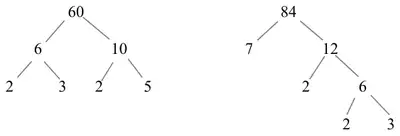
(a) Express 250 as a product of its prime factors. (2)
(b) Find the lowest common multiple (LCM) of 30 and 25 (2)
Mark scheme (a)
Answer
Mark
Mark scheme
\(2 \times 5^3\)
M1
for a complete method to find prime factors; could be shown on a complete factor tree with no more than one arithmetic error or by division by prime factors with no more than one error or for 2, 5, 5, 5
A1
accept \(2 \times 5 \times 5 \times 5\) oe
Additional guidance
Condone the inclusion of 1s for this mark
Mark scheme (b)
Answer
Mark
Mark scheme
150
M1
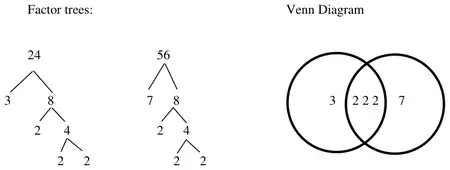
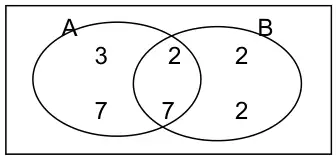
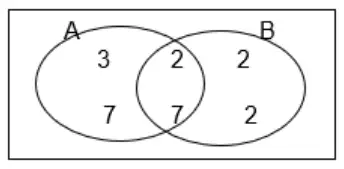
for at least 3 multiples of both 30 and 25 (can include 30 and 25) or for the prime factors 2, 3, 5 and 5, 5 (could be shown in a factor tree with no more than 1 arithmetic error or Venn diagram or table) or identifies the factors 5, 5 and 6 (may be seen in a grid) or for a different common multiple, eg 300
A1
150 or \(2 \times 3 \times 5 \times 5\) oe
Additional guidance
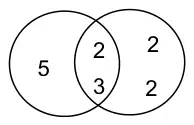
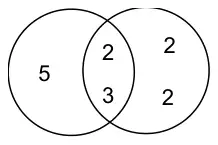
30, 60, 90, 120, 150, 180, 210, 240 25, 50, 75, 100, 125, 150, 175 \(30 = 2 \times 3 \times 5\) \(25 = 5 \times 5\) Condone the inclusion of 1s for this mark
19 Find the highest common factor (HCF) of 54 and 120 (2)
Mark scheme
Answer
Mark
Mark scheme
6
M1
for a complete factor tree for 54 or 120 with no more than one arithmetic error or for listing at least 4 correct factors (with no more than 1 incorrect) of 54 or 120, could be in factor pairs or for the prime factors of 54 (2, 3, 3, 3) or 120 (2, 2, 2, 3, 5)
A1
cao
SCB1 for an answer of 2 or 3 or \(2 \times 3\) if M0 scored
“The cube root of 27 is 9 because 27 divided by 3 is 9”
Is Jason correct? You must give a reason for your answer. (1)
Mark scheme
Answer
Mark
Mark scheme
No with reason
C1
No with reason
Acceptable reasons: No, the cube root of 27 is 3 (not 9) No, the answer is 3 No, \(9 \times 9 \times 9\) is not 27 No, \(9 \times 9 \times 9\) is 729 No, \(3 \times 3 \times 3\) is 27 No, \(27 \div 3 = 9\) and \(9 \div 3 = 3\) No, he needs to divide by 3 again No, because you don’t divide by 3 for cube root No, \(9 \times 9\) is 81 which is already more than 27
Not acceptable reasons: No, the cube root is not 9 3 divided by 27 is 9 No because a cube number is a number times by itself 3 times No, because you don’t divide by 3 Yes…
Additional guidance
‘No’ may be implied by an equivalent statement eg ‘Jason is wrong’ or ‘He is not correct’
1 Find the highest common factor (HCF) of 54 and 120 (2)
Mark scheme
Answer
Mark
Mark scheme
6
M1
for a complete factor tree for 54 or 120 with no more than one arithmetic error or for listing at least 4 correct factors (with no more than 1 incorrect) of 54 or 120, could be in factor pairs or for the prime factors of 54 (2, 3, 3, 3) or 120 (2, 2, 2, 3, 5)
A1
cao
SCB1 for an answer of 2 or 3 or \(2 \times 3\) if M0 scored
(a) Express 250 as a product of its prime factors. (2)
(b) Find the lowest common multiple (LCM) of 30 and 25 (2)
Mark scheme (a)
Answer
Mark
Mark scheme
\(2 \times 5^3\)
M1
for a complete method to find prime factors; could be shown on a complete factor tree with no more than one arithmetic error or by division by prime factors with no more than one error or for 2, 5, 5, 5
A1
accept \(2 \times 5 \times 5 \times 5\)
Additional guidance
Condone the inclusion of 1s for this mark
Mark scheme (b)
Answer
Mark
Mark scheme
150
M1
for at least 3 multiples of both 30 and 25 (can include 30 and 25) or for the prime factors 2, 3, 5 and 5, 5 (could be shown in a factor tree with no more than 1 arithmetic error or Venn diagram or table) or identifies the factors 5, 5 and 6 (may be seen in a grid) or for a different common multiple, eg 300
A1
150 or \(2 \times 3 \times 5 \times 5\) oe
Additional guidance
30, 60, 90, 120, 150, 180, 210, 240 25, 50, 75, 100, 125, 150, 175 \(30 = 2 \times 3 \times 5\) \(25 = 5 \times 5\) Condone the inclusion of 1s for this mark
8 Junaid says that 20 is a square number because \(10^2 = 20\)
(a) Is Junaid correct? Give a reason for your answer. (1)
Chloe says,
“When you divide an even number by an even number the answer is always an even number.”
(b) Write down an example to show that Chloe is wrong. (1)
Mark scheme (a)
Answer
Mark
Mark scheme
No and reason
C1
No and reason
Acceptable examples No, because \(10^2 = 100\) or \(10^2\) is \(10 \times 10\) \(4^2 = 16\) and \(5^2 = 25\) so 20 is not a square number Junaid is wrong because \(\sqrt{20} \neq 10\) or \(\sqrt{20} = 4.47\ldots\) Incorrect because 20 is \(2 \times 10\) not \(10 \times 10\) No she multiplied by 2 instead of squaring or \(10^2\) is not \(10 \times 2\) Wrong as she added instead of multiplying
Not acceptable examples Yes…. No because 20 is \(10 \times 2\) Incorrect because 20 is not a square number No because \(10^2\) is not 20 No because she added No because a square number is when a number is multiplied by itself
Mark scheme (b)
Answer
Mark
Mark scheme
example
C1
for a correctly evaluated example, eg \(12 \div 4 = 3\) or \(10 \div 2 = 5\) or \(2 \div 4 = 0.5\)
(a) Write 90 as a product of its prime factors. (2)
\(A = 2^2 \times 3\)
\(B = 2 \times 3^2\)
(b) Write down the lowest common multiple (LCM) of \(A\) and \(B\). (1)
Mark scheme (a)
Answer
Mark
Mark scheme
\(2 \times 3 \times 3 \times 5\)
M1
for a complete method to find prime factors; could be shown on a complete factor tree with no more than one error or by division by prime factors with no more than one error or for 2, 3, 3, 5
There was an election in the year of Aisha’s 18th birthday. There is an election every 5 years.
Will there be an election in 2030? You must show how you get your answer. (3)
Mark scheme
Answer
Mark
Mark scheme
No from correct figures
P1
for process to find year of Aisha’s 18th birthday, eg \(1993 + 18\ (= 2011)\) or for process to find Aisha’s age in 2030, eg \(2030 - 1993\ (= 37)\)
P1
for process to find years of future elections, eg writes down 2011, 2016, 2021, 2026, 2031 or for \(2011 + 4 \times 5\ (= 2031)\) oe or for process to find Aisha’s age in years when there is an election, eg writes down 18 in 2011, 23 in 2016, 28 in 2021, 33 in 2026 and 38 in 2031 or for process to find years between 18th birthday and election eg \(2030 - 2011\ (= 19)\)
A1
for No with correct figures eg 2011 and 2026 or 2031 or for No with eg 37 and 33 or 38 or for No with 2011 (2016, 2021, ...) and explanation that election years end in 1 or 6, not 0 or for No with 2011 and explanation that 19 is not divisible by 5
Additional guidance
P1 (future elections): at least 3 correct values needed
P1 (Aisha’s age): at least 3 correct values needed, condone years missing eg 18, 23, 28,… without 2011, 2016, 2021…
(a) Write 90 as a product of its prime factors. (2)
\(A = 2^2 \times 3\) \(B = 2 \times 3^2\)
(b) Write down the lowest common multiple (LCM) of \(A\) and \(B\). (1)
Mark scheme (a)
Answer
Mark
Mark scheme
\(2 \times 3 \times 3 \times 5\)
M1
for a complete method to find prime factors; could be shown on a complete factor tree with no more than one error or by division by prime factors with no more than one error or for 2, 3, 3, 5
24 Ali buys packs of balloons and boxes of pencils.
There are 30 balloons in each pack. There are 24 pencils in each box.
Ali buys exactly the same number of balloons and pencils.
Work out how many packs of balloons and how many boxes of pencils she could have bought. You must show all your working.(3)
Mark scheme
Answer
Mark
Mark scheme
4 packs and 5 boxes, or any multiple
P1
for start of a process to find common multiples of 30 and 24, eg writes down at least 3 multiples of 30 and at least 3 multiples of 24 or draws factor trees for both 30 and 24 with no more than 1 error in total or draws a correct Venn diagram
P1
for identifying a common multiple eg 120 or 240 or \(5 \times 3 \times 2 \times 2 \times 2\) oe
A1
for 4 packs and 5 boxes or any multiple of this pairing eg 8, 10
(a) Write 156 as a product of its prime factors. (2)
(b) Find the highest common factor (HCF) of 156 and 130 (2)
Mark scheme (a)
Answer
Mark
Mark scheme
\(2^2 \times 3 \times 13\)
M1
for a complete method to find prime factors; could be shown in a complete factor tree with no more than one error or by division by prime factors with no more than one error
(a) Find the highest common factor (HCF) of \(A\) and \(B\). (1)
(b) Find the lowest common multiple (LCM) of \(A\) and \(B\). (2)
Mark scheme (a)
Answer
Mark
Mark scheme
63
B1
for 63, accept \(3 \times 3 \times 7\) or \(3^2 \times 7\)
Mark scheme (b)
Answer
Mark
Mark scheme
15 876
M1
for at least two of \(2^2\), \(3^4\), \(7^2\) or shows at least 3 multiples of 2268, eg 2268, 4536, 6804 and at least 3 multiples of 441, eg 441, 882, 1323
21 Write 60 as a product of its prime factors. (2)
Mark scheme
Answer
Mark
Mark scheme
\(2 \times 2 \times 3 \times 5\)
M1
for a complete method to find prime factors, could be shown on a complete factor tree, with no more than one error or by division by prime factors with no more than one error
(a) Find the highest common factor (HCF) of \(A\) and \(B\). (1)
(b) Find the lowest common multiple (LCM) of \(A\) and \(B\). (2)
Mark scheme (a)
Answer
Mark
Mark scheme
63
B1
for 63, accept \(3 \times 3 \times 7\) or \(3^2 \times 7\)
Mark scheme (b)
Answer
Mark
Mark scheme
15 876
M1
for at least two of \(2^2\), \(3^4\), \(7^2\) or shows at least 3 multiples of 2268, eg 2268, 4536, 6804 and at least 3 multiples of 441, eg 441, 882, 1323
for a complete method to find prime factors, could be shown on a complete factor tree, with no more than one error or by division by prime factors with no more than one error or for 2, 2, 3, 5 (1)
19 Write 500 as a product of powers of its prime factors. (3)
Mark scheme
Answer
Mark
Mark scheme
\(2^2 \times 5^3\)
M1
for a complete method to find prime factors; could be shown on a complete factor tree with no more than one error or by division by prime factors with no more than one error
1 Write 500 as a product of powers of its prime factors. (3)
Mark scheme
Answer
Mark
Mark scheme
\(2^2 \times 5^3\)
M1
for a complete method to find prime factors, could be shown on a complete factor tree with no more than one error or by division by prime factors with no more than one error
24 Write 124 as a product of its prime factors. (2)
Mark scheme
Answer
Mark
Mark scheme
\(2 \times 2 \times 31\)
M1
for a complete method to find prime factors; could be shown on a complete factor tree with no more than one error or by division by prime factors with no more than one error or for 2, 2, 31, (1)
2 Write 124 as a product of its prime factors. (2)
Mark scheme
Answer
Mark
Mark scheme
\(2 \times 2 \times 31\)
M1
for a complete method to find prime factors; could be shown on a complete factor tree with no more than one error or by division by prime factors with no more than one error or for 2, 2, 31, (1)
(a) Find the Highest Common Factor (HCF) of 60 and 84 (2)
(b) Find the Lowest Common Multiple (LCM) of 24 and 40 (2)
Mark scheme (a)
Answer
Mark
Mark scheme
12
M1
for a correct factor tree for either 60 or 84 with no more than one arithmetic error or for listing factors of 60 or 84, at least 4 correct for either (with no more than 1 incorrect in either list), could be in factor pairs or for the prime factors of 60 (2, 2, 3, 5) or 84 (2, 2, 3, 7)
A1
for 12 or \(2 \times 2 \times 3\) oe SC B1 for answer of 4 or 6, if M0 scored
Additional guidance
Condone the use of 1 in any factor tree 60: 1, 2, 3, 4, 5, 6, 10, 12, 15, 20, 30, 60 84: 1, 2, 3, 4, 6, 7, 12, 14, 21, 28, 42, 84
2, 2, 3 is not enough, it must be a product
Mark scheme (b)
Answer
Mark
Mark scheme
120
M1
for a correct factor tree for either 24 or 40 with no more than one arithmetic error or for at least 3 multiples of both 24 and 40 (can include 24 and 40) or for the prime factors of either 24 (2, 2, 2, 3) or 40 (2, 2, 2, 5) or for a common multiple from their lists (≠ 120)
A1
for 120 or \(2 \times 2 \times 2 \times 3 \times 5\) oe
Additional guidance
Condone the use of 1 in any factor tree 24: 24, 48, 72, 96, 120, … 40: 40, 80, 120, … For the list not containing 120, accept the first 3 correct multiples or one error in the first 4 multiples
10 Rachel records the temperature in her garden at noon each day.
On Monday, the temperature was 5 °C. On Tuesday, the temperature was 10° less than the temperature on Monday. On Wednesday, the temperature was 3° greater than the temperature on Tuesday.
Find the difference between the temperature on Monday and the temperature on Wednesday. You must show all your working. (2)
Mark scheme
Answer
Mark
Mark scheme
7
P1
for process to find temperature on Wednesday, eg \(5 - 10 + 3\ (= -2)\) or \(-10 + 3\) or \(10 - 3\)
(a) Find the Highest Common Factor (HCF) of 60 and 84 (2)
(b) Find the Lowest Common Multiple (LCM) of 24 and 40 (2)
Mark scheme (a)
Answer
Mark
Mark scheme
12
M1
for a correct factor tree for either 60 or 84 with no more than one arithmetic error or for listing factors of 60 or 84, at least 4 correct for either (with no more than 1 incorrect in either list), could be in factor pairs or for the prime factors of 60 (2, 2, 3, 5) or 84 (2, 2, 3, 7)
A1
for 12 or \(2 \times 2 \times 3\) oe SC B1 for answer of 4 or 6, if M0 scored
Additional guidance
Condone the use of 1 in any factor tree 60: 1, 2, 3, 4, 5, 6, 10, 12, 15, 20, 30, 60 84: 1, 2, 3, 4, 6, 7, 12, 14, 21, 28, 42, 84
2,2,3 is not enough, it must be a product
Mark scheme (b)
Answer
Mark
Mark scheme
120
M1
for a correct factor tree for either 24 or 40 with no more than one arithmetic error or for at least 3 multiples of both 24 and 40 (can include 24 and 40) or for the prime factors of either 24 (2, 2, 2, 3) or 40 (2, 2, 2, 5) or for a common multiple from their lists (\(\neq 120\))
A1
for 120 or \(2 \times 2 \times 2 \times 3 \times 5\) oe
Additional guidance
Condone the use of 1 in any factor tree 24: 24, 48, 72, 96, 120, … 40: 40, 80, 120, …
For the list not containing 120, accept the first 3 correct multiples or one error in the first 4 multiples
20 Find the Lowest Common Multiple (LCM) of 108 and 120 (3)
Mark scheme
Answer
Mark
Mark scheme
1080
M1
for method to write one number as a product of prime factors (condone one division error in method chosen), eg. one complete factor tree or 2, 2, 3, 3, 3 or 2, 2, 2, 3, 5 or for listing at least 5 multiples of either number (condone one error) or for any common multiple (\(\neq 1080\)), eg. 12960 (\(= 108 \times 120\))
M1
for method to write both numbers as a product of prime factors (condone a total of one division error) eg. two complete factor trees or 2, 2, 3, 3, 3 and 2, 2, 2, 3, 5 or lists of multiples of the two numbers, at least 5 of each, one of which includes 1080
A1
cao
SC B2 for any product that would lead to 1080, eg \(2^3 \times 3^3 \times 5\) or \(12 \times 9 \times 10\)
Additional guidance
Accept first 5 multiples if all correct or one error in first 6 multiples
For the list not containing 1080, accept first 5 multiples if all correct or one error in first 6 multiples
15 Prove algebraically that the sum of the squares of any two consecutive even numbers is always a multiple of 4 (3)
Mark scheme
Answer
Mark
Mark scheme
Proof
M1
for correct expressions for two consecutive even numbers eg \(2n\) and \(2n + 2\)
M1
(dep M1) for expanding both expressions with at least one expansion fully correct eg \(4n^2\) and \(4n^2 + 4n + 4n + 4\) or for factorising both terms and intention to square correctly eg \((2n)^2\) and \(2^2(n + 1)^2\)
1 Find the Lowest Common Multiple (LCM) of 108 and 120 (3)
Mark scheme
Answer
Mark
Mark scheme
1080
M1
for method to write one number as a product of prime factors (condone one division error in method chosen), eg. one complete factor tree or 2, 2, 3, 3, 3 or 2, 2, 2, 3, 5 or for listing at least 5 multiples of either number (condone one error) or for any common multiple (\(\neq 1080\)), eg. 12960 (\(= 108 \times 120\))
M1
for method to write both numbers as a product of prime factors (condone a total of one division error) eg. two complete factor trees or 2, 2, 3, 3, 3 and 2, 2, 2, 3, 5 or lists of multiples of the two numbers, at least 5 of each, one of which includes 1080
A1
cao
SC: B2 for any product that would lead to 1080, eg. \(2^3 \times 3^3 \times 5\) or \(12 \times 9 \times 10\)
Additional guidance
Accept first 5 multiples if all correct or one error in the first 6 multiples
For the list not containing 1080, accept first 5 correct multiples or one error in the first 6 multiples
3 Find the highest common factor (HCF) of 72 and 90 (2)
Mark scheme
Answer
Mark
Mark scheme
18
M1
for listing factors of 72 and 90, at least 4 correct for each (with no more than 1 incorrect in each list), could be in factor pairs OR for the prime factors of 72 (2, 2, 2, 3, 3) or 90 (2, 3, 3, 5)
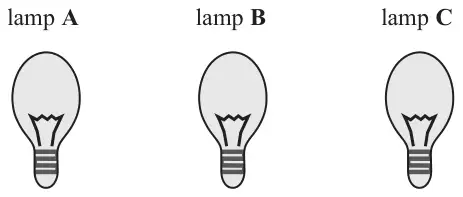
Lamp A flashes every 20 seconds. Lamp B flashes every 45 seconds. Lamp C flashes every 120 seconds.
The three lamps start flashing at the same time.
How many times in one hour will the three lamps flash at the same time? (3)
Mark scheme
Answer
Mark
Mark scheme
10
P1
for start to a process to find the LCM of 20, 45 and 120 (= 360), eg \(45 = 3 \times 3 \times 5\) or \(20 = 2 \times 2 \times 5\) or \(120 = 2 \times 2 \times 2 \times 3 \times 5\) or writes down at least 3 multiples of 45 and 120
P1
(dep) for a process to find number of times/hour using their LCM, eg \(3600 \div 360\) or \(3600 \div 720\)
A1
for 10 or 11
Additional guidance
Could be presented as complete prime factor trees for 45 or 120
Must use a common multiple. Working may be in minutes.
She adds together her two numbers. Her answer is a square number less than 30
Find two prime numbers that Nidah could have written down. (2)
Mark scheme
Answer
Mark
Notes
2, 7 or 3, 13 or 5, 11 or 2, 23
M1
for identifying two different prime numbers or two numbers which add up to give a square number or for a list of at least 3 prime numbers with no errors and a list of 3 square numbers with no errors.
“There are more prime numbers between 20 and 30 than there are between 10 and 20”
Is Steve right? You must show how you get your answer. (2)
Mark scheme
Answer
Mark
Notes
No (supported)
B1
for showing 11 or 13 or 17 or 19 with no non-prime numbers between 10 and 20, or for showing 23 or 29 with no non-prime numbers between 20 and 30. Ignore any numbers shown below 11.
C1
“No” supported by listing 11, 13, 17, 19 and 23, 29 and no non-prime
10 At 1am on Monday, the temperature in Oslo was \(-5\) °C. At 1pm on Monday, the temperature in Oslo was 12 °C higher than the temperature at 1am. At 1am on Tuesday, the temperature in Oslo was 18 °C lower than the temperature at 1pm on Monday.
(a) Work out the temperature in Oslo at 1am on Tuesday. (2)
In Malaga, the temperature is 18 °C. In Granada, the temperature is \(-6\) °C.
(b) Work out the difference in temperature between Malaga and Granada. (2)
Mark scheme (a)
Answer
Mark
Notes
\(-11\)
2
M1 for \(-5 + 12 - 18\) oe A1cao
Mark scheme (b)
Answer
Mark
Notes
24
2
M1 for a method to find the difference eg \(18 - {-6}\) or \(18 + 6\) or use of a number line A1 for 24 accept \(-24\)
M1 for multiples of both 40 and 15 (at least 2 of each shown but condone errors if intention is clear) or \(40 \times 15\) M1 (dep on M1) for a complete method to find a common multiple of 40 and 15, eg sight of 120, 240, 600, condoning one arithmetic error in any lists of multiples shown A1 for 3, 8 or any multiple of 3, 8
OR
M1 for factors 2,2,2,5 and factors 3,5 M1 (dep on M1) for a complete method to find a common multiple of 40 and 15 A1 for 3, 8 or any multiple of 3, 8
M1 for multiples of both 40 and 15 (at least 2 of each shown but condone errors if intention is clear) or for \(40 \times 15\) M1 (dep on M1) for a complete method to find a common multiple of 40 and 15, eg. 120, 240, 600 condoning one arithmetic error in any lists of multiples shown A1 for 3, 8 or any multiple of 3, 8
OR M1 for factors 2,2,2,5 and factors 3,5 M1 (dep on M1) for a complete method to find a common multiple of 40 and 15 A1 for 3, 8 or any multiple of 3, 8
25 Express 180 as a product of its prime factors. (3)
Mark scheme
Answer
Mark
Notes
\(2 \times 2 \times 3 \times 3 \times 5\)
3
M1 for continual prime factorisation (at least two consecutive steps correct) or at least two stages of a factor tree correct M1 for a fully correct factor tree or list 2, 2, 3, 3, 5 A1 for \(2 \times 2 \times 3 \times 3 \times 5\) or \(2^2 \times 3^2 \times 5\)
(a) Express 180 as a product of its prime factors. (3)
Martin thinks of two numbers. He says,
“The Highest Common Factor (HCF) of my two numbers is 6 The Lowest Common Multiple (LCM) of my two numbers is a multiple of 15”
(b) Write down two possible numbers that Martin is thinking of. (2)
Mark scheme (a)
Answer
Mark
Notes
\(2 \times 2 \times 3 \times 3 \times 5\)
3
M1 for a continual prime factorisation (at least two consecutive steps correct) or at least two stages of a factor tree correct M1 for a fully correct factor tree or list 2,2,3,3,5 A1 for \(2 \times 2 \times 3 \times 3 \times 5\) or \(2^2 \times 3^2 \times 5\)
Mark scheme (b)
Answer
Mark
Notes
Eg 6, 30
2
M1 for two numbers with an HCF of 6 or for two numbers with a LCM a multiple of 15 A1 for two numbers with an HCF of 6 and a LCM a multiple of 15 (eg (6, 30), (12, 30), …)
OR M1 for \(2 \times 3\) and \(3 \times 5\) or for \(2 \times 3 \times 5\) A1 for two numbers with an HCF of 6 and a LCM a multiple of 15 eg (6, 30) (12, 30) …
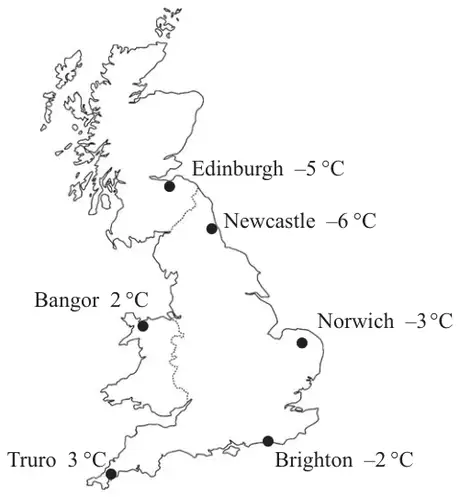
7 Here is a map of Great Britain. The map shows the temperatures in some cities at midnight on 20th January.
(a) Which city had the lowest temperature at midnight? (1)
In Brighton, the temperature rose by 5 °C between midnight on 20th January and midday on 21st January.
(b) What was the temperature in Brighton at midday on 21st January? (1)
At midnight on 20th January, the temperature in Nottingham was halfway between the temperature in Truro and the temperature in Edinburgh.
(c) What was the temperature in Nottingham? (2)
Mark scheme (a)
Answer
Mark
Notes
Newcastle
1
B1 cao
Mark scheme (b)
Answer
Mark
Notes
3
1
B1 cao
Mark scheme (c)
Answer
Mark
Notes
\(-1\)
2
M1 for intention to find middle of \(-5\) and 3 eg, may see \(-5\) and 3 identified on a correct number line or \((-5 + 3) \div 2\) or \(-5 + (3 - {-5}) \div 2\) or \(3 - (3 - {-5}) \div 2\) A1 cao
M1 for listing at least 3 multiples of each of 12 and 8 or 24 in two lists of multiples or from factor trees M1 (dep) for attempt to find a common multiple of 12 and 8 above 60 (=72) M1 (dep M2) for method to find the number of boxes and the number of packs \(72 \div 12\) (=6) and \(72 \div 8\) (=9) M1 for finding the total cost by multiplying numbers by cost and adding eg \(\text{``}6\text{''} \times 2.50 + \text{``}9\text{''} \times 1.20\) A1 for 25.8(0)
13 5600 copies of the Village Advertiser are printed each week.
(a) Write the number 5600 in words. (1)
People have to pay to have an advert in the Village Advertiser. Each advert is in the shape of a rectangle.
The table gives information about the cost of having an advert in the Village Advertiser.
Advert size
Size of rectangle
Cost per week
Size 1
44 mm by 27 mm
£6.50
Size 2
90 mm by 35 mm
£13.50
Size 3
90 mm by 60 mm
£20.00
Size 4
90 mm by 125 mm
£33.00
A Size 2 advert is a 90 mm by 35 mm rectangle.
(b) In the space below, draw a 90 mm by 35 mm rectangle. (2)
David has this advert in the Village Advertiser for 2 weeks. The advert is accurately drawn.
(c) What is the total cost of the advert for 2 weeks? (3)
Raja wants to have a Size 2 advert in the Village Advertiser for 8 weeks. He has £100 to spend.
(d) Show that Raja does not have enough money to pay for the advert for 8 weeks. You must show all your working. (2)
Mark scheme (a)
Answer
Mark
Notes
Five thousand six hundred
1
B1 cao
Mark scheme (b)
Answer
Mark
Notes
Rectangle drawn
2
B2 for fully correct diagram (B1 for one line of correct length within a rectangle)
Mark scheme (c)
Answer
Mark
Notes
13
3
M1 for the length of one side of rectangle, e.g. 44 (mm) or 27 (mm) ±2mm (allow use of cm) M1 for 6.5(0) or size 1 clearly indicated A1 for 13(.00)
Mark scheme (d)
Answer
Mark
Notes
Working shown and compared to 8 weeks
2
M1 for 13.50 × 8 or 13.50 × 7 oe or repeated subtraction of 13.50 from 100 at least 7 times A1 for arriving at a correct figure they can compare with £100 in one step eg 108, 94.5(0), 5.5(0) or \(-8\) OR M1 for 100 ÷ 8 A1 for 12.5(0) OR M1 100 ÷ 13.50 = 7.4 A1 for 7
27 Rita is going to make some cheeseburgers for a party.
She buys some packets of cheese slices and some boxes of burgers.
There are 20 cheese slices in each packet. There are 12 burgers in each box.
Rita buys exactly the same number of cheese slices and burgers.
(i) How many packets of cheese slices and how many boxes of burgers does she buy?
Rita wants to put one cheese slice and one burger into each bread roll. She wants to use all the cheese slices and all the burgers.
(ii) How many bread rolls does Rita need?
(4)
Mark scheme
Working
Answer
Mark
Notes
20, 40, 60 12, 24, 36, 48, 60
20 = 4×5 = 2×2×5 12 = 4×3 = 2×2×3
(i) 3 and 5 or any multiple of 3, 5
4
M1 attempts multiples of both 20 and 12 (at least 3 of each shown but condone errors if intention is clear) or identifies 60 or a multiple of 60 M1 (dep on M1) for a division by 20 or 12 or counts up ‘multiples’ or identifies a common mulitple (implied if one answer is correct or answers reversed) A1 cheese slices (packets) 3, burgers (boxes) 5 or any multiple of 3, 5 OR M1 for expansion of either 20 or 12 into factors M1 for demonstration that both expansions include 4 (or 2 × 2) A1 cao for cheese slices (packets) 3, burgers (boxes) 5
(ii) 60
B1 for 60 or ft from their correct answer to (i) or ft “common multiple”
Jan adds her three numbers together. The answer is greater than 20 but less than 30
What three numbers could Jan have written down? (3)
Mark scheme
Answer
Mark
Notes
eg. 18, 4, 5
3
M1 for two different factors of 40 M1 for 3 numbers where the sum lies between 20 and 30 AND (where one is 9 or 18 or two are different factors of 40 A1
M1 attempts multiples of both 20 and 12 (at least 3 of each shown but condone errors if intention is clear) or identifies 60 or a multiple of 60 M1 (dep on M1) for a division by 20 or 12 or counts up ‘multiples’ or identifies a common multiple (implied if one answer is correct or answers reversed) A1 cheese slices (packets) 3, burgers (boxes) 5 or any multiple of 3, 5
OR
M1 for expansion of either 20 or 12 into factors M1 for demonstration that both expansions include 4 (or \(2 \times 2\)) A1 cao for cheese slices (packets) 3, burgers (boxes) 5
(ii) 60
4
B1 for 60 or ft from their correct answer in (i) or ft ‘common multiple’
M1 lists multiples of both 80 (seconds) and 50 (seconds) (at least 3 of each but condone errors if intention is clear, can be in minutes and seconds) or use of 400 seconds oe. M1 (dep on M1) for a division of "LCM" by 80 or 50 or counts up “multiples” (implied if one answer is correct or answers reversed) A1 Matt 8 and Dan 5 SC B1 for Matt 7, Dan 4
OR
M1 for expansion of both 80 and 50 into prime factors. M1 demonstrates that both expansions include 10 oe A1 Matt 8 and Dan 5 SC B1 for Matt 7, Dan 4
5 Write 525 as a product of its prime factors. (3)
Mark scheme
Working
Answer
Mark
Notes
5 | 525 5 | 105 3 | 21 7
\(3 \times 5 \times 5 \times 7\)
3
M1 for continual prime factorisation (at least first 2 steps correct) or first two stages of a factor tree correct M1 for fully correct factor tree or list 3, 5, 5, 7 A1 \(3 \times 5 \times 5 \times 7\) or \(3 \times 5^2 \times 7\)
16 Trams leave Piccadilly to Eccles every 9 minutes to Didsbury every 12 minutes
A tram to Eccles and a tram to Didsbury both leave Piccadilly at 9 am.
At what time will a tram to Eccles and a tram to Didsbury next leave Piccadilly at the same time? (3)
Mark scheme
Answer
Mark
Notes
09 36
3
M1 for listing 9, 18, 27, 36, 45, ... (at least 3 correct multiples with at most one incorrect) M1 for listing 12, 24, 36, 48, .... (at least 3 correct multiples with at most one incorrect) A1 for 09 36 or 9 36(am) OR M1 for listing 9.09 9.18 9.27 9.36 ... (at least 3 correct times with at most one incorrect) M1 for listing 9.12 9.24 9.36 ... (at least 3 correct times with at most one incorrect) A1 for 09 36 or 9 36(am) OR M1 for \(9 = 3 \times 3\) or \(12 = 2 \times 2 \times 3\) (could be in a factor tree) M1 for \(9 = 3 \times 3\) and \(12 = 2 \times 2 \times 3\) (could be in a factor tree) A1 for 09 36 or 9 36(am) SC B2 9 36pm or (after) 36 (minutes) on the answer line
From the list, write down three different prime numbers that add together to make 20 (3)
Mark scheme
Answer
Mark
Notes
3 primes that total 20
3
M1 for identifying at least 2 different prime numbers from the list, could indicate on the list (not more than one incorrect) M1 for any 3 numbers from the list that total 20 A1 for 2, 7, 11 or 2, 5, 13 or both (in any order)
(i) two different numbers that add up to an even number
(ii) a multiple of 20
(iii) a factor of 45
(iv) a cube number (4)
Mark scheme
Answer
Mark
Notes
(i) 5,15 or 5,125 or 15,125 or 30,50 or 30,60 or 30,90 or 30,100 or 50,60 or 50,90 or 50,100 or 60,90 or 60,100 or 90,100 (ii) 60 or 100 (iii) 5 or 15 (iv) 125
4
(i) B1 for 2 numbers, from the list, whose sum is an even number. (ii) B1 for 60 or 100 or both (iii) B1 for 5 or 15 or both (iv) B1 cao
to Eccles every 9 minutes to Didsbury every 12 minutes
A tram to Eccles and a tram to Didsbury both leave Piccadilly at 9 am.
At what time will a tram to Eccles and a tram to Didsbury next leave Piccadilly at the same time? (3)
Mark scheme
Answer
Mark
Notes
09 36
3
M1 for listing 9, 18, 27, 36, 45, ... (at least 3 correct multiples with at most one incorrect) M1 for listing 12, 24, 36, 48, .... (at least 3 correct multiples with at most one incorrect) A1 for 09 36 or 9 36 (am) OR M1 for listing 9.09 9.18 9.27 9.36 ... (at least 3 correct times with at most one incorrect) M1 for listing 9.12 9.24 9.36 ... (at least 3 correct times with at most one incorrect) A1 for 09 36 or 9 36 (am) OR M1 for 9 = 3 × 3 or 12 = 2 × 2 × 3 (could be in factor tree) M1 for 9 = 3 × 3 and 12 = 2 × 2 × 3 (could be in a factor tree) A1 for 09 36 or 9 36 (am) SC B2 for 9 36 pm or (after) 36 (minutes) on the answer line
(a) Write the number seven thousand and twenty five in figures. (1)
(b) Write the number 9450 in words. (1)
(c) Write the number 28.75 to the nearest whole number. (1)
(d) Write the number 7380 to the nearest thousand. (1)
Mark scheme (a)
Answer
Mark
Notes
7025
1
B1 cao
Mark scheme (b)
Answer
Mark
Notes
Nine thousand four hundred (and) fifty
1
B1 for Nine thousand four hundred (and) fifty Accept ‘nine thousand’ written as ‘9 thousand’, ‘four hundred’ written as ‘4 hundred’ and ‘fifty’ written as ‘5 tens’ or any mixture of these. Do not penalise poor spelling.
6 The table gives information about the temperatures in Reykjavik for 5 days one week.
Day
Maximum temperature
Minimum temperature
Monday
5 °C
4 °C
Tuesday
8 °C
6 °C
Wednesday
6 °C
\(-2\) °C
Thursday
\(-1\) °C
\(-4\) °C
Friday
\(-3\) °C
\(-6\) °C
(a) Which day had the highest maximum temperature? (1)
(b) What is the lowest minimum temperature? °C (1)
(c) Which day had the greatest difference between the maximum temperature and the minimum temperature? (2)
Mark scheme (a)
Answer
Mark
Notes
Tuesday
1
B1 for Tuesday (accept 8)
Mark scheme (b)
Answer
Mark
Notes
\(-6\)
1
B1 cao
Mark scheme (c)
Answer
Mark
Notes
Wednesday or 8
2
B2 for Wednesday or 8 OR M1 for an attempt to find the difference in at least 3 of: 5 and 4, 8 and 6, 6 and \(-2\), \(-1\) and \(-4\), \(-3\) and \(-6\); ie the answers need not be correct. A1 for Wednesday or 8
24 Buses to Acton leave a bus station every 24 minutes. Buses to Barton leave the same bus station every 20 minutes.
A bus to Acton and a bus to Barton both leave the bus station at 9 00 am.
When will a bus to Acton and a bus to Barton next leave the bus station at the same time? (3)
Mark scheme
Working
Answer
Mark
Notes
Acton after 24, 48, 72, 96, .. Barton after 20, 40, 60, 80, .. LCM of 20 and 24 is 120 9: 00 am + 120 minutes OR Acton after 24, 48, 1h 12 min... Barton after 20, 40, 1 h LCM is 2 hours 9: 00 am + 2 hours OR Times from 9: 00 am when each service leaves the bus station Acton at 9: 24, 9: 48, 10: 12.. Barton at 9: 20, 9: 40, 10: 00.. OR \(20 = 2 \times 2 \times 5\) \(24 = 2 \times 2 \times 2 \times 3\) \(2 \times 2 \times 2 \times 3 \times 5 = 120\)
11: 00 am
3
M1 for listing multiples of 20 and 24 with at least 3 numbers in each list ; multiples could be given in minutes or in hours and minutes (condone one addition error in total in first 3 numbers in lists) A1 identify 120 (mins) or 2 (hours) as LCM A1 for 11: 00 (am) or 11(am) or 11 o'clock OR M1 for listing times after 9am when each bus leaves the bus station, with at least 3 times in each list (condone one addition error in total in first 3 times after 9am in lists) A1 for correct times in each list up to and including 11: 00 A1 for 11: 00 (am) or 11(am) or 11 o'clock OR M1 for correct method to write 20 and 24 in terms of their prime factors 2, 2, 5 and 2, 2, 2, 3 (condone one error) A1 identify 120 as LCM A1 for 11: 00 (am) or 11(am) or 11 o'clock
7 Buses to Acton leave a bus station every 24 minutes. Buses to Barton leave the same bus station every 20 minutes.
A bus to Acton and a bus to Barton both leave the bus station at 9 00 am.
When will a bus to Acton and a bus to Barton next leave the bus station at the same time? (3)
Mark scheme
Working
Answer
Mark
Notes
Acton after 24, 48, 72, 96, 120 Barton after 20, 40, 60, 80, 100, 120 LCM of 20 and 24 is 120 9: 00 am + 120 minutes OR Acton after 24, 48, 1h 12 m, 1h 36m, 2h Barton after 20, 40, 1 h, 1h 20m, 1h 40m, 2h LCM is 2 hours 9: 00 am + 2 hours OR Times from 9: 00 am when each bus leaves the bus station Acton at 9: 24, 9: 48, 10: 12, 10:36, 11:00 Barton at 9: 20, 9: 40, 10: 00, 10:20, 10:40, 11:00 OR 20 = 2 × 2 × 5 24 = 2 × 2 × 2 × 3 2 × 2 × 2 × 3 × 5 = 120
11: 00 am
3
M1 for listing multiples of 20 and 24 with at least 3 numbers in each list ; multiples could be given in minutes or in hours and minutes (condone one addition error in total in first 3 numbers in lists) A1 identify 120 (mins) or 2 (hours) as LCM A1 for 11: 00 (am) or 11(am) or 11 o’clock OR M1 for listing times after 9am when each bus leaves the bus station, with at least 3 times in each list (condone one addition error in total in first 3 times after 9am in lists) A1 for correct times in each list up to and including 11: 00 A1 for 11: 00 (am) or 11(am) or 11 o’clock OR M1 for correct method to write 20 and 24 in terms of their prime factors 2, 2, 5 and 2, 2, 2, 3 (condone one error) A1 identify 120 as LCM A1 for 11: 00 (am) or 11(am) or 11 o’clock
13 \(c\) and \(d\) are consecutive cube numbers, where \(\quad c \lt 4.5^3 \lt d\)
Work out the value of \(\quad d - c\) [2 marks]
Mark scheme
Answer
Mark
Comments
61
B2
B1 \((c =)\ 4^3\) oe or \((c =)\ 64\) and \((d =)\ 5^3\) oe or \((d =)\ 125\) or their answer comes from \(x^3 - (x - 1)^3\) correctly calculated, where \(x\) is an integer \(\ne 5\) eg answer 91 from \(216 - 125\) SC1 \(-61\)
Additional guidance
SC1 is for \(c - d\)
Do not allow 64 or 125 seen in a list if not identified or used
(a) The square of a whole number is a two-digit number.
Work out
the smallest number that could have been squared and the largest number that could have been squared. [3 marks]
(b) Which has the larger value \(\quad 0.8^2 \quad\) or \(\quad 0.8^3\) ?
Tick a box.
\(0.8^2\)
\(0.8^3\)
Give a reason for your answer. [1 mark]
Mark scheme (a)
Answer
Mark
Comments
4 and 9 in correct positions
B3
B2 9 in smallest position and 4 in largest position or only 4 in correct position or only 9 in correct position or \(4^2\) in smallest position and \(9^2\) in largest position or 16 or \(\sqrt{16}\) in smallest position and 81 or \(\sqrt{81}\) in largest position B1 \(4^2\) or 16 or \(\sqrt{16}\) or \(9^2\) or 81 or \(\sqrt{81}\)
Additional guidance
\(4^2 = 16\) in smallest position and \(9^2 = 81\) in largest position
B2
16, 4 in smallest position and 81, 9 in largest position
B2
\(2^2 = 4\) in smallest position is not 4 in smallest position \(3^2 = 9\) in largest position is not 9 in largest position
Mark scheme (b)
Answer
Mark
Comments
\(0.8^2\) ticked with either 0.64 and 0.512 or \(\dfrac{64}{100}\) and \(\dfrac{64}{125}\) or \(0.8 \lt 1\) or suitable worded reason
B1
oe in comparable form fractions must have same numerator or same denominator eg multiplying by decimals below 1 makes numbers smaller
Additional guidance
Ignore further work after correct values in comparable form
Condone 0.51 for 0.512
\(\dfrac{16}{25}\) and \(\dfrac{64}{125}\) (fractions do not have same numerator or denominator)
B0
\(0.8^2\) ticked and squaring makes numbers bigger
Two numbers which are 1 more than a multiple of 12 eg 13, 25, 37, 49, 61 …
B2
B1 at least one number which is 1 more than a multiple of 12 with at most one other number or lists (3, 5, 7, 9 …and) 4, 7, 10, 13 … and 5, 9, 13, 17 …
Additional guidance
If the answer line is blank: award B2 if two or more correct numbers and no incorrect numbers are clearly chosen award B1 if one or more correct number(s) and one incorrect number are clearly chosen
“When two multiples of 5 are added, the answer is always a multiple of 10”
Give one example to show that he is wrong. [1 mark]
Mark scheme (a)
Answer
Mark
Comments
1, 2, 4, 5, 10, 20
B2
any order B1 5 or 6 correct values with up to 2 incorrect values or 4 correct values with 0 or 1 incorrect values or 3 correct values with 0 incorrect values
Work out the value of \(\quad a^4 \times b\) [3 marks]
(b) \(c\) and \(d\) are different prime numbers.
Circle the equation for which \(\quad c^4 \times d^2 \times e \quad\) is a cube number. [1 mark]
\(e = cd\)
\(e = c^2d\)
\(e = c^2d^2\)
\(e = c^3d^3\)
Mark scheme (a)
Answer
Mark
Comments
80
B3
B2 \((200 =)\ 2^3 \times 5^2\) or \(2^4 \times 5\) oe or \(16 \times 5\) or \(200 \times 2 \div 5\) B1 \(a = 2\) and \(b = 5\) or 2, 2, 2, 5, 5 seen on a factor tree or 25 or 8
Additional guidance
For B1, 25 or 8 must be chosen from any lists of square or cube numbers
(a) At a restaurant, vegan pizzas have two different toppings.
The toppings are
sweetcorn (S) mushrooms (M) peppers (P)
Complete the table to list all the possible pairs of toppings. [1 mark]
SM
(b) At the restaurant, dough balls can be ordered in small portions and large portions.
Small portion 6 dough balls
Large portion 10 dough balls
A group of people want to order exactly 44 dough balls.
Show how they can do this. [2 marks]
Number of Small portions \(\ldots\ldots\ldots\) Number of Large portions \(\ldots\ldots\ldots\)
Mark scheme (a)
Answer
Mark
Comments
SP MP with no others
B1
oe accept in words
Additional guidance
Any indication, any order
Do not ignore repeats
Mark scheme (b)
Answer
Mark
Comments
A trial of at least 3 portions involving small and large with correct total seen or 24 and 20 chosen or \(4 \times 6\) (\(= 24\)) and \(2 \times 10\) (\(= 20\))
M1
eg \(2 \times 6 + 10 = 22\) or 3S and 2L is 38
4 small and 2 large
A1
Additional guidance
Ignore incorrect trials if a correct trial or the correct answer is seen
numbers in the boxes on the right side of calculation can be in any order SC2 \(27 = 2 + 2 + 23\) or \(27 = 5 + 5 + 17\) or \(27 = 7 + 7 + 13\) or \(27 = 5 + 11 + 11\)
Additional guidance
SC2 is for using a repeated prime number
\(27 = 3 + 5 + 17\)
B1M1A0
\(27 = 7 + 11 + 9\)
B1M0A0
\(27 = 1 + 3 + 23\)
B1M0A0
List of prime numbers with right side boxes empty or incorrect
or 2 or 3 mathematically correct sums and both of:
only uses integers 1-12
no repeated numbers
B1 2 or 3 mathematically correct sums with one of:
only uses integers 1-12
no repeated numbers
or only 4 mathematically correct sums
Additional guidance
Allow negative or decimal numbers for up to B2
For a row to be mathematically correct, there must be three numbers Blank boxes should not be treated as zeros
Any box that is not crossed out must be considered when checking the conditions regarding integers 1-12 and repeated numbers If a number is crossed out, but still legible, judge in favour of the student to give the best mark
A completed row takes precedence over working space If a row is blank, check working space for that calculation and award a mark based on the work that benefits the student most Working outside of boxes must be evaluated
numbers in the boxes on the right side of calculation can be in any order SC2 \(27 = 2 + 2 + 23\) or \(27 = 5 + 5 + 17\) or \(27 = 7 + 7 + 13\) or \(27 = 5 + 11 + 11\)
Additional guidance
SC2 is for using a repeated prime number
\(27 = 3 + 5 + 17\)
B1M1A0
\(27 = 7 + 11 + 9\)
B1M0A0
\(27 = 1 + 3 + 23\)
B1M0A0
List of prime numbers with right side boxes empty or incorrect
any order B1 5 or 6 correct values with up to 2 incorrect values or 4 correct values with 0 or 1 incorrect values or 3 correct values with 0 incorrect values
Additional guidance
Allow values given in products or ‘coordinates’ eg1 \(1 \times 45,\ 3 \times 15,\ 5 \times 9\) eg2 (1, 45), (3, 15)
B2 B1
Lists with repeated values cannot score B2, but ignore repeated values in any format for B1 eg1 1, 3, 5, 9, 9 eg2 \(1 \times 45,\ 3 \times 15,\ 5 \times 9,\ 45 \times 1,\ 15 \times 3,\ 9 \times 5\)
\((5^2 =)\) 25 or \((3 \times 5^2 =)\) 75 or \(600 \div 3\) or 200 or \(600 \div 5^2\) or 24
M1
oe
oe eg \(3 \times 200 = 600\)
oe eg \(25 \times 24 = 600\)
\(600 \div 3 \div 5^2\) or 8
M1dep
oe eg \(8 \times 75 = 600\)
3 with M1 awarded and not from incorrect working
A1
Alternative method 2 – product of prime factors
600 written as a product of factors where at least one factor is prime
M1
eg 2 and 300 or 5 and 120 or 2 and 2 and 150 may be seen on a factor tree or in repeated division allow one strand to be incorrect if a previous value completes the product eg \(20 \times 30\) followed by \(2 \times 10 \times 5 \times 8\) implies \(2 \times 10 \times 30\) for M1
2 and 2 and 2 and 3 and 5 and 5
M1dep
may be seen on a factor tree or in repeated division
3 with M1 awarded and not from incorrect working
A1
Additional guidance
\(8 \times 3 \times 25 = 600\) and answer 3
M1M1A1
\(2^3\) on answer line with M2 awarded
M1M1A0
Answer 3 on answer line with no working
M0M0A0
Do not allow \(600 \div 3 \times 5^2\) for M2 in alt 1 unless recovered, but do allow \(\dfrac{600}{3 \times 5^2}\) or \(600 \div (3 \times 5^2)\)
Two even and two odd numbers and the numbers all different and the sum of the four numbers is 46
B2
any order B1 two even and two odd numbers and the sum of the four numbers is 46 or the numbers all different and the sum of the four numbers is 46 or two even and two odd numbers and the numbers all different and the sum of the four numbers is [36, 56]
\(\boxed{30} + \boxed{10} + \boxed{3} + \boxed{3}\) (not all different)
B1
\(\boxed{8} + \boxed{12} + \boxed{10} + \boxed{16}\) (no odds)
B1
\(\boxed{10} + \boxed{16} + \boxed{1} + \boxed{11}\) (not 46 but in range)
B1
\(\boxed{15} + \boxed{10} + \boxed{15} + \boxed{10}\) (not all different and not 46)
B0
\(\boxed{3} + \boxed{5} + \boxed{7} + \boxed{29}\) (no evens and not 46)
B0
Negatives are acceptable for B1 or B2
0 is an even number for B1 or B2, but a blank box does not imply 0
Fractions and/or decimals are acceptable for four different numbers that sum to 46 for B1
Mark the boxes
Mark scheme (b)
Answer
Mark
Comments
\(\boxed{3} \times \boxed{10}\) or \(\boxed{6} \times \boxed{5}\)
B2
either order B1 uses a factor of 12 and the product of the two numbers is [24, 36] or uses a factor of 40 and the product of the two numbers is [24, 36] or the product of the two numbers is 30
Additional guidance
\(\boxed{3} \times \boxed{9}\)
B1
\(\boxed{7} \times \boxed{5}\)
B1
\(\boxed{30} \times \boxed{1}\)
B1
\(\boxed{15} \times \boxed{2}\)
B1
Fractions and/or decimals are acceptable for non-factors for B1
Mark the boxes
Mark scheme (c)
Answer
Mark
Comments
\(\boxed{36} \div \boxed{2}\)
B2
B1 any square number \(\gt 1\) or any prime number
Additional guidance
Allow squares to be written in index form for B2 or B1 eg \(\boxed{6^2} \div \boxed{2}\)
\((5^2 =)\ 25\) or \((3 \times 5^2 =)\ 75\) or \(600 \div 3\) or 200 or \(600 \div 5^2\) or 24
M1
oe
oe eg \(3 \times 200 = 600\)
oe eg \(25 \times 24 = 600\)
\(600 \div 3 \div 5^2\) or 8
M1dep
oe eg \(8 \times 75 = 600\)
3 with M1 awarded and not from incorrect working
A1
Alternative method 2 – product of prime factors
600 written as a product of factors where at least one factor is prime
M1
eg 2 and 300 or 5 and 120 or 2 and 2 and 150 may be seen on a factor tree or in repeated division allow one strand to be incorrect if a previous value completes the product eg \(20 \times 30\) followed by \(2 \times 10 \times 5 \times 8\) implies \(2 \times 10 \times 30\) for M1
2 and 2 and 2 and 3 and 5 and 5
M1dep
may be seen on a factor tree or in repeated division
3 with M1 awarded and not from incorrect working
A1
Additional guidance
\(8 \times 3 \times 25 = 600\) and answer 3
M1M1A1
\(2^3\) on answer line with M2 awarded
M1M1A0
Answer 3 on answer line with no working
M0M0A0
Do not allow \(600 \div 3 \times 5^2\) for M2 in alt 1 unless recovered, but do allow \(\dfrac{600}{3 \times 5^2}\) or \(600 \div (3 \times 5^2)\)
Work out the highest common factor (HCF) of 12 600 and 14 112
Give your answer as an integer. [2 marks]
Mark scheme
Answer
Mark
Comments
At least two of \(2^3\), \(3^2\), 7 selected eg \(2^3 \times 3^2 \times 7\) or 2 2 2 3 3 7 7 or \(2^2 + 3^2 + 7\) or \(2^3 \times 3^2\) or \(2^3 + 7\) or \(3^2 . 7\)
M1
allow \(2^3\) to be \(2 \times 2 \times 2\) or 8 allow \(3^2\) to be \(3 \times 3\) or 9 allow 7 to be \(7^1\) selection is implied by inclusion in intersection of overlapping circles M0 inclusion of 5 in selection
504
A1
Additional guidance
\(8 \times 9 \times 7\)
M1
8, 9, 49
M1
\(4 + 9 + 7\)
M1
Intersecting circles with eg only 9 and 7 in the intersection
M1
Allow inclusion of 1 for up to M1 eg \(1 \times 2^3 \times 3^2 \times 7\)
The cube root of \(k\) is 3, to the nearest whole number.
Work out the largest possible value of \(k\). [2 marks]
(b) Fay tries to solve \(\quad x^2 = 100\)
She says,
“The only possible value of \(x\) is 10”
Give a reason why she is not correct. [1 mark]
Mark scheme (a)
Answer
Mark
Comments
Correct evaluation of the cube root of an integer \([40, 50]\) or correct evaluation of the cube of a decimal or fraction \((3, 3.5]\)
M1
eg \(\sqrt[3]{40} = 3.4\) or \(40 \to 3.4\) eg \(3.5^3 = 42.8\) or \(3.5 \to 42.8\)
42
A1
SC1 answer given as \(\sqrt[3]{42}\)
Additional guidance
Up to M1 may be awarded for correct work with no answer, or incorrect answer, even if this is seen amongst multiple attempts
Condone eg \(40 = 3.4\) or \(\sqrt{40} = 3.4\) to mean \(\sqrt[3]{40} = 3.4\)
Answer only 42
M1A1
Must select 42 as final answer for M1A1 ie 42 as the last in a list with a blank answer line is not enough for A1 unless 42 selected
If \(\sqrt[3]{42}\) or \(3.5^3\) is evaluated then it must be correct to award the A1 for 42
NB 42 only from incorrect method eg listing multiples of 3 or \(42 \div 3\) seen or 42 is divisible by 3 as the working
M0A0
Acceptable values for cube roots of integers in range
40
3.4(19…) or 3.42(0)
41
3.4(48…) or 3.45
42
3.4(76…) or 3.48 or 3.5
43
3.5(03…)
44
3.5(30…)
45
3.5(56…) or 3.557 or 3.56 or 3.6
46
3.5(83…) or 3.6
47
3.6(08…) or 3.609 or 3.61
48
3.6(34…)
49
3.6(59…) or 3.66 or 3.7
50
3.6(84…) or 3.7
Examples of cubes of numbers in range with their acceptable values
3.1
29(.791) or 29.8 or 30
3.2
32(.768) or 32.77 or 32.8 or 33
3.3
35(.937) or 35.94 or 36
3.4
39(.304)
3.5 or \(3.4\dot{9}\)
42(.875) or 42.88 or 42.9 or 43
Mark scheme (b)
Answer
Mark
Comments
Valid response that indicates there is one (negative) answer missing
B1
eg −10 (is also an answer) or there is a negative value as well or square roots have two answers or answer is 10 and −10
Additional guidance
\(-10 \times -10\;(= 100)\)
B1
Another number can square to make 100 (implies exactly two)
B1
She has forgotten the other value (implies exactly two)
B1
There is another value it could be (implies exactly two)
B1
It could be a different number (implies exactly two)
B1
It could be negative (bod means 10 could be −10)
B1
\(-10^2\;(= 100)\) (condone missing brackets around −10)
B1
\(\pm\sqrt{100}\)
B1
Indication that there might be more than two possible values for \(x\) eg There are other possible numbers eg There could be other values eg Other numbers square to make 100 eg She hasn’t included negatives
B0 B0 B0 B0
Repeating the question eg There is more than 1 possible value eg 10 is not the only possible value eg More than 1 number works
B0 B0 B0
A partially correct statement eg \(x\) could be negative or decimal eg \(-10 \times -10 = -100\) eg \(x^2 = -10\)
One number from Set A is swapped with one number from Set B.
The total of the numbers in each set is now the same.
Which two numbers are swapped? [2 marks]
Mark scheme
Answer
Mark
Comments
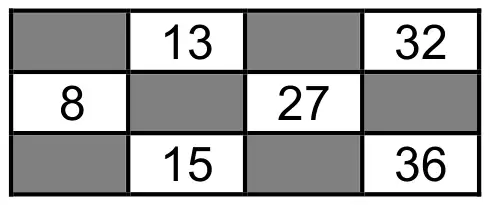
\(62 - 54\) or 8 or \(54 - 62\) or −8 or \(\dfrac{62 - 54}{2}\) or 4 or \(\dfrac{54 - 62}{2}\) or −4 or \(\dfrac{62 + 54}{2}\) or \(\dfrac{116}{2}\) or 58 or \(2 + 16 + 13 + 27 = 58\) or \(1 + 15 + 12 + 30 = 58\)
When 5 is added to a negative number, the answer can be positive
Give one example to show that this is correct. [1 mark]
(b)
When 5 is added to a negative number, the answer can be negative
Give one example to show that this is correct. [1 mark]
(c)
When a number is doubled, the answer is always greater than the original number
Give one example to show that this is not correct. [1 mark]
Mark scheme (a)
Answer
Mark
Comments
One example that would give a positive answer
B1
eg \(-2 + 5\;(= 3)\) or \(5 + -2\;(= 3)\)
Additional guidance
Evaluation is not required but if given must be correct
Allow two or more correct examples eg \(-1 + 5 = 4\) and \(-4 + 5 = 1\)
B1
Do not ignore an incorrect example alongside a correct example eg1 \(-1 + 5 = 4\) and \(-7 + 5 = -2\) (\(-7 + 5\) is an incorrect example) eg2 \(-1 + 5\) and \(-7 + 5\) eg3 \(-5 + 5 = 0\) and \(-2 + 5 = 3\) (\(-5 + 5\) is an incorrect example) eg4 \(-2 + 5 = 3\) and \(-4 + 5 = -9\) (−9 is an incorrect evaluation)
B0 B0 B0 B0
Allow an example in words eg five added to negative four (is one)
B1
The number could be −2
B1
Allow brackets around negative numbers eg \(5 + (-2)\)
B1
\(5 - 2\;(= 3)\)
B1
\(-5 + 5 = 0\)
B0
Mark scheme (b)
Answer
Mark
Comments
One example that would give a negative answer
B1
eg \(-6 + 5\;(= -1)\) or \(5 + -6\;(= -1)\)
Additional guidance
Evaluation not required but if given must be correct
Allow two or more correct examples eg \(-7 + 5 = -2\) and \(-6 + 5 = -1\)
B1
Do not ignore an incorrect example alongside a correct example eg1 \(-7 + 5 = -2\) and \(-1 + 5 = 4\) (\(-1 + 5\) is an incorrect example) eg2 \(-7 + 5\) and \(-1 + 5\) eg3 \(-5 + 5 = 0\) and \(-6 + 5 = -1\) (\(-5 + 5\) is an incorrect example) eg4 \(-9 + 5 = -4\) and \(-8 + 5 = -13\) (−13 is an incorrect evaluation)
B0 B0 B0 B0
Allow an example in words eg five added to negative ten (is negative five)
B1
The number could be −6
B1
Allow brackets around negative numbers eg \(5 + (-8)\)
B1
\(5 - 6\;(= -1)\)
B1
\(-5 + 5 = 0\)
B0
Mark scheme (c)
Answer
Mark
Comments
One example that shows the statement is not correct
B1
eg \(-3 \times 2\;(= -6)\) or \(2 \times -3\;(= -6)\)
Additional guidance
Evaluation not required but if given must be correct
Allow two or more correct examples eg \(-7 \times 2 = -14\) and \(-6 \times 2 = -12\)
B1
Do not ignore an incorrect example alongside a correct example eg1 \(-5 \times 2 = -10\) and \(4 \times 2 = 8\) (\(4 \times 2\) is an incorrect example) eg2 \(-4 \times 2\) and \(4 \times 2\) eg3 \(-5 \times 2 = -10\) and \(-8 \times 2 = -10\) (−10 is an incorrect evaluation)
The cube root of \(k\) is 3, to the nearest whole number.
Work out the largest possible value of \(k\). [2 marks]
(b) Fay tries to solve \(\quad x^2 = 100\)
She says,
“The only possible value of \(x\) is 10”
Give a reason why she is not correct. [1 mark]
Mark scheme (a)
Answer
Mark
Comments
Correct evaluation of the cube root of an integer [40, 50] or correct evaluation of the cube of a decimal or fraction (3, 3.5]
M1
eg \(\sqrt[3]{40} = 3.4\) or \(40 \to 3.4\) eg \(3.5^3 = 42.8\) or \(3.5 \to 42.8\)
42
A1
SC1 answer given as \(\sqrt[3]{42}\)
Additional guidance
Up to M1 may be awarded for correct work with no answer, or incorrect answer, even if this is seen amongst multiple attempts
Condone eg \(40 = 3.4\) or \(\sqrt{40} = 3.4\) to mean \(\sqrt[3]{40} = 3.4\)
Answer only 42
M1A1
Must select 42 as final answer for M1A1 ie 42 as the last in a list with a blank answer line is not enough for A1 unless 42 selected
If \(\sqrt[3]{42}\) or \(3.5^3\) is evaluated then it must be correct to award the A1 for 42
NB 42 only from incorrect method eg listing multiples of 3 or \(42 \div 3\) seen or 42 is divisible by 3 as the working
M0A0
Acceptable values for cube roots of integers in range
40
3.4(19…) or 3.42(0)
46
3.5(83…) or 3.6
41
3.4(48…) or 3.45
47
3.6(08…) or 3.609 or 3.61
42
3.4(76…) or 3.48 or 3.5
48
3.6(34…)
43
3.5(03…)
49
3.6(59…) or 3.66 or 3.7
44
3.5(30…)
50
3.6(84…) or 3.7
45
3.5(56…) or 3.557 or 3.56 or 3.6
Examples of cubes of numbers in range with their acceptable values
3.1
29(.791) or 29.8 or 30
3.4
39(.304)
3.2
32(.768) or 32.77 or 32.8 or 33
3.5 or \(3.4\dot{9}\)
42(.875) or 42.88 or 42.9 or 43
3.3
35(.937) or 35.94 or 36
Mark scheme (b)
Answer
Mark
Comments
Valid response that indicates there is one (negative) answer missing
B1
eg \(-10\) (is also an answer) or there is a negative value as well or square roots have two answers or answer is 10 and \(-10\)
Additional guidance
\(-10 \times -10\ (= 100)\)
B1
Another number can square to make 100 (implies exactly two)
B1
She has forgotten the other value (implies exactly two)
B1
There is another value it could be (implies exactly two)
B1
It could be a different number (implies exactly two)
B1
It could be negative (bod means 10 could be \(-10\))
B1
\(-10^2\ (= 100)\) (condone missing brackets around \(-10\))
B1
\(\pm\sqrt{100}\)
B1
Indication that there might be more than two possible values for \(x\) eg There are other possible numbers eg There could be other values eg Other numbers square to make 100 eg She hasn’t included negatives
B0 B0 B0 B0
Repeating the question eg There is more than 1 possible value eg 10 is not the only possible value eg More than 1 number works
B0 B0 B0
A partially correct statement eg \(x\) could be negative or decimal eg \(-10 \times -10 = -100\) eg \(x^2 = -10\)
Work out the highest common factor (HCF) of 12 600 and 14 112
Give your answer as an integer. [2 marks]
Mark scheme
Answer
Mark
Comments
At least two of \(2^3\), \(3^2\), 7 selected eg \(2^3 \times 3^2 \times 7\) or 2 2 2 3 3 7 7 or \(2^2 + 3^2 + 7\) or \(2^3 \times 3^2\) or \(2^3 + 7\) or \(3^2 . 7\)
M1
allow \(2^3\) to be \(2 \times 2 \times 2\) or 8 allow \(3^2\) to be \(3 \times 3\) or 9 allow 7 to be \(7^1\) selection is implied by inclusion in intersection of overlapping circles M0 inclusion of 5 in selection
504
A1
Additional guidance
\(8 \times 9 \times 7\)
M1
8, 9, 49
M1
\(4 + 9 + 7\)
M1
Intersecting circles with eg only 9 and 7 in the intersection
M1
Allow inclusion of 1 for up to M1 eg \(1 \times 2^3 \times 3^2 \times 7\)
a cube number multiplied by a prime number between 10 and 20 [2 marks]
Mark scheme
Answer
Mark
Comments
125 and 17 or \(5^3\) and 17 or 5 and 5 and 5 and 17
B2
together in any order eg \(125 \times 17\) or \(17 \times 5^3\) or 5, 5, 5, 17 or \(2125 \div 17 = 125\) or \(2125 \div 125 = 17\) B1 at least three of 8, 27, 64, 125, 216, 343, 512, 729, 1000, 1331, 1728, 2197 etc (allow \(2^3, 3^3, 4^3\) etc) or all four of 11, 13, 17, 19 (ignore any numbers not between 10 and 20) or (cube number \(\gt 1\)) \(\times\) (prime number between 10 and 20) or \(2125 \div\) (cube number \(\gt 1\)) or \(2125 \div\) (prime number between 10 and 20)
Additional guidance
B1 may be awarded for correct work with no, or incorrect answer, even if this is seen amongst multiple attempts
B2 responses may be seen on a factor tree
B1 for three cube numbers given in index form – evaluations can be ignored eg \(4^3\ \ 5^3\ \ 6^3\) scores B1 with no evaluations or with incorrect evaluations
B1 for multiplications or divisions – evaluation can be ignored eg1 \(2^3 \times 13\) scores B1 with no evaluation or evaluated incorrectly eg2 \(2125 \div 27\) scores B1 with no evaluation or evaluated incorrectly eg3 \(2125 \div 11\) scores B1 with no evaluation or evaluated incorrectly
125 and 17 seen in multiple attempts is B2 if 2125 included eg \(125 \times 17 = 2125\) or \(2125 \div 17 = 125\) or \(2125 \div 125 = 17\) seen amongst multiple attempts
B2
125 and 17 seen in multiple attempts is B1 if 2125 not included eg \(125 \times 17\) seen amongst multiple attempts
B1
11 13 15 17 19 does not score B1 unless 11 13 17 19 selected
15 In the grid, the product of each row, column and diagonal is 1
\(\dfrac{1}{4}\)
4
\(\dfrac{1}{8}\)
Complete the grid. [2 marks]
Mark scheme
Answer
Mark
Comments
8
\(\dfrac{1}{4}\)
\(\dfrac{1}{2}\)
\(\dfrac{1}{16}\)
1
16
2
4
\(\dfrac{1}{8}\)
B2
oe values eg 0.0625 for \(\dfrac{1}{16}\) condone unprocessed values eg for 8 allow \(\dfrac{16}{2}\) or \(\dfrac{8}{1}\) B1 at least three of the eight rows, columns and diagonals have a product of 1 do not count rows, columns or diagonals that only have ones do not count incomplete rows, columns or diagonals
Additional guidance
If decimal values are used they must be exact
The given values in the grid cannot be changed
B1 can be awarded with an incomplete grid eg
8
\(\dfrac{1}{4}\)
\(\dfrac{1}{16}\)
1
2
4
\(\dfrac{1}{8}\)
B1
1
\(\dfrac{1}{4}\)
1
1
1
\(\dfrac{1}{2}\)
1
4
\(\dfrac{1}{8}\)
Three products of 1 but two are not counted as they only have ones
a cube number multiplied by a prime number between 10 and 20 [2 marks]
Mark scheme
Answer
Mark
Comments
125 and 17 or \(5^3\) and 17 or 5 and 5 and 5 and 17
B2
together in any order eg \(125 \times 17\) or \(17 \times 5^3\) or 5, 5, 5, 17 or \(2125 \div 17 = 125\) or \(2125 \div 125 = 17\) B1 at least three of 8, 27, 64, 125, 216, 343, 512, 729, 1000, 1331, 1728, 2197 etc (allow \(2^3\), \(3^3\), \(4^3\) etc) or all four of 11, 13, 17, 19 (ignore any numbers not between 10 and 20) or (cube number \(\gt 1\)) \(\times\) (prime number between 10 and 20) or \(2125 \div\) (cube number \(\gt 1\)) or \(2125 \div\) (prime number between 10 and 20)
Additional guidance
B1 may be awarded for correct work with no, or incorrect answer, even if this is seen amongst multiple attempts
B2 responses may be seen on a factor tree
B1 for three cube numbers given in index form – evaluations can be ignored eg \(4^3 \quad 5^3 \quad 6^3\) scores B1 with no evaluations or with incorrect evaluations
B1 for multiplications or divisions – evaluation can be ignored eg1 \(2^3 \times 13\) scores B1 with no evaluation or evaluated incorrectly eg2 \(2125 \div 27\) scores B1 with no evaluation or evaluated incorrectly eg3 \(2125 \div 11\) scores B1 with no evaluation or evaluated incorrectly
125 and 17 seen in multiple attempts is B2 if 2125 included eg \(125 \times 17 = 2125\) or \(2125 \div 17 = 125\) or \(2125 \div 125 = 17\) seen amongst multiple attempts
B2
125 and 17 seen in multiple attempts is B1 if 2125 not included eg \(125 \times 17\) seen amongst multiple attempts
B1
11 13 15 17 19 does not score B1 unless 11 13 17 19 selected
30 Erik thinks of a prime number between 20 and 30
His number is \(x\)% of 125
Work out one possible value of \(x\). [3 marks]
Mark scheme
Answer
Mark
Comments
23 or 29
B1
implied by correct answer
\(\dfrac{23}{125}\ (\times 100)\) or \(\dfrac{29}{125}\ (\times 100)\) or \(\dfrac{\text{their number}}{125}\ (\times 100)\) or their number \(= \dfrac{x}{100} \times 125\)
M1
oe their number can be any integer value
18.4 or 23.2 or correct evaluation of their number as a percentage of 125
A1ft
ft B0M1 oe their number must be an integer [20, 30] or any prime number
Additional guidance
18.4 or 23.2
B1M1A1
18.4 and 23.2
B1M1A1
23 or 29 must be clearly indicated as their prime number
Any integer [20, 30] used can score B0M1A1ft eg \(25 \div 125 \times 100\) with answer 20
B0M1A1ft
Any prime number used can score B0M1A1ft eg \(7 \div 125 \times 100\) with answer 5.6
B0M1A1ft
24% of 125 is 30 with answer 24
B0M1A1ft
29% of 125 is 36.25 (36.25 is not an integer)
B1M0A0ft
28% of 125 is 35 with answer 28 (35 is an integer out of range)
B0M1A0ft
28% of 125 is 35 scores M1 (35 is an integer) 25% of 125 is 31.25 scores M0 (31.25 is not an integer)
200 written as a product of factors where at least one factor is prime
M1
eg 2 and 100 or \(2 \times 10^2\) or \(200 \div 5 = 40\) may be on a factor tree or repeated division allow one strand to be incorrect if a previous value completes the product eg \(10 \times 20\) followed by \(5 \times 2 \times 5 \times 6\) implies \(5 \times 2 \times 20\) for M1
2 and 2 and 2 and 5 and 5
A1
may be on a factor tree or repeated division
\(2^3 \times 5^2\) or \(5^2 \times 2^3\)
A1
Additional guidance
Allow any number of 1s included as factors up to M1A1 only
M1 may be awarded for correct work with no or incorrect answer, even if this is seen among multiple attempts
\(1 \times 2^3 \times 5^2\)
M1A1A0
\(2^3.5^2\) or \(2^3{\cdot}5^2\) or \(2^35^2\) or \(2^3,5^2\)
M1A1A1
\(2 + 2 + 2 + 5 + 5\)
M1A1A0
\(2^3 + 5^2\)
M1A1A0
\(2 \times 2 \times 2 \times 5 \times 5\) and \(2^3 \times 5^2\) on answer line but \(2 \times 2 \times 2 \times 5 \times 5 = 2^3 \times 5^2\) on answer line
11 Erik thinks of a prime number between 20 and 30
His number is \(x\)% of 125
Work out one possible value of \(x\). [3 marks]
Mark scheme
Answer
Mark
Comments
23 or 29
B1
implied by correct answer
\(\dfrac{23}{125}\) \((\times 100)\) or \(\dfrac{29}{125}\) \((\times 100)\) or \(\dfrac{\text{their number}}{125}\ (\times 100)\) or their number = \(\dfrac{125x}{100}\)
M1
oe their number can be any integer value
18.4 or 23.2 or correct evaluation of their number as a percentage of 125
A1ft
ft B0M1 oe their number must be an integer [20, 30] or any prime number
Additional guidance
18.4 or 23.2
B1M1A1
18.4 and 23.2
B1M1A1
23 or 29 must be clearly indicated as their prime number
Any integer [20, 30] used can score B0M1A1ft eg \(25 \div 125 \times 100\) with answer 20
B0M1A1ft
Any prime number used can score B0M1A1ft eg \(7 \div 125 \times 100\) with answer 5.6
B0M1A1ft
24% of 125 is 30 with answer 24
B0M1A1ft
29% of 125 is 36.25 (36.25 is not an integer)
B1M0A0ft
28% of 125 is 35 with answer 28 (35 is an integer out of range)
B0M1A0ft
28% of 125 is 35 scores M1 (35 is an integer)
25% of 125 is 31.25 scores M0 (31.25 is not an integer)
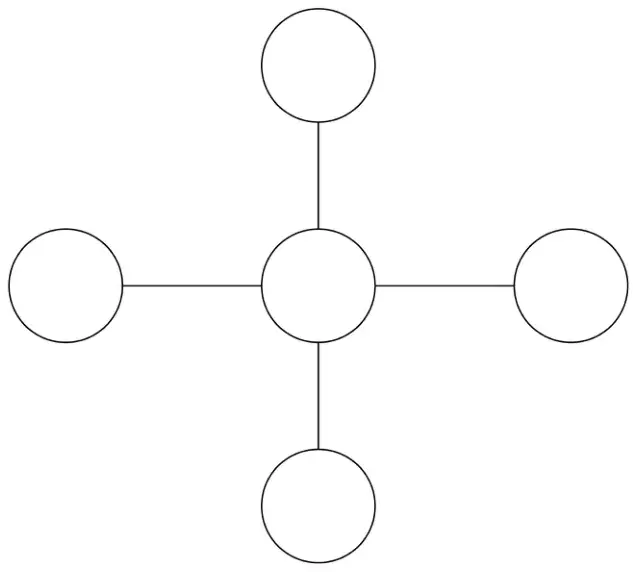
6 Put the numbers 1, 2, 3, 4 and 6 into the circles so that
each line of three numbers multiplies to 12 the total of the vertical line is one more than the total of the horizontal line.
Use each number once. [2 marks]
Mark scheme
Answer
Mark
Comments
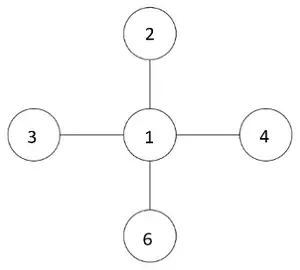
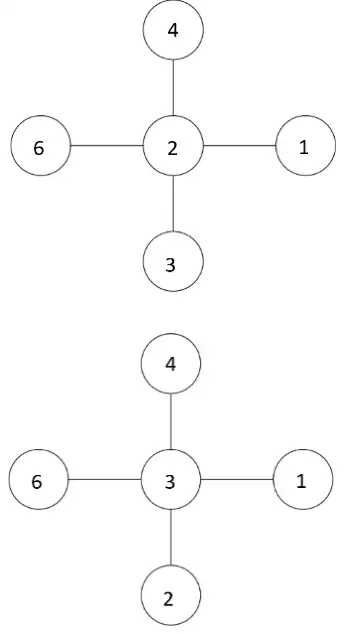
B2
2 and 6 can be in either order 3 and 4 can be in either order
B1 the horizontal line multiplies to 12 or the vertical line multiplies to 12 or the sum of the vertical line is 1 more than the sum of the horizontal line or the sum of the horizontal line is 1 more than the sum of the vertical line
Additional guidance
Must use 1, 2, 3, 4 and 6 each once and all circles must be completed
200 written as a product of factors where at least one factor is prime
M1
eg 2 and 100 or \(2 \times 10^2\) or \(200 \div 5 = 40\) may be on a factor tree or repeated division allow one strand to be incorrect if a previous value completes the product eg \(10 \times 20\) followed by \(5 \times 2 \times 5 \times 6\) implies \(5 \times 2 \times 20\) for M1
2 and 2 and 2 and 5 and 5
A1
may be on a factor tree or repeated division
\(2^3 \times 5^2\) or \(5^2 \times 2^3\)
A1
Additional guidance
Allow any number of 1s included as factors up to M1A1 only
M1 may be awarded for correct work with no or incorrect answer, even if this is seen among multiple attempts
\(1 \times 2^3 \times 5^2\)
M1A1A0
\(2^3.5^2\) or \(2^3{\cdot}5^2\) or \(2^35^2\) or \(2^3,5^2\)
M1A1A1
\(2 + 2 + 2 + 5 + 5\)
M1A1A0
\(2^3 + 5^2\)
M1A1A0
\(2 \times 2 \times 2 \times 5 \times 5\) and \(2^3 \times 5^2\) on answer line
M1A1A0
but \(2 \times 2 \times 2 \times 5 \times 5 = 2^3 \times 5^2\) on answer line
24 Work out the highest common factor (HCF) of 75 and 105 [2 marks]
Mark scheme
Answer
Mark
Comments
15
B2
B1 answer 3 or answer 5 or answer 3 \((\times)\) 5 or (75 =) 3 \((\times)\) 5 \((\times)\) 5 or (75 =) 3 \((\times)\) \(5^2\) or (105 =) 3 \((\times)\) 5 \((\times)\) 7 or (1) 3 5 15 25 (75) or (1) 3 5 7 15 21 35 (105)
Additional guidance
NB 15 from \(3 + 5 + 7\) does not score unless working for B1 seen elsewhere
Prime factor responses for B1 may be seen in repeated division, on a factor tree or in a Venn diagram eg1 3 5 5 in repeated division or factor tree for 75 eg2 3 5 7 inside one circle of a Venn diagram eg3 3 5 inside the intersection of a Venn diagram
B1 B1 B1
For products of prime factors, repeated division, factor trees and Venn diagrams, ignore inclusion of factors of 1
A repeated division needs to reach the final prime factor but does not need to reach 1
B1 can be awarded even if LCM is subsequently worked out
(a) Write down an even whole number that is also a square number. [1 mark]
(b) Write down all the cube numbers between 100 and 400 [2 marks]
(c) Write down two numbers that
are multiples of 3 and multiply to make 216 [1 mark]
Mark scheme (a)
Answer
Mark
Comments
Any even square whole number
B1
eg 4 or 16 or 36 or 64
Additional guidance
0
B1
\(2^2 = 4\)
B1
Answer only of \(2^2\)
B0
Answer only of \(\dfrac{16}{4}\)
B0
Mark scheme (b)
Answer
Mark
Comments
125 216 343 with no extras
B2
B1 125 216 343 seen with extras or two of 125 216 343 seen alone or with extras or \(5^3\;\; 6^3\;\; 7^3\)
Additional guidance
125 216 343 seen with answer \(5^3\;\; 6^3\;\; 7^3\)
B2
\(5^3\;\; 6^3\;\; 7^3\) only
B1
125 216 343 seen with answer 5 6 7
B1
5 6 7 only
B0
Extras may be incorrect for B1
Mark scheme (c)
Answer
Mark
Comments
3 and 72 or 6 and 36 or 9 and 24 or 12 and 18
B1
either order
Additional guidance
Answer line takes precedence
Award the mark for embedded answers only if the answers are selected eg1 \(216 \div 3 = 72\) with no answer or with incorrect answer eg2 \(216 \div 3 = 72\) (with 3 and 72 circled) with no contradictory answer eg3 \(3 \times 72\) in working with no contradictory answer
6 Work out the highest common factor (HCF) of 75 and 105 [2 marks]
Mark scheme
Answer
Mark
Comments
15
B2
B1 answer 3 or answer 5 or answer 3 (\(\times\)) 5 or (75 =) 3 (\(\times\)) 5 (\(\times\)) 5 or (75 =) 3 (\(\times\)) \(5^2\) or (105 =) 3 (\(\times\)) 5 (\(\times\)) 7 or (1) 3 5 15 25 (75) or (1) 3 5 7 15 21 35 (105)
Additional guidance
NB 15 from \(3 + 5 + 7\) does not score unless working for B1 seen elsewhere
Prime factor responses for B1 may be seen in repeated division, on a factor tree or in a Venn diagram eg1 3 5 5 in repeated division or factor tree for 75 eg2 3 5 7 inside one circle of a Venn diagram eg3 3 5 inside the intersection of a Venn diagram
B1 B1 B1
For products of prime factors, repeated division, factor trees and Venn diagrams, ignore inclusion of factors of 1
A repeated division needs to reach the final prime factor but does not need to reach 1
B1 can be awarded even if LCM is subsequently worked out
24 Work out the lowest common multiple (LCM) of 120 and 144 [2 marks]
Mark scheme
Answer
Mark
Comments
720
B2
B1 at least 3 multiples of 120 (> 120) and at least 3 multiples of 144 (> 144) eg 240 360 480 and 288 432 576 or \((120 =)\ 2 \times 2 \times 2 \times 3 \times 5\) or \((144 =)\ 2 \times 2 \times 2 \times 2 \times 3 \times 3\) or \((\text{Answer} =)\ 2 \times 2 \times 2 \times 2 \times 3 \times 3 \times 5\) or \((\text{Answer} =)\ 2^4 \times 3^2 \times 5\) or (Answer =) any multiple of 720 (> 720) eg 1440 or 17 280
Additional guidance
Prime factor responses for B1 may be in index form eg \((120 =)\ 3 \times 5 \times 2^3\)
B1
Prime factor responses for B1 may be seen on a factor tree or a Venn diagram or in repeated division eg1 2 2 2 3 5 on a factor tree for 120 eg2 2 2 2 2 3 3 inside one circle on a Venn diagram
B1 B1
For B1 allow some incorrect multiples if 3 correct of each eg1 240 380 480 720 900 (3 correct) and 288 432 576 868 (3 correct) eg2 Answer 1440 but some incorrect multiples seen
B1 B1
Any multiple of 720 (> 720) given in unsimplified form eg1 \(2^7 \times 3^3 \times 5\) eg2 \(2 \times 2 \times 2 \times 2 \times 2 \times 5 \times 3 \times 3\)
B1 B1
B1 can still be awarded even if subsequently works out HCF
Answer 720 with some incorrect multiples seen
B2
For products of prime factors, ignore inclusion of \(\times 1\)
5 Work out the lowest common multiple (LCM) of 120 and 144 [2 marks]
Mark scheme
Answer
Mark
Comments
720
B2
B1 at least 3 multiples of 120 (> 120) and at least 3 multiples of 144 (> 144) eg 240 360 480 and 288 432 576 or (120 =) \(2 \times 2 \times 2 \times 3 \times 5\) or (144 =) \(2 \times 2 \times 2 \times 2 \times 3 \times 3\) or (Answer =) \(2 \times 2 \times 2 \times 2 \times 3 \times 3 \times 5\) or (Answer =) \(2^4 \times 3^2 \times 5\) or (Answer =) any multiple of 720 (> 720) eg 1440 or 17 280
Additional guidance
Prime factor responses for B1 may be in index form eg (120 =) \(3 \times 5 \times 2^3\)
B1
Prime factor responses for B1 may be seen on a factor tree or a Venn diagram or in repeated division eg1 2 2 2 3 5 on a factor tree for 120 eg2 2 2 2 2 3 3 inside one circle on a Venn diagram
B1 B1
For B1 allow some incorrect multiples if 3 correct of each eg1 240 380 480 720 900 (3 correct) and 288 432 576 868 (3 correct) eg2 Answer 1440 but some incorrect multiples seen
B1 B1
Any multiple of 720 (> 720) given in unsimplified form eg1 \(2^7 \times 3^3 \times 5\) eg2 \(2 \times 2 \times 2 \times 2 \times 2 \times 5 \times 3 \times 3\)
B1 B1
B1 can still be awarded even if subsequently works out HCF
Answer 720 with some incorrect multiples seen
B2
For products of prime factors, ignore inclusion of \(\times 1\)
(b) Work out the lowest common multiple (LCM) of 12 and 15 [2 marks]
Mark scheme (a)
Answer
Mark
Comments
1, 2, 3, 6, 9, 18
B2
B1 the 6 correct values, some or all repeated, with no incorrect values or 5 or 6 correct values with up to 2 incorrect values or 4 correct values with 0 or 1 incorrect values or 3 correct values with 0 incorrect values
Additional guidance
Use of products or ‘coordinates’ is B1 max for at least 2 correct products with 0 or 1 incorrect products eg \(1 \times 18,\ 2 \times 9,\ 3 \times 6\) eg \(1 \times 18,\ 2 \times 9,\ 3 \times 6,\ 4 \times 4\)
B1 B1
Lists with repeated values cannot score B2, but ignore repeated values in any format for B1 eg 1, 2, 3, 3 eg \(1 \times 18,\ 2 \times 9,\ 3 \times 6,\ 18 \times 1,\ 9 \times 2,\ 6 \times 3\)
B1 B1
If a prime factor ‘tree’ or similar is used, factors must be identified
Mark scheme (b)
Answer
Mark
Comments
60
B2
B1 any common multiple of 12 and 15 eg 120, 180
B1 at least the first two multiples correct for each of 12 and 15 (ignore errors after first two)
B1 \((12 =)\ 2(\times)2(\times)3\) and \((15 =)\ 5(\times)3\) and \(2(\times)2(\times)5(\times)3\ ((\times)3)\) (or the equivalent work seen in a correct Venn diagram)
Additional guidance
Answer 60 with error(s) seen may be B0 or B1 but cannot be B2 These error(s) may occur after the 60 – but cannot be ignored
If they have listed both multiples and factors, they must choose multiples to score
For B2, 60 must be chosen and not just at the end of a list of multiples
Subtracts 17, 34, 51 or 68 from 84 or subtracts any multiple of 3 from 84 or subtracts any three equal positive whole numbers from 84
M1
implied by 67, 50, 33 or 16 or implied by a multiple of 17 plus three positive whole numbers that sum to 84 or implied by a multiple of 3 and another positive whole number that sum to 84 or implied by four positive whole numbers, three of which are equal, that sum to 84
Subtracts 17, 34, 51 or 68 from 84 and then divides by 3 or subtracts any multiple of 3 from 84 and then divides by 17 or subtracts any three equal positive whole numbers from 84 and then divides by 17
M1dep
implied by 22.3(…), 16.6(…) or 16.7, 11 or 5.3(…)
51, 11, 11, 11
A1
any order
Alternative method 2
A correctly evaluated trial using addition of a multiple of 17 and three equal positive whole numbers or addition of a multiple of 17 and a multiple of 3
M1
A different correctly evaluated trial using addition of a multiple of 17 and three equal positive whole numbers or addition of a multiple of 17 and a multiple of 3
M1dep
51, 11, 11, 11
A1
any order
Additional guidance
Answer of 51 and 11 with indication of three 11s in working
M1M1A1
Answer line blank with 51 and three 11s indicated as their four numbers
M1M1A1
Answer line blank with 51 and three 11s in working
M1M1A0
Answer of 51 and 11 with no indication of three 11s in working
M1M1A0
34, 20, 20, 10 implies first method mark as a multiple of 17 plus three positive whole numbers that sum to 84
Work out the highest possible value of \(\quad \dfrac{a}{b}\) [4 marks]
Mark scheme
Answer
Mark
Comments
At least two common factors of 72 and 120 from 2, 3, 4, 6, 8, 12, 24 or \(72 = 2\ (\times)\ 2\ (\times)\ 2\ (\times)\ 3\ (\times)\ 3\) or \(120 = 2\ (\times)\ 2\ (\times)\ 2\ (\times)\ 3\ (\times)\ 5\)
M1
May be seen on a diagram, eg factor tree
At least two common multiples of 6 and 9 from 18, 36, 54…
M1
(HCF =) 24 selected from factors or \(a = 24\) or (LCM =) 18 selected from multiples or \(b = 18\)
M1
oe eg HCF \(= 2\ (\times)\ 2\ (\times)\ 2\ (\times)\ 3\) 24 can be implied from their numerator oe eg LCM \(= 2\ (\times)\ 3\ (\times)\ 3\) 18 can be implied from their denominator oe eg \(\dfrac{2 \times 2 \times 2 \times 3}{2 \times 3 \times 3}\)
\(1\dfrac{1}{3}\) or \(\dfrac{4}{3}\) or 1.33…
A1
oe Accept \(\dfrac{24}{18}\) Ignore further incorrect cancelling
One of the numbers is a multiple of 7 The other three numbers are equal.
Work out the result when the four numbers are multiplied. [3 marks]
Mark scheme
Answer
Mark
Comments
A correct trial using one from a multiple of 7 subtracted from 36 a multiple of 7 plus three equal whole numbers three equal whole numbers subtracted from 36 or Lists four whole numbers, of which three are equal, that sum to 36 or Lists four whole numbers that sum to 36 with at least one multiple of 7
Each of the four sides of the grid must add up to 26
Complete the grid using the numbers
1, 3, 6, 8, 9 and 11 [3 marks]
Mark scheme
Answer
Mark
Comments
with 1 and 9 in either order
B3
B2 for three sides adding to 26 using the given numbers with no repeats across the three sides B1 for one or two sides adding to 26 using the given numbers with no repeats across the one or two sides
Additional guidance
Four sides add to 26 but across the four sides there is one repeat (8) so only three sides qualify
B2
Three sides add to 26 but across these three sides there is one repeat (3) so only two sides qualify One side has 14, one side has repeats of 10 and 3 so these two sides do not qualify. Only one of the remaining sides adds to 26 so qualifies
Work out the highest possible value of \(\;\dfrac{a}{b}\) [4 marks]
Mark scheme
Answer
Mark
Comments
At least two common factors of 72 and 120 from 2, 3, 4, 6, 8, 12, 24 or \(72 = 2\ (\times)\ 2\ (\times)\ 2\ (\times)\ 3\ (\times)\ 3\) or \(120 = 2\ (\times)\ 2\ (\times)\ 2\ (\times)\ 3\ (\times)\ 5\)
M1
May be seen on a diagram, eg factor tree
At least two common multiples of 6 and 9 from 18, 36, 54…
M1
(HCF =) 24 selected from factors or \(a = 24\) or (LCM =) 18 selected from multiples or \(b = 18\)
M1
oe eg HCF \(= 2\ (\times)\ 2\ (\times)\ 2\ (\times)\ 3\) 24 can be implied from their numerator oe eg LCM \(= 2\ (\times)\ 3\ (\times)\ 3\) 18 can be implied from their denominator oe eg \(\dfrac{2 \times 2 \times 2 \times 3}{2 \times 3 \times 3}\)
\(1\dfrac{1}{3}\) or \(\dfrac{4}{3}\) or 1.33…
A1
oe Accept \(\dfrac{24}{18}\) Ignore further incorrect cancelling
23 Show that 268 can be written as the sum of a power of 3 and a square number. [2 marks]
Mark scheme
Answer
Mark
Comments
Lists three from 3, 9, 27, 81, 243, 729 or lists three from 1, 4, 9, 16, …, 225, 256, 289 or correctly evaluating a power of 3 + a square number or correctly evaluating 268 – a power of 3 or correctly evaluating 268 – a square number
M1
eg 27 + 25 = 52 or \(3^3 + 5^2 = 52\)
eg 268 – 27 = 241
eg 268 – 49 = 219
243 + 25 or \(3^5 + 5^2\)
A1
oe Addition sign must be seen in working or on answer line
Additional guidance
\(3^5\), \(5^2\) or \(3^5\) and \(5^2\) on answer line
“If you add any three multiples of 10 the total must be a multiple of 10 and a multiple of 3”
Is she correct?
You must show your working. [2 marks]
Mark scheme
Answer
Mark
Comments
Correct evaluation of the sum of three multiples of 10 where the sum is not a multiple of three and No eg 10 (+) 20 (+) 40 = 70 and No or Correct evaluation of the sum of three multiples of 10 and she is only correct if the total is a multiple of 30
B2
B1 for correct evaluation of the sum of three multiples of 10 eg 10 (+) 20 (+) 40 (=) 70 10 (+) 20 (+) 30 (=) 60
Additional guidance
Ignore incorrect evaluations alongside a correct evaluation
6 Show that 268 can be written as the sum of a power of 3 and a square number. [2 marks]
Mark scheme
Answer
Mark
Comments
Lists three from 3, 9, 27, 81, 243, 729 or lists three from 1, 4, 9, 16, …, 225, 256, 289 or correctly evaluating a power of 3 + a square number or correctly evaluating 268 − a power of 3 or correctly evaluating 268 − a square number
M1
eg \(27 + 25 = 52\) or \(3^3 + 5^2 = 52\)
eg \(268 - 27 = 241\)
eg \(268 - 49 = 219\)
\(243 + 25\) or \(3^5 + 5^2\)
A1
oe Addition sign must be seen in working or on answer line
Additional guidance
\(3^5, 5^2\) or \(3^5\) and \(5^2\) on answer line
13 To make one cheese sandwich, Gina uses one bread roll and two cheese slices.
Pack of 15 bread rolls £1.88
Pack of 20 cheese slices £2.15
She is going to buy enough packs to
have exactly twice as many cheese slices as bread rolls
make more than 100 cheese sandwiches.
Work out the least amount she can spend. [4 marks]
Mark scheme
Answer
Mark
Comments
Alternative method 1
Valid number of bread rolls and cheese slices
M1
eg 30 bread and 60 cheese or 60 bread and 120 cheese or 90 bread and 180 cheese or 120 bread and 240 cheese Valid number means ratio 1 : 2 and can be bought in exact numbers of packs May be implied by valid number of packs
Valid number of packs of bread rolls and cheese slices
M1dep
eg 2 packs bread and 3 packs cheese or 4 packs bread and 6 packs cheese or 6 packs bread and 9 packs cheese or 8 packs bread and 12 packs cheese Valid number of packs means ratio 2 : 3
their number of packs of bread \(\times\) 1.88 and their number of packs of cheese \(\times\) 2.15
M1dep
eg 15.04 and 25.8(0)
40.84
A1
SC2 27.94 or 42.98
Alternative method 2
Valid number of sandwiches
M1
eg Common multiple of 15 and 20 identified eg 15 30 45 60 75 and 20 40 60 Valid number means can be bought in exact numbers of packs
\(1.88 \div 15 + 2.15 \div 10\) or \(0.125(\ldots) + 0.215\) or 0.34(0…)
M1
oe Cost of one sandwich
their 0.34(0…) \(\times\) their number of sandwiches
M1dep
dep on M2
40.84
A1
SC2 27.94 or 42.98
Additional guidance
Alt 1 3rd M1 Allow working in pence
Alt 2 2nd M1 Allow working in pence
30 bread and 60 cheese/2 packs bread and 3 packs cheese \(2 \times 1.88\) or 3.76 and \(3 \times 2.15\) or 6.45 (Answer £10.21)
M3 A0
60 bread and 120 cheese/4 packs bread and 6 packs cheese \(4 \times 1.88\) or 7.52 and \(6 \times 2.15\) or 12.9(0) (Answer £20.42)
M3 A0
90 bread and 180 cheese/6 packs bread and 9 packs cheese \(6 \times 1.88\) or 11.28 and \(9 \times 2.15\) or 19.35 (Answer £30.63)
M3 A0
150 bread and 300 cheese/10 packs bread and 15 packs cheese \(10 \times 1.88\) or 18.8(0) and \(15 \times 2.15\) or 32.25 (Answer £51.05)
M3 A0
SC2 from 120 bread and 120 cheese or 240 bread and 120 cheese
6 Twelve cards numbered 1 to 12 are put into six pairs.
Each pair has a total.
Complete the table to show the pairs and their totals. [4 marks]
Cards
Total
1 and 2
3
\(\underline{\qquad\quad}\) and \(\underline{\qquad\quad}\)
9
\(\underline{\qquad\quad}\) and \(\underline{\qquad\quad}\)
11
\(\underline{\qquad\quad}\) and \(\underline{\qquad\quad}\)
14
\(\underline{\qquad\quad}\) and \(\underline{\qquad\quad}\)
19
\(\underline{\qquad\quad}\) and \(\underline{\qquad\quad}\)
22
Mark scheme
Answer
Mark
Comments
Cards
Total
1 and 2
3
3 and 6
9
4 and 7
11
5 and 9
14
8 and 11
19
10 and 12
22
B4
B3 for any three or four pairs giving the correct totals B2 for any two pairs giving the correct totals B1 for any one pair giving the correct total
Additional guidance
Mark pairs from top down and mark table only
Numbers in pairs can be reversed eg 6 and 3 Total 9
Accept first use of a number, in a correct or incorrect pair, but discount further use of the same number in a subsequent pair
Do not accept repeated numbers eg 7 and 7 or 11 and 11 as a correct pair (this is incorrect, not discounted)
Do not accept use of other numbers eg 9 and 13 is not a correct pair
4 and 5 Total 9 correct 5 and 6 Total 11 discount (5 already used in a correct pair) 6 and 8 Total 14 correct (first use of 6 as 5 and 6 discounted) 8 and 11 Total 19 discount (8 already used in a correct pair) 10 and 12 Total 22 correct
3 correct B3
3 and 6 Total 9 correct 7 and 4 Total 11 correct (order reversed) 7 and 7 Total 14 discount (7 already used in a correct pair) 7 and 12 Total 19 discount (7 already used in a correct pair) 10 and 12 Total 22 correct (first use of 12 as 7 and 12 discounted)
3 correct B3
2 and 7 Total 9 discount (2 already used in correct pair) 5 and 6 Total 11 correct 4 and 10 Total 14 correct 9 and 10 Total 19 discount (10 already used in a correct pair) 11 and 11 Total 22 incorrect (11 is a repeated number in a pair)
2 correct B2
3 and 3 Total 9 incorrect (3 is a repeated number in a pair) 3 and 8 Total 11 discount (3 already used in an incorrect pair) 6 and 8 Total 14 correct (first use of 8 as 3 and 8 discounted) 9 and 10 Total 19 correct 7 and 15 Total 22 incorrect (15 is not a card number)
2 correct B2
3 and 5 Total 9 incorrect 3 and 8 Total 11 discount (3 already used in an incorrect pair) 7 and 7 Total 14 incorrect (7 is a repeated number in a pair) 7 and 12 Total 19 discount (7 already used in an incorrect pair) 10 and 12 Total 22 correct (first use of 12 as 7 and 12 discounted)
(a) Here are all the factors of a number, A.\[1 \qquad 2 \qquad 3 \qquad 5 \qquad 6 \qquad 10 \qquad 15 \qquad 30\]
(i) Write down the value of A. [1]
(ii) Here is a number, B, written as the product of its prime factors.
\(\text{B} = 3 \times 5 \times 7\)
Find the highest common factor (HCF) of A and B. [2]
(b) Find a number between 150 and 200 which has factors 7 and 8. [2]
Mark scheme (a)
Answer
Marks
Part marks and guidance
(i) 30
1
(ii) 15 as final answer
2
B1 for only 3 and 5 [and 1 and / or 15] identified as the common factors
Allow Venn diagram with 5 and 3 in centre
Do not allow 15 from \(3 + 5 + 7\)
Mark scheme (b)
Answer
Marks
Part marks and guidance
168
2
M1 for \(7 \times 8\ [\times k]\) where \(k\) is a positive integer, maybe implied by \(56k\) or a list of multiples of 7 and 8 reaching 56 or 112 with no errors
Treat extra incorrect values as choice Correct answer from trials scores 2 Lists need not start at 7 or 8
\(N = 3 \times 5 \times k\), where \(k\) is a prime number
\(N\) is greater than 400.
Find the smallest possible value of \(N\). [3]
(b) \(a\) and \(b\) are different prime numbers.
Explain why \(a \times b\) is not a prime number. [1]
Mark scheme (a)
Answer
Marks
Part marks and guidance
435
3
B2 for [\(k =\)] 29
or for an answer that satisfies both conditions e.g. \(3 \times 5 \times 31 = 465\) or M1 for \(400 \div (3 \times 5)\) maybe implied by 26.66… or 26.7 or for \(3 \times 5 \times\) (their prime number) correctly evaluated or for \(3 \times 5 \times 27 = 405\)
e.g. 29 used in final trial or even as their answer using any prime number that is greater than 29
e.g. M1 for \(3 \times 5 \times 23 = 345\) in working or \(3 \times 5 \times 31 = 465\) with 31 as the answer treat factor trees or factor tables as multiplication
Mark scheme (b)
Answer
Marks
Part marks and guidance
any correct reason e.g. \(a\) and/or \(b\) are factors
1
see appendix
Appendix
Exemplar responses for 18b
Response
Mark
it has four factors [1, \(a\), \(b\), \(ab\)]
1
\(a\) and/or \(b\) are factors
1
[two different prime numbers multiplied together do not make a prime number] because they are both factors of the new number
1
Any non-identical prime numbers create a non-prime number when multiplied together because the resulting number can be divided by both prime numbers
1 (BOD)
The product of two prime numbers is always divisible by both prime numbers ….
1 (BOD)
\(a \times b\) has other factors aside from 1 and itself (\(a\) and \(b\))
1(BOD)
\(a \times b = 15\) 15 is divisible by 5 (may use other numbers)
1 (BOD)
it has factors besides itself and 1
0 (not enough)
two prime numbers multiplied together do not always become a prime number
0
Two prime numbers can multiply to make a number that isn’t prime
0
2 primes make a non prime
0
A prime number x a prime number doesn’t equal prime
0
A prime number can’t have factors that are also prime
14 Rosa is thinking of a fraction. The numerator is a cube number less than 100. The denominator is a square number less than 100. The fraction is equivalent to \(\dfrac{1}{8}\).
Find the fraction that Rosa is thinking of. [3]
Mark scheme
Answer
Marks
Part marks and guidance
\(\dfrac{8}{64}\) cao
3
B2 for a fraction with numerator a cube number >1 and denominator a square number as final answer or for \(\dfrac{8}{64}\) seen in workings but not their final answer
Condone \(\dfrac{8}{64} = \dfrac{1}{8}\) on answer line for 3 marks e.g. answers \(\dfrac{27}{36}\), \(\dfrac{64}{25}\) scores B2
OR
B1 for a fraction with numerator a cube number >1 or denominator a square number as final answer B1 for answer \(\dfrac{1k}{8k}\)
For B1 allow e.g. \(\dfrac{x}{64}\) or \(\dfrac{\square}{64}\) e.g. answer \(\dfrac{2}{16}\) scores B1B1
Where \(k\) is an integer >1
OR
B1 for [1,] 8,27,64, [125] B1 for [1,] 4,9,16,25,36,49,64,81,[100]
Work out the highest common factor (HCF) of 198 and 495. [2]
(b) A five-digit passcode is created using the lowest common multiple (LCM) followed by the highest common factor (HCF) of two numbers. The two numbers chosen are 198 and 495.
(i) To try and find the passcode, a computer hacker multiplies the highest common factor (HCF) of 198 and 495 by 5 and uses this as the lowest common multiple (LCM) in the passcode. The computer hacker’s passcode is incorrect. Write down the omission in the computer hacker’s method. [1]
(ii) Work out the correct five-digit passcode. [2]
Mark scheme (a)
Answer
Marks
Part marks and guidance
99
2
M1 for identification of 3 (or 32 or 9) and 11 as common factors, not spoilt
Venn diagram on its own scores 0 unless 32 and 11 selected
Mark scheme (b)
Answer
Marks
Part marks and guidance
(i) They did not multiply by 2 oe
1
See appendix
(ii) 99099
2
B1 for [LCM] 990 soi by passcode or M1 for 2 × 32 × 5 × 11 oe
FTtheir(a) eg (a) 46 (b) 2 marks for 99099, 99046, 46046 or B1 for (a) × 10
Appendix: Exemplar responses for Q8(b)(i)
An acceptable response will usually refer to 2
Response
Mark
They did not multiply by 2 / they should have multiplied by 2
1
They have forgotten 2 (implies omission)
BOD 1
They needed to multiply by 10 instead of 5 (this is not the omission)
\(N = 3 \times 5 \times k\), where \(k\) is a prime number
\(N\) is greater than 400.
Find the smallest possible value of \(N\). [3]
(b) \(a\) and \(b\) are different prime numbers.
Explain why \(a \times b\) is not a prime number. [1]
Mark scheme (a)
Answer
Marks
Part marks and guidance
435
3
B2 for [\(k\) = ] 29
or for an answer that satisfies both conditions e.g. 3 × 5 × 31 = 465 or M1 for 400 ÷ (3 × 5) maybe implied by 26.66… or 26.7 or for 3 × 5 × (their prime number) correctly evaluated or for 3 × 5 × 27 = 405
e.g. 29 used in final trial or even as their answer using any prime number that is greater than 29
e.g. M1 for 3 × 5 × 23 = 345 in working or 3 × 5 × 31 = 465 with 31 as the answer treat factor trees or factor tables as multiplication
Mark scheme (b)
Answer
Marks
Part marks and guidance
any correct reason e.g. \(a\) and/or \(b\) are factors
1
see appendix
Appendix: Exemplar responses for Q3(b)
Response
Mark
it has four factors [1, \(a\), \(b\), \(ab\)]
1
\(a\) and/or \(b\) are factors
1
[two different prime numbers multiplied together do not make a prime number] because they are both factors of the new number
1
Any non-identical prime numbers create a non-prime number when multiplied together because the resulting number can be divided by both prime numbers
1 (BOD)
The product of two prime numbers is always divisible by both prime numbers ….
1 (BOD)
\(a \times b\) has other factors aside from 1 and itself (\(a\) and \(b\))
1(BOD)
\(a \times b = 15\) 15 is divisible by 5 (may use other numbers)
1 (BOD)
it has factors besides itself and 1
0 (not enough)
two prime numbers multiplied together do not always become a prime number
0
Two prime numbers can multiply to make a number that isn’t prime
0
2 primes make a non prime
0
A prime number x a prime number doesn’t equal prime
0
A prime number can’t have factors that are also prime
25 Riley and Sam are conducting surveys. They are both given the same list of 12 463 people from which to select their sample.
Riley selects every 56th person. Sam selects every 64th person. They both start counting from the first name in the list.
Work out how many people will be selected to be in both surveys. You must show your working. [5]
Mark scheme
Answer
Marks
Part marks and guidance
27 with correct working
5
M2 for [56 =] \(2 \times 2 \times 2 \times 7\) oe or better and [64 =] \(2 \times 2 \times 2 \times 2 \times 2 \times 2\) oe or better or listing the correct multiples of 56 and 64 up to 448
or M1 for [56 =] \(2 \times 2 \times 2 \times 7\) or better or [64 =] \(2 \times 2 \times 2 \times 2 \times 2 \times 2\) or listing the next 3 correct multiples of each or one complete list or [LCM =] \(448k\) (\(k = 2, 3, 4 \ldots\))
A1 for 448 or \(2^6 \times 7\) oe e.g \(8 \times 8 \times 7\)
and
M1 for 12 463 \(\div\) their 448
If 0, 1 or 2 scored, instead award SC3 for answer 27 with no working or insufficient working If 0 or 1 scored, instead award SC2 for answer 27.8… with no working or insufficient working If 0 scored, instead award SC1 for 448 with no working or insufficient working
“Correct working” requires evidence of at least either M2 or M1 M1
Allow factors in e.g. factor trees or tables and allow for M2 any correct complete method e.g. [56=] \(8 \times 7\) and [64=] \(8 \times 8\) or multiples of 56 up to 448 and some indication of dividing these numbers by 64 or with multiples of 64 and dividing by 56
multiples of 56 and 64 are 112, 168, 224, 280, 336, 392, 448 and 128, 192, 256, 320, 384, 448 You might see this:
56
64
2
28
32
2
14
16
2
7
8
M1 may be implied by 27.8…
Alternative method : M2 for an attempt at \(\frac{12463}{56} - \frac{12463}{64}\) or M1 for an attempt at \(\frac{12463}{56}\) and an attempt at \(\frac{12463}{64}\) AND B2 for 27.8…. or B1 for \(27 \lt\) their 27.8 \(\leqslant 28\)
11 Riley and Sam are conducting surveys. They are both given the same list of 12 463 people from which to select their sample.
Riley selects every 56th person. Sam selects every 64th person. They both start counting from the first name in the list.
Work out how many people will be selected to be in both surveys. You must show your working. [5]
Mark scheme
Answer
Marks
Part marks and guidance
27 with correct working
5
“Correct working” requires evidence of at least either M2 or M1 M1
M2 for [56 =] 2×2×2×7 oe or better and [64 =] 2×2×2×2×2×2 oe or better or listing the correct multiples of 56 and 64 up to 448
or M1 for [56 =] 2×2×2 × 7 or better or [64 =] 2×2×2×2×2×2 or listing the next 3 correct multiples of each or one complete list or [LCM = ] 448k (k = 2,3,4 …)
A1 for 448 or 26 × 7 oe e.g 8 × 8 × 7
and
Allow factors in e.g. factor trees or tables and allow for M2 any correct complete method e.g. [56=] 8 x 7 and [64=] 8 x 8 or multiples of 56 up to 448 and some indication of dividing these numbers by 64 or with multiples of 64 and dividing by 56
multiples of 56 and 64 are 112, 168, 224, 280, 336, 392, 448 and 128, 192, 256, 320, 384, 448 You might see this:
56
64
2
28
32
2
14
16
2
7
8
M1 for 12 463 ÷ their 448
If 0, 1 or 2 scored, instead award SC3 for answer 27 with no working or insufficient working If 0 or 1 scored, instead award SC2 for answer 27.8… with no working or insufficient working If 0 scored, instead award SC1 for answer 448 with no working or insufficient working
M1 may be implied by 27.8…
Alternative method : M2 for an attempt at \(\frac{12463}{56} - \frac{12463}{64}\) or M1 for an attempt at \(\frac{12463}{56}\) and an attempt at \(\frac{12463}{64}\) AND B2 for 27.8…. or B1 for 27 < their 27.8 ⩽ 28
21 Trams to the airport leave every 50 minutes. Trams to the beach leave every 35 minutes. A tram to the airport and a tram to the beach leave together at 9:30 am.
When is the next time that two of these trams leave together? [4]
Mark scheme
Answer
Marks
Part marks and guidance
1520 or 3 20 pm
4
B3 for 3.20 or 1520 pm or B2 for listing the next 3 correct times of both trams i.e. 10.20, 11.10, 12.[00] and 10.05, 10.40, 11.15 or B1 for listing the next 3 correct times of one tram i.e. 10.20, 11.10, 12.[00] or 10.05, 10.40, 11.15
OR
B3 for 5 [h] 50 or B2 for [LCM =] 350 or B1 for listing the next 3 multiples of 50 or 35 i.e, 100, 150, 200 or 70, 105, 140 or 1[h] 40 2[h] 30 3[h]20 or 1[h]10 1[h]45 2[h]20 or M1 for [50 =] \(2 \times 5 \times 5\) and [35 =] \(5 \times 7\) allow in a factor tree or tables etc or [LCM = ] 350\(k\) or \(2 \times 5 \times 5 \times 7\)
Mark only 1 method
Condone 0320, 3.20 am 1520am for 3 marks but do not accept 15 h 20 or 3 h 20
Condone 10.5 if followed by 1040
May be indicated by circling in a list must be identified
(i) 2000 and 8750 are written below as the product of their prime factors.\[2000 = 2^4 \times 5^3\]\[8750 = 2 \times 5^4 \times 7\]Find the highest common factor (HCF) of 2000 and 8750. [2]
(ii) Write \(2 \times 10^{12}\) as a product of its prime factors. [2]
Mark scheme (a)
Answer
Marks
Part marks and guidance
Divisible by 5 or divisible by 19 or 95 ÷ 5 = 19 or 95 ÷ 19 = 5 or 5 × 19
1
Accept factor tree showing 95, 5 and 19 Accept 5 and 19 are factors of 95 Do not accept 5 and 19 are multiples of 95
Mark scheme (b)
Answer
Marks
Part marks and guidance
(b)(i)
250
2
B1 for 2 [×] \(5^3\)
Venn diagram on its own scores 0 unless 2 and \(5^3\) selected
(b)(ii)
\(2^{13} \times 5^{12}\)
2
M1 for \(10^k = 2^k \times 5^k\) where \(k\) is a positive integer implied by final answer of the form \(2^{k+1} \times 5^k\) or SC1 for \(2^{12} \times 5^{12}\)
18 In 2019, comet A and comet B were both seen from Earth.
Comet A is seen from Earth every 84 years.
Comet B is seen from Earth every 105 years.
Find the next year when both comets will be seen from Earth. [4]
Mark scheme
Answer
Marks
Part marks and guidance
2439
4
B3 for [LCM=] 420 or answer \(2439 + 420n\) OR B2 for listing the next 3 multiples for both comets 168, 252, 336 and 210, 315, 420 or [84 =] \(2^2 \times 3 \times 7\) and [105=] \(3 \times 5 \times 7\) or [LCM=] \(420k\) OR B1 for listing the next 3 multiples for one comet or [84 =] \(2^2 \times 3 \times 7\) or [105=] \(3 \times 5 \times 7\) allow in a factor tree or table
Alternative method 1 B2 for listing the next 3 years for both comets 2103, 2187, 2271 and 2124, 2229, 2334 or B1 for listing the next 3 years for one comet
Alternative method 2 B2 for Venn diagram with 3, 7 in the intersection 2, 2 in set 84 and 5 in set 105 or B1 for the diagram with one error
(b) 98 and 147 are written as the product of their prime factors.\[98 = 2 \times 7^2 \qquad 147 = 3 \times 7^2\]
Work out the highest common factor (HCF) of 98 and 147. [2]
Mark scheme (a)
Answer
Marks
Part marks and guidance
13 and 78
3
B2 for answer 13 or 78 in correct place or M1 for one correct trial of \(2 \times 3 \times\) prime or a correct factor tree for a number from 70 to 80 or an integer from 70 to 80 \(\div (2 \times 3)\)
Accept 6 for \((2 \times 3)\) throughout e.g. \(6 \times 13 = 78\) for \(2 \times 3 \times 13 = 78\) e.g. \(2 \times 3 \times 5 = 30\), \(2 \times 3 \times 7 = 42\), \(2 \times 3 \times 11 = 66\) May be \(2 \times 3 \times 13 = 78\) if answer not 13 and 78 Includes 70 and 80
10 The highest common factor (HCF) of two numbers is 14. The lowest common multiple (LCM) of the same two numbers is 210. The two numbers are not 14 and 210.
Find the two numbers. [3]
Mark scheme
Answer
Marks
Part marks and guidance
42 and 70
3
M2 foror M1 foror for 2 with 7 and 2 with 3, 5, 7
Alternative method: M1 for at least four correct multiples of 14 apart from 14 M1 for at least four correct factor pairs of 210 apart from 1 & 210
For M2 or M1 allow 14 for 2 and 7 in the overlap
As lists, products or factor trees etc
Ignore errors when counting four correct 28, 42, 56, 70, 84, 98, …
2 In 2019, comet A and comet B were both seen from Earth. Comet A is seen from Earth every 84 years. Comet B is seen from Earth every 105 years.
Find the next year when both comets will be seen from Earth. [4]
Mark scheme
Answer
Marks
Part marks and guidance
2439
4
B3 for [LCM=] 420 or answer 2439 + 420\(n\) OR B2 for listing the next 3 multiples for both comets 168, 252, 336 and 210, 315, 420 or [84 = ] \(2^2 \times 3 \times 7\) and [105=] \(3 \times 5 \times 7\) or [LCM=] 420\(k\) or B1 for listing the next 3 multiples for one comet or [84 = ] \(2^2 \times 3 \times 7\) or [105=] \(3 \times 5 \times 7\) allow in a factor tree or table
Alternative method 1 B2 for listing the next 3 years for both comets 2103, 2187, 2271 and 2124, 2229, 2334 or B1 for listing the next 3 years for one comet
Alternative method 2 B2 for Venn diagram with 3, 7 in the intersection 2,2 in set 84 and 5 in set 105 or B1 for the diagram with one error
17 Some boxes are each in the shape of a cuboid. The base of each box is exactly 35 cm by 45 cm. The boxes are to be placed on their base, side by side against a wall. If all the shorter sides or if all the longer sides are against the wall, they fit perfectly with no gaps.
Find the shortest possible length of the wall. [4]
Mark scheme
Answer
Marks
Part marks and guidance
315
4
B3 for answer 630 or 945 or 1260 or M3 for \(3 \times 3 \times 5 \times 7\) or \(5 \times 7 \times 9\)
OR
M1 for [35 =] 5 and 7 M1 for [45 =] 3 and 3 and 5
OR
M1 for 35, 70, 105, 140, (… 280, 315) M1 for 45, 90, 135, 180, (… 270, 315)
Accept final answer 3.15 m for 4 marks, ideally “cm” would be crossed out but BOD if not
(a) Complete this statement by writing the missing power in the box.\[784 = 2^{\boxed{\phantom{0}}} \times 7^2\]
[1]
(b) Use your answer to part (a) to find the value of \(\sqrt{784}\). [2]
Mark scheme (a)
Answer
Marks
Part marks and guidance
4
1
Mark scheme (b)
Answer
Marks
Part marks and guidance
28
2
B1 for answer that is a multiple of 7 (not 7 or 14) but not a multiple of 49 and is less than 784
or \(n \times 7\) seen leading to the answer
28 scores 2 marks from any method Allow B1 for a correct equivalent to 28 of form \(a\sqrt{b}\) \((a \ne 1)\) e.g. \(7\sqrt{16}\), \(4\sqrt{49}\), \(2\sqrt{196}\)
(a) Complete this statement by writing the missing power in the box.\[784 = 2^{\square} \times 7^2\]
[1]
(b) Use your answer to part (a) to find the value of \(\sqrt{784}\). [2]
Mark scheme (a)
Answer
Marks
Part marks and guidance
4
1
Mark scheme (b)
Answer
Marks
Part marks and guidance
28
2
B1 for answer that is a multiple of 7 (not 7 or 14) but not a multiple of 49 and is less than 784
or \(n \times 7\) seen leading to the answer
28 scores 2 marks from any method Allow B1 for a correct equivalent to 28 of form \(a\sqrt{b}\) (\(a \ne 1\)) e.g. \(7\sqrt{16}\), \(4\sqrt{49}\), \(2\sqrt{196}\)
(a) Fountain A squirts water every 24 minutes. Fountain B squirts water every 42 minutes. They squirt water together at 15:19. Find the next time they squirt water together. [4]
(b) A school sends 60 students from Year 8 and 105 students from Year 9 to a museum.
The school divides these students into groups using the following rules.
The groups must all be the same size.
All students in any group must be from the same year.
There should be as few groups as possible.
Find the size of each group and the total number of groups. [4]
Mark scheme (a)
Answer
Marks
Part marks and guidance
18 07 [pm] or 6 07 pm
4
B3 for 18 07 am or 6 07 [am] OR B2 for listing the next three correct times of both fountains, i.e. 15 43, 16 07, 16 31 and 16 01, 16 43, 17 25 OR B1 for listing the next three correct times of one fountain, i.e. 15 43, 16 07, 16 31 or 16 01, 16 43, 17 25. Alternative method B3 for 2[h] 48[m] OR B2 for [LCM =] 168 OR B1 for listing the next three multiples of 24 and 42, i.e. 48, 72, 96 and 84, 126, 168 OR M1 for [24 =] \(2 \times 2 \times 2 \times 3\) or [42 =] \(2 \times 3 \times 7\) allow in a factor tree or table or [LCM =] \(168k\) (\(k \ne 1\)) and M1 for correctly converting their time (mins) to hours and mins
Condone use of 12 hour clock e.g. [0]3 43 and 3 43 am for B1 and B2
their time must be over 60
Mark scheme (b)
Answer
Marks
Part marks and guidance
[size] 15 [number] 11
4
B3 for 15 and 11 OR B2 for [HCF or group size =] 15 or M2 for [60] \(= 2 \times 2 \times 3 \times 5\) and [105] \(= 3 \times 5 \times 7\) or for listing complete factors of both numbers allow in a factor tree or table
OR M1 for one of \(2 \times 2 \times 3 \times 5\) or \(3 \times 5 \times 7\) allow in a factor tree or table or for common factors 3 or 5 AND B1 for [size] 3 [number] 55 or [size] 5 [number] 33
(a) Fountain A squirts water every 24 minutes. Fountain B squirts water every 42 minutes. They squirt water together at 15:19.
Find the next time they squirt water together. [4]
(b) A school sends 60 students from Year 8 and 105 students from Year 9 to a museum.
The school divides these students into groups using the following rules.
The groups must all be the same size.
All students in any group must be from the same year.
There should be as few groups as possible.
Find the size of each group and the total number of groups. [4]
Mark scheme (a)
Answer
Marks
Part marks and guidance
18 07 [pm] or 6 07 pm
4
B3 for 18 07 am or 6 07 [am] OR B2 for listing the next three correct times of both fountains, i.e. 15 43, 16 07, 16 31 and 16 01, 16 43, 17 25 OR B1 for listing the next three correct times of one fountain, i.e. 15 43, 16 07, 16 31 or 16 01, 16 43, 17 25.
Condone use of 12 hour clock e.g. [0]3 43 and 3 43 am for B1 and B2
Alternative method B3 for 2[h] 48[m] OR B2 for [LCM=] 168 OR B1 for listing the next three multiples of 24 and 42, i.e. 48, 72, 96 and 84, 126, 168 OR M1 for [24 =] 2 × 2 × 2 × 3 or [42 =] 2 × 3 × 7 allow in a factor tree or table or [LCM=] 168\(k\) (\(k \ne 1\)) and M1 for correctly converting their time(mins) to hours and mins
their time must be over 60
Mark scheme (b)
Answer
Marks
Part marks and guidance
[size] 15 [number] 11
4
B3 for 15 and 11 OR B2 for [HCF or group size =] 15 or M2 for [60] = 2 × 2 × 3 × 5 and [105] = 3 × 5 × 7 or for listing complete factors of both numbers allow in a factor tree or table
OR M1 for one of 2 × 2 × 3 × 5 or 3 × 5 × 7 allow in a factor tree or table or for common factors 3 or 5 AND B1 for [size] 3 [number] 55 or [size] 5 [number] 33
6 A clock chimes every 20 minutes. A light flashes every 8 minutes. The clock chimes and the light flashes together at 08:00.
How many times between 08:01 and 12:30 will the clock chime and the light flash together? Show your working. [5]
Mark scheme
Answer
Marks
Part marks and guidance
6 with correct working
5
B2 for 40 [LCM] identified or M1 for multiples of 8 and 20 up to at least 40
AND
B2 for indicates 40, 80, 120, 160, 200, 240
or B1 for [time =] 269 oe or 270 oe M1 for their time ÷ 40 oe
If 0 scored, SC1 for answer 6
“Correct working” requires evidence of at least B2 AND B1 or alternate convincing approach
eg attempts to count in 40 May be seen as clock times eg 0808, 0816, 0824,… 8.20, 8.40, 9.00,… condone 1 error in either list FT other values Accept also if starting from 0801
17 Two model cars, A and B, are in a race. They start together on the starting line. Assume each car travels at a constant speed.
Car A takes 30 seconds to complete each lap of the track. Car B takes a whole number of seconds to complete each lap of the track. The two cars next cross the starting line together 150 seconds after the start of the race.
Find the four possible times that car B could take to complete one lap.
3 At a railway station, trains are either eastbound or westbound. An eastbound train leaves the station every 25 minutes. A westbound train leaves the station every 45 minutes.
An eastbound train and a westbound train both leave the station at 8 am.
When is the next time that two trains leave the station together? [4]
Mark scheme
Answer
Marks
Part marks and guidance
11 45 [am]
4
SC3 for 11 45 pm OR B2 for LCM as 225 and M1 for their LCM correctly converted to hours and minutes OR M1 for 25 = 5 x 5 and 45 = 3 x 3 x 5 and M1 for [0] 8 00 plus their LCM OR B1 for listing [0] 8:25, [0]8:50, [0]9:15... or 25, 50, 75.. and B1 for listing [0]8:45, [0]9:30, 10:15… or 45, 90, 135..
condone 11 45 h[ours] or 11 h[ours] 45 m[ins] as answer
23 A bus timetable shows the following information.
A bus following route T leaves for the train station every 20 minutes.
A bus following route A leaves for the airport every 18 minutes.
A bus following route T and a bus following route A both leave at 8.37 am.
(a) When is the next time one of each bus is timetabled to leave at the same time? [4]
(b) Write down one assumption that was necessary to solve this problem. [1]
Mark scheme (a)
Answer
Marks
Part marks and guidance
11.37 [am]
4
B3 for 11.37 pm OR B2 for listing the next 3 correct times of both buses. i.e. 8.55, 9.13, 9.31 and 8.57, 9.17, 9.37 OR B1 for listing the next 3 correct times of one bus i.e. 8.55, 9.13, 9.31 or 8.57, 9.17, 9.37
Alternative method B3 for 3 [h] (must be sure 3 is not minutes) OR B2 for [LCM=] 180 or answer 14 37 or 2 37 pm OR M1 for [18=] \(2 \times 3^2\) or [20=] \(2^2 \times 5\) allow in a tree diagram etc or [LCM=] \(180k\) (\(k \ne 1\)) OR B1 for listing the next 3 multiples of 18 and 20 i.e. 36, 54, 72 and 40, 60, 80
See appendix for other methods
Appendix
Q23
Alternative method B1 for \(18x = 20y\) B1 for \(x = 10\) \(y = 9\)
M1 for [837 +] \(\dfrac{10 \times 18}{60}\)
Mark scheme (b)
Answer
Marks
Part marks and guidance
accept any correct assumption e.g. buses keep to the timetable or there are no delays or there are no changes to the timetable or they do not cancel any buses
1
See the appendix for other comments, if there is more than one comment mark the best one providing there are no incorrect comments
Appendix
Exemplar responses for Q23(b)
Response
Mark
buses keep to the timetable
1
buses arrive/leave on time
1BOD
there are no delays
1
there are no unexpected stops
1
they follow the same routes each time
1
there are no changes to the timetable/ they keep to the timetable
1
they do not cancel any buses
1
no buses break down
1
there is no bad/heavy traffic
1
there is no traffic
0 not enough
buses are travelling at constant speed
0
buses stop to recharge/ refuel or collect passengers
4 A bus timetable shows the following information.
A bus following route T leaves for the train station every 20 minutes.
A bus following route A leaves for the airport every 18 minutes.
A bus following route T and a bus following route A both leave at 8.37 am.
(a) When is the next time one of each bus is timetabled to leave at the same time? [4]
(b) Write down one assumption that was necessary to solve this problem. [1]
Mark scheme (a)
Answer
Marks
Part marks and guidance
11.37 [am]
4
B3 for 11.37 pm or B2 for listing the next 3 correct times of both buses. i.e. 8.55, 9.13, 9.31 and 8.57, 9.17, 9.37 or B1 for listing the next 3 correct times of one bus i.e. 8.55, 9.13, 9.31 or 8.57, 9.17, 9.37
Alternative method
B3 for 3 [h] (must be sure 3 is not minutes) or B2 for [LCM=] 180 or answer 14 37 or 2 37 pm or M1 for [18=] \(2 \times 3^2\) or [20=] \(2^2 \times 5\) allow in a tree diagram etc or [LCM=] \(180k\) \((k \ne 1)\) or B1 for listing the next 3 multiples of 18 and 20 i.e. 36, 54, 72 and 40, 60, 80
See appendix for other methods SC2 for answer 14 37 oe
Appendix: Question 4(a)
Alternative method : B1 for \(18x = 20y\) B1 for \(x = 10\) \(y = 9\) M1 for [8 37 +] \(\frac{10 \times 18}{60}\)
Mark scheme (b)
Answer
Marks
Part marks and guidance
accept any correct assumption e.g. buses keep to the timetable or there are no delays or there are no changes to the timetable or they do not cancel any buses
1
see the appendix for other comments, if there is more than one comment mark the best one providing there are no incorrect comments
Appendix: exemplar responses for Q4(b)
Response
Mark
buses keep to the timetable
1
buses arrive/leave on time
1BOD
there are no delays
1
there are no unexpected stops
1
they follow the same routes each time
1
there are no changes to the timetable/ they keep to the timetable
1
they do not cancel any buses
1
no buses break down
1
there is no bad/heavy traffic
1
there is no traffic
0 not enough
buses are travelling at constant speed
0
buses stop to recharge/ refuel or collect passengers
If more than one, all must be correct (condone factor products)
(iii) 23 or 29
1
Accept both
Mark scheme (b)
Answer
Marks
Part marks and guidance
Explanation based on \(\sqrt{55}\) or \(7^2\) and \(8^2\) eg \(\sqrt{55}\) is between 7 and 8 or 55 is between 49 and 64 [so it cannot be a square number] \(\sqrt{55}\) [= 7.4..] is not a whole number
2
B1 for 7.4… or \(7^2 = 49\) or \(8^2 = 64\) or \(7^2\) and \(8^2\) or 49 and 64 e.g. \(\sqrt{55} = 7.4\)
(a) Two numbers, \(P\) and \(Q\), are written as products of their prime factors.\[P = 2^5 \times 3^2 \times 5^3 \times 11 \qquad Q = 2^4 \times 3 \times 5^4 \times 7\]
(i) Find the lowest common multiple (LCM) of \(P\) and \(Q\). [2]
(ii) The number \(C\) is written as the product of its prime factors. \(C = 2^3 \times 3 \times 5^2\) Work out \(P \div C\), leaving your answer as a product of powers of prime numbers. [2]
(b)
(i) Write 450 as a product of its prime factors. [3]
(ii) Find the highest common factor (HCF) of 270 and 450. [3]
Mark scheme (a)
Answer
Marks
Part marks and guidance
(i) 13 860 000 oe
2
M1 for \(2^5 \times 3^2 \times 5^4 \times 11 \times 7\) with at most one error
condone \(2^5 \times 3^2 \times 5^4 \times 11 \times 7\) for 2 marks
(ii) \(2^2 \times 3 \times 5 \times 11\) isw
2
M1 for answer one step away
Mark scheme (b)
Answer
Marks
Part marks and guidance
(i) \(2 \times 3^2 \times 5^2\)
3
B2 for answer one step away or a correct diagram e.g. factor tree or B1 for 2, 3 and 5 identified e.g. could be in a factor tree
(ii) 90
3
M2 for [270 =] 2 × 3 × 3 × 3 × 5 oe or M1 for 2, 3 and 5 as factors of 270 or for an answer of 2, 3, 5, 6, 9, 10, 15, 18, 30 or 45
Accept in factor tree or a division spine, allow M1 if one step away
Accept factor trees with 2,3 and 3 and 3,3,7 at the ends
Showing there is no greater common factor
1
9 must be clearly identified as the highest factor it may be ringed or underlined. Do not accept \(3^2\) for 9. If listing factors we need to see a complete list for both 18 and 63 in order to award 2 marks
Mark scheme (b)
Answer
Marks
Part marks and guidance
126
2
M1 for listing at least 4 multiples of 18 or 2 x 3 x 3 x 7 or any common multiple of 18 and 63
(i) Write 120 as a product of its prime factors. [3]
(ii) The lowest common multiple (LCM) of \(x\) and 120 is 360.
Find the smallest possible value of \(x\). [2]
(b) Two numbers, A and B, are written as a product of prime factors.\[\text{A} = 2^4 \times 3^2 \times 7^2 \qquad\qquad \text{B} = 2^3 \times 3 \times 5 \times 7\]
Find the highest common factor (HCF) of A and B. [2]
Mark scheme (a)
Answer
Marks
Part marks and guidance
(i) 2 × 2 × 2 × 3 × 5 oe
3
M2 for 2, 2, 2, 3, 5 which could be on a tree diagram or in a table or for an answer one step away from correct answer e.g. 2 × 2 × 2 × 15 or M1 for correct complete method with one error or one step from correct method e.g tree or multiple division or B1 for two of 2, 3 and 5 as factors
So \(2^3 \times 3 \times 5\) scores 3 marks and \(2^3\), 3, 5 scores M2
see additional guidance
(ii) 9
2
B1 for an answer of 18, 36, 45, 72, 90, 180 or 360.
Mark scheme (b)
Answer
Marks
Part marks and guidance
168
2
M1 for \(2^3\), 3 and 7 selected
condone \(2^3 \times 3 \times 7\) for 2 marks even if calculated incorrectly
M2 for a complete factor list of 60 e.g. [1] 2,3,4,5,6,10,12,15,20,30 [60] or M1 for the list with at most two errors or [6] 12, 18, 24, 30 [36, ...] or B1 for 2 numbers with a HCF of 6 or LCM of 60
May be seen as products eg \(2 \times 30\)
Error, omission or repeat
Eg 6 and 12, 12 and 18, 18 and 24 Eg 4 and 15, 10 and 12, 20 and 30
(a) Write 504 as the product of its prime factors. [3]
(b) Find the lowest common multiple (LCM) of 180 and 504. [2]
Mark scheme (a)
Answer
Marks
Part marks and guidance
\(2 \times 2 \times 2 \times 3 \times 3 \times 7\) or \(2^3 \times 3^2 \times 7\) final answer
3
B2 for 2,2,2,3,3,7 or \(2^3\), \(3^2\), 7 or for a correct expression one stage short of the correct answer e.g. \(2^3 \times 9 \times 7\) or B1 for two of 2,3,7 identified
allow “.” for “×” and condone \(2^3\ 3^2\ 7\) for 3 marks for B1 and B2 allow factor tables and trees
Mark scheme (b)
Answer
Marks
Part marks and guidance
2520
2
M1 for factors of 180 = 2,2,3,3,5 oe or seen as factor tables and trees