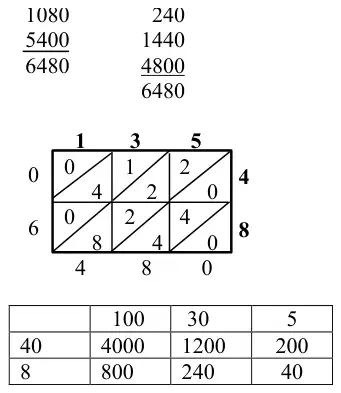
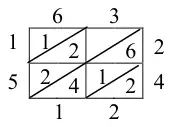
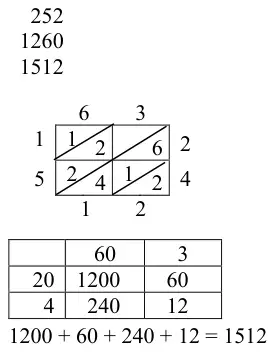
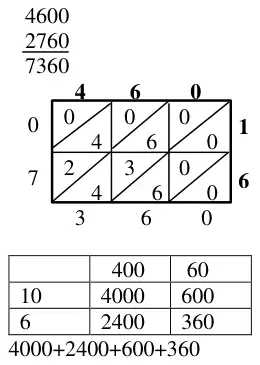
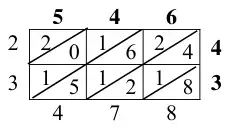
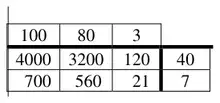
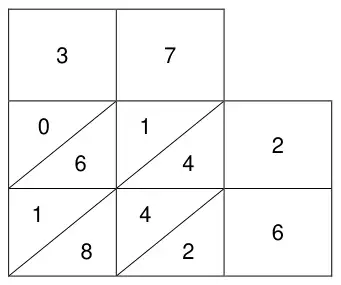
for a complete method with relative place value correct including an intention to add all the appropriate elements of the calculation or for a complete method to find 35% of 48 or 0.48 and add this on eg \(48 \div 10\ (= 4.8)\) and \(\text{``}4.8\text{''} \div 2\ (= 2.4)\) and \(48 + 3 \times \text{``}4.8\text{''} + \text{``}2.4\text{''}\)
A1
for digits 648
A1
ft (dep on M1) for correct placement of the decimal point into their final answer
8 Nina orders some items from a DIY shop. Here is her bill.
Item
Quantity
Cost of each item
Total
Pack of screws
4
£29.99
£119.96
Tin of paint
2
£24.95
£ ..........
Wooden plank
..........
£7.75
£232.50
Delivery charge
£14.95
Total cost
£ ..........
(a) Complete all the missing information in the bill. (3)
At the beginning of January, Jeff had £892.48 in his bank account.
During January, Jeff had £4.47 interest added to his account paid £240 into his account spent £365.50 from his account.
(b) How much money did Jeff have in his account at the end of January? (3)
Mark scheme (a)
Answer
Mark
Mark scheme
49.9(0)
B1
for 49.9(0)
30
B1
for 30
417.31
B1
for 417.31, ft allow 367.41 + [their 49.9(0)] for this mark
Additional guidance
To award B1ft, the total for tin of paint must not be blank or 0
Mark scheme (b)
Answer
Mark
Mark scheme
771.45
M1
for a correct first step, eg \(892.48 + 4.47\ (= 896.95)\) or \(892.48 + 240\ (= 1132.48)\) or \(892.48 - 365.5(0)\ (= 526.98)\) or \(4.47 + 240\ (= 244.47)\)
M1
for a complete method, eg \(892.48 + 4.47 + 240 - 365.5(0)\)
A1
cao
Additional guidance
May be seen embedded in other calculations eg \(4.47 + 240 - 365.5(0)\)
9 Anil has a job as a driver. He is paid for each mile he drives. He is also paid expenses.
One week Anil writes down the distance readings from his car.
Start of week:
4
7
2
4
1
miles
End of week:
4
7
8
7
9
miles
For this week, Anil is paid 47p for each mile he drives. He is also paid expenses of £80
Work out the total amount that Anil is paid. Give your answer in pounds. (4)
Mark scheme
Answer
Mark
Mark scheme
379.86
P1
for process to work with number of miles or cost, eg \(47879 - 47241\ (= 638)\) or \(47879 \times 47\ (= 2250313)\) or \(47241 \times 47\ (= 2220327)\) or [mileage] \(\times\, 47\)
P1
for process to work with miles and cost, eg \(\text{``}638\text{''} \times 47\ (= 29986)\) or \(\text{``}638\text{''} \times 0.47\ (= 299.86)\) or \(\text{``}2250313\text{''} - \text{``}2220327\text{''}\ (= 29986)\)
B1
(indep) for converting between pence and pounds, eg \(\text{``}29986\text{''} \div 100\) or \(47 \div 100\ (= 0.47)\) or \(80 \times 100\) OR miles divided by 100, eg \(\text{``}638\text{''} \div 100\ (= 6.38)\) or \(47879 \div 100\ (= 478.79)\) and \(47241 \div 100\ (= 472.41)\)
A1
for 379.86
Additional guidance
working may be seen in £ or pence throughout
[mileage] is any value they consider to be mileage
The cost of ski hire is £26 per day. The cost of a lift pass is £45 per day. The cost of ski lessons is £23.50 per hour.
Lucia will pay for
ski hire for 5 days a lift pass for 4 days ski lessons for 8 hours.
Lucia has £500
Show that Lucia has enough money to pay for the total cost of ski hire, the lift pass and the ski lessons. (3)
Mark scheme
Answer
Mark
Mark scheme
Shown
P1
for a start to process of finding the total cost, eg \(5 \times 26\ (= 130)\) or \(4 \times 45\ (= 180)\) or \(8 \times 23.50\ (= 188)\) or \(26 + 45 + 23.50\ (= 94.5(0))\) or for a start to process of finding money left after paying costs, eg \(500 - 26\ (= 474)\) or \(500 - 45\ (= 455)\) or \(500 - 23.50\ (= 476.5(0))\) or \(500 - 5 \times 26\ (= 370)\) or \(500 - 4 \times 45\ (= 320)\) or \(500 - 8 \times 23.50\ (= 312)\)
Chloe has a large number of hair bands. Each hair band costs 8p.
She buys 100 g of wool for £3
Chloe uses 1 hair band and 5 g of wool to make each scrunchy. She makes as many scrunchies as she can.
Work out the total cost of each scrunchy that she makes. Give your answer in pence. (4)
Mark scheme
Answer
Mark
Mark scheme
23
P1
for finding the number of scrunchies possible eg \(100 \div 5\ (= 20)\) or the cost of 1 g of wool eg \(300 \div 100\ (= 3)\)
P1
for working out the cost of wool per scrunchie eg \(3 \div \text{``}20\text{''}\ (= 0.15)\) or \(300 \div \text{``}20\text{''}\ (= 15)\) or \(\text{``}3\text{''} \times 5\ (= 15)\) or the cost of all hair bands eg \(\text{``}20\text{''} \times 8\ (= 160)\) or \(\text{``}20\text{''} \times 0.08\ (= 1.6(0))\)
P1
for complete process eg \((\text{``}0.15\text{''} + 0.08) \times 100\) or \(\text{``}15\text{''} + 8\) or \((300 + \text{``}160\text{''}) \div \text{``}20\text{''}\) or \((3 + \text{``}1.6(0)\text{''}) \div \text{``}20\text{''} \times 100\)
A1
accept £0.23
Additional guidance
P1 (cost of wool per scrunchie): award of this mark implies the previous mark 460 implies P2
The cans are sold in packs. There are 12 cans in each pack. Each pack costs £3
(a) Work out the total cost of the cola Asha buys. (3)
Ethan buys a box of 24 cans of lemonade for £7 There are 330 ml of lemonade in each can.
(b) Work out the cost of 100 ml of lemonade. Give your answer correct to the nearest penny. (3)
Mark scheme (a)
Answer
Mark
Mark scheme
45
P1
for a valid start to the process, eg \(180 \div 12\ (= 15)\) or \(3(.00) \div 12\ (= 0.25)\)
P1
for complete process, eg \(\text{``}15\text{''} \times 3(.00)\) or \(180 \times \text{``}0.25\text{''}\)
A1
for 45(.00)
Additional guidance
Calculations can be in £ or p or a combination for both process marks
Mark scheme (b)
Answer
Mark
Mark scheme
9
P1
for a valid start to the process, eg cost of each can, eg \(7(.00) \div 24\ (= 0.2916...)\) or \(700 \div 24\ (= 29.16...)\) or total volume of 24 cans, eg \(330 \times 24\ (= 7920)\) or proportion of ml, eg \(330 \div 100\ (= 3.3)\)
P1
for complete process, eg \(\dfrac{100}{330} \times \text{``}0.2916...\text{''}\ (= 0.08838...)\) or \(\dfrac{100}{330} \times \text{``}29.16...\text{''}\ (= 8.838...)\) or \(\dfrac{100}{\text{``}7920\text{''}} \times 7(.00)\ (= 0.08838...)\) or \(7(.00) \div 24 \div \dfrac{330}{100}\ (= 0.08838...)\) or \(7(.00) \div \dfrac{\text{``}7920\text{''}}{100}\ (= 0.08838...)\)
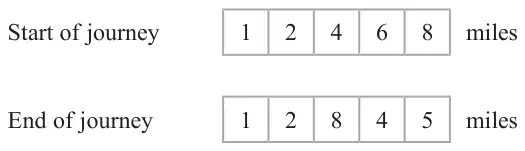
7 Myles writes down the distance readings from his car at the start and end of a journey.
Myles knows that the cost of petrol for this journey is 13p per mile.
Work out the total cost of the petrol used for this journey. Give your answer in pounds. (4)
Mark scheme
Answer
Mark
Mark scheme
49.01
P1
for process to work with the number of miles, eg \(12845 - 12468\ (= 377)\) or \(12845 \times 13\ (= 166985)\) or \(12468 \times 13\ (= 162084)\)
P1
for process to find the cost, eg \(\text{``}377\text{''} \times 13\ (= 4901)\) or \(\text{``}166985\text{''} - \text{``}162084\text{''}\ (= 4901)\)
B1
(indep) for converting from pence to pounds, eg \(\text{``}4901\text{''} \div 100\) or \(13 \div 100\) or miles divided by 100 eg \(\text{``}377\text{''} \div 100\ (= 3.77)\) or \(12845 \div 100\ (= 128.45)\) and \(12468 \div 100\ (= 124.68)\)
A1
49 or 49.01
Additional guidance
The B1 mark can be awarded at any stage in the process
6 Fay is planning a trip to a theme park for 1 adult and 2 children.
These are the costs for the trip.
Total cost of petrol
£23
Tickets to theme park
£33 each adult £24.50 each child
Meals
£15 each adult £10 each child
Fay has £200 to spend. She pays all the costs.
How much money does she have left? (4)
Mark scheme
Answer
Mark
Mark scheme
60
P3
for complete process to find the total costings eg \(23 + 33 + 24.5(0) + 24.5(0) + 15 + 10 + 10\ (= 140)\) or for a complete process to find the total money left, eg. \(200 - 23 - 33 - 24.5(0) - 24.5(0) - 15 - 10 - 10\ (= 60)\), condone one error, eg one omission or one additional cost
(P2
for process to find the total cost of all theme park tickets, eg \(33 + 2 \times 24.5(0)\ (= 33 + 49 = 82)\) or for process to find the total cost of all meals, eg \(15 + 2 \times 10\ (= 15 + 20 = 35)\) or for process to find the total cost for the children, eg \(2 \times 24.5(0) + 2 \times 10\ (= 49 + 20 = 69)\) or for process to find total costs with just one child, eg \(23 + 33 + 24.5(0) + 15 + 10\ (= 105.5(0))\))
(P1
for a start to a correct process, considering at least 2 costs eg \(33 + 24.5(0)\ (= 57.5(0))\) or \(2 \times 24.5(0)\ (= 49)\) or for start to a process to find money left, eg \(200 - 23\ (= 177)\) or \(200 - 33\ (= 167)\))
A1
cao
Additional guidance
All processes may be seen as part of subtractions to find money left
Additions may include other elements for process marks, eg. \(23 + 33 + 2 \times 24.5(0)\)
11 At the end of October, Fiona’s electricity meter reads 88 738 kWh. At the end of November, her electricity meter reads 89 198 kWh.
Each kWh of electricity Fiona uses costs 16p
Work out how much Fiona had to pay for the electricity she used in November. (4)
Mark scheme
Answer
Mark
Mark scheme
£73.60 or 7360p
M1
for \(89198 - 88738\ (= 460)\) OR for showing \(89198 \times 16\) or \(88738 \times 16\) OR for showing \((89198 + 88738) \times 16\)
M1
for showing \(\text{``}460\text{''} \times 16\) OR for showing \(89198 \times 16 - 88738 \times 16\)
M1
(dep on M1) for a complete method of multiplication with relative place value correct including an intention to add all the appropriate elements of the calculation eg, 2 lines of the 1st method, internal numbers of grids, or complete structure shown of partitioning methods.
A1
for £73.6(0) or 7360p SC B3 for an answer with digits 736 with incorrect or missing units
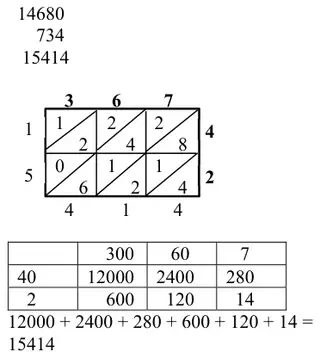
for a complete method with relative place value correct including an intention to add all the appropriate elements of the calculation eg, 2 lines of the 1st method, internal numbers of grids, or complete structure shown of partitioning methods.
A1
for digits 15414
A1
(ft) dep on M1 for correct placement of the decimal point into their final answer
Additional guidance
Mark scheme (b)
Answer
Mark
Mark scheme
37.4
M1
for a start to a method, eg \(598.4 \div 16\) (or \(59.84 \div 1.6\)) = 3 (as a first digit)
A1
for digits 374
A1
(ft) dep on M1 for correct placement of the decimal point into their final answer
Additional guidance
A start to a repeated subtraction method or build-up method is acceptable if a correct first digit of 3 is found
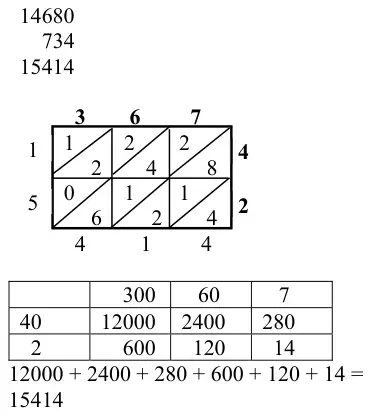
for a complete method with relative place value correct including intention to add all the appropriate elements of the calculation eg 2 lines of the 1st method, internal numbers of grids, or complete structure shown of partitioning methods.
A1
for digits 15414
A1
(ft) dep on M1 for correct placement of the decimal point into their final answer
Additional guidance
Mark scheme (b)
Answer
Mark
Mark scheme
37.4
M1
for a start to a method, eg \(598.4 \div 16\) (or \(59.84 \div 1.6\)) = 3 (as a first digit)
A1
for digits 374
A1
(ft) dep on M1 for correct placement of the decimal point into their final answer
Additional guidance
A start to a repeated subtraction method or build-up method is acceptable if a correct first digit of 3 is found
6 There are 14 rows of seats in a cinema. There are 15 seats in each row.
A film was shown in the cinema on Saturday. Each ticket for the film cost £6.50
The tickets that were sold cost a total of £1274
How many tickets were not sold? (3)
Mark scheme
Answer
Mark
Mark scheme
14
P1
for making a start to the process eg \(14 \times 15\ (= 210)\) or \(14 \times 15 \times 6.50\ (= 1365)\) or \(1274 \div 6.50\ (= 196)\) or \(14 \times 15 \times 6.50 - 1274\ (= 91)\)
P1
for a complete process eg \((14 \times 15 \times 6.50 - 1274) \div 6.50\) or \(14 \times 15 - (1274 \div 6.50)\)
11 The table shows the costs of sending a parcel by the Express service and by the Rapid service.
Type of service
Cost
Express
£15.25
Rapid
£35.38
Brendan has to send 12 parcels. It will be cheaper to send the parcels by the Express service than by the Rapid service.
(a) How much cheaper? (3)
Luke wants to send 21 parcels by the Express service.
He does the calculation 20 × £15 = £300 to estimate the cost.
(b) Explain why Luke’s calculation shows the actual cost will be more than £300 (1)
Mark scheme (a)
Answer
Mark
Mark scheme
241.56
P1
for difference for 1 parcel eg \(35.38 - 15.25\ (= 20.13)\) OR for total cost for 12 parcels by either service eg \(35.38 \times 12\ (= 424.56)\) or \(15.25 \times 12\ (= 183)\)
P1
for a complete process eg \(\text{``}20.13\text{''} \times 12\) or \(\text{``}424.56\text{''} - \text{``}183\text{''}\)
A1
cao
Mark scheme (b)
Answer
Mark
Mark scheme
Explanation
C1
for explanation Acceptable examples both figures rounded down (refers to both figures) 20 is less than 21 and 15 is less than 15.25 Not acceptable examples both figures rounded (up); rounded down either 20 is less than 21 or 15 is less than 15.25 (refers to just one figure) the cost is 320.25 (more than 300); multiplying with bigger numbers
6 Dave goes into a cafe and buys 2 cups of coffee and a piece of cake.
Each cup of coffee costs £2.75 The cake costs £2.90
Dave pays with a £10 note.
He thinks he will get more than £1.50 in change.
Is Dave correct? You must show how you get your answer. (3)
Mark scheme
Answer
Mark
Mark scheme
Yes and statement
P1
for a first step towards solution, eg. \(2 \times 2.75\ (= 5.5)\) or \(2.75 + 2.9\ (= 5.65)\) OR \(10 - 1.5\ (= 8.5)\) or \(10 - 2.9\ (= 7.1)\) or \(10 - 2.75\ (= 7.25)\)
P1
for a complete process to find figures to compare eg. \(2 \times 2.75 + 2.9 + 1.5\ (= 9.90)\) or \(10 - (2 \times 2.75 + 2.9)\ (=1.60)\) OR \(2 \times 2.75 + 2.9\ (=8.40)\) and \(10 - 1.5\ (= 8.5)\)
C1
for correct conclusion with accurate figure(s) eg. Yes and (£)1.6(0) or Yes and (£)9.9(0) or Yes and (£)8.4(0) and (£)8.5(0)
8 Neil buys 30 pens, 30 pencils, 30 rulers and 30 pencil cases.
Price list
pens
6 for 82p
pencils
15 for 45p
rulers
10 for £1.25
pencil cases
37p each
What is the total amount of money Neil spends? (5)
Mark scheme
Answer
Mark
Mark scheme
19.85
P1
for a start to the process eg \(30 \div 6\) (=5) or \(30 \div 15\) (=2) or \(30 \div 10\) (=3) OR \(30 \times 37\) (=1110) OR \(82 \div 6\) (=13.6 to 13.7) or \(45 \div 15\) (=3) or \(1.25 \div 10\) (=0.125)
P1
for process to find cost of 30 pens or 30 pencils or 30 rulers eg \(\text{``}5\text{''} \times 82\ (= 410)\) or \(\text{``}2\text{''} \times 45\ (= 90)\) or \(\text{``}3\text{''} \times 1.25\ (= 3.75)\) OR \(\text{``}13.6..\text{''} \times 30\) (=409.8 to 410) or \(\text{``}3\text{''} \times 30\) (=90) or \(\text{``}0.125\text{''} \times 30\) (=3.75)
P1
for a process to find cost of 2 of 30 pens or 30 pencils or 30 rulers eg any 2 of \(\text{``}5\text{''} \times 82\ (= 410)\), \(\text{``}2\text{''} \times 45\ (= 90)\), \(\text{``}3\text{''} \times 1.25\ (= 3.75)\)
P1
for adding at least 3 different costs (units may not be consistent) eg \(\text{``}410\text{''} + \text{``}90\text{''} + \text{``}3.75\text{''}\) or \(\text{``}410\text{''} + \text{``}90\text{''} + \text{``}11.10\text{''}\)
A1
cao
Additional guidance
Work may be in pence or in pounds
Intention to add not necessary eg 410, 3.75 is sufficient, or working leading to these figures Any two correct methods will imply P1P1P1
Correct working for 3 of pens, pencils, rulers and pencil cases with an intention to add, may be in a mixture of money units
for answer in correct notation with correct units, eg. 90p or £0.90 (accept £0.90p and £0.9) [SC: B1 for an answer of £2.90]
Mark scheme (b)
Answer
Mark
Notes
8.27pm
M1
for using 60 mins = 1 hour in the conversion of 102 minutes, eg. 1 h 42 mins or 1.42 or 1.7 or \((60 + 42)\) mins or \(102 - 60\) or \(102 \div 60\) or for an answer of 8.27am or 08.27
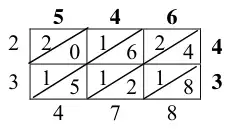
for complete method with relative place value correct including addition of all the appropriate elements of the calculation e.g. two lines of 1st method, internal numbers of grids, or complete structure shown of partitioning methods
A1
for digits 23478
A1
(ft dep M1) for correct placement of the decimal point into their final answer
2 packets of bread rolls costing £1.50 for each packet 1 bottle of ketchup costing £1.60 3 packets of sausages
Fahima pays with a £10 note. She gets 30p change.
Fahima works out that one packet of sausages costs £2.30
Is Fahima right? You must show how you get your answer. (3)
Mark scheme
Answer
Mark
Notes
No (supported)
P1
process to work with either cost of 3 sausages e.g. \(3 \times 2.30\ (=6.9(0))\) or division of a cost by 3
P1
process to work with costs of at least 3 of bread rolls, bread rolls, ketchup, change, sausages e.g. \(2 \times 1.50 + 1.60\) or \(1.50 + 1.60 + 0.30\), or \(10 - 1.50 - 1.60 - 0.30\) or \(10 - 1.50 - 1.50 - 1.60\)
C1
E.g. No and (£)5.10 and (£)6.90 No and (£)5.40 and (£)6.90 No and (£)1.70 No and (£)11.50 or (£)11.80 or shows cost of sausages at £2.30 and cost of any 2 other items is greater than (or equal to) £10 NB can work in £ or p throughout. Condone 5.1 etc
for complete method with relative place value correct including addition of all the appropriate elements of the calculation e.g. two lines of 1st method, internal numbers of grids, or complete structure shown of partitioning methods
A1
for digits 23478
A1
(ft dep M1) for correct placement of the decimal point into their final answer
*4 Mr and Mrs Shankara and their 3 children go on a train journey.
Mr Shankara pays for 2 adult tickets and 3 child tickets. The price of an adult ticket is £8.40 The price of a child ticket is half the price of an adult ticket.
Mr Shankara pays for the tickets with 3 ten pound notes.
Work out how much change he should get. (4)
Mark scheme
Answer
Mark
Notes
60p
4
M1 for price of child ticket e.g. \(8.40 \div 2\) (= 4.20) M1 for a method to work out the total cost of the 2 adults e.g. \(2 \times 8.40\) (= 16.80) or of the 3 children e.g. \(\text{``}4.20\text{''} \times 3\) (= 12.60) or of the whole family e.g. \(2 \times 8.40 + 3 \times \text{``}4.20\text{''}\) (= 29.40) M1 for a complete method to work out the change e.g. \(3 \times £10 - \text{``}29.40\text{''}\) = (0.60) or \(3 \times £10 - (2 \times 8.40 + 3 \times \text{``}4.20\text{''})\) (= 0.60) C1 for change with correct money notation 60p or £0.60 (accept £0.60p)
NB candidates may work in pence rather than pounds
Sue worked for 18 days last month. She bought a day return ticket each day she worked.
A monthly saver ticket is cheaper than 18 day return tickets. How much cheaper? (4)
Mark scheme
Answer
Mark
Notes
17.6(0)
4
M1 \(18 \times 6.45\) (= 116.1(0)) or \(18 \times 645\) (= 11610) M1 for \(18 \times 6.45 - 98.50\) in the correct order but units may not be consistent A1 for digits 1760 A1 ft (dep on M2) for correct placement of decimal point after subtraction (of appropriate values)
7 Paula has £10 to spend on music downloads. Each music download costs 84p. Paula buys as many music downloads as possible.
Work out how much money Paula has left. (3)
Mark scheme
Answer
Mark
Notes
76p
3
M1 for \(1000 \div 84\) or \(10 \div 0.84\) (= 11.90…) or \(11 \times 84\) (= 924) or \(11 \times 0.84\) (= 9.24) or 11 given as the answer. M1 for complete method to find the change (showing figures in compatible units) or 76 as the answer no/incorrect units. A1 for 76p or £0.76 or £0.76p
M1 for \(7 \times 30\) (= 210) or \(3 \times 45\) (= 135) M1 (dep on previous M1) for £5 – their total of \(7 \times 30\) and \(3 \times 45\) or digits 155 seen A1 for 1.55 cao
Sue worked for 18 days last month. She bought a day return ticket each day she worked.
A monthly saver ticket is cheaper than 18 day return tickets. How much cheaper? (4)
Mark scheme
Answer
Mark
Notes
17.6(0)
4
M1 \(18 \times 6.45\) (= 116.1(0)) or \(18 \times 645\) = (11610) M1 for \(18 \times 6.45 - 98.50\) in the correct order but units may not be consistent A1 for digits 1760 A1 (dep on M2) for correct placement of decimal point after subtraction (of appropriate values)
M1 for a complete method to find the cost for one company M1 for a complete method to find the cost for both companies and finding the difference A1 cao
OR M1 for a complete method to find the differences in cost for calls or texts M1 for a complete method to find the amount saved and finding the sum A1 cao
(a) Complete the shopping bill by writing in the missing costs. (3)
Pat wants to buy a book. The book costs £5.50
Pat has a voucher for £1.70 She also has 3 pound coins and 3 twenty pence coins. She wants to buy the book with the voucher and the coins.
(b) Is this enough for Pat to buy the book? You must show all your working. (3)
Mark scheme (a)
Answer
Mark
Notes
£1.11 and £2.68
3
B1 for (£)1.11 or 111(p) B1 for (£)2.68 or 268(p) or ft from “£1.11” B1 for correct units
Mark scheme (b)
Answer
Mark
Notes
No (from correct calculations)
3
M1 for finding the value of the coins M1 for a complete method to find the total value of the voucher and coins A1 correct conclusion from correct calculations, eg No, she only has £5.30
Or
M1 for finding the difference between the price of the book and the voucher or the price of the book and the coins M1 for a complete method to find the difference between the book and the voucher AND the coins A1 correct conclusion from correct calculations, eg No, she is 20p short
Work out how much Dani has to pay for the units of electricity she has used. (4)
Mark scheme
Answer
Mark
Notes
£52.74 or 5274p
4
M1 for subtracting to find the units used (= 293) M1 for \(\text{‘}293\text{’} \times 18\) or \(\text{‘}293\text{’} \times 0.18\) A1 for 52.74 or 5274 C1 (dep M2) for identifying their answer with the correct monetary units
OR
M1 for \(2968 \times 18\) (= 53424) or \(2675 \times 18\) (= 48150) or \(2968 \times 0.18\) (= 534.24) or \(2675 \times 0.18\) (= 481.50) M1 for subtracting their two costs (consistent in pence or pounds) A1 for 52.74 or 5274 C1 (dep M2) for identifying their answer with the correct monetary units
9 Here is information about the cost of sending a parcel to Europe by Parcel Link.
Next day delivery
£19.00 plus 70p for each kg more than 5 kg
3 day delivery
£16.00 plus 50p for each kg more than 5 kg
Kate is going to send a parcel to Europe by Parcel Link. The parcel weighs 12 kg.
Kate can send the parcel using next day delivery or using 3 day delivery.
(a) Work out the difference in the two costs. (3)
Adam sends a parcel to Europe by Parcel Link. He uses 3 day delivery. The cost is £25
(b) Work out how many kilograms Adam’s parcel weighs. (3)
Mark scheme (a)
Answer
Mark
Notes
4.40
3
M1 for a method to find the cost for one delivery method eg \(19 + 7 \times 0.7(0)\) (= 23.9(0)) or \(16 + 7 \times 0.5(0)\) (= 19.5(0)) M1 for a method to find the cost for both delivery methods and attempting to subtract eg \(23.90 - 19.50\) A1 cao Accept 4.4
OR
M1 for method to find the difference between the two delivery costs eg \(19 - 16\) (= 3) and \(70 - 50\) (= 20) M1 for a method to find the “cost” using the differences eg \(\text{``}3\text{''} + 7 \times \text{``}20\text{''}\) A1 cao Accept 4.4
Mark scheme (b)
Answer
Mark
Notes
23
3
M1 for \(25 - 16\) (= 9) M1 for a method to divide “9” by 0.50 (= 18) A1 cao
OR
M1 for starting with 16 and a method to add on 0.50s M1 for starting with 16 and adding on 0.50s to within 0.50 of 25 A1 cao
11 Susan and Joe are going on holiday. They can take two cases onto the plane free of charge if the total weight of the two cases is no more than 40 kg.
Susan’s case has a weight of 22.8 kg. Joe’s case has a weight of 19.5 kg.
(*a) Can they take their two cases onto the plane free of charge? (2)
Susan and Joe want to be at the airport terminal at 14 30
It will take 1 hour and 20 minutes to drive from home to the airport. It will then take a total of 30 minutes to park the car and go into the airport terminal.
(b) What is the latest time they can leave home? (3)
Mark scheme (a)
Answer
Mark
Notes
No with working
2
M1 for \(19.5 + 22.8\) (= 42.3) or \(40 - 19.5 - 22.8\) (= \(-2.3\)) or \(22 + 19\) (= 41) C1 for statement with No and 42.3 or ±2.3 or 41 seen
Mark scheme (b)
Answer
Mark
Notes
12 40
3
M1 for correct start eg. addition of two times or subtraction of one time from 1430 M1 for a complete method A1 for 12 40 (pm)
M1 for correct method to find total cost of chairs (and table) for at least one shop M1 for correct method to find total cost of chairs (and table) for at least two shops A1 for 3 comparable totals (eg. chairs £200, £192, £210 or table and chairs £320, £312, £330) C1 (dep on M1) ft for correct statement with shop name from comparable figures
Leah has some lessons with Stan’s Driving School. The total cost of the lessons is £305.50
(b) Work out how many lessons Leah has. (3)
Mark scheme (a)
Answer
Mark
Notes
85.50
2
M1 for \(2 \times 12.75 + 3 \times 20\) or \(12.75 + 3 \times 20\) (= 72.75) A1 for 85.5(0)
Mark scheme (b)
Answer
Mark
Notes
16
3
M1 (ft from (a)) for subtracting cost of 1 or 2 or 5 lessons from 305.50 \(305.50 - \text{“}2 \times 12.75\text{”}\) (= 280) or \(305.50 - \text{“}85.50\text{”}\) (= 220) or \(305.50 - 12.75\) (= 292.75) M1 for \(\text{``}280\text{''} \div 20\) (= 14) or \(\text{``}220\text{''} \div 20\) (= 11) or \(292.75 \div 20\) A1 cao
OR
M1 for adding 20s to cost of 1 or 2 or 5 lessons eg 12.75 or “2×12.75” or “85.50” and intention to add on 20s or \(14 \times 20\) or \(11 \times 20\) M1 for “2×12.75” or “85.50” and adding 20s to within 20 of 305.50 A1 cao
2 fish and chips at £9.25 each 1 chicken and chips at £9.50 1 roast lamb at £10.55 4 puddings at £4.55 each.
Edwin pays for the meals with three £20 notes.
How much change should Edwin get? (3)
Mark scheme
Answer
Mark
Notes
3.25
3
M1 for 2 × 9.25 + 9.50 + 10.55 + 4 × 4.55 (= 56.75) or at least one of each item added M1(dep) for 3 × 20 − “56.75” A1 cao (SC B2 for answer 26.15) (SC B1 for answer of 13.85 or 36.75)
M1 for adding at least 3 of 1.25, 1.15, 85, 85 A1 for 4.1(0) or 410 C1 ft (dep on M1) for correct statement comparing £4 and their total (units must be given and correct) or for correct statement referring to difference eg. 10p short (units must be given and correct) OR M1 for finding at least one difference between coins and costs eg 2 – 0.85 – 0.85 or 1.15 – 1 or 1.25 – 1 A1 for 0.10 or 10 C1 ft (dep on M1) for correct statement referring to total difference units (must be given and correct) (SC : B1 for correct figures with no working eg. £4.10 and £4 or 10p)
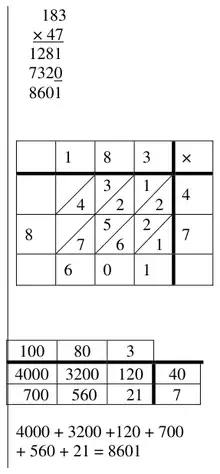
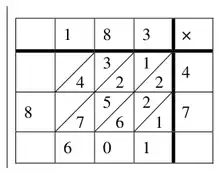
M1 for a complete method to multiply 183 by 47 (condone one multiplication error) A1 for digits 8601 given as the answer B1 (dep on M1) for correctly writing their answer to 2 decimal places
7 Mrs Clark shares £20 between Sally, Bethan, Robert and Tom.
Mrs Clark gives £6.65 to Sally. She shares the rest of the money equally between Bethan, Robert and Tom.
How much money does Mrs Clark give to Bethan? (3)
Mark scheme
Working
Answer
Mark
Notes
\(20 - 6.65\) \(13.35 \div 3\)
4.45
3
M1 for a correct method to find the amount shared by B, R and T M1 (dep) for a correct method of dividing this amount by 3 A1 cao [SC: B1 for an answer of 17.78 (\(20 - 6.65 \div 3\)), if M0 scored, with or without working]
M1 for a complete method to multiply 183 by 47 and attempt at addition (condone one multiplication error) A1 for digits 8601 given as the answer B1 (dep on M1) for correctly writing their answer to 2 decimal places
*12 The table gives information about the costs of posting parcels.
Maximum weight of a parcel
Cost
2 kg
£4.41
4 kg
£7.06
6 kg
£9.58
8 kg
£11.74
10 kg
£12.61
20 kg
£14.69
Umar has to post some parcels.
He has to post 3 parcels with a weight of 6 kg each 1 parcel with a weight of 10 kg 1 parcel with a weight of 3 kg 1 parcel with a weight of 1.2 kg
Umar has £55 to spend on posting the parcels.
Can he post all the parcels? (4)
Mark scheme
Working
Answer
Mark
Notes
\(3 \times 9.58 + 12.61 + 7.06 + 4.41\) (= 52.82)
Yes + working
4
M2 for \(3 \times 9.58\) (=28.74) \(+ 12.61 + 7.06 + 4.41\) or \(55 - 3 \times 9.58\) (=28.74) \(- 12.61 - 7.06 - 4.41\) (M1 for at least 2 correct costs seen) A1 for 52.82 or 2.18 C1 (dep M1) for comparison and correct deduction using their total cost or amount left
M2 for \((5 - 1.18 - 0.94 - 0.30) \div 2\) oe or digits 129 (M1 for \(1.18 + 0.94\) or 2.12 seen or \(1.18 + 0.94 + 0.30\) oe or 2.42 seen or \(5 - 1.18 - 0.94\) oe or 2.88 seen or \((5 - 1.18 - 0.94) \div 2\) or 1.44 seen or \(5 - 1.18 - 0.94 - 0.30\) oe or 2.58 seen ) A1 cao NOTE: Accept working in £ or pence
M1 for \(1000 \div 79\) or \(10 \div 0.79\) (=12.65…) or \(12 \times 79\) or \(12 \times 0.79\) A1 for 9.48 or 948 A1 for 52p or £0.52 or £0.52p (SC if M0 then B2 for 0.52, 0.52p or 52 as answer) (SC if M0 then B1 for 12 as answer)
(a) The square of a whole number is a two-digit number.
Work out
the smallest number that could have been squared and the largest number that could have been squared. [3 marks]
(b) Which has the larger value \(\quad 0.8^2 \quad\) or \(\quad 0.8^3\) ?
Tick a box.
\(0.8^2\)
\(0.8^3\)
Give a reason for your answer. [1 mark]
Mark scheme (a)
Answer
Mark
Comments
4 and 9 in correct positions
B3
B2 9 in smallest position and 4 in largest position or only 4 in correct position or only 9 in correct position or \(4^2\) in smallest position and \(9^2\) in largest position or 16 or \(\sqrt{16}\) in smallest position and 81 or \(\sqrt{81}\) in largest position B1 \(4^2\) or 16 or \(\sqrt{16}\) or \(9^2\) or 81 or \(\sqrt{81}\)
Additional guidance
\(4^2 = 16\) in smallest position and \(9^2 = 81\) in largest position
B2
16, 4 in smallest position and 81, 9 in largest position
B2
\(2^2 = 4\) in smallest position is not 4 in smallest position \(3^2 = 9\) in largest position is not 9 in largest position
Mark scheme (b)
Answer
Mark
Comments
\(0.8^2\) ticked with either 0.64 and 0.512 or \(\dfrac{64}{100}\) and \(\dfrac{64}{125}\) or \(0.8 \lt 1\) or suitable worded reason
B1
oe in comparable form fractions must have same numerator or same denominator eg multiplying by decimals below 1 makes numbers smaller
Additional guidance
Ignore further work after correct values in comparable form
Condone 0.51 for 0.512
\(\dfrac{16}{25}\) and \(\dfrac{64}{125}\) (fractions do not have same numerator or denominator)
B0
\(0.8^2\) ticked and squaring makes numbers bigger
\(1.5 \times 1.5\) or \(\left(\dfrac{3}{2}\right)^2\)
M1
oe oe improper fraction squared
2.25 or \(\dfrac{9}{4}\) or \(2\dfrac{1}{4}\)
A1
oe decimal, improper fraction or mixed number SC1 answer digits 225
Additional guidance
Ignore attempt to simplify or convert if correct fraction seen
Do not allow further work but condone adjusting place value eg \(1.5 \times 1.5 = 2.25\), \(2.25 \div 100 = 0.0225\) (adjusting place value) eg \(1.5 \times 1.5 = 2.25\), \(2.25 \times 1.5\) (cubing not squaring)
Work out the greatest number of notepads he can buy. [2 marks]
Mark scheme
Answer
Mark
Comments
\(20 \div 1.3(0)\) or [15.3, 15.4] or 19.5(0)
M1
oe
15 with no incorrect working
A1
Additional guidance
\(15 \times 1.30 = 19.05\) with answer 15 (incorrect working)
M1A0
\(15 \times 1.30\) without answer 15
M1A0
For build up method allow one error but must get above £18.70 eg1 13 14.30 15.60 17 18.30 19.60 and answer of 15 eg2 13 15.30 16.60 17.90 19.20 For build down method allow one error but must get below £1.30 eg3 20 18.70 17.40 16.10 14.60 \(\ldots\) 5.50 4.20 2.90 1.60 0.30
Accept correct conversions to equivalent fractions or decimals eg 0.25, \(\dfrac{4}{8}\), \(\dfrac{7}{8}\), \(3\dfrac{1}{10}\)
B2
Do not accept any incorrect working or incorrect conversions for B2 eg1 \(\dfrac{1}{4}\), \(\dfrac{1}{2}\), \(\dfrac{7}{8}\), \(3\dfrac{1}{10}\) with 3.01 seen in working eg2 \(\dfrac{1}{4}\), \(\dfrac{1}{2}\), \(\dfrac{7}{8}\), 3.01
B1 B1
Condone any incorrect working or incorrect conversions for B1 eg \(\dfrac{1}{4}\), 0.3, \(\dfrac{1}{2}\), \(\dfrac{7}{8}\)
B1
Condone correct percentage value without percentage sign for B2 eg \(\dfrac{1}{2} = 50\) is condoned as not incorrect working
\(1.5 \times 1.5\) or \(\left(\dfrac{3}{2}\right)^2\)
M1
oe oe improper fraction squared
2.25 or \(\dfrac{9}{4}\) or \(2\dfrac{1}{4}\)
A1
oe decimal, improper fraction or mixed number SC1 answer digits 225
Additional guidance
Ignore attempt to simplify or convert if correct fraction seen
Do not allow further work, but condone adjusting place value eg \(1.5 \times 1.5 = 2.25\), \(2.25 \div 100 = 0.0225\) (adjusting place value) eg \(1.5 \times 1.5 = 2.25\), \(2.25 \times 1.5\) (cubing not squaring)
\(1.7 \times 0.9\) or 1.53 or \(1.7 \times 6\) or 10.2
M1
oe eg \(1.7 - 0.1 \times 1.7\)
\(1.7 \times 0.9 \times 6\) or 9.18
M1dep
oe eg \(10.2 - 0.1 \times 10.2\) dep on 2nd M1
their \(9.18 + 2 \times 0.62\) or 10.42
M1
oe their 9.18 must be 6 times their pack price
Shop A Cheaper by £0.82
A1
oe eg Shop A Cheaper by 82p
Additional guidance
Accept working in pounds or pence
Mixed units in the 4th M1 mark must be recovered with a correct value for their calculation 960 and \(9.18 + 2 \times 62\) 960 and \(9.18 + 2 \times 62\) and 10.42
M1M1M1M0 M1M1M1M1
\(10.20 + 2 \times 0.62\) or 11.44 score the 2nd and 4th M1 mark
\(4095 + 63\) or \(4221 - 63\) or \((4095 + 4221) \div 2\) or \(8316 \div 2\) or Valid attempt to multiply 63 by 66 with no conceptual error
M1
oe from traditional method their \(378 +\) their 3780 or their \(198 +\) their 3960 with at least one correct and placeholder of zero correct or implied
from grid method their \(3600 +\) their \(360 +\) their \(180 +\) their 18 (at least three correct)
from Chinese / Napier’s bones method at least three values correct from 1/8, 1/8, 3/6 and 3/6 and total calculated for each diagonal with at least one carrying figure placed correctly
their \(15 \times 0.4(0) + 3 \times 1.35\) or \(6(.00) + 4.05\)
M1dep
oe working in pence their 15 can be a truncated or rounded up decimal
10.05
A1
SC2 6.05
Alternative method 3
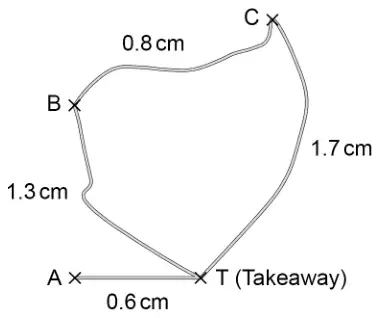
\(0.6 \times 3\) or 1.8 or \(1.2 \times 3\) or 3.6 or \(1.3 \times 3\) or 3.9 or \(0.8 \times 3\) or 2.4 or \(1.7 \times 3\) or 5.1
M1
\(0.6 \times 3 \times 0.4\) or 0.72 or \(1.2 \times 3 \times 0.4\) or 1.44 or \(1.3 \times 3 \times 0.4\) or 1.56 or \(0.8 \times 3 \times 0.4\) or 0.96 or \(1.7 \times 3 \times 0.4\) or 2.04
oe working in pence condone one missing or incorrect distance
10.05
A1
SC2 6.05
Additional guidance
Units must be consistent unless recovered
All correct except for missing the return distance from A eg \(0.6 + 1.3 + 0.8 + 1.7\) or 4.4 \(4.4 \times 3 = 13.2\) \(13.2 \times 0.4 + 3 \times 1.35 = 9.33\)
M1M1M1A0
Example using their 15 truncated or rounded up for each mile \(0.6 + 1.3 + 0.8 + 1.7\) or 4.4 \(4.4 \times 3 = 13.2\) \(13 \times 0.4 + 3 \times 1.35 = 9.25\) or \(14 \times 0.4 + 3 \times 1.35 = 9.65\)
M1M1M1A0
\(3.6 + 3.9 + 5.1\) (BC missing)
M1M1
\(3.9 + 2.4 + 5.1\) without further working (TA and AT missing)
25 hours at £10.20 per hour and extra hours at the weekend at £11.80 per hour.
Here are the extra hours he works at the weekend.
Saturday
7 am to 10 am
Sunday
1 pm to 3 pm
In total, how much is he paid this week? [4 marks]
Mark scheme
Answer
Mark
Comments
\(25 \times 10.2(0)\) or 255
M1
oe
\(10 - 7 + 3 - 1\) or \(3 + 2\) or 5 or \((10 - 7) \times 11.8(0)\) or \(3 \times 11.8(0)\) or 35.4(0) or \((3 - 1) \times 11.8(0)\) or \(2 \times 11.8(0)\) or 23.6(0)
M1
oe
their \(5 \times 11.8(0)\) or their \(35.4(0) +\) their 23.6(0) or 59
M1dep
oe dep on 2nd M their 35.4(0) and their 23.6(0) must both be from correct methods
(b) Work out \(\quad \dfrac{5}{6} \div 3\) [1 mark]
(c) Work out \(\quad 27 \div 0.6\) [1 mark]
Mark scheme (a)
Answer
Mark
Comments
(0).35
B1
oe
Additional guidance
Mark the answer line. If this is blank, mark the working
If values are given in one or more forms, either on the answer line or in working with nothing on the answer line, all values must be correct eg1 \(0.35 = \dfrac{7}{20}\) on answer line eg2 \(\dfrac{35}{100}\) and 3.5 in working with \(\dfrac{35}{100}\) on answer line eg3 \(\dfrac{35}{100}\) and 3.5 in working with 3.5 on answer line eg4 \(\dfrac{35}{100}\) and 3.5 in working with answer line blank
B1 B1 B0 B0
Mark scheme (b)
Answer
Mark
Comments
\(\dfrac{5}{18}\)
B1
oe eg \(\dfrac{10}{36}\)
Additional guidance
Mark the answer line. If this is blank, mark the working
Allow 0.277… (minimum two 7s and two dots) or correct notation for recurring decimals
If values are given in one or more forms, either on the answer line or in working with nothing on the answer line, all values must be correct eg1 \(\dfrac{5}{18} = 0.277\ldots\) on answer line eg2 \(\dfrac{5}{18}\) and 0.518 in working with answer line blank
B1 B0
\(\dfrac{1\frac{2}{3}}{6}\) or \(\dfrac{1.66\ldots}{6}\) without answer in correct form
B0
Mark scheme (c)
Answer
Mark
Comments
45
B1
Additional guidance
Mark the answer line. If this is blank, mark the working
If values are given in one or more forms, either on the answer line or in working with nothing on the answer line, all values must be correct eg1 \(\dfrac{270}{6} = 45\) on answer line eg2 \(\dfrac{270}{6}\) and \(44\dfrac{5}{6}\) in working with answer line blank
B1 B0
Do not allow unprocessed answers eg \(\dfrac{270}{6}\)
Using fractions, digits 962 may be seen as part of a fraction for first A1 For unsimplified fractions, follow appropriate MS for M marks For simplified fractions, please follow the spirit of each MS for M marks
Alt 1 If the 0 is missing or misaligned allow if units digit 2 in their answer for the first M1 If the 0 is missing allow 0 to be replaced by x for the first M1
Alt 2 If numbers are broken down further there can be only one error for the first M1 eg 20 10 7 and 20 6 needs five of 400, 120, 200, 60, 140, 42
Alt 3 Diagonals must slope consistently for M1 unless recovered Diagonals missing is M0 unless recovered
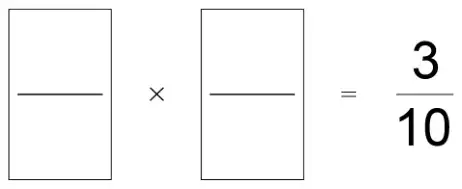
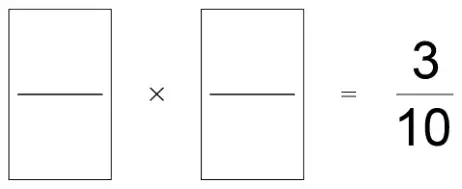
(a) In each box, write a fraction less than 1 to make a correct calculation. [1 mark]
(b) In each box, write a decimal less than 1 to make a correct calculation. [1 mark]
Mark scheme (a)
Answer
Mark
Comments
Two fractions less than 1 with product \(\dfrac{3}{10}\)
B1
eg \(\dfrac{3}{5}\) and \(\dfrac{1}{2}\) or \(\dfrac{6}{10}\) and \(\dfrac{5}{10}\) either order
Additional guidance
Accept negatives if each processed fraction is less than 1 eg \(-\dfrac{3}{2}\) and \(-\dfrac{1}{5}\) eg \(\dfrac{-1}{-2}\) and \(\dfrac{3}{5}\) eg \(\dfrac{-3}{-2}\) and \(\dfrac{1}{5}\)
B1 B1 B0
Do not accept decimals within the fractions eg \(\dfrac{0.6}{1}\) and \(\dfrac{0.5}{1}\)
B0
\(\dfrac{11}{10}\) and \(\dfrac{3}{11}\)
B0
\(\dfrac{3}{10}\) and \(\dfrac{1}{1}\)
B0
0.6 and 0.5
B0
Mark scheme (b)
Answer
Mark
Comments
Two decimals less than 1 with product 0.06
B1
eg 0.3 and 0.2 or 0.60 and 0.10 or 0.5 and 0.12 or 0.75 and 0.08 either order
Correct vertical method of long multiplication with at least one of 1450 and 7250 correct or Correct set up of grid method with at least three products correct or Correct set up of Gelosia method with at least three products correct or \(10 \times 725 = 7250\) and \(2 \times 725 = 1450\) attempted with at least one correct or \(12 \times 700 = 8400\) and \(12 \times 20 = 240\) and \(12 \times 5 = 60\) attempted with at least one correct
M1dep
oe allow a placeholder space to be present instead of a physical zero in vertical method
87(.00)
A1
SC2 103.8(0) or 146.4(0) or 169.2(0) or 190.8(0) or 256.2(0) or 250.2(0) or 315.6(0) SC1 \(8.65 \times 12\) or \(12.2(0) \times 12\) or \(14.1(0) \times 12\) or \(15.9(0) \times 12\) or \(21.35 \times 12\) or \(20.85 \times 12\) or \(26.3(0) \times 12\)
Additional guidance
Condone 87.0
M2A1
Accept answers in pence
Condone p after their final answer eg £87.00p
Method of repeated addition must have no more than one error. If broken down into groups, the one error made may be seen multiple times
(a) In each box, write a fraction less than 1 to make a correct calculation. [1 mark]
(b) In each box, write a decimal less than 1 to make a correct calculation. [1 mark]
Mark scheme (a)
Answer
Mark
Comments
Two fractions less than 1 with product \(\dfrac{3}{10}\)
B1
eg \(\dfrac{3}{5}\) and \(\dfrac{1}{2}\) or \(\dfrac{6}{10}\) and \(\dfrac{5}{10}\) either order
Additional guidance
Accept negatives if each processed fraction is less than 1 eg \(-\dfrac{3}{2}\) and \(-\dfrac{1}{5}\) eg \(\dfrac{-1}{-2}\) and \(\dfrac{3}{5}\) eg \(\dfrac{-3}{-2}\) and \(\dfrac{1}{5}\)
B1 B1 B0
Do not accept decimals within the fractions eg \(\dfrac{0.6}{1}\) and \(\dfrac{0.5}{1}\)
B0
\(\dfrac{11}{10}\) and \(\dfrac{3}{11}\)
B0
\(\dfrac{3}{10}\) and \(\dfrac{1}{1}\)
B0
0.6 and 0.5
B0
Mark scheme (b)
Answer
Mark
Comments
Two decimals less than 1 with product 0.06
B1
eg 0.3 and 0.2 or 0.60 and 0.10 or 0.5 and 0.12 or 0.75 and 0.08 either order
19 Work out which of these fractions is closer in value to 0.5
\(\dfrac{5}{16} \qquad\qquad \dfrac{17}{25}\)
You must show your working. [2 marks]
Mark scheme
Answer
Mark
Comments
Alternative method 1
0.31(25) or 0.68
M1
oe eg 31(.25)% or 68%
0.31(25) and 0.68 and \(\dfrac{17}{25}\)
A1
accept 0.68 as the answer with both values seen
Alternative method 2
Converts both fractions to a valid common denominator with at least one numerator correct
M1
eg \(\dfrac{125}{400}\) and \(\dfrac{272}{400}\) with one numerator correct
Two correct fractions with a common denominator and \(\dfrac{17}{25}\)
A1
accept \(\dfrac{272}{400}\) oe as the answer with both values seen
Alternative method 3
Gives differences from \(\dfrac{1}{2}\) in same form with at least one correct
M1
eg \(\dfrac{75}{400}\) and \(\dfrac{72}{400}\) with one numerator correct or 0.1875 and 0.18 with one correct
Both differences correct and \(\dfrac{17}{25}\)
A1
accept 0.18 as the answer with both values seen
Additional guidance
Accept \(\dfrac{17}{25}\) circled in question with both values seen
Ignore subsequent rounding or truncation once 0.31 and 0.68 seen
Ignore incorrect attempts at differences in Alt 1 and Alt 2 and award up to full marks
Choose the scheme that favours the student
Use of other methods requires comparable forms eg \(0.5 - \dfrac{5}{16} = \dfrac{3}{16}\), \(0.5 + \dfrac{3}{16} = \dfrac{11}{16}\) and compares with \(\dfrac{17}{25}\)
You can use the calculation to help answer the following questions.
(a) Work out \(\quad 2604 \div 84\) [1 mark]
(b) Work out \(\quad 3.1 \times 8.4\) [1 mark]
(c) Work out \(\quad 31 \times 85\) [2 marks]
Mark scheme (a)
Answer
Mark
Comments
31
B1
Mark scheme (b)
Answer
Mark
Comments
26.04
B1
Mark scheme (c)
Answer
Mark
Comments
2604 + 31 or Valid attempt to multiply 31 by 85
M1
from traditional method their 155 + their 2480 or their 85 + their 2550 at least one correct and placeholder of zero correct or implied from grid method their 2400 + their 150 + their 80 + their 5 (at least three correct) from Chinese / Napier’s bones method at least three values correct from 2/4, 1/5, (0)/8 and (0)/5 and total calculated for each diagonal with at least one carrying figure placed correctly
10 Boxes of chocolates each contain 25 chocolates.
One box costs £3.25
A shop has a special offer.
Two boxes for £5
How much cheaper per chocolate is the special offer? [3 marks]
Mark scheme
Answer
Mark
Comments
Alternative method 1
\(3.25 \div 25\) or 0.13 or \(325 \div 25\) or 13 or \(5 \div (2 \times 25)\) or \(5 \div 50\) or 0.1(0) or \(500 \div (2 \times 25)\) or \(500 \div 50\) or 10
M1
oe cost of a chocolate in a single box
cost of a chocolate from special offer
\(3.25 \div 25 - 5 \div (2 \times 25)\) or their 0.13 \(-\) their 0.1(0) or 0.03 or \(325 \div 25 - 500 \div (2 \times 25)\) or their 13 \(-\) their 10
M1dep
oe their 0.13 and their 0.1(0) must come from correct methods
their 13 and their 10 must come from correct methods
3
A1
condone £0.03 on answer line
Alternative method 2
\(2 \times 3.25 - 5\) or \(6.5(0) - 5\) or 1.5(0) or \(2 \times 325 - 500\) or \(650 - 500\) or 150
M1
difference in cost of two boxes
their \(1.5(0) \div (2 \times 25)\) or 0.03 or their \(150 \div (2 \times 25)\)
M1dep
oe \(1.5(0) \div 50\)
oe \(150 \div 50\)
3
A1
condone £0.03 on answer line
Alternative method 3
\(3.25 - 5 \div 2\) or \(3.25 - 2.5(0)\) or 0.75 or \(325 - 500 \div 2\) or \(325 - 250\) or 75
M1
difference in cost of one box
their \(0.75 \div 25\) or 0.03 or their \(75 \div 25\)
Cards take precedence, but if cards or answer line are blank, mark all other working and award the lowest mark unless their choice is unambiguously identified
Mark scheme (b)
Answer
Mark
Comments
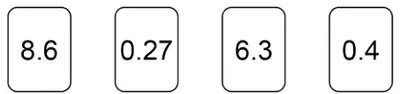
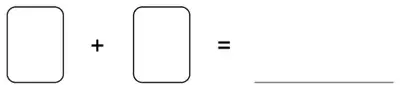
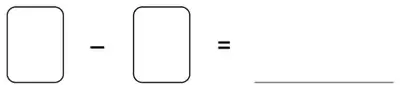
8.6 and 0.27 in this order only
B1
8.33
B1ft
correct or ft their two numbers
Additional guidance
Do not allow misreads of the cards in this question
Examples of follow through (there are many) 0.27 and 8.6 Answer \(-8.33\) 6.3 and 0.4 Answer 5.9
B0B1ft
Cards take precedence, but if cards or answer line are blank, mark all other working and award the lowest mark unless their choice is unambiguously identified
He pays the exact amount with two notes and four coins.
List the notes and coins. [2 marks]
Mark scheme
Answer
Mark
Comments
Notes £10 £5 Coins 50p 50p 50p 5p
B2
either order for notes any order for coins units must be included for all values B1 correct answer with units not included for all values or two notes and four coins totalling [£16.50, £16.60] with correct units or another combination of notes and coins totalling £16.55 with correct units
Additional guidance
Any correct units (may be shown in working) eg 50p may be £0.50, £1 may be 100p, £5 may be 5 pounds Condone £0.50p, £0.05p Condone 10£ for 10 pounds
Accept use of £1 £5 £10 notes Accept use of 1p 2p 5p 10p 20p 50p £1 £2 £5 coins
£5 reduction if you spend more than £100 or £10 reduction if you spend more than £150 or £20 reduction if you spend more than £200
At the shop, dresses cost £42 each.
Amira buys 3 dresses. Bobbi buys 5 dresses.
How much more than Amira does Bobbi pay? [3 marks]
Mark scheme
Answer
Mark
Comments
\(3 \times 42\) or 126 or \(5 \times 42\) or 210
M1
implied by 121 or 190 or 84
\(3 \times 42 - 5\) or 121 or \(5 \times 42 - 20\) or 190
M1dep
oe
69 or 69.00(p)
A1
69p is A0
Additional guidance
121 or 190 seen
M1M1
\(121 \div 3\) or \(190 \div 5\)
M1M1A0
Do not allow a misread of the discounts
Follow through the correct discount for their misread of a dress price eg for a misread of £42 as £24 \(24 \times 3 = 72\) and no discount required so M1 max but \(24 \times 5 = 120\) and \(120 - 5 = 115\) could score M1M1
A misread of the number of dresses must be > 3 for Amira and > 5 for Bobbi
A has 11 tracks. Each track on A costs the same. The total cost of downloading A is £8.80
Josh also downloads album B. B has 14 tracks.
(a) Work out the total cost of downloading B.
Assume each track costs the same as a track on A. [3 marks]
(b) In fact, compared to the cost of each track on A
the cost of 6 tracks on B is more by 5p each the cost of 8 tracks on B is less by 5p each.
What does this tell you about your answer to part (a)?
Tick one box.
The total cost is less than my answer to part (a)
The total cost is more than my answer to part (a)
The total cost is the same as my answer to part (a)
Give a reason for your decision. [2 marks]
Mark scheme (a)
Answer
Mark
Comments
Alternative method 1
\(8.8(0) \div 11\) or (0).8(0) or \(880 \div 11\) or 80
M1
oe \(8.8(0) \times 14\) or 123.2(0) or \(880 \times 14\) or 12320
their \((0).8(0) \times 3\ (+\ 8.8(0))\) or 2.4(0) (+ 8.8(0)) or their \(80 \times 3\ (+\ 880)\) or 240 (+ 880) or their \((0).8(0) \times 14\) or their \(80 \times 14\) or 11.2 or 1120
M1dep
oe their \(123.2(0) \div 11\) or their \(12320 \div 11\)
11.20
A1
Condone (£)11.20p
Alternative method 2
\(11 \div 8.8(0)\) or 1.25 or \(11 \div 880\) or 0.0125
M1
oe
\(14 \div\) their 1.25 or \(14 \div\) their 0.0125 or 11.2 or 1120
M1dep
oe
11.20
A1
Condone (£)11.20p
Additional guidance
\(8.8(0) \times \dfrac{14}{11}\) or \(8.8(0) \times 1.27(\ldots)\)
M1M1
\(\dfrac{56}{5}\) is oe for 11.2
M1M1
\(\dfrac{4}{5}\) is oe for 0.8, \(\dfrac{5}{4}\) is oe for 1.25, \(\dfrac{1}{80}\) is oe for 0.0125
M1
Mark scheme (b)
Answer
Mark
Comments
Alternative method 1 – answer in (a) correct or answer in (a) not used
Ticks the box The total cost is less than my answer to part (a) and correct reason
B2
correct reasons include more tracks cost less 10(p) (less) (costs) (£)11.1(0)
B1 Ticks the box The total cost is less than my answer to part (a)
Alternative method 2 – answer in (a) incorrect and used for comparison
Ticks the box for the correct decision for comparison with their answer in part (a) and correct reason from comparison with their answer in part (a)
B2ft
B1ft Ticks the box for the correct decision for comparison with their answer in part (a)
Additional guidance
Condone irrelevant statements with a correct reason
Do not accept an incorrect reason with a correct reason
Comes out of your account / comes off balance / comes out of the bank
B1
Condone description of direct debit eg amount paid regularly / money withdrawn monthly / paid out each month / paid frequently / money that needs to be paid / money you will have to pay
B1
Do not accept description of debt or use of the word ‘owe’ eg something that you owe, money owed for bills, what you owe the bank, how much you spent on debt
B0
Do not accept description of cost or discount eg how much it costs, something that is taken off the price, money taken off the cost
B0
Other unacceptable answers are eg spending money on a card directly from your bank, borrowed from the bank, your own money that is not borrowed, monthly charge, loss of money
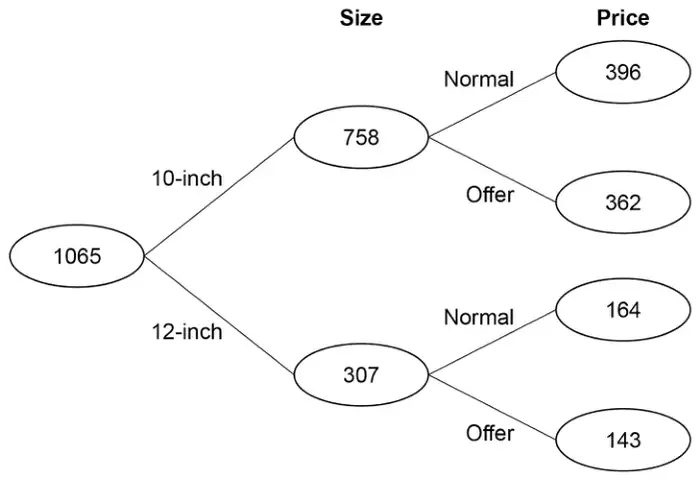
12 A takeaway sells 10-inch pizzas and 12-inch pizzas.
Here is some information about the numbers sold in two weeks.
Week 1
10-inch
512
12-inch
231
Total
743
Week 2
(a) In each week a proportion of the pizzas sold were 10-inch.
In which week was this proportion greater?
Show working to support your answer. [2 marks]
(b) The table shows the profit or loss the takeaway makes on each pizza.
Normal price
Offer price
10-inch
£3.74 profit
51p loss
12-inch
£5.29 profit
4p loss
In week 1 the total profit was £1895.55
At the end of week 1 the takeaway spent £175 on adverts.
Was the increase in profit in week 2 more than the cost of the adverts?
You must show your working. [4 marks]
Mark scheme (a)
Answer
Mark
Comments
Alternative method 1
\(512 \div 743\) or 0.6 or 0.68… or 0.69 or \(758 \div 1065\) or 0.7 or 0.71…
M1
oe
0.6 or 0.68… or 0.69 and 0.7 or 0.71… and Week 2
A1
Alternative method 2
\(512 \div 231\) or 2.2 or 2.21… or 2.22 or \(758 \div 307\) or 2.4 or 2.46… or 2.47 or 2.5
M1
oe
2.2 or 2.21… or 2.22 and 2.4 or 2.46… or 2.47 or 2.5 and Week 2
A1
Alternative method 3
\(\dfrac{512}{743}\) or \(\dfrac{758}{1065}\)
M1
\(\dfrac{512}{231}\) or \(\dfrac{758}{307}\)
\(\dfrac{545280}{791295}\) and \(\dfrac{563194}{791295}\) and Week 2
A1
\(\dfrac{157184}{70917}\) and \(\dfrac{175098}{70917}\) and Week 2
Additional guidance
Accept working in percentages
Proportions can be calculated using reciprocals in both Alternative method 1 and Alternative method 2 eg \(231 \div 512\)
60(%) or 68(%) or 69(%) or 70(%) or 71(%)
M1
(10% = 74.3 followed by) \(\dfrac{512}{74.3} \times 10\) or (10% = 106.5 followed by) \(\dfrac{758}{106.5} \times 10\) is oe for Alternative method 1
M1
Mark scheme (b)
Answer
Mark
Comments
\(396 \times 3.74\) or 1481.04 or \(164 \times 5.29\) or 867.56 or \(362 \times 0.51\) or 184.62 or \(143 \times 0.04\) or 5.72
M1
oe Week 2 profit on 10-inch pizzas Week 2 profit on 12-inch pizzas Week 2 loss on 10-inch pizzas Week 2 loss on 12-inch pizzas
their 1481.04 + their 867.56 or 2348.6(0) or their 184.62 + their 5.72 or 190.34 or their \(1481.04 -\) their 184.62 or 1296.42 or their \(867.56 -\) their 5.72 or 861.84
M1dep
oe Week 2 profit for both pizzas Week 2 loss for both pizzas Week 2 profit – loss on 10-inch pizzas Week 2 profit – loss on 12-inch pizzas
their \(2348.6(0) -\) their 190.34 or their 1296.42 + their 861.84 or 2158.26
M1dep
Total week 2 profit from total profit – total loss
(£)87.71 or (£)262.71 and Yes or (£)1983.26 and Yes or (£) 2158.26 and (£)2070.55 and Yes
A1
Total week 2 profit – (total week 1 profit + cost of adverts) Total week 2 profit – total week 1 profit Total week 2 profit – cost of adverts Condone eg £87.71p
Additional guidance
Accept use of inequality sign or words to imply “Yes” in final answer
Accept –184.62 and –5.72 for first M1
Accept working in pence to calculate losses for M1
2070.55 is total week 1 profit + cost of adverts
Answer of (£)87.71 does not require “Yes” to be stated as the advert cost has been subtracted
(a) Work out \(\quad 16.4 - 3.92 + 7.8\) [2 marks]
(b) Work out \(\quad 2843.61 \div 7\) [2 marks]
Mark scheme (a)
Answer
Mark
Comments
\((16.4 - 3.92 =)\) 12.48 or \((16.4 + 7.8 =)\) 24.2 or \((7.8 - 3.92 =)\) 3.88
B1
20.28
B1ft
ft their \(12.48 + 7.8\) or their \(24.2 - 3.92\) or their \(3.88 + 16.4\) SC1 4.68
Additional guidance
Answer of 20.28
B1B1
4.68 comes from \(16.4 - (3.92 + 7.8)\)
SC1
\(-4.68\)
SC0
Follow through must have at least 1 decimal place eg \(16.4 - 3.92 = 12\) then \(12 + 7.8 = 19.8\) eg \(16.4 - 3.92 = 12.58\) then \(12.58 + 7.8 = 20.38\)
B0B0ft B0B1ft
Mark scheme (b)
Answer
Mark
Comments
406.23
B2
Ignore further work e.g rounding B1 \(400 \leqslant\) answer \(< 410\) B1 digits 40 623 (not 406.23)
Additional guidance
0406.23
B2
Ignore trailing zeros eg 406.230000
B2
406.23 in division calculation and 406 on answer line
B2
406.23 in division calculation and 46.23 on answer line cannot be considered a transcription error and cannot be ignored as further work
Totals either set of coins or Totals all coins or Works out difference
(their 3.97 + their 1.53) \(\div\) 2 or their (£) 5.5(0) \(\div\) 2 or (£)2.75 or (their 3.97 – their 1.53) \(\div\) 2 or their (£) 2.44 \(\div\) 2 or (£)1.22
M1dep
oe Accept incorrect or missing units
£1, 20p and 2p
A1
oe eg £1.00, £0.20, £0.02 Correct units must be given
Alternative method 2
Moves 3 coins from Eve to Ola and correctly evaluates one set of coins
M1
Accept incorrect or missing units
Moves a different set of 3 coins from Eve to Ola and correctly evaluates both sets of coins
M1dep
Accept incorrect or missing units
£1, 20p and 2p
A1
oe eg £1.00, £0.20, £0.02 Correct units must be given
Additional guidance
Answer of 1, 20, 2 with some or all units incorrect or missing
17 Anika has a shelf 79.6 cm long. She has many books, each of width 3.4 cm. Anika puts two paperweights, each of width 5 cm, and the maximum possible number of books on the shelf.
Work out the amount of space on the shelf that is left over. You must show your working. [5]
Mark scheme
Answer
Marks
Part marks and guidance
1.6 with correct working
5
M2 for \(\dfrac{79.6 - 2 \times 5}{3.4}\) oe
“Correct working” requires evidence of at least M2 For M2 allow for use of trials to try to make 69.6 e.g. \(3.4 \times 20\) [= 68] with \(79.6 - 2 \times 5\) oe seen Accept attempt with repeated addition/subtraction of 3.4 for M2 isw using estimation only after correct values shown for M2
or M1 for \(79.6 - 2 \times 5\) oe implied by 69.6
AND
B1 for 20 [. …] or [total length of books = ] 68 [cm]
AND
20[. …] seen or used as max number of books For B1 ignore remainders with 20 68 must be their total length of books and not just a value in working
their 20 must be written and working shown for M1. M1 Dep on answer < 3.4 Could be implied by e.g. repeated subtraction
If 0 or 1 scored, instead award SC2 for answer 1.6 with no working or insufficient working
Alternative method: M2B1M1 or M2B0M1 depending on “20” for \(\left(\dfrac{79.6 - 2 \times 5}{3.4} - \textit{their}\ 20\right) \times 3.4\) Alt scheme if consistent omission of two paperweights or one paperweight with no adjustment later M1 for \(\dfrac{79.6[-5]}{3.4}\) oe B2 for answer 11.6 or B1 for 68 [cm] OR M1 for \(\dfrac{79.6[-5]}{3.4}\) oe B1 for 23.[…] ignore remainders or for 78.2 or 21.[…] ignore remainders or for 71.4 A1 for answer 1.4 or 3.2
5 Anika has a shelf 79.6 cm long. She has many books, each of width 3.4 cm. Anika puts two paperweights, each of width 5 cm, and the maximum possible number of books on the shelf.
Work out the amount of space on the shelf that is left over. You must show your working. [5]
Mark scheme
Answer
Marks
Part marks and guidance
1.6 with correct working
5
M2 for \(\frac{79.6 - 2 \times 5}{3.4}\) oe
or M1 for 79.6 – 2 × 5 oe implied by 69.6
“Correct working” requires evidence of at least M2 For M2 allow for use of trials to try to make 69.6 e.g. 3.4 × 20 [= 68] with 79.6 – 2 × 5 oe seen Accept attempt with repeated addition/subtraction of 3.4 for M2 isw using estimation only after correct values shown for M2
AND
B1 for 20 [. …] or [total length of books = ] 68 [cm]
20[. …] seen or used as max number of books For B1 ignore remainders with 20 68 must be their total length of books and not just a value in working
AND
M1 for 79.6 – (their 20 × 3.4 + 2 × 5)
their 20 must be written and working shown for M1. M1 Dep on answer < 3.4 Could be implied by e.g. repeated subtraction
If 0 or 1 scored, instead award SC2 for answer 1.6 with no working or insufficient working
Alternative method: M2B1M1 or M2B0M1 depending on “20” for \(\left(\frac{79.6 - 2 \times 5}{3.4} - \textit{their } 20\right) \times 3.4\)
Alt scheme if consistent omission of two paperweights or one paperweight with no adjustment later M1 for \(\frac{79.6[-5]}{3.4}\) oe B2 for answer 11.6 or B1 for 68 [cm] OR M1 for \(\frac{79.6[-5]}{3.4}\) oe B1 for 23.[…] ignore remainders or for 78.2 or 21.[…] ignore remainders or for 71.4 A1 for answer 1.4 or 3.2
Accept \(1200 \div 30\), \(\frac{600}{15}\), \(\frac{120}{100} \div \frac{3}{100}\) Do not allow M1 if extra step after \(120 \div 3\) e.g. \(120 \div 3\) then divide by 100
Ivan has a sack containing 50 litres of compost. He uses this compost to fill pots for his plants.
(a) Ivan fills six large pots each holding 7.5 litres.
Work out how much compost is left in the sack. [2]
(b) Ivan uses the remaining compost to fill small pots each holding 400 ml.
Work out the maximum number of small pots Ivan can fill with the remaining compost. [3]
(c) Work out how much compost will then be left in the sack. [2]
Mark scheme (a)
Answer
Marks
Part marks and guidance
5
2
M1 for \(6 \times 7.5\) oe
M1 implied by 45 Repeated addition, we must see their method, allow one arithmetic error. e.g. 7.5, 15 then \(15 \times 3\) [=45]
Mark scheme (b)
Answer
Marks
Part marks and guidance
12
3
B2 for 12.5
or
M2 for their (a) \(\times 1000 \div 400\) or their (a) \(\div\) [0].4
or
M1 for their (a) \(\times\) 1000 or \(400 \div 1000\) or their (a) \(\div\) figs 4
their (a) must be \(\gt\) 0.4
M2 implied by repeated addition or subtraction to one less than their (a) or their (a) \(\times\) 1000 see appendix If their (a) \(\lt\) 1.2 then all multiples must be seen
Appendix
Repeated Addition/Subtraction Methods
This is when division is attempted by listing multiples of a number or by repeated subtraction.
When marking this we need to see at least 3 correct multiples, one of these MUST be the number before reaching the value, in this case 2800.
We allow ONLY one arithmetic error in this method (unless the mark scheme states otherwise) Example 1: 400, 800, 1100 (error), 1500, 1900, 2300, 2700, [3100] – one arithmetic error, but correct FT from the error so M1 awarded.
Example 2: 400, 800, 1100 (error), 1500, 1800 (error), 2200, 2600, [3000] – two arithmetic errors, so M0 awarded.
When marking this we need to see at least 3 correct subtractions, one of these MUST be the number before reaching 0.
We allow ONLY one arithmetic error in this method (unless the mark scheme states otherwise) Example 1: 400, 340, 280, 200 (error), 140, 80, 20, [\(-40\)] – one arithmetic error, but correct FT from the error so M1 awarded.
Example 2: 400, 320(error), 260, 210 (error), 150, 90, 30, [\(-30\)] – two arithmetic errors, so M0 awarded.
Mark scheme (c)
Answer
Marks
Part marks and guidance
200
2
B2FT for their (a) \(\times 1000 -\) their (b) \(\times\) 400 evaluated correctly
or
M1their (a) \(\times 1000 -\) their (b) \(\times\) 400
their (a) must be \(\gt\) 0.4
their (a) \(\times 1000 \geqslant\) their (b) \(\times\) 400 their (b) must be an integer.
Implied by repeated subtraction or addition. Working may be seen in part (b) for M1
Accept \(1200 \div 30\), \(\frac{600}{15}\), \(\frac{120}{100} \div \frac{3}{100}\) Do not allow M1 if extra step after \(120 \div 3\) e.g. \(120 \div 3\) then divide by 100
(b) A carpenter has a plank of wood of length \(w\) metres.
The carpenter cuts \(\frac{3}{5}\) of the plank of wood into 20 equal pieces.
Each piece has length 0.06 metres.
Work out the value of \(w\), the original length of the plank of wood. You must show your working. [4]
Mark scheme (a)
Answer
Marks
Part marks and guidance
200
1
Mark scheme (b)
Answer
Marks
Part marks and guidance
2 with correct working
4
Accept 200 cm with correct working “Correct working” requires evidence of at least M1A1M1 or alternate convincing approach
M1 for 0.06 × 20 or 6 × 20 A1 for 1.2 oe or 120 [cm] M1 for (their 1.2) ÷ \(\frac{3}{5}\) oe
M1 may be done in steps e.g. 60% = 120 cm, 10% = 20 cm, 100% = 200 cm
OR M1 for \(\frac{3}{5} \div 20\) or \(20 \div \frac{3}{5}\) A1 for \(\frac{3}{100}\) or 0.03 or 33 or 33.3… M1 for 0.06 ÷ (their \(\frac{3}{5}\) ÷ 20) or 6 ÷ (their \(\frac{3}{5}\) ÷ 20) [cm] or 0.06 × (their 20 ÷ \(\frac{3}{5}\)) oe
If 0 scored SC1 for answer 2 with no/insufficient working
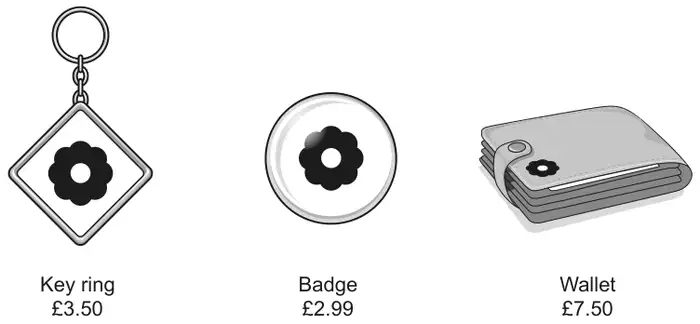
14 A student is buying some gifts for their friends. The gifts are shown below with the prices.
The student has £50 to spend. They first buy 6 key rings and 2 wallets. They then buy badges with the remainder of the money.
(a) Work out the maximum number of badges that the student can buy. You must show your working. [5]
(b) Work out the amount of money they have left over. [2]
Mark scheme (a)
Answer
Marks
Part marks and guidance
4 [badges] with correct working
5
M3 for 50 – \((6 \times 3.50 + 2 \times 7.50)\) oe or M2 for \(6 \times 3.50 + 2 \times 7.50\) oe or M1 for \(6 \times 3.50\) or \(2 \times 7.50\) oe
AND
M1 for their (50 – \((6 \times 3.50 + 2 \times 7.50)) \div 2.99\) oe
If 0 or 1 scored, instead award SC2 for 4 [badges] with no or insufficient working or If 0 scored SC1 for 14 with no or insufficient working
‘Correct working’ requires full evidence of at least M2M1
M3 implied by 14, 15, 21 seen or 14, 36 seen M2 implied by 36 M1 implied by 21 or 15
Accept their (50 – \(6 \times 3.50 + 2 \times 7.50) \div 3\) Implied by list 2.99, 5.98, 8.97, 11.96, [14.95, …….] up to one less than their 14 Condone one arithmetic slip. or 3, 6, 9, 12, [15, ……] up to one less than their 14 or Embedded e.g. 4 x 2.99 = 11.96
Mark scheme (b)
Answer
Marks
Part marks and guidance
2.04
2
M1 for their 14 – their ((a) \(\times\) 2.99) oe
their ((a) \(\times\) 2.99) could be seen in part (a) and must be \(\lt\) their 14
M1 can be implied by a correct FT answer to their 14 – their ((a) \(\times\) 2.99)
Ashley buys 2 pineapples and 3 kilograms of bananas. Ashley spends the remaining money on strawberries.
Work out the mass, in grams, of strawberries that Ashley buys. You must show your working.
.................... g [6]
Mark scheme
Answer
Marks
Part marks and guidance
400 with correct working
6
M1 for \(2 \times 1.15 + 3 \times 0.70\) oe or 2.3[0] + 2.1[0] A1 for 4.4[0] AND M1 for (7 – their 4.4[0]) oe A1 for 2.6[0] AND M1 for their 2.6[0] \(\div\) 1.3[0] [\(\times\) 200] A1FT for their 2.6[0] \(\div\) 1.3[0] rounded down \(\times\) 200
If 0 or 1 scored, instead award SC2 for answer 400 with no or insufficient working If 0 scored, instead award SC1 for 2.6[0] with no or insufficient working
“Correct working” requires evidence of at least two M marks and one A mark
Allow working in pence provided consistent units used
4.4[0] implies M1A1
Could be Implied by their 4.4[0] + their 2.6[0] + their ‘change’ [=7.0[0]]
Implied by list 1.3[0], 2.6[0], [3.9[0], ……] up to one less than their 2.6[0] or Embedded \(2 \times 1.3[0] = 2.6[0]\)
Alternative Method: For first M1A1 M1A1 M1 for \(7 - 2 \times 1.15\) or \(7 - 3 \times 0.70\) A1 for 4.7[0] or 4.9[0] AND M1 for \(7 - 2 \times 1.15 - 3 \times 0.70\) or their 4.7[0] \(- 3 \times 0.70\) or their 4.9[0] \(- 2 \times 1.15\) A1 for 2.6[0]
10 Two supermarkets, A and B, have special offers on the same packet of biscuits.
Supermarket A
Supermarket B
Normal price: £1.50 for each packet
Special offer: Buy two packets at the normal price and get a third packet for half price
Normal price: £1.60 for each packet
Special offer: 10% off the normal price
(a) Dan buys one packet of these biscuits.
Which supermarket is best value for Dan? Show how you decide.
Supermarket .................... because ........................................ [3]
(b) Darcy buys three packets of these biscuits.
Which supermarket is best value for Darcy? Show how you decide.
Supermarket .................... because ........................................ [3]
Mark scheme (a)
Answer
Marks
Part marks and guidance
B and 1.44 is less than 1.5[0] oe or B and ([0].06 or 6p) cheaper oe or B and 1.44 and 1.5[0] seen in final statement
3
M2 for \(1.6[0] \times 0.9\) oe implied by 1.44 or M1 for \(1.6[0] \times 0.1\) oe implied by [0].16
Allow B and “It’s cheaper oe” if only 1.44 [and 1.50] seen in working space Accept all figures in pence May be \(1.6[0] - 1.6[0] \times 0.1\) oe M0 for 10% of 1.6[0] See Appendix B and 3.75 and 4.32 only scores 0 B and 1.44 and 3.75 scores M2 only
Appendix
Appendix for 10a
Working and answer
Mark
Reason
3.75 and 4.32 seen in working Answer: B it is cheaper because 1.44 is cheaper than 1.5
3
Answer uses correct figures
1.44 only seen in working Answer: B it costs less
3
There can be no other figure to compare with so all marks awarded
1.44, 3.75 and 4.32 seen in working Answer: B He only wants one packet so it is cheaper
M2
M2 for 1.44 but no comparison
1.44 and 3.75 seen in working Answer: B even when you buy 2 packets it is cheaper than A
M2
M2 for 1.44 but no comparison
Answer: B and 1.44 cheaper than 3.75
M2
Answer based on incorrect figures but 1.44 seen
16p found and 3.75 seen Answer: B and 3.59 cheaper
M1
16p seen but 3.59 comes from 3.75 – 0.16 so incorrect values. M1 as 16p used
Answer: B and 3.75 lower than 4.32
0
Answer based on incorrect values
Mark scheme (b)
Answer
Marks
Part marks and guidance
A and 3.75 less than 4.32 oe or A and [0].57 saved oe or A and 3.75 and 4.32 seen in final statement OR A and 1.25 less than 1.44 oe or A and 0.19 oe saved or A and 1.25 and 1.44 seen in final statement
3
Method 1 M1 for \(1.5 \times 2.5\) oe or 3.75 oe M1 for their \(1.44 \times 3\) or \((3 \times 1.6) \times 0.9\) oe or 4.32 oe
Method 2 M2 for \(1.5 \times 2.5 \div 3\) oe or 1.25 or M1 for \(1.5 \times 2.5\) oe or 3.75
Ignore other figures/statements that don’t invalidate answer All values may be seen in (a) oe may be \(1.5 + 1.5 + 1.5 \div 2\)
Allow “A because it’s cheaper” oe if 3.75 and 4.32 only seen as final costs in working space for (b)
Allow “A because it’s cheaper” oe if 1.25 and 1.44 only seen as final costs in working space for (b)
12 Frankie goes on holiday. They change £375 into euros (€) at a rate of £1 = €1.15. They spend €217.49 of this money. After the holiday, Frankie changes the remaining euros back into pounds at a rate of £1 = €1.28.
Work out how many pounds Frankie gets back. [4]
Mark scheme
Answer
Marks
Part marks and guidance
167
4
M1 for \(375 \times 1.15\) soi by 431.25
M1 for (their euros) \(-\) 217.49
M1 for their \(213.76 \div 1.28\) oe
213.76 implies M1M1 Must be linked to 375 but do not accept 375 as euros
B2 for figs 45 in final answer or 1.5 oe nfww or \(\left(2.1 - \textit{their}\ \dfrac{3}{5}\right) \times 0.3\) evaluated accurately or \(\textit{their}\,(2.1 - 0.6) \times 0.3\) evaluated accurately
or B1 for [\(\dfrac{3}{5} =\)] 0.6 or \(\left(2.1 - \textit{their}\ \dfrac{3}{5}\right)\) evaluated accurately or the result of \(\textit{their}\left(2.1 - \textit{their}\ \dfrac{3}{5}\right) \times 0.3\) evaluated accurately
i.e. B2 for two accurate processes or B1 for one accurate process
17 The depth of water in a garden pond is 57.8 cm. The depth decreases by 0.3 cm per day.
(a) Assume the depth continues to decrease at the same rate.
After how many days will the depth reach 54.2 cm? [3]
(b) If the depth of water decreases at a slower rate, what effect will this have on your answer to part (a)? [1]
Mark scheme (a)
Answer
Marks
Part marks and guidance
12
3
M2 for \(\dfrac{57.8 - 54.2}{0.3}\) oe or M1 for 57.8 – 54.2 or 3.6 seen or for repeated subtraction of 0.3 from 57.8 or for repeated addition of 0.3 to 54.2
Explain the error that Nathan has made and work out the correct answer. [3]
(b) Four friends buy cinema tickets using this offer.
Cinema tickets
Buy 3 tickets and get a ticket free
They each pay £6.45.
How much does a ticket cost? [3]
Mark scheme (a)
Answer
Marks
Part marks and guidance
When multiplying [12.4] by 10, Nathan has not moved the figures to the left [he has just added a 0]
1
Accept \(12.4 \times 10 = 124\) not 12.40
Condone he has not moved the decimal point to the right soi Accept reference to either first or second line of working See Appendix B
285.2
2
M1 for \(12.4 \times 20 = 248\) or \(124 \times 2 = 248\)
Accept 248 seen If \(12.4 \times 23\) is worked out using grid method, allow M1 if no more than one error. If other long multiplication method used, allow M1 if not more than one arithmetic slip but M0 if error in place value
Appendix B
Exemplar responses for Q3(a) explanation mark
Response
Mark
For 10 × 12.4 Nathan has only times by 1. For 20 × 12.4 he has only times by 2. 10 × 12.4 = 124. Accept identifying that he has timesed by 1 instead of 10, or by 2 instead of 20.
1
10 × 12.4 is not 12.40 it is 124. He didn’t add the 0s onto the numbers. 10 x 124 is not 12.40 it is 124 scores 1, ignore the rest of the explanation because it is unclear rather than being incorrect.
1
He added 0 to 12.4 Explains what he has done wrong.
1
He does not move the decimal place when he x by 10 so it should have been 124.0. Doesn’t need to say where
1
Nathan has got the place value wrong on first answer. They have correctly identified that the error is in the place value
1
10 × 12.4 = 124 so 20 × 12.4 is wrong Allow identification of error in second line
1
Instead of moving the decimal place to the right he just added a zero to the end of the number and instead of multiplying he add. Ignore final part of statement
1
He hasn’t multiplied it he just added a zero that makes no difference. Error identified and ‘makes no difference’ explains error
1
He said that 20 × 12.4 is 24.80 when it is 248 which means the answer is 285.2 Accept reference to second line of working
1
When Nathan done 10 × 12.4 it should equal 124 10 x 12.4 = 124 is not enough. ‘It should equal 124’ is just about enough to identify the error.
1bod
When he multiplied by 10 he didn’t remove the decimal place and same when he multiplied by 20 Multiplying by 10 isn’t the same as removing the decimal place.
0
Nathan kept the decimal in. When calculating a sum with a decimal you take it out as you do the sum then put it back at the end. Too vague.
0
Nathan has divided the 12.4 rather than moving the decimal point to the right (positive/multiplying) Moving the decimal point to the right would score 1, but we can’t ignore the rest of the explanation because it is incorrect rather than unclear.
0
12.40 is wrong Identifies error but doesn’t explain
0
Mark scheme (b)
Answer
Marks
Part marks and guidance
8.60
3
M2 for \(6.45 \times 4 \div 3\) oe Or M1 for \(6.45 \times 4\) oe or 25.8[0] seen