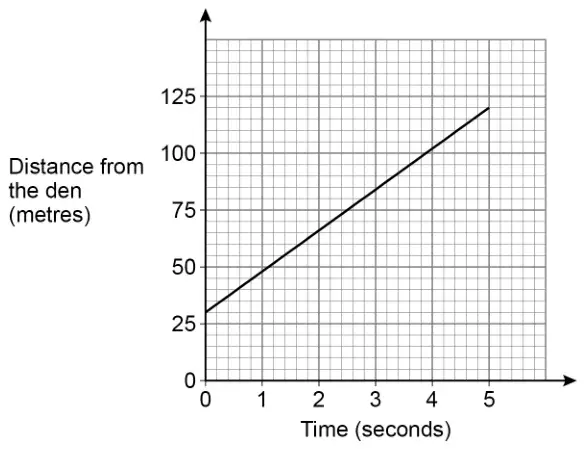
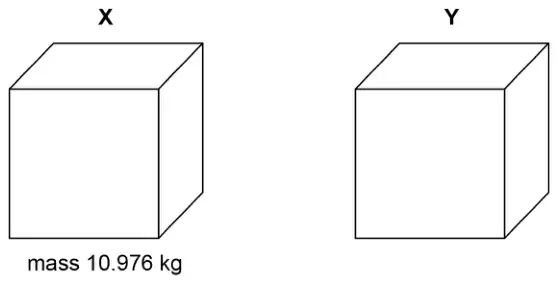
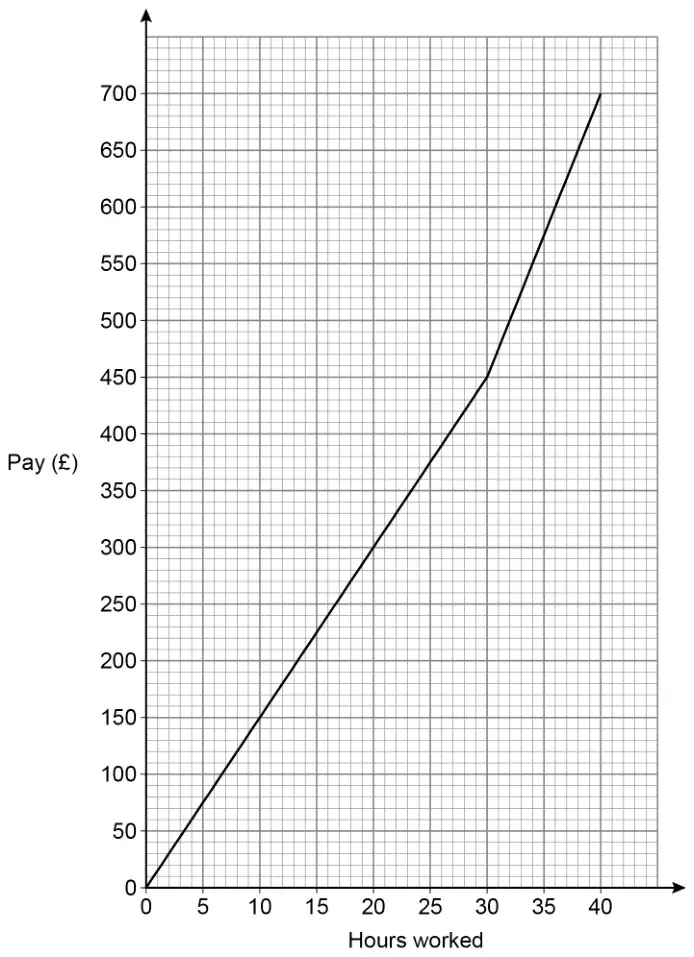
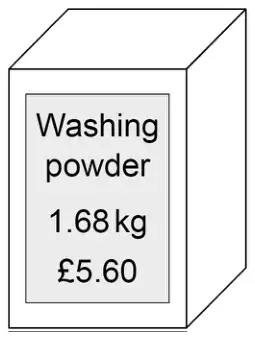
27 Metal rods are made from steel with density 8 g/cm3 Each metal rod has a volume of 1500 cm3
The maximum mass of metal rods that can be put on a trolley is 300 kg.
Work out the greatest number of metal rods that can be put on the trolley. (3)
Mark scheme
Answer
Mark
Mark scheme
25
P1
for working with density, eg \(8 \times 1500\ (= 12\,000)\) or [density] \(\times\, 1500\)
P1
for a correct conversion, eg \(\text{``}12\,000\text{''} \div 1000\ (= 12)\) or \(\dfrac{8}{1000}\ (= 0.008)\) or \(300 \times 1000\ (= 300\,000)\) or [mass] \(\div\, 1000\)
A1
cao
Additional guidance
P marks can be awarded in either order [density] is \(8 \times 10^n\) Condone \(8 \times 1500 \times 300\) for this mark only
P marks can be awarded in either order [mass] must be what they believe to be mass following a calculation that uses 8 and 1500 but not 300
OR for using distance \(\div\) time, eg \(1512 \div [\text{time}]\) oe or \([\text{distance}] \div [\text{time}]\) oe
M1
for a complete method using distance \(\div\) time, eg \(1512 \div \text{``}2.4\text{''}\) or \(1512 \div \text{``}2\tfrac{2}{5}\text{''}\) or \(1512 \div \text{``}144\text{''} \times 60\) oe or \(1512 \div \text{``}8640\text{''} \times 60 \times 60\) oe
A1
cao
Additional guidance
10.5 or 0.175 imply M1
[distance] can be 1512 or the result of an attempt to convert 1512 km to a different unit, it must have the digits 1512 eg 151.2 or 1 512 000
[time] can be any value they believe to be the time the plane takes to fly
11 Jamie drives his van for 150 minutes. He stops for a rest. Jamie then drives for a further 75 minutes.
(a) Show that Jamie drives for less than 4 hours in total. (2)
A car travels for 2 hours at a steady speed of 65 mph.
(b) Work out the distance the car travels. (2)
Mark scheme (a)
Answer
Mark
Mark scheme
Shown
M1
for a correct first step, eg method to convert, \(4 \times 60\ (= 240)\) or \(75 \div 60\ (= 1.25)\) or \(150 \div 60\ (= 2.5)\) or accurate converted time shown, eg 1(hr) 15(mins) oe or 2(hrs) 30(mins) oe or adding the two required times \(150 + 75\ (= 225)\)
C1
for accurate figures to compare, eg 240 and 225 (mins) or 3.75(hrs) or 3(hrs) 45(mins) or 15 mins spare (from \(240 - 150 - 75\))
Additional guidance
Units not required but if stated they must be correct.
Units not required but if stated they must be correct. An incorrect conversion will score C0, eg 3.75 incorrectly converted to 3hrs 75mins Figures are enough and a direct comparison to 4 hrs is not needed
8 Metal rods are made from steel with density 8 g/cm3 Each metal rod has a volume of 1500 cm3
The maximum mass of metal rods that can be put on a trolley is 300 kg.
Work out the greatest number of metal rods that can be put on the trolley. (3)
Mark scheme
Answer
Mark
Mark scheme
25
P1
for working with density eg \(8 \times 1500\ (= 12\,000)\) or [density] \(\times\, 1500\)
P1
for a conversion, eg \(\text{``}12\,000\text{''} \div 1000\ (= 12)\) or \(\dfrac{8}{1000}\ (= 0.008)\) or \(300 \times 1000\ (= 300\,000)\) or [mass] \(\div\, 1000\)
A1
cao
Additional guidance
P marks can be awarded in either order [density] is \(8 \times 10^n\) Condone \(8 \times 1500 \times 300\) for this mark only
P marks can be awarded in either order [mass] must be what they believe to be mass following a calculation that uses 8 and 1500 but not 300
OR for using distance \(\div\) time, eg \(1512 \div [\text{time}]\) oe or \([\text{distance}] \div [\text{time}]\) oe
M1
for a complete method using distance \(\div\) time, eg \(1512 \div \text{``}2.4\text{''}\) or \(1512 \div \text{``}2\tfrac{2}{5}\text{''}\) or \(1512 \div \text{``}144\text{''} \times 60\) oe or \(1512 \div \text{``}8640\text{''} \times 60 \times 60\) oe
A1
cao
Additional guidance
10.5 or 0.175 imply M1
[distance] can be 1512 or the result of an attempt to convert 1512 km to a different unit, it must have the digits 1512 eg 151.2 or 1 512 000
[time] can be any value they believe to be the time the plane takes to fly
22 A car travelled 4.96 miles at an average speed of 30.4 miles per hour.
(a) Work out an estimate for the time taken by the car. Give your answer in minutes. (3)
(b) Is your answer to part (a) an underestimate or an overestimate? Give a reason for your answer. (1)
Mark scheme (a)
Answer
Mark
Mark scheme
Estimated time
P1
for rounding of distance = 5 (miles) or speed = 30 (mph)
P1
(dep) for using time = distance/speed eg \(5 \div 30\)
or for a complete process, eg \(30 \div 60\ (= 0.5)\) and \(5 \div \text{``}0.5\text{''}\) or \(30 \div 5\ (= 6)\) and \(60 \div \text{``}6\text{''}\) or \(4.96 \times \dfrac{60}{30}\)
A1
for a correct answer following through their correct rounded distance and/or speed
Mark scheme (b)
Answer
Mark
Mark scheme
Overestimate with reason
C1
ft from (a) for decision with correct reasoning, eg overestimate as dividing a larger number by a smaller number or overestimate as miles rounded up and speed rounded down
Additional guidance
Ft the rounding and process from (a) Must relate to estimation and not rounding of their final answer and they must have a final answer to part (a)
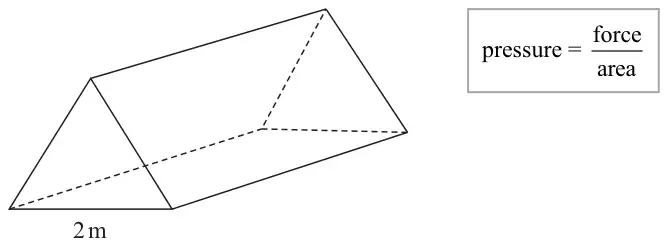
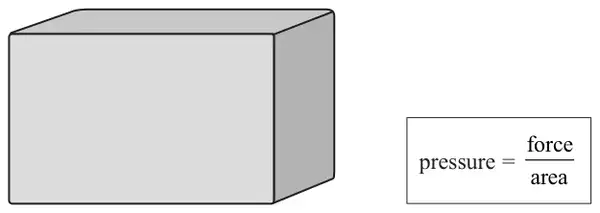
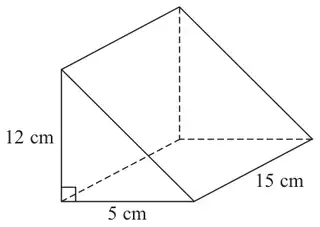
8 The diagram shows a solid triangular prism on a horizontal floor.
The face in contact with the floor is a rectangle of width 2 m.
The pressure on the floor due to the prism is 80 newtons/m2 The force exerted by the prism on the floor is 720 newtons.
Work out the length of the prism. (3)
Mark scheme
Answer
Mark
Mark scheme
4.5
P1
for process to find the area, eg \(80 = \dfrac{720}{A}\) or (area =) \(\dfrac{720}{80}\ (= 9)\) or \(80 = \dfrac{720}{2x}\) or \(2x = \dfrac{720}{80}\)
P1
for complete process to find the length, eg \(\text{``}9\text{''} \div 2\) or \(720 \div (2 \times 80)\)
5 A car travelled 4.96 miles at an average speed of 30.4 miles per hour.
(a) Work out an estimate for the time taken by the car. Give your answer in minutes. (3)
(b) Is your answer to part (a) an underestimate or an overestimate? Give a reason for your answer. (1)
Mark scheme (a)
Answer
Mark
Mark scheme
Estimated time
P1
for rounding of distance = 5 (miles) or speed = 30 (mph)
P1
(dep) for using time = distance/speed eg \(5 \div 30\)
or for a complete process, eg \(30 \div 60\ (= 0.5)\) and \(5 \div \text{``}0.5\text{''}\) or \(30 \div 5\ (= 6)\) and \(60 \div \text{``}6\text{''}\) or \(4.96 \times \dfrac{60}{30}\)
A1
for a correct answer following through their correct rounded distance and/or speed
Mark scheme (b)
Answer
Mark
Mark scheme
Overestimate with reason
C1
ft from (a) for decision with correct reasoning, eg overestimate as dividing a larger number by a smaller number or overestimate as miles rounded up and speed rounded down
Additional guidance
Ft the rounding and process from (a) Must relate to estimation and not rounding of their final answer and they must have a final answer to part (a)
He puts 600 grams of flour into one of the tins. The flour fills the tin completely. The density of the flour is 0.6 g/cm3
Habib puts 600 grams of salt into the other tin. The salt does not fill the tin completely. The volume of the space in the tin that is not filled with salt is 700 cm3
Work out the density of the salt. You must show all your working.(4)
Mark scheme
Answer
Mark
Mark scheme
2
P1
for process to find volume of tin eg \(600 \div 0.6\ (= 1000)\)
P1
for process to find volume of salt eg \(\text{``}1000\text{''} - 700\ (= 300)\)
P1
for a process to find density of the salt eg \(600 \div \text{``}300\text{''}\) or \(0.6 \times (\text{``}1000\text{''} \div \text{``}300\text{''})\) or \(600 \div [\text{volume}]\)
A1
cao
Additional guidance
Award P1 for \(600 \div 0.6\ (= 1000)\) even if not used
[volume] can be 700 or from a seen calculation using “1000”, “300”, 700 or identified as volume by label or formula or units
A correct answer with no supportive working gets 0 marks
He puts 600 grams of flour into one of the tins. The flour fills the tin completely. The density of the flour is 0.6 g/cm3
Habib puts 600 grams of salt into the other tin. The salt does not fill the tin completely. The volume of the space in the tin that is not filled with salt is 700 cm3
Work out the density of the salt. You must show all your working. (4)
Mark scheme
Answer
Mark
Mark scheme
2
P1
for process to find volume of tin eg \(600 \div 0.6\ (= 1000)\)
P1
for process to find volume of salt eg \(\text{``}1000\text{''} - 700\ (= 300)\)
P1
for a process to find density of the salt eg \(600 \div \text{``}300\text{''}\) or \(0.6 \times (\text{``}1000\text{''} \div \text{``}300\text{''})\) or \(600 \div [\text{volume}]\)
A1
cao
Additional guidance
Award P1 for \(600 \div 0.6\ (= 1000)\) even if not used
[volume] can be 700 or from a seen calculation using "1000", "300", 700 or identified as volume by label or formula or units
A correct answer with no supportive working gets 0 marks
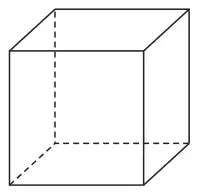
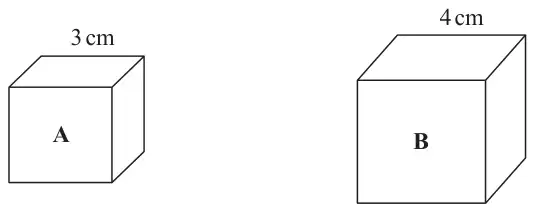
The pressure on the table due to the cube is 3.5 newtons/cm2 The force exerted by the cube on the table is 504 newtons.
Show that the total surface area of the cube is less than 900 cm2(3)
Mark scheme
Answer
Mark
Mark scheme
Shown
M1
for substitution to find area of face, eg \(3.5 = \dfrac{504}{\text{area}}\) or \(3.5 \times \text{area} = 504\) or \(\text{area} = 504 \div 3.5\ (= 144)\) or for working from surface area eg \(900 \div 6\ (= 150)\)
M1
for method to find comparable figures, eg \(\text{``}144\text{''} \times 6\ (= 864)\) or \(\text{``}150\text{''} \times 3.5\ (= 525)\) or \(504 \div \text{``}150\text{''}\ (= 3.36\ldots)\) or \(504 \div 3.5\ (= 144)\) and \(900 \div 6\ (= 150)\) or \(900 \div 144\ (= 6.25)\) and 6
C1
for correct comparable figures, eg 864 (and 900) or 144 and 150 or 525 (and 504) or 3.36… (and 3.5) or 6.25 and 6
Additional guidance
Other equivalent methods should be credited accordingly
He travelled 143 miles by car at an average speed of 55 miles per hour. Riley then travelled for 5 hours and 20 minutes by aeroplane.
Work out, in hours and minutes, Riley’s total travelling time. (3)
Mark scheme
Answer
Mark
Mark scheme
7 hours 56 minutes
P1
for process to begin to work with speed, eg \(143 \div 55\ (= 2.6)\)
P1
for process to work in minutes, eg \(\text{``}2.6\text{''} \times 60\ (= 156 \text{ mins})\) and \(5 \times 60 + 20\ (= 320 \text{ mins})\) or for 476 (mins) or for process to work in hours eg “2.6” and \(5\frac{20}{60}\ (= 5.33\ldots)\) or for 7.93... or for process to work in hours and minutes, eg \(\text{``}2\text{''} + (\text{``}0.6\text{''} \times 60)\ (= 2 \text{ hrs } 36 \text{ mins})\)
A1
cao
Additional guidance
May work in minutes or hours and minutes
Accept 2 or more decimal places for the second P1 mark
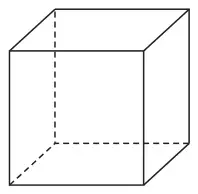
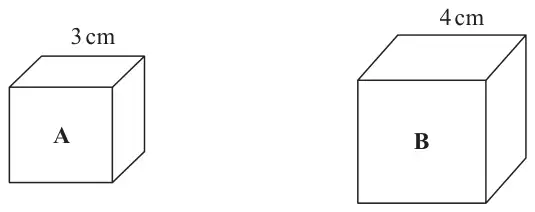
The pressure on the table due to the cube is 3.5 newtons/cm2 The force exerted by the cube on the table is 504 newtons.
Show that the total surface area of the cube is less than 900 cm2(3)
Mark scheme
Answer
Mark
Mark scheme
Shown
M1
for substitution to find area of face, eg \(3.5 = \dfrac{504}{\text{area}}\) or \(3.5 \times \text{area} = 504\) or \(\text{area} = 504 \div 3.5\ (= 144)\) or for working from surface area eg \(900 \div 6\ (= 150)\)
M1
for method to find comparable figures, eg \(\text{``}144\text{''} \times 6\ (= 864)\) or \(\text{``}150\text{''} \times 3.5\ (= 525)\) or \(504 \div \text{``}150\text{''}\ (= 3.36\ldots)\) or for \(504 \div 3.5\ (= 144)\) and \(900 \div 6\ (= 150)\) or for \(900 \div 144\ (= 6.25)\) and 6
C1
for correct comparable figures, eg 864 (and 900) or 144 and 150 or 525 (and 504) or 3.36… (and 3.5) or 6.25 and 6
Additional guidance
Other equivalent methods should be credited accordingly
He travelled 143 miles by car at an average speed of 55 miles per hour. Riley then travelled for 5 hours and 20 minutes by aeroplane.
Work out, in hours and minutes, Riley’s total travelling time. (3)
Mark scheme
Answer
Mark
Mark scheme
7 hours 56 minutes
P1
for process to begin to work with speed, eg \(143 \div 55\ (= 2.6)\)
P1
for process to work in minutes, eg \(\text{``}2.6\text{''} \times 60\ (= 156\text{ mins})\) and \(5 \times 60 + 20\ (= 320\text{ mins})\) or for 476 (mins) or for process to work in hours eg "2.6" and \(5\tfrac{20}{60}\ (= 5.33\ldots)\)…or for 7.93… or for process to work in hours and minutes, eg \(\text{``}2\text{''} + (\text{``}0.6\text{''} \times 60)\ (= 2\text{ hrs }36\text{ mins})\)
25 Lava flows from a volcano at a constant rate of 11.9 m\(^3\)/s
How many days does it take for 67 205 600 m\(^3\) of lava to flow from the volcano? Give your answer correct to the nearest day. (3)
Mark scheme
Answer
Mark
Mark scheme
65
P1
for a correct process to find the number of seconds, eg \(67\,205\,600 \div 11.9\ (= 5\,647\,529.4...)\) or for a correct process to convert between seconds and days, eg \(24 \times 60 \times 60\ (= 86\,400)\) oe, may be seen in stages or \(11.9 \times 60 \times 60 \times 24\ (= 1\,028\,160)\)
P1
for a complete process, eg \(\text{``}5\,647\,529.4...\text{''} \div \text{``}86\,400\text{''}\) or \(67\,205\,600 \div \text{``}1\,028\,160\text{''}\)
A1
accept answers in the range 65 to 65.4 or 66
Additional guidance
Note that this mark may be awarded at any stage in the working.
If a correct answer within the range is shown in working but incorrectly rounded award full marks.
16 Paulo drives at an average speed of 56 km/h for 1 hour 45 minutes.
Work out the distance Paulo drives. (3)
Mark scheme
Answer
Mark
Mark scheme
98
M1
for method to use speed, distance and time, eg \(56 \times [\text{time}]\) or \(56 \times 105\ (= 5880)\) or \(56 \div 4 \times 3\ (= 42)\) or \(56 \div 60\ (= 0.933...)\) OR for method to convert decimal time, eg \((60 + 45) \div 60\ (= 1.75)\) or \(45 \div 60\ (= 0.75)\)
M1
for a complete method using decimal time, eg \(56 \times \text{``}1.75\text{''}\) or \(\text{``}5880\text{''} \div 60\) or \(\text{``}0.933...\text{''} \times 105\) or \(56 + \text{``}42\text{''}\) or \(56 + \text{``}28\text{''} + \text{``}14\text{''}\)
A1
for 97.65 to 98.3
Additional guidance
For this mark accept [time] written unconventionally eg as 1.45, 145, 175, 75
6 Lava flows from a volcano at a constant rate of 11.9 m3/s
How many days does it take for 67 205 600 m3 of lava to flow from the volcano? Give your answer correct to the nearest day. (3)
Mark scheme
Answer
Mark
Mark scheme
65
P1
for a correct process to find the number of seconds, eg \(67\,205\,600 \div 11.9\ (= 5\,647\,529.4\ldots)\) or for a correct process to convert between seconds and days, eg \(24 \times 60 \times 60\ (= 86\,400)\) oe, may be seen in stages or \(11.9 \times 60 \times 60 \times 24\ (= 1\,028\,160)\)
P1
for a complete process, eg \(\text{``}5\,647\,529.4\ldots\text{''} \div \text{``}86\,400\text{''}\) or \(67\,205\,600 \div \text{``}1\,028\,160\text{''}\)
A1
accept answers in the range 65 to 65.4 or 66
Additional guidance
Note that this mark may be awarded at any stage in the working.
If a correct answer within the range is shown in working but incorrectly rounded award full marks.
(b) Change a speed of 180 km per hour to metres per second. (3)
Mark scheme (a)
Answer
Mark
Mark scheme
0.008
B1
for 0.008 or \(8 \times 10^{-3}\)
Additional guidance
May be awarded at any stage
Mark scheme (b)
Answer
Mark
Mark scheme
50
M1
for conversion from km to m eg \(180 \times 1000\ (= 180\,000)\) or for conversion from hours to seconds eg \(180 \div (60 \times 60)\ (= 0.05)\) or for conversion from km per hour to metres per second, eg \(1000 \div (60 \times 60)\ (= 0.277...)\) (Accept \((60 \times 60) \div 1000\ (= 3.6)\))
M1
for a complete process eg \(180 \times 1000 \div 3600\)
14 Jenny drives from London to Swindon at an average speed of 54 miles per hour. She drives for \(1\dfrac{1}{2}\) hours.
(a) Work out the distance from London to Swindon. (2)
Aleksy is using a map. The map has a scale of \(\;1 : 25\,000\) On the map a road has a length of 6 cm.
(b) Work out the length, in kilometres, of the real road. (3)
Mark scheme (a)
Answer
Mark
Mark scheme
81
M1
for \(54 \times [\text{time}]\) eg \(54 \times 1\dfrac{1}{2}\) oe, or \(54 + 54 \div 2\) oe
A1
cao
Additional guidance
[time] could be \(1\dfrac{1}{2}\) oe or any other time that has been changed from \(1\dfrac{1}{2}\), eg 90 (mins) or 1.30 or 130
Mark scheme (b)
Answer
Mark
Mark scheme
1.5
P1
for use of scale eg \(6 \times 25\,000\ (= 150\,000)\) or for \(25\,000 \div 100\,000\ (= 0.25)\) or \(25\,000 \div 100\ (= 250)\) or \(25\,000 \div 1000\ (= 25)\)
P1
for \(\text{``}150\,000\text{''} \div 100\,000\ (= 1.5)\) or \(\text{``}150\,000\text{''} \div 100\ (= 1500)\) or \(\text{``}150\,000\text{''} \div 1000\ (= 150)\) or for \([0.25] \times 6\ (= 1.5)\)
A1
for 1.5 oe
Additional guidance
[0.25] could be found by dividing 25 000 by 100 (= 250) or dividing 25 000 by 1000 (= 25)
27 Jessica runs for 15 minutes at an average speed of 6 miles per hour. She then runs for 40 minutes at an average speed of 9 miles per hour.
It takes Amy 45 minutes to run the same total distance that Jessica runs.
Work out Amy’s average speed. Give your answer in miles per hour. (4)
Mark scheme
Answer
Mark
Mark scheme
10
P1
for a process to use distance = speed × time for either of the parts of Jessica’s journey, eg \(6 \times \dfrac{15}{60}\ (= 1.5)\) or \(9 \times \dfrac{40}{60}\ (= 6)\) or \(6 \times 15\ (= 90)\) or \(9 \times 40\ (= 360)\)
P1
for a process to add the 2 distances for Jessica, eg \(6 \times \dfrac{15}{60} + 9 \times \dfrac{40}{60}\ (= 7.5)\) or \(6 \times 15 + 9 \times 40\ (= 450)\)
P1
for complete process to find Amy’s average speed, eg \(\text{``}7.5\text{''} \div \text{``}0.75\text{''}\) oe or \(\text{``}450\text{''} \div 45\)
24 Festival A will be in a rectangular field with an area of 80 000 m2 The greatest number of people allowed to attend Festival A is 425
Festival B will be in a rectangular field 700 m by 2000 m. The greatest number of people allowed to attend Festival B is 6750
The area per person allowed for Festival B is greater than the area per person allowed for Festival A.
(a) How much greater? Give your answer correct to the nearest whole number. (4)
Callum says,
“300 cm2 is the same as 3 m2 because there are 100 cm in 1 m so you divide by 100”
Callum’s method is wrong.
(b) Explain why. (1)
Mark scheme (a)
Answer
Mark
Mark scheme
19
P1
for process to find area available at festival B, eg \(700 \times 2000\ (=1\,400\,000)\)
P1
for finding the area available per person at one festival, eg \(80\,000 \div 425\ (= 188.23..)\) or \([\text{area}] \div 6750\ (= 207.40..)\)
P1
for finding the area available per person at both festivals, eg \(80\,000 \div 425\ (= 188.23..)\) and \([\text{area}] \div 6750\ (= 207.40..)\)
A1
answer in the range 18.7 to 19.5
Additional guidance
Accept either number rounded eg 207 or 188
Accept both numbers rounded eg 207 and 188
Mark scheme (b)
Answer
Mark
Mark scheme
explanation
C1
for a valid statement relating to scale factor for area, Acceptable examples there are 10000 (cm2) in 1 (m2) because 1 m2 is the same as \(100 \times 100 = 10000\) cm2 there are 2 side lengths that change from 1 m to 100 cm \(300 \div 3\) is 100 should use \(100^2\) \(300 \div 100 \div 100 = 0.03\) \(3 \times 100 \times 100 = 30000\) Because it’s area not length. Because it’s in m2 not just metres He hasn’t taken the squared sign into account Not acceptable examples there are 1000 cm in 1 m Callum is correct because … \(300 \div 3\) is 100 \(3^2 = 9\) \(300 \times 300 = 90000\) You have to square the number
16 Savio leaves his home at 07 30 to drive to work. He drives a distance of 50 miles.
Savio thinks he drives at an average speed of 40 miles per hour.
(a) If Savio is correct, at what time will he arrive at work? (3)
In fact, Savio’s average speed was greater than 40 miles per hour.
(b) How does this affect your answer to part (a)? (1)
Mark scheme (a)
Answer
Mark
Mark scheme
(0)8 45
P1
for \(50 \div 40\ (= 1.25)\) oe or (time =) (0)8 30 (after travelling for) 40 miles
P1
for a process to convert their time to minutes or hours and minutes, eg \(\text{``}1.25\text{''} \times 60\) (= 75 mins = 1 hr 15 mins) or for \(\dfrac{10}{40} \times 60\) (= 15 mins)
A1
for (0)8 45 oe
Additional guidance
May be seen as a build-up method and may state 1 hour 15 mins
SC: B2 for answer of (0)8 55 \((= 7.30 + 1.25)\)
Mark scheme (b)
Answer
Mark
Mark scheme
Explanation
C1
Acceptable examples It will be earlier Time will be reduced He will get there quicker/faster He will arrive at a different time The journey will be shorter so he will arrive earlier
Not acceptable examples He will arrive later The time will increase
The face in contact with the floor is a rectangle of length 1.2 metres and width \(x\) metres.
Work out the value of \(x\). (3)
Mark scheme
Answer
Mark
Mark scheme
0.8
P1
for process to find the area, eg \(187.5 = \dfrac{180}{A}\) or \(180 \div 187.5\ (= 0.96)\) or \(\dfrac{180}{1.2x} = 187.5\) or \(1.2x = \dfrac{180}{187.5}\)
P1
for complete process to find width, eg \(\text{``}0.96\text{''} \div 1.2\) or \(180 \div 225\)
6 Jessica runs for 15 minutes at an average speed of 6 miles per hour. She then runs for 40 minutes at an average speed of 9 miles per hour.
It takes Amy 45 minutes to run the same total distance that Jessica runs.
Work out Amy’s average speed. Give your answer in miles per hour. (4)
Mark scheme
Answer
Mark
Mark scheme
10
P1
for a process to use distance = speed \(\times\) time for either of the parts of Jessica’s journey, eg \(6 \times \dfrac{15}{60}\ (= 1.5)\) or \(9 \times \dfrac{40}{60}\ (= 6)\) or \(6 \times 15\ (= 90)\) or \(9 \times 40\ (= 360)\)
P1
for a process to add the 2 distances for Jessica, eg \(6 \times \dfrac{15}{60} + 9 \times \dfrac{40}{60}\ (= 7.5)\) or \(6 \times 15 + 9 \times 40\ (= 450)\)
P1
for complete process to find Amy’s average speed, eg \(\text{``}7.5\text{''} \div \text{``}0.75\text{''}\) oe or \(\text{``}450\text{''} \div 45\)
4 Festival A will be in a rectangular field with an area of 80 000 m2 The greatest number of people allowed to attend Festival A is 425
Festival B will be in a rectangular field 700 m by 2000 m. The greatest number of people allowed to attend Festival B is 6750
The area per person allowed for Festival B is greater than the area per person allowed for Festival A.
(a) How much greater? Give your answer correct to the nearest whole number. (4)
Callum says,
“300 cm2 is the same as 3 m2 because there are 100 cm in 1 m so you divide by 100”
Callum’s method is wrong.
(b) Explain why. (1)
Mark scheme (a)
Answer
Mark
Mark scheme
19
P1
for process to find area available at festival B, eg \(700 \times 2000\ (= 1\,400\,000)\)
P1
for process to find the area available per person at one festival, eg \(80\,000 \div 425\ (= 188.23\ldots)\) or [area] \(\div\, 6750\ (= 207.40\ldots)\)
P1
for process to find the area available per person at both festivals, eg \(80\,000 \div 425\ (= 188.23\ldots)\) and [area] \(\div\, 6750\ (= 207.40\ldots)\)
A1
for an answer in the range 18.7 to 19.5
Additional guidance
Accept either number rounded eg 207 or 188
Mark scheme (b)
Answer
Mark
Mark scheme
explanation
C1
for a valid statement relating to scale factor for area, Acceptable examples There are 10000 (cm2) in 1 (m2) Because 1 m2 is the same as \(100 \times 100 = 10000\) cm2 There are 2 side lengths that change from 1 m to 100 cm \(300 \div 3\) is 100 should use \(100^2\) \(300 \div 100 \div 100 = 0.03\) \(3 \times 100 \times 100 = 30000\) Because it’s area not length. Because it’s in m2 not just metres He hasn’t taken the squared sign into account Not acceptable examples There are 1000 cm in 1 m Callum is correct because ……. \(300 \div 3\) is 100 \(3^2 = 9\) \(300 \times 300 = 90000\) You have to square the number
24 A water tank is empty. Anil needs to fill the tank with 2400 litres of water.
Company A supplies water at a rate of 8 litres in 1 minute 40 seconds. Company B supplies water at a rate of 2.2 gallons per minute.
1 gallon = 4.54 litres
Company A would take more time to fill the tank than Company B would take to fill the tank.
How much more time? Give your answer in minutes correct to the nearest minute. (4)
Mark scheme
Answer
Mark
Mark scheme
260
P1
conversion to common units of capacity eg \(2.2 \times 4.54\ (= 9.988)\) or \(8 \div 4.54\ (= 1.76...)\) OR for company A \(2400 \div 4.54\ (= 528.63...)\) OR \(2400 \div 8\ (= 300)\) OR a rate per minute \(8 \div\) [time for Company A] \((= 4.8\ldots)\) oe
P1
for a complete process to find the time for one water rate in minutes. eg in litres Company A \(2400 \div \text{``}4.8..\text{''}\ (= 500)\) or \(\text{``}300\text{''} \times\) [1 min 40 sec] \((= 500)\) or Company B \(2400 \div \text{``}9.988\text{''}\ (= 240.28...)\) OR eg in gallons Company A \(\text{``}528.63..\text{''} \div (\text{``}1.76...\text{''} \div\) [1 min 40 sec]\()\ (= 500)\) or Company B \(\text{``}528.63\ldots\text{''} \div 2.2\ (= 240.28\ldots)\)
P1
for complete processes to find the times for both company A and company B in minutes. Company A eg in litres \(2400 \div \text{``}4.8\ldots\text{''}\ (= 500)\) or \(\text{``}300\text{''} \times\) [1 min 40 sec] \((= 500)\) or in gallons \(\text{``}528.63..\text{''} \div (\text{``}1.76...\text{''} \div\) [1 min 40 sec]\()\ (= 500)\) AND Company B eg in litres \(2400 \div \text{``}9.988\text{''}\ (= 240.28...)\) or in gallons \(\text{``}528.63\ldots\text{''} \div 2.2\ (= 240.28\ldots)\)
A1
for an answer in the range 259 to 260
Additional guidance
[time for Company A] could be 1 min 40 sec or 1.66… or 1.6 or 1.40 etc as long as it is clear it relates to 1 min 40 sec Results of calculations may be truncated or rounded.
If the answer is given within the range but then rounded incorrectly award full marks.
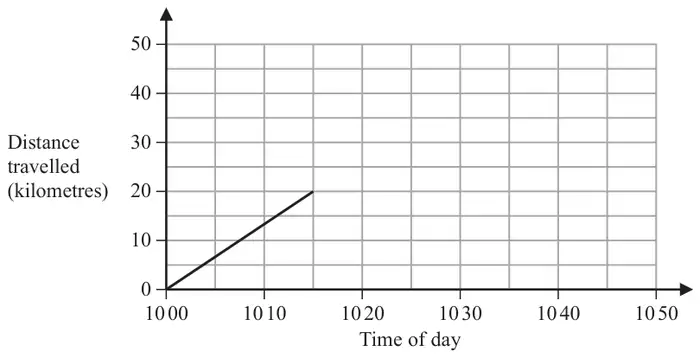
Here is the travel graph for the first 15 minutes of his journey.
(a) Work out Sam’s speed, in km/h, for the first 15 minutes of his journey. (2)
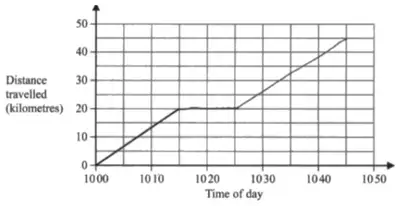
At 10 15 Sam stops for 10 minutes and then drives for 20 minutes at a speed of 75 km/h.
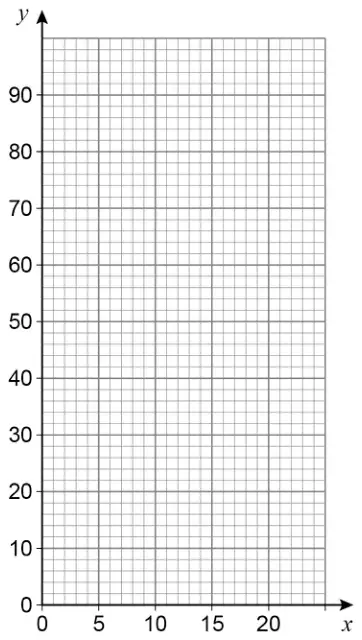
(b) On the grid, complete the travel graph for Sam’s journey. (3)
Mark scheme (a)
Answer
Mark
Mark scheme
80
M1
for a complete method eg \(\dfrac{20}{15} \times 60\) or \(20 \times 4\) or \(20 \div \dfrac{1}{4}\)
A1
cao
Mark scheme (b)
Answer
Mark
Mark scheme
Travel graph
M1
for method to find distance travelled in last 20 minutes, eg \(75 \times \dfrac{20}{60}\ (= 25)\)
C2
for a fully correct travel graph
(C1
for horizontal straight line from (10 15, 20) to (10 25, 20) or for a line of the correct length and gradient to indicate a speed of 75 km/h eg straight line from (10 25, 20) to (10 45, 45))
Additional guidance
Can be implied by a distance of 25 km drawn on the graph
(b) Write down an expression, in terms of \(x\), for the average speed of the train. (1)
Mark scheme (a)
Answer
Mark
Mark scheme
3 hrs 16 mins
P1
\(196 - 60 - 60 - 60\ (= 16)\) oe or \(196 \div 60\ (= 3.26..\) or \(3.27\ldots)\) or states 3 hours in their answer (with an incorrect number of minutes or minutes left blank)
4 A water tank is empty. Anil needs to fill the tank with 2400 litres of water.
Company A supplies water at a rate of 8 litres in 1 minute 40 seconds. Company B supplies water at a rate of 2.2 gallons per minute.
1 gallon = 4.54 litres
Company A would take more time to fill the tank than Company B would take to fill the tank.
How much more time? Give your answer in minutes correct to the nearest minute. (4)
Mark scheme
Answer
Mark
Mark scheme
260
P1
conversion to common units of capacity eg \(2.2 \times 4.54\ (= 9.988)\) or \(8 \div 4.54\ (= 1.76...)\) OR for Company A \(2400 \div 4.54\ (= 528.63...)\) OR \(2400 \div 8\ (= 300)\) OR a rate per minute \(8 \div [\text{time for Company A}]\ (= 4.8\ldots)\) oe
P1
for a complete process to find the time for company A or company B in minutes. eg in litres Company A \(2400 \div \text{``}4.8\ldots\text{''}\ (= 500)\) or \(\text{``}300\text{''} \times [1\text{ min }40\text{ sec}]\ (= 500)\) or Company B \(2400 \div \text{``}9.988\text{''}\ (= 240.28...)\) OR eg in gallons Company A \(\text{``}528.63..\text{''} \div (\text{``}1.76...\text{''} \div [1\text{ min }40\text{ sec}])\ (= 500)\) or Company B \(\text{``}528.63\ldots\text{''} \div 2.2\ (= 240.28\ldots)\)
P1
for complete processes to find the times for both company A and company B in minutes.
Company A eg in litres \(2400 \div \text{``}4.8\ldots\text{''}\ (= 500)\) or \(\text{``}300\text{''} \times [1\text{ min }40\text{ sec}]\ (= 500)\) or in gallons \(\text{``}528.63..\text{''} \div (\text{``}1.76.\,..\text{''} \div [1\text{ min }40\text{ sec}])\ (= 500)\) AND Company B eg in litres \(2400 \div \text{``}9.988\text{''}\ (= 240.28...)\) or in gallons \(\text{``}528.63\ldots\text{''} \div 2.2\ (= 240.28\ldots)\)
A1
for an answer in the range 259 to 260
Additional guidance
Results of calculations may be truncated or rounded.
[time for Company A] could be 1 min 40 sec or 1.66… or 1.6 or 1.40 etc as long as it is clear it relates to 1 min 40 sec
If the answer is given within the range but then rounded incorrectly award full marks.
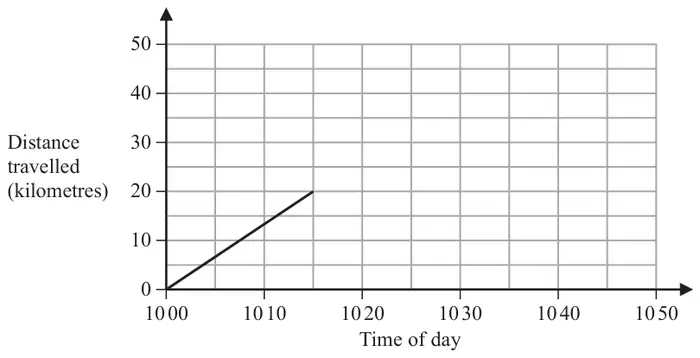
3 Sam drives his car on a journey. Here is the travel graph for the first 15 minutes of his journey.
(a) Work out Sam’s speed, in km/h, for the first 15 minutes of his journey. (2)
At 10 15 Sam stops for 10 minutes and then drives for 20 minutes at a speed of 75 km/h.
(b) On the grid, complete the travel graph for Sam’s journey. (3)
Mark scheme (a)
Answer
Mark
Mark scheme
80
M1
for a complete method eg \(\dfrac{20}{15} \times 60\) or \(20 \times 4\) or \(20 \div \dfrac{1}{4}\)
A1
cao
Mark scheme (b)
Answer
Mark
Mark scheme
Travel graph
M1
for method to find distance travelled in last 20 minutes, eg \(75 \times \dfrac{20}{60}\ (= 25)\)
C2
for a fully correct travel graph
(C1
for horizontal straight line from (10 15, 20) to (10 25, 20) or for a line of the correct length and gradient to indicate a speed of 75 km/h eg a straight line from (10 25, 20) to (10 45, 45))
Additional guidance
Can be implied by a distance of 25 km drawn on the graph
27 Nimer was driving to a hotel. He looked at his Sat Nav at 13 30
Time
13 30
Distance to destination
65 miles
Nimer arrived at the hotel at 14 48
Work out the average speed of the car from 13 30 to 14 48 You must show all your working. (4)
Mark scheme
Answer
Mark
Mark scheme
50
B1
for finding the time difference, eg, 1hr 18 mins or 78 mins oe
P1
for correct process to convert minutes to hours, eg \(18 \div 60\ (=0.3)\) or \(78 \div 60\ (=1.3)\) or for a correct process to convert speed in miles per minute to mph eg \(\text{``}0.833...\text{''} \times 60\)
P1
for using speed = distance \(\div\) time eg, \(65 \div [\text{time}]\) or \(65 \div 78\ (=0.833...)\)
A1
cao
SCB2 for 83(.333...) seen as the answer
Additional guidance
For the B1: Allow 1.18 for this mark 118 scores B0
For the first P1: For a conversion of time or speed
For the second P1: [time] is what the candidate clearly indicates as time difference
13 Liquid A and liquid B are mixed together in the ratio 2 : 13 by volume to make liquid C.
Liquid A has density 1.21 g/cm3 Liquid B has density 1.02 g/cm3
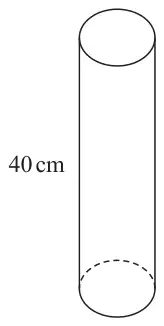
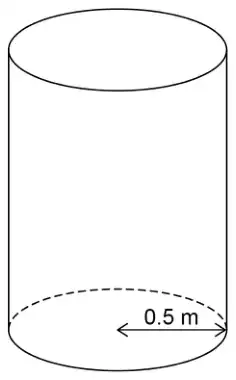
A cylindrical container is filled completely with liquid C. The cylinder has radius 3 cm and height 25 cm.
Work out the mass of the liquid in the container. Give your answer correct to 3 significant figures. You must show all your working. (4)
Mark scheme
Answer
Mark
Mark scheme
739
P1
process to find the volume of C, eg \(\pi \times 3^2 \times 25\) (= 706.8583471 or \(225\pi\))
P1
process to find the volume of A or the volume of B, eg \(\text{``}706.8\ldots\text{''} \times \dfrac{2}{2 + 13}\) (= 94.24777961 or \(30\pi\)) or \(\text{``}706.8\ldots\text{''} \times \dfrac{13}{2 + 13}\) (= 612.6105675 or \(195\pi\)) or process to work with density and ratio, eg \((2 \times 1.21 + 13 \times 1.02)\ (= 15.68)\)
P1
process to find the mass of C, eg \(\text{``}30\pi\text{''} \times 1.21\ (= 114.0398133) + \text{``}195\pi\text{''} \times 1.02\ (= 624.8627788)\) or \(\text{``}225\pi\text{''} \times \text{``}15.68\text{''} \div (2 + 13)\)
A1
for an answer in the range 738.5 to 739
Additional guidance
For use of 3.14 Volume of C is 706.5 Volume of A is 94.2 Volume of B is 612.3 Mass of A is 113.982 Mass of B is 624.546
Do not award accuracy mark if the figure is from obvious incorrect working
Jon drove into the car park at 10 45 When he drove out of the car park he had to pay 8.40 euros.
At what time did Jon drive out of the car park? (3)
Mark scheme
Answer
Mark
Mark scheme
16 35
P1
for process to find length of time in car park eg \(8.40 \div 0.024\ (= 350)\) or \(0.024 \times 60\ (= 1.44)\) and \(8.40 \div \text{``}1.44\text{''}\ (= 5.833...)\)
P1
for process to add “350” minutes to 10 45 eg 10 45 + \(60 + 60 + 60 + 60 + 60 + 50\) or 10 45 + “5 hours 50 minutes” OR for 4 35
A1
for 16 35 or 4 35 pm
Additional guidance
Do not accept incorrect interpretation of time, eg 5.83 = 5 hours 83 minutes
9 A car travels for 18 minutes at an average speed of 72 km/h.
(a) How far will the car travel in these 18 minutes? (2)
David says,
“72 kilometres per hour is faster than 20 metres per second.”
(b) Is David correct? You must show how you get your answer. (2)
Mark scheme (a)
Answer
Mark
Mark scheme
21.6
M1
for a method using distance = speed \(\times\) time, eg. \(72 \times \dfrac{18}{60}\) or 7.2 km in 6 minutes, so \(7.2 \times 3\) oe partitioning method
A1
for 21.6 oe
Additional guidance
Accept \(72 \times 18\)
Mark scheme (b)
Answer
Mark
Mark scheme
No (supported)
M1
for a method to convert 20 m/s to km/h or 72 km/h to m/s, eg. \(20 \times \dfrac{3600}{1000}\ (= 72)\) or \(72 \times \dfrac{1000}{3600}\ (= 20)\)
C1
for No since 72 km/h = 20 m/s oe
Additional guidance
Accept methods to convert both speeds to km/s or m/h
6 Nimer was driving to a hotel. He looked at his Sat Nav at 13 30
Time
13 30
Distance to destination
65 miles
Nimer arrived at the hotel at 14 48
Work out the average speed of the car from 13 30 to 14 48 You must show all your working. (4)
Mark scheme
Answer
Mark
Mark scheme
50
B1
for finding the time difference, eg, 1 hr 18 mins or 78 mins oe
P1
for correct process to convert minutes to hours, eg \(18 \div 60\ (= 0.3)\) or \(78 \div 60\ (= 1.3)\) or for a correct process to convert speed in miles per minute to mph eg \(\text{``}0.833..\text{''} \times 60\)
P1
for using speed = distance ÷ time eg, \(65 \div [\text{time}]\) or \(65 \div 78\ (= 0.833..)\)
A1
cao
SC B2 for 83(.333…) seen as the answer
Additional guidance
Allow 1.18 for this mark 118 scores B0
For a conversion of time or speed
[time] is what the candidate clearly indicates as time difference
22 In October Sally drove 560 miles in her car. The car travelled 34.5 miles for each gallon of petrol used.
Petrol cost £1.08 per litre. 1 gallon \(=\) 4.55 litres.
Work out the cost of the petrol the car used in October. (4)
Mark scheme
Answer
Mark
Mark scheme
79.76
P1
process to find number of gallons eg \(560 \div 34.5\ (=16.23\ldots)\) OR finding the miles per litre eg \(34.5 \div 4.55\ (=7.582\ldots)\)
P1
process to convert from gallons to litres eg \(\text{``}16.23\text{''} \times 4.55\ (=73.855\ldots)\) OR to work out the cost per gallon eg \(4.55 \times 1.08\ (=4.914)\) OR finding the number of litres eg \(560 \div \text{``}7.582\ldots\text{''}\ (=73.859\ldots)\)
P1
(dep P2) for a complete process to work out the cost using the operations \((560 \div 34.5) \times 4.55 \times 1.08\) eg \(\text{``}73.855\ldots\text{''} \times 1.08\ (=79.763\ldots)\) or \(\text{``}4.914\text{''} \times \text{``}16.23\ldots\text{''}\ (=79.763\ldots)\) or \(\text{``}73.859\ldots\text{''} \times 1.08\ (=79.763\ldots)\)
13 The density of ethanol is 1.09 g/cm3 The density of propylene is 0.97 g/cm3
60 litres of ethanol are mixed with 128 litres of propylene to make 188 litres of antifreeze.
Work out the density of the antifreeze. Give your answer correct to 2 decimal places. (4)
Mark scheme
Answer
Mark
Mark scheme
1.01
P1
for \(1.09 \times 60\) (= 65.4 or \(\dfrac{327}{5}\)) or \(0.97 \times 128\) (= 124.16 or \(\dfrac{3104}{25}\))
P1
for \(1.09 \times 60\) (= 65.4 or \(\dfrac{327}{5}\)) and \(0.97 \times 128\) (= 124.16 or \(\dfrac{3104}{25}\)) or \(\text{``}65.4\text{''} + \text{``}124.16\text{''}\) (= 189.56 or \(\dfrac{4739}{25}\))
P1
for a complete process to find the density of antifreeze eg \((\text{``}65.4\text{''} + \text{``}124.16\text{''}) \div 188\) or \(189.56 \div 188\) or \(\dfrac{4739}{25} \div 188\)
A1
for answer in the range 1.00 to 1.01
Additional guidance
Note that the volumes may be converted to ml, eg \(1.09 \times 60000\ (= 65400)\)
Candidates working in ml must use 188,000
If an answer within the range is seen in working but then rounded incorrectly award full marks. Accept 1 for 1.00 Note that the correct value is 1.008.....
11 In May 2019, the distance between Earth and Mars was \(3.9 \times 10^7\) km.
In May 2019, a signal was sent from Earth to Mars. Assuming that the signal sent from Earth to Mars travelled at a speed of \(3 \times 10^5\) km per second,
(a) how long did the signal take to get to Mars? (2)
The speed of the signal sent from Earth to Mars in May 2019 was actually less than \(3 \times 10^5\) km per second.
(b) How will this affect your answer to part (a)? (1)
Mark scheme (a)
Answer
Mark
Mark scheme
130
P1
for process to divide eg \((3.9 \times 10^7) \div (3 \times 10^5)\)
A1
cao
Additional guidance
Condone missing brackets
Accept \(1.3 \times 10^2\)
Mark scheme (b)
Answer
Mark
Mark scheme
Explanation
C1
Explanation referring to the time Acceptable examples The time will be more It will take longer The answer will be bigger Not acceptable examples The answer will be wrong The answer will be different
She completed a ski race in 1 minute 54 seconds. The race was 475 m in length.
Lara assumes that her average speed is the same for each race.
(a) Using this assumption, work out how long Lara should take to complete a 700 m race. Give your answer in minutes and seconds. (3)
Lara’s average speed actually increases the further she goes.
(b) How does this affect your answer to part (a)? (1)
Mark scheme (a)
Answer
Mark
Mark scheme
2 mins 48 secs
P1
for an appropriate first step eg \(700 \div 475\) (=1.47..) or \(475 \div\) [time] (= 4.16.. m/s) or [time] \(\div\ 475\) (= 0.24 s/m)
P1
for a complete process to find the required time eg \(700 \div 475 \times\) [time] (=168) or \(700 \div (475 \div\) [time]\()\) (=168) or [time] \(\div\ 475 \times 700\) (=168)
A1
cao
Additional guidance
[time] what candidate indicates as time of first race Units are not needed and can be ignored if given
Allow calculation in stages and appropriate rounding.
Mark scheme (b)
Answer
Mark
Mark scheme
Statement
C1
eg takes less time Acceptable examples Quicker time Faster time Reduces my answer to part (a)
Not acceptable examples It is an underestimate The amount of time could/may increase Laura goes faster
24 A plane travels at a speed of 213 miles per hour.
(a) Work out an estimate for the number of seconds the plane takes to travel 1 mile. (3)
(b) Is your answer to part (a) an underestimate or an overestimate? Give a reason for your answer. (1)
Mark scheme (a)
Answer
Mark
Mark scheme
16 to 20
P1
for using \(\text{time} = \dfrac{\text{distance}}{\text{speed}}\), eg \(\dfrac{1}{200}\) or \(\dfrac{1}{213}\) or for 1 hour \(= 60 \times 60\ (= 3600)\) seconds
(dep on correct use of \(\text{time} = \dfrac{\text{distance}}{\text{speed}}\)) for reason related to their response to part(a), eg overestimate as speed rounded down
18 A high speed train travels a distance of 487 km in 3 hours.
The distance is measured correct to the nearest kilometre. The time is measured correct to the nearest minute.
By considering bounds, work out the average speed, in km/minute, of the train to a suitable degree of accuracy. You must show all your working and give a reason for your answer. (5)
Mark scheme
Answer
Mark
Mark scheme
2.7 with statement
B1
for 179.5 or 180.5 or 180.4999...
B1
for 486.5 or 487.5 or 487.4999...
P1
for a correct process to find a bound for average speed, eg [upper bound of distance] ÷ [lower bound of time] where \(487 \lt\) [UB of distance] \(\leqslant 487.5\) and \(179.5 \leqslant\) [LB of time] \(\lt 180\) or for [lower bound of distance] ÷ [upper bound of time] where \(486.5 \leqslant\) [LB of distance] \(\lt 487\) and \(180 \lt\) [UB of time] \(\leqslant 180.5\)
A1
(dep on all previous marks) for 2.695(2…) and 2.715(8…) with both values clearly coming from working with correct values
C1
for 2.7 from 2.695… and 2.715… and statement that both LB and UB round to 2.7
Additional guidance
Accept bounds truncated or rounded to at least 4 sig fig
5 A plane travels at a speed of 213 miles per hour.
(a) Work out an estimate for the number of seconds the plane takes to travel 1 mile. (3)
(b) Is your answer to part (a) an underestimate or an overestimate? Give a reason for your answer. (1)
Mark scheme (a)
Answer
Mark
Mark scheme
16 to 20
P1
for using \(\text{time} = \dfrac{\text{distance}}{\text{speed}}\), eg \(\dfrac{1}{200}\) or \(\dfrac{1}{213}\) or for 1 hour \(= 60 \times 60\ (= 3600)\) seconds
(dep on correct use of \(\text{time} = \dfrac{\text{distance}}{\text{speed}}\)) for reason related to their response to part(a), eg overestimate as speed rounded down
She completed a ski race in 1 minute 54 seconds. The race was 475 m in length.
Lara assumes that her average speed is the same for each race.
(a) Using this assumption, work out how long Lara should take to complete a 700 m race. Give your answer in minutes and seconds. (3)
Lara’s average speed actually increases the further she goes.
(b) How does this affect your answer to part (a)? (1)
Mark scheme (a)
Answer
Mark
Mark scheme
2 mins 48 secs
P1
for an appropriate first step eg \(700 \div 475\) (=1.47..) or \(475 \div\) [time] (= 4.16.. m/s) or [time] \(\div\ 475\) (= 0.24 s/m)
P1
for a complete process to find the required time eg \(700 \div 475 \times\) [time] (=168) or \(700 \div (475 \div\) [time]\()\) (=168) or [time] \(\div\ 475 \times 700\) (=168)
A1
cao
Additional guidance
[time] what candidate indicates as time of first race Units are not needed and can be ignored if given
Allow calculation in stages and appropriate rounding.
Mark scheme (b)
Answer
Mark
Mark scheme
Statement
C1
eg takes less time Acceptable examples Quicker time Faster time Reduces my answer to part (a)
Not acceptable examples It is an underestimate The amount of time could/may increase Laura goes faster
The force is increased by 10 newtons. The area is increased by 10 cm2
Helen says,
“The pressure decreases by less than 20%”
Is Helen correct? You must show how you get your answer. (3)
Mark scheme
Answer
Mark
Mark scheme
No (supported)
P1
For a process to calculate the initial or new pressure, eg \((70 + 10) \div (20 + 10)\) (=2.6 to 2.7) or \(80 \div 30\) (=2.6 to 2.7) or \(70 \div 20\) (=3.5)
P1
For a complete process to make a comparison eg. \(0.8 \times \text{``}3.5\text{''}\) (=2.8) OR \(\dfrac{(\text{``}3.5\text{''} - \text{``}2.6\text{''})}{\text{``}3.5\text{''}} \times 100\) (=22 to 26) OR \(\text{``}3.5\text{''} \times 0.2\) (=0.7) and \(80 \div 30\) (=2.6 to 2.7) OR \(\dfrac{\text{``}2.6\text{''}}{\text{``}3.5\text{''}}\ (\times\ 100)\) (=0.74 to 0.78 or 74 to 78)
A1
for a correct conclusion supported by accurate figures eg 2.8 and 2.6(6…) OR decrease is 24% (or 22% to 26%) OR 0.7 and 2.6 to 2.7 and 3.5 OR 0.7 and 0.9 OR 0.76 (or 0.74 to 0.78) OR 76% (or 74% to 78%)
Additional guidance
Accept any value in the range 2.6 to 2.7 if unsupported by working
22 A cycle race across America is 3069.25 miles in length.
Juan knows his average speed for his previous races is 15.12 miles per hour. For the next race across America he will cycle for 8 hours per day.
(a) Estimate how many days Juan will take to complete the race. (3)
Juan trains for the race. The average speed he can cycle at increases. It is now 16.27 miles per hour.
(b) How does this affect your answer to part (a)? (1)
Mark scheme (a)
Answer
Mark
Mark scheme
Estimated value
P1
for using a rounded value in a correct process eg \(3000 \div 15\) or \(15 \times 8\) or \(20 \times 8\)
P1
for a full process to find the number of days eg \(\text{``}3000\text{''} \div \text{``}15\text{''} \div \text{``}10\text{''}\ (= 20)\) or \(\text{``}3000\text{''} \div \text{``}15\text{''} \div 8\ (= 25)\)
A1
for a correct answer following through their rounded values
Additional guidance
Their rounded value must be used in a calculation
Rounding may appear after a correct process eg \(15.12 \times 8 = 120.96 \approx 100\) followed by eg \(3069.25 \div 100\)
Accept \(3069.25 \div 15.12 \div 8\) oe
Mark scheme (b)
Answer
Mark
Mark scheme
Explanation
C1
eg less days required or it doesn’t affect the answer because I would still round 16.27 down to 15 (or up to 20)
21 Jackson is trying to find the density, in g/cm3, of a block of wood. The block of wood is in the shape of a cuboid.
He measures
the length as 13.2 cm, correct to the nearest mm the width as 16.0 cm, correct to the nearest mm the height as 21.7 cm, correct to the nearest mm
He measures the mass as 1970 g, correct to the nearest 5 g.
By considering bounds, work out the density of the wood. Give your answer to a suitable degree of accuracy. You must show all your working and give a reason for your final answer. (5)
Mark scheme
Answer
Mark
Mark scheme
0.43
B1
for one correct bound for mass or length eg 1967.5 or 1972.5 or 13.15 or 15.95 or 21.65 or 13.25 or 16.05 or 21.75
P1
for a correct process to find a bound for the volume, eg \(13.15 \times 15.95 \times 21.65\) (=454(0.925125)) or \(13.25 \times 16.05 \times 21.75\) (=462(5.409375))
P1
for a correct process to find a bound for density, eg [mass LB] \(\div\ \text{``}462(5.409375)\text{''}\) (=0.425(367755)) where \(1965 \leqslant\) mass LB \(\lt 1970\) or [mass UB] \(\div\ \text{``}454(0.925125)\text{''}\) (=0.434(3828506)) where \(1970 \lt\) mass UB \(\leqslant 1975\)
A1
for both correct bounds, 0.425(367755) and 0.434(3828506)
C1
(dep on A1) for a correct statement on degree of accuracy e.g. UB and LB both round to 0.43 to 2 decimal places or 2 significant figures
Additional guidance
B1: Can work in any units
P1 (volume): Accept volumes truncated or rounded to at least 3 sig fig
P1 (density): Accept densities truncated or rounded to at least 3 sig fig
A1: Accept bounds truncated or rounded to at least 3 sig fig At this point correct units must be used
The force is increased by 10 newtons. The area is increased by 10 cm2
Helen says,
“The pressure decreases by less than 20%”
Is Helen correct? You must show how you get your answer. (3)
Mark scheme
Answer
Mark
Mark scheme
No (supported)
P1
For a process to calculate the initial or new pressure, eg \((70 + 10) \div (20 + 10)\) (=2.6 to 2.7) or \(80 \div 30\) (=2.6 to 2.7) or \(70 \div 20\) (=3.5)
P1
For a complete process to make a comparison eg. \(0.8 \times \text{``}3.5\text{''}\) (=2.8) OR \(\dfrac{(\text{``}3.5\text{''} - \text{``}2.6\text{''})}{\text{``}3.5\text{''}} \times 100\) (=22 to 26) OR \(\text{``}3.5\text{''} \times 0.2\) (=0.7) and \(80 \div 30\) (=2.6 to 2.7) OR \(\dfrac{\text{``}2.6\text{''}}{\text{``}3.5\text{''}}\ (\times\ 100)\) (=0.74 to 0.78 or 74 to 78)
A1
for a correct conclusion supported by accurate figures eg 2.8 and 2.6(6…) OR decrease is 24% (or 22% to 26%) OR 0.7 and 2.6 to 2.7 and 3.5 OR 0.7 and 0.9 OR 0.76 (or 0.74 to 0.78) OR 76% (or 74% to 78%)
Additional guidance
Accept any value in the range 2.6 to 2.7 if unsupported by working
4 A cycle race across America is 3069.25 miles in length.
Juan knows his average speed for his previous races is 15.12 miles per hour. For the next race across America he will cycle for 8 hours per day.
(a) Estimate how many days Juan will take to complete the race. (3)
Juan trains for the race. The average speed he can cycle at increases. It is now 16.27 miles per hour.
(b) How does this affect your answer to part (a)? (1)
Mark scheme (a)
Answer
Mark
Mark scheme
Estimated value
P1
for using a rounded value in a correct process eg \(3000 \div 15\) or \(15 \times 8\) or \(20 \times 8\)
P1
for a full process to find the number of days eg \(\text{``}3000\text{''} \div \text{``}15\text{''} \div \text{``}10\text{''}\ (= 20)\) or \(\text{``}3000\text{''} \div \text{``}15\text{''} \div 8\ (= 25)\)
A1
for a correct answer following through their rounded values
Additional guidance
Their rounded value must be used in a calculation
Rounding may appear after a correct process eg \(15.12 \times 8 = 120.96 \approx 100\) followed by eg \(3069.25 \div 100\)
Accept \(3069.25 \div 15.12 \div 8\) oe
Mark scheme (b)
Answer
Mark
Mark scheme
Explanation
C1
eg less days required or it doesn’t affect the answer because I would still round 16.27 down to 15 (or up to 20)
Work out the volume of the gold bar. Give your answer correct to 3 significant figures. (3)
Mark scheme
Answer
Mark
Notes
648
M2
a complete method, eg \(12.5 \times 1000 \div 19.3\)
[M1
for using volume = mass/density, eg \(12500 \div 19.3\) (condone inconsistent units or incorrect conversions) may be implied by digits 647... or 648... ]
20 Olly drove 56 km from Liverpool to Manchester. He then drove 61 km from Manchester to Sheffield.
Olly’s average speed from Liverpool to Manchester was 70 km/h. Olly took 75 minutes to drive from Manchester to Sheffield.
(a) Work out Olly’s average speed for his total drive from Liverpool to Sheffield. (4)
Janie drove from Barnsley to York.
Janie’s average speed from Barnsley to Leeds was 80 km/h. Her average speed from Leeds to York was 60 km/h.
Janie says that the average speed from Barnsley to York can be found by working out the mean of 80 km/h and 60 km/h.
(b) If Janie is correct, what does this tell you about the two parts of Janie’s journey? (1)
Mark scheme (a)
Answer
Mark
Notes
57.1
P1
for a process to find time from Liverpool to Manchester, eg. \(56 \div 70\ (= 0.8\) (hrs) or 48 (mins))
P1
for a process to find the total distance, eg \(56 + 61\ (= 117)\) or the total time, eg \(\text{``}48\text{''} + 75\ (= 123)\) or \(\text{``}0.8\text{''} + \dfrac{75}{60}\ (= 2.05)\), with consistent units of time
P1
(dep P2) for a correct process to find average speed with consistent units of time, eg. \(\text{``}117\text{''} \div \text{``}2.05\text{''}\) or \(\text{``}117\text{''} \div \text{``}123\text{''}\)
A1
for answer in the range 57 to 57.1
Mark scheme (b)
Answer
Mark
Notes
explanation
C1
for explaining that the time taken for the two parts of the journey must be the same or the distance from Leeds to York is \(\frac{3}{4}\) the distance from Barnsley to Leeds oe (corrected from the printed mark scheme: it says “\(\frac{3}{4}\) the distance from Barnsley to York”; with equal times the Leeds to York distance is \(\frac{3}{4}\) of the Barnsley to Leeds distance, or \(\frac{3}{7}\) of the whole journey)
20 The density of apple juice is 1.05 grams per cm³. The density of fruit syrup is 1.4 grams per cm³. The density of carbonated water is 0.99 grams per cm³.
25 cm³ of apple juice are mixed with 15 cm³ of fruit syrup and 280 cm³ of carbonated water to make a drink with a volume of 320 cm³.
Work out the density of the drink. Give your answer correct to 2 decimal places. (4)
Mark scheme
Answer
Mark
Notes
1.01
P1
fruit syrup \(15 \times 1.4\ (= 21)\) or water \(280 \times 0.99\ (= 277.2)\) or apple juice \(25 \times 1.05\ (= 26.25)\)
P1
(dep P1) for complete process to find the total mass e.g. \(\text{``}277.2\text{''} + \text{``}26.25\text{''} + \text{``}21\text{''}\ (= 324.45)\) or a weighted density eg \(15 \times 1.4 \div 320\ (= 0.065625)\) or \(280 \times 0.99 \div 320\ (= 0.86625)\) or \(25 \times 1.05 \div 320\ (= 0.08203125)\)
P1
(dep P2) for complete process to find the density eg \(\text{``}324.45\text{''} \div 320\ (=1.01..)\) or \(\text{``}0.065625\text{''} + \text{``}0.86625\text{''} + \text{``}0.08203125\text{''}\ (= 1.0139..)\)
17 A train travelled along a track in 110 minutes, correct to the nearest 5 minutes.
Jake finds out that the track is 270 km long. He assumes that the track has been measured correct to the nearest 10 km.
(a) Could the average speed of the train have been greater than 160 km/h? You must show how you get your answer. (4)
Jake’s assumption was wrong. The track was measured correct to the nearest 5 km.
(b) Explain how this could affect your decision in part (a). (1)
Mark scheme (a)
Answer
Mark
Notes
No (supported)
P1
for 265 or 275 or 274.999... or 107.5 or 112.5 or 112.4999...
P1
process to find \(\dfrac{d}{t}\) where \(270 \lt d \leqslant 275\) and \(107.5 \leqslant t \lt 110\) oe
P1
for process to work in consistent units of time eg \(\dfrac{d}{t} \times 60\) or \(t \div 60\) where \(265 \leqslant d \leqslant 275\) and \(107.5 \leqslant t \lt 110\) oe or \(160 \div 60\ (= 2.666..)\)
C1
Conclusion supported with correct figure(s) given eg No and 153(.488..) or No and 2.66 to 2.7 and 2.5(581..) from correct working
Mark scheme (b)
Answer
Mark
Notes
Statement
C1
e.g. Less distance in the same time so (max) speed would drop
6 The density of apple juice is 1.05 grams per cm³. The density of fruit syrup is 1.4 grams per cm³. The density of carbonated water is 0.99 grams per cm³.
25 cm³ of apple juice are mixed with 15 cm³ of fruit syrup and 280 cm³ of carbonated water to make a drink with a volume of 320 cm³.
Work out the density of the drink. Give your answer correct to 2 decimal places. (4)
Mark scheme
Answer
Mark
Notes
1.01
P1
fruit syrup \(15 \times 1.4\ (= 21)\) or water \(280 \times 0.99\ (= 277.2)\) or apple juice \(25 \times 1.05\ (= 26.25)\)
P1
(dep P1) for complete process to find the total mass e.g. \(\text{``}277.2\text{''} + \text{``}26.25\text{''} + \text{``}21\text{''}\ (= 324.45)\) or a weighted density eg \(15 \times 1.4 \div 320\ (= 0.065625)\) or \(280 \times 0.99 \div 320\ (= 0.86625)\) or \(25 \times 1.05 \div 320\ (= 0.08203125)\)
P1
(dep P2) for complete process to find the density eg \(\text{``}324.45\text{''} \div 320\ (=1.01..)\) or \(\text{``}0.065625\text{''} + \text{``}0.86625\text{''} + \text{``}0.08203125\text{''}\ (= 1.0139..)\)
4 Olly drove 56 km from Liverpool to Manchester. He then drove 61 km from Manchester to Sheffield.
Olly’s average speed from Liverpool to Manchester was 70 km/h. Olly took 75 minutes to drive from Manchester to Sheffield.
(a) Work out Olly’s average speed for his total drive from Liverpool to Sheffield. (4)
Janie drove from Barnsley to York.
Janie’s average speed from Barnsley to Leeds was 80 km/h. Her average speed from Leeds to York was 60 km/h.
Janie says that the average speed from Barnsley to York can be found by working out the mean of 80 km/h and 60 km/h.
(b) If Janie is correct, what does this tell you about the two parts of Janie’s journey? (1)
Mark scheme (a)
Answer
Mark
Notes
57.1
P1
for a process to find time from Liverpool to Manchester, eg. \(56 \div 70\ (= 0.8\) (hrs) or 48 (mins))
P1
for a process to find the total distance, eg \(56 + 61\ (= 117)\) or the total time, eg \(\text{``}48\text{''} + 75\ (= 123)\) or \(\text{``}0.8\text{''} + \dfrac{75}{60}\ (= 2.05)\), with consistent units of time
P1
(dep P2) for a correct process to find average speed with consistent units of time, eg. \(\text{``}117\text{''} \div \text{``}2.05\text{''}\) or \(\text{``}117\text{''} \div \text{``}123\text{''}\)
A1
for answer in the range 57 to 57.1
Mark scheme (b)
Answer
Mark
Notes
explanation
C1
for explaining that the time taken for the two parts of the journey must be the same or the distance from Leeds to York is \(\dfrac{3}{4}\) of the distance from Barnsley to Leeds
18 Ibrar mixes 74 g of lead and 126 g of tin to make 200 g of an alloy. Lead has a density of 11.34 g/cm\(^3\). Tin has a density of 7.31 g/cm\(^3\).
Work out the density of the alloy. Give your answer correct to 1 decimal place. (3)
Mark scheme
Answer
Mark
Notes
8.4
3
M1 for using \(d = m/v\) e.g. \(11.34 = 74/V\) or vol. of lead (= 6.5(25...)) or vol. of tin (= 17.2(3...)) M1 (dep) for a complete method using \(200 \div\) “total volume” A1 for answer in range 8.4 to 8.44
21 David drives to the supermarket on his way home from work. The table shows some information about his journey.
Time
Leaves work
1730
Gets to supermarket
1745
Leaves supermarket
1810
(a) How many minutes is David at the supermarket? (1)
David leaves the supermarket at 1810 He drives 20 miles to his home. The speed limit for the journey is 30 mph. David drives within the speed limit.
*(b) Can David get home before 1900? Give reasons for your answer. (3)
Mark scheme (a)
Answer
Mark
Notes
25
1
B1 cao
Mark scheme (b)
Answer
Mark
Notes
yes with correct comparative figures
3
M1 for method to calculate journey time travelling at 30 mph, eg \(\frac{20}{30}\) (= 0.66…) or 40 (mins) M1 (dep) for method to work out arrival time at home, (consistent units), eg 18 10 + “40 mins” (= 18 50) C1 for yes with comparison of 40 minutes with 50 minutes or stating arrival time home as 18 50
OR M1 for method to calculate speed in order to get home by 1900 eg \(20 \div \frac{50}{60}\) (= 24 mph) M1 (dep) for stating speed as 24 mph C1 for yes with supporting calculations showing speed as 24 mph
11 Colin works on 5 days each week. Each day he drives from his home to work and from work to his home.
Colin pays £3.50 each day to use the car park at work.
The distance from Colin’s home to work is 18 miles. Colin’s car uses one gallon of petrol every 45.2 miles.
1 litre of petrol costs 136.9p 1 gallon = 4.546 litres
Work out the total cost for Colin to use his car for work each week. You must show all your working. (5)
Mark scheme
Answer
Mark
Notes
42.28
5
M1 for method to find weekly mileage, eg. \(18 \times 2 \times 5\) (= 180) or weekly car park charge, eg. \(3.50 \times 5\) (= 17.50)
M1 for method to find fuel used in a relevant journey, eg. \(\text{``}180\text{''} \div 45.2\) (= 3.9823 gallons) or \(18 \div 45.2\) (= 0.39823 gallons)
M1 for a correct use of the conversion factor to convert between gallons and litres, eg. \(\text{``}3.9823\text{''} \times 4.546\) (= 18.1 …. litres) or \(\text{``}0.39823\text{''} \times 4.546\) (= 1.81 …. litres) or \(1.369 \times 4.546\) (= 6.22... £/gallon) or \(45.2 \div 4.546\) (= 9.94… miles/litre)
M1 for a method to find the cost of a relevant journey, eg. \(\text{``}18.1\ldots\text{''} \times 1.369\) (= 24.78 …) or \(\text{``}1.81\ldots\text{''} \times 1.369\) (= 2.478 …) or \(\text{``}3.9823\text{''} \times \text{``}6.22...\text{''}\) (= 24.78...)
A1 for answer in the range 42.26 to 42.3(0)
NB candidates could work in litres or in gallons and/or could work in £ or p
Table for use in Question 11
Journeys in miles
Fuel used in gallons; miles ÷ 45.2
Fuel used in litres, gallons × 4.546
Cost of journey in £, litres × 1.369 or gallons × 6.22...
11 Manchester airport is on a bearing of \(330^\circ\) from a London airport.
(a) Find the bearing of the London airport from Manchester airport. (2)
The London airport is 200 miles from Manchester airport. A plane leaves Manchester airport at 10 am to fly to the London airport. The plane flies at an average speed of 120 mph.
(b) What time does the plane arrive at the London airport? (4)
Mark scheme (a)
Answer
Mark
Notes
150
2
M1 for \(180 - (360 - 330)\) or \(180 - 30\) or \(330 - 180\) or a complete diagram showing the bearing of \(330^\circ\) A1 cao
Mark scheme (b)
Answer
Mark
Notes
11 40
4
M1 for \(200 \div 120\) \(\left(= 1\tfrac{2}{3}\text{ h}\right)\) M1 for conversion between hours and minutes A1 for 1 h 40 min or 100 minutes B1 (ft dep on M1) for 11 40
4 There are 18 500 gallons of fuel in a fuel tank.
The fuel is pumped from the fuel tank into a plane at a rate of 1700 litres per minute.
1 gallon = 4.5 litres.
How many minutes will it take to empty the fuel tank completely? Give your answer to the nearest minute. (3)
Mark scheme
Answer
Mark
Notes
49
3
M1 for converting calculations to common units (either system is acceptable) M1 for dividing their total capacity by the refuelling rate A1 48.9 - 49.1
16 Liquid A has a density of 0.7 g/cm\(^3\). Liquid B has a density of 1.6 g/cm\(^3\).
140 g of liquid A and 128 g of liquid B are mixed to make liquid C.
Work out the density of liquid C. (4)
Mark scheme
Working
Answer
Mark
Notes
Volume of A = \(\dfrac{140}{0.7} = 200\) Volume of B = \(\dfrac{128}{1.6} = 80\) Mass of C = \(140 + 128 = 268\)
Density of C = \(\dfrac{268}{280}\)
0.957
4
M1 for finding the volume of either liquid A or B or the mass of liquid C M1 for a complete method to find the volume AND mass of liquid C M1 (dep M2) for “total mass” ÷ “total volume” A1 for 0.957 to 0.96
14 The distance from Fulbeck to Ganby is 10 miles. The distance from Ganby to Horton is 18 miles.
Raksha is going to drive from Fulbeck to Ganby. Then she will drive from Ganby to Horton.
Raksha leaves Fulbeck at 10 00 She drives from Fulbeck to Ganby at an average speed of 40 mph.
Raksha wants to get to Horton at 10 35
Work out the average speed Raksha must drive at from Ganby to Horton. (3)
Mark scheme
Answer
Mark
Notes
54
3
M1 for any correct use of distance, speed, time formulae, eg. \(10 \div 40\) (=0.25) or 15 min M1 (dep) for a complete method to find speed from G to H, eg. \(18 \div (35 - \text{``}15\text{''}) \times 60\) oe. A1 cao
*23 A road is 4530 m long, correct to the nearest 10 metres. Kirsty drove along the road in 205 seconds, correct to the nearest 5 seconds.
The average speed limit for the road is 80 km/h.
Could Kirsty’s average speed have been greater than 80 km/h? You must show your working. (5)
Mark scheme
Answer
Mark
Notes
Yes, average speed could have been as high as 80.622...
5
B1 for 4535 or 4534.999... or 202.5 M1 for 4535 (oe) ÷ 202.5 M1 for ×3600 and ÷1000 A1 for 80.622... C1 (dep on first M1) for correct conclusion from their calculations
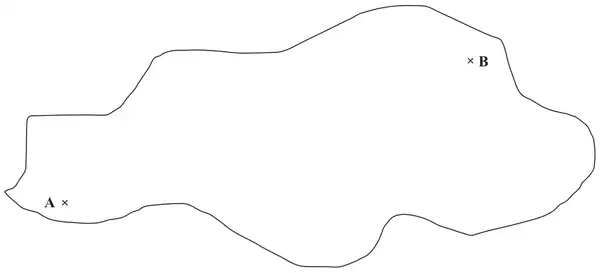
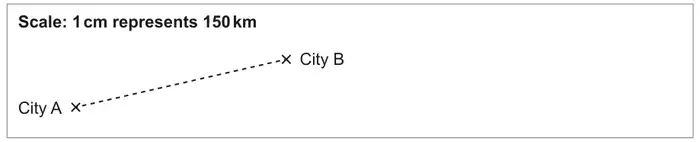
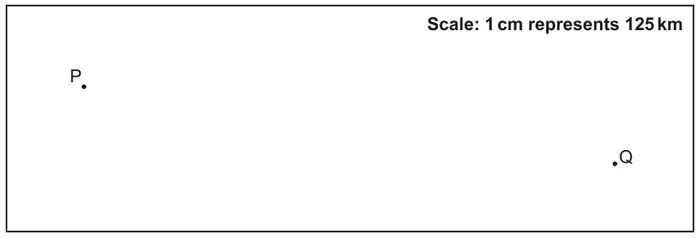
A plane flies directly from A to B. The average speed of the plane is 300 km/h.
How long does the plane take to fly from A to B? You must show all your working. (3)
Mark scheme
Answer
Mark
Notes
4
3
B1 for 11.8 – 12.2 (cm) or 1180 – 1220 (km) M1 for \(\text{``}12\text{''} \times 100 \div 300\) oe A1 for 3.9 – 4.1 from correct figures or ft from \(\text{``}12\text{''} \times 100 \div 300\) oe
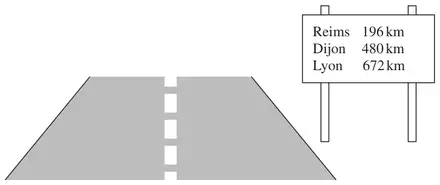
14 Emily is driving in France. She sees this sign.
Emily is going to drive to Dijon. She plans to drive at an average speed of 50 miles per hour.
Work out how long it should take Emily to drive to Dijon. (4)
Mark scheme
Answer
Mark
Notes
6 hours
4
B1 for 5 miles = 8 km or equivalent statement or for \(\dfrac{8}{5}\) or \(\dfrac{5}{8}\) used correctly M1 for \(50 \times r\) with \(1.5 \leqslant r \leqslant 1.7\) oe or \(480 \times s\) with \(0.6 \leqslant s \leqslant 0.7\) oe M1 for \(480 \div\) speed or distance \(\div 50\) A1 oe
10 miles from her friend’s house to the motorway 240 miles on the motorway 5 miles from the motorway to her home
Sue
takes 20 minutes to drive from her friend’s house to the motorway drives at an average speed of 60 mph on the motorway takes 25 minutes to drive from the motorway to her home
Sue stops for a 30 minute rest on her drive home.
Sue leaves her friend’s house at 9.00 am.
What time does Sue get home? You must show all your working. (3)
Mark scheme
Answer
Mark
Notes
2.15 pm
3
M1 for \(240 \div 60\) (=4) M1 for adding at least 3 of the 4 periods of time eg 20 (mins) + “4 (hrs)” + 25 (mins) + 30 (mins) (=5 h 15 min) oe or 2.15 without units A1 for 2.15 pm 14 15 (h or pm) oe
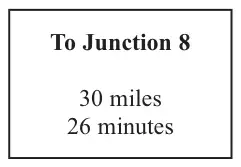
The road sign shows the distance to Junction 8 It also shows the average time drivers will take to get to Junction 8
The speed limit on the motorway is 70 mph.
Lethna says,
‘We will have to drive faster than the speed limit to go 30 miles in 26 minutes.’
Is Lethna right? You must show how you got your answer. (3)
Mark scheme
Answer
Mark
Notes
No with correct figure
3
M1 for a calculation which uses the Time × Speed = Distance relationship OR a conversion of units eg between hours & minutes or between mph & miles per min M1 for a calculation involving both of the above C1 for “no” with a correct calculation, with units, from working: 25.2 – 25.8 minutes, 30.1 – 30.8 miles, 69 – 69.3 mph Distance ÷ speed: 30 ÷ 70 (= 0.42 - 0.43); Distance ÷ time: 30 ÷ 26 (= 1.15…); Speed × time: = 70 × 26 (=1820 mins) Mph to miles/min 70 ÷ 60 (=1.16 - 1.17); Minutes to hours is 26 ÷ 60 (= 0.43…) NB 70 ÷ 26 × 30 as a single stage calculation gets 0 marks
Notes
Corrected from the printed mark scheme: “1.16 - 1.67” for 70 ÷ 60, which is 1.166…
18 On Monday Ravi drives for 4 hours. His average speed is 30 mph.
(a) How far does Ravi drive on Monday? (2)
On Tuesday Ravi drives 200 km.
5 miles = 8 kilometres.
*(b) On which day did Ravi drive further? (3)
Mark scheme (a)
Answer
Mark
Notes
120
2
M1 4 × 30 A1 cao
Mark scheme (b)
Working
Answer
Mark
Notes
125 miles > 120 miles 200 km > 192 km
Tuesday
3
M1 for 200 ÷ 8 × 5 or “120” ÷ 5 × 8 A1 for 125 or 192 or ft from “a” C1 (dep M1) Correct conclusion for their calculated figure with its correct units stated. of “125” miles and “a” miles or “192” km and 200 km
M1 for a calculation which uses the Time × Speed = Distance relationship OR a conversion of units eg between hours & minutes or between mph & miles per min M1 for a calculation involving both of the above C1 for “no” with a correct calculation, with units, from working: 25.2-25.8 minutes, 30.1-30.8 miles, 69-69.3 mph NB: \(70 \div 26 \times 30\) as a single stage calculation gets 0 marks
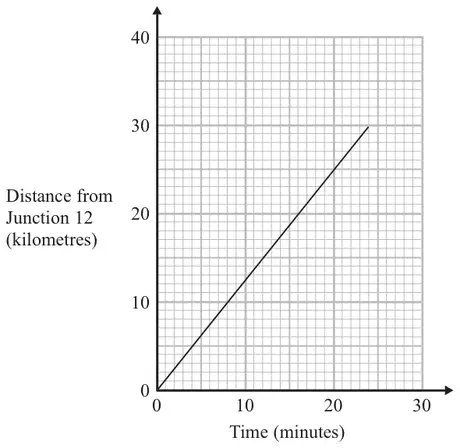
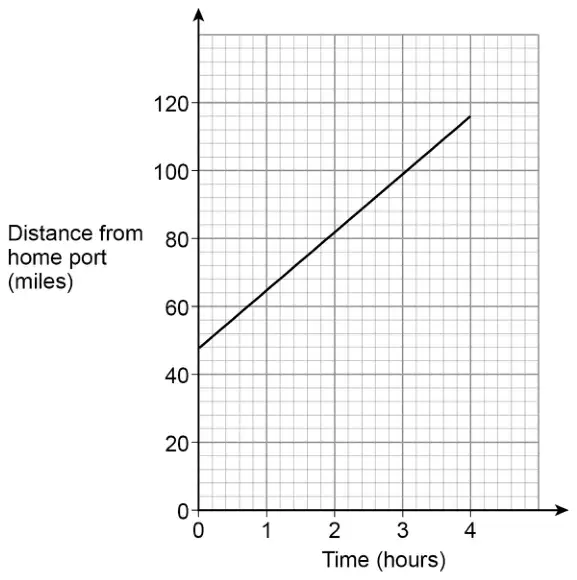
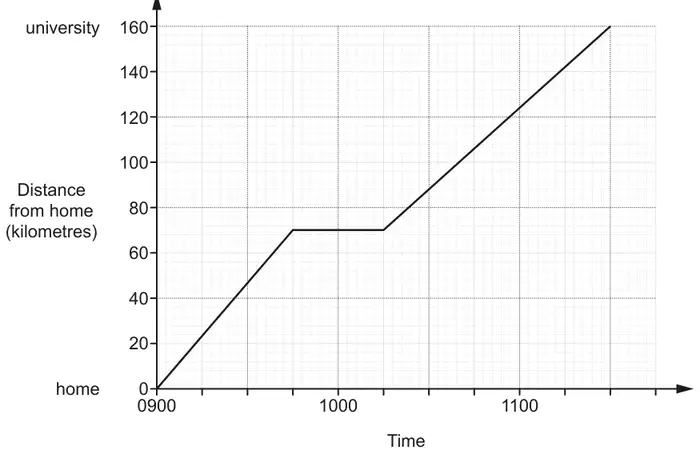
*11 Debbie drove from Junction 12 to Junction 13 on a motorway.
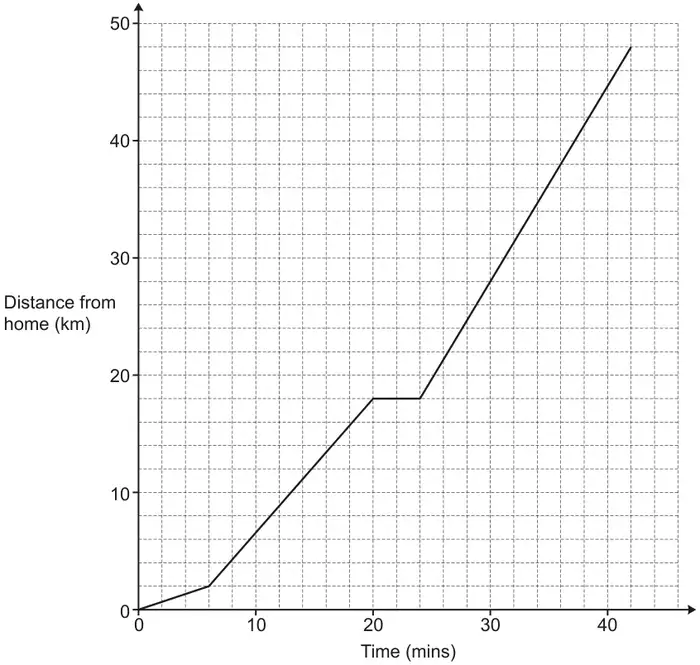
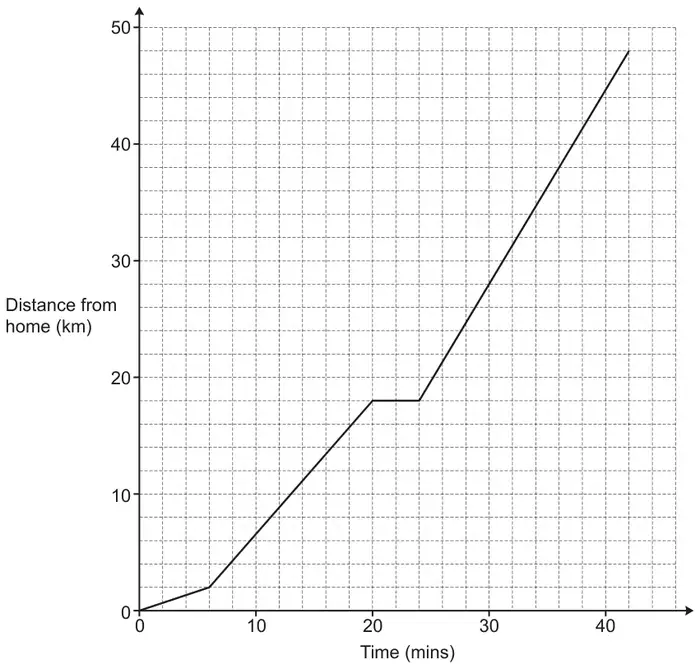
The travel graph shows Debbie’s journey.
Ian also drove from Junction 12 to Junction 13 on the same motorway. He drove at an average speed of 66 km/hour.
Who had the faster average speed, Debbie or Ian? You must explain your answer. (4)
Mark scheme
Working
Answer
Mark
Notes
\(\dfrac{30}{24} \times 60 = 75\)
Debbie + explanation
4
M1 for reading 24 (mins) and 30 (km) or a pair of other values for Debbie M1 for correct method to calculate speed eg. \(30 \div 24\) oe A1 for 74 – 76 or for 1.2 – 1.3 and 1.1 C1 (dep on M2) for correct conclusion, eg Debbie is fastest from comparison of “74 – 76” with 66 (kph) or “1.2 – 1.3” and 1.1 (km per minute)
OR
M1 for using an appropriate pair of values for Ian’s speed eg 66 and 60, 33 and 30, 11 and 10 M1 for pair of values plotted on graph A1 for correct line drawn C1 (dep on M2) for Debbie is fastest from comparison of gradients.
OR
M1 for reading 24 (mins) and 30 (km) or a pair other values for Debbie M1 for Ian’s time for same distance or Ian’s distance for same time. A1 for a pair of comparable values. C1 (dep on M2) for Debbie is fastest from comparison of comparable values.
24 Peter goes for a walk. He walks 15 miles in 6 hours.
(a) Work out Peter’s average speed. Give your answer in miles per hour. mph (2)
5 miles = 8 km. Sunita says that Peter walked more than 20 km.
*(b) Is Sunita right? You must show all your working. (2)
Mark scheme (a)
Working
Answer
Mark
Notes
\(15 \div 6\)
2.5
2
M1 for \(15 \div 6\) oe A1 for 2.5 or \(2\frac{1}{2}\)
Mark scheme (b)
Answer
Mark
Notes
Yes + evidence
2
M1 for a correct method to change 15 miles into kilometres C1(dep on M1) for 24 km and statement with correct conclusion [SC: B1 for “Yes” oe and 24 km shown if M0 scored] OR M1 for a correct method to change 20 kilometres into miles C1(dep on M1) for 12.5 miles and statement with correct conclusion [SC: B1 for “Yes” oe and 12.5 miles shown if M0 scored]
7 Peter goes for a walk. He walks 15 miles in 6 hours.
(a) Work out Peter’s average speed. Give your answer in miles per hour. (2)
5 miles = 8 km.
Sunita says that Peter walked more than 20 km.
*(b) Is Sunita right? You must show all your working. (2)
Mark scheme (a)
Answer
Mark
Notes
2.5
2
M1 for 15 ÷ 6 oe A1 for 2.5 or \(2\frac{1}{2}\)
Mark scheme (b)
Answer
Mark
Notes
Yes + evidence
2
M1 for a correct method to change 15 miles into kilometres C1 (dep M1) for 24 km and statement with correct conclusion [SC: B1 for “Yes” oe and 24 km shown if M0 scored] or M1 for a correct method to change 20 kilometres into miles C1 (dep M1) for 12.5 miles and statement with correct conclusion [SC: B1 for “Yes” oe and 12.5 miles shown if M0 scored]
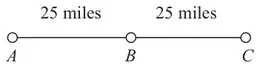
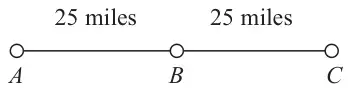
\(A\), \(B\) and \(C\) are 3 service stations on a motorway.
\(AB = 25\) miles \(BC = 25\) miles
Aysha drives along the motorway from \(A\) to \(C\).
Aysha drives at an average speed of 50 mph from \(A\) to \(B\). She drives at an average speed of 60 mph from \(B\) to \(C\).
Work out the difference in the time Aysha takes to drive from \(A\) to \(B\) and the time Aysha takes to drive from \(B\) to \(C\). Give your answer in minutes. (3)
Mark scheme
Working
Answer
Mark
Notes
\(25 \div 50 = 0.5\) h = 30 min \(25 \div 60 = 0.41\dot{6}\) h = 25 min
5
3
M1 for \(25 \div 50\) or \(\frac{60}{50} \times 25\) or 30 (min) or 0.5(h) or \(25 \div 60\) or \(\frac{60}{60} \times 25\) or 25 (min) or 0.41(6)(h) M1(dep) ‘0.5’ − ‘0.41(6)’ or ‘30’ − ‘25’ A1 cao OR M1 for \(60 \div 25\) (= 2.4) and \(60 \div\) “2.4” or \(50 \div 25\) (= 2) and \(60 \div\) “2” M1(dep) for ‘30’ − ‘25’ A1 cao
\(A\), \(B\) and \(C\) are 3 service stations on a motorway.
\(AB = 25\) miles \(BC = 25\) miles
Aysha drives along the motorway from \(A\) to \(C\).
Aysha drives at an average speed of 50 mph from \(A\) to \(B\). She drives at an average speed of 60 mph from \(B\) to \(C\).
Work out the difference in the time Aysha takes to drive from \(A\) to \(B\) and the time Aysha takes to drive from \(B\) to \(C\). Give your answer in minutes. (3)
Mark scheme
Working
Answer
Mark
Notes
25 ÷ 50 = 0.5 h = 30 min 25 ÷ 60 = 0.416 h = 25 min
5
3
M1 for 25 ÷ 50 or \(\frac{60}{50} \times 25\) or 30 (min) or 0.5(h) or 25 ÷ 60 or \(\frac{60}{60} \times 25\) or 25 (min) or 0.41(6)(h) or 0.42 (h) M1 (dep) ‘0.5’ – ‘0.416’ or ‘30’ – ‘25’ A1 cao OR M1 for 60 ÷ 25 (= 2.4) and 60 ÷ “2.4” or 50 ÷ 25 (= 2) and 60 ÷ “2” M1 (dep) ‘30’ – ‘25’ A1 cao
the mass of the empty plane is 800 kg, to the nearest 100 kg
the mass of fuel is 190 kg, to the nearest 5 kg
the mass of the passengers is 163 kg, to the nearest kg
The total mass of a plane is calculated by adding these three masses.
The maximum mass for the plane to take off safely is 1200 kg
Can this plane definitely take off safely?
Tick a box.
Yes
No
Show working to support your answer. [4 marks]
(b) A different plane travels 1250 miles in 2 hours 30 minutes at a constant speed.
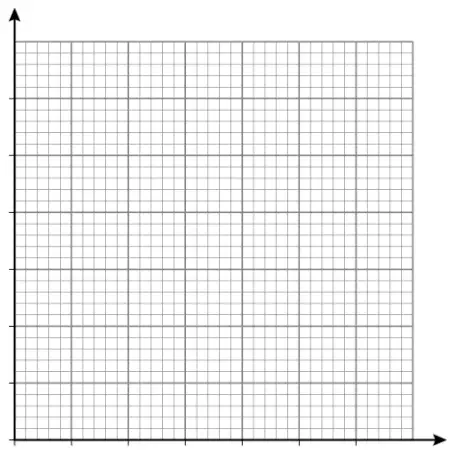
On the grid, draw a speed/time graph to represent this information. [3 marks]
Mark scheme (a)
Answer
Mark
Comments
Alternative method 1: uses the upper bounds
750 or 850 or 187.5 or 192.5 or 162.5 or 163.5
B1
condone 849.99… for 850
condone 192.49… for 192.5
condone 163.49… for 163.5
850 and 192.5 and 163.5
B1
(800, 900] + (190, 195] + (163, 164]
M1
1206 and No
A1
oe 6 kg too heavy and No
Alternative method 2: uses other values
Correct sum of three possible values that exceeds 1200 and No
B4
possible values must lie between the bounds, on the lower bound or on the upper bound eg \(849 + 192 + 163 = 1204\) and No
Additional guidance
Units not required
850 and 195 and 163.5 with answer 1208.5
B1B0M1A0
900 and 195 and 164 with answer 1259
B0B0M1A0
There are no part marks for Alt method 2
Mark to the Alt method which favours the student eg 849 and 192 and 163.5 with answer 1204.5 and ‘No’ could score B1B0M1A0 using Alt method 1, but scores B4 using Alt method 2
\(845 + 194 + 163 = 1202\) and No does not score using either Alt method
Mark scheme (b)
Answer
Mark
Comments
(Speed =) 500
B1
implied by 500 as highest point plotted or marked accept 8.33… with correct units miles per minute stated or implied
Vertical axis labelled ‘Speed’ with a linear scale to at least their 500 and Horizontal axis labelled ‘Time’ with a linear scale to at least 2 hours 30 minutes or 150 minutes
B1ft
ft their 500 which must not be 1250 accept their speed as the only value on the vertical axis and 2 hours 30 minutes as the only value on the horizontal axis ignore all units shown on their graph
Horizontal line from (0, their 500) stopping at (2 hours 30 minutes, their 500) or (150 minutes, their 500)
B1ft
ft their 500 which must not be 1250 ignore any vertical line at 2 hours 30 minutes
Additional guidance
‘Speed’ and ‘Time’ are the only acceptable labels
Use of a distance/time graph is a maximum of B1 for 500 seen
1250/150 = 8.33… miles per minute and correctly plotted with correct labelling and scales
B1B1ftB1ft
\(1250 \div 2.3 = 543\ldots\), with horizontal line from (0, 543) to (2 hours 30 minutes, 543) with correct labelling and scales
21 The graph represents the velocity of a ball as it rolls along the ground.
(a) Work out an estimate for the acceleration of the ball, in m/s\(^2\), after 2 seconds.
You must show your working. [2 marks]
(b) Work out an estimate for the total distance covered by the ball. [3 marks]
(c) Is your estimate from part (b) an overestimate or underestimate?
Tick a box.
Overestimate
Underestimate
Give a reason for your answer. [1 mark]
Mark scheme (a)
Answer
Mark
Comments
Draws a tangent at 2 seconds and [1.5, 2.5]
B2
B1 draws tangent at 2 seconds
Mark scheme (b)
Answer
Mark
Comments
[88, 95]
B3
B2 (area under curve =) [16, 22] or (area under horizontal =) 48 and (area under diagonal =) 24 implied by 72 B1 (area under horizontal =) 48 or (area under diagonal =) 24
Additional guidance
For B2 and B1 areas may be seen on the diagram
Mark scheme (c)
Answer
Mark
Comments
Underestimate and valid reason involving area under the graph
(a) On Monday, Larrs swims 50 metres in 40 seconds at a constant speed.
On Tuesday, Larrs swims 1.5 kilometres.
Assume he swims at the same constant speed as on Monday.
How many minutes does he swim for on Tuesday? [5 marks]
(b) In fact, on Tuesday Larrs swims at a slower constant speed than on Monday.
What does this mean about the number of minutes he swims for on Tuesday?
Tick the correct box. [1 mark]
It is less than the answer to part (a)
It is the same as the answer to part (a)
It is greater than the answer to part (a)
It is not possible to say
Mark scheme (a)
Answer
Mark
Comments
Alternative method 1: working in metres per second or kilometres per second
1500 (metres) or 0.05 (km)
B1
implied by 30 or 1200
their \(1500 \div 50 \times 40\) or \(1.5 \div\) their \(0.05 \times 40\) or 1200
M2
oe M1 their \(1500 \div 50\) or 30 oe or \(50 \div 40\) or 1.25 oe or \(1.5 \div\) their 0.05 oe their 1500 must be using digits 15 (and zeros) their 0.05 must be using single digit 5 (and zeros)
their \(1200 \div 60\)
M1dep
oe dep on M2
20
A1ft
ft their 1500 or their 0.05
Alternative method 2: working in metres per minute or kilometres per minute
1500 (metres) or 0.05 (km)
B1
implied by 0.075
\(40 \div 60\) or \(\dfrac{2}{3}\)
M1
oe accept [0.66, 0.67]
\(50 \div (40 \div 60)\) or 75 or \(\dfrac{\text{their } 0.05}{(40 \div 60)}\) or 0.075 or their \(1500 \times (40 \div 60)\)
M1dep
oe calculation their 1500 must be using digits 15 (and zeros) their 0.05 must be using single digit 5 (and zeros)
their \(1500 \div\) their 75 or \(1.5 \div\) their 0.075 or their \(1500 \times (40 \div 60) \div 50\)
M1dep
oe
20
A1ft
ft their 1500 or their 0.05
Additional guidance
\(1500 \div 1.25\)
B1M2
\(1.5 \div 50 \times 40\) their 1500 must be using digits 15 (and zeros)
B0M2
\(1.5 \div 0.5 \times 40\) their 0.05 must be using single digit 5 (and zeros)
B0M2
\(150 \div 50\) their 1500 must be using digits 15 (and zeros)
15 Concrete from a truck is poured at 10.9 kg per second for 30 minutes.
1000 kg \(=\) 1 tonne
Is more than 20 tonnes of concrete poured?
Tick a box.
Yes
No
You must show your working. [4 marks]
Mark scheme
Answer
Mark
Comments
Alternative method 1: works out concrete poured in 30 minutes
\(10.9 \times 30 \times 60 \div 1000\) or 19.6(2) or \(10.9 \times 30 \times 60\) or 19 620 and \(20 \times 1000\) or 20 000
M3
oe full method eg \(10.9 \times 1800 \div 1000\) or \(30 \times 654 \div 1000\) or \(19\,620 \div 1000\)
M2 two correct steps eg \(10.9 \times 30 \times 60\) or 19 620 or \(10.9 \times 30 \div 1000\) or 0.327 or \(10.9 \times 60 \div 1000\) or 0.654 or \(30 \times 60 \div 1000\) or 1.8
M1 one correct step eg \(10.9 \times 30\) or 327 or \(10.9 \times 60\) or 654 or \(10.9 \div 1000\) or 0.0109 or \(30 \times 60\) or 1800 or \(30 \div 1000\) or 0.03 or \(60 \div 1000\) or 0.06 or \(20 \times 1000\) or 20 000
19.6(2) and No or 19 620 and 20 000 and No
A1
oe eg 19.62 so it isn’t
Alternative method 2: works out time for 20 tonnes at given rate
\(20 \times 1000 \div 10.9 \div 60\) or [30.5, 30.6] or \(20 \times 1000 \div 10.9\) or [1834, 1835] and \(30 \times 60\) or 1800
M3
oe full method eg \(20\,000 \div 10.9 \div 60\) or \(20 \times [91.7, 91.74312] \div 60\) or \([1834, 1835] \div 60\) M2 two correct steps eg \(20 \times 1000 \div 10.9\) or [1834, 1835] or \(20 \times 1000 \div 60\) or 333.(…) or \(20 \div 10.9 \div 60\) or [0.0305, 0.031] or \(1000 \div 10.9 \div 60\) or [1.52, 1.53] M1 one correct step eg \(20 \times 1000\) or 20 000 or \(20 \div 10.9\) or [1.83, 1.835] or \(20 \div 60\) or 0.33(…) or \(1000 \div 10.9\) or [91.7, 91.74312] or \(1000 \div 60\) or [16.6, 16.7] or \(10.9 \times 60\) or 654 or \(30 \times 60\) or 1800
[30.5, 30.6] and No or [1834, 1835] and 1800 and No
A1
oe eg 30.6 so it isn’t
Additional guidance
Up to M2 may be awarded for correct work with no answer or incorrect answer, even if this is seen amongst multiple attempts
M3 or M2 will usually be seen in stages eg Alt 1 \(10.9 \times 30 = 327 \quad 327 \times 60 = 19\,620 \quad 19\,620 \div 1000\)
M3
M2 or M1 may be seen embedded in more than one step (extra steps could be incorrect)
No may be indicated by selecting the box or a statement in the working lines
No cannot be implied only by an inequality
A correct value is sufficient for showing working eg Alt 1 19.62 and No
M3A1
Ignore their units throughout
Other approaches are possible eg works out rate in kg per s for 20 tonnes in 30 minutes and compares to 10.9
(a) On Monday, Larrs swims 50 metres in 40 seconds at a constant speed.
On Tuesday, Larrs swims 1.5 kilometres.
Assume he swims at the same constant speed as on Monday.
How many minutes does he swim for on Tuesday? [5 marks]
(b) In fact, on Tuesday Larrs swims at a slower constant speed than on Monday.
What does this mean about the number of minutes he swims for on Tuesday?
Tick the correct box. [1 mark]
It is less than the answer to part (a)
It is the same as the answer to part (a)
It is greater than the answer to part (a)
It is not possible to say
Mark scheme (a)
Answer
Mark
Comments
Alternative method 1: working in metres per second or kilometres per second
1500 (metres) or 0.05 (km)
B1
implied by 30 or 1200
their \(1500 \div 50 \times 40\) or \(1.5 \div\) their \(0.05 \times 40\) or 1200
M2
oe M1 their \(1500 \div 50\) or 30 oe or \(50 \div 40\) or 1.25 oe or \(1.5 \div\) their 0.05 oe their 1500 must be using digits 15 (and zeros) their 0.05 must be using single digit 5 (and zeros)
their \(1200 \div 60\)
M1dep
oe dep on M2
20
A1ft
ft their 1500 or their 0.05
Alternative method 2: working in metres per minute or kilometres per minute
1500 (metres) or 0.05 (km)
B1
implied by 0.075
\(40 \div 60\) or \(\dfrac{2}{3}\)
M1
oe accept [0.66, 0.67]
\(50 \div (40 \div 60)\) or 75 or \(\dfrac{\text{their } 0.05}{(40 \div 60)}\) or 0.075 or their \(1500 \times (40 \div 60)\)
M1dep
oe calculation their 1500 must be using digits 15 (and zeros) their 0.05 must be using single digit 5 (and zeros)
their \(1500 \div\) their 75 or \(1.5 \div\) their 0.075 or their \(1500 \times (40 \div 60) \div 50\)
M1dep
oe
20
A1ft
ft their 1500 or their 0.05
Additional guidance
\(1500 \div 1.25\)
B1M2
\(1.5 \div 50 \times 40\) their 1500 must be using digits 15 (and zeros)
B0M2
\(1.5 \div 0.5 \times 40\) their 0.05 must be using single digit 5 (and zeros)
B0M2
\(150 \div 50\) their 1500 must be using digits 15 (and zeros)
23 A factory packs \(x\) boxes of teabags per hour.
Each box contains 80 teabags.
Show that the factory packs \(\dfrac{4x}{3}\) teabags per minute. [2 marks]
Mark scheme
Answer
Mark
Comments
\(80 \times x\) or \(80x\) or \(x \times 80\) or \(x80\) or \(x \div 60\) or \(\dfrac{x}{60}\) or \(\dfrac{1}{60}x\) or \(x\dfrac{1}{60}\) or \(80 \div 60\) or \(\dfrac{80}{60}\)
13 A factory packs \(x\) boxes of teabags per hour.
Each box contains 80 teabags.
Show that the factory packs \(\dfrac{4x}{3}\) teabags per minute. [2 marks]
Mark scheme
Answer
Mark
Comments
\(80 \times x\) or \(80x\) or \(x \times 80\) or \(x80\) or \(x \div 60\) or \(\dfrac{x}{60}\) or \(\dfrac{1}{60}x\) or \(x\dfrac{1}{60}\) or \(80 \div 60\) or \(\dfrac{80}{60}\)
M1
teabags per hour
boxes per minute
\(\dfrac{80x}{60} \left(= \dfrac{4x}{3}\right)\) or \(80 \div 60 \times x \left(= \dfrac{4x}{3}\right)\)
A1
oe showing 80 and 60 and \(x\) eg \(\dfrac{80 \times x}{60} \left(= \dfrac{4x}{3}\right)\) or \(x\dfrac{80}{60} \left(= \dfrac{4x}{3}\right)\) or \(\dfrac{80}{60} \times x \left(= \dfrac{4x}{3}\right)\) or \(80x \div 60 \left(= \dfrac{4x}{3}\right)\)
Additional guidance
M1 may be awarded for correct work with no answer or incorrect answer, even if this is seen amongst multiple attempts
Do not allow M1 if only seen embedded in an incorrect expression or calculation eg \(80x \times 4 = 320x\)
M0
\(60 \times \dfrac{4x}{3} = 80x\) (M1 allowed as \(80x\) is not embedded in an incorrect expression or calculation, A0 because using the given answer)
M1A0
Condone \(x = 80 \div 60\)
M1A0
\(\dfrac{80x}{60} \left(= \dfrac{4x}{3}\right)\)
M1A1
\(\dfrac{80}{60} = \dfrac{4}{3}\) and \(\dfrac{4}{3} \times x \left(= \dfrac{4x}{3}\right)\) \(\dfrac{80}{60} = \dfrac{4}{3}\) and \(\dfrac{4x}{3}\)
a basic hourly rate for the first 30 hours worked an overtime hourly rate for any extra hours worked.
The graph shows his pay for working up to 40 hours in a week.
Work out the ratio basic hourly rate : overtime hourly rate
Give your answer in its simplest form. [3 marks]
Mark scheme
Answer
Mark
Comments
Alternative method 1: using different time periods
\(450 \div 30\) or 15 or \(250 \div 10\) or 25
M1
oe for any section of the basic rate or the overtime rate eg \(\dfrac{450 - 150}{30 - 10}\)
15 and 25
A1
implied by any ratio equivalent to 3 : 5 do not allow as a ratio in the wrong order eg 25 : 15
3 : 5 or \(\dfrac{3}{5}\) : 1 or 1 : \(\dfrac{5}{3}\)
B1ft
oe fully simplified ft full simplification of their two values
Alternative method 2: using equal time periods
Four correct readings from equal time periods of at least 5 hours from the two sections of the graph
M1
eg at 5 and 10 hours and at 35 and 40 hours if a reading from 30 is used, there may only be 3 readings a reading of 0 from 0 may be implied
15 and 25 or correct totals for their equal time periods
A1
eg 10 hours = 150 and 10 hours = 250 implied by any ratio equivalent to 3 : 5 must not be seen as a ratio in the wrong order eg 250 : 150
3 : 5 or \(\dfrac{3}{5}\) : 1 or 1 : \(\dfrac{5}{3}\)
B1ft
oe fully simplified ft full simplification of their two values
Additional guidance
In alt 2, only three readings are needed if a reading from 30 hours is included in both time periods or a reading of 0 is used eg readings of 300 from 20, 450 from 30 and 700 from 40
M1
Readings from 10, 20, 30 and 40 should be 150, 300, 450 and 700 For readings from other numbers of hours not giving a multiple of £10 allow the multiple of 10 above or below the reading or any value between, which can then be used to score all three marks eg allow [220, 230] for a reading at 15 hours
eg alt 1 readings of 70 at 5 hours, 380 at 25 hours, 450 at 30 hours and 700 at 40 hours, followed by hourly rates of 15.50 and 25 and an answer of 31 : 50
M1A1B1ft
eg alt 2 readings of 370 at 25 hours, 450 at 30 hours, 580 at 35 hours and 700 at 40 hours, followed by totals of 80 and 120 or hourly rates of 16 and 24 and an answer of 2 : 3
M1A1B1ft
For \(1\dfrac{2}{3}\) allow 1.67 or better with correct rounding
450 : 250 = 45 : 25 does not get the mark for 25, but gets the final mark if simplified to 9 : 5
Ignore units throughout eg answer £3 : £5
M1A1B1
15 : 25
M1A1B0
25 : 15 or 25 : 10 not simplified
M1A0B0
25 : 15 with answer 5 : 3 or 25 : 10 with answer 5 : 2
Up to M3 may be awarded for correct work with no, or incorrect answer, even if this is seen amongst multiple attempts
\(\dfrac{0.28}{5.60} = 0.05\) is M0 unless 1.05 subsequently used
\(5.60 \div 1.68\) with no further correct working
M0
Note that 1.6 seen may be from an incorrect method eg \(1.68 \times 0.95 = 1.6\) does not score because \(1.68 \times 0.95\) is an incorrect method and the actual value of \(1.68 \times 0.95\) is 1.596
Any single calculation or set of calculations that lead to \(\dfrac{20}{21}\) or \(\dfrac{1}{21}\)
M3
Some common oes for \(1 - 5.6(0) \div 5.88\) are \(\dfrac{5.88 - 5.6(0)}{5.88}\) or \(\dfrac{0.28}{5.88}\) and \(\dfrac{1.68 - 1.6}{1.68}\) or \(\dfrac{0.08}{1.68}\)
M3
3rd M1 oes include [0.952, 0.9524] \(\times\) 100 or [95.2, 95.24]% 100% \(-\) [0.952, 0.9524] \(\times\) 100 [0.0476, 0.048] \(\times\) 100 or (4.76, 4.8]%
Values that score marks may be seen in ratios eg 5.88 : 1.68 (does not score at this stage)
3.50 : 1
M1
Allow working in pence eg \(588 \div 1.68\) or 350
M1
Allow working in grams eg \(5.88 \div 1680\) or 0.0035
The operations may be in any order and may be fragmented eg \(8 \div 4 = 2\) and \(2 \times 35\)
B1
An incorrect intermediate answer may be part of a correct set of operations eg \(60 \times 8 = 4800\) and \(4800 \div 4 = 1200\) and \(1200 \times 35\)
B2
Mark scheme (b)
Answer
Mark
Comments
\(32.5 \div 4\)
M1
oe
8.125
A1
oe
Additional guidance
Accept 8.1 or 8.12 or 8.13
M1A1
Accept 8 with M1 seen
M1A1
Ignore truncation or incorrect rounding after correct answer seen
(a) Draw the graph of \(\quad y = 3.6x \quad\) for values of \(x\) from 0 to 20 [2 marks]
In the formula \(\quad y = 3.6x\)
\(y\) is speed in kilometres per hour (km/h) \(x\) is speed in metres per second (m/s)
(b) Convert 50 km/h to m/s
Give your answer to the nearest whole number. [1 mark]
(c) Convert 30 m/s to miles per hour.
Use 1 mile per hour \(=\) 1.61 km/h [3 marks]
Mark scheme (a)
Answer
Mark
Comments
Correct ruled straight line through (0, 0) and (20, 72)
B2
\(\pm\dfrac{1}{2}\) square B1 any one correct coordinate plotted or seen in a table of values with \(1 \leqslant x \leqslant 20\) eg (1, 3.6) (2, 7.2) (3, 10.8) (4, 14.4) (5, 18) (10, 36) (15, 54) or (20, 72)
Additional guidance
Ignore lines beyond (0, 0) to (20, 72)
Ignore incorrect points plotted
To award B1, points plotted cannot be implied by an incorrect line, there must be a coordinate plotted or values in a table
Correct ruled line but too short
B1
Mark scheme (b)
Answer
Mark
Comments
14
B1ft
ft from their graph in part (a) \(\pm\dfrac{1}{2}\) square
Additional guidance
Answer must be a whole number
Mark scheme (c)
Answer
Mark
Comments
Alternative method 1 (using formula and conversion factor)
\(30 \times 3.6\) or 108 or \(30 \div 1.61\) or [18.6, 18.64] or \(3.6 \div 1.61\) or [2.2, 2.24] or \(1.61 \div 3.6\) or [0.4, 0.45]
M1
oe working in metres eg \(30 \times 60 \times 60\) or 108 000
their \(108 \div 1.61\) or their \([18.6, 18.64] \times 3.6\) or their \([2.2, 2.24] \times 30\) or \(30 \div\) their [0.4, 0.45]
M1dep
oe working in metres eg \(108\,000 \div 1610\)
[67, 67.1]
A1
[67, 67.1]
Alternative method 2 (using graph and conversion factor)
Uses their graph to convert 30 m/s to km/h or 108
M1
eg \(3 \times\) (their \(y\) at \(x = 10\)) or (their \(y\) at \(x = 10\)) + (their \(y\) at \(x = 20\)) \(\pm\dfrac{1}{2}\) square
their \(108 \div 1.61\)
M1dep
[67, 67.1]
A1ft
ft from their graph in part (a) and M2
Additional guidance
Alt 2 For A1ft answers may be rounded to the nearest integer or rounded to 1 decimal place eg their graph used correctly gives 114 km/h \(114 \div 1.61\) [70.8, 71]
Stage 2 The car travels 44 miles at the same average speed as Stage 1
Work out the time for Stage 2
Give your answer in minutes. [3 marks]
Mark scheme
Answer
Mark
Comments
Alternative method 1
\(110 \div 2\) or 55 or \(2 \div 110\) or 0.018(1…) or 0.0182 or \(44 \div 110\) or 0.4 or \(110 \div 44\) or 2.5
M1
oe
\(44 \div (110 \div 2)\) or 0.8 or \(\dfrac{4}{5}\)
M1dep
oe eg 2880 or calculation that would evaluate to 0.8 eg \(2 \div 110 \times 44\) or \(44 \div 110 \times 2\) or \(2 \div (110 \div 44)\) or \(\dfrac{110 + 44}{110 \div 2} - 2\) or \(2.8 - 2\)
48
A1
Alternative method 2
\(110 \div 2 \div 60\) or 0.916… or 0.917 or 0.92 or \(2 \times 60 \div 110\) or 1.09(0…) or 1.091
M1
oe
\(44 \div (110 \div 2 \div 60)\)
M1dep
oe calculation that would evaluate to 48 eg \(44 \times 2 \times 60 \div 110\)
48
A1
Additional guidance
Ignore units for M marks eg 55 miles
M1
Do not award A1 if premature approximation for 48 seen eg (Alt 1) \(0.018 \times 44 = 0.8\) Answer 48 (Alt 1) \(0.018 \times 44 = 0.792\) and \(0.792 \times 60 = 47.52\) Answer 48 (Alt 2) \(44 \div 0.917 = 48\) (Alt 2) \(44 \div 0.917 = 47.9\) Answer 48 (Alt 2) \(44 \times 1.09 = 48\) (Alt 2) \(44 \times 1.09 = 47.96\) Answer 48
The car travels 44 miles at the same average speed as Stage 1
Work out the time for Stage 2
Give your answer in minutes. [3 marks]
Mark scheme
Answer
Mark
Comments
Alternative method 1
\(110 \div 2\) or 55 or \(2 \div 110\) or 0.018(1…) or 0.0182 or \(44 \div 110\) or 0.4 or \(110 \div 44\) or 2.5
M1
oe
\(44 \div (110 \div 2)\) or 0.8 or \(\dfrac{4}{5}\)
M1dep
oe eg 2880 or calculation that would evaluate to 0.8 eg \(2 \div 110 \times 44\) or \(44 \div 110 \times 2\) or \(2 \div (110 \div 44)\) or \(\dfrac{110 + 44}{110 \div 2} - 2\) or \(2.8 - 2\)
48
A1
Alternative method 2
\(110 \div 2 \div 60\) or 0.916… or 0.917 or 0.92 or \(2 \times 60 \div 110\) or 1.09(0…) or 1.091
M1
oe
\(44 \div (110 \div 2 \div 60)\)
M1dep
oe calculation that would evaluate to 48 eg \(44 \times 2 \times 60 \div 110\)
48
A1
Additional guidance
Ignore units for M marks eg 55 miles
M1
Do not award A1 if premature approximation for 48 seen eg (Alt 1) \(0.018 \times 44 = 0.8\) Answer 48 (Alt 1) \(0.018 \times 44 = 0.792\) and \(0.792 \times 60 = 47.52\) Answer 48 (Alt 2) \(44 \div 0.917 = 48\) (Alt 2) \(44 \div 0.917 = 47.9\) Answer 48 (Alt 2) \(44 \times 1.09 = 48\) (Alt 2) \(44 \times 1.09 = 47.96\) Answer 48
She drives the first 18 miles at an average speed of 36 mph
Work out her average speed for the rest of the journey. [3 marks]
Mark scheme
Answer
Mark
Comments
Alternative method 1
\(18 \div 36\) or 0.5 or 30
M1
oe implied by 3.5 or 3 h 30 min or 3.3(0) or 210 seen
\(\dfrac{200 - 18}{4 - \text{their } 0.5}\) or \(\dfrac{182}{3.5}\) or \(\dfrac{200 - 18}{4 \times 60 - \text{their } 30}\) or \(\dfrac{182}{210}\) or 0.86(6…) or 0.87
M1dep
oe method for miles per hour or miles per minute implied by \(\dfrac{182}{3 \text{ h } 30 \text{ min}}\) or \(\dfrac{182}{3.3(0)}\)
52
A1
Alternative method 2
\(18 \div 36\) or 0.5 or 30
M1
implied by 7
\(\dfrac{200}{4} + \dfrac{50 - 36}{7}\) or \(50 + 2\)
M1dep
oe
52
A1
Additional guidance
Allow the first mark even if not subsequently used
Ignore units for the M marks
Answer 0.86(6…) or 0.87
M1M1A0
Answer 0.86(6…) or 0.87 with mph crossed out and replaced by miles per min oe
M1M1A1
Working for 52 then \((52 + 36) \div 2\)
M1M1A0
NB \(50 + 2 = 52\) from \(200 \div 4 = 50\) and \(36 \div 18 = 2\)
She drives the first 18 miles at an average speed of 36 mph
Work out her average speed for the rest of the journey. [3 marks]
Mark scheme
Answer
Mark
Comments
Alternative method 1
\(18 \div 36\) or 0.5 or 30
M1
oe implied by 3.5 or 3 h 30 min or 3.3(0) or 210 seen
\(\dfrac{200 - 18}{4 - \text{their } 0.5}\) or \(\dfrac{182}{3.5}\) or \(\dfrac{200 - 18}{4 \times 60 - \text{their } 30}\) or \(\dfrac{182}{210}\) or 0.86(6…) or 0.87
M1dep
oe method for miles per hour or miles per minute implied by \(\dfrac{182}{3\text{ h }30\text{ min}}\) or \(\dfrac{182}{3.3(0)}\)
52
A1
Alternative method 2
\(18 \div 36\) or 0.5 or 30
M1
implied by 7
\(\dfrac{200}{4} + \dfrac{50 - 36}{7}\) or 50 + 2
M1dep
oe
52
A1
Additional guidance
Allow the first mark even if not subsequently used
Ignore units for the M marks
Answer 0.86(6…) or 0.87
M1M1A0
Answer 0.86(6…) or 0.87 with mph crossed out and replaced by miles per min oe
M1M1A1
Working for 52 then \((52 + 36) \div 2\)
M1M1A0
NB 50 + 2 = 52 from \(200 \div 4 = 50\) and \(36 \div 18 = 2\)
Priya starts at 9.00 am and walks at a constant speed of 6 km/h Joe starts at 9.30 am and runs at a constant speed.
Joe overtakes Priya at 10.20 am
At what time does Joe finish the route? [5 marks]
Mark scheme
Answer
Mark
Comments
1(h) 20 (min) and 50 (min) or \(1\dfrac{20}{60}\) (h) or \(1\dfrac{1}{3}\) (h) or 1.33…(h) or \(\dfrac{50}{60}\) (h) or \(\dfrac{5}{6}\) (h) or 0.83…(h)
B1
oe Journey time(s) at 10.20 am
\(6 \times \text{their } 1\dfrac{1}{3}\) or 8
M1
oe Priya’s distance at 10.20 am
\(\text{their } 8 \div \text{their } \dfrac{50}{60}\) or 9.6 or \(16.8 \div 8\) or 2.1
M1dep
oe Joe’s speed in km/h Multiplier for distance comparison
\(16.8 \div \text{their } 9.6\) or 1.75(h) or 1(h) 45 (min) or 105 (min)
or \(16.8 \div 8 \times 50\ (\div 60)\)
or \(\dfrac{16.8 - \text{their } 8}{\text{their } 9.6}\) or \(\dfrac{8.8}{\text{their } 9.6}\) or 0.91(6…)(h) or 0.917(h) or 0.92(h) or 55(min)
M1dep
oe Joe’s total journey time
Joe’s journey time after overtaking Priya
11.15 (am)
A1
oe eg quarter past 11 (in the morning)
Additional guidance
If 11.15 comes from correct method but with premature rounding eg \(8 \div 0.83 = 9.64\) \(16.8 \div 9.64 = 1.743\) h \(1.743 \times 60 = 104.58\) minutes ie 11 : 14 : 58 so 11 : 15
B1M3A0
8 km implies
B1M1
\(16.8 \div 6\) or 2.8 with no further valid working
(a) The density of the concrete is 2400 kg/m\(^3\)
Work out the mass of the concrete. [2 marks]
(b) The 3.8 m\(^3\) of concrete is made into the shape of a cylinder.
The base has radius 0.5 metres.
Work out the height of the cylinder. [2 marks]
Mark scheme (a)
Answer
Mark
Comments
\(2400 \times 3.8\) or \(\dfrac{m}{3.8} = 2400\) or \(\dfrac{m}{2400} = 3.8\)
M1
oe equation allow mass for \(m\) allow any letter apart from \(v\) or \(d\)
9120
A1
Mark scheme (b)
Answer
Mark
Comments
\(\pi r^2 h = 3.8\) or \(\pi \times 0.5^2 \times h\) or \(0.25\pi h\) or [0.78, 0.79]\(h\) or \(3.8 \div (\pi \times 0.5^2)\) or \(3.8 \div 0.25\pi\) or \(3.8 \div\) [0.78, 0.79]
(a) Use \(\quad 8\text{ km/h} = 5\text{ mph} \quad\) to convert 96 km/h to mph [2 marks]
(b) \(x\text{ km/h} = y\text{ mph}\)
Use \(\quad 8\text{ km/h} = 5\text{ mph} \quad\) to write a formula for \(y\) in terms of \(x\). [2 marks]
Mark scheme (a)
Answer
Mark
Comments
\(96 \div 8\) or 12 or \(8 \times 12 = 96\) or \(96 \times 5\) or 480 or \(96 \div 8 \times 5\) or \(8 \div 5\) or 1.6 or \(\dfrac{8}{5}\) or \(5 \div 8\) or 0.625 or \(\dfrac{5}{8}\)
M1
oe
60
A1
Additional guidance
Build up method must be complete at least as far as, and must include, 96, but allow one error in the build up of 5s (oe) for M1
eg
8
16
24
32
40
48
56
64
72
80
88
96
5
10
15
20
25
30
35
45
50
55
60
65
M1 A0
Mark scheme (b)
Answer
Mark
Comments
\(\dfrac{y}{x} = \dfrac{5}{8}\) or \(\dfrac{x}{y} = \dfrac{8}{5}\) or \(8y = 5x\) or \(\dfrac{5x}{8}\) or \(0.625x\) or \((x =)\, \dfrac{8y}{5}\) or \((x =)\ 1.6y\) or \(y = kx\) and \(k = \dfrac{5}{8}\) or \(8 \div 5\) incorrectly evaluated and then \(y = \dfrac{x}{\text{their incorrect evaluation}}\)
M1
oe
\(y = \dfrac{5x}{8}\)
A1
oe in form \(y = \mathrm{f}(x)\) eg \(\;y = 0.625x\;\) or \(\;y = \dfrac{x}{1.6}\;\) or \(\;y = 5x \div 8\) or \(\;y = x \div (8 \div 5)\;\) or \(\;y = x \div 8 \times 5\)
Additional guidance
\(y = \dfrac{5}{8} \times x\;\) or \(\;y = \dfrac{x}{8} \times 5\;\) or \(\;y = x \div 1.6\)
M1A1
\((y =)\, \dfrac{x5}{8}\;\) or \(\;(y =)\ x\dfrac{5}{8}\;\) or \(\;y = \dfrac{5}{8}\) of \(x\)
M1A0
Condone units for M1 only
Do not ignore further work eg \(\;y = x \div (8 \div 5)\;\) then \(\;y = x \div 8 \div 5\)
He drives the first 9 miles in 9 minutes. He then drives at an average speed of 70 miles per hour for 1 hour 36 minutes.
He finds this information about his car.
Average speed
Miles travelled per gallon
65 miles per hour or less
50
More than 65 miles per hour
40
Use the information to show that his car uses less than 3 gallons of petrol for the drive. [5 marks]
Mark scheme
Answer
Mark
Comments
Alternative method 1
1 mile per minute or 60 miles per hour or 0.15 (hours) or 1.6 (hours) or \(1\dfrac{36}{60}\) (hours)
B1
\(9 \div 50\) or 0.18
M1
oe
\(70 \times 1\dfrac{36}{60}\) or \(70 \times 1.6\) or 112
M1
oe
their \(112 \div 40\) or 2.8
M1dep
dep on 2nd M1
2.98 or 2.8 and (3 – 0.18 =) 2.82 or 0.18 and (3 – 2.8 = ) 0.2
A1
Ignore fw
Alternative method 2
1 mile per minute or 60 miles per hour or 0.15 (hours) or 1.6 (hours) or \(1\dfrac{36}{60}\) (hours)
B1
\(9 \div 50\) or 0.18
M1
oe
\(70 \times 1\dfrac{36}{60}\) or 112 or \(70 \times 1.6\) or 112
M1
\(40 \times (3 -\) their \(0.18)\) or 112.8
M1dep
dep on 1st M1
112.8 and 112
A1
Ignore fw
Alternative method 3
1 mile per minute or 60 miles per hour or 0.15 (hours) or 1.6 (hours) or \(1\dfrac{36}{60}\) (hours)
B1
\(9 \div 50\) or 0.18
M1
oe
\(70 \div 40\) or 1.75
M1
\(70 \div 40 \times 1.6\) or 2.8 or their \(1.75 \times 1.6\)
M1dep
oe eg 1.75 + 0.875 + 0.175 dep on 2nd M1
2.98 or 2.8 and (3 – 0.18 =) 2.82 or 0.18 and (3 – 2.8 = ) 0.2
A1
Ignore fw
Additional guidance
Key facts are :
First stage: Distance travelled 9 miles (given) Time taken 9 minutes (given) or 0.15 hours Average speed 60 mph Miles per gallon 50 mpg (given), Amount of petrol \(\;9 \div 50 = 0.18\) gallons
Second stage: Distance travelled \(\;70 \times 1.6 = 112\) miles Time taken 1 hour 36 minutes (given) or 1.6 hours Average speed 70 mph (given) Miles per gallon 40 mpg (given), Amount of petrol \(\;112 \div 40 = 2.8\) gallons
An incorrect conversion of 1 hour 36 minutes to 1.36 can score: eg \(70 \times 1.36 = 95.2,\ 95.2 \div 40 = 2.38\) \(70 \times 1.36 = 95.2,\ 95.2 \div 40 = 2.38,\ 0.18 + 2.38 = 2.56\)
Use \(\quad 8\) km/h \(= 5\) mph \(\quad\) to write a formula for \(y\) in terms of \(x\). [2 marks]
Mark scheme
Answer
Mark
Comments
\(\dfrac{y}{x} = \dfrac{5}{8}\) or \(\dfrac{x}{y} = \dfrac{8}{5}\) or \(8y = 5x\) or \(\dfrac{5x}{8}\) or \(0.625x\) or \((x =)\ \dfrac{8y}{5}\) or \((x =)\ 1.6y\) or \(y = \mathrm{k}x\) and \(\mathrm{k} = \dfrac{5}{8}\) or \(8 \div 5\) incorrectly evaluated and then \(y = \dfrac{x}{\text{their incorrect evaluation}}\)
M1
oe
\(y = \dfrac{5x}{8}\)
A1
oe in form \(y = f(x)\) or \(f(x) = y\) eg \(y = 0.625x\) or \(y = \dfrac{x}{1.6}\) or \(y = 5x \div 8\) or \(y = x \div (8 \div 5)\) or \(y = x \div 8 \times 5\)
Additional guidance
\(y = \dfrac{5}{8} \times x\) or \(y = \dfrac{x}{8} \times 5\) or \(y = x \div 1.6\)
M1A1
\(y8 = x5\) or \((y =)\ \dfrac{x5}{8}\) or \((y =)\ x\dfrac{5}{8}\) or \(y = \dfrac{5}{8}\) of \(x\)
M1A0
Condone units for M1 only
Do not ignore further work eg \(y = x \div (8 \div 5)\) then \(y = x \div 8 \div 5\)
(b) A country consists of a south island and a north island. The table below shows the population and area of each island in June 2023.
Population
Area (km\(^2\))
South island
\(1.2 \times 10^6\)
\(1.5 \times 10^5\)
North island
\(4.0 \times 10^6\)
\(1.1 \times 10^5\)
Work out the overall population density of the country in June 2023. [4]
Mark scheme (a)
Answer
Marks
Part marks and guidance
\(3.7 \times 10^{-3}\)
1
Condone trailing zeros
Mark scheme (b)
Answer
Marks
Part marks and guidance
20 or \(2 \times 10^1\) or \(2 \times 10\) nfww
4
M1 for \(1.2 \times 10^6 + 4[.0] \times 10^6\) or \(5.2 \times 10^6\) oe M1 for \(1.5 \times 10^5 + 1.1 \times 10^5\) or \(2.6 \times 10^5\) oe
M1 for \(\dfrac{\textit{a population value}}{\textit{an area value}}\)
may be implied by figs 52 may be implied by figs 26
Award M marks even if not used to find final answer as long as it is not contradicted.
Population and area values must be consistent eg both south island, both north island or their summed population and area e.g. M1 implied by 8 or 36.36 to 36.4 or 44.36 or 44.4
6 The distance of a car race is 420 km. A car completes the first 210 km at an average speed of 150 km/h. The same car completes the final 210 km at an average speed of 100 km/h.
Show that the average speed of the car for the whole race is less than 125 km/h. [5]
Mark scheme
Answer
Marks
Part marks and guidance
\(\frac{210}{150}\) oe or 1.4
M1
implied by 1 [h] 24 [m] or 84 [m]
\(\frac{210}{100}\) oe or 2.1
M1
implied by 2 [h] 6 [m] or 126 [m]
their 1.4 + their 2.1 or 3.5
M1
their 3.5 could be 3½, 3 [h] 30[m] or 210 [m]
\(\dfrac{210 + 210}{\textit{their } 3.5}\) oe or \(125 \times\) their 3.5 oe or \(420 \div 125\)
M1
use of \(\dfrac{\text{total distance}}{\text{total time}}\) and allow total time=3.30 or in mins
120 or \(420 \lt 437.5\) oe or \(3.36 \lt 3.5\) oe
A1
A1 dep. on M4
see appendix
e.g. 420 is less distance than 437.5 e.g. 3.36 is faster than 3.5
Appendix: exemplar responses for Q6
Response
Mark
120 and no comment
A1
It takes 3 and a half hours and to be below 125 it has to be above 3 hours 21 minutes
A1
If the ave. speed is 125, it must be 3.36 h but it is 3.5 h so the ave. speed is less than 125
A1
\(120 \gt 125\)
A0
(3.5 and 3.36 shown) it is slower than if it travelled at 125
12 A housing estate is built on a triangular piece of land.
Not to scale
There are 3951 people living on the estate.
Work out an estimate of the population density of the estate in people per km2. [4]
Mark scheme
Answer
Marks
Part marks and guidance
Answer 800 with 2, 5 and 4000 seen
4
B1 for at least two of the values 5, 2 and 4000 M2 for \(\frac{\textit{their } 4000}{0.5 \times \textit{their } 5 \times \textit{their } 2}\) oe or M1 for \(\frac{1}{2} \times \textit{their } 5 \times \textit{their } 2\)
For B1 condone trailing zeros
For M2 and M1 their values can be 3951, 5.03, 1.96 or other rounded relatable values
7 A rock has a mass of 36 920 g and a volume of 14 200 cm3.
Work out the density of the rock. Give the units of your answer. [3]
Mark scheme
Answer
Marks
Part marks and guidance
2.6
2
M1 for 36 920 ÷ 14 200
Allow clear correct conversions to other units so 0.0026, 2600 or 2 600 000 score 2 marks for M1 condone figs 36 920 ÷ figs14 200
g/cm3 or g cm-3
1
Units correct or consistent with their answer e.g. 0.0026 kg/cm3, 2600 kg/m3, 2 600 000 g/m3 or 2.6 kg/dm3 Accept units in words including use of “per”.
(b) A train travels 90 km at an average speed of 40 km/h.
Work out the time taken for this journey. Give your answer in hours and minutes. [3]
Mark scheme (a)
Answer
Marks
Part marks and guidance
(i) 35 000
1
(ii) 0.203
1
(iii) 400
1
Mark scheme (b)
Answer
Marks
Part marks and guidance
2 hours 15 minutes
3
B2 for 2.25[hours], \(2\dfrac{1}{4}\) [hours] or 135[mins] or M1 for \(90 \div 40\) oe or for their decimal hours correctly converted or for their minutes correctly converted to hours and minutes
If 0 scored SC1 for answer 2 hr 25 mins
Condone incorrect units for distance
e.g. \(9 \div 4\) or \(\dfrac{9}{4}\) Decimal hours must be > 0
(a) Ryan makes a journey of 200 miles from his home to the coast.
\(\dfrac{1}{10}\) of the journey is on roads with a speed limit of 40 miles per hour. 40% of the journey is on roads with a speed limit of 50 miles per hour. The remainder of the journey takes a time of 1 hour 30 minutes.
Ryan leaves home at 08 50 and does not exceed the speed limits on the journey.
Find the earliest time that Ryan could arrive at the coast. You must show your working. [6]
(b) Write down an assumption you have made when working out the answer to part (a). [1]
Mark scheme (a)
Answer
Marks
Part marks and guidance
12 26 with correct working
6
B5 for 3 hours 36 mins with correct working or 12 26am with correct working
OR
Method to find time in 1st stage
M2 for \(\dfrac{1}{10} \times 200 \div 40\) [\(\times\) 60] oe or M1 for \(\frac{1}{10} \times 200\) oe
AND
Method to find time in 2nd stage
M2 for \(0.4 \times 200 \div 50\) oe
or M1 for \(0.4 \times 200\) oe
AND
M1dep on M2M2 for their 30[mins] + their 96[mins] + 1hr30[mins]
If 0 or 1 or 2 scored, instead award SC3 for answer 12 26 or 12 26pm If 0 or 1 scored, instead award SC2 for 3h 36 [mins] or 12 26 am
Correct working requires evidence of at least M2M2 Accept 12 26pm for 6 marks
M2 implied by 0.5[h], \(\frac{1}{2}\) [h] or 30 [mins] nfww
M1 implied by 20 [miles] nfww
M2 implied by \(\frac{8}{5}\) [h], \(1\frac{3}{5}\) [h], 1.6 [h] isw, 96[mins] or 1[h] 36[min] nfww
M1 implied by 80 [miles] nfww
M1 implied by addition onto 0850
Mark scheme (b)
Answer
Marks
Part marks and guidance
Correct response e.g. Ryan drives at the speed limit and does not drive slower or is delayed
1
Accept any valid reason why Ryan may not be able to travel at Maximum Speed at all times e.g. Ryan does not get stuck in traffic There are no roadworks etc He does not stop on the journey Car does not breakdown
Do not accept incorrect statements e.g he travels at a constant speed
Mark best response as long as not contradictory or incorrect
See Appendix 2
Appendix
APPENDIX 2 Question 21(b)
Response
Mark
1
That Ryan does not stop along the way
1
2
He stayed the exact speed limit and was not below the limit
1
3
That he didn’t speed and met the speed limit (travels at speed limit)
1
4
He travels at the speed limit
1
5
Does not have to stop [for fuel, lunch etc]
1
6
Ryan stays at 40 mph and 50mph when on these roads (BODreferencing the roads with the speed limits)
1BOD
7
There was no traffic so Ryan kept on moving (BODimplies that he isn’t stopped/slowed down by traffic)
1BOD
8
That Ryan stayed at a constant speed in each section of the journey
0
9
That he didn’t stop for a brake and drove the same speed (drove same speed is incorrect)
0
10
He makes stops on his journey (He must be travelling at max speed at all times)
0
11
Could not be true due to traffic
0
12
There will not be much traffic
0
13
They are at 50mph and 40mph the whole time (for the third part he doesn’t travel at 50mph or 40mph so this is incorrect)
0
14
He travelled at a constant speed (this is not true)
0
15
The speed limit does not change (this is not true)
0
16
He drove and constant speed and did not stop for lunch (part of statement is incorrect-constant speed)
0
17
There is no traffic (not quite enough – need to say e.g. traffic is not holding them up)
(a) Below is part of the map showing City A and City B.
Heidi is planning to walk from City A to City B for charity.
Heidi measures the straight-line distance on the map from City A to City B accurately as 5 cm. Heidi says she will walk from City A to City B at an average speed of 2.5 km/h for 10 hours per day.
(i) Use this information to work out how many days Heidi needs to complete the walk from City A to City B. [4]
(ii) Explain why the information used in part (i) is likely to give an underestimate for the number of days Heidi needs to complete the walk. [1]
(b) Yoshi writes the scale of the map, 1 cm represents 150 km, as the ratio 1 : 150.
Explain Yoshi’s error and write the scale correctly in the form 1 : \(n\). [2]
Mark scheme (a)
Answer
Marks
Part marks and guidance
(i) 30 nfww
4
M1 for \(5 \times 150\) implied by 750 [km] M2 for their \(750 \div (2.5 \times 10)\) oe or M1 for \(2.5 \times 10\) implied by 25 OR M1 for \(5 \times 150\) implied by 750 [km] M2 for their \(750 \div 2.5 \div 10\) oe or M1 for their \(750 \div 2.5\) implied by 300
Not from \(150 \div 5\) A correct answer in working, subsequently spoilt, scores max M1M1
Their 750 from attempt at \(5 \times 150\) Condone 150 for their 750
(ii) Correct reason indicating roads/paths unlikely to be straight oe
1
See Appendix
Appendix
Appendix Question 21a(ii)
Reason
Mark
Reason
In real life Heidi will not be able to walk in a straight line
1
Implies distance increases
Roads aren’t straight
1
Implies distance increases
She doesn’t consider buildings in the way of the straight line distance
1
Implies “not a straight line”
The km are estimated as 750 where it is not in real life
0
Correct but does not reference using a direct distance
She may have to go a different route
0
Doesn’t say that the overall distance may be greater (than calculated)
Do not accept
Average speed is just an estimate
0
Do not address error in method of using straight-line distance
Because it’s a decimal so doesn’t give an exact number of days
0
Because it seems unrealistic
0
She will get tired/slow down/toilet stops
0
There is not enough information
0
Rounded down
0
Mark scheme (b)
Answer
Marks
Part marks and guidance
The units are not the same oe
1
See Appendix eg should have multiplied by 100 000 or one is cm and the other is km
[1 :] 15 000 000
1
Condone: • poorly placed zero separators e.g. 150, 000, 00 • correct other forms • inclusion of units
Appendix
Appendix Question 21b
Reason
Mark
Reason
Kilometres is not the same as cm
1
BOD recognises the different units
Not converting km to cm
1
Not converting to the same units
1
“Not converting the units” is not enough
The 1 and 150 aren’t both cm
1
BOD implies different units
They are in different measurements
1
BOD condone “measurements” oe for “units”
He hasn’t used units making it seem 1 cm = 150 cm
1
BOD the missed out “the same” as explained by the example. The words before 1 cm...are not enough
If it was 1 : 150 then 1 cm would be 1.5 metres
1
Shows statement is incorrect
There are 1000 cm in 1 km so he didn’t convert
1
Incorrect factor but recognises no conversion and does link cm and km implying “between them” (The incorrect factor penalised by wrong 15 000 000)
You can’t have two different measurements in the same ratio
1
BOD condone “measurements” oe for “units”
It needs to be in cm
1
BOD “The ratio” needs to be “all” in cm
He did not convert the km to cm correctly
1
BOD references km and cm and conversion
He did not use scale correctly and so has made 150 cm and not 150 km
1
BOD Implies not in same units
He wrote it as 1 cm to 150 cm not km
1
BOD Implies not in same units
Because cm and km are / are not the same scale
0
Incorrect use of scale and the meaning is unclear
He did not convert the units
0
Needs to say “to the same units”
He undervalues the 150 km in the ratio
0
Doesn’t explain how or why
It doesn’t show the units so it would be inaccurate
16 A lift can travel at a maximum speed of 9.83 m / s, correct to 3 significant figures. The lift travels a distance of 174 m, correct to the nearest metre, between the ground floor and the top floor of a building.
(a) Use the above information to work out the shortest possible time for the lift to travel between the ground floor and the top floor. You must show your working. [4]
(b) Explain why your answer to part (a) may not be possible to achieve. [1]
Mark scheme (a)
Answer
Marks
Part marks and guidance
17.6[4…] with correct working
4
B2 for 173.5 and 9.835 or 9.8349[9..] selected or B1 for one of these or M1 for 173.5 to 174.5/174.49[9..] and 9.825 to 9.835/9.8349[9..]
M1 for (173.5 to 174.5) ÷ (9.825 to 9.835)
If 0 or 1 scored, instead award SC2 for answer 17.6[4…] with no working or insufficient working
“Correct working” requires evidence of the selection of 173.5 and 9.835 or 9.8349[9..]
Mark scheme (b)
Answer
Marks
Part marks and guidance
Any viable reason e.g. lift has to speed up and slow down
1
see appendix
Appendix: exemplar responses for Q16(b)
Response
Mark
lift has to speed up and slow down
1
it will take time to reach this speed
1
It will not travel at the maximum speed all the way
1
the distance could be greater than 173.5 (e.g. 174.3) and the speed may be less than 9.835 (e.g. 9.826) therefore the time will be greater than the shortest time oe
1
We are using the bounds so it may not be accurate/achievable
1
The figure for the height has been rounded down which may not be the height of the building
1
The figure for the speed has been rounded up which may not be the actual speed
1
It makes other stops on the way
1
Extra weight may slow it down
1
Technical fault may occur
1
May not be a constant speed
1
Lift gets stuck
1
Lift may not be able to reach that speed
1
Weight on the lift is a factor [so may slow it down]
9 When Layla walks to school she always takes 28 minutes. When Layla cycles to school her speed is double her walking speed.
(a) One day Layla leaves home at 08 20 and cycles to school.
Find the time that Layla arrives at school. [2]
(b) On another day Layla cycles half-way to school. She walks the rest of the way at her normal walking speed.
Find how many minutes Layla takes to get to school on this day. [3]
Mark scheme (a)
Answer
Marks
Part marks and guidance
[0]8 34 oe
2
B1 for 14 [minutes]
Accept any recognisable time format e.g. full stop, colon, gap and inclusion of am but not pm
Mark scheme (b)
Answer
Marks
Part marks and guidance
21
3
FTtheir time added to 8.20 leading to answer in (a) or stated as cycling time in (a)
B1 for 7 [minutes cycling] or their cycle time in (a) \(\div 2\) M1 for their cycle time in (a) \(\div 2 + 14\)
No FT if working not shown in (a) but if 9.16 is answer in (a) working does not need to be seen to FT
Example Their time in (a) is 56 then [cycling =] \((56 \div 2 =)\) 28 for B1 [walking =] \((28 \div 2 =)\) 14 M1 for \(28 + 14\) 3 marks for answer 42 (check (a) = 9.16 or cycle time = 56)
Here \(28 \div 2 = 14\) minutes to walk half the distance Must be correctly evaluated
9 The following kinematics formulas may be used in this question.
\(v = u + at\) \(v^2 = u^2 + 2as\)
A particle has an initial velocity of 0 m/s. The particle accelerates uniformly at \(3\,\text{m/s}^2\) for 4 seconds.
Find the distance travelled by the particle in the 4 seconds. [4]
Mark scheme
Answer
Marks
Part marks and guidance
24 nfww
4
M1 for [\(v =\) ] [0+] 3 × 4
M2 for their \((3 \times 4)^2 \div (2 \times 3)\) or better or M1 for their \((3 \times 4)^2 = 2 \times 3 \times s\)
nfww – not from 2 × 3 × 4 M1 implied by [\(v =\)] 12 but not if obtained from \(0 = u + 3 \times 4\) , this gets M0 If eqn not used and \(d = st\) answer 12 then M0
Condone other variable used for \(s\) but not \(v\), \(u\), \(a\) or \(t\) See AG if other kinematics formulas used
Additional guidance: Question 9
Candidates may choose to use Kinematics formulas other than those given
If \(s = ut + \frac{1}{2}at^2\) used instead of given formulae, allow M3 for [\(s =\) ] [\(0 \times 4 +\)] \(\frac{1}{2} \times 3 \times 4^2\)
(a) Below is part of the map showing City A and City B.
Heidi is planning to walk from City A to City B for charity.
Heidi measures the straight-line distance on the map from City A to City B accurately as 5 cm. Heidi says she will walk from City A to City B at an average speed of 2.5 km / h for 10 hours per day.
(i) Use this information to work out how many days Heidi needs to complete the walk from City A to City B. [4]
(ii) Explain why the information used in part (i) is likely to give an underestimate for the number of days Heidi needs to complete the walk. [1]
(b) Yoshi writes the scale of the map, 1 cm represents 150 km, as the ratio 1 : 150.
Explain Yoshi’s error and write the scale correctly in the form 1 : \(n\). [2]
Mark scheme (a)
Answer
Marks
Part marks and guidance
(i) 30 nfww
4
Not from 150 ÷ 5 A correct answer in working, subsequently spoilt, scores max M1M1
M1 for 5 × 150 implied by 750 [km]
M2 for their 750 ÷ (2.5 × 10) oe or M1 for 2.5 × 10 implied by 25
Their 750 from attempt at 5 × 150; condone 150 for their 750
OR
M1 for 5 × 150 implied by 750 [km]
M2 for their 750 ÷ 2.5 ÷ 10 oe or M1 for their 750 ÷ 2.5 implied by 300
Their 750 from attempt at 5 × 150; condone 150 for their 750
(ii) Correct reason indicating roads/paths unlikely to be straight oe
1
See Appendix
Appendix: Question 4(a)(ii)
Reason
Mark
Reason
In real life Heidi will not be able to walk in a straight line
1
Implies distance increases
Roads aren’t straight
1
Implies distance increases
She doesn’t consider buildings in the way of the straight line distance
1
Implies “not a straight line”
The km are estimated as 750 where it is not in real life
0
Correct but does not reference using a direct distance
She may have to go a different route
0
Doesn’t say that the overall distance may be greater (than calculated)
Do not accept
Average speed is just an estimate
0
Do not address error in method of using straight-line distance
Because it’s a decimal so doesn’t give an exact number of days
0
Do not address error in method of using straight-line distance
Because it seems unrealistic
0
Do not address error in method of using straight-line distance
She will get tired/slow down/toilet stops
0
Do not address error in method of using straight-line distance
There is not enough information
0
Do not address error in method of using straight-line distance
Rounded down
0
Do not address error in method of using straight-line distance
Mark scheme (b)
Answer
Marks
Part marks and guidance
The units are not the same oe
1
1 : 15 000 000
1
See Appendix eg should have multiplied by 100 000 or one is cm and the other is km Condone: • poorly placed zero separators e.g. 150, 000, 00 • correct other forms • inclusion of units
Appendix: Question 4(b)
Reason
Mark
Reason
Kilometres is not the same as cm
1
BOD recognises the different units
Not converting km to cm
1
Not converting to the same units
1
“Not converting the units” is not enough
The 1 and 150 aren’t both cm
1
BOD implies different units
They are in different measurements
1
BOD condone “measurements” oe for “units”
He hasn’t used units making it seem 1 cm = 150 cm
1
BOD the missed out “the same” as explained by the example. The words before 1 cm...are not enough
If it was 1 : 150 then 1 cm would be 1.5 metres
1
Shows statement is incorrect
There are 1000 cm in 1 km so he didn’t convert
1
Incorrect factor but recognises no conversion and does link cm and km implying “between them” (The incorrect factor penalised by wrong 15 000 000)
You can’t have two different measurements in the same ratio
1
BOD condone “measurements” oe for “units”
It needs to be in cm
1
BOD “The ratio” needs to be “all” in cm
He did not convert the km to cm correctly
1
BOD references km and cm and conversion
He did not use scale correctly and so has made 150 cm and not 150 km
1
BOD Implies not in same units
He wrote it as 1 cm to 150 cm not km
1
BOD Implies not in same units
Because cm and km are / are not the same scale
0
Incorrect use of scale and the meaning is unclear
He did not convert the units
0
Needs to say “to the same units”
He undervalues the 150 km in the ratio
0
Doesn’t explain how or why
It doesn’t show the units so it would be inaccurate
(a) Ryan makes a journey of 200 miles from his home to the coast. \(\frac{1}{10}\) of the journey is on roads with a speed limit of 40 miles per hour. 40% of the journey is on roads with a speed limit of 50 miles per hour. The remainder of the journey takes a time of 1 hour 30 minutes.
Ryan leaves home at 08 50 and does not exceed the speed limits on the journey.
Find the earliest time that Ryan could arrive at the coast. You must show your working. [6]
(b) Write down an assumption you have made when working out the answer to part (a). [1]
Mark scheme (a)
Answer
Marks
Part marks and guidance
12 26 with correct working
6
B5 for 3 hours 36 mins with correct working or 12 26 am with correct working
OR
Correct working requires evidence of at least M2M2 Accept 12 26 pm for 6 marks
Method to find time in 1st stage
M2 for \(\frac{1}{10} \times 200 \div 40\) [× 60] oe or M1 for \(\frac{1}{10} \times 200\) oe
AND
M2 implied by 0.5[h], \(\frac{1}{2}\) [h] or 30 [mins] nfww M1 implied by 20 [miles] nfww
Method to find time in 2nd stage
M2 for \(0.4 \times 200 \div 50\) oe or M1 for 0.4 × 200 oe
AND
M2 implied by \(\frac{8}{5}\) [h], \(1\frac{3}{5}\) [h], 1.6 [h] isw, 96[mins] or 1[h] 36[min] nfww M1 implied by 80 [miles] nfww
M1dep on M2M2 for their 30[mins] + their 96[mins] + 1hr30[mins]
If 0 or 1 or 2 scored, instead award SC3 for answer 12 26 or 12 26 pm If 0 or 1 scored, instead award SC2 for 3 h 36 [mins] or 12 26 am
M1 implied by addition onto 0850
Mark scheme (b)
Answer
Marks
Part marks and guidance
Correct response e.g. Ryan drives at the speed limit and does not drive slower or is delayed
1
Accept any valid reason why Ryan may not be able to travel at Maximum Speed at all times e.g. Ryan does not get stuck in traffic There are no roadworks etc He does not stop on the journey Car does not breakdown
Do not accept incorrect statements e.g he travels at a constant speed
Mark best response as long as not contradictory or incorrect
See Appendix 1
Appendix 1: Question 3(b)
Response
Mark
1
That Ryan does not stop along the way
1
2
He stayed the exact speed limit and was not below the limit
1
3
That he didn’t speed and met the speed limit (travels at speed limit)
1
4
He travels at the speed limit
1
5
Does not have to stop [for fuel, lunch etc]
1
6
Ryan stays at 40 mph and 50mph when on these roads (BOD referencing the roads with the speed limits)
1BOD
7
There was no traffic so Ryan kept on moving (BOD implies that he isn’t stopped/slowed down by traffic)
1BOD
8
That Ryan stayed at a constant speed in each section of the journey
0
9
That he didn’t stop for a break and drove the same speed (drove same speed is incorrect)
0
10
He makes stops on his journey (He must be travelling at max speed at all times)
0
11
Could not be true due to traffic
0
12
There will not be much traffic
0
13
They are at 50mph and 40mph the whole time (for the third part he doesn’t travel at 50mph or 40mph so this is incorrect)
0
14
He travelled at a constant speed (this is not true)
0
15
The speed limit does not change (this is not true)
0
16
He drove at constant speed and did not stop for lunch (part of statement is incorrect-constant speed)
0
17
There is no traffic (not quite enough – need to say e.g. traffic is not holding them up)
19 The graph shows Taylor’s journey from home to an airport. During the journey Taylor stops for petrol.
(a) For how long did Taylor stop for petrol? [1]
(b) Taylor drives the same route back home from the airport at an average speed of 45 km/h. Taylor leaves the airport at 22:00.
Work out the time when Taylor arrives home. [4]
Mark scheme (a)
Answer
Marks
Part marks and guidance
4 [mins]
1
Mark scheme (b)
Answer
Marks
Part marks and guidance
23:04 or 11 04 pm
4
B3 for 64[m] or 1[h] 4[m] OR M3 for \(\frac{48}{45} \times 60\) oe or M2 for \(\frac{48}{45}\) implied by 1.06 to 1.07 or \(1\frac{1}{15}\) or \(\frac{3}{45} \times 60\) oe implied by 4 or M1 for \(\frac{k}{45}\)
9 Heidi and Yoshi compete in the same car race. Heidi completes the race in 6 hours. Heidi’s average speed was 50 miles per hour. Yoshi’s average speed was 48 miles per hour.
Calculate how long it took Yoshi to complete the race. Give your answer in hours and minutes. [4]
Mark scheme
Answer
Marks
Part marks and guidance
6 hours 15 minutes
4
B3 for 6.25 oe or for answer 6 h 25 min OR M2 for \(6 \times 50 \div 48\) or M1 for \(6 \times 50\) may be implied by 300
4 The graph shows Taylor’s journey from home to an airport. During the journey Taylor stops for petrol.
(a) For how long did Taylor stop for petrol? [1]
(b) Taylor drives the same route back home from the airport at an average speed of 45 km / h. Taylor leaves the airport at 22:00.
Work out the time when Taylor arrives home. [4]
Mark scheme (a)
Answer
Marks
Part marks and guidance
4
1
Mark scheme (b)
Answer
Marks
Part marks and guidance
23:04 or 11 04 pm
4
B3 for 64[m] or 1[h] 4[m] or M3 for \(\frac{48}{45} \times 60\) oe or M2 for \(\frac{48}{45}\) implied by 1.06 to 1.07 or \(1\frac{1}{15}\) or \(\frac{3}{45} \times 60\) oe implied by 4 or M1 for \(\frac{k}{45}\)
24 A volunteer packs boxes for a charity. They can pack 5 boxes in 45 seconds.
(a) Use this information to show that they can pack 55 boxes in less than 9 minutes. [4]
(b) What assumption did you make in part (a)? [1]
Mark scheme (a)
Answer
Marks
Part marks and guidance
Correct method that would lead to 495, 60 or 8.25 oe e.g. \((55 \div 5) \times 45\) or \(55 \times (45 \div 5)\) or \(11 \times 0.75\) oe or \(540 \div (45 \div 5)\)
M2
M1 for \(55 \div 5\) or 11 or \(45 \div 5\) or 0.75 or \(60 \times 9\) oe or for repeated addition attempt at method with no more than one error
M2 may be repeated addition, done in stages etc For M2 accept e.g. \(11 \times 45\), \(45 \times 10 + 45\), \(9 \times 55\), \(540 \div 9\), \(540 \div 45 \times 5\) M2 implied by 495 or 60 or 8.25 or 8 mins 15 seconds For M2, do not accept incorrect time conversion e.g. \(0.45 \times 11\)
60 [boxes] or 8.25 oe or 495 and 540
A2
A1 for 495
Accept 8 mins 15 seconds for A2
Mark scheme (b)
Answer
Marks
Part marks and guidance
They continue to pack boxes at the same rate (or faster) oe
1
Accept any comment that implies the rate does not go slower e.g. They took no breaks They pack for 9 mins without stopping Each box took the same time to pack They don’t get tired That they were not interrupted The boxes remain the same size and consistency That they won’t make any mistakes I assumed every box took 9 seconds Do not accept e.g. I assumed one box took 9 seconds
8 A block made of iron is in the shape of a cuboid. The block is 3.1 cm by 4.9 cm by 2.2 cm. The density of iron is 7.87 g / cm3.
Sam thinks that the mass of the block is about 2.4 kg.
Use estimation to decide if Sam’s answer is reasonable. Show how you decide. [5]
Mark scheme
Answer
Marks
Part marks and guidance
[Vol of block ≈ 3 × 5 × 2 = ] 30 or [3 × 4.9 × 2 =] 29[.4] or [ 3 × 4.9 × 2 =] 31 or [ 3 × 5 × 2.2 = ] 33
M2
M1 for 3.1 × 4.9 × 2.2 or with one rounded value[s]
Throughout question if the candidate attempts to convert to different units this must be done correctly for method marks
their 30 × their 8
or 2400 ÷ their 30
or 2400 ÷ their 8
M1
Dep on at least M1or for 2400 and their 8 used If M0M0, SC1 for two of 3, 5, 2 and 8 used
their 8 is 7.87, 7.9 or 8
Accept 2.4 ÷ their 30
their 8 is 7.87, 7.9 or 8 If these calculations are not shown they may be implied by correct figures for the answers
240 or 80 or 300
A1
Accept e.g. 0.24 kg
Accept e.g. 0.08 kg/cm3
Not reasonable oe and 2400 g or 0.24[0] kg shown oe
or Not reasonable oe and 80 or 0.08 kg/cm3 shown
or Not reasonable oe and 300 and 30 shown
A1
Dep on M2M1A1
Allow e.g. wrong/not correct for not reasonable Accept implicit comparison with 2.4 kg if 2400 g or 0.24 kg not shown e.g. it should be 10 times heavier
7 A volunteer packs boxes for a charity. They can pack 5 boxes in 45 seconds.
(a) Use this information to show that they can pack 55 boxes in less than 9 minutes. [4]
(b) What assumption did you make in part (a)? [1]
Mark scheme (a)
Answer
Marks
Part marks and guidance
Correct method that would lead to 495, 60 or 8.25 oe
e.g. (55 ÷ 5) × 45 or 55 × (45 ÷ 5) or 11 × 0.75 oe or 540 ÷ (45 ÷ 5)
M2
M1 for 55 ÷ 5 or 11 or 45 ÷ 5 or 0.75 or 60 × 9 oe or for repeated addition attempt at method with no more than one error
M2 may be repeated addition, done in stages etc For M2 accept e.g. 11 × 45, 45 × 10 + 45, 9 × 55, 540 ÷ 9, 540 ÷ 45 × 5 M2 implied by 495 or 60 or 8.25 or 8 mins 15 seconds For M2, do not accept incorrect time conversion e.g. 0.45 × 11
60 [boxes] or 8.25 oe or 495 and 540
A2
A1 for 495
Accept 8 mins 15 seconds for A2
Mark scheme (b)
Answer
Marks
Part marks and guidance
They continue to pack boxes at the same rate (or faster) oe
1
Accept any comment that implies the rate does not go slower e.g. They took no breaks They pack for 9 mins without stopping Each box took the same time to pack They don’t get tired That they were not interrupted The boxes remain the same size and consistency That they won’t make any mistakes. I assumed every box took 9 seconds Do not accept e.g. I assumed one box took 9 seconds
(b) The speed of sound is \(3.43 \times 10^{-1}\) km/s. An object is travelling at the speed of sound.
Work out how far the object travels in one day. [2]
(c) In a science fiction story, a spacecraft travelling faster than the speed of light is said to be travelling at ‘warp \(n\)’ where \(n\) is an integer.
Warp \(n\) is defined as \(n^3 \times\) the speed of light.
In the story, a spacecraft needs to travel from Earth to Neptune in less than 2 minutes.
The speed of light is \(3.00 \times 10^5\) km/s.
The distance from Earth to Neptune is \(4.41 \times 10^9\) km.
Find the smallest possible warp \(n\) at which the spacecraft can travel. You must show your working. [3]
Mark scheme (a)
Answer
Marks
Part marks and guidance
\(3.86 \times 10^{-3}\)
1
Condone trailing zeros
Mark scheme (b)
Answer
Marks
Part marks and guidance
29 635[.2] or 29 640 or 29 600
2
M1 for \(3.43 \times 10^{-1} \times 60^2 \times 24\) oe If 0 scored SC1 for 14 817.6, 14 818, 14 820 or 14 800
Note: \(60^2 \times 24 = 86\,400\)
Mark scheme (c)
Answer
Marks
Part marks and guidance
5 with correct working
3
M2 for \(\sqrt[3]{\frac{4.41 \times 10^9}{120 \times 3.00 \times 10^5}}\) oe
OR
M1 for \(\frac{4.41 \times 10^9}{3.00 \times 10^5}\) oe or \(\frac{4.41 \times 10^9}{120}\) oe or \(120 \times 3.00 \times 10^5\) oe
If 0 scored SC1 for answer 5 with no or insufficient working
“Correct working” requires evidence of at least M1 or M2 if trials are used M2 implied by 4.966… or 4.97 or \(\sqrt[3]{122.5}\) or \(n^3 = 122.5\) condone use of a value \(119 \leqslant\) value \(\leqslant 120\) instead of 120 which should lead to 4.98
M1 may be seen within a larger calculation e.g. \(\frac{4.41 \times 10^9}{120 \times 3.00 \times 10^5}\) or \(\sqrt[3]{\frac{4.41 \times 10^9}{3.00 \times 10^5}}\) M1 implied by 14 700 or \(3.675 \times 10^7\) oe or \(3.6 \times 10^7\) oe or 122.5
use of trials M1 for each correct trial using integer values of \(n\) up to a maximum of M2 e.g. \(\frac{their\ 14700}{5^3}\) oe and 117 to 118 or 1.95 to 1.97 \(\frac{their\ 14700}{4^3}\) oe and 229[. ..] or 3.8[…] their 14 700 comes from \(3 \times 10^5\) and \(4.41 \times 10^9\) (see appendix for more examples)
Appendix: Question 5(c)
Other trials, condone rot : \(\frac{their\ 14700}{2^3}\) oe and 1837[.5…] or 30[.6…] \(\frac{their\ 14700}{3^3}\) oe and 544[.4….] or 9[.07…] \(\frac{their\ 14700}{6^3}\) oe and 68[.05…] or 1[.1…]
Or they might try to see how far they go at each warp speed in 2 minutes (rot at least 2 figures):
16 A plane flies from London to Tokyo. The distance is 9600 km, correct to the nearest 100 km. The plane travels at an average speed of 820 km/h, correct to the nearest 10 km/h.
Calculate the shortest possible flight time of the plane. Give your answer in hours and minutes, correct to the nearest minute. You must show your working. [5]
Mark scheme
Answer
Marks
Part marks and guidance
11 [hours] 35 [mins] with correct working
5
B4 for answers 11 [hours] 34 [mins] or 11 [hours] 34.5[…] to 34.8 [mins], with correct working
OR
B1 for 9550 B1 for 825 M1 for (9550 to 9650) ÷ (815 to 825) M1 for their 0.57… × 60 oe
If 0, 1 or 2 scored, instead award SC3 for answer 11 [hours] 35 [mins] with no working or insufficient working
If 0 or 1 scored, instead award SC2 for answer 11 [hours] 34 [mins] or 11 [hours] 34.5[…] to 34.8 [mins] with no working or insufficient working
If 0 scored, instead award SC1 for 11.57[…] or 11.58 with no working or insufficient working
“Correct working” requires evidence of at least B1B1M1
Allow 824.9[9…] for 825 With no contradictory choice With no contradictory choice Do not imply this first M1 mark. their 0.57 following from distance ÷ speed implied by 11.57 to 11.85
24 A machine can dig, on average, 2 cm of tunnel each minute. It operates 24 hours each day.
(a) Work out how many days it should take to dig a tunnel of length 3.5 km. Give your answer to the nearest day. [4]
(b) The machine actually digs an average of 2.5 cm of tunnel each minute for most of the time and an average of 1.5 cm each minute for the rest of the time.
How would this affect your answer to part (a)? [1]
Mark scheme (a)
Answer
Marks
Part marks and guidance
122
4
B3 for 121.5[…] leading to an answer 121[.5…] or 1215.2[…] leading to an answer 1215 or 12.15[…] leading to an answer 12
M1 for correct time conversion to a day e.g. \([2 \times]\ 60 \times 24\)
M1 may be implied by e.g. 1440 or 14.4 or 0.0144 or 2880 or 28.8
and M1 for one distance km to cm or one distance cm to km or two distances to metres
M1 may be implied by e.g. 0.02 and 28.8 or 3500 and (0.02 or 28.8) or 0.000 02 or 350 000
and M1 for distance divided by rate e.g. \(\dfrac{3.5 \times 100 \times 100}{2 \times 60 \times 24}\) to a maximum of M2
M1 may be implied by e.g. \(\dfrac{\textit{figs}\,35}{\textit{figs}\,288}\) or \(\dfrac{3.5 \times 1000 \times 100}{2 \times 60 \times 60 \times 24}\) or figs 175
Mark scheme (b)
Answer
Marks
Part marks and guidance
It will take less time [than their 122 days]
1
accept any correct explanation (see appendix) and select best comment if more than one providing they do not conflict
Appendix
Exemplar responses for Q24b
Response
Mark
it will take less time [than their 122 days]
1
my answer to part (a) will decrease
1
it will take longer on some parts and less time on other parts
0
it will increase
0
it will change the time
0
it will not affect my answer
0
it will take 4 days not 5 days (incorrect statement)
6 A machine can dig, on average, 2 cm of tunnel each minute. It operates 24 hours each day.
(a) Work out how many days it should take to dig a tunnel of length 3.5 km. Give your answer to the nearest day. [4]
(b) The machine actually digs an average of 2.5 cm of tunnel each minute for most of the time and an average of 1.5 cm each minute for the rest of the time. How would this affect your answer to part (a)? [1]
Mark scheme (a)
Answer
Marks
Part marks and guidance
122
4
B3 for 121.5[…] leading to an answer 121[.5…] or 1215.2[…] leading to an answer 1215 or 12.15[…] leading to an answer 12
M1 for correct time conversion to a day e.g. [2×] 60×24
M1 may be implied by e.g. 1440 or 14.4 or 0.0144 or 2880 or 28.8
and M1 for one distance km to cm or one distance cm to km or two distances to metres
M1 may be implied by e.g. 0.02 and 28.8 or 3500 and (0.02 or 28.8) or 0.000 02 or 350 000
and M1 for distance divided by rate e.g. \(\frac{3.5 \times 100 \times 100}{2 \times 60 \times 24}\) to a maximum of M2
M1 may be implied by e.g. \(\frac{\textit{figs}35}{\textit{figs}288}\) or \(\frac{3.5 \times 1000 \times 100}{2 \times 60 \times 60 \times 24}\) or figs 175
Mark scheme (b)
Answer
Marks
Part marks and guidance
It will take less time [than their 122 days]
1
accept any correct explanation (see appendix) and select best comment if more than one providing they do not conflict
Appendix: exemplar responses for Q6(b)
Response
Mark
it will take less time [than their 122 days]
1
my answer to part (a) will decrease
1
it will take longer on some parts and less time on other parts
0
it will increase
0
it will change the time
0
it will not affect my answer
0
it will take 4 days not 5 days (incorrect statement)
25 Frankie and Taylor travel the same distance from town A to town B. Frankie travels at an average speed of 52 kilometres per hour (km/h). Taylor travels at an average speed of 15 metres per second (m/s). The journey takes Frankie 4 hours.
Calculate how long the journey takes Taylor. Give your answer in hours and minutes, correct to the nearest minute. You must show your working. [6]
Mark scheme
Answer
Marks
Part marks and guidance
3 [hours] 51 [minutes] with correct working
6
B5 for 3.85[…] or 3 [hours] 51.1[1…] [minutes] or \(3\frac{23}{27}\) oe or 231 [minutes] with correct working
OR
M1 for \(52 \times 4\) soi by 208
M2 for \(\dfrac{15 \times 60 \times 60}{1000}\) or better or M1 for \(15 \times 60 \times 60\) oe or \(\dfrac{15}{1000}\) oe
M1 for their \(208 \div\) their \(\dfrac{15 \times 60 \times 60}{1000}\)
Alternative method B5 for 3.85[…] or 3 [hours] 51.1[1…] [minutes] or \(3\frac{23}{27}\) or 231 [minutes] with correct working
or
M1 for \(52 \times 4\) soi by 208
M2 for \(\dfrac{\textit{their } 208 \times 1000}{15}\)
or M1 for their \(208 \times 1000\) or M1 for their \(\dfrac{208}{15}\)
M1 for \(\dfrac{\textit{their } 13866 \text{ to } 13867}{60 \times 60}\)
If 0 or M1 scored, instead award SC2 for 3 [hours] 51 [minutes] with no working or insufficient working or SC1 for 3.85[…] with no working or insufficient working
“Correct working” requires evidence of at least M2 or M1M1
Accept other alternative methods. “Correct working” requires evidence of at least M2 or M1M1
My normal typing speed is 40 words per minute. Therefore, I estimate that my normal typing speed is about 210 characters per minute.
Each letter, space and piece of punctuation counts as a character.
How many letters per word is Amit most likely to have used in making the estimate? Show how you decide. [3]
(b) Amit starts some homework at their normal typing speed. Amit types 52 words in 1 minute 12 seconds. What may be true about the length of the words that Amit has just typed? Show how you decide. [3]
Mark scheme (a)
Answer
Marks
Part marks and guidance
4 with correct working
3
M1 for \(210 - n\) where \(40 \leqslant n \leqslant 50\) soi by 160 to 170 M1 for (their number of characters) \(\div 40\)
Alternative M2 for two from [4 letters] \(210 \div 5\), [5 letters] \(210 \div 6\), [6 letters] \(210 \div 7\) or M1 for one from [4 letters] \(210 \div 5\), [5 letters] \(210 \div 6\), [6 letters] \(210 \div 7\)
Alternative (trials): M2 for two from \(3 \times 40 +\) [40 to 50], \(4 \times 40 +\) [40 to 50], \(5 \times 40 +\) [40 to 50] or M1 for one from \(3 \times 40 +\) [40 to 50] or \(4 \times 40 +\) [40 to 50] or \(5 \times 40 +\) [40 to 50]
OR
M1 for \(210 \div 40\) A1 for final answer of 5
If 0 scored and no/insufficient working SC1 for answer 4
Correct working requires at least M1 \(n\) represents an estimate of the number of spaces and/or punctuation, digits, symbols etc
Allow \(40 \times 5 = 200\) for M1
Answer “4 to 5” or 5 with no working score 0
Mark scheme (b)
Answer
Marks
Part marks and guidance
72 [seconds]
B1
\(\dfrac{40}{60} \times\) their 72 oe or \(\dfrac{52}{\textit{their } 72} \times 60\) oe
M1
OR
1.2 oe
B1
oe may be \(1\dfrac{12}{60}\) oe
\(40 \times\) their 1.2 oe or \(52 \div\) their 1.2
M1
their 1.2 is not 1.12
AND
48 or 43.[3…] and short/shorter word length oe
A1
Ignore non-contradictory statements but, “He may type faster” is incorrect and, if included, scores A0
(a) Train A travels 120 km at a constant speed of 80 km/h. Train B travels 120 km at a constant speed of 50 km/h.
How many more minutes does train B take to travel 120 km than train A? [4]
(b) Train C has a speed of \(x\) km/h.
Write an algebraic expression for train C’s speed in metres per second. [2]
Mark scheme (a)
Answer
Marks
Part marks and guidance
54 nfww
4
B3 for 90 [min] and 144 [min] or for 0.9 [h] or B2 for 90 [min] or 144 [min] or for A: 1.5 [h] and B: 2.4 [h] or M1 for evidence of time = distance ÷ speed
For B3 and B2 accept 1 h 30 min and 2 h 24 min
Mark scheme (b)
Answer
Marks
Part marks and guidance
\(\dfrac{1000x}{3600}\) oe isw
2
B1 for \(1000x\) [m/h] or \(\dfrac{x}{3600}\) [km/s] or \(\dfrac{x}{1000 \times 3600}\) oe
For 2 marks the final answer must not have any units within the expression isw wrong simplification after correct answer Accept \(\dfrac{x}{3.6}\) and (0.277 to 0.28)\(x\)
For B1 allow \(x \times 1000\) or \(x \div 3600\) or these clearly implied in a longer calculation
Each wood panel is a cuboid measuring 2.4 m by 1.2 m by 1.8 cm.
The density of each wood panel is 750 kg/m\(^3\). The truck can carry 15 tonnes of these wood panels.
Calculate the maximum number of wood panels that the truck can carry. Show how you decide. [6]
Mark scheme
Answer
Marks
Part marks and guidance
385 with correct working
6
M2 for [mass of one panel =] 2.4 × 1.2 × 0.018 × 750 or 240 × 120 × 1.8 × 0.750 or M1 for figs 24 × figs 12 × figs 18 × figs 750 or 2.4 × 1.2 × 0.018 or 240 × 120 × 1.8
AND
B1 for 15 000 [kg] or 15 000 000 g seen or their mass correctly converted to tonnes
M1 for \(\dfrac{\textit{figs } 15}{\textit{their mass}}\)
A1 for 385.[…] to 387
If 0 or B1 scored instead award SC2 for answer 385 with no or insufficient working or SC1 for answer 385.[…] to 387 with no working
“Correct working” requires evidence of at least M2 AND B1 i.e. correct and consistent units used
soi by 38.8 to 38.9 [kg] soi by 38 800 to 38 900 [g]
soi by 0.0518 to 0.0519 [m\(^3\)] soi by 51 800 to 51 900 [cm\(^3\)] Assume their mass unit from M2, but do not assume from M1 only
Accept any figure but not 2.4, 1.2, 1.8 and 750 for their mass For M1 accept one or more trial(s) of their mass × an integer in attempt to = their figs 15
6 A truck is used to transport some wood panels. Each wood panel is a cuboid measuring 2.4 m by 1.2 m by 1.8 cm. The density of each wood panel is 750 kg/m3.
The truck can carry 15 tonnes of these wood panels.
Calculate the maximum number of wood panels that the truck can carry. Show how you decide. [6]
Mark scheme
Answer
Marks
Part marks and guidance
385 with correct working
6
M2 for [mass of one panel =] 2.4 × 1.2 × 0.018 × 750 or 240 × 120 × 1.8 × 0.750 or M1 for figs 24 × figs 12 × figs 18 × figs 750 or 2.4 × 1.2 × 0.018 or 240 × 120 × 1.8
AND
B1 for 15 000 [kg] or 15 000 000 g seen or their mass correctly converted to tonnes
M1 for \(\frac{\textit{figs}\ 15}{\textit{their mass}}\)
A1 for 385.[…] to 387
If 0 or B1 scored, instead award SC2 for answer 385 with no working or insufficient working
If 0 scored SC1 for answer 385.[…] to 387 with no working
“Correct working” requires evidence of at least M2 AND B1 i.e. correct and consistent units used
soi by 38.8 to 38.9 [kg] soi by 38 800 to 38 900 [g]
soi by 0.0518 to 0.0519 [m3] soi by 51 800 to 51 900 [cm3] Assume their mass unit from M2, but do not assume from M1 only
Accept any figure but not 2.4, 1.2, 1.8 and 750 for their mass For M1 accept one or more trial(s) of their mass × an integer in attempt to = their figs 15
How many days does it take to grow from a height of 80 cm to more than 1.06 m? [3]
(b) If the sunflower grows at a faster rate, how would this affect your answer to part (a)? [1]
Mark scheme (a)
Answer
Marks
Part marks and guidance
7
3
B2 for 6.5 or \(6\dfrac{1}{2}\) oe
Or M1 for \(\dfrac{\text{their } (106 - 80)}{4}\) oe
For M1 accept attempted repeated subtraction from 106 to 80 or from 26 to 0 or repeated addition of 4 from 80 to 106 or from 0 to 26 condone 1 error At least 4 correct additions or subtractions needed soi FT one error
Mark scheme (b)
Answer
Marks
Part marks and guidance
Fewer days oe
1
e.g. smaller, less, days would be shorter, would decrease, ignore reference to numbers of days if lower
15 Anna and Paddy take part in the same fun run. Anna completed the fun run in 2 hours. Her average speed was 6 kilometres per hour. Paddy completed the fun run in 90 minutes.
(a) Work out Paddy’s average speed in kilometres per hour. [4]
(b) Anna says
Because I stopped for drinks, my average running speed was faster than 6 kilometres per hour.
Give one reason to support Anna’s statement. [1]
Mark scheme (a)
Answer
Marks
Part marks and guidance
8 nfww
4
M3 for \(\dfrac{12}{1.5}\) or \(\dfrac{12}{90} \times 60\) or \(\dfrac{2}{1.5} \times 6\) or \(\dfrac{120}{90} \times 6\) oe
or
M2 for \(\dfrac{12}{90}\) or \(\dfrac{2}{1.5}\) or \(\dfrac{120}{90}\) oe
OR
B1 for 12 [as a distance]
B1 for 1.5 or \(1\dfrac{1}{2}\) [as a time]
M1 for \((2 \times 6) \div 1.5\)
Mark scheme (b)
Answer
Marks
Part marks and guidance
Correct reason
1
See appendix
Appendix
Exemplar responses for Q15(b)
Response
Mark
The stopping time would have been counted as it’s an average for the whole race
1
If she hadn’t stopped her time would have been less than 2 hours which would change her speed
1
Average running speed is not the same thing as average speed
1
She was running for less than 2 hours
1
\(12 \div (\text{a time} \lt 2) \gt 6\) oe
1
If she’d carried on she would have done it in 90 mins
0
Because she stopped her running speed slowed down
0
She could have stopped for a long time
0
She slowed down to stop (no concept of average)
0
Because she kept herself hydrated/gave herself energy
13 Delroy drives 240 miles. His car averages 40 miles per gallon of petrol. Petrol costs £1.30 per litre. 1 gallon is 4.5 litres.
How much does Delroy spend on petrol for this journey? [4]
Mark scheme
Answer
Marks
Part marks and guidance
35.1[0]
4
M1 for \(240 \div 40\) soi 6 [gallons] AND M2 for their \((240 \div 40) \times 1.3[0] \times 4.5\) or M1 for their \((240 \div 40) \times 1.3[0]\) soi 7.8[0] or their \((240 \div 40) \times 4.5\) soi 27 or \(1.3[0] \times 4.5\) soi 5.85
If 0 scored, SC1 for any number of litres \(\times\) 1.3 correct
Alternative method
M1 for \(40 \div 4.5\) soi 8.88… oe
M1 for 240 ÷ their \((40 \div 4.5)\) soi 27
M1 for their (240 ÷ their \((40 \div 4.5)) \times 1.3\)
How many days does it take to grow from a height of 80 cm to more than 1.06 m? [3]
(b) If the sunflower grows at a faster rate, how would this affect your answer to part (a)? [1]
Mark scheme (a)
Answer
Marks
Part marks and guidance
7
3
B2 for 6.5 or \(6\frac{1}{2}\) oe or M1 for \(\dfrac{\textit{their }(106 - 80)}{4}\) oe
For M1 accept attempted repeated subtraction from 106 to 80 or from 26 to 0 or repeated addition of 4 from 80 to 106 or from 0 to 26 condone 1 error At least 4 correct additions or subtractions needed soi FT one error
Mark scheme (b)
Answer
Marks
Part marks and guidance
Fewer days oe
1
e.g. smaller, less, days would be shorter, would decrease, ignore reference to numbers of days if lower
(a) Use this information to show that he could run 5 kilometres in less than 14 minutes. [4]
(b) Hector tries to run 5 kilometres in less than 14 minutes.
Give one reason why he might not achieve this. [1]
Mark scheme (a)
Answer
Marks
Part marks and guidance
a correct distance conversion e.g. 400 \(\div\) 1000 or [0].4 or 5 \(\times\) 1000 or 5000
M1
accept any correct method
a scale factor e.g. 5[000] \(\div\) 400 soi by figs 125 or 840 \(\div\) 66 soi by 12.727… or 12.73 or figs 127
M1
correct time conversion e.g. 14 \(\times\) 60 or 840 or 66 \(\div\) 60 or 1[m] 6[s] or 1.1 or 825 \(\div\) 60
M1
correct figures e.g. (value found, then the value it is compared with) • 13.75 or 13.7 or 13.8 compared with [14] • 5.09… or 5.1 compared with [5] • 5090[. …] or 5100 compared with 5000 • 825 compared with 840 • 12.5 compared with 12.7… • 5.95 or 5.9 or 6 compared with 6.06… or 6.1
A1
Dep on M3
Mark scheme (b)
Answer
Marks
Part marks and guidance
an acceptable response e.g. [he will not maintain this rate because] he will get tired
1
Accept any correct reason must not be contradicted.
20 A bee flies from its hive to a flower at a constant speed of 7.5 metres per second for 10 seconds. The bee then takes 15 seconds to fly back to the hive. Assume the bee always flies in a straight line.
(a) Ignoring the time spent at the flower, work out the overall average speed of the bee in its flight from the hive to the flower and back. [4]
(b) If the bee is not assumed to fly in a straight line, how might your answer be affected? [1]
Mark scheme (a)
Answer
Marks
Part marks and guidance
6
4
M3 for \(\dfrac{2 \times 7.5 \times 10}{10 + 15}\)
or
M2 for speed = distance ÷ time correctly applied or M1 for 7.5 \(\times\) 10 soi 75 or
If 0 scored SC2 for answer 6.25
May be in stages: 7.5 \(\times\) 10 = 75 → 75 \(\times\) 2 = 150 → 10 + 15 = 25 → 150 \(\div\) 25 [= 6] Mark overall process ignoring numerical errors Distances: 75, 150, 112.5, 187.5 m Times: 10, 20, 15, 25 s
Mark scheme (b)
Answer
Marks
Part marks and guidance
[Average] speed [may be] greater oe
1
Time is longer ... scores 0 Mark the best bit unless contradictory. E.g. It might have gone faster or slower. Do not accept “It (or distance) will be longer”. Must go on to say “so the bee flies faster” oe Condone “It will be bigger”
5 The depth of water in a garden pond is 57.8 cm. The depth decreases by 0.3 cm per day.
(a) Assume the depth continues to decrease at the same rate.
After how many days will the depth reach 54.2 cm? [3]
(b) If the depth of water decreases at a slower rate, what effect will this have on your answer to part (a)? [1]
Mark scheme (a)
Answer
Marks
Part marks and guidance
12
3
M2 for \(\dfrac{57.8 - 54.2}{0.3}\) oe or M1 for 57.8 – 54.2 or 3.6 seen or for repeated subtraction of 0.3 from 57.8 or for repeated addition of 0.3 to 54.2
19 The scale diagram below shows two cities, P and Q.
A plane departs from P at 09 47 and arrives at Q at 12 07.
(a) Work out the average speed, in kilometres per hour, of the plane. [5]
(b) Give one reason why your answer may be inaccurate. [1]
Mark scheme (a)
Answer
Marks
Part marks and guidance
610.7 to 632.2
5
B2 for 1425 to 1475 or B1 for 11.4 to 11.8 or M1 for their length \(\times\) 125 ANDB1 for \(2\frac{1}{3}\), 2[h] 20 or 2.33… or 140 and M1 for distance ÷ time and A1FT ft for a correct answer for their length
See additional guidance
This calculation must be seen and distance must be their measurement or their measurement \(\times\) 125. You must be convinced that it is a time as a divisor.
Mark scheme (b)
Answer
Marks
Part marks and guidance
accept any correct reason e.g. it may not have flown in a straight line or it may have been diverted
1
If more than one choose the best one. Comment about distance only, see list of exemplars.
17 Viraj cycled from his home to visit his aunt. He drew this graph to show his journey. He stopped at a shop 7 km from his home.
(a) State one assumption that Viraj made when he drew his graph. [1]
(b) For how long did Viraj stop at the shop? [1]
(c) Work out Viraj’s average speed between his home and the shop. Give your answer in metres per minute. [3]
(d) How can you tell, without doing any calculations, that Viraj’s average speed between his home and the shop is greater than his average speed between the shop and his aunt? [1]
Mark scheme (a)
Answer
Marks
Part marks and guidance
Valid assumption
1
Such as ‘he travelled at a constant speed’
See AG
Appendix
Exemplar responses for Q17a
Response
Mark
assume he measured distance correctly
1
That it was exactly 12km from his home
1
assume timings were accurate
1
His speed remained the same
1
Kept a steady pace
1
He was travelling at the same rate (whole journey not clearly implied so not clearly incorrect)
1BOD
That he was going at the same speed the whole time (whole time implies from home to aunts)
0
The speed he was doing
0
That he had stopped half way for a break (he did stop)
0
How long he stopped for (he timed his journey)
0
He travelled at a faster speed between 7km and 12km (not assumed, already measured)
0
The road was flat (don’t accept comments that just describe the road)
0
He doesn’t break down (Viraj has already done the journey and used his measurements)
0
Assumed how long he was in the shop
0
Mark scheme (b)
Answer
Marks
Part marks and guidance
12
1
Mark scheme (c)
Answer
Marks
Part marks and guidance
350
3
B1 7 km = 7000 m and M1 for their 7000/20
If 0 scored SC1 for 12000/58
B1 implied by 7000 seen
Accept 7 as their 7000
Mark scheme (d)
Answer
Marks
Part marks and guidance
Valid explanation
1
Such as ‘graph is steeper on the first part of the journey’
eg ‘last part of graph is not as steep’ see AG
Appendix
Exemplar responses for Q17d
Response
Mark
The line has a steeper gradient (assume statement refers to 1st line unless otherwise stated)
1
The slope is steeper (ignore any mention of acceleration)
1
2nd line is not as steep
1
The gradient is higher and therefore he was quicker
1
The line is more diagonal showing he was going faster
0
Because the line is not as steep
0
the first line is shorter
0
The strong incline or gradient on the graph (stronger would be ok BOD)
0
Because the timing from home to the shop
0
It took him less time
0
His distance is longer from his house to the shop than the shop to his aunt (adding ‘but he took less time’ would score 1)
5 The scale diagram below shows two cities, P and Q.
A plane departs from P at 09 47 and arrives at Q at 12 07.
(a) Work out the average speed, in kilometres per hour, of the plane. [5]
(b) Give one reason why your answer may be inaccurate. [1]
Mark scheme (a)
Answer
Marks
Part marks and guidance
610.7 to 632.2
5
B2 for 1425 to 1475 or B1 for 11.4 to 11.8 or M1 for their length × 125 AND B1 for \(2\frac{1}{3}\), 2[h] 20 or 2.33… or 140 and M1 for distance ÷ time and A1FT ft for a correct answer for their length
See additional guidance
This calculation must be seen and distance must be their measurement or their measurement × 125. You must be convinced that it is a time as a divisor.
Mark scheme (b)
Answer
Marks
Part marks and guidance
accept any correct reason e.g. it may not have flown in a straight line or it may have been diverted
1
If more than one choose the best one. Comment about distance only, see list of exemplars.
Appendix: exemplar responses for Q5(b)
Response
Mark
it may not have flown in a straight line
1
It may not have taken a direct route
1
it may have been diverted
1
it flies up [and down]
1
I might have measured wrong
1
I am human, humans make errors
1
Because I rounded to the nearest one/ not exact
1
Not precise measurements
1
I might have worked out the distance from P to Q wrong
1
The distance could have been different
1BOD
We do not know the route the pilot took
1 BOD
The plane wouldn’t be travelling at that speed the whole journey
0
The pilot make have taken a break
0
The jet stream may have got them there faster
0
There may be a delay
0
Assumes plane travelled at the same speed the whole time/it may have been faster or slower at some points
11 Students deliver catalogues and leaflets to houses. One day, they have to deliver 360 catalogues and 1440 leaflets.
Each student can deliver either 15 catalogues or 80 leaflets in 1 hour. Each student can only work for 8 hours.
Work out the minimum number of students needed. [4]
Mark scheme
Answer
Marks
Part marks and guidance
6
4
B3 for 3 and 2.25 or for 5.25 OR M1 360 \(\div\) 15 soi by 24 M1 1440 \(\div\) 80 soi by 18 M1their 24 \(\div\) 8 and their 18 \(\div\) 8 or their (24 + 18) \(\div\) 8 OR M1 for 15 \(\times\) 8 soi by 120 M1 for 80 \(\times\) 8 soi by 640 M1 for 360 \(\div\) their 120 and 1440 \(\div\) their 640
18 A village has a population of 4200 and a population density of 700 people per km\(^2\). An estate is built next to the village. The estate has an area of 2 km\(^2\) and a population density of 800 people per km\(^2\).
Work out the population density for the village and the estate together. [4]
Mark scheme
Answer
Marks
Part marks and guidance
725
4
M1 for \(\dfrac{4200}{700}\) soi 6
M1 for \(800 \times 2\) soi 1600
M1 for \(\dfrac{4200 + \textit{their}\ 1600}{\textit{their}\ 6 + 2}\)
Alt method
M3 for \(\dfrac{\frac{4200}{700}}{8} \times 700 + \dfrac{2}{8} \times 800\) or M2 for \(\dfrac{\frac{4200}{700}}{8} \times 700\) or M1 for \(\dfrac{2}{8} \times 800\)
Their 1600 must come from calculation with 800 and 2 Expect \(5800 \div 8\)
15 The graph shows Mia’s journey from her home to university.
Calculate Mia’s average speed for the whole journey. [3]
Mark scheme
Answer
Marks
Part marks and guidance
64
3
M2 for \(160 \div 2.5\) oe isw
Or M1 for 160 and 2.5 oe seen or for attempt at 160 divided by their time interval isw Or for clear attempt to find gradient of line joining (0900, 0) to (1130, 160)
or their dist divided by 2.5 oe isw
For M1, their time interval is in range 2 to 3 or 2h 30m or 1.5 or 3.5, accept 150 mins used
8 The object below is made from a square-based pyramid joined to a cuboid.
The base of the cuboid and the base of the pyramid are both squares of side 4 cm. The height of the cuboid is 8 cm and the total height of the object is 13 cm. The total mass of the object is 158 g.
The cuboid is made from wood with density 0.67 g/cm\(^3\). The pyramid is made from granite.
Calculate the density of the granite.
[The volume of a pyramid is \(\frac{1}{3}\) × area of base × perpendicular height.] [5]
Mark scheme
Answer
Marks
Part marks and guidance
2.7 nfww
5
Allow 2.70 to 2.71
Condone for full marks minor inaccuracies from rounding if final answer given as 2.7
2 The graph shows Mia’s journey from her home to university.
Calculate Mia’s average speed for the whole journey. [3]
Mark scheme
Answer
Marks
Part marks and guidance
64
3
M2 for 160 ÷ 2.5 oe isw
Or M1 for 160 and 2.5 oe seen or for attempt at 160 divided by their time interval isw or for clear attempt to find gradient of line joining (09 00, 0) to (11 30, 160)
or their dist divided by 2.5 oe isw
For M1, their time interval is in range 2 to 3 or 2h 30m or 1.5 or 3.5 accept 150 mins used