23 Ben is trying to make \(m\) the subject of \(p = \dfrac{m}{3} + 5\)
Here is his working.
\[\begin{aligned} p - 5 &= \frac{m}{3} \\ 3 \times p - 5 &= m \\ m &= 3p - 5 \end{aligned}\]
Ben’s answer is wrong.
(a) What mistake has Ben made? (1)
(b) Factorise fully \(2x^3y + 4xy^2\) (2)
Mark scheme (a)
Answer
Mark
Mark scheme
Mistake identified
C1
for identifying the mistake
Acceptable examples \(p - 5\) should be multiplied by 3 (\(-\))5 should be multiplied by 3 All of left side / everything should be multiplied by 3 He failed to multiply the 5 as well He should have / didn’t put brackets around the \(p - 5\) (The \(3p - 5\)) should be \(3p - 15\) (The \(-5\)) should be \(-15\) / (the 5) should be 15 (The answer should be) \(m = 3p - 15\) / \(m = 3(p - 5)\) He only times the \(p\) by 3
Not acceptable examples The first line should be \(3p = m + 5\) He should have multiplied everything Ben didn’t divide \(p - 5\) by 3 He failed to multiply the \(p - 5\) He failed to multiply the (\(-\))5 He only times the \(p\) He should have multiplied by 3 first He only multiplied one side by 3 He needs to get rid of the fraction Should have used brackets Just circling the \(3 \times p - 5\) and / or the \(m = 3p - 5\) Needs to multiply the 5 by \(-3\) He should have done \(p - 5 \times 3\)
Mark scheme (b)
Answer
Mark
Mark scheme
\(2xy(x^2 + 2y)\)
B2
for \(2xy(x^2 + 2y)\) oe eg \(2(x^2 + 2y)xy\)
(B1
for \(2x(x^2y + 2y^2)\) or \(2y(x^3 + 2xy)\) or \(xy(2x^2 + 4y)\) or for correctly identifying the HCF in the factorisation of the form \(2xy(ax^2 \pm \ldots)\) or \(2xy(\ldots \pm by)\) where \(a\) and \(b\) are integers or \((x^2 + 2y)\) as a factor eg \(2x(x^2 + 2y)\))
Additional guidance
\(\ldots\) can be numerical or algebraic but not equal to 0 or absent
2 Ben is trying to make \(m\) the subject of \(p = \dfrac{m}{3} + 5\)
Here is his working.
\[\begin{aligned} p - 5 &= \frac{m}{3} \\ 3 \times p - 5 &= m \\ m &= 3p - 5 \end{aligned}\]
Ben’s answer is wrong.
(a) What mistake has Ben made? (1)
(b) Factorise fully \(2x^3y + 4xy^2\) (2)
Mark scheme (a)
Answer
Mark
Mark scheme
Mistake identified
C1
for identifying the mistake
Acceptable examples \(p - 5\) should be multiplied by 3 (\(-\))5 should be multiplied by 3 All of left side / everything should be multiplied by 3 He failed to multiply the 5 as well He should have / didn’t put brackets around the \(p - 5\) (The \(3p - 5\)) should be \(3p - 15\) (The \(-5\)) should be \(-15\) / (the 5) should be 15 (The answer should be) \(m = 3p - 15\) / \(m = 3(p - 5)\) He only times the \(p\) by 3
Not acceptable examples The first line should be \(3p = m + 5\) He should have multiplied everything Ben didn’t divide \(p - 5\) by 3 He failed to multiply the \(p - 5\) He failed to multiply the (\(-\))5 He only times the \(p\) He should have multiplied by 3 first He only multiplied one side by 3 He needs to get rid of the fraction Should have used brackets Just circling the \(3 \times p - 5\) and / or the \(m = 3p - 5\) Needs to multiply the 5 by \(-3\) He should have done \(p - 5 \times 3\)
Mark scheme (b)
Answer
Mark
Mark scheme
\(2xy(x^2 + 2y)\)
B2
for \(2xy(x^2 + 2y)\) oe eg \(2(x^2 + 2y)xy\)
(B1
for \(2x(x^2y + 2y^2)\) or \(2y(x^3 + 2xy)\) or \(xy(2x^2 + 4y)\) or for correctly identifying the HCF in the factorisation of the form \(2xy(ax^2 \pm \ldots)\) or \(2xy(\ldots \pm by)\) where \(a\) and \(b\) are integers or \((x^2 + 2y)\) as a factor eg \(2x(x^2 + 2y)\))
Additional guidance
\(\ldots\) can be numerical or algebraic but not equal to 0 or absent
11 Kate was asked to factorise \(x^2 + 5x + 6\) in the form \((x + a)(x + b)\)
Kate says,
“The sum of \(a\) and \(b\) must be 6 and the product of \(a\) and \(b\) must be 5”
(a) Explain what is wrong with Kate’s statement. (1)
(b) Factorise fully \(2m^2 - 2\) (2)
(c) Factorise fully \(ax + bx - ay - by\) (2)
Mark scheme (a)
Answer
Mark
Mark scheme
Explanation
C1
for explanation Acceptable examples the sum must be 5 and the product must be 6 she had the sum and the product the wrong way round it should be the other way around \(a\) and \(b\) must be multiplied together to make 6
Not acceptable examples the answer should be \((x + 3)(x + 2)\) the product of \(a\) and \(b\) is not 5
Mark scheme (b)
Answer
Mark
Mark scheme
\(2(m - 1)(m + 1)\)
M1
for a correct partial factorisation, eg \(2(m^2 - 1)\) or \((2m - 2)(m + 1)\) or \((m - 1)(2m + 2)\)
A1
cao
Mark scheme (c)
Answer
Mark
Mark scheme
\((a + b)(x - y)\)
M1
for a correct partial factorisation, eg \(x(a + b) - y(a + b)\) or \(x(a + b) + y(-a - b)\) or \(a(x - y) + b(x - y)\)
for factorisation eg \((4 - x^2 =)\ (2 - x)(2 + x)\) and \((x^2 + 3x =)\ x(x + 3)\) or for inversion and multiplication (condone incorrect factorising) eg \(\dfrac{4 - x^2}{x^2 + 3x} \times \dfrac{x + 3}{x + 2}\) oe
M1
for factorisation of both quadratics and inversion and multiplication, eg \(\dfrac{(2 - x)(2 + x)}{x(x + 3)} \times \dfrac{x + 3}{x + 2}\) allow sign errors in one bracket
(c) Make \(g\) the subject of the formula \(\ f = 3g + 11\) (2)
Mark scheme (a)
Answer
Mark
Mark scheme
\(13y - 1\)
M1
for method to expand one bracket or collect like terms eg \(3 \times 2y - 3 \times 5\ (= 6y - 15)\) or \(7 \times y + 7 \times 2\ (= 7y + 14)\) or \(3 \times 2y + 7 \times y\ (= 6y + 7y)\) or \(3 \times -5 + 7 \times 2\ (= -15 + 14)\)
A1
oe
Additional guidance
May be implied by \(13y\) or \(-1\)
Mark scheme (b)
Answer
Mark
Mark scheme
\(3x(2x + 5)\)
B2
oe
(B1
for \(3(2x^2 + 5x)\) or \(x(6x + 15)\) or \(3x(ax + b)\))
Mark scheme (c)
Answer
Mark
Mark scheme
\(g = \dfrac{f - 11}{3}\)
M1
for correct first step to rearrange eg \(f - 11 = 3g + 11 - 11\) or \(f - 11 = 3g\) or eg \(\dfrac{f}{3} = \dfrac{3g}{3} + \dfrac{11}{3}\) or \(-3g = 11 - f\) or answer ambiguously shown, eg \(g = f - 11 \div 3\) or given as \(\dfrac{f - 11}{3}\)
14 Show that \(\dfrac{x^2 - x - 6}{2x^2 - 5x - 3}\) can be written in the form \(\dfrac{ax + b}{cx + d}\) where \(a\), \(b\), \(c\) and \(d\) are integers. (3)
Mark scheme
Answer
Mark
Mark scheme
\(\dfrac{x + 2}{2x + 1}\)
M1
for correctly factorising one expression, eg \((x - 3)(x + 2)\) or \((x - 3)(2x + 1)\)
M1
for factorising both expressions, eg \((x - 3)(x + 2)\) and \((x - 3)(2x + 1)\)
for a correct first step, eg subtracts 3 from both sides or multiplies all terms by 2
M1
(dep M1) for a correct second step, eg multiplies both sides by 2 or divides both sides by 5 or gives the critical value, 6.
A1
for \(x \gt 6\)
Additional guidance
Could be seen as an equation for both method marks, eg \(5x + 6 = 36\) or \(5x = 30\)
First 2 marks may be awarded for critical value of 6, eg \(x = 6\)
Mark scheme (b)
Answer
Mark
Mark scheme
\((x + 9)(x + 1)\)
M1
for \((x \pm 1)(x \pm 9)\) or for \((x + a)(x + b)\) where product of \(a\) and \(b\) = 9, eg \((x + 3)(x + 3)\) or \((x - 3)(x - 3)\) or the sum of \(a\) and \(b\) = 10, eg \((x + 5)(x + 5)\) or \((x + 6)(x + 4)\)
(a) Prove that \[(2m + 1)^2 - (2n - 1)^2 = 4(m + n)(m - n + 1)\] (3)
Sophia says that the result in part (a) shows that the difference of the squares of any two odd numbers must be a multiple of 4
(b) Is Sophia correct? You must give reasons for your answer. (1)
Mark scheme (a)
Answer
Mark
Mark scheme
Proof
M1
for expansion of \((2m + 1)^2\) or \((2n - 1)^2\), all 4 terms correct with or without signs (and no additional terms) or 3 out of 4 terms correct with signs, eg \(4m^2 + 2m + 2m + 1\) or \(4n^2 - 2n - 2n + 1\)
or for correct expansion of \(4(m + n)(m - n + 1)\) or \((m + n)(m - n + 1)\) eg \(4m^2 - 4mn + 4m + 4mn - 4n^2 + 4n\) oe or \(m^2 - mn + m + mn - n^2 + n\) oe
for yes with explanation, eg \(2m + 1\) and \(2n - 1\) are odd numbers (for any positive integer value of \(m\), \(n\)) and the right-hand side is a multiple of 4
(b) Show that \((m + 4)(2m - 5)(3m + 1)\) can be written in the form \(am^3 + bm^2 + cm + d\) where \(a\), \(b\), \(c\) and \(d\) are integers. (3)
Mark scheme (a)
Answer
Mark
Mark scheme
\(4(p - 3)(p + 3)\)
M1
for \(4(p^2 - 9)\) or partial factorisation which includes the product of 2 linear factors eg \((4p - 12)(p + 3)\) or \((p - 3)(4p + 12)\) or \((2p - 6)(2p + 6)\) or \(2(2p - 6)(p + 3)\) or \(2(2p + 6)(p - 3)\) or \(2(p - 3)2(p + 3)\)
A1
for \(4(p - 3)(p + 3)\)
Mark scheme (b)
Answer
Mark
Mark scheme
\(6m^3 + 11m^2 - 57m - 20\)
M1
for a method to find the product of two linear expressions, 3 correct terms out of 4 terms, eg \(6m^2 + 2m - 15m - 5 = 6m^2 - 13m - 5\) or \(2m^2 + 8m - 5m - 20 = 2m^2 + 3m - 20\) or \(3m^2 + 12m + m + 4 = 3m^2 + 13m + 4\)
M1
for a complete method to obtain all terms, at least half of which are correct (ft their first product), eg \(6m^3 + 2m^2 - 15m^2 + 24m^2 + 8m - 60m - 5m - 20\)
A1
for \(6m^3 + 11m^2 - 57m - 20\)
Additional guidance
Note that, for example, \(3m - 20\) is regarded as three terms in the expansion of \((m + 4)(2m - 5)\)
First product must be a 3 or 4 term quadratic but need not be simplified or may be incorrect.
22 Show that \(\dfrac{6x^3}{(9x^2 - 144)} \div \dfrac{2x^4}{3(x - 4)}\) can be written in the form \(\dfrac{1}{x(x + r)}\) where \(r\) is an integer. (3)
Mark scheme
Answer
Mark
Mark scheme
\(\dfrac{1}{x(x + 4)}\)
M1
inverting the fraction and multiplying eg \(\dfrac{6x^3}{(9x^2 - 144)} \times \dfrac{3(x - 4)}{2x^4}\)
for isolating \(x\) terms, eg \(4x = 37 + 7\) or \(4x = 44\) or for \(x - \frac{7}{4} = \frac{37}{4}\) or for \(37 + 7 = 44\) followed by \(\text{``}44\text{''} \div 4\ (= 11)\)
for factorising the numerator or denominator of the 1st fraction, eg \(\dfrac{7(x - 2)}{(x - 2)(x + 6)}\) or \(\dfrac{7(x - 2)}{x^2 + 4x - 12}\) or \(\dfrac{7x - 14}{(x - 2)(x + 6)}\)
M1
for factorising the denominator of the second fraction, eg \(\dfrac{x - 6}{x(x + 6)(x - 6)}\ \left(= \dfrac{1}{x(x + 6)}\right)\)
13 Given that \(n\) can be any integer such that \(n \gt 1\), prove that \(n^2 - n\) is never an odd number. (2)
Mark scheme
Answer
Mark
Mark scheme
Proof shown
C2
for complete argument, eg \(n(n - 1)\) is the product of two consecutive integers and must be even as either \(n\) or \(n - 1\) must be even or gives correct reasoning for \(n\) odd and \(n\) even \(n\) odd: odd × odd = odd and odd − odd = even \(n\) even: even × even = even and even − even = even or \(n\) odd: \((2n + 1)^2 - (2n + 1) = 4n^2 + 2n = 2(2n^2 + n)\) \(n\) even: \((2n)^2 - (2n) = 4n^2 - 2n = 2(2n^2 - n)\)
(C1
for factorising, eg \(n(n - 1)\) OR gives correct reasoning for \(n\) odd or \(n\) even OR gives a partial explanation using \(n\) odd and \(n\) even, eg odd2 − odd = even and even2 − even = even)
15 Prove algebraically that the difference between the squares of any two consecutive odd numbers is always a multiple of 8 (3)
Mark scheme
Answer
Mark
Mark scheme
proof
C1
for writing an expression for an odd number, eg \(2n + 1\) or \(2n - 1\) (assuming \(n\) is any integer) or states \(n\) is even and eg \((n + 1)\) or \((n + 3)\) as odd numbers
C1
for a correct expression of the form \((2n + 1)^2 - (2n - 1)^2\) expanded eg \(4n^2 + 12n + 9 - (4n^2 + 4n + 1)\) or \(4n^2 + 4n + 1 - (4n^2 - 4n + 1)\) or \((2n + 1 + 2n - 1)(2n + 1 - (2n - 1))\) or when \(n\) is even and eg \((n^2 + 6n + 9) - (n^2 + 2n + 1)\) (\(= 4n + 8\))
C1
for a correct simplified expression as a multiple of 8 eg \(8n + 8\) or \(8n\) or when \(n\) is even and eg \(4n + 8\) and full explanation as to why \(4(n + 2)\) is always a multiple of 8
Additional guidance
Expansion of \((2n - 1)^2 - (2n + 1)^2\) oe is acceptable
(a) Write \(\dfrac{4x^2 - 9}{6x + 9} \times \dfrac{2x}{x^2 - 3x}\) in the form \(\dfrac{ax + b}{cx + d}\) where \(a\), \(b\), \(c\) and \(d\) are integers. (3)
(b) Express \(\dfrac{3}{x + 1} + \dfrac{1}{x - 2} - \dfrac{4}{x}\) as a single fraction in its simplest form. (3)
for using ‘\(a\)’ \(= x^2 + 4\) and ‘\(b\)’ \(= x^2 - 2\) OR multiplying out both brackets, at least one fully correct
M1
(dep) for a correct expression for (‘\(a\)’ + ‘\(b\)’)(‘\(a\)’ − ‘\(b\)’) with no additional brackets, simplified or unsimplified eg \((x^2 + 4 + x^2 - 2)(x^2 + 4 - x^2 + 2)\) or \((2x^2 + 2) \times 6\) OR ft for a correct expression without brackets, simplified or unsimplified eg \(x^4 + 8x^2 + 16 - x^4 + 4x^2 - 4\)
A1
for \(12(x^2 + 1)\) or \(12x^2 + 12\) oe
Additional guidance
M1 (first): Correct 4 terms if not simplified or 3 terms if simplified
for \(2a(ab + 3b^2)\) or \(2b(a^2 + 3ab)\) or \(ab(2a + 6b)\) or \(2ab(\)2 term expression with terms in \(a\) or \(b\) or \(ab\), can include constants), eg \(2ab(1a + 3ab)\), \(2ab(1 + 3b)\)
(c) Solve \(3x^2 - x - 1 = 0\) Give your solutions correct to 2 decimal places. (3)
Mark scheme (a)
Answer
Mark
Notes
\(y^2 + 7y + 10\)
2
M1 for all 4 terms (and no additional terms) correct ignoring signs or 3 terms correct A1 for \(y^2 + 7y + 10\)
Mark scheme (b)
Answer
Mark
Notes
\((e - 3)(e + 4)\)
2
M1 for \((e \pm 3)(e \pm 4)\) A1 for \((e - 3)(e + 4)\)
Mark scheme (c)
Answer
Mark
Notes
0.77, \(-0.43\)
3
M1 for \(\dfrac{--1 \pm \sqrt{(-1)^2 - 4 \times 3 \times -1}}{2 \times 3}\) (condone one sign error) M1 for \(\dfrac{1 \pm \sqrt{13}}{6}\) A1 for one answer in the range 0.767 to 0.77 and one answer in the range \(-0.43\) to \(-0.4343\)
M1 for \(\dfrac{n^{10}}{n^6}\) oe or \(\dfrac{n^7}{n^3}\) oe or \(n \times n^3\) oe A1 cao
Mark scheme (b)
Answer
Mark
Notes
\(3x^2 + 4x\)
2
B2 for \(3x^2 + 4x\) or \(x(3x + 4)\) (B1 for \(x^2 - 2x\) or \(2x^2 + 6x\) or \(3x^2 + nx\) or \(px^2 + 4x\))
Mark scheme (c)
Answer
Mark
Notes
\(5(y - 3)\)
1
B1 cao
Mark scheme (d)
Answer
Mark
Notes
\(9ab(2 + 3b)\)
2
B2 for \(9ab(2 + 3b)\) (B1 for \(9a(2b + 3b^2)\) or \(9b(2a + 3ab)\) or \(ab(18 + 27b)\) or \(3ab(6 + 9b)\) or \(3a(6b + 9b^2)\) or \(3b(6a + 9ab)\) or \(9ab\)(a two term algebraic expression))
M1 for intention to expand brackets, eg \(7k - 21\) or division of all terms on RHS by 7 as first step, eg \(\tfrac{3}{7}k - \tfrac{5}{7}\) M1 for correct method to isolate terms in \(k\) in an equation A1 cao
Mark scheme (c)
Answer
Mark
Notes
\(2x^2 - 13x - 24\)
2
M1 for 4 terms correct ignoring signs or 3 out of no more than 4 terms correct A1 cao
Mark scheme (d)
Answer
Mark
Notes
\(-\dfrac{1}{3}\)
3
M1 for clear intention to multiply both sides by 4 or split into individual fractions on LHS M1 for correct method to isolate term in \(f\) in an equation, ft from equations of form \(a + bf = c\), where \(a, b, c \neq 0\) A1 cao
(b) Make \(m\) the subject of \[g - 3m = am + 5\] (3)
Mark scheme (a)
Answer
Mark
Notes
\((2x + 3)(2x - 3)\)
1
B1 cao
Mark scheme (b)
Answer
Mark
Notes
\(m = \dfrac{g - 5}{a + 3}\)
3
M1 for correct processes to isolate terms in \(m\) from other terms M1 for taking \(m\) out as a common factor A1 for \(m = \dfrac{g - 5}{a + 3}\) or \(m = \dfrac{5 - g}{-a - 3}\)
M1 for correct method to expand one bracket eg \(3 \times x + 3 \times 4\) or \(3x + 12\) or \(2 \times 5x - 2 \times 1\) or \(10x - 2\) A1 for \(13x + 10\)
Mark scheme (b)
Working
Answer
Mark
Notes
\(2x^2 - 8x + x - 4\)
\(2x^2 - 7x - 4\)
2
M1 for all 4 terms (and no additional terms) correct ignoring signs or 3 out of no more than four terms correct A1 for \(2x^2 - 7x - 4\)
Mark scheme (c)
Answer
Mark
Notes
\(3y(2y - 3x)\)
2
B2 for \(3y(2y - 3x)\) (B1 for \(3(2y^2 - 3xy)\) or \(y(6y - 9x)\) or \(3y(2y + 3x)\) or \(3y(2y - ax)\) where \(a\) is any positive integer except 3 or \(3y(by - 3x)\) where \(b\) is any positive integer except 2)
(c) Make \(h\) the subject of the formula \(t = \dfrac{gh}{10}\) (2)
Mark scheme (a)
Answer
Mark
Notes
\(6y - 15\)
1
B1 cao
Mark scheme (b)
Answer
Mark
Notes
\(4x(2x + y)\)
2
B2 cao (B1 for \(x(8x + 4y)\) or \(2x(4x + 2y)\) or \(4(2x^2 + xy)\) or \(4x(ax + by)\) where \(a\), \(b\) are positive integers or \(ax(2x + y)\) where \(a\) is a positive integer or \(4x(2x\ \ y)\) )
Mark scheme (c)
Working
Answer
Mark
Notes
\(10t = gh\) \(h = \dfrac{10t}{g}\)
\(\dfrac{10t}{g}\)
2
M1 for clear intention to multiply both sides of the equation by 10 (eg. \(\times 10\) seen on both sides of equation) or clear intention to divide both sides of the equation by \(g\) (eg. \(\div g\) seen on both sides of equation) or \(10t = gh\) or \(\dfrac{t}{g} = \dfrac{h}{10}\) or fully correct reverse flow diagram eg. \(\leftarrow \times 10 \leftarrow \div g \leftarrow\) A1 for \(\dfrac{10t}{g}\) oe
M1 for denominator \((x + 2)(x - 2)\) oe or \(x^2 - 4\) M1 for \(\dfrac{4(x - 2)}{(x + 2)(x - 2)}\) oe or \(\dfrac{3(x + 2)}{(x + 2)(x - 2)}\) oe (NB. The denominator must be \((x + 2)(x - 2)\) or \(x^2 - 4\) or another suitable common denominator) A1 for \(\dfrac{7x - 2}{(x + 2)(x - 2)}\) or \(\dfrac{7x - 2}{x^2 - 4}\) SC: If no marks awarded then award B1 for \(\dfrac{4(x - 2)}{x^2 - 2} + \dfrac{3(x + 2)}{x^2 - 2}\) oe
(c) Make \(h\) the subject of the formula \(t = \dfrac{gh}{10}\) (2)
Mark scheme (a)
Answer
Mark
Notes
\(6y - 15\)
1
B1 cao
Mark scheme (b)
Answer
Mark
Notes
\(4x(2x + y)\)
2
B2 cao (B1 for \(x(8x + 4y)\) or \(2x(4x + 2y)\) or \(4(2x^2 + xy)\) or \(4x(ax + by)\) where \(a\), \(b\) are positive integers or \(ax(2x + y)\) where \(a\) is a positive integer or \(4x(2x - y)\))
Mark scheme (c)
Working
Answer
Mark
Notes
\(10t = gh\) \(h = \dfrac{10t}{g}\)
\(\dfrac{10t}{g}\)
2
M1 for clear intention to multiply both sides of the equation by 10 (eg. ×10 seen on both sides of equation) or clear intention to divide both sides of the equation by \(g\) (eg. \(\div g\) seen on both sides of equation) or \(10t = gh\) or \(\dfrac{t}{g} = \dfrac{h}{10}\) or fully correct reverse flow diagram eg. ← ×10 ← \(\div g\) ← A1 for \(\dfrac{10t}{g}\) oe
24 Prove that \(\quad \dfrac{60x^4 - 15x^2}{-2x - 1} \times \dfrac{1}{6x - 3} \quad\) can never be positive. [4 marks]
Mark scheme
Answer
Mark
Comments
Partially or fully factorises numerator
M1
eg \(15x(4x^3 - x)\) or \(x^2(60x^2 - 15)\) or \(15x^2(2x - 1)(2x + 1)\)
Factorises at least one denominator or correct multiplication of the denominators
M1
eg \(-(2x + 1)\) and/or \(3(2x - 1)\)
eg \(-12x^2 + (6x - 6x +)\ 3\) may be in a grid
Converts numerators and denominators into terms which can be fully cancelled
M1dep
dep on M1M1 eg \(\dfrac{15x^2(2x - 1)(2x + 1)}{-(2x + 1)3(2x - 1)}\) or \(\dfrac{15x^2(2x - 1)(2x + 1)}{-(2x + 1)} \times \dfrac{1}{3(2x - 1)}\) or \(\dfrac{5x^2(12x^2 - 3)}{-(12x^2 - 3)}\) factorisation and cancelling may be done in stages
\(\dfrac{15x^2}{-3}\) or \(-5x^2\) with M3 awarded and explanation that \(x^2\) cannot be negative
A1
oe with full cancelling of algebraic terms
condone explanation that \(x^2\) must be positive
Additional guidance
\(\dfrac{20x^4 - 5x^2}{(-2x - 1)(2x - 1)}\) or \(\dfrac{20x^4 - 5x^2}{-4x^2 + 1}\) implies M1M1 as 3 has been cancelled from both
M1M1
\(\dfrac{5x^2(2x + 1)}{-(2x + 1)}\) implies complete factorisation of numerator and denominator as 3 and \((2x - 1)\) have been cancelled from both
(b) A sequence has \(n\)th term \(\quad 3n^2 + 5n + 2\)
Are any of the terms in the sequence a prime number?
Tick a box.
Yes
No
Give a reason for your answer. [1 mark]
Mark scheme (a)
Answer
Mark
Comments
\((3n + 2)(n + 1)\)
B2
oe product of brackets any consistent letter condone = 0 ignore any attempt to solve B1 \((3n + 2)\) or \((n + 1)\) seen in a product of 2 linear brackets or \(3n(n + 1) + 2(n + 1)\) or \(n(3n + 2) + (3n + 2)\)
Additional guidance
\((3n + 2)(n + 1) + k\)
B1
Mark scheme (b)
Answer
Mark
Comments
No and valid reason
B1
valid reasons include the sequence is always even and greater than 2 \(n + 1\) and \(3n + 2\) cannot be equal to 1 each term can be made by multiplying (whole) numbers together not equal to 1 \(n + 1\) and \(3n + 2\) are factors not equal to 1
Additional guidance
Yes ticked
B0
No reason given
B0
No ticked, and every term in the sequence is even and the first term is 10
B1
No ticked, and odd + odd + 2 is even, even + even + 2 is even and first term is 10
\(\left(\dfrac{6}{a} =\right) \dfrac{24}{4a}\) or converts both fractions to a common denominator or correct unsimplified fraction eg \(\dfrac{26}{8a}\) or \(\dfrac{13a}{4a^2}\) or \(\dfrac{3.25}{a}\)
M1
oe eg \(\dfrac{48}{8a}\) and \(\dfrac{22}{8a}\) or \(\dfrac{24a}{4a^2}\) and \(\dfrac{11a}{4a^2}\)
\(\dfrac{13}{4a}\)
A1
Additional guidance
Do not ignore further work eg \(\dfrac{13}{4a}\) followed by answer \(\dfrac{3.25}{a}\)
M1A0
Allow a division sign rather than a fraction line for M1 only eg \(26 \div 8a\) eg \(13 \div 4a\)
\(y(y + 7)\) or \(y^2 + 7y\) with no other working
M1M1M1A1
Answer \(\dfrac{y(y + 7)}{1}\) or \(\dfrac{y^2 + 7y}{1}\)
M1M1M1A0
Ignore the consistent use of a different variable within a factorisation
Award SC1 only if there are no correct factorisations eg correct factorisation to \((y + 7)(y + 3)\) and correct expansion to \(y^4 - 3y^3 + 10y^3 - 30y^2 + 21y^2 - 63y\)
\(10cd + 5c\) or \(10dc + 5c\) or \(5c + 10cd\) or \(5c + 10dc\)
B2
B1 fully simplified first term ie \(10cd\) or \(10dc\) or correct expansion not fully simplified eg \(10 \times cd + 5c\) or \(5c \times 2d + 5c\) (\(\times\) 1) or \(5c2d + 5 \times c\)
Additional guidance
Further incorrect work after a B2 response is B1 eg \(10cd + 5c = 15cd\)
B1
Further incorrect work after a B1 response is still B1 eg \(10cd + 1 = 11cd\)
B1
Mark scheme (c)
Answer
Mark
Comments
\(7(3x + 4)\)
B1
Additional guidance
Condone missing final bracket ie \(7(3x + 4\)
B1
Allow multiplying back out to check their answer
Further incorrect work after a correct response is B0 eg \(7(3x + 4) = 7(7x)\)
Condone multiplication signs for B1 but not B2 Condone \(1x\) for \(x\) for B1 but not B2 Condone incorrect algebraic notation for B1 but not B2 eg \(x(x2 + 6)\)
Do not allow further work for B2 but ignore further work for B1 eg \(2x(x + 3) = 2x(3x)\) eg \(x(2x + 6) = x(8x)\)
Do not ignore further incorrect algebraic simplification for B3 \(2a^2 + 15a - 1 = 17a - 1\)
B2
Do not ignore further incorrect algebraic simplification for B2 \(2a + 15a - 1 = 17a - 1 = 16a\) \(2a^2 + 15a - 1 = 17a - 1 = 16a\)
B1
Mark scheme (b)
Answer
Mark
Comments
\(4y(6y - 5)\) or \(-4y(5 - 6y)\)
B2
B1 \(2y(12y - 10)\) or \(-2y(10 - 12y)\) or \(y(24y - 20)\) or \(-y(20 - 24y)\) or \(4(6y^2 - 5y)\) or \(-4(5y - 6y^2)\) or \(2(12y^2 - 10y)\) or \(-2(10y - 12y^2)\)
Additional guidance
Ignore any ‘solutions’ seen eg \(4y(6y - 5)\) in working with 0 and \(\dfrac{5}{6}\) on answer line
B2
Condone \(4y \times (6y - 5)\)
B2
Condone \(y \times (24y - 20)\)
B1
\((4y + 0)(6y - 5)\)
B1
Do not ignore further incorrect algebraic simplification for B2
Correct factorisation of numerator \(2(2x - 4x^2)\) or \(4(x - 2x^2)\) or \(x(4 - 8x)\) or \(2x(2 - 4x)\) or \(4x(1 - 2x)\) or correct factorisation of denominator \(2(6x - 3)\) or \(3(4x - 2)\) or \(6(2x - 1)\) or correct cancelling by 2 throughout \(\dfrac{2x - 4x^2}{6x - 3}\)
M1
oe with negative coefficients
Correct fraction with numerator \(4x(1 - 2x)\) or \(-4x(2x - 1)\) and denominator \(6(2x - 1)\) or \(-6(1 - 2x)\) or \(-\dfrac{4x}{6}\) or \(\dfrac{-4x}{6}\) or \(\dfrac{4x}{-6}\) or \(\dfrac{2x(2 - 4x)}{-3(2 - 4x)}\) or \(\dfrac{2x(2 - 4x)}{3(4x - 2)}\)
M1dep
oe with cancelling of 2 throughout eg \(\dfrac{2x(1 - 2x)}{3(2x - 1)}\) or \(\dfrac{2x(1 - 2x)}{-3(1 - 2x)}\)
\(-\dfrac{2x}{3}\) or \(-\dfrac{2}{3}x\)
A1
allow \(\dfrac{-2x}{3}\) or \(\dfrac{2x}{-3}\)
Additional guidance
Allow multiplication signs up to M1M1
Allow \(-0.\dot{6}\) for \(-\dfrac{2}{3}\)
Do not allow \(-0.66\ldots\) for \(-\dfrac{2}{3}\)
For the first M1 only, allow any correct factorisation seen within multiple attempts
\(\dfrac{8x^2 - 8}{4x + 4} \quad\) simplifies to the form \(\quad ax + b \quad\) where \(a\) and \(b\) are integers. [3 marks]
Mark scheme
Answer
Mark
Comments
Alternative method 1
Any correct factorisation of the numerator or the denominator
M1
eg \(8(x^2 - 1)\) or \(4(x + 1)\) or \(2(4x^2 - 4)\) or \(2(2x + 2)\) or \(4(2x^2 - 2)\) or \((4x + 4)(2x - 2)\) or \((4x - 4)(2x + 2)\) or \((8x + 8)(x - 1)\) or \((8x - 8)(x + 1)\) or \(-2(-4x^2 + 4)\) does not need to be seen in a fraction may be implied eg \(\dfrac{2x^2 - 2}{x + 1}\) or \(\dfrac{4x^2 - 4}{2x + 2}\)
Correct fraction with a common algebraic factor in the numerator and the denominator
A1
eg \(\dfrac{8(x + 1)(x - 1)}{4(x + 1)}\) or \(\dfrac{2(2x + 2)(2x - 2)}{2(2x + 2)}\) or \(\dfrac{2(x + 1)(x - 1)}{(x + 1)}\) or \(\dfrac{4(x + 1)(2x - 2)}{4(x + 1)}\) or \(\dfrac{(4x + 4)(2x - 2)}{4x + 4}\)
\(2x - 2\) or \(a = 2\) and \(b = -2\) with M1A1 scored
A1
Alternative method 2
\(4ax^2 + 4ax + 4bx + 4b\)
M1
oe expands \((ax + b)(4x + 4)\) to 4 terms with at least 3 terms correct
Any 2 of \(4a = 8 \qquad 4b = -8 \qquad 4a + 4b = 0\)
A1
\(a = 2\) and \(b = -2\) and shows that third equation is satisfied with M1A1 scored
A1
Additional guidance
M1 is implied by the first A1 eg \(\dfrac{8(x + 1)(x - 1)}{4(x + 1)}\)
M1A1
\(1(8x^2 - 8)\) or \(-1(8 - 8x^2)\) etc
M0
\(2x - 2\) without M1A1 scored
M0A0A0
M1A1 scored and \(2x - 2\) followed by attempt to solve \(2x - 2 = 0\)
M1A1A1
M1A1 scored and \(2x - 2\) followed by \(2(x - 1)\)
M1A1A1
M1A1 scored followed by \(2(x - 1)\) but \(2x - 2\) not seen
B1 \((3x + a)(x + b)\) where \(ab = 7\) or \(a + 3b = -22\) or \((a - 3x)(b - x)\) where \(ab = 7\) or \(a + 3b = 22\)
Additional guidance
\((3x + 1)(x + 7)\)
B1
\((3x - 1)(x - 7)\)
B1
\((3x - 4)(x - 6)\)
B1
\((7 - 3x)(1 - x)\)
B1
\((10 - 3x)(4 - x)\)
B1
\((3x - 1) \times (x - 7)\)
B2
Ignore any ‘solutions’ seen eg \((3x - 1)(x - 7)\) in working with \(\dfrac{1}{3}\) and 7 on answer line
B2
Notes
The second guidance row is printed this way in the published mark scheme. The correct answer \((3x - 1)(x - 7)\) scores B2, as shown in the main table.
(a) Write this expression in its simplest factorised form.
\((x + 4)(x - 4)^2 - x^2(x - 5)\)
You must show your working. [6]
(b) Use your answer to part (a) to write down the value of \(x\) which gives the smallest value of this expression. [1]
Mark scheme (a)
Answer
Marks
Part marks and guidance
\((x - 8)^2\) or \((x - 8)(x - 8)\) final answer with correct working
6
B5 for answer \(x^2 - 16x + 64\) with correct working
correct working requires at least M3 or M1 M1 M1 or M2 M1
If you award B marks do not award any extra M marks
OR B4 for answer \(-9x^2 - 16x + 64\) with correct working
OR M3 for correctly expanding the triple bracket e.g. \(x^3 - 4x^2 - 16x + 64\) oe
e.g. \(x^3 - 8x^2 + 16x + 4x^2 - 32x + 64\) oe
or M2 for correctly expanding any two brackets from the triple bracket e.g. \(x^2\ [-4x + 4x] - 16\) or \(x^2 - 4x - 4x + 16\) oe or \((x^2 - 8x + 16)(x + 4)\)
e.g. \(x^2 - 16\) or \(x^2 - 8x + 16\)
condone one error in the previous step e.g \((x^2 - 8x + 8)(x + 4) = x^3 + 4x^2 - 8x^2 - 32x + 8x + 32\) or better scores M2
or M1 for attempting to expand any two brackets e.g. \(x^2 + 4x - 4x - 16\) oe with at most one error
e.g. \(x^2 - 8\)
AND M1 for correctly expanding final bracket e.g. \(-x^3 + 5x^2\) oe
Note : brackets must be removed and \((-x^3 + 5x^2)\) must not be used for multiplication
AND M1 for correctly simplifying their final expression by collecting like terms e.g. \(x^2 - 16x + 64\)
If 0,1 or 2 scored instead SC3 for answer \((x - 8)^2\) or \((x - 8)(x - 8)\)
Note : once mark(s) are awarded they are not lost for subsequent incorrect working
Mark scheme (b)
Answer
Marks
Part marks and guidance
8
1FT
Note : correct answer 8 scores 1 FTtheir \((ax^2 + bx + c)\) where \(a \gt 0\) and their answer should be \(-\frac{b}{2a}\).
If the quadratic expression is factorised, expand the brackets first.
B2 for \((x + 6)(x - 7)\) isw or M1 for \(x(x + 6) - 7(x + 6)\) seen or \(x(x - 7) + 6(x - 7)\) seen or for \((x + a)(x + b)\) where \(a + b = -1\) or \(ab = -42\) isw
If answer \(x\) – 6/\(x\) – 7 check working and if seen written correctly allow 4 marks
M2 for \([x](x + 3)(x + 5)\) or M1 for \([x](x(x + 5) + 3(x + 5))\) or \([x](x(x + 3) + 5(x + 3))\) or for \([x](x + a)(x + b)\) where \(a + b = 8\) or \(ab = 15\) and M1 for \([x](x + 3)(x - 3)\) or \(\frac{x(x^2 + 8x + 15)}{x(x^2 - 9)}\) or \(\frac{x^2 + 8x + 15}{x^2 - 9}\) or for \(x^2 + 8x + 15\) and \(x^2 - 9\) or any other partially factorised form of the numerator or denominator
For M2 and M1 marks, if written as a quotient, condone [\(x\)] not being consistently present in both or cancelled out from both
Also award M2 and M1 marks for factorising without first factorising [\(x\)]. eg. \((x^2 + 3x)(x + 5)\) earns M2
M1 for answer a pair of factors of the type \((ax + b)(ax - b)\), where \(a = 3\) or \(b = 2\) or for correct answer seen
For 2 marks or M1, condone omission of final bracket
Mark scheme (b)
Answer
Marks
Part marks and guidance
\((3x + 4)(x - 2)\)
M2
M1 for \(3x(x - 2) + 4(x - 2)\) or \(x(3x + 4) - 2(3x + 4)\) or for \((3x + a)(x + b)\) where \(ab = -8\) or \(3b + a = -2\)
For M2 and M1 condone omission of final bracket For M2, condone \(\frac{(3x - 6)(3x + 4)}{3}\) followed by \(x - 2\) [= 0] and \(3x + 4\) [= 0] If no product of factors shown, \(x - 2 = 0\) and \(3x + 4 = 0\) gets M1 only After \(3x(x - 2) + 4(x - 2)\) or \(x(3x + 4) - 2(3x + 4)\) and then correct answers allow M2B1
\(-\frac{4}{3}\) oe and 2
B1
Correct or FTtheir two factors dep on factors of the form \((3x \pm a)(x \pm b)\)
Accept –1.33…
Mark scheme (c)
Answer
Marks
Part marks and guidance
1.5 or \(1\frac{1}{2}\) or \(\frac{3}{2}\)
4
M1 for \(2(x - 5) = 2(1 - 3x)\) or \(\frac{x - 5}{1 - 3x} = 1\)
M1 for \(2x - 10 = 2 - 6x\) or \(x - 5 = 1 - 3x\) M1 for reaching \(ax = b\), FT their previous working provided previous working is of the form \(dx + e = f + gx\)
For 4 marks, condone \(\frac{12}{8}\) or \(\frac{6}{4}\) isw incorrect cancelling/conversion Embedded answer scores M3 maximum
This final method mark may be implied from the answer
Give your answer using set notation. You must show your working. [5]
Mark scheme
Answer
Marks
Part marks and guidance
\(\{x : -6 \leqslant x \leqslant 2\}\) final answer and with correct working
5
“correct working” requires at least M2 e.g. \((x + 6)(x - 2)\)
B4 for \(-6 \leqslant x \leqslant 2\) with correct working and not written separately
OR
M2 for \((x + 6)(x - 2)\) or \(\frac{-4 \pm \sqrt{4^2 - 4 \times 1 \times -12}}{2}\) or M1 for brackets which give two correct terms or the formula with at most two errors
B1 −6 and 2
condone \(x(x - 2) + 6(x - 2)\) for M2 could be seen as roots on a sketch of graph or with incorrect inequality symbols
completing the square : allow \((x + 2)^2 - 16\) for M2 or \((x + 2)^2 + k\) for M1
If 0 or 1 scored award instead SC2 for \(\{x : -6 \leqslant x \leqslant 2\}\) If 0 scored SC1 for \(-6 \leqslant x \leqslant 2\)
\(\dfrac{2(x - 5)}{x + 2}\) or \(\dfrac{2x - 10}{x + 2}\) final answer
5
M2 for \(2(x - 5)(x + 5)\) or \((2x - 10)(x + 5)\) or M1 for \(2(x^2 - 25)\) M2 for \((x + 2)(x + 5)\) or M1 for \(x(x + 2) + 5(x + 2)\) or \(x(x + 5) + 2(x + 5)\) or for \((x + a)(x + b)\) where \(a + b = 7\) or \(ab = 10\)
For method marks condone omission of final bracket
M2 for \((x + 4)\) and \((x + 5)\) or M1 for \((x + a)\) and \((x + b)\) where \(ab = 20\) or \(a + b = 9\) or \(x(x + 4) + 5(x + 4)\) or \(x(x + 5) + 4(x + 5)\)
If M0 scored SC1 for \(x + 4 = 0\) and \(x + 5 = 0\)
For M2 or M1 condone omission of final bracket
\({}^{-}5\) and \({}^{-}4\) nfww
B1
STRICT FTtheir factors dep on two brackets in factors.
If 0 scored SC1 for answers \(\pm 5\) and \(\pm 4\)
M2 for \((x + 4)\) and \((x + 5)\) or M1 for \((x + a)\) and \((x + b)\) where \(ab = 20\) or \(a + b = 9\) or \(x(x + 4) + 5(x + 4)\) or \(x(x + 5) + 4(x + 5)\)
If M0 scored SC1 for \(x + 4 = 0\) and \(x + 5 = 0\)
For M2 or M1 condone omission of final bracket
-5 and -4
B1
STRICT FTtheir factors dep on two brackets in factors.
\((5x + 2)(x + 1)\) oe using two pairs of brackets
2
M1 for any two factors that give two correct terms when expanded or partial factorisation such as \(5x(x + 1) + 2(x + 1)\) or \(x(5x + 2) + [1](5x + 2)\)
Condone missing final bracket for up to full marks
Up to full marks can be awarded for solving using non-integer factorisations such as \(5(x + 0.4)(x + 1)\) oe
NB Working backwards from the answers scores only the final mark e.g. \((x + 0.4)(x + 1) = 0\) without seeing a factor of 5 or division by 5 leading to –0.4 and –1
Any other method, award B1 for both answers correct
13 In this question, assume all dimensions are in centimetres.
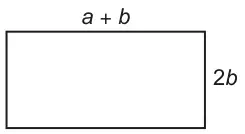
Jess and Pete have many rectangular tiles. Each tile has length \(a + b\) and width \(2b\).
Not to scale
(a) Jess joins three tiles together to make a larger rectangle, as shown.
Not to scale
(i) Write an expression for the perimeter of her rectangle. Give your answer in its simplest form. [2]
(ii) An expression for the area of her rectangle is \(6ab + 6b^2\).
Factorise this expression fully. [2]
(b) Pete joins some tiles together to make a different rectangle. The area of his rectangle is \(8ab + 8b^2\).
Draw a possible arrangement of tiles for Pete’s rectangle. Write down expressions for the length and for the width of the rectangle. [5]
Mark scheme (a)
Answer
Marks
Part marks and guidance
(i) \(6a + 10b\) or \(2(3a + 5b)\) final answer
2
M1 for \(6(a + b) + 2 \times 2b\) oe
If 0 scored SC1 for \(3a + 5b\) as final answer
M1 for EG \(a + b + a + b + a + b + a + b + a + b + a + b + 2b + 2b\) or \(2 \times (3a + 3b + 2b)\) etc
(ii) \(6b(a + b)\) final answer
2
B1 for \(6(ab + b^2)\) or \(b(6a + 6b)\) or \(3(2ab + 2b^2)\) or \(3b(2a + 2b)\) or \(2(3ab + 3b^2)\) or \(2b(3a + 3b)\)
Mark scheme (b)
Answer
Marks
Part marks and guidance
4 by 1 rectangle with \(4a + 4b\) and \(2b\) or 2 by 2 rectangle with \(2a + 2b\) and \(4b\) or 1 by 4 rectangle with \(a + b\) and \(8b\) stated or marked on rectangle
5
B4 for \(4a + 4b\) and \(2b\) or \(2a + 2b\) and \(4b\) or \(a + b\) and \(8b\) or B3 for rectangle drawn as (4 by 1) or (2 by 2) or (1 by 4) or B2 for one of \(2a + 2b\) or \(4a + 4b\) or \(4b\) or \(8b\) or
B1 for any rectangle of 3 or more tiles drawn with \(a+b\) or \(2b\) marked on individual tiles
Accept unsimplified throughout Once correct expression(s) seen, ignore incorrect simplification to answer line In answer space or intended as final length and width
Must clearly be answer
May be in attempt to factorise EG \(4b(2a + b)\) Accept unsimplified EG \(a+b + a+b\)
M2 for \((x + 3)\) and \((x + 7)\) M1 for \((x + a)\) and \((x + b)\) where \(ab = 21\) or \(a + b = 10\) B1 ft their quadratic factors If 0 scored SC1 for answer \(\pm 7\) and \(\pm 3\)
ft their quadratic factors condone omission of final bracket