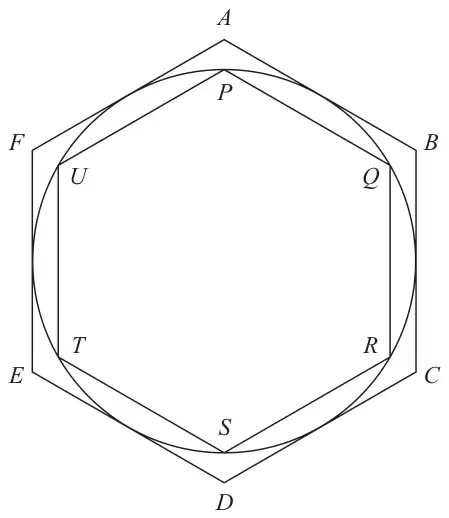
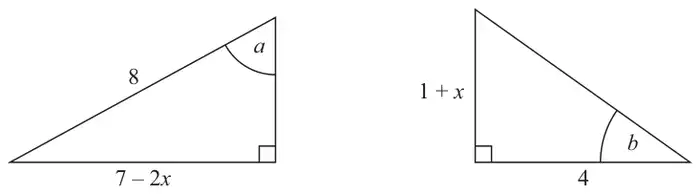
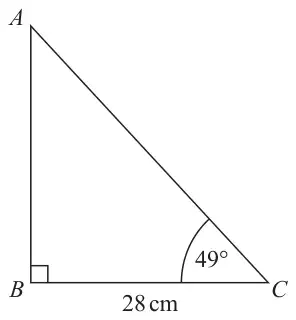
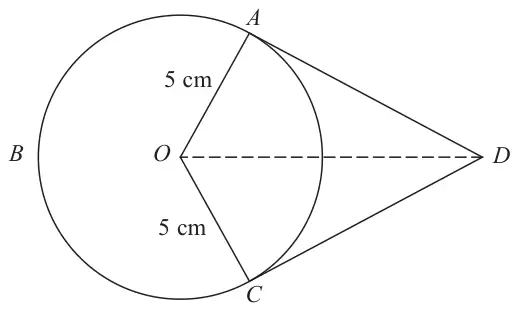
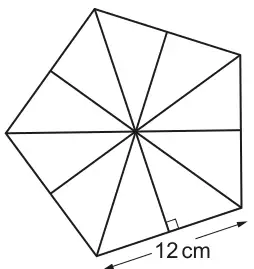
21 The diagram shows a circle, radius \(r\) cm and two regular hexagons.
Each side of the larger hexagon \(ABCDEF\) is a tangent to the circle. Each side of the smaller hexagon \(PQRSTU\) is a chord of the circle.
By considering perimeters, show that
\[3 \lt \pi \lt 2\sqrt{3}\]
(4)
Mark scheme
Answer
Mark
Mark scheme
Result shown
P1
for process to find the length of half a side or a side or the perimeter of the smaller hexagon \(PQRSTU\), eg \(r\sin 30\ \left(= \dfrac{r}{2}\right)\) oe or \(2r\sin 30\ (= r)\) oe or \(6 \times 2r\sin 30\ (= 6r)\) oe
P1
for process to find the length of half a side or a side or the perimeter of the larger hexagon \(ABCDEF\) eg Length of half side \(= r\tan 30\) or \(\dfrac{r}{\tan 60}\ \left(= \dfrac{\sqrt{3}r}{3}\right)\) oe or Length of side \(= 2r\tan 30\) or \(\dfrac{2r}{\tan 60}\) or \(\dfrac{r}{\sin 60}\) or \(\dfrac{r}{\cos 30}\ \left(= \dfrac{2\sqrt{3}r}{3}\right)\) oe or Length of perimeter \(= 6 \times 2r\tan 30\) or \(6 \times \dfrac{2r}{\tan 60}\) oe
P1
(dep P2) for process of forming a correct inequality, eg using half lengths eg \(\dfrac{r}{2} \lt \dfrac{2\pi r}{12} \lt r\tan 30\) oe or using lengths eg \(r \lt \dfrac{2\pi r}{6} \lt 2r\tan 30\) oe or using perimeters eg \(6 \times r \lt 2\pi r \lt 6 \times 2r\tan 30\) oe
C1
(dep P2) correct algebra leading to given result, \(3 \lt \pi \lt 2\sqrt{3}\)
Additional guidance
May use Sine Rule or cos60 instead of sin30
May use Sine Rule Note this mark is not for just the sight of \(\dfrac{\sqrt{3}r}{3}\) or \(\dfrac{2\sqrt{3}r}{3}\) or \(\dfrac{12\sqrt{3}r}{3}\) oe, they need to be associated with the correct length Perimeter \(= 4\sqrt{3}r\) alone does not get this mark
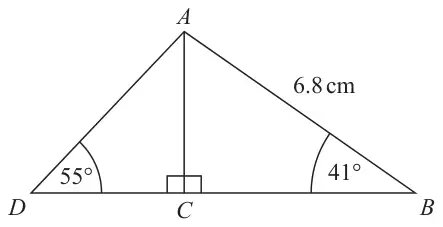
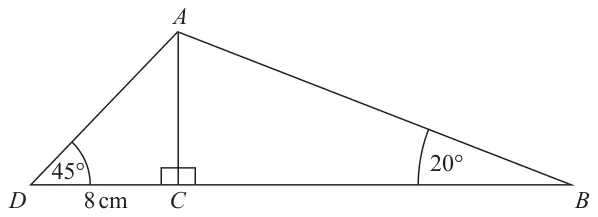
10 \(ABD\) is a triangle. \(C\) is a point on \(BD\).
Work out the length of \(DC\). Give your answer correct to 1 decimal place. (3)
Mark scheme
Answer
Mark
Mark scheme
3.1
P1
for using sin to find length of \(AC\), eg \(6.8 \times \sin 41\) or a full process to find \(AC\) or \((AC =)\ 4.46\ldots\) or a full process to find \(AD\) or \((AD =)\ 5.44\ldots\)
P1
for a complete process to find a relationship involving \(DC\) eg \(\tan 55 = \dfrac{\text{``}4.46\ldots\text{''}}{DC}\) or \((DC =)\ \dfrac{\text{``}4.46\ldots\text{''}}{\tan 55}\) or \(\cos 55 = \dfrac{DC}{\text{``}5.44\ldots\text{''}}\)
A1
answer in the range 3.1 to 3.2
Additional guidance
Accept rounded or truncated figures.
If a correct answer within the range is shown in working but is incorrectly rounded, award full marks.
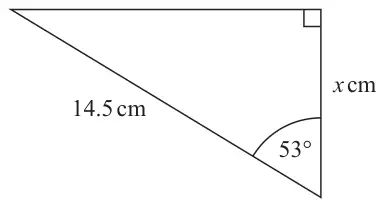
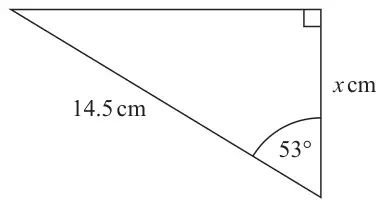
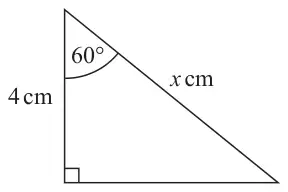
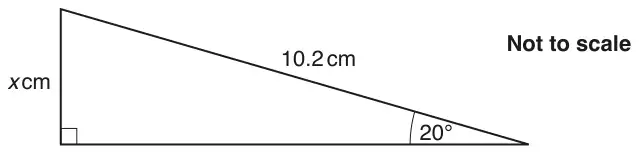
Work out the value of \(x\). Give your answer correct to 3 significant figures. (2)
Mark scheme
Answer
Mark
Mark scheme
8.73
M1
for a correct trig statement, eg \(14.5 \times \cos 53\) or \(\cos 53 = x \div 14.5\)
A1
answer in the range 8.726 to 8.73
Additional guidance
Can use a combination of skills but must have only one unknown in \(x\) to score this mark If an answer is given in the range in working and then rounded incorrectly award full marks.
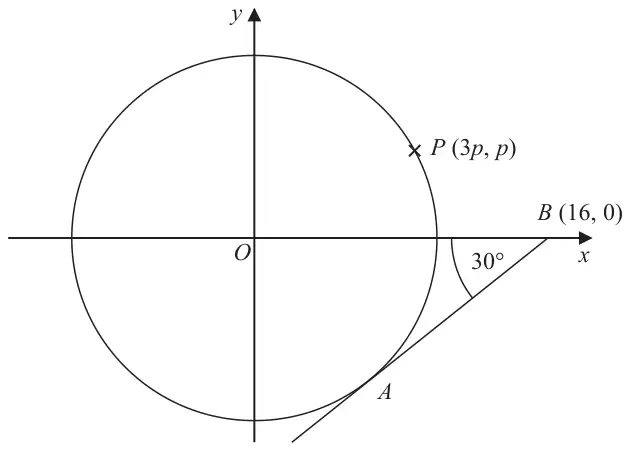
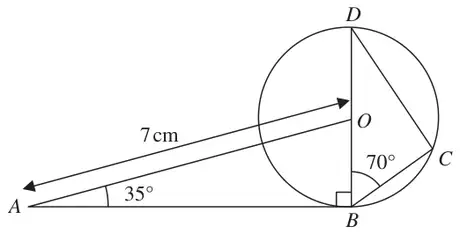
\(AB\) is the tangent to the circle at the point \(A\). Angle \(OBA = 30^\circ\)
Point \(B\) has coordinates \((16, 0)\) Point \(P\) has coordinates \((3p, p)\)
Find the value of \(p\). Give your answer correct to 1 decimal place. You must show all your working. (4)
Mark scheme
Answer
Mark
Mark scheme
2.5
P1
use of \(\sin 30 = \tfrac{1}{2}\) to find \(OA\ (= 8)\) or \(OAB = 90^\circ\) eg \(OA = 16\sin 30^\circ\) or right angle marked on diagram
P1
recognition that equation of circle is \(x^2 + y^2 = r^2\)
P1
Correct substitution of \(p\), \(3p\) and \(r\) in \(x^2 + y^2 = r^2\) eg \(9p^2 + p^2 = OA^2\) or \((3p)^2 + p^2 = \text{``}8^2\text{''}\)
A1
for answer in the range 2.5 to 2.53
Additional guidance
Accept \(3p^2 + p^2 = r^2\) for the award of this mark
Do not accept \(3p^2 + p^2 = 8^2\) for the award of this mark
Accept \(\sqrt{6.4}\) or \(\dfrac{4\sqrt{10}}{5}\) If an answer within the given range is seen in working and rounded incorrectly award full marks. Award 0 marks for the answer without supportive working.
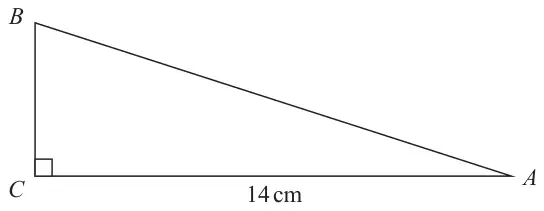
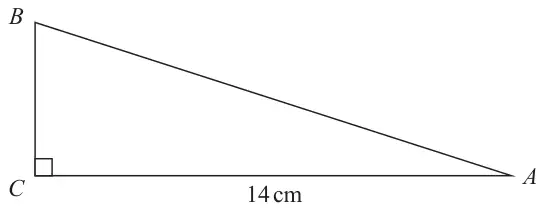
Work out the length of \(AB\). Give your answer correct to 3 significant figures. (4)
Mark scheme
Answer
Mark
Mark scheme
17.3
P1
for full process to find either angle eg \((180 - 90) \div (2 + 3) \times 2\) or for 36 or 54 seen as an angle
P1
for a correct equation using trigonometry eg \(\cos [A] = 14 \div AB\)
P1
(dep previous P mark) for rearranging their trigonometry equation to make \(AB\) the subject eg (\(AB =\)) \(\text{``}14 \div \cos 36\text{''}\)
A1
for an answer in the range 17.3 to 17.4
Additional guidance
May be seen on diagram Condone correct values if incorrectly placed.
This must be shown as an equation with all four elements (eg cos, [\(A\)], 14, \(AB\)) present. [\(A\)] could be 36 or any angle clearly and unambiguously identified as \(A\). This also applies to [\(B\)] with Sine.
If an answer is shown in the range in working and then incorrectly rounded award full marks.
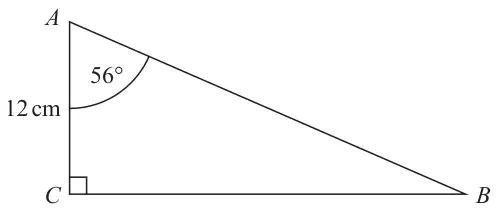
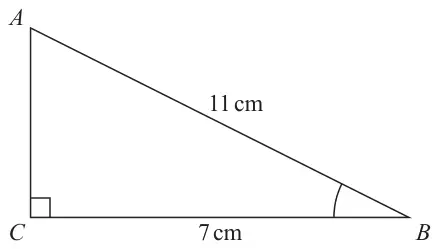
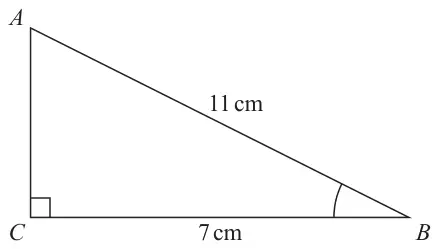
(a) Work out the size of angle \(ABC\). Give your answer correct to 1 decimal place. (2)
The length of the side \(AB\) is reduced by 1 cm.
The length of the side \(BC\) is still 7 cm. Angle \(ACB\) is still \(90^\circ\)
(b) Will the value of \(\cos ABC\) increase or decrease? You must give a reason for your answer. (1)
Mark scheme (a)
Answer
Mark
Mark scheme
50.5
M1
for \(\cos ABC = \dfrac{7}{11}\) (0.63…) oe
A1
for answer in the range 50.4 to 50.51
Additional guidance
Must be a complete statement for cos, sin or tan with all three elements present.
If an answer is in the range 50.4 to 50.51 is given in the working space then incorrectly rounded, award full marks.
Mark scheme (b)
Answer
Mark
Mark scheme
Increase (supported)
C1
States increase with supporting reason eg “\(\dfrac{7}{10}\) is greater than \(\dfrac{7}{11}\)” “0.636 is less than 0.7” ….“cos increases as angle decreases” “decreasing the denominator increases the value of the fraction” “angle is now 45.6” (accept 45.5 – 45.6)
Additional guidance
If figures are given they must be correct (truncated or rounded).
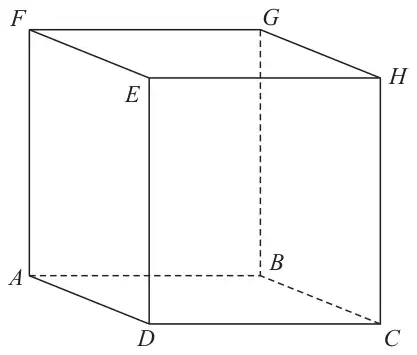
\(AB = 7.3\) cm \(CH = 8.1\) cm Angle \(BCA = 48^\circ\)
Find the size of the angle between \(AH\) and the plane \(ABCD\). Give your answer correct to 1 decimal place. (4)
Mark scheme
Answer
Mark
Mark scheme
39.5
P1
for a start to a process eg, for a correct trigonometric statement, eg \(\sin 48 = \dfrac{7.3}{AC}\) or \(\cos 42 = \dfrac{7.3}{AC}\) or \(\dfrac{AC}{\sin 90} = \dfrac{7.3}{\sin 48}\) OR angle \(CAH\) unambiguously identified on a diagram
P1
for a complete correct process to find \(AC\), eg (\(AC =\)) \(\dfrac{7.3}{\sin(48)}\) (=9.8..) or (\(AC =\)) \(\dfrac{7.3}{\cos(42)}\) (=9.8..) or (\(AC =\)) \(\sin 90 \times \dfrac{7.3}{\sin 48}\) (=9.8..)
P1
for a correct statement using angle \(CAH\), eg \(\tan(CAH) = \dfrac{8.1}{\text{``}9.8...\text{''}}\) OR \(\sqrt{8.1^2 + \text{``}9.8\text{''}^2}\) (=12.7…) and \(\dfrac{\sin CAH}{8.1} = \dfrac{\sin 90}{\text{``}12.7\text{''}}\)
A1
for answer in the range 39.5 – 39.51
Additional guidance
P1 (start): Must include correct values
If an answer is given in the range but then incorrectly rounded award full marks.
(a) Work out the size of angle \(ABC\). Give your answer correct to 1 decimal place. (2)
The length of the side \(AB\) is reduced by 1 cm.
The length of the side \(BC\) is still 7 cm. Angle \(ACB\) is still \(90^\circ\)
(b) Will the value of \(\cos ABC\) increase or decrease? You must give a reason for your answer. (1)
Mark scheme (a)
Answer
Mark
Mark scheme
50.5
M1
for \(\cos ABC = \dfrac{7}{11}\) (0.63…) oe
A1
for answer in the range 50.4 to 50.51
Additional guidance
Must be a complete statement for cos, sin or tan with all three elements present.
If an answer is in the range 50.4 to 50.51 is given in the working space then incorrectly rounded, award full marks.
Mark scheme (b)
Answer
Mark
Mark scheme
Increase (supported)
C1
States increase with supporting reason eg “\(\dfrac{7}{10}\) is greater than \(\dfrac{7}{11}\)” “0.636 is less than 0.7” ….“cos increases as angle decreases” “decreasing the denominator increases the value of the fraction” “angle is now 45.6” (accept 45.5 – 45.6)
Additional guidance
If figures are given they must be correct (truncated or rounded).
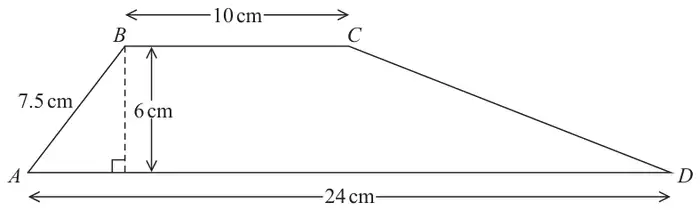
Work out the size of angle \(CDA\). Give your answer correct to 1 decimal place. (5)
Mark scheme
Answer
Mark
Notes
32.3
P1
for using Pythagoras to find length of third side of triangle, eg \(7.5^2 - 6^2\) or \(6^2 + x^2 = 7.5^2\) or uses trigonometry to find angle in triangle eg \(\sin A = \dfrac{6}{7.5}\) or \(\cos B = \dfrac{6}{7.5}\)
P1
(dep P1) for complete process to find length of third side of triangle eg \(\sqrt{7.5^2 - 6^2}\) or \(\sqrt{56.25 - 36}\) or \(\sqrt{20.25}\ (= 4.5)\) or uses trigonometry to find base length of triangle eg \(7.5 \times \cos \text{``}A\text{''}\) or \(7.5 \times \sin \text{``}B\text{''}\) or \(\dfrac{6}{\tan \text{``}A\text{''}}\)
P1
(dep P2) for \(24 - 10 - \text{``}4.5\text{''}\ (= 9.5)\)
P1
(indep) for process to find angle \(CDA\), eg \(\tan CDA = \dfrac{6}{\textit{base}}\) from right-angled triangle
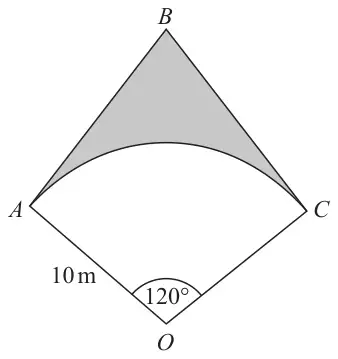
\(OAC\) is a sector of a circle, centre \(O\), radius 10 m.
\(BA\) is the tangent to the circle at point \(A\). \(BC\) is the tangent to the circle at point \(C\).
Angle \(AOC = 120^\circ\)
Calculate the area of the shaded region. Give your answer correct to 3 significant figures. (5)
Mark scheme
Answer
Mark
Notes
68.5
B1
for angle \(OAB = 90^\circ\) or angle \(OCB = 90^\circ\), may be seen on diagram
P1
for a process to find the length of \(AB\) or the length of \(CB\) \((= 10\sqrt{3}\) oe\()\) eg \(10 \times \tan 60^\circ\ (= 17.3\ldots)\) or the length of \(OB\ (= 20)\), eg \(10 \div \cos 60^\circ\)
P1
for a process (dep previous P1) to find the area of the triangle \(OAB\) \((= 50\sqrt{3}\) oe\()\) or area of triangle \(OCB\) \((= 50\sqrt{3}\) oe\()\) or area of kite \(OABC\) \((= 100\sqrt{3}\) oe\()\)
P1
for a process to find the area of the sector \(OAC\) e.g. \(\dfrac{1}{3} \times \pi \times 10^2\ (= 104.7\ldots)\), accept rounded or truncated to 3 significant figures or more
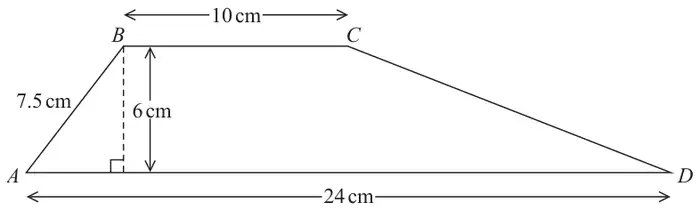
Work out the size of angle \(CDA\). Give your answer correct to 1 decimal place. (5)
Mark scheme
Answer
Mark
Notes
32.3
P1
for using Pythagoras to find length of third side of triangle, eg \(7.5^2 - 6^2\) or \(6^2 + x^2 = 7.5^2\) or uses trigonometry to find angle in triangle eg \(\sin A = \dfrac{6}{7.5}\) or \(\cos B = \dfrac{6}{7.5}\)
P1
(dep P1) for complete process to find length of third side of triangle eg \(\sqrt{7.5^2 - 6^2}\) or \(\sqrt{56.25 - 36}\) or \(\sqrt{20.25}\ (= 4.5)\) or uses trigonometry to find base length of triangle eg \(7.5 \times \cos \text{``}A\text{''}\) or \(7.5 \times \sin \text{``}B\text{''}\) or \(\dfrac{6}{\tan \text{``}A\text{''}}\)
P1
(dep P2) for \(24 - 10 - \text{``}4.5\text{''}\ (= 9.5)\)
P1
(indep) for process to find angle \(CDA\), eg \(\tan CDA = \dfrac{6}{\textit{base}}\) from right-angled triangle
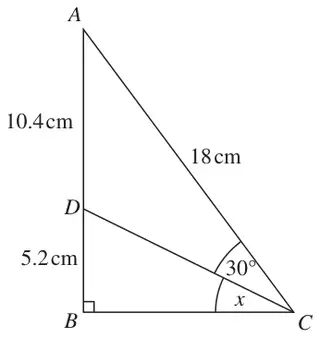
\(ABC\) is a right-angled triangle. \(D\) is a point on \(AB\).
Angle \(ACD = 30^\circ\) \(AD = 10.4\) cm \(DB = 5.2\) cm \(AC = 18\) cm
Work out the size of the angle marked \(x\). Give your answer correct to 1 decimal place. (4)
Mark scheme
Answer
Mark
Notes
30.1
4
M1 for a correct trigonometric statement to find an unknown angle, eg. \(\sin(30 + x)\) or \(\cos A = \dfrac{10.4 + 5.2}{18}\) or \(\dfrac{\sin ADC}{18} = \dfrac{\sin 30}{10.4}\) M1 for a complete method to find the angle, eg. \(\sin^{-1}\left(\dfrac{10.4 + 5.2}{18}\right)\) (= 60.07...) or \(\cos^{-1}\left(\dfrac{10.4 + 5.2}{18}\right)\) (= 29.92..) or \(\sin^{-1}\left(\dfrac{18 \times \sin 30}{10.4}\right)\) (= 59.92.. or 180 – 59.92.. = 120.07..) M1 (dep on M2) for a fully complete method to find angle \(x\), eg. "60.07..". – 30 or 60 – "29.92.." or 90 – "59.92.." A1 for answer in the range 30.07 to 30.1
OR
M1 for \((BC^2 =)\ 18^2 - (10.4 + 5.2)^2\) or \(BC^2 + (10.4 + 5.2)^2 = 18^2\) M1 for \((BC =)\ \sqrt{18^2 - (10.4 + 5.2)^2}\) (= 8.97...) M1 (dep on M2) for a fully complete method to find angle \(x\), eg. \(\tan^{-1}\left(\dfrac{5.2}{\text{``}8.97...\text{''}}\right)\) A1 for answer in the range 30.07 to 30.1
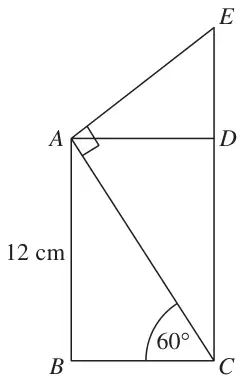
M1 for a method to find \(BC\) or \(AC\) or \(AD\) B1 for angle \(EAD = 30^\circ\) or \(AED = 60^\circ\) or \(ACD = 30^\circ\) or \(CAD = 60^\circ\) M1 for a method to find \(CE\) A1 for 15.9-16.1 with supporting working
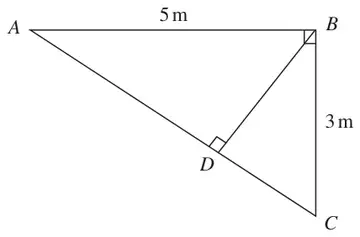
M1 for \((AC^2) = 5^2 + 3^2\) (=34) M1 for \(\sqrt{25 + 9}\) or \(\sqrt{34}\) (=5.83) M1 for \(\dfrac{5}{\text{'}5.83'} = \dfrac{DB}{3}\) or \(DB \times AC = 5 \times 3\) M1 for \((DB =)\ \dfrac{5}{\text{'}5.83'} \times 3\) A1 for 16.4 to 16.41
OR M1 for \((AC^2) = 5^2 + 3^2\) (=34) M1 for \(\sqrt{25 + 9}\) or \(\sqrt{34}\) (=5.83) M1 for using a correct trig ratio in an attempt to find angle \(A\) or angle \(C\), e.g. \(\tan A = \dfrac{3}{5}\), \(\sin A = \dfrac{3}{\text{'}5.83'}\), \(\cos C = \dfrac{3}{\text{'}5.83'}\) M1 for using \(DB\) in a a correct trig ratio, e.g. \(\sin \text{'}30.96\text{'} = \dfrac{DB}{5}\) A1 for 16.4 to 16.41
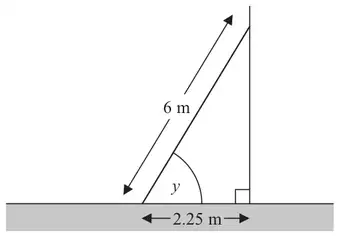
*20 The diagram shows a ladder leaning against a vertical wall.
Diagram NOT accurately drawn
The ladder stands on horizontal ground.
The length of the ladder is 6 m. The bottom of the ladder is 2.25 m from the bottom of the wall.
A ladder is safe to use when the angle marked \(y\) is about \(75^\circ\).
Is the ladder safe to use? You must show all your working. (3)
Mark scheme
Working
Answer
Mark
Notes
\(\cos y = 2.25 \div 6\) \(y = \cos^{-1}(2.25 \div 6)\) OR \(6\cos 75 = 1.55\ldots\)
The ladder is not safe because \(y\) is not near to 75
3
M1 for \(\cos y = 2.25 \div 6\) oe M1 for \(\cos^{-1}(2.25 \div 6)\) C1 for sight of 67-68 and a statement eg this angle is NOT (near to) 75° and so the ladder is not steep enough and so not safe.
OR
M1 for \(\cos 75 = x \div 6\) M1 for \(6\cos 75\) C1 for sight of 1.55(29…) and a statement eg that 2.25 NOT (near to) 1.55 and so the ladder is not steep enough and so not safe.
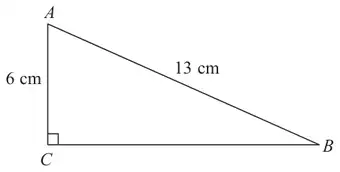
\(ABC\) is a right-angled triangle. \(AC = 6\) cm \(AB = 13\) cm
(a) Work out the length of \(BC\). Give your answer correct to 3 significant figures. (3)
Diagram NOT accurately drawn
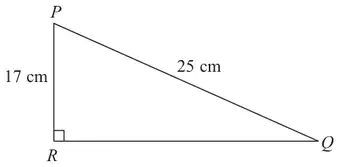
\(PQR\) is a right-angled triangle. \(PR = 17\) cm \(PQ = 25\) cm
(b) Work out the size of angle \(RPQ\). Give your answer correct to 1 decimal place. (3)
Mark scheme (a)
Answer
Mark
Notes
11.5
3
M1 for \(13^2 - 6^2\) or \(169 - 36\) or 133 M1 (dep on M1) for \(\sqrt{13^2 - 6^2}\) or \(\sqrt{133}\) A1 for answer in the range 11.5 − 11.6
Mark scheme (b)
Answer
Mark
Notes
47.2
3
M1 for \(\cos(RPQ) = \frac{17}{25}\) oe OR \(\sin PQR = \frac{17}{25}\) with \(PQR\) clearly identified M1 for (\(RPQ =\)) \(\cos^{-1}\frac{17}{25}\) oe OR \(PQR = \sin^{-1}\frac{17}{25}\) with \(PQR\) clearly identified A1 for answer in the range 47.1 − 47.2 SC : B2 for an answer of 0.823(033...) or 52.3(95...) or 52.4
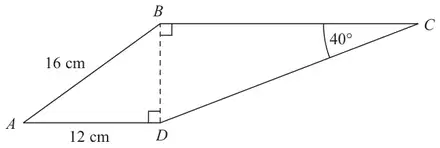
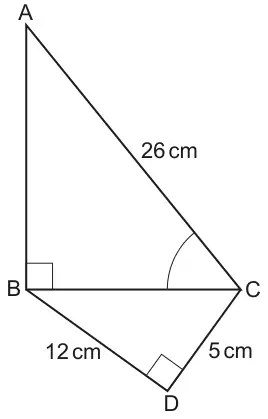
M1 for \(BD^2 + 12^2 = 16^2\) oe or \(16^2 - 12^2\) or 112 seen M1 for \(\sqrt{256 - 144}\) or \(\sqrt{112}\) (=10.58...) M1 for \(\sin 40 = \dfrac{\text{‘}10.58\text{’}}{CD}\) or \(\cos 50 = \dfrac{\text{‘}10.58\text{’}}{CD}\) M1 for (\(CD =\)) \(\dfrac{\text{‘}10.58\text{’}}{\sin 40}\) or \(\dfrac{\text{‘}10.58\text{’}}{\cos 50}\) A1 for 16.4 – 16.5 OR M1 for \(BD^2 + 12^2 = 16^2\) oe or \(16^2 - 12^2\) or 112 seen M1 for \(\sqrt{256 - 144}\) or \(\sqrt{112}\) (=10.58...) M1 for (\(BC =\)) ‘10.58’ × tan 50 or \(\dfrac{\text{‘}10.58\text{’}}{\tan 40}\) (=12.6…) M1 for \(\sqrt{\text{‘}12.6\text{’}^2 + \text{‘}10.58...\text{’}^2}\) A1 for 16.4 – 16.5
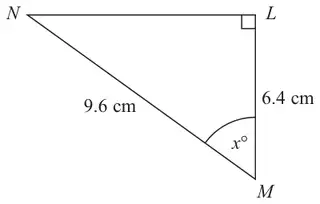
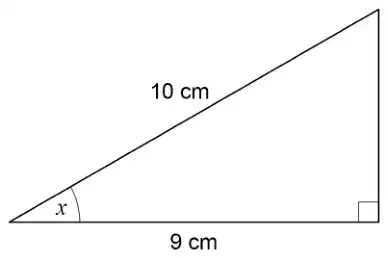
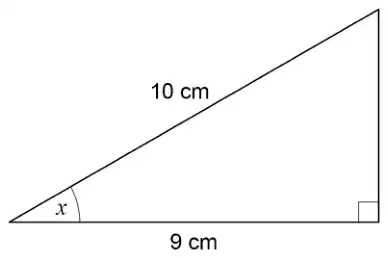
\(LMN\) is a right-angled triangle. \(MN = 9.6\) cm. \(LM = 6.4\) cm.
Calculate the size of the angle marked \(x^\circ\). Give your answer correct to 1 decimal place. (3)
Mark scheme
Working
Answer
Mark
Notes
\(\cos x = \dfrac{6.4}{9.6}\) \(x = \cos^{-1}\dfrac{6.4}{9.6} =\)
48.2
3
M1 for \(\cos x = \dfrac{6.4}{9.6}\) or \(\cos x = 0.66(6...)\) or \(\cos x = 0.67\) M1 for \(\cos^{-1}\dfrac{6.4}{9.6}\) or \(\cos^{-1} 0.66(6...)\) or \(\cos^{-1} 0.67\) A1 for 48.1 – 48.2 OR Correct use of Pythagoras and then trigonometry, no marks until M1 for \(\sin x = \dfrac{\text{‘}7.155\text{’}}{9.6}\) or \(\tan x = \dfrac{\text{‘}7.155\text{’}}{6.4}\) or \(\sin x = \dfrac{\text{‘}7.155\text{’}}{9.6} \times \sin 90\) or \(\cos x = \dfrac{6.4^2 + 9.6^2 - \text{‘}7.155\text{’}^2}{2 \times 6.4 \times 9.6}\) M1 for \(\sin^{-1}\dfrac{\text{‘}7.155\text{’}}{9.6}\) or \(\tan^{-1}\dfrac{\text{‘}7.155\text{’}}{6.4}\) or \(\sin^{-1}\left(\dfrac{\text{‘}7.155\text{’}}{9.6} \times \sin 90\right)\) or \(\cos^{-1}\left(\dfrac{6.4^2 + 9.6^2 - \text{‘}7.155\text{’}^2}{2 \times 6.4 \times 9.6}\right)\) A1 for 48.1 – 48.2 SC B2 for 0.841... (using rad) or 53.5... (using grad)
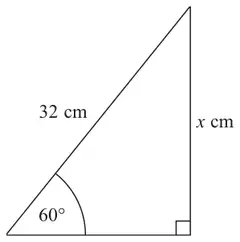
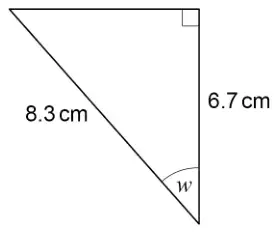
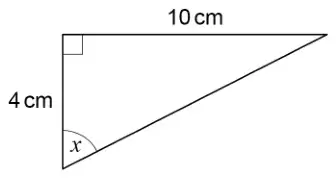
23 Use trigonometry to work out the size of angle \(w\). [3 marks]
Not drawn accurately
Mark scheme
Answer
Mark
Comments
Alternative method 1
cos chosen or used
M1
\(\cos w = \dfrac{6.7}{8.3}\) or \(\cos^{-1} \dfrac{6.7}{8.3}\)
M1dep
any letter or symbol for \(w\) accept 0.807(…) or 0.81 for \(\dfrac{6.7}{8.3}\)
[35.9, 36.2]
A1
Alternative method 2
\(\sin x = \dfrac{6.7}{8.3}\) or \(\sin^{-1} \dfrac{6.7}{8.3}\) or [53.8, 54.1]
M1
any letter or symbol other than \(w\) accept 0.807(…) or 0.81 for \(\dfrac{6.7}{8.3}\)
\(90 -\) their [53.8, 54.1]
M1dep
[35.9, 36.2]
A1
Alternative method 3
\(\sqrt{8.3^2 - 6.7^2}\) or \(\sqrt{68.89 - 44.89}\) or \(\sqrt{24}\) or \(2\sqrt{6}\) or [4.89, 4.9] and \(\sin^{-1} \dfrac{\text{their } [4.89, 4.9]}{8.3}\) or \(\tan^{-1} \dfrac{\text{their } [4.89, 4.9]}{6.7}\)
M2
full method to work out the missing length and use it correctly to work out the value of \(w\) any letter or symbol for \(w\)
[35.9, 36.2]
A1
Additional guidance
Use of sine rule follows Alt method 2
\(\sin w = \dfrac{6.7}{8.3}\) without \(\sin^{-1} \dfrac{6.7}{8.3}\) or [53.8, 54.1]
M0
\(\cos w = 0.807\)
M1M1
\(\cos^{-1} w = \dfrac{6.7}{8.3}\) or \(\cos = \dfrac{6.7}{8.3}\) unless recovered
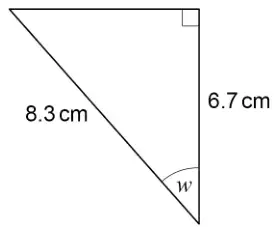
9 Use trigonometry to work out the size of angle \(w\). [3 marks]
Not drawn accurately
Mark scheme
Answer
Mark
Comments
Alternative method 1
cos chosen or used
M1
\(\cos w = \dfrac{6.7}{8.3}\) or \(\cos^{-1} \dfrac{6.7}{8.3}\)
M1dep
any letter or symbol for \(w\) accept 0.807(…) or 0.81 for \(\dfrac{6.7}{8.3}\)
[35.9, 36.2]
A1
Alternative method 2
\(\sin x = \dfrac{6.7}{8.3}\) or \(\sin^{-1} \dfrac{6.7}{8.3}\) or [53.8, 54.1]
M1
any letter or symbol other than \(w\) accept 0.807(…) or 0.81 for \(\dfrac{6.7}{8.3}\)
\(90 -\) their [53.8, 54.1]
M1dep
[35.9, 36.2]
A1
Alternative method 3
\(\sqrt{8.3^2 - 6.7^2}\) or \(\sqrt{68.89 - 44.89}\) or \(\sqrt{24}\) or \(2\sqrt{6}\) or [4.89, 4.9] and \(\sin^{-1} \dfrac{\text{their } [4.89, 4.9]}{8.3}\) or \(\tan^{-1} \dfrac{\text{their } [4.89, 4.9]}{6.7}\)
M2
full method to work out the missing length and use it correctly to work out the value of \(w\) any letter or symbol for \(w\)
[35.9, 36.2]
A1
Additional guidance
Use of sine rule follows Alt method 2
\(\sin w = \dfrac{6.7}{8.3}\) without \(\sin^{-1} \dfrac{6.7}{8.3}\) or [53.8, 54.1]
M0
\(\cos w = 0.807\)
M1M1
\(\cos^{-1} w = \dfrac{6.7}{8.3}\) or \(\cos = \dfrac{6.7}{8.3}\) unless recovered
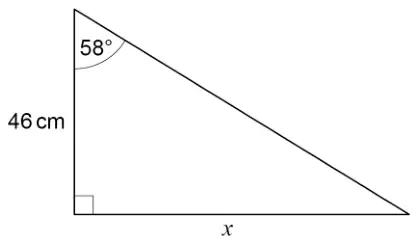
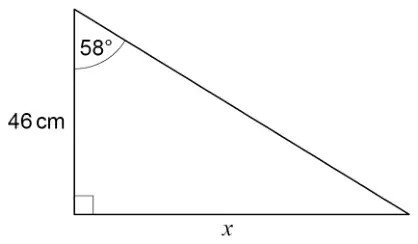
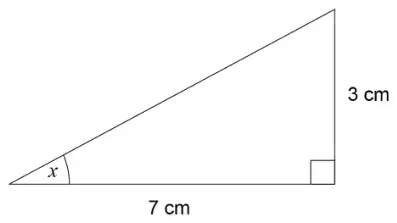
23 Use trigonometry to work out the value of \(x\).
Not drawn accurately
[3 marks]
Mark scheme
Answer
Mark
Comments
Alternative method 1 – using tangent of an angle
tan chosen or used
M1
\(\tan 58 = \dfrac{x}{46}\) or \(46 \times \tan 58\) or \(\tan 32 = \dfrac{46}{x}\) or \(\dfrac{46}{\tan 32}\)
M1dep
oe
[73.6, 74]
A1
Alternative method 2 – finding hypotenuse first
\(\dfrac{46}{\cos 58}\) or \(\dfrac{46}{\sin 32}\) or 86.8(…) or 87
M1
oe
\(\sqrt{(\text{their } 86.8(\ldots))^2 - 46^2}\) or \(\sqrt{5418.(\ldots)}\) or their \(86.8(\ldots) \times \sin 58\) or their \(86.8(\ldots) \times \cos 32\)
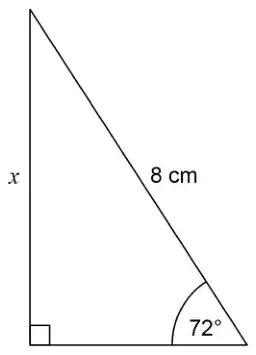
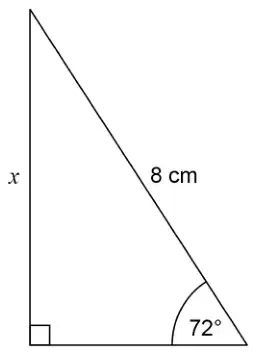
10 Use trigonometry to work out the value of \(x\). [3 marks]
Not drawn accurately
Mark scheme
Answer
Mark
Comments
Alternative method 1 – using tangent of an angle
tan chosen or used
M1
\(\tan 58 = \dfrac{x}{46}\) or \(46 \times \tan 58\) or \(\tan 32 = \dfrac{46}{x}\) or \(\dfrac{46}{\tan 32}\)
M1dep
oe
[73.6, 74]
A1
Alternative method 2 – finding hypotenuse first
\(\dfrac{46}{\cos 58}\) or \(\dfrac{46}{\sin 32}\) or 86.8(…) or 87
M1
oe
\(\sqrt{(\text{their } 86.8(\ldots))^2 - 46^2}\) or \(\sqrt{5418.(\ldots)}\) or their \(86.8(\ldots) \times \sin 58\) or their \(86.8(\ldots) \times \cos 32\)
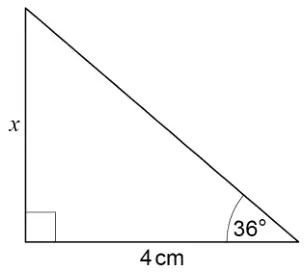
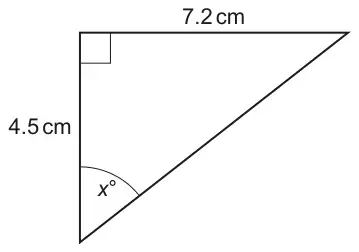
21 Use trigonometry to work out the size of angle \(x\). [3 marks]
Not drawn accurately
Mark scheme
Answer
Mark
Comments
Alternative method 1
tan identified
M1
oe eg \(\tan^{-1}\)
\(\tan x = \dfrac{10}{4}\) or \(\tan x = \dfrac{5}{2}\) or \(\tan x = 2.5\)
M1dep
oe eg \(\tan^{-1} \dfrac{10}{4}\) or \(90 - \tan^{-1} \dfrac{4}{10}\)
[68, 68.2]
A1
SC1 [21.8, 22]
Alternative method 2
\(\sin x = \dfrac{10}{\sqrt{4^2 + 10^2}}\) or \(\cos x = \dfrac{4}{\sqrt{4^2 + 10^2}}\)
M2
oe eg \(\sin x = \dfrac{10}{\sqrt{116}}\) or \(\sin^{-1} \dfrac{10}{\sqrt{4^2 + 10^2}}\) or \(\cos x = \dfrac{4}{\sqrt{116}}\) or \(\cos^{-1} \dfrac{4}{\sqrt{4^2 + 10^2}}\) or \(90 - \sin^{-1} \dfrac{4}{\sqrt{4^2 + 10^2}}\) or \(90 - \cos^{-1} \dfrac{10}{\sqrt{4^2 + 10^2}}\)
[68, 68.2]
A1
SC1 [21.8, 22]
Additional guidance
Accept 10.77 or 10.8 or \(2\sqrt{29}\) for \(\sqrt{116}\)
Tan can be identified by, for example, circling TOA in SOHCAHTOA
Answer from accurate drawing
M0M0A0
\(\sin x = \dfrac{10 \sin 90}{\sqrt{116}}\)
M2
\((x =)\) tan 2.5 or \((x =)\) tan 0.4 or \((x =)\) \(\tan \left(\dfrac{10}{4}\right)^{-1}\) unless recovered
M1M0A0
\(\tan = \dfrac{10}{4}\) or \(\tan = \dfrac{4}{10}\) or \(\tan x = \dfrac{4}{10}\) with no further correct working
4 Use trigonometry to work out the size of angle \(x\).
Not drawn accurately
[3 marks]
Mark scheme
Answer
Mark
Comments
Alternative method 1
tan identified
M1
oe eg \(\tan^{-1}\)
\(\tan x = \dfrac{10}{4}\) or \(\tan x = \dfrac{5}{2}\) or \(\tan x = 2.5\)
M1dep
oe eg \(\tan^{-1} \dfrac{10}{4}\) or \(90 - \tan^{-1} \dfrac{4}{10}\)
[68, 68.2]
A1
SC1 [21.8, 22]
Alternative method 2
\(\sin x = \dfrac{10}{\sqrt{4^2 + 10^2}}\) or \(\cos x = \dfrac{4}{\sqrt{4^2 + 10^2}}\)
M2
oe eg \(\sin x = \dfrac{10}{\sqrt{116}}\) or \(\sin^{-1} \dfrac{10}{\sqrt{4^2 + 10^2}}\) or \(\cos x = \dfrac{4}{\sqrt{116}}\) or \(\cos^{-1} \dfrac{4}{\sqrt{4^2 + 10^2}}\) or \(90 - \sin^{-1} \dfrac{4}{\sqrt{4^2 + 10^2}}\) or \(90 - \cos^{-1} \dfrac{10}{\sqrt{4^2 + 10^2}}\)
[68, 68.2]
A1
SC1 [21.8, 22]
Additional guidance
Accept 10.77 or 10.8 or \(2\sqrt{29}\) for \(\sqrt{116}\)
Tan can be identified by, for example, circling TOA in SOHCAHTOA
Answer from accurate drawing
M0M0A0
\(\sin x = \dfrac{10 \sin 90}{\sqrt{116}}\)
M2
(\(x\) =) tan 2.5 or (\(x\) =) tan 0.4 or (\(x\) =) \(\tan \left(\dfrac{10}{4}\right)^{-1}\) unless recovered
M1M0A0
\(\tan = \dfrac{10}{4}\) or \(\tan = \dfrac{4}{10}\) or \(\tan x = \dfrac{4}{10}\) with no further correct working
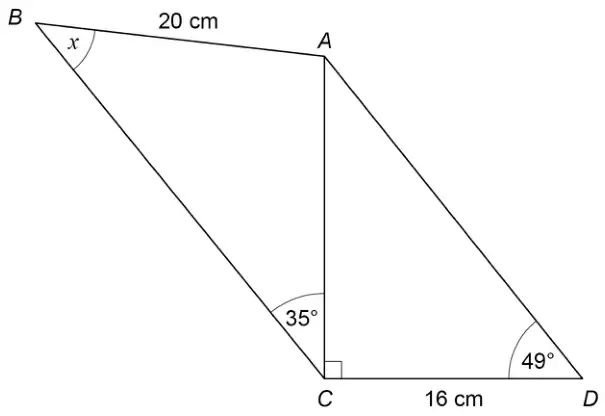
oe eg \(\dfrac{\sin x}{16 \tan 49} = \dfrac{\sin 35}{20}\) dep on 1st M1
\(\sin x = \dfrac{\sin 35}{20} \times \text{their } [18.4, 18.41]\)
M1dep
oe eg \(\sin x = \dfrac{16 \tan 49 \sin 35}{20}\) or \(\sin^{-1}\left(\dfrac{\sin 35}{20} \times \text{their } [18.4, 18.41]\right)\) or \(\sin^{-1}\) [0.527, 0.528] dep on 1st and 3rd M1
\(\tan x = \dfrac{3}{7}\) or \(\tan^{-1} \dfrac{3}{7}\) or \(\sin x = \dfrac{3(\sin 90)}{\sqrt{3^2 + 7^2}}\) or \(\sin x = \dfrac{3(\sin 90)}{\sqrt{58}}\) or \(\cos x = \dfrac{7}{\sqrt{3^2 + 7^2}}\) or \(\cos x = \dfrac{7}{\sqrt{58}}\) or \(90 - \tan^{-1} \dfrac{7}{3}\) or 90 – [66.7, 66.81] or 90 – 67
M1
oe eg \(\cos x = \dfrac{7^2 + \left(\sqrt{7^2 + 3^2}\right)^2 - 3^2}{2 \times \sqrt{3^2 + 7^2} \times 7}\) Any letter
[23, 23.3]
A1
Additional guidance
\(\tan = \dfrac{3}{7}\) or \(\tan \dfrac{3}{7}\) or \(\tan^{-1} = \dfrac{3}{7}\) (unless recovered)
M0
Answer [23, 23.3] (possibly coming from scale drawing)
M1A1
If using sine rule must rearrange to \(\sin x =\) for M1
If using cosine rule must rearrange to \(\cos x =\) for M1
\(\tan x = \dfrac{3}{7}\) or \(\tan^{-1} \dfrac{3}{7}\) or \(\sin x = \dfrac{3(\sin 90)}{\sqrt{3^2 + 7^2}}\) or \(\sin x = \dfrac{3(\sin 90)}{\sqrt{58}}\) or \(\cos x = \dfrac{7}{\sqrt{3^2 + 7^2}}\) or \(\cos x = \dfrac{7}{\sqrt{58}}\) or \(90 - \tan^{-1} \dfrac{7}{3}\) or 90 − [66.7, 66.81] or 90 − 67
M1
oe eg \(\cos x = \dfrac{7^2 + \left(\sqrt{7^2 + 3^2}\right)^2 - 3^2}{2 \times \sqrt{3^2 + 7^2} \times 7}\) Any letter
[23, 23.3]
A1
Additional guidance
\(\tan = \dfrac{3}{7}\) or \(\tan \dfrac{3}{7}\) or \(\tan^{-1} = \dfrac{3}{7}\) (unless recovered)
M0
Answer [23, 23.3] (possibly coming from scale drawing)
M1A1
If using sine rule must rearrange to \(\sin x =\) for M1
If using cosine rule must rearrange to \(\cos x =\) for M1
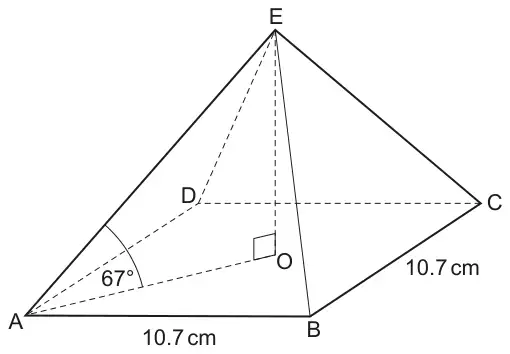
22 The diagram shows a square-based pyramid ABCDE. O is the centre of the base.
The length of the base is 10.7 cm. Angle EAO is 67°.
Calculate the length of AE. You must show your working. [6]
Mark scheme
Answer
Marks
Part marks and guidance
19.3[4…] to 19.3[7…] or 19.4 with correct working
6
M2 for \(\left[\frac{1}{2} \times\right]\sqrt{10.7^2 + 10.7^2}\) or for \(\sqrt{5.35^2 + 5.35^2}\) or for \(\left[\frac{1}{2} \times\right] \frac{10.7}{\cos 45}\) or \(\left[\frac{1}{2} \times\right] \frac{10.7}{\sin 45}\) or for \(\frac{5.35}{\cos 45}\) or \(\frac{5.35}{\sin 45}\) or M1 for \(10.7^2 + 10.7^2\) or \(5.35^2 + 5.35^2\) or for \(\cos 45 = \frac{10.7}{\text{AC}}\) oe or \(\sin 45 = \frac{10.7}{\text{AC}}\) oe or for \(\cos 45 = \frac{5.35}{\text{AO}}\) oe or \(\sin 45 = \frac{5.35}{\text{AO}}\) oe
Correct working requires evidence of at least M1 AND M1 Accept intermediate values rot to at least 3sf.
If M1A1 seen then award M2A1
AO
AE
7.5
19.19478
7.56
19.34834
7.566
19.3637
7.566043
19.36381
7.57
19.37394
7.6
19.45072
A1 for 7.56 to 7.57 or 7.6
AND
M2 for \(\frac{\textit{their } 7.566\ldots}{\cos 67}\) or \(\frac{\textit{their } 7.566\ldots}{\sin 23}\) or \(\frac{\text{AE}}{\sin 90} = \frac{\textit{their } 7.566\ldots}{\sin 23}\) or M1 for \(\cos 67 = \frac{\textit{their } 7.566\ldots}{\text{AE}}\) oe or \(\sin 23 = \frac{\textit{their } 7.566\ldots}{\text{AE}}\) oe or \(\frac{\sin 90}{\text{AE}} = \frac{\sin 23}{\textit{their } 7.566}\) oe
their 7.566…must follow from the award of the first M2
If 0, 1 or 2 scored, instead award SC3 for answer 19.3 to 19.4 with no or insufficient working If 0 or M1 scored, instead award SC2 for 7.56 to 7.57 or 7.6 with no or insufficient working If 0 scored instead award SC1 for 15.1[3…] or 57.2… with no or insufficient working
Mark less efficient methods by considering how many steps remain to reach the correct answer and match against the most comparable stage: eg Assuming AO has been found, then using trig to find EO is unnecessary and inefficient, so no further marks are awarded for just finding EO and stopping. However, if EO is then used in a correct Pythagoras expression with AO or a correct trig expression with 67° that lead directly or indirectly to finding AE, then M2 or M1 may be awarded.
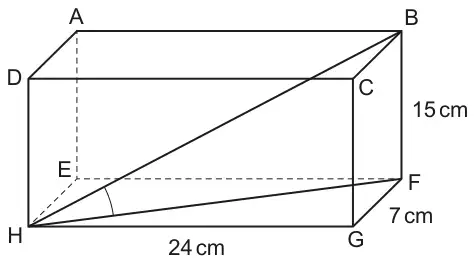
Calculate the angle BHF. You must show your working. [5]
Mark scheme
Answer
Marks
Part marks and guidance
30.9 to 31 with correct working
5
M2 for \(\sqrt{(24^2 + 7^2)}\) or M1 for \([\ldots]^2 = 24^2 + 7^2\)
and
M2 for \(\tan^{-1} \frac{15}{\textit{their } 25}\) oe or M1 for \(\tan(\text{BHF}) = \frac{15}{\textit{their } 25}\) oe
Correct working requires evidence of at least M1M1 Alternative method: M2 for \(\sqrt{(24^2 + 7^2 + 15^2)}\) or M1 for \([\ldots]^2 = 24^2 + 7^2 + 15^2\)
and
M2 for \(\sin^{-1} \frac{15}{\textit{their } \sqrt{850}}\) oe or M1 for \(\sin(\text{BHF}) = \frac{15}{\textit{their } \sqrt{850}}\) oe
Other methods: M2 for a correct expression that would give correct HF or HB or M1 for “one-step away” eg \(\sin\left(\tan^{-1}\left(\frac{7}{24}\right)\right) = \frac{7}{\text{HF}}\) and M2 for correct trig inverse expression with angle BHF or M1 for correct trig expression with angle BHF
If 0 or 1 scored, instead award SC2 for answer 30.9 to 31 with no or insufficient working If 0 scored, instead award SC1 for [HF =] 25 or for [HB =] \(\sqrt{850}\) oe or 29.1 to 29.2
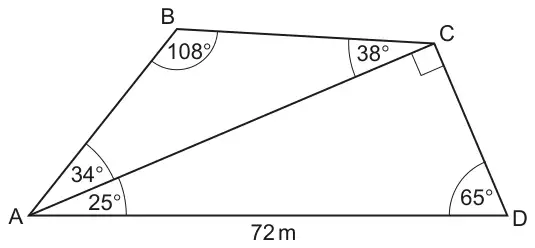
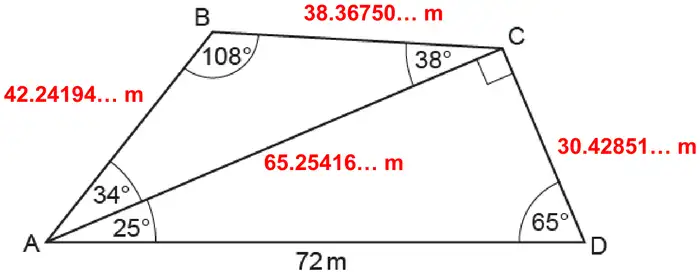
AD = 72 m. Angle ABC = 108°, angle BCA = 38° and angle BAC = 34°. Angle ACD = 90°, angle CDA = 65° and angle CAD = 25°.
Find the area of ABCD. You must show your working. [6]
Mark scheme
Answer
Marks
Part marks and guidance
1763 or 1763.4 to 1763.5 with correct working
6
“Correct working” requires evidence of at least M2 or M1 M1 condone answers in range 1750 – 1780 with full correct working
M2 for \(\frac{1}{2} \times 72 \times\) their 65.25… × sin 25 or M1 for [AC=] 72cos 25 or 72sin 65 oe
M2 implied by 992.79… or 992.8 or maybe by 985 – 999[…] nfww or M1 implied by [AC=] 65.2[5…] or 65.3
M3 for \(\frac{1}{2} \times\) their 65.254 × their 42.24… × sin34 oe or M2 for [AB=] \(\frac{\textit{their } 65.25\ldots \times \sin 38}{\sin 108}\) oe or M1 for \(\frac{\text{AB}}{\sin 38} = \frac{\textit{their } 65.25\ldots}{\sin 108}\) oe
M3 implied by 770.69… or 770.7 or maybe by 760 – 783 nfww
M2 implied by [AB=] 42.2[4…]
If 0, 1 or 2 scored award SC3 for answer 1763 or 1763.4 to 1763.5 with no or insufficient working If 0 or 1 scored award SC2 for 992.79… or 992.8 or 770.69… or 770.7 with no or insufficient working
accept any correct method e.g. M2 for area of triangle ACD = ½ × 72sin25 × 72cos25 oe or M1 for [CD=]72sin25 implied by 30.4…
Appendix: Question 16
Area of ABC = 770.687099… and area of ACD = 992.793598… total area = 1763.480697… Note : condone answers in range 1745 – 1780, area ACD in range 985 – 998 and area ABC in range 760 – 783
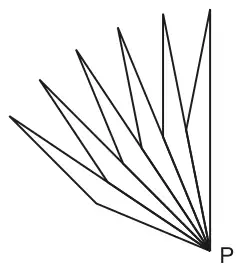
25 Taylor designs a logo using isosceles triangles joined at a central point, P.
This is the start of Taylor’s design.
Not to scale
The completed design will have rotational symmetry, order 60 about point P.
Each triangle has base, \(b\), and height, \(h\), measured in mm.
Not to scale
Calculate \(h\) when \(b = 40\) mm. Give your answer correct to 1 decimal place. [4]
Mark scheme
Answer
Marks
Part marks and guidance
2.1[0…] nfww
4
M1 for \(\dfrac{360}{60}\) oe soi by 6
AND
Method 1 using tan:
M2 for [\(h\) = ] 20 tan(their 6) oe
or
M1 for correct use of tan(their 6) oe
or Method 2 using sine rule:
M2 for [\(h\) = ] \(\dfrac{20\sin(\textit{their}\ 6)}{\sin(90 - \textit{their}\ 6)}\) or M1 for \(\dfrac{\sin(\textit{their}\ 6)}{h} = \dfrac{\sin(90 - \textit{their}\ 6)}{20}\) oe
or Method 3 using cos and Pythagoras:
M2 for \(\sqrt{\left(\dfrac{20}{\cos(\textit{their}\ 6)}\right)^2 - 20^2}\) or M1 for \(\left(\dfrac{20}{\cos(\textit{their}\ 6)}\right)^2 - 20^2\)
May be on diagram
In all methods, if their angle is not 6 then method must be seen, not implied by interim answers unless stated otherwise Accept any acute angle used for their 6
NBs \(\dfrac{\text{approx. circumference}}{60} = \dfrac{40\pi}{60} = 2.1\) scores 0 20sin6 = 2.1 scores M1 for 6 Solution from scale drawing scores a maximum of M1 if 6 seen
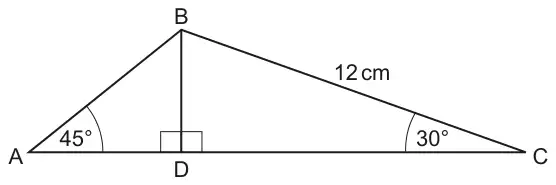
13 The diagram shows a triangle, ABC, with perpendicular height BD.
Not to scale
BC = 12 cm, angle BCD = 30° and angle BAD = 45°.
(a) Work out the length of BD. [3]
(b) Work out the exact length of AB. Give your answer in its simplest form. [3]
Mark scheme (a)
Answer
Marks
Part marks and guidance
6
3
M1 for sin 30 = \(\frac{BD}{12}\) oe B1 for sin 30 = 0.5 oe soi
Accept e.g. sin 30 = \(\frac{\sqrt{1}}{2}\) Do not allow B1 if contradicted
Mark scheme (b)
Answer
Marks
Part marks and guidance
\(6\sqrt{2}\) or \(\frac{12}{\sqrt{2}}\) cao
3
B2 for \(\sqrt{72}\) or better
OR M1 for \(\frac{their(a)}{\sin 45}\) [= \(AB\)] oe or 2(their (a))\(^2\) oe or \(\frac{12 \times \sin 30}{\sin 45}\) [= \(AB\)]
B1 for sin 45 = \(\frac{\sqrt{2}}{2}\) or \(\frac{1}{\sqrt{2}}\) oe soi
For M1, accept \(\frac{their(a)}{\cos 45}\) [= \(AB\)] oe For M1 , accept e.g. \(\frac{their(a) \times \sin 90}{\sin 45}\) [= \(AB\)] M1 implied by e.g. 72
For B1 accept cos 45 = \(\frac{\sqrt{2}}{2}\) or \(\frac{1}{\sqrt{2}}\) oe Do not allow B1 if contradicted
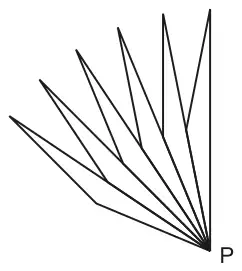
8 Taylor designs a logo using isosceles triangles joined at a central point, P.
This is the start of Taylor’s design.
Not to scale
The completed design will have rotational symmetry, order 60 about point P.
Each triangle has base, \(b\), and height, \(h\), measured in mm.
Not to scale
Calculate \(h\) when \(b = 40\) mm. Give your answer correct to 1 decimal place. [4]
Mark scheme
Answer
Marks
Part marks and guidance
2.1[0…] nfww
4
M1 for \(\frac{360}{60}\) oe soi by 6
AND
Method 1 using tan:
M2 for [\(h\) = ] 20 tan(their 6) oe
or
M1 for correct use of tan(their 6) oe
or Method 2 using sine rule:
M2 for [\(h\) = ] \(\frac{20 \sin(their\ 6)}{\sin(90 - their\ 6)}\) or M1 for \(\frac{\sin(their\ 6)}{h} = \frac{\sin(90 - their\ 6)}{20}\) oe
or Method 3 using cos and Pythagoras:
M2 for \(\sqrt{\left(\frac{20}{\cos(their\ 6)}\right)^2 - 20^2}\) or M1 for \(\left(\frac{20}{\cos(their\ 6)}\right)^2 - 20^2\)
May be on diagram
In all methods, if their angle is not 6 then method must be seen, not implied by interim answers unless stated otherwise Accept any acute angle used for their 6
eg [\(h\) = ] \(\frac{20}{\tan(90 - their\ 6)}\)
eg tan(their 6) = \(\frac{h}{20}\)
NBs \(\frac{\text{approx. circumference}}{60} = \frac{40\pi}{60}\) = 2.1 scores 0 20sin6 = 2.1 scores M1 for 6 Solution from scale drawing scores a maximum of M1 if 6 seen
Calculate the length of BC. You must show your working.
.................... cm [5]
Mark scheme
Answer
Marks
Part marks and guidance
17 or 17.2 to 17.3 with correct working
5
M4 for \((\sin 27 \times 19) \times 2\) or \((\cos 63 \times 19) \times 2\) or M3 for \(\sin 27 \times 19\) or \(\cos 63 \times 19\) or M2 for \(\sin 27 = \dfrac{x}{19}\) oe or \(\cos 63 = \dfrac{x}{19}\) oe or B1 for 27 as angle
If 0 or 1 scored, instead award SC2 for 17.2 to 17.3 with no or insufficient working If 0 scored, instead award SC1 for 8.6 or 8.62 to 8.63 or 17 with no or insufficient working
“Correct working” requires evidence of at least M2
B2FT for final answer \(12\sqrt{3}\), 8, \(8\sqrt{3}\) or 6 if consistent with their (a) or M1 for \(24 \times \dfrac{1}{2}\) or \(24 \times\) their (a)
For 1 or 2 marks, isw attempts to simplify the surds
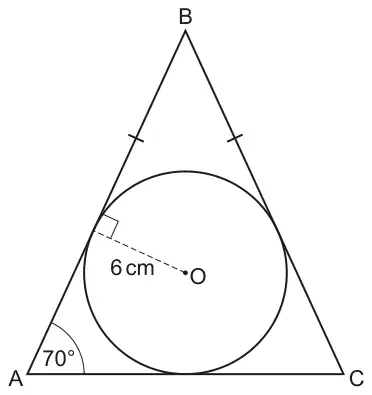
19 ABC is an isosceles triangle. The sides of the triangle ABC are all tangents to a circle of radius 6 cm, centre O.
Not to scale
Angle BAC = 70° and BA = BC.
(a) Show that length BO is 17.54 cm, correct to 2 decimal places. [4]
(b) Find the area of triangle ABC. You must show your working. [5]
Mark scheme (a)
Answer
Marks
Part marks and guidance
complete correct argument e.g.
accept any correct method not using 17.54
angle ABC = 40°
B1
could be on diagram and also accept ABO = 20°, BO’T’ = 70°
[BO = ] e.g. \(\dfrac{6}{\sin 20}\)
M2
M1 for e.g \(\sin 20 = \dfrac{6}{[BO]}\)
i.e BO as subject for M2 and condone sine rule with sin 90° for M2
17.542… or 17.543
A1dep
dep. on at least M1
Mark scheme (b)
Answer
Marks
Part marks and guidance
202 or 201.5 to 201.8 with correct working
5
Accept any correct method e.g. M1 for [height=] 17.54 + 6 or 23.54… M2 for [half base =] \(\dfrac{6}{\tan 35}\) or \(\dfrac{23.54}{\tan 70}\) or M1 for \(\tan 35 = \dfrac{6}{\textit{half base}}\) or \(\tan 70 = \dfrac{23.54}{\textit{half base}}\)
“Correct working” requires evidence of at least M2 or M1M1 Condone use of 8.6 leading to an answer of 202.4… M2 implied by e.g. 8.56 to 8.57 or 17.1 to 17.2
M1 for \(\frac{1}{2}\) × their base × their height oe If 0 scored SC2 for 202 or 201.6 to 201.8 with no working or SC1 for 8.56 to 8.57 or 17.1 to 17.2 with no working
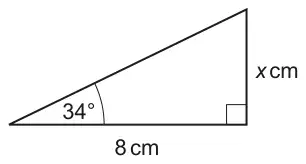
Use trigonometry to work out the value of \(x\). [3]
Mark scheme
Answer
Marks
Part marks and guidance
5.39[6...] or 5.4[0]
3
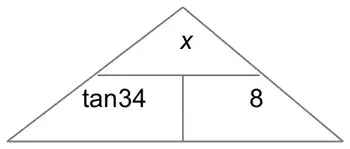
M2 for \(8 \times \tan 34\) or any complete correct method or M1 for \(\tan 34 = \dfrac{x}{8}\)
e.g. \(\dfrac{8}{\tan(90 - 34)}\)
e.g. \(\tan(90 - 34) = \dfrac{8}{x}\) See appendix
Appendix
Exemplar responses for Q18
Response
Mark
For longest method M1 is for step before explicit calculation for answer \(\cos 34 = \dfrac{8}{y}\) so \(y = \dfrac{8}{\cos 34}\) so \(x^2 = \left(\dfrac{8}{\cos 34}\right)^2 - 8^2\) (corrected from the printed mark scheme, which shows \(\left(\dfrac{y}{\cos 34}\right)^2 - 8^2\))
M1
For longest method M2 is for explicit calculation for answer \(\cos 34 = \dfrac{8}{y}\) so \(y = \dfrac{8}{\cos 34}\) so \(x = \sqrt{\left(\dfrac{8}{\cos 34}\right)^2 - 8^2}\)
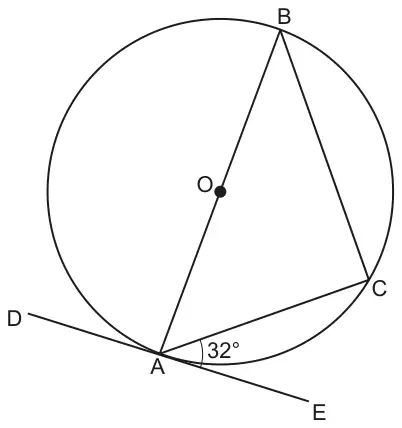
Points A, B and C lie on the circumference of the circle. Line AOB is a diameter. Line DAE is a tangent to the circle. Angle CAE = 32°.
Not to scale
(a) Give a reason why angle ACB is a right angle. [1]
(b) The radius of the circle is 8 cm.
Calculate length BC. [4]
Mark scheme (a)
Answer
Marks
Part marks and guidance
[angle in a] semi-circle oe
1
Accept other reasoning if fully justified
Mark scheme (b)
Answer
Marks
Part marks and guidance
13.5 to 13.6
4
B1 for angle BAC = 58° or angle ABC = 32°
M2 for 16sin(their 58) or 16cos(their 32) or M1 for \(\sin(\textit{their}\ 58) = \frac{BC}{\textit{their}\ 16}\) or \(\cos(\textit{their}\ 32) = \frac{BC}{\textit{their}\ 16}\) or better
If 0 or B1 scored then instead award SC2 for 6.7 to 6.8 as final answer
Grads or rads: If 0, 1 or 2 scored then instead award SC3 for 15.8[8…] to 15.9 or 12.6[4…] as final answer or If 0 scored award SC1 for 7.9[4…] or 6.3[2…]
May be seen on diagram or implied by use of sin58 or cos32
Only award M marks if their angle and trig ratio are consistent ie do not accept 16sin32 unless angle BAC previously seen as 32.
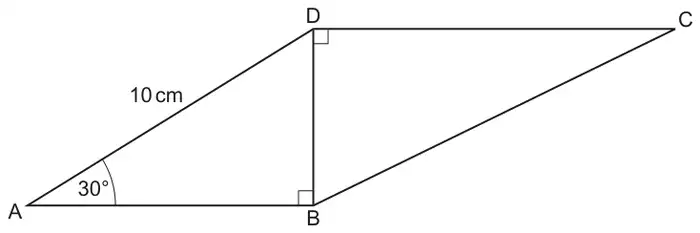
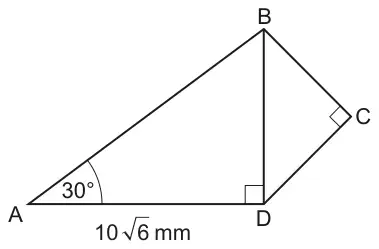
(b) ADB and BCD are right-angled triangles. BC = CD. AD = \(10\sqrt{6}\) mm. Angle BAD = 30°.
\(\tan 30^\circ = \dfrac{1}{\sqrt{3}}\)
Not to scale
Work out the length of BC. [6]
Mark scheme (a)
Answer
Marks
Part marks and guidance
\(\frac{1}{\sqrt{2}}\) or \(\frac{\sqrt{2}}{2}\) final answer
1
Mark scheme (b)
Answer
Marks
Part marks and guidance
10 nfww
6
B3 for BD = \(10\sqrt{2}\) oe or M2 for \(10\sqrt{6} \times \tan 30\) oe or M1 for \(\frac{BD}{10\sqrt{6}} = \tan 30\) oe AND M2 for BC = \(\sqrt{\frac{\textit{their}\ BD^2}{2}}\) oe or their BD × their sin 45 oe or M1 for BC2 + CD2 = (their BD)2 or for \(\frac{BC}{\textit{their}\ BD} = \textit{their}\ \sin 45\)
Allow use of other variables for BC and CD (possibly different)
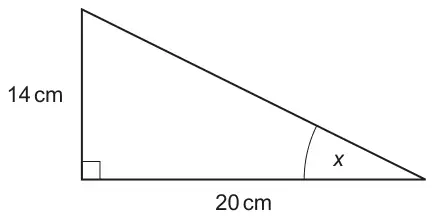
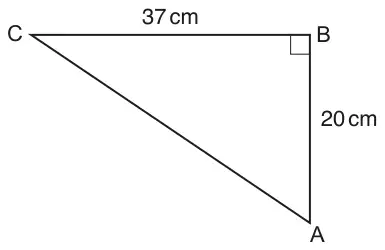
5 ABC is a right-angled triangle. AB = 20 cm and BC = 37 cm.
Not to scale
Calculate angle BAC. [3]
Mark scheme
Answer
Marks
Part marks and guidance
Answer which rounds to 61.6 nfww
3
M2 for \(\tan^{-1}\left(\dfrac{37}{20}\right)\) oe or M1 for tan[x =] \(\dfrac{37}{20}\) oe
If M0 scored then SC1 for answers 28.4, 28 or angles that round to 28.4 if correct working seen.
Condone answer of 62 only if correct working seen Answers of 68.5 or 68.4(5..) [grads] or 1.08 or 1.07(5..) [rads] imply M2
Alternative method After correct method for Pythagoras soi by 42.0 to 42.1 M2 for \(\sin^{-1}\left(\dfrac{37}{\textit{their}\sqrt{20^2 + 37^2}}\right)\) or \(\cos^{-1}\left(\dfrac{20}{\textit{their}\sqrt{20^2 + 37^2}}\right)\) or M1 for sin[x =] \(\dfrac{37}{\textit{their}\sqrt{20^2 + 37^2}}\) or cos[x =] \(\dfrac{20}{\textit{their}\sqrt{20^2 + 37^2}}\) or M0 for just Pythagoras reaching AC = 42.0 to 42.1 Do not condone answer of 62 following an interim answer seen that does not round to 61.6 0 for scale drawing
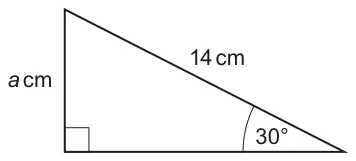
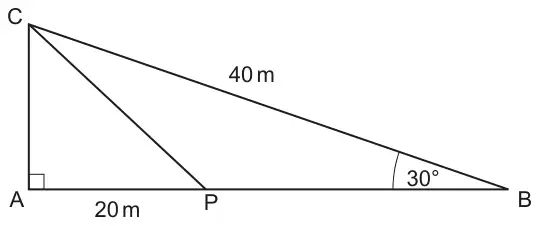
13 In the diagram, ABC is a right-angled triangle. P is a point on AB. BC = 40 m, AP = 20 m and angle ABC = 30°.
Not to scale
(a) Show that AC = 20 m. [3]
(b) Find the length of PB. Give your answer in the form \(a(\sqrt{3} - b)\), where \(a\) and \(b\) are integers. [5]
Mark scheme (a)
Answer
Marks
Part marks and guidance
AC = 40sin30
M2
M1 for \(\dfrac{\text{AC}}{40} = \sin 30\) oe
20 and evidence that sin 30 = 0.5
A1
If 0 scored, B1 for sin 30 = 0.5 oe
Mark scheme (b)
Answer
Marks
Part marks and guidance
\(20(\sqrt{3} - 1)\)
5
B4 for \(20\sqrt{3} - 20\) or \(\sqrt{1200} - 20\) or B3 for \(\sqrt{1200}\) or \(\dfrac{40\sqrt{3}}{2}\) or M2 for 40cos30 oe or M1 for \(\cos 30 = \dfrac{\text{AB}}{40}\) oe
Other methods are possible e.g. Pythag e.g. M2 for [AB =] \(\sqrt{40^2 - 20^2}\) e.g. M1 for AB² + 20² = 40²
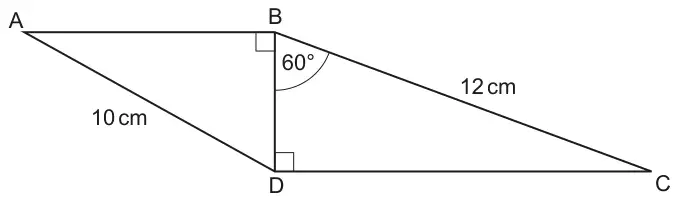
11 The diagram shows two right-angled triangles ABD and BCD, sharing a common side BD. AD = 10 cm, BC = 12 cm and angle DBC = 60°.
Not to scale
Work out the length of AB. [6]
Mark scheme
Answer
Marks
Part marks and guidance
8 nfww
6
nfww - must check method before giving 6 marks must not come from wrong working
B1 for cos 60 = 0.5 oe soi M1 for \(\dfrac{\text{BD}}{12} = \cos 60\) oe A1 for [BD =] 6 AND M2 for \(\sqrt{10^2 - \textit{their}\text{ BD}^2}\) or M1 for their \(\text{BD}^2 + \text{AB}^2 = 10^2\) oe or for \(10^2 -\) their \(\text{BD}^2\)
e.g. sin 30 = 0.5 e.g. \(\dfrac{\text{BD}}{12} = \sin 30\)
For M2 or M1 0 < their BD < 10 and BD must be identified first on diagram or in working
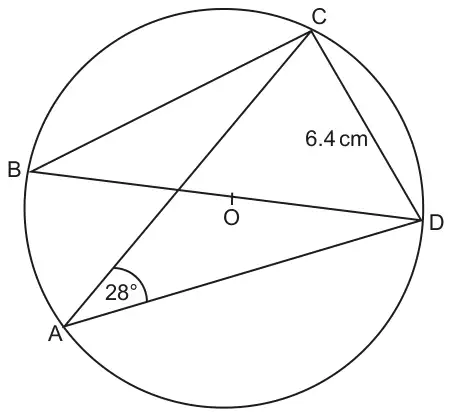
8 A, B, C and D are points on the circumference of a circle, centre O.
Not to scale
Angle CAD = 28° and CD = 6.4 cm. BD is a diameter of the circle.
Calculate the area of the circle. [5]
Mark scheme
Answer
Marks
Part marks and guidance
145.2 to 146.2
5
B1 for angle CBD = 28 soi or for angle BCD = 90 soi and M2 for \(\dfrac{6.4}{\sin 28}\) oe or 13.6[3…] nfww or M1 for \(\sin [28] = \dfrac{6.4}{[..]}\) oe and M1 for \(\pi \times (\textit{their}\text{ radius})^2\)
B1 implied by e.g. 28 or 62 correctly used in trigonometry or 28, 62 or 90 (or symbol) marked in the correct place in the diagram
13.6… can imply B1 however if it is marked on the wrong side, e.g. on AC, then it scores 0 marks
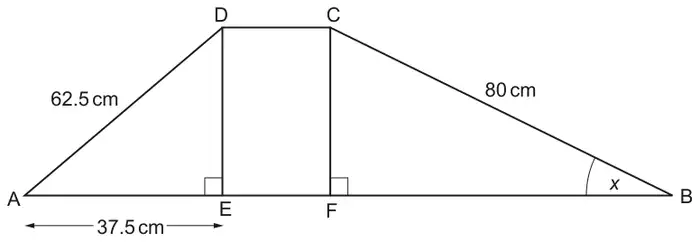
B3 for 50 for DE or CF nfww Or M1 for \(62.5^2 - 37.5^2\) M1 for \(\sqrt{62.5^2 \pm 37.5^2}\)
And
B3 FT for \(\sin^{-1}\left(\dfrac{\textit{their } 50}{80}\right)\) correctly evaluated or M2 FT for \(\sin^{-1}\left(\dfrac{\textit{their } 50}{80}\right)\) or M1 FT for \(\sin\) [\(x\)] = \(\dfrac{\textit{their } 50}{80}\)
Allow 39
May be in correct place on diagram 2500 implies M1
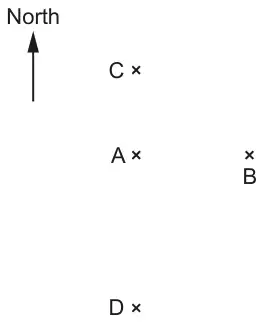
B is 25 kilometres due East of A. C is 25 kilometres due North of A. D is 45 kilometres due South of A.
Not to scale
(a) Work out the bearing of B from C. [2]
(b) Calculate the bearing of D from B. [4]
Mark scheme (a)
Answer
Marks
Part marks and guidance
135
2
B1 for angle 45
e.g 45 marked at ACB or ABC or 180 – 45 or 90 + 45
Mark scheme (b)
Answer
Marks
Part marks and guidance
209 to 209.1
4
M2 for \(\tan^{-1}(45 \div 25)\) or \(\tan^{-1}(25 \div 45)\) soi by 61, 60.94 to 60.95 or 29[.1], 29.05...
or
M1 for \(\tan\) [=] \(45 \div 25\) or \(\tan\) [=] \(25 \div 45\)
AND
M1 for 270 – their angleABD or 180 + their angleADB
Accept longer methods but they must get to the equivalent point to gain credit e.g. if they find the hypotenuse, they score M0 until they start to use sin or cos.
B is 25 kilometres due East of A. C is 25 kilometres due North of A. D is 45 kilometres due South of A.
Not to scale
(a) Work out the bearing of B from C. [2]
(b) Calculate the bearing of D from B. [4]
Mark scheme (a)
Answer
Marks
Part marks and guidance
135
2
B1 for angle 45
e.g. 45 marked at ACB or ABC, 180 – 45, 90 + 45
Mark scheme (b)
Answer
Marks
Part marks and guidance
209 to 209.1
4
M2 for \(\tan^{-1}(45 \div 25)\) or \(\tan^{-1}(25 \div 45)\) soi by 61, 60.94 to 60.95 or 29[.1], 29.05...
or
M1 for tan [=] 45÷25 or tan [=] 25÷45
Accept longer methods but they must get to the equivalent point to gain credit e.g. if they find the hypotenuse, they score M0 until they start to use sin or cos.
Can be implied by their answer
AND
M1 for 270 – their angleABD or 180 + their angleADB