(a) Use your calculator to work out the value of \[\dfrac{42.1 - 29.53}{9.82 + 37.6}\]Give your answer as a decimal. Write down all the figures on your calculator display. (2)
(b) Write your answer to part (a) correct to 2 significant figures. (1)
Mark scheme (a)
Answer
Mark
Mark scheme
0.265(0780261)
M1
for 12.57 or 47.42 or 0.2 or 0.26 or 0.27 or 0.3 or \(\dfrac{1257}{4742}\) oe
A1
for 0.265(0780261)
Additional guidance
Answer must be given to at least 3 decimal places rounded or truncated Check first 3 decimal places only
Mark scheme (b)
Answer
Mark
Mark scheme
0.27
B1
for 0.27 or ft from part (a) provided answer to (a) has at least 3 sf
The table shows the number of blue pens and the number of red pens Samina sold in each of three months.
Month
Blue pens
Red pens
April
33
20
May
40
14
June
27
15
(a) Work out the total number of blue pens and red pens Samina sold in June. (1)
Samina says,
“In these three months, in total, I sold more than twice as many blue pens as red pens.”
(b) Is Samina correct? You must show how you get your answer. (3)
Mark scheme (a)
Answer
Mark
Mark scheme
42
B1
cao
Mark scheme (b)
Answer
Mark
Mark scheme
Yes (supported)
P1
for a start to a process to find figures to compare, eg \(33 + 40 + 27\ (= 100)\) or \(20 + 14 + 15\ (= 49)\) or \((33 - 20) + (40 - 14) + (27 - 15)\ (= 51)\)
P1
for complete process to give figures to compare, eg \(33 + 40 + 27\ (= 100)\) and \(20 + 14 + 15\ (= 49)\) and \(\text{``}49\text{''} \times 2\ (= 98)\) or \(33 + 40 + 27\ (= 100)\) and \(20 + 14 + 15\ (= 49)\) and \(\text{``}100\text{''} \div 2\ (= 50)\) or \(33 + 40 + 27\ (= 100)\) and \(20 + 14 + 15\ (= 49)\) and \(\text{``}100\text{''} - \text{``}49\text{''}\ (= 51)\) or \(33 + 40 + 27\ (= 100)\) and \(20 \times 2 + 14 \times 2 + 15 \times 2\ (= 98)\) or \((33 - 20) + (40 - 14) + (27 - 15)\ (= 51)\) and \(20 + 14 + 15\ (= 49)\)
C1
for Yes with correct supporting figures, eg 100 and 98 or 50 and 49 or 100 and 49 and 51 or 51 and 49
Write down all the digits on your calculator display. (2)
Mark scheme
Answer
Mark
Mark scheme
4.643(069317)
M1
for 192.6 or 8.934 or 21.558(09268) or answer of 4.64 or digits 4643…
A1
for 4.643(069317)
Additional guidance
Answer must be given to at least 3 decimal places rounded or truncated Check first 3 decimal places only If given to 3 dp or better ignore subsequent rounding
14 Harry works in a shop. From Monday to Friday his basic rate of pay is £8 per hour.
On Saturday and Sunday, Harry’s rate of pay is \(1\dfrac{1}{2}\) times his basic rate of pay.
The table shows the number of hours Harry worked each day last week.
Day
Mon
Tue
Wed
Thu
Fri
Sat
Sun
Hours worked
6
6
6
6
6
4
3
Work out Harry’s total pay last week. (4)
Mark scheme
Answer
Mark
Mark scheme
324
P1
for a process to work out daily pay on a weekday, eg \(8 \times 6\ (= 48)\)
or a process to work out the number of hours of pay for weekdays, eg \(6 \times 5\ (= 30)\)
or the number of hours of pay for Saturday and Sunday, eg \((4 + 3) \times 1.5\ (= 10.5)\)
or a process to work out rate of pay for Saturday or Sunday, eg \(8 \times 1.5\ (= 12)\)
P1
for a process to work out the total pay from Monday to Friday, eg \(\text{``}48\text{''} \times 5\ (= 240)\) or \(\text{``}30\text{''} \times 8\ (= 240)\)
or for a process to work out the total pay from Saturday and Sunday, eg \(\text{``}10.5\text{''} \times 8\ (= 84)\) or \(\text{``}12\text{''} \times (4 + 3)\ (= 84)\)
or a process to work out the total number of hours of pay, eg \(\text{``}30\text{''} + \text{``}10.5\text{''}\ (= 40.5)\)
P1
for a complete process, eg \(\text{``}240\text{''} + \text{``}84\text{''}\) or \(\text{``}40.5\text{''} \times 8\)
Olly wrote \(5 - 3 = 2\) He then worked out \(2 \times 4\)
Explain what is wrong with Olly’s method. (1)
Mark scheme
Answer
Mark
Mark scheme
explanation
C1
for explanation Acceptable examples he should have multiplied first multiplication should be done before subtraction he should have done \(3 \times 4\) first he didn’t use BIDMAS/BODMAS/PEMDAS \(5 - 12 = -7\)
Not acceptable examples he was correct the answer is \(-7\) Olly’s method gives the wrong answer BIDMAS/BODMAS/PEMDAS he should multiply first so \(3 \times 4 = 12\) then \(12 - 5 = 7\) he should have done \(3 \times 4 = 12\) then \(12 - 5 = 7\) he should have done \(2 \times 4\) first
Write down all the digits on your calculator display. (2)
Mark scheme
Answer
Mark
Mark scheme
4.643(069317)
M1
for 192.6 or 8.934 or 21.558(09268) or answer of 4.64 or digits 4643…
A1
for 4.643(069317)
Additional guidance
Answer must be given to at least 3 decimal places rounded or truncated Check first 3 decimal places only If given to 3 dp or better ignore subsequent rounding
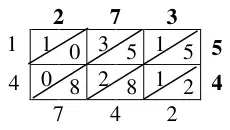
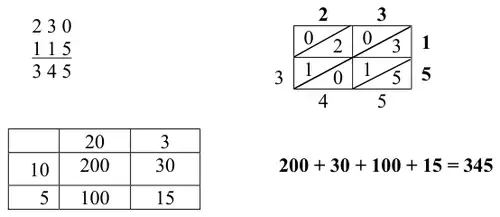
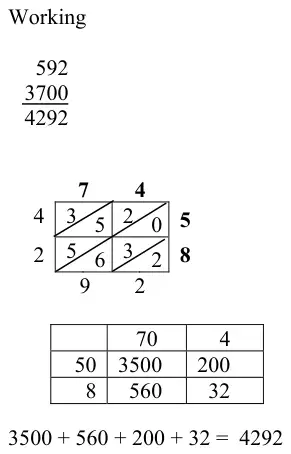
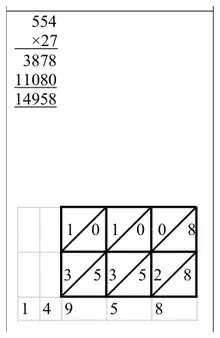
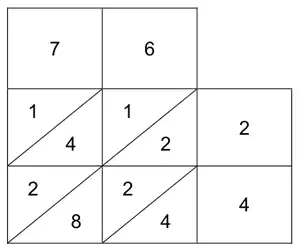
for complete correct method with relative place value correct eg two lines of 1st method, internal numbers of grids, or complete structure shown of partitioning methods
M1
(dep on M1) for addition of all the appropriate elements of the calculation
Show that Curtis can buy all the items he needs. (4)
Mark scheme
Answer
Mark
Mark scheme
Shown
M1
for a method to find the total cost for footballs, hockey sticks or cricket bats, eg \(9.5 \times 5\ (= 47.5)\) or \((6 \div 2) \times 30\ (= 90)\) or \(23 \times 2\ (= 46)\) OR begins to work with budget, eg \(200 - 5\ (= 195)\)
M1
for a method to find the total cost for two of footballs, hockey sticks or cricket bats, eg two from \(9.5 \times 5\ (= 47.5)\) or \((6 \div 2) \times 30\ (= 90)\) or \(23 \times 2\ (= 46)\) OR works with budget and total cost for one of footballs, hockey sticks or cricket bats, eg \(200 - \text{``}47.5\text{''}\)
M1
for a complete method to find comparable figures, eg \(9.5 \times 5 + (6 \div 2) \times 30 + 23 \times 2 + 5\) or \(\text{``}47.5\text{''} + \text{``}90\text{''} + \text{``}46\text{''} + 5\) or \(200 - (9.5 \times 5 + (6 \div 2) \times 30 + 23 \times 2 + 5)\) or \(200 - \text{``}188.5\text{''}\)
C1
shows correct figures for a conclusion eg (£)188.5(0) or (£)11.5(0)
Additional guidance
Can be done with addition or subtraction, or combination
Figures need not be supported by words but must not be contradicted.
7 Miklos is swimming lengths of a swimming pool. Each length of the pool is 25 m.
Miklos has swum 178 lengths of the pool. He wants to swim a total distance of 8050 m.
Calculate how many more lengths Miklos needs to swim. (3)
Mark scheme
Answer
Mark
Mark scheme
144
P1
for process to begin to work with length, eg \(8050 \div 25\ (= 322)\) or \(178 \times 25\ (= 4450)\)
P1
for full process to find number of lengths remaining, eg \(\text{``}322\text{''} - 178\) or \((8050 - \text{``}4450\text{''}) \div 25\) or \(3600 \div 25\)
10 A shop sells jars of coffee. Each jar of coffee costs £4 Michael has £23
(a) Work out the greatest number of jars of coffee Michael can buy. (2)
In a sale on Wednesday, jars of coffee are sold at half price.
Michael thinks that he can now buy exactly twice the number of jars of coffee for £23
(b) Is Michael correct? You must give a reason for your answer. (1)
Mark scheme (a)
Answer
Mark
Mark scheme
5
P1
for correct process, eg \(23 \div 4\ (= 5.75)\) or adds 4s up to at least 20 or repeatedly subtracts 4 up to a remainder of less than 4
A1
cao
Mark scheme (b)
Answer
Mark
Mark scheme
No (supported)
C1
for No with reason
Acceptable examples Can buy 11 jars Can buy an extra jar (for the £3 extra) Can buy 10 jars for £20 He will have £3 left Because he can buy more than twice the number of jars Because \(23 \div 2 = 11.5\)
Not acceptable examples Yes ….. Can buy 10 / Can buy 12
10 In Norway last year, the lowest temperature was \(-15^\circ\)C. In Norway last year, the highest temperature was \(42^\circ\)C greater than the lowest temperature.
Work out the highest temperature in Norway last year. (2)
9 Alec needs to work out the value of \(2 + 3 \times 4\)
He writes
\(2 + 3 = 5\) and \(5 \times 4 = 20\), so \(2 + 3 \times 4 = 20\)
Alec is wrong. Explain why. (1)
Mark scheme
Answer
Mark
Mark scheme
Explanation
C1
for explanation, Acceptable examples Answer should be 14 Should work out \(3 \times 4\) first Alec should times first instead of adding Not used BIDMAS/BODMAS BIDMAS/BODMAS He has done it in the wrong order Alec needs to use brackets so \(2 + (3 \times 4)\) Because you always do multiplication or division first Not acceptable examples Because the answer is wrong It is \(2 + (3 \times 4) = 15\) It needs brackets Because working out should only be one sum
(a) Use your calculator to work out \(\dfrac{29^2 - 4.6}{\sqrt{35 - 1.9^3}}\) Write down all the figures on your calculator display. (2)
(b) Write your answer to part (a) correct to 4 significant figures. (1)
Mark scheme (a)
Answer
Mark
Mark scheme
157.668(255)
M1
for 836.4 or 5.304(809139) or 28.141 or a truncated or rounded version of 157.668255 to no less than 3 sf
A1
for 157.668(255)
Additional guidance
Answer must be given to at least 3 decimal places rounded or truncated Accept a clear indication of the decimal point. Check first 3 decimal places only
Mark scheme (b)
Answer
Mark
Mark scheme
157.7
B1
ft from part (a) provided answer to (a) has at least 5 sf
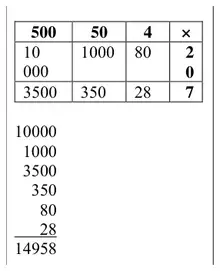
for complete method with relative place value correct including addition of all the appropriate elements of the calculation.\(23 + 23 + 23 + 23 + 23 = 115\); \(115 + 115 + 115 = 345\)
A1
cao
Additional guidance
Accept all equivalent methods if complete.
Partitioning methods may show a complete method which has been broken down into multiple stages.
Multiple addition of 23 (or 15) acceptable if the correct number added is shown, and an attempt at addition is clear.
Rae buys 3 small boxes of cornflakes and some large boxes of cornflakes. In total she buys 5850 g of cornflakes.
Work out the number of large boxes of cornflakes Rae buys. (3)
Mark scheme
Answer
Mark
Mark scheme
6
P1
process to find the weight of small boxes eg \(3 \times 450\ (=1350)\)
P1
complete process to find the number of large boxes, eg \((5850 - \text{``}1350\text{''}) \div 750\) or \(5850 - \text{``}1350\text{''}\ (=4500)\) and \(6 \times 750\ (=4500)\)
A1
cao
Additional guidance
For the A1: Cannot award this mark if 6 comes from a rounded value due to error in calculating
21 There are 40 students in a class. Each student walks to school or cycles to school or gets the bus to school.
There are 22 girls in the class. 9 of the girls walk to school. 7 of the boys cycle to school. 6 of the 10 students who get the bus to school are boys.
Find the number of these students who walk to school. (4)
Mark scheme
Answer
Mark
Mark scheme
14
P1
for process to find total number of boys, \(40 - 22\ (= 18)\) OR the number of girls who travel by bus \(10 - 6\ (= 4)\)
P1
for process to find the number of girls who cycle to school \(22 - \text{``}4\text{''} - 9\ (=9)\) OR the number of boys who walk to school \(\text{``}18\text{''} - 6 - 7\ (= 5)\)
P1
full process to find the total number of students who walked to school eg \(\text{``}5\text{''} + 9\) or \(40 - (6 + 7 + \text{``}4\text{''} + \text{``}9\text{''})\)
A1
cao
Additional guidance
W
C
B
boy
5
(7)
(6)
18
girl
(9)
9
4
(22)
14
16
(10)
(40)
Note 16 is 7+9 and 10 is 6+4 6+7 is 13 and 4+9=13 may be seen as intermediate steps
14 Find the value of \(\dfrac{5.27 + 3.5}{7.9 - 4.36}\)
Give your answer as a decimal. Write down all the figures on your calculator display. (2)
Mark scheme
Answer
Mark
Mark scheme
2.4774(011...)
M1
for 8.77 or 3.54 or 2.477 or 2.47 or 2.48 or \(\dfrac{877}{354}\)
A1
for 2.4774(011...)
Additional guidance
For the A1: If the answer has been rounded to less than 4 dp but the figure is shown in working to 4 dp or more, award full marks. Ignore any incorrect digits after the 4th decimal place.
The table shows the number of each type of counter in the bag.
Type of counter
red circle
green circle
red square
green square
Number of counters
16
26
11
7
There are more green counters than red counters. How many more? (2)
Mark scheme
Answer
Mark
Mark scheme
6
M1
for interpreting the table to find the number of green counters \((26 + 7\ (= 33))\) or the number of red counters \((16 + 11\ (= 27))\) or the difference in circles \((26 - 16\ (=10))\) or squares \((11 - 7\ (=4))\)
6 Harry is planning a holiday for 4 people for 7 days.
Here are the costs for the holiday for each person.
Travel
£150
Hotel
£50 for each day
Spending money
£250
Work out the total cost of the holiday for 4 people for 7 days. (4)
Mark scheme
Answer
Mark
Mark scheme
3000
P1
for a correct step for travel or/and spending money eg \(4 \times 150\ (=600)\) or \(4 \times 250\ (=1000)\) or \(150 + 250\ (=400)\)
P1
for an appropriate step with the hotel price eg \(7 \times 50\ (=350)\) or \(4 \times 50\ (=200)\)
P1
for combining at least two “costs” for 4 people for 7 nights eg \(4 \times 150 + 4 \times 250\ (=1600)\) or \(4 \times 150 + 7 \times 4 \times 50\ (=2000)\)
A1
cao
Additional guidance
For the first P1: Can be embedded eg \(4 \times 7 \times 150\)
For the second P1: Can be \(4 \times 7 \times 50\)
For the third P1: Must be correct process for two costs eg not \(4 \times 150 \times 7\) but may be 2 correct costs and one incorrect
(a) Write 7357 correct to 3 significant figures. (1)
(b) Work out \(\dfrac{\sqrt{17 + 4^2}}{7.3^2}\) Write down all the figures on your calculator display. (2)
Mark scheme (a)
Answer
Mark
Mark scheme
7360
B1
cao
Mark scheme (b)
Answer
Mark
Mark scheme
0.1077981356
B2
for 0.1077(981…)
(B1
for 5.74(45626…) or 53.29 or 0.11 or 0.107 or 0.108 )
Additional guidance
Answer must be given to at least 4 decimal places rounded or truncated Accept a clear indication of the decimal point. Check first four decimal places only
17 Adrian is going to make concrete. He is going to use
180 kg of cement 375 kg of sand 1080 kg of stone
Cement, sand and stone are sold in bags.
1 bag cement
1 bag sand
1 bag stone
25 kg
22.5 kg
50 kg
Adrian already has
10 bags of cement 20 bags of sand 20 bags of stone
Work out what bags he needs to buy to make the concrete. (3)
Mark scheme
Answer
Mark
Mark scheme
2 bags of stone
P2
for a complete process to work out how many bags of each material is required eg \(180 \div 25\) (= 7.2 or 8), \(375 \div 22.5\) (= 16.6.. or 17), \(1080 \div 50\) (= 21.6 or 22)
or a complete process to work out the total weight of each element that he has eg \(25 \times 10\ (= 250)\), \(20 \times 22.5\ (= 450)\), \(50 \times 20\ (= 1000)\)
(P1
for a correct start to the process, eg for at least one correct calculation
C1
correct conclusion eg 2 bags of stone, with no incorrect working
Additional guidance
The correct figures do not need to be seen to award the process marks
(a) Write 7357 correct to 3 significant figures. (1)
(b) Work out \(\dfrac{\sqrt{17 + 4^2}}{7.3^2}\) Write down all the figures on your calculator display. (2)
Mark scheme (a)
Answer
Mark
Mark scheme
7360
B1
cao
Mark scheme (b)
Answer
Mark
Mark scheme
0.1077981356
B2
for 0.1077(981…)
(B1
for 5.74(45626…) or 53.29 or 0.11 or 0.107 or 0.108 )
Additional guidance
Answer must be given to at least 4 decimal places rounded or truncated Accept a clear indication of the decimal point. Check first four decimal places only
Peter cuts two 45 cm lengths off the wire. He then cuts the rest of the wire into as many 40 cm lengths as possible.
Work out how many 40 cm lengths of wire Peter cuts. (3)
Mark scheme
Answer
Mark
Mark scheme
3
P1
for a start to the process eg \(240 - (2 \times 45)\ (= 150)\) oe or \((2 \times 45) + 40\ (= 130)\) oe
P1
for complete process eg \(\text{``}150\text{''} \div 40\ (= 3.75)\) – can be implied by \(40 + 40 + 40 = 120\) or \(\text{``}130\text{''} + 40 + 40\ (= 210)\)
A1
cao
Additional guidance
Considering just one piece of 45 cm is not a misread but \((240 - 45) \div 40\ (= 4.875)\) oe should be awarded P1 only
10 Tim and three friends go on holiday together for a week. The 4 friends will share the costs of the holiday equally. Here are the costs of the holiday.
£1280 for 4 return plane tickets £640 for the villa £220 for hire of a car for the week
Work out how much Tim has to pay for his share of the costs. (3)
Mark scheme
Answer
Mark
Mark scheme
535
P1
for a start to the process eg \(1280 + 640 + 220\) (=2140) or \(1280 \div 4\) (=320) or \(640 \div 4\) (=160) or \(220 \div 4\) (=55)
P1
for a full process to find cost per adult eg \(\text{``}2140\text{''} \div 4\) or \(\text{``}320\text{''} + \text{``}160\text{''} + \text{``}55\text{''}\)
A1
cao SC: B1 for answer of 1495 if P0 scored
Additional guidance
Can have arithmetical error as long as the complete processes, in the correct order, are present.
(a) Work out the value of \(T\). Give your answer in standard form correct to 3 significant figures. (2)
\(w\) is increased by 10% \(d\) is increased by 5%
Lottie says,
“The value of \(T\) will increase because both \(w\) and \(d\) are increased.”
(b) Lottie is wrong. Explain why. (2)
Mark scheme (a)
Answer
Mark
Mark scheme
\(4.52 \times 10^3\)
M1
for \(2.04.... \times 10^7\) oe eg \(2.04.... \times 10^{-5} \div 10^{-12}\) or \(20.4... \times 10^6\) or 204(08163.27) or for correct value of \(T\), 4517.(53....), not written in standard form, eg 4520
A1
for answer in the range \(4.51 \times 10^3\) to \(4.52 \times 10^3\)
(SC B1 for \(6.32... \times 10^{-1}\))
Additional guidance
May be given correct to 3 sig figs or more
Mark scheme (b)
Answer
Mark
Mark scheme
Explanation
M1
for method to find the scale factor or decreased value in \(T\), eg \(\sqrt{\dfrac{1.1}{1.05^3}}\) (= 0.97......) oe or \(\sqrt{\dfrac{5.6 \times 10^{-5} \times 1.1}{(1.4 \times 10^{-4} \times 1.05)^3}}\) (\(= 4.40.... \times 10^3\)) oe
C1
(dep M1) for explanation eg value of scale factor less than 1, so a decrease in \(T\) OR compares \(4.40... \times 10^3\) with their value of \(T\) from (a) provided answer to (a) is greater
Additional guidance
Award mark for a correct method to calculate the scale factor or the percentage increases in \(w\) and \(d^3\) or the decreased value of \(T\)
This mark may only be awarded if supported by numerical evidence
9 Ben hires some buses to take 768 people to a football match. Each bus can take 56 people.
Ben hires the least number of buses needed to take all 768 people.
Then 19 of the 768 people decide not to go to the football match.
Does Ben still need all the buses he has hired? You must show how you get your answer. (3)
Mark scheme
Answer
Mark
Notes
Yes with correct calculations
3
M1 for \(768 \div 56\) (= 13.71... or 14) OR \(13 \times 56\) (= 728) or \(14 \times 56\) (= 784) M1 for \((768 - 19) \div 56\) (= 13.375) OR for [\(13 \times 56\) (= 728) or \(14 \times 56\) (= 784)] and \(768 - 19\) (= 749) A1 for correct conclusion from correct calculations, eg Yes, he still needs 14 buses.
3 The price of a calculator depends on the number of these calculators you buy. The table gives information about the prices of this calculator.
Number of calculators
Price of each calculator
1–29
£3.85
30–99
£3.65
100 or more
£3.49
Mr Edwards wants to buy some of these calculators. He has £200 to spend.
Work out the greatest number of calculators he can buy. (3)
Mark scheme
Answer
Mark
Notes
54
3
M1 for \(200 \div 3.85\) (= 51.94.. or 51) or \(200 \div 3.65\) (= 54.79.. or 54) or \(200 \div 3.49\) (= 57.31.. or 57) M1 for working out all of the above, or an answer of 54.79... A1 cao
7 Paula has £10 to spend on music downloads. Each music download costs 84p. Paula buys as many music downloads as possible.
Work out how much money Paula has left. (3)
Mark scheme
Answer
Mark
Notes
76p
3
M1 for \(1000 \div 84\) or \(10 \div 0.84\) (= 11.90…) or \(11 \times 84\) (= 924) or \(11 \times 0.84\) (= 9.24) or 11 given as the answer. M1 for complete method to find the change (showing figures in compatible units) or 76 as the answer no/incorrect units. A1 for 76p or £0.76 or £0.76p
11 Amber earns £7 for each hour she works from Monday to Friday. She earns £10 for each hour she works on Saturday.
One week Amber worked for 4 hours on Saturday. That week she earned a total of £180
(a) How many hours did Amber work that week? (3)
Chris works for 7 hours each day from Monday to Friday. He earns \(e\) pounds for each hour he works.
(b) Write down an expression, in terms of \(e\), for the total amount, in pounds, that Chris earns from Monday to Friday. Give your answer in its simplest form. (2)
Mark scheme (a)
Answer
Mark
Notes
24
3
M1 for \(4 \times 10\) (= 40) M1 for operations \(-\text{``}40\text{''}\) then \(\div 7\) in correct order or 20 A1 cao
Mark scheme (b)
Answer
Mark
Notes
\(35e\)
2
M1 for \(7 \times e\) or \(5 \times e\) or \(7 \times 5 \times e\) oe A1 for \(35e\) (ignore £ signs)
4 The table shows the numbers of people, in thousands, visiting five castles in 2009 and in 2010
Castle
Number of people (thousands)
2009
2010
Bodiam
185
177
Chirk
108
120
Dunster
133
128
Penrhyn
231
230
Scotney
124
118
*(a) Did a greater total number of people visit these castles in 2009 or in 2010? You must show all your working. (3)
David wants to visit Dunster castle. He is going to go from Taunton to Dunster by bus.
Here is part of the bus timetable.
Taunton
07 20
08 42
09 33
11 03
Coombe Florey
07 40
08 58
09 58
11 28
Watchet
08 03
09 21
10 21
11 51
Carhampton
08 16
09 34
10 34
12 04
Dunster
08 18
09 36
10 36
12 06
A bus leaves Taunton at 08 42
(b)
(i) What time should this bus get to Dunster?
(ii) How many minutes should this bus take to get from Taunton to Dunster? (2)
Anne lives in Watchet. She is going to go to Dunster by bus. She wants to arrive in Dunster by 10 00
(c) Write down the time of the latest bus Anne can get from Watchet. (1)
Mark scheme (a)
Answer
Mark
Notes
Statement (supported)
3
M1 for method to find total visitors for 2009 or for 2010 eg \(185 + 108 + 133 + 231 + 124\) (= 781) or \(177 + 120 + 128 + 230 + 118\) (= 773) A1 for 781 and 773 (or 781000 and 773000) C1 ft (dep on M1 and two totals) for clearly stating 2009 as their answer or ft from their two totals.
OR M1 for method to find difference in the number of visitors for each castle eg 8, \(-12\), 5, 1, 6 or \(-8\), 12, \(-5\), \(-1\), \(-6\) A1 for correct total net difference 8 or \(-8\) C1 (dep M1 and a net difference) for clearly stating 2009 as their answer or ft from their net difference.
M1 for a complete method to find the cost for one company M1 for a complete method to find the cost for both companies and finding the difference A1 cao
OR M1 for a complete method to find the differences in cost for calls or texts M1 for a complete method to find the amount saved and finding the sum A1 cao
He puts some of the potatoes into a small sack. He puts the rest of the potatoes into a large sack.
The total weight of the potatoes in the large sack is 13 kg more than the total weight of the potatoes in the small sack.
(a) What is the total weight of the potatoes in the small sack? (2)
There are 30 kg of potatoes in a wheelbarrow.
The farmer puts some carrots into the wheelbarrow. The total weight of the potatoes and the carrots in the wheelbarrow is 110 pounds.
(b) What weight of carrots did the farmer put into the wheelbarrow? 1 kg = 2.2 pounds (4)
Mark scheme (a)
Answer
Mark
Notes
12
2
M1 for correct first step, eg \(37 - 13\) (= 24) or \((37 + 13) \div 2\) (= 25) oe or two weights with a difference of 13 or two weights with a total of 37 A1 cao
Mark scheme (b)
Answer
Mark
Notes
44 pounds or 20 kg
4
M1 for \(30 \times 2.2\) (= 66) M1 (dep) for \(110 - \text{``}66\text{''}\) (= 44) A1 for 44 A1 (dep on first M1) for pounds
OR
M1 for \(110 \div 2.2\) (= 50) M1 (dep) for \(\text{``}50\text{''} - 30\) (= 20) A1 for 20 A1 (dep on first M1) for kg
19 Miss Martins is organising a school play. The total cost of putting on the play is £960
The school pays £300 of this cost. Miss Martins sells tickets to pay the rest of the cost.
Miss Martins sells 500 tickets. Each ticket costs £4
Miss Martins has enough money to pay the rest of the costs and to give all the money left over to charity.
Work out how much money Miss Martins gives to charity. (4)
Mark scheme
Answer
Mark
Notes
1340
4
M1 for \(500 \times 4\) (= 2000) M1 for \(960 - 300\) (= 660) or \(\text{``}2000\text{''} + 300\) (= 2300) or \(\text{``}2000\text{''} - 960\) (= 1040) M1 (dep on M2) for a fully correct method eg \(\text{``}2000\text{''} - \text{``}660\text{''}\) or \(\text{``}2300\text{''} - \text{``}960\text{''}\) or \(\text{``}1040\text{''} + 300\) A1 cao
She needs 3 pieces of wood of length 32 cm and 2 pieces of wood of length 45 cm.
Amy has a piece of wood of length 2 metres. She cuts the 5 pieces of wood she needs from the 2 metre length of wood.
(a) What length of wood does Amy have left from the 2 metre length? (3)
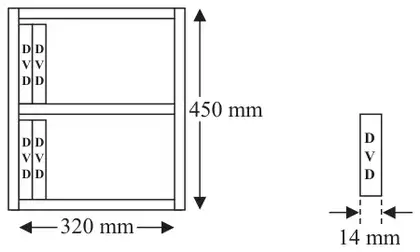
The diagram shows the shelf unit.
Diagram NOT accurately drawn
Amy will put DVDs on the 2 shelves, as shown in the diagram. Each DVD has a width of 14 mm.
(b) What is the greatest number of DVDs Amy can put on the 2 shelves? (3)
Mark scheme (a)
Answer
Mark
Notes
14 cm or 0.14 m
3
M1 for \(3 \times 32 + 2 \times 45\) (= 186) oe M1 (indep) for subtraction of “wood needed” from 2 m using consistent units eg \(200 - \text{``}186\text{''}\) (= 14) or \(2 - \text{``}1.86\text{''}\) (= 0.14) A1 for 14 cm, 0.14 m or 140 mm
Mark scheme (b)
Answer
Mark
Notes
44
3
M1 for \(320 \div 14\) (= 22.8... or 23) or \(2 \times 320 \div 14\) (= 45.7... or 46) M1 (dep) for evidence of truncating “total DVDs” down to integer value, e.g. 22.8... to 22 or 45.7... to 45 A1 cao
*6 Steve wants to put a hedge along one side of his garden. He needs to buy 27 plants for the hedge. Each plant costs £5.54
Steve has £150 to spend on plants for the hedge.
Does Steve have enough money to buy all the plants he needs? (4)
Mark scheme
Answer
Mark
Notes
Yes with correct working
4
M1 for a complete method with relative place value correct. Condone 1 multiplication error, addition not necessary. M1 (dep) for addition of all the appropriate elements of the calculation. A1 for £149.58 or 42p (spare) C1 ft (dep on M1) for correct decision for their total cost
OR M1 for a complete grid with not more than 1 multiplication error, addition not necessary M1 (dep) for addition of all the appropriate elements of the calculation A1 for £149.58 or 42p (spare) C1 ft (dep on M1) for correct decision for their total cost
OR M1 for sight of a complete partitioning method, condone 1 multiplication error, addition not necessary. M1 (dep) for addition of all the appropriate elements of the calculation. A1 for £149.58 or 42p (spare) C1 ft (dep on M1) for correct decision for their total cost
OR M1 for 150.0... ÷ 27 at least 5 seen and 15 carried or \(\tfrac{50}{9}\) M1 (dep) for full correct process to divide 150 by 27 or \(5\tfrac{5}{9}\) A1 for £5.55 or £5.56 or £5.55... C1 ft (dep on M1) for correct decision for their plant cost
OR M1 for 150.0… ÷ 5.54 at least 2 seen and 392 carried M1 (dep) for full correct process to divide 150 by 5.54 A1 for 27 (.07…) C1 ft (dep on M1) for correct decision for their number of plants
4 Sarah has saved 254 pound coins. She puts the pound coins into bags. There are 20 pound coins in each full bag of coins.
Sarah is going to take all her full bags of coins to the bank. She can only take up to 5 full bags of coins to the bank each day.
Sarah wants to go to the bank on as few days as possible.
On how many days will Sarah need to go to the bank? (3)
Mark scheme
Answer
Mark
Notes
3
3
M1 for attempt to find number of bags needed eg \(254 \div 20\) oe (= 12.7) or 12 or 13 M1 (dep) for \(\text{``}254 \div 20\text{''} \div 5\) oe (= 2.4) A1 cao
OR
M1 for \(5 \times 20\) (= 100) M1 (dep) for intention to find how many “100” in 254 (= 2.54) A1 cao
9 Sarah wants a music magazine each month for a year.
She can pay £3.50 each month or pay £37.20 for the year.
Sarah pays £37.20 for the year.
How much cheaper is this than paying £3.50 each month? (3)
Mark scheme
Answer
Mark
Notes
4.80
3
M1 for 3.50 × 12 (= 42) M1 for “42” − 37.20 A1 for 4.8(0) OR M1 for 37.20 ÷ 12 (= 3.10) M1 for (3.50 − “3.10”) × 12 A1 for 4.8(0) Or M1 for 37.20 ÷ 12 (= 3.10) M1 for 3.50 − “3.10” A1 for 0.4(0) or 40p
3 The table shows some information about the numbers of medals won by Great Britain in the 2012 Olympic Games and in the 2012 Paralympic Games.
Gold
Silver
Bronze
Olympic Games
29
17
19
Paralympic Games
34
43
43
Great Britain won more medals in total in the Paralympic Games than in the Olympic Games.
How many more medals in total? (3)
Mark scheme
Answer
Mark
Notes
55
3
M1 for 29 + 17 + 19 (=65) or 34 + 43 + 43 (=120) M1 for “120” – “65” A1 cao OR M1 for 34 – 29 (=5) or 43 – 17 (=26) or 43 – 19 (=24) M1 for “5” + “26” + “24” A1 cao OR M1 for three other consistent differences found M1 adding their differences A1 cao
2 fish and chips at £9.25 each 1 chicken and chips at £9.50 1 roast lamb at £10.55 4 puddings at £4.55 each.
Edwin pays for the meals with three £20 notes.
How much change should Edwin get? (3)
Mark scheme
Answer
Mark
Notes
3.25
3
M1 for 2 × 9.25 + 9.50 + 10.55 + 4 × 4.55 (= 56.75) or at least one of each item added M1(dep) for 3 × 20 − “56.75” A1 cao (SC B2 for answer 26.15) (SC B1 for answer of 13.85 or 36.75)
(i) Use your calculator to work out \(\sqrt{500} + 12.8\) Write down all the figures on your calculator display. You must give your answer as a decimal.
(ii) Write your answer to part (i) correct to 1 decimal place.
(2)
Mark scheme (a)
Answer
Mark
Notes
34.81
1
B1 cao
Mark scheme (b)
Answer
Mark
Notes
(i) 35.1606....
2
B1 for 35.1606(7977...)
(ii) 35.2
B1 ft from (i) provided (i) has more than one decimal place
(e) Add brackets ( ) to make this statement correct.
\(12 - 2 \times 3 + 1 = 4\)
(1)
(f) Why does \(\dfrac{1}{4} = \dfrac{2}{8}\)? (1)
Mark scheme (a)
Answer
Mark
Notes
10
1
B1 cao
Mark scheme (b)
Answer
Mark
Notes
16
1
B1 cao
Mark scheme (c)
Answer
Mark
Notes
\(-11\)
1
B1 cao
Mark scheme (d)
Answer
Mark
Notes
17
1
B1 cao
Mark scheme (e)
Answer
Mark
Notes
\(12 - 2 \times (3 + 1)\)
1
B1 cao
Mark scheme (f)
Answer
Mark
Notes
Explanation/ reason
1
B1 Correct explanation of equivalence eg: Indication that the same operation needs to be applied to both numerator and denominator. Correct shading on diagrams to demonstrate 1 quarter and 2 eighths Conversion of both fractions to a common format 2 is \(\frac{1}{4}\) of 8 oe
Jackie buys some tickets to see the film. Each ticket costs £4.50 Jackie pays with two £20 notes. Jackie gets £8.50 change.
(b) How many tickets did Jackie buy? (3)
Mark scheme (a)
Answer
Mark
Notes
1 hour 40 minutes
2
M1 for correct working shown to find the difference between 17 50 and 19 30 e.g. using a carry of 60 minutes in a take away or counting on from 17 50 to 19 30 A1 for 1 hr 40 mins or 100 mins
Mark scheme (b)
Answer
Mark
Notes
7
3
M1 for 2 × 20 − 8.5 (= 31.5) or 20 − 8.5 (= 11.5) M1 (dep) for “31.5” ÷ 4.5 or (20 + “11.5”) ÷ 4.5 or 7 × 4.5 oe (eg by addition/subtraction method) A1 cao
(a) Use your calculator to work out \[\frac{\sqrt{7056}}{0.35 \times 12.8}\] Write down all the figures on your calculator display. You must give your answer as a decimal. (2)
(b) Write your answer to part (a) correct to 1 significant figure. (1)
Mark scheme (a)
Answer
Mark
Notes
18.75
2
M1 for 84 or 4.48 or \(\dfrac{112}{25}\) or 18.7 or 18.8 or 19 or 20 or \(\dfrac{75}{4}\) A1 cao
Mark scheme (b)
Answer
Mark
Notes
20
1
B1 for 20 or ft from their answer to (a) provided (a) is written to 2 or more significant figures
1 Mary buys three tickets for a theatre show. Each ticket costs £50
Mary also has to pay a booking fee. The booking fee is £2.50 per ticket.
Work out the total amount Mary has to pay. (3)
Mark scheme
Answer
Mark
Notes
157.50
3
M1 50 × 3 (=150) or 2.5 × 3 (=7.5) or 50 + 2.5 (=52.5) M1 “150” + “7.50” or 3 × “52.5” oe (=157.5) A1 cao SC B1 for final answer of 152.5(0) if M0 awarded
5 There is enough space for 80 boxes of cornflakes in a stockroom.
On Monday there are 65 boxes of cornflakes in the stockroom. On Tuesday 17 boxes of cornflakes are taken out of the stockroom. On Wednesday 29 boxes of cornflakes are put into the stockroom.
Work out how many more boxes of cornflakes can now be put into the stockroom. (3)
Mark scheme
Working
Answer
Mark
Notes
Eg. 65 − 17 + 29 = 77 80 − “77”
3
3
M1 for 77 or a correct start to the process using at least two of the given figures M1 for a complete correct method A1 cao
17 Calculate the value of \(\sqrt{\dfrac{\tan 60^\circ + 1}{\tan 60^\circ - 1}}\)
Write down all the figures on your calculator display. You must give your answer as a decimal. (2)
Mark scheme
Working
Answer
Mark
Notes
\(\sqrt{\dfrac{2.73\ldots}{0.732\ldots}}\)
1.931851…
2
M1 for 2.73… or 0.732… or 3.73… or 1.931 or 1.932 or 1.93 or \((1 + \sqrt{3})\) or \((\sqrt{3} - 1)\) or \((2 + \sqrt{3})\) or 1.65... or 0.855... A1 for 1.9318(5…) SC: B1 for 2.5127(17...)
6 72 people are on a bus. 15 people get off the bus. 9 people get on the bus.
How many people are now on the bus? (2)
Mark scheme
Answer
Mark
Notes
66
2
M1 for a correct method to find the number of people on the bus if the 15 get off first. (= 57) A1 cao OR M1 for a correct method to find the number of people on the bus if the 9 get on first. (= 81) A1 cao OR M1 for a correct method to find the net change in the number of people on the bus (= 6 or −6) A1 cao
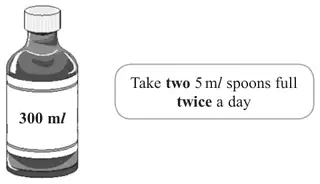
There are 300 ml of medicine in a bottle. Mary has to take two 5 ml spoons full of medicine twice a day. Mary has to take the medicine until the bottle is empty.
(a) How many days does Mary have to take the medicine for? days (3)
You can work out the amount of medicine, \(c\) ml, to give to a child by using the formula
\[c = \frac{ma}{150}\]
\(m\) is the age of the child, in months. \(a\) is an adult dose, in ml.
A child is 30 months old. An adult’s dose is 40 ml.
(b) Work out the amount of medicine you can give to the child. ml (2)
Mark scheme (a)
Working
Answer
Mark
Notes
\(2 \times 5 \times 2 = 20\) \(300 \div 20 =\)
15
3
M2 for \(300 \div (2 \times 5 \times 2)\) oe (M1 for \(2 \times 5 \times 2\) or 20 seen or \(300 \div (2 \times 5)\) or 30 seen A1 cao
Mark scheme (b)
Working
Answer
Mark
Notes
\(c = \dfrac{30 \times 40}{150} =\)
8
2
M1 for \(\dfrac{30 \times 40}{150}\) or 1200 seen A1 cao
(a) Use your calculator to work out \(\dfrac{38.5 \times 14.2}{18.4 - 5.9}\) Write down all the figures on your calculator display. You must give your answer as a decimal. (2)
(b) Write your answer to part (a) correct to 1 significant figure. (1)
Mark scheme (a)
Working
Answer
Mark
Notes
\(\dfrac{546.7}{12.5} =\)
43.736
2
B2 for 43.736 (B1 for 546.7 or \(\frac{5467}{10}\) or \(\frac{5467}{125}\) or 12.5 or \(\frac{25}{2}\) or 43.7 or 43.8 or 43.73 or 43.74 or 40 or 44)
Mark scheme (b)
Answer
Mark
Notes
40
1
B1 for 40 or ft from their answer to (a) provided (a) is written to 2 or more significant figures
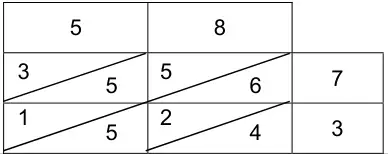
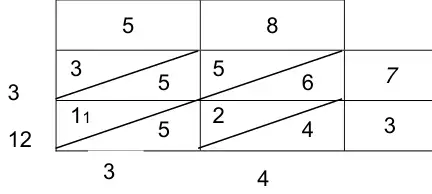
\(4095 + 63\) or \(4221 - 63\) or \((4095 + 4221) \div 2\) or \(8316 \div 2\) or Valid attempt to multiply 63 by 66 with no conceptual error
M1
oe from traditional method their \(378 +\) their 3780 or their \(198 +\) their 3960 with at least one correct and placeholder of zero correct or implied
from grid method their \(3600 +\) their \(360 +\) their \(180 +\) their 18 (at least three correct)
from Chinese / Napier’s bones method at least three values correct from 1/8, 1/8, 3/6 and 3/6 and total calculated for each diagonal with at least one carrying figure placed correctly
3 Work out the value of \(\quad \left(\dfrac{3}{2}\right)^2\)
Give your answer as a mixed number. [1 mark]
Mark scheme
Answer
Mark
Comments
\(2\dfrac{1}{4}\)
B1
oe mixed number
Additional guidance
\(\dfrac{9}{4} = 2\dfrac{1}{4}\) or \(2.25 = 2\dfrac{1}{4}\) on answer line \(2\dfrac{1}{4} = \dfrac{9}{4}\) or \(2\dfrac{1}{4} = 2.25\) on answer line
B1 B0
Otherwise, \(2\dfrac{1}{4}\) and \(\dfrac{9}{4}\) or \(2\dfrac{1}{4}\) and 2.25 on answer line in either order (or in working with answer line blank and answer unclear)
B0
\(1\dfrac{5}{4}\)
B0
\(2\left(\dfrac{1}{4}\right)\) or \(2 + \dfrac{1}{4}\)
Work out the total amount of money from ticket sales for this match. [2 marks]
(b) In fact, for the first match,
some of the tickets cost less than £38.50 and some of the tickets cost more than £38.50
What does this mean about the total amount of money from ticket sales for this match?
Tick one box. [1 mark]
It will be more than the answer to part (a)
It will be the same as the answer to part (a)
It will be less than the answer to part (a)
It is not possible to tell
(c) For the second match, the number of tickets sold increases from 40 000 to 55 000
Is the increase in tickets sold more than 35% ?
You must show your working. [3 marks]
Mark scheme (a)
Answer
Mark
Comments
\(38.5(0) \times 40\,000\)
M1
oe implied by digits 154
1 540 000
A1
oe eg \(1.54 \times 10^6\) or 1.54 million or 1.54 m SC1 3 080 000 or 770 000
Additional guidance
Allow any commas or spaces eg 154,00,00
M1A1
Using decimal points is A0, even if 1 540 000 seen in working eg 15 400.00
M1A0
1 540 000 seen in working but loses or gains one zero on answer line is acceptable as a transcription error eg 1 540 000 seen and answer 1 5040 000 or answer 1 540 00
M1A1
Do not allow the A1 for further work (but may gain M1 eg for digits 154 seen or SC1)
Mark scheme (b)
Answer
Mark
Comments
It is not possible to tell
B1
Mark scheme (c)
Answer
Mark
Comments
Alternative method 1 Working out the increase using 35%
\(55\,000 - 40\,000\) or 15 000
M1
oe
\(0.35 \times 40\,000\) or 14 000
M1
oe
15 000 and 14 000 and Yes
A1
oe
Alternative method 2 Working out the tickets for the second or first match using 35%
\(0.35 \times 40\,000\) or 14 000
M1
oe
\(40\,000 + 0.35 \times 40\,000\) or 54 000 or \(55\,000 - 0.35 \times 40\,000\) or 41 000
M1dep
oe \(1.35 \times 40\,000\) scores M2
54 000 and Yes or 41 000 and Yes
A1
oe
Alternative method 3 Working out the percentage increase
\(55\,000 - 40\,000\) or 15 000 or \(\dfrac{55\,000}{40\,000}\) or 1.375
M1
oe
\(\dfrac{55\,000 - 40\,000}{40\,000}\) or \(\dfrac{15\,000}{40\,000}\) or \(\dfrac{55\,000}{40\,000} - 1\) or \(1.375 - 1\) or 0.375 or 37.5 or 1.375 and 1.35
M1dep
oe eg \(\dfrac{55 - 40}{40}\)
37.5 and Yes or 0.375 and 0.35 and Yes or 1.375 and 1.35 and Yes
A1
oe
Additional guidance
Up to M2 may be awarded for correct work with no answer, or incorrect answer, even if this is seen amongst multiple attempts
May use sales of tickets but must use 1 540 000 Alt 1 \(55\,000 \times 38.5 - 40\,000 \times 38.5\) or \(2\,117\,500 - 1\,540\,000\) or 577 500 \(0.35 \times 1\,540\,000\) or 539 000 577 500 and 539 000 and Yes Alt 2 \(0.35 \times 1\,540\,000\) or 539 000 \(1\,540\,000 + 539\,000\) or 2 079 000 or \(2\,117\,500 - 539\,000\) or 1 578 500 2 079 000 and 2 117 500 and Yes or 1 578 500 and 1 540 000 and Yes Alt 3 \(55\,000 \times 38.5 - 40\,000 \times 38.5\) or \(2\,117\,500 - 1\,540\,000\) or 577 500 or \(\dfrac{2\,117\,500}{1\,540\,000}\) \(\dfrac{2\,117\,500 - 1\,540\,000}{1\,540\,000}\) 37.5 and Yes
M1 M1 A1
M1 M1dep A1
M1 M1dep A1
Only \(40\,000 - 55\,000\) (may be recovered)
M0
In Alt 1 the 2nd mark is not dependent
Build-up to 35% must be correct or full method must be shown
Accept \(35\% \times 40\,000\) for 2nd mark of Alt 1 or 1st mark of Alt 2
20 or 19 and no incorrect evaluations and 3rd box indicated
B2
oe eg 30 and 29 and no incorrect evaluations and 3rd box indicated B1 20 or 19 or incorrect values seen and correct box indicated for their values SC1 3rd box indicated but no evaluations seen
Additional guidance
14 and 39 and 1st box indicated
B1
Ignore any incorrect statements such as \(20 \lt 19\) if the correct box is ticked as they may be checking each statement
You can use the calculation to help answer the following questions.
(a) Work out \(\quad 2604 \div 84\) [1 mark]
(b) Work out \(\quad 3.1 \times 8.4\) [1 mark]
(c) Work out \(\quad 31 \times 85\) [2 marks]
Mark scheme (a)
Answer
Mark
Comments
31
B1
Mark scheme (b)
Answer
Mark
Comments
26.04
B1
Mark scheme (c)
Answer
Mark
Comments
2604 + 31 or Valid attempt to multiply 31 by 85
M1
from traditional method their 155 + their 2480 or their 85 + their 2550 at least one correct and placeholder of zero correct or implied from grid method their 2400 + their 150 + their 80 + their 5 (at least three correct) from Chinese / Napier’s bones method at least three values correct from 2/4, 1/5, (0)/8 and (0)/5 and total calculated for each diagonal with at least one carrying figure placed correctly
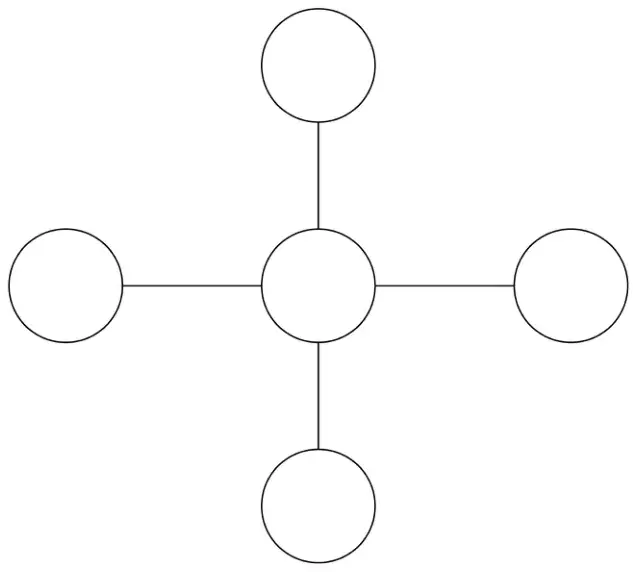
6 Put the numbers 1, 2, 3, 4 and 6 into the circles so that
each line of three numbers multiplies to 12 the total of the vertical line is one more than the total of the horizontal line.
Use each number once. [2 marks]
Mark scheme
Answer
Mark
Comments
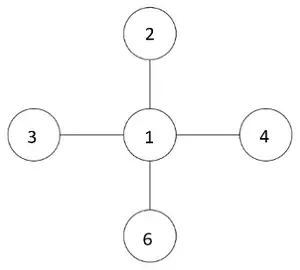
B2
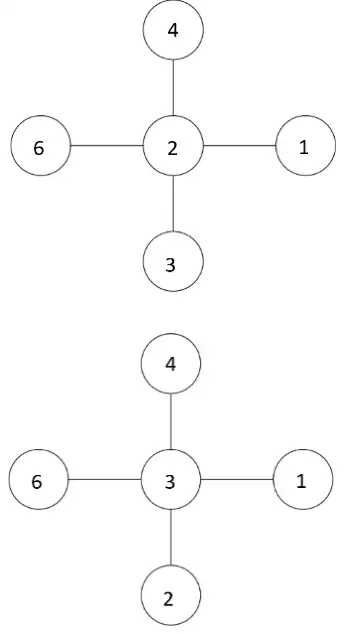
2 and 6 can be in either order 3 and 4 can be in either order
B1 the horizontal line multiplies to 12 or the vertical line multiplies to 12 or the sum of the vertical line is 1 more than the sum of the horizontal line or the sum of the horizontal line is 1 more than the sum of the vertical line
Additional guidance
Must use 1, 2, 3, 4 and 6 each once and all circles must be completed
7 Work out \(\quad (43 \times 8) - (234 \div 6)\) [3 marks]
Mark scheme
Answer
Mark
Comments
344
B1
39
B1
305
B1ft
ft their 344 \(-\) their 39 if either B1B0 or B0B1 awarded
Additional guidance
If their division results in a decimal answer, allow correct rounding to 0dp or better for the B1ft eg \(234 \div 6 = 38.333\), \(344 - 38.3 = 305.7\) (may have answer 306) eg 344, \(234 \div 6 = 20.3\), answer 324
B1B0B1ft B1B0B1ft
Negative, fractional and decimal answers are acceptable on ft
Start with the calculation that has the smallest answer.
You must show the answer to each calculation. [3 marks]
Mark scheme
Answer
Mark
Comments
(A =) 2 000 000 and (B =) 500 000 and (C =) 400 000 and smallest answer C B largest answer A
B3
allow values or calculations instead of letters on answer lines B2 two of (A =) 2 000 000, (B =) 500 000, (C =) 400 000 B1 (A =) 2 000 000 or (B =) 500 000 or (C =) 400 000
Additional guidance
Answer line takes precedence over working
Any of the original value(s) misread or miscopied is max B2 for calculations
Once a correct evaluation has been seen, ignore further attempts to manipulate it for up to B2 eg 400,000 = 0.004 million, 0.5 million, 2 million, answer = CBA
B2
Accept values in words eg accept half a million for 500 000
Ordering of their values is irrelevant when awarding B2 or B1
Ignore (incorrect) spacings or any use of commas within numbers or continental notation eg 4 00000 50 0000 2,00000,0 eg 40.0000 500.000 2.000.000
Work out the total cost of hiring 13 coaches. [3 marks]
Mark scheme (a)
Answer
Mark
Comments
Alternative method 1
\(820 \div 50\) or \(82 \div 5\)
M1
oe eg \(1640 \div 100\) eg counting up in 50s to at least 800 (allow one error) eg counting down in 50s to less than 50 (allow one error)
16.4 or 16+ or over 16
A1
oe eg 16 r 20 or 16 with 20 left allow 16 if 17 is final answer
17
A1ft
ft rounding up from a decimal, fraction or remainder with M1 awarded
Alternative method 2
850
M1
\(850 \div 50\)
M1dep
oe eg \(85 \div 5\) eg counting up in 50s to try to achieve 850 (allow one error) eg counting down in 50s to at least 50 (allow one error)
17
A1
Additional guidance
Incorrect remainders or decimals or fractions cannot score the second mark eg \(820 \div 50 = 16.2\) answer 17 Remainder or decimal not shown, leading to answer of 17 will score full marks eg \(820 \div 50 = 16.\) \(\quad\) answer 17
M1A0A1ft
M1A1A1ft
A1ft cannot be scored if their division does not yield a remainder eg \(820 \div 50 =\) (exactly) 14 answer 14
M1A0A0ft
\(800 \div 50\) or 16 implies M1 from Alt 1
\(800 \div 50 = 16\) so 17 needed (oe)
M1A1A1
If \(82 \div 5\) is attempted, allow 16 r 2 or 16 with 2 left over for the first A1
Mark scheme (b)
Answer
Mark
Comments
\(13 \times 450\)
M1
Accept repeated addition of thirteen 450s
Correct vertical method of long multiplication with 4500 correct or Correct vertical method of long multiplication with at least one of 650 and 5200 correct or Correct set up of grid method with at least three of the four or six products correct or Correct set up of Gelosia method with at least three of the six products correct or \(10 \times 450 = 4500\) and \(3 \times 450 = 1350\) attempted with at least one correct or \(13 \times 400 = 5200\) and \(13 \times 50 = 650\) attempted with at least one correct
M1dep
oe Allow a placeholder space to be present instead of a physical zero in vertical method
5850
A1
Additional guidance
For repeated addition method, to score M1dep, answer must end in 50 with a 6 carried into the hundreds column
Students may choose to multiply 13 by 45 using any method, for the method marks. We do not need the zero to be recovered for either method mark, so \(13 \times 45\) scores at least M1 eg \(13 \times 45 = 585\) scores M2 even if answer line gives 585 eg \(13 \times 45\) vertical method with 450 correct or at least one of 65 and 520 correct eg \(13 \times 45\) using grid method with 40 and 5 rather than 400, 50 and 0, with three of the four products correct eg \(13 \times 45\) using Gelosia method with no zero column, with at least three (of the now four) products correct
(a) Use your calculator to work out \(\quad \dfrac{9.75^3}{1.875} + 6.4^2\)
Give your answer as a decimal. Write down your full calculator display. [2 marks]
(b) Is your answer to part (a) sensible?
Check by rounding each of 9.75, 1.875 and 6.4 to the nearest whole number. You must show your working. [3 marks]
Tick a box.
Sensible
Not sensible
Mark scheme (a)
Answer
Mark
Comments
494.325 or \(\dfrac{19\,773}{40}\) or \(494\dfrac{13}{40}\) or 40.96 or \(\dfrac{1024}{25}\) or \(40\dfrac{24}{25}\) or 535.29 or 535.3 or \(\dfrac{107\,057}{200}\) or \(535\dfrac{57}{200}\)
M1
535.285
A1
Additional guidance
Ignore any subsequent truncation or rounding if 535.285 seen in working
M1A1
Mark scheme (b)
Answer
Mark
Comments
\(10^3\) and 2 and \(6^2\) and 536 and indicates Sensible
B3ft
ft correct decision for comparing 536 with their 535.285 B2 \(10^3\) and 2 and \(6^2\) seen B1 any two of 10, 2 and 6 seen allow 1000 to imply 10 or \(10^3\) and 36 to imply 6 or \(6^2\) for B1 or B2 only
Additional guidance
Students must give the correct ft decision for part (a) for B3
Correct decision for their (a) should be Sensible if their 535.285 is 530 or 540 to 2 sf. Otherwise they should indicate Not sensible
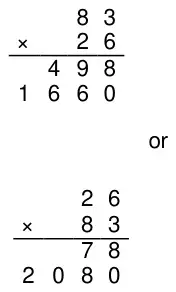
at least one row correct, with the 0 correct for multiplication by the multiple of 10
you may see the rows of working switched
their 498 + their 1660 or their 78 + their 2080
M1dep
2158
A1
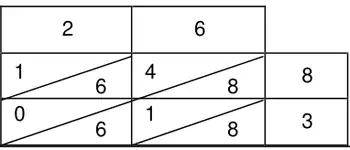
Alternative method 2
20
6
80
1600
480
3
60
18
M1
at least three of the calculated values correct
may be seen as 4 calculations, not in a grid
their 1600 + their 480 + their 60 + their 18
M1dep
2158
A1
Alternative method 3
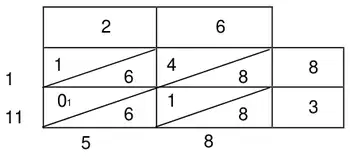
M1
at least three of the calculated values correct
Total calculated for each diagonal with at least one correct carrying figure
M1dep
clear attempt to add each diagonal
2158
A1
Additional guidance
\(20 \times 80 + 6 \times 3 \quad (= 1618)\)
M0A0
Alternative method 1: if the place holder 0 is missing or misaligned, allow this to be evidenced by their 8 as the units value in the answer, or an ‘x’ in place of the 0
Alternative method 2: if numbers are broken down further they must have at least 8 of the calculated values correct in example below (oe) eg 40 40 3 and 10 10 6 (ie a maximum of one error)
Alternative method 3: diagonals must slope the correct way for M1 (unless recovered)
Diagonal lines not present is M0 unless this is recovered by seeing correct totals around the grid
Example of alternate method 3 with carrying completed once
(a) Use your calculator to work out the exact value of \(\quad \dfrac{18\,953 \times 437}{11}\) [1 mark]
(b) Use approximations to 1 significant figure to check if your answer to part (a) is sensible. [3 marks]
Mark scheme (a)
Answer
Mark
Comments
752 951 or 752951 or 752,951
B1
Allow commas even if positioning incorrect eg 75,2951 or 752’951 B1
Additional guidance
752.951
B0
Mark scheme (b)
Answer
Mark
Comments
20 000 and 400 and 10 and 800 000 and Yes
B3ft
ft correct decision for their answer to (a) oe decision eg it is sensible
B2 20 000 and 400 and 10
B1 20 000 or 400 or 10
Additional guidance
800 000 (and Yes) with no other values
B0
If answer to (a) is 800 000 to 1sf then the correct ft decision in (b) is Yes eg1 (a) 770 000 (b) decision should be Yes eg2 (a) 1762 (b) decision should be No eg3 (a) 752.951 (b) allow decision to be Yes or No
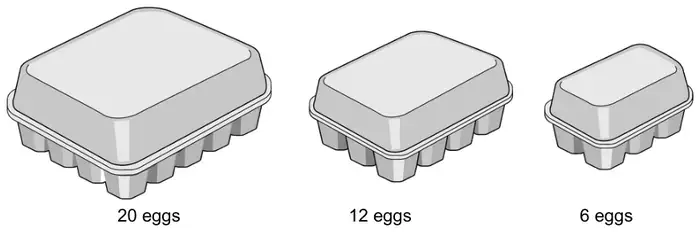
at least 10 boxes of 20 eggs at least 15 boxes of 12 eggs at least 25 boxes of 6 eggs.
The farmer fills 54 boxes with the 580 eggs.
Show how he does this. [5 marks]
Mark scheme
Answer
Mark
Comments
Alternative method 1
\(10 \times 20\) or 200 and \(15 \times 12\) or 180 and \(25 \times 6\) or 150
M1
\(10 \times 20 + 15 \times 12 + 25 \times 6\) or their 200 + their 180 + their 150 or 530
M1dep
580 – their 530 or 50 (eggs)
M1dep
54 – (10 + 15 + 25) or 54 – 50 (boxes) or 4 (more boxes) or 1 (+) 2 (+) 1
M1
11 boxes of 20 17 boxes of 12 26 boxes of 6
A1
Alternative method 2
11 boxes of 20 17 boxes of 12 26 boxes of 6
B5
B4 for 11 boxes of 20 16 boxes of 12 28 boxes of 6 or 11 boxes of 20 15 boxes of 12 30 boxes of 6
B3 for 580 eggs placed in boxes with two of these conditions satisfied at least 10 boxes of 20 eggs at least 15 boxes of 12 eggs at least 25 boxes of 6 eggs
B2 for 580 eggs placed in boxes with one of the three conditions satisfied and at least one of each box
B1 for all three conditions satisfied with 54 boxes but a total number of eggs not equal to 580
Additional guidance
Fourth M1 mark may be awarded at any stage
10 + 15 + 25 = 50 is a total of boxes and does not score M1M1M1
1 (extra) boxes of 20 2 (extra) boxes of 12 1 (extra) boxes of 6
M1M1M1M1A1
220, 204 and 156 (eggs) on answer line with 11, 17 and 26 (boxes) seen in working
B5
Condone number of eggs on answer line if number of boxes seen in working eg 220, 240 and 120 (eggs) on answer line with 11, 20 and 20 (boxes) seen in working
(b) Work out \(\qquad \dfrac{5}{6} + \dfrac{3}{7}\)
Give your answer as a mixed number. [3 marks]
Mark scheme (a)
Answer
Mark
Comments
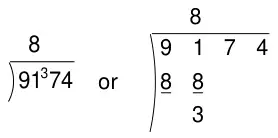
Division set up, with 8 and a remainder 3 seen in correct position or \(830 \leqslant\) answer \(< 840\) but not 834
M1
834
A1
Additional guidance
Build up method or chunking method must lead to \(830 \leqslant\) answer \(< 840\) to score M1 or better
Mark scheme (b)
Answer
Mark
Comments
\(\dfrac{35}{42}\) (+) \(\dfrac{18}{42}\)
M1
oe fractions with a correct common denominator and at least one correct numerator
\(\dfrac{53}{42}\)
A1
oe improper fraction
\(1\dfrac{11}{42}\)
B1ft
oe mixed number ft for correct conversion of an improper fraction to a mixed number
Additional guidance
For B1ft the mixed number must not be an integer
Beware \(5 + 3 = 53\)
M0
When attempts are made to cancel the fraction, full marks cannot be scored \(\dfrac{53}{42} = \dfrac{9}{4} = 2\dfrac{1}{4}\) (attempt to cancel occurs before conversion to mixed number) \(\dfrac{53}{42} = 1\dfrac{11}{42} = 1\dfrac{1}{3}\) (attempt to cancel occurs after completely correct answer seen)
In all cases, allow extra pairs of brackets which do not alter the result of the calculation eg in 3rd calculation \(\quad ((2 + 0) \times (1 + 7)) = 2^4\)
B1
Brackets can be used in the place of a multiplication sign eg in 2nd calculation \(\quad 2 \times 0(1 + 7) = 0\)
B1
Each gap must have a bracket or an operator in
Allow additional + or - signs in any gap, if correct eg in 1st calculation \(\quad 2 + 0 + 1 + -7 = -4\)
(a) A student thinks of a number. The student takes 16 from the number and then divides by 4. The answer is 8.
What number is the student thinking of? [2]
(b) A teacher thinks of a number. 150% of the number is 36.
What number is the teacher thinking of? [2]
Mark scheme (a)
Answer
Marks
Part marks and guidance
48
2
M1 for \(4 \times 8\) or for \(x \to -16 \to \div 4 = 8\) oe or for \(\dfrac{x - 16}{4} = 8\)
M1 may be implied by 32 or \((48 - 16) \div 4\ [= 8]\) Flow diagram may be reversed Accept any letter for \(x\) May be \((x - 16) \div 4 = 8\) Do not allow missing brackets
Mark scheme (b)
Answer
Marks
Part marks and guidance
24
2
M1 for correct method reaching figs(24 or 12) e.g. \(\dfrac{36}{1.5}\) or \(\dfrac{36}{150}\) or \(\dfrac{36}{3}\)
See appendix for non-calculator methods
Appendix
Non Calculator methods for percentages.
Labels only This is when labels such as 10% = are used. If only labels are used the final answer scores full marks if it is correct. Condone a numerical slip if the answer is correct. If there is an error in the values and so the final answer is incorrect this cannot score method marks e.g. Find 65% of 80
10% = 8 5% = 6 ✖ Do not condone this slip as answer incorrect 50% = 40 65% = 54 ✖ M0
Build up method This is where the candidate finds the percentages to build up to the required value but shows the operations used. e.g. Find 65% of 80 10% = \(80 \div 10 = x\) 5% = \(x \div 2 = y\) 50% = \(x \times 5 = z\) 65% = \(x + z + y\) Because the operations have been shown and they are correct, if there is an error in one of \(x\), \(y\) or \(z\), method marks can still be earned
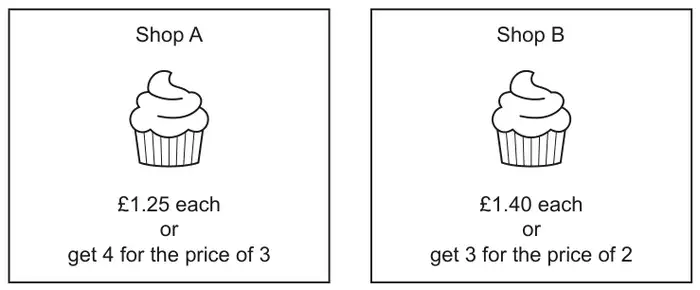
15 Shop A and shop B have special offers on the same cupcakes.
(a) Show that the special offer cost of 6 cupcakes from Shop A is £6.25. [1]
(b) Gabi wants 25 cupcakes for a party.
Which shop will be cheapest and by how much? Show how you decide.
Shop .................. by ..................p [5]
Mark scheme (a)
Answer
Marks
Part marks and guidance
\(1.25 \times 3 + 2 \times 1.25\) oe
1
Addition implied by column with answer at bottom Accept \(1.25 \times 5\) or 1.25 + 1.25 + 1.25 + 1.25 + 1.25 Condone \(6 \times 1.25 - 1.25\) If working in pence must change 625 to 6.25
Mark scheme (b)
Answer
Marks
Part marks and guidance
A 5[p] with 23.75 and 23.8[0] seen
5
B2 for [total price A] 23.75 or M2 for \(6 \times 3 \times 1.25 + 1.25\) oe
\(3 \times 1.25 = (3.75)\) then their \(3.75 \times 6 = (22.5) + 1.25\) or \(\dfrac{1.25 \times 3}{4} \times 24 + 1.25\) oe or \(19 \times 1.25\) oe
or M1 for \(25 \div 4\) or 6 [lots] or \(\dfrac{1.25 \times 3}{4}\) soi 0.9375
May be 4+4+4+4+4+4
AND
B2 for [total price B] 23.8[0] or M2 for \(8 \times 2 \times 1.4[0] + 1.4[0]\) oe
or \(1.4[0] \times 2 = 2.8[0]\) then their \(2.80 \times 8 = (22.4) + 1.4[0]\) or \(\dfrac{2.80}{3} \times 24 + 1.40\) or \(17 \times 1.4\) oe
or M1 for \(25 \div 3\) or 8 [lots] or \(\dfrac{2.80}{3}\) soi 0.93
May be 3+3+3+3+3+3+3+3
If 0, 1 or 2 scored, instead award SC3 for Shop A and 5[p] or If 0 or 1 scored, instead award SC2 for their cheapest shop and correct difference between their prices in pence
Their two total prices must be clearly identifiable Allow £ sign added to give e.g. £2.05[p]
(a) The table shows charges made by a gas company to its customers.
Cost per day
27p
PLUS
Cost per unit of gas used
8p
The owner of a flat receives a gas bill covering a period of 100 days. They have used 7000 units of gas in this period.
Show that their bill is for £587. [4]
(b) The owner of a house is supplied gas by a different gas company.
The cost per day is 25p.
They use 10 000 units of gas in 100 days.
Their bill covering the period of 100 days is £975.
Work out the cost per unit of gas used, giving your answer in pence. [4]
Mark scheme (a)
Answer
Marks
Part marks and guidance
Candidate clearly shows that: 27 + 560 = 587
4
M2 for [£]\(0.08 \times 7000\) or 8[p] \(\times\ 7000\) and [£]\(0.27 \times 100\) or 27[p] \(\times\ 100\) or M1 for [£]\(0.08 \times 7000\) or [£]\(0.27 \times 100\) or 8[p] \(\times\ 7000\) or 27[p] \(\times\ 100\)
B1 for £27 or [£]560 or for 2700[p] or 56 000[p]
“Shows that” requires evidence of at least M2, B1
For M2, M1 & B1 if units (£ or p) are given they must be correct
Mark scheme (b)
Answer
Marks
Part marks and guidance
9.5 [p]
4
B1 for \(25 \times 100\) or 2500[p] or [0].25 \(\times\ 100\) or £25
M2 for \((975 - \textit{their}\ 25) \div 100\) oe or M1 for \((975 - \textit{their}\ 25) \div 10\,000\) oe
If 0 or 1 scored, instead award SC2 for figs 95 as final answer
Condone answer of 9 or 10 after 9.5[p] or [£]0.095 seen
Ignore units for M2 and M1 M2 Implied by \(950 \div 100\) M1 implied by \(950 \div 10{,}000\) or 0.095
Multiply the number of biscuits by 6.25 to find the number of grams of butter needed.
Darcie uses 125 g of butter.
How many biscuits does Darcie make? [2]
(b) The estimated cost of driving
an electric car is 68 pence per mile
a petrol car is 77 pence per mile.
Charlie expects to drive 12 000 miles next year.
Use this information to work out how much money Charlie can expect to save next year if driving an electric car instead of a petrol car. [3]
Mark scheme (a)
Answer
Marks
Part marks and guidance
20
2
M1 for \(125 \div 6.25\) oe
May be 20 repeated subtraction or addition in a list Accept \(6.25 \times 20\) for M1
Mark scheme (b)
Answer
Marks
Part marks and guidance
1080
3
B2 for figs 108 OR M2 for \(12\,000 \times (77 - 68)\) oe
or
M1 for \(12\,000 \times 77\) or \(12\,000 \times 68\) or \(77 - 68\)
May be in working or on answer line
May be implied by figs 924 – figs 816 oe may be e.g. \(12\,000 \times (0.77 - 0.68)\) or \(12\,000 \times 0.09\) Subtraction should be seen but may be implied by layout Condone subtraction written the wrong way around
May be implied by figs 924... or figs 816 ... or 9
(a) By writing each number correct to 1 significant figure, find an estimate for \(79.8 \times 3.1\). [2]
(b) Jamie works out \(79.8 \times 3.1\) on a calculator. Jamie’s answer is 2473.8.
Do you think Jamie has used their calculator correctly? Explain why.
.................... because ........................................ [1]
Mark scheme (a)
Answer
Marks
Part marks and guidance
240 with working
2
B1 for rounded value of 80 or 3 If 0 scored SC1 for 80.0 and 3.0 and 240.0 as answer
For 2 marks 80 and 3 must be seen
Mark scheme (b)
Answer
Marks
Part marks and guidance
No oe and [because] the answer should be close to 240 oe
1
Eg No his answer is ten times too big No the decimal point is in the wrong place
See AG
Appendix
Appendix Q9b
Response
Mark
No
1
The answer should be 247.38
1
2
The decimal point should be between the 7 and 3
1
3
The number is a lot higher than my estimate. I think she placed a decimal point wrong (The first part is not enough without seeing what their estimate is, ‘placed decimal point wrong’ scores the mark)
1
4
His answer should be in 200s not 2000s he must have placed decimal incorrectly
1
5
There should be 2 numbers behind the decimal place and not one
1
6
Because if you do \(80 \times 3\) you’ll get 240 (implies the answer is 10 times too big)
1
7
it should be closer to 240 (This is the correct estimate, so no need for calculation to be shown here)
1
8
His answer was in thousands which is too large (with it should be in the hundreds would have scored the mark)
0
9
Has not put decimals in
0
10
His answer is too high and shouldn’t have a decimal at the end (First part of answer is not enough to score and ‘shouldn’t have a decimal at the end’ is incorrect)
0
11
The answer that Jamie got is bigger than the estimate by 1 significant figure
0
12
There is only one two digit number so it cannot be above 1000
0
13
It would be less than 2473.8 due to \(80 \times 3\) (if the candidate had written = 240, this would be enough)
0
14
his answer is significantly larger
0
15
there is no way it can be higher than 300 (not enough as we need to see the calculation of their ‘estimate’ of 300)
0
16
The place value is not in the correct position (‘place value’ not an equivalent for decimal point)
9 A shopper buys 4 apples costing 60p each and 3 peaches. They pay with a £5 note and receive 44p in change. Each peach costs the same amount.
Work out the cost of one peach. You must show your working. [5]
Mark scheme
Answer
Marks
Part marks and guidance
72 with correct working
5
M3 for \(500 - 4 \times 60 - 44\) oe or M2 for \(500 - 4 \times 60\) oe or for \(4 \times 60 + 44\) oe or M1 for \(4 \times 60\) or for \(500 - 44\) or \(5[.00] - [0].44\)
M1 for their \(216 \div 3\)
If 0 scored SC2 for answer 72 or SC1 for 216 with no working
“Correct working” requires evidence of at least M2 [216] [260] [284] [240] [456] or [4.56]
Explain the error that Nathan has made and work out the correct answer. [3]
(b) Four friends buy cinema tickets using this offer.
Cinema tickets
Buy 3 tickets and get a ticket free
They each pay £6.45.
How much does a ticket cost? [3]
Mark scheme (a)
Answer
Marks
Part marks and guidance
When multiplying [12.4] by 10, Nathan has not moved the figures to the left [he has just added a 0]
1
Accept \(12.4 \times 10 = 124\) not 12.40
Condone he has not moved the decimal point to the right soi Accept reference to either first or second line of working See Appendix B
285.2
2
M1 for \(12.4 \times 20 = 248\) or \(124 \times 2 = 248\)
Accept 248 seen If \(12.4 \times 23\) is worked out using grid method, allow M1 if no more than one error. If other long multiplication method used, allow M1 if not more than one arithmetic slip but M0 if error in place value
Appendix B
Exemplar responses for Q3(a) explanation mark
Response
Mark
For 10 × 12.4 Nathan has only times by 1. For 20 × 12.4 he has only times by 2. 10 × 12.4 = 124. Accept identifying that he has timesed by 1 instead of 10, or by 2 instead of 20.
1
10 × 12.4 is not 12.40 it is 124. He didn’t add the 0s onto the numbers. 10 x 124 is not 12.40 it is 124 scores 1, ignore the rest of the explanation because it is unclear rather than being incorrect.
1
He added 0 to 12.4 Explains what he has done wrong.
1
He does not move the decimal place when he x by 10 so it should have been 124.0. Doesn’t need to say where
1
Nathan has got the place value wrong on first answer. They have correctly identified that the error is in the place value
1
10 × 12.4 = 124 so 20 × 12.4 is wrong Allow identification of error in second line
1
Instead of moving the decimal place to the right he just added a zero to the end of the number and instead of multiplying he add. Ignore final part of statement
1
He hasn’t multiplied it he just added a zero that makes no difference. Error identified and ‘makes no difference’ explains error
1
He said that 20 × 12.4 is 24.80 when it is 248 which means the answer is 285.2 Accept reference to second line of working
1
When Nathan done 10 × 12.4 it should equal 124 10 x 12.4 = 124 is not enough. ‘It should equal 124’ is just about enough to identify the error.
1bod
When he multiplied by 10 he didn’t remove the decimal place and same when he multiplied by 20 Multiplying by 10 isn’t the same as removing the decimal place.
0
Nathan kept the decimal in. When calculating a sum with a decimal you take it out as you do the sum then put it back at the end. Too vague.
0
Nathan has divided the 12.4 rather than moving the decimal point to the right (positive/multiplying) Moving the decimal point to the right would score 1, but we can’t ignore the rest of the explanation because it is incorrect rather than unclear.
0
12.40 is wrong Identifies error but doesn’t explain
0
Mark scheme (b)
Answer
Marks
Part marks and guidance
8.60
3
M2 for \(6.45 \times 4 \div 3\) oe Or M1 for \(6.45 \times 4\) oe or 25.8[0] seen