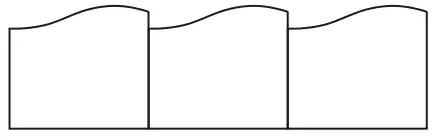
The height of the pile is 10.4 cm, correct to the nearest mm. The thickness of each sheet of paper is 0.17 mm, correct to 2 significant figures.
Calculate the upper bound for the number of sheets of paper in the pile. You must show all your working. (3)
Mark scheme
Answer
Mark
Mark scheme
633
B1
for stating any correct bound, eg 10.35 or 10.45 or 103.5 or 104.5 or 0.165 or 0.175 or 0.0165 or 0.0175
P1
for process to find the upper bound, eg [UB of height] \(\div\) [LB of thickness] or \(104.5 \div 0.165\) or \(10.45 \div 0.0165\)
or eg [UB of height] \(\div\) [LB of thickness] \(\times\ 10\) or \(10.45 \div 0.165 \times 10\)
A1
(dep on all previous marks) for an answer of 633 or 633(.33…) clearly coming from working with correct values eg \(104.5 \div 0.165 = 633\)
Additional guidance
Accept \(10.44\dot{9}\) or 10.4499(9…) for 10.45
Accept \(0.174\dot{9}\) or 0.17499(9…) for 0.175
\(104 \lt [\text{UB of height}] \leqslant 104.5\) and \(0.165 \leqslant [\text{LB of thickness}] \lt 0.17\) or \(10.4 \lt [\text{UB of height}] \leqslant 10.45\) and \(0.0165 \leqslant [\text{LB of thickness}] \lt 0.017\)
or \(10.4 \lt [\text{UB of height}] \leqslant 10.45\) and \(0.165 \leqslant [\text{LB of thickness}] \lt 0.17\)
Condone 630 from a correct calculation If correct answer is seen and then incorrectly rounded award full marks Award 0 marks for a correct answer with no (or incorrect) supportive working
\(w = 435\) correct to the nearest 5 \(a = 9.8\) correct to 2 significant figures. \(c = 2.5\) correct to 2 significant figures.
By considering bounds, calculate the value of \(T\) to a suitable degree of accuracy. You must show all your working and give a reason for your final answer. (5)
Mark scheme
Answer
Mark
Mark scheme
60 and reason
B1
for 432.5 or 437.5 or 9.75 or 9.85 or 2.45 or 2.55
M1
for a correct process to find a bound for \(T\) eg [LB of \(w\)] \(\div\) [UB of \(a\) – LB of \(c\)] where \(432.5 \leqslant\) [LB of \(w\)] \(\lt 435\) and \(9.8 \lt \) [UB of \(a\)] \(\leqslant 9.85\) and \(2.45 \leqslant\) [LB of \(c\)] \(\lt 2.5\)
or [UB of \(w\)] \(\div\) [LB of \(a\) – UB of \(c\)] where \(435 \lt \) [UB of \(w\)] \(\leqslant 437.5\) and \(9.75 \leqslant\) [LB of \(a\)] \(\lt 9.8\) and \(2.5 \lt \) [UB of \(c\)] \(\leqslant 2.55\)
M1
for a correct process to find both LB and UB bound for \(T\) eg [LB of \(w\)] \(\div\) [UB of \(a\) – LB of \(c\)] where \(432.5 \leqslant\) [LB of \(w\)] \(\lt 435\) and \(9.8 \lt \) [UB of \(a\)] \(\leqslant 9.85\) and \(2.45 \leqslant\) [LB of \(c\)] \(\lt 2.5\)
and [UB of \(w\)] \(\div\) [LB of \(a\) – UB of \(c\)] where \(435 \lt \) [UB of \(w\)] \(\leqslant 437.5\) and \(9.75 \leqslant\) [LB of \(a\)] \(\lt 9.8\) and \(2.5 \lt \) [UB of \(c\)] \(\leqslant 2.55\)
A1
(dep on all previous marks) for 58.44(5...) and 60.76(3...) with both values clearly coming from working with correct values
C1
for 60 from 58.44... and 60.76... and statement that both LB and UB round to 60
Additional guidance
Letter
Given
LB
UB
\(w\)
435
432.5
437.5
\(a\)
9.8
9.75
9.85
\(c\)
2.5
2.45
2.55
UB
Letter
Given
LB
UB
\(w\)
435
432.5
437.5
\(a\)
9.8
9.75
9.85
\(c\)
2.5
2.45
2.55
LB
Letter
Given
LB
UB
\(w\)
435
432.5
437.5
\(a\)
9.8
9.75
9.85
\(c\)
2.5
2.45
2.55
Accept bounds rounded or truncated to at least 4 sf
The materials to make all the bracelets cost £190, correct to the nearest £5 Ebony sells all the bracelets for a total of £875, correct to the nearest £5
The total time taken to make and sell all these bracelets was 72 hours, correct to the nearest hour.
Ebony uses this method to calculate her hourly rate of pay
\[\text{Hourly rate of pay} = \frac{\text{total selling price} - \text{total cost of materials}}{\text{total time taken}}\]
The minimum hourly rate of pay for someone of Ebony’s age is £8.20
By considering bounds, determine if Ebony’s hourly rate of pay was definitely more than £8.20 You must show all your working. (4)
Mark scheme
Answer
Mark
Mark scheme
(£)9.37(9…) and conclusion
B1
for stating at least one bound 187.5 or 192.5 or 192.499… or 872.5 or 877.5 or 877.499… or 71.5 or 72.5 or 72.499…
P1
for correct use of LB and UB find the lower bound for profit, eg [LB of selling price] – [UB of costs] \((= 872.5 - 192.5\ (= 680))\)
P1
(dep P1) for correct use of LB and UB to find the lower bound for hourly rate, eg [LB of profit] ÷ [UB of hours]
C1
for (£)9.37(9…) and conclusion that Ebony does earn more than minimum wage with value from working with correct bounds
Additional guidance
May be seen in calculations Accept 192.499... or \(192.4\dot{9}\) or 877.499... \(877.4\dot{9}\) or 72.499… or \(72.4\dot{9}\)
23 A race is measured to have a distance of 10.6 km, correct to the nearest 0.1 km.
Sam runs the race in a time of 31 minutes 48 seconds, correct to the nearest second.
Sam’s average speed in this race is \(V\) km/hour.
By considering bounds, calculate the value of \(V\) to a suitable degree of accuracy. You must show all your working and give a reason for your answer. (5)
Mark scheme
Answer
Mark
Mark scheme
20
B1
stating bound, eg 10.65 or 10.55 or 31 min 48.5sec or 31 min 47.5sec or 1908.5sec or 1907.5sec
P1
(dep on B1) for a correct bound for time in hours, eg 0.5301(38…) or 0.5298(61…) Or a correct process to find one bound for speed in km per minute, eg [UB of S] = [UB of D]÷[LB of T] or [LB of S] = [LB of D]÷[UB of T] or a correct process to find one bound for speed in km per second, eg [UB of S] = [UB of D]÷[LB of T] or [LB of S] = [LB of D]÷[UB of T]
P1
(dep on P1) for correct process to find one bound for speed in km per hour, eg [UB of S] = [UB of D]÷ 0.5298(61…) or [LB of S] = [LB of D]÷ 0.5301(38…) OR Correct process to convert a bound for speed in km per minute to km per hour eg [UB of S] = [UB of D]÷[LB of T] × 60 or [LB of S] = [LB of D]÷[UB of T] × 60 OR Correct process to convert a bound for speed in km per second to km per hour eg [UB of S] = [UB of D]÷[LB of T] × 60 × 60 or [LB of S] = [LB of D]÷[UB of T] × 60 × 60
A1
for both correct bounds from correct working, 20.099… and 19.900…
C1
for 20 correct to 2 significant figures as both bounds agree
Additional guidance
Bound rounded or truncated to 4 dp Where \(10.6 \lt \) [UB of D] \(\leqslant 10.65\) and 31 min 47.5 sec \(\leqslant\) [LB of T] \(\lt \) 31 min 48 sec Or \(10.55 \leqslant\) [LB of D] \(\lt 10.6\) and 31 min 48 sec \(\lt \) [UB of T] \(\leqslant\) 31 min 48.5 sec Where \(10.6 \lt \) [UB of D] \(\leqslant 10.65\) and 1907.5 sec \(\leqslant\) [LB of T] \(\lt \) 1908 sec Or \(10.55 \leqslant\) [LB of D] \(\lt 10.6\) and 1908 sec \(\lt \) [UB of T] \(\leqslant\) 1908.5 sec
Time used in hours Where \(10.6 \lt \) [UB of D] \(\leqslant 10.65\) and 31 min 47.5 sec \(\leqslant\) [LB of T] \(\lt \) 31 min 48 sec Or \(10.55 \leqslant\) [LB of D] \(\lt 10.6\) and 31 min 48 sec \(\lt \) [UB of T] \(\leqslant\) 31 min 48.5 sec Where \(10.6 \lt \) [UB of D] \(\leqslant 10.65\) and 1907.5 sec \(\leqslant\) [LB of T] \(\lt \) 1908 sec Or \(10.55 \leqslant\) [LB of D] \(\lt 10.6\) and 1908 sec \(\lt \) [UB of T] \(\leqslant\) 1908.5 sec
Work out the upper bound for the value of \(p\). Give your answer correct to 3 significant figures. You must show all your working. (3)
Mark scheme
Answer
Mark
Mark scheme
17.4
B1
for stating any correct bound, eg 6.75 or 6.85 or 0.045 or 0.055
M1
using both UB of \(e\) and LB of \(f\) to work out value of \(2e \div f\), eg 2[UB of \(e\)] \(\div\) [LB of \(f\)] or \(\dfrac{2 \times 6.85}{0.045}\)
A1
for answer in the range 17.4 to 17.5 from correct working
Additional guidance
Accept \(6.84\dot{9}\) or 6.8499... for 6.85 and \(0.054\dot{9}\) or 0.05499.. for 0.055
If an answer is given in the range in working and then rounded incorrectly award full marks. Award 0 marks for a correct answer with no (or incorrect) supportive working
21 The time period, \(T\) seconds, of a simple pendulum of length \(l\) cm is given by the formula
\[T = 2\pi\sqrt{\frac{l}{g}}\]
Katie uses a simple pendulum in an experiment to find an estimate for the value of \(g\).
Here are her results.
\(l = 52.0\) correct to 3 significant figures. \(T = 1.45\) correct to 3 significant figures.
Work out the upper bound and the lower bound for the value of \(g\). Use \(\pi = 3.142\) You must show all your working. (4)
Mark scheme
Answer
Mark
Mark scheme
984.(3677853) and 969.(0181643)
B1
stating bound of 51.95 or 52.05 or 1.445 or 1.455
P1
for process to rearrange formula to give \(g\) as the subject, eg \(g = \dfrac{4\pi^2 l}{T^2}\) oe
P1
for process to use LB of \(l\) and UB of \(T\) in formula for \(g\) or \(T\) or process to use UB of \(l\) and LB of \(T\) in formula for \(g\) or \(T\) eg \(\dfrac{4\pi^2[\text{LB of } l]}{[\text{UB of } T]^2}\) or \(\dfrac{4\pi^2[\text{UB of } l]}{[\text{LB of } T]^2}\)
A1
for upper bound = 984.(3677853) or 984.(1125639..) and lower bound = 969.(0181643) or 968.(7669227..)
Additional guidance
Accept \(52.04\dot{9}\) or 52.0499… for 52.05 Accept \(1.454\dot{9}\) or 1.4549… for 1.455
Rearrangement may occur after substitution, in this case correct bounds are not needed for this mark
\(51.95 \leqslant [\text{LB of } l] \lt 52.0\) \(1.45 \lt [\text{UB of } T] \leqslant 1.455\)
\(52.0 \lt [\text{UB of } l] \leqslant 52.05\) \(1.445 \leqslant [\text{LB of } T] \lt 1.45\) Rearrangement may not be correct
NB: correct answer without supportive working gets 0 marks Accept answers rounded or truncated to 3sf or better
By considering bounds, work out the value of \(d\) to a suitable degree of accuracy. Give a reason for your answer. (4)
Mark scheme
Answer
Mark
Mark scheme
160 (supported)
B1
stating bound of 10.85 or 10.95
M1
using both UB and LB to work out value of \(d\) eg [UB of \(c\)]\(^3 \div 8\) and [LB of \(c\)]\(^3 \div 8\) or gives a bound of 159.66… from correct working or gives a bound of 164.11… from correct working
A1
for 159.66… and 164.11… from correct working
C1
for 160 from 159.66… and 164.11… with a supporting reason eg “since both UB and LB round to 160”
(a) Calculate the upper bound for the value of \(D\). Give your answer correct to 6 significant figures. You must show all your working. (3)
The lower bound for the value of \(D\) is 78.6003 correct to 6 significant figures.
(b) By considering bounds, write down the value of \(D\) to a suitable degree of accuracy. You must give a reason for your answer. (2)
Mark scheme (a)
Answer
Mark
Mark scheme
81.0662
M1
for one of 26.15 or 26.25 or 4.25 or 4.35
M1
for a correct process to find the upper bound for \(D\) [UB of \(u\)]\(^2 \div [2 \times\) LB of \(a\)] eg \(\dfrac{26.25^2}{2 \times 4.25}\) where \(26.2 \lt \) UB of \(u \leqslant 26.25\) and \(4.25 \leqslant\) LB of \(a \lt 4.3\)
A1
for answer given in the range 81.0661 to 81.0662 from correct working
Additional guidance
Accept \(26.24\dot{9}\) for 26.25 and \(4.34\dot{9}\) for 4.35
Award for \(\dfrac{26.25^2}{4.25}\)
Mark scheme (b)
Answer
Mark
Mark scheme
80
explanation
B1
for 80 ft answer to (a) with 78.6003
C1
for explanation relating to the upper bound found in (a) Acceptable examples bounds agree when rounded to 80 bounds agree to nearest 10 Not acceptable examples 80 79.83325 rounded to nearest tenth
18 A high speed train travels a distance of 487 km in 3 hours.
The distance is measured correct to the nearest kilometre. The time is measured correct to the nearest minute.
By considering bounds, work out the average speed, in km/minute, of the train to a suitable degree of accuracy. You must show all your working and give a reason for your answer. (5)
Mark scheme
Answer
Mark
Mark scheme
2.7 with statement
B1
for 179.5 or 180.5 or 180.4999...
B1
for 486.5 or 487.5 or 487.4999...
P1
for a correct process to find a bound for average speed, eg [upper bound of distance] ÷ [lower bound of time] where \(487 \lt\) [UB of distance] \(\leqslant 487.5\) and \(179.5 \leqslant\) [LB of time] \(\lt 180\) or for [lower bound of distance] ÷ [upper bound of time] where \(486.5 \leqslant\) [LB of distance] \(\lt 487\) and \(180 \lt\) [UB of time] \(\leqslant 180.5\)
A1
(dep on all previous marks) for 2.695(2…) and 2.715(8…) with both values clearly coming from working with correct values
C1
for 2.7 from 2.695… and 2.715… and statement that both LB and UB round to 2.7
Additional guidance
Accept bounds truncated or rounded to at least 4 sig fig
21 Jackson is trying to find the density, in g/cm3, of a block of wood. The block of wood is in the shape of a cuboid.
He measures
the length as 13.2 cm, correct to the nearest mm the width as 16.0 cm, correct to the nearest mm the height as 21.7 cm, correct to the nearest mm
He measures the mass as 1970 g, correct to the nearest 5 g.
By considering bounds, work out the density of the wood. Give your answer to a suitable degree of accuracy. You must show all your working and give a reason for your final answer. (5)
Mark scheme
Answer
Mark
Mark scheme
0.43
B1
for one correct bound for mass or length eg 1967.5 or 1972.5 or 13.15 or 15.95 or 21.65 or 13.25 or 16.05 or 21.75
P1
for a correct process to find a bound for the volume, eg \(13.15 \times 15.95 \times 21.65\) (=454(0.925125)) or \(13.25 \times 16.05 \times 21.75\) (=462(5.409375))
P1
for a correct process to find a bound for density, eg [mass LB] \(\div\ \text{``}462(5.409375)\text{''}\) (=0.425(367755)) where \(1965 \leqslant\) mass LB \(\lt 1970\) or [mass UB] \(\div\ \text{``}454(0.925125)\text{''}\) (=0.434(3828506)) where \(1970 \lt\) mass UB \(\leqslant 1975\)
A1
for both correct bounds, 0.425(367755) and 0.434(3828506)
C1
(dep on A1) for a correct statement on degree of accuracy e.g. UB and LB both round to 0.43 to 2 decimal places or 2 significant figures
Additional guidance
B1: Can work in any units
P1 (volume): Accept volumes truncated or rounded to at least 3 sig fig
P1 (density): Accept densities truncated or rounded to at least 3 sig fig
A1: Accept bounds truncated or rounded to at least 3 sig fig At this point correct units must be used
17 A train travelled along a track in 110 minutes, correct to the nearest 5 minutes.
Jake finds out that the track is 270 km long. He assumes that the track has been measured correct to the nearest 10 km.
(a) Could the average speed of the train have been greater than 160 km/h? You must show how you get your answer. (4)
Jake’s assumption was wrong. The track was measured correct to the nearest 5 km.
(b) Explain how this could affect your decision in part (a). (1)
Mark scheme (a)
Answer
Mark
Notes
No (supported)
P1
for 265 or 275 or 274.999... or 107.5 or 112.5 or 112.4999...
P1
process to find \(\dfrac{d}{t}\) where \(270 \lt d \leqslant 275\) and \(107.5 \leqslant t \lt 110\) oe
P1
for process to work in consistent units of time eg \(\dfrac{d}{t} \times 60\) or \(t \div 60\) where \(265 \leqslant d \leqslant 275\) and \(107.5 \leqslant t \lt 110\) oe or \(160 \div 60\ (= 2.666..)\)
C1
Conclusion supported with correct figure(s) given eg No and 153(.488..) or No and 2.66 to 2.7 and 2.5(581..) from correct working
Mark scheme (b)
Answer
Mark
Notes
Statement
C1
e.g. Less distance in the same time so (max) speed would drop
\(v = 37.6\) correct to 3 significant figures. \(u = 11.3\) correct to 3 significant figures. \(t = 8.4\) correct to 2 significant figures.
Work out the upper bound for the value of \(a\). Show your working clearly. (3)
Mark scheme
Answer
Mark
Notes
\(\dfrac{528}{167}\)
3
B1 for 37.55 or 37.65 or 11.25 or 11.35 or 8.35 or 8.45 M1 for \(\dfrac{37.65 - 11.25}{8.35}\) for \(\dfrac{v_{ub} - u_{lb}}{t_{lb}}\) where \(37.6 \lt v_{ub} \leqslant 37.65\) and \(11.25 \leqslant u_{lb} \lt 11.3\) and \(8.35 \leqslant t_{lb} \lt 8.4\) A1 for answer in range 3.16 to 3.162 from correct working
Work out the upper bound for the value of \(I\). You must show your working. (3)
Mark scheme
Answer
Mark
Notes
29.25
3
B1 for one of 14.5, 13.5, 8.75, 8.65
M1 for \(\text{``}v_{\text{UB}}\text{''} - \text{``}u_{\text{LB}}\text{''}\) where \(14 \lt \text{``}v_{\text{UB}}\text{''} \leqslant 14.5\) and \(8.65 \leqslant \text{``}u_{\text{LB}}\text{''} \lt 8.7\) A1 for 29.25 from correct working
24 Steve travelled from Ashton to Barnfield. He travelled 235 miles, correct to the nearest 5 miles. The journey took him 200 minutes, correct to the nearest 5 minutes.
Calculate the lower bound for the average speed of the journey. Give your answer in miles per hour, correct to 3 significant figures.
You must show all your working.(4)
Mark scheme
Working
Answer
Mark
Notes
\(\dfrac{232.5}{202.5} \times 60\)
68.9
4
M1 for 232.5 or 237.5 or 197.5 (=3.29… hours) or 202.5 (= 3.375 hours) M1 for correct conversion of “upper bound of time” from minutes to hours, (202.5 to 205) ÷ 60 M1 for “lower bound of distance” ÷ “upper bound of time” (230 to 232.5) ÷ (3.375 to 3.41(6…)) A1 for 68.8 to 69 from correct working
OR M1 for 232.5 or 237.5 or 197.5 (=3.29… hours) or 202.5 (= 3.375 hours) M1 for “lower bound of distance” ÷ “upper bound of time” (230 to 232.5) ÷ (202.5 to 205) M1 for correct conversion of “lower bound of speed” from miles per minute to miles per hour, ((1.12(1...) to 1.14(8...)) × 60 A1 for 68.8 to 69 from correct working
*23 A road is 4530 m long, correct to the nearest 10 metres. Kirsty drove along the road in 205 seconds, correct to the nearest 5 seconds.
The average speed limit for the road is 80 km/h.
Could Kirsty’s average speed have been greater than 80 km/h? You must show your working. (5)
Mark scheme
Answer
Mark
Notes
Yes, average speed could have been as high as 80.622...
5
B1 for 4535 or 4534.999... or 202.5 M1 for 4535 (oe) ÷ 202.5 M1 for ×3600 and ÷1000 A1 for 80.622... C1 (dep on first M1) for correct conclusion from their calculations
B1 for any one correct bound quoted M1 for \(170.5 \div 53.5\) or \(169.5 \div 54.5\) A1 for UB = answer in range 3.18 to 3.19 from correct working A1 for LB = 3.11.. from correct working
\(s = 3.47\) correct to 2 decimal places \(t = 8.132\) correct to 3 decimal places
By considering bounds, work out the value of \(m\) to a suitable degree of accuracy. You must show all your working and give a reason for your final answer. (5)
Mark scheme
Answer
Mark
Notes
0.229 because the LB and UB agree to that number of figures
5
B1 for 3.465 or 3.475 or 3.474999… B1 for 8.1315 or 8.1325 or 8.132499… M1 for \(\dfrac{\sqrt{3.475}}{8.1315}\) as UB OR \(\dfrac{\sqrt{3.465}}{8.1325}\) as LB C1 (dep on all previous marks) for 0.2292… and 0.2288… both values must clearly come from working with correct values C1 for 0.229 from 0.2292… and 0.2288… and ‘both LB and UB round to 0.229’
M1 may be awarded for correct work with no answer or incorrect answer, even if this is seen amongst multiple attempts
Accept rounding or truncating of \(2.0\dot{6}\) or \(206.\dot{6}\) to at least 4 sf Accept rounding or truncating of \(2.0\dot{6}\) to 3 sf only if \(6.2 \div 3\) is seen Accept rounding or truncating of \(206.\dot{6}\) to 3 sf only if \(620 \div 3\) is seen
Accept \(2.04\dot{9}\) for 2.05
Ignore any reference to lower bounds
Ignore reference to units
2.05 or 205 may be embedded eg \(2.05 + 2.06 + 2.09 = 6.2\) with no further work or explanation
M1A0
\(2.06 + 2.06 + 2.08 = 6.2\) with no further work or explanation \(2.06 + 2.06 + 2.06 = 6.18\) with a clear reference to 2.05 and a full explanation
the mass of the empty plane is 800 kg, to the nearest 100 kg
the mass of fuel is 190 kg, to the nearest 5 kg
the mass of the passengers is 163 kg, to the nearest kg
The total mass of a plane is calculated by adding these three masses.
The maximum mass for the plane to take off safely is 1200 kg
Can this plane definitely take off safely?
Tick a box.
Yes
No
Show working to support your answer. [4 marks]
(b) A different plane travels 1250 miles in 2 hours 30 minutes at a constant speed.
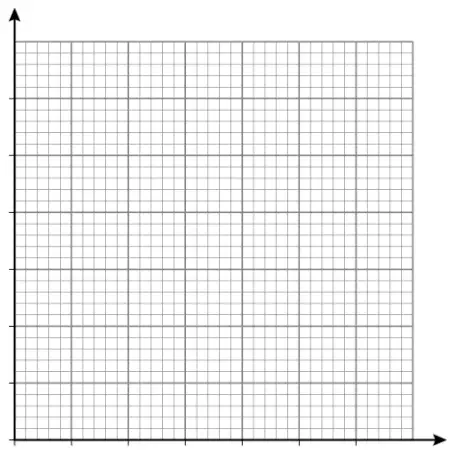
On the grid, draw a speed/time graph to represent this information. [3 marks]
Mark scheme (a)
Answer
Mark
Comments
Alternative method 1: uses the upper bounds
750 or 850 or 187.5 or 192.5 or 162.5 or 163.5
B1
condone 849.99… for 850
condone 192.49… for 192.5
condone 163.49… for 163.5
850 and 192.5 and 163.5
B1
(800, 900] + (190, 195] + (163, 164]
M1
1206 and No
A1
oe 6 kg too heavy and No
Alternative method 2: uses other values
Correct sum of three possible values that exceeds 1200 and No
B4
possible values must lie between the bounds, on the lower bound or on the upper bound eg \(849 + 192 + 163 = 1204\) and No
Additional guidance
Units not required
850 and 195 and 163.5 with answer 1208.5
B1B0M1A0
900 and 195 and 164 with answer 1259
B0B0M1A0
There are no part marks for Alt method 2
Mark to the Alt method which favours the student eg 849 and 192 and 163.5 with answer 1204.5 and ‘No’ could score B1B0M1A0 using Alt method 1, but scores B4 using Alt method 2
\(845 + 194 + 163 = 1202\) and No does not score using either Alt method
Mark scheme (b)
Answer
Mark
Comments
(Speed =) 500
B1
implied by 500 as highest point plotted or marked accept 8.33… with correct units miles per minute stated or implied
Vertical axis labelled ‘Speed’ with a linear scale to at least their 500 and Horizontal axis labelled ‘Time’ with a linear scale to at least 2 hours 30 minutes or 150 minutes
B1ft
ft their 500 which must not be 1250 accept their speed as the only value on the vertical axis and 2 hours 30 minutes as the only value on the horizontal axis ignore all units shown on their graph
Horizontal line from (0, their 500) stopping at (2 hours 30 minutes, their 500) or (150 minutes, their 500)
B1ft
ft their 500 which must not be 1250 ignore any vertical line at 2 hours 30 minutes
Additional guidance
‘Speed’ and ‘Time’ are the only acceptable labels
Use of a distance/time graph is a maximum of B1 for 500 seen
1250/150 = 8.33… miles per minute and correctly plotted with correct labelling and scales
B1B1ftB1ft
\(1250 \div 2.3 = 543\ldots\), with horizontal line from (0, 543) to (2 hours 30 minutes, 543) with correct labelling and scales
M1 may be awarded for correct work with no answer or incorrect answer, even if this is seen amongst multiple attempts
Accept rounding or truncating of \(2.0\dot{6}\) or \(206.\dot{6}\) to at least 4 sf Accept rounding or truncating of \(2.0\dot{6}\) to 3 sf only if \(6.2 \div 3\) is seen Accept rounding or truncating of \(206.\dot{6}\) to 3 sf only if \(620 \div 3\) is seen
Accept \(2.04\dot{9}\) for 2.05
Ignore any reference to lower bounds
Ignore reference to units
2.05 or 205 may be embedded eg \(2.05 + 2.06 + 2.09 = 6.2\) with no further work or explanation
M1A0
\(2.06 + 2.06 + 2.08 = 6.2\) with no further work or explanation \(2.06 + 2.06 + 2.06 = 6.18\) with a clear reference to 2.05 and a full explanation
allow \(65.4\dot{9}\) or \(34.\dot{9}\) implied by 4160.25 or 4290.25 or 8320.5 or 8580.5 or 625 or 1225
\(2 \times\) their \(65.5^2 -\) their \(25^2\) or \(2 \times 4290.25 - 625\) or \(8580.5 - 625\)
M1
their 65.5 must be (65, 66] their 25 must be [20, 30)
65.5 and 25 and 7955.5
A1
Additional guidance
Up to M2 may be awarded for correct work with no answer or incorrect answer, even if this is seen amongst multiple attempts
If multiple attempts are seen and one is fully correct, the correct one must be unambiguously selected (eg ticked or circled) to award A1 if the answer line is blank
Note that M0M1A0 is possible eg \(2 \times 66^2 - 21^2\)
27 To be rented, a bedroom must have a floor area of at least 6.51 m2
A bedroom has a rectangular floor.
The floor measures 2.4 m by 2.9 m, each correct to 2 significant figures.
Show that the bedroom can be rented. [3 marks]
Mark scheme
Answer
Mark
Comments
Alternative method 1
Sight of at least one of 2.35 or 2.45 or 2.85 or 2.95
M1
allow \(2.44\dot{9}\) for 2.45 and \(2.94\dot{9}\) for 2.95
their \(2.35 \times\) their 2.85
M1
\(2.3 \leqslant\) their \(2.35 \lt 2.4\) \(2.8 \leqslant\) their \(2.85 \lt 2.9\)
\(2.35 \times 2.85\) selected and 6.6(975)
A1
accept 6.7(0) or 6.698 with \(2.35 \times 2.85\) selected
Alternative method 2
Sight of at least one of 2.35 or 2.45 or 2.85 or 2.95
M1
allow \(2.44\dot{9}\) for 2.45 and \(2.94\dot{9}\) for 2.95
\(6.51 \div\) their 2.35 or \(6.51 \div\) their 2.85
M1
\(2.3 \leqslant\) their \(2.35 \lt 2.4\) \(2.8 \leqslant\) their \(2.85 \lt 2.9\)
\(6.51 \div 2.35\) and 2.7(7…) and 2.85 or \(6.51 \div 2.85\) and 2.2(8…) and 2.35
A1
Additional guidance
Alt 1 \(2.35 \times 2.85\) amongst other calculations eg \(2.45 \times 2.95\) and/or \(2.35 \times 2.95\) can still score the second M1 but it must be clear that they are considering \(2.35 \times 2.85 = 6.6(975)\) to show that the bedroom can be rented
28 The length of each side of a regular pentagon is 8.4 cm to 1 decimal place.
(a) Complete the error interval for the length of one side. [2 marks]
\(\ldots\ldots\ldots\) cm \(\leqslant\) length \(<\) \(\ldots\ldots\ldots\) cm
(b) Complete the error interval for the perimeter. [1 mark]
\(\ldots\ldots\ldots\) cm \(\leqslant\) perimeter \(<\) \(\ldots\ldots\ldots\) cm
Mark scheme (a)
Answer
Mark
Comments
8.35 and 8.45 in the correct order
B2
B1 8.35 on the left or 8.45 on the right or 8.45 and 8.35 in the wrong order accept \(8.44\dot{9}\) for 8.45
Additional guidance
Do not accept 8.449… for \(8.44\dot{9}\)
Mark scheme (b)
Answer
Mark
Comments
41.75 and 42.25
B1ft
correct or ft their two different values from (a) their 8.35 must be in the range (8.3, 8.4] their 8.45 must be in the range (8.4, 8.5] correct order or ft order accept \(42.24\dot{9}\) for 42.25
Additional guidance
(8.3, 8.4] does not include 8.3 but does include 8.4 (8.4, 8.5] does not include 8.4 but does include 8.5
Answer of 8.35 and 8.44 in part (a) leading to 41.75 and 42.2
B1ft
Answer of 8 and 9 in part (a) leading to 40 and 45
24 A tank is a cuboid measuring 50 cm by 35 cm by 20 cm
All lengths are to the nearest centimetre.
A container has a capacity of exactly 34 litres.
1 litre = 1000 cm\(^3\)
Which has the greater capacity?
Tick one box.
Tank
Container
Cannot tell
Show working to support your answer. [4 marks]
Mark scheme
Answer
Mark
Comments
Alternative method 1
Any product of three valid dimensions that would give a volume \(\lt\) 34 000 or any product of three valid dimensions that would give a volume \(\gt\) 34 000
M1
eg \(49.5 \times 34.5 \times 19.5\) or \(50.5 \times 35.5 \times 20.5\) or \(50 \times 35 \times 20\) ignore any evaluations of products
Any product of three valid dimensions that would give a volume \(\lt\) 34 000 and any product of three valid dimensions that would give a volume \(\gt\) 34 000
M1dep
eg \(49.5 \times 34.5 \times 19.5\) and \(50.5 \times 35.5 \times 20.5\) ignore any evaluations of products
\(34 \times 1000\) or 34 000
M1
converts to cm\(^3\)
their volume \(\lt\) 34 000 and their volume \(\gt\) 34 000 and 34 000 and ticks Cannot tell
A1
both volumes in cm\(^3\) must see working for M3 answers for their volumes must be seen and be correct or rounded or truncated to at least 2 sf (unless 34 000 to 2 sf when must be to at least 3 sf)
Alternative method 2
Any product of three valid dimensions that would give a volume \(\lt\) 34 000 or any product of three valid dimensions that would give a volume \(\gt\) 34 000
M1
eg \(49.5 \times 34.5 \times 19.5\) or \(50.5 \times 35.5 \times 20.5\) or \(50 \times 35 \times 20\) ignore any evaluations of products
Any product of three valid dimensions that would give a volume \(\lt\) 34 000 and any product of three valid dimensions that would give a volume \(\gt\) 34 000
M1dep
eg \(49.5 \times 34.5 \times 19.5\) and \(50.5 \times 35.5 \times 20.5\) ignore any evaluations of products
one of their volumes \(\div\) 1000
M1dep
dep on first M1 converts to litres
their volume \(\lt\) 34 and their volume \(\gt\) 34 and ticks Cannot tell
A1
both volumes in litres must see working for M3 answers for their volumes must be seen and be correct or rounded or truncated to at least 2 sf (unless 34 000 to 2 sf when must be to at least 3 sf)
Additional guidance
There are an infinite number of sets of three valid dimensions Valid dimensions for 50 are [49.5, 50.5] for 35 are [34.5, 35.5] for 20 are [19.5, 20.5]
\(49.5 \times 34.5 \times 19.5 = 33\,301.(\ldots)\) or 33 000 or 33 300 \(49.6 \times 34.6 \times 19.6 = [33\,636, 33\,637]\) or 33 000 or 33 600 or 33 630 or 33 640 \(49.7 \times 34.7 \times 19.7 = 33\,974.(\ldots)\) or 33 000 or 33 900 or 33 970 \(49.8 \times 34.8 \times 19.8 = 34\,314.(\ldots)\) or 34 300 or 34 310 \(49.9 \times 34.9 \times 19.9 = 34\,656.(\ldots)\) or 34 600 or 34 700 or 34 650 or 34 660 \(50 \times 35 \times 20 = 35\,000\) \(50.1 \times 35.1 \times 20.1 = 35\,346.(\ldots)\) or 35 000 or 35 300 or 35 340 or 35 350 \(50.2 \times 35.2 \times 20.2 = 35\,694.(\ldots)\) or 35 000 or 36 000 or 35 600 or 35 700 or 35 690 \(50.3 \times 35.3 \times 20.3 = 36\,044.(\ldots)\) or 36 000 or 36 040 \(50.4 \times 35.4 \times 20.4 = [36\,396, 36\,397]\) or 36 000 or 36 300 or 36 400 or 36 390 \(50.5 \times 35.5 \times 20.5 = 36\,751.(\ldots)\) or 36 000 or 37 000 or 36 700 or 36 800 or 36 750
Three valid dimensions do not have to follow a pattern eg \(49.6 \times 35 \times 20.4\) (\(= 35\,414.(\ldots)\) or 35 000 or 35 400 or 35 410)
M1
49.5 34.5 19.5 and 33 301 (answer implies multiplication signs)
M1
49.5 34.5 19.5 (no answer so multiplication signs not implied)
9 The length of each side of a regular pentagon is 8.4 cm to 1 decimal place.
(a) Complete the error interval for the length of one side. [2 marks]\[\ldots\ldots\ldots \text{ cm} \leqslant \text{length} \lt \ldots\ldots\ldots \text{ cm}\]
(b) Complete the error interval for the perimeter. [1 mark]\[\ldots\ldots\ldots \text{ cm} \leqslant \text{perimeter} \lt \ldots\ldots\ldots \text{ cm}\]
Mark scheme (a)
Answer
Mark
Comments
8.35 and 8.45 in the correct order
B2
B1 8.35 on the left or 8.45 on the right or 8.45 and 8.35 in the wrong order accept \(8.44\dot{9}\) for 8.45
Additional guidance
Do not accept 8.449… for \(8.44\dot{9}\)
Mark scheme (b)
Answer
Mark
Comments
41.75 and 42.25
B1ft
correct or ft their two different values from (a) their 8.35 must be in the range (8.3, 8.4] their 8.45 must be in the range (8.4, 8.5] correct order or ft order accept \(42.24\dot{9}\) for 42.25
Additional guidance
(8.3, 8.4] does not include 8.3 but does include 8.4 (8.4, 8.5] does not include 8.4 but does include 8.5
Answer of 8.35 and 8.44 in part (a) leading to 41.75 and 42.2
B1ft
Answer of 8 and 9 in part (a) leading to 40 and 45
(a) The width, \(w\), of the space is 70 cm, correct to the nearest centimetre.
Complete the error interval for the width, \(w\).
\[\ldots\ldots\ldots\ldots \leqslant w < \ldots\ldots\ldots\ldots\]
[2]
(b) A fridge is advertised as having a width of 69.5 cm, correct to 1 decimal place.
Show that this fridge may not fit in the space. [2]
Mark scheme (a)
Answer
Marks
Part marks and guidance
69.5 [\(\leqslant w <\)] 70.5
2
B1 for each
If 0 scored SC1 for
correct but reversed or
69.50 [\(\leqslant w <\)] 70.50
Mark scheme (b)
Answer
Marks
Part marks and guidance
Accept any correctly matched pair of values in which space < fridge from these ranges \(69.5 \leqslant\) space \(< 69.55\) and \(69.5 <\) fridge \(< 69.55\) e.g. s = 69.5 and f = 69.54
2
B1 for one value for space or fridge where \(69.5 \leqslant\) space \(< 69.55\) e.g s = 69.5 or \(69.5 <\) fridge \(< 69.55\) e.g. f = 69.51
Error interval (e.g. ...\(\leqslant\) space < ...) alone scores 0 Only mark candidate’s chosen value(s) Measurements used must be clearly associated with space and/or fridge Space < fridge does not need to be stated For B1 if one or multiple values for fridge/space seen and no clear choice all must be in correct ranges
(a) The width, \(w\), of the space is 70 cm, correct to the nearest centimetre.
Complete the error interval for the width, \(w\).
\(\ldots\ldots \leqslant w \lt \ldots\ldots\) [2]
(b) A fridge is advertised as having a width of 69.5 cm, correct to 1 decimal place.
Show that this fridge may not fit in the space. [2]
Mark scheme (a)
Answer
Marks
Part marks and guidance
69.5 [\(\leqslant w \lt\)] 70.5
2
B1 for each
If 0 scored SC1 for
correct but reversed or
69.50 [\(\leqslant w \lt\)] 70.50
Mark scheme (b)
Answer
Marks
Part marks and guidance
Accept any correctly matched pair of values in which space < fridge from these ranges 69.5 ≤ space < 69.55 e.g. s = 69.5 and 69.5 < fridge < 69.55 e.g. f = 69.54
2
B1 for one value for space or fridge where 69.5 ≤ space < 69.55 e.g s = 69.5 or 69.5 < fridge < 69.55 e.g. f = 69.51
Error interval (e.g. ...≤ space < ...) alone scores 0 Only mark candidate’s chosen value(s) Measurements used must be clearly associated with space and/or fridge Space < fridge does not need to be stated For B1 if one or multiple values for fridge/space seen and no clear choice all must be in correct ranges
13 A water company is laying pipes to cover a distance of 37 metres, correct to the nearest metre. Each pipe has a length of 2.3 metres, correct to 1 decimal place. Assume the pipes are laid end to end with no gaps or overlaps.
Work out the minimum number of pipes the water company needs to be sure of covering that distance. You must show your working. [4]
Mark scheme
Answer
Marks
Part marks and guidance
17 with correct working
4
B1 for 37.5 selected or 37.49[9…] B1 for 2.25 selected
M1 for (36.5 to 37.5) ÷ (2.25 to 2.35)
If 0 scored, instead award SC1 for an answer of 17 with no working or insufficient working or SC1 for either 36.5 and 37.49[9…]/37.5 or 2.25 and 2.349[9…]/2.35
“Correct working” requires evidence of at least B1B1
alt. method B1 for 2.25 selected B1 for 37.5 selected M1 for 2.25 × 16 = 36 M1 for 2.25 × 17 = 38.25 Max. 3 marks unless the answer is 17 Note : 37 ÷ 2.3 = 16.08… with answer 17 scores M1
23 A garage is 5 metres long, correct to the nearest metre. A car is 4.5 metres long, correct to 1 decimal place.
Show that the car may not fit in the garage. [3]
Mark scheme
Answer
Marks
Part marks and guidance
Accept any correctly matched pair where car > garage matched pair of values or non-overlapping ranges and the values quoted are \(4.5 \leqslant \text{garage} \lt 4.55\) \(4.5 \lt \text{car} \lt 4.55\)
3
B1 for a value in \(4.5 \leqslant \text{garage} \lt 5\) B1 for a value in \(4.5 \lt \text{car} \lt 4.55\)
Ranges must not overlap for 3 marks
Values must be clearly associated with garage (or 5) or car (or 4.5) as appropriate.
For B1 if choice of values given all must be in range, unless acceptable value(s) indicated
16 A lift can travel at a maximum speed of 9.83 m / s, correct to 3 significant figures. The lift travels a distance of 174 m, correct to the nearest metre, between the ground floor and the top floor of a building.
(a) Use the above information to work out the shortest possible time for the lift to travel between the ground floor and the top floor. You must show your working. [4]
(b) Explain why your answer to part (a) may not be possible to achieve. [1]
Mark scheme (a)
Answer
Marks
Part marks and guidance
17.6[4…] with correct working
4
B2 for 173.5 and 9.835 or 9.8349[9..] selected or B1 for one of these or M1 for 173.5 to 174.5/174.49[9..] and 9.825 to 9.835/9.8349[9..]
M1 for (173.5 to 174.5) ÷ (9.825 to 9.835)
If 0 or 1 scored, instead award SC2 for answer 17.6[4…] with no working or insufficient working
“Correct working” requires evidence of the selection of 173.5 and 9.835 or 9.8349[9..]
Mark scheme (b)
Answer
Marks
Part marks and guidance
Any viable reason e.g. lift has to speed up and slow down
1
see appendix
Appendix: exemplar responses for Q16(b)
Response
Mark
lift has to speed up and slow down
1
it will take time to reach this speed
1
It will not travel at the maximum speed all the way
1
the distance could be greater than 173.5 (e.g. 174.3) and the speed may be less than 9.835 (e.g. 9.826) therefore the time will be greater than the shortest time oe
1
We are using the bounds so it may not be accurate/achievable
1
The figure for the height has been rounded down which may not be the height of the building
1
The figure for the speed has been rounded up which may not be the actual speed
1
It makes other stops on the way
1
Extra weight may slow it down
1
Technical fault may occur
1
May not be a constant speed
1
Lift gets stuck
1
Lift may not be able to reach that speed
1
Weight on the lift is a factor [so may slow it down]
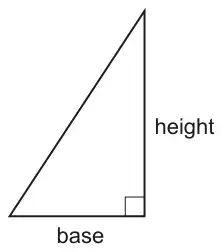
The area of the triangle is 100 cm2, correct to the nearest 10 cm2. The length of the base of the triangle is 8 cm, correct to the nearest cm.
Calculate the largest possible height of the triangle. [4]
Mark scheme
Answer
Marks
Part marks and guidance
28 nfww
4
B1 for 105 B1 for 7.5 M1 for \(\dfrac{\textit{their}\ (95 \text{ to } 105)}{\frac{1}{2} \times \textit{their}\ (7.5 \text{ to } 8.5)}\) but not \(\dfrac{100}{\frac{1}{2} \times 8}\)
17 The number of people watching a football match is 30 000, correct to the nearest thousand.
(a) Complete the error interval for \(n\), the number of people watching the football match.\[\ldots\ldots\ldots \leqslant n \lt 30\,500\] [1]
(b) The number of people watching a rugby match is 30 500, correct to the nearest hundred.
Show that fewer people could be watching the rugby match than the football match. [2]
Mark scheme (a)
Answer
Marks
Part marks and guidance
29 500
1
Mark scheme (b)
Answer
Marks
Part marks and guidance
Accept any correctly matched pair of values in which rugby < football from these ranges rugby: 30 450 to 30 498 and football: 30 451 to 30 499
2
B1 for one value for rugby or football in these ranges rugby from 30 450 to 30 498 or football from 30 451 to 30 499
Error interval alone scores 0 Only mark candidate’s chosen value(s) Rugby < football does not need to be stated If a pair of values and rugby or football not stated assume the value on the left or below another is rugby
For B1 if one or multiple values seen and no clear choice/designation all must be in range 30 451 to 30 498
12 A box contains 200 matches, correct to the nearest ten matches.
(a) Complete the error interval for \(n\), the number of matches in the box.\[\ldots\ldots \leqslant n \leqslant \ldots\ldots\] [2]
(b) The box is a cuboid with
length 7 cm, correct to the nearest cm
width 5 cm, correct to the nearest cm
volume 248 cm3, correct to the nearest cm3.
Show that the smallest possible height of the box is 6 cm. [3]
Mark scheme (a)
Answer
Marks
Part marks and guidance
195 [\(\leqslant n \leqslant\)] 204
2
B1 for 195 or 204 in correct position or for both 195 and 204 but in wrong position
Do not accept < 205 where \(\leqslant\) has been crossed out and replaced
Mark scheme (b)
Answer
Marks
Part marks and guidance
\(\frac{247.5}{7.5 \times 5.5} = 6\)
3
Max 2 marks if answer is incorrect
B1 for 247.5
B1 for 7.5 and 5.5
M1 for \(\frac{their\ 247.5}{their\ 7.5 \times their\ 5.5}\) where \(247.5 \leqslant their\ 247.5 \leqslant 248.5\), \(6.5 \leqslant their\ 7.5 \leqslant 7.5\) and \(4.5 \leqslant their\ 5.5 \leqslant 5.5\)
May be done in stages. 6 must not come from a rounded answer or other wrong working.
If choice, mark the bounds used in the calculation. If no calculation, then 0 each time upper and lower bounds are both given
7.5 × 5.5 × 6 = 247.5 scores just the second mark. If they then explicitly state that 247.5 is the lower bound of 248 they also get the first mark but not for “247.5 rounds to 248”
16 A plane flies from London to Tokyo. The distance is 9600 km, correct to the nearest 100 km. The plane travels at an average speed of 820 km/h, correct to the nearest 10 km/h.
Calculate the shortest possible flight time of the plane. Give your answer in hours and minutes, correct to the nearest minute. You must show your working. [5]
Mark scheme
Answer
Marks
Part marks and guidance
11 [hours] 35 [mins] with correct working
5
B4 for answers 11 [hours] 34 [mins] or 11 [hours] 34.5[…] to 34.8 [mins], with correct working
OR
B1 for 9550 B1 for 825 M1 for (9550 to 9650) ÷ (815 to 825) M1 for their 0.57… × 60 oe
If 0, 1 or 2 scored, instead award SC3 for answer 11 [hours] 35 [mins] with no working or insufficient working
If 0 or 1 scored, instead award SC2 for answer 11 [hours] 34 [mins] or 11 [hours] 34.5[…] to 34.8 [mins] with no working or insufficient working
If 0 scored, instead award SC1 for 11.57[…] or 11.58 with no working or insufficient working
“Correct working” requires evidence of at least B1B1M1
Allow 824.9[9…] for 825 With no contradictory choice With no contradictory choice Do not imply this first M1 mark. their 0.57 following from distance ÷ speed implied by 11.57 to 11.85
11 Jamie buys fence panels that fit tightly together.
Not to scale
Each panel has a length of 1.8 m, correct to 1 decimal place. Jamie measures the length of a garden as 42 m, correct to the nearest metre.
Work out the minimum number of panels Jamie should buy in order to be certain that there are enough panels for the length of the garden. Show how you decide. [4]
Mark scheme
Answer
Marks
Part marks and guidance
42.5 or 42.49[9..] ÷ 1.75
M3
B1 for 1.75 B1 for 42.5 or 42.49[9…]
B1 seen anywhere and mark figures crossed out if you think they have been “rejected” for use
25
A1
If 0 scored award B3 for 24.29 or 24.28[5…]
or if 0 or 1 scored award SC1 as well for their 24.29 seen and correctly rounded up
9 The width, \(w\), of a kitchen cupboard is 60 cm, correct to the nearest centimetre.
(a) Complete the error interval for the width, \(w\).\[\ldots\ldots \leqslant w < \ldots\ldots\]
[2]
(b) Six of these kitchen cupboards are to be placed side by side along a kitchen wall. The wall is 363 cm long, correct to the nearest centimetre.
(i) Show that the six cupboards may not fit along the wall. [3]
(ii) Find the upper bound of the space remaining if six cupboards do fit along the wall. [3]
Mark scheme (a)
Answer
Marks
Part marks and guidance
59.5 60.5
2
B1 for either one correct or both correct but reversed
Mark scheme (b)(i)
Answer
Marks
Part marks and guidance
Accept any correctly matched wall and 6 × cupboard where values quoted satisfy:
wall < 6 × cupboard where 362.5 ⩽ wall < 363 and 362.5 < 6 × cupboard ⩽ 363
OR wall ÷ 6 < cupboard where 362.5 ⩽ wall < 363 and \(60.41\dot{6}\) to 60.42 < cupboard ⩽ 60.5
OR wall ÷ cupboard < 6 where 362.5 ⩽ wall < 363 and \(60.41\dot{6}\) to 60.42 < cupboard ⩽ 60.5
3
B1 for 362.5 ⩽ wall value < 363 B1 for 362.5 < 6 × cupboard value ⩽ 363 or 60.416 to 60.42 < cupboard value ⩽ 60.5
Example: [lower bound of] wall is 362.5 [upper bound of] cupboard is 60.5 362.5 ÷ 60.5 = 5.9[9…] < 6
Mark scheme (b)(ii)
Answer
Marks
Part marks and guidance
6.5
3
M2 for 363.5 – 6 × their lower bound of cupboard or 363.5 – 357 or M1 for [upper bound of wall =] 363.5 or for 6 × their lower bound of cupboard or [6 cupboards =] 357
(a) The length, \(d\), of Jamal’s car is 4.72 m, correct to 2 decimal places.
Complete the error interval for the length, \(d\).
.................... \(\leqslant d \lt\) .................... [2]
(b) Jamal travels 430 km, correct to the nearest 10 km. His average speed is 57.3 km / h, correct to 1 decimal place.
Calculate the shortest possible time for Jamal’s journey. Give your answer correct to the nearest minute. [5]
Mark scheme (a)
Answer
Marks
Part marks and guidance
4.715 4.725
2
B1 for each or both correct and reversed
Mark scheme (b)
Answer
Marks
Part marks and guidance
7 25
5
B4 for 7.41[0...] or 7.411 OR B1 for 425 used B1 for 57.35 or 57.349[9...] used If B0 then B1 for 425 and 57.35 seen AND M2 for 425 ÷ 57.35 or M1 for use of distance ÷ speed e.g 430 ÷ 57.3
If 4 or 5 not scored SC1 for correctly changing their part hour to minutes
Condone use of 57.349[9...] for M2 and for M1 420 ≤ distance ≤ 440 and 56 ≤ speed ≤ 58
15 Andrea is 165 cm tall, correct to the nearest cm. Joel is 170 cm tall, correct to the nearest 10 cm.
Show that Andrea could be taller than Joel. [3]
Mark scheme
Answer
Marks
Part marks and guidance
Accept any correctly matched pair where Andrea > Joel and values quoted are \(165 \lt \text{Andrea} \lt 165.5\) \(165 \leqslant \text{Joel} \lt 165.5\)
3
B1 for value \(165 \lt \text{Andrea} \lt 165.5\) B1 for value \(165 \leqslant \text{Joel} \lt 170\)
For B1 if choice of values given all must be in range, unless acceptable value(s) indicated Values must be clearly associated with either Andrea or Joel as appropriate.
11 The area of a rectangle is 56 m\(^2\), correct to the nearest m\(^2\). The length of the rectangle is 9.2 m, correct to the nearest 0.1 m.
Calculate the smallest possible width of the rectangle. [4]
Mark scheme
Answer
Marks
Part marks and guidance
[55.5 ÷ 9.25 or \(9.24\dot{9}\) =] 6
4
6 must not come from a rounded answer B1 for 55.5 B1 for 9.25 condone 9.2499 or better M1 for their 55.5 ÷ their 9.25 \((55.5 \leqslant\) their \(55.5 \leqslant 56.5\) and \(9.15 \leqslant\) their \(9.25 \leqslant 9.25)\)
16 A £1 coin weighs 8.75 g, correct to the nearest 0.01 g.
Mitul weighs the contents of a large bag of £1 coins. The coins weigh 2.63 kg, correct to the nearest 10 g.
Mitul says
I am sure that the bag contains exactly £300 because, using bounds, 2625 ÷ 8.755 = 299.8 to 1 decimal place.
Show that Mitul may not be correct. [3]
Mark scheme
Answer
Marks
Part marks and guidance
There could be £301 e.g. because 2635 ÷ 8.745 = 301[.3…]
3
M2 for a calculation of (2625 to 2635) ÷ (8.745 to 8.755) oe correctly evaluated to an answer of 301(….) or for a calculation of (2632.245 to 2635) ÷ 301 oe correctly evaluated to an answer of 8.745 to 8.755 or for a calculation of 301 × (8.745 to 8.7541528…) oe correctly evaluated to an answer of 2625 to 2635 or M1 for any further calculation of (2625 to 2635) ÷ (8.745 to 8.755) or (2625 to 2635) ÷ 301 or 301 × (8.745 to 8.755) but not 2625 ÷ 8.755 or 2630 ÷ 8.75 or B1 for 2635, 2.635, 8.745 or 8745 seen
For full marks, their conclusion must follow from a relevant calculation which shows that 301 is a possible answer (either use of 301 and two weights in range, or an answer of more than 301 rounded down, and not an answer of less than 301 rounded up)
Calculations may be done in grams as shown, or converted to kg.
Common calculations for at least M2 include: 2635 ÷ 8.75 = 301.1(…) 2635 ÷ 8.745 = 301.3(…)
Common calculations scoring only M1 include: 2625 ÷ 8.75 (= 300) 2630 ÷ 8.745 = 300.7(…)
Note the first method does not require a comparison against 1 (km)
4
B1 for (minimum length =) 21.45 seen
Allow access to all marks if brick and 1 km are in consistent units.
B1 for 1 km = 100 000 cm soi oe such as ÷ 100 then ÷ 1000 or use of 1m = 100cm and 1km = 1000m if working in metres.
Allow these conversions even with their volume or surface area. eg 21.5 × 10.3 × 6.5 = 1439.425 cm/cm\(^2\)/cm\(^3\) = 0.014 394 25 km
M1 for their 21.45 × 4663 (÷ 100 000) or 100 000 ÷ their 21.45 or 100 000 ÷ 4663
their 21.45 must be in the range 21.45 to 21.55 but accept equivalent if attempting the unit conversion first eg B0B0M1 for 21.5 cm = 0.0215 km followed by 0.0215 × 4663
If M0 scored, allow SC1 for \(k\) × 4663 (÷ 100 000) or 100 000 ÷ \(k\) with \(k\) in the range 10.25 to 10.35 or 6.45 to 6.55
Thus, use of width or height of the brick may score B0,B1,SC1 whereas use of volume may score B0/1,B1,SC0
Accept equivalent if working in m or km
Mark scheme (b)
Answer
Marks
Part marks and guidance
(i) 7017 to 7020
3
B1 for 20 000 or 2.849[…] or 2.85 or 0.0028[…] seen
M1 for their 20 000 ÷ their 2.85 or 20 ÷ their 0.00285
Ignore other bound
ie a division after an attempt to reach consistent units their 2.85 must be in the range 2.75 to 2.85 inc.; their 0.00285 must be in the range 0.00275 to 0.00285. B0M0 for 20 ÷ 2.8 as no attempt to reach consistent units
(ii) The truck may not have enough room oe Safety regulations may not allow it
1
Mark their best reason. 0 for we do not know the exact weight of the bricks oe 0 for because the truck may need to carry other loads 0 there may not be enough bricks available
(a) The mass, \(m\) tonnes, of a girder is 12.7, correct to 1 decimal place.
Complete the error interval for the mass, \(m\).
\[\ldots\ldots\ldots\ldots \leqslant m \lt \ldots\ldots\ldots\ldots\]
[2]
(b) The length of a piece of wood is given as 8 metres, correct to the nearest metre. The length of a metal rod is given as 8.5 metres, correct to 1 decimal place.
Show that the piece of wood could be longer than the metal rod. [2]
Mark scheme (a)
Answer
Marks
Part marks and guidance
12.65 12.75
2
B1 for one correct or both correct and reversed
For B1, correct value must be in correct place
Mark scheme (b)
Answer
Marks
Part marks and guidance
Accept any correctly matched pair in which wood > metal
from \(8.45 \lt \text{wood} \leqslant 8.49[9\ldots]\) and \(8.45 \leqslant \text{metal} \leqslant 8.49[9\ldots]\)
2
Wood > metal does not need to be stated but it must be clear which measurement refers to wood and which to metal
B1 for one measurement in range \(8.45 \lt \text{wood} \leqslant 8.49[9\ldots]\) seen or \(8.45 \leqslant \text{metal} \leqslant 8.49[9\ldots]\) seen
Eg “Wood 8.46 [m] but Metal 8.45 [m]” scores 2 marks
Wood or 8 Metal or 8.5
For B1, measurement must be correctly associated with either wood or metal, as appropriate
8.45 seen as end of range Eg \(8.45 \leqslant 8.5 \lt 8.55\) scores 1 mark
11 Sunil makes 7.5 litres of soup, correct to the nearest 0.5 litre. He serves the soup in 300 ml portions, correct to the nearest 10 ml. 24 people order this soup.
Does Sunil definitely have enough soup to serve the 24 people? Show how you decide. [4]
Mark scheme
Answer
Marks
Part marks and guidance
No, with correct calculation leading to 23.77 to 23.8 identified or with 7.32 compared with 7.25 oe or 302 compared with 305 oe
4
B1 for 7250 or 7.25 seen B1 for 305 or 0.305 seen
M1 for their 7.25 ÷ their 0.305 with consistent units and at least one attempted bound or for their 0.305 × 24 oe or their 7250 ÷ 24 oe
Ignore upper bound Ignore lower bound
Their 7.25 in range 7 to 8, their 0.305 in range 0.29 to 0.31 or equivs. Ignore other divisions or products M0 for 7500 ÷ 300 or 7.5 ÷ 0.3