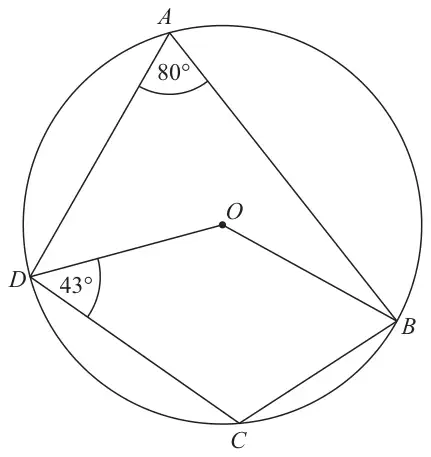
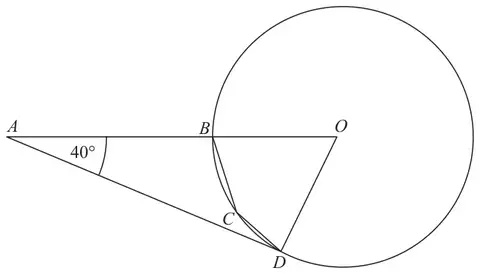
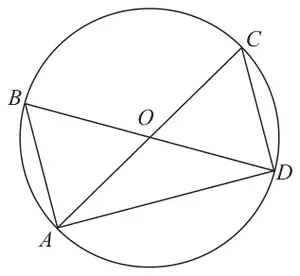
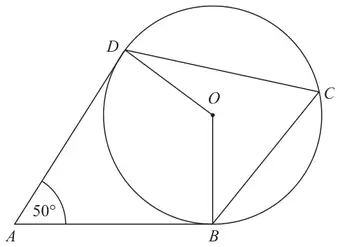
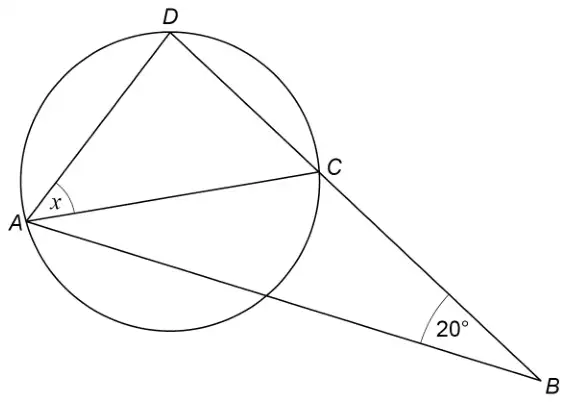
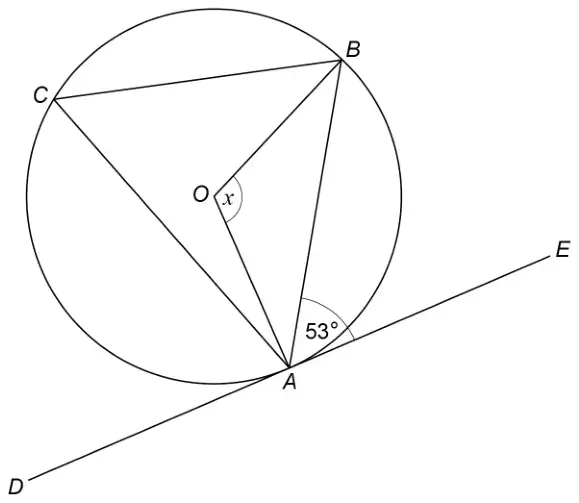
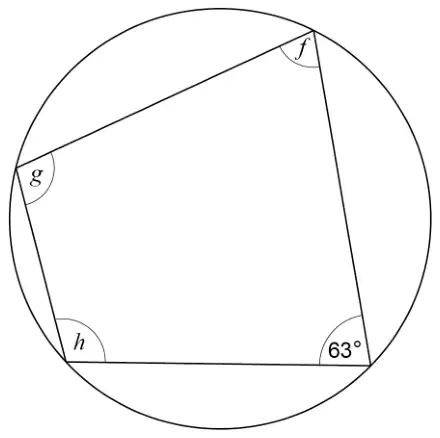
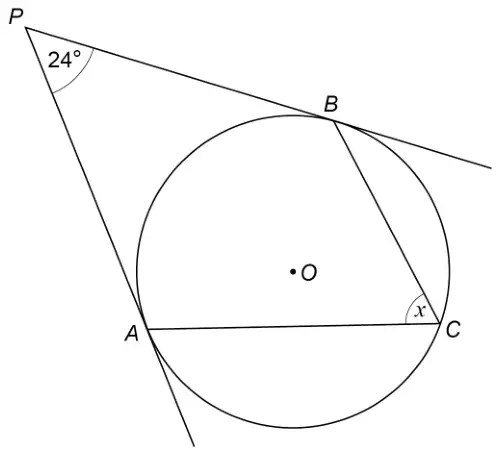
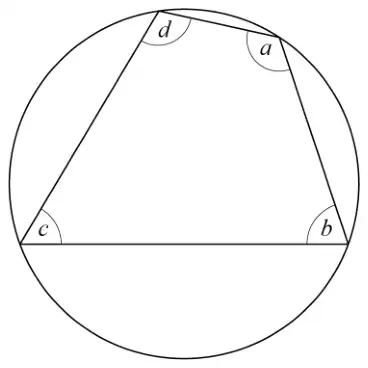
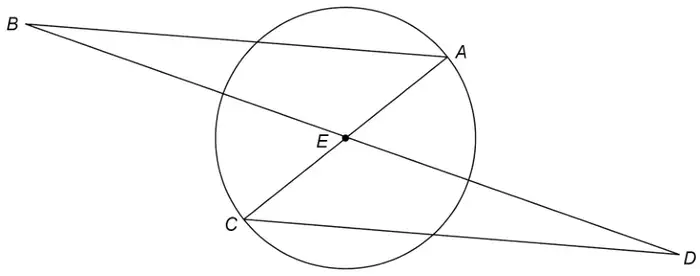
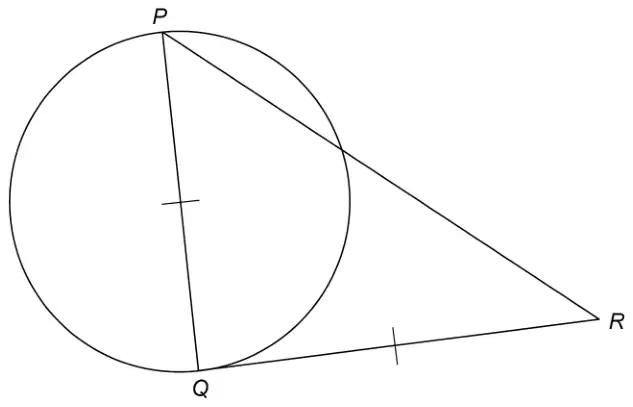
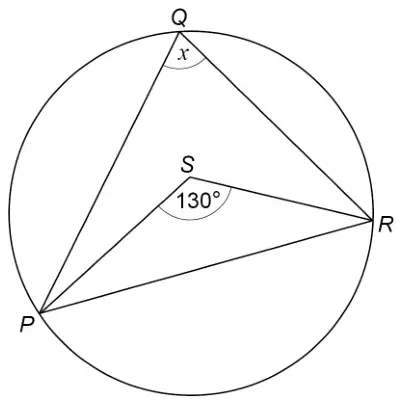
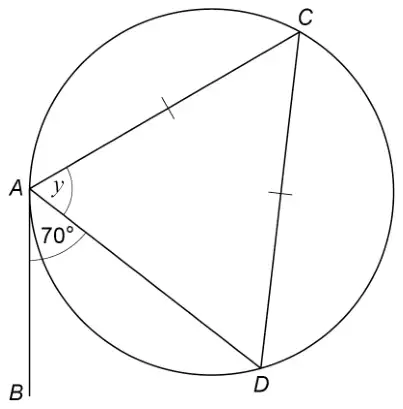
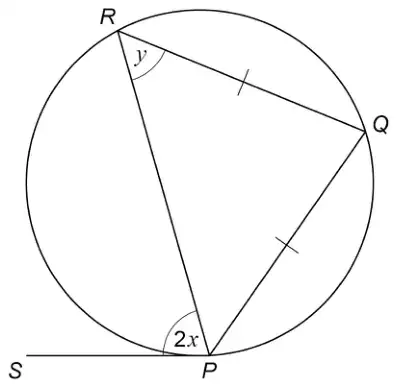
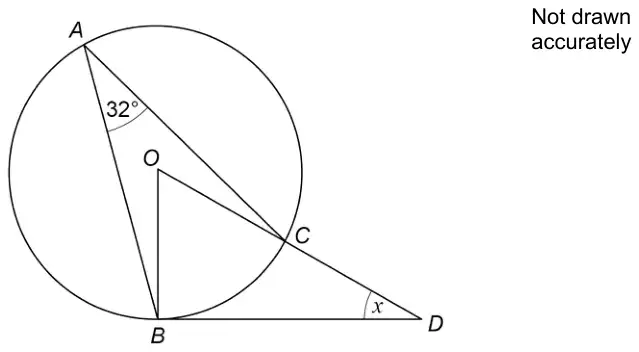
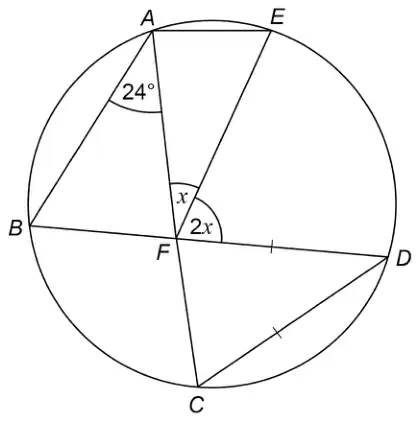
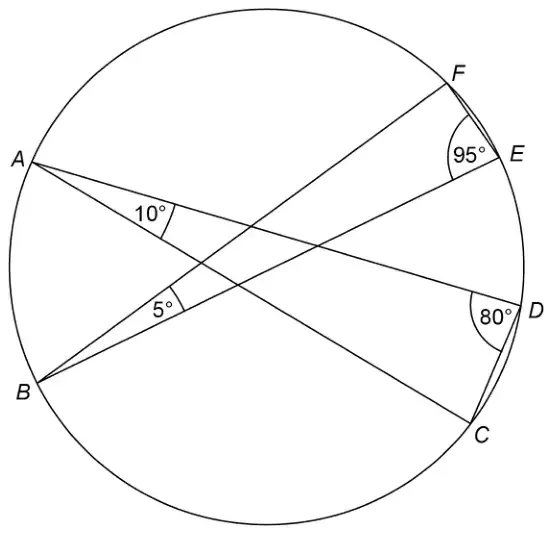
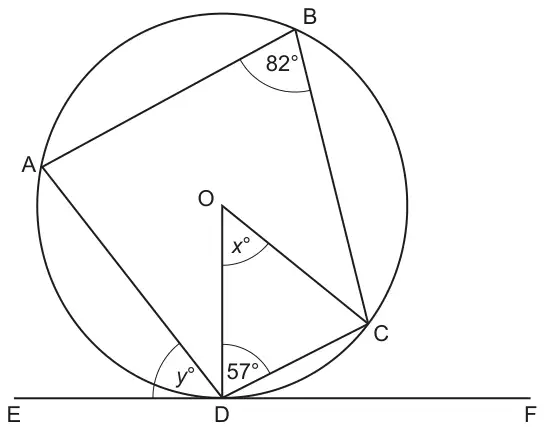
20 \(A\), \(B\), \(C\) and \(D\) are points on a circle with centre \(O\).
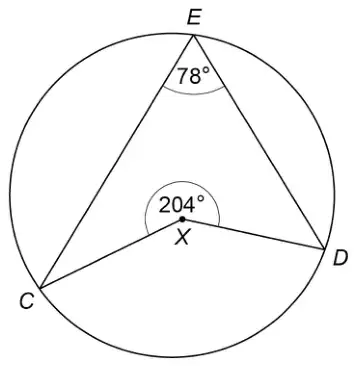
Find the size of angle \(OBC\). Write down any circle theorems that you use. (4)
Mark scheme
Answer
Mark
Mark scheme
57
M1
for method to find angle \(BCD\) eg \(BCD = 180 - 80\ (= 100)\)
M1
for method to find angle \(DOB\) eg \(DOB = 80 \times 2\ (= 160)\)
A1
for \(OBC = 57\)
C1
(dep on M1) for one correct circle theorem appropriate to their method eg The angle at the centre of a circle is twice the angle at the circumference or The angle at the circumference of a circle is half the angle at the centre orOpposite angles of a cyclic quadrilateral add up to 180
Additional guidance
Angles may be seen on diagram Method marks can be awarded in either order Correct method can be implied from angles on the diagram if no ambiguity or contradiction. eg Angle \(O\) = 160 is too ambiguous accept angle \(C\) = 100
Underlined words need to be shown; reasons need to be linked to their method. Accept “\(\angle\)” for “angle” and “\(\angle s\)” for “angles” Accept “4-sided shape” for “quadrilateral”
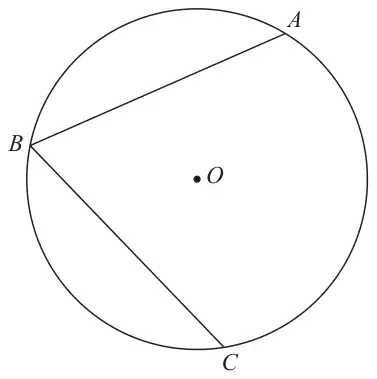
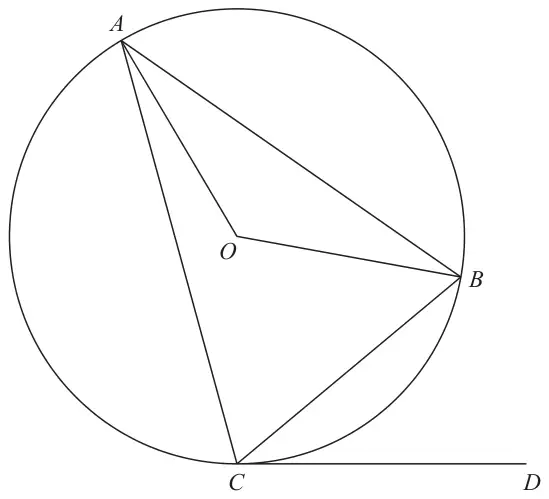
18 \(A\), \(B\) and \(C\) are three points on a circle, centre \(O\).
\(BA = BC\)
Prove that \(OB\) bisects angle \(ABC\). (3)
Mark scheme
Answer
Mark
Mark scheme
Proof
M1
begins proof to show that triangles \(ABO\) and \(CBO\) or triangles \(ABD\) and \(CBD\) are congruent by giving one pair of equal sides or equal angles with reason
M1
for different pair of equal sides or angles with reason
C1
for full proof that triangles \(ABO\) and \(CBO\) are congruent, SSS, or triangles \(ABD\) and \(CBD\) are congruent, RHS, and therefore angle \(ABO\) = angle \(CBO\)
\(AB = CB\) (given) \(BO\) (or \(BD\)) is common \(AO = CO\) radii of circle angle \(BAD\) = angle \(BCD\) angles in a semicircle are 90 (\(BO = AO = CO\) radii of circle) counts as two sides with reasons
OR
M1
draws \(OA\), \(OC\) and \(AC\) and labels angle \(OAC = x\) and angle \(OCA = x\) with reason given, \(AO = CO\) radii of circle and base angles of an isosceles triangle are equal or \(BAC = BCA\) since \(ABC\) is isosceles
M1
shows \(OAC = OCA\) and shows \(BAC = BCA\) and uses these to show \(OAB = OCB\) with all reasons given
C1
for full proof concluding with angle \(ABO = y\) and angle \(CBO = y\) with reason given, eg \(OA = OB = OC\) radii of circle and \(OBC\) and \(OAB\) are isosceles
Additional guidance
Where \(D\) is point such that \(BOD\) is diameter
Work out the size of angle \(ACD\). Write down any circle theorems that you use. (4)
Mark scheme
Answer
Mark
Mark scheme
100
M1
for angle \(BAC = 40\)
M1
for angle \(OAC\) or angle \(OCA = 10\) or angle \(OAB\) or angle \(OBA = 30\)
M1
for angle \(ACB = (180 - 30 - 30) \div 2\ (= 60)\) or angle \(OCD = 90\) or angle \(OCB = 50\)
C1
for angle \(ACD = 100\) and one correct appropriate circle theorem from alternate segment theorem angle at the centre is twice the angle at the circumference the tangent to a circle is perpendicular to the radius
Additional guidance
angle \(AOB = 120\) gets M1M1
Award M3C0 for answer of 100 with no correct appropriate circle theorem
Underlined words need to be shown Reason needs to be linked to their method, which can be implied from correctly identified angles (stated or written on the diagram)
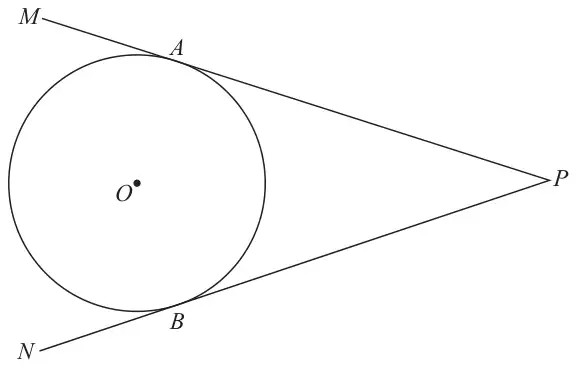
22 \(A\) and \(B\) are points on a circle, centre \(O\).
\(MAP\) and \(NBP\) are tangents to the circle.
Prove that \(AP = BP\) (4)
Mark scheme
Answer
Mark
Mark scheme
Proof
C1
for angle \(OAP\) = angle \(OBP = 90\) angle between radius and tangent is 90°
C1
for \(OA = OB\) both radii
C1
\(OP\) is common
C1
(dep on C3) for a complete proof with all reasons given, eg triangles \(OAP\) and \(OBP\) are congruent RHS so \(AP = BP\) or \(AP = \sqrt{OP^2 - OA^2}\) and \(BP = \sqrt{OP^2 - OB^2}\) and \(OA = OB\) so \(AP = BP\)
Additional guidance
May be seen as 2 separate diagrams
All reasons given must be clearly linked to the appropriate statement
Underlined words need to be shown
Alternative
Answer
Mark
Mark scheme
Proof
C1
for \(\cos AOP = \dfrac{AO}{OP} = \dfrac{r}{OP}\) or \(\cos BOP = \dfrac{BO}{OP} = \dfrac{r}{OP}\) angle between radius and tangent is 90°
C1
for \(\cos AOP = \dfrac{AO}{OP} = \dfrac{r}{OP}\) and \(\cos BOP = \dfrac{BO}{OP} = \dfrac{r}{OP}\) and \(AOP = BOP\) both radii
C1
\(OP\) is common
C1
(dep on C3) for a complete proof with all reasons given, eg triangles \(OAP\) and \(OBP\) are congruent SAS so \(AP = BP\)
May be seen as 2 separate diagrams Underlined words need to be shown
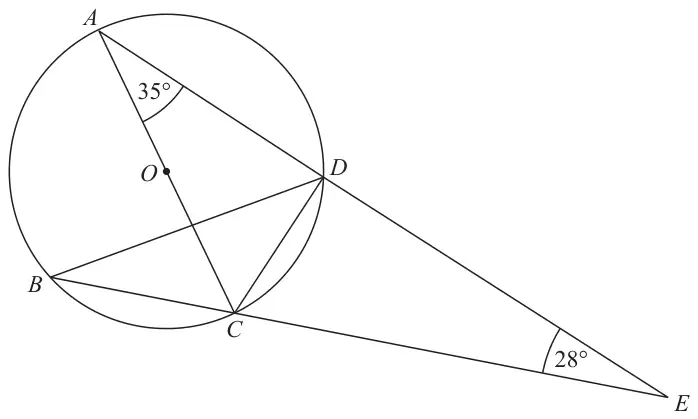
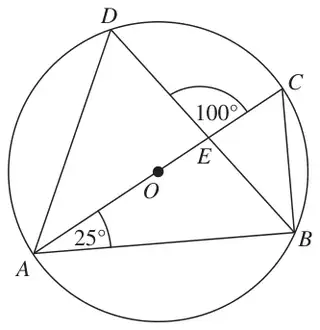
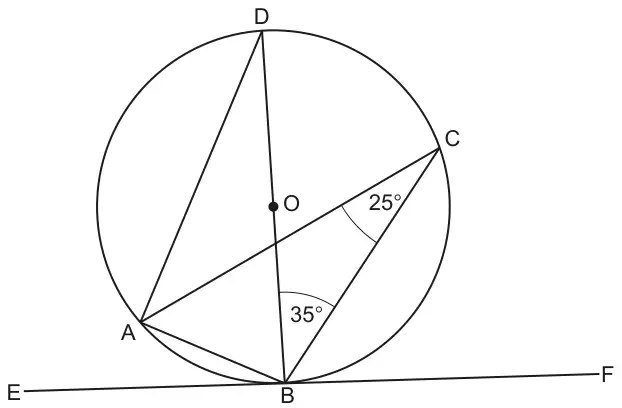
\(A\), \(B\), \(C\) and \(D\) are points on the circumference of a circle, centre \(O\). \(AC\) is a diameter of the circle.
\(ADE\) and \(BCE\) are straight lines.
Work out the size of angle \(BDC\). Write down any circle theorems that you use. (4)
Mark scheme
Answer
Mark
Mark scheme
27
M1
for start by finding one missing angle, eg angle \(CBD = 35\) or angle \(ADC = 90\) or angle \(ACE = 117\)
M1
for making progress by finding a second angle, eg angle \(BDE = 117\) or angle \(DCE = 62\) or angle \(BCA = 63\)
A1
for angle \(BDC = 27\)
C1
(dep on M1) for stating one correct circle theorem used eg Angles in a semicircle are 90 orAngles in the same segment are equal orAngles at the circumference subtended from the same arc of a circle are equal or The angle at the centre of a circle is twice the angle at the circumference
Additional guidance
Angles clearly identified on the diagram or in the working space may be awarded marks provided there is no ambiguity or contradiction.
Underlined words need to be shown; circle theorems stated need to be linked to their method, which can be implied from correctly identified angles (stated or written on the diagram).
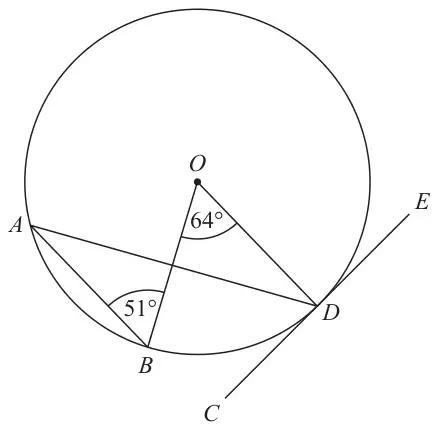
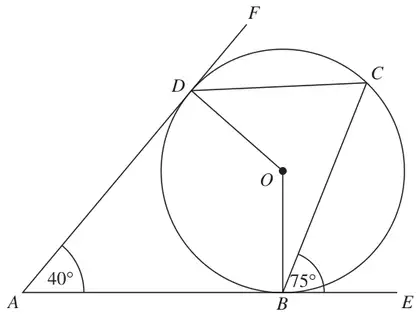
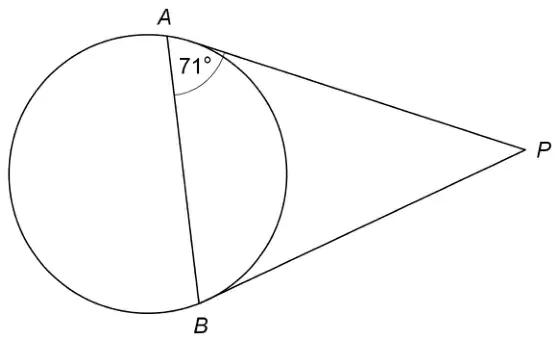
21 \(A\), \(B\) and \(D\) are points on a circle with centre \(O\). \(CDE\) is the tangent to the circle at \(D\).
Work out the size of angle \(ADC\). Write down any circle theorems you use. (4)
Mark scheme
Answer
Mark
Mark scheme
71
M1
for method to find angle \(BAD\) or angle \(OAB\) or angle \(OBD\), eg angle \(BAD = 64 \div 2\ (= 32)\) or angle \(OAB = 51\) or angle \(OBD = (180 - 64) \div 2\ (= 58)\)
M1
for method to find angle \(ADO\) or angle \(AXD\) (where \(X\) is a point on the major arc \(AD\)) eg \(ADO = 180 - 64 - (180 - 51 - \text{``}32\text{''})\ (= 19)\) or \(ADO = (180 - 64 - (180 - 2 \times \text{``}51\text{''})) \div 2\ (= 19)\) or angle \(AXD = 180 - \text{``}58\text{''} - 51\ (= 71)\)
A1
for angle \(ADC = 71\)
C1
(dep on M1) for one circle theorem relevant to their method, eg The angle at the centre of a circle is twice the angle at the circumference or The tangent to a circle is perpendicular to the radius (diameter) or Opposite angles of a cyclic quadrilateral add up to 180 or Alternate segment theorem
Additional guidance
Angles may be seen on the diagram
Underlined words need to be shown; reasons need to be linked to their method
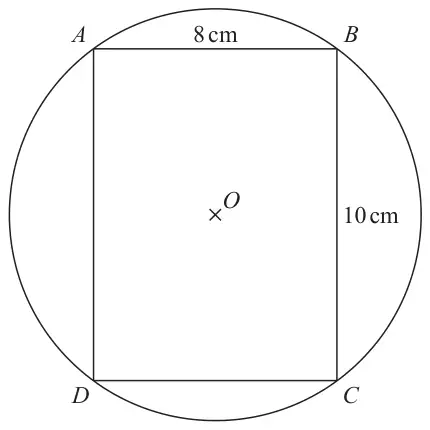
12 The points \(A\), \(B\), \(C\) and \(D\) lie on a circle, centre \(O\). \(ABCD\) is a rectangle.
\(AB = 8\) cm \(BC = 10\) cm
Work out the circumference of the circle. Give your answer correct to 3 significant figures. (4)
Mark scheme
Answer
Mark
Mark scheme
40.2
P1
for start of process to find the diameter or the radius of the circle, eg \(8^2 + 10^2\ (= d^2)\) oe or \(4^2 + 5^2\ (= r^2)\) oe
P1
for complete process to find diameter, eg \(\sqrt{8^2 + 10^2}\ (= 12.8\ldots)\) or complete process to find radius, eg \(\sqrt{4^2 + 5^2}\ (= 6.40\ldots)\)
P1
for process to find circumference, eg \(\pi \times \text{``}12.8\ldots\text{''}\) or \(2 \times \pi \times \text{``}6.40\ldots\text{''}\)
A1
answer in the range 40.2 to 40.24
Additional guidance
Accept \(\sqrt{164}\) or \(2\sqrt{41}\) or \(\sqrt{41}\)
If an answer is given in the range in working and then rounded incorrectly award full marks.
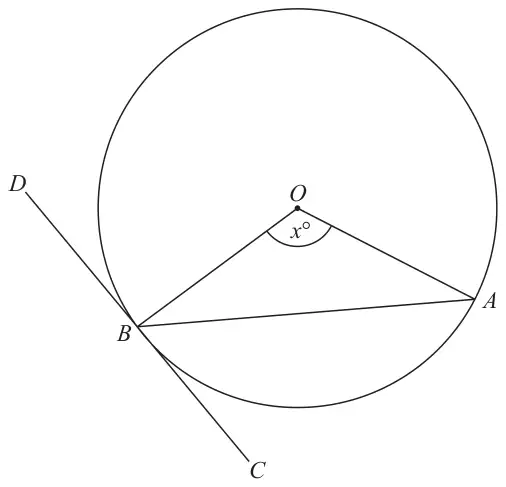
\(A\) and \(B\) are points on a circle, centre \(O\). \(DBC\) is the tangent to the circle at \(B\). Angle \(AOB = x^\circ\)
Show that angle \(ABC = \dfrac{1}{2}x^\circ\) You must give a reason for each stage of your working. (3)
Mark scheme
Answer
Mark
Mark scheme
Result shown
M1
for angle \(OBC = 90\) or for method to find angle \(OBA\) or angle \(OAB\), eg \(\dfrac{180 - x}{2}\) oe or for angle \(ABC = 90\) – angle \(OBA\), eg angle \(ABC = 90 - y\)
or marks point on circumference and draws triangle using \(A\) and \(B\) and point marked
M1
for method to find angle \(ABC\), eg \(90 - \text{``}\dfrac{180 - x}{2}\text{''}\) oe or for \(x = 180 - 2 \times\) angle \(OBA\), eg \(x = 180 - 2y\) or for angle at circumference \(= \dfrac{1}{2}x\)
C1
for correct algebra leading to angle \(ABC = \dfrac{1}{2}x\) and one circle theorem relevant to their method, eg The tangent to a circle is perpendicular to the radius
OR for \(x = 180 - 2y\) and angle \(ABC = 90 - y\) and one circle theorem relevant to their method, eg The tangent to a circle is perpendicular to the radius
OR for angle \(ABC = \dfrac{1}{2}x\) and one circle theorem relevant to their method, eg The angle at the centre of a circle is twice the angle at the circumference or Alternate segment theorem
Additional guidance
Angles must be clearly labelled on the diagram or otherwise identified. Correct method can be implied from angles on the diagram if no ambiguity or contradiction.
Underlined words need to be shown; reasons need to be linked to their method.
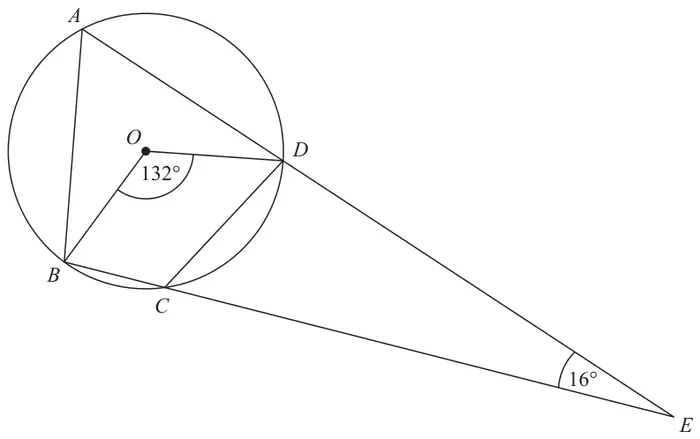
M2 for reflex \(BOD = 360 - 132\ (= 228)\) and \(BCD = \text{``}228\text{''} \div 2\ (= 114)\)
A1
for finding \(CDE = 98\)
C1
(dep on at least M2) for one circle theorem relevant to their method eg The angle at the centre of a circle is twice the angle at the circumference orOpposite angles of a cyclic quadrilateral add up to 180
Additional guidance
Angles may be seen on diagram
Underlined words need to be shown; reasons need to be linked to their method.
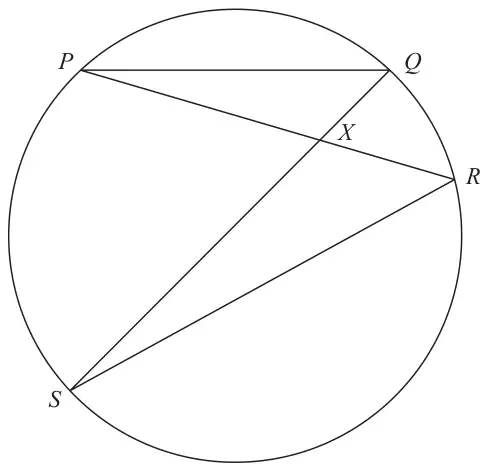
15 \(P\), \(Q\), \(R\) and \(S\) are four points on a circle.
\(PXR\) and \(SXQ\) are straight lines.
Prove that triangle \(PQX\) and triangle \(SRX\) are similar. (3)
Mark scheme
Answer
Mark
Mark scheme
Proof
C1
for angle \(PQX\) = angle \(SRX\) as angles in the same segment are equal (or angles at the circumference subtended from the same arc/chord of a circle are equal)
or angle \(QPX\) = angle \(RSX\) as angles in the same segment are equal (or angles at the circumference subtended from the same arc/chord of a circle are equal)
or angle \(PXQ\) = angle \(SXR\) as vertically opposite angles/vertically opposite angles are equal
or for identifying two pairs of corresponding equal angles with no reason given
C1
for identifying two pairs of corresponding equal angles with correct reasons given
C1
for stating that the triangles are similar because all three pairs of corresponding angles are equal with complete reasons given.
Additional guidance
Underlined words need to be shown; reasons need to be linked to their method.
Could be shown on the diagram
Note that the students third/final reason may be: Angles in a triangle add up to 180
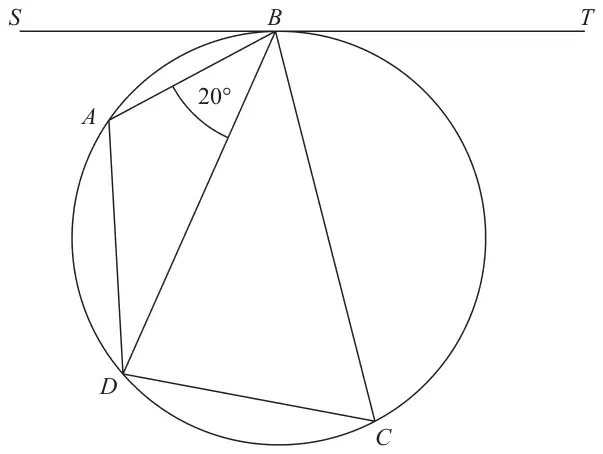
\(A\), \(B\), \(C\) and \(D\) are four points on a circle. \(SBT\) is a tangent to the circle. Angle \(ABD = 20^\circ\)
the size of angle \(BAD\) : the size of angle \(BCD = 3 : 1\)
Find the size of angle \(SBA\). Give a reason for each stage of your working. (4)
Mark scheme
Answer
Mark
Mark scheme
25 with reasons
M1
for method to find angle \(BCD\) eg \(180 \div (3 + 1)\ (= 45)\) or \(BAD = 180 \div (3 + 1) \times 3\ (= 135)\)
M1
for method to find angle \(BDA\) eg \(180 - 20 - (180 - \text{``}45\text{''})\ (= 25)\) or method to find angle \(SBD\) eg \(SBD = BCD\ (= 45)\)
C2
for finding \(SBA\ (= 25)\) and both reasons given, eg Opposite angles of a cyclic quadrilateral add up to 180 for angle \(SBD = 45\) because alternate segment theorem
(C1
(dep M1) for one reason given Opposite angles of a cyclic quadrilateral add up to 180 for angle \(SBD = 45\) because alternate segment theorem)
Additional guidance
Could be shown on the diagram or in working
Do not award if it ambiguous as to which angle is being found
Underlined words need to be shown; reasons need to be linked to their method
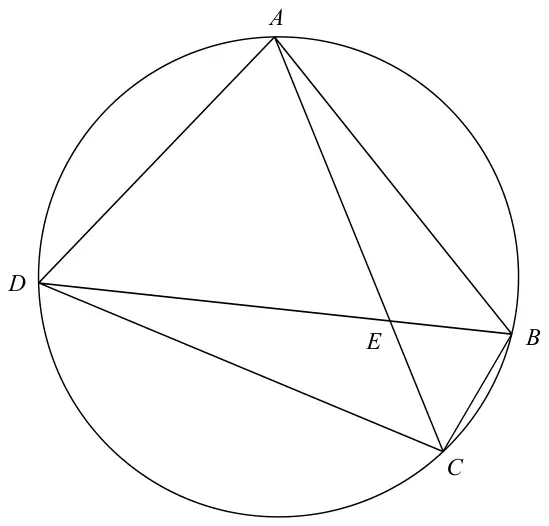
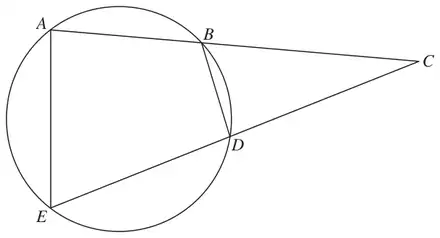
22 \(A\), \(B\), \(C\) and \(D\) are four points on a circle.
\(AEC\) and \(DEB\) are straight lines.
Triangle \(AED\) is an equilateral triangle.
Prove that triangle \(ABC\) is congruent to triangle \(DCB\). (4)
Mark scheme
Answer
Mark
Mark scheme
Proof
C1
for one correct pair of equal angles with correct reason from: angle \(ACB\) = angle \(ADB\), (angles in the same segment are equal) angle \(DBC\) = angle \(DAC\), (angles in the same segment are equal) angle \(ABD\) = angle \(ACD\), (angles in the same segment are equal) or for recognising all angles of 60 in triangle \(AED\) and in triangle \(CEB\))
C1
for one identity, with reason(s), from the following list of alternatives: Alternatives: a complete method to show that angle \(ACB\) = angle \(DBC\) (= 60), or \(BC\) being common to both triangles or \(DB = DE+EB = AE+EC = AC\) (sides of an equilateral triangle are equal) or angle \(ABC = 60 +\) angle \(ABD = 60 +\) angle \(ACD\) = angle \(DCB\) (angles in the same segment are equal) or angle \(BDC\) = angle \(CAB\) (angles in the same segment are equal)
C1
for a second identity, with reason(s), from the alternatives above
C1
for concluding the proof with a third identity, with reason(s), from the alternatives above, together with the condition for congruency, ASA or SAS or AAS
Additional guidance
Underlined words need to be shown; reasons need to be linked to their statement(s)
Pairs of equal angles may be just shown on the diagram
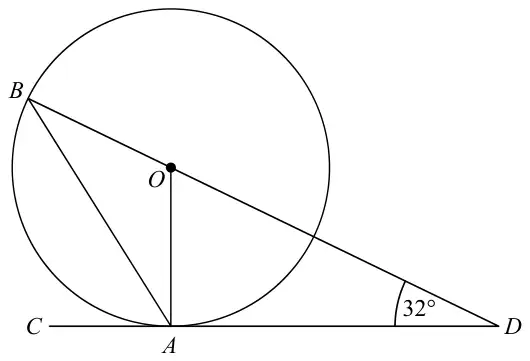
\(A\) and \(B\) are points on a circle with centre \(O\). \(CAD\) is the tangent to the circle at \(A\). \(BOD\) is a straight line.
Angle \(ODA = 32^\circ\)
Work out the size of angle \(CAB\). You must show all your working. (3)
Mark scheme
Answer
Mark
Mark scheme
61
B1
angle \(OAD = 90\), may be marked on diagram
M1
method to work out angle \(OAB\) (= 29)
A1
cao
Additional guidance
Angle could be shown by a right-angle symbol
Correct method can be implied from angles on the diagram if no ambiguity or contradiction. Reasons need not be given. Award 0 marks for an answer of 61 with no other working.
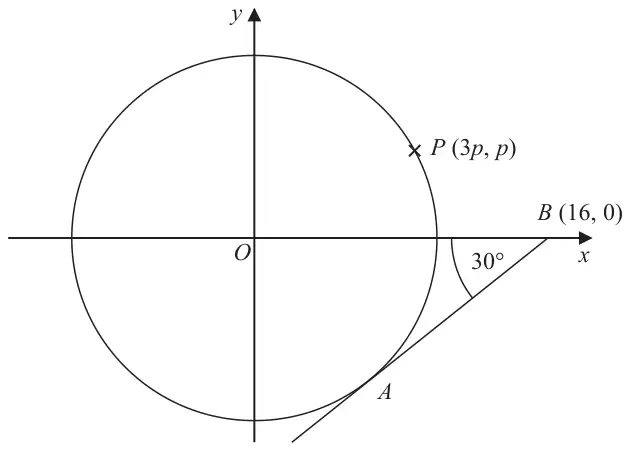
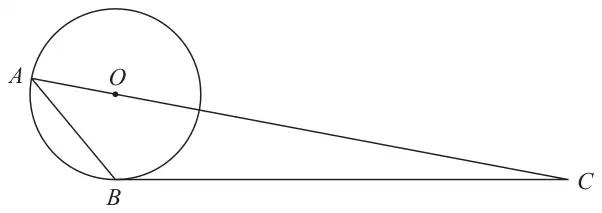
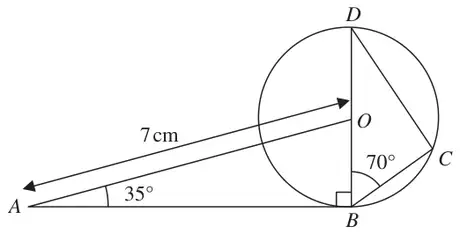
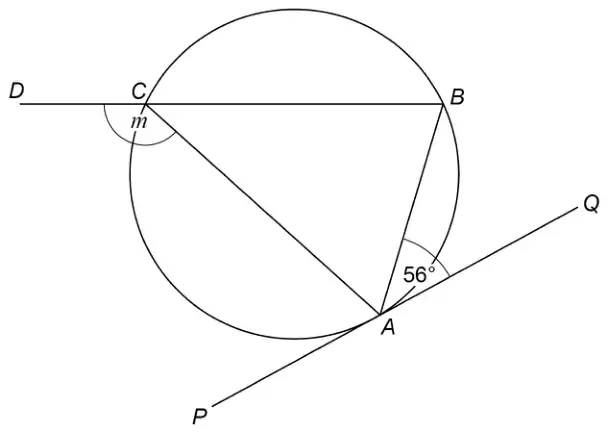
\(AB\) is the tangent to the circle at the point \(A\). Angle \(OBA = 30^\circ\)
Point \(B\) has coordinates \((16, 0)\) Point \(P\) has coordinates \((3p, p)\)
Find the value of \(p\). Give your answer correct to 1 decimal place. You must show all your working. (4)
Mark scheme
Answer
Mark
Mark scheme
2.5
P1
use of \(\sin 30 = \tfrac{1}{2}\) to find \(OA\ (= 8)\) or \(OAB = 90^\circ\) eg \(OA = 16\sin 30^\circ\) or right angle marked on diagram
P1
recognition that equation of circle is \(x^2 + y^2 = r^2\)
P1
Correct substitution of \(p\), \(3p\) and \(r\) in \(x^2 + y^2 = r^2\) eg \(9p^2 + p^2 = OA^2\) or \((3p)^2 + p^2 = \text{``}8^2\text{''}\)
A1
for answer in the range 2.5 to 2.53
Additional guidance
Accept \(3p^2 + p^2 = r^2\) for the award of this mark
Do not accept \(3p^2 + p^2 = 8^2\) for the award of this mark
Accept \(\sqrt{6.4}\) or \(\dfrac{4\sqrt{10}}{5}\) If an answer within the given range is seen in working and rounded incorrectly award full marks. Award 0 marks for the answer without supportive working.
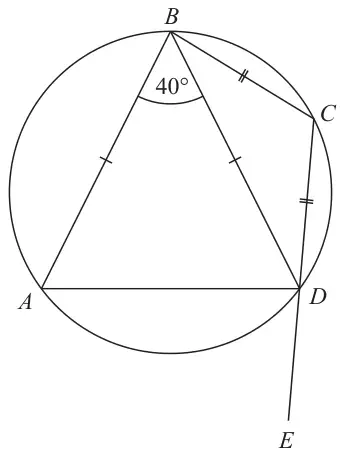
18 The points \(A\), \(B\), \(C\) and \(D\) lie on a circle. \(CDE\) is a straight line.
\(BA = BD\) \(CB = CD\) Angle \(ABD = 40^\circ\)
Work out the size of angle \(ADE\). You must give a reason for each stage of your working. (5)
Mark scheme
Answer
Mark
Mark scheme
\(75^\circ\) with reasons
M1
for finding angle \(BAD = \dfrac{180 - 40}{2}\ (= 70)\) or angle \(BDA = \dfrac{180 - 40}{2}\ (= 70)\)
M1
for finding angle \(BCD = 180 - \text{``}70\text{''}\ (= 110)\) or \(40 + x + 70 + x = 180\)
A1
for finding angle \(ADE = 75\)
C2
(dep M2) for “Opposite angles of a cyclic quadrilateral add up to 180” and one other reason; all reasons given must be appropriate for their working. Other reasons: Base angles of an isosceles triangle are equal Angles in a triangle add up to 180 Angles on a straight line add up to 180 [or exterior angle of a cyclic quadrilateral is equal to the interior opposite angle]
(C1
(dep M2) for “Opposite angles of a cyclic quadrilateral add up to 180” or all other reasons given appropriate for their working)
Additional guidance
Could be shown on the diagram or in working
Underlined words need to be shown; reasons need to be linked to their method
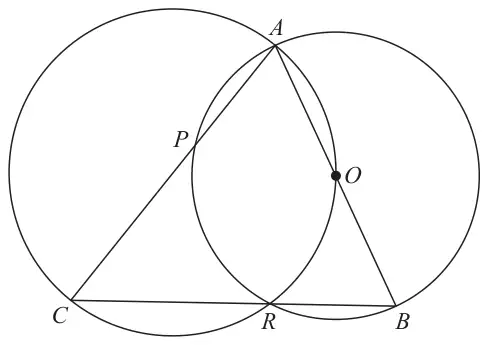
\(A\), \(B\), \(R\) and \(P\) are four points on a circle with centre \(O\). \(A\), \(O\), \(R\) and \(C\) are four points on a different circle. The two circles intersect at the points \(A\) and \(R\).
\(CPA\), \(CRB\) and \(AOB\) are straight lines.
Prove that angle \(CAB\) = angle \(ABC\). (4)
Mark scheme
Answer
Mark
Mark scheme
proof
C1
uses cyclic quad eg if \(CAB = x\) then \(CRO = 180 - x\) (Opposite angles of a cyclic quadrilateral add up to 180°.)
C1
establishes relationship outside a circle eg \(ORB = x\) (Angles on a straight line add up to 180)
C1
uses properties of a circle eg \(RO = OB\) (both radii) so \(ABC = x\) (Base angles of an isosceles triangle are equal.)
C1
Complete proof and conclusion
Additional guidance
Underlined words need to be shown; reasons need to be linked to their method; any reasons not linked do not credit.
Correct method can be implied from angles on the diagram if no ambiguity or contradiction.
Full reasons given without any redundant reasons and correct reasoning throughout.
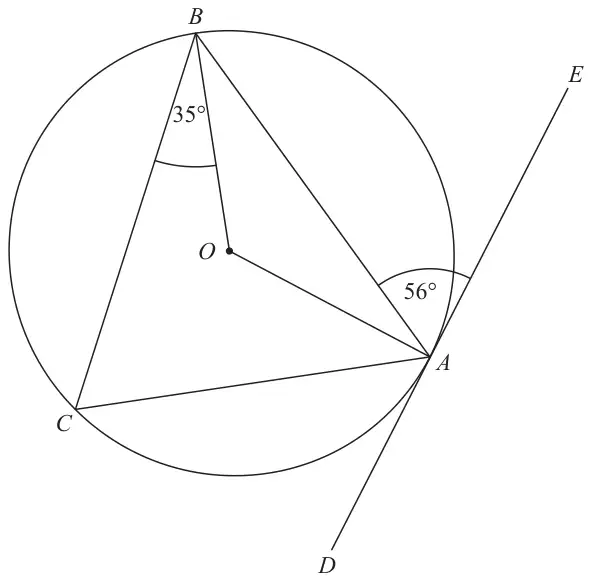
\(A\), \(B\) and \(C\) are points on the circumference of a circle, centre \(O\). \(DAE\) is the tangent to the circle at \(A\).
Angle \(BAE = 56^\circ\) Angle \(CBO = 35^\circ\)
Work out the size of angle \(CAO\). You must show all your working. (3)
Mark scheme
Answer
Mark
Mark scheme
21
C1
for angle \(OAB = 90 - 56\ (= 34)\)
C1
for process to find angle \(CAD\ (= 69)\) or angle \(BCA\ (= 56)\) or angle \(COA\ (= 138)\), eg use of alternate segment theorem or angle at centre is twice the angle at the circumference
C1
cao
Additional guidance
Throughout, angles may be written on the diagram; accept as evidence if correct. Ignore absence of degree sign Reasons need not be given.
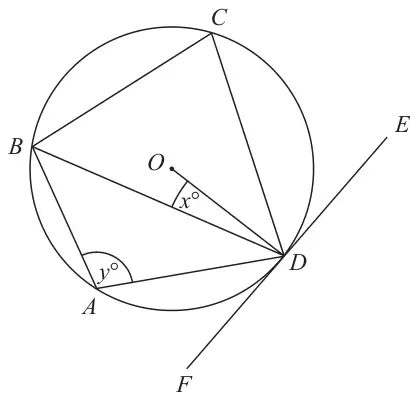
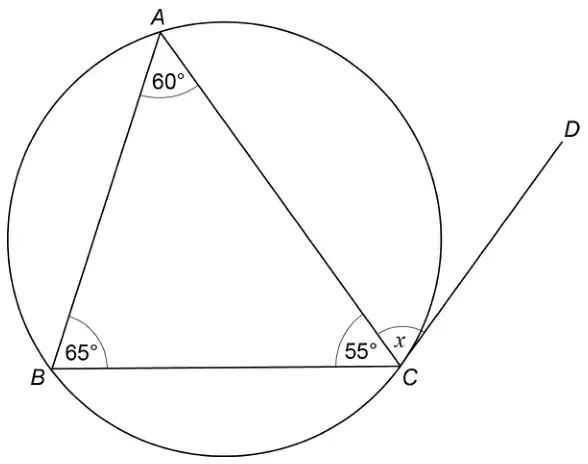
\(A\), \(B\), \(C\) and \(D\) are points on the circumference of a circle, centre \(O\). \(FDE\) is a tangent to the circle.
(a) Show that \(y - x = 90\) You must give a reason for each stage of your working. (3)
Dylan was asked to give some possible values for \(x\) and \(y\).
He said,
“\(y\) could be 200 and \(x\) could be 110, because \(200 - 110 = 90\)”
(b) Is Dylan correct? You must give a reason for your answer. (1)
Mark scheme (a)
Answer
Mark
Mark scheme
Shown
M1
for finding one missing angle eg \(BDE = y\) or \(ODE = 90\) or \(ODF = 90\) or \(DBO = x\) or \(BCD = 180 - y\) or (reflex) \(BOD = 2y\)
A1
for a complete correct method leading to \(y - x = 90\)
C1
(dep on A1) for all correct circle theorems given appropriate for their working eg The tangent to a circle is perpendicular (90°) to the radius (diameter) Alternate segment theorem OR Angle at the centre is twice the angle at the circumference Opposite angles in a cyclic quadrilateral sum to 180°
Additional guidance
Could be shown on the diagram or in working
Mark scheme (b)
Answer
Mark
Mark scheme
Explanation
C1
for explanation eg No as \(y\) must be less than 180 as it is an angle in a triangle
full method to find the required angle eg a method leading to \(180 - x - x - 90\)
A1
for \(90 - 2x\)
C2
(dep M2) full reasons for their method, from base angles in an isosceles triangle are equal angles in a triangle add up to 180° a tangent to a circle is perpendicular to the radius (diameter) angles on a straight line equal 180° the exterior angle of a triangle is equal to the sum of the interior opposite angles
(C1
(dep M1) for a tangent to a circle is perpendicular to the radius (diameter) )
Additional guidance
Could be shown on the diagram alone
Needs to be an algebraic method Accept \(x + x + 90 + y = 180\) for M2
Underlined words need to be shown; reasons need to be linked to their method; any reasons not linked do not credit.
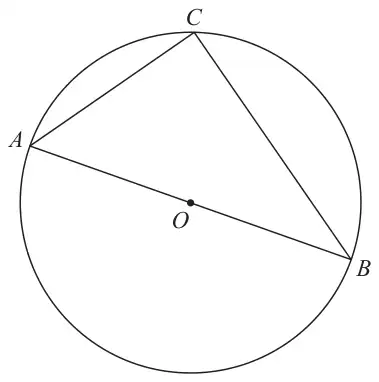
\(A\), \(B\) and \(C\) are points on the circumference of a circle, centre \(O\). \(AOB\) is a diameter of the circle.
Prove that angle \(ACB\) is \(90^\circ\) You must not use any circle theorems in your proof. (4)
Mark scheme
Answer
Mark
Notes
Proof
C1
draws \(OC\) and considers angles in an isosceles triangle (algebraic notation may be used, eg two angles labelled \(x\))
C1
finds sum of angles in triangle \(ABC\), eg \(x + x + y + y = 180\), or sum of angles at \(O\), eg \(180 - 2x + 180 - 2y\)
C1
complete method leading to \(ACB = 90\)
C1
complete proof with all reasons given, eg base angles of an isoscelestriangle are equal, angles in a triangle add up to \(180^\circ\), angles on a straight line add up to \(180^\circ\)
15 \(A\), \(B\), \(C\) and \(D\) are four points on the circumference of a circle.
\(AEC\) and \(BED\) are straight lines.
Prove that triangle \(ABE\) and triangle \(DCE\) are similar. You must give reasons for each stage of your working. (3)
Mark scheme
Answer
Mark
Notes
Proof
C1
for identifying one pair of equal angles with a correct reason, e.g. (angle) \(BAE\) = (angle) \(CDE\); angles in the same segment are equal or angles at the circumference subtended on the same arc are equal or for identifying two pairs of equal angles with no correct reasons given (angles must be within the appropriate triangles)
C1
for identifying a second pair of equal angles with a correct reason, e.g. (angle) \(AEB\) = (angle) \(DEC\); opposite angles or vertically opposite angles are equal or for identifying the three pairs of equal angles with no correct reasons given
C1
for stating the three pairs of equal angles of the two triangles e.g. \(ABE = DCE\), \(BEA = CED\), \(EAB = EDC\) with fully correct reasons
\(B\), \(C\) and \(D\) are points on the circumference of a circle, centre \(O\). \(ABO\) is a straight line. \(AD\) is the tangent at \(D\) to the circle. Angle \(DAO = 40^\circ\)
Work out the size of angle \(BCD\). Give a reason for each stage of your working. (5)
Mark scheme
Answer
Mark
Notes
\(155^\circ\)
5
M1 for a method to find angle \(AOD\) e.g \(90 - 40\) (= 50) M1 for a complete method to find angle \(BCD\) eg \(360 - \text{\textquoteleft}50\text{\textquoteright}\) (= 310) and \(\text{\textquoteleft}310\text{\textquoteright} \div 2\) (= 155) A1 for 155 C2 for complete reasons for their method Angle between tangent and radius = 90 Angle at the centre is twice the angle at the circumference oe Angle sum of a triangle = 180 Sum of angles round a point = 360 (C1 for at least two reasons, one of which must be a circle theorem)
OR M1 for a method to find angle \(AOD\) eg \(90 - 40\) (= 50) M1 for a complete method to find angle \(BCD\) eg \(50 \div 2\) (= 25) and \(180 - \text{\textquoteleft}25\text{\textquoteright}\) (= 155) A1 for 155 C2 for complete reasons for their method Angle between tangent and radius = 90 Angle at the centre is twice the angle at the circumference oe Opposite angles of a cyclic quadrilateral add up to 180 Angle sum of a triangle = 180 (C1 for at least two reasons, one of which must be a circle theorem)
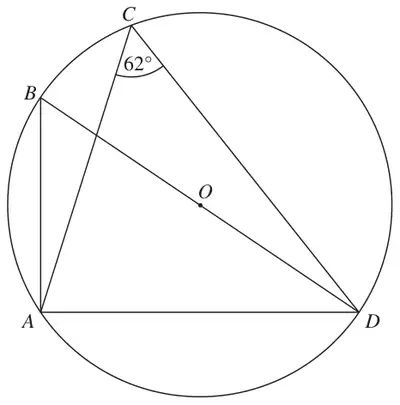
\(A\), \(B\), \(C\) and \(D\) are points on the circumference of a circle, centre \(O\). \(BOD\) is a straight line. Angle \(ACD = 62^\circ\)
Find the size of angle \(ADB\). Give a reason for each stage in your working. (4)
Mark scheme
Answer
Mark
Notes
\(28^\circ\)
4
M1 for angle \(ABD = 62^\circ\) M1 for angle \(BAD = 90^\circ\) C2 for angle \(ADB = 28^\circ\) with full, appropriate reasons given angles in the same segment are equal; angles in a semicircle are 90°; angles in a triangle add up to 180° (C1 (dep on relevant M1) for one correct and appropriate reason relating to a circle theorem)
OR
M1 for angle \(AOD = 62^\circ \times 2\) (= 124°) M1 for \((180^\circ - 124^\circ) \div 2\) C2 for angle \(ADB = 28^\circ\) with full, appropriate reasons given the angle at the centre of a circle is twice the angle at the circumference; base angles of an isosceles triangle are equal; angles in a triangle add up to 180° (C1 (dep on relevant M1) for one correct and appropriate reason relating to a circle theorem)
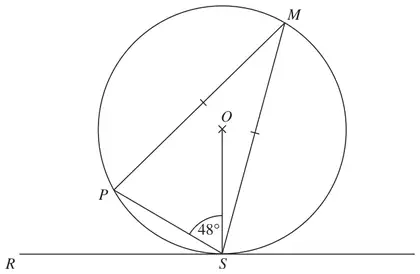
\(P\), \(M\) and \(S\) are points on a circle, centre \(O\). \(RST\) is a tangent to the circle.
Angle \(PSO = 48^\circ\) \(MP = MS\)
Work out the size of angle \(MST\). Give reasons for each stage of your working. (5)
Mark scheme
Answer
Mark
Notes
\(69^\circ\) (supported)
5
M1 for method to find angle \(PSR\) eg \(90 - 48\) (= 42) or method in triangle \(POS\) to find angle \(POS\) (= 84) M1 for method to find angle \(PMS\) (= 42) A1 cao C2 (dep on at least M1) for correct and complete set of appropriate reasons (C1 for one correct reason involving a circle theorem supported by working) eg The tangent to a circle is perpendicular (90) to the radius (diameter) Alternate segment theorem. Angles in a triangle add up to 180 Base angles of an isosceles triangle are equal. The angle at the centre of a circle is twice the angle at the circumference.
\(A\), \(B\), \(D\) and \(E\) are points on a circle. \(ABC\) and \(EDC\) are straight lines.
Prove that triangle \(BCD\) is similar to triangle \(ECA\). You must give reasons for your working. (5)
Mark scheme
Answer
Mark
Notes
Similarity and proof
5
B1 for method matching a pair of opposite angles, e.g. if \(EAB = x\), \(BDE = 180 - x\), \(EAB + BDE = 180\) B1 for linking angles between quad and triangle, e.g. if \(BDE = 180 - x\) then \(BDC = x\) B1 for stating or implying \(ACE = BCD\) (same angle) C1 for Opposite angles of a cyclic quadrilateral add up to \(180^\circ\) or statement linking three angles for similarity C1 for complete proof
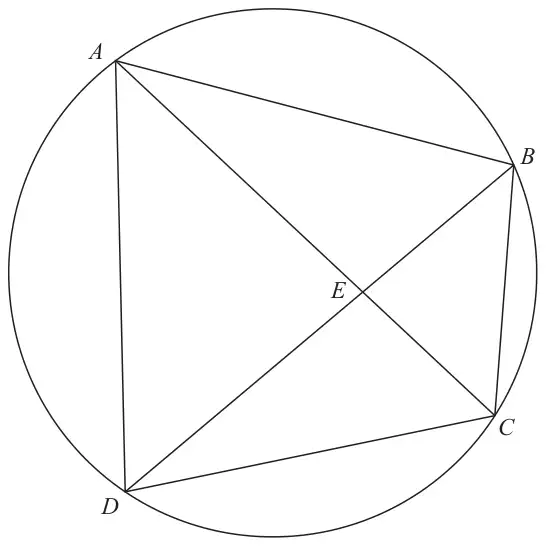
\(A\), \(B\), \(C\) and \(D\) are points on the circumference of a circle, centre \(O\). \(AC\) is a diameter of the circle. \(AC\) and \(BD\) intersect at \(E\).
\(AOC\) and \(BOD\) are diameters of a circle, centre \(O\).
Prove that triangle \(ABD\) and triangle \(DCA\) are congruent. (3)
Mark scheme
Answer
Mark
Notes
Proof
3
M1 for one pair of equal angles or sides with reason M1 for second pair of equal angles or sides with reason C1 for proof completed correctly with full reasons and reason for congruence
Acceptable reasons: \(AD\) common (oe eg both same) Angle \(BAD\) = angle \(CDA\) (angles in a semicircle are 90°) Angle \(ABO\) = angle \(DCA\) (angles in the same segment are equal) Triangle \(ABD\) and triangle \(DCA\) are congruent - ASA
OR
\(BD = CA\) (diameters of the circle) Angle \(BAD\) = angle \(CDA\) (angles in a semicircle are 90°.) \(AD\) common Triangle \(ABD\) and triangle \(DCA\) are congruent - RHS
OR
\(BD = CA\) (diameters of the circle) \(AD\) is common Angle \(ADB\) = angle \(CAD\) (base angles of an isosceles triangle are equal.) Triangle \(ABD\) and triangle \(DCA\) are congruent - SAS
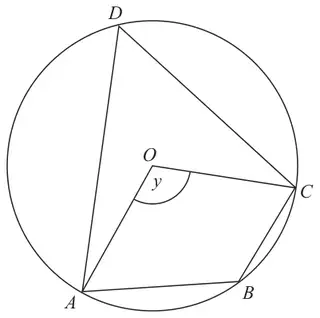
\(A\), \(B\), \(C\) and \(D\) are points on the circumference of a circle, centre \(O\).
Angle \(AOC = y\).
Find the size of angle \(ABC\) in terms of \(y\). Give a reason for each stage of your working. (4)
Mark scheme
Working
Answer
Mark
Notes
\(360 - y\)
\(180 - \dfrac{y}{2}\)
4
M1 \(ADC = \dfrac{y}{2}\) A1 \(180 - \dfrac{y}{2}\) C2 (dep on M1) for both reasons Angle at centre is twice the angle at the circumference Opposite angles in cyclic quadrilateral add to 180˚ (C1 (dep on M1) for one appropriate circle theorem reason)
OR
M1 reflex \(AOC = 360 - y\) A1 \(\dfrac{360 - y}{2}\) oe C2 (dep on M1) for both reasons Angles around a point add up to 360˚ Angle at centre is twice the angle at the circumference (C1 (dep on M1) for one appropriate circle theorem reason)
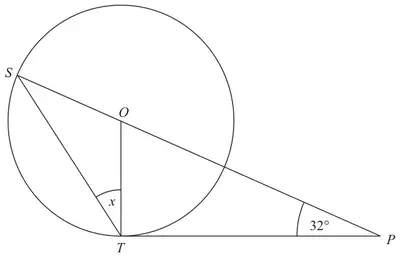
\(S\) and \(T\) are points on the circumference of a circle, centre \(O\). \(PT\) is a tangent to the circle. \(SOP\) is a straight line.
Angle \(OPT = 32^\circ\)
Work out the size of the angle marked \(x\). Give reasons for your answer. (5)
Mark scheme
Working
Answer
Mark
Notes
Angle \(POT = 180 - 90 - 32 = 58\) (angle between radius and tangent = 90° and sum of angles in a triangle = 180°) Angle \(OST\) = angle \(OTS = 58 \div 2\) (ext angle of a triangle equal to sum of int opp angles and base angles of an isos triangle are equal) or (angle at centre = 2x angle at circumference) OR Angle \(SOT = 90 + 32 = 122\) (ext angle of a triangle equal to sum of int opp angles) \((180 - 122) \div 2\) (base angles of an isos triangle are equal)
29
5
B1 for angle \(OTP = 90^\circ\), quoted or shown on the diagram M1 for a method that leads to \(180 - (90 + 32)\) or 58 shown at \(TOP\) M1 for completing the method leading to “58”÷2 or 29 shown at \(TSP\) A1 cao C1 for “angle between radius and tangent = 90°” and one other correct reason given from theory used NB: C0 if inappropriate rules listed
OR
B1 for angle \(OTP = 90^\circ\), quoted or shown on the diagram M1 for a method that leads to 122 shown at \(SOT\) M1 for \((180 - \text{``}122\text{''}) \div 2\) or 29 shown at \(TSP\) A1 cao C1 for “angle between radius and tangent = 90°” and one other correct reason given from theory used NB: C0 if inappropriate rules listed
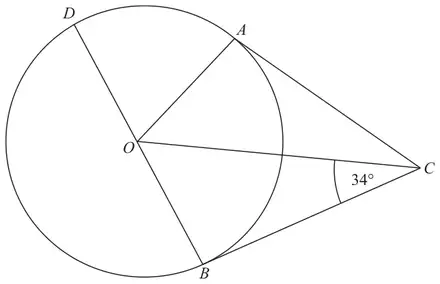
\(A\), \(B\) and \(D\) are points on the circumference of a circle, centre \(O\). \(BOD\) is a diameter of the circle. \(BC\) and \(AC\) are tangents to the circle. Angle \(OCB = 34^\circ\).
Work out the size of angle \(DOA\). (3)
Mark scheme
Answer
Mark
Notes
68
3
M1 for angle \(OBC = 90^\circ\) or angle \(OAC = 90^\circ\) (may be marked on the diagram or used in subsequent working) M1 for correct method to find angle \(BOC\) or \(AOC\) or \(AOB\) e.g. angle \(BOC = 180 - 90 - 34\) (\(= 56\)) or angle \(AOC = 180 - 90 - 34\) (\(= 56\)) or angle \(AOB = 180 - 2 \times 34\) (\(= 112\)) A1 cao NB (68 must be clearly stated as an answer and not just seen on diagram)
\(B\), \(C\) and \(D\) are points on the circumference of a circle, centre \(O\). \(AB\) and \(AD\) are tangents to the circle.
Angle \(DAB = 50^\circ\)
Work out the size of angle \(BCD\). Give a reason for each stage in your working. (4)
Mark scheme
Working
Answer
Mark
Notes
\(ABO = ADO = 90^\circ\) (Angle between tangent and radius is 90°) \(DOB = 360 - 90 - 90 - 50\) (Angles in a quadrilateral add up to 360°) \(BCD = 130 \div 2\) (Angle at centre is twice angle at circumference) OR \(ABD = (180 - 50) \div 2\) (Base angles of an isosceles triangle) \(BCD = 65\) (Alternate segment theorem)
65°
4
B1 for \(ABO = 90\) or \(ADO = 90\) (may be on diagram) B1 for \(BCD = 65\) (may be on diagram) C2 for \(BCD = 65^\circ\) stated or \(DCB = 65^\circ\) stated or angle \(C = 65^\circ\) stated with all reasons: angle between tangent and radius is 90°; angles in a quadrilateral sum to 360°; angle at centre is twice angle at circumference (accept angle at circumference is half (or \(\frac{1}{2}\)) the angle at the centre) (C1 for one correct and appropriate circle theorem reason) QWC: Working clearly laid out and reasons given using correct language OR B1 for \(ABD = 65\) or \(ADB = 65\) (may be on diagram) B1 for \(BCD = 65\) (may be on diagram) C2 for \(BCD = 65^\circ\) stated or \(DCB = 65^\circ\) stated or angle \(C = 65^\circ\) stated with all reasons: base angles of an isosceles triangle are equal; angles in a triangle sum to 180°; tangents from an external point are equal; alternate segment theorem (C1 for one correct and appropriate circle theorem reason) QWC: Working clearly laid out and reasons given using correct language
15 \(A\), \(C\) and \(D\) are points on a circle, diameter \(AC\).
\(ABC\) is an isosceles triangle with \(AC = BC\)
\(BCD\) is a straight line.
Not drawn accurately
Work out the size of angle \(x\). [4 marks]
Mark scheme
Answer
Mark
Comments
Alternative method 1: from triangle ADC
\(CAB = 20\)
M1
\(ACB = 180 - 20 - 20\) or \(ACB = 140\) or \(ACD = 40\)
M1dep
oe
\(ADC = 90\) or \(ADB = 90\)
M1
50
A1
Alternative method 2: from triangle ADB
\(ADC = 90\) or \(ADB = 90\)
M1
\(DAB = 180 - 90 - 20\) or \(DAB = 70\)
M1dep
oe
\(CAB = 20\)
M1
50
A1
Additional guidance
Angles may be seen on the diagram throughout
For an incomplete method, for angles not marked in the correct position on the diagram the correct 3-letter codes must be given, but condone \(D\) for \(ADC\) or \(ADB\)
\(ADC = 90\) or \(ADB = 90\) may be designated by a square at the angle
\(d^2 + d^2 = 10^2\) or \(2d^2 = 100\) or \((2r)^2 + (2r)^2 = 10^2\) or \(8r^2 = 100\)
M1
oe must use same letter for \(PQ\) and \(QR\)
\((d =)\ \sqrt{\dfrac{100}{2}}\) or \((d =)\ 5\sqrt{2}\) or \((d =)\ 7.07(1…)\) or \((d =)\ 7.1\) or \((r^2 =)\ \dfrac{100}{8}\) or \((r =)\ \dfrac{5}{2}\sqrt{2}\)
M1dep
oe eg \((d =)\ \sqrt{50}\)
3.5(3…) or 3.54 or 3.55
A1
Alternative method 2
\(\sin 45 = \dfrac{d}{10}\) or \(\cos 45 = \dfrac{d}{10}\)
may be seen on diagram or angle \(OCB\) dep on 2nd M1
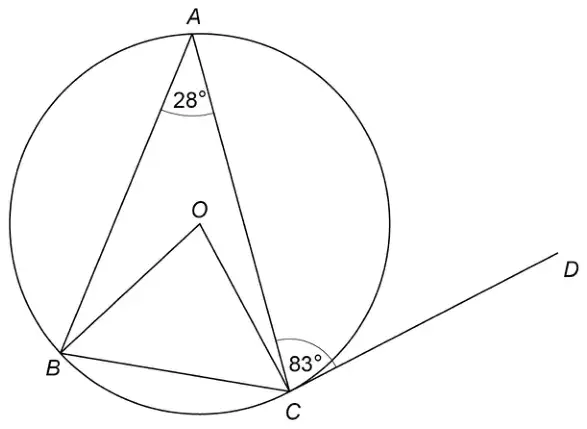
\(ABO\) = 180 − 28 − 62 − 62 − 7 or \(ABO\) = 21
M1dep
oe may be seen on diagram dep on M3
\(ABO\) = 21 and \(ACO\) = 7 and 21 : 7 = 3 : 1
A1
all angle values must be seen
Additional guidance
If angles are not correctly positioned on the diagram they must be correctly identified in the working, eg \(BOC\) = 56 is M0 if not correctly positioned on the diagram and not identified as acute
\(ACO\) = 7 and \(ABO\) : \(ACO\) = 21 : 7 with no other correct working
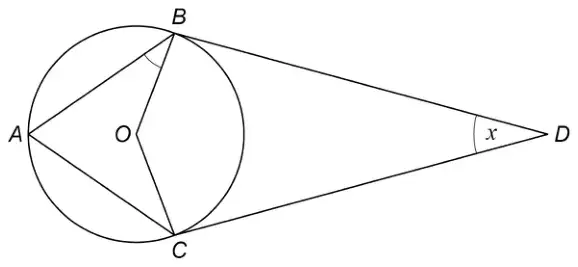
29 \(A\), \(B\) and \(C\) are three points on the circumference of a circle, centre \(O\).
\(BD\) and \(CD\) are tangents to the circle.
\(ABDC\) is a kite.
Angle \(BDC\) is \(x\)
Not drawn accurately
Prove that angle \(ABO\) is \(\quad 45^\circ - \dfrac{x}{4}\) [4 marks]
Mark scheme
Answer
Mark
Comments
Alternative method 1
\(OBD\) and \(OCD\) are right angles and \(BOC\) (obtuse) \(= 180 - x\)
M1
may be on diagram
\(BAC = 90 - \dfrac{x}{2}\)
M1dep
oe may be on diagram
\(BOC\) (reflex) \(= 180 + x\) and \(ABO + ACO = 360 - \left(90 - \dfrac{x}{2} + 180 + x\right)\) or \(90 - \dfrac{x}{2}\) and \(ABO = \dfrac{1}{2}\left(90 - \dfrac{x}{2}\right)\) \(= 45 - \dfrac{x}{4}\) with M2 scored
A1
oe \(360 - 90 + \dfrac{x}{2} - 180 - x\)
All reasons given tangent meets the radius at 90° angles in a quadrilateral add up to 360° angle at the circumference is half the angle at the centre angles around a point add to 360°
A1
Alternative method 2
\(OBD\) and \(OCD\) are right angles and \(BOC\) (obtuse) \(= 180 - x\)
M1
may be on diagram
\(BAC = 90 - \dfrac{x}{2}\)
M1dep
oe may be on diagram
\(BOC\) (reflex) \(= 180 + x\) and \(BAD = \dfrac{1}{2}\left(90 - \dfrac{x}{2}\right)\) or \(45 - \dfrac{x}{4}\) and \(ABO = 180 - \left(45 - \dfrac{x}{4}\right) - \left(90 + \dfrac{x}{2}\right)\) \(= 45 - \dfrac{x}{4}\) with M2 scored
A1
All reasons given tangent meets the radius at 90° angles in a quadrilateral add up to 360° angle at the circumference is half the angle at the centre angles in a triangle add up to 180°
A1
Alternative method 3
\(OBD\) and \(OCD\) are right angles and \(BOC\) (obtuse) \(= 180 - x\)
All reasons given tangent meets the radius at 90° angles in a quadrilateral add up to 360° angle at the circumference is half the angle at the centre angles in a triangle add up to 180° (base angles in an) isosceles triangle (are equal)
A1
Alternative method 4
\(OBD\) is a right angle and \(BDO = \dfrac{x}{2}\)
M1
may be on diagram
\(BOD = 90 - \dfrac{x}{2}\)
M1dep
may be on diagram
\(OAB + ABO = 90 - \dfrac{x}{2}\) and \(ABO = 45 - \dfrac{x}{4}\) with M2 scored
A1
All reasons given tangent meets the radius at 90° the diagram is symmetrical oe angles in a triangle add up to 180° exterior angle of a triangle is equal to the sum of the opposite interior angles \(OA\) and \(OB\) are radii, so triangle \(ABO\) is isosceles (base angles in an) isosceles triangle (are equal)
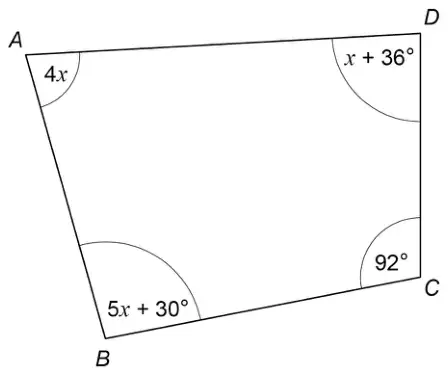
Prove that \(ABCD\) is not a cyclic quadrilateral. [4 marks]
Mark scheme
Answer
Mark
Comments
Alternative method 1: works out the value of \(x\) using two different methods and shows they are different
Any one of \(4x + 92 = 180\) or \(5x + 30 + x + 36 = 180\) or \(6x + 66 = 180\) or \(4x + x + 36 + 5x + 30 + 92 = 360\) or \(10x + 158 = 360\)
M1
oe
\((x =)\) 22 with M1 seen or \((x =)\) 19 with M1 seen or \((x =)\) 20.2 with M1 seen
A1
must be correct value for corresponding equation
A different one of \(4x + 92 = 180\) or \(5x + 30 + x + 36 = 180\) or \(6x + 66 = 180\) or \(4x + x + 36 + 5x + 30 + 92 = 360\) or \(10x + 158 = 360\)
M1
oe
Any two of \((x =)\) 22 with M1 seen or \((x =)\) 19 with M1 seen or \((x =)\) 20.2 with M1 seen and should be equal
A1
must be correct values for corresponding equations
oe statement
Alternative method 2: uses angle sum of quadrilateral to work out \(x\) and then shows opposite angles do not sum to 180°
\(4x + x + 36 + 5x + 30 + 92 = 360\) or \(10x + 158 = 360\)
M1
oe
\((x =)\) 20.2 with M1 seen
A1
\(4 \times\) their \(20.2 + 92\) or \(5 \times\) their \(20.2 + 30 +\) their \(20.2 + 36\)
M1dep
oe
\(4 \times 20.2 + 92 = 172.8\) and should be 180 or \(5 \times 20.2 + 30 + 20.2 + 36 = 187.2\) and should be 180
A1
oe oe statement
oe oe statement
Alternative method 3: uses angle sum of \(4x\) and 92° to work out \(x\) and then shows other angles do not sum to 180° or all angles do not sum to 360°
\(4x + 92 = 180\)
M1
oe
\((x =)\) 22 with M1 seen
A1
\(5 \times\) their \(22 + 30 +\) their \(22 + 36\) or \(4 \times\) their \(22 + 92 + 5 \times\) their \(22 + 30 +\) their \(22 + 36\)
M1dep
oe
\(5 \times 22 + 30 + 22 + 36 = 198\) and should be 180 or \(4 \times 22 + 92 + 5 \times 22 + 30 + 22 + 36 = 378\) and should be 360
A1
oe oe statement
oe oe statement
Alternative method 4: uses angle sum of \(5x + 30\) and \(x + 36\)° to work out \(x\) and then shows other angles do not sum to 180° or all angles do not sum to 360°
\(5x + 30 + x + 36 = 180\) or \(6x + 66 = 180\)
M1
oe
\((x =)\) 19 with M1 seen
A1
\(4 \times\) their \(19 + 92\) or \(5 \times\) their \(19 + 30 +\) their \(19 + 36 + 4 \times\) their \(19 + 92\)
M1dep
oe
\(4 \times 19 + 92 = 168\) and should be 180 or \(5 \times 19 + 30 + 19 + 36 + 4 \times 19 + 92 = 348\) and should be 360
A1
oe oe statement
oe oe statement
Additional guidance
Alts 1 and 2 \(x = 20.2\) with M1 not seen
Zero
Alts 1 and 3 \(x = 22\) with M1 not seen
Zero
Alts 1 and 4 \(x = 19\) with M1 not seen
Zero
Allow \(20\dfrac{1}{5}\) or \(\dfrac{101}{5}\) for 20.2, but do not allow other improper fractions for 20.2, 22 or 19 unless recovered
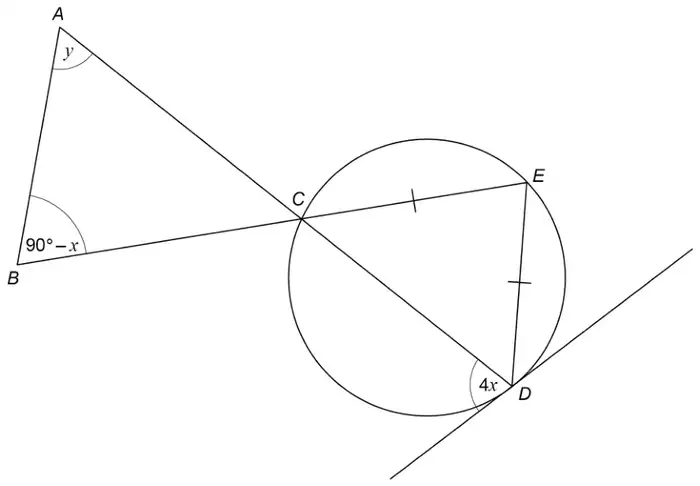
CED \(= 4x\) and DCE \(= \dfrac{180 - 4x}{2}\) or ACB = \(180 - y - (90 - x)\) and DCE = \(180 - y - (90 - x)\)
M1dep
may be on diagram
allow DCE = ACB for DCE = \(180 - y - (90 - x)\)
M2 seen and \(y + 90 - x + \dfrac{180 - 4x}{2} = 180\) and \(y = 3x\) or M2 seen and \(\dfrac{180 - 4x}{2} = 180 - y - (90 - x)\) and \(y = 3x\)
A1
M2 seen and \(2(180 - y - (90 - x)) + 4x = 180\) and \(y = 3x\)
M2A1 seen and all reasons given
A1
eg alt(ernate) seg(ment theorem) and (base angles of) isos(celes) triangle (are equal) and (vertically) opp(osite) angles (are equal) and angles in a triangle (sum to 180°)
Additional guidance
Allow CE = DE for the reason (base angles of) isos(celes) triangle (are equal)
Allow \(90 - y + x\) or \(180 - y - 90 + x\) for \(180 - y - (90 - x)\)
Allow \(90 - 2x\) for \(\dfrac{180 - 4x}{2}\)
Allow clear indication of angles eg allow E for CED do not allow C for ACB unless seen on diagram
Assuming \(y = 3x\)
Zero
For 1st A1, allow equivalent equations eg For \(2(180 - y - (90 - x)) + 4x = 180\) allow \(2(180 - y - (90 - x)) = 180 - 4x\)
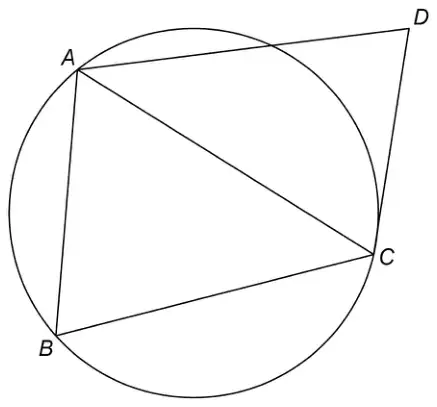
(a) Assume that triangle \(ABC\) is isosceles with \(\quad AC = BC\)
Prove that \(AB\) is parallel to \(DC\). [4 marks]
(b) In fact, triangle \(ABC\) is equilateral.
Tick the two boxes for the statements that must be correct. [1 mark]
\(AB\) is parallel to \(DC\)
\(AC\) bisects angle \(BCD\)
\(AC\) bisects angle \(BAD\)
Mark scheme (a)
Answer
Mark
Comments
Alternative method 1: shows that \(BAC = ACD\) and alternate angles
\(ACD = ABC\)
M1
accept both with same letter on diagram
\(ABC = BAC\)
M1
accept both with same letter on diagram
\(BAC = ACD\) and alternate segment (theorem) with M2 awarded
M1dep
dep on M2
Other two correct reasons given with M3 awarded
A1
eg (base angles of) isosceles triangle and alternate angles
Alternative method 2: shows that \(ABC + BCD = 180\) and co-interior angles
\(ACD = ABC\)
M1
accept both with same letter on diagram
\(ABC = BAC\)
M1
accept both with same letter on diagram
\(BCD = 180 - (BAC + ABC) + ACD\) and \(ABC + BCD = 180\) and alternate segment (theorem) with M2 awarded
M1dep
oe dep on M2
Other two correct reasons given with M3 awarded
A1
eg (base angles of) isosceles triangle and (co-)interior angles or allied angles
Alternative method 3: line from midpoint of \(AB\) to \(C\) is perpendicular to \(AB\) and \(CD\)
Let \(M\) be the midpoint of \(AB\) and \(MC\) is perpendicular to \(AB\)
M1
any letter
\(MC\) is perpendicular to \(CD\)
M1
\(AB\) and \(CD\) are both perpendicular to \(MC\) with M2 awarded
M1dep
oe dep on M2
Three correct reasons given with M3 awarded
A1
eg (perpendicular bisector of) isosceles triangle and \(MC\) goes through the centre of the circle and tangent is perpendicular to radius
Additional guidance
Other correct methods can be found by extending one or more of the lines. For example, by extending \(BC\) it is possible to use corresponding angles as a proof instead of alternating angles. This should be reflected in the reasons required for the last mark
In the scheme, \(ACD\) (for example) means angle \(ACD\) and not triangle \(ACD\)
Accept equality of angles indicated by labelling with the same letter, but not by arcs
Accept (angle) \(B\) for angle \(ABC\) Do not accept (angle) \(A\) for angle \(BAC\) or (angle) \(C\) for angle \(ACB\) unless intention is clear from annotation of the diagram
For the third mark in alternative method 2, accept algebraic expressions for angles if clearly marked on the diagram
Do not award marks for an argument based only on assumed values of angles, but ignore 60° marked on diagram, which is for (b)
Ignore an angle marked at \(ADC\)
Ignore incorrect statements that do not affect the proof eg \(ACD\) is an isosceles triangle (but not used in proof)
Mark scheme (b)
Answer
Mark
Comments
✓ \(AB\) is parallel to \(DC\) ✓ \(AC\) bisects angle \(BCD\) ☐ \(AC\) bisects angle \(BAD\)
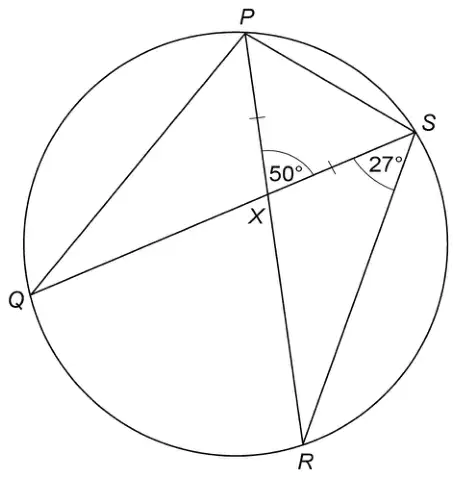
20 \(P\), \(Q\), \(R\) and \(S\) are points on a circle.
\(PXR\) and \(QXS\) are straight lines.
\(PX = SX\)
Not drawn accurately
Prove that \(QS\) is not a diameter of the circle. [4 marks]
Mark scheme
Answer
Mark
Comments
Alternative method 1
angle \(QPR = 27\)
M1
may be seen on diagram
angle \(XPS = \dfrac{180 - 50}{2}\) or 65
M1
may be seen on diagram
angle \(QPR = 27\) and angle \(XPS = 65\) and angle \(QPS = 92\) and angle in a semicircle is a right angle
A1
oe accept \(92 \ne 90\)
all reasons for angle facts: angles in same segment (are equal) and angle sum of triangle (is 180) and base angles of isosceles triangle (are equal)
A1
oe
Alternative method 2
angle \(SXR = 180 - 50\) or 130 and angle \(XRS = 180 -\) their \(130 - 27\) and angle \(PQS =\) their 23
M1
may be seen on diagram angle \(XRS = 23\)
angle \(XSP = \dfrac{180 - 50}{2}\) or 65
M1
may be seen on diagram
angle \(SXR = 130\) and angle \(XRS = 23\) and angle \(PQS = 23\) and \(XSP = 65\) and angle \(QPS = 92\) and angle in a semicircle is a right angle
A1
oe accept \(92 \ne 90\)
all reasons for angle facts: angles on a straight line (add up to 180) and angle sum of triangle (is 180) and angles in same segment (are equal) and base angles of isosceles triangle (are equal)
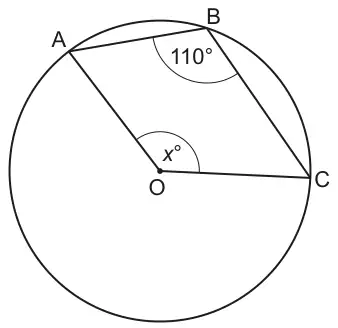
(a) Explain why OABC is not a cyclic quadrilateral. [1]
(b) Work out the value of \(x\). [2]
Mark scheme (a)
Answer
Marks
Part marks and guidance
O is not on the circumference oe
1
see appendix
Appendix: exemplar responses for Q13(a)
Response
Mark
O is not on the circumference
1
Not all the ends of the quadrilateral touch the sides of the circle
1(BOD)
Not all 4 points of the quadrilateral touch the circumference of the circle
1
Each point/angle/corners is not touching the circle
1
Point AOC does not touch the circumference
1
It should touch the circle 4 times
1
Not all corners touch the perimeter of the circle
1
It does not cover the whole of the diameter only the radius
0
Opposite angles are not supplementary
0
It does not touch the circle
0
All the points do not touch the arcs
0
All corners do not touch the edge
0
The point where A and C meet does not touch the perimeter (needs AO and CO and perimeter of the circle)
0
It meets at the centre of the circle
0
One point connects at the centre
0
Mark scheme (b)
Answer
Marks
Part marks and guidance
140
2
M1 for reflex angle AOC = 220 or for \(360 - 2 \times 110\)
May be on diagram
Award M1 for other valid method reaching the equivalent of a correct equation in \(x\) e.g. Point D added on major arc, ADC indicated as \(\frac{x}{2}\) and then \(110 + \frac{x}{2} = 180\) oe or marking angle ADC as 70
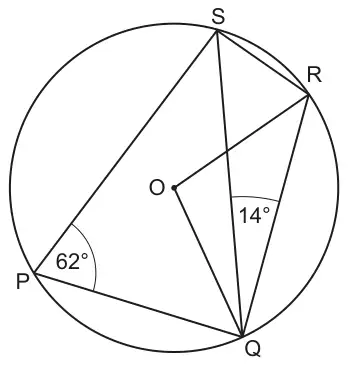
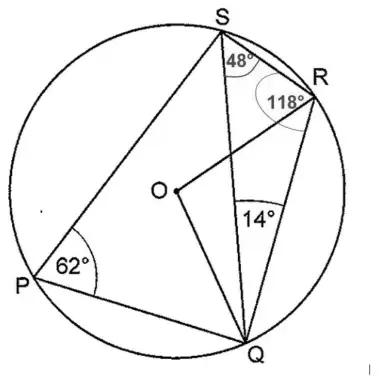
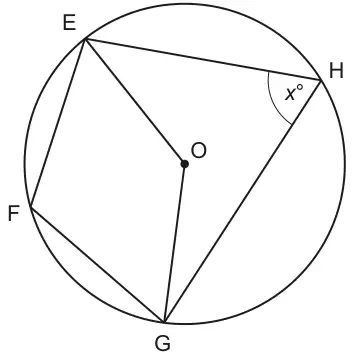
(a) P, Q, R and S are points on the circumference of a circle, centre O. Angle SQR = 14° and angle SPQ = 62°.
Not to scale
Find the size of angle ROQ. [3]
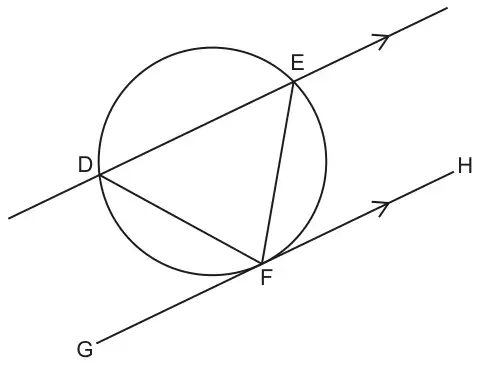
(b) D, E and F are points on the circumference of a circle.
Not to scale
Line GH is a tangent to the circle at F. Line DE is parallel to line GH.
Complete these statements to prove that triangle DEF is isosceles. Give reasons for your statements. You may not need all of the lines.
Angle ............... = Angle ............... because ............... Angle ............... = Angle ............... because ............... Angle ............... = Angle ............... because ............... Angle ............... = Angle ............... because ............... Angle ............... = Angle ............... because ............... Triangle DEF is isosceles because ............... [3]
Mark scheme (a)
Answer
Marks
Part marks and guidance
96
3
B1 for angle SRQ = 180 – 62 or SRQ = 118 B1 for angle RSQ = 48 B1 for angle ROQ = 2 × their 48 to maximum of B2
could be marked on the diagram, see appendix for alternative methods
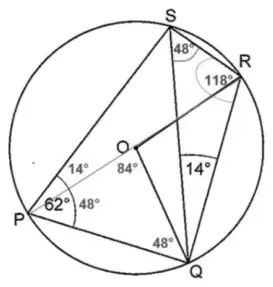
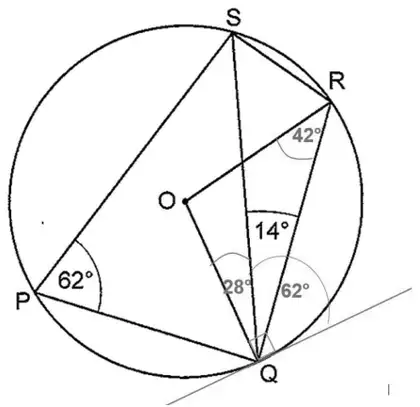
Appendix: working for Q12(a)
Hence angle ROQ = 96° from which ORQ=OQR=42°, SRO=76°, OQS=28°.
Alternative method 1 Some candidates are joining OP, however ROP are not co-linear but point P can be moved so that ROP is a straight line and maintaining angle SPQ as 62°. Mark this; B1 for angle SPO = 14° B1 for angle OPQ and angle OQP = 48° B1 for angle QOP = 84° or OQR and ORQ = 42° to maximum of B2
Alternative method 2 They can draw a tangent at Q. T is the end of the tangent. B1 for SQT = 62° (alternate segment theorem), B1 for (angle OQT = 90°) so angle OQS = 28°, B1 for making angle OQR = 42° = angle ORQ. to maximum of B2 Hence angle ROQ = 180° – 42° – 42° = 96°
Mark scheme (b)
Answer
Marks
Part marks and guidance
Method 1 using angle EFH :
angle DEF = angle EFH because alternate [angle]
B1
Method 2 using angle DFG :
angle EDF = angle DFG because alternate [angle]
If extra statements mark the best two
BOD ‘alternating’ but not ‘Z-angles’
angle EDF = angle EFH because alternate segment [thm.]
B1
angle DEF = angle DFG because alternate segment [theorem]
BOD ‘alt. seg.’
therefore angle DEF = angle EDF or “they have two angles equal” oe
B1dep
dep on B2 awarded
If 0 scored SC1 for two sets of angles linked with incorrect/missing reasons e.g. DEF = EFH and EDF = EFH or EDF = DFG and DEF = DFG
Note : Angles may be written the other way round e.g. EDF is the same as FDE and they can say angle DFG = angle EDF and in marking you must use either method 1 or method 2 not both
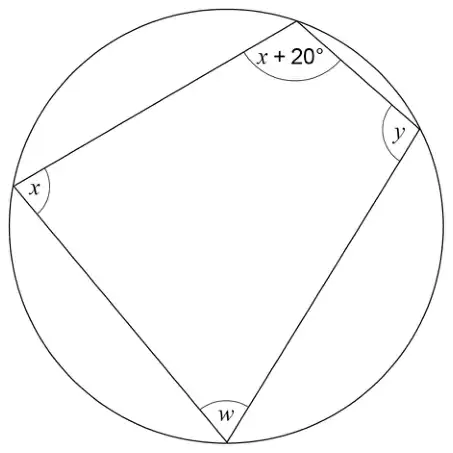
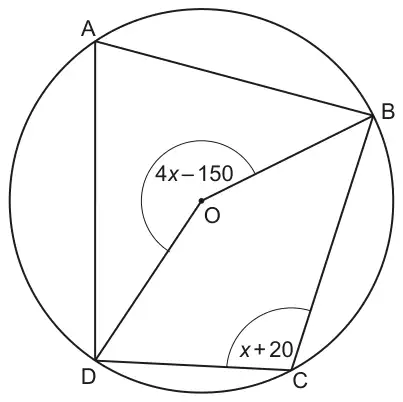
22 In this question all angles are given in degrees.
A, B, C and D are points on the circumference of a circle, centre O.
Not to scale
(a) Find the size of angle BCD. [4]
(b) Find the size of angle DAB. Give a reason for your answer. [2]
Mark scheme (a)
Answer
Marks
Part marks and guidance
115
4
M1 for \(4x - 150 = 2(x + 20)\) oe M1 for \(4x - 150 = 2x + 40\) FT their 4 term linear equation with brackets M1 for \(x = 95\) FT their 4 term linear equation
FT linear eqn with more than 4 terms but not fewer, must have at least two terms in \(x\)
Mark scheme (b)
Answer
Marks
Part marks and guidance
65 and Opposite angles of a cyclic quadrilateral are supplementary
2
FT 180 – their (a) B1 for 65 FT or for correct reason
Accept [Opp angles of] cyclic quad [add up to 180] [Angles in] opposite segments [are supplementary] Accept complete longer reasons Angles at a point add to 360 and angle at centre is twice angle at circumference oe
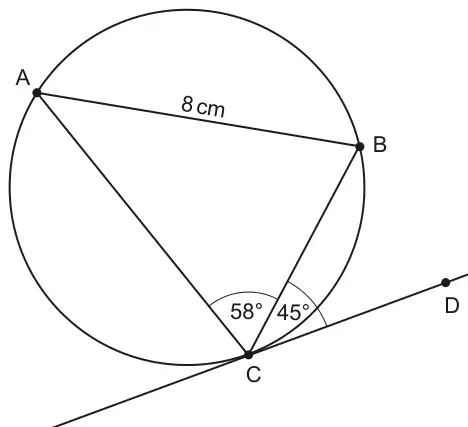
18 A, B and C are points on the circumference of a circle.
Not to scale
Points C and D lie on a tangent to the circle at C. Angle BCD = 45°. Angle ACB = 58°. AB = 8 cm.
Find the length of BC. [4]
Mark scheme
Answer
Marks
Part marks and guidance
6.67 or 6.670 to 6.671
4
B1 for [BAC =] 45 soi
Accept 6.7 with working
AND
M2 for [BC=] \(\dfrac{8 \times \sin(45 \text{ or } \textit{their}\ \text{BAC})}{\sin 58}\) or M1 for \(\dfrac{BC}{\sin(45 \text{ or } \textit{their}\ \text{BAC})} = \dfrac{8}{\sin 58}\) oe
May be seen on diagram or within M2/M1 expressions
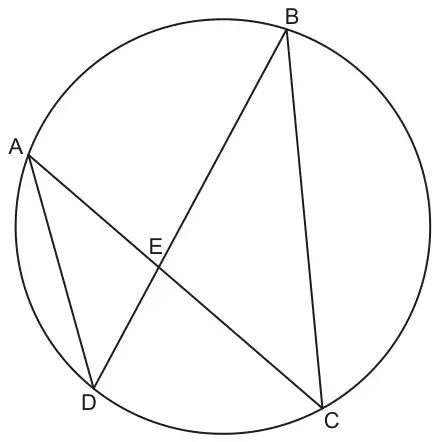
13 Points A, B, C and D lie on the circumference of a circle. Line AC intersects line BD at point E.
Not to scale
Prove that triangle AED is similar to triangle BEC. [3]
Mark scheme
Answer
Marks
Part marks and guidance
Angle AED = angle BEC and [vertically] opposite Angle DAE = angle EBC and same segment Angle ADE = angle ECB and same segment
M2
For M2 only two of the three statements and reasons are required M1 for one pair of angles with a reason
Allow any unambiguous labelling for angles e.g. DAE or DAC or A, but not E For reason accept e.g. opp ∠’s For same segment, accept same arc but not same chord Accept 3rd angle in triangle oe for reason with final angle if other two given correctly with correct reasons
[Triangle AED is similar to triangle BEC] [corresponding] angles are equal oe or AAA oe
OR
After two pairs of angles with reasons gives 3rd pair of equal angles with a reason
A1
With no errors or incorrect statements seen
If 0 scored, SC1 for at least two correct pairs of angles identified with no / incorrect reasons
Accept they have the ‘same/equal angles’ oe, AA and similar. Accept symbol ~ for similar
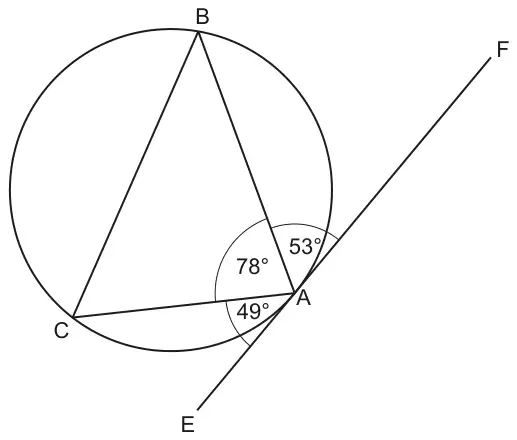
(a) Points A, B and C lie on the circumference of a circle. EAF is a tangent to the circle.
Not to scale
Write down the value of angle BCA giving a reason for your answer. [2]
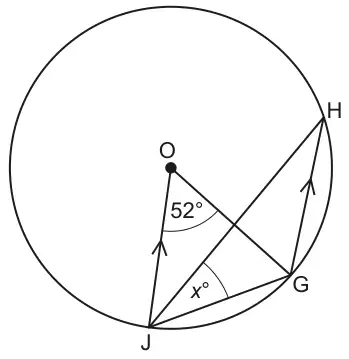
(b) Points G, H and J lie on the circumference of a circle, centre O.
Not to scale
Angle GOJ = 52° and angle GJH = \(x\)°. Lines JO and GH are parallel.
Find the value of \(x\). You must show your working. [5]
Mark scheme (a)
Answer
Marks
Part marks and guidance
53
alternate segment [theorem]
1
1
condone ‘rule’ for ‘theorem’
Mark scheme (b)
Answer
Marks
Part marks and guidance
38 with correct working
5
“correct working” requires at least B2 or B1B1
B1 for OGH = 52 B1 for JHG = 26 B2 for [OGJ =] 64 or M1 for 180 – 52 [÷2]
angles may be on diagram
Alt. 1: B1 for JHG = 26 B1 for OJH = 26 B2 for [OJG =] 64
If 0 or 1 scored award SC2 for answer 38 with no working or insufficient working Note: If answer is 38 and the working is incorrect only award the B marks.
Alt.2: B1 for tangent at G B1 for OGH = 52 M2 for 90 − 52
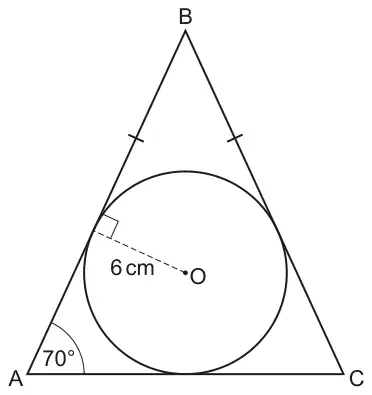
19 ABC is an isosceles triangle. The sides of the triangle ABC are all tangents to a circle of radius 6 cm, centre O.
Not to scale
Angle BAC = 70° and BA = BC.
(a) Show that length BO is 17.54 cm, correct to 2 decimal places. [4]
(b) Find the area of triangle ABC. You must show your working. [5]
Mark scheme (a)
Answer
Marks
Part marks and guidance
complete correct argument e.g.
accept any correct method not using 17.54
angle ABC = 40°
B1
could be on diagram and also accept ABO = 20°, BO’T’ = 70°
[BO = ] e.g. \(\dfrac{6}{\sin 20}\)
M2
M1 for e.g \(\sin 20 = \dfrac{6}{[BO]}\)
i.e BO as subject for M2 and condone sine rule with sin 90° for M2
17.542… or 17.543
A1dep
dep. on at least M1
Mark scheme (b)
Answer
Marks
Part marks and guidance
202 or 201.5 to 201.8 with correct working
5
Accept any correct method e.g. M1 for [height=] 17.54 + 6 or 23.54… M2 for [half base =] \(\dfrac{6}{\tan 35}\) or \(\dfrac{23.54}{\tan 70}\) or M1 for \(\tan 35 = \dfrac{6}{\textit{half base}}\) or \(\tan 70 = \dfrac{23.54}{\textit{half base}}\)
“Correct working” requires evidence of at least M2 or M1M1 Condone use of 8.6 leading to an answer of 202.4… M2 implied by e.g. 8.56 to 8.57 or 17.1 to 17.2
M1 for \(\frac{1}{2}\) × their base × their height oe If 0 scored SC2 for 202 or 201.6 to 201.8 with no working or SC1 for 8.56 to 8.57 or 17.1 to 17.2 with no working
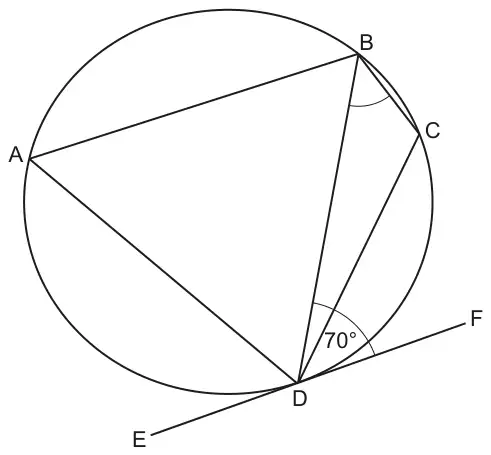
18 A, B, C and D are points on the circumference of a circle. EF is the tangent to the circle at D. Angle BDF = 70°.
Not to scale
The ratio angle BCD : angle CBD is 5 : 2.
Work out angle CBD. You must show your working. [5]
Mark scheme
Answer
Marks
Part marks and guidance
44 with correct working
5
For full marks “correct working” requires evidence of at least M1 AND M1 ie at least a correct angle and some ratio work Ignore geometric reasons if given
B3 for angle BCD = 110 with correct working or M1 for angle BAD = 70 or for angle BDE = 180 – 70 or 110 M1 for angle BCD = 180 – their angle BAD
For B3 “correct working” requires at least M1 or alternate convincing approach
Angles may be indicated on diagram for part marks
AND
M2 for their angle BCD ÷ 5 × 2 oe or M1 for their angle BCD ÷ 5 oe
If 0 scored SC2 for answer 44 or SC1 for angle BCD = 110
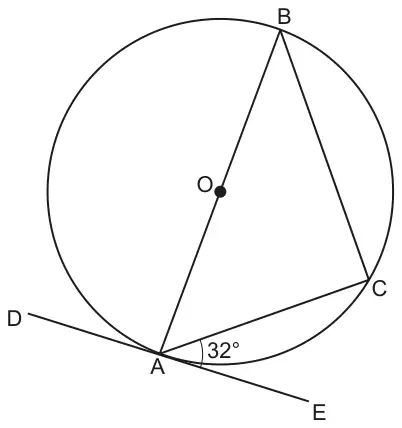
Points A, B and C lie on the circumference of the circle. Line AOB is a diameter. Line DAE is a tangent to the circle. Angle CAE = 32°.
Not to scale
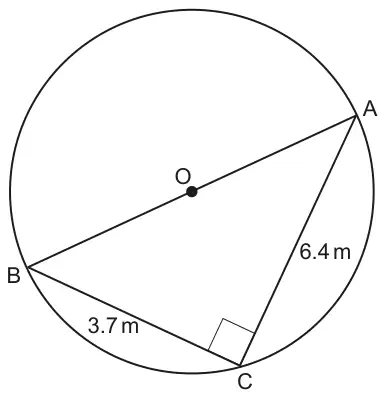
(a) Give a reason why angle ACB is a right angle. [1]
(b) The radius of the circle is 8 cm.
Calculate length BC. [4]
Mark scheme (a)
Answer
Marks
Part marks and guidance
[angle in a] semi-circle oe
1
Accept other reasoning if fully justified
Mark scheme (b)
Answer
Marks
Part marks and guidance
13.5 to 13.6
4
B1 for angle BAC = 58° or angle ABC = 32°
M2 for 16sin(their 58) or 16cos(their 32) or M1 for \(\sin(\textit{their}\ 58) = \frac{BC}{\textit{their}\ 16}\) or \(\cos(\textit{their}\ 32) = \frac{BC}{\textit{their}\ 16}\) or better
If 0 or B1 scored then instead award SC2 for 6.7 to 6.8 as final answer
Grads or rads: If 0, 1 or 2 scored then instead award SC3 for 15.8[8…] to 15.9 or 12.6[4…] as final answer or If 0 scored award SC1 for 7.9[4…] or 6.3[2…]
May be seen on diagram or implied by use of sin58 or cos32
Only award M marks if their angle and trig ratio are consistent ie do not accept 16sin32 unless angle BAC previously seen as 32.
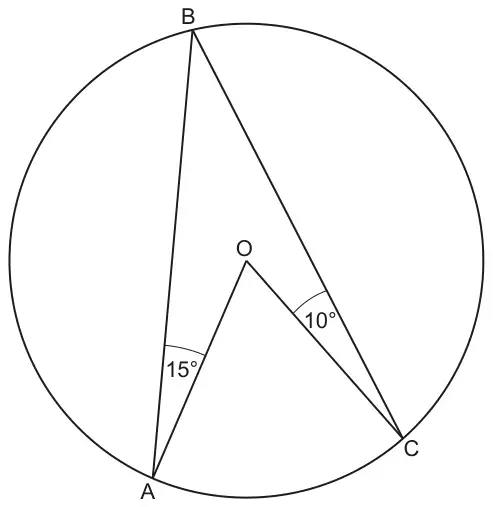
A, B and C are points on the circumference of a circle
O is the centre of the circle
angle OAB = 15°
angle BCO = 10°.
Not to scale
Calculate the acute angle AOC. [4]
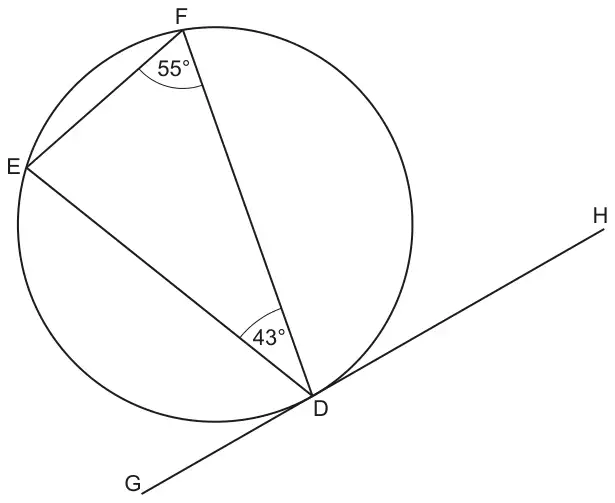
(b) In the diagram,
E, F and D are points on the circumference of the circle
G, D and H lie on a tangent to the circle
angle EFD = 55°
angle FDE = 43°.
Not to scale
Explain why angle HDF is 82°. [4]
Mark scheme (a)
Answer
Marks
Part marks and guidance
50 nfww
4
M3 for ABC = 25 or B = 25 or for AOB = 150 and COB = 160 or M2 for ABO = 15 and CBO = 10 or for AOB = 150 or for COB = 160 or M1 for ABO = 15 or CBO = 10
If 0 scored, SC1 for AOC = 2 × [their] ABC stated or applied or for 360 – their AOB – their COB applied
Alternative method to find AOC = \(x\) M3 for \(\frac{x}{2} + 2\left(\frac{180 - x}{2}\right) + 15 + 10 = 180\) oe OR M1 for OAC = OCA = \(\frac{180 - x}{2}\) and M1 for ABC = \(\frac{x}{2}\)
Alternative method to find AOC = \(x\) M3 for \(360 - x + 10 + 15 + \frac{x}{2} = 360\) OR M1 for [reflex] AOC = \(360 - x\) and M1 for ABC = \(\frac{x}{2}\)
Throughout, angles could be on diagram
SC0 for angle at centre = 2 × angle at circumference
Mark scheme (b)
Answer
Marks
Part marks and guidance
e.g. DEF = 180 – (43 + 55) = 82 angles in a triangle HDF = DEF = 82 alternate segment theorem
OR
GDE = 55 alternate segment theorem HDF = 180 – (43+55) = 82 angles on a straight line
4
M2 for [DEF =] 180 – (43 + 55) soi by DEF = 82 and angles in a triangle or M1 for [DEF =] 180 – (43 + 55) soi by DEF = 82
AND
M2 for HDF = DEF [= 82] and alternate segment theorem or M1 for HDF = DEF [= 82]
Alternative method M2 for GDE = 55 and alternate segment theorem or M1 for GDE = 55
AND
M2 for [HDF =] 180 – (43 + 55) [= 82] and angles on a straight line or M1 for [HDF =] 180 – (43 + 55) [= 82]
Allow full marks if 3 letter angle notation not used provided their angles are unambiguously defined (eg. labelled on the diagram and referred to in working using their labels)
Note: 180 – (43 + 55) with no other creditable working or reasoning scores M1
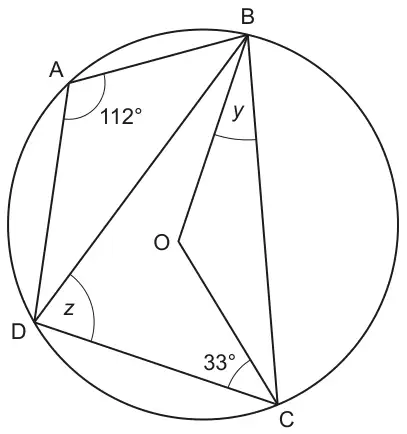
16 A, B, C and D are points on the circumference of a circle, centre O.
Angle BAD = 112° and angle DCO = 33°.
Not to scale
(a) Show that angle \(y = 35\)°. Give reasons for each stage of your working. [4]
(b) Work out angle \(z\). Give reasons for your answer.
Angle \(z\) = ......... ° because ...... [3]
Mark scheme (a)
Answer
Marks
Part marks and guidance
[Angle DCB =] 180 – 112
M1
Must show the subtraction
Must not be associated with wrong angle
[Opposite angles in a] cyclic quadrilateral [are supplementary] oe
M1
Do not accept any incorrect statement e.g. opposite angles in a cyclic quad are equal, angles of a cyclic quad = 180. Condone issues with spelling provided clear
[Angle BCO =] 68 – 33 = 35
M1
Must show the subtraction
Must not be associated with wrong angle If [angle BCO =] 180 – 112 – 33 is shown this implies first M1 and third M1
\(y = 35\) and [triangle BOC =] isosceles with no incorrect statement
M1
For M1 must mention isosceles with \(y = 35\) stated not just shown on the diagram
Mark scheme (b)
Answer
Marks
Part marks and guidance
55 Angles in triangle [BOC sum to 180] oe
B1 M1
Accept [triangle BOC = ] isosceles
Accept triangle and 180 without ‘angle’
Angle at circumference is half angle at centreoe
M1
Must use correct terminology, angle, circumference, half oe (or double oe), centre. Accept arc for circumference If more than 2 reasons given then treat each extra reason as choice
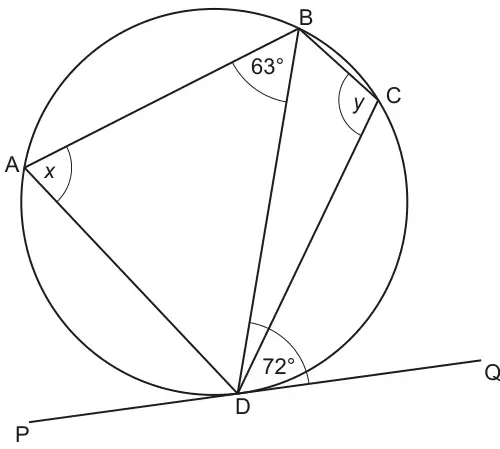
16 A, B, C and D are points on the circumference of a circle.
Not to scale
PQ is a tangent to the circle at D. Angle BDQ = 72° and angle ABD = 63°.
(a) Work out angle \(x\). Give a reason for your answer. [2]
(b) Work out angle \(y\). Give a reason for your answer. [2]
Mark scheme (a)
Answer
Marks
Part marks and guidance
72 and [angles in] alternate segment [are equal]
2
B1 for 72
For 2 marks. In reason, must mention alternate segment or opposite segment with no incorrect statement seen
Mark scheme (b)
Answer
Marks
Part marks and guidance
108 and [opposite angles of a] cyclic quadrilateral [are supplementary] oe
2FT
FT 180 – their 72 with correct reason accept alt reason angles on a [straight] line [add up to 180] and [angles in] alternate segment [are equal] oe
B1FT for 180 – their 72 or for a correct reason given
In reason, must mention cyclic quadrilateral with no incorrect statement If part (a) blank allow 2FT \(180 - x\) in (b) with a correct reason or B1FT for \(180 - x\)
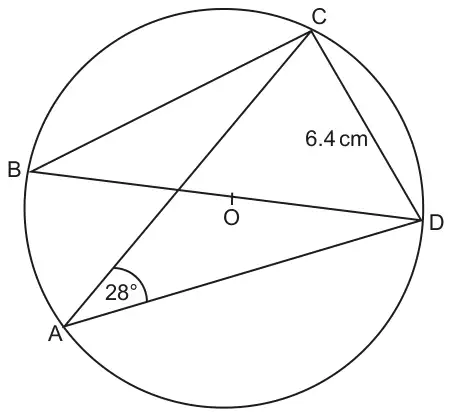
8 A, B, C and D are points on the circumference of a circle, centre O.
Not to scale
Angle CAD = 28° and CD = 6.4 cm. BD is a diameter of the circle.
Calculate the area of the circle. [5]
Mark scheme
Answer
Marks
Part marks and guidance
145.2 to 146.2
5
B1 for angle CBD = 28 soi or for angle BCD = 90 soi and M2 for \(\dfrac{6.4}{\sin 28}\) oe or 13.6[3…] nfww or M1 for \(\sin [28] = \dfrac{6.4}{[..]}\) oe and M1 for \(\pi \times (\textit{their}\text{ radius})^2\)
B1 implied by e.g. 28 or 62 correctly used in trigonometry or 28, 62 or 90 (or symbol) marked in the correct place in the diagram
13.6… can imply B1 however if it is marked on the wrong side, e.g. on AC, then it scores 0 marks
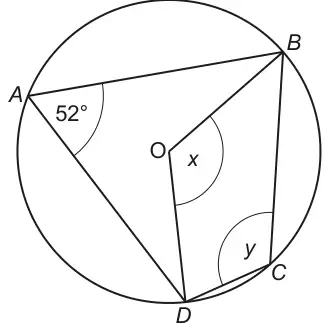
16 A, B, C and D are points on the circumference of a circle, centre O.
Not to scale
Angle BAD = 52°.
(a) Work out angle \(x\). Give a reason for your answer. [2]
(b) Work out angle \(y\). Give a reason for your answer. [2]
Mark scheme (a)
Answer
Marks
Part marks and guidance
104 Angle at centre is twice angle at circumference
2
B1 for 104
With no incorrect statement Must use underlined terms. Accept reverse: angle at circumference is half angle at centre Accept arc for circumference but not edge
Mark scheme (b)
Answer
Marks
Part marks and guidance
128 Opposite angles in a cyclic quadrilateral [are supplementary oe]
2
B1 for 128
With no incorrect statement Must use underlined terms Condone opp angles in cyclic quad = 180
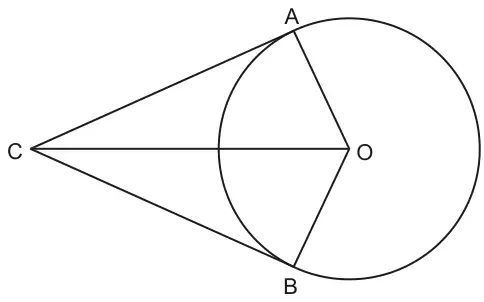
13 A and B are points on the circumference of a circle, centre O. CA and CB are tangents to the circle.
Not to scale
Prove that triangle OAC is congruent to triangle OBC. [4]
Mark scheme
Answer
Marks
Part marks and guidance
Three of these
OC is common or shared
OA = OB (equal) radii
\(\angle\)OAC = \(\angle\)OBC tangent perpendicular to radius
CA = CB tangents from a point [to a circle]
M3
M1 for each
After M0, B2 three pairs of these equal sides/angles with insufficient or no reasons or B1 for two pairs of these equal sides/angles identified with insufficient or no reasons
OR
After M1, B1 for two further pairs of these equal sides/angles identified with insufficient or no reasons