(a) Use your calculator to work out the value of \[\dfrac{42.1 - 29.53}{9.82 + 37.6}\]Give your answer as a decimal. Write down all the figures on your calculator display. (2)
(b) Write your answer to part (a) correct to 2 significant figures. (1)
Mark scheme (a)
Answer
Mark
Mark scheme
0.265(0780261)
M1
for 12.57 or 47.42 or 0.2 or 0.26 or 0.27 or 0.3 or \(\dfrac{1257}{4742}\) oe
A1
for 0.265(0780261)
Additional guidance
Answer must be given to at least 3 decimal places rounded or truncated Check first 3 decimal places only
Mark scheme (b)
Answer
Mark
Mark scheme
0.27
B1
for 0.27 or ft from part (a) provided answer to (a) has at least 3 sf
(b) Work out an estimate for the value of \(5.9 \times 98.1\) (2)
Mark scheme (a)
Answer
Mark
Mark scheme
24 000
B1
Mark scheme (b)
Answer
Mark
Mark scheme
600
M1
for 6 or 100 or 98 used in a calculation
A1
for 600 (from \(6 \times 100\)) or 588 (from \(6 \times 98\)) or 590 (from \(5.9 \times 100\)) or 588.6 (from \(6 \times 98.1\))
Additional guidance
578.2 from \(5.9 \times 98\) scores M1A0
M0A0 for working with unrounded figures with answer rounded to 600 ISW rounding of an estimated answer e.g. rounding 588 to 600
Subtraction of additional products after a rounded calculation may score the M mark for 6 or 100 or 98, but will not score the A mark unless one of the acceptable answers is reached.
22 A car travelled 4.96 miles at an average speed of 30.4 miles per hour.
(a) Work out an estimate for the time taken by the car. Give your answer in minutes. (3)
(b) Is your answer to part (a) an underestimate or an overestimate? Give a reason for your answer. (1)
Mark scheme (a)
Answer
Mark
Mark scheme
Estimated time
P1
for rounding of distance = 5 (miles) or speed = 30 (mph)
P1
(dep) for using time = distance/speed eg \(5 \div 30\)
or for a complete process, eg \(30 \div 60\ (= 0.5)\) and \(5 \div \text{``}0.5\text{''}\) or \(30 \div 5\ (= 6)\) and \(60 \div \text{``}6\text{''}\) or \(4.96 \times \dfrac{60}{30}\)
A1
for a correct answer following through their correct rounded distance and/or speed
Mark scheme (b)
Answer
Mark
Mark scheme
Overestimate with reason
C1
ft from (a) for decision with correct reasoning, eg overestimate as dividing a larger number by a smaller number or overestimate as miles rounded up and speed rounded down
Additional guidance
Ft the rounding and process from (a) Must relate to estimation and not rounding of their final answer and they must have a final answer to part (a)
5 A car travelled 4.96 miles at an average speed of 30.4 miles per hour.
(a) Work out an estimate for the time taken by the car. Give your answer in minutes. (3)
(b) Is your answer to part (a) an underestimate or an overestimate? Give a reason for your answer. (1)
Mark scheme (a)
Answer
Mark
Mark scheme
Estimated time
P1
for rounding of distance = 5 (miles) or speed = 30 (mph)
P1
(dep) for using time = distance/speed eg \(5 \div 30\)
or for a complete process, eg \(30 \div 60\ (= 0.5)\) and \(5 \div \text{``}0.5\text{''}\) or \(30 \div 5\ (= 6)\) and \(60 \div \text{``}6\text{''}\) or \(4.96 \times \dfrac{60}{30}\)
A1
for a correct answer following through their correct rounded distance and/or speed
Mark scheme (b)
Answer
Mark
Mark scheme
Overestimate with reason
C1
ft from (a) for decision with correct reasoning, eg overestimate as dividing a larger number by a smaller number or overestimate as miles rounded up and speed rounded down
Additional guidance
Ft the rounding and process from (a) Must relate to estimation and not rounding of their final answer and they must have a final answer to part (a)
24 Sophie drives a distance of 513 kilometres on a motorway in France.
She pays 0.81 euros for every 10 kilometres she drives.
(a) Work out an estimate for the total amount that Sophie pays. (3)
(b) Is your answer to part (a) an underestimate or an overestimate? Give a reason for your answer. (1)
Mark scheme (a)
Answer
Mark
Mark scheme
Estimated value
P1
for using a value rounded to 1sf in a calculation eg \(500 \div 10\) or \(500 \times 0.8\) or \(510 \times 0.8\) or \(513 \times 0.8\) or \(500 \times 0.81\)
P1
for a full process to find the total amount eg \(500 \div 10 \times 0.8\ (= 40)\) or \(510 \div 10 \times 0.8\ (= 40.8)\) or \(500 \div 10 \times 0.81\ (= 40.5)\) or [distance] \(\div\, 10 \times\) [amount] oe
A1
for a correct answer following through their correct rounded value(s)
Additional guidance
Their rounded value must be used in a calculation
Rounding may occur after a correct process, eg \(513 \div 10 = 51.3 \approx 50\) and \(50 \times 0.81\) \(513 \div 10 = 51.3 \approx 51\) and \(51 \times 0.8\) scores P1P1
Accept 0.81 rounded to 0.80 for this mark Condone 0.81 rounded to 1 for this mark.
Where [distance] is their rounded 513 or 513 and [amount] is their rounded 0.81 or 0.81 Accept \(513 \div 10 \times 0.81\) for this mark.
Do not award this mark if 0.81 is rounded to 1
Mark scheme (b)
Answer
Mark
Mark scheme
underestimate with reason
C1
ft from (a) eg underestimate as numbers rounded down
Additional guidance
Must relate to estimation and not rounding of their final answer and they must have a final answer to part (a)
9 A number \(N\) is rounded to 2 significant figures. The result is 7.3
(a) Write down the least possible value of \(N\). (1)
Leila says,
“The value of \(N\) cannot be greater than 7.349 because 7.350 would round up to 7.4”
(b) Is Leila correct? You must give a reason for your answer. (1)
Mark scheme (a)
Answer
Mark
Mark scheme
7.25
B1
oe
Mark scheme (b)
Answer
Mark
Mark scheme
No with supporting reason
C1
No with supporting reason Acceptable reasons: No, the 9 should be recurring No, 7.3491 is greater No, there are numbers between 7.349 and 7.350
Not acceptable reasons: Yes with any reason given Leila is correct … 7.350 would round down She has rounded to 3sf and should only round to 2sf 7.349 rounds to 7.4
5 Sophie drives a distance of 513 kilometres on a motorway in France. She pays 0.81 euros for every 10 kilometres she drives.
(a) Work out an estimate for the total amount that Sophie pays. (3)
(b) Is your answer to part (a) an underestimate or an overestimate? Give a reason for your answer. (1)
Mark scheme (a)
Answer
Mark
Mark scheme
Estimated value
P1
for using a value rounded to 1sf in a calculation eg \(500 \div 10\) or \(500 \times 0.8\) or \(510 \times 0.8\) or \(513 \times 0.8\) or \(500 \times 0.81\)
P1
for a full process to find the total amount eg \(500 \div 10 \times 0.8\) oe (= 40) or \(510 \div 10 \times 0.8\) oe (= 40.8) or \(500 \div 10 \times 0.81\ (= 40.5)\) or \([\text{distance}] \div 10 \times [\text{amount}]\) oe
A1
for a correct answer following through their correct rounded value(s)
Additional guidance
Their rounded value must be used in a calculation
Rounding may occur after a correct process, eg \(513 \div 10 = 51.3 \approx 50\) and \(50 \times 0.81\) \(513 \div 10 = 51.3 \approx 51\) and \(51 \times 0.8\) scores P1P1
Accept 0.81 rounded to 0.80 for this mark Condone 0.81 rounded to 1 for this mark
Where [distance] is their rounded 513 or 513 and [amount] is their rounded 0.81 or 0.81
Accept \(513 \div 10 \times 0.81\) for this mark
Do not award this mark if 0.81 is rounded to 1
Mark scheme (b)
Answer
Mark
Mark scheme
underestimate with reason
C1
ft from (a) eg underestimate as numbers rounded down
Additional guidance
Must relate to estimation and not rounding of their final answer and they must have a final answer to part (a)
11 A total of 700 tickets were on sale for a football match.
452 of the tickets were sold.
(a) How many tickets were not sold? (2)
For a different football match,
297 tickets were sold for £9.50 each. 399 tickets were sold for £19.50 each.
(b) Work out an estimate for the total amount of money paid for these tickets. You must show all your working. (3)
(c) Is your answer to part (b) an underestimate or an overestimate? Give a reason for your answer. (1)
Mark scheme (a)
Answer
Mark
Mark scheme
248
P1
for \(700 - 452\)
A1
cao
Mark scheme (b)
Answer
Mark
Mark scheme
11000
P1
for evidence of rounding values to 1 significant figure, eg 300 or 400 or 10 or 9 or 20
P1
(dep on P1) for beginning a process to work with ticket sales, eg. \(300 \times 10\ (= 3000)\) or \(290 \times 10\ (= 2900)\) or \(297 \times 10\ (= 2970)\) or \(300 \times 9\ (= 2700)\) or \(300 \times 9.5\ (= 2850)\) or \(290 \times 9\ (= 2610)\) or \(297 \times 9\ (= 2673)\) OR \(400 \times 20\ (= 8000)\) or \(390 \times 20\ (= 7800)\) or \(399 \times 20\ (= 7980)\) or \(400 \times 19.5\ (= 7800)\) or \(400 \times 19\ (= 7600)\)
A1
for using correct values giving an answer in the range 10 200 to 11 000 from calculations using their rounded values
Additional guidance
Note: not \(290 \times 9.5\ (= 2755)\) or \(297 \times 9.5\ (= 2821.5)\)
Note: not \(390 \times 19\ (= 7410)\) or \(390 \times 19.5\ (= 7605)\) or \(399 \times 19\ (= 7581)\) or \(399 \times 19.5\ (= 7780.5)\)
Award 0 marks for an answer in the range with no supportive working
Mark scheme (c)
Answer
Mark
Mark scheme
Overestimate with reason
C1
(dep on P2 in (b)) for overestimate and reason, eg (ft from (b)) true total amount of money paid will be less as all values were rounded up
Additional guidance
Must relate to estimation and not to rounding of their final answer and they must have a final answer to part (b)
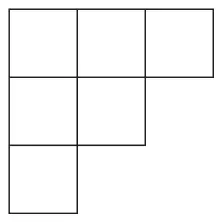
10 The diagram shows a shape made from 6 identical squares.
The total area of the shape is 5406 cm2
(a) Find an estimate for the length of one side of each square. Give your answer correct to the nearest whole number. (3)
(b) Is your answer to part (a) an underestimate or an overestimate? You must give a reason for your answer. (1)
Mark scheme (a)
Answer
Mark
Mark scheme
30
P1
for a start to the process, eg \(5406 \div 6\ (= 901)\) or \(5400 \div 6\ (= 900)\) or \(5000 \div 6\ (= 833.33..)\) or \(5410 \div 6\ (= 901.66..)\)
P1
for a process to find the length of one side, eg \(\sqrt{\text{``}901\text{''}}\) or \(\sqrt{\text{``}900\text{''}}\) or \(\sqrt{\text{``}833.33..\text{''}}\) or \(\sqrt{\text{``}901.66..\text{''}}\)
A1
for 30
Mark scheme (b)
Answer
Mark
Mark scheme
Explanation
C1
for a correct explanation based on their working in (a), eg underestimate because I rounded the total area down
Additional guidance
Must be based on the use of a rounded value in a calculation
(a) Use your calculator to work out \(\dfrac{29^2 - 4.6}{\sqrt{35 - 1.9^3}}\) Write down all the figures on your calculator display. (2)
(b) Write your answer to part (a) correct to 4 significant figures. (1)
Mark scheme (a)
Answer
Mark
Mark scheme
157.668(255)
M1
for 836.4 or 5.304(809139) or 28.141 or a truncated or rounded version of 157.668255 to no less than 3 sf
A1
for 157.668(255)
Additional guidance
Answer must be given to at least 3 decimal places rounded or truncated Accept a clear indication of the decimal point. Check first 3 decimal places only
Mark scheme (b)
Answer
Mark
Mark scheme
157.7
B1
ft from part (a) provided answer to (a) has at least 5 sf
(a) Has Rehan got enough money to buy the jacket? You must show how you get your answer. (3)
The trainers cost $60 The exchange rate is $1 = £0.749
Rehan says, “The trainers cost less than £40”
Rehan is wrong.
(b) Using a suitable approximation, show working to explain why. (2)
Mark scheme (a)
Answer
Mark
Mark scheme
No from correct figures
P1
for first step in process to solve the problem, eg find cost of 3 T-shirts, \(25 \times 3\ (= 75)\) or eg find remaining money after just one purchase, eg \(200 - 60\ (= 140)\) or \(200 - 25\ (= 175)\)
P1
for process to find total cost of trainers and T-shirts, eg \(60 + \text{``}75\text{''}\ (= 135)\) or find total cost including cost of jacket, eg. \(60 + \text{``}75\text{''} + 80\ (= 215)\) or find the change after buying all 4 items, eg. \(200 - 60 - 3 \times 25\ (= 65)\) oe
C1
for No from correct figures Acceptable examples No, needs 215 No, only has 65 left No, needs 15 more Not acceptable examples Yes ....
Additional guidance
Award this mark for addition of 2 or more items or for subtraction of one item or more from 200 eg \(200 - 50\ (= 150)\) etc.
Figures can be given without units ($)
Mark scheme (b)
Answer
Mark
Mark scheme
Explanation
P1
for a start to a method, eg. approximating 0.749 to 0.7, 0.74, 0.75 or 0.8
C1
for explanation Acceptable examples \(0.7 \times 60 = 42\) [is an underestimate] \(0.74 \times 60 = 44.4(0)\) [is an underestimate] Not acceptable examples \(0.75 \times 60 = 45\) [is an overestimate] \(0.8 \times 60 = 48\) [is an overestimate]
Additional guidance
For full marks, any calculations must be correct. No statement in words is needed.
11 The table shows the costs of sending a parcel by the Express service and by the Rapid service.
Type of service
Cost
Express
£15.25
Rapid
£35.38
Brendan has to send 12 parcels. It will be cheaper to send the parcels by the Express service than by the Rapid service.
(a) How much cheaper? (3)
Luke wants to send 21 parcels by the Express service.
He does the calculation 20 × £15 = £300 to estimate the cost.
(b) Explain why Luke’s calculation shows the actual cost will be more than £300 (1)
Mark scheme (a)
Answer
Mark
Mark scheme
241.56
P1
for difference for 1 parcel eg \(35.38 - 15.25\ (= 20.13)\) OR for total cost for 12 parcels by either service eg \(35.38 \times 12\ (= 424.56)\) or \(15.25 \times 12\ (= 183)\)
P1
for a complete process eg \(\text{``}20.13\text{''} \times 12\) or \(\text{``}424.56\text{''} - \text{``}183\text{''}\)
A1
cao
Mark scheme (b)
Answer
Mark
Mark scheme
Explanation
C1
for explanation Acceptable examples both figures rounded down (refers to both figures) 20 is less than 21 and 15 is less than 15.25 Not acceptable examples both figures rounded (up); rounded down either 20 is less than 21 or 15 is less than 15.25 (refers to just one figure) the cost is 320.25 (more than 300); multiplying with bigger numbers
24 A plane travels at a speed of 213 miles per hour.
(a) Work out an estimate for the number of seconds the plane takes to travel 1 mile. (3)
(b) Is your answer to part (a) an underestimate or an overestimate? Give a reason for your answer. (1)
Mark scheme (a)
Answer
Mark
Mark scheme
16 to 20
P1
for using \(\text{time} = \dfrac{\text{distance}}{\text{speed}}\), eg \(\dfrac{1}{200}\) or \(\dfrac{1}{213}\) or for 1 hour \(= 60 \times 60\ (= 3600)\) seconds
(dep on correct use of \(\text{time} = \dfrac{\text{distance}}{\text{speed}}\)) for reason related to their response to part(a), eg overestimate as speed rounded down
(a) Write 7357 correct to 3 significant figures. (1)
(b) Work out \(\dfrac{\sqrt{17 + 4^2}}{7.3^2}\) Write down all the figures on your calculator display. (2)
Mark scheme (a)
Answer
Mark
Mark scheme
7360
B1
cao
Mark scheme (b)
Answer
Mark
Mark scheme
0.1077981356
B2
for 0.1077(981…)
(B1
for 5.74(45626…) or 53.29 or 0.11 or 0.107 or 0.108 )
Additional guidance
Answer must be given to at least 4 decimal places rounded or truncated Accept a clear indication of the decimal point. Check first four decimal places only
5 A plane travels at a speed of 213 miles per hour.
(a) Work out an estimate for the number of seconds the plane takes to travel 1 mile. (3)
(b) Is your answer to part (a) an underestimate or an overestimate? Give a reason for your answer. (1)
Mark scheme (a)
Answer
Mark
Mark scheme
16 to 20
P1
for using \(\text{time} = \dfrac{\text{distance}}{\text{speed}}\), eg \(\dfrac{1}{200}\) or \(\dfrac{1}{213}\) or for 1 hour \(= 60 \times 60\ (= 3600)\) seconds
(dep on correct use of \(\text{time} = \dfrac{\text{distance}}{\text{speed}}\)) for reason related to their response to part(a), eg overestimate as speed rounded down
(a) Write 7357 correct to 3 significant figures. (1)
(b) Work out \(\dfrac{\sqrt{17 + 4^2}}{7.3^2}\) Write down all the figures on your calculator display. (2)
Mark scheme (a)
Answer
Mark
Mark scheme
7360
B1
cao
Mark scheme (b)
Answer
Mark
Mark scheme
0.1077981356
B2
for 0.1077(981…)
(B1
for 5.74(45626…) or 53.29 or 0.11 or 0.107 or 0.108 )
Additional guidance
Answer must be given to at least 4 decimal places rounded or truncated Accept a clear indication of the decimal point. Check first four decimal places only
22 A cycle race across America is 3069.25 miles in length.
Juan knows his average speed for his previous races is 15.12 miles per hour. For the next race across America he will cycle for 8 hours per day.
(a) Estimate how many days Juan will take to complete the race. (3)
Juan trains for the race. The average speed he can cycle at increases. It is now 16.27 miles per hour.
(b) How does this affect your answer to part (a)? (1)
Mark scheme (a)
Answer
Mark
Mark scheme
Estimated value
P1
for using a rounded value in a correct process eg \(3000 \div 15\) or \(15 \times 8\) or \(20 \times 8\)
P1
for a full process to find the number of days eg \(\text{``}3000\text{''} \div \text{``}15\text{''} \div \text{``}10\text{''}\ (= 20)\) or \(\text{``}3000\text{''} \div \text{``}15\text{''} \div 8\ (= 25)\)
A1
for a correct answer following through their rounded values
Additional guidance
Their rounded value must be used in a calculation
Rounding may appear after a correct process eg \(15.12 \times 8 = 120.96 \approx 100\) followed by eg \(3069.25 \div 100\)
Accept \(3069.25 \div 15.12 \div 8\) oe
Mark scheme (b)
Answer
Mark
Mark scheme
Explanation
C1
eg less days required or it doesn’t affect the answer because I would still round 16.27 down to 15 (or up to 20)
4 A cycle race across America is 3069.25 miles in length.
Juan knows his average speed for his previous races is 15.12 miles per hour. For the next race across America he will cycle for 8 hours per day.
(a) Estimate how many days Juan will take to complete the race. (3)
Juan trains for the race. The average speed he can cycle at increases. It is now 16.27 miles per hour.
(b) How does this affect your answer to part (a)? (1)
Mark scheme (a)
Answer
Mark
Mark scheme
Estimated value
P1
for using a rounded value in a correct process eg \(3000 \div 15\) or \(15 \times 8\) or \(20 \times 8\)
P1
for a full process to find the number of days eg \(\text{``}3000\text{''} \div \text{``}15\text{''} \div \text{``}10\text{''}\ (= 20)\) or \(\text{``}3000\text{''} \div \text{``}15\text{''} \div 8\ (= 25)\)
A1
for a correct answer following through their rounded values
Additional guidance
Their rounded value must be used in a calculation
Rounding may appear after a correct process eg \(15.12 \times 8 = 120.96 \approx 100\) followed by eg \(3069.25 \div 100\)
Accept \(3069.25 \div 15.12 \div 8\) oe
Mark scheme (b)
Answer
Mark
Mark scheme
Explanation
C1
eg less days required or it doesn’t affect the answer because I would still round 16.27 down to 15 (or up to 20)
20 Ami and Josh use a calculator to work out \(\dfrac{595}{4.08^2 + 5.3}\)
Ami’s answer is 27.1115 Josh’s answer is 271.115
One of these answers is correct.
Use approximations to find out which answer is correct. (3)
Mark scheme
Answer
Mark
Notes
Ami with estimate
M2
for an approximate calculation eg \(\dfrac{600}{16+5}\) or \(\dfrac{600}{21}\) or \(\dfrac{600}{20}\) or \(\dfrac{600}{20+5}\) or \(\dfrac{600}{25}\) or \(\dfrac{600}{25+5}\) or \(\dfrac{600}{30}\) or \(\dfrac{595}{20}\)
(M1
for using 600 or 5 or 4)
C1
Ami’s answer /27.1115 is closest with accurately calculated figure from approximation
Each T-shirt costs £5.80 Berenika does the calculation \(40 \times 6 = 240\) to estimate the cost of 35 T-shirts.
(a) Explain how Berenika’s calculation shows the actual cost will be less than £240 (1)
There is a special offer.
T-shirts £5.80 each.
Buy 30 or more T-shirts. Get 10% off the total cost.
(b) Work out the actual cost of buying 35 T-shirts using the special offer. (4)
Mark scheme (a)
Answer
Mark
Notes
Explanation
C1
eg States over-estimated for both values
Mark scheme (b)
Answer
Mark
Notes
182.7(0)
P1
for a process to find 10% of a value stated in the question eg \(\dfrac{10}{100} \times 5.80\ (= 0.58)\) or \(\dfrac{10}{100} \times 35\ (= 3.5)\) oe or \(35 \times 5.80\ (= 203)\), allow \(30 \times 5.80\ (= 174)\) or \(35 \times\) [reduced price]
P1
for a process to find 90% of a value stated in the question eg \(35 - \text{``}3.5\text{''}\ (= 31.5)\) or \(0.9 \times 5.80\ (= 5.22)\) oe or \(\dfrac{10}{100} \times \text{``}203\text{''}\ (= 20.3)\) or \(\dfrac{10}{100} \times \text{``}174\text{''}\ (= 17.4)\) oe
P1
for a complete process to find actual cost of 35 eg \(0.9 \times 5.80 \times 35\) oe
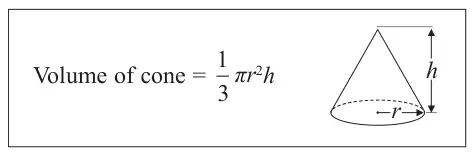
15 A cone has a volume of 98 cm3. The radius of the cone is 5.13 cm.
(a) Work out an estimate for the height of the cone. (3)
John uses a calculator to work out the height of the cone to 2 decimal places.
(b) Will your estimate be more than John’s answer or less than John’s answer? Give reasons for your answer. (1)
Mark scheme (a)
Answer
Mark
Notes
3.5 to 4.5
M1
substitution into formula \(\dfrac{1}{3}\pi r^2 h\) of chosen values for \(r\) and \(V\) (accept \(r = 5.13\) and \(V = 98\)) and starts rearrangement e.g. multiplies by 3, divides by \(\pi\) or divides by \(r^2\) (both sides)
M1
uses estimates in calculation e.g. \(\dfrac{3 \times 100}{3 \times 25}\) (or in rearranged formula) or \(\dfrac{12}{\pi}\)
A1
arrives at a single value from estimate in the range 3.5 to 4.5
Mark scheme (b)
Answer
Mark
Notes
more
C1
ft e.g. more since number in numerator goes up; numbers in denominator go down.
In a competition, a prize is won every 2014 seconds.
Work out an estimate for the number of prizes won in 24 hours. You must show your working. (4)
Mark scheme
Answer
Mark
Notes
Answer in range 35 – 50
4
M1 for a method to either find the exact or approximate number of seconds in one day, e.g. \(24 \times 60 \times 60\) (=86400) or the number of minutes in 2014 seconds, e.g. \(2014 \div 60\) or \(2000 \div 60\) (≈30) M1 for a correct method to find the number of prizes; eg. ‘\(24 \times 60 \times 60\)’ \(\div 2014\) oe or \(60 \div \text{``}30\text{''} \times 24\) oe B1 for rounding at least one appropriate value in the working to 1 sf, e.g. 24 rounded to 20 or 2014 rounded to 2000 or 86400 rounded to 90000 C1 (dep on M2) for answer in 35 – 50 clearly identified
(i) Use your calculator to work out \(\sqrt{500} + 12.8\) Write down all the figures on your calculator display. You must give your answer as a decimal.
(ii) Write your answer to part (i) correct to 1 decimal place.
(2)
Mark scheme (a)
Answer
Mark
Notes
34.81
1
B1 cao
Mark scheme (b)
Answer
Mark
Notes
(i) 35.1606....
2
B1 for 35.1606(7977...)
(ii) 35.2
B1 ft from (i) provided (i) has more than one decimal place
(a) Use your calculator to work out \[\frac{\sqrt{7056}}{0.35 \times 12.8}\] Write down all the figures on your calculator display. You must give your answer as a decimal. (2)
(b) Write your answer to part (a) correct to 1 significant figure. (1)
Mark scheme (a)
Answer
Mark
Notes
18.75
2
M1 for 84 or 4.48 or \(\dfrac{112}{25}\) or 18.7 or 18.8 or 19 or 20 or \(\dfrac{75}{4}\) A1 cao
Mark scheme (b)
Answer
Mark
Notes
20
1
B1 for 20 or ft from their answer to (a) provided (a) is written to 2 or more significant figures
17 A ticket for a seat at a school play costs £2.95
There are 21 rows of seats. There are 39 seats in each row.
The school will sell all the tickets.
Work out an estimate for the total money the school will get. (3)
Mark scheme
Answer
Mark
Notes
2400
3
B1 for one of 20, 40, 3 or 300 M1 for “20” × “40” × “3” or “20” × “40” × “300” (values do not need to be rounded) A1 for answer in range 2280 − 2520 SC : Award B3 for an answer of 2400 if no working seen NB. An answer of 2416.05 implies B0 M1 A1
8 Margaret has some goats. The goats produce an average total of 21.7 litres of milk per day for 280 days.
Margaret sells the milk in \(\dfrac{1}{2}\) litre bottles.
Work out an estimate for the total number of bottles that Margaret will be able to fill with the milk. You must show clearly how you got your estimate. (3)
Mark scheme
Working
Answer
Mark
Notes
\(\dfrac{20 \times 300}{0.5}\)
12000
3
B1 for 20 or 300 used M1 for \(\text{``}20\text{''} \times \text{``}300\text{''}\) or \(\dfrac{\text{``}20\text{''}}{0.5}\) or \(\dfrac{\text{``}300\text{''}}{0.5}\), values do not need to be rounded A1 for answer in the range 11200 –13200 SC B3 for 12000 with or without working
(a) Write the number seven thousand and twenty five in figures. (1)
(b) Write the number 9450 in words. (1)
(c) Write the number 28.75 to the nearest whole number. (1)
(d) Write the number 7380 to the nearest thousand. (1)
Mark scheme (a)
Answer
Mark
Notes
7025
1
B1 cao
Mark scheme (b)
Answer
Mark
Notes
Nine thousand four hundred (and) fifty
1
B1 for Nine thousand four hundred (and) fifty Accept ‘nine thousand’ written as ‘9 thousand’, ‘four hundred’ written as ‘4 hundred’ and ‘fifty’ written as ‘5 tens’ or any mixture of these. Do not penalise poor spelling.
5 Work out an estimate for \(\dfrac{31 \times 9.87}{0.509}\) (3)
Mark scheme
Answer
Mark
Notes
600
3
(M2 for 300 ÷ 0.5 or 60 × 10 or 30 × 20) M1 for at least two of 30, 10 and 0.5 or sight of 300 or 60 or 20 A1 for 600 – 620 but not 601.1(198428…) OR (M2 for 310 ÷ 0.5 or 62 × 10 or 31 × 20) M1 for at least two of 31, 10 and 0.5 or sight of 310 or 62 or 20 A1 for 600 – 620 but not 601.1(198428…)
(a) Use your calculator to work out \(\dfrac{38.5 \times 14.2}{18.4 - 5.9}\) Write down all the figures on your calculator display. You must give your answer as a decimal. (2)
(b) Write your answer to part (a) correct to 1 significant figure. (1)
Mark scheme (a)
Working
Answer
Mark
Notes
\(\dfrac{546.7}{12.5} =\)
43.736
2
B2 for 43.736 (B1 for 546.7 or \(\frac{5467}{10}\) or \(\frac{5467}{125}\) or 12.5 or \(\frac{25}{2}\) or 43.7 or 43.8 or 43.73 or 43.74 or 40 or 44)
Mark scheme (b)
Answer
Mark
Notes
40
1
B1 for 40 or ft from their answer to (a) provided (a) is written to 2 or more significant figures
M1 may be awarded for correct work with no answer or incorrect answer, even if this is seen amongst multiple attempts
Accept rounding or truncating of \(2.0\dot{6}\) or \(206.\dot{6}\) to at least 4 sf Accept rounding or truncating of \(2.0\dot{6}\) to 3 sf only if \(6.2 \div 3\) is seen Accept rounding or truncating of \(206.\dot{6}\) to 3 sf only if \(620 \div 3\) is seen
Accept \(2.04\dot{9}\) for 2.05
Ignore any reference to lower bounds
Ignore reference to units
2.05 or 205 may be embedded eg \(2.05 + 2.06 + 2.09 = 6.2\) with no further work or explanation
M1A0
\(2.06 + 2.06 + 2.08 = 6.2\) with no further work or explanation \(2.06 + 2.06 + 2.06 = 6.18\) with a clear reference to 2.05 and a full explanation
The cube root of \(k\) is 3, to the nearest whole number.
Work out the largest possible value of \(k\). [2 marks]
(b) Fay tries to solve \(\quad x^2 = 100\)
She says,
“The only possible value of \(x\) is 10”
Give a reason why she is not correct. [1 mark]
Mark scheme (a)
Answer
Mark
Comments
Correct evaluation of the cube root of an integer \([40, 50]\) or correct evaluation of the cube of a decimal or fraction \((3, 3.5]\)
M1
eg \(\sqrt[3]{40} = 3.4\) or \(40 \to 3.4\) eg \(3.5^3 = 42.8\) or \(3.5 \to 42.8\)
42
A1
SC1 answer given as \(\sqrt[3]{42}\)
Additional guidance
Up to M1 may be awarded for correct work with no answer, or incorrect answer, even if this is seen amongst multiple attempts
Condone eg \(40 = 3.4\) or \(\sqrt{40} = 3.4\) to mean \(\sqrt[3]{40} = 3.4\)
Answer only 42
M1A1
Must select 42 as final answer for M1A1 ie 42 as the last in a list with a blank answer line is not enough for A1 unless 42 selected
If \(\sqrt[3]{42}\) or \(3.5^3\) is evaluated then it must be correct to award the A1 for 42
NB 42 only from incorrect method eg listing multiples of 3 or \(42 \div 3\) seen or 42 is divisible by 3 as the working
M0A0
Acceptable values for cube roots of integers in range
40
3.4(19…) or 3.42(0)
41
3.4(48…) or 3.45
42
3.4(76…) or 3.48 or 3.5
43
3.5(03…)
44
3.5(30…)
45
3.5(56…) or 3.557 or 3.56 or 3.6
46
3.5(83…) or 3.6
47
3.6(08…) or 3.609 or 3.61
48
3.6(34…)
49
3.6(59…) or 3.66 or 3.7
50
3.6(84…) or 3.7
Examples of cubes of numbers in range with their acceptable values
3.1
29(.791) or 29.8 or 30
3.2
32(.768) or 32.77 or 32.8 or 33
3.3
35(.937) or 35.94 or 36
3.4
39(.304)
3.5 or \(3.4\dot{9}\)
42(.875) or 42.88 or 42.9 or 43
Mark scheme (b)
Answer
Mark
Comments
Valid response that indicates there is one (negative) answer missing
B1
eg −10 (is also an answer) or there is a negative value as well or square roots have two answers or answer is 10 and −10
Additional guidance
\(-10 \times -10\;(= 100)\)
B1
Another number can square to make 100 (implies exactly two)
B1
She has forgotten the other value (implies exactly two)
B1
There is another value it could be (implies exactly two)
B1
It could be a different number (implies exactly two)
B1
It could be negative (bod means 10 could be −10)
B1
\(-10^2\;(= 100)\) (condone missing brackets around −10)
B1
\(\pm\sqrt{100}\)
B1
Indication that there might be more than two possible values for \(x\) eg There are other possible numbers eg There could be other values eg Other numbers square to make 100 eg She hasn’t included negatives
B0 B0 B0 B0
Repeating the question eg There is more than 1 possible value eg 10 is not the only possible value eg More than 1 number works
B0 B0 B0
A partially correct statement eg \(x\) could be negative or decimal eg \(-10 \times -10 = -100\) eg \(x^2 = -10\)
The cube root of \(k\) is 3, to the nearest whole number.
Work out the largest possible value of \(k\). [2 marks]
(b) Fay tries to solve \(\quad x^2 = 100\)
She says,
“The only possible value of \(x\) is 10”
Give a reason why she is not correct. [1 mark]
Mark scheme (a)
Answer
Mark
Comments
Correct evaluation of the cube root of an integer [40, 50] or correct evaluation of the cube of a decimal or fraction (3, 3.5]
M1
eg \(\sqrt[3]{40} = 3.4\) or \(40 \to 3.4\) eg \(3.5^3 = 42.8\) or \(3.5 \to 42.8\)
42
A1
SC1 answer given as \(\sqrt[3]{42}\)
Additional guidance
Up to M1 may be awarded for correct work with no answer, or incorrect answer, even if this is seen amongst multiple attempts
Condone eg \(40 = 3.4\) or \(\sqrt{40} = 3.4\) to mean \(\sqrt[3]{40} = 3.4\)
Answer only 42
M1A1
Must select 42 as final answer for M1A1 ie 42 as the last in a list with a blank answer line is not enough for A1 unless 42 selected
If \(\sqrt[3]{42}\) or \(3.5^3\) is evaluated then it must be correct to award the A1 for 42
NB 42 only from incorrect method eg listing multiples of 3 or \(42 \div 3\) seen or 42 is divisible by 3 as the working
M0A0
Acceptable values for cube roots of integers in range
40
3.4(19…) or 3.42(0)
46
3.5(83…) or 3.6
41
3.4(48…) or 3.45
47
3.6(08…) or 3.609 or 3.61
42
3.4(76…) or 3.48 or 3.5
48
3.6(34…)
43
3.5(03…)
49
3.6(59…) or 3.66 or 3.7
44
3.5(30…)
50
3.6(84…) or 3.7
45
3.5(56…) or 3.557 or 3.56 or 3.6
Examples of cubes of numbers in range with their acceptable values
3.1
29(.791) or 29.8 or 30
3.4
39(.304)
3.2
32(.768) or 32.77 or 32.8 or 33
3.5 or \(3.4\dot{9}\)
42(.875) or 42.88 or 42.9 or 43
3.3
35(.937) or 35.94 or 36
Mark scheme (b)
Answer
Mark
Comments
Valid response that indicates there is one (negative) answer missing
B1
eg \(-10\) (is also an answer) or there is a negative value as well or square roots have two answers or answer is 10 and \(-10\)
Additional guidance
\(-10 \times -10\ (= 100)\)
B1
Another number can square to make 100 (implies exactly two)
B1
She has forgotten the other value (implies exactly two)
B1
There is another value it could be (implies exactly two)
B1
It could be a different number (implies exactly two)
B1
It could be negative (bod means 10 could be \(-10\))
B1
\(-10^2\ (= 100)\) (condone missing brackets around \(-10\))
B1
\(\pm\sqrt{100}\)
B1
Indication that there might be more than two possible values for \(x\) eg There are other possible numbers eg There could be other values eg Other numbers square to make 100 eg She hasn’t included negatives
B0 B0 B0 B0
Repeating the question eg There is more than 1 possible value eg 10 is not the only possible value eg More than 1 number works
B0 B0 B0
A partially correct statement eg \(x\) could be negative or decimal eg \(-10 \times -10 = -100\) eg \(x^2 = -10\)
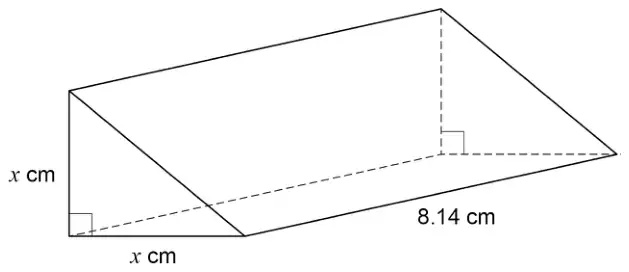
13 The triangular cross section of a prism is an isosceles right-angled triangle.
The volume of the prism is 102 cm3
Use approximations to estimate the value of \(x\).
You must show your working. [3 marks]
Mark scheme
Answer
Mark
Comments
One of \((102 \to)\ 100\) \((8.14 \to)\ 8\)
M1
their \(100 = 0.5 \times x^2 \times\) their 8 or \((x^2 =)\) their \(100 \div 8 \times 2\) or \((x^2 =)\ 100 \div\) their \(8 \times 2\) or 25 or their \(8 \times 5 \times 5 \times 0.5 = 100\) or \(8 \times 5 \times 5 \times 0.5 =\) their 100
M1dep
oe must have used at least one correct 1 sf value
5 with M2 seen
A1
Additional guidance
If working is done with approximations and with the given values ignore the working with the given values and mark the working with approximations
(a) Use your calculator to work out \(\quad \dfrac{9.75^3}{1.875} + 6.4^2\)
Give your answer as a decimal. Write down your full calculator display. [2 marks]
(b) Is your answer to part (a) sensible?
Check by rounding each of 9.75, 1.875 and 6.4 to the nearest whole number. You must show your working. [3 marks]
Tick a box.
Sensible
Not sensible
Mark scheme (a)
Answer
Mark
Comments
494.325 or \(\dfrac{19\,773}{40}\) or \(494\dfrac{13}{40}\) or 40.96 or \(\dfrac{1024}{25}\) or \(40\dfrac{24}{25}\) or 535.29 or 535.3 or \(\dfrac{107\,057}{200}\) or \(535\dfrac{57}{200}\)
M1
535.285
A1
Additional guidance
Ignore any subsequent truncation or rounding if 535.285 seen in working
M1A1
Mark scheme (b)
Answer
Mark
Comments
\(10^3\) and 2 and \(6^2\) and 536 and indicates Sensible
B3ft
ft correct decision for comparing 536 with their 535.285 B2 \(10^3\) and 2 and \(6^2\) seen B1 any two of 10, 2 and 6 seen allow 1000 to imply 10 or \(10^3\) and 36 to imply 6 or \(6^2\) for B1 or B2 only
Additional guidance
Students must give the correct ft decision for part (a) for B3
Correct decision for their (a) should be Sensible if their 535.285 is 530 or 540 to 2 sf. Otherwise they should indicate Not sensible
the 240 cows produce milk for 10 months each year each cow produces an average of 25 litres of milk per day.
Estimate the total milk production, in litres, of the 240 cows in one year.
You must show your working. [4 marks]
Mark scheme (a)
Answer
Mark
Comments
8
B1
Additional guidance
Ignore mention of bulls or cows eg condone 8 cows
B1
Condone an answer of 8 : 240
B1
8 : 240 followed by 1 : 30
B0
8 : 30
B0
Do not accept 8 from an incorrect method eg \(240 \div 31 = 7.7\ldots\) and answer 8
B0
Mark scheme (b)
Answer
Mark
Comments
Alternative method 1
\([28, 31] \times 10\) or [280, 310]
M1
appropriate days in 10-month year
their \([280, 310] \times 25\) or [7000, 7750] or their \([280, 310] \times 240\) or [67 200, 74 400]
M1dep
litres per year per cow
milkings per year for 240 cows
their \([7000, 7750] \times 240\) or their \([67\,200, 74\,400] \times 25\)
M1dep
[1 680 000, 1 860 000] with correct working
A1
accept to 1 or 2 sf with correct working
SC2 answer of [2 016 000, 2 232 000] with the only error using 12 months and working shown
Alternative method 2
\(25 \times 240\) or 6000
M1
litres per day for 240 cows may be seen embedded in a product eg \(25 \times 10 \times 240\)
their \(6000 \times [28, 31]\) or [168 000, 186 000] or \(25 \times 240\) or 6000 and \([28, 31] \times 10\) or [280, 310]
M1dep
litres per month for 240 cows
litres per day for 240 cows and appropriate days in 10-month year
their \([168\,000, 186\,000] \times 10\) or \(25 \times 240 \times [28, 31] \times 10\) or their \(6000 \times\) their [280, 310]
M1dep
[1 680 000, 1 860 000] with correct working
A1
accept to 1 or 2 sf with correct working
SC2 answer of [2 016 000, 2 232 000] with the only error using 12 months and working shown
Alternative method 3
\([28, 31] \times 25\) or [700, 775]
M1
litres per month per cow
their \([700, 775] \times 10\) or [7000, 7750] or their \([700, 775] \times 240\) or [168 000, 186 000]
M1dep
litres per year per cow
litres per month for 240 cows
their \([7000, 7750] \times 240\) or their \([168\,000, 186\,000] \times 10\)
M1dep
[1 680 000, 1 860 000] with correct working
A1
accept to 1 or 2 sf with correct working
SC2 answer of [2 016 000, 2 232 000] with the only error using 12 months and working shown
Alternative method 4
\([28, 31] \times 240\) or [6720, 7440]
M1
milkings per month for 240 cows
their \([6720, 7440] \times 10\) or [67 200, 74 400] or their \([6720, 7440] \times 25\) or [168 000, 186 000]
M1dep
milkings per year for 240 cows
litres per month for 240 cows
their \([67\,200, 74\,400] \times 25\) or their \([168\,000, 186\,000] \times 10\)
M1dep
[1 680 000, 1 860 000] with correct working
A1
accept to 1 or 2 sf with correct working
SC2 answer of [2 016 000, 2 232 000] with the only error using 12 months and working shown
Additional guidance
Use the scheme that awards the most marks and ignore choice
A value in the range [280, 310] may come from subtracting two months from a year eg uses 303 (may come from 365 – 31 – 31)
M1
The special case allows 2 marks for those using 12 months or using [336, 372] days
Allow consistent use of approximations to 1 sf throughout (this leads to an answer in the given range) ie \(30 \times 10 \times 30 \times 200 = 1\,800\,000\)
M3A1
Mark inconsistent use of approximations to 1sf as the scheme
Their final answer must be in range and correct for their product but may be given to 1 or 2 sf eg 280 days: \(28 \times 10 \times 25 \times 240 = 1\,680\,000\) 300 days: \(30 \times 10 \times 25 \times 240 = 1\,800\,000\) 310 days: \(31 \times 10 \times 25 \times 240 = 1\,860\,000\) 303 days: \(303 \times 25 \times 240 = 1\,818\,000\) 304 days: \(304 \times 25 \times 240 = 1\,824\,000\) 305 days: \(305 \times 25 \times 240 = 1\,830\,000\)
(a) Use your calculator to work out the exact value of \(\quad \dfrac{18\,953 \times 437}{11}\) [1 mark]
(b) Use approximations to 1 significant figure to check if your answer to part (a) is sensible. [3 marks]
Mark scheme (a)
Answer
Mark
Comments
752 951 or 752951 or 752,951
B1
Allow commas even if positioning incorrect eg 75,2951 or 752’951 B1
Additional guidance
752.951
B0
Mark scheme (b)
Answer
Mark
Comments
20 000 and 400 and 10 and 800 000 and Yes
B3ft
ft correct decision for their answer to (a) oe decision eg it is sensible
B2 20 000 and 400 and 10
B1 20 000 or 400 or 10
Additional guidance
800 000 (and Yes) with no other values
B0
If answer to (a) is 800 000 to 1sf then the correct ft decision in (b) is Yes eg1 (a) 770 000 (b) decision should be Yes eg2 (a) 1762 (b) decision should be No eg3 (a) 752.951 (b) allow decision to be Yes or No
12 Use approximations to 1 significant figure to estimate the value of
\[\frac{0.526 \times 39.6^2}{\sqrt{97.65}}\]
You must show your working. [3 marks]
Mark scheme
Answer
Mark
Comments
Any two of 0.5, 40 and 100
M1
1600 implies 40 10 implies 100
(\(40^2 =\)) 1600 or (\(0.5 \times 40^2 =\)) 800 or (\(\sqrt{100} =\)) 10
M1
80 with correct working
A1
Additional guidance
\(\dfrac{0.5 \times 1600}{\sqrt{100}}\) or \(\dfrac{0.5 \times 40^2}{10}\) or \(\dfrac{1 \times 1600}{10}\) or \(\dfrac{800}{\sqrt{100}}\) or \(\dfrac{800}{10}\)
M1M1
80 with no or incorrect working, eg attempt at actual calculation and then rounding to 80
M0M0A0
Condone 0.50(0) for 0.5, 40.0(0) for 40 and 100.0(0) for 100 etc
Rounding 0.526 to 1, but otherwise correct, with answer 160
(a) Heidi and Ben both work with the same positive number \(N\).
Heidi works out \(\dfrac{5}{8} \times N\).
Ben works out \(0.63 \times N\).
Tick (✓) the correct statement.
Heidi gets a larger answer than Ben
Heidi gets a smaller answer than Ben
Heidi gets the same answer as Ben
Give a reason why you ticked the statement. [2]
(b) Heidi correctly works out the area of a circle with radius 10 cm. Heidi uses the formula \(A = \pi r^2\).
Heidi’s answer is 314.1592654 cm\(^2\).
Ben correctly works out the area of the same circle using the same formula. Ben’s answer is bigger than Heidi’s answer.
Show how this can happen. [2]
Mark scheme (a)
Answer
Marks
Part marks and guidance
Correct row only
Heidi gets a larger answer than Ben
Heidi gets a smaller answer than Ben
✓
Heidi gets the same answer as Ben
2
B1 for correct statement only selected
Accept any clear indication
and \(\left[\dfrac{5}{8} =\right]\) 0.625
B1 for correct conversion isw
or
correctly finding 0.63 and \(\dfrac{5}{8}\) of the same amount isw
For second B1 Mark converted value(s) on the answer line first If insufficient converted value(s) on line, mark converted value(s) in body
Accept both converted to comparable form e.g. 63% and 62.5% or \(\dfrac{630}{1000}\) and \(\dfrac{625}{1000}\). Condone \(\dfrac{63}{100}\) and \(\dfrac{62.5}{100}\) condone rounding/truncation to a level to compare quantities
Mark scheme (b)
Answer
Marks
Part marks and guidance
\(k \times 10^2\) where \(k\) is one from 3.1415927, 3.141593, 3.1416, 3.142 leading to 314.15927, 314.1593, 314.16, 314.2
2
B1 for \(k \times 10^2\) where \(k\) is one from 3.1415927, 3.141593, 3.1416, 3.142
For 1 or 2 marks
Accept 100 for \(10^2\)
must see value of \(\pi\) not just \(\pi \times 10^2\)
Do not accept answer giving rounded value from use of accurate \(\pi\) e.g 314.1592654 = 314.2 [to 1dp]
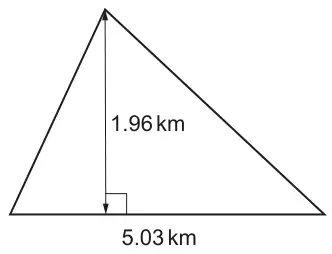
12 A housing estate is built on a triangular piece of land.
Not to scale
There are 3951 people living on the estate.
Work out an estimate of the population density of the estate in people per km2. [4]
Mark scheme
Answer
Marks
Part marks and guidance
Answer 800 with 2, 5 and 4000 seen
4
B1 for at least two of the values 5, 2 and 4000 M2 for \(\frac{\textit{their } 4000}{0.5 \times \textit{their } 5 \times \textit{their } 2}\) oe or M1 for \(\frac{1}{2} \times \textit{their } 5 \times \textit{their } 2\)
For B1 condone trailing zeros
For M2 and M1 their values can be 3951, 5.03, 1.96 or other rounded relatable values
(a) By rounding each value to one significant figure, estimate the cost of 4.9 kg of carrots at 73p per kg. [2]
(b) A student works out an estimate for this calculation.\[\dfrac{13.7 + 1.28}{5.099}\]
Their method is to:
round each number correct to the same number of significant figures and
work out the approximation.
The student writes
\[\dfrac{14 + 1}{5} = \dfrac{15}{5} = 3.\]
What error has the student made in using their method? [1]
Mark scheme (a)
Answer
Marks
Part marks and guidance
\(5\ [\times]\ 70\) or \(5\ [\times]\ 0.7\)
M1
Not from \(73 \times 4.9\) and rounded to 360 or truncated 350 Accept e.g. 70+70+70+70+70 for M1 Condone units included in product Condone answer 350p with £ crossed through or £3.50p
and 3.5[0]
A1
Mark scheme (b)
Answer
Marks
Part marks and guidance
Recognition that the figures are not all to the same number of sig fig e.g. They’re not all the same accuracy oe
1
See appendix
Allow complete and correct example(s)
Appendix
Question 6b
Response
Mark
13.7 rounded to the same number of significant figures would be 10
Mentions “same number of sig fig” and the correct number chosen with correct example
1
1.28 and 5.099 have not been rounded to the same number of sig fig as 13.7
Correct, but only because of the mention of 13.7 (because they have been rounded to the same number of sig fig as each other)
1
They should have rounded 13.7 to 10
Accept correct example as illustrating the error
1
They should have rounded 1.28 to 1.3 and 5.099 to 5.1
Accept the two correct examples as illustrating the error
1
They should have rounded 1.28 to 1.30 and 5.099 to 5.1
Condone the use of 1.30 for 1.3
1
He should have rounded 13.7 to the first significant figure
Condone “first” for “1”
1
They should have rounded 1.28 to 1.3
Recognises only one of the incorrectly rounded figures. If using 1.28 and 5.099 must describe both
0
The numerator is bigger than the denominator
Not a comment on the method
0
He did not round each number to its correct significant figure
A comment about the method BUT does not mention the same number of significant figures
0
They did not round each number to the correct amount of significant figures
A comment about the method BUT does not mention the same number of significant figures
0
1.28 rounded to the same number of significant figures would be 2
Does mention same number of sig fig but the wrong figure chosen and example is incorrect
0
They have rounded 13 wrong
Not explained what “wrong” means
0
He didn’t round 1.28 and 5.099 down properly
Does not explain the error. Might just be suggesting an arithmetic error
One week Amaya works for \(40\frac{1}{3}\) hours between Monday and Friday and then for \(4\frac{1}{4}\) hours on Saturday.
(a) Amaya says
I will earn at least £900 for my work this week.
By rounding each value to the nearest integer, use estimation to show that Amaya may be correct. [5]
(b) Give one reason why your working in part (a) shows that Amaya can be certain of earning at least £900 for her work in this week. [1]
Mark scheme (a)
Answer
Marks
Part marks and guidance
Three of 20[.00], 30[.00], 40 and 4 seen
B1
B1 seen as rounding
\(40 \times 20\)
M1
for their 40 x their 20
their 40 can be \(40\frac{1}{3}\), \(40.\dot{3}\), 40.33[3…] or 41 their 20 can be 20.15 or 21 their 4 can be \(4\frac{1}{4}\), 4.25 or 5 their 30 can be 30.23 or 31
\(4 \times 30\)
M1
for their 4 x their 30
920 or 800 and 120
A2
A2 dep on B1M1M1 or A1 dep on B1M1 for 800 or 120
Mark scheme (b)
Answer
Marks
Part marks and guidance
The calculation is an underestimate
1
All values were rounded down oe
Mark best response as long as not contradictory or incorrect
See Appendix 1
Appendix
APPENDIX 1 Question 16(b)
We want the candidate to say WHY they are certain of the figure being at least £900. If TOTAL is used then this MUST be £920. IF rounded figures are used then all four must be rounded down correctly (20,30,40,4)
Response
Mark
1
It is an Underestimate
1
2
All Values were rounded down
1
3
This is correct because at minimum she will make 920 (‘at minimum’ implies rounding and is correct)
1
4
The values are rounded down meaning she earnt more than this
1
5
(40 x 20) + (4 x 30) already equal over £900
1
6
The underestimation is over £900
1
7
If you round the earnings you get over £900 (this is true for rounding both up and down)
1BOD
8
Because in my working not adding the minutes, it’s still over £900 as it’s £928.80 (incorrect)
0
9
Because I estimated it meaning she’d probably got more (probably does not mean certain)
0
10
As it has gone over £900 (not describing rounding or underestimate)
0
11
This is correct because she will make 920 (the candidate is not telling us WHY they are certain)
0
12
Because £20.15x40=£806 and £30.23 x4=120.92 + them = 926.92 not including the minimum (All rounded values not used)
0
13
If you added everything without a fraction it adds up to almost £900 (incorrect)
0
14
Because it works out that all of her work will add to over 900 (no reference to underestimate)
0
15
Because it’s over 900 (not enough, need to say WHY it is certainly over £900)
0
16
The estimation is over £900 (not enough, need to say WHY estimation is certainly over £900)
0
17
Because I rounded down (not enough- needs to be e.g. rounded all numbers down)
17 The number of people watching a football match is 30 000, correct to the nearest thousand.
(a) Complete the error interval for \(n\), the number of people watching the football match.\[\ldots\ldots\ldots \leqslant n \lt 30\,500\] [1]
(b) The number of people watching a rugby match is 30 500, correct to the nearest hundred.
Show that fewer people could be watching the rugby match than the football match. [2]
Mark scheme (a)
Answer
Marks
Part marks and guidance
29 500
1
Mark scheme (b)
Answer
Marks
Part marks and guidance
Accept any correctly matched pair of values in which rugby < football from these ranges rugby: 30 450 to 30 498 and football: 30 451 to 30 499
2
B1 for one value for rugby or football in these ranges rugby from 30 450 to 30 498 or football from 30 451 to 30 499
Error interval alone scores 0 Only mark candidate’s chosen value(s) Rugby < football does not need to be stated If a pair of values and rugby or football not stated assume the value on the left or below another is rugby
For B1 if one or multiple values seen and no clear choice/designation all must be in range 30 451 to 30 498
8 A block made of iron is in the shape of a cuboid. The block is 3.1 cm by 4.9 cm by 2.2 cm. The density of iron is 7.87 g / cm3.
Sam thinks that the mass of the block is about 2.4 kg.
Use estimation to decide if Sam’s answer is reasonable. Show how you decide. [5]
Mark scheme
Answer
Marks
Part marks and guidance
[Vol of block ≈ 3 × 5 × 2 = ] 30 or [3 × 4.9 × 2 =] 29[.4] or [ 3 × 4.9 × 2 =] 31 or [ 3 × 5 × 2.2 = ] 33
M2
M1 for 3.1 × 4.9 × 2.2 or with one rounded value[s]
Throughout question if the candidate attempts to convert to different units this must be done correctly for method marks
their 30 × their 8
or 2400 ÷ their 30
or 2400 ÷ their 8
M1
Dep on at least M1or for 2400 and their 8 used If M0M0, SC1 for two of 3, 5, 2 and 8 used
their 8 is 7.87, 7.9 or 8
Accept 2.4 ÷ their 30
their 8 is 7.87, 7.9 or 8 If these calculations are not shown they may be implied by correct figures for the answers
240 or 80 or 300
A1
Accept e.g. 0.24 kg
Accept e.g. 0.08 kg/cm3
Not reasonable oe and 2400 g or 0.24[0] kg shown oe
or Not reasonable oe and 80 or 0.08 kg/cm3 shown
or Not reasonable oe and 300 and 30 shown
A1
Dep on M2M1A1
Allow e.g. wrong/not correct for not reasonable Accept implicit comparison with 2.4 kg if 2400 g or 0.24 kg not shown e.g. it should be 10 times heavier
(a) By writing each number correct to 1 significant figure, find an estimate for \(79.8 \times 3.1\). [2]
(b) Jamie works out \(79.8 \times 3.1\) on a calculator. Jamie’s answer is 2473.8.
Do you think Jamie has used their calculator correctly? Explain why.
.................... because ........................................ [1]
Mark scheme (a)
Answer
Marks
Part marks and guidance
240 with working
2
B1 for rounded value of 80 or 3 If 0 scored SC1 for 80.0 and 3.0 and 240.0 as answer
For 2 marks 80 and 3 must be seen
Mark scheme (b)
Answer
Marks
Part marks and guidance
No oe and [because] the answer should be close to 240 oe
1
Eg No his answer is ten times too big No the decimal point is in the wrong place
See AG
Appendix
Appendix Q9b
Response
Mark
No
1
The answer should be 247.38
1
2
The decimal point should be between the 7 and 3
1
3
The number is a lot higher than my estimate. I think she placed a decimal point wrong (The first part is not enough without seeing what their estimate is, ‘placed decimal point wrong’ scores the mark)
1
4
His answer should be in 200s not 2000s he must have placed decimal incorrectly
1
5
There should be 2 numbers behind the decimal place and not one
1
6
Because if you do \(80 \times 3\) you’ll get 240 (implies the answer is 10 times too big)
1
7
it should be closer to 240 (This is the correct estimate, so no need for calculation to be shown here)
1
8
His answer was in thousands which is too large (with it should be in the hundreds would have scored the mark)
0
9
Has not put decimals in
0
10
His answer is too high and shouldn’t have a decimal at the end (First part of answer is not enough to score and ‘shouldn’t have a decimal at the end’ is incorrect)
0
11
The answer that Jamie got is bigger than the estimate by 1 significant figure
0
12
There is only one two digit number so it cannot be above 1000
0
13
It would be less than 2473.8 due to \(80 \times 3\) (if the candidate had written = 240, this would be enough)
0
14
his answer is significantly larger
0
15
there is no way it can be higher than 300 (not enough as we need to see the calculation of their ‘estimate’ of 300)
0
16
The place value is not in the correct position (‘place value’ not an equivalent for decimal point)
16 Last year, Katie earned £16 200. Her total loan repayments were £6400.
Katie estimates that the ratio of her loan repayments to her earnings is approximately 3 : 8.
Is she correct? Show your reasoning. [3]
Mark scheme
Answer
Marks
Part marks and guidance
A - Yes with appropriate reasoning involving rounding and correct simplification to 3 : 8 or 3 : 11 or 8 : 11 or ratios reversed OR B - Yes it is approximately correct oe and simplification of 6400 : 16200 to 32 : 81 OR C - Yes with a correctly evaluated calculation using e.g. ratio 3 : 8 with a comparison comment
OR
D - Yes and e.g. \(16200 \div 8\) and \(6400 \div 3\) correctly evaluated
3
M2 eg for showing 6000 : 16000 and reducing to 3 : 8 or for appropriate rounding at some stage in correctly simplifying ratio leading to 3 : 8 isw
or reduces 6400 : 16200 to 32 : 81 isw or reduces 6400 : 22600 to 32 : 113 isw
or for ratio calculation leading to one of the following values seen 6075, 6163 to 6165, 16436 to 16440, 17066 to 17067 or 22 275 or 23 463 to 23 467 seen isw
or for 2025 and 2133 to 2134 seen isw or 2025 and 2054 to 2055 seen isw or 2133 to 2134 and 2054 to 2055 seen isw
Or M1 for 6000 or 16 000 or 20 000 or 22 000 or 23 000 seen or for appropriate rounding of one number at some stage in simplifying ratio or for intention to find \(\dfrac{3}{8}\) of 16 200 or for \(\dfrac{8}{3}\) of 6400 or \(\dfrac{3}{11}\) of (16 200 + 6400) or \(\dfrac{8}{11}\) of (16 200 + 6400) isw
or for \(6400 \div 3\) and one of \(16\,200 \div 8\) or \((6400 + 16\,200) \div 11\) seen isw or \(16\,200 \div 8\) and \((6400 + 16\,200) \div 11\) seen isw
For all marks accept method with equivalent fractions or decimals [3sf or better] Allow equivalent methods working with the totals e.g. 3 : 11, condone 22600 rounded to 22000 For 3 or M2, allow clear ‘reverse’ methods working from e.g. 3 : 8 to 6000 and 16000 Accept clear working if not in ratio form e.g. 3.2 and 8.1 shown not in ratio
The figures in the part marks column are guidance on accuracy required for 3 marks or M2
SEE APPENDIX B
Appendix B
Exemplar responses for Q16
Response
Mark
6400 : 16200 = 64 : 162 = 32 : 81 which is roughly 30 : 80 = 3 : 8 so yes
3B
6000 + 16000 = 22000, 22000 ÷ (3 + 8) = 2000 3 × 2000 = 6000 , 8 × 2000 = 16 000 so yes she is correct Method C but better
3C
3.2 and 8.1 in working. Close as he can round the decimals to nearest whole number. Decision not clear
M2B
3 : 8 = 6 : 16 = 6000 : 16000 yes Katie is correct if she rounds to the nearest 1000 Reverse method
3A
16 200 ÷ 8 = 2040, 2040 × 3 = 6120 she is not correct Error made in calculation M2 not available
M1C
16 200 ÷ 8 = 2025, 2025 × 3 = 6075 which is close to 6400 so yes she is approximately correct
3C
16200 + 6400 = 22600, 22600 ÷ 11 =2540, 2540 × 3 Intention to find 3/11 with errors
M1C
16200 + 6400 = 22600 = 22000, 22000 ÷ 11 = 2000 M1 for one correct rounding
M1D
16200 ÷ 8 × 3 = 6075 No it is not correct Correctly evaluated calculation with ratio 3 : 8
M2C
16200 : 6400 = 81 : 32 = 8.1 : 3.2 which is approximately 8 : 3 so she is correct
3B
6000 ÷ 3 = 2000 and 16000 ÷ 8 = 2000 so yes Equivalent to 4th the method but better
3D
16000÷8 = 2000, 6400÷3 = 2138.3×11 = 23466. Approximately 400 off so No. Error in calculation
M1C/D
16200 × 3/8 =6075. No not correct as for ratio to be correct her loan would have to be £6075.
M2C
6400÷3 = 2133.33, 16200÷8 = 2025. Not correct as ratio parts are not equal.
(a) The mass, \(m\) tonnes, of a girder is 12.7, correct to 1 decimal place.
Complete the error interval for the mass, \(m\).
\[\ldots\ldots\ldots\ldots \leqslant m \lt \ldots\ldots\ldots\ldots\]
[2]
(b) The length of a piece of wood is given as 8 metres, correct to the nearest metre. The length of a metal rod is given as 8.5 metres, correct to 1 decimal place.
Show that the piece of wood could be longer than the metal rod. [2]
Mark scheme (a)
Answer
Marks
Part marks and guidance
12.65 12.75
2
B1 for one correct or both correct and reversed
For B1, correct value must be in correct place
Mark scheme (b)
Answer
Marks
Part marks and guidance
Accept any correctly matched pair in which wood > metal
from \(8.45 \lt \text{wood} \leqslant 8.49[9\ldots]\) and \(8.45 \leqslant \text{metal} \leqslant 8.49[9\ldots]\)
2
Wood > metal does not need to be stated but it must be clear which measurement refers to wood and which to metal
B1 for one measurement in range \(8.45 \lt \text{wood} \leqslant 8.49[9\ldots]\) seen or \(8.45 \leqslant \text{metal} \leqslant 8.49[9\ldots]\) seen
Eg “Wood 8.46 [m] but Metal 8.45 [m]” scores 2 marks
Wood or 8 Metal or 8.5
For B1, measurement must be correctly associated with either wood or metal, as appropriate
8.45 seen as end of range Eg \(8.45 \leqslant 8.5 \lt 8.55\) scores 1 mark
3 Last year, Katie earned £16 200. Her total loan repayments were £6400.
Katie estimates that the ratio of her loan repayments to her earnings is approximately 3 : 8.
Is she correct? Show your reasoning. [3]
Mark scheme
Answer
Marks
Part marks and guidance
A - Yes with appropriate reasoning involving rounding and correct simplification to 3 : 8 or 3 :11 or 8 : 11 or ratios reversed OR B - Yes it is approximately correct oe and simplification of 6400 : 16200 to 32 : 81 OR C - Yes with a correctly evaluated calculation using e.g. ratio 3 : 8 with a comparison comment OR D - Yes and e.g. 16200 ÷ 8 and 6400 ÷ 3 correctly evaluated
3
M2 eg for showing 6000 : 16000 and reducing to 3 : 8 or for appropriate rounding at some stage in correctly simplifying ratio leading to 3 : 8 isw
or reduces 6400 : 16200 to 32 : 81 isw or reduces 6400 : 22600 to 32 : 113 isw
or for ratio calculation leading to one of the following values seen 6075, 6163 to 6165, 16436 to16440, 17066 to 17067 or 22 275 or 23 463 to 23 467 seen isw
or for 2025 and 2133 to 2134 seen isw or 2025 and 2054 to 2055 seen isw or 2133 to 2134 and 2054 to 2055 seen isw
Or M1 for 6000 or 16 000 or 20 000 or 22 000 or 23 000 seen or for appropriate rounding of one number at some stage in simplifying ratio or for intention to find \(\frac{3}{8}\) of 16 200 or for \(\frac{8}{3}\) of 6400 or \(\frac{3}{11}\) of (16 200 + 6400) or \(\frac{8}{11}\) of (16 200 + 6400) isw
or for 6400 ÷ 3 and one of 16 200 ÷ 8 or (6400 + 16 200) ÷ 11 seen isw or 16 200 ÷ 8 and (6400 + 16 200)÷ 11 seen isw
For all marks accept method with equivalent fractions or decimals [3sf or better] Allow equivalent methods working with the totals e.g. 3 : 11, condone 22600 rounded to 22000 For 3 or M2, allow clear ‘reverse’ methods working from e.g. 3 : 8 to 6000 and 16000 Accept clear working if not in ratio form e.g. 3.2 and 8.1 shown not in ratio
The figures in the part marks column are guidance on accuracy required for 3 marks or M2
SEE APPENDIX
Appendix: Exemplar responses for Q3
Response
Mark
1
6400 : 16200 = 64 : 162 = 32 : 81 which is roughly 30 : 80 = 3 : 8 so yes
3B
2
6000 + 16000 = 22000, 22000 ÷ (3 + 8) = 2000 3 × 2000 = 6000 , 8 × 2000 = 16 000 so yes she is correct
Method C but better
3C
3
3.2 and 8.1 in working. Close as he can round the decimals to nearest whole number.
Decision not clear
M2B
4
3 : 8 = 6 : 16 = 6000 : 16000 yes Katie is correct if she rounds to the nearest 1000
Reverse method
3A
5
16 200 ÷ 8 = 2040, 2040 × 3 = 6120 she is not correct
Error made in calculation M2 not available
M1C
6
16 200 ÷ 8 = 2025, 2025 × 3 = 6075 which is close to 6400 so yes she is approximately correct
3C
7
16200 + 6400 = 22600, 22600 ÷ 11 =2540, 2540 × 3
Intention to find 3/11 with errors
M1C
8
16200 + 6400 = 22600 = 22000, 22000 ÷ 11 = 2000
M1 for one correct rounding
M1D
9
16200 ÷ 8 × 3 = 6075 No it is not correct
Correctly evaluated calculation with ratio 3 : 8
M2C
10
16200 : 6400 = 81 : 32 = 8.1 : 3.2 which is approximately 8 : 3 so she is correct
3B
11
6000 ÷ 3 = 2000 and 16000 ÷ 8 = 2000 so yes
Equivalent to 4th the method but better
3D
12
16000÷8 = 2000, 6400÷3 = 2138.3×11 = 23466. Approximately 400 off so No.
Error in calculation
M1C/D
13
16200 × 3/8 =6075. No not correct as for ratio to be correct her loan would have to be £6075.
M2C
14
6400÷3 = 2133.33, 16200÷8 = 2025. Not correct as ratio parts are not equal.
M2D
15
16200 – 6400 = 9800, 9800 ÷ 5 × 3 = 5880 No
M2C
16
6400 × 8 = 51200, 16200 x 3 = 48600 No they are different