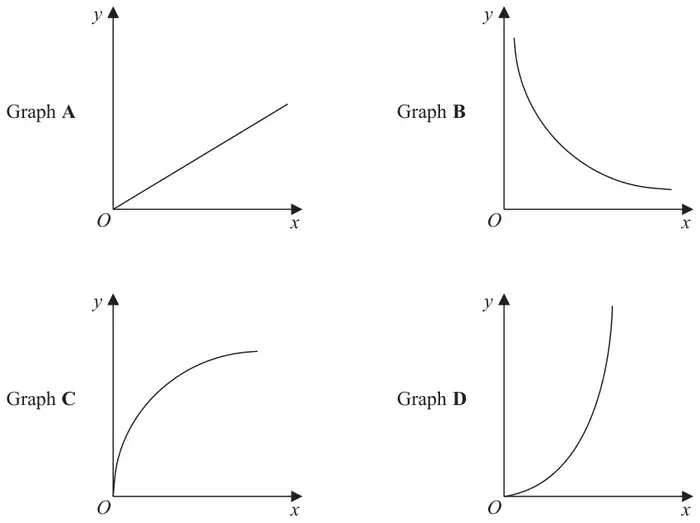
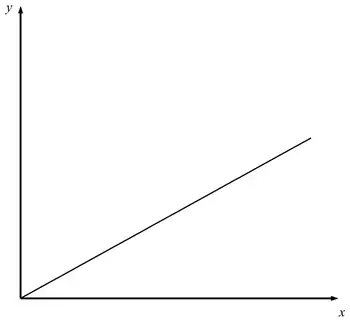
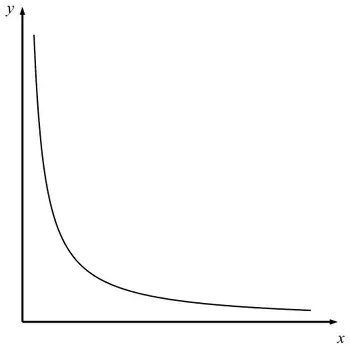
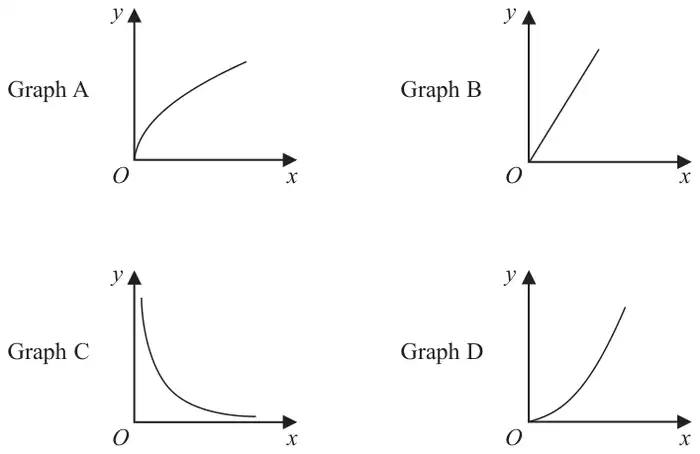
\(w\) is directly proportional to the cube root of \(d\).
When \(w = 6\), \(T = 20\) When \(w = 1\), \(d = 8\)
Find the value of \(d\) when \(T = 48\) (5)
Mark scheme
Answer
Mark
Mark scheme
125
P1
for setting up an equation with a constant term, eg \(T = \dfrac{k}{w}\) or \(w = K\sqrt[3]{d}\)
P1
for a process to substitute values in one equation, eg \(20 = \dfrac{k}{6}\) or \(k = 120\) or \(1 = K\sqrt[3]{8}\) or \(K = \dfrac{1}{2}\) oe
P1
(dep P2) for combining the two equations ft their values of \(k\) and \(K\), eg \(T = \dfrac{\text{``}120\text{''}}{\text{``}\frac{1}{2}\text{''}\sqrt[3]{d}}\) oe OR for a correct process to find the value of \(w\) when \(T = 48\), eg \(w = \dfrac{\text{``}120\text{''}}{48}\) (= 2.5 oe)
P1
for substitution into their formula, eg \(48 = \dfrac{\text{``}120\text{''}}{\text{``}\frac{1}{2}\text{''}\sqrt[3]{d}}\) OR for substitution of found value of \(w\) in the equation for \(d\), eg \(\text{``}2.5\text{''} = \text{``}\dfrac{1}{2}\text{''}\sqrt[3]{d}\)
A1
cao
Additional guidance
Condone the use of ‘\(\alpha\)’ instead of ‘=’ for the first two P marks Equation can be implied by correct substitution
\(T = \dfrac{120}{w} \qquad w = \dfrac{1}{2}\sqrt[3]{d}\)
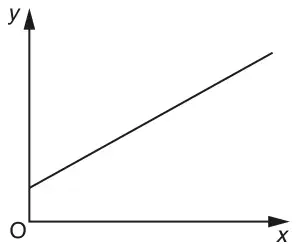
Nadia says that \(y\) is directly proportional to \(x\) because the value of \(y\) increases by 4 as the value of \(x\) increases by 2
(a) Is Nadia correct? You must give a reason for your answer. (1)
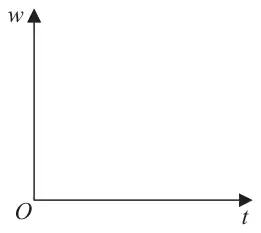
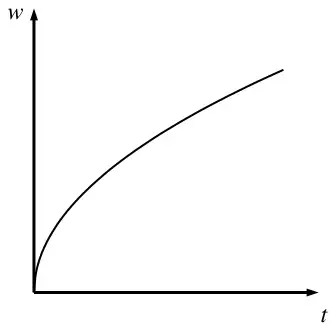
\(w\) is directly proportional to the square root of \(t\).
\(w = 140\) when \(t = 64\)
(b)
(i) Calculate the value of \(w\) when \(t = 7.84\) (3)
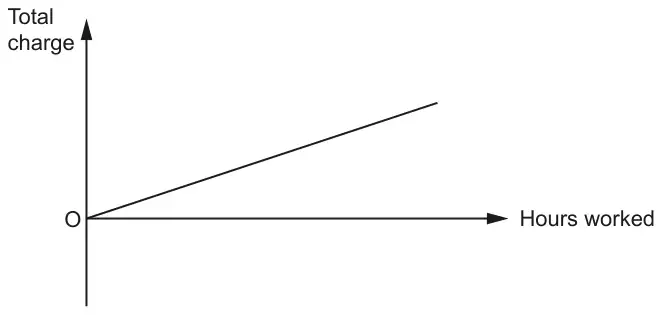
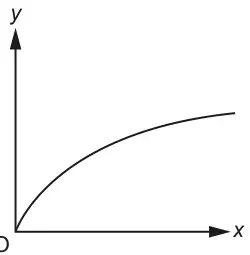
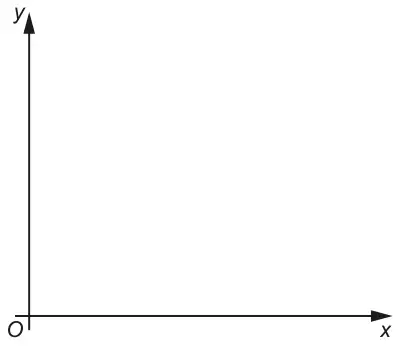
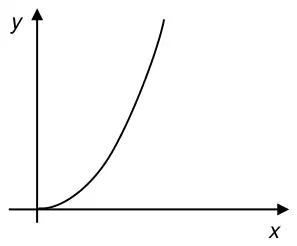
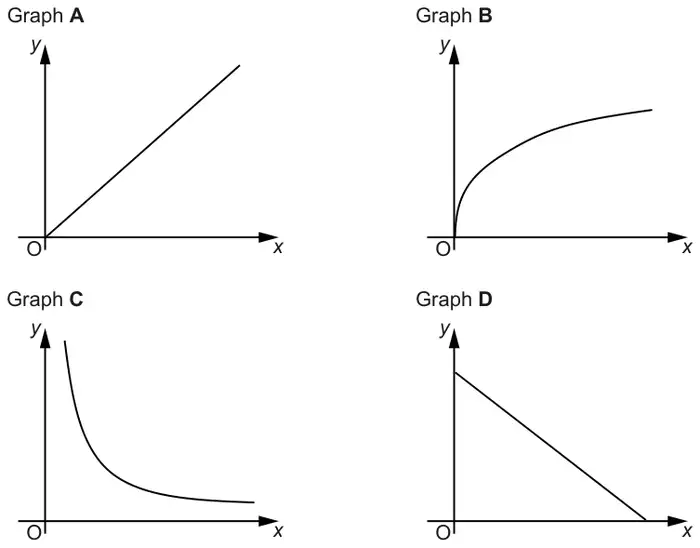
(ii) On the axes below, sketch a graph to show the relationship between \(w\) and \(t\).(1)
Mark scheme (a)
Answer
Mark
Mark scheme
No with reason
C1
for No with reason,
Acceptable examples No, \(4 \div 4 \neq 8 \div 6\) No, \(4 \div 4 \neq 8 \div 6\) so they don’t have the same constant No because \(y = kx\) doesn’t work No, it wont pass through (0, 0)
Not acceptable examples Yes, …. No, they don’t increase by the same number No, they don’t have the same constant
Mark scheme (b)
Answer
Mark
Mark scheme
(i) 49
M1
for stating a correct relationship, eg \(w = k \times \sqrt{t}\) or \(140 = k \times \sqrt{64}\) oe
M1
for method to find constant of proportionality, eg \(140 \div \sqrt{64}\ (= 17.5\) oe\()\)
A1
cao
(ii) sketch
C1
for sketch
Additional guidance
(i) Condone the use of ‘\(\alpha\)’ instead of ‘=’ for both M marks
(a) Find an equation for \(f\) in terms of \(d\). (2)
(b) Find the positive value of \(d\) when \(f = 10\) Give your answer correct to 3 significant figures. (2)
Mark scheme (a)
Answer
Mark
Mark scheme
\(f = \dfrac{224}{d^2}\)
M1
for \(3.5 = \dfrac{k}{8^2}\) oe \((k = 224)\)
A1
for \(f = \dfrac{224}{d^2}\) oe
Additional guidance
Accept use of \(\propto\) for the M mark
Mark scheme (b)
Answer
Mark
Mark scheme
4.73
M1
for \(10 = \dfrac{\text{``}224\text{''}}{d^2}\) or \(d^2 = \text{``}224\text{''} \div 10\) or ft their value for \(k\) provided \(f = \dfrac{k}{d^2}\) is used
14 \(y\) is proportional to \(x^2\) \(y = 3\) when \(x = 0.5\)
\(x\) is inversely proportional to \(w\) \(x = 2\) when \(w = 0.2\)
Find the value of \(y\) when \(w = 2\) (5)
Mark scheme
Answer
Mark
Mark scheme
0.48
P1
for setting up an equation with a constant term, eg \(y = kx^2\) or \(x = \dfrac{j}{w}\)
P1
for a process to substitute values in one equation, eg \(3 = k \times 0.5^2\) or \(k = 12\) or \(2 = j \div 0.2\) or \(j = 0.4\)
P1
(dep P2) for combining the two equations ft their values of \(k\) and \(j\) eg \(y = \text{``}12\text{''} \times \left(\dfrac{\text{``}0.4\text{''}}{w}\right)^2\) oe OR for correct process to find the value of \(x\) when \(w = 2\), eg \(x = \text{``}0.4\text{''} \div 2\ (= 0.2)\)
P1
for substitution into their formula, eg \(y = \dfrac{\text{``}1.92\text{''}}{2^2}\) OR for using found value of \(x\) to find the value of \(y\), eg \(y = \text{``}12\text{''} \times \text{``}0.2\text{''}^2\)
A1
oe
Additional guidance
Condone the use of "\(\propto\)" instead of "=" for the first two P marks Equation can be implied by correct substitution
16 Water flows through each of the pipes that fill a lake at the same rate.
It takes 4 of the pipes 12 hours to fill the lake.
Work out how many hours it would take 6 pipes to fill \(\dfrac{1}{4}\) of the lake. (3)
Mark scheme
Answer
Mark
Mark scheme
2
P1
for a calculation from within the list \(4 \times 12 \div 4 \div 6\) eg \(4 \times 12\ (= 48)\) or \(12 \div 4\ (= 3)\) or \(6 \div 4\ (=1.5)\) or \(4 \div 6\ (= 0.66..)\)
P1
for a complete process, eg \((\text{``}48\text{''} \div 6) \div 4\) or for \(\text{``}0.\dot{6}\text{''} \times 12 \div 4\)
17 \(y\) is directly proportional to the square root of \(t\). \(y = 15\) when \(t = 9\)
\(t\) is inversely proportional to the cube of \(x\). \(t = 8\) when \(x = 2\)
Find a formula for \(y\) in terms of \(x\). Give your answer in its simplest form. (4)
Mark scheme
Answer
Mark
Mark scheme
\(y = \dfrac{40}{\sqrt{x^3}}\)
P1
for setting up an equation with a constant term, eg \(y = k\sqrt{t}\) or \(t = \dfrac{K}{x^3}\)
P1
for a process to substitute values in one equation, eg \(15 = k\sqrt{9}\) or \(k = 5\) or \(8 = \dfrac{K}{2^3}\) or \(K = 64\)
P1
(dep P2) for combining the two equations ft their values of \(k\) and \(K\), eg \(y = 5\sqrt{\dfrac{64}{x^3}}\) OR for \(y = 5\sqrt{t}\) and \(t = \dfrac{64}{x^3}\)
A1
oe
Additional guidance
Condone the use of ‘\(\propto\)’ instead of ‘=’ for the first two P marks Equation can be implied by correct substitution
Formula must include 40 Accept other forms for the power of \(x\) but must be a single term in \(x\)
9 On Monday, 12 people took 5 hours to clean a number of cars. On Tuesday, 15 people cleaned the same number of cars.
Assuming that all the people worked at the same rate,
(a) work out how many hours the 15 people took to clean the cars. (2)
The assumption is wrong.
(b) How might this affect the time taken for the 15 people to clean the cars? (1)
Mark scheme (a)
Answer
Mark
Mark scheme
4
P1
\(12 \times 5 \div 15\)
A1
cao
Mark scheme (b)
Answer
Mark
Mark scheme
Statement
C1
Acceptable examples it could take more time it could take less time it could take more or less time it would take longer if they worked at a slower rate Not acceptable examples the time will be less as there are more people if the rate at which the 15 people work changes it would have taken longer it would take less time
8 The number of days, \(d\), that it will take to build a house is given by
\[d = \frac{720}{n}\]
where \(n\) is the number of workers used each day.
Ali’s company will take 40 days to build the house. Hayley’s company will take 30 days to build the house.
Hayley’s company will have to use more workers each day than Ali’s company.
How many more? (3)
Mark scheme
Answer
Mark
Mark scheme
6
M1
for \(720 \div 40\ (= 18)\) or \(720 \div 30\ (= 24)\)
M1
for a complete process eg \((720 \div 30) - (720 \div 40)\) or \(\text{``}18\text{''} \times 4/3 - \text{``}18\text{''}\) or \(\text{``}24\text{''} - \text{``}24\text{''} \times 3/4\)
20 \(h\) is inversely proportional to \(p\) \(p\) is directly proportional to \(\sqrt{t}\)
Given that \(h = 10\) and \(t = 144\) when \(p = 6\) find a formula for \(h\) in terms of \(t\) (4)
Mark scheme
Answer
Mark
Mark scheme
\(h = \dfrac{120}{\sqrt{t}}\)
P1
for setting up a proportional relationship between \(h\) and \(p\), eg \(h \propto \dfrac{1}{p}\) or \(h = \dfrac{k}{p}\) OR a proportional relationship between \(p\) and \(t\), eg \(p \propto \sqrt{t}\) or \(p = K\sqrt{t}\)
P1
for process to substitute at least 2 values, eg \(10 = \dfrac{k}{6}\ (k = 60)\) or \(6 = K\sqrt{144}\ (K = 0.5)\)
P1
for full process leading to \(h = \dfrac{\text{``}60\text{''}}{p}\) oe and \(p = \text{``}0.5\text{''}\sqrt{t}\) oe
The company has 6 machines. All the machines work at the same rate. When all the machines are working, they can make all the boxes in 9 days.
The table gives the number of machines working each day.
day 1
day 2
day 3
all other days
Number of machines working
3
4
5
6
Work out the total number of days taken to make all the boxes. (3)
Mark scheme
Answer
Mark
Mark scheme
10
P1
for a process to start to solve the problem eg \(6 \times 9\ (= 54)\) machine days needed or 12 (machine days used in first 3 days) or 42 (machine days needed after first 3 days) or 6 (machine days not used in first 3 days) or \(3 + 4 + 5\) equivalent to 2 days with 6 machines or has used 48 machine days in first 9 days
P1
for \(\text{``}42\text{''} \div 6\ (= 7)\) (more days needed) or 3 days − 2 (equivalent) days (= 1) extra day needed to make up for the days not used
23 It would take 120 minutes to fill a swimming pool using water from 5 taps.
(a) How many minutes will it take to fill the pool if only 3 of the taps are used? (2)
(b) State one assumption you made in working out your answer to part (a). (1)
Mark scheme (a)
Answer
Mark
Mark scheme
200
M1
for \(120 \times 5 \div 3\) oe
A1
cao
Mark scheme (b)
Answer
Mark
Mark scheme
statement
C1
Statement that each tap fills at the same rate or that the rate does not change over time Examples Acceptable responses: Taps are running at the same speed They (clearly referring to taps) all fill the pool with the same volume of water The amount of water is the same in the same time (again referring to taps) Each tap is doing a fifth of the filling That all taps take equal time to fill the pool All taps produce the same amount of water That the water flow stays at the same rate over the whole time.
Non acceptable responses It will take more time because there are less taps The less taps used the longer it takes to fill the pool That 1 tap can take up to 24 mins each 3 taps will take longer to fill the pool
Additional guidance
Any statement referring to the same amount of water flowing from each tap is acceptable.
14 \(y\) is inversely proportional to \(x^3\) \(y = 44\) when \(x = a\)
Show that \(y = 5.5\) when \(x = 2a\) (3)
Mark scheme
Answer
Mark
Mark scheme
Evidence of solution
M1
for constructing an equation eg \(y \propto \dfrac{1}{x^3}\) or eg \(y = \dfrac{k}{x^3}\) oe
M1
for substituting in the values \(a\) and 44 into \(y = \dfrac{k}{x^3}\)
C1
for a complete method to use the equation, the value of \(k\) and \(x = 2a\) to show \(y = 5.5\) eg \((2a)^3 y = 44a^3\) and \(y = 44a^3 \div 8a^3 = 5.5\)
4 It would take 120 minutes to fill a swimming pool using water from 5 taps.
(a) How many minutes will it take to fill the pool if only 3 of the taps are used? (2)
(b) State one assumption you made in working out your answer to part (a). (1)
Mark scheme (a)
Answer
Mark
Mark scheme
200
M1
for \(120 \times 5 \div 3\) oe
A1
cao
Mark scheme (b)
Answer
Mark
Mark scheme
statement
C1
Statement that each tap fills at the same rate or that the rate does not change over time Examples Acceptable responses: Taps are running at the same speed They (clearly referring to taps) all fill the pool with the same volume of water The amount of water is the same in the same time (again referring to taps) Each tap is doing a fifth of the filling That all taps take equal time to fill the pool All taps produce the same amount of water That the water flow stays at the same rate over the whole time.
Non acceptable responses It will take more time because there are less taps The less taps used the longer it takes to fill the pool That 1 tap can take up to 24 mins each 3 taps will take longer to fill the pool
Additional guidance
Any statement referring to the same amount of water flowing from each tap is acceptable.
9 Yesterday it took 5 cleaners \(4\dfrac{1}{2}\) hours to clean all the rooms in a hotel.
There are only 3 cleaners to clean all the rooms in the hotel today.
Each cleaner is paid £8.20 for each hour or part of an hour they work.
How much will each cleaner be paid today? (3)
Mark scheme
Answer
Mark
Notes
65.60
P1
for start in using inverse proportionality, eg \(5 \times 4.5\ (= 22.5)\) or \(4.5 = \dfrac{k}{5}\) or \(5 \times 4.5 \times 60\ (= 1350)\) or \(\dfrac{5}{3}\) or \(\dfrac{3}{5}\)
P1
for process to find number of hours for each cleaner today, eg \(\dfrac{22.5}{3}\ (= 7.5)\)
24 The intensity of the sound, \(I\) watts/m\(^2\), received from a loudspeaker is inversely proportional to the square of the distance, \(d\) metres, from the loudspeaker.
When \(d = 2\), \(I = 30\)
Work out the value of \(I\) when \(d = 10\) (3)
Mark scheme
Answer
Mark
Notes
1.2
3
M1 for \(I \propto \dfrac{1}{d^2}\) or \(I = \dfrac{k}{d^2}\) or \(k = Id^2\) or \(30 = \dfrac{k}{2^2}\) or \(k = 120\) M1 (dep) for \(I = \dfrac{\text{``}120\text{''}}{10^2}\) A1 cao
24 Given that \(y \propto \dfrac{1}{x^2}\), complete this table of values.
\(x\)
1
2
5
10
\(y\)
1
(4)
Mark scheme
Answer
Mark
Notes
100, 25, 4
4
M1 for \(y = \dfrac{k}{x^2}\) oe or \(1 = \dfrac{k}{10^2}\) M1 for complete method to find \(k\) or \(y = \dfrac{100}{x^2}\) oe OR (dep on M1) for \(k = 100\) A1 for one entry correct A1 for other two entries correct
M1 for \(p = \dfrac{k}{t}\) oe (\(k \neq 1\)) or \(12 = \dfrac{k}{4}\) M1 for correct method to find \(k\) or \(p = \dfrac{48}{t}\) oe or (dep on M1) for \(k = 48\) A1 cao
OR
M1 for \(\dfrac{6}{4}\) oe M1 for \(12 \div \dfrac{6}{4}\) oe A1 cao
22 \(h\) is inversely proportional to the square of \(r\).
When \(r = 5\), \(h = 3.4\)
Find the value of \(h\) when \(r = 8\) (3)
Mark scheme
Answer
Mark
Notes
1.33
3
M1 for \(3.4 = \dfrac{k}{5^2}\) oe or \(3.4 \times 5^2\) (=85) M1 for ‘\(3.4 \times 5^2\)’ \(\div 8^2\) A1 for answer in range 1.32 to 1.33 or \(\dfrac{85}{64}\)
24 A study suggests a student’s exam mark, \(m\), is directly proportional to the cube root of total revision time, \(t\) hours.
A student doubles their total revision time.
Work out the percentage increase in their exam mark. [3 marks]
Mark scheme
Answer
Mark
Comments
\(m = k\sqrt[3]{t}\) or \(km = \sqrt[3]{t}\) or \(m = k\sqrt[3]{2t}\) or \(km = \sqrt[3]{2t}\)
M1
oe equation eg \(m = k \times \sqrt[3]{t}\) or \(\dfrac{m}{\sqrt[3]{t}} = k\)
Expression or calculation for \(\dfrac{m_2}{m_1}\ (\times 100)\) or \(\dfrac{m_2 - m_1}{m_1}\ (\times 100)\)
M1dep
\(m_1\) is the mark for time \(t\) \(m_2\) is the mark for time \(2t\) eg \(k\sqrt[3]{2t} \div k\sqrt[3]{t}\) or \(\dfrac{\sqrt[3]{8} - \sqrt[3]{4}}{\sqrt[3]{4}}\)
[25.9, 26]
A1
Additional guidance
M1 may be awarded for correct work with no answer or incorrect answer, even if this is seen amongst multiple attempts
A common approach used (i) Work out values of \(m_1\), \(k\) and \(t\) that satisfy \(m = k\sqrt[3]{t}\) (ii) Double their value of \(t\) and use their value of \(k\) to work out a value for \(m_2\) (iii) Write down a calculation for \(\dfrac{m_2}{m_1}\ (\times 100)\) or \(\dfrac{m_2 - m_1}{m_1}\ (\times 100)\) eg \(20 = 4 \times \sqrt[3]{125}\) (using \(m_1 = 20 \quad k = 4 \quad t = 125\)) \(m_2 = 4 \times \sqrt[3]{250}\) \(\dfrac{4 \times \sqrt[3]{250} - 20}{20}\) (award M1dep at this stage so 1st M1 is implied) 25.99
M1M1dep A1
For M1 accept use of different letters if intention is clear eg \(y = c\sqrt[3]{x}\)
M1
\(m \propto \sqrt[3]{t}\) or \(m \propto k\sqrt[3]{t}\) etc with no further correct working
M0
Writing square roots for cube roots must be recovered
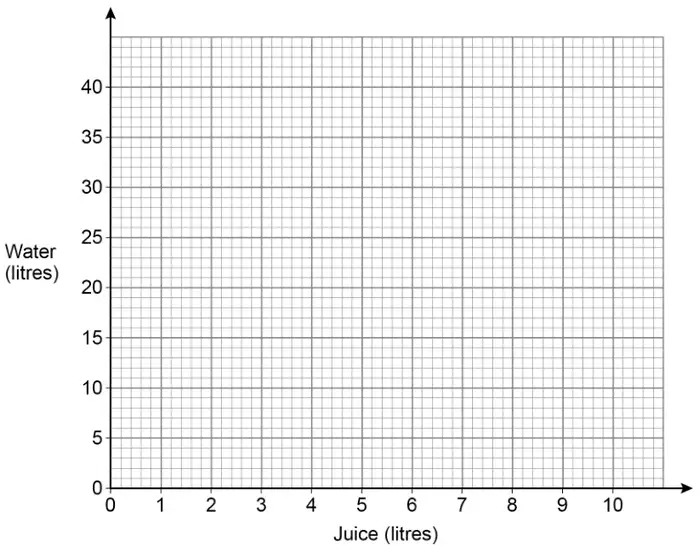
19 Juice and water are mixed together in the ratio 2 : 7
(a) Draw a straight line graph that shows the amounts of juice and water to mix together.
Your graph must show up to 10 litres of juice. [2 marks]
(b) How much water needs to be mixed with 5 litres of juice? [1 mark]
Mark scheme (a)
Answer
Mark
Comments
Straight line from (0, 0) to (10, 35)
B2
\(\pm \dfrac{1}{2}\) square B1 one correct point \(\pm \dfrac{1}{2}\) square from (2, 7) to (10, 35) seen or plotted or one correct ratio apart from 2 : 7 or one correct pair of amounts apart from 2 juice 7 water
Additional guidance
Mark intention
If no points plotted, a correct point from (2, 7) to (10, 35) can be implied by a straight line with positive gradient
Two points plotted with the same \(x\)-coordinate is choice unless the line is drawn through one of the points
Condone straight line from (2, 7) to (10, 35)
B2
(2, 7) seen with graph not drawn or incorrect
B1
10 : 35 seen with graph not drawn or incorrect
B1
6 juice 21 water with graph not drawn or incorrect
B1
Mark scheme (b)
Answer
Mark
Comments
Alternative method 1 – uses the given ratio
17.5
B1
Alternative method 2 – uses their graph
Correct water reading for 5 litres of juice from their straight line
24 Working alone, it takes Kevin 4 hours to paint an area of 12 m\(^2\)
Kevin and Steve are going to paint an area of 24 m\(^2\)
Kevin says,
“Working together at the same rate it will take us 8 hours, because 24 is \(2 \times 12\)”
Is he correct?
Tick a box.
Yes
No
Give a reason for your answer. [1 mark]
Mark scheme
Answer
Mark
Comments
No and correct reason
B1
eg it will still only take 4 hours it will be the same (time) they could do 48 m\(^2\) in that time even though it’s twice the area there are twice as many people
Additional guidance
No and there are two people so it won’t take as long (as 8h)
\(P\) is directly proportional to the square of \(Q\). When \(P = 1.25\), \(Q = 0.5\)
\(Q\) is inversely proportional to \(R\). When \(Q = 0.5\), \(R = 6\)
Work out the value of \(R\) when \(P = 0.8\) [5 marks]
Mark scheme
Answer
Mark
Comments
Alternative method 1
\(P = kQ^2\) or \(1.25 = k \times 0.5^2\) or \(Q = \dfrac{c}{R}\) or \(0.5 = \dfrac{c}{6}\)
M1
oe
\(k = \dfrac{1.25}{0.5^2}\) or \(k = 5\) or \(P = 5Q^2\) or \(c = 0.5 \times 6\) or \(c = 3\) or \(Q = \dfrac{3}{R}\)
M1
oe
\(P = 5Q^2\) and \(Q = \dfrac{3}{R}\) or \(k = 5\) and \(c = 3\)
A1
oe
\(0.8 =\) their \(5 \times \left(\dfrac{\text{their } 3}{R}\right)^2\) or \({(R =)}\ \sqrt{\dfrac{\text{their } 5 \times (\text{their } 3)^2}{0.8}}\)
M1
ft their equations of the form \(P = kQ^2\) and \(Q = \dfrac{c}{R}\) oe eg \((Q =)\ \sqrt{\dfrac{0.8}{\text{their } 5}}\) or \(Q = 0.4\) and \((R =)\ \dfrac{\text{their } 3}{\text{their } 0.4}\)
7.5 or \(7\dfrac{1}{2}\) or \(\dfrac{15}{2}\)
A1ft
ft their equations of the form \(P = kQ^2\) and \(Q = \dfrac{c}{R}\) with 3rd M1 scored
Alternative method 2
\(P = \dfrac{k}{R^2}\) or \(1.25 = \dfrac{k}{6^2}\)
20 \(d\) is directly proportional to the square of \(v\).
\(d = 6\) when \(v = 20\)
(a) Work out an equation connecting \(d\) and \(v\). [3 marks]
(b) Work out the value of \(d\) when \(v = 30\) [2 marks]
Mark scheme (a)
Answer
Mark
Comments
\(d \propto v^2\) or \(d = \text{k} \times v^2\) or \(6 = \text{k} \times 20^2\) or \(\text{c} \times d = v^2\) or \(\text{c} \times 6 = 20^2\)
M1
oe eg \(v = \text{k}d^{\frac{1}{2}}\)
\((\text{k} =)\ 6 \div 20^2\) or 0.015 or \((\text{c} =)\ 20^2 \div 6\) or 66.66… or 66.67
M1dep
oe eg \(\dfrac{6}{400}\) or \(\dfrac{3}{200}\) \(\dfrac{400}{6}\) or \(\dfrac{200}{3}\)
\(d = 0.015 \times v^2\) or \(\dfrac{200}{3} \times d = v^2\)
A1
oe equation
Additional guidance
Working for second M mark must follow from their initial equation
\(d \propto 0.015 \times v^2\)
M1M1A0
\((\text{k} =)\ 0.015\) or \((\text{c} =)\ \dfrac{200}{3}\) with no incorrect working
M1M1A0
\(0.015v^2\) or \(\dfrac{200}{3}d\)
M1M1A0
Mark scheme (b)
Answer
Mark
Comments
their \(0.015 \times 30^2\) or their \(0.015 \times 900\) or \(6 \times \left(\dfrac{30}{20}\right)^2\) or \(30^2 \div\) their \(\dfrac{200}{3}\) or \(900 \div \dfrac{200}{3}\) or \(6 \div \left(\dfrac{20}{30}\right)^2\)
M1
oe
13.5
A1ft
oe ft their 0.015 provided using \(d =\) their \(0.015 \times v^2\)
Additional guidance
Must use \(\times 30^2\) or \(\times 900\) or \(\times \left(\dfrac{30}{20}\right)^2\) for M1
\(d \propto 13.5\)
M1A0
If in part (a) \(d = \text{k} \times v \quad 6 = \text{k} \times 20 \quad d = \dfrac{6}{20}v\) and in part (b) \(d = \dfrac{6}{20} \times 30, \quad d = 9\)
M0 part (a)
M0 part (b)
If in part (a) \(d = \text{k} \times v \quad 6 = \text{k} \times 20 \quad d = \dfrac{6}{20}v\) and in part (b) \(d = \dfrac{6}{20} \times 30^2, \quad d = 270\)
21 \(y\) is inversely proportional to \(\sqrt{x}\)
\(y = 4 \quad\) when \(\quad x = 9\)
(a) Work out an equation connecting \(y\) and \(x\). [3 marks]
(b) Work out the value of \(y\) when \(\quad x = 25\) [2 marks]
Mark scheme (a)
Answer
Mark
Comments
Alternative method 1
\(y = \dfrac{k}{\sqrt{x}}\)
M1
oe equation implied by \(\quad 4 = \dfrac{k}{\sqrt{9}}\) oe
(\(k =\)) \(4 \times \sqrt{9}\) or (\(k =\)) 12
M1dep
oe
\(y = \dfrac{12}{\sqrt{x}}\)
A1
oe equation
Alternative method 2
\(ky = \dfrac{1}{\sqrt{x}}\)
M1
oe equation implied by \(\quad 4k = \dfrac{1}{\sqrt{9}}\) oe
(\(k =\)) \(\dfrac{1}{\sqrt{9}} \div 4\) or (\(k =\)) \(\dfrac{1}{12}\)
M1dep
oe
\(\dfrac{1}{12}y = \dfrac{1}{\sqrt{x}}\)
A1
oe equation
Additional guidance
Alt 1 (\(k =\)) 12 or (\(k \propto\)) 12 with no incorrect working
M1M1
Condone use of \(\propto\) for up to M1M1A0 eg (Alt 1) \(y \propto \dfrac{k}{\sqrt{x}}\) M1 \(k \propto 12\) M1dep \(y \propto \dfrac{12}{\sqrt{x}}\) A0
\(y = \dfrac{12}{\sqrt{x}}\) oe
M1M1A1
Mark scheme (b)
Answer
Mark
Comments
\(\dfrac{12}{\sqrt{25}}\) or \(\dfrac{\text{their } k}{\sqrt{25}}\)
B1 \(y = \dfrac{24}{x}\) or \(4 = \dfrac{k}{6}\) or \(k = 24\) oe or \((x =)\) 3 in correct position above 8 or \((y =)\) 2 in correct position below 12
Additional guidance
\(y = \dfrac{1}{kx}\) or \(4 = \dfrac{1}{6k}\) oe followed by \(k = \dfrac{1}{24}\), with no or incorrect values in table
14 2 people working at the same rate will take 6 hours to paint a room.
(a) Assuming that they all work at this rate,
how long will it take 3 people to paint the room? [2 marks]
(b) In fact, the third person works at a faster rate.
How does this affect the time to paint the room? [1 mark]
Mark scheme (a)
Answer
Mark
Comments
\(2 \times 6\) or 12 or \(6 \times \dfrac{2}{3}\) or \(6 - \dfrac{1}{3} \times 6\)
M1
oe
eg \(6 \div 3 = 2\) followed by \(6 - 2\) \(6 \div 3 = 2\) followed by \(2 \times 2\)
4
A1
Additional guidance
Accept minutes for M1 even if units not given ie \(2 \times 360\) or 720 etc However, answer in minutes accepted only if units changed to minutes on answer line
Mark scheme (b)
Answer
Mark
Comments
It takes less (time)
B1
oe
Additional guidance
(It will be) quicker / faster
B1
(It will) now take less than (their answer to part (a)) hours
B1
Time will decrease
B1
It will not take as long
B1
It will not take long
B0
It will now take 2 hours (their answer in (a) was 3 hours)
B1 \(y = \dfrac{24}{x}\) or \(4 = \dfrac{k}{6}\) or \(k = 24\) oe or (\(x =\)) 3 in correct position above 8 or (\(y =\)) 2 in correct position below 12
Additional guidance
\(y = \dfrac{1}{kx}\) or \(4 = \dfrac{1}{6k}\) oe followed by \(k = \dfrac{1}{24}\), with no or incorrect values in table
27 It takes 36 hours for 7 people to paint a fence. Assume that all people paint at the same rate.
How long would it take 15 people to paint the same fence? Give your answer in hours and minutes. [4]
Mark scheme
Answer
Marks
Part marks and guidance
16 hours 48 minutes
4
B3 for 16.8 or 1008 or M2 for \(7 \times 36 \div 15\ [\times 60]\) oe or M1 for \(7 \times 36\) maybe implied by 252 or \(15 \div 7\) maybe implied by 2.14.. or \(7 \div 15\) maybe implied by 0.46..
15 \(y\) is inversely proportional to the square of \(x\). \(y = 5\) when \(x = 6\).
Find a formula linking \(x\) and \(y\). [3]
Mark scheme
Answer
Marks
Part marks and guidance
\(y = \frac{180}{x^2}\) oe
3
M1 for \(y = \frac{k}{x^2}\) oe B1 for [\(k =\)] 180 If 0 or 1 scored instead SC2 for answer \(y \propto \frac{180}{x^2}\) or if 0 scored instead SC1 for \(y \propto \frac{1}{x^2}\)
equivalents include \(5 = \frac{k}{6^2}\) and \(yx^2 = k\)
Find the percentage decrease in \(y\) when \(x\) is increased by 25%. [4]
Mark scheme
Answer
Marks
Part marks and guidance
36
4
M3 for \(\left(1 - \frac{1}{1.25^2}\right)\) [× 100] oe soi \(\frac{9}{25}\) oe or M2 for \(\frac{1}{1.25^2}\) [× 100] oe soi \(\frac{16}{25}\) oe or 64 or M1 for 1.25 [× 100] oe or for \(y = \frac{k}{x^2}\) oe
Alternative method following a valid combination of values where \(x_1^2 y_1 = k\) eg \(x_1 = 4\), \(y_1 = 10\), \(k = 160\)
M3 for \(\frac{y_1 - y_2}{y_1}\) [×100] or M2 for \(\frac{\textit{their } k}{(1.25x_1)^2}\) soi or M1 for \(1.25x_1\) soi
eg continued \(\frac{10 - 6.4}{10}\) [×100] \(\frac{160}{5^2}\) soi by 6.4 1.25 × 4 soi by 5
(a) Machine A makes enough lollipops to fill 300 packs. There are 8 lollipops in each pack.
Show that 2400 lollipops are made by machine A. [1]
(b) Machine B makes 3600 lollipops in the same time it took by machine A to make 2400 lollipops. Machine B makes lollipops one at a time and at a constant rate.
What fraction of the time needed to fill 300 packs is saved if machine B is used rather than machine A? Give your answer in its simplest form. [3]
Mark scheme (a)
Answer
Marks
Part marks and guidance
\(300 \times 8\) [= 2400]
1
Condone also doing the reverse \(2400 \div 8\) or \(2400 \div 300\) as a check
Mark scheme (b)
Answer
Marks
Part marks and guidance
\(\dfrac{1}{3}\)
3
B2 for \(\dfrac{1200}{3600}\) oe
or
M2 for \(1 - \dfrac{2400}{3600}\) oe
or
B1 for \(\dfrac{2400}{3600}\) oe or \(\dfrac{3600}{2400}\) oe or 1200
May be \(\dfrac{3600}{1200}\) oe Answers of 33.3[3...]% or 0.333[3...] or 3 score B2
May be \(1 - \dfrac{1}{1.5}\) or \(1 - \dfrac{x}{1.5x}\) or \(\dfrac{3600 - 2400}{3600}\) etc
e.g. \(\dfrac{2}{3}\) or \(\dfrac{3}{2}\) 66% to 67% or 0.66 to 0.67 or \(\dfrac{300}{450}\) or 1.5 A time may be chosen e.g. 1 hour 3600 in 60 min, 60 per min 2400 in 60 min, 40 per min B1 for \(\dfrac{40}{60}\), M2 for \(1 - \dfrac{40}{60}\) etc
12 \(y\) is directly proportional to the square of \(t\). \(y = 14\) when \(t = 2\).
\(t\) is directly proportional to \(x\). \(t = 12\) when \(x = 3\).
Find a formula for \(y\) in terms of \(x\). Give your answer in its simplest form. You must show your working. [6]
Mark scheme
Answer
Marks
Part marks and guidance
[\(y\) =] \(56x^2\) with correct working
6
B2 for \(y = 3.5t^2\) or M1 for \(y = kt^2\) or better e.g. \(14 = k2^2\) or \(k = 3.5\) B2 for \(t = 4x\) or M1 for \(t = mx\) or better e.g. \(12 = m3\) or \(m = 4\)
M1 for \(y = 3.5(4x)^2\)
If 0, 1 or 2 scored, instead award SC3 for \(y = 56x^2\) with no working or insufficient working
“Correct working” requires evidence of at least M1M1 or B2 condone e.g. \(y = kt^2\) and \(k = 3.5\) for B2
condone e.g. \(t = mx\) and \(m = 4\) for B2
for M1FT allow combining their two expressions for \(y\) and \(t\)
11 \(y\) is directly proportional to the square of \(x\).
Find the percentage decrease in \(y\) when \(x\) is decreased by 30%. [4]
Mark scheme
Answer
Marks
Part marks and guidance
51
4
M3 for \((1 - (1 - 0.3)^2)\) oe soi
or M2 for \((1 - 0.3)^2\) oe soi or 0.49 or 49 or M1 for (1 – 0.3) oe soi or for \(y = kx^2\) oe or \(yk = x^2\) oe
\(\frac{51}{100}\) oe and –51 implies M3
For method soi if a value of \(x\) introduced e.g. if 100 used M2 for \(100 \times (1 - 0.3)^2\) oe M1 for \(100 \times (1 - 0.3)\) oe or 70 seen Not e.g. \(y \propto kx^2\)
(a) Write 18 : 42 as a ratio in its simplest form. [2]
(b) In a bag of sweets \(\dfrac{1}{5}\) of the sweets are green.
The rest of the sweets are red.
The ratio of the number of green sweets to the number of red sweets can be written in the form 1 : \(n\).
Find the value of \(n\). [2]
(c) A factory has a large order for copper pipe. The factory has many machines that make the copper pipe.
Each machine makes the same length of copper pipe in a day. 3 machines can make the copper pipe for this order in 25 days.
Find the number of machines needed to make this order in 15 days. [3]
Mark scheme (a)
Answer
Marks
Part marks and guidance
3 : 7
2
B1 for 9 : 21 or 6 : 14 or seen or for answer 1 : 2.3[3...] or 0.42 to 0.43 : 1
Ignore incorrect cancelling once a correct, partially simplified ratio seen
Mark scheme (b)
Answer
Marks
Part marks and guidance
4
2
M1 for \(\dfrac{1}{5} \times 5\) or \(1 \div \dfrac{1}{5}\) or \(\dfrac{4}{5}\) oe seen or B1 for equivalent ratio to 1 : 4 oe seen
0.8 or 80%
e.g. 2 : 8, \(\dfrac{1}{4}\) : 1, 0.25 : 1
Mark scheme (c)
Answer
Marks
Part marks and guidance
5 nfww
3
M2 for \((3 \times 25) \div 15\) or M1 for \((3 \times 25)\) implied by 75 or \(\dfrac{25}{15}\) implied by 1.6 to 1.7 OR
M2 for \(3 \times 5 \div 3\)
NB The following are wrong methods and score M0 \(25 \div 3 = 8.33\)... and then \(15 \div 8.33... = 1.8\) rounded to 2 So 3 + 2 = 5 Also \(15 \div 3 = 5\) and also \(25 \div 5 = 5\)
From using the inverse of 25 days \(\div 5 \times 3\) to get 15 days
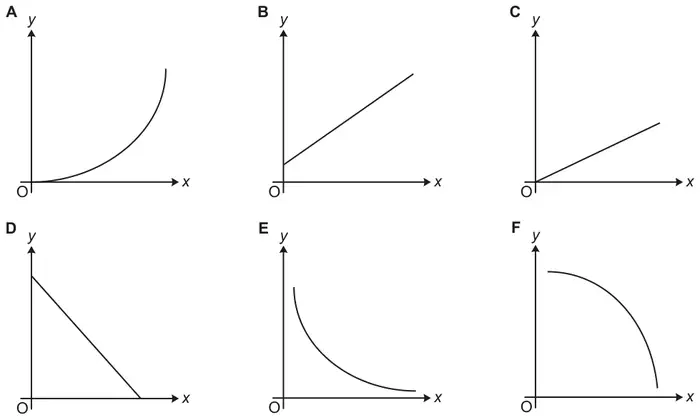
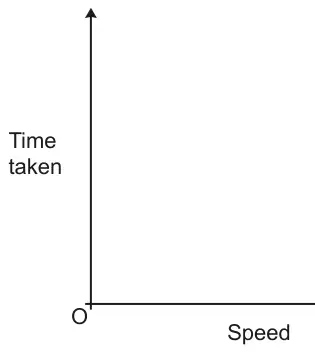
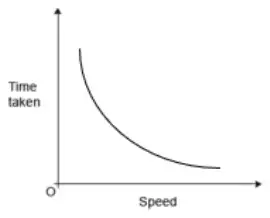
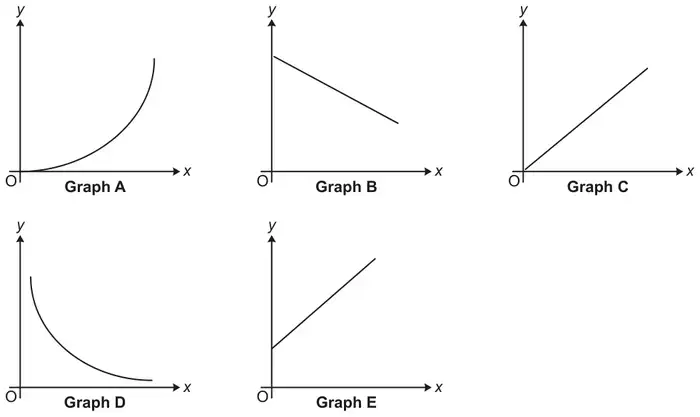
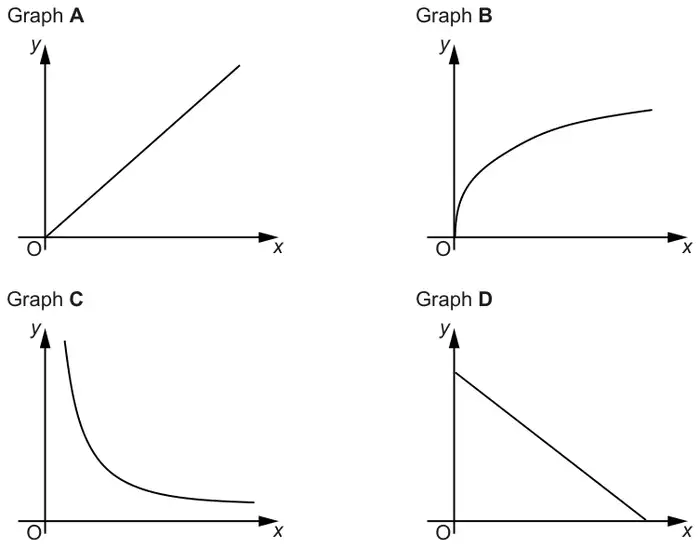
(a) The time taken to complete a journey halves as the speed doubles.
On the axes below, sketch a graph to show this relationship.
[2]
(b) It takes 40 minutes to fill a garden pond using water from 5 identical hose pipes.
Assuming the rate of flow of water from each hose pipe is the same, work out how many minutes it would take to fill the same garden pond using 2 of these hose pipes. [2]
Mark scheme (a)
Answer
Marks
Part marks and guidance
Correct shape, not touching the axes
2
Condone slight curvature away from axes at the extremes
B1 for correct curve but touching, not crossing, one or both axes
Ignore scales
Mark scheme (b)
Answer
Marks
Part marks and guidance
100
2
M1 for \(\frac{40 \times 5}{2}\) oe or B1 for 200 or 2.5 or 0.4
(a) The time taken to paint a wall is inversely proportional to the number of people painting. It takes 40 minutes for 3 people to paint the wall if nobody stops painting.
Layla, Mia and Nina start painting the wall. After 10 minutes Layla stops painting. She leaves Mia and Nina to finish painting the wall.
Assume that Layla, Mia and Nina paint at the same rate.
Work out the total time taken to paint the wall, in minutes. [3]
(b) \(y\) is inversely proportional to \(x^3\). \(y = 16\) when \(x = 2\).
Find the value of \(y\) when \(x = 8\). [3]
Mark scheme (a)
Answer
Marks
Part marks and guidance
55 nfww
3
M2 for [(40 × 3) – (10 × 3)] ÷ 2 oe implied by 45 or for [(40 × 3) – 10] ÷ 2 oe or M1 for 40 × 3 implied by 120
Alternative method: M2 for 40 + (40 — 10) ÷ 2 or M1 for (40 — 10) ÷ 2
Mark scheme (b)
Answer
Marks
Part marks and guidance
[0].25 oe
3
B1 for \(y = \frac{k}{x^3}\) oe soi by \(16 = \frac{k}{2^3}\) or \(k\) = 128
M1 for \(y = \frac{their\ k}{8^3}\)
OR
M2 for \(2^3 \times 16 = 8^3 \times y\) or \(16 \div \left(\frac{8}{2}\right)^3\)
11 \(y\) is inversely proportional to \(x^2\). \(y = 9\) when \(x = 2\).
Find the value of \(y\) when \(x = 10\). [3]
Mark scheme
Answer
Marks
Part marks and guidance
0.36 oe final answer
3
B1 for \(y = \frac{k}{x^2}\) oe soi by \(9 = \frac{k}{2^2}\) or \(k = 36\) M1 for \(y = \frac{\textit{their } k}{10^2}\) OR M2 for \(2^2 \times 9 = 10^2 \times y\) oe
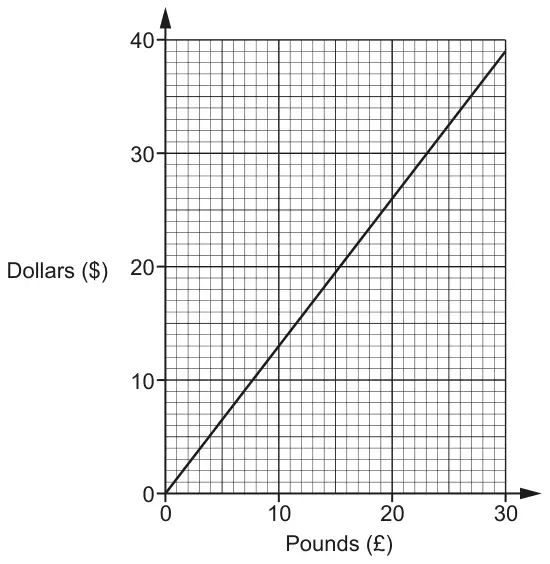
12 A conversion graph between pounds (£) and dollars ($) is shown below.
(a) Explain fully how the graph shows that the number of dollars is directly proportional to the number of pounds. [2]
(b) Use the conversion graph to change £20 into dollars. [1]
(c) Some trainers cost £170 in the UK. The same trainers cost $195 in the USA. Show that the trainers cost less in the USA. [4]
(d) If the trainers are brought from the USA there is an extra charge for tax and delivery. Alex wants to pay the lowest total amount for the trainers. Write down the maximum extra charge for tax and delivery that Alex should be willing to pay. Give your answer in dollars. [1]
Mark scheme (a)
Answer
Marks
Part marks and guidance
Straight line oe Passes through origin oe
1 1
Mark scheme (b)
Answer
Marks
Part marks and guidance
26
1
Mark scheme (c)
Answer
Marks
Part marks and guidance
$195 \(\lt\) $221 or £150 \(\lt\) £170 With correct working
4
Allow exchange rates of 1.25 to 1.35 leading to $212.5[0] to $229.5[0] or £144 to £156
M2 for \(195 \div 1.3\) or \(170 \times 1.3\) A1 for [£]150 or [$]221 or M1 for a correct exchange rate e.g. \(26 \div 20\)
OR
M2 for building up to $ equivalent of £170 or £ equivalent of $195 e.g. \(17 \times 13\) or \(8.5 \times 26\) or \(15 \times 10\) A1 for [£]150 or [$]221 or M1 for building up to £170 or $195 e.g. \(17 \times 10\) or \(8.5 \times 20\) or \(15 \times 13\) or \(170 \div 10 = 17\)
OR
M2 for \(195 \div 13\) and \(170 \div 10\) A1 for 15 and 17 or M1 for \(195 \div 13 = 15\) or \(170 \div 10 = 17\)
If 0 scored SC1 for $195 \(\lt\) ($212.5[0] to $229.5[0]) or (£144 to £156) \(\lt\) £170 with no or insufficient working, but not wrong working
Comparison in symbols or words required
Allow FT their value from (b)
Allow correctly rounded values used for M marks e.g. for £7.69 or £8 for $10 used
21 Three people take \(2\frac{1}{2}\) hours to deliver leaflets to 270 houses.
Assuming all people deliver leaflets at the same rate, how long will it take five people to deliver leaflets to 405 houses? Give your answer in hours and minutes. [4]
Mark scheme
Answer
Marks
Part marks and guidance
2 [h] 15 [m]
4
M3 for a fully correct method e.g. \(2.5 \times \dfrac{405}{270} \times \dfrac{3}{5}\)
OR
M2 for three correct steps from \(2.5 \times \dfrac{405}{270} \times \dfrac{3}{5}\) e.g. \(2.5 \times \dfrac{405}{270} \times 3\)
OR
M1 for one correct step e.g. \(\dfrac{270}{2.5}\), \(\dfrac{270}{150}\), \(\dfrac{270}{3}\), 2.5×3, 150×3, \(\dfrac{3}{5}\), \(\dfrac{405}{270}\) or \(\dfrac{405}{5}\)
if M0 or M1 scored allow SC1 for their final time as a decimal hour or their final time in minutes correctly converted to hours and minutes e.g. 2.3333[h] = 2[h] 20[min]
M3 implied by 2.25, 2 [h] 25 [min] or 135 nfww note : (405 – 270 or 270 ÷ 2 )= 135 = 2[h] 15[min] scores M0
M2 could be implied by 180, 11.25, 675 or 3 nfww
M1 could be implied by 108, 1.8, 90, 7.5, 450, 0.6, 1.5 or 81
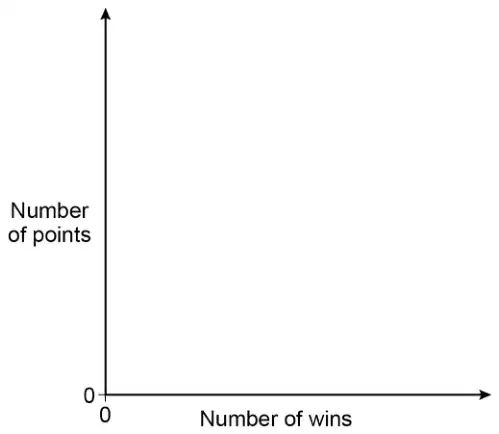
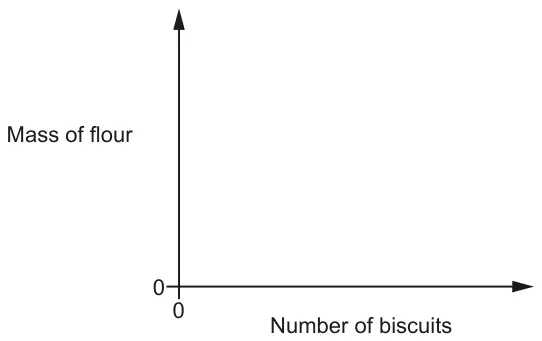
(a) The mass of flour used in a recipe doubles as the number of biscuits made doubles.
On the axes below, sketch a graph to show this relationship.
[2]
(b) Here are some of the ingredients for a recipe to make 10 biscuits.
To make 10 biscuits: 120 g butter 100 g sugar
Jane followed the recipe and used 432 g of butter. All of the sugar used came from a new 2 kg bag.
(i) Find the number of biscuits she made. [3]
(ii) Find the mass of the sugar, in grams, that Jane has left in the bag. [3]
Mark scheme (a)
Answer
Marks
Part marks and guidance
Straight line from (0, 0) with positive gradient
2
B1 for straight line with positive gradient
or a series of crosses in a straight line that would pass through (0, 0)
Intercept within 1 mm of (0, 0) (“centre of line” inside circle of overlay) For 1 or 2 marks, intended straight Ignore scale on axes At least three crosses
Mark scheme (b)
Answer
Marks
Part marks and guidance
(i) 36
3
M2 for \(432 \div 120 \times 10\) oe or M1 for \(432 \div 120\) soi 3.6 or \(120 \div 10\) soi 12
e.g. \(432 \div 12\)
120+120+120+60 = 420 oe
(ii) 1640
3
B1 for [2 kg =] 2000 seen
M1 for \(100 \times \dfrac{\textit{their } 36}{10}\) or \(10 \times\) their 36
B1 may be awarded for the conversion even if not used in method May be \(10 \times\) their 36 correctly evaluated or 360 seen
9 \(x\) is directly proportional to \(y\). \(y\) is directly proportional to \(z\).
When \(x = 10\), \(y = 60\). When \(y = 8\), \(z = 1.6\).
Find a formula for \(z\) in terms of \(x\). [4]
Mark scheme
Answer
Marks
Part marks and guidance
\(z = 1.2x\) or \(z = \frac{6x}{5}\)
4
B3 for a correct equation involving just \(x\) and \(z\) but not in required form
OR
B1 for \(y = 6x\) oe B1 for \(y = 5z\) oe M1 for a correct equation involving just \(x\) and \(z\) using their two equations
OR
B1 for \(y = 60\) when \(z = 12\) B1 for \(x : [y :]\ z\) is 10 : [60 :]12 M1 for a correct equation involving just \(x\) and \(z\) using their triple ratio or their two ratios with a common \(y\) value
If 0 scored SC1 for \(y = kx\) and \(k = 6\) found oe or for \(y = kz\) and \(k = 5\) found oe
Condone \(\propto\) for = in B1 marks and SC1 but not at B3 or full marks
e.g. \(5z = 6x\), or \(x = \frac{5z}{6}\)
Their two equations of the form \(y = ax\) oe and \(y = bz\) oe
Allow B2 for other triple ratios of the form \(5k : 30k : 6k\) or two correct ratios with a common \(y\) value
3 Three people take \(2\frac{1}{2}\) hours to deliver leaflets to 270 houses.
Assuming all people deliver leaflets at the same rate, how long will it take five people to deliver leaflets to 405 houses? Give your answer in hours and minutes. [4]
Mark scheme
Answer
Marks
Part marks and guidance
2 [h] 15 [m]
4
M3 for a fully correct method e.g. \(2.5 \times \frac{405}{270} \times \frac{3}{5}\)
OR
M2 for three correct steps from \(2.5 \times \frac{405}{270} \times \frac{3}{5}\) e.g. \(2.5 \times \frac{405}{270} \times 3\)
OR
M1 for one correct step e.g. \(\frac{270}{2.5}\), \(\frac{270}{150}\), \(\frac{270}{3}\), 2.5×3, 150×3, \(\frac{3}{5}\), \(\frac{405}{270}\) or \(\frac{405}{5}\)
if M0 or M1 scored allow SC1 for their final time as a decimal hour or their final time in minutes correctly converted to hours and minutes e.g. 2.3333[h] = 2[h] 20[min]
M3 implied by 2.25, 2 [h] 25 [min] or 135 nfww note : (405 – 270 or 270 ÷ 2 )= 135 = 2[h] 15[min] scores M0
M2 could be implied by 180, 11.25, 675 or 3 nfww
M1 could be implied by 108, 1.8, 90, 7.5, 450, 0.6, 1.5 or 81
Show that these values fit the relationship that \(y\) is inversely proportional to \(\sqrt{x}\). [2]
(b) \(a\) is inversely proportional to \(b^2\) and \(a = 3.75\) when \(b = 4\).
Find a formula linking \(a\) and \(b\). [3]
Mark scheme (a)
Answer
Marks
Part marks and guidance
any correct method e.g. two of [\(y \times \sqrt{x}\) =] \(6 \times \sqrt{4} = 12\), \(3 \times \sqrt{16} = 12\), \(2 \times \sqrt{36} = 12\) oe
or
use one pair to find \(y = \dfrac{12}{\sqrt{x}}\) and check with another pair
2
accept 6 for \(\sqrt{36}\) etc M1 for correct method with one error or omission or uses \(y = \frac{k}{\sqrt{x}}\) to find \(k = 12\) or one of [\(y \times \sqrt{x}\) =] \(6 \times \sqrt{4} = 12\), \(3 \times \sqrt{16} = 12\), \(2 \times \sqrt{36} = 12\)
alternative method : show \(x\) is × 4 and × 9 and \(y\) is ÷ 2 and ÷ 3.
Mark scheme (b)
Answer
Marks
Part marks and guidance
\(a = \dfrac{60}{b^2}\) oe
3
condone answer of \(a \propto \frac{60}{b^2}\) for 2 marks or
M1 for \(a = \dfrac{k}{b^2}\) oe implied by \(3.75 = \frac{k}{4^2}\) B1 for [\(k\) =] 60
(a) How long would it take one of these people to paint the same fence? [1]
(b) How long would it take 5 people to paint the same fence? Give your answer in hours and minutes. [4]
Mark scheme (a)
Answer
Marks
Part marks and guidance
12
1
Mark scheme (b)
Answer
Marks
Part marks and guidance
2 h 24 min nfww
4
B3 for 2 h and 0.4 \(\times\) 60 oe or 144[min] nfww or B2 for 2.4 h or M2 for \(\dfrac{\textit{their}\ 12}{5}\) or M1 for converting their 2.4 hours correctly to hours and minutes
Working may all be in minutes so award comparable M and B marks oe may be 60 ÷ 10 (= 6) \(\times\) 4
B2 for answer space completed as 2.4 [hours] and 144 [minutes] 2.4 may be \(2\frac{2}{5}\) or equivalent fraction
or their 144 minutes, if working in minutes their 2.4 hours or their 144 minutes must come from some working Their 2.4h not integer and > 1 Their 144 min not 60\(n\) and > 60