for first step to change the subject of \(y = \dfrac{5x - 3}{4}\) or \(x = \dfrac{5y - 3}{4}\) eg \(4y = 5x - 3\) or \(4x = 5y - 3\)
A1
oe
Additional guidance
Answer of \(\dfrac{4y + 3}{5}\) gets M1A0
Mark scheme (b)
Answer
Mark
Mark scheme
100
M1
for \(\mathrm{h}(5) = 1 - 2 \times 5\ (= -9)\) and a clear intention to find \(\mathrm{g}(\text{``}{-}9\text{''})\) or for \(((1 - 2 \times 5) - 1)^2\) or for stating \(\mathrm{gh}(x)\), eg \((1 - 2x - 1)^2\) oe
for \(\text{g}(1) = 5 - 3 \times 1\ (= 2)\) and a clear intention to find \(\text{f}(\text{``}2\text{''})\) or for \(\dfrac{12}{5 - 3 \times 1 + 1}\) or for stating fg, eg \(\dfrac{12}{5 - 3x + 1}\) oe
A1
cao
Additional guidance
For reference \(\text{f}(x) = \dfrac{12}{x + 1}\) and \(\text{g}(x) = 5 - 3x\)
Accept \(\dfrac{4}{1}\)
Mark scheme (c)
Answer
Mark
Mark scheme
\(\dfrac{1}{3}\)
M1
for \(\text{g}^{-1}\) as \(\dfrac{5 - x}{3}\) oe or for \(5 - 3x = 4\) or \(\text{g}\left(\dfrac{1}{3}\right) = 5 - 1 = 4\)
A1
for \(\dfrac{1}{3}\) oe eg 0.33(3…)
Additional guidance
Could be shown in the form of a flowchart, which must show correct inverse operations. Allow \(\text{g}^{-1}\) and g to be in terms of \(y\) ie accept \(\dfrac{5 - y}{3}\) and \(5 - 3y = 4\)
(c) Show that there is a number for which the output is the same as the input. (2)
Mark scheme (a)
Answer
Mark
Mark scheme
16
B1
cao
Mark scheme (b)
Answer
Mark
Mark scheme
19
M1
starts method to find input using inverse operations eg \(28 + 10\ (=38)\) or sight of \(+10\) and \(\div 2\)
A1
cao
Additional guidance
\(+10\) and \(\div 2\) could be seen in a flow diagram Working may be next to number machine.
Mark scheme (c)
Answer
Mark
Mark scheme
Shown
M1
for carrying out at least one trial or for forming a suitable equation, eg \(2x - 10 = x\) or for identifying 10
C1
for showing that an input of 10 gives an output of 10
Additional guidance
Trial can be for any value, must be correctly evaluated. Accept correct inverse function trial, correctly evaluated. If working seen on the number machine provided in the question allow for a trial other than input 13 or output 28.
for a first step to change the subject of \(y = \dfrac{\sqrt{x} + 2}{5}\) or \(x = \dfrac{\sqrt{y} + 2}{5}\), eg \(5y = \sqrt{x} + 2\) or \(5x = \sqrt{y} + 2\)
A1
oe
Mark scheme (b)
Answer
Mark
Mark scheme
55
M1
for method to find \(\mathrm{gf}(x)\), eg \(\dfrac{\sqrt{3x + 4} + 2}{5}\) or method to find \(\mathrm{g}^{-1}(3)\), eg \((5 \times 3 - 2)^2\ (= 169)\)
\(\mathrm{f}(x) = 3x^2 + 1\) for \(x \gt 0\) and \(\mathrm{g}(x) = \dfrac{4}{x^2}\) for \(x \gt 0\)
(a) Work out \(\mathrm{gf}(1)\) (2)
The function h is such that \(\mathrm{h} = (\mathrm{fg})^{-1}\)
(b) Find \(\mathrm{h}(x)\) (4)
Mark scheme (a)
Answer
Mark
Mark scheme
\(\dfrac{1}{4}\)
M1
for \(\mathrm{f}(1) = 3 \times 1^2 + 1\ (= 4)\) and a clear intention to find \(\mathrm{g}(\text{``}4\text{''})\) or for \(\dfrac{4}{(3 \times 1^2 + 1)^2}\)
or for stating \(\mathrm{gf}(x)\), eg \(\dfrac{4}{(3x^2 + 1)^2}\) oe
A1
oe
Mark scheme (b)
Answer
Mark
Mark scheme
\(\sqrt[4]{\dfrac{48}{x - 1}}\)
M1
for finding \(\mathrm{fg}(x)\), eg \(3 \times \left(\dfrac{4}{x^2}\right)^2 + 1\) or \(\dfrac{48}{x^4} + 1\)
M1
for start of method to find the inverse of \(\mathrm{fg}(x)\), eg \(y - 1 = 3 \times \left(\dfrac{4}{x^2}\right)^2\) or \(y - 1 = \dfrac{48}{x^4}\) or \(x - 1 = \dfrac{48}{y^4}\) or \(x - 1 = 3 \times \left(\dfrac{4}{y^2}\right)^2\)
M1
for \(y^4 = \dfrac{48}{x - 1}\) or \(x^4 = \dfrac{48}{y - 1}\) or for a final answer of \(\sqrt[4]{\dfrac{48}{y - 1}}\)
for \(\mathrm{f}^{-1}(x) = \sqrt[3]{\dfrac{x+4}{2}}\) OR for \(2x^3 - 4 = 50\) OR for substituting \(x = 3\) to find f(3)
C1
for substituting \(x = 50\) to show the result giving \(\mathrm{f}^{-1}(50) = 3\) OR solving for \(x\) to give \(x = 3\) OR for showing that \(\mathrm{f}(3) = 50\)
Mark scheme (b)
Answer
Mark
Mark scheme
\(x = -1\) and \(x = 2.5\)
P1
for \(\mathrm{hg}(x) = (x + 2)^2\)
P1
(dep) for start to a process to derive a quadratic equation eg. \(x^2 + 4x + 4 = 3x^2 + x - 1\)
P1
for a process to solve the quadratic equation \(2x^2 - 3x - 5 = 0\) eg \((2x - 5)(x + 1)\ (= 0)\) or \(\dfrac{--3 \pm \sqrt{(-3)^2 - 4 \times 2 \times -5}}{2 \times 2}\) or \(2\left[\left(x - \dfrac{3}{4}\right)^2 - \dfrac{9}{16} - \dfrac{5}{2}\right]\ (= 0)\)
A1
for \(x = -1\) and \(x = 2.5\)
Additional guidance
\((x + 2)^2\) must be correctly expanded
2.5 or \(2\frac{1}{2}\) or \(\frac{5}{2}\) acceptable
for first step, eg \(2((x + 1)^2 - 1)\) or \(2(x^2 + 2x + 1 - 1)\) oe
C1
for fully correct chain of reasoning
Additional guidance
It is insufficient to state \(\mathrm{gf}(x) = 2x(x + 2)\) without showing the first step, and the following sequence of algebraic steps leading to it.
Mark scheme (b)
Answer
Mark
Mark scheme
4.5
M1
process to find inverse of g, eg \(g^{-1}(x) = \dfrac{1}{2}x + 1\) or for \(2(x - 1) = 7\)
A1
for 4.5 oe
Additional guidance
Could be shown in the form of a flowchart, which must show inverse operations.
(a) Find \(\mathrm{f}(23)\) Give your answer correct to 3 significant figures. (1)
\(\mathrm{g}(x) = 2x - 3\)
(b) Find \(\mathrm{fg}(34)\) Give your answer correct to 3 significant figures. (2)
\(\mathrm{h}(x) = (x + 4)^2\)
Ivan needs to solve the following equation \(\mathrm{h}(x) = 25\)
He writes
\((x + 4)^2 = 25\) \(x + 4 = 5\) \(x = 1\)
This is not fully correct.
(c) Explain why. (1)
Mark scheme (a)
Answer
Mark
Mark scheme
1.56
B1
1.56 to 1.563
Mark scheme (b)
Answer
Mark
Mark scheme
3.63
M1
for a complete method to find \(\mathrm{fg}(34)\) eg \(4 \sin 65\) (=3.625..) or \(\mathrm{fg}(x)\) eg \(4 \sin (2x - 3)\)
A1
for answer in the range 3.6 to 3.63
Additional guidance
If an answer in the range is seen in working and then incorrectly rounded award full marks.
Mark scheme (c)
Answer
Mark
Mark scheme
Statement
C1
for statement eg positive and negative square root required.
Acceptable examples The other answer is \(-9\) The quadratic should have 2 solutions.
Not acceptable examples He has not expanded the brackets. He needed to \((x+4)\) twice as there is a squared sign. \((x+4)^2\) is 16 not 25. Didn’t expand the bracket.
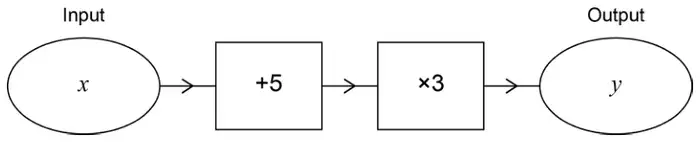
When \(\quad x = 5 \quad y = 13\) and when \(\quad x = 10 \quad y = 28\)
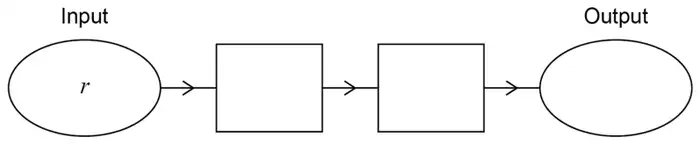
Complete the number machine. [2 marks]
Mark scheme (a)
Answer
Mark
Comments
40 in correct position in number machine
B1
Mark scheme (b)
Answer
Mark
Comments
\(+\,11\) in correct position in number machine
B1
oe operation to reach 18 eg \(-\,-11\) or \(\times\,\dfrac{18}{7}\)
Mark scheme (c)
Answer
Mark
Comments
3 and 2 in correct positions in number machine
B2
B1 correct operations for input 5, output 13 or correct operations for input 10, output 28
Additional guidance
B1 may be awarded for correct work, with no or incorrect answer, even if this is seen amongst multiple attempts
Examples of correct operations for input 5, output 13 include \(\times\,2.6\) and \(-\,0\) or \(\times\,4\) and \(-\,7\) or \(\times\,5\) and \(-\,12\)
B1
Examples of correct operations for input 10, output 28 include \(\times\,2.8\) and \(-\,0\) or \(\times\,4\) and \(-\,12\) or \(\times\,5\) and \(-\,22\)
Show that when the input increases by 2 the output increases by \(2a\). [2 marks]
(b) \(\text{f}(x) = kx^2 \quad\) where \(k\) is a constant.
Kai says that \(\dfrac{\text{f}(6)}{\text{f}(2)}\) is equal to \(\text{f}(3)\) because \(\dfrac{6}{2} = 3\)
Is he correct?
Show working to support your answer. [2 marks]
Mark scheme (a)
Answer
Mark
Comments
\((y =)\ ax + b\) and \((y =)\ ax + 2a + b\)
B2
any letter for \(x\) other than \(a\) or \(b\) or \(y\) B1 \((y =)\ ax + b\) or \((y =)\ a(x + 2) + b\) or \((y =)\ ax + 2a + b\) or substitution of two values for \(x\) with a difference of 2 and correct working to show that the output increases by \(2a\) eg substituting \(x = 3\) and \(x = 5\) to get \(3a + b\) and \(5a + b\)
Additional guidance
Allow \(xa\) for \(ax\) throughout
Do not allow \(a \times x + b\) for \(ax + b\) unless recovered
Allow, eg \((x + 2) \times a + b\) for \(a(x + 2) + b\)
Do not allow missing brackets unless recovered eg do not allow \(x + 2 \times a\) for \(a(x + 2)\)
Do not accept written answers without the necessary algebra eg The input has increased by 2 and will then be multiplied by \(a\), so the output will increase by \(2a\)
B0
Ignore further non-contradictory work if B2 awarded
Mark scheme (b)
Answer
Mark
Comments
Alternative method 1 – using \(k\)
\(\dfrac{\text{f}(6)}{\text{f}(2)} \left(= \dfrac{36k}{4k}\right) = 9\) or \(\text{f}(3) = 9k\)
M1
condone eg \(k36\)
\(\dfrac{\text{f}(6)}{\text{f}(2)} = 9\) and \(\text{f}(3) = 9k\) and No
A1
condone \(k9\)
Alternative method 2 – substituting a value for \(k\)
Identifies a value of \(k\) other than 1 and correctly evaluates \(\dfrac{\text{f}(6)}{\text{f}(2)}\) or \(\text{f}(3)\)
M1
eg \(k = 2\) and \(\dfrac{\text{f}(6)}{\text{f}(2)} = 9\) or \(\text{f}(3) = 18\)
Identifies a value of \(k\) other than 1 and correctly evaluates \(\dfrac{\text{f}(6)}{\text{f}(2)}\) and \(\text{f}(3)\) and No
A1
eg \(k = 2\) and \(\dfrac{\text{f}(6)}{\text{f}(2)} = 9\) and \(\text{f}(3) = 18\) and No
Additional guidance
\(9k\) from \(\dfrac{\text{f}(6)}{\text{f}(2)}\) is M0, but M1 can be awarded if accompanied by \(\text{f}(3) = 9k\)
Do not allow 9 from \(\dfrac{36}{4}\) (unless \(\dfrac{36}{4}\) is from \(\dfrac{36k}{4k}\))
Do not allow 9 from \(\dfrac{36k^2}{4k^2}\)
Students may correctly state that \(\dfrac{\text{f}(6)}{\text{f}(2)}\) and \(\text{f}(3)\) are (only) equal when \(k = 1\) This may replace ‘No’ in their answer, but does not score without \(9k\) and 9
Do not allow unprocessed values, eg \(6^2\), \(2^2\) or \(3^2\)
oe eg \(\dfrac{x}{2} - \dfrac{5}{2}\) may be implied eg by \(12\text{f}^{-1}(x) = 6(x - 5)\) implied by \(\dfrac{y - 5}{2}\) if \(\dfrac{x - 5}{2}\) used in subsequent working
Correctly expands \(3(2x + 5) - 12 \times\) their \(\dfrac{x - 5}{2}\) to a linear expression
M1
\(6x + 15 - 6x + 30\) if M1A1 their \(\dfrac{x - 5}{2}\) must be a function of \(x\) their \(\dfrac{x - 5}{2}\) cannot be \(2x + 5\) implied by a correct linear expression or value for \(3(2x + 5) - 12 \times\) their \(\dfrac{x - 5}{2}\)
\(\dfrac{x - 5}{2}\) and 45
A1
Additional guidance
45 with no working
Zero
45 from wrong working does not score 4 marks – mark the working seen
First A1 Condone \(y = \dfrac{x - 5}{2}\) or \(\text{f} = \dfrac{x - 5}{2}\) or \(\text{f}(x) = \dfrac{x - 5}{2}\) or \(x = \dfrac{x - 5}{2}\)
For \(6x + 15 - 6x + 30\) allow \(\dfrac{12x + 30 - 12x + 60}{2}\) but not \(6x + 15 - \dfrac{12x - 60}{2}\)
\(x = 2y + 5 \qquad \dfrac{x + 5}{2}\)
M1A0
\(6x + 15 - \dfrac{12x}{2} - \dfrac{60}{2}\) (implied by \(-15\))
Work out the value of \(\quad \text{f}^{-1}(3) + \text{f}(-0.5)\) [5 marks]
Mark scheme
Answer
Mark
Comments
Alternative method 1
\(y + 1 = \dfrac{2x}{5}\) or \(5y = 2x - 5\)
M1
\(x\) and \(y\) may be transposed oe 1st step eg \(\dfrac{y}{2} = \dfrac{x}{5} - \dfrac{1}{2}\)
\(5(y + 1) = 2x\) or \(5y + 5 = 2x\)
M1dep
\(x\) and \(y\) may be transposed oe 2nd step eg \(\dfrac{y}{2} + \dfrac{1}{2} = \dfrac{x}{5}\) implies M2
\(\dfrac{5(y + 1)}{2}\) or \(\dfrac{5y + 5}{2}\) or \(\dfrac{5(3 + 1)}{2}\) or 10
A1
may use \(x\) instead of \(y\) oe expression or calculation eg \(\dfrac{5y}{2} + \dfrac{5}{2}\) or \(\dfrac{3 + 1}{\frac{2}{5}}\)
\(\dfrac{2 \times -0.5}{5} - 1\) or \(-1.2\) or \(-\dfrac{6}{5}\) or \(-1\dfrac{1}{5}\)
M1
oe
8.8 or \(\dfrac{44}{5}\) or \(8\dfrac{4}{5}\)
A1
Alternative method 2
\(\dfrac{2x}{5} = 3 + 1\) or \(\dfrac{2x}{5} = 4\)
M1
oe
\(2x =\) their \(4 \times 5\)
M1dep
oe implies M2
10
A1
\(\dfrac{2 \times -0.5}{5} - 1\) or \(-1.2\) or \(-\dfrac{6}{5}\) or \(-1\dfrac{1}{5}\)
M1
oe
8.8 or \(\dfrac{44}{5}\) or \(8\dfrac{4}{5}\)
A1
Additional guidance
The 4th mark may be seen first and may be the only mark awarded
f may be used for \(y\)
Missing brackets must be recovered
Answer 8.8
M2A1M1A1
First three marks in Alt 1 Can be gained using a reverse function machine for a full calculation (applied to 3) which may be seen in stages eg \(3 + 1 = 4\) and \(4 \times 5 = 20\) and \(20 \div 2\) Part marks are not possible for this approach
(a) \(\mathrm{h}(x) = \sqrt[3]{x} \qquad\) for all values of \(x\)
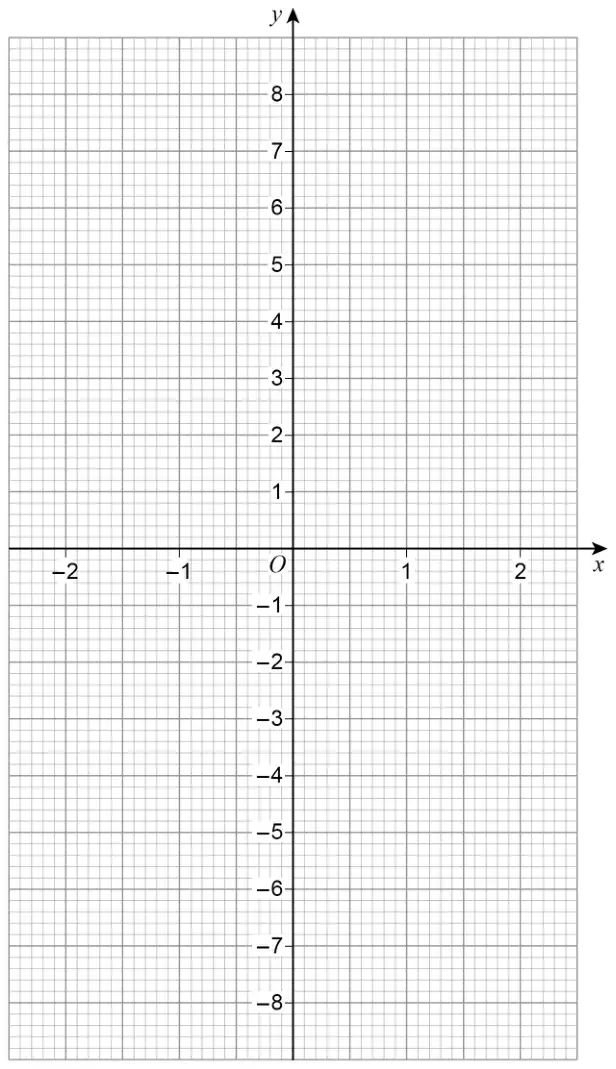
On the grid, draw the graph of the inverse function \(\;y = \mathrm{h}^{-1}(x) \quad\) for \(\;-2 \leqslant x \leqslant 2\) [2 marks]
(b) For all values of \(x\)
\(\mathrm{f}(x) = \sin x\)
\(\mathrm{g}(x) = x + 90\)
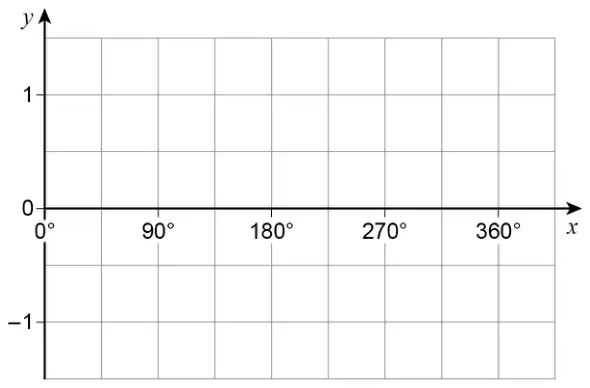
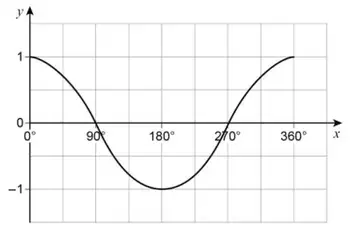
On the grid, draw the graph of the composite function \(\;y = \mathrm{fg}(x) \quad\) for \(\;0^\circ \leqslant x \leqslant 360^\circ\) [2 marks]
Mark scheme (a)
Answer
Mark
Comments
Fully correct graph passing through \((-2, -8)\ (-1, -1)\ (0, 0)\ (1, 1)\) and (2, 8)
B2
B1 \(x^3\) or \(y^3 = x\) or at least 4 points from \((-2, -8)\ (-1, -1)\ (0, 0)\ (1, 1)\) and \((2, 8)\) plotted or seen in a table Tolerance of \(\pm 1\) small square Points can be implied by graph passing through them
Additional guidance
Tolerance of \(\pm 1\) small square means it is on the edges of or within the shaded area
Ignore graph drawn outside of \(\;-2 \leqslant x \leqslant 2\)
B1 \(\sin (x + 90)\) or \(\cos x\) or at least 4 points from \((0, 1)\ (90, 0)\ (180, -1)\ (270, 0)\) and \((360, 1)\) plotted or seen in a table Mark intention
Additional guidance
Ignore graph drawn outside of \(\;0^\circ \leqslant x \leqslant 360^\circ\)
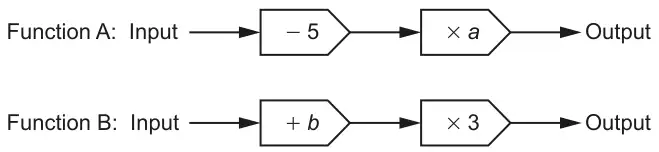
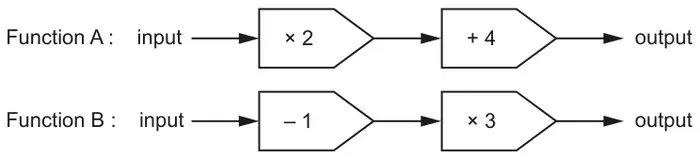
When the input for both machines is 11, the output of Function A is equal to the output of Function B. When the input for both machines is 29, the output of Function A is twice the output of Function B.
Find the value of \(a\) and the value of \(b\). [5]
e.g. \(6a = 3(11 + b)\) or better e.g. \(24a = 6(29 + b)\) or better
or B1 for any two of the expressions below \(a(11 - 5)\), \(3(11 + b)\), \(a(29 - 5)\), \(3(29 + b)\) oe
e.g \(6a\), \(24a\), \(33 + 3b\), \(87 + 3b\)
M1 for equating coefficients of one variable in their original linear equations or making \(a\) or \(b\) the subject of one of their original equations e.g. \(24a = 12(11 + b)\) and \(24a = 6(29 + b)\) or \(b = 2a - 11\)
Note : if they write two correct equations and manipulate them incorrectly e.g. expanding brackets incorrectly then they can score B2 M0 M1
M1 for correctly eliminating one variable in their linear equations with one coefficient of one variable equal e.g. \(6(29 + b) = 12(11 + b)\) oe or \(24a = 6(29 + 2a - 11)\)
B2 M2 for a correct linear equation in \(a\) or \(b\) e.g. \(2a - 11 = 4a - 29\) oe or better
Allow one arithmetical error in one of the processes For substitution award second M1 at the point of substitution
If 0 scored SC1 for \(a(x - 5)\) or \(3(x + b)\) allowing any letter for \(x\)
Trials : M1 for each attempt using values for \(a\) and \(b\) and checking both functions with 11 and 29 to a maximum of M2
Write an algebraic expression, in terms of \(x\), for the inverse of function B. [2]
(b) Function C is shown below as a composite function.
Complete the diagram below using two arithmetic operations to show function C as a single function. [4]
Mark scheme (a)
Answer
Marks
Part marks and guidance
\(\frac{x + 3}{5}\) or \(\frac{x}{5} + \frac{3}{5}\) oe
2
B1 for \(x + 3\) written in the correct place on the diagram or in the working space or B1 for answer \(\frac{x}{5} + 3\) oe or \(\frac{x - 3}{5}\) oe or \(5(x + 3)\) oe or correct answer using a different variable
\((x + 3) \div 5\) scores 2 marks \(x + 3 \div 5\) scores 1 marks
Mark scheme (b)
Answer
Marks
Part marks and guidance
\(\times 15\) \(+ 27\)
4
B3 for \(15x\) and +27 or B2 for ×15 or +27 in the correct place or M2 for \(5 \times (3(x + 2))\) [– 3] or better or M1 for \(3(x + 2)\) or better
B3 may be seen on the diagram or as an expression Note: the variable \(x\) can be any letter for the B and M marks
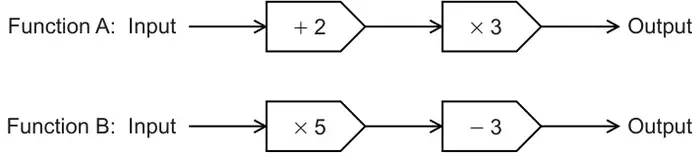
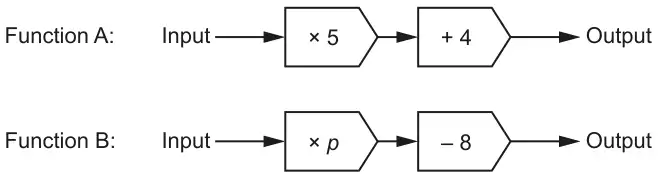
When the input of each function is 6, the output of Function A is equal to the output of Function B.
Work out the value of \(p\) in Function B. [4]
Mark scheme
Answer
Marks
Part marks and guidance
7 nfww
4
M3 for \(6p - 8\) and their \((6 \times 5 + 4)\) correctly used together or \(34 + 8 = 6p\) or \((34 + 8) \div 6\) or \(6 \times 7 - 8 = 34\) OR M1 for \(6 \times 5 + 4\) may be implied by 34 M1 for \(6p - 8\) or \(34 + 8\) or for one correctly evaluated trial
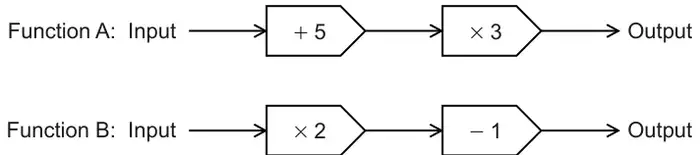
5 is input into Function A. 5 is also input into Function B. The output of Function A is 10 times the output of Function B.
Work out the value of \(k\). You must show your working. [5]
Mark scheme
Answer
Marks
Part marks and guidance
[0].7 oe with correct working
5
By Equation: M3 for \(5k + 21\) and \(10(5 - 1.5)k\) oe or M1 for \(5k + 21\) M1 for \((5 - 1.5)k\) or \(3.5k\)
AND
M1FT for \(30k = 21\)
“correct working” requires evidence of at least M3
\(5k + 21\) [M1] = \(26k\) [isw, but ruled out of M3 and M1FT if \(26k\) used] \(5 - 1.5k = 3.5k\) [M1 bod]
FT their linear equation in the form \(ak + b = ck\)
If 0 or 1 scored, instead award SC2 for answer [0].7 with no working or insufficient working If 0 scored, instead award SC1 for \(-\frac{140}{31}\) or −4.516… to −4.52 as final answer
SC1 is from ×10 of wrong function
By Trials: M4 for \(5k + 21\) and either \(10(5 - 1.5)k\) oe or \((5 - 1.5)k\) oe both correctly evaluated with \(k = 0.7\)
or
M3 for \(5k + 21\) and either \(10(5 - 1.5)k\) oe or \((5 - 1.5)k\) oe both correctly evaluated in one trial with consistent \(k\)
or M1 for \(5k + 21\) correctly evaluated in one trial M1 for either \(10(5 - 1.5)k\) oe or \((5 - 1.5)k\) oe correctly evaluated in one trial
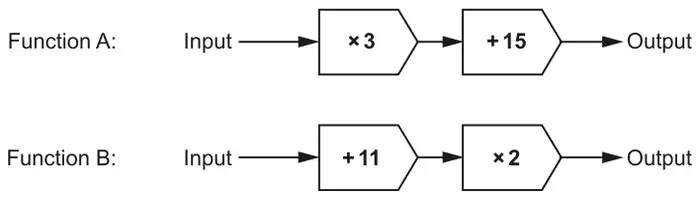
(a) Write an algebraic expression for the output of function A when the input is \(x\). [1]
(b) Here is a composite function C.
The input to function C is \(x\). The output from function C is \(2x + 1\).
Find the value of \(x\). You must show your working. [5]
Mark scheme (a)
Answer
Marks
Part marks and guidance
\(3(x + 5)\) oe final answer
1
Equivalent includes \(3x + 15\)
Mark scheme (b)
Answer
Marks
Part marks and guidance
\(-7\) with correct working
5
accept any correct method
B1 for [output = ] 2 × their{\(3(x + 5)\)} – 1 oe or output through inverse of B as \(x + 1\)
B1dep for their {2× \(3(x + 5)\) – 1} = \(2x + 1\) oe or output through inverse of A as \(\frac{x + 1}{3} - 5\) or \(x + 1\) = their {\(3(x + 5)\)}
M1 for e.g. their \(6x + 30 - 1 = 2x + 1\) or their \(3x = x + 1 - 15\) or inverse method \(\frac{x + 1}{3} - 5 = x\) M1 for their {\(4x = -28\) or \(-2x = 14\)} oe
Alternative method using trials M2 for at least two complete correct evaluations of both \(6x + 29\) oe(or functions) and \(2x + 1\) or M1 at least one complete correct evaluation of both \(6x + 29\) oe and \(2x + 1\)
If 0 or 1 scored SC3 for answer \(-7\) with no or insufficient working
“Correct working” requires evidence of at least B1B1 or B1M1 or M2 if using trials
B1 implied by \(2 \times 3(x + 5) - 1\) or better e.g. \(6x + 30 - 1\)
The first M1 is for dealing with bracket(s) correctly in a linear equation and the second M1 is for correctly getting the linear equation, with \(x\)’s on both sides, into the form \(ax = b\). We can only follow through an equation with \(x\)’s on both sides for M1 or \(x\)’s on both sides and a bracket for M2.
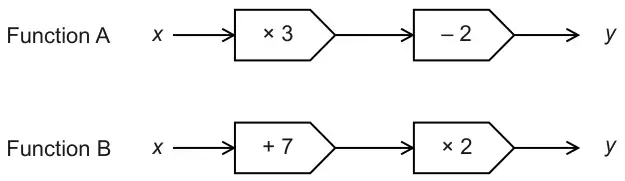
(i) Jo chooses a number, \(x\). She inputs \(x\) into each function. The two outputs are equal.
Work out the value of \(x\). [4]
(ii) Explain why there is no other input that gives two outputs that are equal. [1]
(b) Here is function C.
Kai chooses values for \(p\) and \(q\) so that if he inputs any number into both function A and function C, he will always get two outputs that are equal.
Find the value of \(p\) and the value of \(q\). [3]
Mark scheme (a)
Answer
Marks
Part marks and guidance
(i) 7
4
M2 for \(3x + 15 = 2(x + 11)\) oe or M1 for \(3x + 15\) or \(2(x + 11)\) oe
M1 for a productive step towards solving their linear equation
Alternative method by trials: M2 for at least two complete trials using the same inputs for both functions or M1 for one complete trial using the same input for both functions
A1 for at least one correct evaluation for A and one for B
Starting equation must have x on both sides e.g. from \(3x + 15 = 2(x + 11)\): M1 for \(2x + 22\) or \(x + 15 = 22\) or \(3x = 2x + 7\) or \(1.5x + 7.5 = x + 11\) e.g. from \(3x + 15 = 2x + 11\): M1 for \(x + 15 = 11\) or \(3x = 2x - 4\)
(ii) Because \(3x + 15\) and \(2(x + 11)\) are not equivalent oe
OR
\(3x + 15 = 2(x + 11)\) only has one solution oe
1
If not using the words ‘not equivalent’, must clearly imply that the two expressions will not be equal for all values of \(x\)
The mark is unlikely to be awarded unless algebra is used
Mark scheme (b)
Answer
Marks
Part marks and guidance
\(p = 5\), \(q = 3\)
3
B1 for \(p = 5\) or \(q = 3\)
M1 for \(q(x + p)\) oe or [\(3x + 15 =\)] \(3(x + p)\) or [\(3x + 15 =\)] \(q(x + 5)\)
If no working SC1 for \(p = 3\) and \(q = 5\) as answers
May be seen with a particular value of \(x\), eg. \(q(2 + p)\)
(a) Find an algebraic expression for the output of the inverse of function A when the input is \(x\). [2]
(b) Here is a composite function C.
Find the value \(x\) when \(z = 4x\). [5]
Mark scheme (a)
Answer
Marks
Part marks and guidance
\(\dfrac{x + 2}{3}\) or \(\dfrac{x}{3} + \dfrac{2}{3}\) final answer
2
M1 for \(y + 2 = 3x\) or \(x + 2 = 3y\) or for \(x = 3y - 2\) or for \([x =]\ \dfrac{y + 2}{3}\)
If 0 scored, SC1 for answer \(y = \dfrac{x}{2} - 7\)
For 2 marks, condone answer \(y = \dfrac{x + 2}{3}\) Allow M1 for correct reverse flowchart with arrows reversed ← ÷ 3 ← + 2 ←
Mark scheme (b)
Answer
Marks
Part marks and guidance
−5
5
For method marks, condone inclusion of multiplication signs Method must be seen in working space for part (b) If brackets omitted then allow recovery for method
M3 for \(2(3x - 2 + 7) = 4x\) oe or \(\dfrac{2x - 7 + 2}{3} = x\) oe
or M2 for \(2(3x - 2 + 7)\) oe seen or \(\dfrac{2x - 7 + 2}{3}\) oe seen
or M1 for \(3x - 2\) or \(3x + 5\) oe seen or \(2x - 7\) or \(2x - 5\) oe seen
For M3 eg \(2x - 7 = 3x - 2\)
M1dep for correct rearrangement of their eqn with at least 2 terms in \(x\) to \(ax + b = 0\) or better
M1dep on at least M1 earned previously e.g. \(2(3x - 2) + 7\) [\(= 4x\)] scores M1 and then can earn M1 dep if they then correctly rearrange to \(ax = b\)
Write an algebraic expression, in terms of \(x\), for the input of function A. [2]
(b) A number, \(k\), is put into function A. The output is also \(k\).
Find the value of \(k\). [3]
Mark scheme (a)
Answer
Marks
Part marks and guidance
\(\dfrac{x}{5} - 14\) oe
2
M1 for \(\dfrac{x}{5}\)
If 0 scored then SC1 for \(\dfrac{x - 14}{5}\) oe
Condone use of another letter for M1 max
Must use \(x\) in SC1 0 for \(x - 14 \div 5\)
Mark scheme (b)
Answer
Marks
Part marks and guidance
−17.5 or \(-\dfrac{35}{2}\) oe nfww
3
M1 for 5(‘\(k\)’ + 14) = ‘\(k\)’ or ‘\(k\)’ = \(\dfrac{k}{5} - 14\) M1FT for 4’\(k\)’ = −70 or better or re-arrangement of their comparable f(\(k\)) = g(\(k\)) equation into the form \(ak = b\).
M1FT solving their \(ak = b\)
eg \(5k + 14 = k\) becomes \(4k = -14\) and then \(k = -3.5\) scores M0 M1FT M1FT \(k + 70 = k\) is not comparable
Answers may be in decimal or fractional form but fractions equating to integers should be simplified
Alternative (FT as above): M1 for ‘\(k\)’ = \(\dfrac{k}{5} - 14\) M1FT for \(\dfrac{4k}{5}\) = −14 or better M1FT solving their \(ak = b\)
Find an expression for \(m\) in terms of \(p\). Give your answer in its simplest form. [4]
Mark scheme (a)
Answer
Marks
Part marks and guidance
\(x\)
\(y\)
−5
−4
2.5
11
2
B1 for one correct
Mark scheme (b)
Answer
Marks
Part marks and guidance
\(y = 5(x - 4)\) oe
or
\(x \to \boxed{-\,4} \to \boxed{\times 5} \to y\)
2
M1 for correct operations in correct order but poor notation eg \(y = x - 4 \times 5\) or \(5(x - 4)\) oe \(\to \boxed{-\,4} \to \boxed{\times 5} \to\) (as minimum allow \(-4\), \(\times 5\) if intent clear)
or for correct operations in reverse order eg implied by \(y = 5x - 4\) \(x \to \boxed{\times 5} \to \boxed{-\,4} \to y\)
For 2 marks and M1 condone \(x\) and \(y\) transposed in algebraic expression or transposed in flow diagram.
M0 for wrong order and poor notation \(\to \boxed{\times 5} \to \boxed{-\,4} \to\)
Mark right-to-left flow diagrams in a similar way
Condone correct flow diagram followed by incorrect algebra or vice-versa
Mark scheme (c)
Answer
Marks
Part marks and guidance
\(5p - 3\) as final answer
4
M1 for \(2p + 4 - 4\) soi M1 for their \(2p \times 5\) soi M1 for their \(10p \div 2\) M1 for their \(5p - 3\) Maximum 3 marks if answer incorrect
Output of function A is \(10p\) implies first M1M1
Alternative method: M1 for \(2(m + 3)\) soi
Use of function A
M1 for \(\dfrac{\mathit{their}\,2(m + 3)}{5} + 4\) soi
Use of function B with output of A
M1 for their \(\dfrac{2(m + 3)}{5} + 4 = 2p + 4\) or better
Equating their output of B with \(2p + 4\)
M1FT for rearranging their equation to isolate \(m\)
Maximum 3 marks if answer incorrect
Their equation must be of form \(\dfrac{am + b}{5} + 4 = 2p + 4\) oe where \(a \ne 0\) and \(b \ne 0\), leading to (\(m =\)) \(\dfrac{10p - b}{a}\) and then simplified if possible
Accept another letter used consistently for \(m\) or \(p\) but not \(m\) and \(p\) interchanged