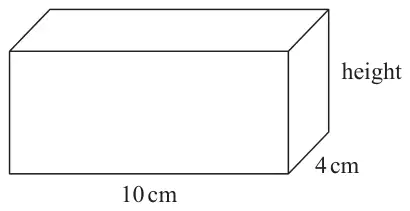
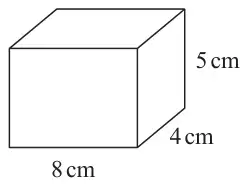
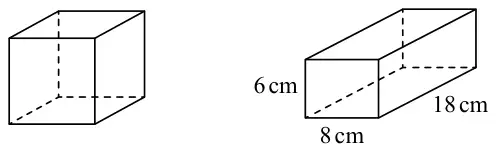
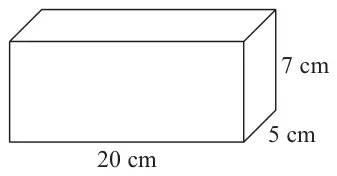
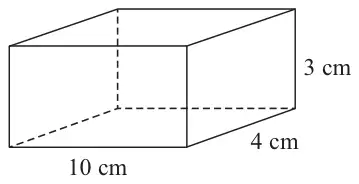
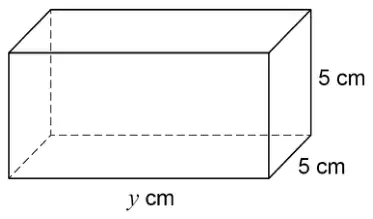
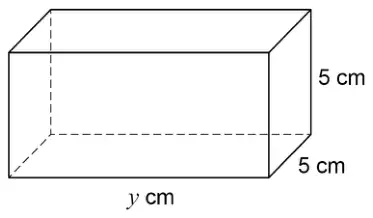
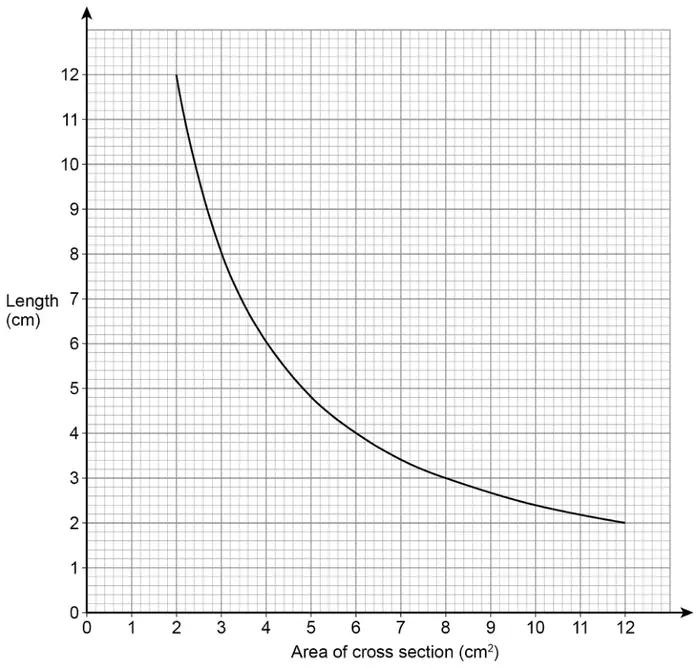
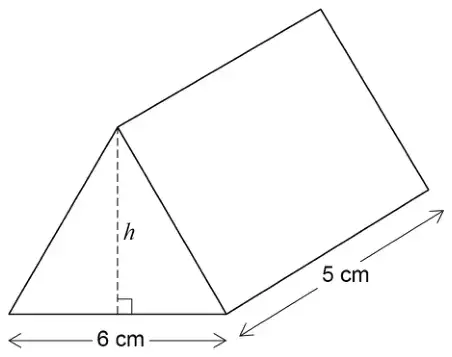
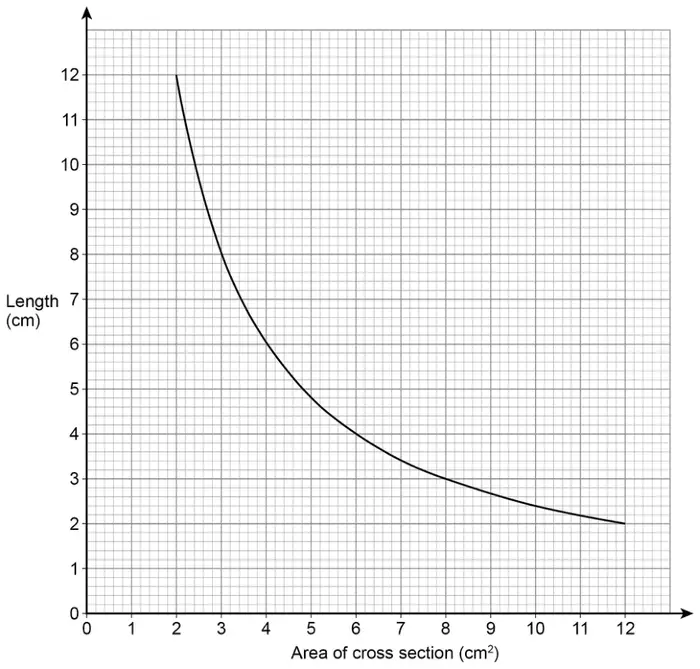
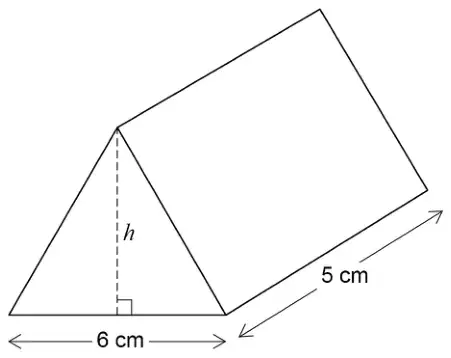
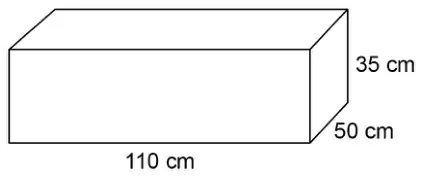
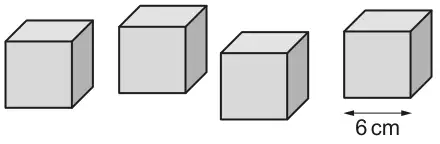
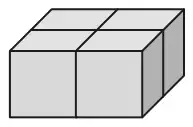
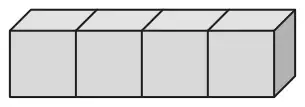
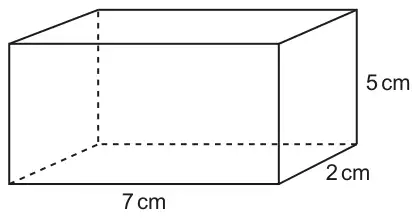
14 Here is a cuboid of length 10 cm and width 4 cm.
The cuboid has a volume of 200 cm3
(a) Work out the height of the cuboid. (2)
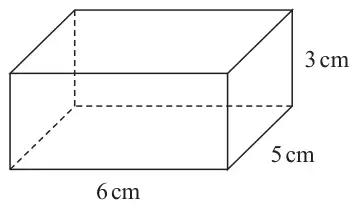
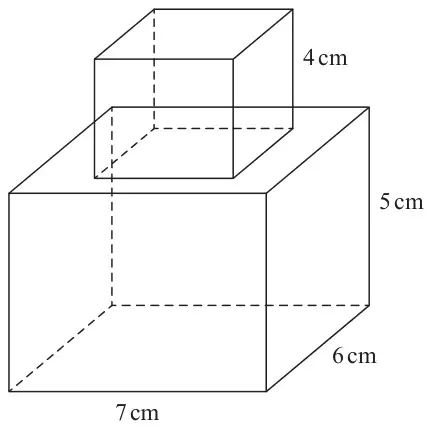
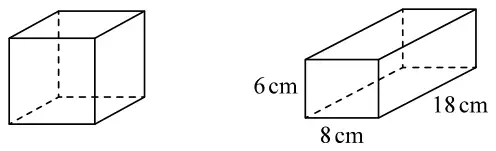
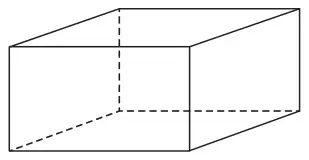
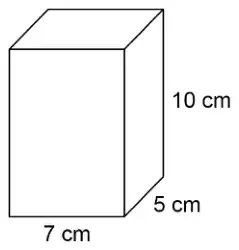
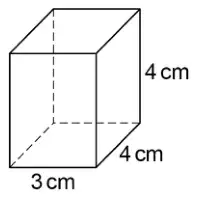
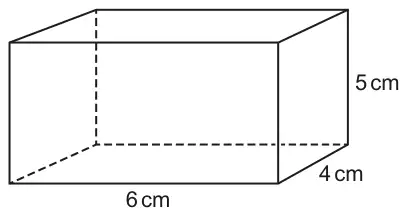
Here is a different cuboid.
(b) Work out the total surface area of this cuboid. (3)
Mark scheme (a)
Answer
Mark
Mark scheme
5
P1
for a start of a method to find the height, eg \(10 \times 4\ (= 40)\) or \(200 \div 10\ (= 20)\) or \(200 \div 4\ (= 50)\)
or for forming a correct equation \(10 \times 4 \times h = 200\)
A1
cao
Mark scheme (b)
Answer
Mark
Mark scheme
126
M1
for a start to find the area of at least one face, eg \(6 \times 3\ (= 18)\) or \(5 \times 3\ (= 15)\) or \(6 \times 5\ (= 30)\)
M1
for combining the area of at least three of the correct faces eg \(\text{``}18\text{''} + \text{``}15\text{''} + \text{``}30\text{''}\ (= 63)\) or \(2 \times \text{``}18\text{''} + \text{``}15\text{''}\)
A1
cao
Additional guidance
Do not award first M if multiplied by a third length (ie volume calculation)
May be part of a larger addition including incorrect areas. Do not award if more than 6 areas added.
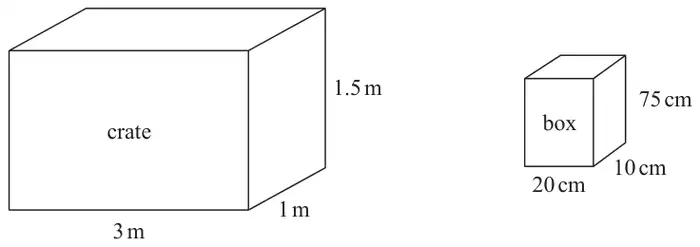
The crate is 3 m by 1 m by 1.5 m. The crate is completely filled with boxes. Each box is 20 cm by 10 cm by 75 cm.
Work out the number of boxes in the crate. (4)
Mark scheme
Answer
Mark
Mark scheme
300
B1
(indep) for process to convert to common units, eg \(3 \times 100\ (= 300)\) or \(1 \times 100\ (= 100)\) or \(1.5 \times 100\ (= 150)\) or \(20 \div 100\ (= 0.2)\) or \(10 \div 100\ (= 0.1)\) or \(75 \div 100\ (= 0.75)\) or \(\text{``}4.5\text{''} \times 100^3\ (= 4\,500\,000)\) or \(\text{``}15\,000\text{''} \div 100^3\ (= 0.015)\)
P1
for finding the volume of either shape, eg \(3 \times 1 \times 1.5\ (= 4.5)\) or \([300] \times [100] \times [150]\ (= 4\,500\,000)\) or \(20 \times 10 \times 75\ (= 15\,000)\) or \([0.2] \times [0.1] \times [0.75]\ (= 0.015)\)
OR
for start of the process to find the number of boxes using one dimension, eg \([300] \div 20\ (= 15)\) or \([100] \div 10\ (= 10)\) or \([150] \div 75\ (= 2)\) or \(3 \div [0.2]\ (= 15)\) or \(1 \div [0.1]\ (= 10)\) or \(1.5 \div [0.75]\ (= 2)\)
P1
(dep on P1) for a complete process with or without unit conversion eg \(\text{``}4\,500\,000\text{''} \div \text{``}15\,000\text{''}\) or \(\text{``}4.5\text{''} \div \text{``}0.015\text{''}\)
or \(\text{``}15\text{''} \times \text{``}10\text{''} \times \text{``}2\text{''}\)
A1
cao
Additional guidance
This mark can be awarded at any stage One correct conversion for their process is enough for the award of this mark Working may be seen on the diagram
[300] = 3 or 30 or “300” or 3000 [100] = 1 or 10 or “100” or 1000 [150] = 1.5 or 15 or “150” or 1500 [0.2] = 20 or 2 or “0.2” or 0.02 [0.1] = 10 or 1 or “0.1” or 0.01 [0.75] = 75 or 7.5 “0.75” or 0.075
May be implied by correctly dividing the areas of the corresponding faces eg \(\dfrac{[300] \times [100]}{20 \times 10}\)
Condone an incorrect attempt to convert volume before division
22 A cube has a total surface area of 150 cm\(^2\)
Work out the volume of the cube. (4)
Mark scheme
Answer
Mark
Mark scheme
125
P1
for process to find area of one face, eg \(150 \div 6\ (= 25)\) or \(6x^2 = 150\)
P1
for process to find side length, eg \(\sqrt{\text{``}25\text{''}}\ (= 5)\)
P1
for a complete process to find volume, eg \(\text{``}5\text{''} \times \text{``}5\text{''} \times \text{``}5\text{''}\) or \(\text{``}25\text{''} \times \text{``}5\text{''}\)
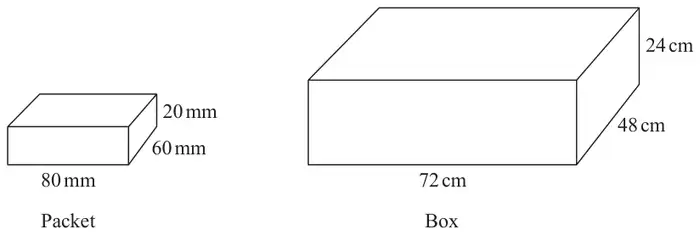
Each packet is a cuboid, 80 mm by 60 mm by 20 mm. Each box is a cuboid, 72 cm by 48 cm by 24 cm.
Work out the greatest number of packets that can be put into each box. (4)
Mark scheme
Answer
Mark
Mark scheme
864
B1
(indep) for process to convert to common units, eg \(72 \times 10\ (= 720)\) or \(48 \times 10\ (= 480)\) or \(24 \times 10\ (= 240)\) or \(80 \div 10\ (= 8)\) or \(60 \div 10\ (= 6)\) or \(20 \div 10\ (= 2)\) or or \(\text{``}96000\text{''} \div 10^3\ (= 96)\) or \(\text{``}82944\text{''} \times 10^3\ (= 82944000)\) or \(\text{``}0.864\text{''} \times 10^3\)
P1
for using volume, eg \(80 \times 60 \times 20\ (= 96000)\) or \(72 \times 48 \times 24\ (= 82944)\) or for start of process to find number of packets using one dimension, eg \(\text{``}720\text{''} \div 80\ (= 9)\) or \(\text{``}480\text{''} \div 60\ (= 8)\) or \(\text{``}240\text{''} \div 20\ (= 12)\) or \(48 \div \text{``}8\text{''}\ (= 6)\) or \(72 \div \text{``}2\text{''}\ (= 36)\) or \(24 \div \text{``}6\text{''}\ (= 4)\)
P1
for full process with or without unit conversion, eg \(\text{``}82\,944\,000\text{''} \div \text{``}96000\text{''}\) or \(\text{``}82944\text{''} \div \text{``}96\text{''}\) or for \(\text{``}9\text{''} \times \text{``}8\text{''} \times \text{``}12\text{''}\) or \(\text{``}36\text{''} \times \text{``}6\text{''} \times \text{``}4\text{''}\) or \(\text{``}0.9\text{''} \times \text{``}0.8\text{''} \times \text{``}1.2\text{''}\ (= 0.864)\)
A1
cao
Additional guidance
This mark can be awarded at any stage One correct conversion for their method is enough for the award of this mark
Working may be seen on diagram. May be implied by correctly dividing the areas of corresponding faces
for process to find area of one face, eg \(150 \div 6\ (= 25)\)
or \(6x^2 = 150\)
P1
for process to find side length, eg \(\sqrt{\text{``}25\text{''}}\ (= 5)\)
P1
for a complete process to find volume, eg \(\text{``}5\text{''} \times \text{``}5\text{''} \times \text{``}5\text{''}\) or \(\text{``}25\text{''} \times \text{``}5\text{''}\)
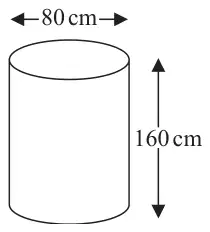
24 Karina has 4 tanks on her tractor. Each tank is a cylinder with diameter 80 cm and height 160 cm.
The 4 tanks are to be filled completely with a mixture of fertiliser and water.
The fertiliser has to be mixed with water in the ratio \(1 : 100\) by volume. Karina has 32 litres of fertiliser.
1 litre = 1000 cm\(^3\)
Has Karina enough fertiliser for the 4 tanks? You must show how you get your answer. (4)
Mark scheme
Answer
Mark
Mark scheme
Yes (supported)
P1
for a process to find the volume of 1 tank eg \(\pi \times 40^2 \times 160\ (= 804247.7… \text{ or } 804.2... \text{ or } 256000\pi)\)
P1
for complete process to find the volume of 4 tanks, [volume of tank] \(\times\ 4\) eg \(\pi \times 40^2 \times 160 \times 4\ (= 3216990.8… \text{ or } 3216.9... \text{ or } 1024000\pi)\) or for process to find volume of fertiliser available per tank eg \(32 \times 1000 \div 4\ (= 8000)\)
P1
for a process to find the amount of mixture for 1 tank eg [volume of tank] \(\div\ 101\ (= 7962.8...)\) or 4 tanks \((= 31851.3…)\) OR for a process to find volume of mixture that 32 litres of fertiliser will make eg \(32000 \times 101\ (= 3232000)\) or \(32 \times 101\ (= 3232)\)
C1
for Yes supported by correct figures shown eg a comparable figure in the range 31.8 to 31.9 (litres) or in the range 31800 to 31900 with 32000 (cm³) or in the range 3216 to 3217 with 3232 (litres) or in the range 3216000 to 3217000 with 3232000 (cm³) or in the range 7958 to 7963 with 8000 (cm³)
Additional guidance
First P1: Could be truncated or rounded
Second P1: For this mark [volume of tank] must come from a calculation involving \(\pi\), \(r^2\), \(h\)
Third P1: For this mark [volume of tank] must come from a calculation involving \(\pi\), \(r^2\), \(h\) or be stated as their volume
C1: There are other possible pairs of values which can be used in the comparison
for a process to find the total surface area of at least 5 faces for each solid, eg \(\text{``}35\text{''} \times 2 + \text{``}30\text{''} \times 2 + \text{``}42\text{''}\) and \(\text{``}16\text{''} \times 6\) or \(\text{``}35\text{''} \times 2 + \text{``}30\text{''} \times 2 + \text{``}42\text{''} \times 2\) and \(\text{``}16\text{''} \times 5\)
A1
cao
Additional guidance
Total surface area of cuboid = 214 Total surface area of cube = 96
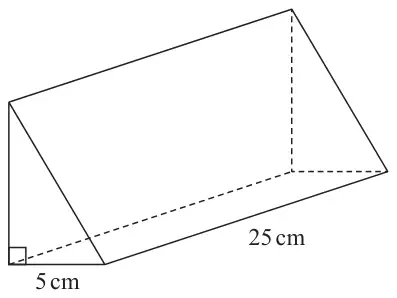
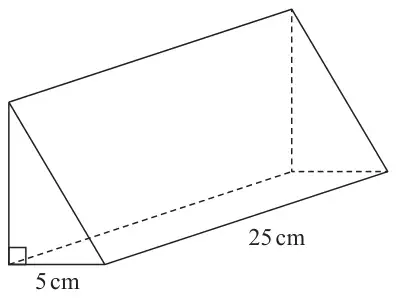
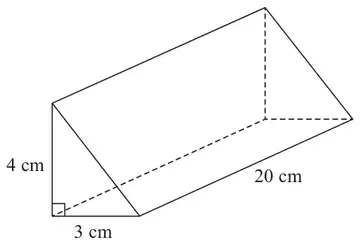
The cross section of the prism is a right-angled triangle. The base of the triangle has length 5 cm
The prism has length 25 cm The prism has volume 750 cm3
Work out the height of the prism. (3)
Mark scheme
Answer
Mark
Mark scheme
12
P1
for a process to find the area of cross section, eg \(750 \div 25\ (= 30)\) oe or \(\dfrac{1}{2} \times 5 \times h\) oe
P1
for a correct equation in \(h\), eg \(750 \div 25 = \dfrac{1}{2} \times 5 \times h\) oe or \(\dfrac{1}{2} \times 5 \times h \times 25 = 750\) oe or for a complete process to find \(h\), eg \(\dfrac{750}{25} \times \dfrac{2}{5}\) oe or \(\text{``}30\text{''} \times 2 \div 5\)
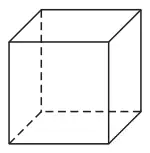
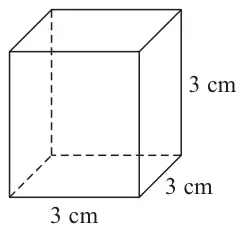
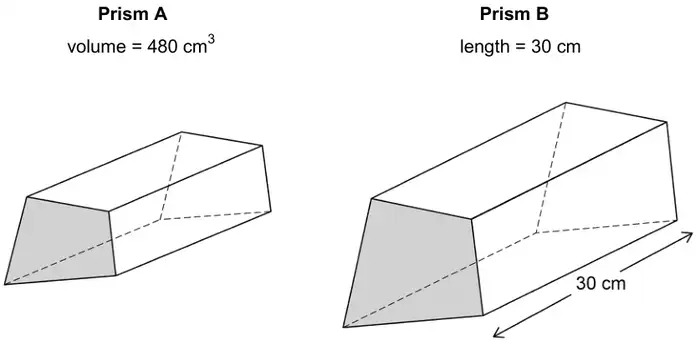
The total surface area of the cube is equal to the total surface area of the cuboid.
Janet says,
“The volume of the cube is equal to the volume of the cuboid.”
Is Janet correct? You must show how you get your answer. (5)
Mark scheme
Answer
Mark
Mark scheme
No (supported)
P1
for finding the area of 3 or more faces of the cuboid and adding eg \((6 \times 8) + (8 \times 18) + (6 \times 18) \ldots\) or \(\text{``}48\text{''} + \text{``}144\text{''} + \text{``}108\text{''} \ldots\ (= 300)\)
P1
complete process to find surface area of cuboid, eg \(6 \times 8 \times 2 + 6 \times 18 \times 2 + 8 \times 18 \times 2\ (= 600)\)
P1
for process to find side length of cube, eg [surface area] \(\div\ 6\) and square rooting \((= 10)\) OR for a process to find the volume of the cuboid \(6 \times 8 \times 18\ (= 864)\) and cube rooting \((= 9.52...)\) to find a side length
P1
(dep on previous P1) for processes to find volume of cube and volume of cuboid, eg [side length]\(^3\ (= 1000)\) and \(6 \times 8 \times 18\ (= 864)\) OR (dep on previous P1) for process to find surface area of cube, eg. \((\text{``}9.52...\text{''})^2 \times 6\ (= 544.28...)\)
A1
No with 1000 and 864 OR No with 600 and 544(.28...)
Additional guidance
Could be an addition of any three faces eg 48 + 48 + 144 etc.
[surface area] must come from the addition of at least three attempts at area, but not from volume.
The third and fourth marks are printed in two columns: the first method in each of those rows goes with the first method in the other, and the method after OR goes with the method after OR.
The total surface area of the cube is equal to the total surface area of the cuboid.
Janet says,
“The volume of the cube is equal to the volume of the cuboid.”
Is Janet correct? You must show how you get your answer. (5)
Mark scheme
Answer
Mark
Mark scheme
No (supported)
P1
for finding the area of 3 or more faces of the cuboid and adding eg \((6 \times 8) + (8 \times 18) + (6 \times 18) \ldots\) or \(\text{``}48\text{''} + \text{``}144\text{''} + \text{``}108\text{''} \ldots\ (= 300)\)
P1
complete process to find surface area of cuboid, eg \(6 \times 8 \times 2 + 6 \times 18 \times 2 + 8 \times 18 \times 2\ (= 600)\)
P1
for process to find side length of cube, eg [surface area] \(\div\, 6\) and square rooting (= 10) or for a process to find the volume of the cuboid \(6 \times 8 \times 18\ (= 864)\) and cube rooting \((= 9.52\ldots)\) to find a side length
P1
(dep on previous P1) for processes to find volume of cube and volume of cuboid, eg [side length]\(^3\ (= 1000)\) and \(6 \times 8 \times 18\ (= 864)\) or (dep on previous P1) for process to find surface area of cube, eg. \((\text{``}9.52\ldots\text{''})^2 \times 6\ (= 544.28\ldots)\)
A1
No with 1000 and 864 OR No with 600 and 544(.28…)
Additional guidance
Could be an addition of any three faces eg \(48 + 48 + 144\) etc.
[surface area] must come from the addition of at least three attempts at area, but not from volume.
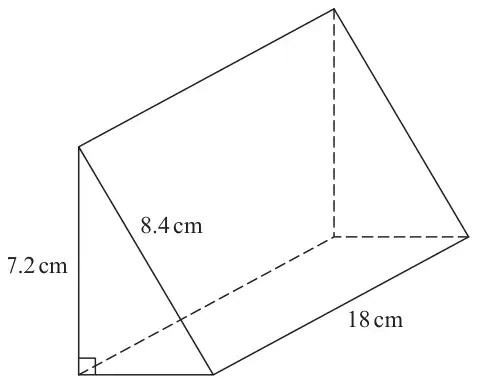
Work out the volume of the prism. Give your answer correct to 3 significant figures. (5)
Mark scheme
Answer
Mark
Mark scheme
280
P1
for starting to use Pythagoras to find the missing side eg \(8.4^2 - 7.2^2\ (= 18.72)\)
P1
for a complete process to find the missing side eg \(\sqrt{70.56 - 51.84}\) or \(\sqrt{18.72}\) (=4.32....)
P1
(dep P1) for a process to find the area of the triangular face eg ([length of base] \(\times\ 7.2) \div 2\) (=15.57..) OR the volume of the cuboid eg [length of base] \(\times\ 7.2 \times 18\) (=560.7..)
P1
for a complete process to find the volume of the prism eg \(\text{``}15.5..\text{''} \times 18\) or \(\text{``}560.7..\text{''} \div 2\)
A1
answer in the range 278 – 281
Additional guidance
Award P1 for a correct Pythagorean statement eg \(x^2 + 7.2^2 = 8.4^2\)
4.3 truncated or rounded can imply P2
Uses a figure they show as the length of the base of the right angled triangle but dep on P1 Allow 15.57.. truncated or rounded if unsupported
If an answer is given in the range 278 to 281 but then incorrectly given to 3 sig fig this mark can still be awarded.
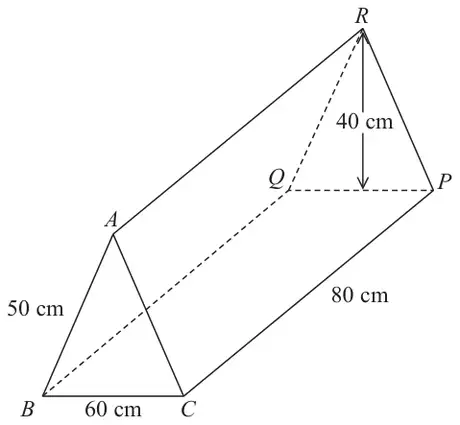
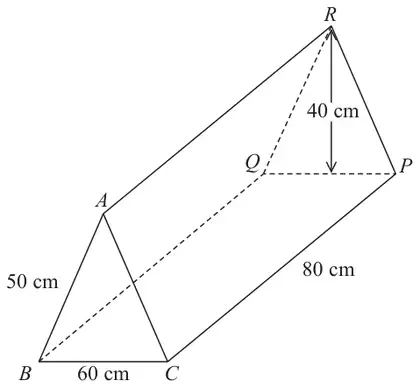
23 Frances grows plants in a container. Each of the 5 faces of the container is made of glass.
Diagram NOT accurately drawn
The container is in the shape of a prism. The cross section of the prism is an isosceles triangle with height 40 cm.
\(BC = 60\) cm \(AB = AC = 50\) cm \(CP = 80\) cm
Work out the total area of glass needed to make the container. (3)
Mark scheme
Answer
Mark
Notes
15 200
3
M1 for a method to obtain at least two different areas from \(50 \times 80\) (= 4000), \(\frac{1}{2} \times 40 \times 60\) (= 1200), \(60 \times 80\) (= 4800) M1 (dep on M1) for adding at least 4 correct face areas A1 cao
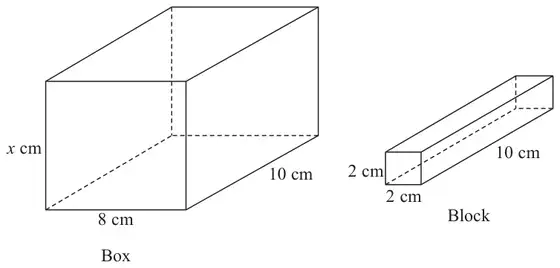
Each box is a cuboid \(x\) cm by 8 cm by 10 cm. Each block is a cuboid 2 cm by 2 cm by 10 cm.
24 blocks completely fill a box.
Work out the value of \(x\). (4)
Mark scheme
Answer
Mark
Notes
12
4
M1 for a correct expression for the volume of a block e.g. \(2 \times 2 \times 10\) (= 40) M1 for a correct expression for the volume of a box e.g. \(10 \times 8 \times x\) or for \(\text{``}40\text{''} \times 24\) M1 for a complete method to find \(x\) e.g. \((\text{``}40\text{''} \times 24) \div (10 \times 8)\) A1 cao
or M1 for a method to find number of blocks that can fit in a bottom row of the box \(8 \div 2\) (= 4) M1 for a method to find the number of rows \(24 \div 4\) (= 6) M1 for a complete method to find \(x\) e.g. \(\text{``}6\text{''} \times 2\) A1 cao
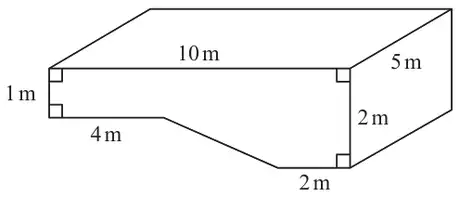
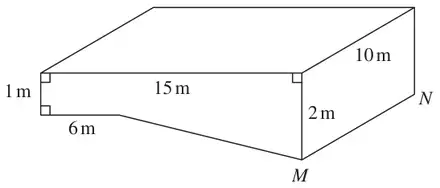
*16 The diagram shows a swimming pool in the shape of a prism.
Diagram NOT accurately drawn
The swimming pool is empty.
Water from 3 water tankers is going to be put into the pool. There are 20 000 litres of water in each water tanker.
Sam thinks that the surface of the water in the pool will be 10 cm below the top of the pool.
Is Sam correct? You must show how you get your answer. (1 m\(^3\) = 1000 litres) (5)
Mark scheme
Answer
Mark
Notes
No with correct calculations
5
M1 for splitting the cross section into separate areas and a method to find the area of one part OR for splitting up the pool into smaller prisms and a method to find the volume of one prism, e.g. a cuboid M1 (dep) for a complete method to find the cross-sectional area OR for a method to find the volume of more than one prism M1 (dep) for a complete method to find the vol of the pool (= 70 (m\(^3\))) OR for a complete method to find the depth of 60000L of water M1 for method to find figure for comparison, eg distance between surface and top of pool \((\text{``}70\text{''} - \text{``}60\text{''}) \div (5 \times 10)\) C1 No, with correct calculations, eg water level is 20cm below top of pool
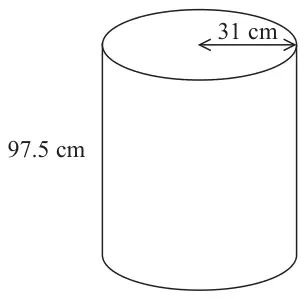
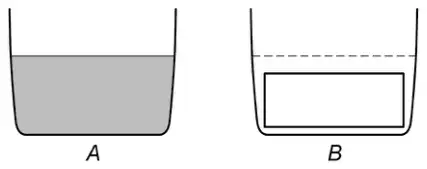
12 Sanders has a water tank for storing rainwater.
Diagram NOT accurately drawn
The tank is in the shape of a cylinder. The radius of the cylinder is 31 cm. The height of the cylinder is 97.5 cm.
The tank is full of water. Work out an estimate for the volume of water in the tank. Give your answer in litres. You must show your working.
Use 1000 cm\(^3\) = 1 litre. (3)
Mark scheme
Answer
Mark
Notes
270
3
M1 for correct use of formula for volume of a cylinder using exact or (some) approximate figures eg \(\pi \times 31^2 \times 97.5\) or \(\pi \times 31^2 \times 100\) or using an estimate of \(\pi\) eg \(\pi = 3\) in the volume formula
M1 for a complete method to find an estimate for the volume in cm\(^3\) with at least 2 values rounded eg \(\pi \times 30^2 \times 100\) (= 270 000) eg \(3.1 \times 30^2 \times 100\) eg \(3 \times 31^2 \times 100\)
A1 accept answer in the range 270 − 300 from a method using estimates
7 Frances grows plants in a container. Each of the 5 faces of the container is made of glass.
Diagram NOT accurately drawn
The container is in the shape of a prism. The cross section of the prism is an isosceles triangle with height 40 cm.
\(BC = 60\) cm \(AB = AC = 50\) cm \(CP = 80\) cm
Work out the total area of glass needed to make the container. (3)
Mark scheme
Answer
Mark
Notes
15 200
3
M1 for a method to obtain at least 2 different areas from \(50 \times 80\) (= 4000), \(\dfrac{1}{2} \times 40 \times 60\) (= 1200), \(60 \times 80\) (= 4800) M1 (dep on M1) for adding at least 4 correct face areas A1 cao
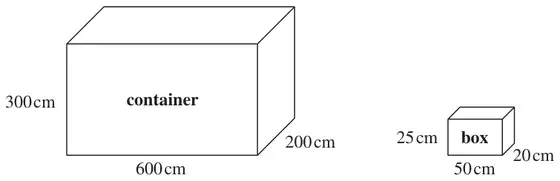
The container is a cuboid, 600 cm by 300 cm by 200 cm. Each box is a cuboid, 50 cm by 25 cm by 20 cm.
Work out the largest number of boxes that can be packed into the container. (3)
Mark scheme
Answer
Mark
Notes
1440
3
M1 for correct method to find volume of a cuboid eg \(300 \times 600 \times 200\) (= 36000000) or \(25 \times 50 \times 20\) (= 25000) M1 (dep) for “volume of container” \(\div\) “volume of box” A1 cao Ignore units.
OR M1 for correct method to find number of boxes along one edge eg \(300 \div 25\) (= 12) or \(600 \div 50\) (= 12) or \(200 \div 20\) (= 10) M1 (dep) for intention to use 3 values to find total number of boxes A1 cao Ignore units.
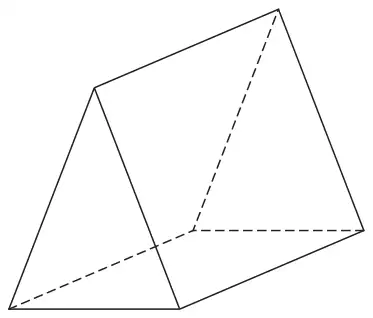
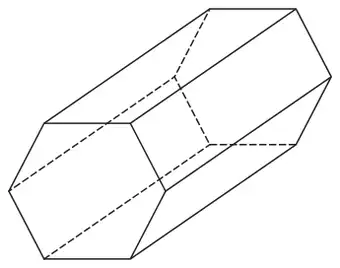
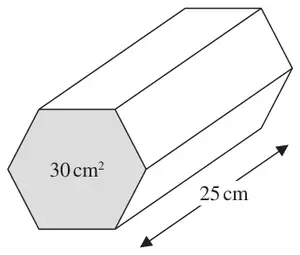
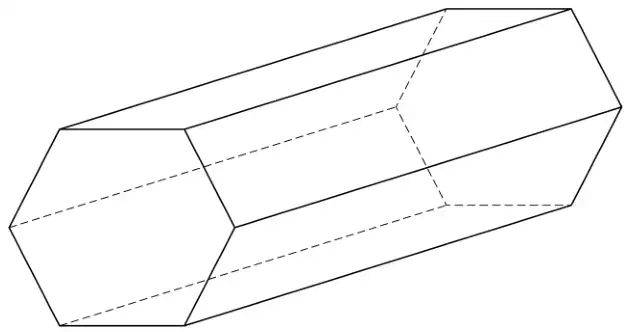
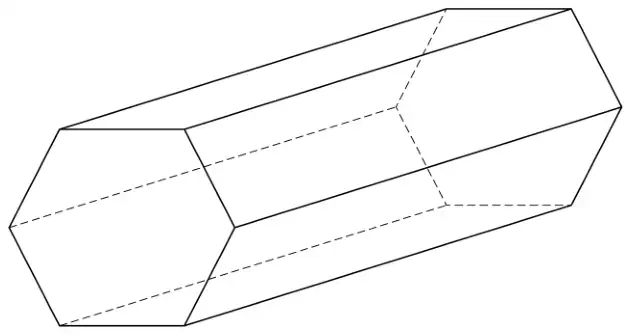
The cross section of the prism is a regular hexagon.
(b) In the space below, sketch a net of the prism. (2)
Diagram NOT accurately drawn
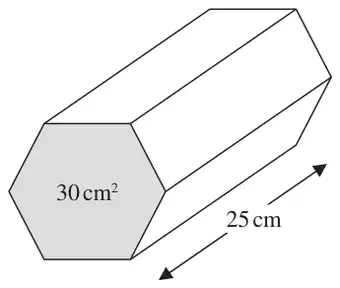
The area of the cross section of the prism is 30 cm2. The length of the prism is 25 cm.
(c) Work out the volume of the prism. (3)
Mark scheme (a)
Answer
Mark
Notes
(i) 12 (ii) 8
2
(i) B1 cao (ii) B1 cao
Mark scheme (b)
Answer
Mark
Notes
Sketch of net
2
M1 for attempt to draw net with 2 of the following 3 features: 6 rectangles 2 polygon faces with at least 5 edges a net with correct connections to give at least one vertex with 3 faces meeting. A1 for a correct net
Mark scheme (c)
Answer
Mark
Notes
750 cm3
3
M1 for \(30 \times 25\) A1 for 750 B1 (indep) for cm3
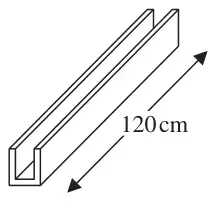
14 The diagram shows a metal bar in the shape of a prism.
Diagram NOT accurately drawn
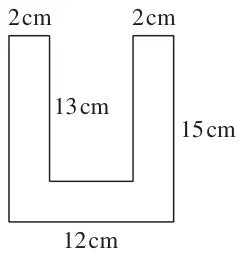
The length of the metal bar is 120 cm. The cross section of the metal bar is shown below.
Diagram NOT accurately drawn
All corners are right angles.
The metal bar is made from steel with density 8 g/cm\(^3\).
Sean has a trolley. The trolley can carry a maximum mass of 250 kg.
How many metal bars can the trolley carry at the same time? You must show your working. (5)
Mark scheme
Answer
Mark
Notes
3
5
M1 for a complete method to find the area of the cross section, eg. \(15 \times 2 + \text{``}(12 - 4)\text{''} \times 2 + 15 \times 2\) (= 76) or for finding the volume of a relevant prism, eg. \(15 \times 2 \times 120\) (= 3600) NB: "(12 − 4)" maybe just seen on the diagram
M1 for a method to find the volume of the bar, eg. \(\text{``}76\text{''} \times 120\) (= 9120) or ft "area of cross section" \(\times\) 120 provided "area of cross section" includes a method to find the area of at least two relevant rectangles
M1 for "volume" \(\times\) 8, eg. \(\text{``}9120\text{''} \times 8\) (= 72960) or \(250 \times 1000 \div 8\) (= 31250) NB "volume" must be dimensionally correct
M1 (dep on previous M1) for \(250 \div (\text{``}\text{volume}\text{''} \times 8 \div 1000)\), eg. \(250 \div \text{``}72960 \div 1000\text{''}\) (= 3.4265….) or \(\text{``}31250\text{''} \div \text{``}9120\text{''}\)
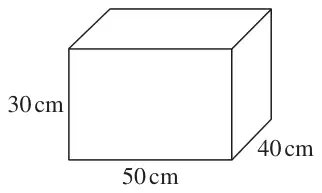
*23 The diagram shows a container for oil. The container is in the shape of a cuboid. The container is empty.
Diagram NOT accurately drawn
Sally has to fill the container with oil. A bottle of oil costs £3.50 There are 3000 cm3 of oil in each bottle.
Sally must not spend more than £60 buying the oil.
Can Sally buy enough oil to fill the container? You must show all your working. (4)
Mark scheme
Answer
Mark
Notes
NO with evidence
4
M1 for \(50 \times 40 \times 30\) (= 60 000) M1 for \(\text{``}60\,000\text{''} \div 3000\) (= 20) M1 for \(\text{``}20\text{''} \times £3.50\) C1 for (£)70 and comparison resulting in NO
OR
M1 for \(60 \div 3.50\) (= 17 bottles) M1 for \(\text{``}17\text{''} \times 3000\) (= 51,000) M1 for \(50 \times 40 \times 30\) (= 60,000) C1 for 51,000 and 60,000 and comparison resulting in NO
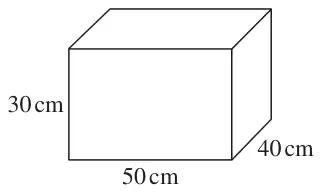
The diagram shows a container for oil. The container is in the shape of a cuboid. The container is empty.
Sally has to fill the container with oil. A bottle of oil costs £3.50 There are 3000 cm\(^3\) of oil in each bottle. Sally must not spend more than £60 buying the oil.
Can Sally buy enough oil to fill the container?
You must show all your working.(4)
Mark scheme
Answer
Mark
Notes
NO with evidence
4
M1 for \(50 \times 40 \times 30\) (=60000) M1 for \(\text{``}60000\text{''} \div 3000\) (=20) M1 for "20" × £3.50 C1 eg for 70 and comparison resulting in NO
OR M1 for £60 ÷ 3.50 (=17 bottles) M1 for \(\text{``}17\text{''} \times 3000\) (=51000) M1 for \(50 \times 40 \times 30\) (=60000) C1 eg for 51000 and 60000 and comparison resulting in NO
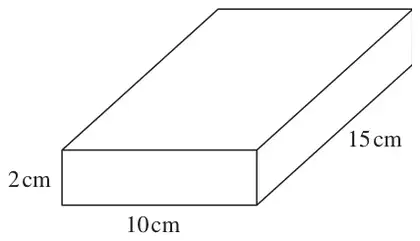
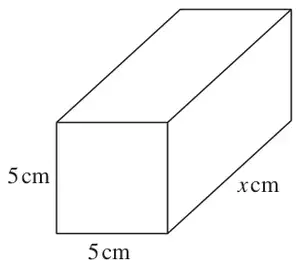
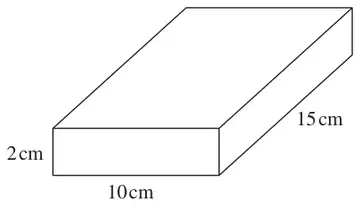
21 Jane makes cheese. The cheese is in the shape of a cuboid.
Diagram NOT accurately drawn
Jane is going to make a new cheese. The new cheese will also be in the shape of a cuboid. The cross section of the cuboid will be a 5 cm by 5 cm square.
Diagram NOT accurately drawn
Jane wants the new cuboid to have the same volume as the 2 cm by 10 cm by 15 cm cuboid.
Work out the value of \(x\). (3)
Mark scheme
Answer
Mark
Notes
12
3
M1 for a method to find volume of a cuboid, eg. \(2 \times 10 \times 15\) (= 300) or \(5 \times 5 \times x\) (= \(25x\)) M1 (dep) for \(\text{``}300\text{''} \div \text{``}25\text{''}\) oe A1 cao
OR
M1 for \(10 \div 5\) (= 2) and \(15 \div 5\) (= 3) or \(10 \div 5\) (= 2) and \(2 \div 5\) (= 0.4) M1 (dep) for \(2 \times \text{``}2\text{''} \times \text{``}3\text{''}\) or \(15 \times \text{``}2\text{''} \times \text{``}0.4\text{''}\) A1 cao
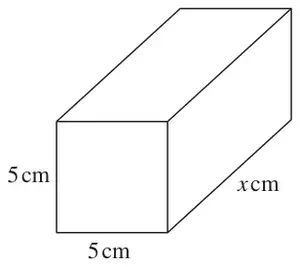
5 Jane makes cheese. The cheese is in the shape of a cuboid.
Diagram NOT accurately drawn
Jane is going to make a new cheese. The new cheese will also be in the shape of a cuboid. The cross section of the cuboid will be a 5 cm by 5 cm square.
Diagram NOT accurately drawn
Jane wants the new cuboid to have the same volume as the 2 cm by 10 cm by 15 cm cuboid.
Work out the value of \(x\). (3)
Mark scheme
Answer
Mark
Notes
12
3
M1 for a method to find volume of a cuboid, eg. \(2 \times 10 \times 15\) (= 300) or \(5 \times 5 \times x\) (= \(25x\)) M1 (dep) for \(\text{``}300\text{''} \div \text{``}25\text{''}\) oe A1 cao
OR M1 for \(10 \div 5\) (= 2) and \(15 \div 5\) (= 3) or \(10 \div 5\) (= 2) and \(2 \div 5\) (= 0.4) M1 (dep) for \(2 \times \text{``}2\text{''} \times \text{``}3\text{''}\) or \(15 \times \text{``}2\text{''} \times \text{``}0.4\text{''}\) A1 cao
13 The diagram shows a swimming pool in the shape of a prism.
Diagram NOT accurately drawn
The swimming pool is empty. The swimming pool is filled with water at a constant rate of 50 litres per minute.
(a) Work out how long it will take for the swimming pool to be completely full of water. Give your answer in hours. (1 m\(^3\) = 1000 litres) (5)
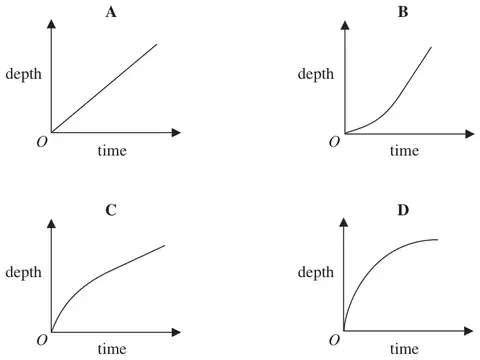
Here are four graphs.
(b) Write down the letter of the graph that best shows how the depth of the water in the pool above the line MN changes with time as the pool is filled. (1)
Mark scheme (a)
Answer
Mark
Notes
65
5
M1 for splitting up the cross section into separate areas and a method to find the area of one part OR for splitting up the pool into smaller prisms and a method to find the volume of one small prism, e.g. a cuboid M1 (dep) for a complete method to find the area of the cross section [with correct dimensions] OR for a method to find the total volume of more than one correct prism M1 (dep) for a complete method to find the volume of the pool [with correct dimensions] (= 195) M1 for \(\text{``}195\text{''} \times 1000 \div 50\) (=3900) oe where “195” comes from a volume A1 cao
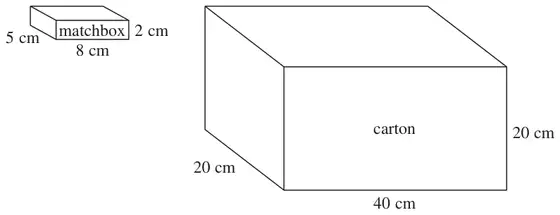
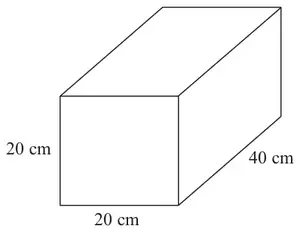
A matchbox is 5 cm by 8 cm by 2 cm. A carton is 20 cm by 40 cm by 20 cm.
The carton is completely filled with matchboxes.
Work out the number of matchboxes in the carton. (3)
Mark scheme
Answer
Mark
Notes
200
3
M1 for 20 × 40 × 20 (=16000) or 5 × 8 × 2 (=80) M1 (dep) for “16000” ÷ “80” A1 cao OR M1 attempt one division (eg 20 ÷ 5), may be implied by marks or number on one edge of diagram M1 (dep) for “(20 ÷ 5)” × “(40 ÷ 8)” × “(20 ÷ 2)” A1 cao
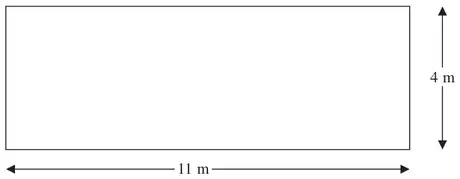
Martin is going to cover his driveway with gravel. The gravel will be 6 cm deep.
Gravel is sold in bags. There are 0.4 m\(^3\) of gravel in each bag. Each bag of gravel costs £38
Martin gets a discount of 30% off the cost of the gravel.
Work out the total amount of money Martin pays for the gravel. (5)
Mark scheme
Answer
Mark
Notes
186.20
5
M1 for use of consistent units to find volume, \(11 \times 4 \times 0.06\) (=2.64) or \(1100 \times 400 \times 6\) (=2640000) M1 (dep on vol calculation) for attempt to find number of bags needed, eg \(\text{``}2.64\text{''} \div 0.4\) (=6.6, 7) M1 for the cost of gravel before discount eg \(\text{``}6.6\text{''} \times 38\) or \(\text{``}7\text{''} \times 38\) M1 for attempt to find the total cost after discount \(\text{``}266\text{''} \times 0.7\) oe A1 for 186.2(0)
OR
M1 for cost of gravel per bag after discount, \(38 \times 0.7\) (=26.60) M1 for use of consistent units to find volume, \(11 \times 4 \times 0.06\) (=2.64) or \(1100 \times 400 \times 6\) (=2640000) M1 (dep on vol calculation) for attempt to find number of bags needed, eg \(\text{``}2.64\text{''} \div 0.4\) M1 for total cost of gravel after discount \(\text{``}7\text{''} \times \text{``}26.6\text{''}\) A1 for 186.2(0)
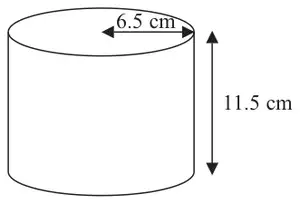
24 The diagram shows a large tin of pet food in the shape of a cylinder.
Diagram NOT accurately drawn
The large tin has a radius of 6.5 cm and a height of 11.5 cm.
A pet food company wants to make a new size of tin. The new tin will have a radius of 5.8 cm. It will have the same volume as the large tin.
Calculate the height of the new tin. Give your answer correct to one decimal place. (3)
Mark scheme
Answer
Mark
Notes
14.4
3
M1 for \(\pi \times 6.5^2 \times 11.5\) (=1526.42...) M1 (dep) for \(\dfrac{\text{‘}1526.42...\text{’}}{\pi \times 5.8^2}\) A1 for 14.4 - 14.5
OR
M1 for \(\dfrac{5.8}{6.5}\) or \(\dfrac{6.5}{5.8}\) or 0.89(23…) or 1.12(06896…) M1 for \(11.5 \div \left(\dfrac{5.8}{6.5}\right)^2\) or \(11.5 \times \left(\dfrac{6.5}{5.8}\right)^2\) A1 for 14.4 - 14.5
Notes
Corrected from the printed mark scheme, which shows the second method as \(11.5 \div \left(\dfrac{6.5}{5.8}\right)^2\); dividing by this gives 9.16, not the height.
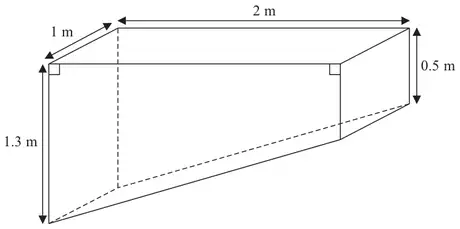
The pond is completely full of water. Sumeet wants to empty the pond so he can clean it. Sumeet uses a pump to empty the pond.
The volume of water in the pond decreases at a constant rate. The level of the water in the pond goes down by 20 cm in the first 30 minutes.
Work out how much more time Sumeet has to wait for the pump to empty the pond completely. (6)
Mark scheme
Answer
Mark
Notes
1 hour 45 mins
6
M1 for method to find volume of pond, eg \(\frac{1}{2}(1.3 + 0.5) \times 2 \times 1\) (= 1.8) M1 for method to find the volume of water emptied in 30 minutes, eg \(1 \times 2 \times 0.2\) (= 0.4), \(100 \times 200 \times 20\) (= 400000) A1 for correct rate, eg 0.8 m³/hr, 0.4 m³ in 30 minutes M1 for correct method to find total time taken to empty the pond, eg \(\text{``}1.8\text{''} \div \text{``}0.8\text{''}\) M1 for method to find extra time, eg 2 hrs 15 minutes − 30 minutes A1 for 1.75 hours, \(1\frac{3}{4}\) hours, 1 hour 45 mins or 105 mins
OR
M1 for method to find volume of water emptied in 30 minutes, eg. \(1 \times 2 \times 0.2\) (= 0.4), \(100 \times 200 \times 20\) (= 400000) M1 for method to work out rate of water loss eg. \(\text{``}0.4\text{''} \times 2\) A1 for correct rate, eg 0.8 m³/hr M1 for correct method to work out remaining volume of water eg. \(\frac{1}{2}(1.1 + 0.3) \times 2 \times 1\) (= 1.4) M1 for method to work out time, eg \(\text{``}1.4\text{''} \div \text{``}0.8\text{''}\) A1 for 1.75 hours, \(1\frac{3}{4}\) hours, 1 hour 45 mins or 105 mins
NB working could be in 3D or in 2D and in metres or cm throughout
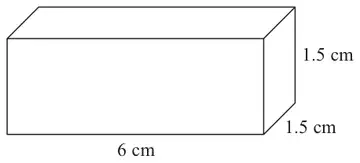
Work out the total surface area of the cuboid. (3)
Mark scheme
Answer
Mark
Notes
40.5
3
M1 for \(1.5 \times 6\) or \(1.5 \times 1.5\) M1 for adding area of 5 or 6 faces provided at least 3 are the correct area A1 cao NB: anything that leads to a volume calculation 0 marks.
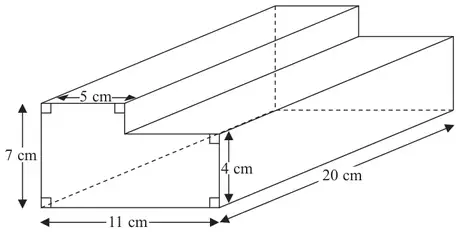
M1 for a correct method to find the area of the cross section M1 (dep) for a complete correct method for the volume of the prism A1 cao OR M1 for a correct method to find the volume of one cuboid M1 (dep) for a complete correct method for the volume of the prism A1 cao
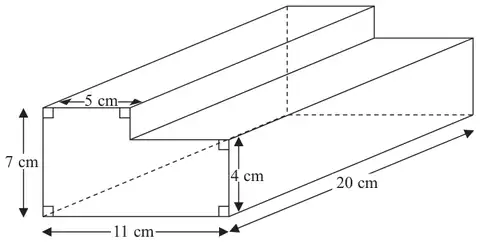
M1 for a correct method to find the area of the cross section M1 (dep) for a complete correct method for the volume of the prism A1 cao OR M1 for a correct method to find the volume of one cuboid M1 (dep) for a complete correct method for the volume of the prism A1 cao
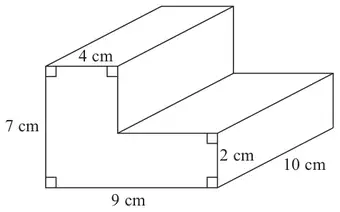
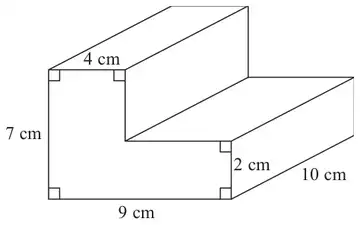
M1 for 4×7 + 5×2 (=38) or 9×2 + 5×4 (=38) or 4×7×10 or (7×9 − 5×5) or 5×2×10 (=100) or 9×2×10 (=180) or 5×4×10 (=200) or 9×7×10 (=630) or 5×5×10 (=250) M1 (dep) for ‘38’×10 or 380 or 4×7×10 + 5×2×10 or 9×2×10 + 5×4×10 or ×10 A1 cao
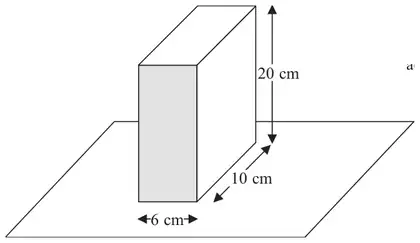
12 Jane has a carton of orange juice. The carton is in the shape of a cuboid.
Diagram NOT accurately drawn
The depth of the orange juice in the carton is 8 cm.
Jane closes the carton. Then she turns the carton over so that it stands on the shaded face.
Work out the depth, in cm, of the orange juice now. (3)
Mark scheme
Working
Answer
Mark
Notes
6 × 10 × 8 = 480 480 ÷ (6 × 20) =
4
3
M1 for 6 × 10 × 8 or 480 seen M1 (dep) for ‘480’ ÷ (6 × 20) oe A1 cao OR M1 for 20 ÷ 10 (=2) or 10 ÷ 20 (\(= \frac{1}{2}\)) or \(\frac{8}{20}\) oe or \(\frac{20}{8}\) oe M1 (dep) for 8 ÷ ‘2’ or \(8 \times \frac{1}{2}\) or \(\frac{8}{20} \times 10\) oe or \(10 \div \frac{20}{8}\) A1 cao SC : B2 for answer of 16 coming from \(\dfrac{20 \times 8 \times 6}{10 \times 6}\) oe
\(\sqrt[3]{\text{their } \dfrac{125}{8}}\) or \(\dfrac{5}{2}\) or 2.5
M1dep
oe eg \((L = 2)\ \sqrt[3]{\text{their } \dfrac{125}{64}}\) or \(\dfrac{5}{4}\) or 1.25
\(2 \times 3 \times\) their \(2.5 + 2 \times 4 \times\) their 2.5 \(+\ 2 \times 5 \times\) their 2.5 \(+\ 3 \times 12 \times\) their 2.5
M1dep
oe eg \((L = 2)\) \(2 \times 6 \times\) their \(1.25 + 2 \times 8 \times\) their 1.25 \(+\ 2 \times 10 \times\) their 1.25 \(+\ 3 \times 24 \times\) their 1.25
150
A1
SC4 [119, 119.1]
Alternative method 2: works out a value of \(a\), \(b\), \(c\) or \(d\)
Correct expression for volume in terms of \(a\) or \(b\) eg \(\dfrac{1}{2} \times a \times \dfrac{4a}{3} \times \dfrac{12a}{3}\) or \(\dfrac{8a^3}{3}\) or \(\dfrac{1}{2} \times \dfrac{3b}{4} \times b \times \dfrac{12b}{4}\) or \(\dfrac{9b^3}{8}\)
M1
oe in terms of \(c\) or \(d\) eg \(\dfrac{1}{2} \times \dfrac{3c}{5} \times \dfrac{4c}{5} \times \dfrac{12c}{5}\) or \(\dfrac{72c^3}{125}\) or \(\dfrac{1}{2} \times \dfrac{3d}{12} \times \dfrac{4d}{12} \times d\) or \(\dfrac{d^3}{24}\) may be implied by an equation eg \(a \times \dfrac{4a}{3} \times \dfrac{12a}{3} = 1125 \times 2\)
\(a^3 = 1125 \div\) their \(\dfrac{8}{3}\) or \(a^3 = \dfrac{3375}{8}\) or \(b^3 = 1125 \div\) their \(\dfrac{9}{8}\) or \(b^3 = 1000\)
M1dep
oe eg \(c^3 = 1125 \div\) their \(\dfrac{72}{125}\) or \(c^3 = \dfrac{15\,625}{8}\) or \(d^3 = 1125 \div\) their \(\dfrac{1}{24}\) or \(d^3 = 27\,000\)
\(a = \sqrt[3]{\text{their } \dfrac{3375}{8}}\) or \(a = 7.5\) or \(b = \sqrt[3]{1000}\) or \(b = 10\)
M1dep
oe eg \(c = \sqrt[3]{\text{their } \dfrac{15\,625}{8}}\) or \(c = 12.5\) or \(d = \sqrt[3]{27\,000}\) or \(d = 30\)
\(2 \times\) their \(a + 2 \times \dfrac{4}{3} \times\) their \(a\) \(+\ 2 \times \dfrac{5}{3} \times\) their \(a + 3 \times \dfrac{12}{3} \times\) their \(a\) or \(2 \times \dfrac{3}{4} \times\) their \(b + 2 \times\) their \(b\) \(+\ 2 \times \dfrac{5}{4} \times\) their \(b + 3 \times 3 \times\) their \(b\)
M1dep
oe correct method using their \(c\) or their \(d\)
150
A1
SC4 [119, 119.1]
Additional guidance
Up to M3 may be awarded for correct work with no answer or incorrect answer, even if this is seen amongst multiple attempts
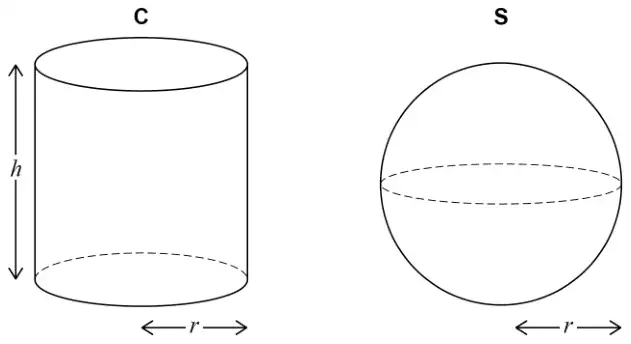
21 A cylinder, C, and a sphere, S, each have radius \(r\)
C has height \(h\)
Volume of a sphere \(= \dfrac{4}{3}\pi r^3\) where \(r\) is the radius
(a) volume of C \(=\) volume of S
Work out the ratio \(\quad r : h\)
You must show your working. [3 marks]
(b) A different cylinder has radius \(3r\) and height \(2h\).
How many times bigger is the volume of this cylinder than the volume of C? [2 marks]
Mark scheme (a)
Answer
Mark
Comments
Alternative method 1
\(\dfrac{4}{3}\pi r^3 = \pi r^2 h\)
M1
\(\dfrac{4}{3}r = h\) or \(4r = 3h\)
M1dep
oe equation with \(\pi\) and \(r^2\) cancelled
3 : 4 with M2 awarded
A1
oe ratio eg \(\dfrac{3}{4} : 1\) or \(1 : \dfrac{4}{3}\) accept 1.33 or better for \(\dfrac{4}{3}\)
Alternative method 2
\(\dfrac{4}{3}\pi r^3 = \pi r^2 h\) or substitution of the same value of \(r\) into \(\dfrac{4}{3}\pi r^3\) and \(\pi r^2 h\)
M1
the substitution must be shown
Substitution of the same value of \(r\) into \(\dfrac{4}{3}\pi r^3\) and \(\pi r^2 h\) and correct value of \(h\) for their value of \(r\)
A1
the substitution must be shown their \(h\) should be exactly \(\dfrac{4}{3} \times\) their \(r\) eg \(r = 2\) and \(h = \dfrac{8}{3}\) (oe fraction) do not allow rounded values
3 : 4 with M1A1 awarded
A1
oe ratio eg \(\dfrac{3}{4} : 1\) or \(1 : \dfrac{4}{3}\) accept 1.33 or better for \(\dfrac{4}{3}\)
Additional guidance
Accept \(h : r = 4 : 3\) for final mark with M2 or M1A1 awarded
Mark scheme (b)
Answer
Mark
Comments
\((\pi)(3r)^2(2h)\) or \(3^2 \times 2\)
M1
oe ft their formula for a cylinder from part (a) in the form \(k\pi r^2 h\) with \(k\) as a positive constant
18
A1
Additional guidance
Answer 18 from choosing values for \(r\) and \(h\) eg \(\pi \times 3^2 \times 4 = 36\pi\) and \(\pi \times 9^2 \times 8 = 648\pi\) and \(648\pi \div 36\pi = 18\)
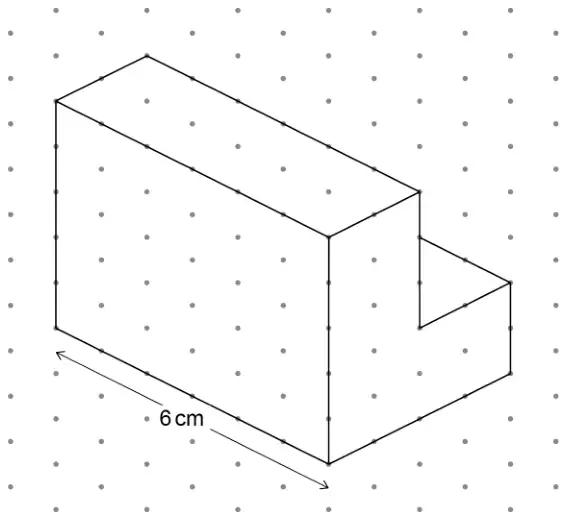
Correct method or evaluation of the area of any face or correct method or evaluation of the volume of any relevant cuboid of length 6 cm
M1
eg \(5 \times 6\) or 30 or \(2 \times 6\) or 12 or \(3 \times 6\) or 18 or \(4 \times 6\) or 24 or \(2 \times 5 + 2 \times 2\) or \(10 + 4\) or 14 or \(2 \times 5 \times 6\) or 60 or \(2 \times 2 \times 6\) or 24 or \(2 \times 3 \times 6\) or 36 or \(4 \times 2 \times 6\) or 48 or \(5 \times 4 \times 6\) or 120
Correct method for volume of prism
M1dep
eg \(2 \times 5 \times 6 + 2 \times 2 \times 6\) or \(60 + 24\) or \(14 \times 6\)
84
A1
Additional guidance
The first M1 may be awarded even if this is seen amongst multiple attempts
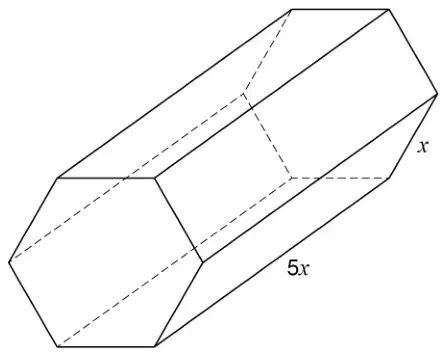
23 A chocolate box in the shape of a prism is being designed.
All lengths are in centimetres.
The cross section is a regular hexagon with side \(x\) The length is \(5x\)
An expression for the area of the cross section, in cm\(^2\), is \(\;\dfrac{3\sqrt{3}}{2}x^2\)
The total surface area of the box must be less than 650 cm\(^2\)
Work out the largest possible integer value of \(x\).
You must show your working. [4 marks]
Mark scheme
Answer
Mark
Comments
\(x \times 5x\) or \(5x^2\)
M1
oe may be implied eg \(30x^2\)
\(2 \times \dfrac{3\sqrt{3}}{2}x^2 + 6 \times x \times 5x\) or \(3\sqrt{3}\,x^2 + 30x^2\)
M1dep
oe eg \(35.19(6…)x^2\) or \(35.2x^2\)
\(650 \div (3\sqrt{3} + 30)\) or [18.4, 18.5] or [4.2, 4.3] or \(3\sqrt{3} \times 4^2 + 30 \times 4^2\) or 563.(…) and \(3\sqrt{3} \times 5^2 + 30 \times 5^2\) or 879.(…) or 880
M1dep
oe dep on M2 calculation or [18.4, 18.5] may be seen in a square root
trials \(x = 4\) and \(x = 5\) ignore substitution of other integer values of \(x\)
Correct method or evaluation of the area of any face or correct method or evaluation of the volume of any relevant cuboid of length 6 cm
M1
eg \(5 \times 6\) or 30 or \(2 \times 6\) or 12 or \(3 \times 6\) or 18 or \(4 \times 6\) or 24 or \(2 \times 5 + 2 \times 2\) or \(10 + 4\) or 14 or \(2 \times 5 \times 6\) or 60 or \(2 \times 2 \times 6\) or 24 or \(2 \times 3 \times 6\) or 36 or \(4 \times 2 \times 6\) or 48 or \(5 \times 4 \times 6\) or 120
Correct method for volume of prism
M1dep
eg \(2 \times 5 \times 6 + 2 \times 2 \times 6\) or \(60 + 24\) or \(14 \times 6\)
84
A1
Additional guidance
The first M1 may be awarded even if this is seen amongst multiple attempts
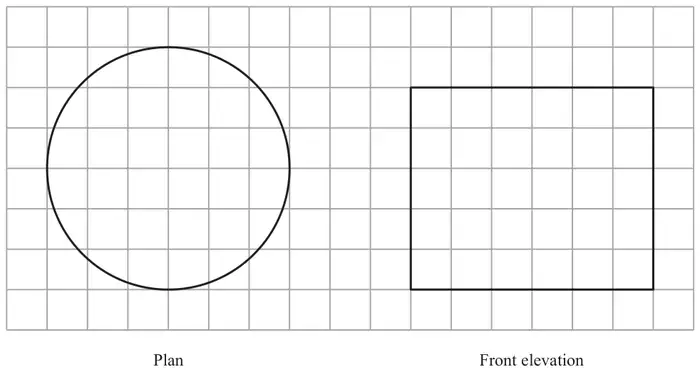
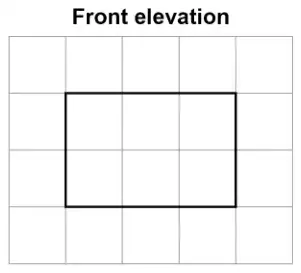
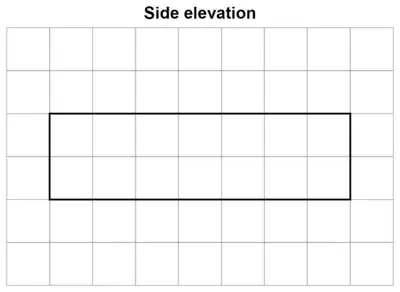
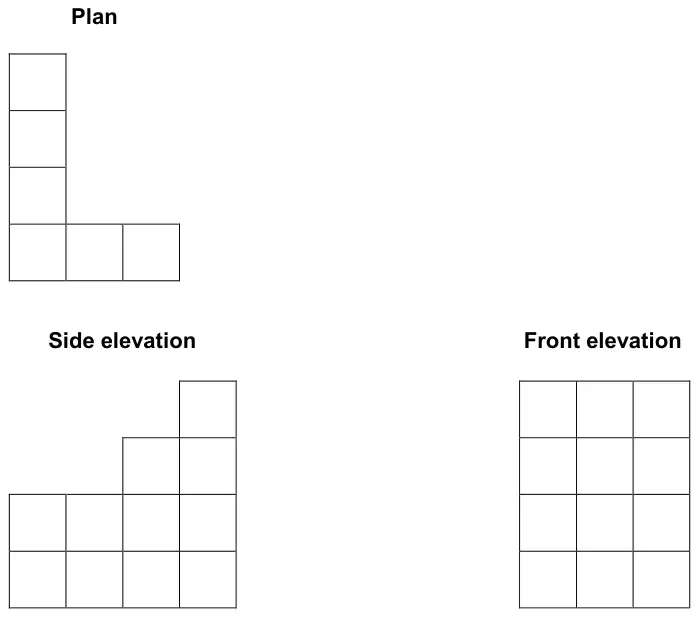
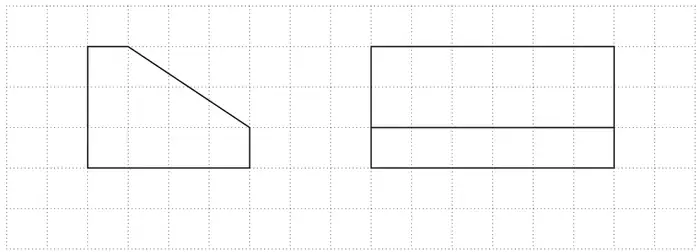
Here are the plan, side elevation and front elevation of the shape.
Centimetre cubes are added to make this cuboid.
How many cubes are added? [3 marks]
Mark scheme
Answer
Mark
Comments
29
B3
B2 answer 27, 28, 30 or 31 B1 answer 25, 26, 32 or 33 or \(4 \times 4 \times 3\) or 48 (total cubes) or \(2 \times 3 \times 4\) or 24 (missing cuboid) or 19 seen (cubes in original shape)
Additional guidance
Beware of 29 or close to 29 arising from (clear) adding of the squares in the original diagrams. This alone is B0, however B1 can still be scored for either 48, 24 or 19 (or the appropriate products leading to 48 or 24)
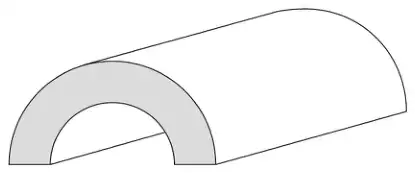
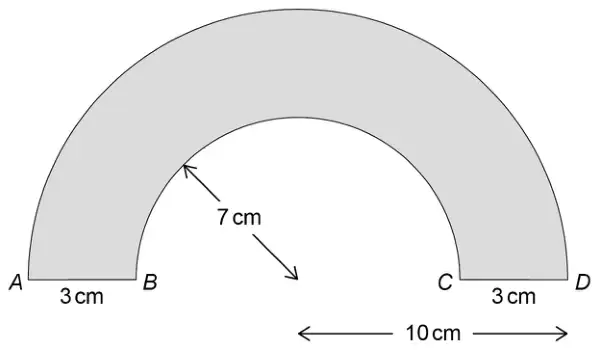
The diagram below shows the cross section of the tunnel.
Not drawn accurately
\(AD\) is a semicircular arc of radius 10 cm \(BC\) is a semicircular arc of radius 7 cm The length of the tunnel is 30 cm
Work out the total area of all six faces of the tunnel.
Give your answer in terms of \(\pi\). [5 marks]
Mark scheme
Answer
Mark
Comments
\(\pi \times 10^2 - \pi \times 7^2\) or \(100\pi - 49\pi\) or \(51\pi\) or \(\dfrac{1}{2} \times \pi \times 10^2 - \dfrac{1}{2} \times \pi \times 7^2\) or \(\dfrac{1}{2} \times 100\pi - \dfrac{1}{2} \times 49\pi\) or \(\dfrac{1}{2} \times 51\pi\) or \(25.5\pi\)
M1
oe implied by \(102\pi\) method to work out front and/or back faces – must not be part of a method to work out volume (\(\times\) 30) may be taken to be full circles
\(2 \times \pi \times 10 \times 30\) or \(600\pi\) or \(\dfrac{1}{2} \times 2 \times \pi \times 10 \times 30\) or \(300\pi\) or \(2 \times \pi \times 7 \times 30\) or \(420\pi\) or \(\dfrac{1}{2} \times 2 \times \pi \times 7 \times 30\) or \(210\pi\) or \(1020\pi\) or \(510\pi\)
M1
oe method to work out outer and/or inner curved surfaces may be taken to be full circles \(1122\pi\) implies M1M1
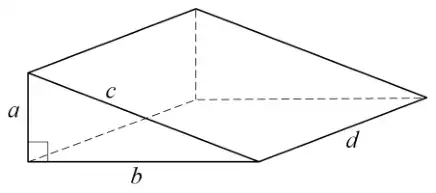
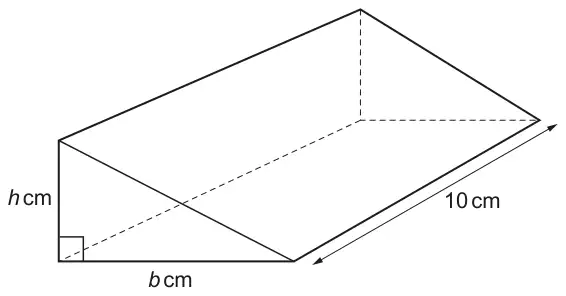
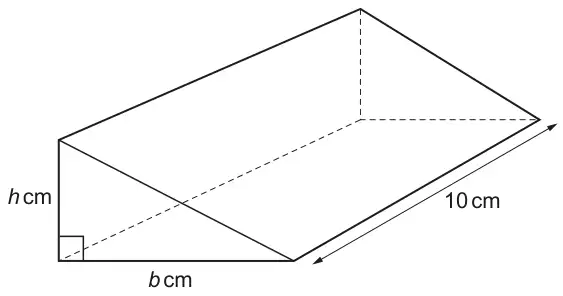
The cross-section of the prism is a right-angled triangle. The base, \(b\) cm, is 2 cm longer than the height, \(h\) cm. The volume of the prism is 240 cm3.
A student is explaining how they worked out the value of \(b\).
They say
\(b\) is 6 because that means \(h\) is 4 and \(6 \times 4 \times 10 = 240\).
Describe the student’s error and find the correct value of \(b\). [3]
Mark scheme
Answer
Marks
Part marks and guidance
Correct explanation \(\dfrac{1}{2}\) omitted from the area of the cross section oe
1
See appendix Do not ignore incorrect statements
8
2
M1 for \(\dfrac{1}{2} \times b \times h = 24\) seen, either as a formula or with values
M1 implied by \(b \times h = 48\) or a correct factor pair of 48 or e.g. \(h(h+2) = 48\) oe M1 may be seen in their explanation of the error
Appendix
Exemplar responses for Q20
Response
Mark
Has found [the volume of] a cuboid
1
He needs to halve the volume of a cuboid (BOD referring to the calculation rather than 240)
1
They forgot to ÷2 to work out the area of the front face
1
He did not divide the [area of the] cross section by 2
1
She did not do half base times height
1
The area of the cross section is ½ b × h
1
The area of the triangle needs to be halved
1
It has the cross section of a triangle so it needs to be divided by 2 (referring to cross section)
1
That the student has to divide h × b by 2
1
It’s a triangle, they didn’t half 24 after they did 4 × 6
1
So it would be 6 × 4 / 2 = 12
1
6 × 4 / 2 × 10 = 120 (BOD describes that triangle should be divided by 2)
1
He forgot to half the 10 (incorrect – needs to refer to triangle area)
0
They didn’t find the area of the triangle before ×10 (not sufficient does not describe the error)
0
The student did not work out that it is a triangle (similar to above)
0
Calculated a cube instead of a triangle (incorrect)
0
He did not halve it (not referring to what the ‘it’ is)
0
They did not multiply the volume by 2 (the volume is given as 240)
0
He did not divide the volume by 2
0
Wrong formula
0
They did not halve the answer (not specific to the cross section)
0
They needed to divide by 2 (not specific to cross section)
The cross-section of the prism is a right-angled triangle. The base, \(b\) cm, is 2 cm longer than the height, \(h\) cm. The volume of the prism is 240 cm3.
A student is explaining how they worked out the value of \(b\).
They say
\(b\) is 6 because that means \(h\) is 4 and 6 × 4 × 10 = 240.
Describe the student’s error and find the correct value of \(b\). [3]
Mark scheme
Answer
Marks
Part marks and guidance
Correct explanation \(\frac{1}{2}\) omitted from the area of the cross section oe
1
See appendix 1 Do not ignore incorrect statements
8
2
M1 for \(\frac{1}{2} \times b \times h = 24\) seen, either as a formula or with values
M1 implied by \(b \times h = 48\) or a correct factor pair of 48 or e.g. \(h(h + 2) = 48\) oe M1 may be seen in their explanation of the error
Appendix 1: exemplar responses for Q4
Response
Mark
1
Has found [the volume of] a cuboid
1
2
He needs to halve the volume of a cuboid (BOD referring to the calculation rather than 240)
1
3
They forgot to ÷2 to work out the area of the front face
1
4
He did not divide the [area of the] cross section by 2
1
5
She did not do half base [times height]
1
6
The area of the cross section is ½ \(b \times h\)
1
7
The area of the triangle needs to be halved
1
8
It has the cross section of a triangle so it needs to be divided by 2 (referring to cross section)
1
9
That the student has to divide \(h \times b\) by 2
1
10
It’s a triangle, they didn’t half 24 after they did 4 × 6
1
11
So it would be 6 × 4 / 2=12
1
12
6 × 4 / 2 × 10 =120 (BOD describes that triangle should be divided by 2)
1
13
He forgot to half the 10 (incorrect – needs to refer to triangle area)
0
14
They didn’t find the area of the triangle before ×10 (not sufficient does not describe the error)
0
15
The student did not work out that it is a triangle. (similar to above)
0
16
Calculated a cube instead of a triangle (incorrect)
0
17
He did not halve it (not referring to what the ‘it’ is)
0
18
They did not multiply the volume by 2 (the volume is given as 240)
0
19
He did not divide the volume by 2
0
20
Wrong formula
0
21
They did not halve the answer (not specific to the cross section)
0
22
They needed to divide by 2 (not specific to cross section)
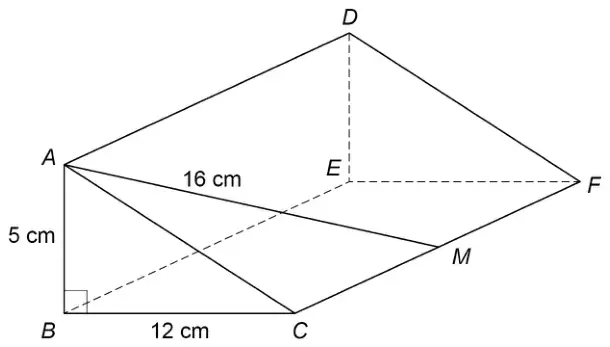
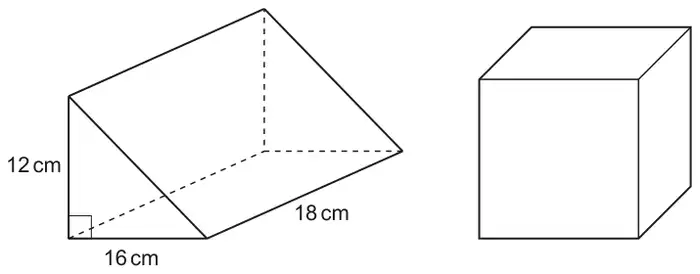
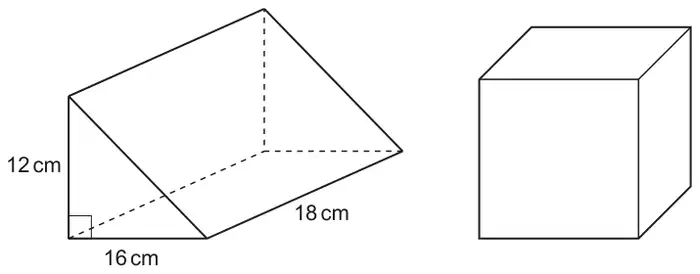
26 The diagram shows a triangular prism and a cube. The ends of the prism are right-angled triangles with base 16 cm and height 12 cm. The prism is 18 cm long.
The volume of the prism is equal to the volume of the cube. Find the surface area of the cube. You must show your working. [6]
Mark scheme
Answer
Marks
Part marks and guidance
864 with correct working
6
M1 for \(\dfrac{12 \times 16}{2} \times 18\) oe A1 for 1728 or M1 for \(\dfrac{12 \times 16}{2}\) oe
AND
M1 for \(\sqrt[3]{\textit{their } 1728}\) A1 for 12
AND
M1 for \(6 \times (\textit{their } 12)^2\)
If 0, 1 or 2 scored, instead award SC3 for 864 as final answer with no working or insufficient working
If 0 or M1 scored, instead award SC2 for 12 seen as dimension of cube or \(\left(\sqrt[3]{3456}\right)^2 \times 6\) soi 1371 to 1372 with no working or insufficient working
If 0 scored, award SC1 for 1728 or \(\sqrt[3]{3456}\) soi 15.1[…] with no working or insufficient working
“correct working” requires at least M1M1
Accept e.g. \(12 \times 8 \times 18\) or \(96 \times 18\)
Allow \(12^3 = 1728\) for M1A1 1728 must be from correct method for volume of triangular prism
their 12 must come from use of volume of triangular prism and cube root
10 The diagram shows a triangular prism and a cube. The ends of the prism are right-angled triangles with base 16 cm and height 12 cm. The prism is 18 cm long.
The volume of the prism is equal to the volume of the cube.
Find the surface area of the cube. You must show your working. [6]
Mark scheme
Answer
Marks
Part marks and guidance
864 with correct working
6
M1 for \(\dfrac{12 \times 16}{2} \times 18\) A1 for 1728 or M1 for \(\dfrac{12 \times 16}{2}\)
“correct working” requires at least M1M1 Accept e.g. 12 × 8 × 18 or 96 × 18 Allow \(12^3 = 1728\) for M1A1
AND M1 for \(\sqrt[3]{\textit{their } 1728}\) A1 for 12
Their 1728 must be from correct method for volume of triangular prism
AND M1 for \(6 \times (\textit{their } 12)^2\)
Their 12 must come from use of volume of triangular prism and cube root
If 0, 1 or 2 scored, instead award SC3 for 864 as final answer with no working or insufficient working If 0 or M1 scored, instead award SC2 for 12 seen as dimension of cube or \((\sqrt[3]{3456})^2 \times 6\) soi 1371 to 1372 with no working or insufficient working If 0 scored, award SC1 for 1728 or \(\sqrt[3]{3456}\) soi 15.1[…] with no working or insufficient working
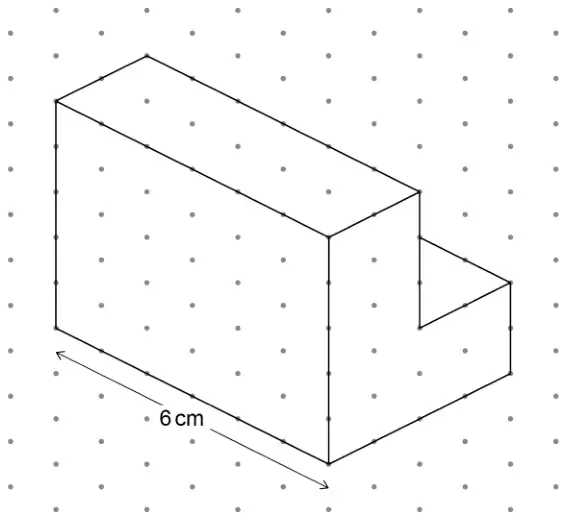
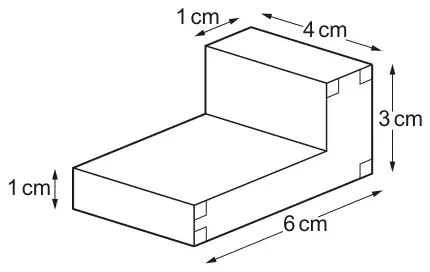
M2 for correct method to find area of L shaped face e.g 6 × 3 – 5 × 2 or M1 for finding one of the relevant partial lengths of 2 or 5 M1 for their area × 4
M1 could be on diagram
OR M1 for 3 × 4 × 1 M1 for 5 × 4 × 1 A1 for 12 or 20
Treat extra volumes as choice A1 Implies M1 Mark as oe for other correct products if split into two different cuboids that make the solid
OR M1 for 6 × 3 × 4 M1 for 2 × 5 × 4 A1 for 72 or 40
Not 6 × 3 × 4 × 1 × 1 Treat extra volumes as choice A1 implies M1 unless 72 comes from 6 × 3 × 4 × 1 × 1
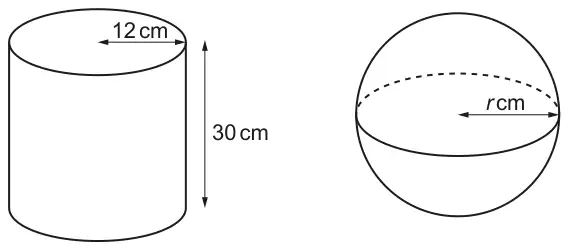
The cylinder has radius 12 cm and height 30 cm. The cylinder and the sphere have the same volume.
Work out the radius \(r\) cm of the sphere.
[The volume \(V\) of a sphere with radius \(r\) is \(V = \frac{4}{3}\pi r^3\).] [5]
Mark scheme
Answer
Marks
Part marks and guidance
14.79 to 14.8
5
M2 for \(\pi \times 12^2 \times 30\) soi by 13 564 to 13 574 or M1 for \(\pi \times 12^2\) soi 452 to 453 B1 for \(\frac{4}{3}\pi r^3\) = their 13 571 M1 for their 13 571 ÷ \(\frac{4}{3}\pi\) or 3240
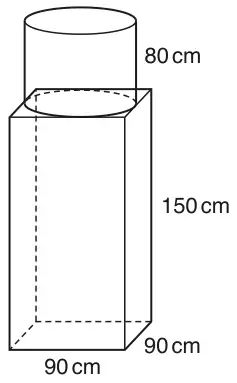
A sculpture is formed from a cylinder resting on top of a cuboid. The cylinder has radius 45 cm and height 80 cm. The cuboid measures 90 cm by 90 cm by 150 cm.
The sculpture is made of granite. The granite has a density of 2.7 g/cm\(^3\).
Calculate the total mass of the sculpture in tonnes. [5]
Mark scheme
Answer
Marks
Part marks and guidance
4.653 to 4.655 or 4.65 or 4.7 or 5
5
Volume of cuboid M1 for \(90 \times 90 \times 150\) soi 1 215 000
Volume of cylinder M1 for \(\pi \times 45^2 \times 80\) soi 508 680 to 509 004
Total volume M1 for their 1 215 000 + their 508 938.1 soi 1 723 680 to 1 723 938.1
Find mass using density M1 for any of their volumes \(\times\) 2.7
Answers of 4.7 or 5 require supporting working
Answers from values of \(\pi\) \(\pi\) = 508 938.0099 3.142 = 509 004 3.14 = 508 680
Their volumes must be seen to come from the product of three relevant lengths
Dependent on a calculated volume for cuboid, cylinder or total If total consists of one volume and one non-volume but is \(\times\) 2.7, final M1 scored