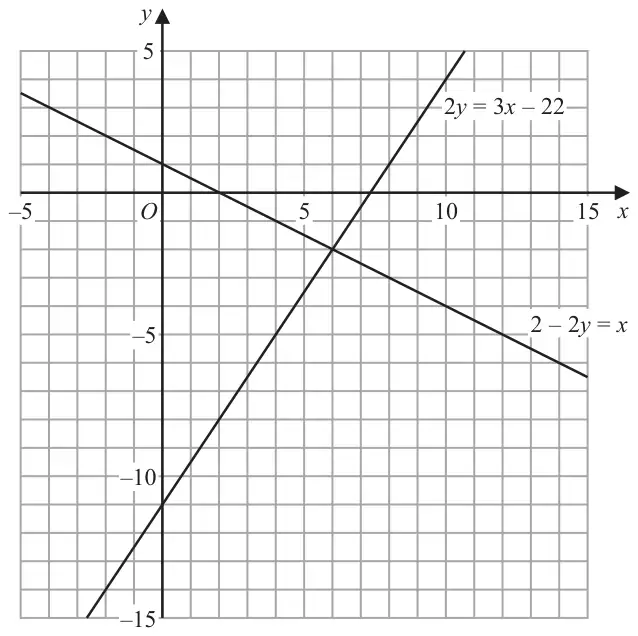
22 \(\mathbf{C}\) is a circle with centre \((0, 0)\) The straight line with equation \(3x - 2y = 52\) is the tangent to \(\mathbf{C}\) at the point \(P\).
Find the coordinates of \(P\). (4)
Mark scheme
Answer
Mark
Mark scheme
(12, −8)
P1
for process to rearrange the equation to give \(y\) in terms of \(x\), eg \(y = \dfrac{3x - 52}{2}\) or \(y = \dfrac{3}{2}x - 26\) or \(m = \dfrac{3}{2}\)
P1
for process to find gradient of \(OP\), eg \(-1 \div \text{``}\dfrac{3}{2}\text{''}\ \left(= -\dfrac{2}{3}\right)\) or \(-1 \div [m]\)
P1
(dep on equation of the form \(y = \dfrac{-1}{[m]}x\) for the radius may be implied in subsequent working) for starting to solve \(3x - 2y = 52\) with \(y = \dfrac{-1}{[m]}x\) simultaneously to find the value of \(x\) or \(y\) eg substituting \(y = \dfrac{-2}{3}x\) or \(y = \dfrac{-1}{[m]}x\) into \(y = \dfrac{3}{2}x - 26\) or \(3x - 2y = 52\) or an equation of the form \(y = \dfrac{3}{2}x + c\) eg \(-\dfrac{2}{3}x = \dfrac{3}{2}x - 26\) or \(3x - 2\left(-\dfrac{2}{3}x\right) = 52\) or \(-\dfrac{2}{3}x = \dfrac{3}{2}x + c\) or \(-\dfrac{1}{[m]}x = \dfrac{3}{2}x - 26\) or \(3x - 2\left(-\dfrac{1}{[m]}x\right) = 52\) or \(-\dfrac{1}{[m]}x = \dfrac{3}{2}x + c\)
A1
cao
Additional guidance
Condone an incorrect value for the \(y\) intercept (\(= c\))
Where \([m]\) is clearly identified as the gradient of the straight line \(3x - 2y = 52\) Allow 0.66(6…) or 0.67 for \(\dfrac{2}{3}\) throughout
Where \([m]\) is clearly identified as the gradient of the straight line \(3x - 2y = 52\)
Can be done by elimination Award P1 for a correct method to eliminate \(x\) or \(y\): coefficient of \(x\) or \(y\) the same and correct operator to eliminate selected variable eg
for substitution of a rearranged equation into a correct equation to form an equation in one variable. eg \(3x^2 + 2(2 - 3x)^2 = 44\) or \(3\left(\dfrac{2 - y}{3}\right)^2 + 2y^2 = 44\)
M1
(dep on first M1) for multiplying out all brackets and collecting terms to form a simplified three term quadratic in any form of \(ax^2 + bx + c\ (= 0)\) where at least 2 coefficients (\(a\), \(b\), \(c\)) are correct
(dep on first M1) for a suitable method to solve their 3 term quadratic using any correct method,
for factorising, eg \((7x + 6)(x - 2)\) or \((7x + 6)(3x - 6)\) or \((21x + 18)(x - 2)\) or \((7y - 32)(y + 4)\)
or correct use of formula, eg \(\dfrac{8 \pm \sqrt{(-8)^2 - 4 \times 7 \times -12}}{2 \times 7}\) or \(\dfrac{4 \pm \sqrt{(-4)^2 - 4 \times 7 \times -128}}{2 \times 7}\) or completing the square
M1
(dep on first M1) for substituting their 2 found values of \(x\) or \(y\) in a suitable equation or (dep on first M1) for one correct pair of values following from a correct quadratic
A1
for \(x = -\dfrac{6}{7}\) oe, \(y = \dfrac{32}{7}\) oe and \(x = 2\), \(y = -4\)
Additional guidance
Allow \((\pm 2 \pm 3x)\) for \((2 - 3x)\) (or \(\left(\dfrac{\pm 2 \pm y}{3}\right)\) for \(\left(\dfrac{2 - y}{3}\right)\)) Implied by a correct equation (simplified or unsimplified) in terms of \(x\) or \(y\) eg \(3x^2 + 2(4 - 12x + 9x^2) = 44\) or \(3x^2 + 8 - 24x + 18x^2 = 44\) or \(21x^2 - 24x = 36\)
Look out for signs reversed The quadratic does not have to equal 0, ie accept \(21x^2 - 24x = 36\)
Can be implied by both \(x\) values or both \(y\) values correct (condone incorrect labelling) if the quadratic is correct If using the quadratic formula (condone one sign error, omission of brackets around the \(b\) in the \(b^2 - 4ac\) and the fraction line not being under the \(-\) in the \(-b\). Allow some simplification – as far as eg \(\dfrac{8 \pm \sqrt{64 + 336}}{14}\) or if factorising allow brackets which expand to give 2 out of 3 terms correct for their quadratic
Condone substitution into their \((\pm 2 \pm 3x)\) or \(\left(\dfrac{\pm 2 \pm y}{3}\right)\)
Allow \(-0.85(7\ldots)\) or \(-0.86\) for \(-\dfrac{6}{7}\) Allow 4.57(1…) for \(\dfrac{32}{7}\) If values of \(x\) or \(y\) are incorrect then working must be shown
Accept as coordinates Assume correct pairing unless clearly incorrect eg \(\left(-\tfrac{6}{7}, -4\right), \left(2, \tfrac{32}{7}\right)\) Allow \(-0.85(7\ldots)\) or \(-0.86\) for \(-\dfrac{6}{7}\) Allow 4.57(1…) for \(\dfrac{32}{7}\) If an answer is shown in the range in working and then incorrectly rounded award full marks
A correct answer with no supportive working gets 0 marks
for correct substitution for \(y^2\) or \(x^2\), eg \((7 - 2x)^2 = 3x^2 + 4\) OR for correct rearrangement and expansion of \((7 - 2x)^2\) to obtain 4 terms with all correct without considering signs or for 3 terms out of 4 correct with correct signs and substitution eg \((7 - 2x)^2 = 49 - 14x - 14x + 4x^2\) and \(49 - 14x - 14x + 4x^2 = 3x^2 + 4\)
M1
for method to write a correct simplified equation eg \(x^2 - 28x + 45\ (= 0)\)
M1
for a method to solve a correct quadratic eg \(\dfrac{28 \pm \sqrt{(-28)^2 - 4 \times 1 \times 45}}{2 \times 1}\) or \(\dfrac{28 \pm \sqrt{604}}{2}\) or \(14 \pm \sqrt{151}\) or \((x - 14)^2 - 14^2 + 45 = 0\) oe
A1
\(x = 26.2\) to 26.3, \(y = -45.6\) to \(-45.5\) and \(x = 1.7\) to 1.712, \(y = 3.5\) to 3.6
Additional guidance
NB \(49 - 28x\) or \(-28x + 4x^2\) can be considered 3 terms out of 4 correct with correct signs
The quadratic does not have to equal 0, ie accept \(x^2 - 28x = -45\)
Can be implied by both \(x\) values correct or both \(y\) values correct
Answers must be correctly paired (May be in the body of the working) If answers are given in the range in working and then rounded incorrectly award full marks
16 1 cup of tea and 1 cup of coffee cost £4.50 3 cups of tea and 1 cup of coffee cost £8.50
Work out the total cost of 4 cups of tea and 3 cups of coffee. You must show all your working. (5)
Mark scheme
Answer
Mark
Mark scheme
15.5(0)
P1
for a correct process to find the cost of some teas only or some coffees only eg (2 teas =) \(8.50 - 4.50\ (= 4)\) or (2 coffees =) \(3 \times 4.50 - 8.50\ (= 5)\)
P1
for a process to find the cost of one tea or four teas, eg (1 tea =) \(\text{``}4\text{''} \div 2\ (= 2)\) or (4 teas =) \(\text{``}4\text{''} \times 2\ (= 8)\)
P1
for a process to find cost of one coffee or three coffees, eg (1 coffee =) \(4.50 - \text{``}2\text{''}\ (= 2.50)\) or \(8.50 - \text{``}2\text{''} \times 3\ (= 2.50)\) or \(1.5 \times \text{``}5\text{''}\ (= 7.50)\)
P1
for a complete process, eg \(\text{``}2\text{''} \times 4 + \text{``}2.50\text{''} \times 3\)
A1
cao
Additional guidance
Use of simultaneous equations – marks awarded at the stages shown in the scheme.
for a correct method to eliminate either variable or rearrangement of one equation leading to substitution (condone one arithmetic error)
A1
for either \(x = 3\) or \(y = -4\)
M1
(dep M1) for a correct substitution of found value into one of the equations or a correct method leading to the second value (condone one arithmetic error)
A1
for \(x = 3\) and \(y = -4\)
NB Trial and improvement methods score 0 marks unless both \(x\) and \(y\) are correct
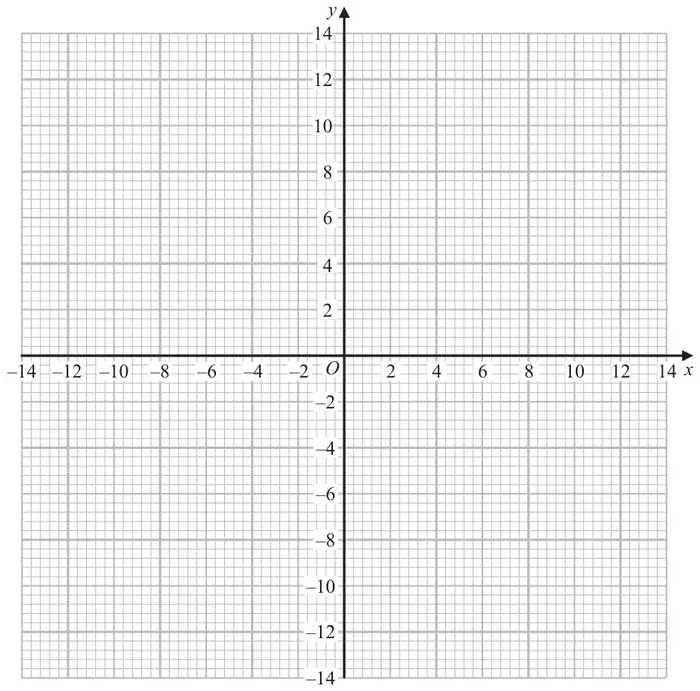
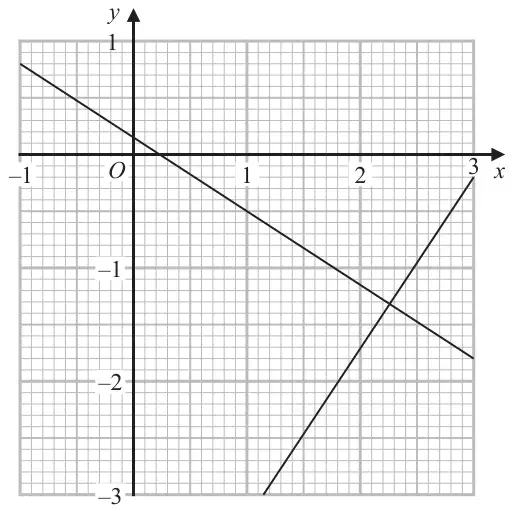
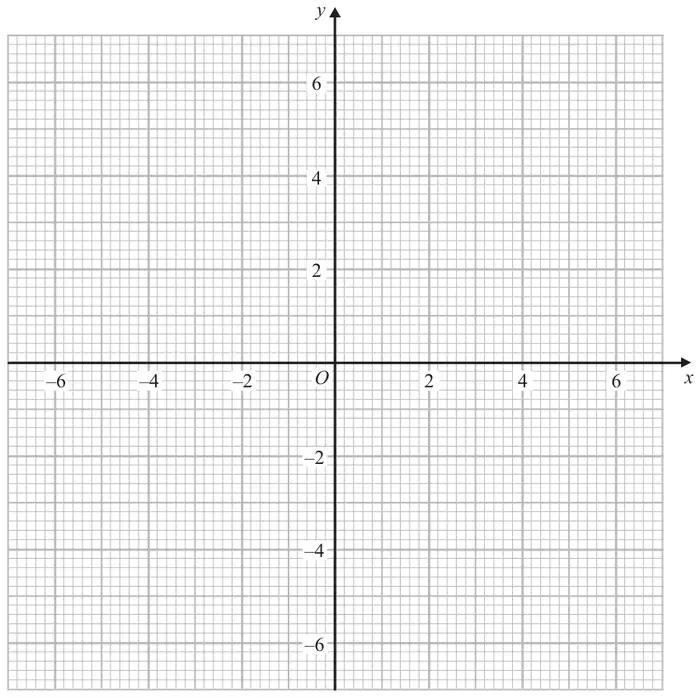
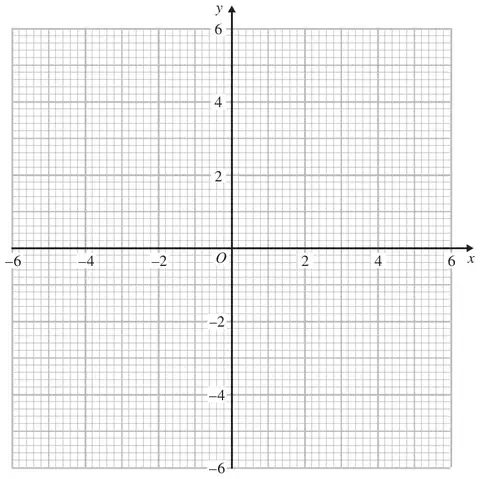
(a) On the grid, draw the graph of \(x^2 + y^2 = 169\)(2)
(b) Use your graph to find estimates for the solutions of the simultaneous equations\[\begin{gathered} x^2 + y^2 = 169 \\ 2y = 3x \end{gathered}\] (3)
Mark scheme (a)
Answer
Mark
Mark scheme
Circle drawn
B2
for drawing a circle centre \((0,0)\) and radius 13
(B1
for drawing a circle centre \((0,0)\) with radius \(\neq 13\) or a circle of radius 13 with a centre not \((0,0)\) or an incomplete correct circle drawn)
Additional guidance
Circle could be drawn freehand as long as it closely approximates to a circle
for a correct method to eliminate either variable or rearrangement of one equation leading to substitution (condone one arithmetic error)
A1
for either correct value of \(x\) or correct value of \(y\)
M1
(dep M1) for a correct substitution of found value into one of the equations or a correct method leading to the second value (condone one arithmetic error)
A1
\(x = 3\), \(y = -2\)
Additional guidance
Trial and improvement methods score 0 marks unless both \(x\) and \(y\) are correct
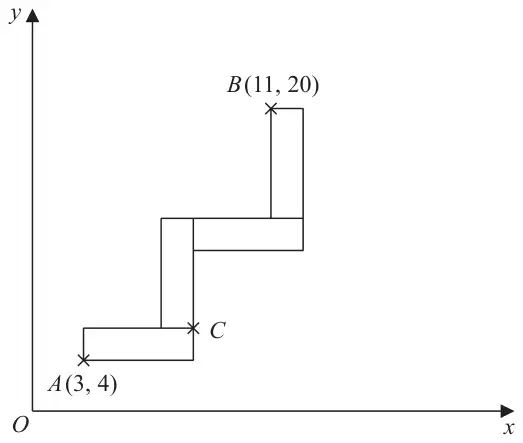
13 A pattern is made from four identical rectangles. The sides of the rectangles are parallel to the axes.
Point \(A\) has coordinates (3, 4) Point \(B\) has coordinates (11, 20) Point \(C\) is marked on the diagram.
Work out the coordinates of \(C\). You must show all your working. (5)
Mark scheme
Answer
Mark
Mark scheme
(9, 8)
P1
for setting up an equation for one dimension (width) of the pattern eg \(2b - a = 8\) oe or \(2x + y = 8\) oe
P1
for setting up an equation for the other dimension (height) of the pattern eg \(2b + a = 16\) oe or \(2x + 3y = 16\) oe
P1
(dep P2) for a full process to solve for both variables eg \(4b = 24\), \(b = 6\) and \(12 - a = 8\), \(a = 4\) or \(8 = 2y\), \(y = 4\) and \(8 = 2x + y\), \(x = 2\)
P1
(dep P3) for a full process to find one of the coordinates of \(C\) eg \(3 + 6\ (= 9)\) or \(4 + 4\ (= 8)\) or \(3 + 2 + 4\ (= 9)\) or \(4 + 4\ (= 8)\)
A1
cao
Additional guidance
\(a\) and \(b\) are the width and length \(x\) is the difference between the length and width, \(y\) is the width of the rectangle
Both values correct implies this mark
Award 0 marks for a correct answer with no supportive working.
25 The straight line L has equation \(3x + 2y = 17\)
The point \(A\) has coordinates (0, 2) The straight line M is perpendicular to L and passes through \(A\).
Line L crosses the \(y\)-axis at the point \(B\). Lines L and M intersect at the point \(C\).
Work out the area of triangle \(ABC\). You must show all your working. (5)
Mark scheme
Answer
Mark
Mark scheme
9.75
P1
process to find the gradient of L \(\left(= -\dfrac{3}{2}\right)\)
P1
process to find the gradient of the perpendicular line M eg use of \(-\dfrac{1}{m}\) or states gradient as \(\dfrac{2}{3}\) or \(y = \dfrac{2}{3}x + c\)
B1
(indep) gives \(y\) coordinate of \(B = 8.5\) oe
P1
(dep P2) process to find \(x\) coordinate of \(C\) (= 3) or \(y\) coordinate of \(C\) (= 4) eg the first stage of solving equations or using elimination by substitution, to find a coordinate of \(C\).
A1
9.75 oe
Additional guidance
Could be indicated other ways, eg 8.5 on the \(y\) axis of a diagram
ft their linear equation for M with L; allow some error in manipulation of these linear equations as long as the overall process is correct.
Award 0 marks for a correct answer with no supportive working.
22 There are only \(r\) red counters and \(g\) green counters in a bag.
A counter is taken at random from the bag. The probability that the counter is green is \(\dfrac{3}{7}\)
The counter is put back in the bag.
2 more red counters and 3 more green counters are put in the bag. A counter is taken at random from the bag. The probability that the counter is green is \(\dfrac{6}{13}\)
Find the number of red counters and the number of green counters that were in the bag originally. (5)
Mark scheme
Answer
Mark
Mark scheme
12 red, 9 green
P1
for process to find a relationship between \(r\) and \(g\) eg \(\dfrac{g}{r + g} = \dfrac{3}{7}\) or \(\dfrac{g}{r} = \dfrac{3}{4}\)
P1
for process to find a second relationship between \(r\) and \(g\) eg \(\dfrac{g + 3}{r + 2 + g + 3} = \dfrac{6}{13}\) or \(\dfrac{g + 3}{r + 2} = \dfrac{6}{7}\)
P1
(dep P2) for start to process of solving pair of equations, eg eliminates one variable from the equations or removes fractions from both equations
P1
(dep P3) for complete process to solve equations to find \(g\) or \(r\)
A1
cao
OR
P1
for two of \(3x + 3\), \(4x + 2\) and \(7x + 5\)
P1
for \(\dfrac{3x + 3}{7x + 5} = \dfrac{6}{13}\)
P1
(dep P2) for removing fractions from the equation, eg \(13(3x + 3) = 6(7x + 5)\) or \(39x + 39 = 42x + 30\)
P1
(dep P3) for complete process to solve \(13(3x + 3) = 6(7x + 5)\)
for substitution of a rearrangement eg for \(2(1 - 2y)^2 - y^2 = 17\) or \(2x^2 - \left(\dfrac{1 - x}{2}\right)^2 = 17\) or expansion of \((1 - 2y)^2 = 1 - 4y + 4y^2\) or \(\left(\dfrac{1 - x}{2}\right)^2 = \dfrac{1 - 2x + x^2}{4}\)
M1
for expansion of bracket and substitution eg \(2(1 - 4y + 4y^2) - y^2\) (= 17) or \(8x^2 - (1 - 2x + x^2)\) (= 68)
A1
for forming quadratic ready for solving eg \(7y^2 - 8y - 15\) (= 0) or \(7x^2 + 2x - 69\) (= 0)
M1
ft a 3 term quadratic, factorising eg \((7y - 15)(y + 1)\) (= 0) or \((7x + 23)(x - 3)\) (= 0) or correct use of formula eg \(\dfrac{8 \pm \sqrt{64 + 420}}{14}\) or \(\dfrac{-2 \pm \sqrt{4 + 1932}}{14}\) or completing the square
M1 (third method mark): Can be implied by both \(x\) values correct or both \(y\) values correct.
Answers must be correctly paired. (Maybe in the body of the working) Accept for \(x\) between \(-3.29\) and \(-3.28\) and for \(y\) between 2.14 and 2.15
18 The straight line \(\mathbf{L}_1\) passes through the points with coordinates \((4, 6)\) and \((12, 2)\) The straight line \(\mathbf{L}_2\) passes through the origin and has gradient \(-3\)
The lines \(\mathbf{L}_1\) and \(\mathbf{L}_2\) intersect at point \(P\).
Find the coordinates of \(P\). (4)
Mark scheme
Answer
Mark
Mark scheme
\(\left(\dfrac{-16}{5}, \dfrac{48}{5}\right)\)
P1
for a method to find gradient of \(\mathbf{L}_1\) eg \(\dfrac{6 - 2}{4 - 12}\ \left(= -\frac{1}{2}\right)\) or states \(\mathbf{L}_2\) as \(y = -3x\)
P1
(dep on P1) for a method to find equation of \(\mathbf{L}_1\) eg subs into \(y = \text{``}{-}\frac{1}{2}\text{''}x + c\) OR states \(\mathbf{L}_1\) as \(y = \text{``}{-}\frac{1}{2}\text{''}x + 8\)
P1
(dep on P2) complete method to equate both lines eg \(\text{``}{-}\frac{1}{2}\text{''}x + 8 = -3x\)
17 \(p\) and \(q\) are two numbers such that \(p \gt q\)
When you subtract 5 from \(p\) and subtract 5 from \(q\) the answers are in the ratio 5 : 1 When you add 20 to \(p\) and add 20 to \(q\) the answers are in the ratio 5 : 2
Find the ratio \(p : q\) Give your answer in its simplest form. (5)
Mark scheme
Answer
Mark
Mark scheme
4 : 1
P1
for associating algebraic expressions with the correct ratio eg \(p - 5 : q - 5\ (= 5 : 1)\) or \(p + 20 : q + 20\ (= 5 : 2)\)
P1
for \(\dfrac{p + 20}{q + 20} = \dfrac{5}{2}\) or \(\dfrac{p - 5}{q - 5} = \dfrac{5}{1}\) oe or \(p - 5 = 5(q - 5)\) or \(2(p + 20) = 5(q + 20)\) oe
M1
for a complete method shown to find \(p\) or \(q\)
M1
for a complete method shown to find \(p\) and \(q\) or two values for \(p\) and \(q\) that are in the ratio 4 : 1 or an unsimplified ratio 4 : 1 (eg 80 : 20) or an answer of 1 : 4
A1
cao
Additional guidance
Award for one of the two simultaneous equations eg \(5q - p = 20\), \(5q - 2p = -60\) oe
Award for a simultaneous equation method to eliminate one variable leading to either \(p = 80\) or \(q = 20\)
Award for a simultaneous equation method to eliminate both variables leading to either \(p = 80\) and \(q = 20\)
16 The \(n\)th term of a sequence is given by \(an^2 + bn\) where \(a\) and \(b\) are integers.
The 2nd term of the sequence is \(-2\) The 4th term of the sequence is 12
(a) Find the 6th term of the sequence. (4)
Here are the first five terms of a different quadratic sequence.
0 2 6 12 20
(b) Find an expression, in terms of \(n\), for the \(n\)th term of this sequence. (2)
Mark scheme (a)
Answer
Mark
Mark scheme
42
P1
for process to find an equation in \(a\) and \(b\), eg \(a \times 2^2 + b \times 2 = -2\) (\(4a + 2b = -2\)) or \(a \times 4^2 + b \times 4 = 12\) (\(16a + 4b = 12\))
P1
for process to find a pair of simultaneous equations and eliminate one unknown, eg \(16a + 8b = -8\) and \(16a + 4b = 12\) and subtraction or \(16a + 4b = 12\) and \(8a + 4b = -4\) and subtraction
A1
for \(a = 2\) and \(b = -5\)
A1
cao
Additional guidance
Allow one arithmetic error in elimination, eg \(16a + 8b = -8\) and \(16a + 4b = 12\) leading to \(4b = 20\) but no subtraction sign seen
19 Prove algebraically that the straight line with equation \(x - 2y = 10\) is a tangent to the circle with equation \(x^2 + y^2 = 20\) (5)
Mark scheme
Answer
Mark
Notes
Proof (supported)
M1
starts process to find point of intersection by substituting, eg \((10 + 2y)^2 + y^2\ (= 20)\)
M1
for expanding, eg \(4y^2 + 20y + 20y + 100\) (3 out of 4 terms correct)
M1
(dep M2) for 3-term quadratic equation ready for solving, eg \(5y^2 + 40y + 80 = 0\)
M1
(dep on previous M1) for method to solve an equation of the form \(ay^2 + by + c = 0\), eg by factorising or correct substitution into quadratic formula
C1
fully correct method leading to \(y = -4\) or \(x = 2\) or \((y + 4)^2 = 0\) or \((x - 2)^2 = 0\) and statement, eg only one point of intersection so the line is a tangent to the circle
for substitution of a rearrangement of \(y - 3x = 13\) e.g. \((3x + 13)^2 + x^2 = 25\)
M1
(dep M1) for expansion of bracket after substitution (at least 3 terms correct out of the 4 terms) e.g. \(9x^2 + 39x + 39x + 169\)
M1
for forming quadratic ready for solving e.g. \(10x^2 + 78x + 144\ (= 0)\)
M1
for factorising e.g. \((5x + 24)(x + 3)\ (= 0)\) oe
A1
\(x = -\dfrac{24}{5}\), \(y = -\dfrac{7}{5}\) and \(x = -3\), \(y = 4\) SC: B1 (if M0) for all 4 values mis-associated or one correct pair of values or values given as coordinates.
M1 for correct process to eliminate one variable (condone one arithmetic error) M1 (dep) for substituting found value in one of the equations or appropriate method after starting again (condone one arithmetic error) A1 for \(x = 5\) and \(y = -3\)
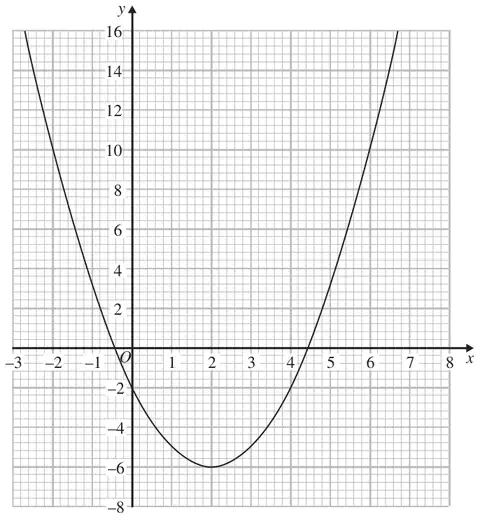
19 The diagram shows the graph of \(y = x^2 - 4x - 2\)
(a) Use the graph to find estimates for the solutions of
(i) \(x^2 - 4x - 2 = 0\)
(ii) \(x^2 - 4x - 6 = 0\) (3)
(b) Use the graph to find estimates for the values of \(x\) that satisfy the simultaneous equations \[\begin{aligned} y &= x^2 - 4x - 2 \\ x + y &= 6 \end{aligned}\] (3)
Mark scheme (a)
Answer
Mark
Notes
(i) \(-0.4\) to \(-0.5\) 4.4 to 4.5
B1 for value in range \(-0.4\) to \(-0.5\) and value in range 4.4 to 4.5 NB: condone values given as part of coordinates.
(ii) \(-1.0\) to \(-1.2\) 5.0 to 5.2
3
M1 for \(x^2 - 4x - 2 = 4\) or line \(y = 4\) drawn on graph or points marked with a \(y\) coord. of 4 or a value in range \(-1.0\) to \(-1.2\) or a value in range 5.0 to 5.2 A1 for value in range \(-1.0\) to \(-1.2\) and value in range 5.0 to 5.2; do not accept coordinates.
Mark scheme (b)
Answer
Mark
Notes
\(-1.6\) to \(-1.8\) 4.6 to 4.8
3
M1 for \(x + y = 6\) drawn on graph A2 for value in range \(-1.6\) to \(-1.8\) and value in range 4.6 to 4.8 (A1 for one correct value or both values given as coordinates)
M1 for a correct process to eliminate either variable (condone one arithmetic error) or to rearrange and substitute for elimination A1 cao for either \(x\) or \(y\) M1 (dep on M1) for correct substitution of found value into one of the equation or appropriate method after starting again (condone one arithmetic error) A1 cao
M1 for \(y = 2x + 1\) drawn or for elimination of one variable A1 for one correct pair of values given or for \(x = 1.4, -2.2\) (\(\pm 0.2\)) or ft from graph provided 2 marks in (a) A1 for second correct pair of values given (\(\pm 0.2\)) or ft from graph provided 2 marks in (a)
15 A cinema sells adult tickets and child tickets.
The total cost of 3 adult tickets and 1 child ticket is £30 The total cost of 1 adult ticket and 3 child tickets is £22
Work out the cost of an adult ticket and the cost of a child ticket. (4)
Mark scheme
Working
Answer
Mark
Notes
\(3x + y = 30\) \(x + 3y = 22\)
8.50 4.50
4
M1 for forming two algebraic equations M1 for a correct process to eliminate one variable (condone one arithmetic error) M1 (dep) for substituting found value in one of the equations or appropriate method after starting again (condone one arithmetic error) A1 for 8.5(0) and 4.5(0)
M1 for substitution for elimination eg \((2y + 6)^2 + y^2 = 36\) M1 (dep on M1) for expansion eg \(4y^2 + 12y + 12y + 36\) (3 out of 4 terms correct) A1 for \(4y^2 + 24y + 36 + y^2 = 36\) oe M1 for a correct attempt to solve a 2 or 3 term quadratic equation eg by factorising or correct substitution into a quadratic formula A1 for \(x = 6\), \(y = 0\) and \(x = -3.6\) oe, \(y = -4.8\) oe SC: B1 (if M0 scored) for all 4 values mis-associated or one correct pair of values.
18 Solve the simultaneous equations \[\begin{aligned} 4x + y &= 25 \\ x - 3y &= 16 \end{aligned}\] (3)
Mark scheme
Answer
Mark
Notes
\(x = 7\) \(y = -3\)
3
M1 for correct process to eliminate one variable (condone one arithmetic error) M1 (dep) for substituting found value in one of the equations or appropriate method after starting again (condone one arithmetic error) A1 for \(x = 7\) and \(y = -3\)
M1 for a correct process to eliminate either variable (condone one arithmetic error) A1 cao for either \(x\) or \(y\) M1 (dep on M1) for correct substitution of found value into one of the equations or appropriate method after starting again (condone one arithmetic error) A1 cao
OR
M1 for full method to rearrange and substitute to eliminate either variable (condone one arithmetic error) A1 cao for either \(x\) or \(y\) M1 (dep on M1) for correct substitution of found value into one of the equations or appropriate method after starting again (condone one arithmetic error) A1 cao
Trial and improvement scores 0 marks unless both \(x\) and \(y\) are correct
M1 for \(x^2 + (2 - x)^2 = 9\) M1 for \(4 - 4x + x^2\) A1 for \(2x^2 - 4x - 5 = 0\) oe 3 term simplified quadratic M1 for a correct method to solve their quadratic Eg \(x = \dfrac{4 \pm \sqrt{16 - 4 \times 2 \times -5}}{4}\) A1 for \(x = 2.87\), \(y = -0.87\) or better A1 for \(x = -0.87\), \(y = 2.87\) or better Award marks for equivalent algebraic expressions. Apply the same scheme as above for \(y\) first.
M1 for a correct process to eliminate either \(x\) or \(y\) or rearrangement of one equation leading to substitution (condone one arithmetic error) A1 for either \(x = -5\) or \(y = 3\) M1 (dep) for correct substitution of their found value A1 cao
M1 for a correct process to eliminate either \(x\) or \(y\) or leading to substitution (condone one arithmetic error) A1 for either \(x = -2\) or \(y = 5\) M1 (dep) for correct substitution of their found value A1 cao SC If M0 scored B1 for \(y = -2\) and \(x = 5\)
Notes
(corrected from the printed mark scheme: the working line \(3x + 2 \times 5 = 4\) is printed as \(3x + 2 \times 5 = 6\))
M1 for coefficients of \(x\) or \(y\) the same followed by correct operation (condone one arithmetic error) A1 cao for first solution M1 (dep on M1) for correct substitution of found value into one of the equations or appropriate method after starting again (condone one arithmetic error) A1 cao for second solution OR M1 for full method to rearrange and substitute to eliminate \(x\) or \(y\), (condone one arithmetical error) A1 cao for first solution M1 (dep on M1) for correct substitution of found value into one of the equations or appropriate method after starting again (condone one arithmetic error) A1 cao for second solution Trial and improvement 0 marks unless both \(x\) and \(y\) correct values found
oe correct for their 3-term quadratic in the form \(ax^2 + bx + c\ (= 0)\) if the quadratic formula is used with \(+\) and \(-\) separately, both must be seen correctly for this mark
oe correct for their 3-term quadratic in the form \(ay^2 + by + c\ (= 0)\) if the quadratic formula is used with \(+\) and \(-\) separately, both must be seen correctly for this mark
\((y =)\) \(-8\) and \((y =)\) 1
A1
\((-2, -8)\) and \((1, 1)\)
A1
SC1 for 1 correct coordinate
Additional guidance
Trial and improvement may be awarded SC1 for one correct coordinate or full marks if both coordinates are correct
14 4 chocolate bars and 3 packets of mints cost £4.70
5 chocolate bars and 1 packet of mints cost £4.50
Work out the cost of a chocolate bar and the cost of a packet of mints. [4 marks]
Mark scheme
Answer
Mark
Comments
Alternative method 1: elimination
at least one correct equation
M1
eg \(4x + 3y = 4.7(0)\) or \(5x + y = 4.5(0)\) or \(15x + 3y = 13.5(0)\) or \(9x + 4y = 9.2(0)\) may work in pounds or pence any letters
correctly multiplies one or two correct equations to equate coefficients of \(x\) or \(y\)
M1dep
eg \(4x + 3y = 4.7(0)\) and \(15x + 3y = 13.5(0)\) or \(20x + 15y = 23.5(0)\) and \(20x + 4y = 18.(00)\)
correctly adds or subtracts correct equations to eliminate one variable
M1dep
eg \(11x = 8.8(0)\) or \(11y = 5.5(0)\) may be implied by one correct value of \(x\) or \(y\) with M2 scored
chocolate bar £0.80 and packet of mints £0.50 or chocolate bar 80p and packet of mints 50p
A1
correct money notation condone £0.80p and £0.50p
Alternative method 2: substitution
\(4x + 3y = 4.7(0)\) or \(5x + y = 4.5(0)\) or \(15x + 3y = 13.5(0)\) or \(9x + 4y = 9.2(0)\)
M1
oe may work in pounds or pence any letters
correctly makes \(x\) or \(y\) the subject of a correct equation
M1dep
eg \(x = \dfrac{4.7(0) - 3y}{4}\) or \(x = \dfrac{4.5(0) - y}{5}\) or \(y = \dfrac{4.7(0) - 4x}{3}\) or \(y = 4.5(0) - 5x\)
correctly substitutes to eliminate a variable
M1dep
eg \(5\dfrac{(4.7(0) - 3y)}{4} + y = 4.5(0)\) or \(4\dfrac{(4.5(0) - y)}{5} + 3y = 4.7(0)\) or \(5x + \dfrac{4.7(0) - 4x}{3} = 4.5(0)\) or \(4x + 3(4.5(0) - 5x) = 4.7(0)\) may be implied by one correct value of \(x\) or \(y\) with M2 scored
chocolate bar £0.80 and packet of mints £0.50 or chocolate bar 80p and packet of mints 50p
A1
correct money notation condone £0.80p and £0.50p
Additional guidance
Up to M3 may be awarded for correct work with no answer or incorrect answer if this is seen amongst multiple attempts
Condone multiple letters in equations eg \(cb\) for \(x\)
Trial and improvement is 0, 3 (incorrect money notation) or 4 (fully correct)
Final answer chocolate bar £0.8 and packet of mints £0.5
M3A0
Final answer chocolate bar 0.80p and packet of mints 0.50p
\(5^2 + 7 \times 5 - c\) or \(60 - c\) and \(3 \times 5 + d\) or \(15 + d\)
M1
oe
\(25 + 35 - c = 15 + d\) or \(60 - c = 15 + d\) or \(c = 60 - y\) and \(d = y - 15\) and \(c + d = 60 - y + y - 15\)
M1dep
oe equation with squaring and multiplications correctly completed
45
A1
Alternative method 2
\(x^2 + 7x - c = 3x + d\) or \(x^2 + 7x - c - (3x + d) = 0\) or \(x^2 + 7x - c - 3x - d = 0\) or \(3x + d - (x^2 + 7x - c) = 0\) or \(3x + d - x^2 - 7x + c = 0\)
oe elimination of one variable implied by \(21x + 14y = 112\) and \(21x + 6y = 108\) followed by \(8y = n\), where \(n < 112\) and \(n \ne 36\), 16 or 20
oe elimination of one variable implied by \(21x + 14y = 112\) and \(21x + 6y = 108\) followed by \(8y = n\), where \(n < 112\) and \(n \ne 36\), 16 or 20
\[\begin{aligned} 2x + 3y &= 5p \\ y &= 2x + p \end{aligned}\]
where \(p\) is a constant.
Give your answers in terms of \(p\) in their simplest form. [4 marks]
Mark scheme
Answer
Mark
Comments
Alternative method 1: substitution of \(2x + p\) for \(y\)
\(2x + 3(2x + p) = 5p\)
M1
oe equation eg \(2x + 6x + 3p = 5p\)
\(6x + 2x = 5p - 3p\) or \(8x = 2p\)
M1dep
oe equation with terms collected condone incorrect expansion before rearrangement
Correct simplified terms \((x =)\ \dfrac{p}{4}\) or \(\dfrac{1}{4}p\) or \(0.25p\) and \((y =)\ \dfrac{3p}{2}\) or \(\dfrac{3}{2}p\) or \(1\dfrac{1}{2}p\) or \(1.5p\)
A2
A1 one correct simplified term or otherwise correct terms for both with ‘\(p\)’ omitted eg \(x = 0.25\) and \(y = 1.5\) or correct unsimplified terms for both eg \(x = \dfrac{2p}{8}\) and \(y = \dfrac{6p}{4}\)
Alternative method 2: substitution of \(y - p\) for \(2x\)
\(y - p + 3y = 5p\)
M1
oe equation
\(y + 3y = 5p + p\) or \(4y = 6p\)
M1dep
oe equation with terms collected
Correct simplified terms \((x =)\ \dfrac{p}{4}\) or \(\dfrac{1}{4}p\) or \(0.25p\) and \((y =)\ \dfrac{3p}{2}\) or \(\dfrac{3}{2}p\) or \(1\dfrac{1}{2}p\) or \(1.5p\)
A2
A1 one correct simplified term or otherwise correct terms for both with ‘\(p\)’ omitted eg \(x = 0.25\) and \(y = 1.5\) or correct unsimplified terms for both eg \(x = \dfrac{2p}{8}\) and \(y = \dfrac{6p}{4}\)
Alternative method 3: elimination of \(x\)
\(y - 2x = p\)
M1
oe with multiplication of both equations
\(y + 3y = 5p + p\) or \(4y = 6p\)
M1dep
oe addition must be seen if result is incorrect
Correct simplified terms \((x =)\ \dfrac{p}{4}\) or \(\dfrac{1}{4}p\) or \(0.25p\) and \((y =)\ \dfrac{3p}{2}\) or \(\dfrac{3}{2}p\) or \(1\dfrac{1}{2}p\) or \(1.5p\)
A2
A1 one correct simplified term or otherwise correct terms for both with ‘\(p\)’ omitted eg \(x = 0.25\) and \(y = 1.5\) or correct unsimplified terms for both eg \(x = \dfrac{2p}{8}\) and \(y = \dfrac{6p}{4}\)
Alternative method 4: elimination of \(y\)
\(3y - 6x = 3p\)
M1
oe with multiplication of both equations
\(2x - (-6x) = 5p - 3p\) or \(8x = 2p\)
M1dep
oe subtraction must be seen if result is incorrect
Correct simplified terms \((x =)\ \dfrac{p}{4}\) or \(\dfrac{1}{4}p\) or \(0.25p\) and \((y =)\ \dfrac{3p}{2}\) or \(\dfrac{3}{2}p\) or \(1\dfrac{1}{2}p\) or \(1.5p\)
A2
A1 one correct simplified term or otherwise correct terms for both with ‘\(p\)’ omitted eg \(x = 0.25\) and \(y = 1.5\) or correct unsimplified terms for both eg \(x = \dfrac{2p}{8}\) and \(y = \dfrac{6p}{4}\)
oe Correct factorisation of their 3-term quadratic or correct substitution in formula for their 3-term quadratic or correct completion of square to expression for \(x\)
(\(x =\)) \(-2.6\)
A1
oe
\(({-2.6}, {-6.8})\)
A1
oe
Additional guidance
After scoring first M1, they substitute \(p = {-13}\) \((p - 1)(p + 13)\) or \(p = 1\) (and \(p = {-13}\))
(\(x =\)) \(-\dfrac{1}{2}\) with no other solutions with M2A1 seen or states that as brackets are the same there is only one solution with M2A1 seen or \(b^2 - 4ac = 4^2 - 4 \times 4 \times 1 = 0\) and states there is only one solution with M2A1 seen or D(iscriminant) \(= 4^2 - 4 \times 4 \times 1 = 0\) and states there is only one solution with M2A1 seen
A1
oe allow \(b^2 - 4ac = 16 - 16 = 0\) and states there is only one solution with M2A1 seen allow D(iscriminant) \(= 16 - 16 = 0\) and states there is only one solution with M2A1 seen
(\(y =\)) \(\dfrac{3}{2}\) with no other solutions with M2A1 seen or states that as brackets are the same there is only one solution with M2A1 seen or \(b^2 - 4ac = (-12)^2 - 4 \times 4 \times 9 = 0\) and states there is only one solution with M2A1 seen or D(iscriminant) \(= (-12)^2 - 4 \times 4 \times 9 = 0\) and states there is only one solution with M2A1 seen
A1
oe allow \(b^2 - 4ac = 144 - 144 = 0\) and states there is only one solution with M2A1 seen allow D(iscriminant) \(= 144 - 144 = 0\) and states there is only one solution with M2A1 seen
Additional guidance
Alt 1 (\(x =\)) \(-\dfrac{1}{2}\) with no working or Alt 2 (\(y =\)) \(\dfrac{3}{2}\) with no working
M0M0A0A0
Alt 1 Ignore any \(y\)-coordinate whether correct \(\left(= \dfrac{3}{2}\right)\) or incorrect
Alt 2 Ignore any \(x\)-coordinate whether correct \(\left(= -\dfrac{1}{2}\right)\) or incorrect
T & I leading to \(x = -\dfrac{1}{2}\)
M0M0A0A0
To award M1dep you must see a correct expression with terms collected or a correct equation with terms collected
\(4x^2 + 5x + 3 = x + 2\) \(4x^2 + 1 = -4x\) (all \(x\) terms not collected on one side)
M1 M0dep
\(4x^2 + 5x + 3 = x + 2\) \(4x^2 + 4x + 3 = 2\) (all constant terms not collected on one side)
M1 M0dep
If using the discriminant to award A marks, you must see either \(b^2 - 4ac\) or D(iscriminant) \(b^2 - 4ac = 4^2 - 4 \times 4 \times 1\) can be implied eg \(b + \sqrt{b^2 - 4ac}\) and \(4 + \sqrt{4^2 - 4 \times 4 \times 1}\) scores first A1 For final A1 must see \(b^2 - 4ac = 4^2 - 4 \times 4 \times 1 = 0\) and statement that there is only one solution with M2A1 seen
22 Kai plays an online game. Kai collects diamonds and rubies. Each diamond and each ruby is worth a fixed number of points.
In game 1, Kai collects 4 diamonds and 3 rubies and scores 47 points. In game 2, Kai collects 3 diamonds and 5 rubies and scores 49 points.
Work out the number of points for a diamond and the number of points for a ruby. You must show your working. [5]
Mark scheme
Answer
Marks
Part marks and guidance
[diamond =] 8 [ruby =] 5 with correct working
5
B4 for one correct answer with correct working
Correct working requires evidence of at least M1 M1 M1 Mark the method leading to answer. If no answer, treat different methods as choice and mark the worst
OR
M1 for \(4d + 3r = 47\) oe M1 for \(3d + 5r = 49\) oe
Accept other letters and “diamonds/rubies” seen in equations The last two M marks are dependent on first M1M1 (two correct equations)
M1 for correct method to equate coefficients of one variable allowing one arithmetic error
e.g. \(12d + 9r = 141\) and \(12d + 20r = 196\) or \(20d + 15r = 235\) and \(9d + 15r = 147\)
M1 for correct method to eliminate one variable allowing one arithmetic error
e.g. \(11r = 55\) or \(11d = 88\) Note: A sign error is not an arithmetic error
If 0 or 1 scored, instead award SC2 for [diamond =] 8 and [ruby =] 5 with no or insufficient working
If 0 scored, instead award SC1 for two integer answers which satisfy one of the original conditions
If substitution method used apply first two M1s then, if M1M1 awarded, M1 for correctly rearranging an equation M1 for correct substitution into other equation
Alternative method of Trials \(4 \times \mathbf{8} + 3 \times \mathbf{5} = 47\) and \(3 \times \mathbf{8} + 5 \times \mathbf{5} = 49\) and correct answer scores 5 or \(4 \times \mathbf{8} = 32\) then \((47 - 32) \div 3 = \mathbf{5}\) and \(3 \times \mathbf{8} = 24\) then \((49 - 24) \div 5 = 5\) (or \(3 \times \mathbf{8} + 5 \times \mathbf{5} = 49\)) (5 may be substituted and used to find 8) or M1 for one correct trial of integer values for \(d\) and \(r\) in one case e.g. \(4 \times \mathbf{6} + 3 \times \mathbf{5} = 39\) oe or \(3 \times \mathbf{6} + 5 \times \mathbf{5} = 43\) oe oe may be substitution of an integer value into one relationship and “solving” to find the second value, which may be non-integer e.g \(4 \times \mathbf{6} = 24\) then \((47 - 24) \div 3 = \mathbf{7.6...}\)
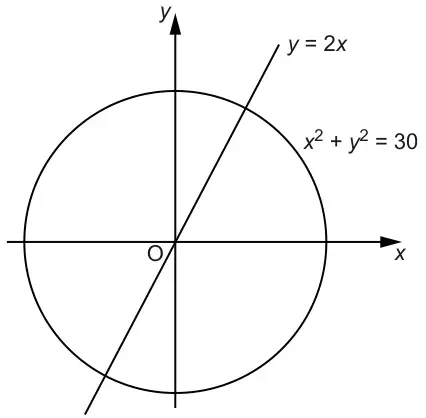
21 The graph of \(y = -3x\) intersects the graph of \(x^2 + y^2 = 70\) at two points.
Work out the exact coordinates of the two points. You must show your working. [5]
Mark scheme
Answer
Marks
Part marks and guidance
\((-\sqrt{7}, 3\sqrt{7})\) and \((\sqrt{7}, -3\sqrt{7})\) exact form only with correct working
5
Correct working requires evidence of at least M2 For \(y\) values accept \(\pm\sqrt{63}\) and for \(x\) values accept \(\frac{\pm\sqrt{63}}{3}\)
M3 for \(x^2 = 7\) or M2 for \(x^2 + 9x^2 = 70\) or \(10x^2 = 70\) or \(10x^2 - 70 = 0\) or M1 for \(x^2 + (-3x)^2 = 70\)
If \(x = -\sqrt{7}\) and \(\sqrt{7}\) seen after M2, award M3A1
Condone omission of brackets if recovered
A1 for \(x = -\sqrt{7}\) and \(\sqrt{7}\) or for one correct point
For A1 and SC1, condone –2.65 to –2.64, 2.64 to 2.65, –7.94 to –7.93, 7.93 to 7.94
If 0 or 1 scored, instead award SC2 for \((-\sqrt{7}, 3\sqrt{7})\) and \((\sqrt{7}, -3\sqrt{7})\) with no or insufficient working If 0 scored, instead award SC1 for both \(x\) values or for one correct point with no or insufficient working
Apply similar scheme for working in terms of \(y\).
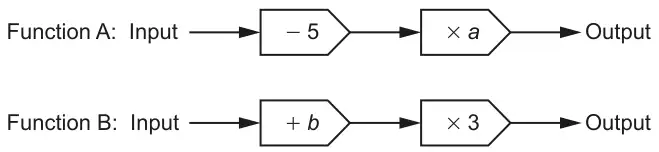
When the input for both machines is 11, the output of Function A is equal to the output of Function B. When the input for both machines is 29, the output of Function A is twice the output of Function B.
Find the value of \(a\) and the value of \(b\). [5]
e.g. \(6a = 3(11 + b)\) or better e.g. \(24a = 6(29 + b)\) or better
or B1 for any two of the expressions below \(a(11 - 5)\), \(3(11 + b)\), \(a(29 - 5)\), \(3(29 + b)\) oe
e.g \(6a\), \(24a\), \(33 + 3b\), \(87 + 3b\)
M1 for equating coefficients of one variable in their original linear equations or making \(a\) or \(b\) the subject of one of their original equations e.g. \(24a = 12(11 + b)\) and \(24a = 6(29 + b)\) or \(b = 2a - 11\)
Note : if they write two correct equations and manipulate them incorrectly e.g. expanding brackets incorrectly then they can score B2 M0 M1
M1 for correctly eliminating one variable in their linear equations with one coefficient of one variable equal e.g. \(6(29 + b) = 12(11 + b)\) oe or \(24a = 6(29 + 2a - 11)\)
B2 M2 for a correct linear equation in \(a\) or \(b\) e.g. \(2a - 11 = 4a - 29\) oe or better
Allow one arithmetical error in one of the processes For substitution award second M1 at the point of substitution
If 0 scored SC1 for \(a(x - 5)\) or \(3(x + b)\) allowing any letter for \(x\)
Trials : M1 for each attempt using values for \(a\) and \(b\) and checking both functions with 11 and 29 to a maximum of M2
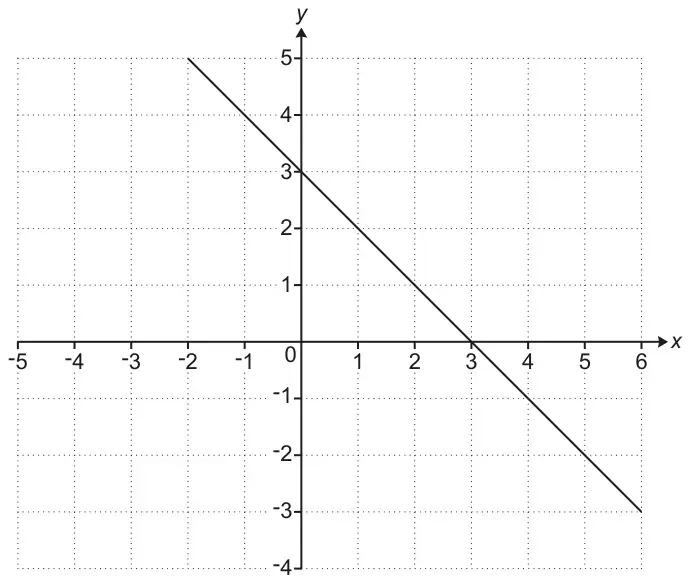
7 The graph of the line \(x + y = 3\) is shown on this grid.
(a) By drawing a suitable line on the grid, solve these simultaneous equations.
\(x + y = 3\) and \(y = 2x - 3\) [4]
(b) Umi says,
The simultaneous equations \(y = 2x + 3\) and \(2y - 4x = 7\) will have no solutions.
Is Umi correct?
Explain how you decide. [2]
Mark scheme (a)
Answer
Marks
Part marks and guidance
Draws ruled line \(y = 2x - 3\)
4
M2 for drawing ruled line \(y = 2x - 3\)
or M1 for correct line but freehand or for ruled line with gradient 2 or for ruled line with positive gradient passing through (0, –3)
Accuracy - use overlay as a guide and line must touch circles For M2 must reach at least (0, –3) and intersection with \(x + y = 3\)
AND
\(x = 2\) and \(y = 1\)
B2FT for \(x = 2\) and \(y = 1\) or B1FT for one correct value
FTtheir intersection of their ruled or freehand line with given line Allow correct or FT for B2 and B1 If intersection is not on integer values allow reasonable estimated readings
Mark scheme (b)
Answer
Marks
Part marks and guidance
Showing \(2y - 4x = 7\) can be written as \(y = 2x + 3.5\) oe Or Rearranges equations to the same form for comparison e.g. \(2y = 4x + 6\) and \(2y = 4x + 7\), or \(2y - 4x = 6\) and \(2y - 4x = 7\) or states that both have gradient of 2 with no error in rearrangement seen
1
Accept other working that supports a conclusion of parallel or no solutions
eg \(2(2x + 3) - 4x = 7\) and \(4x + 6 - 4x = 7\) or better \(2y = 4x + 6\) and \(2y - 4x = 7\) then eliminates \(x\) or \(y\) leading e.g. 6 – 7 oe or ‘no solutions’
correct oe and the lines are parallel/have same gradient/ have no solutions oe
21 Work out the coordinates of the intersection of the graphs of \(y = 5 - 2x\) and \(y = 3x^2\).
You must show your working. [6]
Mark scheme
Answer
Marks
Part marks and guidance
\(\left(-\frac{5}{3}, \frac{25}{3}\right)\) oe and (1, 3) with correct working
6
Accept ( –1.67 or –1.666 to –1.667 , 8.33[3]…) Correct working requires evidence of at least M2M2
M2 for \(3x^2 + 2x - 5\) [= 0]
or M1 for \(3x^2 = 5 - 2x\)
For M2 accept e.g. \(5 - 2x - 3x^2\) [= 0]
M2 for \((3x + 5)(x - 1)\) [= 0]
or M1 for \((3x + a)(x + b)\) where \(ab = -5\) or \(3b + a = 2\) or for correct partial factors \(3x(x - 1) + 5(x - 1)\) or \(x(3x + 5) - [1](3x + 5)\)
Strict FT their 3-term quadratic equation or expression e.g.If M2 awarded for \(5 - 2x - 3x^2\) [= 0] then factors should be correct for this equation for M2 or M1 Accept correct use of quad formula or completing the square, M2 if completely correct, M1 if one error in substitution in formula or \((x + a)^2\) correct if completing the square
A1dep on M2M2 for either pair of coordinates correct or for both \(x\) values correct or both \(y\) values correct
If 0, 1 or 2 scored, instead award SC3 for answers \(\left(-\frac{5}{3}, \frac{25}{3}\right)\) oe and (1, 3) If 0 or 1 scored, instead award SC2 for answer \(\left(-\frac{5}{3}, \frac{25}{3}\right)\) oe or for both \(x\) values correct or both \(y\) values correct If 0 scored, SC1 for one answer (1, 3)
If A1 for correct \(x\)–values or \(y\) – values after correct partial factorisation award M2 for factors
See AG for work with equations in terms of \(y\)
Additional guidance: Question 21
A few may choose to work in terms of \(y\)
If working in terms of \(y\)
M2 for \(3y^2 - 34y + 75\) [ = 0] or M1 for \(\frac{5 - y}{2} = \sqrt{\frac{y}{3}}\) oe or better
or M1 for \((3y + a)(y + b)\) where \(ab = 75\) or \(3b + a = -34\)
accept equivalent negative version factors \(-(3y + a)(y + b)\) Allow M1 for factors that when expanded give one other term correct as well as ‘\(3y^2\)’
or for correct partial factors \(3y(y - 3) - 25(y - 3)\) or \(y(3y - 25) - 3(3y - 25)\)
accept equivalent negative version partial factors
If A1 for correct \(y\) values after correct partial factors award M2 for factors
3 Four numbers are written, in ascending order, as algebraic expressions.
\(a \qquad a + b \qquad a + 2b \qquad 3a - b\)
The mean of these four numbers is 27. The range of these four numbers is 24.
Find the value of \(a\) and the value of \(b\). You must show your working. [5]
Mark scheme
Answer
Marks
Part marks and guidance
[\(a =\)] 15.6 [\(b =\)] 7.2 with correct working
5
B4 for one correct answer with correct working
“Correct working” requires evidence of at least M1M1 for the two equations and M1 for some evidence of solving them
OR
M1 for \(\dfrac{a + a + b + a + 2b + 3a - b}{4} = 27\) oe
e.g. \(6a + 2b = 108\)
M1 for \(3a - b - a = 24\) oe
e.g. \(2a - b = 24\)
M1 for equating coefficients of one variable for their linear equations
dependant on two linear equations e.g. \(6a - 3b = 72\) or \(4a - 2b = 48\) or \(3a + b = 54\)
M1 for correct method to eliminate one variable for their original linear equations
dependant on two linear equations e.g. \(5b = 36\) Allow one numerical error in each step of solving their equations A sign error is not an arithmetic error
If 0, M1 or M2 scored, instead award SC3 for answers 15.6 and 7.2 with no working or insufficient working If 0 or M1 scored, instead award SC2 for \(a = 7.2\) and \(b = 15.6\) with no working or insufficient working If 0 scored, instead award SC1 for two answers which satisfy one of the original conditions
Substitution method: M1 and M1 for the two equations M1 dependant on two linear equations and for rearranging one equation to make one variable the subject e.g. \(a = \frac{24 + b}{2}\) M1 for substituting it into their other equation
Trials (need to see the mean or total, and the range evaluated for each): M1 for each correct trial up to a maximum of 3 After three correct trials, correct final answers score 5
24 2 kg of carrots and 5 kg of potatoes cost £6.36. 3 kg of carrots and 2 kg of potatoes cost £5.25.
Find the cost of 1 kg of carrots and the cost of 1 kg of potatoes. You must show your working. [5]
Mark scheme
Answer
Marks
Part marks and guidance
[carrots =] 1.23 [potatoes =] 0.78 with correct working
5
B4 for one correct answer with correct working OR M1 for \(2c + 5p = 6.36\) oe M1 for \(3c + 2p = 5.25\) oe M1 for correct method to equate coefficients of one variable allowing one arithmetic error M1 for correct method to eliminate one variable allowing one arithmetic error
If 0 or M1 scored award SC2 for answers 1.23 and 0.78 with no working or insufficient working or if 0 scored SC1 for two answers which satisfy one of the original conditions
“Correct working” requires evidence of at least M1 M1 M1
Allow any letter for \(c\) and \(p\), but not carrots or potatoes, and working in pence, answers in pence must have ‘p’ after, condone £ or pence in equations
e.g. \(6c + 15p = 19.08\) and \(6c + 4p = 10.50\) or \(4c + 10p = 12.72\) and \(15c + 10p = 26.25\)
e.g. \(11p = 8.58\) or \(11c = 13.53\) Note: A sign error is not an arithmetic error
if substitution method used M1 for correctly rearranging equation M1 for correct substitution into other equation
Correct answers from trial and improvement scores 5
(a) Describe fully the graph of \(x^2 + y^2 = 20\). [3]
(b) The graph of \(y = 3x + 10\) intersects the graph of \(x^2 + y^2 = 20\) at two points.
Use an algebraic method to work out the coordinates of the two points. You must show your working. [6]
Mark scheme (a)
Answer
Marks
Part marks and guidance
Circle
1
Accept circular graph
Centre (0, 0) oe
1
Accept origin or O for (0, 0) but not turning point (0, 0)
Radius \(\sqrt{20}\) or \(2\sqrt{5}\) or 4.47[2..] or 4.5
1
If their description uniquely defines the circle then award full marks eg After “circle” and “centre (0, 0)”, passes through one correct stated point, scores 3 “circle” and (\(\pm\sqrt{20}\) , 0) and (0, \(\pm\sqrt{20}\) ), scores 3 “circle” and two correct stated points, scores 1
Mark scheme (b)
Answer
Marks
Part marks and guidance
(\(-2\), 4) and (\(-4\), \(-2\)) with correct working
6
M1 for \(x^2 + (3x + 10)^2 = 20\)
M1 for expanding their square term e.g. \(9x^2 + 30x + 30x + 100\)
M1 for simplifying their quadratic equation e.g. \(10x^2 + 60x + 100 = 20\) or better
M1 for correctly factorising their 3-term quadratic equation or for correct use of quadratic formula for their 3-term quadratic equation or for correct completing the square
A1 for one correct point or two correct \(x\)-values
If 0 or 1 scored, instead award SC2 for 2 correct points with no or insufficient working
If 0 scored SC1 for 1 correct point or 2 correct \(x\)-coordinates or 2 correct \(y\)-coordinates with no or insufficient working
‘Correct working’ requires evidence of at least M1M1M1
Award equivalent marks if working in terms of \(y\) May be in a grid May be implied by subsequent working
Their quadratic must include an \(x\) term Simplified: \(10x^2 + 60x + 80\) [= 0] or \(x^2 + 6x + 8\) [= 0]
Some algebraic working leading to an answer of 3 −3
5
M1 for e.g. \(x^2 + (x - 6)^2 = 18\) M1 for expanding their square term e.g. \(x^2 - 12x + 36\) M1 for \(2x^2 - 12x + 18 = 0\) or better M1 for [2]\((x - 3)^2\) or \((2x - 6)(x - 3)\)
If 0 scored SC2 for correct answers with no algebraic working
condone one error in expanding brackets
simplifying to \(ax^2 - bx + c\) e.g. solving their quadratic equation by e.g. factors or quadratic formula
Note : apply scheme to substitution for \(x\) e.g. M1 for \((y + 6)^2 + y^2 = 18\) etc
22 A theatre has an adult price and a child price for their shows.
A group of 4 adults and 5 children paid a total of £136.
A group of 3 adults and 2 children paid a total of £81.
Work out the price for one adult and the price for one child. You must show your working.
Price for one adult £ .................... Price for one child £ .................... [5]
Mark scheme
Answer
Marks
Part marks and guidance
[a =] 19 [c =] 12 with correct working
5
B4 for one correct answer with correct working OR M1 for \(4a + 5c = 136\) oe M1 for \(3a + 2c = 81\) oe M1 for method to find a common coefficient, allow one arithmetic error M1 for correct method to eliminate 1 variable, allow one arithmetic error OR
If 0 or M1 scored instead award SC2 for both correct answers with no or insufficient working or SC1 for two answers which satisfy one of the original conditions
“Correct working” requires evidence of at least M1M1M1
Correct answer from trial and improvement scores 5
Accept other variables for \(a\) and \(c\)
If substitution method used M1 for correct rearrangement of equation M1 for correctly substituting into other equation
(a) The next term in a Fibonacci sequence is found by adding together the two previous terms.
(i) The first and second terms of a particular Fibonacci sequence are \(x\) and \(y\). Show that the fourth term of the sequence can be written as \(x + 2y\). [2]
(ii) The fourth term of the same Fibonacci sequence is 7. The seventh term of the sequence is 31. Work out the value of \(x\) and the value of \(y\). You must show your working. [6]
(b) Here are the first four terms of a sequence.\[1 \qquad \sqrt{3} \qquad 3 \qquad 3\sqrt{3}\]
Write an expression for the \(n\)th term. [2]
(c) Here are the first four terms of a quadratic sequence.\[-1 \qquad 5 \qquad 13 \qquad 23\]
The \(n\)th term is \(n^2 + bn + c\).
Find the value of \(b\) and the value of \(c\). [3]
Mark scheme (a)
Answer
Marks
Part marks and guidance
(a)(i)
[\(u_3\) = ] \(x + y\)
1
[\(u_4\) = ] \(y + x + y\) [= \(x + 2y\)]
1
(a)(ii)
3 2 with correct working
6
M2 for [\(u_7\) = ] \(7 + x + y + 7 + x + y + 7\) oe or better
or M1 for [\(u_5\) = ] \(x + y + 7\) oe or better and B1 for \(x + 2y = 7\) oe B1FT for their \((2x + 2y + 21) = 31\) oe M1 for solving their equations e.g. subtracting equations to give \(x = 3\)
If 0 or 1 scored, instead award SC2 for answers [\(x\) =] 3 and [\(y\) =] 2 with no or insufficient working If 0 scored, instead award SC1 for [\(x\) =] 3 or [\(y\) =] 2 or both correct answers switched, with no or insufficient working
“Correct working” requires evidence of at least B1 B1 or M2 or M1 M1 e.g. \(2x + 2y + 21\) or \(2x + 3y + x + 2y + 2x + 3y\) or \(5x + 8y\) e.g. \(x + y + x + 2y\) or \(2x + 3y\)
e.g. \(5x + 8y = 31\) FTtheir \(u_7\) e.g. multiplying one equation and correctly adding or subtracting to eliminate one variable
correct answers with trials will score 6 marks M1 for each correct trial (value of \(x\) and a value of \(y\)) up to a maximum of M3 e.g. \(x = 1\) \(y = 4\) gives 1 4 5 9 [14 23 37]
Mark scheme (b)
Answer
Marks
Part marks and guidance
\((\sqrt{3})^{n-1}\) or \(3^{\frac{1}{2}(n-1)}\) oe
2
M1 for common ratio of \(\sqrt{3}\) implied by answer of \((\sqrt{3})^k\)
Mark scheme (c)
Answer
Marks
Part marks and guidance
3 −5
3
B2 for \(b\) = 3 OR M1 for [−1 5 13 23] − [1 4 9 16] implied by −2 1 4 7 B1 for \(c\) = −5
condone 3\(n\) for 2 marks If equations used M1 for e.g. 1 + b + c = −1 oe 4 + 2b + c = 5 oe Allow any correct method
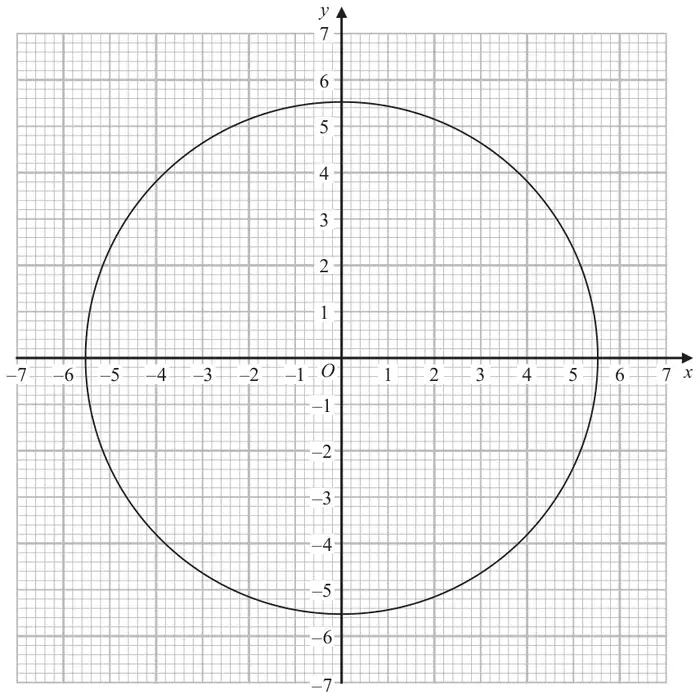
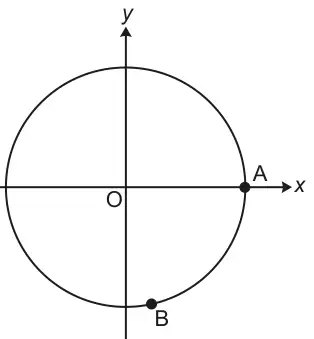
The sketch shows the circle and two points, A and B, which lie on the circumference of the circle.
(a) Write down the coordinates of point A. [1]
(b) Point B has \(x\)-coordinate 3.
Find the exact value of the \(y\)-coordinate of point B. [3]
(c) Another point, C, lies on the circle and has a \(y\)-coordinate that is seven times its \(x\)-coordinate.
Find the two possible pairs of coordinates for point C. Give your answers in exact form. You must show your working. [5]
Mark scheme (a)
Answer
Marks
Part marks and guidance
(10, 0)
1
Mark scheme (b)
Answer
Marks
Part marks and guidance
\(-\sqrt{91}\)
3
B2 for \(\sqrt{91}\) or −9.539[…] or −9.54
or
B1 for 9.539[…] or 9.54
or
M1 for \(9 + y^2 = 100\) oe
± answers treat as choice
Mark scheme (c)
Answer
Marks
Part marks and guidance
\((\sqrt{2},\ 7\sqrt{2})\) and \((-\sqrt{2},\ -7\sqrt{2})\) with correct working
5
B4 for \((\sqrt{2},\ 7\sqrt{2})\) with correct working or \((-\sqrt{2},\ -7\sqrt{2})\) with correct working
or
M2 for \(x^2 + (7x)^2 = 100\) oe A1 for [\(x = \pm\)] \(\sqrt{2}\)
or
M1 for 7\(x\) seen
If 0 or 1 or 2 scored, instead award SC3 for answer \((\sqrt{2},\ 7\sqrt{2})\) and \((-\sqrt{2},\ -7\sqrt{2})\) with no working or insufficient working
If 0 or M1 scored, instead award SC2 for answer \((\sqrt{2},\ 7\sqrt{2})\) or \((-\sqrt{2},\ -7\sqrt{2})\) or for \(\left(\frac{5\sqrt{2}}{2}, \frac{35\sqrt{2}}{2}\right)\) and \(\left(-\frac{5\sqrt{2}}{2}, -\frac{35\sqrt{2}}{2}\right)\) with no working or insufficient working
If 0 scored, instead award SC1 for [\(x = \pm\)] \(\sqrt{2}\) or for \(\left(\frac{5\sqrt{2}}{2}, \frac{35\sqrt{2}}{2}\right)\) or \(\left(-\frac{5\sqrt{2}}{2}, -\frac{35\sqrt{2}}{2}\right)\) with no working
“Correct working” requires evidence of at least M2 Allow \(\sqrt{98}\) for \(7\sqrt{2}\)
M1 for correct method to eliminate one variable B1 for \(x = 4\) B1 for \(y = -1\) If 0 scored SC1 for a pair of values that satisfy one of the original equations
Allow one arithmetic error in subtraction of terms or in rearrangement
If previously rearranged must be correct rearrangement
22 Kai buys 5 drinks and 3 cakes for £16.35. Azmi buys 2 drinks and 6 cakes for £14.70. Assume that each drink costs the same and that each cake costs the same.
Calculate the cost of one drink and the cost of one cake. You must show your working. [5]
Mark scheme
Answer
Marks
Part marks and guidance
[\(d =\)] 2.25 [\(c =\)] 1.7[0] with correct working
5
B4 for 1 correct answer with correct working
OR
M1 for \(5d + 3c = 16.35\) oe M1 for \(2d + 6c = 14.7[0]\) oe M1 for method to find a common coefficient, allow 1 arithmetic error M1 for correct method to eliminate 1 variable, allow one arithmetic error
OR
If 0 or M1 scored instead award SC2 for both answers correct with no or insufficient working or SC1 for two answers which satisfy one of the original equations
Accept other variables for \(d\) and \(c\) “Correct working” requires evidence of at least M1M1M1
Correct answers from trial and improvement score 5
If substitution method used M1 for correct rearrangement of equation M1 for correctly substituting into other equation
\[\begin{aligned} y &= x + 3 \\ (x - 3)^2 + y^2 &= 50 \end{aligned}\]
You must show your working. [5]
Mark scheme
Answer
Marks
Part marks and guidance
[\(x\)=] −4 [\(y\)=] −1 [\(x\)=] 4 [\(y\)=] 7 with correct algebraic working
5
accept any correct method
M1 for correct substitution e.g. \((x - 3)^2 + (x + 3)^2\) [= 50] M1 for expanding both brackets correctly e.g. \(x^2 - 3x - 3x + 9 + x^2 + 3x + 3x + 9\) [=50] M1 for simplifying their equation e.g. \(2x^2 = 32\) or \(2x^2 - 32\) [= 0]
“Correct algebraic working” requires evidence of at least M1M1
implied by \(2x^2 + 18\) [= 50]
condoning one error
or better to \(ax^2 = b\) or to \(ax^2 + bx + c\) [= 0]
A1FT for \(x = -4, 4\)
If 0 scored SC2 for [\(x\)=] −4 [\(y\)=] −1, [\(x\)=] 4 [\(y\)=] 7 with no working or SC1 for both \(x\) values with no working or a correct pair of \(x\) and \(y\) values with no working
FTtheir quadratic equation
See appendix for alternative methods
Appendix: Question 20
M1 for correct substitution e.g. \((y - 3 - 3)^2 + y^2\) [= 50] M1 for expanding the bracket correctly e.g. \(y^2 - 6y - 6y + 36 + y^2\) [=50] M1 for simplifying their equation e.g. \(2y^2 - 12y - 14\) [= 0] or better e.g. \(y^2 - 6y - 7\) [= 0] A1FT for \(y = -1, 7\)
If A0, SC1 for a pair of values that satisfy one of the original equations
ISW correct answers seen in working then reversed
Condone 1 arithmetic error – a sign error is not an arithmetic error Condone 1 further arithmetic error
Alt method M1 for rearrangement of one equation to make either \(x\) or \(y\) the subject M1 for correct substitution of their rearrangement into the other equation
[\(x\) =] −5 [\(y\) =] −3 [\(x\) =] 3 [\(y\) =] 5 with some algebraic working
6
M1 for \(x^2 + (x + 2)^2 = 34\)
M1 for expanding their square term e.g. \(x^2 + 4x + 4\)
M1 for simplifying their quadratic expression e.g. \(2x^2 + 4x + 4 = 34\) or better
M1 for correctly factorising their quadratic expression \(ax^2 + bx + c = 0\) e.g. \((x + 5)(x - 3)\) or \((2x + 10)(x - 3)\) or use of quadratic formula with no more than two errors
B1FT for either one correct point or two correct \(x\) values B1FT for the other correct point or two correct \(y\) values
If insufficient working B2 for 4 correct answers or B1 for 2 correct answers
e.g. \(x^2 + 2x - 15 = 0\)
\(a, b, c \ne 0\)
Alternative : M1 for \((y - 2)^2 + y^2 = 34\) or better M1 for \(y^2 - 4y + 4\) M1 for \(2y^2 - 4y + 4 = 34\) or better M1 for \((y - 5)(y + 3)\) or use of quadratic formula with no more than two errors
Both B1s are strict FT from their method to solve their quadratic equation e.g. they must FT correctly from their factorisation
\[\begin{aligned} 2x - y &= 7 \\ 2x + y &= 5 \end{aligned}\]
[3]
Mark scheme
Answer
Marks
Part marks and guidance
[\(x =\)] 3 [\(y =\)] \(-1\)
3
M1 for correct method to eliminate one variable B1 for \(x = 3\) B1 for \(y = -1\) If 0 scored SC1 for correct substitution in a given equation and correct evaluation to find other variable
Allow one error in addition or subtraction of terms or in rearrangement
If previously rearranged must be correct rearrangement
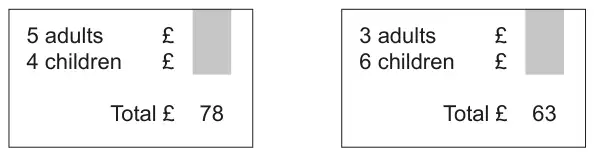
8 The diagrams show the price paid by two groups of people visiting a funfair.
Assume each adult pays the same price and each child pays the same price.
Find the price for an adult and the price for a child. [5]
Mark scheme
Answer
Marks
Part marks and guidance
[adult =] 12[.00] [child =] 4.5[0]
5
B1 for \(5a + 4c = 78\) B1 for \(3a + 6c = 63\) M1 for multiplying/dividing both equations to get the coefficient of one variable equal (allow one error) M1 for correctly adding or subtracting both equations to eliminate one variable (allow one error)
21 James and Elizabeth buy some clothes. James buys 5 shirts and 4 jumpers. He pays £163. Elizabeth buys 3 shirts and 2 jumpers. She pays £89.
Assume that each shirt has the same cost and that each jumper has the same cost.
Work out the cost of one shirt and the cost of one jumper.
You must show your working.
[5]
Mark scheme
Answer
Marks
Part marks and guidance
[\(s =\)] 15 with correct working [\(j =\)] 22
5
Correct answer from trial and improvement scores 5 B4 for 1 correct answer with correct working OR M1 for \(5s + 4j = 163\) oe M1 for \(3s + 2j = 89\) oe M1 for method to find a common coefficient, allow 1 arithmetic error M1 for correct method to eliminate 1 variable, allow one arithmetic error – a sign error is not an arithmetic error
If zero scored SC2 for correct answers with no working
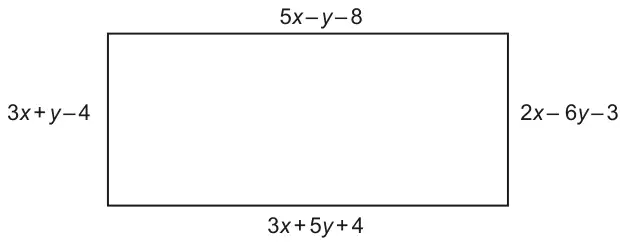
21 The dimensions, in centimetres, of this rectangle are shown as algebraic expressions.
Not to scale
Work out the length and width of the rectangle. [6]
Mark scheme
Answer
Marks
Part marks and guidance
15
9
6
B5 for [\(x\) =] 4.5 or \(4\frac{1}{2}\) and [\(y\) =] \(-0.5\) or \(-\frac{1}{2}\) even given as answers ORB2 for \(5x - y - 8 = 3x + 5y + 4\) or \(3x + y - 4 = 2x - 6y - 3\) and M1dep for rearranging either equation correctly so that the \(x\)’s, \(y\)’s and numbers are combined in one of the equations
and
M1dep for multiplying one equation to equate coefficients of one variable and M1dep for the correct method to eliminate a variable
If 0 scored SC1 for equating two adjacent sides e.g. \(5x - y - 8 = 2x - 6y - 3\)
accept 15 or 9 either way round for 6 marks
The next M1s are dep on B2 gained. For M1 need an equation with one \(x\) term, one \(y\) term and one number term and allow one numerical error e.g. \(2x - 6y = 12\) oe or \(x + 7y = 1\) oe .
allow one numerical error e.g. \(2x - 6y = 12\) and \(2x + 14y = 2\)
(a) A straight line passes through the point (0, 6) and is perpendicular to \(y = 4x - 5\).
Find the equation of this line, giving your answer in the form \(y = mx + c\). [3]
(b) Work out the coordinates of the intersection of the graphs of \(y = 4x - 5\) and \(y = x^2 - 17\). [6]
Mark scheme (a)
Answer
Marks
Part marks and guidance
\(y = -\dfrac{1}{4}x + 6\)
3
Mark final answer
B2 for correct equation seen
or M1 for [grad=] \(-\dfrac{1}{4}\) oe soi M1 for answer \(y = kx + 6\) oe (\(k \ne 0\))
For 3 marks accept \(y = -0.25x + 6\)
Does not have to be in form \(y = mx + c\) e.g. \(y - 6 = -\dfrac{1}{4}(x - 0)\)
Mark scheme (b)
Answer
Marks
Part marks and guidance
(6, 19) and (–2, –13)
6
M2 for \(x^2 - 4x - 12\) [= 0] or M1 for \(x^2 - 17 = 4x - 5\) or better
M2 for \((x - 6)(x + 2)\) [= 0] oe or M1 for \((x + a)(x + b)\) [= 0] where \(a + b = -4\) or \(ab = -12\)
FT their 3 term quadratic equation or expression. Accept correct use of quad formula or complete the square M2 if completely correct, M1 if one error in formula or complete the square
B1 for either pair of coordinates correct or for \(x = 6\) and \(x = -2\)
See AG for alt method
Alternative: Q18(b) alt algebraic method
Answer
Marks
Part marks and guidance
(6, 19) and (–2, –13)
6
M2 for \(y^2 - 6y - 247\) [= 0] or M1 for \(y = \left(\dfrac{y + 5}{4}\right)^2 - 17\) or better
M2 for \((y + 13)(y - 19)\) [= 0] oe or M1 for \((y + a)(y + b)\) [= 0] where \(a + b = -6\) or \(ab = -247\)
FT their 3 term quadratic equation or expression. Accept correct use of quad formula or complete the square M2 if completely correct, M1 if one error in formula or complete the square
B1 for either pair of coordinates correct or for \(y = 19\) and \(y = -13\)
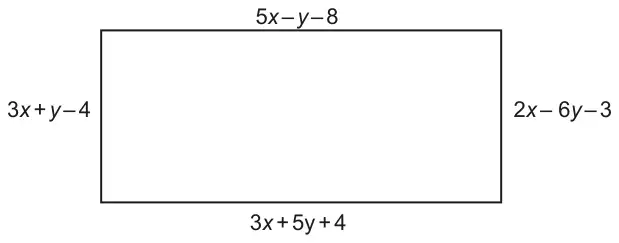
9 The dimensions, in centimetres, of this rectangle are shown as algebraic expressions.
Not to scale
Work out the length and width of the rectangle. [6]
Mark scheme
Answer
Marks
Part marks and guidance
15
9
6
B5 for [\(x\)=] 4.5 or \(4\frac{1}{2}\) and [\(y\) =] −0.5 or \(-\frac{1}{2}\) even given as answers OR B2 for \(5x - y - 8 = 3x + 5y + 4\) or \(3x + y - 4 = 2x - 6y - 3\)
accept 15 or 9 either way round for 6 marks
and M1dep for rearranging either equation correctly so that the \(x\)’s, \(y\)’s and numbers are combined in one of the equations
The next M1s are dep on B2 gained. For M1 need an equation with one \(x\) term, one \(y\) term and one number term and allow one numerical error e.g. \(2x - 6y = 12\) oe or \(x + 7y - 1 = 0\) oe .
and M1dep for multiplying one equation to equate coefficients of one variable
allow one numerical error e.g. \(2x - 6y = 12\) and \(2x + 14y = 2\)
and M1dep for the correct method to eliminate a variable
If 0 scored SC1 for equating two adjacent sides e.g. \(5x - y - 8 = 2x - 6y - 3\)
M1 for \(2x^2 - 7x + 4 = 4x - 1\) oe M1 for \(2x^2 - 11x + 5\) [ = 0] oe 3 term eqn
Implies previous M1
M2 for \((2x - 1)(x - 5)\) [ = 0]
or M1 for \((2x + a)(x + b)\) [ = 0] where \(ab = 5\) or \(2b + a = -11\)
FT their 3 term quadratic equation M2 for complete the square or for formula condone 1 error M1 for \(\left(x - \dfrac{11}{4}\right)^2\) oe or for correct formula used with 2 errors
We'd like to use Google Analytics cookies to count visits and see which pages help most. They're optional, and the site works exactly the same either way. Privacy policy