Past Paper Questions by Topic › Higher (SQA) › Functions & Graphs
Functions & Graphs Topic Straight Line (11) Functions & Graphs (17) Exponentials & Logarithms (18) Polynomials (6) Quadratics (11) Recurrence Relations (3) Trig Formulae & Equations (12) Wave Function (5) Circles (11) Vectors (8) Differentiation (21) Integration (17) More questions on this topic: AS Pure: Sketching & Transforming Graphs (105) A2 Pure: Functions (including |mod|) (125)
Your progress
0 of 17 done
What do the colours mean? Save code Ticks are kept only in this browser : clearing your browsing data or changing device loses them. Get a free save code · I have a code · Keep them in this browser only
All specs Current spec All series May 2026 May 2025 May 2024 May 2023 May 2022 Any marks 1 to 4 marks 5 to 8 marks 9+ marks
Questions Step through List
‹ Previous All questions Next ›
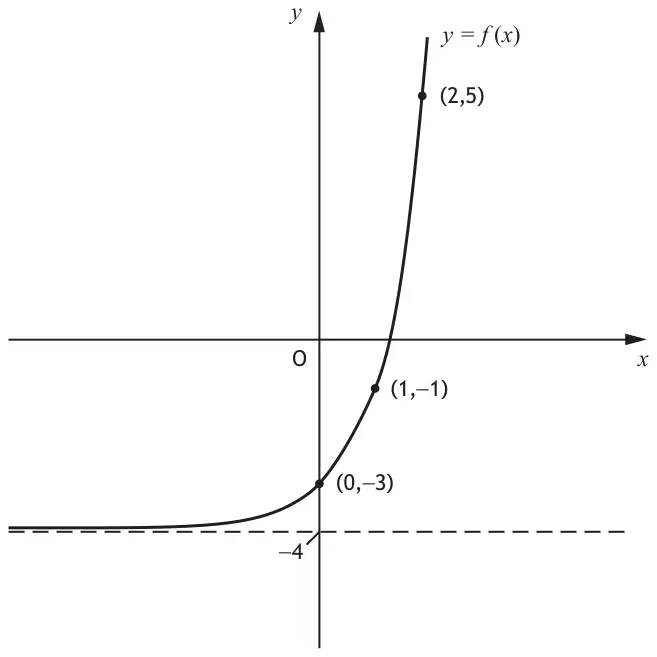
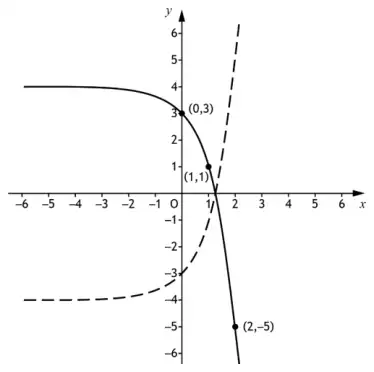
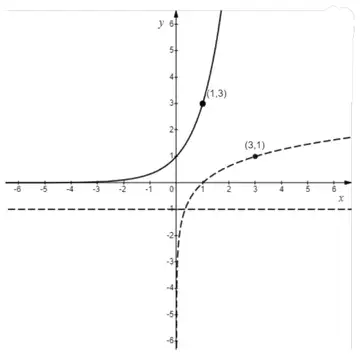
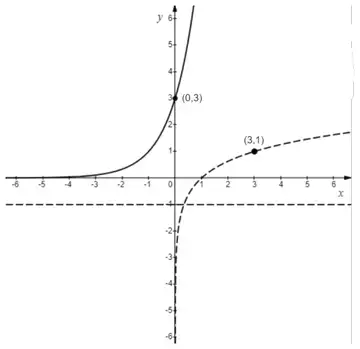
12. An exponential function, \(f\), is defined for \(x\in\mathbb{R}\).
The diagram shows the graph of \(y=f(x)\).
The inverse function, \(f^{-1}(x)\), exists.
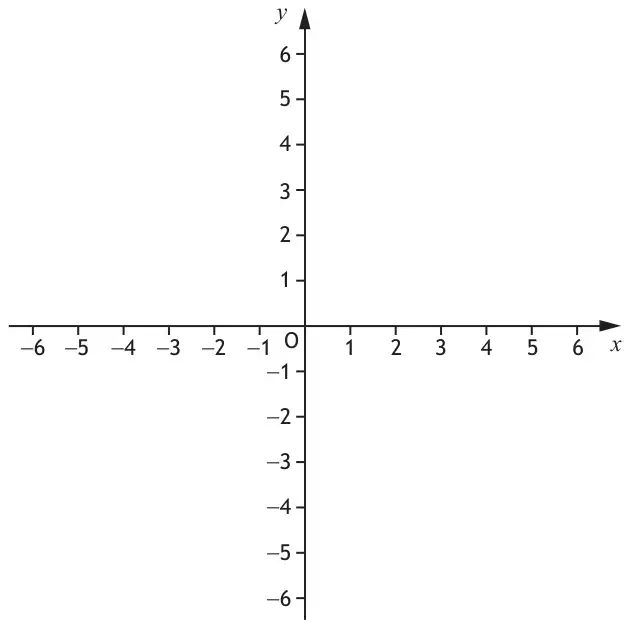
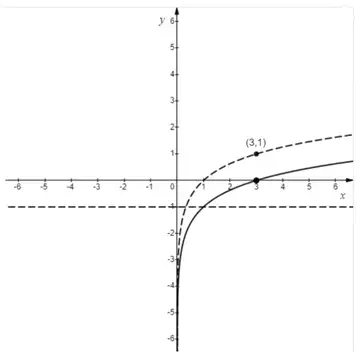
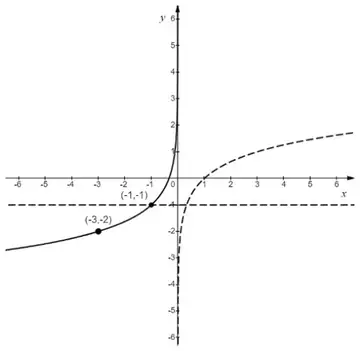
(a) On the diagram in your answer booklet (shown below), sketch the graph of the inverse function. [2]
The inverse function is of the form \(f^{-1}(x)=\log_a(x+b)\).
(b) (i) Determine the values of \(a\) and \(b\). [2]
(ii) State the domain of the inverse function, \(f^{-1}(x)\). [1]
Marking instructions (a) Marking instructions (b)(i) Marking instructions (b)(ii)
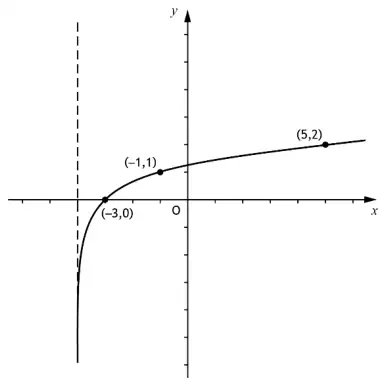
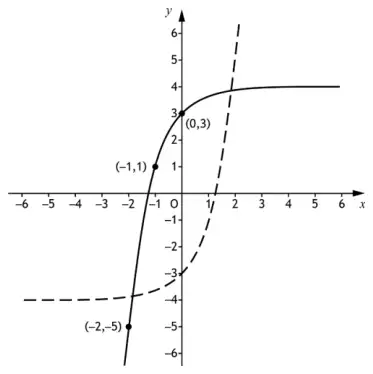
Marking instructions (a) Mark Generic scheme Illustrative scheme •1 graph reflected in \(y=x\) •1 , •2 •2 increasing for \(x\lt-3\) (and for \(x\gt5\)) and approaching \(x=-4\) from the right (2)
Notes:
•1 is not available where the graph has a maximum turning point where \(-1\lt x\lt5\) and •2 is not available where the graph has a maximum turning point where \(5\leqslant x\leqslant6\). •2 is only available where •1 has been awarded. The line \(x=-4\) does not need to be shown. For a rotation, award 0/2 – for example see Candidate A. Do not penalise graphs which do not extend beyond (5,2). Commonly Observed Responses:
Candidate A - rotation about O
•1 ✗ •2 ✗
No further marks in this question can be inferred from this graph .
Candidate B - reflection in \(x\)-axis
•1 ✗ •2 ✗
No further marks in this question can be inferred from this graph .
Marking instructions (b)(i) Mark Generic scheme Illustrative scheme •3 determine value of \(b\) \(b=4\) •4 determine value of \(a\) \(a=3\) (2)
Marking instructions (b)(ii) Mark Generic scheme Illustrative scheme •5 state domain \(x\gt-4,\quad(x\in\mathbb{R})\) (1)
Notes:
\(a\) and \(b\) may be calculated independently of each other. The values of \(a\) or \(b\) can be calculated using \(a=b-1\) where \(b\gt1\). Accept ‘\(f(x)\gt-4\)’ for •5 . For •5 , the domain can be calculated using \(x\gt-b\). For •5 , do not penalise the omission of \(x\in\mathbb{R}\). For •5 , the domain can be from the original graph, the candidate’s transformed graph or from the value of \(b\) in (b)(i). However, refer back to Candidates A and B. Commonly Observed Responses:
Candidate C - Values of \(a\) and \(b\) in equation
Candidate D - Incorrect values of \(a\) and \(b\)
\(\log_3(x+4)\) •3 ✗ \(b=3\) •4 ✗ \(x\gt-3\) •5 ✓1
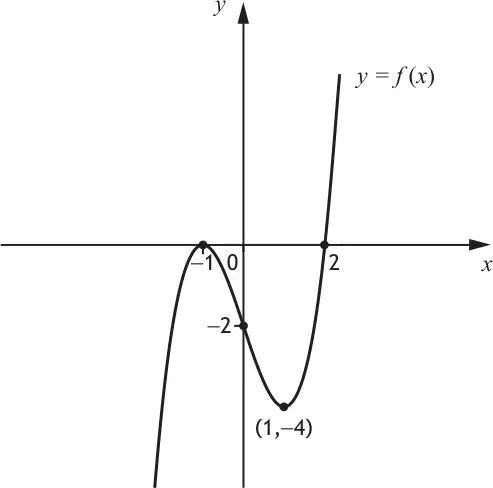
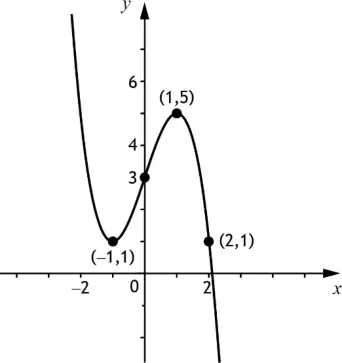
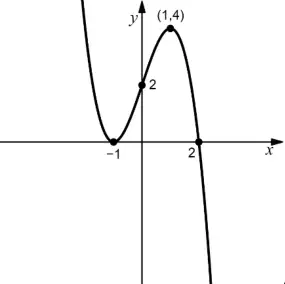
6. The diagram shows the graph of a cubic function \(y=f(x)\) with stationary points at \((-1,0)\) and \((1,-4)\).
On the diagram in your answer booklet, sketch the graph of \(y=-f(x)+1\). [3]
Marking instructions
Marking instructions Mark Generic scheme Illustrative scheme •1 vertical reflection in \(x\)-axis identifiable from stationary points of graph •1,2,3 •2 vertical translation of ‘+1’ units identifiable from stationary points of graph •3 transformation applied in the correct order and remaining points identifiable from graph (3)
Notes:
Where candidates do not sketch a cubic function of the correct orientation, award 0/3. However, see Candidate A. Where either stationary point has been incorrectly transformed, no marks are available. However, see Candidates A and B and the table for possible exceptions. Do not penalise graphs which cross the \(x\)-axis at (2,0) or which do not extend past (2,1). Commonly Observed Responses:
Candidate A – one transformation
\(y=f(x)+1\)
Award 1/3
Candidate B – one transformation
\(y=-f(x)\)
Award 1/3
Table showing two transformations…
Function Transformation of stationary points Transformation of intercepts Shape Award \(y=-f(x)-1\) (−1,−1) and (1,3) (2,−1) and (0,1) 2/3 \(y=f(-x)+1\) (1,1) and (−1,−3) (−2,1) and (0,−1) 1/3 \(y=-f(x+1)\) (−2,0) and (0,4) (1,0) and (−1,2) 1/3 \(y=-f(x-1)\) (0,0) and (2,4) (3,0) and (1,2) 1/3 \(y=f((-x)+1)\) (2,0) and (0,−4) (−1,0) and (1,−2) 0/3 \(y=f((-x)-1)\) (0,0) and (−2,−4) (−3,0) and (−1,−2) 0/3
5. Functions \(f\) and \(g\) are defined on \(\mathbb{R}\), the set of real numbers, by \(f(x)=2x^2+5\) and \(g(x)=x+3\).
(a) Find an expression for:
(i) \(f\left(g(x)\right)\) and [2]
(ii) \(g\left(f(x)\right)\). [1]
(b) State the range of \(g\left(f(x)\right)\). [1]
Marking instructions (a)(i) Marking instructions (a)(ii) Marking instructions (b)
Marking instructions (a)(i) Mark Generic scheme Illustrative scheme •1 interpret notation \(f(x+3)\) or \(2\left(g(x)\right)^2+5\) stated or implied by •2 •2 state expression for \(f\left(g(x)\right)\) \(2(x+3)^2+5\) (2)
Marking instructions (a)(ii) Mark Generic scheme Illustrative scheme •3 state expression for \(g\left(f(x)\right)\) \((2x^2+5)+3\) (1)
Notes:
Accept \(2g(x)^2+5\) for •1 . Commonly Observed Responses:
Candidate A - two attempts
\(f\left(g(x)\right)=2x^2+5\) \(\phantom{f\left(g(x)\right)}=2(x+3)^2+5\) •1 ✗ •2 ✗
Candidate B - \(f\left(g(x)\right)\) and \(g\left(f(x)\right)\) interchanged
\(f\left(g(x)\right)=(2x^2+5)+3\) •1 ✗ •2 ✓1 \(g\left(f(x)\right)=2(x+3)^2+5\) •3 ✓1
Marking instructions (b) Mark Generic scheme Illustrative scheme •4 state range \(g\left(f(x)\right)\geqslant8\) (1)
Notes:
Accept \(y\geqslant8\) or \([8,\infty)\) for •4 . 3. A function, \(g\), is defined on \(\mathbb{R}\), the set of real numbers, by
\[g(x)=\frac{1}{5}x+6.\]
Find the inverse function, \(g^{-1}(x)\). [3]
Marking instructions
Marking instructions Mark Generic scheme Illustrative scheme Method 1 Method 1 •1 equate composite function to \(x\) \(g\left(g^{-1}(x)\right)=x\) •2 write \(g\left(g^{-1}(x)\right)\) in terms of \(g^{-1}(x)\) \(\dfrac{1}{5}g^{-1}(x)+6=x\) •3 state inverse function \(g^{-1}(x)=5(x-6)\) Method 2 Method 2 •1 write as \(y=g(x)\) and start to re-arrange \(y=g(x)\Rightarrow x=g^{-1}(y)\) •2 express \(x\) in terms of \(y\) eg \(x=\dfrac{(y-6)}{\frac{1}{5}}\) •3 state inverse function \(g^{-1}(y)=5(y-6)\) (3)
Notes:
In Method 1, accept \(\dfrac{1}{5}g^{-1}(x)+6=x\) for •1 and •2 . In Method 2 accept \(y-6=\dfrac{1}{5}x\) without reference to \(y=g(x)\Rightarrow x=g^{-1}(y)\) at •1 . In Method 2, accept \(g^{-1}(x)=5(x-6)\) without reference to \(g^{-1}(y)\) at •3 . In Method 2, beware of candidates with working where each line is not mathematically equivalent. At •3 stage, accept \(g^{-1}\) written in terms of any dummy variable eg \(g^{-1}(y)=5(y-6)\). \(y=5(x-6)\) does not gain •3 . \(g^{-1}(x)=5(x-6)\) with no working gains 3/3. In method 2, where candidates make multiple algebraic errors at the •1 or •2 stage, •3 is still available. For example, see Candidate G. Marks should only be awarded for using a valid strategy to find the inverse of \(g(x)\). Commonly Observed Responses:
Candidate A
\(g(x)=\dfrac{1}{5}x+6\) \(y=\dfrac{1}{5}x+6\) (red dashed bracket joins this line to the \(y=5(x-6)\) line) \(x=5(y-6)\) •1 ✓ •2 ✓ \(y=5(x-6)\) •3 ✗ \(g^{-1}(x)=5(x-6)\)
Candidate B
\(g(x)=\dfrac{1}{5}x+6\) \(y=\dfrac{1}{5}x+6\) (red dashed bracket joins this line and the next) \(x=\dfrac{1}{5}y+6\) •1 ✗ \(y=5(x-6)\) •2 ✓1 \(g^{-1}(x)=5(x-6)\) •3 ✓1
Candidate C
\(g(x)=\dfrac{1}{5}x+6\) (red dashed bracket joins this line and the next) \(x=\dfrac{1}{5}g(x)+6\) •1 ✗ \(g(x)=5(x-6)\) •2 ✓1 \(g^{-1}(x)=5(x-6)\) •3 ✓1
The first line appears in the question
Candidate D - Method 1
\(g\left(g^{-1}(x)\right)=\dfrac{1}{5}g^{-1}(x)+6\) •2 ✓ \(x=\dfrac{1}{5}g^{-1}(x)+6\) •1 ✓ \(g^{-1}(x)=5(x-6)\) •3 ✓
Candidate E - BEWARE
\(g'(x)=\ldots\) •3 ✗ OR \(f^{-1}(x)=\ldots\) •3 ✗ OR multiple expressions for \(g^{-1}(x)\) •3 ✗
Candidate F
\(x\to x\div 5\to x\div 5+6=g(x)\) \(\therefore -6\to\times 5\) •1 ✓ \(5(x-6)\) •2 ✓ \(g^{-1}(x)=5(x-6)\) •3 ✓
Candidate G - incomplete multiplication
\(y=\dfrac{1}{5}x+6\) \(5y=x+6\) •1 ✗ \(x=5y-6\) •2 ✓1 \(g^{-1}(x)=5x-6\) •3 ✓1
Candidate H - poor notation
\(y=\dfrac{1}{5x}+6\) \(y-6=\dfrac{1}{5x}\) \(x=5(y-6)\) \(g^{-1}(x)=5(x-6)\) Award 2/3
12. Functions \(f\) and \(g\) are defined on the set of real numbers by:
\(f(x)=x^5+3\) \(g(x)=1-x^3\). (a) Find an expression for \(h(x)\), where \(h(x)=f\left(g(x)\right)\). [2]
(b) Find \(h'(x)\). [2]
Marking instructions (a) Marking instructions (b)
Marking instructions (a) Mark Generic scheme Illustrative scheme •1 interpret notation \(f(1-x^3)\)OR •2 state expression for \(f\left(g(x)\right)\) \((1-x^3)^5+3\) (2)
Notes:
For \((1-x^3)^5+3\) without working, award 2/2. Commonly Observed Responses:
Candidate A
\(f\left(g(x)\right)=(1-x^3)^5+3\) •1 ✓ •2 ✓ \(h(x)=4-x^{15}\)
Candidate B - two ‘attempts’
\(f\left(g(x)\right)=x^5+3\) •1 ✗ •2 ✗ \(f\left(g(x)\right)=(1-x^3)^5+3\)
Candidate C
\(f\left(g(x)\right)=1-(x^5+3)^3\) •1 ✗ •2 ✓1
Marking instructions (b) Mark Generic scheme Illustrative scheme •3 start to differentiate \(5(1-x^3)^4\ldots\) •4 complete differentiation \(\cdots\times(-3x^2)\) (2)
Notes:
For \(-15x^2(1-x^3)^4\), award 2/2. •3 and •4 are not available for working with \(4-x^{15}\). Accept ‘\(5u^4\) where \(u=1-x^3\)’ for •3 . Do not award •4 where the answer includes ‘\(+c\)’. Commonly Observed Responses:
Candidate D - differentiating over two lines
\(5(1-x^3)^4\) •3 ✓ \(5(1-x^3)^4\times(-3x^2)\) •4 ^
Candidate E - poor notation
\(y=(1-x^3)^5\qquad y=1-x^3\) \(\phantom{y=(1-x^3)^5\qquad{}}\dfrac{dy}{dx}=-3x^2\) \(\dfrac{dy}{dx}=5(1-x^3)^4\times(-3x)^2\) •3 ✓ •4 ✓
Candidate F - poor communication
\(y=(1-x^3)^5+3\) \(y=5(1-x^3)^4\times(-3x^2)\) •3 ✓ •4 ✓
Candidate G - insufficient evidence for •3
\(-15(1-x^3)^4\) •3 ✗ •4 ✗
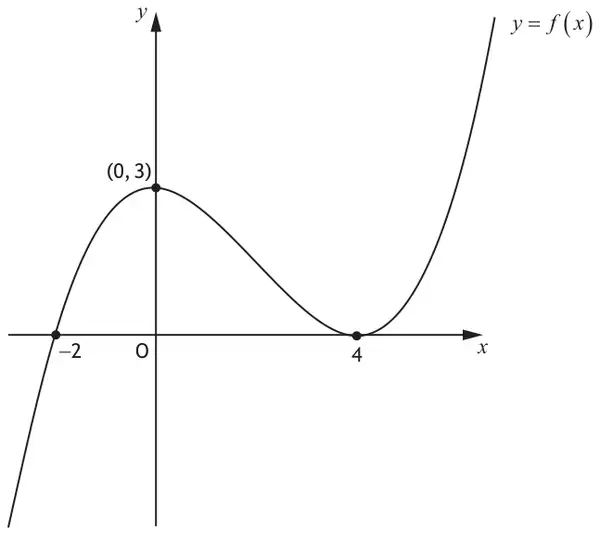
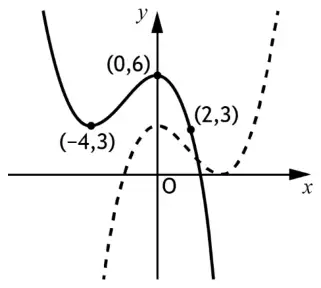
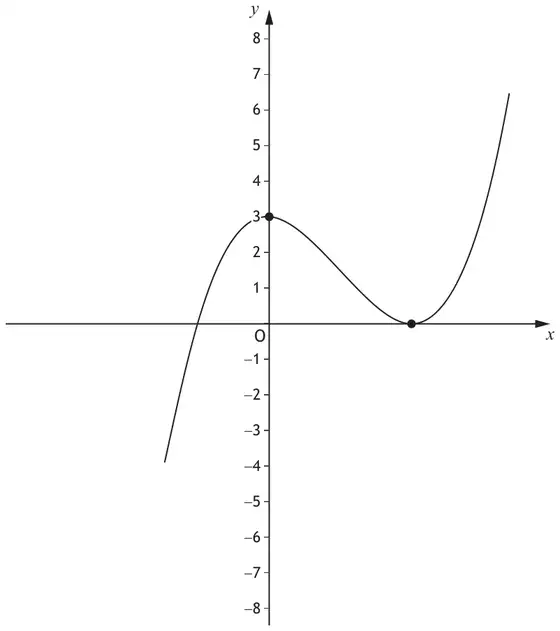
5. The diagram shows the graph of \(y=f(x)\), with stationary points at (0, 3) and (4, 0).
On the diagram in your answer booklet (shown below), sketch the graph of \(y=f(-x)+3\). [2]
Marking instructions
Marking instructions Mark Generic scheme Illustrative scheme •1 reflection in \(y\)-axis identifiable from graph •1,2 •2 vertical translation of ‘\(+3\)’ identifiable from graph (2)
Notes:
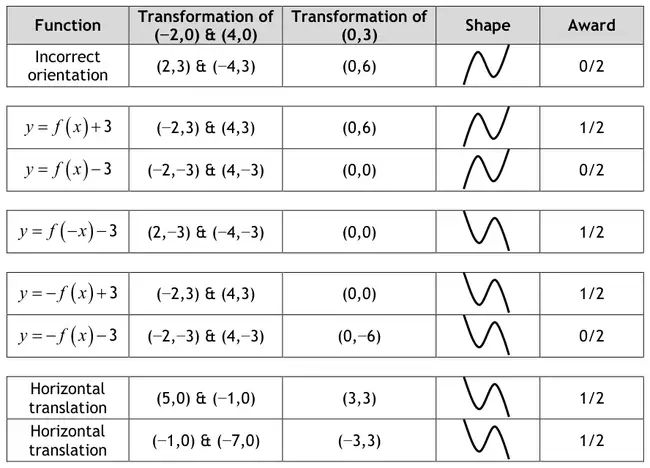
Where candidates do not sketch a cubic function, award 0/2. Where only two of the three points are correctly transformed, award 0/2. However, see the table for possible exceptions. Note that the position of the root, where shown, is not being assessed. Ignore intersections (or lack of intersections) with the original graph. Commonly Observed Responses:
4. A function, \(g\), is defined by \(g(x)=(x-4)^3\), where \(x\in\mathbb{R}\).[3]
Marking instructions
Marking instructions Mark Generic scheme Illustrative scheme Method 1 Method 1 •1 equate composite function to \(x\) \(g\left(g^{-1}(x)\right)=x\) •2 write \(g\left(g^{-1}(x)\right)\) in terms of \(g^{-1}(x)\) \(\left(g^{-1}(x)-4\right)^3=x\) •3 state inverse function \(g^{-1}(x)=\sqrt[3]{x}+4\) Method 2 Method 2 •1 write as \(y=(x-4)^3\) and start to rearrange \(y=g(x)\Rightarrow x=g^{-1}(y)\) •2 complete rearrangement \(x=4+\sqrt[3]{y}\) •3 state inverse function \(g^{-1}(y)=\sqrt[3]{y}+4\) (3)
Notes:
In method 1, accept \(x=\left(g^{-1}(x)-4\right)^3\) for •1 and •2 . In method 2, accept ‘\(\sqrt[3]{y}=x-4\)’ without reference to \(y=g(x)\Rightarrow x=g^{-1}(y)\) at •1 . In method 2, accept \(g^{-1}(x)=\sqrt[3]{x}+4\) without reference to \(g^{-1}(y)\) at •3 . In method 2, beware of candidates with working where each line is not mathematically equivalent. See Candidates A, B and C. At •3 stage, accept \(g^{-1}\) written in terms of any dummy variable. For example \(g^{-1}(y)=\sqrt[3]{y}+4\). \(y=\sqrt[3]{x}+4\) does not gain •3 . \(g^{-1}(x)=\sqrt[3]{x}+4\) with no working gains 3/3. In method 2, where candidates make multiple algebraic errors at the •2 stage, •3 is still available. Marks should only be awarded for using a valid strategy to find the inverse of \(g(x)\). Commonly Observed Responses:
Candidate A
\(g(x)=(x-4)^3\) \(y=(x-4)^3\) \(x=\sqrt[3]{y}+4\) •1 ✓ •2 ✓ \(y=\sqrt[3]{x}+4\) •3 ✗ \(g^{-1}(x)=\sqrt[3]{x}+4\)
(In the original, a dashed bracket links the lines \(y=(x-4)^3\) to \(y=\sqrt[3]{x}+4\).)
Candidate B
\(g(x)=(x-4)^3\) \(y=(x-4)^3\) \(x=(y-4)^3\) •1 ✗ \(y=\sqrt[3]{x}+4\) •2 ✓1 \(g^{-1}(x)=\sqrt[3]{x}+4\) •3 ✓1
(In the original, a dashed bracket links the lines \(y=(x-4)^3\) and \(x=(y-4)^3\).)
Candidate C
\(x=\left(g(x)-4\right)^3\) •1 ✗ \(g(x)=\sqrt[3]{x}+4\) •2 ✓1 \(g^{-1}(x)=\sqrt[3]{x}+4\) •3 ✓1
Candidate D - Method 1
\(g\left(g^{-1}(x)\right)=\left(g^{-1}(x)-4\right)^3\) •2 ✓ \(x=\left(g^{-1}(x)-4\right)^3\) •1 ✓ \(g^{-1}(x)=\sqrt[3]{x}+4\) •3 ✓
Candidate E - BEWARE of incorrect notation
\(g^{\prime}(x)=\ldots\) •3 ✗ \(f^{-1}(x)=\ldots\) •3 ✗
Candidate F
\(x\to x-4\to (x-4)^3=g(x)\) \(\phantom{x\to{}}-4\to{}^3\) \(\therefore \sqrt[3]{\phantom{x}}\to +4\) •1 ✓ \(\sqrt[3]{x}+4\) •2 ✓ \(g^{-1}(x)=\sqrt[3]{x}+4\) •3 ✓
8. Functions \(f\) and \(g\) are defined on \(\mathbb{R}\), the set of real numbers, by:
\(f(x)=2x^2-18\) \(g(x)=x+1\). (a) Find an expression for \(f\left(g(x)\right)\). [2]
(b) Find the values of \(x\) for which \(\dfrac{1}{f\left(g(x)\right)}\) is undefined. [2]
Marking instructions (a) Marking instructions (b)
Marking instructions (a) Mark Generic scheme Illustrative scheme •1 interpret notation \(f(x+1)\) or \(2g(x)^2-18\) •2 state expression for \(f\left(g(x)\right)\) \(2(x+1)^2-18\) (2)
Notes:
For \(2(x+1)^2-18\) without working, award both •1 and •2 . Commonly Observed Responses:
Candidate A - \(g\left(f(x)\right)\)
Candidate B - beware of two “attempts”
\(f\left(g(x)\right)=2x^2-18\) •1 ✗ •2 ✗ \(f(x+1)=2(x+1)^2-18\)
Marking instructions (b) Mark Generic scheme Illustrative scheme •3 apply condition \(2(x+1)^2-18=0\) •4 state values of \(x\) \(-4\) and \(2\) (2)
Notes:
Working at •3 must be consistent with working at •2 . Accept \(2(x+1)^2-18\neq 0\) for •3 only when \(x=-4\) and \(x=2\) are stated explicitly at •4 . See Candidate H •4 is only available for finding the roots of a quadratic. For subsequent incorrect working, the final mark is not available. For example \(-4<x<2\). Commonly Observed Responses:
Candidate C - expanding brackets in (a)
Part (a) \(f\left(g(x)\right)=2(x+1)^2-18\) •1 ✓ •2 ✓ \(f\left(g(x)\right)=2x^2+4x-16\) Part (b) \(2x^2+4x-16=0\) •3 ✓ \(x=-4\) and \(x=2\) •4 ✓
Candidate D - expanding brackets in (a)
Part (a) \(f\left(g(x)\right)=2(x+1)^2-18\) •1 ✓ •2 ✓ \(f\left(g(x)\right)=2x^2-16\) Part (b) \(2x^2-16=0\) •3 ✗ \(x=\pm\sqrt{8}\) •4 ✓1
Candidate E - \(g\left(f(x)\right)\)
Part (a) \(f\left(g(x)\right)=2x^2-17\) •1 ✗ •2 ✓1 Part (b) \(2x^2-17=0\) •3 ✓1 \(x=\pm\sqrt{\dfrac{17}{2}}\) •4 ✓1
Candidate F - equivalent condition
Candidate G - use of \(\neq\)
\(2(x+1)^2-18\neq 0\) •3 ✗ \(x\neq -4,\ x\neq 2\) •4 ✓1
Candidate H - use of \(\neq\)
\(2(x+1)^2-18\neq 0\) \(x\neq -4,\ x\neq 2\) \(x=-4,\ x=2\) •3 ✓ •4 ✓
5. A function, \(h\), is defined by \(h(x)=2x^3-7\) where \(x\in\mathbb{R}\).
Find the inverse function, \(h^{-1}(x)\). [3]
Marking instructions
Marking instructions Mark Generic scheme Illustrative scheme Method 1 Method 1 •1 equate composite function to \(x\) \(h\left(h^{-1}(x)\right)=x\) •2 write \(h\left(h^{-1}(x)\right)\) in terms of \(h^{-1}(x)\) \(2\left(h^{-1}(x)\right)^3-7=x\) •3 state inverse function \(h^{-1}(x)=\sqrt[3]{\dfrac{x+7}{2}}\) Method 2 Method 2 •1 write as \(y=h(x)\) and start to rearrange \(y=h(x)\Rightarrow x=h^{-1}(y)\) •2 express \(x\) in terms of \(y\) \(x=\sqrt[3]{\dfrac{y+7}{2}}\) •3 state inverse function \(h^{-1}(y)=\sqrt[3]{\dfrac{y+7}{2}}\) (3)
Notes:
In method 1, accept \(2\left(h^{-1}(x)\right)^3-7=x\) for •1 and •2 . In method 2, accept ‘\(y+7=2x^3\)’ without reference to \(y=h(x)\Rightarrow x=h^{-1}(y)\) at •1 . In method 2, accept \(h^{-1}(x)=\sqrt[3]{\dfrac{x+7}{2}}\) without reference to \(h^{-1}(y)\) at •3 . In method 2, beware of candidates with working where each line is not mathematically equivalent. See candidates A and B for example. At •3 stage, accept \(h^{-1}\) written in terms of any dummy variable. \(y=\sqrt[3]{\dfrac{x+7}{2}}\) does not gain •3 . \(h^{-1}(x)=\sqrt[3]{\dfrac{x+7}{2}}\) with no working gains 3/3. Commonly Observed Responses:
Candidate A
\(h(x)=2x^3-7\) \(y=2x^3-7\) \(x=\sqrt[3]{\dfrac{y+7}{2}}\) •1 ✓ •2 ✓ \(y=\sqrt[3]{\dfrac{x+7}{2}}\) •3 ✗ \(h^{-1}(x)=\sqrt[3]{\dfrac{x+7}{2}}\)
[Annotation in the marking instructions: a dashed bracket joins the lines \(y=2x^3-7\) to \(y=\sqrt[3]{\dfrac{x+7}{2}}\)]
Candidate B
\(h(x)=2x^3-7\) \(y=2x^3-7\) \(x=2y^3-7\) •1 ✗ \(y=\sqrt[3]{\dfrac{x+7}{2}}\) •2 ✓1 \(h^{-1}(x)=\sqrt[3]{\dfrac{x+7}{2}}\) •3 ✓1
[Annotation in the marking instructions: a dashed bracket joins the lines \(y=2x^3-7\) and \(x=2y^3-7\)]
Candidate C
\(x=2h(x)^3-7\) •1 ✗ \(h(x)=\sqrt[3]{\dfrac{x+7}{2}}\) •2 ✓1 \(h^{-1}(x)=\sqrt[3]{\dfrac{x+7}{2}}\) •3 ✓1
Candidate D - Method 1
\(h\left(h^{-1}(x)\right)=2\left(h^{-1}(x)\right)^3-7\) •2 ✓ \(x=2\left(h^{-1}(x)\right)^3-7\) •1 ✓ \(h^{-1}(x)=\sqrt[3]{\dfrac{x+7}{2}}\) •3 ✓
Candidate E
\(x\to x^3\to2x^3\to2x^3-7=h(x)\) \(\times2\to-7\) \(\therefore+7\to\div2\) •1 ✓ \(\sqrt[3]{\dfrac{x+7}{2}}\) •2 ✓ \(h^{-1}(x)=\sqrt[3]{\dfrac{x+7}{2}}\) •3 ✓
Candidate F - BEWARE of incorrect notation
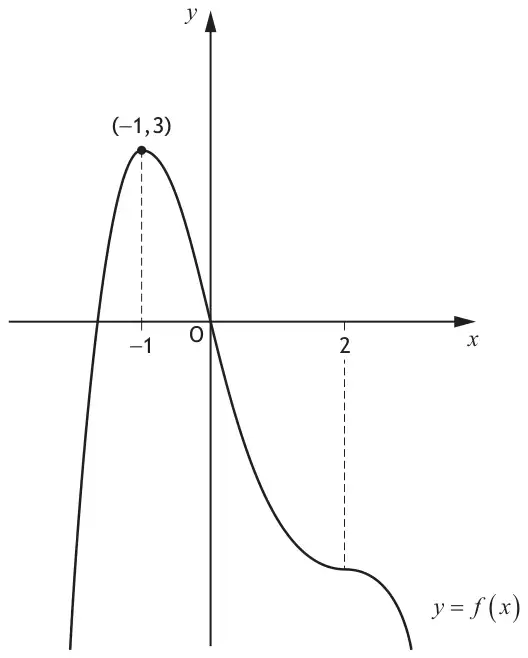
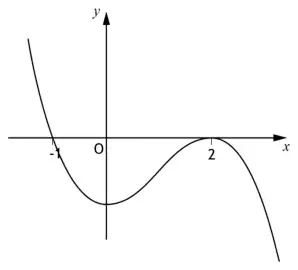
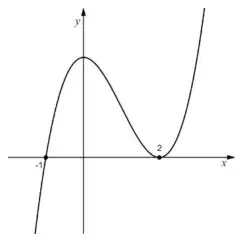
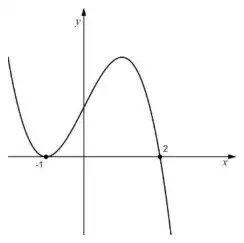
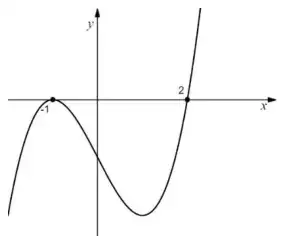
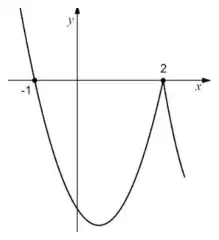
4. The diagram shows the graph of a quartic function \(y=f(x)\).
A maximum turning point occurs at (−1, 3).
The graph of \(y=f(x)\) also has a point of inflection at \(x=2\).
(a) Determine the coordinates of the maximum turning point on the graph of \(y=f(x-4)+2\). [2]
(b) On the diagram below, sketch the graph of \(y=f^{\prime}(x)\).
[3] Marking instructions (a) Marking instructions (b)
Marking instructions (a) Mark Generic scheme Illustrative scheme •1 identify \(x\)-coordinate \(3\) •2 identify \(y\)-coordinate \(5\) (2)
Marking instructions (b) Mark Generic scheme Illustrative scheme •3 identify roots “cubic” with roots at \(-1\) and \(2\) •4 interpret point of inflection “cubic” with turning point at \((2,0)\) •5 identify orientation and complete cubic curve cubic with maximum turning point at \((2,0)\)
(3)
Notes:
Note that the position of the minimum turning point of \(f^{\prime}(x)\) is not being assessed. Where a candidate has not drawn a cubic curve or their graph does not extend outwith \(-1\leqslant x\leqslant 2\) award 0/3. However see Candidate D. Do not penalise the appearance of an additional root outwith \(-1\leqslant x\leqslant 2\) (on a cubic curve) at •3 . Commonly Observed Responses:
Candidate A - \(-f^{\prime}(x)\)
✓ ✓ ✗
Candidate B
✓ ✗ ✗
Candidate C
✓ ✗ ✗
Candidate D - left derivative ≠ right derivative at (2,0)
✓ ✓ ✗
13. Functions \(f\) and \(g\) are defined by:
\(f(x)=2\sin x\), where \(0<x<\dfrac{\pi}{2}\) \(g(x)=2x\), where \(0<x<\dfrac{\pi}{4}\) (a) (i) Evaluate \(f\left(g\left(\dfrac{\pi}{6}\right)\right)\). [1]
(ii) Determine an expression for \(f(g(x))\). [2]
(b) (i) Given that \(f(p)=\dfrac{1}{3}\), determine the exact value of \(\sin p\). [1]
(ii) Hence, determine the exact value of \(f(g(p))\). [3]
Marking instructions (a)(i) Marking instructions (a)(ii) Marking instructions (b)(i) Marking instructions (b)(ii)
Marking instructions (a)(i) Mark Generic scheme Illustrative scheme •1 state exact value \(\sqrt3\) (1)
Marking instructions (a)(ii) Mark Generic scheme Illustrative scheme •2 interpret notation \(f(2x)\) or \(2\sin(g(x))\) •3 state expression for \(f(g(x))\) \(2\sin2x\) (2)
Notes:
For \(f(g(x))=2\sin2x\) without working, award both •2 and •3 . Working for (a)(ii) may be found in (a)(i) Commonly Observed Responses:
Candidate A
(a)(ii) \(f(g(x))=4\sin x\) •2 ✗ •3 ✓1
Candidate B - Beware of “2 attempts”
\(f(g(x))=2\sin x\) •2 ✗ •3 ✗ \(f(2x)=2\sin2x\)
Marking instructions (b)(i) Mark Generic scheme Illustrative scheme •4 find the value of \(\sin p\) \(\dfrac{1}{6}\) (1)
Marking instructions (b)(ii) Mark Generic scheme Illustrative scheme •5 expand \(f(g(p))\) using double angle formula \(2\times2\sin p\cos p\) or \(4\sin p\cos p\) stated explicitly •6 find value of \(\cos p\) \(\dfrac{\sqrt{35}}{6}\) •7 substitute and determine exact value \(2\times2\times\dfrac{1}{6}\times\dfrac{\sqrt{35}}{6}\) (3)
Notes:
•5 is not available for expansions which do not involve \(p\). •6 and •7 are still available. However, accept \(\sin^{-1}\left(\dfrac{1}{6}\right)\) in place of \(p\) - see Candidate C. •7 is only available as a consequence of substituting into a valid formula from •5 . Do not penalise trigonometric ratios which are less than \(-1\) or greater than 1 throughout this question. Commonly Observed Responses:
Candidate C
\(f(g(p))=4\sin\left(\sin^{-1}\left(\dfrac{1}{6}\right)\right)\cos\left(\sin^{-1}\left(\dfrac{1}{6}\right)\right)\) •5 ✓ \(4\times\dfrac{1}{6}\times\dfrac{\sqrt{35}}{6}\) •6 ✓ \(\dfrac{\sqrt{35}}{9}\) •7 ✓
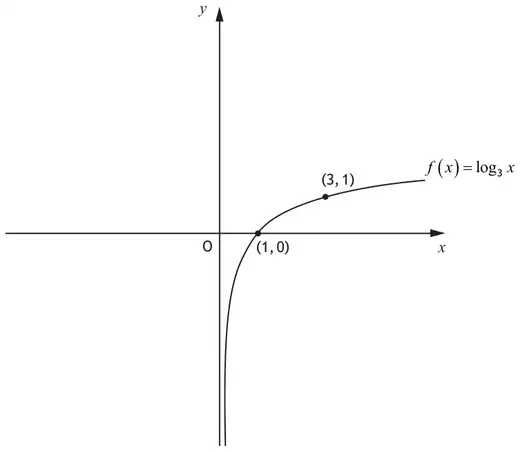
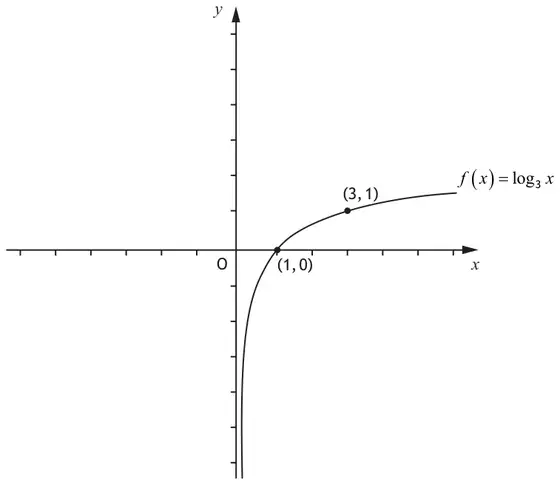
9. The diagram shows the graph of the function \(f(x)=\log_3x\), where \(x>0\).
The inverse function, \(f^{-1}\), exists.
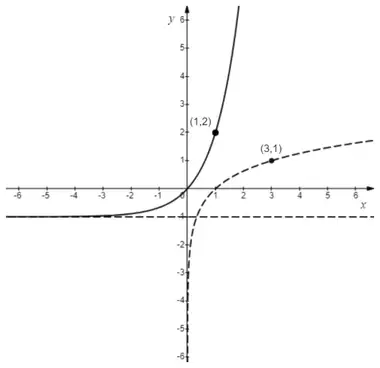
On the diagram in your answer booklet (shown below), sketch the graph of \(y=f^{-1}(x)-1\). [3]
Marking instructions
Marking instructions Mark Generic scheme Illustrative scheme •1 graph reflected in \(y=x\) a concave up curve above the \(x\)-axis for \(x>0\) •2 vertical translation of “\(-1\)” unit following a reflection in \(y=x\) identifiable from graph curve passing through (0,0) and (1,2) •3 sketch of required function curve approaches the line \(y=-1\) from above as \(x\to-\infty\)
(3)
Notes:
For •1 accept any graph of a function which is concave up within the first quadrant. •1 is only available where the candidate has attempted to reflect the given curve in the line \(y=x\). •3 is only available where the curve passes through (0,0) and (1,2). The line \(y=-1\) does not need to be shown. For a rotation, award 0/3 – for example see Candidate D. Commonly Observed Responses:
Candidate A - reflection only
•1 ✓ •2 ✗ •3 ✗
Candidate B - translation only
•1 ✗ •2 ✗ •3 ✗
Candidate C - incorrect order of transformations
•2 ✗ •1 ✓1 •3 ✗
Candidate D - rotation
•1 ✗ •2 ✗ •3 ✗
6. A function \(f(x)\) is defined by \(f(x)=\dfrac{2}{x}+3,\ x>0\).
Find the inverse function, \(f^{-1}(x)\). [3]
Marking instructions
Marking instructions Mark Generic scheme Illustrative scheme Method 1 Method 1 •1 equate composite function to \(x\) \(f\left(f^{-1}(x)\right)=x\) •2 write \(f\left(f^{-1}(x)\right)\) in terms of \(f^{-1}(x)\) \(x=\dfrac{2}{f^{-1}(x)}+3\) •3 state inverse function \(f^{-1}(x)=\dfrac{2}{x-3}\) Method 2 Method 2 •1 write as \(y=f(x)\) and start to rearrange \(y=f(x)\Rightarrow x=f^{-1}(y)\) •2 express \(x\) in terms of \(y\) \(x=\dfrac{2}{y-3}\) •3 state inverse function \(f^{-1}(y)=\dfrac{2}{y-3}\) (3)
Notes:
In Method, 1 accept \(x=\dfrac{2}{f^{-1}(x)}+3\) for •1 and •2 . In Method 2, accept ‘\(y-3=\dfrac{2}{x}\)’ without reference to \(y=f(x)\Rightarrow x=f^{-1}(y)\) at •1 . In Method 2, accept \(f^{-1}(x)=\dfrac{2}{x-3}\) without reference to \(f^{-1}(y)\) at •3 . In Method 2, beware of candidates with working where each line is not mathematically equivalent - see Candidates A and B for example. At •3 stage, accept \(f^{-1}\) written in terms of any dummy variable eg \(f^{-1}(y)=\dfrac{2}{y-3}\). \(y=\dfrac{2}{x-3}\) does not gain •3 . \(f^{-1}(x)=\dfrac{2}{x-3}\) with no working gains 3/3. In Method 2, where candidates make multiple algebraic errors at the •2 stage, •3 is still available. Commonly Observed Responses:
Candidate A
\(f(x)=\dfrac{2}{x}+3\) \(y=\dfrac{2}{x}+3\) \(y-3=\dfrac{2}{x}\) \(x=\dfrac{2}{y-3}\) •1 ✓ •2 ✓ \(y=\dfrac{2}{x-3}\) •3 ✗ \(f^{-1}(x)=\dfrac{2}{x-3}\)
[Annotation in the marking instructions: the four lines from \(y=\dfrac{2}{x}+3\) to \(y=\dfrac{2}{x-3}\) are grouped by a dashed bracket]
Candidate B
\(f(x)=\dfrac{2}{x}+3\) \(y=\dfrac{2}{x}+3\) \(x=\dfrac{2}{y}+3\) •1 ✗ \(x-3=\dfrac{2}{y}\) \(y=\dfrac{2}{x-3}\) •2 ✓1 \(f^{-1}(x)=\dfrac{2}{x-3}\) •3 ✓1
[Annotation in the marking instructions: the lines \(y=\dfrac{2}{x}+3\) and \(x=\dfrac{2}{y}+3\) are grouped by a dashed bracket]
Candidate C - BEWARE
Candidate D
\(x\rightarrow\dfrac{1}{x}\rightarrow\dfrac{2}{x}\rightarrow\dfrac{2}{x}+3=f(x)\) \(\times2\rightarrow+3\) \(\therefore -3\rightarrow\div2\) •1 ✓ \(\dfrac{2}{x-3}\) (invert) •2 ✓ \(f^{-1}(x)=\dfrac{2}{x-3}\) •3 ✓
Candidate E
\(\vdots\) •1 ✓ •2 ✓ \(f^{-1}(x)=\left(\dfrac{x-3}{2}\right)^{-1}\) •3 ✓
Candidate F
\(\vdots\) •1 ✓ •2 ✓ \(f^{-1}(x)=\sqrt[-1]{\dfrac{x-3}{2}}\) •3 ✓
Candidate G
\(y=\dfrac{2}{x}+3\) \(xy=5\) •1 ✗ \(x=\dfrac{5}{y}\) •2 ✓2 \(f^{-1}(x)=\dfrac{5}{x}\) •3 ✓1 However \(f^{-1}(x)=\dfrac{2+3}{x}\) •3 ^
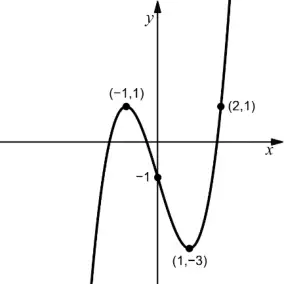
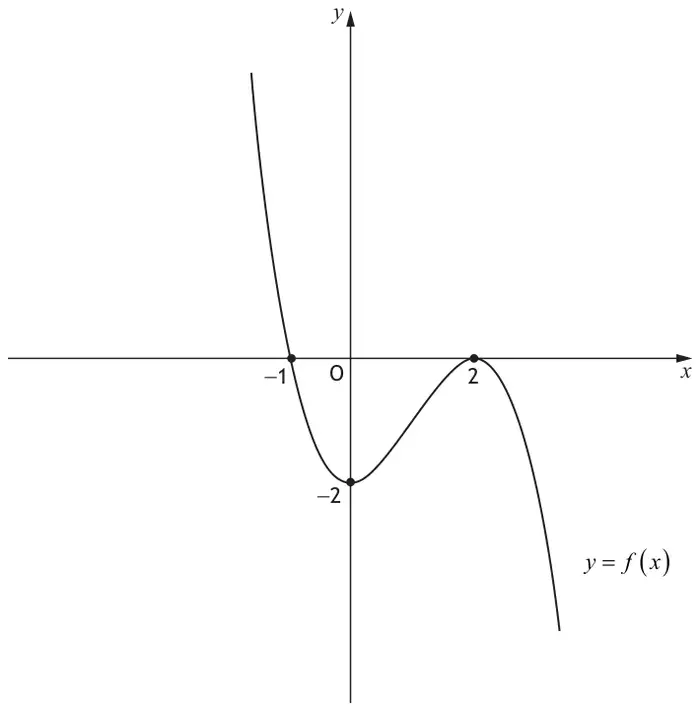
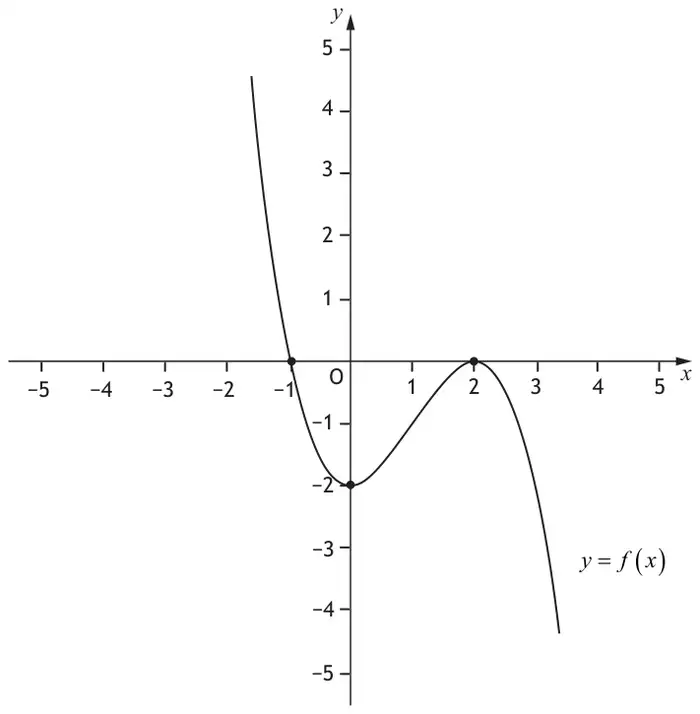
4. The diagram shows the cubic graph of \(y=f(x)\), with stationary points at (2, 0) and (0, −2).
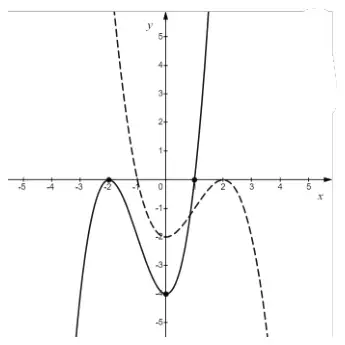
On the diagram below, sketch the graph of \(y=2f(-x)\). [2]
Marking instructions
Marking instructions Mark Generic scheme Illustrative scheme •1 reflect in the \(y\)-axis cubic graph with max at \((-2,0)\) and passing through \((1,0)\) •2 apply appropriate vertical scaling
(2)
Notes:
Where candidates do not sketch a cubic function award 0/2. For transformations of the form \(f(-x)+k\) or \(-f(x+k)\) award 0/2. If the transformation has not been applied to all coordinates, award 0/2. Commonly Observed Responses:
Function Transformation of (−1,0) and (2,0) Transformation of (0,−2) Shape Award Incorrect orientation (−2,0) and (1, 0) (0,−4) 0/2 \(-2f(x)\) (−1,0) and (2,0) (0,4) 1/2 \(-2f(-x)\) (−2,0) and (1, 0) (0,4) 1/2 \(-2f(-2x)\) (−1,0) and (\(\frac{1}{2}\),0) (0,4) 0/2 \(-2f\left(-\frac{x}{2}\right)\) (−4,0) and (2,0) (0,4) 0/2 \(2f(x)\) (−1,0) and (2,0) (0,−4) 1/2 \(2f(2x)\) (\(-\frac{1}{2}\),0) and (1,0) (0,−4) 1/2 \(2f\left(\frac{x}{2}\right)\) (−2,0) and (4,0) (0,−4) 1/2 \(2f\left(-\frac{x}{2}\right)\) (−4,0) and (2,0) (0,−4) 1/2 \(2f(x-1)\) (0,0) and (3,0) (1,−4) 1/2 \(f(-x)\) (−2,0) and (1,0) (0,−2) 1/2 \(\frac{1}{2}f(-x)\) (−2,0) and (1,0) (0,−1) 1/2 \(f(2x)\) (\(-\frac{1}{2}\),0) and (1,0) (0,−2) 0/2 \(f(-2x)\) (−1,0) and (\(\frac{1}{2}\),0) (0,−2) 0/2 \(f\left(-\frac{x}{2}\right)\) (−4,0) and (2,0) (0,−2) 0/2 \(-f\left(\frac{x}{2}\right)\) (−2,0) and (4,0) (0,2) 0/2 \(-f\left(-\frac{x}{2}\right)\) (−4,0) and (2,0) (0,2) 0/2
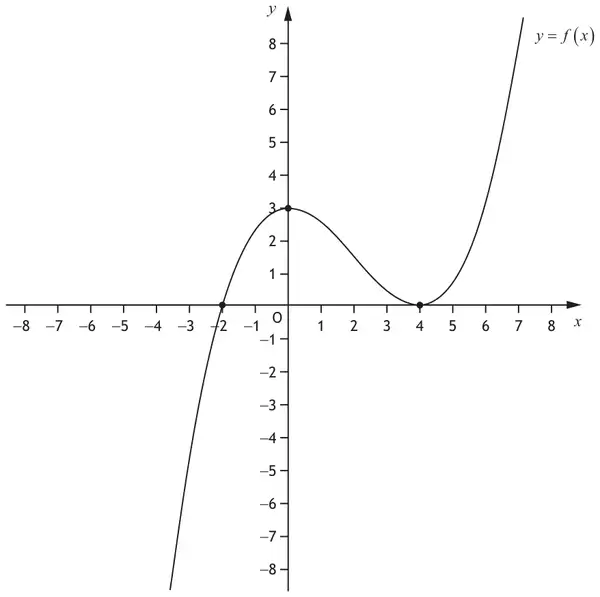
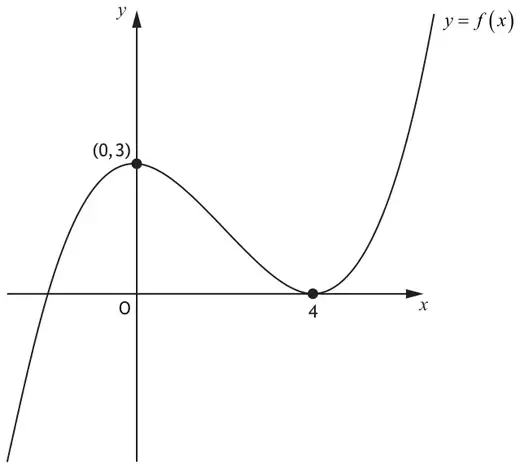
10. The diagram shows the graph of a cubic function with equation \(y=f(x)\).
The curve has stationary points at \((0,3)\) and \((4,0)\).
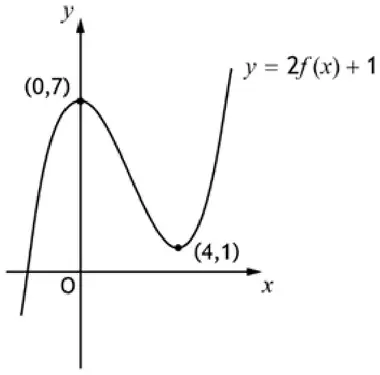
(a) Sketch the graph of \(y=2f(x)+1\).
Use the diagram provided below.
[3] (b) State the coordinates of the stationary points on the graph of \(y=f\left(\dfrac{1}{2}x\right)\). [1]
Marking instructions (a) Marking instructions (b)
Marking instructions (a) Mark Generic scheme Illustrative scheme •1 vertical scaling by a factor of 2 identifiable from graph •1 •2 •3
•2 vertical translation of ‘\(+1\)’ units identifiable from graph •3 transformations applied in correct order (3)
Notes:
•1 , •2 and •3 are only available for a ‘cubic’ with a maximum and minimum turning point. Ignore intersections (or lack of intersections) with the original graph. Commonly Observed Responses:
Where the image of (4,0) is not (4,1), that point must be annotated (or drawn to within tolerance). In the following table, the images of the given points must be stationary points for the marks to be awarded.
Image of (0,3) Image of (4,0) Award… (0,8) (4,2) 2/3 Transformation in wrong order (0,4) (8,1) 1/3 Only vertical translation correct (0,5) (4,−1) 2/3 Evidence of vertical scaling and transformation in correct order (0,6) (4,0) 1/3 Evidence of vertical scaling (0,−2) (4,1) 1/3 Evidence of vertical translation (0,5) any other point 0/3 Insufficient evidence of scaling/translation
Marking instructions (b) Mark Generic scheme Illustrative scheme •4 state coordinates of stationary points \((0,3)\) and \((8,0)\) (1)
5. Functions \(f\) and \(g\) are given by \(f(x)=x^2-2\) and \(g(x)=3x+5\), \(x\in\mathbb{R}\).
(a) Find expressions for:
(i) \(f(g(x))\) and [2]
(ii) \(g(f(x))\). [1]
(b) Determine the range of values of \(x\) for which \(f(g(x))\lt g(f(x))\). [4]
Marking instructions (a) Marking instructions (b)
Marking instructions (a) (a)(i)
Mark Generic scheme Illustrative scheme •1 interpret notation \(f(3x+5)\) or \(\left(g(x)\right)^2-2\) •2 state expression for \(f(g(x))\) \((3x+5)^2-2\) (2)
(a)(ii)
Mark Generic scheme Illustrative scheme •3 state expression for \(g(f(x))\) \(3\left(x^2-2\right)+5\) (1)
Notes:
For \(f(g(x))=(3x+5)^2-2\) without working, award both •1 and •2 . Commonly Observed Responses:
Candidate A
(a)(i) \(f(g(x))=3\left(x^2-2\right)+5\) •1 ✗ •2 ✓1 (a)(ii) \(g(f(x))=(3x+5)^2-2\) •3 ✓1
Marking instructions (b) Mark Generic scheme Illustrative scheme •4 interpret information and expand \(9x^2+30x+25-2\lt 3x^2-6+5\) •5 express inequality in standard quadratic form \(6x^2+30x+24\lt 0\) •6 determine zeros of quadratic equation \(-4,\ -1\) •7 state range with justification \(-4\lt x\lt -1\) with eg sketch or table of signs (4)
Notes:
Candidates who do not work with an inequation from the outset lose •4 , •5 and •7 . However, •6 is still available. See Candidate D. Accept the appearance of \(-4,-1\) within inequalities for •6 . At •7 accept “\(x>-4\) and \(x\lt -1\)” or “\(x>-4,\ x\lt -1\)” together with the required justification. Commonly Observed Responses:
Candidate B
\(9x^2+30x+25-2\lt 3x^2-6+5\) •4 ✓ \(6x^2+30x+24\lt 0\) •5 ✓ \(6x^2+30x+24=0\) \(x=-1,\ x=-4\) •6 ✓ \(-4\lt x\lt -1\) with sketch •7 ✓
Candidate C
\(9x^2+30x+25-2\lt 3x^2-6+5\) •4 ✓ \(6x^2+30x+24=0\) •5 ✗ \(x=-1,\ x=-4\) •6 ✓ \(-4\lt x\lt -1\) with sketch •7 ✗
Candidate D
\(9x^2+30x+25-2=3x^2-6+5\) •4 ✗ \(6x^2+30x+24=0\) •5 ✗ \(x=-1,\ x=-4\) •6 ✓ For \(f(g(x))\lt g(f(x))\) \(-4\lt x\lt -1\) with sketch •7 ✗
3. A function, \(h\), is defined by \(h(x)=4+\dfrac{1}{3}x\), where \(x\in\mathbb{R}\).
Find the inverse function, \(h^{-1}(x)\). [3]
Marking instructions
Marking instructions Mark Generic scheme Illustrative scheme Method 1 Method 1 •1 equate composite function to \(x\) \(h\left(h^{-1}(x)\right)=x\) •2 write \(h\left(h^{-1}(x)\right)\) in terms of \(h^{-1}(x)\) \(4+\dfrac{1}{3}h^{-1}(x)=x\) •3 state inverse function \(h^{-1}(x)=3(x-4)\) Method 2 Method 2 •1 write as \(y=h(x)\) and start to rearrange \(y=h(x)\Rightarrow x=h^{-1}(y)\) •2 express \(x\) in terms of \(y\) \(x=3(y-4)\) •3 state inverse function \(h^{-1}(y)=3(y-4)\) (3)
Notes:
In Method 1, accept \(4+\dfrac{1}{3}h^{-1}(x)=x\) for •1 and •2 . In Method 2, accept ‘\(y-4=\dfrac{1}{3}x\)’ without reference to \(y=h(x)\Rightarrow x=h^{-1}(y)\) at •1 . In Method 2, accept \(h^{-1}(x)=3(x-4)\) without reference to \(h^{-1}(y)\) at •3 . In Method 2, beware of candidates with working where each line is not mathematically equivalent. See Candidates A and B for example. At •3 stage, accept \(h^{-1}\) written in terms of any dummy variable eg \(h^{-1}(y)=3(y-4)\). \(y=3(x-4)\) does not gain •3 . \(h^{-1}(x)=3(x-4)\) with no working gains 3/3. Commonly Observed Responses:
Candidate A
\(h(x)=4+\dfrac{1}{3}x\) \(y=4+\dfrac{1}{3}x\) \(x=3(y-4)\) •1 ✓ •2 ✓ \(y=3(x-4)\) •3 ✗ \(h^{-1}(x)=3(x-4)\)
Candidate B
\(h(x)=4+\dfrac{1}{3}x\) \(y=4+\dfrac{1}{3}x\) \(x=4+\dfrac{1}{3}y\) •1 ✗ \(y=3(x-4)\) •2 ✓1 \(h^{-1}(x)=3(x-4)\) •3 ✓1
Candidate C - BEWARE
Candidate D
\(x\rightarrow x\div3\rightarrow x\div3+4=h(x)\) \(\div3\rightarrow+4\) \(\therefore -4\rightarrow\times3\) •1 ✓ \(3(x-4)\) •2 ✓ \(h^{-1}(x)=3(x-4)\) •3 ✓
No questions match these filters.