complete division, interpret result and state conclusion
\(\begin{array}{r|rrrr}-2&1&7&18&16\\&&-2&-10&-16\\\hline&1&5&8&0\end{array}\) Remainder \(=0\therefore(x+2)\) is a factor
Method 2
Method 2
•1
know to substitute \(x=-2\)
\((-2)^3+7(-2)^2+18(-2)+16\)
•2
complete evaluation, interpret result and state conclusion
\(=0\therefore(x+2)\) is a factor
(2)
Notes:
Communication at •2 must be consistent with working at that stage i.e. candidate’s working must arrive legitimately at 0 before •2 can be awarded.
The conclusion for (a)(i) must be stated in (a)(i).
Accept any of the following for •2:
‘\(f(-2)=0\) so \((x+2)\) is a factor’
‘since remainder = 0, it is a factor’
the ‘0’ from any method linked to the word ‘factor’ by ‘so’, ‘hence’, \(\therefore\), \(\rightarrow\), \(\Rightarrow\) etc
Do not accept any of the following for •2:
double underlining the ‘0’ or boxing the ‘0’ without comment
‘\(x=-2\) is a factor’, ‘… is a root’
the word ‘factor’ only, with no link
Commonly Observed Responses:
Candidate A - grid method
\(x^2\)
\(5x\)
\(8\)
\(x\)
\(x^3\)
\(5x^2\)
\(2\)
\(2x^2\)
•1 ✓
\(x^2\)
\(5x\)
\(8\)
\(x\)
\(x^3\)
\(5x^2\)
\(8x\)
\(2\)
\(2x^2\)
\(10x\)
\(16\)
with no remainder
\(\therefore(x+2)\) is a factor
•2 ✓
Candidate B - grid method
\(x^2\)
\(5x\)
\(8\)
\(x\)
\(x^3\)
\(5x^2\)
\(2\)
\(2x^2\)
•1 ✓
\(x^2\)
\(5x\)
\(8\)
\(x\)
\(x^3\)
\(5x^2\)
\(8x\)
\(2\)
\(2x^2\)
\(10x\)
\(16\)
\(\therefore(x+2)(x^2+5x+8)=x^3+7x^2+18x+16\)
\(\therefore(x+2)\) is a factor
•2 ✓
Corrected by Westie's Workshop
The board's marking instructions printed “\(x^3+7x+18x+16\)”. Changed to “\(x^3+7x^2+18x+16\)” because \((x+2)(x^2+5x+8)\) expands to \(x^3+7x^2+18x+16\) (the grid gives \(5x^2+2x^2=7x^2\)), so the second term needs a square.
Original: see the board's marking instructions PDF (link above).
Marking instructions (a)(ii)
Mark
Generic scheme
Illustrative scheme
•3
use discriminant
\(5^2-4(1)(8)\)
•4
evaluate discriminant and give valid reason
\(-7\lt0\), \(\Rightarrow x^2+5x+8\) does not factorise (so \((x+2)\) is the only linear factor)
(2)
Notes:
Evidence for •3 may appear in the quadratic formula.
Accept \(b^2-4ac=-7\) for •3.
Do not penalise candidates who replace “\(x^2+5x+8\)” with “the quadratic factor”.
At •4 accept interpretations such as “no real roots”, “no (further) factors” and “cannot factorise (further)” with comparison with 0.
Where the quadratic factor used in •3 can be factorised, •4 is not available.
Commonly Observed Responses:
Candidate C - no reference to discriminant
\(-7\lt0\)
•3 ^
\(\Rightarrow\) the quadratic factor does not factorise
•4 ^
\(\Rightarrow(x+2)\) is the only linear factor
Candidate D - minimal reference to discriminant
\(-7\lt0\)
•3 ^
discriminant < 0
\(\Rightarrow\) the quadratic factor does not factorise
•4 ✓
\(\Rightarrow(x+2)\) is the only linear factor
Candidate E - no evaluation of discriminant
\(b^2-4ac\lt0\)
•3 ^ •4 ^
\(\Rightarrow\) the quadratic factor does not factorise
\(\Rightarrow(x+2)\) is the only linear factor
Candidate F - no evaluation of discriminant
Product = 8 and Sum = 5 No integer pair have this product and sum so the quadratic factor does not factorise
•3 ^ •4 ^
Marking instructions (b)
Mark
Generic scheme
Illustrative scheme
•5
equate curves
\(2x^3+20x^2+27x+9=6x^2-9x-23\)
•6
rearrange and link to (a)
\(2x^3+14x^2+36x+32=0\) leading to \(2(x^3+7x^2+18x+16)=0\)
•7
find \(x\)-coordinate
\(x=-2\)
•8
find \(y\)-coordinate
\(y=19\)
(4)
Notes:
At •6 do not penalise candidates who have divided the cubic equation by 2.
‘\(=0\)’ must appear in at least one of the equations at the •6 stage.
•7 may not be awarded for working in part (a).
Where an error has occurred at the •5 or •6 stage, •7 and •8 are still available for finding all the solutions (the discriminant need not be used for •8 to be awarded on follow-through).
Where candidates “factorise” an irreducible quadratic or use another invalid strategy, •7 and •8 are not available.
[Annotation in the marking instructions: callout on \(2(x+2)(x^2+5x+8)=0\): “To gain •7, \(x^2+5x+8\) must also be stated in (a) or the discriminant used. Also accept \(x=-2\) or \(x+2=0\), AND \(x^2+5x+8=0\) for •6 (or without \(=0\) if previously included)”]
\(x=-2\) and \(10^2-4(2)(16)=-28\lt0\) so \(x=-2\) is the only root
•7 ✓
\(y=19\)
•8 ✓
[Annotation in the marking instructions: a dashed bracket joins the lines from \(2x^3+14x^2+36x+32=0\) to \((x+2)(2x^2+10x+16)\), with the callout “Also accept \(x=-2\) or \(x+2=0\), AND \(2x^2+10x+16=0\) for •6 (or without \(=0\) if previously included)”]
1. The equation \(x^2+kx+(k+3)=0\) has equal roots.
Find algebraically, the values of \(k\). [3]
Marking instructions
Mark
Generic scheme
Illustrative scheme
•1
use discriminant
\(k^2-4(1)(k+3)\)
•2
apply condition and express in standard quadratic form
\(k^2-4k-12=0\)
•3
state values of \(k\)
\(-2,\ 6\)
(3)
Notes:
Where candidates state an incorrect or no condition, •2 is not available. However, •3 is available for finding the roots of the quadratic - see Candidate B.
Where \(x\) appears in any expression, no further marks are available.
11. The equation \(9x^2+3kx+k=0\) has two real and distinct roots.
Determine the range of values for \(k\).
Justify your answer.[4]
Marking instructions
Mark
Generic scheme
Illustrative scheme
•1
use the discriminant
\((3k)^2-4(9)(k)\)
•2
apply condition
\((3k)^2-4(9)(k)>0\)
•3
identify roots of quadratic expression
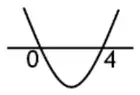
\(0,\ 4\)
•4
state range with justification
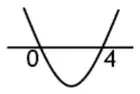
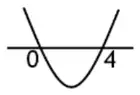
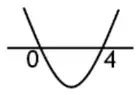
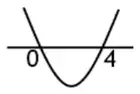
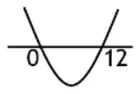
\(k<0\) and \(k>4\) with eg labelled sketch:
(4)
Notes:
At •1, treat the inconsistent use of brackets, for example \(3k^2-4\times 9\times k\), as bad form only if the unbracketed terms are dealt with correctly in the next line of working. See also Candidate F.
Where candidates do not state an inequality in terms of \(k\) but state expressions for \(a\), \(b\) and \(c\), and \(b^2-4ac>0\), award •2. Where no expressions for \(a\), \(b\) and \(c\) are stated, •2 is only available where •4 is awarded. See Candidates A, B and C.
If candidates have the condition ‘discriminant \(<0\)’, ‘discriminant \(\leqslant 0\)’ or ‘discriminant \(\geqslant 0\)’, then •2 is lost but •3 and •4 are available.
Ignore the appearance of \(b^2-4ac=0\) where the correct condition has subsequently been applied. See Candidate D.
If candidates only work with the condition ‘discriminant = 0’, then •2 and •4 are unavailable. See Candidate E.
Accept the appearance of 0 and 4 within inequalities for •3.
For the appearance of \(x\) in any expression of the discriminant, no further marks are available.
Commonly Observed Responses:
Candidate A - no expressions for \(a\), \(b\) and \(c\)
Two real and distinct roots \(b^2-4ac>0\)
\(9k^2-36k=0\)
•1 ✓
\(k=0,\ k=4\)
•3 ✓
\(k<0,\ k>4\)
•2 ✓ •4 ✓
In this case •2 is only available where •4 is awarded
Candidate B - expressions for \(a\), \(b\) and \(c\)
\(a=9,\ b=3k,\ c=k\)
\(b^2-4ac>0\)
•2 ✓
Candidate C - working with =’0’
\((3k)^2-4\times 9\times k\)
•1 ✓
\(9k^2-36k=0\)
\(k=0,\ k=4\)
•3 ✓
\(b^2-4ac>0\)
\(k<0,\ k>4\)
•2 ✓ •4 ✓
In this case •2 is only available where •4 is awarded
8. The equation \(x^2+(m-4)x+(2m-3)=0\) has no real roots.
Determine the range of values for \(m\). [4]
Justify your answer.
Marking instructions
Mark
Generic scheme
Illustrative scheme
•1
use discriminant
\((m-4)^2-4(1)(2m-3)\)
•2
apply condition
\((m-4)^2-4(1)(2m-3)\lt0\)
•3
identify roots of quadratic expression
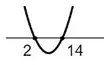
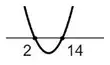
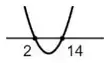
2, 14
•4
state range with justification
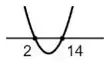
\(2\lt m\lt14\) with eg labelled sketch or table of signs
(4)
Notes:
At •1, treat the inconsistent use of brackets: For example \(m-4^2-4(1)(2m-3)\) or \((m-4)^2-4\times1\times2m-3\) as bad form only if the candidate deals with the unbracketed terms correctly in the next line of working.
Where candidates express \(a\), \(b\) and \(c\) in terms of \(m\), and then state \(b^2-4ac\lt0\), award •2.
If candidates have the condition ‘discriminant \(\gt0\)’, ‘discriminant \(\leqslant0\)’ or ‘discriminant \(\geqslant0\)’, then •2 is lost but •3 and •4 are available.
Ignore the appearance of \(b^2-4ac=0\) where the correct condition has subsequently been applied.
If candidates only work with the condition ‘discriminant \(=0\)’, then •2 and •4 are unavailable.
Accept the appearance of 2 and 14 within inequalities for •3.
At •4 accept “\(m\gt2\) and \(m\lt14\)” or “\(m\gt2,\ m\lt14\)” together with the required justification.
For the appearance of \(x\) in any expression of the discriminant, no further marks are available.
Commonly Observed Responses:
Candidate A - no expressions for \(a\), \(b\) and \(c\)
No real roots \(b^2-4ac\lt0\)
\(m^2-16m+28=0\)
•1 ✓
\(m=2,\ m=14\)
•3 ✓
\(2\lt m\lt14\)
•2 ✓ •4 ✓
In this case •2 is only available where •4 is awarded
Candidate B
\((m-4)^2-4(1)(2m-3)\)
•1 ✓
\(m^2-16m+28=0\)
\(m=2,\ m=14\)
•3 ✓
\(b^2-4ac\lt0\)
\(2\lt m\lt14\)
•2 ✓ •4 ✓
In this case •2 is only available where •4 is awarded
5. The equation \(2x^2+(3p-2)x+p=0\) has equal roots.
Determine the possible values of \(p\). [3]
Marking instructions
Mark
Generic scheme
Illustrative scheme
•1
use the discriminant
\((3p-2)^2-4\times2\times p\)
•2
apply condition and express in standard quadratic form
\(9p^2-20p+4=0\)
•3
process for \(p\)
\(\dfrac{2}{9},\,2\)
(3)
Notes:
Where candidates states an incorrect condition, •2 is not available. However, •3 is available for finding the roots of the quadratic - see Candidate B.
Where \(x\) appears in any expression, no further marks are available.
2. The equation \(2x^2-8x+(4-p)=0\) has two real and distinct roots.
Determine the range of values for \(p\). [3]
Marking instructions
Mark
Generic scheme
Illustrative scheme
•1
use discriminant
\((-8)^2-4(2)(4-p)\)
•2
apply condition and simplify
\(32+8p>0\) or \(8p>-32\)
•3
state range
\(p>-4\)
(3)
Notes:
At •1, treat the inconsistent use of brackets eg \((-8)^2-4\times2\times4-p\) or \(-8^2-4(2)(4-p)\) as bad form only if the candidate deals with the unbracketed terms correctly in the next line of working.
If candidates have the condition ‘discriminant \(=0\)’, then •2 and •3 are unavailable. However, see Candidate E.
If candidates have the condition ‘discriminant \(\lt 0\)’, ‘discriminant \(\leqslant 0\)’ or ‘discriminant \(\geqslant 0\)’ then •2 is lost but •3 is available.
Commonly Observed Responses:
Candidate A - bad form
\((-8)^2-4\times2\times4-p>0\) (wavy underline under “\(\times4-p\)”)
\(32+8p>0\)
•1 ✓ •2 ✓
\(p>-4\)
•3 ✓
Candidate B - no coefficient of \(p\)
\((-8)^2-4\times2\times4-p>0\) (underline under “\(4-p\)”)
\(32-p>0\)
•1 ✗ •2 ✓2
\(p\lt 32\)
•3 ✓2
Candidate C - bad form
\(-8^2-4\times2\times(4-p)>0\) (wavy underline under “\(-8^2\)”)
\(32+8p>0\)
•1 ✓ •2 ✓
\(p>-4\)
•3 ✓
Candidate D - not bad form
\(-8^2-4\times2\times(4-p)>0\) (underline under “\(-8^2\)”)
\(-96+8p>0\)
•1 ✗ •2 ✓2
\(p>12\)
•3 ✓1
Candidate E - condition stated initially
Real and distinct roots \(b^2-4ac>0\)
\((-8)^2-4(2)(4-p)=0\)
•1 ✓
\(32+8p=0\)
\(p=-4\)
so \(p>-4\)
•2 ✓ •3 ✓
Candidate F
\(8^2-4(2)(4-p)>0\)
•1 ✗
\(32+8p>0\)
•2 ✓1
\(p>-4\)
•3 ✓1
However, \(64-4(2)(4-p)>0\) as the first line of working may be awarded •1
We'd like to use Google Analytics cookies to count visits and see which pages help most. They're optional, and the site works exactly the same either way. Privacy policy