12. A function \(f\) is defined on the set of real numbers by
\[f(x)=x^3+2x^2-4x+1.\]
(a) Find the \(x\)-coordinates of the stationary points on the curve with equation \(y=f(x)\). [3]
(b) Hence, determine the maximum and minimum values of \(f(x)\) in the interval \(-1\leqslant x\leqslant 1\). [3]
Marking instructions (a)
Mark
Generic scheme
Illustrative scheme
•1
differentiate two non-constant terms
eg \(3x^2+4x\)
•2
complete differentiation and equate to zero
\(3x^2+4x-4=0\)
•3
solve for \(x\)
\(\dfrac{2}{3},\ -2\)
(3)
Notes:
For a numerical approach, award 0/3.
•2 is only available if ‘\(=0\)’ appears at •2 stage or in the working leading to •3. However, see Candidate A.
•3 is only available for solving a quadratic equation.
Commonly Observed Responses:
Candidate A - derivative not explicitly equated to 0
Stationary points occur when \(f'(x)=0\)
\(f'(x)=3x^2+4x-4\)
•1 ✓ •2 ✓
\(f'(x)=(3x-2)(x+2)\)
\(x=\dfrac{2}{3},\ -2\)
•3 ✓
Candidate B - derivative never equated to 0
\(3x^2+4x-4\)
•1 ✓ •2 ^
\((3x-2)(x+2)\)
\(x=\dfrac{2}{3},\ -2\)
•3 ✓
Marking instructions (b)
Mark
Generic scheme
Illustrative scheme
•4
evaluate \(f(x)\) at stationary point
\(-\dfrac{13}{27}\) or \(-0.481\ldots\) or \(\left(\dfrac{2}{3},-\dfrac{13}{27}\right)\)
•5
consider value of \(f(x)\) at end points
\(f(1)=0,\ f(-1)=6\)
•6
state maximum AND minimum values
max (value) \(=6\) AND min (value) \(=-\dfrac{13}{27}\)
(3)
Notes:
‘Greatest \((-1,6)\); least \(\left(\dfrac{2}{3},-\dfrac{13}{27}\right)\)’ does not gain •6.
•4 is not available for only evaluating \(y\) at a value of \(x\), obtained at the •3 stage, which lies outwith the interval \(-1\leqslant x\leqslant 1\).
•5 is not available for evaluating \(y\) at an end point which is also identified as a stationary point in part (a).
•6 is only available where candidates have attempted to evaluate \(y\) at stationary point(s) in the interval \(-1\leqslant x\leqslant 1\) identified in part (a).
•6 is only available where candidates have attempted to evaluate \(y\) at \(x=-1\) and \(x=1\).
7. Determine the gradient of the tangent to the curve with equation \(y=2x+4\sqrt{x}\), \(x\gt0\), at the point where \(x=9\). [4]
Marking instructions
Mark
Generic scheme
Illustrative scheme
•1
write second term in differentiable form
\(\ldots+4x^{\frac{1}{2}}\) stated or implied by •3
•2
differentiate first term
\(2\)
•3
differentiate second term
\(\ldots+\dfrac{1}{2}\times4x^{-\frac{1}{2}}\)
•4
evaluate gradient
\(\dfrac{8}{3}\) or \(2\dfrac{2}{3}\)
(4)
Notes:
•3 is only available for differentiating a term with a fractional index.
•4 is only available as a consequence of substituting into an expression involving a fractional power of \(x\).
Where candidates make no attempt to differentiate, or integrate one or other of the terms, •4 is unavailable. See Candidates A, B and C.
•4 is not available where a candidate subsequently finds a perpendicular gradient.
Accept \(y=\dfrac{8}{3}\) only where a substitution has been shown, no other values for \(y\) have been stated, or \(\dfrac{8}{3}\) has been used as the gradient in the equation of the tangent.
Where candidates equate \(\dfrac{dy}{dx}\) to 0, •4 is unavailable. See Candidate D.
Commonly Observed Responses:
Candidate A - limited evidence of differentiation of the second term
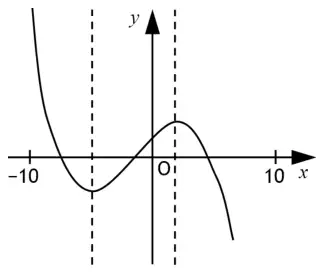
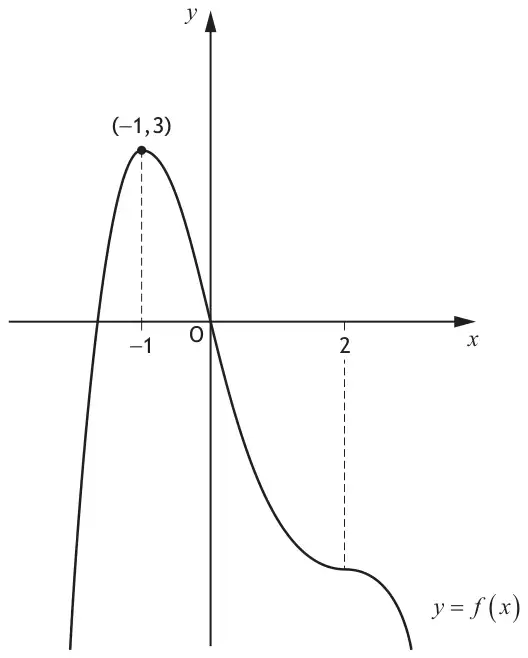
13. A function, \(f\), is defined on the set of real numbers.
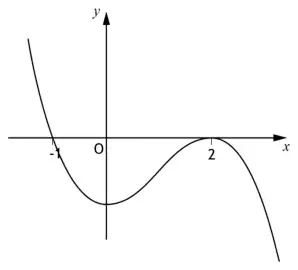
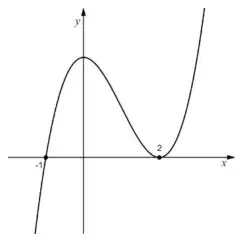
The derivative of \(f\) is \(f'(x)=(x+5)(2-x)\).
(a) Find the \(x\)-coordinates of the stationary points on the curve with equation \(y=f(x)\) and determine their nature. [3]
It is known that:
\(f\) is a cubic function
\(f(0)<0\)
the equation \(f(x)=0\) has exactly one solution. The solution lies between \(-10\) and \(10\).
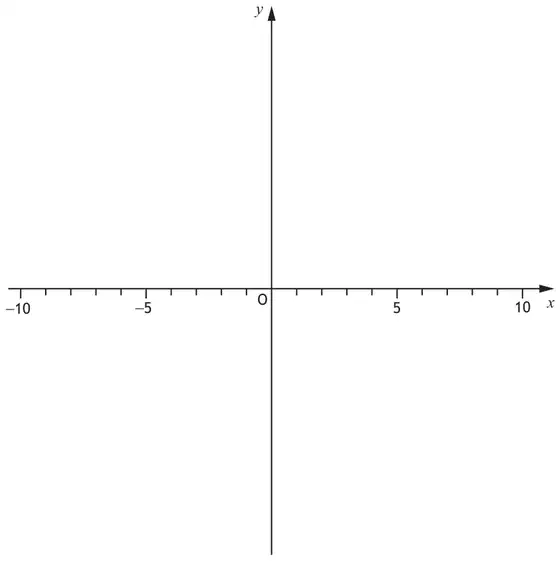
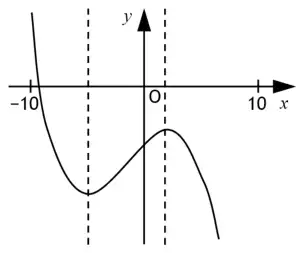
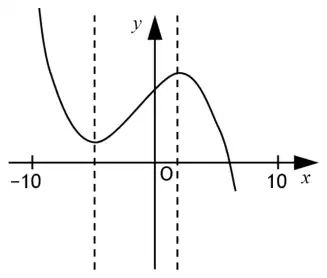
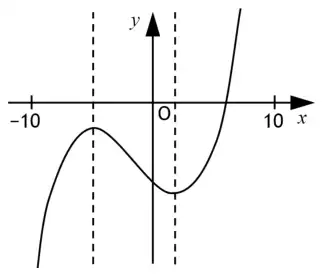
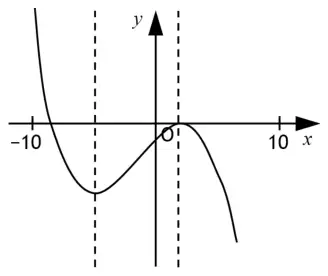
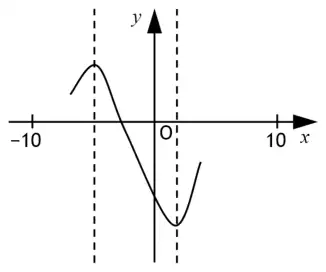
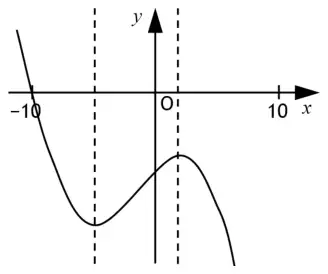
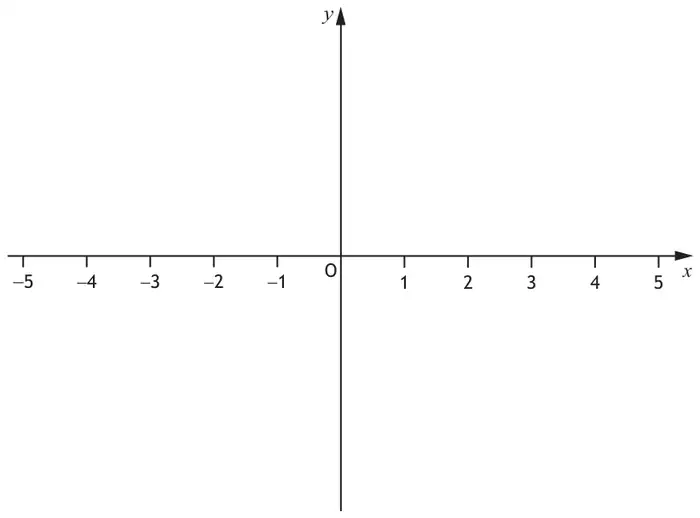
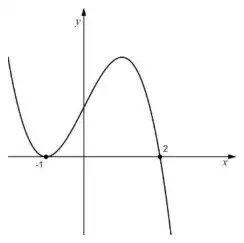
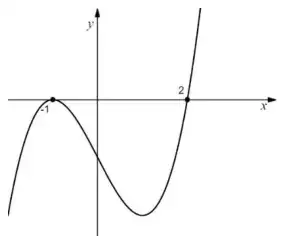
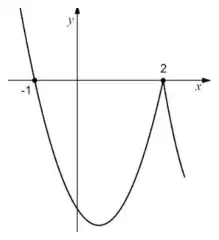
(b) Draw a sketch of a possible graph of \(y=f(x)\) on the diagram in your answer booklet (shown below). [3]
Marking instructions (a)
Mark
Generic scheme
Illustrative scheme
•1
equate derivative to zero and solve for \(x\)
\((x+5)(2-x)=0\) OR \(f'(x)=0\) OR \(\dfrac{dy}{dx}=0\) stated explicitly leading to \(-5\) and \(2\)
•2
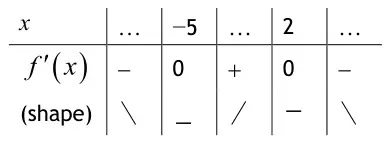
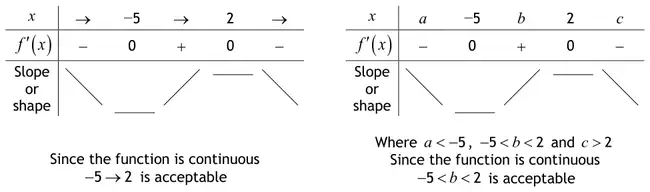
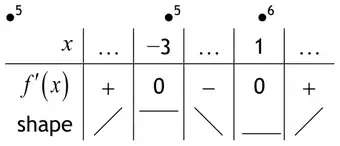
construct nature table(s)
(In the original, •2 is printed above the −5 column and •3 above the 2 column.)
•3
interpret table and state conclusions
min at \(x=-5\); max at \(x=2\)
(3)
Notes:
•2 and •3 may be awarded vertically.
•3 is still available in cases where a candidates table of signs does not lead legitimately to a maximum/minimum shape.
Candidates may use the second derivative. See Candidates A and B.
Ignore any \(y\)-coordinates.
•2 is not available where any errors are made in calculating values of \(f'(x)\).
Commonly Observed Responses:
Candidate A - second derivative
\(f''(x)=-2x-3\)
\(f''(-5)>0\) \(f''(2)<0\)
•2 ✓
So min at \(x=-5\) so max at \(x=2\)
•3 ✓
(In the original, “•2 ✓” is also printed above the \(x=-5\) column and “•3 ✓” above the \(x=2\) column.)
Candidate B - second derivative
\(f''(x)=-2x-3\)
\(f''(-5)=7>0\) \(f''(2)=-7<0\)
•2 ✓
so min at \(x=-5\) so max at \(x=2\)
•3 ✓
(In the original, “•2 ✓” is also printed above the \(x=-5\) column and “•3 ✓” above the \(x=2\) column.)
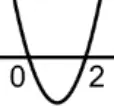
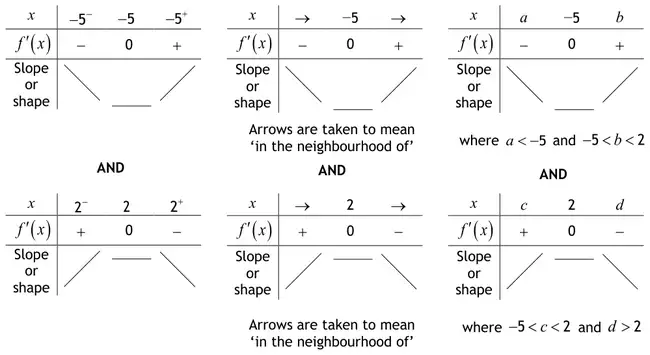
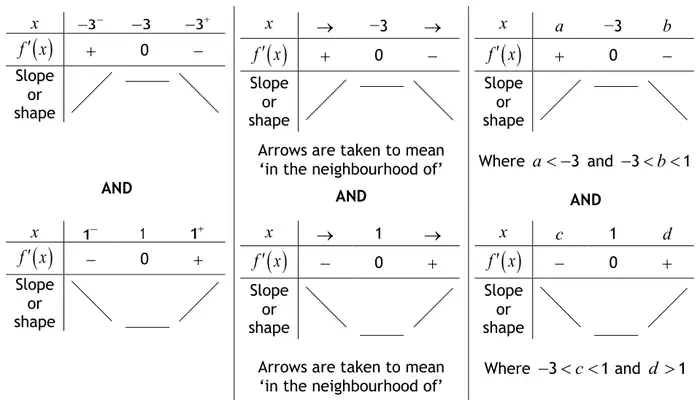
For the table of signs for a derivative, accept:
For the table of signs for a derivative, accept:
For this question do not penalise the omission of ‘\(x\)’ or the word ‘shape’/‘slope’.
Stating values of \(f'(x)\) is an acceptable alternative to writing ‘\(+\)’ or ‘\(-\)’ signs.
Acceptable variations of \(f'(x)\) are: \(f'\), \(\dfrac{df}{dx}\), \(\dfrac{dy}{dx}\), \((x+5)(2-x)\) and \(-x^2-3x+10\)
Marking instructions (b)
Mark
Generic scheme
Illustrative scheme
•4
interpret result of (a) and first bullet point
cubic drawn with stationary points consistent with result of (a)
•5
interpret second bullet point within a cubic function
cubic drawn with \(y\)-intercept below the origin
•6
interpret third bullet point within a cubic function
cubic drawn with exactly one root; \(-10<\text{root}<10\)
(3)
Notes:
•4 is awarded for turning points in a cubic graph consistent with the natures stated in part (a), or where no natures have been stated, the shape of the graph from the nature table.
Do not penalise the appearance of \(y\)-coordinates.
For a cubic graph which does not have two stationary points, award 0/3.
•6 is not available where an extension of the graph of \(y=f(x)\) will cross the \(x\)-axis.
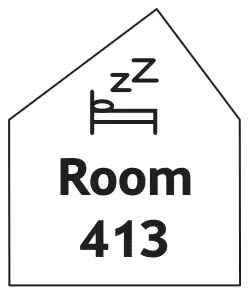
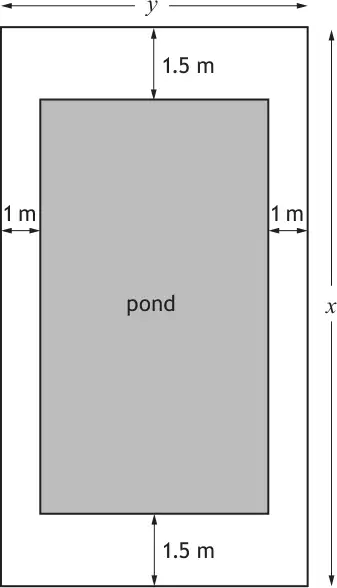
10. A hotel owner is designing signs showing the room numbers.
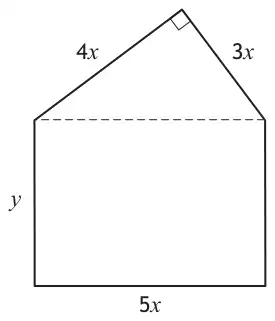
Each sign is a rectangle with a right-angled triangle above it.
The length and breadth of the rectangle are \(5x\) centimetres and \(y\) centimetres respectively.
The shorter sides of the triangle are \(3x\) centimetres and \(4x\) centimetres.
The area of the sign is 150 square centimetres.
(a) Show that the perimeter, \(P\) cm, of the sign is given by [3]\[P=9.6x+\frac{60}{x}.\]
Each sign will be lit using a lighting strip placed around its perimeter.
The hotel owner requires the perimeter, \(P\), of the sign to be as small as possible.
(b) Find the minimum value of \(P\). [6]
Marking instructions (a)
Mark
Generic scheme
Illustrative scheme
•1
express \(P\) in terms of \(x\) and \(y\)
\(P=12x+2y\)
•2
express \(y\) in terms of \(x\)
\(y=\dfrac{150-6x^2}{5x}\)
•3
substitute for \(y\) and complete proof
\(P=12x+2\left(\dfrac{150-6x^2}{5x}\right)\) leading to \(P=9.6x+\dfrac{60}{x}\)
(3)
Notes:
Accept \(P=4x+3x+y+5x+y\) or equivalent for •1.
The substitution for \(y\) at •3 must be clearly shown for •3 to be available.
Do not penalise the omission of brackets at •3 leading to the correct solution. See Candidate A.
Commonly Observed Responses:
Candidate A - missing brackets
\(\vdots\)
\(P=12x+2\times\dfrac{150-6x^2}{5x}\)
\(P=9.6x+\dfrac{60}{x}\)
•3 ✓
Marking instructions (b)
Mark
Generic scheme
Illustrative scheme
•4
express \(P\) in differentiable form
\(9.6x+60x^{-1}\) stated or implied by •5
•5
differentiate
\(9.6-60x^{-2}\)
•6
equate expression for derivative to 0
\(9.6-60x^{-2}=0\)
•7
process for \(x\)
\(2.5\) or \(\dfrac{5}{2}\)
•8
verify nature
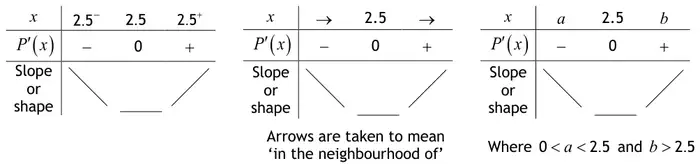
table of signs for a derivative \(\therefore\) minimum OR \(P^{\prime\prime}(x)=120x^{-3}\) and \(P^{\prime\prime}(2.5)=7.68\ldots>0\ \therefore\) minimum
•9
find minimum value of \(P\)
48(cm)
(6)
Notes:
For a numerical approach, award 0/6.
•6 can be awarded for \(60x^{-2}=9.6\).
Where candidates integrate any term at the •5 stage, only •6 is available on follow through for setting their ‘derivative’ to 0.
•7, •8 and •9 are only available for working with a derivative which contains an index \(\leqslant -2\).
\(\left(\dfrac{60}{9.6}\right)^{0.5}\) or \(\sqrt[-2]{\dfrac{9.6}{60}}\) must be simplified at •7 or •8 for •7 to be awarded.
Ignore the appearance of −2.5 at •7.
Notation for the derivative is only assessed at •8.
•8 is not available to candidates who consider a value of \(x\leqslant 0\) in the neighbourhood of 2.5.
•9 is still available in cases where a candidate’s table of signs does not lead legitimately to a minimum at •8.
•8 and •9 are not available to candidates who state that the minimum exists at a value of \(x\) where \(x\leqslant 0\).
Commonly Observed Responses:
Candidate B - differentiating over multiple lines
\(P^{\prime}(x)=9.6+60x^{-1}\)
•4 ✗
\(P^{\prime}(x)=9.6-60x^{-2}\)
•5 ✗
\(9.6-60x^{-2}=0\)
•6 ✓1
Candidate C - differentiating over multiple lines
\(P^{\prime}(x)=9.6x+60x^{-1}\)
•4 ✓
\(P^{\prime}(x)=9.6-60x^{-2}\)
•5 ✗
\(9.6-60x^{-2}=0\)
•6 ✓1
Candidate D
Stationary points when \(P^{\prime}(x)=0\)
\(P^{\prime}(x)=9.6-60x^{-2}\)
•4 ✓ •5 ✓ •6 ✓
10.(b) (continued)
For the table of signs for a derivative, accept:
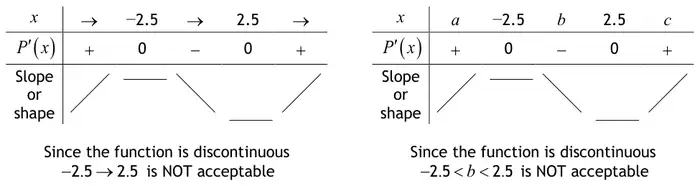
For the table of signs for a derivative, do NOT accept:
For this question, do not penalise the omission of ‘\(x\)’ or the word ‘shape’/‘slope’
Stating values of \(P^{\prime}(x)\) is an acceptable alternative to writing ‘+’ or ‘–’ signs
Acceptable variations of \(P^{\prime}(x)\) are: \(P^{\prime}\), \(\dfrac{dP}{dx}\), and \(9.6-60x^{-2}\). Accept \(f^{\prime}(x)\) only where candidates have previously used \(f(x)=9.6x+60x^{-1}\) in their working
Do not accept \(\dfrac{dy}{dx}\) or \(\dfrac{d^2y}{dx^2}\)
Find the equation of the tangent to this curve at the point where \(x=2\). [4]
Marking instructions
Mark
Generic scheme
Illustrative scheme
•1
find \(y\)-coordinate
\(5\)
•2
differentiate expression
\(3x^2-4x\)
•3
evaluate \(\dfrac{dy}{dx}\) when \(x=2\)
\(4\)
•4
determine equation of tangent
\(y=4x-3\)
(4)
Notes:
Where candidates integrate, only •1 is available. For example, see Candidate F.
•3 is not available for \(y=4\). However, where \(y=4\) comes from substituting into \(3x^2-4x\), or 4 is then used as the gradient of the straight line, •3 may be awarded. See Candidates A, B and C.
•4 is only available where candidates attempt to find the gradient by substituting \(x=2\) into their derivative.
Where \(x=2\) has not been used to determine the \(y\)-coordinate, •4 is not available.
Commonly Observed Responses:
Candidate A - incorrect labels and no evidence of substitution
\(y=5\)
•1 ✓ - BoD
\(y=3x^2-4x\)
•2 ✓
\(y=4\)
•3 ✗
(In the original, a red dashed bracket links the lines \(y=5\), \(y=3x^2-4x\) and \(y=4\).)
Evidence for •4 would need to appear in the equation of the line for •3 to be awarded
Candidate B - incorrect labels and no evidence of substitution
\(y=5\)
•1 ✓ - BoD
\(y=3x^2-4x\)
•2 ✓
\(y=4\)
\(y=4x-3\)
•4 ✓ •3 ✓ - BoD
(In the original, a red dashed bracket links the lines \(y=5\), \(y=3x^2-4x\) and \(y=4\).)
Candidate C - incorrect labels with substitution
\(y=5\)
•1 ✓
\(y=3x^2-4x\)
•2 ✓
\(y=3(2)^2-4(2)=4\)
•3 ✓
Candidate D - no evidence of substitution
\(y=5\)
•1 ✓
\(\dfrac{dy}{dx}=3x^2-4x\)
•2 ✓
\(m=4\)
•3 ✓
Candidate E - equating to zero
\(y=5\)
•1 ✓
\(\dfrac{dy}{dx}=3x^2-4x=0\)
•2 ✓
\(3(2)^2-4(2)=0\)
\(m=4\)
•3 ✗
\(y=4x-3\)
•4 ✓1
(In the original, “= 0” in the second line is underlined with a red wavy line.)
2. A curve has equation \(y=\dfrac{8}{x^3},\ x>0\).
Find the equation of the tangent to this curve at the point where \(x=2\). [5]
Marking instructions
Mark
Generic scheme
Illustrative scheme
•1
find \(y\)-coordinate
\(1\)
•2
write in differentiable form
\(8x^{-3}\)
•3
differentiate
\(8\times(-3)x^{-4}\)
•4
find gradient of tangent
\(-\dfrac{3}{2}\)
•5
determine equation of tangent
\(3x+2y=8\)
(5)
Notes:
Only •1 and •2 are available to candidates who integrate. However, see Candidates E and F.
\(8\times(-3)x^{-4}\) without previous working gains •2 and •3.
•3 is only available for differentiating a negative power. •4 and •5 are still available.
•4 is not available for \(y=-\dfrac{3}{2}\). However, where \(-\dfrac{3}{2}\) is then used as the gradient of the straight line, •4 may be awarded - see Candidates A, B and C.
•5 is only available where candidates attempt to find the gradient by substituting into their derivative.
•5 is not available as a consequence of using a perpendicular gradient.
Where \(x=2\) has not been used to determine the \(y\)-coordinate, •5 is not available.
Commonly Observed Responses:
Candidate A - incorrect notation
\(y=1\)
•1 ✓ - BoD
\(y=8x^{-3}\)
•2 ✓
\(y=-24x^{-4}\)
•3 ✓
\(y=-\dfrac{3}{2}\)
•4 ✓ - BoD
\(3x+2y=8\)
•5 ✓
[Annotation in the marking instructions: the first four lines are grouped by a dashed bracket; the “\(y\)” of \(y=-24x^{-4}\) and of \(y=-\dfrac{3}{2}\) is wavy-underlined (incorrect notation)]
Candidate B - use of values in equation
\(y=1\)
•1 ✓ - BoD
\(y=8x^{-3}\)
•2 ✓
\(\dfrac{dy}{dx}=8\times(-3)x^{-4}\)
•3 ✓
\(\dfrac{dy}{dx}=-\dfrac{3}{2}\)
•4 ✓
\(y=-\dfrac{3}{2}\)
\(3x+2y=8\)
•5 ✓
[Annotation in the marking instructions: the lines from \(y=1\) to \(y=-\dfrac{3}{2}\) are grouped by a dashed bracket; the “\(y\)” of \(y=-\dfrac{3}{2}\) is wavy-underlined]
Candidate C - incorrect notation
\(y=1\)
•1 ✓ - BoD
\(y=8x^{-3}\)
•2 ✓
\(\dfrac{dy}{dx}=8\times(-3)x^{-4}\)
•3 ✓
\(y=-\dfrac{3}{2}\)
•4 ✗
[Annotation in the marking instructions: the four lines are grouped by a dashed bracket]
Evidence for •4 would need to appear in the equation of the line
Candidate D
\(y=1\)
•1 ✓
\(y=8x^{-3}\)
•2 ✓
\(\dfrac{dy}{dx}=8\times(-3)x^{-4}=0\)
•3 ✓
\(8\times(-3)(2)^{-4}=0\)
\(m=-\dfrac{3}{2}\)
•4 ✗
\(3x+2y=8\)
•5 ✓1
[Annotation in the marking instructions: the “\(=0\)” after \(x^{-4}\) is wavy-underlined]
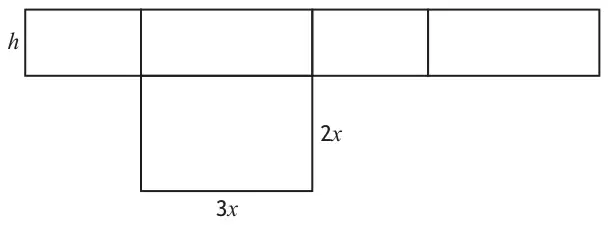
The box is a cuboid with height \(h\) centimetres.
The base is a rectangle measuring \(3x\) centimetres by \(2x\) centimetres.
(a)
(i) Express the area of the net, \(A\) cm2, in terms of \(h\) and \(x\). [1]
(ii) Given that \(A=7200\) cm2, show that the volume of the box, \(V\) cm3, is given by \(V=4320x-\dfrac{18}{5}x^3\). [2]
(b) Determine the value of \(x\) that maximises the volume of the box. [4]
Marking instructions (a)(i)
Mark
Generic scheme
Illustrative scheme
•1
express \(A\) in terms of \(x\) and \(h\)
\((A=)\,6x^2+10xh\)
(1)
Notes:
Accept unsimplified expressions for •1.
Marking instructions (a)(ii)
Mark
Generic scheme
Illustrative scheme
•2
express \(h\) in terms of \(x\)
\(h=\dfrac{7200-6x^2}{10x}\)
•3
substitute for \(h\) and demonstrate result
\(V=3x\times2x\times\left(\dfrac{7200-6x^2}{10x}\right)\) leading to \(V=4320x-\dfrac{18}{5}x^3\)
(2)
Notes:
•2 is only available where the (simplified) expression for \(A\) contains at least 2 terms.
The substitution for \(h\) at •3 must be clearly shown for •3 to be awarded.
Marking instructions (b)
Mark
Generic scheme
Illustrative scheme
•4
differentiate
\(4320-\dfrac{54}{5}x^2\)
•5
equate expression for derivative to 0
\(4320-\dfrac{54}{5}x^2=0\)
•6
solve for \(x\)
\(20\)
•7
verify nature
table of signs for a derivative
\(x\)
\(\ldots\)
\(20\)
\(\ldots\)
\(V'(x)\)
\(+\)
\(0\)
\(-\)
shape
\(\diagup\)
—
\(\diagdown\)
\(\therefore\) maximum (when \(x=20\))
(4)
Notes:
For any approach which does not use differentiation award 0/4.
•5 can be awarded for \(\dfrac{54}{5}x^2=4320\).
For candidates who integrate any term at the •4 stage, only •5 is available on follow through for setting their ‘derivative’ to 0.
Ignore the appearance of \(-20\) at mark •6.
Where \(-20\) is considered in a nature table (or second derivative), “\(x=20\)” must be clearly identified as leading to the maximum volume.
•6 and •7 are not available to candidates who state that the maximum exists at a negative value of \(x\).
Do not penalise statements such as “max volume is 20” or “max is 20” at •7.
Commonly Observed Responses:
Candidate A - second derivative
\(V''(x)=-\dfrac{108}{5}x\)
\(V''(20)<0\ \therefore\) maximum
•7 ✓
Candidate B - beware of multiplying before equating
\(V'(x)=4320-\dfrac{54}{5}x^2\)
•4 ✓
\(V'(x)=21600-54x^2\)
\(21600-54x^2=0\)
•5 ✗
\(x=20\)
•6 ✓1
Candidate C
Stationary points when \(V'(x)=0\)
\(V'(x)=4320-\dfrac{54}{5}x^2\)
•4 ✓ •5 ✓
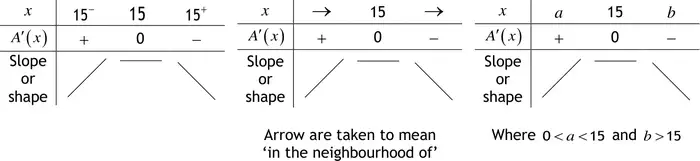
For the table of signs for a derivative, accept:
\(x\)
\(20^-\)
\(20\)
\(20^+\)
\(V'(x)\)
\(+\)
\(0\)
\(-\)
Slope or shape
\(\diagup\)
—
\(\diagdown\)
\(x\)
\(\rightarrow\)
\(20\)
\(\rightarrow\)
\(V'(x)\)
\(+\)
\(0\)
\(-\)
Slope or shape
\(\diagup\)
—
\(\diagdown\)
Arrows are taken to mean ‘in the neighbourhood of’
\(x\)
\(a\)
\(20\)
\(b\)
\(V'(x)\)
\(+\)
\(0\)
\(-\)
Slope or shape
\(\diagup\)
—
\(\diagdown\)
Where \(a<20\) and \(b>20\)
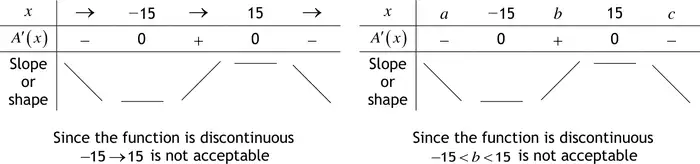
For the table of signs for a derivative, accept:
\(x\)
\(\rightarrow\)
\(-20\)
\(\rightarrow\)
\(20\)
\(\rightarrow\)
\(V'(x)\)
\(-\)
\(0\)
\(+\)
\(0\)
\(-\)
Slope or shape
\(\diagdown\)
—
\(\diagup\)
—
\(\diagdown\)
Since the function is continuous \(-20\rightarrow20\) is acceptable
\(x\)
\(a\)
\(-20\)
\(b\)
\(20\)
\(c\)
\(V'(x)\)
\(-\)
\(0\)
\(+\)
\(0\)
\(-\)
Slope or shape
\(\diagdown\)
—
\(\diagup\)
—
\(\diagdown\)
Since the function is continuous \(-20<b<20\) is acceptable
For this question do not penalise the omission of ‘\(x\)’ or the word ‘shape’/‘slope’.
Stating values of \(V'(x)\) is an acceptable alternative to writing ‘\(+\)’ or ‘\(-\)’ signs.
Acceptable variations of \(V'(x)\) are: \(V'\), \(\dfrac{dV}{dx}\), and \(4320-\dfrac{54}{5}x^2\). Accept \(\dfrac{dy}{dx}\) only where candidates have previously used \(y=4320x-\dfrac{18}{5}x^3\) in their working.
Corrected by Westie's Workshop
The board's marking instructions printed “leading to the maximum area”. Changed to “leading to the maximum volume” because the question asks for the value of \(x\) that gives the maximum volume of the box; the area is fixed at 7200 cm².
Original: see the board's marking instructions PDF (link above).
(Horizontal marking: the first •5 ✓ and •6 ✓ are printed above the \(x=-3\) and \(x=1\) columns respectively; the second •5 ✓ and •6 ✓ are at the end of the rows.)
(Horizontal marking: the first •5 ✓ and •6 ✓ are printed above the \(x=-3\) and \(x=1\) columns respectively; the second •5 ✓ and •6 ✓ are at the end of the rows.)
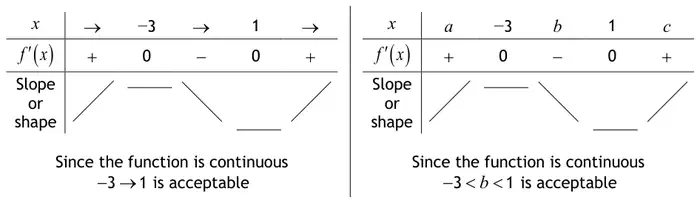
For the table of signs for a derivative, accept:
For the table of signs for a derivative, accept:
For this question do not penalise the omission of ‘\(x\)’ or the word ‘shape’/‘slope’.
Stating values of \(f^{\prime}(x)\) is an acceptable alternative to writing ‘\(+\)’ or ‘\(-\)’ signs.
Acceptable variations of \(f^{\prime}(x)\) are: \(f^{\prime}\), \(\dfrac{df}{dx}\), \(\dfrac{dy}{dx}\), \(3x^2+6x-9\) and \(3(x+3)(x-1)\) but NOT \(x^2+2x-3\) or \((x+3)(x-1)\).
2. Find the equation of the tangent to the curve with equation \(y=2x^5-3x\) at the point where \(x=1\). [4]
Marking instructions
Mark
Generic scheme
Illustrative scheme
•1
calculate \(y\)-coordinate
\(-1\)
•2
differentiate
\(10x^4-3\)
•3
calculate the gradient
\(7\)
•4
find equation of line
\(y=7x-8\)
(4)
Notes:
Only •1 is available to candidates who integrate.
•4 is only available where candidates attempt to find the gradient by substituting into their derivative.
The appearance of \(10x^4-3\) gains •2.
•3 is not available for \(y=7\). However, where 7 is then used as the gradient of the straight line, •3 may be awarded - see Candidates B, C & D.
•4 is not available as a consequence of using a perpendicular gradient.
Commonly Observed Responses:
Candidate A
\(\dfrac{dy}{dx}=10x^4-3\)
•2 ✓
\(y=7\)
•1 ✗
\(m=-3\)
•3 ✗
\(y=-3x+10\)
•4 ✓2
Candidate B - incorrect notation
\(y=-1\)
•1 ✓ - BoD
\(y=10x^4-3\)
•2 ✓
\(y=7\)
•3 ✓ - BoD
\(y+1=7(x-1)\)
\(y=7x-8\)
•4 ✓
[Annotation in the marking instructions: the first three lines are grouped by a dashed bracket; the “\(y\)” of \(y=10x^4-3\) and of \(y=7\) is wavy-underlined (incorrect notation)]
Candidate C - use of values in equation
\(y=-1\)
•1 ✓ - BoD
\(\dfrac{dy}{dx}=10x^4-3\)
•2 ✓
\(\dfrac{dy}{dx}=7\)
•3 ✓
\(y=7\)
\(y+1=7(x-1)\)
\(y=7x-8\)
•4 ✓
[Annotation in the marking instructions: the lines from \(y=-1\) to \(y=7\) are grouped by a dashed bracket; the “\(y\)” of \(y=7\) is wavy-underlined]
Candidate D - incorrect notation
\(y=-1\)
•1 ✓ - BoD
\(\dfrac{dy}{dx}=10x^4-3\)
•2 ✓
\(y=7\)
•3 ✗
[Annotation in the marking instructions: the three lines are grouped by a dashed bracket; \(y=7\) is wavy-underlined]
Evidence for •3 would need to appear in the equation of the line
Candidate E
\(y=-1\)
•1 ✓
\(\dfrac{dy}{dx}=10x^4-3=0\)
•2 ✓
\(10(1)^4-3=0\)
•3 ✗
\(m=7\)
\(y=7x-8\)
•4 ✓1
[Annotation in the marking instructions: the “\(=0\)” in \(\dfrac{dy}{dx}=10x^4-3=0\) is wavy-underlined]
We'd like to use Google Analytics cookies to count visits and see which pages help most. They're optional, and the site works exactly the same either way. Privacy policy