
May 2025 Paper 2 Q10
10. A hotel owner is designing signs showing the room numbers.
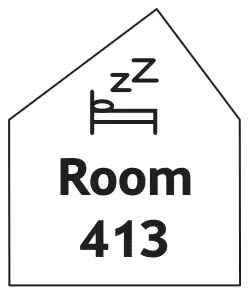
Each sign is a rectangle with a right-angled triangle above it.
The length and breadth of the rectangle are \(5x\) centimetres and \(y\) centimetres respectively.
The shorter sides of the triangle are \(3x\) centimetres and \(4x\) centimetres.
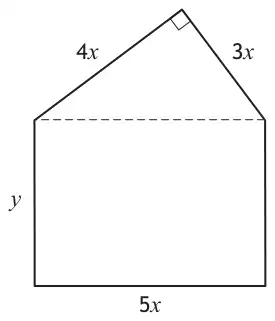
The area of the sign is 150 square centimetres.
Each sign will be lit using a lighting strip placed around its perimeter.
The hotel owner requires the perimeter, \(P\), of the sign to be as small as possible.
| Mark | Generic scheme | Illustrative scheme |
|---|---|---|
| •1 | express \(P\) in terms of \(x\) and \(y\) | \(P=12x+2y\) |
| •2 | express \(y\) in terms of \(x\) | \(y=\dfrac{150-6x^2}{5x}\) |
| •3 | substitute for \(y\) and complete proof | \(P=12x+2\left(\dfrac{150-6x^2}{5x}\right)\) leading to \(P=9.6x+\dfrac{60}{x}\) |
| (3) |
Notes:
- Accept \(P=4x+3x+y+5x+y\) or equivalent for •1.
- The substitution for \(y\) at •3 must be clearly shown for •3 to be available.
- Do not penalise the omission of brackets at •3 leading to the correct solution. See Candidate A.
Commonly Observed Responses:
Candidate A - missing brackets
| \(\vdots\) | |
| \(P=12x+2\times\dfrac{150-6x^2}{5x}\) | |
| \(P=9.6x+\dfrac{60}{x}\) | •3 ✓ |
| Mark | Generic scheme | Illustrative scheme |
|---|---|---|
| •4 | express \(P\) in differentiable form | \(9.6x+60x^{-1}\) stated or implied by •5 |
| •5 | differentiate | \(9.6-60x^{-2}\) |
| •6 | equate expression for derivative to 0 | \(9.6-60x^{-2}=0\) |
| •7 | process for \(x\) | \(2.5\) or \(\dfrac{5}{2}\) |
| •8 | verify nature | table of signs for a derivative \(\therefore\) minimum OR \(P^{\prime\prime}(x)=120x^{-3}\) and \(P^{\prime\prime}(2.5)=7.68\ldots>0\ \therefore\) minimum |
| •9 | find minimum value of \(P\) | 48(cm) |
| (6) |
Notes:
- For a numerical approach, award 0/6.
- •6 can be awarded for \(60x^{-2}=9.6\).
- Where candidates integrate any term at the •5 stage, only •6 is available on follow through for setting their ‘derivative’ to 0.
- •7, •8 and •9 are only available for working with a derivative which contains an index \(\leqslant -2\).
- \(\left(\dfrac{60}{9.6}\right)^{0.5}\) or \(\sqrt[-2]{\dfrac{9.6}{60}}\) must be simplified at •7 or •8 for •7 to be awarded.
- Ignore the appearance of −2.5 at •7.
- Notation for the derivative is only assessed at •8.
- •8 is not available to candidates who consider a value of \(x\leqslant 0\) in the neighbourhood of 2.5.
- •9 is still available in cases where a candidate’s table of signs does not lead legitimately to a minimum at •8.
- •8 and •9 are not available to candidates who state that the minimum exists at a value of \(x\) where \(x\leqslant 0\).
Commonly Observed Responses:
Candidate B - differentiating over multiple lines
| \(P^{\prime}(x)=9.6+60x^{-1}\) | •4 ✗ |
| \(P^{\prime}(x)=9.6-60x^{-2}\) | •5 ✗ |
| \(9.6-60x^{-2}=0\) | •6 ✓1 |
Candidate C - differentiating over multiple lines
| \(P^{\prime}(x)=9.6x+60x^{-1}\) | •4 ✓ |
| \(P^{\prime}(x)=9.6-60x^{-2}\) | •5 ✗ |
| \(9.6-60x^{-2}=0\) | •6 ✓1 |
Candidate D
| Stationary points when \(P^{\prime}(x)=0\) | |
| \(P^{\prime}(x)=9.6-60x^{-2}\) | •4 ✓ •5 ✓ •6 ✓ |
10.(b) (continued)
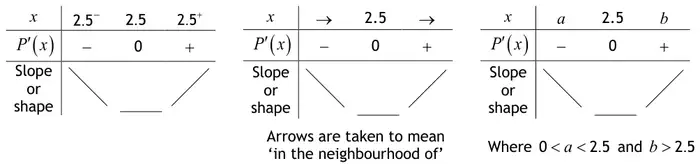
For the table of signs for a derivative, accept:
For the table of signs for a derivative, do NOT accept:
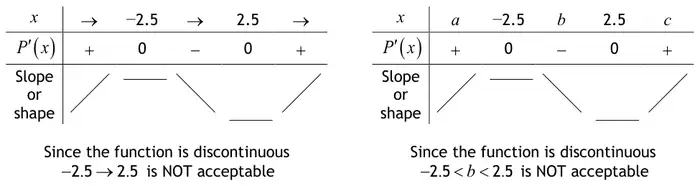
- For this question, do not penalise the omission of ‘\(x\)’ or the word ‘shape’/‘slope’
- Stating values of \(P^{\prime}(x)\) is an acceptable alternative to writing ‘+’ or ‘–’ signs
- Acceptable variations of \(P^{\prime}(x)\) are: \(P^{\prime}\), \(\dfrac{dP}{dx}\), and \(9.6-60x^{-2}\). Accept \(f^{\prime}(x)\) only where candidates have previously used \(f(x)=9.6x+60x^{-1}\) in their working
- Do not accept \(\dfrac{dy}{dx}\) or \(\dfrac{d^2y}{dx^2}\)