(In the illustrative scheme the •4 and •5 answers are set out in two columns headed •4 and •5: the left column holds \(\cos x^\circ=\dfrac{1}{3}\) and 70.52…, 289.47…; the right column holds \(\cos x^\circ=-2\) and ‘no solutions’.)
Notes:
Do not penalise the omission of the degree sign.
In the event of \(\cos^2 x^\circ-\sin^2 x^\circ\) or \(1-2\sin^2 x^\circ\) being substituted for \(\cos 2x^\circ\), •1 cannot be awarded until the equation reduces to a quadratic in \(\cos x^\circ\).
Substituting \(2\cos^2 A-1\) or \(2\cos^2\alpha-1\) for \(\cos 2x^\circ\) at the •1 stage should be treated as bad form only where the equation is written in terms of \(x\) at •2 stage. Otherwise, •1 is not available.
“\(=0\)” must appear by •3 stage for •2 to be awarded. However, for candidates using the quadratic formula to solve the equation, “\(=0\)” must appear at the •2 stage for •2 to be awarded.
The equation \(6\cos^2 x^\circ-4+10\cos x^\circ=0\) does not gain •2 unless •3 has been awarded.
•3 can be awarded for identifying the factors of the quadratic obtained at •2. For example, ‘\(6\cos x^\circ-2=0\) and \(\cos x^\circ+2=0\)’.
Do not penalise candidates who fail to extract a common factor or who have divided the equation by 2 at •3.
Candidates may express their equation, obtained at •2, in the form \(6c^2+10c-4=0\) or \(6x^2+10x-4=0\). In these cases, award •3 for \(2(3c-1)(c+2)=0\), \(2(3x-1)(x+2)=0\) or equivalent. However, •4 is only available if \(\cos x^\circ\) appears explicitly at that stage. See Candidate A.
•3, •4 and •5 are not available for any attempt to solve a quadratic equation written in the form \(ax^2+bx=c\) or for erroneously taking out a ‘common factor’ of \(\cos x^\circ\). See Candidate B.
•4 and •5 are only available as a consequence of trying to solve a quadratic equation. See Candidate C. However, •5 is not available if the quadratic has repeated roots or leads to no solutions for \(x\).
Accept \(x=\cos^{-1}\left(\dfrac{1}{3}\right)\) AND \(x=\cos^{-1}(-2)\) for •4.
•5 is only available if one of the equations has no solutions. See Candidate E.
Ignore solutions outwith the range.
Accept solutions which round to 71 and 289, and \(\cancel{\cos x^\circ=-2}\) at •5. Do not accept “error” at •5.
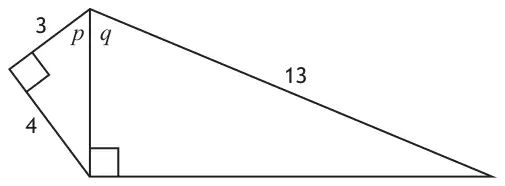
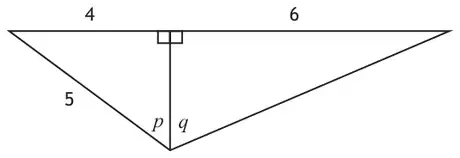
Accept two from \(p=\cos^{-1}\left(\dfrac{3}{5}\right)\), \(p=\sin^{-1}\left(\dfrac{4}{5}\right)\) or \(q=\cos^{-1}\left(\dfrac{5}{13}\right)\) for •2.
Where candidates substitute an incorrect value for \(\sin p\), \(\cos p\) or \(\cos q\), •4 and •6 may be awarded if this value has previously been stated or it can be implied by a diagram or Pythagoras calculation. See Candidate A.
Where candidates explicitly state a value for \(\sin p\), \(\cos p\) or \(\cos q\), subsequent working must follow from that value for •4 to be awarded.
Award •2 and •3 for candidates who write \(\sin\left(\dfrac{4}{5}\right)\times\cos\left(\dfrac{5}{13}\right)+\cos\left(\dfrac{3}{5}\right)\times\sin\left(\dfrac{12}{13}\right)\), •4 and •5 are unavailable.
For any attempt to use \(\sin(p+q)=\sin p\pm\sin q\), •4 and •5 are unavailable.
Do not penalise trigonometric ratios which are less than −1 or greater than 1 throughout this question.
•5 is only available for an answer expressed as a single fraction.
Commonly Observed Responses:
Candidate A - incorrect use of Pythagoras
Missing sides of \(\sqrt{7}\) and \(\sqrt{162}\). •1 is unavailable.
Follow through marks are available leading to:
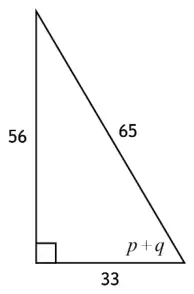
\(\sin(p+q)=\dfrac{4\sqrt{7}+3\sqrt{162}}{13\sqrt{7}}\), \(\cos(p+q)=\dfrac{3\sqrt{7}-4\sqrt{162}}{13\sqrt{7}}\), and \(\tan(p+q)=\dfrac{4\sqrt{7}+3\sqrt{162}}{3\sqrt{7}-4\sqrt{162}}\)
Candidate B - incorrect use of Pythagoras
Missing sides of 5 and \(\sqrt{194}\). •1 is unavailable.
Follow through marks are available leading to:
\(\sin(p+q)=\dfrac{20+3\sqrt{194}}{65}\), \(\cos(p+q)=\dfrac{15-4\sqrt{194}}{65}\), and \(\tan(p+q)=\dfrac{20+3\sqrt{194}}{15-4\sqrt{194}}\)
Candidate C - not considering \(p+q\) is obtuse
•6 ✗
\(\cos(p+q)=\dfrac{33}{65}\)
•7 ✓1
Marking instructions (c)
Mark
Generic scheme
Illustrative scheme
•8
find \(\tan(p+q)\)
\(-\dfrac{56}{33}\)
(1)
Notes:
Accept \(-\dfrac{3640}{2145}\), \(-\dfrac{728}{429}\) or \(-\dfrac{280}{165}\) for •8.
(In the illustrative scheme the solutions are also set out in columns: the left column, cos x° = 0 and 90, 270, is headed •3, and the right column, sin x° = −2/3 and 221.8…, 318.1…, is headed •4.)
Notes:
Substituting \(2\sin\text{A}\cos\text{A}\) for \(\sin 2x^\circ\) at the •1 stage should be treated as bad form provided the equation is written in terms of \(x\) at the •2 stage. Otherwise, •1 is not available.
‘\(=0\)’ must appear by the •2 stage for •2 to be awarded.
Do not penalise the absence of ‘2’ as a common factor at •2.
Award •3 for \(x=\cos^{-1}(0)\) AND \(x=\sin^{-1}\left(-\dfrac{2}{3}\right)\).
Do not penalise the omission of degree signs.
Candidates who leave their answer in radians do not gain •4 (if marking horizontally) or •3 (if marking vertically).
Where equations for \(\sin x^\circ\) and/or \(\cos x^\circ\) do not have solutions, marks are unavailable for stating ‘no solutions’.
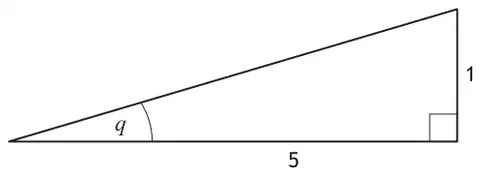
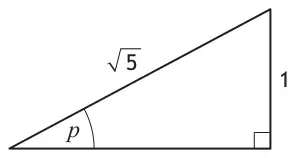
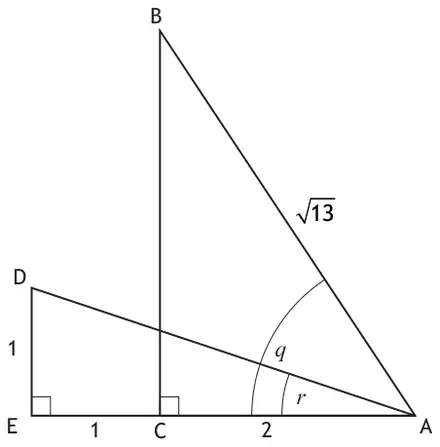
Accept \(q=\sin^{-1}\left(\dfrac{1}{\sqrt{26}}\right)\), \(q=\cos^{-1}\left(\dfrac{5}{\sqrt{26}}\right)\), \(\sin\left(\dfrac{1}{\sqrt{26}}\right)\) or \(\cos\left(\dfrac{5}{\sqrt{26}}\right)\) for •1.
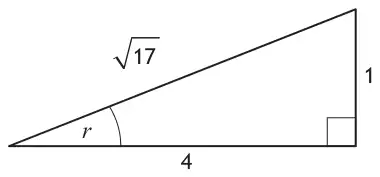
Where candidates substitute an incorrect value for \(\sin q\) or \(\cos q\), •2 may be awarded if this value has previously been stated or it can be implied by a diagram or Pythagoras calculation. See Candidates C and D.
Where candidates explicitly state a value for \(\sin q\) or \(\cos q\), subsequent working must follow from that value for •2 to be awarded.
•3 is only available as a consequence of substituting into a valid formula at •2.
Do not penalise trigonometric ratios which are less than −1 or greater than 1 throughout this question.
For \(\sin 2q=\dfrac{1}{\sqrt{26}}\) and \(\cos 2q=\dfrac{5}{\sqrt{26}}\) •3 and •4 are not available.
The board's marking instructions printed “q = sin ◃ (1/√26)”. Changed to “q = sin⁻¹(1/√26)” because the “−1” printed as a broken symbol, and the next item in the list is q = cos⁻¹(5/√26).
Original: see the board's mark scheme PDF (link above).
Where candidates write \(\sin\dfrac{5}{13}\times\cos\dfrac{4}{\sqrt{17}}-\cos\dfrac{12}{13}\times\sin\dfrac{1}{\sqrt{17}}\), award •5. However, •6 and •7 are unavailable.
•6 and •7 are only available as a consequence of substituting into a formula involving \(\sin 2q\), \(\cos 2q\), \(\sin r\) and \(\cos r\) from •5.
For any attempt to use \(\sin(2q-r)=\sin 2q-\sin r\), •6 and •7 are unavailable.
•7 is only available for an answer expressed as a single fraction.
\(\tan x^\circ=4\) (since \(x=90,\ 270\) are not solutions)
•4
solve \(\tan x^\circ=4\)
\(76,\quad 256\)
•5
solve \(\sin x^\circ=0\)
\(0,\quad 180\)
(5)
In the illustrative scheme, •4 is also printed above the first column (76 and 0) and •5 above the second column (256 and 180).
Notes:
•1 is still available to candidates who correctly substitute for \(\sin^2 x\) in addition to \(\sin 2x\).
Substituting \(2\sin \text{A}\cos \text{A}\) for \(\sin 2x^\circ\) at the •1 stage should be treated as bad form provided the equation is written in terms of \(x\) at the •2 stage. Otherwise, •1 is not available.
‘\(=0\)’ must appear by the •2 stage for •2 to be awarded.
Award •2 for ‘\(S(4C-S)=0\)’ only where \(\sin x^\circ=0\) and \(4\cos x^\circ-\sin x^\circ=0\) appear.
Do not penalise the omission of degree signs.
At •3 stage, candidates are not required to check that 90 and 270 are not solutions before dividing by \(\cos x^\circ\). Where candidates have divided by \(\sin x\) at the •2 stage without considering \(\sin x=0\), •3 and •4 are still available.
At •3 stage, candidates may use the wave function and arrive at \(\sqrt{17}\cos(x+14)^\circ=0\), or an equivalent wave form, instead of \(\tan x^\circ=4\).
•4 is only available where the working at the •3 stage is of equivalent difficulty to reaching \(\tan x^\circ=4\).
•5 is not available where \(\sin x=0\) comes from an invalid strategy.
For candidates who work only in radians, •5 is not available.
•4 and •5 may be awarded vertically. See also Candidate B.
Do not penalise solutions outwith \(0\leqslant x<360\).
Where a candidate substitutes an incorrect value for \(\cos p\) at •2, •2 may be awarded if the candidate has previously stated this incorrect value or it can be implied by a diagram or Pythagoras calculation. See Candidates A and B.
Where a candidate explicitly states a value for \(\cos p\), subsequent working must follow from that value for •2 to be awarded.
•3 is only available as a consequence of substituting into a valid formula at •2.
Do not penalise trigonometric ratios which are less than \(-1\) or greater than 1 throughout this question.
(i) Given that \(f(p)=\dfrac{1}{3}\), determine the exact value of \(\sin p\). [1]
(ii) Hence, determine the exact value of \(f(g(p))\). [3]
Marking instructions (a)(i)
Mark
Generic scheme
Illustrative scheme
•1
state exact value
\(\sqrt3\)
(1)
Marking instructions (a)(ii)
Mark
Generic scheme
Illustrative scheme
•2
interpret notation
\(f(2x)\) or \(2\sin(g(x))\)
•3
state expression for \(f(g(x))\)
\(2\sin2x\)
(2)
Notes:
For \(f(g(x))=2\sin2x\) without working, award both •2 and •3.
Working for (a)(ii) may be found in (a)(i)
Commonly Observed Responses:
Candidate A
(a)(ii) \(f(g(x))=4\sin x\)
•2 ✗ •3 ✓1
Candidate B - Beware of “2 attempts”
\(f(g(x))=2\sin x\)
•2 ✗ •3 ✗
\(f(2x)=2\sin2x\)
Marking instructions (b)(i)
Mark
Generic scheme
Illustrative scheme
•4
find the value of \(\sin p\)
\(\dfrac{1}{6}\)
(1)
Marking instructions (b)(ii)
Mark
Generic scheme
Illustrative scheme
•5
expand \(f(g(p))\) using double angle formula
\(2\times2\sin p\cos p\) or \(4\sin p\cos p\) stated explicitly
•6
find value of \(\cos p\)
\(\dfrac{\sqrt{35}}{6}\)
•7
substitute and determine exact value
\(2\times2\times\dfrac{1}{6}\times\dfrac{\sqrt{35}}{6}\) leading to \(\dfrac{\sqrt{35}}{9}\)
(3)
Notes:
•5 is not available for expansions which do not involve \(p\). •6 and •7 are still available. However, accept \(\sin^{-1}\left(\dfrac{1}{6}\right)\) in place of \(p\) - see Candidate C.
•7 is only available as a consequence of substituting into a valid formula from •5.
Do not penalise trigonometric ratios which are less than \(-1\) or greater than 1 throughout this question.
[In the illustrative scheme, the labels •4 and •5 are printed above the two equations \(\sin x^\circ=\dfrac{1}{3}\) and \(\sin x^\circ=-\dfrac{1}{2}\) respectively.]
Notes:
Substituting \(1-2\sin^2\text{A}\) or \(1-2\sin^2\alpha\) for \(\cos2x^\circ\) at the •1 stage should be treated as bad form provided the equation is written in terms of \(x\) at •2 stage. Otherwise, •1 is not available.
Do not penalise the omission of degree signs.
‘\(=0\)’ must appear by •3 stage for •2 to be awarded. However, for candidates using the quadratic formula to solve the equation, ‘\(=0\)’ must appear at •2 stage for •2 to be awarded.
Candidates may express the equation obtained at •2 in the form \(6S^2+S-1=0\), \(6x^2+x-1=0\) or using any other dummy variable at the •3 stage. In these cases, award •3 for \((3S-1)(2S+1)\) or \((3x-1)(2x+1)\). However, •4 is only available if \(\sin x^\circ\) appears explicitly at this stage - see Candidate A.
The equation \(1-6\sin^2x^\circ-\sin x^\circ=0\) does not gain •2 unless •3 has been awarded.
•3 is awarded for identifying the factors of the quadratic obtained at •2 eg “\(3\sin x^\circ-1=0\) and \(2\sin x^\circ+1=0\)”.
•4 and •5 are only available as a consequence of trying to solve a quadratic equation - see Candidate B.
•3, •4 and •5 are not available for any attempt to solve a quadratic equation written in the form \(ax^2+bx=c\) - see Candidate C.
•5 is only available where at least one of the equations at •4 leads to two solutions for \(x\).
Do not penalise additional (correct) solutions at •5. However see Candidates E and F.
Award •3 for candidates who write \(\cos\left(\dfrac{3}{5}\right)\times\cos\left(\dfrac{3}{\sqrt{45}}\right)-\sin\left(\dfrac{4}{5}\right)\times\sin\left(\dfrac{6}{\sqrt{45}}\right)\). •4 and •5 are unavailable.
For any attempt to use \(\cos(p+q)=\cos p\pm\cos q\), •4 and •5 are unavailable.
•5 is only available if either the surd part or the non-surd part of the fraction is simplified as far as possible. Accept \(-\dfrac{3}{\sqrt{45}}\), \(-\dfrac{\sqrt{45}}{15}\), \(-\dfrac{15}{15\sqrt5}\) or answers obtained on follow through which do not require simplification. Do not accept \(-\dfrac{15}{5\sqrt{45}}\).
•5 is only available for an answer expressed as a single fraction.
9. Solve the equation \(\cos2x^\circ=5\cos x^\circ-3\) for \(0\leqslant x\lt 360\). [5]
Marking instructions
Mark
Generic scheme
Illustrative scheme
•1
substitute for \(\cos2x^\circ\) into equation
\(2\cos^2x^\circ-1\ldots\)
•2
express in standard quadratic form
\(2\cos^2x^\circ-5\cos x^\circ+2=0\)
•3
factorise
\((2\cos x^\circ-1)(\cos x^\circ-2)=0\)
•4
solve for \(\cos x^\circ\)
\(\cos x^\circ=\dfrac{1}{2}\) \(\cos x^\circ=2\)
•5
solve for \(x\)
\(x=60,\ 300\) ‘no solutions’
(5)
(In the marking instructions the •4 and •5 answers are set out in two columns, headed •4 (above \(\cos x^\circ=\dfrac{1}{2}\) and \(x=60,\ 300\)) and •5 (above \(\cos x^\circ=2\) and ‘no solutions’), showing that the two marks may also be awarded horizontally.)
Notes:
•1 is not available for simply stating \(\cos2x^\circ=2\cos^2x^\circ-1\) with no further working.
In the event of \(\cos^2x^\circ-\sin^2x^\circ\) or \(1-2\sin^2x^\circ\) being substituted for \(\cos2x^\circ\), •1 cannot be awarded until the equation reduces to a quadratic in \(\cos x^\circ\).
Substituting \(2\cos^2\text{A}-1\) or \(2\cos^2\alpha-1\) for \(\cos2x^\circ\) at the •1 stage should be treated as bad form provided the equation is written in terms of \(x\) at •2 stage. Otherwise, •1 is not available.
Do not penalise the omission of degree signs.
‘\(=0\)’ must appear by •3 stage for •2 to be awarded. However, for candidates using the quadratic formula to solve the equation, ‘\(=0\)’ must appear at •2 stage for •2 to be awarded.
Candidates may express the equation obtained at •2 in the form \(2c^2-5c+2=0\) or \(2x^2-5x+2=0\). In these cases, award •3 for \((2c-1)(c-2)=0\) or \((2x-1)(x-2)=0\). However, •4 is only available if \(\cos x^\circ\) appears explicitly at this stage. See Candidate A.
The equation \(2+2\cos^2x^\circ-5\cos x^\circ=0\) does not gain •2 unless •3 has been awarded.
•4 and •5 are only available as a consequence of trying to solve a quadratic equation. See Candidate B. However, •5 is not available if the quadratic equation has repeated roots.
•3, •4 and •5 are not available for any attempt to solve a quadratic equation written in the form \(ax^2+bx=c\). See Candidate C.
•5 is only available for 2 valid solutions within the stated range. Ignore ‘solutions’ outwith the range. However, see Candidate E.
Accept \(\cancel{\cos x^\circ=2}\) for •5. See Candidate A.
Commonly Observed Responses:
Candidate A
\(2\cos^2x^\circ-1=5\cos x^\circ-3\)
•1 ✓
\(2c^2-5c+2=0\)
•2 ✓
\((2c-1)(c-2)=0\)
•3 ✓
\(c=\dfrac{1}{2},\ c=2\)
•4 ✗
\(x=60,\ 300\quad\cancel{\cos x^\circ=2}\)
•5 ✓1
Candidate B - not solving a quadratic
\(2\cos^2x^\circ-1=5\cos x^\circ-3\)
•1 ✓
\(2\cos^2x^\circ-5\cos x^\circ+2=0\)
•2 ✓
\(-3\cos x^\circ+2=0\)
•3 ✗
\(\cos x^\circ=\dfrac{2}{3}\)
•4 ✓2 •5 ^
Candidate C - not in standard quadratic form
\(2\cos^2x^\circ-1=5\cos x^\circ-3\)
•1 ✓
\(2\cos^2x^\circ-5\cos x^\circ=-2\)
•2 ✓2
\(\cos x^\circ(2\cos x^\circ-5)=-2\)
•3 ✓2
\(\cos x^\circ=-2,\ 2\cos x^\circ-5=-2\)
\(\Rightarrow\cos x=\dfrac{3}{2}\)
•4 ✗
No solutions
•5 ✗
Candidate D - reading \(\cos2x^\circ\) as \(\cos^2x^\circ\)
Award •3 for candidates who write \(\sin\left(\dfrac{3}{\sqrt{13}}\right)\times\cos\left(\dfrac{3}{\sqrt{10}}\right)-\sin\left(\dfrac{2}{\sqrt{13}}\right)\times\cos\left(\dfrac{1}{\sqrt{10}}\right)\). •4 and •5 are unavailable.
For any attempt to use \(\sin(q-r)=\sin q-\sin r\), •4 and •5 are unavailable.
At •5, the answer must be given as a single fraction. Accept \(\dfrac{7}{\sqrt{13}\sqrt{10}}\), \(\dfrac{7\sqrt{10}}{10\sqrt{13}}\) and \(\dfrac{7\sqrt{13}}{13\sqrt{10}}\).
Do not penalise trigonometric ratios which are less than \(-1\) or greater than 1.
Corrected by Westie's Workshop
The board's marking instructions printed “express in terms of \(p\) and \(q\)”. Changed to “express in terms of \(q\) and \(r\)” because the angles in this question are \(q\) and \(r\); there is no angle \(p\).
Original: see the board's marking instructions PDF (link above).
We'd like to use Google Analytics cookies to count visits and see which pages help most. They're optional, and the site works exactly the same either way. Privacy policy