
May 2025 Paper 1 Q6
6. The diagram shows a right-angled triangle with angle \(q\).
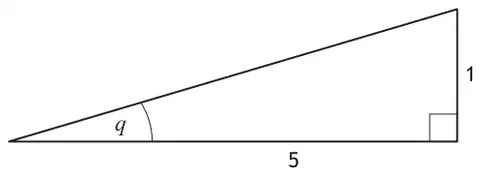
(a) Determine the value of:
(i) \(\sin 2q\) [3]
(ii) \(\cos 2q\). [1]
A second right-angled triangle has angle \(r\) as shown.
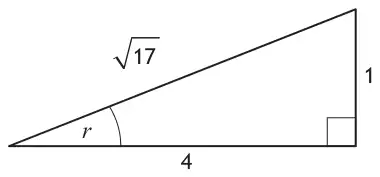
(b) Find the value of \(\sin(2q-r)\). [3]
| Mark | Generic scheme | Illustrative scheme |
|---|---|---|
| (i) | ||
| •1 | determine \(\sin q\) or \(\cos q\) | \(\sin q=\dfrac{1}{\sqrt{26}}\) OR \(\cos q=\dfrac{5}{\sqrt{26}}\) stated or implied by •2 |
| •2 | substitute into formula for \(\sin 2q\) | \(2\times\dfrac{1}{\sqrt{26}}\times\dfrac{5}{\sqrt{26}}\) |
| •3 | calculate \(\sin 2q\) | \(\dfrac{5}{13}\) |
| (3) | ||
| (ii) | ||
| •4 | calculate \(\cos 2q\) | \(\dfrac{12}{13}\) |
| (1) |
Notes:
- Evidence for •1 may appear in (a)(ii).
- Accept \(q=\sin^{-1}\left(\dfrac{1}{\sqrt{26}}\right)\), \(q=\cos^{-1}\left(\dfrac{5}{\sqrt{26}}\right)\), \(\sin\left(\dfrac{1}{\sqrt{26}}\right)\) or \(\cos\left(\dfrac{5}{\sqrt{26}}\right)\) for •1.
- Where candidates substitute an incorrect value for \(\sin q\) or \(\cos q\), •2 may be awarded if this value has previously been stated or it can be implied by a diagram or Pythagoras calculation. See Candidates C and D.
- Where candidates explicitly state a value for \(\sin q\) or \(\cos q\), subsequent working must follow from that value for •2 to be awarded.
- •3 is only available as a consequence of substituting into a valid formula at •2.
- Do not penalise trigonometric ratios which are less than −1 or greater than 1 throughout this question.
- For \(\sin 2q=\dfrac{1}{\sqrt{26}}\) and \(\cos 2q=\dfrac{5}{\sqrt{26}}\) •3 and •4 are not available.
Commonly Observed Responses:
Candidate A
| \(2\times\sin\dfrac{1}{\sqrt{26}}\times\cos\dfrac{5}{\sqrt{26}}\) | •1 ✓ •2 ✗ |
| \(\dfrac{5}{13}\) | •3 ✗ |
Candidate B - unsimplified final answers
| \(\sin q=\dfrac{1}{\sqrt{26}}\) | •1 ✓ |
| \(\sin 2q=2\times\dfrac{1}{\sqrt{26}}\times\dfrac{5}{\sqrt{26}}\) | •2 ✓ |
| \(\sin 2q=\dfrac{10}{26}\) | •3 ^ |
| \(\cos 2q=\dfrac{24}{26}\) | •4 ✓1 |
| \(\sin(2q-r)=\dfrac{10}{26}\times\dfrac{4}{\sqrt{17}}-\dfrac{24}{26}\times\dfrac{1}{\sqrt{17}}\) | •5 ✓ •6 ✓ |
| \(\sin(2q-r)=\dfrac{16}{26\sqrt{17}}\) | •7 ✓1 |
Candidate C - incorrect use of Pythagoras
| hypotenuse \(=\sqrt{24}\) | •1 ✗ |
| \(\sin 2q=2\times\dfrac{1}{\sqrt{24}}\times\dfrac{5}{\sqrt{24}}\) | •2 ✓1 |
| \(\sin 2q=\dfrac{5}{12}\) | •3 ✓1 |
Candidate D - no evidence of Pythagoras
| \(\sin 2q=2\times\dfrac{1}{\sqrt{24}}\times\dfrac{5}{\sqrt{24}}\) | •1 ^ •2 ✗ |
| \(\sin 2q=\dfrac{5}{12}\) | •3 ✓1 |
Corrected by Westie's Workshop
- The board's marking instructions printed “q = sin ◃ (1/√26)”. Changed to “q = sin⁻¹(1/√26)” because the “−1” printed as a broken symbol, and the next item in the list is q = cos⁻¹(5/√26).
Original: see the board's mark scheme PDF (link above).
| Mark | Generic scheme | Illustrative scheme |
|---|---|---|
| •5 | expand \(\sin(2q-r)\) | \(\sin 2q\cos r-\cos 2q\sin r\) |
| •6 | substitute into addition formula | \(\dfrac{5}{13}\times\dfrac{4}{\sqrt{17}}-\dfrac{12}{13}\times\dfrac{1}{\sqrt{17}}\) |
| •7 | evaluate \(\sin(2q-r)\) | \(\dfrac{8}{13\sqrt{17}}\) |
| (3) |
Notes:
- Where candidates write \(\sin\dfrac{5}{13}\times\cos\dfrac{4}{\sqrt{17}}-\cos\dfrac{12}{13}\times\sin\dfrac{1}{\sqrt{17}}\), award •5. However, •6 and •7 are unavailable.
- •6 and •7 are only available as a consequence of substituting into a formula involving \(\sin 2q\), \(\cos 2q\), \(\sin r\) and \(\cos r\) from •5.
- For any attempt to use \(\sin(2q-r)=\sin 2q-\sin r\), •6 and •7 are unavailable.
- •7 is only available for an answer expressed as a single fraction.