
May 2026 Paper 1 Q4
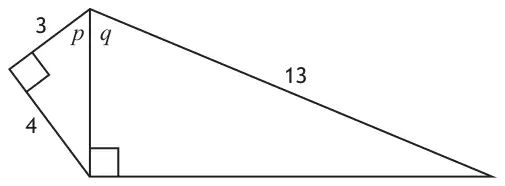
4. The diagram shows two right-angled triangles with angles \(p\) and \(q\) as marked.
| Mark | Generic scheme | Illustrative scheme |
|---|---|---|
| •1 | find \(\sin q\) | \(\dfrac{12}{13}\) |
| (1) |
| Mark | Generic scheme | Illustrative scheme |
|---|---|---|
| •2 | find two remaining trig ratios | two from \(\sin p=\dfrac{4}{5}\), \(\cos q=\dfrac{5}{13}\), and \(\cos p=\dfrac{3}{5}\) stated or implied by •3 and •4 |
| •3 | select appropriate formula and express in terms of \(p\) and \(q\) | \(\sin p\cos q+\cos p\sin q\) |
| •4 | substitute into addition formula | \(\dfrac{4}{5}\times\dfrac{5}{13}+\dfrac{3}{5}\times\dfrac{12}{13}\) |
| •5 | find \(\sin(p+q)\) | \(\dfrac{56}{65}\) |
| (4) |
| Mark | Generic scheme | Illustrative scheme |
|---|---|---|
| •6 | substitute into appropriate formula | \(\dfrac{3}{5}\times\dfrac{5}{13}-\dfrac{4}{5}\times\dfrac{12}{13}\) |
| •7 | find \(\cos(p+q)\) | \(-\dfrac{33}{65}\) |
| (2) |
Notes:
- Accept two from \(p=\cos^{-1}\left(\dfrac{3}{5}\right)\), \(p=\sin^{-1}\left(\dfrac{4}{5}\right)\) or \(q=\cos^{-1}\left(\dfrac{5}{13}\right)\) for •2.
- Where candidates substitute an incorrect value for \(\sin p\), \(\cos p\) or \(\cos q\), •4 and •6 may be awarded if this value has previously been stated or it can be implied by a diagram or Pythagoras calculation. See Candidate A.
- Where candidates explicitly state a value for \(\sin p\), \(\cos p\) or \(\cos q\), subsequent working must follow from that value for •4 to be awarded.
- Award •2 and •3 for candidates who write \(\sin\left(\dfrac{4}{5}\right)\times\cos\left(\dfrac{5}{13}\right)+\cos\left(\dfrac{3}{5}\right)\times\sin\left(\dfrac{12}{13}\right)\), •4 and •5 are unavailable.
- For any attempt to use \(\sin(p+q)=\sin p\pm\sin q\), •4 and •5 are unavailable.
- Do not penalise trigonometric ratios which are less than −1 or greater than 1 throughout this question.
- •5 is only available for an answer expressed as a single fraction.
Commonly Observed Responses:
Candidate A - incorrect use of Pythagoras
Missing sides of \(\sqrt{7}\) and \(\sqrt{162}\). •1 is unavailable.
Follow through marks are available leading to:
\(\sin(p+q)=\dfrac{4\sqrt{7}+3\sqrt{162}}{13\sqrt{7}}\),
\(\cos(p+q)=\dfrac{3\sqrt{7}-4\sqrt{162}}{13\sqrt{7}}\), and
\(\tan(p+q)=\dfrac{4\sqrt{7}+3\sqrt{162}}{3\sqrt{7}-4\sqrt{162}}\)
Candidate B - incorrect use of Pythagoras
Missing sides of 5 and \(\sqrt{194}\). •1 is unavailable.
Follow through marks are available leading to:
\(\sin(p+q)=\dfrac{20+3\sqrt{194}}{65}\),
\(\cos(p+q)=\dfrac{15-4\sqrt{194}}{65}\), and
\(\tan(p+q)=\dfrac{20+3\sqrt{194}}{15-4\sqrt{194}}\)
Candidate C - not considering \(p+q\) is obtuse
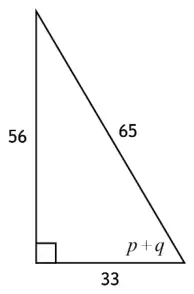 | •6 ✗ |
| \(\cos(p+q)=\dfrac{33}{65}\) | •7 ✓1 |
| Mark | Generic scheme | Illustrative scheme |
|---|---|---|
| •8 | find \(\tan(p+q)\) | \(-\dfrac{56}{33}\) |
| (1) |
Notes:
- Accept \(-\dfrac{3640}{2145}\), \(-\dfrac{728}{429}\) or \(-\dfrac{280}{165}\) for •8.