14. During a metal-working process a heated steel rod is cooled by dropping it into a container of oil.
The temperature of the rod is given by
\[T=800e^{-0.124t}+25,\]
where \(T\) is the temperature of the rod, in degrees Celsius, \(t\) seconds after it is dropped into the oil.
(a) Determine the temperature of the rod as it is dropped into the oil. [1]
(b) Calculate the time taken for the temperature of the rod to cool to 150 °C. [4]
Marking instructions (a)
Mark
Generic scheme
Illustrative scheme
•1
calculate temperature
825 (\(^\circ\)C)
(1)
Marking instructions (b)
Mark
Generic scheme
Illustrative scheme
•2
substitute for \(T\)
\(150=800\times e^{-0.124t}+25\)
•3
process equation
\(\dfrac{150-25}{800}=e^{-0.124t}\)
•4
express in logarithmic form
\(\log_e\dfrac{150-25}{800}=-0.124t\)
•5
solve for \(t\)
14.970 (seconds)
(4)
Notes:
Where values other than 150 are used in the substitution •3, •4 and •5 are still available.
•3 may be implied by •4.
Evidence for •4 must be stated explicitly. See Candidate B.
At •4 all exponentials must be processed.
Any base may be used at •4 stage, See Candidate A.
Accept \(\ln 0.15625=-0.124t\ln e\) and \(-1.856\ldots=-0.124t\) for •4.
•5 is unavailable where candidates round the value of \(\ln 0.15625\) to fewer than 2 decimal places.
Accept answers where \(14.9\leqslant t\leqslant 15\) at •5.
The calculation at •5 must follow from the valid use of exponentials and logarithms at •3 and •4.
Where candidates show no working, or take an iterative approach to arrive at \(t=14\) or \(t=15\), award 1/4. However, if, in any iterations T is evaluated for \(t=14.9\) and \(t=15\), leading to a final answer of \(t=15\) (seconds), then award 4/4. See Candidate C.
Commonly Observed Responses:
Candidate A - using other bases
\(150=800\times e^{-0.124t}+25\)
•2 ✓
\(\dfrac{5}{32}=e^{-0.124t}\)
•3 ✓
\(\log_{10}\dfrac{5}{32}=-0.124t\log_{10}e\)
•4 ✓
\(t=14.97\)
•5 ✓
Candidate B - missing working
\(150=800\times e^{-0.124t}+25\)
•2 ✓
\(0.15625=e^{-0.124t}\)
•3 ✓
•4 ^
\(t=14.97\)
•5 ✓
Candidate C - iterative approach
\(t=13\Rightarrow T=184.59\ldots\) \(t=14\Rightarrow T=165.979\ldots\) \(t=14.9\Rightarrow T=151.091\ldots\) \(t=15\Rightarrow T=149.538\ldots\) so \(t=15\)
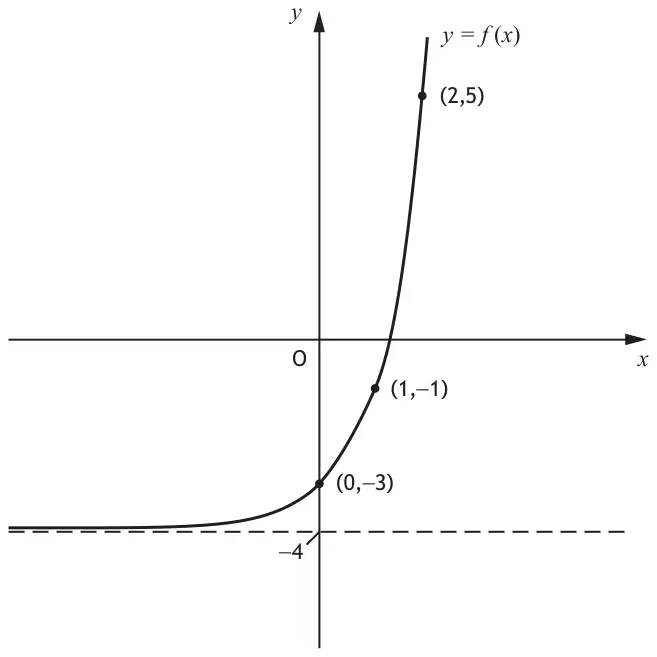
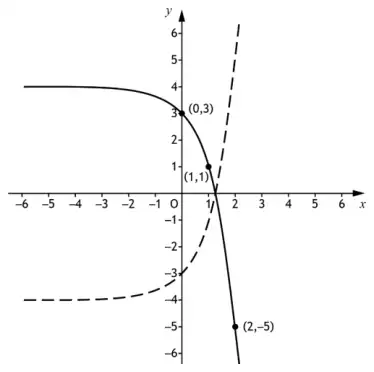
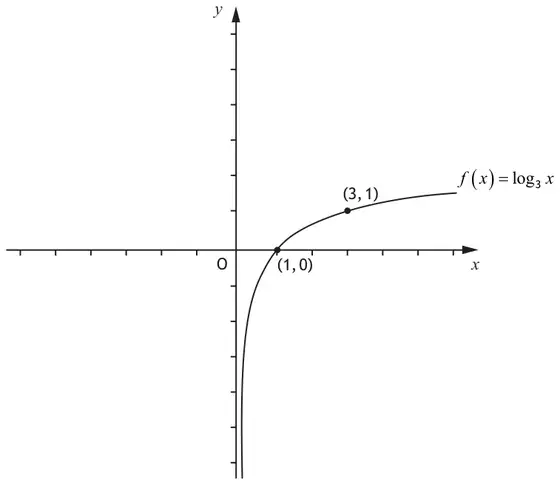
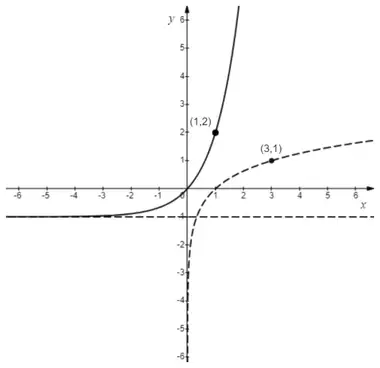
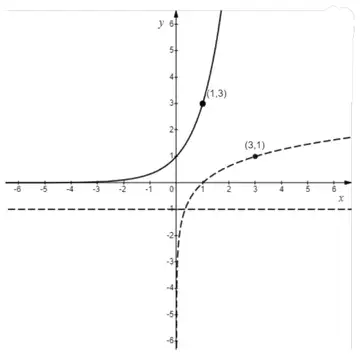
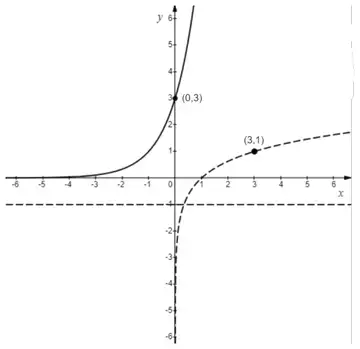
12. An exponential function, \(f\), is defined for \(x\in\mathbb{R}\).
The diagram shows the graph of \(y=f(x)\).
The inverse function, \(f^{-1}(x)\), exists.
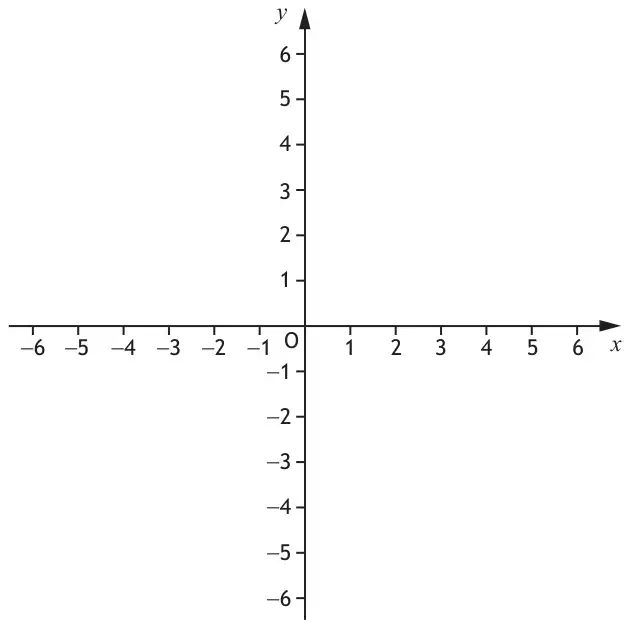
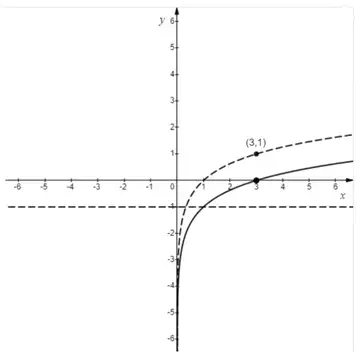
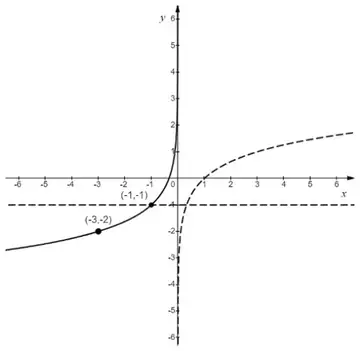
(a) On the diagram in your answer booklet (shown below), sketch the graph of the inverse function. [2]
The inverse function is of the form \(f^{-1}(x)=\log_a(x+b)\).
(b)
(i) Determine the values of \(a\) and \(b\). [2]
(ii) State the domain of the inverse function, \(f^{-1}(x)\). [1]
Marking instructions (a)
Mark
Generic scheme
Illustrative scheme
•1
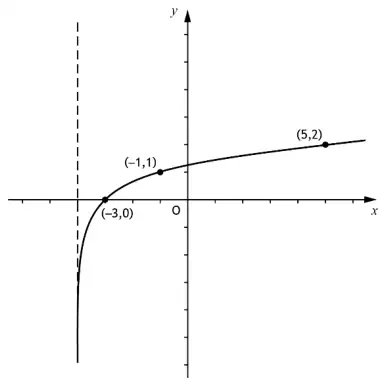
graph reflected in \(y=x\) i.e. generally increasing for \(-3\leqslant x\leqslant5\) and passing through (−3,0), (−1,1) and (5,2)
•1, •2
•2
increasing for \(x\lt-3\) (and for \(x\gt5\)) and approaching \(x=-4\) from the right
(2)
Notes:
•1 is not available where the graph has a maximum turning point where \(-1\lt x\lt5\) and •2 is not available where the graph has a maximum turning point where \(5\leqslant x\leqslant6\).
•2 is only available where •1 has been awarded.
The line \(x=-4\) does not need to be shown.
For a rotation, award 0/2 – for example see Candidate A.
Do not penalise graphs which do not extend beyond (5,2).
Commonly Observed Responses:
Candidate A - rotation about O
•1 ✗ •2 ✗
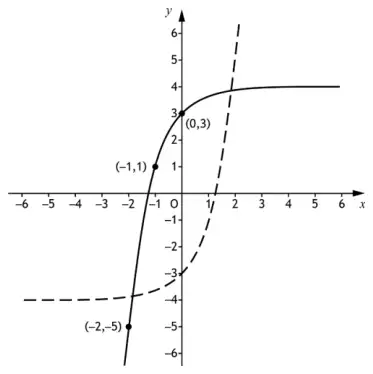
No further marks in this question can be inferred from this graph. In part (b), candidates may work with the original graph and gain full marks for \(b=4\) and \(a=3\) (with or without working) and \(x\gt-4\).
Candidate B - reflection in \(x\)-axis
•1 ✗ •2 ✗
No further marks in this question can be inferred from this graph. In part (b), candidates may work with the original graph and gain full marks for \(b=4\) and \(a=3\) (with or without working) and \(x\gt-4\).
Marking instructions (b)(i)
Mark
Generic scheme
Illustrative scheme
•3
determine value of \(b\)
\(b=4\)
•4
determine value of \(a\)
\(a=3\)
(2)
Marking instructions (b)(ii)
Mark
Generic scheme
Illustrative scheme
•5
state domain
\(x\gt-4,\quad(x\in\mathbb{R})\)
(1)
Notes:
\(a\) and \(b\) may be calculated independently of each other.
The values of \(a\) or \(b\) can be calculated using \(a=b-1\) where \(b\gt1\).
Accept ‘\(f(x)\gt-4\)’ for •5.
For •5, the domain can be calculated using \(x\gt-b\).
For •5, do not penalise the omission of \(x\in\mathbb{R}\).
For •5, the domain can be from the original graph, the candidate’s transformed graph or from the value of \(b\) in (b)(i). However, refer back to Candidates A and B.
Commonly Observed Responses:
Candidate C - Values of \(a\) and \(b\) in equation
13. A radioactive substance, which has been collected, decays over time.
The mass of the radioactive substance remaining is modelled by
\[M=150e^{-0.0054t}\]
where \(M\) is the mass, in micrograms, \(t\) years after the radioactive substance was collected.
(a) Determine the initial mass of the radioactive substance. [1]
(b) Calculate the time taken for the mass of the radioactive substance to decay to 120 micrograms. [4]
Marking instructions (a)
Mark
Generic scheme
Illustrative scheme
•1
identify initial mass
150 (micrograms)
(1)
Marking instructions (b)
Mark
Generic scheme
Illustrative scheme
•2
interpret information
\(120=150e^{-0.0054t}\) stated or implied by •3
•3
process equation
\(e^{-0.0054t}=\dfrac{120}{150}\)
•4
write in logarithmic form
\(\log_e\left(\dfrac{120}{150}\right)=-0.0054t\)
•5
process for \(t\)
41.32… (years)
(4)
Notes:
Where values other than 120 are used in the substitution, •3, •4 and •5 are still available.
•3 may be implied by •4.
Evidence for •4 must be stated explicitly. See Candidate B.
At •4 all exponentials must be processed.
Any base may be used at •4 stage. See Candidate A.
Accept \(\ln 0.8=-0.0054t\ln e\) and \(-0.223\ldots=-0.0054t\) for •4.
•5 is unavailable where candidates round the value of \(\ln 0.8\) to fewer than 2 decimal places.
Accept answers where \(40.7\leqslant t\leqslant 42\) at •5.
The calculation at •5 must follow from the valid use of exponentials and logarithms at •3 and •4.
Where candidates show no working or take an iterative approach to arrive at \(t=41\) or \(t=42\), award 1/4. However, if, in any iterations \(M\) is evaluated for \(t=41\) and \(t=42\) leading to a final answer of \(t=42\) (years), then award 4/4.
11. The number of electric vehicles worldwide can be modelled by
\[N=6.8e^{kt}\]
where:
\(N\) is the estimated number of vehicles in millions
\(t\) is the number of years since the end of 2020
\(k\) is a constant.
(a) Use the model to estimate the number of electric vehicles worldwide at the end of 2020. [1]
At the end of 2030, it is estimated there will be 125 million electric vehicles worldwide.
(b) Determine the value of \(k\). [4]
Marking instructions (a)
Mark
Generic scheme
Illustrative scheme
•1
state number of vehicles
6.8 million
(1)
Notes:
Accept 6.8 or \(N=6.8\) million for •1.
Marking instructions (b)
Mark
Generic scheme
Illustrative scheme
•2
substitute for \(N\) and \(t\)
\(125=6.8e^{10k}\) stated or implied by •3
•3
process equation
\(\dfrac{125}{6.8}=e^{10k}\)
•4
express in logarithmic form
\(\log_e\left(\dfrac{125}{6.8}\right)=10k\)
•5
solve for \(k\)
\(0.2911\ldots\)
(4)
Notes:
Accept answers which round to 0.29.
Do not penalise rounding or transcription errors (which are correct to 2 significant figures) in intermediate calculations.
•3 may be assumed by •4.
Any base may be used at •4 stage. See Candidate A.
At •4 all exponentials must be processed.
Accept \(\log_e\dfrac{125}{6.8}=10k\log_e e\) for •4.
The calculation at •5 must follow from the valid use of exponentials and logarithms at •3 and •4.
For candidates with no working, or who adopt an iterative approach to arrive at \(k=0.29\), award 1/4. However, if, in the iterations \(N\) is calculated for \(k=0.295\) and \(k=0.285\), then award 4/4.
9. Express \(\log_a5+\log_a80-2\log_a10\) in the form \(\log_ak\) where \(k\) is a positive integer. [3]
Marking instructions
Mark
Generic scheme
Illustrative scheme
Method 1
Method 1
•1
apply \(\log_ax+\log_ay=\log_axy\)
\(\log_a(5\times80)\ldots\) stated or implied by •3
•2
apply \(m\log_ax=\log_ax^m\)
\(\ldots-\log_a10^2\) stated or implied by •3
•3
apply \(\log_ax-\log_ay=\log_a\dfrac{x}{y}\) and express in required form
\(\log_a4\)
Method 2
Method 2
•1
apply \(m\log_ax=\log_ax^m\)
\(\ldots-\log_a10^2\) stated or implied by •3
•2
apply \(\log_ax-\log_ay=\log_a\dfrac{x}{y}\)
\(\ldots+\log_a\left(\dfrac{80}{10^2}\right)\) stated or implied by •3
•3
apply \(\log_ax+\log_ay=\log_axy\) and express in required form
\(\log_a4\)
(3)
Notes:
Where an error at the •1 or •2 stage leads to a non-integer value for \(k\), •3 is still available.
Each line of working must be equivalent to the line above within a valid strategy. See commonly observed responses.
Where candidates apply the laws of logarithms in the incorrect order see Candidates A and B.
Where candidates do not consider the ‘2’, a maximum of 1/3 is available. See Candidate C.
Do not penalise the omission of the base of the logarithm.
Correct answer with no working, award 3/3.
Where candidates form an invalid equation, •1 and •2 may only be awarded for working with \(\log_a5+\log_a80-2\log_a10\) on one side of the equation; •3 is not available.
The concentration of the medicine in the patient’s blood is modelled by
\[C_t=11e^{-0.0053t}\]
where:
\(t\) is the time, in minutes, since the dose of medicine was given
\(C_t\) is the concentration of the medicine, in mg/l, at time \(t\).
(a) Calculate the concentration of the medicine 30 minutes after the dose was given. [1]
The dose of medicine becomes ineffective when its concentration falls to 0.66 mg/l.
(b) Calculate the time taken for this dose of the medicine to become ineffective. [3]
Marking instructions (a)
Mark
Generic scheme
Illustrative scheme
•1
calculate concentration
9.38… (mg/l)
(1)
Notes:
Accept any answer which rounds to 9.4 for •1.
Marking instructions (b)
Mark
Generic scheme
Illustrative scheme
•2
substitute
\(0.66=11\times e^{-0.0053t}\)
•3
write in logarithmic form
\(\log_e\dfrac{0.66}{11}=-0.0053t\)
•4
process for \(t\)
\(530.83\ldots\) (minutes)
(3)
Notes:
Where values other than 0.66 are used in the substitution, •3 and •4 are still available.
Evidence for •3 must be stated explicitly.
At •3 all exponentials must be processed.
Any base may be used at •3 stage - see Candidate A.
Accept \(\ln0.06=-0.0053t\ln e\) for •3.
Accept any answer where \(530\leqslant t\leqslant532\) at •4.
•4 is unavailable where a candidate rounds the value of \(\ln0.06\) to fewer than 2 decimal places.
The calculation at •4 must follow from the valid use of exponentials and logarithms at •2 and •3.
For candidates with no working or who take an iterative approach to arrive at \(t=532\), \(t=531\) or \(t=530\) award 1/3. However, if, in any iterations \(C_t\) is evaluated for \(t=530\) and \(t=531\) leading to a final answer of \(t=531\) (minutes) then award 3/3.
10. The heptathlon is an athletics contest made up of seven events.
Athletes score points for each event.
In the 200 metres event, the points are calculated using the formula
\[P=4.99087(42.5-T)^{1.81}\]
where \(P\) is the number of points awarded, and \(T\) is the athlete’s time, in seconds.
(a) Calculate how many points would be awarded for a time of 24.55 seconds in the 200 metres event. [1]
In the long jump event, the points are calculated using the formula
\[P=0.188807(D-210)^{k}\]
where \(P\) is the number of points awarded, \(D\) is the distance jumped, in centimetres, and \(k\) is a constant.
(b) Given that 850 points are awarded for a jump of 600 cm, calculate the value of \(k\). [4]
Marking instructions (a)
Mark
Generic scheme
Illustrative scheme
•1
evaluate \(P\) for \(T=24.55\)
929
(1)
Notes:
Accept any answer which rounds 929.0368007… to at least 2 significant figures.
Corrected by Westie's Workshop
The board's marking instructions printed “\(t=24.55\)”. Changed to “\(T=24.55\)” because the question paper calls the time \(T\) (a capital letter).
Original: see the board's marking instructions PDF (link above).
Marking instructions (b)
Mark
Generic scheme
Illustrative scheme
•2
substitute for \(P\) and \(D\)
\(850=0.188807(600-210)^k\)
•3
arrange equation in the form \(a=b^k\)
\(\dfrac{850}{0.188807}=(600-210)^k\)
•4
write in logarithmic form
eg \(\ln\left(\dfrac{850}{0.188807}\right)=\ln(600-210)^k\) or \(k=\log_{(600-210)}\dfrac{850}{0.188807}\)
•5
solve for \(k\)
1.41
(4)
Notes:
•3 may be implied by •4.
Any base may be used at •4 stage.
Accept 1.4 at •5.
The calculation at •5 must follow from the valid use of exponentials and logarithms at •3 and •4. See Candidate A.
For candidates who take an iterative approach to arrive at the value \(k=1.41\) award 1/4. However, if, in the iterations \(P\) is calculated for \(k=1.405\) and \(k=1.415\) then award 4/4.
Commonly Observed Responses:
Candidate A - invalid use of exponentials
\(850=0.188807(600-210)^k\)
•2 ✓
\(850=73.63473^k\)
•3 ✗ •4 ✗ •5 ✗
\(\log_{73.63473}850=k\)
\(1.56\ldots\)
Candidate B - transcription error
\(850=0.18807(600-210)^k\) (underline under “0.18807”)
•2 ✗
\(4519.59\ldots=390^k\)
•3 ✓1
\(\log_{390}4519.59\ldots\)
•4 ✓1
\(1.41\ldots\)
•5 ✓1
Corrected by Westie's Workshop
The board's marking instructions printed “\(t=1.41\) … \(t=1.405\) and \(t=1.415\)”. Changed to “\(k=1.41\) … \(k=1.405\) and \(k=1.415\)” because the letter being found in part (b) is \(k\); there is no \(t\) in this part.
Original: see the board's marking instructions PDF (link above).
We'd like to use Google Analytics cookies to count visits and see which pages help most. They're optional, and the site works exactly the same either way. Privacy policy