Past Paper Questions by Topic › Level 2 FM Number › Surds
Surds Topic Surds (12) Percentages, Fractions & Ratios (3) Combinations (6) Course Support Current PowerPoint version
More questions on this topic: GCSE Number: Surds (49) IGCSE Number: Surds (54)
All specs Current spec Old spec All series June 2025 June 2024 June 2023 June 2022 November 2021 Specimen 2020 June 2019 June 2018 June 2017 June 2016 Any marks 1 to 4 marks 5 to 8 marks 9+ marks
Questions Step through List
‹ Previous All questions Next ›
6 Simplify fully \(\qquad \dfrac{\sqrt{75} - \sqrt{27}}{\sqrt{48}}\) [3 marks]
Mark scheme
Mark scheme Answer Mark Comments Alternative method 1: by simplifying Any one of \(\left(\sqrt{75} =\right) 5\sqrt{3}\) or \(\left(\sqrt{27} =\right) 3\sqrt{3}\) or \(\left(\sqrt{48} =\right) 4\sqrt{3}\) seen M1 can be seen outside of the whole fraction \(\dfrac{2\sqrt{3}}{4\sqrt{3}}\) or \(\dfrac{2}{4}\) or \(\dfrac{5 - 3}{4}\) or \(\sqrt{\dfrac{12}{48}}\) M1dep would imply first M mark \(\dfrac{1}{2}\) or 0.5 A1 Alternative method 2: by taking out a common factor of \(\sqrt{3}\) \(\dfrac{\sqrt{25} - \sqrt{9}}{\sqrt{16}}\) or \(\dfrac{\sqrt{3}\left(\sqrt{25} - \sqrt{9}\right)}{\sqrt{3}\left(\sqrt{16}\right)}\) M1 \(\dfrac{2}{4}\) or \(\dfrac{5 - 3}{4}\) M1dep would imply first M mark \(\dfrac{1}{2}\) or 0.5 A1 Alternative method 3: by rationalising \(\dfrac{\sqrt{48}\left(\sqrt{75} - \sqrt{27}\right)}{48}\) M1 oe must have a denominator of 48 \(\dfrac{60 - 36}{48}\) or \(\dfrac{24}{48}\) M1dep oe but with all surds correctly removed \(\dfrac{1}{2}\) or 0.5 A1
Additional guidance Also possible to rationalise with \(\sqrt{3}\) or other surds. Follow Alt method 3 and mark to an equivalent level
18 Rationalise the denominator and simplify fully
\[\frac{3\sqrt{5} + \sqrt{3}}{\sqrt{5} - \sqrt{3}}\]
[4 marks]
Mark scheme
Mark scheme Answer Mark Comments \(\times \dfrac{\sqrt{5} + \sqrt{3}}{\sqrt{5} + \sqrt{3}}\) M1 oe eg \(\dfrac{3\sqrt{5} + \sqrt{3}}{\sqrt{5} - \sqrt{3}} \times \dfrac{-\sqrt{5} - \sqrt{3}}{-\sqrt{5} - \sqrt{3}}\) Denominator \(5 - 3\) or 2 M1dep Numerator \(15 + 3 + 3\sqrt{15} + \sqrt{15}\) M1dep oe \(9 + 2\sqrt{15}\) A1
Additional guidance For M dep marks numerator and denominator can be seen separately Follow an equivalent MS for any student using M marks may be seen in a grid method Untidy mathematical notation can be condoned as long as it’s recovered Missing brackets can be recovered
10 Rationalise the denominator and simplify fully
\[\frac{1 + \sqrt{5}}{3 - \sqrt{5}}\]
[4 marks]
Mark scheme
Mark scheme Answer Mark Comments \(\dfrac{\left(1 + \sqrt{5}\right)\left(3 + \sqrt{5}\right)}{\left(3 - \sqrt{5}\right)\left(3 + \sqrt{5}\right)}\) M1 oe \(\dfrac{\left(1 + \sqrt{5}\right)\left(-3 - \sqrt{5}\right)}{\left(3 - \sqrt{5}\right)\left(-3 - \sqrt{5}\right)}\) (if this method is used then follow equivalent MS for \(-4\) and \(-3 - 5 - \sqrt{5} - 3\sqrt{5}\)) Denominator = 4 or \(9 - 5\) M1dep Numerator \(3 + 5 + \sqrt{5} + 3\sqrt{5}\) M1dep oe \(2 + \sqrt{5}\) A1 condone \(2 + 1\sqrt{5}\)
Additional guidance Untidy mathematical notation can be condoned as long as it’s recovered
10 Rationalise and simplify fully \(\qquad \dfrac{\sqrt{3}}{3 + \sqrt{3}}\) [3 marks]
Mark scheme
Mark scheme Answer Mark Comments Alternative method 1 \(\dfrac{\sqrt{3}}{3 + \sqrt{3}} \times \dfrac{3 - \sqrt{3}}{3 - \sqrt{3}}\) or M1 \(\times\,(3 - \sqrt{3})\) can still gain full marks if recovered but doesn’t gain M1 if the second M mark isn’t awarded \(\dfrac{3\sqrt{3} - 3}{9 - 3}\) M1dep oe eg \(\dfrac{3\sqrt{3} - \sqrt{3}\sqrt{3}}{9 + 3\sqrt{3} - 3\sqrt{3} - \sqrt{3}\sqrt{3}}\) \(\dfrac{\sqrt{3} - 1}{2}\) A1 oe to something fully simplified Alternative method 2 \(\dfrac{\sqrt{3}}{3 + \sqrt{3}} = \dfrac{1}{\sqrt{3} + 1}\) M1 \(\dfrac{1}{\sqrt{3} + 1} \times \dfrac{\sqrt{3} - 1}{\sqrt{3} - 1}\) or M1dep oe \(\dfrac{\sqrt{3} - 1}{2}\) A1 oe eg \(\dfrac{\sqrt{3}}{2} - \dfrac{1}{2}\) or \(\dfrac{1 - \sqrt{3}}{-2}\) Alternative method 3 \(\dfrac{\sqrt{3}}{3 + \sqrt{3}} \times \dfrac{\sqrt{3}}{\sqrt{3}} = \dfrac{3}{3\sqrt{3} + 3}\) M1 \(\dfrac{3}{3\sqrt{3} + 3} \times \dfrac{3\sqrt{3} - 3}{3\sqrt{3} - 3}\) or M1dep oe \(\dfrac{\sqrt{3} - 1}{2}\) A1 oe eg \(\dfrac{\sqrt{3}}{2} - \dfrac{1}{2}\) or \(\dfrac{1 - \sqrt{3}}{-2}\)
Additional guidance Penalise further incorrect working
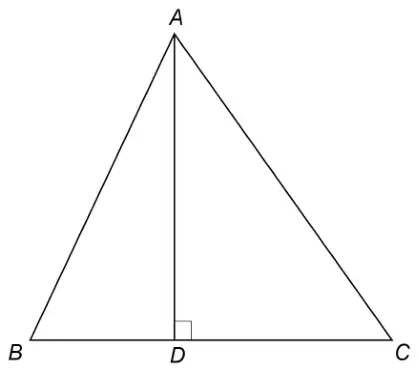
November 2021 Paper 1 Q21 21 \(ABC\) is a triangle.
The perpendicular from \(A\) meets \(BC\) at \(D\).
\(BC = (6 + 2\sqrt{7}\,)\) cm
Not drawn accurately
Area of triangle \(ABC = (13 + 3\sqrt{7}\,)\) cm\(^2\)
Work out the length, in cm, of \(AD\).
Give your answer in the form \(\quad a + b\sqrt{c} \quad\) where \(a\), \(b\) and \(c\) are integers. [5 marks]
Mark scheme
Mark scheme Answer Mark Comments Alternative method 1 Works out \(\dfrac{1}{2} \times (6 + 2\sqrt{7}\,)\) \(\dfrac{1}{2} \times (6 + 2\sqrt{7}\,) \times AD\) M1 oe eg \((3 + \sqrt{7}\,) \times AD\) \(\dfrac{13 + 3\sqrt{7}}{3 + \sqrt{7}} \times \dfrac{3 - \sqrt{7}}{3 - \sqrt{7}}\) M1 ft their \(\dfrac{13 + 3\sqrt{7}}{3 + \sqrt{7}}\) (numerator =) M1dep ft their numerator which must have 2 terms (denominator =) 2 M1dep ft their denominator \(9 - 2\sqrt{7}\) A1 Alternative method 2 Works out \(2 \times (13 + 3\sqrt{7}\,)\) \(\dfrac{1}{2} \times (6 + 2\sqrt{7}\,) \times AD\) M1 oe eg \((6 + 2\sqrt{7}\,) \times AD = (26 + 6\sqrt{7}\,)\) \(\dfrac{26 + 6\sqrt{7}}{6 + 2\sqrt{7}} \times \dfrac{6 - 2\sqrt{7}}{6 - 2\sqrt{7}}\) M1 ft their \(\dfrac{26 + 6\sqrt{7}}{6 + 2\sqrt{7}}\) (numerator =) M1dep ft their numerator which must have 2 terms (denominator =) 8 M1dep ft their denominator \(9 - 2\sqrt{7}\) A1 Alternative method 3 Using identities \((6 + 2\sqrt{7}\,) \times AD = (26 + 6\sqrt{7}\,)\) M1 oe \((6 + 2\sqrt{7}\,) \times (a + b\sqrt{7}\,) = (26 + 6\sqrt{7}\,)\) M1 oe \(6a + 14b = 26\) and \(2a + 6b = 6\) M1dep oe eg \(3a + 7b = 13\) and \(a + 3b = 3\) \(a = 9\) or \(b = -2\) M1dep \(9 - 2\sqrt{7}\) A1
Additional guidance Alt1 \(\dfrac{18 - 4\sqrt{7}}{2}\) M4 Alt2 \(\dfrac{72 - 16\sqrt{7}}{8}\) M4 Omission of \(\dfrac{1}{2}\) can score up to M0M1M1M1A0 Missing brackets must be recovered
8 Simplify \(\quad \sqrt{3}\left(\sqrt{75} + \sqrt{48}\right) \quad\) writing your answer as an integer. [2 marks]
Mark scheme
Mark scheme Answer Mark Comments Alternative method 1 \(\sqrt{225} + \sqrt{144}\) M1 27 A1 Alternative method 2 \(5\sqrt{3} + 4\sqrt{3}\) or \(9\sqrt{3}\) M1 27 A1
Specimen 2020 Paper 1 Q14 14 Rationalise and simplify \(\quad \dfrac{\sqrt{3} - 7}{\sqrt{3} + 1}\)
Give your answer in the form \(\quad a + b\sqrt{3} \quad\) where \(a\) and \(b\) are integers. [4 marks]
Mark scheme
Mark scheme Answer Mark Comments Multiplies numerator and denominator by \(\sqrt{3} - 1\) M1 (denominator =) 2 A1 (numerator =) \(3 - \sqrt{3} - 7\sqrt{3} + 7\) M1dep \(5 - 4\sqrt{3}\) A1
16 Rationalise the denominator and simplify fully \(\qquad \dfrac{21 - 11\sqrt{5}}{3 - \sqrt{5}}\) [4 marks]
Mark scheme
Mark scheme Answer Mark Comments \(\dfrac{(21 - 11\sqrt{5})(3 + \sqrt{5})}{(3 - \sqrt{5})(3 + \sqrt{5})}\) M1 could be \(-3 - \sqrt{5}\) Denominator of 4 A1 would be \(-4\) if \(-3 - \sqrt{5}\) used Numerator M1dep allow three terms correct in a 4 term expansion. If error appears in 2 or 3 term simplification and 4 term expansion not seen award M0 \(2 - 3\sqrt{5}\) or \(-3\sqrt{5} + 2\) A1 penalise further working
Additional guidance Correct first A mark and M1dep mark would assume first M mark correct if not seen.
8 Write \(\quad (1 + 2\sqrt{5})(4 - \sqrt{5}) \quad\) in the form \(\quad a + b\sqrt{5} \quad\) where \(a\) and \(b\) are integers. [2 marks]
Mark scheme
Mark scheme Answer Mark Comments \(4 - \sqrt{5} + 8\sqrt{5} - 2\sqrt{5}\,\sqrt{5}\) M1 oe \(-6 + 7\sqrt{5}\) A1
Additional guidance Any incorrect further work loses the A mark, so they can only score M1 A0
18 Simplify fully \(\qquad \dfrac{24 - \sqrt{300}}{4\sqrt{3} - 5}\)
Give your answer in the form \(\ a\sqrt{b}\ \) where \(a\) and \(b\) are integers. [5 marks]
Mark scheme
Mark scheme Answer Mark Comments Alternative method 1 \(10\sqrt{3}\) B1 \(\dfrac{(24 - \text{their } 10\sqrt{3})(4\sqrt{3} + 5)}{(4\sqrt{3} - 5)(4\sqrt{3} + 5)}\) M1 oe \(96\sqrt{3} - 120 + 120 - 50\sqrt{3}\) M1dep allow one sign error \(48 - 25\) or 23 M1 \(2\sqrt{3}\) A1 Alternative method 2 \(\dfrac{(24 - \sqrt{300})(4\sqrt{3} + 5)}{(4\sqrt{3} - 5)(4\sqrt{3} + 5)}\) M1 \(96\sqrt{3} + 120 - 4\sqrt{900} - 5\sqrt{300}\) M1dep allow one sign error \(96\sqrt{3} - 120 + 120 - 50\sqrt{3}\) M1 \(48 - 25\) or 23 M1 \(2\sqrt{3}\) A1
Additional guidance For the 1st M1, multiplying numerator and denominator by \((4\sqrt{3} + 5)\) could legitimately be replaced by \(-4\sqrt{3} - 5\) ... almost identical working ... it just changes all the signs on the next lines of working
15 Rationalise the denominator and simplify fully \(\qquad \dfrac{6}{\sqrt{7} + 2}\) [3 marks]
Mark scheme
Mark scheme Answer Mark Comments \(\dfrac{6}{(\sqrt{7} + 2)} \times \dfrac{(\sqrt{7} - 2)}{(\sqrt{7} - 2)}\) M1 \(\dfrac{6}{(\sqrt{7} + 2)} \times \dfrac{(2 - \sqrt{7})}{(2 - \sqrt{7})}\) Denominator = 3 or \(-3\) A1 \(2(\sqrt{7} - 2)\) or \(2\sqrt{7} - 4\) A1
Additional guidance Correct answer seen, then error in factorising, do not penalise
13 Solve \(\qquad \sqrt{125} + \sqrt{20} = \sqrt{80} + \sqrt{x}\) [3 marks]
Mark scheme
Mark scheme Answer Mark Comments \(\sqrt{125} = 5\sqrt{5}\), \(\sqrt{20} = 2\sqrt{5}\) M1 allow one error (\(\sqrt{x}\) =) \(3\sqrt{5}\) A1 45 A1
No questions match these filters.