\(\dfrac{2}{5}\) of the people are children. The rest of the people are adults.
35% of the children are vegetarian. 45% of the adults are vegetarian.
How many of the people are not vegetarian? (5)
Mark scheme
Answer
Mark
Mark scheme
118
P1
for a correct first step, eg \(200 \times 2 \div 5\ (= 80)\) or \(200 \times 3 \div 5\ (= 120)\) or \(1 - \dfrac{2}{5}\left(= \dfrac{3}{5}\right)\) oe eg \(100 - 40\ (= 60(\%))\)
P1
for a process to find the number of child vegetarians or number of child non-vegetarians, eg \(\text{``}80\text{''} \times 0.35\ (= 28)\) or \(\text{``}80\text{''} \times (1 - 0.35)\ (= 52)\)
P1
for a process to find the number of adult vegetarians or number of adult non-vegetarians, eg \((200 - \text{``}80\text{''}) \times 0.45\ (= 54)\) or \((200 - \text{``}80\text{''}) \times (1 - 0.45)\ (= 66)\)
P1
for a complete process to find the total number of non-vegetarians, eg \(200 - \text{``}28\text{''} - \text{``}54\text{''}\) or \((\text{``}80\text{''} - \text{``}28\text{''}) + (200 - \text{``}80\text{''} - \text{``}54\text{''})\) oe eg \(\text{``}52\text{''} + (\text{``}120\text{''} - \text{``}54\text{''})\) or \(\text{``}80\text{''} \times (1 - 0.35) + (200 - \text{``}80\text{''}) \times (1 - 0.45)\)
25 Andy, Luke and Tina share some sweets in the ratio \(\ 1 : 6 : 14\)
Tina gives \(\dfrac{3}{7}\) of her sweets to Andy.
Tina then gives \(12\dfrac{1}{2}\)% of the rest of her sweets to Luke.
Tina says,
“Now all three of us have the same number of sweets.”
Is Tina correct? You must show how you get your answer. (4)
Mark scheme
Answer
Mark
Mark scheme
Yes, supported by correct figures
P1
for a process to find the number of sweets Tina gives to Andy, eg \(14 \div 7 \times 3\ (= 6)\) or for a process to work with fractions of the total to find fraction given to Andy, eg \(\dfrac{14}{21} \times \dfrac{3}{7} \left(= \dfrac{2}{7}\right)\) or for dividing a given number (eg 441) in the ratio 1 : 6 : 14 (= 21 : 126 : 294)
P1
for a process to find number for Andy and Tina after first exchange, eg \(A = 1 + \text{``}6\text{''}\ (=7)\) and \(T = 14 - \text{``}6\text{''}\ (=8)\) or for a process to find the number of sweets Tina gives to Luke eg \((\text{``}14\text{''} - \text{``}6\text{''}) \times \dfrac{12.5}{100}\ (= 1)\) or for a process to work with fractions of the total to find fraction given to Luke, eg for \(\dfrac{(14 - \text{``}6\text{''})}{21} \times \dfrac{12.5}{100}\) or process to work out the number of sweets given to Andy and Luke for their total, eg \(\text{``}294\text{''} \div 7 \times 3\ (= 126)\) and \((\text{``}294\text{''} - \text{``}126\text{''}) \times \dfrac{12.5}{100}\ (= 21)\)
P1
for a process to find the final amounts or final shares for at least two of Andy, Luke and Tina eg two of \(1 + \text{``}6\text{''}\ (= 7)\), \(6 + \text{``}1\text{''}\ (= 7)\), \(14 - \text{``}6\text{''} - \text{``}1\text{''}\ (= 7)\) or \(\dfrac{1}{21} + \text{``}\dfrac{2}{7}\text{''} \left(= \dfrac{7}{21}\right)\), \(\dfrac{6}{21} + \text{``}\dfrac{1}{21}\text{''} \left(= \dfrac{7}{21}\right)\), \(\dfrac{14}{21} - \text{``}\dfrac{2}{7}\text{''} - \text{``}\dfrac{1}{21}\text{''} \left(= \dfrac{7}{21}\right)\) or \(\text{``}21\text{''} + \text{``}126\text{''}\ (= 147)\), \(\text{``}126\text{''} + \text{``}21\text{''}\ (= 147)\), \(\text{``}294\text{''} - \text{``}126\text{''} - \text{``}21\text{''}\ (= 147)\)
C1
Yes, supported by full working and accurate figures for Andy, Luke and Tina
Additional guidance
May work with an equivalent ratio, eg 21 : 126 : 294 and do \(294 \div 7 \times 3\ (= 126)\) as a first step
May work in multiples of \(x\) for all marks
Accurate figures with no supportive working scores 0
6 Andy, Luke and Tina share some sweets in the ratio 1 : 6 : 14
Tina gives \(\dfrac{3}{7}\) of her sweets to Andy.
Tina then gives \(12\dfrac{1}{2}\)% of the rest of her sweets to Luke.
Tina says,
“Now all three of us have the same number of sweets.”
Is Tina correct? You must show how you get your answer. (4)
Mark scheme
Answer
Mark
Mark scheme
Yes, supported by correct figures
P1
for a process to find the number of sweets Tina gives to Andy, eg \(14 \div 7 \times 3\ (= 6)\) or for a process to work with fractions of the total to find fraction given to Andy, eg \(\dfrac{14}{21} \times \dfrac{3}{7}\ \left(= \dfrac{2}{7}\right)\) or for dividing a given number (eg 441) in the ratio 1 : 6 : 14 (= 21 : 126 : 294)
P1
for a process to find number for Andy and Tina after first exchange, eg A = \(1 + \text{``}6\text{''}\ (= 7)\) and T = \(14 - \text{``}6\text{''}\ (= 8)\) or for a process to find the number of sweets Tina gives to Luke eg \((14 - \text{``}6\text{''}) \times \dfrac{12.5}{100}\ (= 1)\) or for a process to work with fractions of the total to find fraction given to Luke, eg for \(\dfrac{(14 - \text{``}6\text{''})}{21} \times \dfrac{12.5}{100}\) or process to work out the number of sweets given to Andy and Luke for their total, eg \(\text{``}294\text{''} \div 7 \times 3\ (= 126)\) and \((\text{``}294\text{''} - \text{``}126\text{''}) \times \dfrac{12.5}{100}\ (= 21)\)
P1
for a process to find the final amounts or final shares for at least two of Andy, Luke and Tina eg two of \(1 + \text{``}6\text{''}\ (= 7)\), \(6 + \text{``}1\text{''}\ (= 7)\), \(14 - \text{``}6\text{''} - \text{``}1\text{''}\ (= 7)\) or \(\dfrac{1}{21} + \dfrac{\text{``}2\text{''}}{7}\ \left(= \dfrac{7}{21}\right)\), \(\dfrac{6}{21} + \text{``}\dfrac{1}{21}\text{''}\ \left(= \dfrac{7}{21}\right)\), \(\dfrac{14}{21} - \text{``}\dfrac{2}{7}\text{''} - \text{``}\dfrac{1}{21}\text{''}\ \left(= \dfrac{7}{21}\right)\) or \(\text{``}21\text{''} + \text{``}126\text{''}\ (= 147)\), \(\text{``}126\text{''} + \text{``}21\text{''}\ (= 147)\), \(\text{``}294\text{''} - \text{``}126\text{''} - \text{``}21\text{''}\ (= 147)\)
C1
Yes, supported by full working and accurate figures for Andy, Luke and Tina
Additional guidance
May work with an equivalent ratio, eg 21 : 126 : 294 and do \(294 \div 7 \times 3\ (= 126)\) as a first step
May work in multiples of \(x\) for all marks
Accurate figures with no supportive working scores 0
Converts numbers to common equivalent form, eg 0.58(33..), (0.56), 0.57(0), 0.54(54..), (0.558) or any 4 in correct order or all 5 in correct reverse order
Buy one large plate and get one small plate for half the normal price.
The normal price of a large plate is £2 The normal price of a small plate is 80p
Max wants to buy 6 large plates and 6 small plates using this offer. He has £15
Has Max got enough money? You must show how you get your answer. (4)
Mark scheme
Answer
Mark
Mark scheme
Yes (supported)
P1
for an initial process, eg \(6 \times 2\ (=12)\) or \(80 \div 2\ (=40 = 0.40)\) oe or \(6 \times 0.8\ (= 4.80)\) oe or \(6 \div 2\ (= 3)\)
P1
for a process using the special offer eg \(6 \times \text{``}40\text{''}\ (= 240 \text{ or } 2.40)\) oe or \(\text{``}4.80\text{''} \div 2\ (= 2.40)\) oe or \(2 + \text{``}0.40\text{''}\ (= 2.40)\) oe or \(\text{``}3\text{''} \times 0.8\ (= 2.40)\)
P1
for a complete process to find figures to compare, eg \(6 \times 2 + 6 \times \text{``}0.40\text{''}\ (= 14.40)\) oe or \(15 - \text{``}12\text{''} - \text{``}2.40\text{''}\ (= 0.60 \text{ or } 60\text{p})\)
C1
for Yes with correct comparable figures, eg Yes and (£)14.4(0) or Yes and (£)0.6(0) or 60p change
Additional guidance
May work in pounds or pence
Allow use of inconsistent units for the first 2 marks
Award 0 marks for a correct answer with no supportive working. Answer of ‘No’ gets C0 irrespective of working, correct or not. Ignore incorrect value for change, if (£) 14.4(0) seen
6 Last year a family recycled 800 kg of household waste. 57% of this waste was paper and glass.
weight of paper recycled : weight of glass recycled = 12 : 7
Calculate the weight of glass the family recycled. (3)
Mark scheme
Answer
Mark
Mark scheme
168
P1
for a start to the process, eg \(\dfrac{57}{100} \times 800\ (= 456)\) or \(57 \div (12 + 7)\ (= 3)\) or \(800 \div (12 + 7)\ (= 42.1\ldots)\) or [amount] \(\times \dfrac{57}{100}\) or [amount] \(\times \dfrac{7}{12 + 7}\)
P1
for a complete process to find the weight of glass, eg \(\dfrac{57}{100} \times 800 \times \dfrac{7}{12 + 7}\) oe
A1
for an answer in the range 167.9 to 168 SCB2 for an answer of 288
Additional guidance
May be seen as part of other calculations, eg \(\dfrac{7}{12 + 7} \times 57\ (= 21)\) or \(\dfrac{7}{12 + 7} \times 800\ (= 294.7\ldots)\) [amount] can be any figure considered as being 57% of 800 or 43% of 800 calculated incorrectly or a figure calculated using a full or partial ratio incorrectly as a first step
15 2.5 kg of onions and 2 kg of carrots cost a total of £2.36 3 kg of carrots cost £1.74
Stuart has £2 He wants to buy 4 kg of onions.
Does Stuart have enough money to buy 4 kg of onions? You must show how you get your answer. (5)
Mark scheme
Answer
Mark
Mark scheme
Yes (supported)
P1
for finding the cost of 1 kg of carrots eg \(1.74 \div 3\ (= 0.58)\)
P1
for isolating the cost of 2.5 kg of onions eg \(2.36 - (2 \times \text{``}0.58\text{''})\ (= 1.2(0))\)
P1
for the cost of 1 kg of onions or 0.5 kg of onions, eg \(\text{``}1.20\text{''} \div 2.5\ (= 0.48)\) or \(\text{``}1.20\text{''} \div 5\ (= 0.24)\) or for \(4 \div 2.5\ (= 1.6)\)
P1
for the cost of 4 kg of onions, eg \(4 \times \text{``}0.48\text{''}\) or \(8 \times \text{``}0.24\text{''}\ (= 1.92)\) or for \(\text{``}1.6\text{''} \times \text{``}1.2(0)\text{''}\)
C1
Yes with correct figures shown eg 192 or 1.92 or “has 8p left” or 166.5
Alternative
P1
for finding the cost of 1 kg onions eg \(2.(00) \div 4\ (= 0.5)\)
P1
for finding the cost of 2.5 kg of onions eg \(2.5 \times \text{``}0.5\text{''}\ (= 1.25)\)
P1
for finding the cost of 2 kg of carrots eg \(2.36 - \text{``}1.25\text{''}\ (= 1.11)\)
P1
for finding the cost of 3 kg of carrots eg \(\text{``}1.11\text{''} \div 2 \times 3\ (= 1.665)\) for comparison with 1.74
C1
Yes with correct figures shown eg 192 or 1.92 or “has 8p left” or 166.5
Additional guidance
for all P marks can work in pence or in £
C1: Allow comparison of mixed units eg 192 with £2
She played badminton for 50 minutes. She used the swimming pool for \(\dfrac{1}{6}\) of the 120 minutes. She used the gym for 20% of the 120 minutes. She then spent the rest of the 120 minutes in the cafe.
(a) Work out the total time, in minutes, that Elena spent in the cafe. (4)
Elena got to the sports centre at 1.30 pm. She had asked her friend to meet her in the cafe at 3 pm.
(b) Did Elena get to the cafe by 3 pm? Give a reason for your answer. (1)
Mark scheme (a)
Answer
Mark
Mark scheme
26
P1
for process to find \(\dfrac{1}{6}\) of 120 minutes, eg \(\dfrac{1}{6} \times 120\ (= 20)\)
P1
for process to find 20 % of 120 minutes, eg \(\dfrac{20}{100} \times 120\ (= 24)\)
P1
(dep on P2) for a complete process to find the time remaining, eg \(120 - 50 - \text{``}20\text{''} - \text{``}24\text{''}\)
A1
cao
Additional guidance
May be seen in stages
Mark scheme (b)
Answer
Mark
Mark scheme
No (supported)
C1
for No with reason or ft (a)
Acceptable examples she was (at least) 4 minutes late she did not arrive until (at least) 3 04 pm it took her more than 90 minutes doing the activities
Not acceptable examples Yes ….. she arrived after 3pm
Additional guidance
The ‘No’(or ‘Yes’) may not be required if it is clear from the reasoning that Elena did not (did) get to the café by 3pm
\(\dfrac{1}{4}\) of these bars of chocolate were large bars. The rest of the bars of chocolate were small bars.
All the large bars of chocolate were sold for £1 each. All the small bars of chocolate were sold for 60p each.
Work out the total amount of money for which the 208 bars of chocolate were sold. Give your answer in pounds. (3)
Mark scheme
Answer
Mark
Mark scheme
145.60
P1
for a process to work out the value of the large bars eg \(208 \div 4\ (=52 \text{ or } 5200)\)
P1
for a process to work out the value of the small bars eg \((208 - \text{``}52\text{''}) \times 60\) or \(\left(1 - \dfrac{1}{4}\right) \times 208 \times 60\ (=9360 \text{ or } 93.6(0))\) or for 145.6
25 A delivery company has a total of 160 cars and vans.
the number of cars : the number of vans = 3 : 7
Each car and each van uses electricity or diesel or petrol.
\(\dfrac{1}{8}\) of the cars use electricity. 25% of the cars use diesel. The rest of the cars use petrol.
Work out the number of cars that use petrol. You must show all your working.(5)
Mark scheme
Answer
Mark
Mark scheme
30
P1
for \(160 \div (3+7)\ (= 16)\) or \(\dfrac{3}{3+7}\ \left(= \dfrac{3}{10}\right)\)
P1
for \(\text{``}16\text{''} \times 3\ (= 48)\) or \(\text{``}\dfrac{3}{10}\text{''} \times 160\ (= 48)\)
P1
for a correct step using 48 eg \(\text{``}48\text{''} \div 8\ (= 6)\) or \(\text{``}48\text{''} \times 25 \div 100\ (= 12)\) or (indep) for combining \(\dfrac{1}{8}\) and 25%, eg \(\dfrac{1}{8} + \dfrac{1}{4}\ \left(= \dfrac{3}{8}\right)\) or \(\text{``}0.125\text{''} + \text{``}0.25\text{''}\ (= 0.375)\) or “12.5”(%) + 25(%) (= 37.5(%))
P1
for a complete process to find the number of petrol cars, eg \(\text{``}48\text{''} - \text{``}6\text{''} - \text{``}12\text{''}\) oe or \(\left(1 - \text{``}\dfrac{3}{8}\text{''}\right) \times \text{``}48\text{''}\) oe or \(\dfrac{3}{10} \times \left(1 - \text{``}\dfrac{3}{8}\text{''}\right) \times 160\) oe
A1
cao
SC B2 for an answer of 100 if P0 scored
Additional guidance
Award no marks for a correct answer with no supportive working
3 A delivery company has a total of 160 cars and vans.
the number of cars : the number of vans = 3 : 7
Each car and each van uses electricity or diesel or petrol.
\(\dfrac{1}{8}\) of the cars use electricity. 25% of the cars use diesel. The rest of the cars use petrol.
Work out the number of cars that use petrol. You must show all your working. (5)
Mark scheme
Answer
Mark
Mark scheme
30
P1
for \(160 \div (3+7)\ (= 16)\) or \(\dfrac{3}{3+7}\ \left(= \dfrac{3}{10}\right)\)
P1
for \(\text{``}16\text{''} \times 3\ (= 48)\) or \(\text{``}\dfrac{3}{10}\text{''} \times 160\ (= 48)\)
P1
for a correct step using 48 eg \(\text{``}48\text{''} \div 8\ (= 6)\) or \(\text{``}48\text{''} \times 25 \div 100\ (= 12)\) or (indep) for combining \(\dfrac{1}{8}\) and 25%, eg \(\dfrac{1}{8} + \dfrac{1}{4}\ \left(= \dfrac{3}{8}\right)\) or \(\text{``}0.125\text{''} + \text{``}0.25\text{''}\ (= 0.375)\) or “12.5”(%) + 25(%) (= 37.5(%))
P1
for a complete process to find the number of petrol cars, eg \(\text{``}48\text{''} - \text{``}6\text{''} - \text{``}12\text{''}\) oe or \(\left(1 - \text{``}\dfrac{3}{8}\text{''}\right) \times \text{``}48\text{''}\) oe or \(\text{``}\dfrac{3}{10}\text{''} \times \left(1 - \text{``}\dfrac{3}{8}\text{''}\right) \times 160\) oe
A1
cao
SC B2 for an answer of 100 if P0 scored
Additional guidance
Award no marks for a correct answer with no supportive working
(a) Has Rehan got enough money to buy the jacket? You must show how you get your answer. (3)
The trainers cost $60 The exchange rate is $1 = £0.749
Rehan says, “The trainers cost less than £40”
Rehan is wrong.
(b) Using a suitable approximation, show working to explain why. (2)
Mark scheme (a)
Answer
Mark
Mark scheme
No from correct figures
P1
for first step in process to solve the problem, eg find cost of 3 T-shirts, \(25 \times 3\ (= 75)\) or eg find remaining money after just one purchase, eg \(200 - 60\ (= 140)\) or \(200 - 25\ (= 175)\)
P1
for process to find total cost of trainers and T-shirts, eg \(60 + \text{``}75\text{''}\ (= 135)\) or find total cost including cost of jacket, eg. \(60 + \text{``}75\text{''} + 80\ (= 215)\) or find the change after buying all 4 items, eg. \(200 - 60 - 3 \times 25\ (= 65)\) oe
C1
for No from correct figures Acceptable examples No, needs 215 No, only has 65 left No, needs 15 more Not acceptable examples Yes ....
Additional guidance
Award this mark for addition of 2 or more items or for subtraction of one item or more from 200 eg \(200 - 50\ (= 150)\) etc.
Figures can be given without units ($)
Mark scheme (b)
Answer
Mark
Mark scheme
Explanation
P1
for a start to a method, eg. approximating 0.749 to 0.7, 0.74, 0.75 or 0.8
C1
for explanation Acceptable examples \(0.7 \times 60 = 42\) [is an underestimate] \(0.74 \times 60 = 44.4(0)\) [is an underestimate] Not acceptable examples \(0.75 \times 60 = 45\) [is an overestimate] \(0.8 \times 60 = 48\) [is an overestimate]
Additional guidance
For full marks, any calculations must be correct. No statement in words is needed.
22 A bonus of £2100 is shared by 10 people who work for a company. 40% of the bonus is shared equally between 3 managers. The rest of the bonus is shared equally between 7 salesmen.
One of the salesmen says,
“If the bonus is shared equally between all 10 people I will get 25% more money.”
Is the salesman correct? You must show how you get your answer. (5)
Mark scheme
Answer
Mark
Mark scheme
No (supported)
P1
for start to process, eg \(2100 \times \dfrac{40}{100}\ (= 840)\) or \(100 - 40\ (= 60)\)
P1
for process to find the 7 salesmen’s share of bonus, eg \(2100 - \text{``}840\text{''}\ (= 1260)\) or \(2100 \times \dfrac{\text{``}60\text{''}}{100}\ (= 1260)\)
P1
for process to find bonus amount each salesman gets eg \(\text{``}1260\text{''} \div 7\ (= 180)\) OR process to find the total bonus for all salesmen if shared equally, eg \(\dfrac{2100}{10} \times 7\ (= 1470)\)
P1
for process to compare what a single salesman gets under each scheme, eg \(\text{``}180\text{''} \times \dfrac{25}{100}\ (= 45)\) and \(\text{``}\dfrac{2100}{10}\text{''} - \text{``}180\text{''}\ (= 30)\) or \(\text{``}180\text{''} \times \dfrac{25}{100}\ (= 45)\) and \(\text{``}180\text{''} + \text{``}45\text{''}\ (= 225)\) oe and \(\dfrac{2100}{10}\ (= 210)\) or \(\left(\dfrac{2100}{10} - \text{``}180\text{''}\right) \div \text{``}180\text{''} \times 100\ (= 16.6...)\)
OR process to compare what all salesmen gets under each scheme, eg \(\text{``}1260\text{''} \times \dfrac{25}{100}\ (= 315)\) and \(\text{``}1470\text{''} - \text{``}1260\text{''}\ (= 210)\) or \(\text{``}1260\text{''} \times \dfrac{25}{100}\ (= 315)\) and \(\text{``}1260\text{''} + \text{``}315\text{''}\ (= 1575)\) oe and “1470” or \((\text{``}1470\text{''} - \text{``}1260\text{''}) \div \text{``}1260\text{''} \times 100\ (= 16.6...)\)
A1
‘No’ supported by correct figures, eg 45 and 30, 225 and 210, 315 and 210 or 1575 and 1470 or 16.(6...)(% and 25%)
Additional guidance
May compare bonus shares of a single salesman or total bonus share for all 7 salesmen.
Do not award unless correct figures have been shown to support a statement made that the salesman was not correct.
10 Robert makes 50 litres of green paint by mixing litres of yellow paint and litres of blue paint in the ratio 2 : 3
Yellow paint is sold in 5 litre tins. Each tin of yellow paint costs £26
Blue paint is sold in 10 litre tins. Each tin of blue paint costs £48
Robert sells all the green paint he makes in 10 litre tins. He sells each tin of green paint for £66.96
Work out Robert’s percentage profit on each tin of green paint he sells. (5)
Mark scheme
Answer
Mark
Mark scheme
35
P1
use of ratio 2:3 and tin quantities to find overall ratio of litres eg 4:3 or 4 tins : 3 tins or 20 litres (Y) & 30 litres (B)
P1
calculates total cost of making paint eg \(4 \times 26 + 3 \times 48\) (50 litres) or \(104 + 144\ (= 248)\)
A1
calculates comparable cost eg 10 litres (1 tin) green paint made as 49.6 or differences (profit) for 1 tin as 17.36 or 5 tins as 86.8 or total comparable costs for 50 litres as 334.8 and 248, for 25 litres as 167.4 and 124 or 1 litres as 33.48 and 24.8
Could be multiples 4 & 3 (for an amount which is a multiple of 50 litres). “248” is the total cost for making 50 litres
\(\text{``}248\text{''} \div 5 = 49.6\) for 10 litre (1 tin) green paint made Profit on 10 litres is \(66.96 - 49.60 = 17.36\) Profit on 50 litres is \(334.8 - 248 = 86.8\) (corrected from the printed mark scheme: 304.8) 334.8 comes from \(5 \times 66.96\) and is the selling price for 50 litres green paint
3 A bonus of £2100 is shared by 10 people who work for a company. 40% of the bonus is shared equally between 3 managers. The rest of the bonus is shared equally between 7 salesmen.
One of the salesmen says,
“If the bonus is shared equally between all 10 people I will get 25% more money.”
Is the salesman correct? You must show how you get your answer. (5)
Mark scheme
Answer
Mark
Mark scheme
No (supported)
P1
for start to process, eg \(2100 \times \dfrac{40}{100}\ (= 840)\) or \(100 - 40\ (= 60)\)
P1
for process to find the 7 salesmen’s share of bonus, eg \(2100 - \text{``}840\text{''}\ (= 1260)\) or \(2100 \times \dfrac{\text{``}60\text{''}}{100}\ (= 1260)\)
P1
for process to find bonus amount each salesman gets eg \(\text{``}1260\text{''} \div 7\ (= 180)\) OR process to find the total bonus for all salesmen if shared equally, eg \(\dfrac{2100}{10} \times 7\ (= 1470)\)
P1
for process to compare what a single salesman gets under each scheme, eg \(\text{``}180\text{''} \times \dfrac{25}{100}\ (= 45)\) and \(\text{``}\dfrac{2100}{10}\text{''} - \text{``}180\text{''}\ (= 30)\) or \(\text{``}180\text{''} \times \dfrac{25}{100}\ (= 45)\) and \(\text{``}180\text{''} + \text{``}45\text{''}\ (= 225)\) oe and \(\dfrac{2100}{10}\ (= 210)\) or \(\left(\dfrac{2100}{10} - \text{``}180\text{''}\right) \div \text{``}180\text{''} \times 100\ (= 16.6...)\)
OR process to compare what all salesmen gets under each scheme, eg \(\text{``}1260\text{''} \times \dfrac{25}{100}\ (= 315)\) and \(\text{``}1470\text{''} - \text{``}1260\text{''}\ (= 210)\) or \(\text{``}1260\text{''} \times \dfrac{25}{100}\ (= 315)\) and \(\text{``}1260\text{''} + \text{``}315\text{''}\ (= 1575)\) oe and “1470” or \((\text{``}1470\text{''} - \text{``}1260\text{''}) \div \text{``}1260\text{''} \times 100\ (= 16.6...)\)
A1
‘No’ supported by correct figures, eg 45 and 30, 225 and 210, 315 and 210 or 1575 and 1470 or 16.(6...)(% and 25%)
Additional guidance
May compare bonus shares of a single salesman or total bonus share for all 7 salesmen.
Do not award unless correct figures have been shown to support a statement made that the salesman was not correct.
14 Gavin, Harry and Isabel each earn the same monthly salary.
Each month,
Gavin saves 28% of his salary and spends the rest of his salary
Harry spends \(\dfrac{3}{4}\) of his salary and saves the rest of his salary
the amount of salary Isabel saves : the amount of salary she spends = 3 : 7
Work out who saves the most of their salary each month. You must show how you get your answer. (4)
Mark scheme
Answer
Mark
Mark scheme
Isabel (supported)
P1
for process to work with \(\dfrac{3}{4}\) eg \(1 - \dfrac{3}{4} \left(= \dfrac{1}{4}\right)\) oe, eg 25% or \(\dfrac{25}{100}\) or \(\dfrac{3}{4}\) = 75% or \(\dfrac{75}{100}\) or value of salary (say 1000) \(\times\ 3 \div 4\ (= 750)\)
P1
for process to work with ratio 3 : 7 eg \(\dfrac{3}{3+7}\) oe or \(\dfrac{7}{3+7}\) oe or value of salary (say 1000) \(\div\ (3+7)\ (= 100)\)
A1
for (28(%)), 25(%) and 30(%) or 72(%), 75(%), 70(%) or 0.28, 0.25, 0.3 or for using value of salary (say 1000) giving 280, 250, 300 or 720, 750, 700
C1
(dep P2) for Isabel or ft their comparative values
Additional guidance
“Isabel” alone without supported evidence, gets 0 marks.
18 Daniel bakes 420 cakes. He bakes only vanilla cakes, banana cakes, lemon cakes and chocolate cakes.
\(\dfrac{2}{7}\) of the cakes are vanilla cakes. 35% of the cakes are banana cakes. The ratio of the number of lemon cakes to the number of chocolate cakes is 4:5
Work out the number of lemon cakes Daniel bakes. (5)
Mark scheme
Answer
Mark
Notes
68
P1
for a process to find the number of vanilla cakes, eg \(420 \times 2 \div 7\) oe \((= 120)\)
P1
for a process to find the number of banana cakes, eg \(420 \times 0.35\) oe \((= 147)\)
P1
(dep P1) for a full process to find the number of lemon/chocolate cakes eg \(420 -\) (vanilla cakes) \(-\) (banana cakes) \((= 153)\)
P1
(dep on previous P1) for a process to find the number of lemon cakes eg \(\text{``}153\text{''} \div 9 \times 4\) oe \((= 68)\)
A1
cao
OR
P1
for writing two proportions in the same format
P1
for combining the proportions of vanilla and banana cakes eg \(2/7 + 7/20\ (= 89/140)\)
P1
(dep P1) for a full process to find the proportion or number of lemon/chocolate cakes eg \(1 - \text{``}89/140\text{''}\ (= 51/140)\)
P1
(dep on previous P1) for a process to find the number of lemon cakes eg \(\text{``}51/140\text{''} \times 420 \div 9 \times 4\ (= 68)\)
4 Daniel bakes 420 cakes. He bakes only vanilla cakes, banana cakes, lemon cakes and chocolate cakes.
\(\dfrac{2}{7}\) of the cakes are vanilla cakes. 35% of the cakes are banana cakes. The ratio of the number of lemon cakes to the number of chocolate cakes is 4 : 5
Work out the number of lemon cakes Daniel bakes. (5)
Mark scheme
Answer
Mark
Notes
68
P1
for a process to find the number of vanilla cakes, eg \(420 \times 2 \div 7\) oe \((= 120)\)
P1
for a process to find the number of banana cakes, eg \(420 \times 0.35\) oe \((= 147)\)
P1
(dep P1) for a full process to find the number of lemon/chocolate cakes eg \(420 -\) (vanilla cakes) \(-\) (banana cakes) \((= 153)\)
P1
(dep on previous P1) for a process to find the number of lemon cakes eg \(\text{``}153\text{''} \div 9 \times 4\) oe \((= 68)\)
A1
cao
OR
P1
for writing two proportions in the same format
P1
for combining the proportions of vanilla and banana cakes eg \(2/7 + 7/20\ (= 89/140)\)
P1
(dep P1) for a full process to find the proportion or number of lemon/chocolate cakes eg \(1 - \text{``}89/140\text{''}\ (= 51/140)\)
P1
(dep on previous P1) for a process to find the number of lemon cakes eg \(\text{``}51/140\text{''} \times 420 \div 9 \times 4\ (= 68)\)
\(\frac{1}{3}\) off normal price of £87 for each day
No charge for the miles
£44 for each day plus 15p for each extra mile over 250 miles
Scott wants to hire a van for 2 days. He is going to drive 400 miles in the van.
Scott wants to pay the least possible money to hire the van.
Should Scott hire the van from Best vans or from Vans for hire? You must show all your working. (5)
Mark scheme
Answer
Mark
Notes
Vans for hire and correct calculations
5
M1 for method to find \(\frac{1}{3}\) of 87 (= 29) or \(\frac{2}{3}\) of 87 (= 58) oe M1 for complete method to find cost for Best vans, eg \((87 - \text{``}29\text{''}) \times 2\) (= 116) M1 for method to find the cost of the extra miles, eg \((400 - 250) \times 0.15\) (= 22.50) or \((400 - 250) \times 15\) (= 2250) M1 for complete method to find cost for Vans for hire, eg \(44 \times 2 + \text{``}22.50\text{''}\) (= 110.5(0)) with consistent units C1 for Vans for hire and 116 and 110.5(0)
14 Matthew has a job. His normal hourly rate of pay is £10
His overtime hourly rate of pay is \(1\frac{1}{2}\) times his normal hourly rate of pay.
Matthew is paid at the normal hourly rate for 7 hours work each day, Monday to Friday. He does not work on Saturday or Sunday.
Here is a table showing the number of hours of overtime he worked each day this week.
Mon
Tues
Wed
Thur
Fri
Overtime (hours)
3
2
0
1
3
Work out Matthew’s total pay for this week. (5)
Mark scheme
Answer
Mark
Notes
485
5
M1 for a method to find weekly basic pay e.g. \(7 \times 10\) (= 70) and \(\text{``}70\text{''} \times 5\) (= 350) M1 for a method to find overtime rate e.g. \(10 + 5\) or \(1\frac{1}{2} \times 10\) (= 15) M1 for a method to find total overtime pay e.g. \((3 + 2 + 1 + 3) \times \text{``}15\text{''}\) (= 135) M1 for a method to find total pay e.g. \(\text{``}350\text{''} + \text{``}135\text{''}\) A1 cao
or M3 for method to calculate pay per day for 5 days e.g. Mon \(70 + 45\) (= 115), Tues = \(70 + 30\) (= 100), Wed = 70, Thurs = \(70 + 15\) (= 85), Fri = \(70 + 45\) (= 115) (M2 for method to calculate pay per day for 3 or 4 days) (M1 for method to calculate pay per day for 1 or 2 days except Wednesday) M1 for totalling all five days e.g. \(\text{``}115\text{''} + \text{``}100\text{''} + \text{``}70\text{''} + \text{``}85\text{''} + \text{``}115\text{''}\) A1 cao
or M1 for a method to find overtime hours e.g. \(3 + 2 + 1 + 3\) (= 9) and weekday hours \(7 \times 5\) (= 35) M1 for a method to find equivalent time on overtime e.g. \(\text{``}9\text{''} + \text{``}9\text{''} \div 2\) M1 for a method to find total equivalent time e.g. \(\text{``}13.5\text{''} + \text{``}35\text{''}\) M1 for a method to find total pay e.g. \(\text{``}48.5\text{''} \times 10\) A1 cao
*4 Mr and Mrs Shankara and their 3 children go on a train journey.
Mr Shankara pays for 2 adult tickets and 3 child tickets. The price of an adult ticket is £8.40 The price of a child ticket is half the price of an adult ticket.
Mr Shankara pays for the tickets with 3 ten pound notes.
Work out how much change he should get. (4)
Mark scheme
Answer
Mark
Notes
60p
4
M1 for price of child ticket e.g. \(8.40 \div 2\) (= 4.20) M1 for a method to work out the total cost of the 2 adults e.g. \(2 \times 8.40\) (= 16.80) or of the 3 children e.g. \(\text{``}4.20\text{''} \times 3\) (= 12.60) or of the whole family e.g. \(2 \times 8.40 + 3 \times \text{``}4.20\text{''}\) (= 29.40) M1 for a complete method to work out the change e.g. \(3 \times £10 - \text{``}29.40\text{''}\) = (0.60) or \(3 \times £10 - (2 \times 8.40 + 3 \times \text{``}4.20\text{''})\) (= 0.60) C1 for change with correct money notation 60p or £0.60 (accept £0.60p)
NB candidates may work in pence rather than pounds
26 Colin works on 5 days each week. Each day he drives from his home to work and from work to his home.
Colin pays £3.50 each day to use the car park at work.
The distance from Colin’s home to work is 18 miles. Colin’s car uses one gallon of petrol every 45.2 miles.
1 litre of petrol costs 136.9p 1 gallon = 4.546 litres
Work out the total cost for Colin to use his car for work each week. You must show all your working. (5)
Mark scheme
Answer
Mark
Notes
42.28
5
M1 for method to find weekly mileage eg. \(18 \times 2 \times 5\) (= 180) or weekly car park charge, eg. \(3.50 \times 5\) (= 17.50) M1 for method to find fuel used in a relevant journey eg. \(180 \div 45.2\) (= 3.9823 gallons) or \(18 \div 45.2\) (= 0.39823 gallons) M1 for a correct use of the conversion factor to convert between gallons and litres eg. \(\text{``}3.9823\text{''} \times 4.546\) (= 18.1 … litres) or \(\text{``}0.39823\text{''} \times 4.546\) (= 1.81 …. litres) or \(1.369 \times 4.546\) (= 6.22... £/gallon) or \(45.2 \div 4.546\) (= 9.942 miles/litre) M1 for a method to find the cost of a relevant journey eg. \(\text{``}18.1…\text{''} \times 1.369\) (= 24.78 …) or \(\text{``}1.81…\text{''} \times 1.369\) (= 2.478 …) or \(\text{``}3.9823\text{''} \times \text{``}6.22..\text{''}\) (= 24.78...) A1 for answer in the range 42.26 to 42.3(0)
NB candidates could work in litres or in gallons and/or could work in £ or p
Table for use in Question 26
Journeys in miles
Fuel used in gallons; miles ÷ 45.2
Fuel used in litres, gallons × 4.546
Cost of journey in £, litres × 1.369 or gallons × 6.22...
M1 for method to calculate the time Celina sings M1 for method to calculate the time Zoe sings M1 (dep on at least M1) for finding the difference between two times A1 cao
Or M1 for a conversion to a common representation M1 (dep on M1) for finding the difference in their chosen representation M1 for using their proportional difference multiplied by 80 A1 cao
21 Mr Brown and his 2 children are going to London by train.
An adult ticket costs £24 A child ticket costs £12
Mr Brown has a Family Railcard.
Family Railcard gives
\(\dfrac{1}{3}\) off adult tickets
60% off child tickets
Work out the total cost of the tickets when Mr Brown uses his Family Railcard. (4)
Mark scheme
Answer
Mark
Notes
25.60
4
M1 for a correct method to find \(\dfrac{1}{3}\) of 24 (=8) or \(\dfrac{2}{3}\) of 24 (=16) M1 for a correct method to find 60% (= 7.2) or 40% (= 4.8) of 12 or 60% (= 14.4) or 40% (= 9.6) of 24 M1 (dep on at least M1) for a method to find the sum of their discounted adult ticket + 2 × their discounted child ticket A1 25.6(0)
13 5600 copies of the Village Advertiser are printed each week.
(a) Write the number 5600 in words. (1)
People have to pay to have an advert in the Village Advertiser. Each advert is in the shape of a rectangle.
The table gives information about the cost of having an advert in the Village Advertiser.
Advert size
Size of rectangle
Cost per week
Size 1
44 mm by 27 mm
£6.50
Size 2
90 mm by 35 mm
£13.50
Size 3
90 mm by 60 mm
£20.00
Size 4
90 mm by 125 mm
£33.00
A Size 2 advert is a 90 mm by 35 mm rectangle.
(b) In the space below, draw a 90 mm by 35 mm rectangle. (2)
David has this advert in the Village Advertiser for 2 weeks. The advert is accurately drawn.
(c) What is the total cost of the advert for 2 weeks? (3)
Raja wants to have a Size 2 advert in the Village Advertiser for 8 weeks. He has £100 to spend.
(d) Show that Raja does not have enough money to pay for the advert for 8 weeks. You must show all your working. (2)
Mark scheme (a)
Answer
Mark
Notes
Five thousand six hundred
1
B1 cao
Mark scheme (b)
Answer
Mark
Notes
Rectangle drawn
2
B2 for fully correct diagram (B1 for one line of correct length within a rectangle)
Mark scheme (c)
Answer
Mark
Notes
13
3
M1 for the length of one side of rectangle, e.g. 44 (mm) or 27 (mm) ±2mm (allow use of cm) M1 for 6.5(0) or size 1 clearly indicated A1 for 13(.00)
Mark scheme (d)
Answer
Mark
Notes
Working shown and compared to 8 weeks
2
M1 for 13.50 × 8 or 13.50 × 7 oe or repeated subtraction of 13.50 from 100 at least 7 times A1 for arriving at a correct figure they can compare with £100 in one step eg 108, 94.5(0), 5.5(0) or \(-8\) OR M1 for 100 ÷ 8 A1 for 12.5(0) OR M1 100 ÷ 13.50 = 7.4 A1 for 7
12 Angie is organising a party for 84 adults and 42 children.
At 8 pm all the adults and all the children will sit down at tables for a meal. 6 people will sit at each table.
(a) Work out the number of seats and the number of tables Angie will need. (3)
Each adult meal will cost £4.50 Each child meal will cost £2.50
Angie has £500 to pay for the meals.
(b) Does Angie have enough money to pay for the meals for 84 adults and 42 children? You must show all your working. (3)
Mark scheme (a)
Answer
Mark
Notes
126, 21
3
B1 for 126 (seats) M1 for method identified to divide number of people by 6, ie “126” ÷ 6 or 84 ÷ 6 (= 14) or 42 ÷ 6 (=7) A1 for 21 (tables)
Mark scheme (b)
Answer
Mark
Notes
Yes with £483
3
M1 for 84 × 4.5(0) ( = 378) or 42 × 2.5(0) ( = 105) M1 for 84 × 4.5(0) + 42 × 2.5(0) or “378” + “105” A1 for e.g. yes and (£)483 or yes with (£)17 left
4 Mr Brown and his 2 children are going to London by train.
An adult ticket costs £24 A child ticket costs £12
Mr Brown has a Family Railcard.
Family Railcard gives \(\dfrac{1}{3}\) off adult tickets 60% off child tickets
Work out the total cost of the tickets when Mr Brown uses his Family Railcard. (4)
Mark scheme
Answer
Mark
Notes
25.60
4
M1 for a correct method to find \(\dfrac{1}{3}\) of 24 (=8) or \(\dfrac{2}{3}\) of 24 (=16) M1 for a correct method to find 60% (= 7.2) or 40% (= 4.8) of 12 or 60% (=14.4) or 40% (= 9.6) of 24 M1 (dep on at least M1) for a method to find the sum of their discounted adult ticket + 2 × their discounted child ticket A1 25.6(0)
*15 Brian makes egg cups. He makes 12 egg cups per hour.
Brian makes egg cups for \(4\frac{1}{2}\) hours each day, on 5 days of the week.
The egg cups are packed in boxes. 8 egg cups are packed into each box.
How many boxes are needed for all the egg cups Brian makes in 5 days? (4)
Mark scheme
Answer
Mark
Notes
34 or 33
4
M1 for one operation e.g. 12 × 4.5 (= 54) or 12 × 5 (= 60) or 4.5 × 5 (= 22.5) or ÷8 M1 for two operations e.g. 12 × 4.5 × 5 (= 270) or 12 × 4.5 ÷ 8 (= 6.75) or 4.5 × 5 ÷ 8 (= 2.8125) or 12 × 5 ÷ 8 (7.5) M1 for a complete method e.g. 12 × 4.5 × 5 ÷ 8 (= 33.75) C1 for 34 accept 33 clearly identified from correct calculations and correct figures
*15 Aleena is planning a trip for people at her Youth Club.
Here are the costs for the trip.
Transport
£230
Insurance
£50
Other costs
£30
Entry fee
£14 per person
Aleena charges £18 per ticket for the trip. She sells 100 tickets.
Is there enough money from the ticket sales for Aleena to pay all the costs for the trip?
You must show your working.(4)
Mark scheme
Answer
Mark
Notes
Yes with reasons
4
M1 for 14 × 100 (= 1400) or 18 × 100 (= 1800) or 230 + 50 + 30 (=310) M1 for “1400” + “310” or complete correct method to find 2 other comparable amounts A1 for £1710 total or £17.1(0) ticket price or £90 or £310 and £400 C1 for a clear statement and conclusion from their two correct comparable figures. OR M1 for 230 ÷ 100 or 50 ÷ 100 or 30 ÷ 100 M1 “2.30” + “0.50” + “0.3” + 14 A1 £17.1(0) C1 for a clear statement and conclusion from their two correct comparable figures.
11 Each day a company posts some small letters and some large letters. The company posts all the letters by first class post.
The tables show information about the cost of sending a small letter by first class post and the cost of sending a large letter by first class post.
Small Letter
Weight
First Class Post
0–100 g
60p
Large Letter
Weight
First Class Post
0–100 g
£1.00
101–250 g
£1.50
251–500 g
£1.70
501–750 g
£2.50
One day the company wants to post 200 letters. The ratio of the number of small letters to the number of large letters is 3:2 70% of the large letters weigh 0–100 g. The rest of the large letters weigh 101–250 g.
Work out the total cost of posting the 200 letters by first class post. (5)
Mark scheme
Answer
Mark
Notes
164
5
M1 \(200 \div (3 + 2)\) (= 40) or an equivalent ratio seen M1 (dep) \(3 \times\) ‘40’ (= 120) or \(2 \times\) ‘40’ (= 80) or 120: 80 or 80:120 M1 a complete method to find 70% of their total number of large letters e.g. \(0.7 \times\) ‘80’ (=56) M1 multiplies their three totals by the correct unit price and adds, e.g. 60(p) \(\times\) ‘120’ + (£)1 \(\times\) ‘56’ + (£)1.50 \(\times\) ‘24’ A1 164
27 Mr Mason asks 240 Year 11 students what they want to do next year.
15% of the students want to go to college. \(\dfrac{3}{4}\) of the students want to stay at school. The rest of the students do not know.
Work out the number of students who do not know. (4)
Mark scheme
Answer
Mark
Notes
24
4
M1 for 0.15 × 240 oe ( = 36) M1 for \(\dfrac{3}{4} \times 240\) oe ( = 180) M1 (dep on both prev M1) for 240 – “180” – “36” A1 cao OR M1 for 15(%) + 75(%) ( = 90(%)) M1 for 100(%) – “90”(%) (= 10(%)) M1 (dep on both prev M1) for “\(\dfrac{10}{100}\)” × 240 oe A1 cao OR M1 for 0.15 + 0.75 oe ( = 0.9) M1 for “0.9” × 240 oe (= 216) M1 (dep on both prev M1) for 240 – “216” A1 cao OR M1 for 0.15 + 0.75 oe ( = 0.9) M1 for 1 – “0.9” oe (= 0.1) M1 (dep on both prev M1) for “0.1” × 240 = 24 A1 cao
21 The table shows the prices of drinks at Ed’s Cafe.
Ed’s Cafe
Small
Regular
Large
Black coffee
£1.40
£1.80
£2.20
Cappuccino
£1.60
£2.10
£2.60
Latte
£1.60
£2.10
£2.60
Tea
£1.20
£1.50
£1.80
Cola
£1.50
£2.00
£2.40
Helen buys
2 small black coffees 1 regular cappuccino 1 large cola
Helen pays with a £10 note.
(a) Work out how much change Helen should get. (3)
Ed reduces all the prices by 15%.
(b) Work out the reduced price of a large latte. (3)
Mark scheme (a)
Answer
Mark
Notes
2.70
3
M1 for 2 × 1.40 + 2.10 + 2.40 (= 7.30) M1 (dep) for 10 – ‘7.30’ or 2.7(0) A1 for 2.70 in correct money notation OR M1 for subtracting at least 2 different correct costs from (£)10 M1 for 10 – 1.40 – 1.40 – 2.10 – 2.40 A1 for 2.70 in correct money notation [SC B1 for 4.10 in correct money notation]
Mark scheme (b)
Answer
Mark
Notes
2.21
3
M1 for 2.60 × 0.15 (= 0.39) or 260 × 0.15 (=39p) M1 (dep) for 2.60 – ‘0.39’ or 260 – 39 (=221p) A1 cao OR M1 for 1 – 0.15 (=0.85) or 100 – 15 (=85) M1 (dep) for 2.60 × 0.85 oe A1 cao
2 Mr Mason asks 240 Year 11 students what they want to do next year.
15% of the students want to go to college. \(\dfrac{3}{4}\) of the students want to stay at school. The rest of the students do not know.
Work out the number of students who do not know. (4)
Mark scheme
Answer
Mark
Notes
24
4
M1 for \(0.15 \times 240\) ( = 36) oe M1 for \(\frac{3}{4} \times 240\) ( = 180) oe M1 (dep on both prev M1) for 240 – “180” – “36” A1 cao
OR
M1 for 15(%) + 75(%) ( = 90(%)) M1 for 100(%) – “90(%)” ( = 10(%)) M1 (dep on both prev M1) for \(\text{``}\frac{10}{100}\text{''} \times 240\) oe A1 cao
OR
M1 for 0.15 + 0.75( = 0.9) oe M1 for “0.9” × 240( = 216) oe M1 (dep on both prev M1) for 240 − “216” A1 cao
OR
M1 for 0.15 + 0.75( = 0.9) oe M1 for 1 – “0.9”( = 0.1) oe M1 (dep on both prev M1) for “0.1” × 240 oe A1 cao
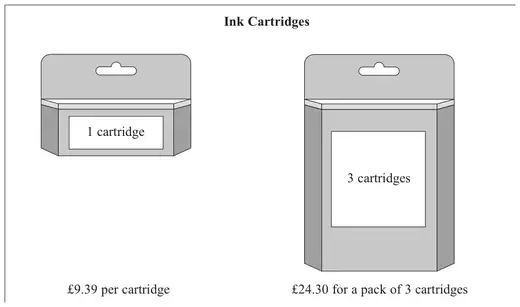
M1 for a correct method to find the most expensive way to buy the 10 cartridges (= 93.90) M1 for a correct method to find the least expensive way to buy the 10 cartridges (= 82.29) M1 (dep on M1 scored) for a correct method to find the difference between their least and their most expensive way, provided that both totals are for the cost of exactly 10 cartridges A1 for 11.61 B1 (indep) for correct units
She wants to buy 3 oranges at 30p each and \(\frac{1}{2}\) kg apples at £1.20 per kg.
The only money Sarah has is one 50p coin and six 20p coins. She pays for the fruit.
Work out how much money Sarah has left. You must show all your working. (5)
Mark scheme
Answer
Mark
Notes
20p
5
M1 for a method to find the price of the apples M1 for a method to find or use the price of 3 oranges ie \(3 \times 30\) OR \(-30-30-30\) M1 for a method to combine the costs of ‘their fruit’ or for a method to total the coins M1 (dep on at least M1 from the first M2 scored) for a method to find the difference between ‘their total of the coins’ and the price of both ‘their fruits’. Could be ‘total’−‘total’ or coins −‘total’ or coins − individual prices. It must be physically possible. C1 (dep on M1) for £0.20 or 20p and valid working
OR M1 for a method to find the price of the apples M1 for a method to find or use the price of 3 oranges ie \(3 \times 30\) OR \(-30-30-30\) M1 for a method to select coins that equate to ‘their total’ for one fruit M1 (dep on at least M1 from the first M2 scored) for a method to select coins that equate to ‘their total’ for both fruits C1 (dep on M1) for £0.20 or 20p and valid working
SC B1 £0.20 or 20p as the answer, no working shown
Work out how much Gary has to pay for the units of electricity he used. (4)
Mark scheme
Answer
Mark
Notes
9
4
M1 for 7155 – 7095 or 60 seen or 7155×15 (or .15) or 7095×15 (or .15) or 107325 or 106425 or 1073.25 or 1064.25 M1 for ‘60’ ×15 or 7155 ×15 – 7095 × 15 [or .15 instead of 15] A1 for 9 or 9.00 or 900 C1 (ft) for answer with correct units (money notation) identified as the answer.
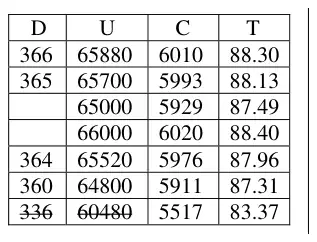
Per year M1 for \(180 \times\) ‘365’ (=65700) M1 for “65700” \(\div 1000\) (=65.7 or 65 or 66) M1 for “65.7” \(\times 91.22\) (=5993.....) A1 for answer in range (£)87 – (£)89 C1(dep on at least M1) for conclusion following from working seen
OR (per day) M1 for \(107 \div\) ‘365’ (=0.293…) M1 for \(180 \div 1000 \times 91.22\) (=16.4196) M1 for \(28.2 \div\) ‘365’ + ‘0.164196’ (units must be consistent) A1 for 29 – 30(p) and 24– 24.3(p) oe C1(dep on at least M1) for conclusion following from working seen
OR M1 for \((107 - 28.20) \div 0.9122\) (=86.384..) M1 for ’86.384..’ \(\times 1000\) (=86384.5…) M1 for ‘365’ \(\times 180\) (=65700) A1 for 65700 and 86384.5.. C1(dep on at least M1) for conclusion following from working seen NB : Allow 365 or 366 or \(52 \times 7\) (=364) or \(12 \times 30\) (=360) or \(365\frac{1}{4}\) for number of days
M1 for \(\frac{42}{100} \times 250\) oe (=105) M1 for \(\frac{2}{5} \times 250\) oe (=100) M1 for 250 − ‘105’ − ‘100’ A1 cao
OR M1 for \(\frac{42}{100} + \frac{2}{5}\) \(\left(= \frac{82}{100}\right)\) or \(\left(= \frac{41}{50}\right)\) M1 for 1 − ‘\(\frac{82}{100}\)’ or 1 − ‘\(\frac{41}{50}\)’ M1 for ‘\(\frac{9}{50}\)’ \(\times 250\) A1 cao
OR M1 for \(\frac{2}{5} \times 100\) or \(\frac{2}{5} = \frac{2 \times 20}{5 \times 20}\) or \(2 \times 20\) M1 for 100 − 42 − ‘40’ (= 18) M1 for ‘0.18’ \(\times 250\) A1 cao
OR M1 for \(\frac{42}{100} + \frac{2}{5}\) \(\left(= \frac{82}{100}\right)\) or \(\left(= \frac{41}{50}\right)\) M1 for ‘\(\frac{41}{50}\)’ \(\times 250\) M1 for 250 − ‘205’ A1 cao
OR M1 for \(\frac{2}{5} \times 100\) or \(\frac{2}{5} = \frac{2 \times 20}{5 \times 20}\) or \(2 \times 20\) M1 for ‘(42 + ‘40’)’/100 \(\times 250\) M1 for 250 − ‘205’ A1 cao
Compares Marks out of 40 or fractions with denominator of 40 M1 for \(35 \div 100 \times 40\) oe or 14 seen (or 14/40 seen) M1 for \(40 \div 8 \times 3\) or 15 seen (or 15/40 seen) A1 for 14 and 15 or \(\frac{14}{40}\) and \(\frac{15}{40}\) C1 (dep on M1) for correct conclusion for their working QWC with 3 comparable marks: Decision and justification should be clear with working clearly presented and attributable.
OR Decimals (or Percentages) M1 for \(16 \div 40\) (\(\times 100\)) oe or 0.4 (or 40) seen M1 for \(3 \div 8\) (\(\times 100\)) oe or 0.375 (or 37.5) seen A1 for 0.4 and 0.375 (or 40 and 37.5) C1 (dep on M1) for correct conclusion for their working QWC: with 3 comparable decimals (or percentages: Decision and justification should be clear with working clearly presented and attributable.
OR Compares Fractions with denominator other than 40 M1 for attempt to convert all to fractions with a common denominator other than 40 M1 for at least 1 correct A1 for \(\frac{80}{200}\) and \(\frac{70}{200}\) and \(\frac{75}{200}\) oe C1 (dep on M1) for correct conclusion for their working QWC with 3 comparable fractions: Decision and justification should be clear with working clearly presented and attributable.
These are the two ways he can pay for the water he uses.
Water Meter
No Water Meter
A charge of £28.20 per year plus 91.22p for every cubic metre of water used 1 cubic metre = 1000 litres
A charge of £107 per year
Henry uses an average of 180 litres of water each day.
Henry wants to pay as little as possible for the water he uses.
Should Henry have a water meter? (5)
Mark scheme
Working
Answer
Mark
Notes
180 × 365 =65700 65700 ÷1000 =65.7 65.7 × 91.22 =5993.154 5993.154÷100 + 28.20 =88.13... (see the table below)
Decision (Should have a water meter installed)
5
Per year M1 for 180 × ‘365’ (= 65700) M1 for ‘65700’ ÷ 1000 (= 65.7 or 65 or 66) M1 for ‘65.7’ × 91.22 (= 5993...) A1 for answer in range (£)87 to (£)89 C1 (dep on at least M1) for conclusion following from working seen OR (per day) M1 for 107 ÷ ‘365’ (= 0.293…) M1 for 180 ÷ 1000 × 91.22 (= 16.4196) M1 for 28.2 ÷ ‘365’ + ‘0.164196’ (units must be consistent) A1 for 29 – 30(p) and 24 – 24.3(p) oe C1 (dep on at least M1) for conclusion following from working seen OR M1 for (107 – 28.20) ÷ 0.9122 (= 86.384..) M1 for ‘86.384..’× 1000 (= 86384.5…) M1 for ‘365’ × 180 (= 65700) A1 for 65700 and 86384.5... C1 (dep on at least M1) for conclusion following from working seen NB : Allow 365 or 366 or 52×7 (=364) or 12 × 30 (=360) or 365¼ for number of days
Up to M3 may be awarded for correct work, with no or incorrect answer, even if this is seen amongst multiple attempts
Note that the third mark is independent
Equivalent methods may be used following 780 and 9 in order to work out the number of paying adults eg \((780 + 9 \times 24.5 - 927) \div 24.5 + 3 = 6\)
M1M1M1
SC3 is the total number of people in the group SC2 is the total number of students plus either the free or paying adults
9 The table shows information about two workers on one day.
Total working time (hours)
Working time spent online (minutes)
Zeke
8
200
Margot
4
110
(a) Margot started work at 10:30am
What time did she finish? [1 mark]
(b) Zeke says he spent more than one quarter of his total working time online.
Is he correct? [3 marks]
Tick a box.
Yes
No
Show working to support your answer.
Mark scheme (a)
Answer
Mark
Comments
2:30pm or 14:30
B1
Additional guidance
Condone 14:30 pm or half past two in the afternoon
B1
2:30 am or 2:30 or half past two
B0
Mark scheme (b)
Answer
Mark
Comments
Alternative method 1
\(8 \div 4\) or 2
M1
oe may be seen by the table
their \(2 \times 60\) or 120
M1dep
oe may be seen by the table
120 and Yes
A1
oe eg Yes and 80 minutes more
Alternative method 2
\(8 \times 60\) or 480
M1
oe may be seen by the table
\(\dfrac{1}{4} \times\) their 480 or 120
M1dep
oe may be seen by the table
120 and Yes
A1
oe eg Yes and 80 minutes more
Alternative method 3
\(8 \times 60\) or 480
M1
oe may be seen by the table
\(\dfrac{200}{8 \times 60}\) or \(\dfrac{200}{480}\)
M1dep
oe fraction, decimal or percentage eg \(0.41\dot{6}\)
\(\dfrac{5}{12}\) and \(\dfrac{3}{12}\) and Yes
A1
oe fractions with common denominator or decimals or percentages eg \(0.41\dot{6}\) and 0.25
Alternative method 4
\(8 \times 60\) or 480
M1
oe may be seen by the table
\(200 \times 4\) or 800
M1
oe may be seen by the table
480 and 800 and Yes
A1
oe
Alternative method 5
\(8 \div 4\) or 2
M1
oe may be seen by the table
\(200 \div 60\) or \(3\dfrac{1}{3}\) or 3.(…)
M1
oe eg 3 hours 20 minutes may be seen by the table
2 and 3.(…) and Yes or 2 and \(3\dfrac{1}{3}\) and Yes
A1
oe eg Yes and 2 hrs and 3 hrs 20 mins eg Yes and 80 minutes more
Additional guidance
Lists: 1h \(=\) 60, 2h \(=\) 120, 3h \(=\) 180, 4h \(=\) 240 … up to 8h \(=\) 480 would gain M1 from alts 2, 3, or 4 for converting 8h to 480 minutes 2h \(=\) 120 needs to be chosen from the list or at the end of the list to gain M2 from alt 1
Accept any unambiguous indication for ticking a box
Ignore any reference to Margot
Accept \(0.41\dot{6}\) and \(41.\dot{6}\) rounded or truncated to at least 2 sf
Alts 4 and 5 the second method mark is independent
(b) In fact, the offer is only for 1 week and there are no new offers.
What does this mean about the number of Saturdays he needs to save for?
Tick one box. [1 mark]
It is less than the answer to part (a)
It is the same as the answer to part (a)
It is greater than the answer to part (a)
It is not possible to tell
Mark scheme (a)
Answer
Mark
Comments
\(25 \div 2\) or 12.5
M1
oe implied by 37.5
\((25 \div 2 + 25) \div 8\) or 4(.6) or better or \((25 \div 2 + 25)\) evaluated and sight of the nearest multiple of 8 under/over their evaluation or 2.5
M1dep
oe multiple may be seen in a list
5 with M2 awarded and no errors
A1
SC1 50 and 7
Additional guidance
SC1 is for two full-priced records
37.5 or 2.5 may be implied, eg 4 Saturdays is 32, need 5.5 more answer 5 (37.5 implied)
5 Put these values in order of size, starting with the smallest. [2 marks]
80% 0.7 \(\dfrac{3}{4}\)
Mark scheme
Answer
Mark
Comments
0.7 \(\dfrac{3}{4}\) 80% with no incorrect working seen
B2
oe B1 at least one correct conversion comparable with another value SC1 reverse order with no incorrect working seen
Additional guidance
Condone missing percentage signs, eg allow 70 for 70%
Correct answer with no working shown
B2
Accept equivalent forms to the given numbers on the answer line eg 70% 75 80% eg 70 75 80 eg 0.7 \(\dfrac{3}{4}\) \(\dfrac{8}{10}\) eg 7% 75% 80%
B2 B2 B2 B1
For B1, to be comparable, fractions must have the same denominator or numerator eg \(\dfrac{7.5}{10}\) \(\dfrac{8}{10}\) eg \(\dfrac{3}{4}\) \(\dfrac{8}{10}\) with no further correct work
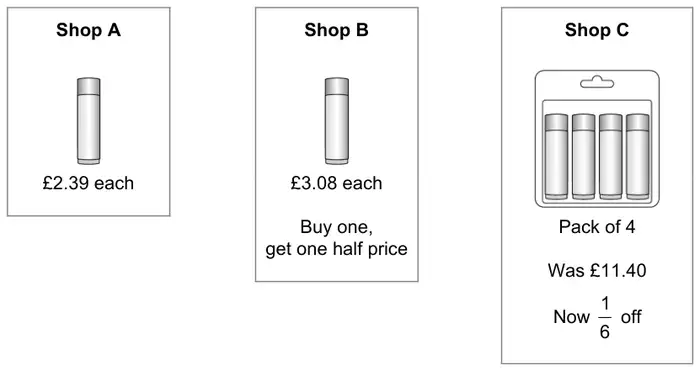
23 Three shops sell the same type and size of lip balm stick.
Which shop is the best value for 8 sticks and what is the total cost in that shop?
Show working to support your answer. [5 marks]
Shop \(\ldots\ldots\ldots\) Total cost £ \(\ldots\ldots\ldots\)
Mark scheme
Answer
Mark
Comments
Alternative method 1: price of buying 8 from each shop
\(2.39 \times 8\) or 19.12
M1
oe shop A
\(3.08 \times 4 + 3.08 \div 2 \times 4\) or 18.48
M1
oe shop B
\(11.4 \div 6\) or 1.9(0) or \(11.4 \times 2 \div 6\) or 3.8(0)
M1
oe shop C
\(11.4 \times 2 -\) their \(1.9(0) \times 2\) or \(11.4 \times 2 -\) their 3.8(0) or 19(.00)
M1dep
oe dep on previous mark \(11.4 \times \dfrac{5}{6} \times 2\) oe scores 3rd & 4th marks
B and 18.48 with 19.12 and 19(.00) seen
A1
Alternative method 2: compares price of individual sticks first
\(3.08 \times 1.5 \div 2\) or 2.31
M1
oe shop B
\((11.4 \div 4) \div 6\) or 0.47(5) or 0.48
M1
oe shop C
\(11.4 \div 4 -\) their 0.475 or 2.37(5) or 2.38
M1dep
oe dep on previous mark \(11.4 \times \dfrac{5}{6} \div 4\) oe scores 2nd & 3rd marks
their \(2.31 \times 8\) or 18.48 with M3 awarded
M1dep
oe
B and 18.48 with 2.31 and 2.37(5) or 2.38 seen
A1
Alternative method 3: compares the price of 4 sticks first
\(2.39 \times 4\) or 9.56 and \(3.08 \times 1.5 \times 2\) or 9.24
M1
oe shops A and B
\(11.4 \div 6\) or 1.9(0)
M1
oe shop C
\(11.4 -\) their 1.9(0) or 9.5(0)
M1dep
dep on previous mark \(11.4 \times \dfrac{5}{6}\) oe scores 2nd & 3rd marks
their \(9.24 \times 2\) or 18.48 with M3 awarded
M1dep
oe
B and 18.48 with 9.56 and 9.24 and 9.5(0) seen
A1
Alternative method 4: compares the price of 2 sticks first
\(2.39 \times 2\) or 4.78 and \(3.08 \times 1.5\) or 4.62
M1
oe shops A and B
\((11.4 \div 2) \div 6\) or 0.95
M1
oe shop C
\(11.4 \div 2 -\) their 0.95 or 4.75
M1dep
dep on previous mark \(11.4 \times \dfrac{5}{6} \div 2\) oe scores 2nd & 3rd marks
their \(4.62 \times 4\) or 18.48 with M3 awarded
M1dep
oe
B and 18.48 with 4.78 and 4.62 and 4.75 seen
A1
Additional guidance
Up to M4 may be awarded for correct work with no answer or incorrect answer, even if this is seen amongst multiple attempts
Use the scheme which gives the highest mark
NB The 4th mark in Alts 2, 3 and 4 does not imply any earlier marks Either the method or values must have been seen and awarded for the first 3 marks in order to give this mark However 18.48 always implies M1 by Alt 1
If students use different numbers of sticks for different shops do not combine marks from different schemes but note that there are possible valid methods that compare eg 2 sticks from A and B and then 4 sticks from B and C (escalate if seen)
All schemes can be oe in pence and allow work in a mix of pounds or pence for up to M4
Allow \(\times\, 0.16(6\ldots)\) or \(\times\, 16(.6\ldots)\%\) or \(\times\, 0.167\) or \(\times\, 16.7\%\) or \(\times\, 0.17\) or \(\times\, 17\%\) if seen for method for one sixth for shop C but must recover to given values for A mark
Allow \(\times\, 0.83(3\ldots)\) or \(\times\, 83(.3\ldots)\%\) if seen for method for five sixths for shop C but must recover to given values for A mark
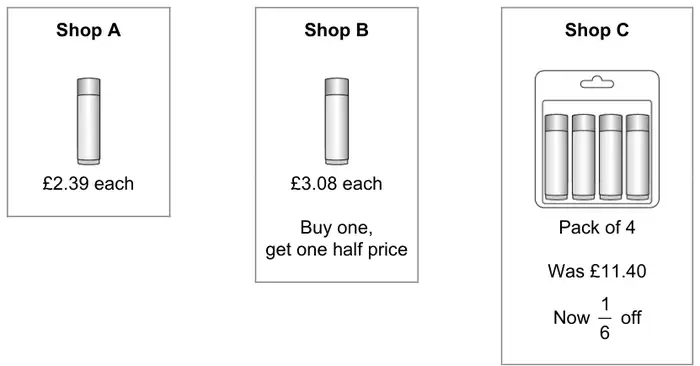
5 Three shops sell the same type and size of lip balm stick.
Which shop is the best value for 8 sticks and what is the total cost in that shop?
Show working to support your answer. [5 marks]
Mark scheme
Answer
Mark
Comments
Alternative method 1: price of buying 8 from each shop
\(2.39 \times 8\) or 19.12
M1
oe shop A
\(3.08 \times 4 + 3.08 \div 2 \times 4\) or 18.48
M1
oe shop B
\(11.4 \div 6\) or 1.9(0) or \(11.4 \times 2 \div 6\) or 3.8(0)
M1
oe shop C
\(11.4 \times 2 -\) their \(1.9(0) \times 2\) or \(11.4 \times 2 -\) their 3.8(0) or 19(.00)
M1dep
oe dep on previous mark \(11.4 \times \dfrac{5}{6} \times 2\) oe scores 3rd & 4th marks
B and 18.48 with 19.12 and 19(.00) seen
A1
Alternative method 2: compares price of individual sticks first
\(3.08 \times 1.5 \div 2\) or 2.31
M1
oe shop B
\((11.4 \div 4) \div 6\) or 0.47(5) or 0.48
M1
oe shop C
\(11.4 \div 4 -\) their 0.475 or 2.37(5) or 2.38
M1dep
oe dep on previous mark \(11.4 \times \dfrac{5}{6} \div 4\) oe scores 2nd & 3rd marks
their \(2.31 \times 8\) or 18.48 with M3 awarded
M1dep
oe
B and 18.48 with 2.31 and 2.37(5) or 2.38 seen
A1
Alternative method 3: compares the price of 4 sticks first
\(2.39 \times 4\) or 9.56 and \(3.08 \times 1.5 \times 2\) or 9.24
M1
oe shops A and B
\(11.4 \div 6\) or 1.9(0)
M1
oe shop C
\(11.4 -\) their 1.9(0) or 9.5(0)
M1dep
dep on previous mark \(11.4 \times \dfrac{5}{6}\) oe scores 2nd & 3rd marks
their \(9.24 \times 2\) or 18.48 with M3 awarded
M1dep
oe
B and 18.48 with 9.56 and 9.24 and 9.5(0) seen
A1
Alternative method 4: compares the price of 2 sticks first
\(2.39 \times 2\) or 4.78 and \(3.08 \times 1.5\) or 4.62
M1
oe shops A and B
\((11.4 \div 2) \div 6\) or 0.95
M1
oe shop C
\(11.4 \div 2 -\) their 0.95 or 4.75
M1dep
dep on previous mark \(11.4 \times \dfrac{5}{6} \div 2\) oe scores 2nd & 3rd marks
their \(4.62 \times 4\) or 18.48 with M3 awarded
M1dep
oe
B and 18.48 with 4.78 and 4.62 and 4.75 seen
A1
Additional guidance
Up to M4 may be awarded for correct work with no answer or incorrect answer, even if this is seen amongst multiple attempts
Use the scheme which gives the highest mark
NB The 4th mark in Alts 2, 3 and 4 does not imply any earlier marks Either the method or values must have been seen and awarded for the first 3 marks in order to give this mark However 18.48 always implies M1 by Alt 1
If students use different numbers of sticks for different shops do not combine marks from different schemes but note that there are possible valid methods that compare eg 2 sticks from A and B and then 4 sticks from B and C (escalate if seen)
All schemes can be oe in pence and allow work in a mix of pounds or pence for up to M4
Allow \(\times\) 0.16(6…) or \(\times\) 16(.6…)% or \(\times\) 0.167 or \(\times\) 16.7% or \(\times\) 0.17 or \(\times\) 17% if seen for method for one sixth for shop C but must recover to given values for A mark
Allow \(\times\) 0.83(3…) or \(\times\) 83(.3…)% if seen for method for five sixths for shop C but must recover to given values for A mark
8 Put these probabilities in order, starting with the least likely. [2 marks]
\[72\% \qquad 0.705 \qquad \dfrac{7}{10}\]
Mark scheme
Answer
Mark
Comments
\(\dfrac{7}{10}\), 0.705, 72% with no incorrect conversions
B2
accept in any format eg 0.7, 0.705, 0.72 B1 correctly converts at least one to a different form which shows at least two in comparable form eg 0.72 or 70.5(%) or 0.7 or 70(%) or \(\dfrac{72}{100}\) and \(\dfrac{70}{100}\)
Additional guidance
Condone missing percentage signs
Examples of probabilities in the same comparable form 70(%), 70.5(%), (72%) 0.7(00), (0.705), 0.72(0) \(\left(\dfrac{7}{10}\right), \dfrac{7.05}{10}, \dfrac{7.2}{10}\) or \(\dfrac{70}{100}, \dfrac{70.5}{100}, \dfrac{72}{100}\) or \(\dfrac{700}{1000}, \dfrac{705}{1000}, \dfrac{720}{1000}\)
\(\dfrac{7}{10}\), 0.705, 72(%) with no working
B2
Award B2 with no incorrect conversions eg1 Answer \(\dfrac{7}{10}\), 0.705, 72(%) with \(\dfrac{28}{40}\) and \(\dfrac{70.5}{100}\) eg2 Answer \(\dfrac{7}{10}, \dfrac{705}{1000}, \dfrac{72}{100}\) with no incorrect conversions
B2
Do not award B2 with an incorrect conversion eg \(\dfrac{7}{10}\), 0.705, 72(%) with 70(%) and 70.05(%)
B1
\(\dfrac{72}{100}\) and \(\dfrac{705}{1000}\) and \(\dfrac{7}{10}\) in working (not comparable conversions)
B0
\(\dfrac{141}{200}\) alone without \(\dfrac{140}{200}\) or \(\dfrac{144}{200}\)
26 At a country park there is a house, a museum and a garden.
The table shows the prices per person to visit the park.
Price per person
Garden only
Free
House and museum
£12.50
House only
£8
Museum only
£7
One day, 480 people visit the park.
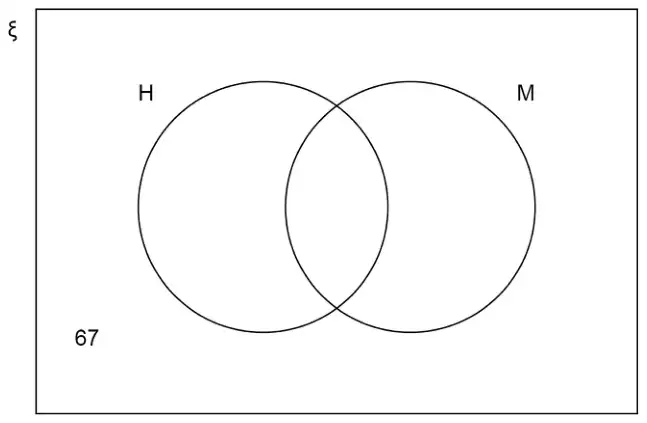
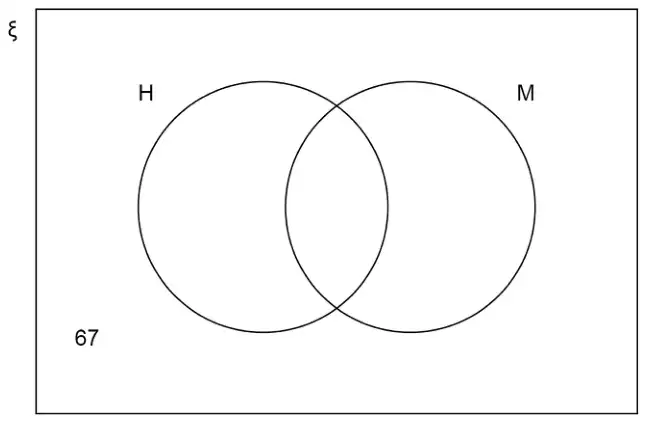
67 visit the garden only. 40% visit the house and the museum. \(\dfrac{3}{8}\) visit the house only. The rest visit the museum only.
In total, how much do the 480 people pay to visit the park?
You may use the Venn diagram to help you. [5 marks]
Mark scheme
Answer
Mark
Comments
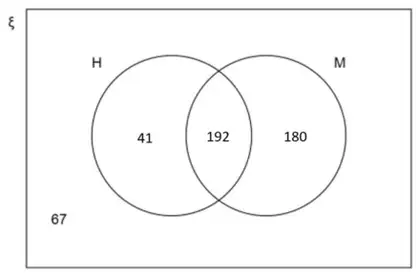
\(480 \times 0.4\) or 192
M1
oe implied by 2400
\(480 \times \dfrac{3}{8}\) or 180
M1
oe implied by 1440
\(480 -\) their \(192 -\) their \(180 - 67\) or 41
M1
oe implied by 287
their \(192 \times 12.5 +\) their \(180 \times 8 +\) their \(41 \times 7\) or \(2400 + 1440 + 287\)
M1
4127
A1
Additional guidance
Method marks may be awarded for correct work seen on Venn diagram or in working, with no or incorrect answer, even if this is seen amongst multiple attempts
For the 4th method mark, incorrectly placed values from their Venn diagram may be used or values connected to the correct category eg if house only and museum only values transposed on the Venn diagram accept their \(192 \times 12.5 +\) their \(41 \times 8 +\) their \(180 \times 7\)
6 At a country park there is a house, a museum and a garden.
The table shows the prices per person to visit the park.
Price per person
Garden only
Free
House and museum
£12.50
House only
£8
Museum only
£7
One day, 480 people visit the park.
67 visit the garden only.
40% visit the house and the museum.
\(\dfrac{3}{8}\) visit the house only.
The rest visit the museum only.
In total, how much do the 480 people pay to visit the park?
You may use the Venn diagram to help you. [5 marks]
Mark scheme
Answer
Mark
Comments
\(480 \times 0.4\) or 192
M1
oe implied by 2400
\(480 \times\) \(\dfrac{3}{8}\) or 180
M1
oe implied by 1440
\(480 -\) their \(192 -\) their \(180 - 67\) or 41
M1
oe implied by 287
their \(192 \times 12.5 +\) their \(180 \times 8 +\) their \(41 \times 7\) or \(2400 + 1440 + 287\)
M1
4127
A1
Additional guidance
Method marks may be awarded for correct work seen on Venn diagram or in working, with no or incorrect answer, even if this is seen amongst multiple attempts
For the 4th method mark, incorrectly placed values from their Venn diagram may be used or values connected to the correct category eg if house only and museum only values transposed on the Venn diagram accept their \(192 \times 12.5 +\) their \(41 \times 8 +\) their \(180 \times 7\)
Correct conversion to a comparable form \(\left(\dfrac{31}{40} =\right)\) 0.775 or \(\left(\dfrac{3}{4} =\right)\) \(\dfrac{30}{40}\) or 0.75 or \(\left(\dfrac{7}{10} =\right)\) \(\dfrac{28}{40}\) or 0.7 or (0.725 =) \(\dfrac{29}{40}\) or any two of 77.5(%), 75(%), 70(%), 72.5(%)
M1
\(\dfrac{7}{10}\) 0.725 \(\dfrac{3}{4}\) \(\dfrac{31}{40}\) with no incorrect working
A1
oe accept in converted form
Additional guidance
Two correct conversions using fractions with common denominators other than 40 eg \(\dfrac{124}{160}\) and \(\dfrac{120}{160}\)
M1
Correct order with incorrect working \(\dfrac{31}{40} = 0.925\), \(\dfrac{3}{4} = 0.75\), \(\dfrac{7}{10} = 0.7\) \(\dfrac{7}{10}\), 0.725, \(\dfrac{3}{4}\), \(\dfrac{31}{40}\)
28% of the total profit the company makes from her sales
a £250 bonus if she sells at least 15 cars.
The table shows information about the cars she sold last year.
Total cost to the company
Total income for the company
Number of months when she sold at least 15 cars
£464 500
£538 000
3
Was Ellen’s total pay for the year more than £40 000?
You must show your working. [6 marks]
Mark scheme
Answer
Mark
Comments
\(3 \times 250\) or 750
M1
\(1470 \times 12\) or 17 640
M1
\(538\,000 - 464\,500\) or 73 500
M1
their 73 500 \(\times\) 0.28 or 20 580
M1dep
oe dep on 3rd M1
their 17 640 \(+\) their 20 580 \(+\) their 750 or 38 970
M1dep
dep on 3rd and 4th M1 Must be adding salary, profit share and bonus
38 970 and No
A1
Additional guidance
For the last method mark, the 3rd and 4th M must have been awarded, but allow the addition of any number of months’ salary and any number of £250 bonuses (at least one month of salary and at least one month of bonus)
\(1470 + 20\,580 + 250\)
M0M0M1 M1dep M1depA0
20 580
3rdM1 4thM1dep
Build up method for 28% must be correct or method shown for incorrect parts eg1 1% of 73 500 = 730, 28% = 20 440 (will also lose the 5th Mdep) eg2 1% of 73 500 = \(73\,500 \div 100\) = 730, 28% = 20 440 eg3 10% of 73 500 = 7350, 1% = 73.5, 28% = 2058 (and 5th Mdep0) eg4 10% of 73 500 = 7350, 1% = \(7350 \div 10\) = 73.5, 28% = 7350 + 7350 + 588 = 15 288
The normal price of a bottle is the same at each shop.
Shop A Buy 1 bottle Get 2 more bottles at half price
Shop B Buy 2 bottles Get 3 more bottles at half price
Shop C 30% off a bottle
What is the cheapest way to buy exactly 8 bottles?
You can buy from more than one shop.
You must show your working. [3 marks]
Mark scheme
Answer
Mark
Comments
Alternative method 1 – price for 8 bottles
Any two (including at least one combination) of Single shops Method to work out cost using one shop Shop A \(3 \times 1 + 5 \times 0.5\) or 5.5 or \(4 \times 1 + 4 \times 0.5\) or 6 or Shop B \(4 \times 1 + 4 \times 0.5\) or 6 or \(5 \times 1 + 3 \times 0.5\) or 6.5 or Shop C \(8 \times 0.7\) or 5.6 Combinations Method to work out cost using two shops A and B \((1 + 2 \times 0.5) + (2 \times 1 + 3 \times 0.5)\) or 5.5 or B and C \((2 \times 1 + 3 \times 0.5) + (3 \times 0.7)\) or 5.6 or A and C \((2 \times 1 + 4 \times 0.5) + (2 \times 0.7)\) or 5.4 or \((1 \times 1 + 2 \times 0.5) + (5 \times 0.7)\) or 5.5
M2
oe Values may be in £ throughout M1 for any one single shop or combination
6 bottles from A and 2 bottles from C with M2 awarded
A1
Condone 2 from A and 2 from C with M2 awarded SC2 6 bottles from A and 2 bottles from C with M1M0 awarded SC1 6 bottles from A and 2 bottles from C with M0M0 awarded
Alternative method 2 – best average cost per bottle
A is \(\dfrac{2}{3}\) or B is 0.7 or C is 0.7
M1
Accept 0.66 or 66(p) or better truncation or rounding or 0.67 or 67(p)
A is \(\dfrac{2}{3}\) and B is 0.7 and C is 0.7
M1
6 bottles from A and 2 bottles from C with M2 awarded
A1
Condone 2 from A and 2 from C with M2 awarded SC2 6 bottles from A and 2 bottles from C with M1M0 awarded SC1 6 bottles from A and 2 bottles from C with M0M0 awarded
Additional guidance
In both methods, if a price or variable is chosen, values would be the respective multiples of that price or variable
For SC2, the M1 may have been awarded for the correct method or price for a different selection of 8 bottles or for the 6 from A and 2 from C eg only working is 6 from A and 2 from C and £5.40
SC2
Calculations or total costs may not be labelled, but shops may be implied by prices
An incorrect evaluation of the total cost of 6 from A and 2 from C leads to a maximum of M1M1A0 Ignore other incorrect evaluations which do not affect the award of marks
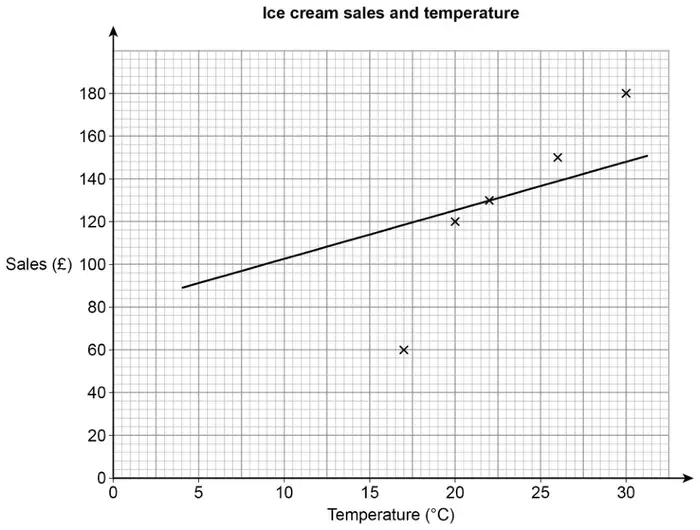
The table shows the midday temperature and his sales for five days.
Day 1
Day 2
Day 3
Day 4
Day 5
Temperature (°C)
30
26
17
22
20
Sales (£)
180
150
80
130
120
(a) He draws this scatter graph and line of best fit.
Write down two mistakes he has made. [2 marks]
(b) Lee wants to work out the range of the five temperatures.
His calculation is \(\quad 30 - 20 = 10\)
Is his method correct?
Tick a box. [1 mark]
Yes
No
Give a reason to support your answer.
(c) The table shows Lee’s costs.
Ingredients
15% of sales
Fuel
£7 per day
Work out his total profit for the five days. [5 marks]
Mark scheme (a)
Answer
Mark
Comments
Correct criticisms about any two of the incorrect plotting of (17, 80) at (17,60) the incorrect position of the line of best fit the incorrect length of the line of best fit (outside the range of the data)
B2
B1 for one correct comment about point, position or length
Allow reference to a better line of best fit drawn eg The line should look like mine
Additional guidance
A comment about the incorrect point must refer to the specific point
One of the points is wrong and point at (17, 60) circled on graph
B1
Not plotted (17, 80) correctly
B1
x on 60 should be on 80
B1
Point at 60 is wrong
B1
Day 3 is wrong/ there is no day 3 on the graph
B1
17 is plotted at 60/ 17 should be plotted at 80
B1
One of the points is wrong
B0
Points on the graph don’t match the table
B0
Not put all the points in the correct place
B0
A comment about the line of best fit must not have any misconception
The line is not steep enough/ at wrong angle/ should be more vertical
B1
The line isn’t a line of best fit/ the line doesn’t fit the points
B1
The line of best fit goes below 17/ condone past 30 (implies outside range)
B1
The line of best fit is wrong/ not drawn accurately/ not drawn properly
B0
It isn’t a line of best fit because it doesn’t start at 0
B0
The line of best fit is wrong it should go through (0, 0)
B0
The line of best fit doesn’t go through the points
B0
The line is wrong it only goes through one cross
B0
The line of best fit doesn’t go to the axis (implies it’s too short)
B0
Mark scheme (b)
Answer
Mark
Comments
Ticks No and explanation that it should be the highest value – the lowest value
B1
Allow any unambiguous indication of No, if boxes blank may be in the reason oe eg No, it should be the hottest – the coldest
Additional guidance
Does not tick or say No
B0
Ticks No and It should be \(30 - 17\)
B1
Ticks No and It should be 13
B1
Ticks No and He hasn’t subtracted the lowest value
B1
Ticks No and It should be \(17 - 30 = 13\)
B1
Ticks No and Range = biggest – smallest
B1
Ticks No and The lowest temperature is 17 not 20
B1
Ticks No and He hasn’t used the lowest temperature
B1
Ticks No and The lowest temperature is not 20
B1
Ticks No and The lowest temperature is 17
B1
Ticks No and The numbers range from 17 to 30
B1
Ticks No and It should be \(30 - 17 = 23\)
B0
Ticks No and It should be \(17 - 30\)
B0
Ticks No and You should take the smallest from the largest \(30 - 26\)
B0
Ticks No and You should take the smallest from the largest \(180 - 17\)
B0
Ticks No and It should be the smallest – the largest
B0
Ticks Yes and It should be the highest value – the lowest value
B0
Mark scheme (c)
Answer
Mark
Comments
Alternative method 1
\(180 + 150 + 80 + 130 + 120\) or 660
M1
their \(660 \times 0.15\) or 99 or their \(660 \times 0.85\) or 561
M1dep
oe
\(7 \times 5\) or 35
M1
their 660 \(-\) their 99 \(-\) their 35 or their 561 \(-\) their 35
M1dep
dep on M1M1M1
526(.00)
A1
SC4 509
Alternative method 2
\(180 \times 0.15\) or 27 and \(150 \times 0.15\) or 22.5(0) and \(80 \times 0.15\) or 12 and \(130 \times 0.15\) or 19.5(0) and \(120 \times 0.15\) or 18
M1
oe
their 27 \(+\) their 22.5(0) \(+\) their 12 \(+\) their 19.5(0) \(+\) their 18 or 99
M1dep
\(7 \times 5\) or 35
M1
\(180 + 150 + 80 + 130 + 120 -\) their 99 \(-\) their 35
M1dep
dep on M1M1M1
526(.00)
A1
SC4 509
Alternative method 3
\(180 \times 0.15\) or 27 and \(150 \times 0.15\) or 22.5(0) and \(80 \times 0.15\) or 12 and \(130 \times 0.15\) or 19.5(0) and \(120 \times 0.15\) or 18
M1
oe
180 \(-\) their 27 or 153 and 150 \(-\) their 22.5(0) or 127.5(0) and 80 \(-\) their 12 or 68 and 130 \(-\) their 19.5(0) or 110.5(0) and 120 \(-\) their 18 or 102
M1dep
Working out 85% of all five sales scores M1M1dep
\(7 \times 5\) or 35 or their 153 \(-\) 7 or 146 and their 127.5(0) \(-\) 7 or 120.5(0) and their 68 \(-\) 7 or 61 and their 110.5(0) \(-\) 7 or 103.5(0) and their 102 \(-\) 7 or 95
M1
Subtracting five 7s
their 153 \(+\) their 127.5(0) \(+\) their 68 \(+\) their 110.5(0) \(+\) their 102 \(-\) their 35 or their 146 \(+\) their 120.5(0) \(+\) their 61 \(+\) their 103.5(0) \(+\) their 95
M1dep
dep on M1M1M1
526(.00)
A1
SC4 509
Alternative method 4
\(180 \times 0.15\) or 27 and \(150 \times 0.15\) or 22.5(0) and \(80 \times 0.15\) or 12 and \(130 \times 0.15\) or 19.5(0) and \(120 \times 0.15\) or 18
M1
oe
their 27 \(+\) 7 or 34 and their 22.5(0) \(+\) 7 or 29.5(0) and their 12 \(+\) 7 or 19 and their 19.5(0) \(+\) 7 or 26.5(0) and their 18 \(+\) 7 or 25
M1
Adding five 7s
their 34 \(+\) their 29.5(0) \(+\) their 19 \(+\) their 26.5(0) \(+\) their 25 or 134 or 180 \(-\) their 34 or 146 and 150 \(-\) their 29.5(0) or 120.5(0) and 80 \(-\) their 19 or 61 and 130 \(-\) their 26.5(0) or 103.5(0) and 120 \(-\) their 25 or 95
M1dep
dep on M1M1
\(180 + 150 + 80 + 130 + 120 -\) their 134 or their 146 \(+\) their 120.5(0) \(+\) their 61 \(+\) their 103.5(0) \(+\) their 95
M1dep
dep on M1M1M1
526(.00)
A1
SC4 509
Additional guidance
509 comes from using 60 from the incorrect point on the scatter graph
Build up method for 15% must be correct or method shown for incorrect parts eg 10% of 660 = 60, 5% = 30, 15% = 90 eg 10% of 660 = \(660 \div 10\) = 60, 5% = 30, 15% = 90
“I will buy 15 pencils. Then I will buy as many rulers as possible. With my change I will buy more pencils.”
How many pencils and how many rulers does she buy? [6 marks]
Mark scheme
Answer
Mark
Comments
Alternative method 1
\(15 \times 8\) or 120
M1
500 \(-\) their 120 or 380
M1dep
their 380 \(\div\) 30 or 12(…)
M1dep
oe builds up in 30s to at least their 380 \(-\) 30 or builds up in 30s from their 120 to at least 470 allow one error in any build up method
their \(12 \times 30\) or 360 or their 12 chosen from a build up
M1dep
oe their 12 must either come from rounding down their 12.(…) or from choosing their 12 out of a build up or because they had an exact answer of their 12 from a correct method for the third mark
their 380 \(-\) their 360 or 20 or 500 \(-\) (their 360 \(+\) their 120) or their 360 \(+ 8 + 8\) (their correct number of 8s) or 376 or their 360 \(+\) their 120 \(+ 8 + 8\) (their correct number of 8s) or 496
M1dep
their 20 must be \(0 \lt\) their \(20 \lt 30\)
17 pencils, 12 rulers
A1
Alternative method 2
\(15 \times 0.08\) or 1.2(0)
M1
5 \(-\) their 1.2(0) or 3.8(0)
M1dep
their 3.8(0) \(\div\) (0).3(0) or 12(...)
M1dep
oe builds up in (0).3(0)s to at least their 3.8(0) \(-\) (0).3(0)* allow one error or builds up in (0).3(0)s from their 1.2(0) to at least 4.7(0) allow one error
their \(12 \times 0.3(0)\) or 3.6(0) or their 12 chosen from a build up
M1dep
dep on previous mark their 12 must either come from rounding down their 12.(…) or from choosing their 12 out of a build up or because they had an exact answer of their 12 from a correct method for the third mark
their 3.8(0) \(-\) their 3.6(0) or (0).2(0) or 5 \(-\) (their 3.6(0) \(+\) their 1.2(0)) or their 3.6(0) \(+\) (0).08 \(+\) (0).08 (their correct number of (0).08s) or 3.76 or their 3.6(0) \(+\) their 1.2(0) \(+\) (0).08 \(+\) (0).08 (their correct number of (0).08s) or 4.96
M1dep
their 0.20 must be \(0 \lt\) their \(0.20 \lt 0.30\)
17 pencils, 12 rulers
A1
Additional guidance
Do not allow mixed units in working unless recovered
For build-up, one arithmetic mistake counts as one error, even though more than one value may be affected eg, 30, 60, 90, 130, 160, 190, 220, 250, 280, 310, 340, 370 gets 3rd mark in alternative method 1 (error from 90 to 130, but 30 then added correctly throughout)
If there is no change possible, or change is not considered after rulers are bought, it is maximum M4
Example \(\;15 \times 8 = 120 \qquad 500 - 120 = 360\) \(360 \div 30 = 12\) then 12 chosen as number of rulers but no further work (4th mark awarded despite no “remainder” but 5th mark has to consider change)
M1M1M1M1M0A0
Example \(\;15 \times 8 = 120 \qquad 500 - 120 = 380\) \(380 \div 30 = 9.2\) and 9 chosen as the number of rulers (no further work)
M1M1M1M1A0A0
Notes
* Corrected from the printed mark scheme, which says “their 3.8(0) \(-\) 30”.
14 A 1.5 litre carton of orange juice costs £1.30. Gabi has £10 to spend on orange juice and buys the maximum possible number of cartons.
Each day Gabi drinks 350 millilitres of the orange juice she has just bought.
Work out how many days the orange juice will last Gabi. You must show your working. [5]
Mark scheme
Answer
Marks
Part marks and guidance
30 with correct working
5
Correct working requires evidence of correct consistent units and 7
B2 for 7 or B1 for \(\dfrac{10}{1.3}\) oe or repeated addition or subtraction reaching 9.1 or 0.9
AND
B2 or B1 maybe implied from use in subsequent working Award B marks even if not used to find final answer and not contradicted.
M2 for \(\dfrac{\textit{their}\left(\frac{10}{1.3}\right) \times 1.5}{0.35}\) or \(\dfrac{\textit{their}\left(\frac{10}{1.3}\right) \times 1500}{350}\) or \(\dfrac{10500}{350}\) or \(\dfrac{10.5}{0.35}\) or M1 for \(\dfrac{\textit{their}\left(\frac{10}{1.3}\right) \times \text{figs}15}{\text{figs}35}\) or \(\dfrac{\textit{figs}105}{\textit{figs}35}\) or \(\dfrac{1500}{350}\) or \(\dfrac{1.5}{0.35}\)
their \(\dfrac{10}{1.3}\) maybe implied by 7.69 to 7.7 or 8
Award M marks even if not used to find final answer and not contradicted.
If 0 or 1 scored, instead award SC2 for answer 30 with no or insufficient working
If 0 scored, instead award SC1 for answer figs 3 with no or insufficient working
13 Jane and Kofi both have the same number of newspapers to deliver.
By 8 am
Jane has delivered 64% of her newspapers
Kofi has delivered \(\dfrac{5}{8}\) of his newspapers.
(a) Who has delivered the greater proportion of their newspapers? Show how you decide. [3]
(b) Work out the smallest possible number of newspapers that Jane must deliver. [2]
Mark scheme (a)
Answer
Marks
Part marks and guidance
Jane
and
two correct values in the same form
3
Reminder: mark at most accurate
Method 1 B2 for 64% and \(\frac{5}{8}\) correct in a common form or B1 for one correct conversion
Method 2 Candidate chooses an integer amount of newspapers B2 for (64% and \(\frac{5}{8}\)) of their amount correct or B1 for (64% or \(\frac{5}{8}\)) of their amount correct
If 0 scored, SC1 for correct judgement for their incorrect conversion(s)
Condone 0.62 and 0.63 and 62[%] and 63[%] Sufficient to see just 62.5[%] to make comparison e.g. \(\frac{128}{200}\) and \(\frac{125}{200}\) or 0.64 and 0.625 Condone bad form e.g \(\frac{12.8}{20}\) and \(\frac{12.5}{20}\) or 64 and 62.5 or 6.4 and 6.25
For B1: e.g. 0.625 or \(\frac{125}{200}\) or \(\frac{128}{200}\) or 62.5
You will need to check their figures Answers can be non-integer e.g. Chooses 70 64% = 44.8 \(\frac{5}{8}\) = 43.75 Allow accuracy sufficient to make judgement and condone truncation
Mark scheme (b)
Answer
Marks
Part marks and guidance
200
2
B1 for answer 100 or answer \(200n\) with \(n\) integer \(\gt 1\)
11 Sam eats 30% of a 600 g pack of cereal every day. Sam has no cereal left.
The cereal is no longer sold in 600 g packs. Instead, the cereal is now sold in 400 g packs. Sam wants to continue to eat the same amount of cereal every day.
Work out the minimum number of 400 g packs of cereal that Sam must buy to have enough for 7 days.
You must show your working. [5]
Mark scheme
Answer
Marks
Part marks and guidance
4 with correct working
5
B4 for answer 3.15 or \(\dfrac{63}{20}\), \(3\dfrac{3}{20}\) or 6.6[6..] or 6.7 with correct working
“Correct working” requires evidence of at least M2 Condone for B4 answer of 3 following 3.15
OR M3 for \(\dfrac{600 \times 0.3 \times 7}{400}\) oe or for \(400 \div 180 \times 3\) or for 1260 with both \(4 \times 400\) and \(3 \times 400\)
M3 and M2 may be seen in stages
may be implied by 1260, 1600 and 1200
OR M2 for \(600 \times 0.3 \times 7\) or for \(\dfrac{600 \times 0.3}{400}\) or for \(400 \div 180\) or for \(400 - 180 - 180\) or for both \(4 \times 400\) and \(3 \times 400\)
may be implied by 1260 or 0.45 may be implied by 2.2(22…) may be implied by 1600 and 1200
OR M1 for \(600 \times 0.3\) or for \(0.3 \times 7\) or for \(\dfrac{600}{400}\)
may be implied by 180 may be implied by 2.1 may be implied by 1.5
0 or 1 scored, instead award SC2 for answer 4 with no or insufficient working If 0 scored, instead award SC1 for answer 3.15 with no or insufficient working
B3 for all 4 expressed in an equivalent comparable form
or
B2 for 3 expressed in an equivalent comparable form
or
B1 for 2 expressed in an equivalent comparable form
Equivalent comparable form is either decimal, percentage or standard index form. Fractions only acceptable as comparable form with common denominators.
For final answer, accept some or all given as equivalent form on answer line. eg. Full marks for 0.003[003…], 0.0031, 0.0036, 0.03 or \(\frac{1}{333}\), \(\frac{31}{10\,000}\), \(\frac{9}{2500}\), \(\frac{3}{100}\)
Where choice of comparable form, mark to candidate’s advantage.
Likely comparable form (award best row):
0.36%
\(\frac{1}{333}\)
0.03
\(3.1 \times 10^{-3}\)
0.36[%]
0.3[003…][%]
3[%]
0.31[%]
0.0036
0.003[003…]
0.03
0.0031
\(3.6 \times 10^{-3}\)
\(3[.003\ldots] \times 10^{-3}\)
\(3 \times 10^{-2}\)
\(3.1 \times 10^{-3}\)
\(\frac{11\,988}{3\,330\,000}\)
\(\frac{10\,000}{3\,330\,000}\)
\(\frac{99\,900}{3\,330\,000}\)
\(\frac{10\,323}{3\,330\,000}\)
Notes
In the percentage row of the table, \(\frac{1}{333}\) is printed in the mark scheme as 0.00003[003…][%]; it has been corrected here to 0.3[003…][%].
14 A student is buying some gifts for their friends. The gifts are shown below with the prices.
The student has £50 to spend. They first buy 6 key rings and 2 wallets. They then buy badges with the remainder of the money.
(a) Work out the maximum number of badges that the student can buy. You must show your working. [5]
(b) Work out the amount of money they have left over. [2]
Mark scheme (a)
Answer
Marks
Part marks and guidance
4 [badges] with correct working
5
M3 for 50 – \((6 \times 3.50 + 2 \times 7.50)\) oe or M2 for \(6 \times 3.50 + 2 \times 7.50\) oe or M1 for \(6 \times 3.50\) or \(2 \times 7.50\) oe
AND
M1 for their (50 – \((6 \times 3.50 + 2 \times 7.50)) \div 2.99\) oe
If 0 or 1 scored, instead award SC2 for 4 [badges] with no or insufficient working or If 0 scored SC1 for 14 with no or insufficient working
‘Correct working’ requires full evidence of at least M2M1
M3 implied by 14, 15, 21 seen or 14, 36 seen M2 implied by 36 M1 implied by 21 or 15
Accept their (50 – \(6 \times 3.50 + 2 \times 7.50) \div 3\) Implied by list 2.99, 5.98, 8.97, 11.96, [14.95, …….] up to one less than their 14 Condone one arithmetic slip. or 3, 6, 9, 12, [15, ……] up to one less than their 14 or Embedded e.g. 4 x 2.99 = 11.96
Mark scheme (b)
Answer
Marks
Part marks and guidance
2.04
2
M1 for their 14 – their ((a) \(\times\) 2.99) oe
their ((a) \(\times\) 2.99) could be seen in part (a) and must be \(\lt\) their 14
M1 can be implied by a correct FT answer to their 14 – their ((a) \(\times\) 2.99)
13 Here are the ticket prices for a zoo when bought at the gate.
Adult
£22
Child
£18
Family ticket (2 adults and up to 4 children)
£80
(a) Mr and Mrs Khan take their four children to the zoo. They buy their tickets at the gate.
How much do Mr and Mrs Khan save by buying a family ticket? [4]
(b) All ticket prices are reduced by 15% if bought online rather than at the gate. Mr and Mrs Morris take their one child to the same zoo. They buy their tickets online.
What is the lowest possible total cost of their tickets? [4]
Mark scheme (a)
Answer
Marks
Part marks and guidance
36
4
M3 for \((2 \times 22 + 4 \times 18) - 80\) oe or M2 for \(2 \times 22 + 4 \times 18\) may be implied by \(44 + 72\) or 116 or M1 for \(2 \times 22\) or \(4 \times 18\) may be implied by 44 or 72
Mark scheme (b)
Answer
Marks
Part marks and guidance
52.7[0]
4
M3 for \(0.85 \times (2 \times 22 + 18)\) oe soi by \(0.85 \times 62\) or M2 for \(0.85 \times\) their price oe may be done in stages, soi by 15.3[0], 18.7[0], 34[.00], 37.4[0], or 68[.00] or \(0.15 \times (2 \times 22 + 18)\) oe soi by \(0.15 \times 62\) or 9.3[0]
or M1 for \(0.15 \times\) their price oe may be done in stages, soi by 2.7[0], 3.3[0], 6[.00], 6.6[0], or 12[.00]
oe includes reducing individual prices before summing
their price must be 18, 22, 18+22 or 40, 22+22 or 44, or 80
If done in stages, award M2 or M1 if at least one correct calculation
3 There are 150 coins in a jar. 20% of the coins are 10p coins. \(\dfrac{3}{10}\) of the coins are 20p coins. The rest of the coins are 50p coins.
Work out the total value, in £, of the 150 coins. You must show your working. [6]
Mark scheme
Answer
Marks
Part marks and guidance
49.50 with correct working
6
B5 for figs 495 as final answer with at least the M2 mark
OR
M1 for [10p =] \(0.2 \times 150\) oe soi 30 M1 for [20p =] \(0.3 \times 150\) oe soi 45 and M1 for (150 − their 30 − their 45) oe soi by 75 and M2 for (their \(30 \times 10\)) and (their \(45 \times 20\)) and (their \(75 \times 50\)) oe or M1 for one from (their \(30 \times 10\)) or (their \(45 \times 20\)) or (their \(75 \times 50\)) oe
If 0 or 1 scored and no/insufficient working seen SC2 for figs 495 as final answer
Ignore money notation Ignore money notation
May be \(150 \div 2\)
May work in £ Implied by 300, 900, 3750 or £3, £9, £37.5[0]
She buys each one for £32 and sells it for £60. She also pays £7 for the delivery of each microwave she sells.
If she sells a microwave that is faulty then Lily must pay for its repair and redelivery. This costs her another £25 for each faulty microwave.
Last month, 6 out of the 80 microwaves Lily sold were faulty.
This month she has orders for 133 microwaves.
Calculate her expected percentage profit on this month’s order. Showing your working in the boxes below may help you present your work.
Expected number of faulty microwaves:
Expected costs:
Income from sales:
Expected percentage profit:
[6]
Mark scheme
Answer
Marks
Part marks and guidance
46.77 to 46.84 or 47 nfww
or (using 9)
47.45 to 47.5 or 48 nfww
6
B2 for 9, 9.9, 9.975, 9.98 or 10 or M1 for [faulty =] \(\dfrac{6}{80}\) [× 133] oe AND M1 for [costs = ] 133 × (32 + 7) + their 10 × 25 oe or their 5187 + their 10 × 25
14 Harry is paid £8.60 per hour for the first 30 hours he works each week. After 30 hours he is paid \(1\frac{1}{2}\) times the hourly rate.
Last week, Harry worked for 33 hours. He was also paid a bonus of \(\dfrac{1}{10}\) of his earnings for that week.
Calculate how much Harry was paid in total last week. [6]
Mark scheme
Answer
Marks
Part marks and guidance
326.37
6
B4 for 296.7[0] M1 for 296.7[0] × 1.1 oe
OR
M1 for 8.6[0] × 30 oe soi 258 and M2 for 8.6 × 1.5 × 3 oe or M1 for 8.6 × 1.5 oe or 8.6 × 3 oe or 1.5 × 3 oe and M1 for their basic pay + their overtime and M1 for their final value × 1.1 oe
Alternative method
M1 for 33 × 8.6 soi by 283.8[0] and M2 for 8.6 × 0.5 × 3 oe or M1 for 8.6 × 0.5 oe or 8.6 × 3 oe or 0.5 × 3 oe and M1 for their basic pay + their overtime and M1 for their final value × 1.1 oe
On Friday, he is paid £8.50 per hour. On Saturday, he is paid \(1\frac{1}{2}\) times that rate.
He works for 4 hours on Friday. He works from 8 am until 1 pm on Saturday.
How much does Harry earn in total for these two days? [6]
Mark scheme
Answer
Marks
Part marks and guidance
97.75
6
M1 for 4 × 8.5 implied by 34
B1 for 5 [hours]
M2 for 8.5 ×1.5 × their 5 implied by 63.75 or M1 for 8.5 ×1.5 implied by 12.75 or their 5 ×1.5 implied by 7.5 or their 5 × 8.5 implied by 42.5 and M1 for their Friday total + their Saturday total
Alternative method
M1 for 9.5 × 8.5 implied by 76.5[0] B1 for 5 [hours] M1 for 0.5 × 8.5 implied by 4.25 M1 for their 5 × their ( 0.5 × 8.5) implied by 21.25 M1 for their (9 × 8.5) + their ((5)× 0.5 ×8.5)
9 Mike drinks \(\dfrac{2}{5}\) of a litre of juice each day. Juice costs £4.40 for a 2 litre carton and £2.60 for a 1 litre carton.
Mike buys enough juice to last for 7 days.
What is the lowest price Mike can pay for this juice? Show how you decide. [4]
Mark scheme
Answer
Marks
Part marks and guidance
[£]7 as answer with 7.8[0] and 8.8[0] and either 2.8 oe, 2800 or 3 [L...]
4
All values must be correct for 4 marks
M1 for \(7 \times \dfrac{2}{5}\) implied by 2.8 oe or 2800 or showing he needs to buy 3 litres
AND
M2 4.4 + 2.6 may be implied by 7 and \(3 \times 2.6\) may be implied by 7.8[0] and \(2 \times 4.4\) may be implied by 8.8[0] or M1 for \(3 \times 2.6\) may be implied by 7.8[0] or \(2 \times 4.4\) may be implied by 8.8[0]
8 Kim is paid £9.40 per hour for the first 35 hours she works each week. After 35 hours she is paid at one and a quarter times the hourly rate.
One week Kim works 42 hours.
Calculate how much she is paid for that week. [6]
Mark scheme
Answer
Marks
Part marks and guidance
411.25
6
Mark the method which leads to the answer. If no final answer, mark to candidate’s advantage
M1 for \(35 \times 9.4\) implied by 329 M1 for \(42 - 35\) implied by 7 as a time M1 for \(9.4 \times \dfrac{5}{4}\) oe implied by 11.75 M1 for their \((42 - 35) \times\) their \(\left(9.4 \times \dfrac{5}{4}\right)\) implied by 82.25 M1 for their \((35 \times 9.4) +\) their \(\left((42 - 35) \times 9.4 \times \dfrac{5}{4}\right)\) or their \((35 \times 9.4) +\) their \(\left((42 - 35) \times 9.4 \times \dfrac{1}{4}\right)\) may be implied by adding 16.45 to their \((35 \times 9.4)\) or answer of 345.45
An alternative method
M1 for \(42 \times 9.4\) implied by 394.8[0] M1 for \(42 - 35\) implied by 7 as a time M1 for \(9.4 \times \dfrac{1}{4}\) oe implied by 2.35 M1 for their \((42 - 35) \times\) their \(\left(9.4 \times \dfrac{1}{4}\right)\) soi by 16.45 M1 for their \((42 \times 9.4) +\) their \(\left((42 - 35) \times 9.4 \times \dfrac{1}{4}\right)\)
9 Lillian works 7 hours each day for 5 days a week. She earns £420 each week.
(a) How much does she earn per hour? [3]
(b) Lillian decides that she is going to work 7 hours each day for only 4 days a week. Her earnings are to be reduced by 20%. Lillian thinks that this reduction is reasonable.
(i) Explain why a reduction of 20% is reasonable. [1]
(ii) How much will Lillian earn working 4 days a week? [2]
Mark scheme (a)
Answer
Marks
Part marks and guidance
12
3
M2 for \(420 \div 7 \div 5\) or \(420 \div 35\) Or M1 for \(420 \div 7\) soi or \(420 \div 5\) soi
Condone 12.0, 12.00
Mark scheme (b)
Answer
Marks
Part marks and guidance
(i) 20% is one day oe
1
Or 20% = 1/5
See Appendix B
(ii) 336
2
M1 for \(420 \times 0.8\) oe or \(420 - 84\) or their 12 \(\times\) 7 \(\times\) 4 oe
Appendix B
Exemplar responses for Q9(b)i
Response
Mark
20% is 1/5 and she is getting rid of 1/5 of her days so 20% is reasonable
1
Because each day is 20% of that week so to take off 20% is fine.
1
5 days = 100%, 5 days – 1 day = 80%, 1 day = 20%
1
20% = 84 £420 – 84 = £336. 20% of 420 is equal to 1 day of pay.
1
Because 5 days add up to 100% and each day is worth 20% which is reasonable.
1
20% is how much she would get each day usually.
1
20% is equal to 1 days pay
1
Because 20% of her original pay is how much she earns in one day so she doesn’t lose any more than
1
Because each day represents 20% of her weekly pay
1
20% of 5 is 1. She loses 1 day pay!
1
20% x 5 = 100% 20% x 4 = 80 If one day isn’t mentioned, reference to 5days & 4 days could imply 1 day
1
Because she is working a day less so 5 days = 100%, 4 days = 80%.
1
Because she is working for 1 less day 20% is stated in the question
1
20% is a reasonable reduction as 7 hours = 20% of Lillian’s earnings. 7 hours is equivalent to one day
1
Because it works out as a day less pay. 20% is stated in the question
1
She is not working 5 days a week therefore 2/10 has been taken away 2/10 doesn’t link to one day even though it is equivalent to 1/5
0
She is working less hours
0
Its only a 1/5 of her earnings Not linked to day
0
Because she was going to work 4 days a week while before she was working for 5 days a week 80% not linked to 4 days
0
A 20% reduction is reasonable, she only wants to work 4 days a week, she will only be earning 80% of what she used to earn. Doesn’t link 4 days to 5 days
0
She is working for 20% less time
0
She would only be losing out on 84 pounds
0
Because 20% is one whole and she is working one less day. ‘One whole day’ would have scored