18 At the start of year \(n\), the population of deer in a park is \(D_n\) At the start of the following year, the population of the deer is \(D_{n+1}\)
\[D_{n+1} = K D_n \qquad \text{where } K \text{ is a constant.}\]
At the start of 2019, the population of the deer was 2000 At the start of 2020, the population of the deer was 2400
Show that, at the start of 2022, the population of the deer was greater than 3000 (3)
Mark scheme
Answer
Mark
Mark scheme
Shown
M1
for beginning to find \(K\) eg \(2400 = K \times 2000\) or \(K = 1.2\) oe
M1
For a correct method to find the value for 2021 or 2022, eg \(2400 \times \text{``}1.2\text{''}\ (= 2880)\) or \(2400 \times (\text{``}1.2\text{''})^2\ (= 3456)\) or \(2000 \times (\text{``}1.2\text{''})^2\ (= 2880)\) or \(2000 \times (\text{``}1.2\text{''})^3\ (= 3456)\) OR method to find rate leading to 3000 in 2022, eg \(\sqrt[3]{\dfrac{3000}{2000}}\ (= 1.144\ldots)\)
C1
for comparative figures eg 3456 (and 3000) OR \(3000 \div 2880 = 1.041\ldots\) and 1.2 OR 1.144… and 1.2
Additional guidance
M marks can be awarded in either order \(1.2^2 = 1.44\)
3000 need not be restated to award this mark If comparison made with 2023 or beyond do not award C1
17 A ball is thrown upwards and reaches a maximum height. The ball then falls and bounces repeatedly.
After the \(n\)th bounce, the ball reaches a height of \(h_n\) After the next bounce, the ball reaches a height given by \(h_{n + 1} = 0.55h_n\)
After the 1st bounce, the ball reaches a height of 8 metres.
What height does the ball reach after the 4th bounce? (3)
Mark scheme
Answer
Mark
Mark scheme
1.331
M1
for method to find height after 2nd bounce, eg \(0.55 \times 8\ (= 4.4)\)
M1
for method to find height after 3rd bounce, eg \(0.55 \times \text{``}4.4\text{''}\ (= 2.4(2))\) or for method to find height after 4th bounce, eg \(0.55^3 \times 8\) or for method to find height after 5th bounce, eg \(0.55^4 \times 8\ (= 0.73(205))\)
A1
for 1.331, accept 1.33, 1.3 oe mixed number
Additional guidance
Award this mark for \(0.55^n \times 8\) where \(n \gt 1\)
If a correct answer is shown and then incorrectly rounded award full marks
(a) Show that the equation \(x^3 + 2x - 6 = 0\) has a solution between \(x = 1\) and \(x = 2\) (2)
(b) Show that the equation \(x^3 + 2x - 6 = 0\) can be rearranged to give \(x = \dfrac{6}{x^2 + 2}\) (1)
(c) Starting with \(x_0 = 1.45\) use the iteration formula \(x_{n + 1} = \dfrac{6}{x_n^{\,2} + 2}\) twice to find an estimate for the solution of \(x^3 + 2x - 6 = 0\) Give your answer correct to 4 decimal places. (3)
Mark scheme (a)
Answer
Mark
Mark scheme
Shown
M1
For a start to establish at least one root in [1,2], eg substitutes \(x = 1\) or \(x = 2\) into LHS, eg \(1^3 + 2 \times 1 - 6\), or \(2^3 + 2 \times 2 - 6\)
C1
For a complete argument, eg evaluates for both values of \(x\) and states since there is a sign change there must be at least one root in \(1 \lt x \lt 2\) (as f is continuous)
for showing re-arrangement; must see \(x^3 + 2x - 6 = 0\) leading to \(x(x^2 + 2) - 6 = 0\) or \(x(x^2 + 2) = 6\) or \(x = \dfrac{6}{x^2 + 2}\) leading to \(x^3 + 2x = 6\)
Mark scheme (c)
Answer
Mark
Mark scheme
1.4496
M1
for \(x_1 = \dfrac{6}{1.45^2 + 2}\ (= 1.462(522851\ldots))\)
M1
for \(x_2 = \dfrac{6}{\text{``}1.462(52\ldots)\text{''}^2 + 2}\ (= 1.449634937)\)
A1
for answer in the range 1.4496 to 1.4497
Additional guidance
If a correct value is given and then rounded or rounded incorrectly award full marks.
(a) Show that the equation \(x^4 - x^2 - 5 = 0\) can be written in the form \(x = \sqrt[4]{x^2 + 5}\) (1)
(b) Starting with \(x_0 = 1.5\) use the iteration formula \(x_{n+1} = \sqrt[4]{x_n^2 + 5}\) three times to find an estimate for a solution of \(x^4 - x^2 - 5 = 0\) (3)
Mark scheme (a)
Answer
Mark
Mark scheme
Shows re- arrangement
C1
for showing rearrangement, must see \(x^4 = x^2 + 5\) leading to \(x = \sqrt[4]{x^2 + 5}\)
Additional guidance
Can work backwards
Mark scheme (b)
Answer
Mark
Mark scheme
1.669763088
M1
for substitution to find \(x_1\) eg \(\sqrt[4]{1.5^2 + 5}\ (= 1.64\ldots)\)
M1
for substitution to find \(x_2\) eg \(\sqrt[4]{{\text{``}1.64\ldots\text{''}}^2 + 5}\ (= 1.66\ldots)\)
A1
for answer in the range 1.6697 to 1.6698 or 1.67(0)
Additional guidance
If a correct value is given and then rounded or rounded incorrectly award full marks
12 The number of insects in a population at the start of the year \(n\) is \(P_n\)
The number of insects in the population at the start of year \((n + 1)\) is \(P_{n+1}\) where
\[P_{n+1} = kP_n\]
Given that \(k\) has a constant value of 1.13
(a) find out how many years it takes for the number of insects in the population to double. You must show how you get your answer. (2)
The value of \(k\) actually increases year on year from its value of 1.13 in year 1
(b) How does this affect your answer to part (a)? (1)
Mark scheme (a)
Answer
Mark
Mark scheme
6
M1
for an attempt to evaluate \(1.13^n\) for at least one value of \(n\) (with \(n \gt 1\))
A1
6 years coming from finding \(n\) such that \(1.13^n \gt 2\)
Additional guidance
1.13, 1.27…, 1.44…, 1.63…, 1.84…, 2.08… May be used with a value Values rounded or truncated to 2dp or better
Mark scheme (b)
Answer
Mark
Mark scheme
Explanation
C1
for explanation
Acceptable examples it will decrease the number of years will go down we can’t tell (as we don’t know how much it is increasing by) it will be an overestimate
Not acceptable examples it will increase it will be an underestimate
19 At the start of year \(n\), the number of animals in a population is \(P_n\) At the start of the following year, the number of animals in the population is \(P_{n + 1}\) where
\(P_{n + 1} = kP_n\)
At the start of 2017 the number of animals in the population was 4000 At the start of 2019 the number of animals in the population was 3610
Find the value of the constant \(k\). (3)
Mark scheme
Answer
Mark
Mark scheme
0.95
P1
for initial use of the formula eg \(3610 = kP_n\) or \(P_{n+1} = 4000k\) or for \(P_{n+2} = k^2 P_n\) or for \(3610 = k^2 \times 4000\)
P1
for a complete method to find \(k\) eg \(\sqrt{\dfrac{3610}{4000}}\) or \(\pm 0.95\)
(a) Use the iteration formula \(x_{n + 1} = \sqrt[3]{10 - 2x_n}\) to find the values of \(x_1\), \(x_2\) and \(x_3\) Start with \(x_0 = 2\) (3)
The values of \(x_1\), \(x_2\) and \(x_3\) found in part (a) are estimates of the solution of an equation of the form \(x^3 + ax + b = 0\) where \(a\) and \(b\) are integers.
(b) Find the value of \(a\) and the value of \(b\). (1)
Mark scheme (a)
Answer
Mark
Mark scheme
\(x_1 = 1.817\) \(x_2 = 1.853\) \(x_3 = 1.846\)
M1
for a correct method to find \(x_1\) eg \(\sqrt[3]{10 - 2 \times 2}\ (= 1.8171\ldots\ldots)\)
M1
(dep on M1) for substitution of \(x_1\) to give \(x_2\) and \(x_2\) to give \(x_3\)
A1
for \(x_1 = 1.81(71\ldots)\), \(x_2 = 1.85(33\ldots)\) and \(x_3 = 1.84(62.\ldots)\)
Additional guidance
Accept an accuracy of 2dp or more rounded or truncated
22 The number of rabbits on a farm at the end of month \(n\) is \(P_n\) The number of rabbits at the end of the next month is given by \(P_{n+1} = 1.2P_n - 50\)
At the end of March there are 200 rabbits on the farm.
(a) Work out how many rabbits there will be on the farm at the end of June. (3)
(b) Considering your results in part (a), suggest what will happen to the number of rabbits on the farm after a long time. (1)
(a) Show that the equation \(x^3 + x = 7\) has a solution between 1 and 2 (2)
(b) Show that the equation \(x^3 + x = 7\) can be rearranged to give \(x = \sqrt[3]{7 - x}\) (1)
(c) Starting with \(x_0 = 2\), use the iteration formula \(x_{n+1} = \sqrt[3]{7 - x_n}\) three times to find an estimate for a solution of \(x^3 + x = 7\) (3)
Mark scheme (a)
Answer
Mark
Mark scheme
Correct statement
C1
for substituting both 1 and 2 into \(x^3 + x\) or into \(x^3 + x - 7\)
C1
for values 2 and 10 plus explanation that these are above and below 7, or for values \(-5\) and 3 plus explanation that there is a change of sign, thus implying a solution lies between 1 and 2
Additional guidance
All arithmetic shown must be correct. Ignore any additional trials shown.
Mark scheme (b)
Answer
Mark
Mark scheme
Correct rearrangement
C1
for correct algebraic rearrangement
Mark scheme (c)
Answer
Mark
Mark scheme
1.74
M1
for substitution of 2 into the formula eg \(\sqrt[3]{7 - 2}\) (= 1.70997…)
M1
for a substitution of \(x_1\) to give \(x_2\) (= 1.74241...)
(a) Show that the equation \(x^3 + 7x - 5 = 0\) has a solution between \(x = 0\) and \(x = 1\) (2)
(b) Show that the equation \(x^3 + 7x - 5 = 0\) can be arranged to give \(x = \dfrac{5}{x^2 + 7}\) (2)
(c) Starting with \(x_0 = 1\), use the iteration formula \(x_{n+1} = \dfrac{5}{x_n^{\,2} + 7}\) three times to find an estimate for the solution of \(x^3 + 7x - 5 = 0\) (3)
(d) By substituting your answer to part (c) into \(x^3 + 7x - 5\), comment on the accuracy of your estimate for the solution to \(x^3 + 7x - 5 = 0\) (2)
Mark scheme (a)
Answer
Mark
Notes
Shown
M1
for method to establish at least one root between \(x = 0\) and \(x = 1\), eg \(\mathrm{f}(0) = -5\) and \(\mathrm{f}(1) = 3\)
C1
for correct values and a deduction about the roots eg as there is a sign change there must be at least one root between \(x = 0\) and \(x = 1\) (as f is continuous)
Mark scheme (b)
Answer
Mark
Notes
Shown
C1
for a correct first step in rearrangement, eg \(x(x^2 + 7) - 5 = 0\) or \(x^3 + 7x = 5\)
C1
for clear and correct steps showing complete rearrangement
B2 for a trial \(2.6 \leqslant x \leqslant 2.7\) evaluated (B1 for a trial \(2 \leqslant x \leqslant 3\) evaluated) B1 for a different trial \(2.6 \lt x \leqslant 2.65\) evaluated B1 (dep on at least one previous B1) for 2.6
Accept trials correct to the nearest whole number (rounded or truncated) if the value of \(x\) is to 1 dp but correct to 1dp (rounded or truncated) if the value of \(x\) is to 2 dp.
NB: no working scores no marks even if the answer is correct.
7 The equation \[x^3 - 5x = 34\] has a solution between 3 and 4
Use a trial and improvement method to find this solution. Give your answer correct to 1 decimal place. You must show all your working. (4)
Mark scheme
Working
Answer
Mark
Notes
\(x\)
\(x^3 - 5x\)
3
12
4
44
3.1
14.(291)
3.2
16.(768)
3.3
19.(437)
3.4
22.(304)
3.5
25.(375)
3.6
28.(656)
3.7
32.(153)
3.8
35.(872)
3.9
39.(819)
3.75
33.9(84..)
3.76
34.3(57..)
3.77
34.7(32..)
3.78
35.1(10..)
3.79
35.4(89..)
3.8
4
B2 for a trial \(3.7 \leqslant x \leqslant 3.8\) evaluated (B1 for a trial \(3 \leqslant x \leqslant 4\) evaluated) B1 for a different trial \(3.75 \leqslant x \lt 3.8\) evaluated B1 (dep on at least one previous B1) for 3.8
Accept trials correct to the nearest whole number (rounded or truncated) if the value of \(x\) is to 1 dp but correct to 1dp (rounded or truncated) if the value of \(x\) is to 2 dp.
NB: no working scores no marks even if the answer is correct.
Use a trial and improvement method to find this solution. Give your answer correct to one decimal place.
You must show ALL your working.(4)
Mark scheme
Answer
Mark
Notes
3.5
4
B2 for a trial \(3.4 \leqslant x \leqslant 3.5\) evaluated correctly (B1 for a trial evaluated correctly for \(3 \leqslant x \leqslant 4\)) B1 for a different trial evaluated correctly for \(3.45 \leqslant x \lt 3.5\) B1 (dep on at least one previous B1) for 3.5 [Note: Trials should be evaluated to at least accuracy shown in table, truncated or rounded] [NB No working scores 0 marks]
Use a trial and improvement method to find this solution. Give your answer correct to 1 decimal place.
You must show all your working.(4)
Mark scheme
Answer
Mark
Notes
5.1
4
B2 for a trial \(5.1 \leqslant x \leqslant 5.2\) evaluated (B1 for a trial \(5 \leqslant x \leqslant 6\) evaluated) B1 for a different trial \(5.1 \lt x \leqslant 5.15\) evaluated B1 (dep on at least one previous B1) for 5.1 Accept trials correct to the nearest whole number (rounded or truncated) if the value of \(x\) is to 1 dp but correct to 1dp (rounded or truncated) if the value of \(x\) is to 2 dp. (Accept 124 for \(x = 5.12\)) NB : no working scores no marks even if the answer is correct.
Use a trial and improvement method to find this solution. Give your answer correct to one decimal place.
You must show ALL your working.(4)
Mark scheme
Working
Answer
Mark
Notes
\(x\)
\(x^3 + 2x\)
4
72
4.1
77.(121)
4.2
82.(488)
4.3
88.(107)
4.4
93.(984)
4.5
100.(125)
4.6
106.(536)
4.7
113.(223)
4.8
120.(192)
4.9
127.(449)
5
135
4.65
109.8(44625)
4.66
110.5(14696)
4.67
111.1(87563)
4.68
111.8(63232)
4.69
112.5(41709)
4.7
4
B2 for a trial \(4.6 \leqslant x \leqslant 4.7\) evaluated correctly (B1 for a trial evaluated correctly for \(4 \leqslant x \leqslant 5\)) B1 for a different trial evaluated correctly for \(4.65 \leqslant x \lt 4.7\) B1 (dep on at least one previous B1) for 4.7 [Note: Trials should be evaluated to at least accuracy shown in table, truncated or rounded] [NB No working scores 0 marks]
10 The equation \[x^3 + 2x = 110\] has a solution between 4 and 5
Use a trial and improvement method to find this solution. Give your answer correct to one decimal place. You must show ALL your working. (4)
Mark scheme
Answer
Mark
Notes
4.7
4
B2 for a trial \(4.6 \leqslant x \leqslant 4.7\) evaluated correctly (B1 for a trial evaluated correctly for \(4 \leqslant x \leqslant 5\)) B1 for a different trial evaluated correctly for \(4.65 \leqslant x \lt 4.7\) B1 (dep on at least one previous B1) for 4.7 [Note: Trials should be evaluated to at least accuracy shown in table, truncated or rounded] No working scores 0 marks
Use a trial and improvement method to find this solution. Give your answer correct to 1 decimal place. You must show all your working. (4)
Mark scheme
Working
Answer
Mark
Notes
\(x\)
\(x^3 - 3x\)
2
2
2.1
2.(961)
2.2
4.(048)
2.3
5.(267)
2.4
6.(624)
2.5
8.(125)
2.6
9.(776)
2.7
11.(583)
2.8
13.(552)
2.9
15.6(89)
3
18
2.85
14.5(99...)
2.86
14.8(13...)
2.87
15.0(29...)
2.88
15.2(47...)
2.89
15.4(67...)
2.9
4
B2 for a trial \(2.8 \leqslant x \leqslant 2.9\) evaluated correctly (B1 for a trial evaluated correctly for \(2 \leqslant x \leqslant 3\)) B1 for a different trial evaluated correctly for \(2.85 \leqslant x \lt 2.9\) B1 (dep on at least one previous B1) for 2.9
NB
For trials where \(x\) has one decimal place: \(x \leqslant 2.6\) trials must be evaluated to at least 1 sf truncated or rounded \(2.6 \lt x \lt 2.85\) trials must be evaluated to at least 2 sf truncated or rounded \(2.85 \leqslant x \leqslant 2.9\) trials must be evaluated to at least 3 sf truncated or rounded
NB. Accept 15 or 15.0 for trial at \(x = 2.87\) No working scores 0 marks.
If candidate is clearly working with \(x^3 - 3x - 15 = 0\) then use same scheme as above but subtract 15 from all evaluated values in the table
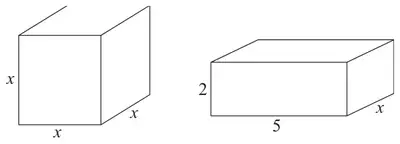
The volume of the cube is 100 cm\(^3\) more than the volume of the cuboid.
(a) Show that \(x^3 - 10x = 100\) (2)
(b) Use a trial and improvement method to find the value of \(x\). Give your answer correct to 1 decimal place. You must show all your working. (4)
Mark scheme (a)
Answer
Mark
Notes
show
2
M1 for \(x \times x \times x\) or \(2 \times 5 \times x\) or vol of cube \(= x^3\) or vol cuboid \(= 10x\) A1 correct completion leading to \(x^3 - 10x = 100\)
Mark scheme (b)
Working
Answer
Mark
Notes
\(x = 1\)
−9
\(x = 2\)
−2
\(x = 3\)
−3
\(x = 4\)
24
\(x = 5\)
75
\(x = 6\)
156
\(x = 10\)
900
\(x = 5.1\)
81.(651)
\(x = 5.2\)
88.(608)
\(x = 5.3\)
95.(877)
\(x = 5.4\)
103.(464)
\(x = 5.5\)
111.(375)
\(x = 5.6\)
119.(616)
\(x = 5.7\)
128.(193)
\(x = 5.8\)
137.(112)
\(x = 5.9\)
146.(379)
\(x = 5.35\)
99.6(30375)
\(x = 5.36\)
100.3(90656)
\(x = 5.355\)
100.0(101139)
5.4
4
B2 for a trial \(5 \leqslant x \leqslant 6\) evaluated correctly (B1 for any two trials evaluated correctly for positive values of \(x\)) B1 for a different trial \(5.3 \lt x \lt 5.4\) evaluated correctly B1 (dep on at least one previous B1) for 5.4 Accept trials correct to the nearest whole number (rounded or truncated) if the value of \(x\) is to 1 d.p., but correct to 1 d.p. (rounded or truncated) if the value of \(x\) is to 2 or more d.p. NB. Allow 100 for a trial of \(x = 5.355\)
B2 for a trial \(4.6 \leqslant x \leqslant 4.7\) evaluated (B1 for a trial \(4 \leqslant x \leqslant 5\) evaluated) B1 for a different trial \(4.6 \lt x \leqslant 4.65\) evaluated B1 (dep on at least one previous B1) for 4.6 Accept trials correct to the nearest whole number (rounded or truncated) if the value of \(x\) is to 1 dp but correct to 1dp (rounded or truncated) if the value of \(x\) is to 2 dp. (Accept 72 for \(x = 4.64\)) NB : no working scores no marks even if the answer is correct.
Work out the values of \(\quad u_1\) and \(u_3\) [3 marks]
Mark scheme
Answer
Mark
Comments
\(8 = \dfrac{24}{u_1} + 4\)
M1
oe eg \(4 = \dfrac{24}{u_1}\) accept \(u_1\) replaced by a different variable eg \(x\)
\(u_1 = 6\)
A1
do not accept \(x = 6\) in working with nothing on answer line for \(u_1\)
\(u_3 = 7\)
B1
SC1 \(u_1 = 7\) and \(u_3 = 7\dfrac{3}{7}\) or \(\dfrac{52}{7}\) or [7.4, 7.43] or \(u_1 = 7\) and \(u_3 = 7\dfrac{3}{13}\) or \(\dfrac{94}{13}\) or [7.2, 7.231]
Additional guidance
M1 may be awarded for correct work with no answer or incorrect answer, even if this is seen amongst multiple attempts
16 A sequence of numbers is formed by the iterative process
\[u_{n+1} = \frac{4}{u_n - 1} \qquad u_1 = 9\]
Work out the values of \(u_2\) and \(u_3\) [2 marks]
Mark scheme
Answer
Mark
Comments
0.5
B1
oe
\(-8\)
B1ft
ft any value other than 1
Additional guidance
If they show \(u_2 = \dfrac{4}{8}\) but simplify or convert it incorrectly, award B1 for the 1st mark, but do not award B1(ft) for the 2nd mark eg \(u_2 = \dfrac{4}{8} = \dfrac{1}{4}\), \(u_3 = \dfrac{4}{-0.75} = -\dfrac{16}{3}\)
B1B0
0.5 (oe) and \(-8\) worked out, with \(-8\) on the \(u_2\) answer line
B0B1
Non-integer answers must be given as correct decimals or correct fractions with integer numerator and denominator If ft, award the 2nd mark for a correct fraction with integer numerator and denominator even if then incorrectly simplified or converted
If the answer line for \(u_2\) is incorrect, do not award the 1st mark for \(10 = \dfrac{4}{8}\) in working
Sign change so solution between \(x\) = 1 and \(x\) = 2
3
M2 for \(1^4 + 3(1)^2 - 2(1) - 5 = -3\) and \(2^4 + 3(2)^2 - 2(2) - 5 = 19\) or M1 for \(1^4 + 3(1)^2 - 2(1) - 5\) or \(2^4 + 3(2)^2 - 2(2) - 5\) soi by –3 or 19
Accept a minimum of 1 + 3 – 2 – 5 = –3 and 16 + 12 – 4 – 5 = 19
Accept other values of x used between 1 and 2 (see table in part (b)). For full marks, we need to see correct substitutions and evaluations that produce a sign change and a correct statement. For M2, we can see correct substitutions and evaluations, or two correct answers producing a sign change with a correct statement.
Alternative Method 1 After \(x^4 + 3x^2 - 2x = 5\) seen M2 for \(1^4 + 3(1)^2 - 2(1) = 2\) and \(2^4 + 3(2)^2 - 2(2) = 24\)
A1 for 24 > 5 and 2 < 5 so solution between \(x\) = 1 and \(x\) = 2 OR M1 for \(1^4 + 3(1)^2 - 2(1)\) or \(2^4 + 3(2)^2 - 2(2)\) soi by 2 or 24
Examples just sufficient for third mark include:
Sign change
\(-3 \lt 0 \lt 19\)
\(x\) = 1 gives an answer < 0 and \(x\) = 2 gives an answer > 0
Examples insufficient for third mark:
so \(x\) lies between 1 and 2
Alternative Method 2 SC3 for using an iterative equation that converges to a value in the range 1.25 to 1.35 and concluding statement that 1 < 1.25 to 1.35 < 2 oe or SC2 for using an iterative equation that converges to a value in the range 1.25 to 1.35
If within part (a) a candidate refers to their iterative equation work in part (b) then award marks for Alternative Method 2.
Mark scheme (b)
Answer
Marks
Part marks and guidance
Two correct evaluations for \(1.25 \leqslant x \leqslant 1.35\), one of which gives a positive answer and the other giving a negative answer
M3
M2 for two correct evaluations for \(1 \lt x \lt 2\), one which gives a positive answer and the other giving a negative answer or M1 for one correct evaluation for \(1 \lt x \lt 2\)
Likely values: accept rot to 1+sf
\(x\)
\(x^4 + 3x^2 - 2x - 5\)
1.1
-2.1059
1.2
-1.0064
1.25
-0.3710…
1.26
-0.2367…
1.27
-0.0998…
1.275
-0.0304…
1.28
0.0395…
1.285
0.1102…
1.3
0.3261
1.31
0.4732…
1.32
0.6231…
1.33
0.7757…
1.34
0.9309…
1.35
1.0890…
1.4
1.9216
1.5
3.8125
1.6
6.0336
1.7
8.6221
1.75
10.0664…
1.8
11.6176
1.9
15.0621
If a candidate refers to relevant working in part (a) then award up to full marks for part (b).
1.3
A1
OR
If 0 scored instead award SC1 for 1.3 with no worthwhile working
Alternative Method by Iteration M1 rearranges to a correct iterative formula (converging or diverging, condone missing subscripts) M1 attempts first iteration (either a substitution seen or evaluated to at least 2dp rot) M1 continues further iteration(s) to reach \(x\) in the interval \(1.25 \leqslant x \lt 1.35\) A1 for 1.3
(b) Another sequence is defined by \(u_{n+1} = 6u_n - 7\).
(i) Find the value of \(u_1\) in the case when \(u_2 = 2 \times u_1\). [2]
(ii) Explain what happens to the sequence \(u_{n+1} = 6u_n - 7\) when \(u_1 = 1.4\). [1]
Mark scheme (a)
Answer
Marks
Part marks and guidance
4.5 or \(4\frac{1}{2}\) or \(\frac{9}{2}\) oe nfww
3
M2 for \(\frac{29.5 + 2}{7}\) or M1 for \(29.5 = k \times 7 - 2\) oe Trials : M1 for each correct trial with value of \(k\) in \(k \times 7 - 2\) with the result to a maximum of 2 marks
Mark scheme (b)
Answer
Marks
Part marks and guidance
(i) 1.75 or \(1\frac{3}{4}\) or \(\frac{7}{4}\) oe
2
M1 for \(2u_1 = 6u_1 - 7\) oe or better Trials : M1 for one correct trial with input and output for \(u_1\)
Accept other values of \(x\) used between 2 and 3, correct to 2 figs rot, (see table in part (c)). For full marks, the two values need to produce a sign change.
and any indication of a sign change [so solution lies between 2 and 3]
A1
Dep. on at least M1 and different signs
Alternative method SC3 for using an iterative equation that converges and concluding statement that first two values lie between 2 and 3 oe
Appendix: Exemplar responses for Q20(a)
Response
Mark
Sign change …..
A1
−2 < 0 < 14
A1(BOD)
answer lies between 2 and 3
A0
answer is in the middle is insufficient
A0
\(x\)
fn
2
-2
2.1
-1.039
2.2
0.048
2.3
1.267
2.4
2.624
2.5
4.125
2.6
5.776
2.7
7.583
2.8
9.552
2.9
11.689
Mark scheme (b)
Answer
Marks
Part marks and guidance
[\(x = 2.5\)] 4.125
B1
\(2 \lt x \lt 2.5\)
B1
Condone equals signs and condone in words, allow a smaller correct interval
Mark scheme (c)
Answer
Marks
Part marks and guidance
Two correct evaluations in the range \(2 \lt x \lt 2.5\), one which gives a positive value and the other giving a negative value
M2
M1 for one correct evaluation in the range \(2 \lt x \lt 2.5\)
Working for (c) may be seen in (b)
Examples
2.05
-1.53488
2.1
-1.039
2.15
-0.51163
2.2
0.048
2.25
0.640625
2.3
1.267
2.35
1.927875
2.4
2.624
2.45
3.356125
[\(x\) =] 2.2
A1
Dependent on achieving at least M1
Alternative method M1 rearranges to a correct iterative formula (converging or diverging) and M1attempts first two iterations (either substitution seen or found to at least 2dp rot) and A1 for 2.2
OR If 0 scored SC1 for 2.2 with no worthwhile working
condone missing suffixes here e.g. \(x_{n+1} = \sqrt[3]{3x_n + 4}\) with \(x_0 = 2\), \(x_1 = 2.1544\ldots\), \(x_2 = 2.1872\ldots\)
Sign change so solution between \(x = 3\) and \(x = 4\)
3
M2 for \(3^5 - 70 \times 3 - 150 = -117\) and \(4^5 - 70 \times 4 - 150 = 594\) or M1 for \(3^5 - 70 \times 3 - 150\) soi by −117 or \(4^5 - 70 \times 4 - 150\) soi by 594
Accept other values of \(x\) used between 3 and 4 (see table in part (b)). For full marks, the two values need to produce a sign change or values either side of 150 if using alternative method.
Examples just sufficient for third mark include: Change of sign −117 < 0 < 594 \(x = 3\) gives an answer < 0 and \(x = 4\) gives an answer > 0 Examples insufficient for third mark: so \(x\) lies between 3 and 4
Alternative method After \(x^5 - 70x = 150\) seen M2 for \(3^5 - 70 \times 3 = 33\) and \(4^5 - 70 \times 4 = 744\) A1 for 33 < 150 and 744 > 150 so solution between \(x = 3\) and \(x = 4\) OR M1 for \(3^5 - 70 \times 3\) soi by 33 or \(4^5 - 70 \times 4\) soi by 744
Alternative method SC3 for using an iterative equation that converges to a value in the range 3.25 and 3.35 and concluding statement that 3 < 3.25 to 3.35 < 4 oe or SC2 for using an iterative equation that converges to a value in the range 3.25 to 3.35
If within part (a) candidates refer to their working in part (b), award marks for this final alternative method.
Mark scheme (b)
Answer
Marks
Part marks and guidance
Examples: when \(x = 3.1\) \(y = -80[.7\ldots]\), so \(3.1 < p < 4\) when \(x = 3.5\) \(y = 130[.2\ldots]\), so \(3 < p < 3.5\) when \(x = 3.1\) \(y = -80[.7\ldots]\) and when \(x = 3.5\) \(y = 130[.2\ldots]\), so \(3.1 < p < 3.5\)
3
Dependent on achieving at least M2
M2 for one further value of \(y\) evaluated correctly, possibly rot or truncated to 2 or more sf, for a value of \(x\) such that \(3 < x < 4\)
OR
M1 for working shown to calculate one further value of \(y\) for a value of \(x\) such that \(3 < x < 4\)
Alternative method After \(x^5 - 70x = 150\) seen Award marks as for the main method, but with one evaluation being < 150 and the other being > 150
Note after SC considered in part (a): if SC2 was awarded then they must use a value of \(x\) that produces a smaller interval than \(3 < x <\) their \(x\)-value in (a) or their \(x\)-value in (a) \(< x < 4\)
If 0 scored, instead award SC1 or SC2 if evidence for M1 or M2 has not been credited in part (a)
Likely values: accept rot to 2+sf
\(x\)
\(x^5 - 70x\)
\(x^5 - 70x - 150\)
3.1
69.292
-80.708
3.2
111.544
-38.456
3.25
135.091
-14.909
3.26
140.004
-9.996
3.27
144.986
-5.014
3.28
150.038
0.038
3.29
155.16
5.16
3.3
160.354
10.354
3.31
165.62
15.62
3.32
170.958
20.958
3.33
176.369
26.369
3.34
181.854
31.854
3.35
187.414
37.414
3.4
216.354
66.354
3.5
280.219
130.219
3.6
352.662
202.662
3.7
434.44
284.44
3.75
479.077
329.077
3.8
526.352
376.352
3.9
629.242
479.242
A correct narrower range scores 0 unless accompanied by the relevant correct calculations. Calculations in support of \(x = 3\) or \(x = 4\) need not be repeated from part (a)
(a) Show that the equation \(x^3 + x^2 - 5 = 0\) has a solution between \(x = 1\) and \(x = 2\). [3]
(b) Find this solution correct to 1 decimal place. You must show calculations to support your answer. [4]
Mark scheme (a)
Answer
Marks
Part marks and guidance
[\(1^3 + 1^2 - 5\)] = \(-3\)
M1
Must indicate their input and output
Accept other values of \(x\) used between 1 and 2 (see table in part (b)). For full marks, the two values need to produce a sign change.
Acceptable answers for third mark are \(x = 1\) gives answer < 0 and \(x = 2\) gives answer >0 Note: so answer lies between 1 and 2 is not sufficient on its own or answer is in the middle is insufficient
If within part (a) a candidate refers to their working in part (b) you must award the marks for this method
[\(2^3 + 2^2 - 5\)] = 7
M1
Sign change [so solution between \(x = 1\) and \(x = 2\)] or \(-3 \lt 0 \lt 7\)
A1
Dep. on at least M1 and different signs
Alternative method 1 for \(x^3 + x^2 = 5\) M2 for \(1^3 + 1^2 = 2\) and \(2^3 + 2^2 = 12\) or M1 for \(1^3 + 1^2 = 2\) or \(2^3 + 2^2 = 12\) may be implied by 2 or 12 and A1 for e.g. 2 < 5 < 12 dep. on at least M1 and 5 lies inbetween their two values
Alternative method 2 SC3 for using an iterative equation that converges to a value between 1.35 and 1.45 and concluding statement such as 1 < 1.35 to 1.45 < 2 or SC2 for using an iterative equation that converges to a value between 1.35 and 1.45
Mark scheme (b)
Answer
Marks
Part marks and guidance
Two correct evaluations in the range \(1.35 \leqslant\) values \(\leqslant 1.49\), one which gives a positive value and the other giving a negative value
M3
M2 for two correct evaluations 1 < values < 2, one which gives a positive value and the other giving a negative value or M1 for one correct evaluation between 1 < value < 2
figures may be rot to at least 2 s.f. (table of values below)
condone missing suffixes in formula here e.g. \(x_{n+1} = \sqrt{\frac{5}{x_n + 1}}\) converges and leads to values 1.5811388… , 1.39180797… , 1.44584536…
If they refer to their working in part (a) which is relevant then award up to full marks in part (b)
1.4
A1
Dependent on achieving at least M2
Alternative method 1 See appendix for values of \(x^3 + x^2\).
Alternative method 2 M1 rearranges to a correct iterative formula (converging or diverging)
M1attempts first iteration (either substitution seen or found to at least 2dp rot)
M1 continues iteration to reach \(x\) in the range 1.35 to 1.45
A1 for 1.4 Dep. on M2
OR If 0 scored SC1 for 1.4 with no worthwhile working
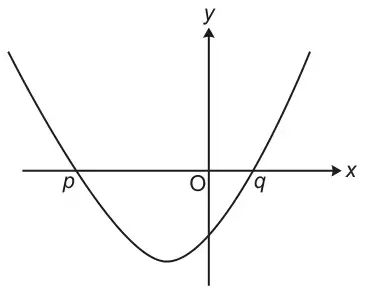
13 The graph of \(y = x^2 + 6x - 2\) is shown below. The roots of the equation \(x^2 + 6x - 2 = 0\) are at \(p\) and \(q\).
(a)
(i) Calculate \(y\) when \(x = 1\). [1]
(ii) Without solving the equation, explain why \(q\) must lie between 0 and 1. [2]
(iii) Explain why using a method of iteration is not the most appropriate way of finding a solution to this equation. [1]
(b) The exact value of \(q\) is \(\dfrac{-6 + \sqrt{44}}{2}\).
Write \(\dfrac{-6 + \sqrt{44}}{2}\) in the form \(a + \sqrt{b}\). [3]
Mark scheme (a)
Answer
Marks
Part marks and guidance
(i) 5
1
(ii) At \(x = 0\) oe and \(y \lt 0\) or \(y\) is negative or \(y = -2\) or curve is below \(x\)-axis and at \(x = 1\) , \(y\) is positive or \(y \gt 0\) or \(y = 5\) or curve is above the \(x\) - axis and change of sign oe [between \(x = 0\) and \(x = 1\)] or the curve crosses the \(x\)-axis between 0 and 1 or solution/q lies between 0 and 1
1
1dep
If \(y\) value evaluated then must be correct for 2 marks or 1 mark
Dep on first mark
If 0 scored, SC1 for change of sign oe or the curve crosses the \(x\)-axis between 0 and 1 oe
For 2 marks needs to refer \(x = 0\) negative oe and \(x = 1\) positive oe and change of sign/graph crosses axis/solution between 0 and 1 oe e.g. For 2 marks At \(x = 0\) the curve is below the \(x\)–axis, at \(x = 1\) the curve is above the \(x\)–axis so there is a change of sign
See Appendix
(iii) Correct response concerning accuracy/time taken/refer to specific more efficient methods e.g. Iteration gives an estimate oe
Iteration can be a lengthy process oe [to get an accurate result]
1
e.g. The quadratic formula/complete the square is quicker/more accurate/easier Trial and improvement is less efficient/takes too long You can always go to more decimal places It will not give an exact/accurate answer It will take many iterations There are two solutions, iteration is used to find one at a time Mark the best if more than one answer given
Do not accept incorrect statement e.g. It would be quicker/easier to factorise the equation
Appendix: additional guidance for Q13(a)(ii)
Response
Mark
1
The graph is below the \(x\)-axis at \(x = 0\) and above the \(x\) – axis at \(x = 1\) so the solution lies between 0 and 1
2
2
\(0^2 - (6 \times 0) - 2 = -2\) and \(1^2 + (6 \times 1) - 2 = 5\) so there is a sign change from −2 to 5 BOD \(x = 0\) and \(x = 1\) implied in reasoning and a correct statement regarding sign change
2
3
Because at \(q\), \(y = 0\), but at 1 \(y = 5\) and at 0 \(y\) is negative. So the solution is in between 0 and 1 (BOD \(x = 0\) and \(x = 1\) implied in reasoning similar to above and correct conclusion stated)
2
4
When \(q = 0\) graph is negative, when \(q = 1\) graph is positive so there is a sign change (BOD \(q\) is on the \(x\)-axis so take \(q\) as \(x\) here)
BOD2
5
The graph is positive at 1 and negative at zero so the solution lies in between 0 and 1 [BOD first mark allow as 1 and 0 imply \(x = 1\) and \(x = 0\) and the conclusion is correct for 2nd mark)
BOD2
6
When \(x = 1\), \(y = 5\) and the graph intersects the \(x\)- axis between 0 and 1 so that is where the solution lies [Does not mention \(x = 0\) and negative and second mark dep on first but gets SC1]
SC1
7
The graph crosses the \(x\)-axis between 0 and 1 [ 2nd mark dep on 1st mark and does not specifically mention \(x = 0\) and \(x = 1\) being negative and positive so zero but gets SC1]
SC1
8
There is a change of sign (2nd mark dep on first mark buts gets SC1)
SC1
9
The root lies between 0 and 1 (not adding to question asked – no reasons given for this)
0
Mark scheme (b)
Answer
Marks
Part marks and guidance
\(-3 + \sqrt{11}\) final answer
3
B2 for answer \(p + \sqrt{11}\) or M1 for [\(\sqrt{44}\) =] \(2\sqrt{11}\) seen or \(\frac{\sqrt{44}}{\sqrt{4}}\) seen
(a) Show that the equation \(x^3 - 5x - 1 = 0\) has a solution between \(x = 2\) and \(x = 3\). [3]
(b) Find this solution correct to 1 decimal place. You must show your working. [4]
Mark scheme (a)
Answer
Marks
Part marks and guidance
\(2^3 - 5 \times 2 - 1 = -3\) \(3^3 - 5 \times 3 - 1 = 11\) Sign change so solution between \(x = 2\) and \(x = 3\)
3
M2 for \(2^3 - 5 \times 2 - 1 = -3\) and \(3^3 - 5 \times 3 - 1 = 11\) or M1 for \(2^3 - 5 \times 2 - 1\) or \(3^3 - 5 \times 3 - 1\) soi by −3 or 11
Accept other values of \(x\) used between 2 and 3 (see table in part (b)) For full marks the two values need to produce a sign change
Examples just sufficient for the third mark: change of sign −3 < 0 < 11 \(x = 2\) gives an answer < 0 and \(x = 3\) gives an answer > 0
Example insufficient for the third mark: so \(x\) lies between 2 and 3
Alternative method After \(x^3 - 5x = 1\) seen M2 for \(2^3 - 5 \times 2 = -2\) and \(3^3 - 5 \times 3 = 12\) A1 for −2 < 1 and 12 > 1 so solution between \(x = 2\) and \(x = 3\) OR M1 for \(2^3 - 5 \times 2\) or \(3^3 - 5 \times 3\) soi by −2 or 12
Alternative method SC3 for using an iterative equation that converges to a value in the range 2.25 to 2.35 and a concluding statement that 2 < 2.25 to 2.35 < 3 oe or SC2 for using an iterative equation that converges to a value in the range 2.25 to 2.35
If within part (a) candidates refer to their working in part (b), award marks for this final alternative method
Mark scheme (b)
Answer
Marks
Part marks and guidance
Two correct evaluations in the range 2.25 to 2.35, one which gives a positive value and the other giving a negative value
M3
M2 for two correct evaluations between 2 and 3, one positive and one negative or M1 for one correct evaluation between 2 and 3
Likely values: accept rot to 2+ sf (see table below)
and 2.3
A1dep
Dependent on achieving at least M2
Alternative method Rearranges to a correct iterative formula (converging or diverging)
M1
Condone missing subscripts
Attempts first iteration (either substitution seen or found to at least 2 dp (rot))
M1
Continues iteration(s) to reach \(x\) in the range 2.25 to 2.35
M1
2.3
A1
If 0 scored SC1 for answer 2.3 with no worthwhile working
If within part (b) candidates refer to their working in part (a), award up to full marks for part (b)
(a) Show that the equation \(x^4 - x^2 - 9 = 0\) has a solution between \(x = 1\) and \(x = 2\). [3]
(b) Find this solution correct to 1 decimal place. Show your working.[4]
Mark scheme (a)
Answer
Marks
Part marks and guidance
\(1^4 - 1^2 - 9 = -9\) \(2^4 - 2^2 - 9 = 3\)
Sign change, solution between \(x = 1\) and \(x = 2\)
3
M2 for \(1^4 - 1^2 - 9 = -9\) and \(2^4 - 2^2 - 9 = 3\) or M1 for \(1^4 - 1^2 - 9\) or \(2^4 - 2^2 - 9\) soi by –9 or 3
Alternative method After \(x^4 - x^2 = 9\) seen M2 for \(2^4 - 2^2 = 12\) and \(1^4 - 1^2 = 0\) A1 for 12 > 9 and 0 < 9 so solution between \(x = 1\) and \(x = 2\) OR M1 for \(2^4 - 2^2\) or \(1^4 - 1^2\) soi by 12 or 0
Alternative method SC3 for using an iterative equation that converges to a value in the range 1.85 to 1.95 and concluding statement that 1 < 1.85 to 1.95 < 2 oe or SC2 for using an iterative equation that converges to a value in the range 1.85 to 1.95
Alternative method SC3 for using quadratic formula (see (b)) leading to a value in the range 1.88 to 1.89 and concluding statement that 1 < 1.88 to 1.89 < 2 oe or SC2 for using quadratic formula (see (b)) leading to a value in the range 1.88 to 1.89
Accept other values of \(x\) used between 1 and 2 (see table in part (b)). For full marks, the two values need to produce a sign change.
Examples just sufficient for third mark include: sign change –9 < 0 < 3 \(x = 1\) gives an answer < 0 and \(x = 2\) gives an > 0 Examples insufficient for third mark: so \(x\) lies between 1 and 2
If candidates refer to their working in part (b) within part (a), award marks for any of the final 2 alternative methods.
Mark scheme (b)
Answer
Marks
Part marks and guidance
Two correct evaluations in the range 1.85 to 1.95, one which gives a positive value and the other giving a negative value
M3
M2 for two correct evaluations between 1 and 2, one which gives a positive value and the other giving a negative value or M1 for one correct evaluation between 1 and 2
Likely values: accept rot to 1 or more dp (see table below)
If candidates refer to or use their working in part (a) within part (b), award up to full marks for part (b).
1.9
A1dep
Dependent on achieving at least M2 OR SC1 for 1.9 with no worthwhile working
Alternative method by iteration M1 rearranges to a correct iterative formula (converging or diverging) M1 attempts first iteration (either substitution of \(1 \leqslant x \leqslant 2\) seen or found to at least 2dp rot) M1 continues further iteration(s) to reach \(x\) in the range 1.85 to 1.95 A1 for 1.9
Alternative method by quadratic formula M2 for [\(x^2 =\)] \(\dfrac{-(-1) \pm \sqrt{(-1)^2 - 4(1)(-9)}}{2(1)}\) soi by 3.54[1..] or M1 for this formula with at most two errors AND M1 for \(x = \sqrt{\textit{their } 3.54[1..]}\) soi by 1.88 to 1.89 A1 for 1.9
Alternative iteration method notes condone missing subscripts e.g. M1 for \(x = \sqrt{\sqrt{9 + x^2}}\) and M1 for \(\sqrt{\sqrt{9 + 1^2}}\) or 1.77[8..] or 1.78
15 Use the formula \(x_{n+1} = \dfrac{(x_n)^3}{30} + 2\) with \(x_1 = 2\) to calculate \(x_2\) and \(x_3\). Round your answers correct to 4 decimal places. [3]
Mark scheme
Answer
Marks
Part marks and guidance
2.2667 and 2.3882
3
B2 for 2.2667 or for 2.2666… or \(\dfrac{34}{15}\) and 2.388… or M1 for \(\dfrac{2^3}{30} + 2\) soi by 2.2666… or \(2.2\dot{6}\) or \(\dfrac{34}{15}\)
For 3 marks, answers must be on answer line or correctly identified as \(x_2\) and \(x_3\)
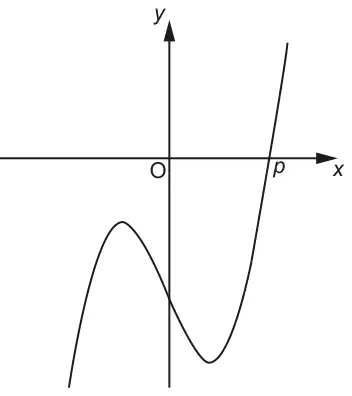
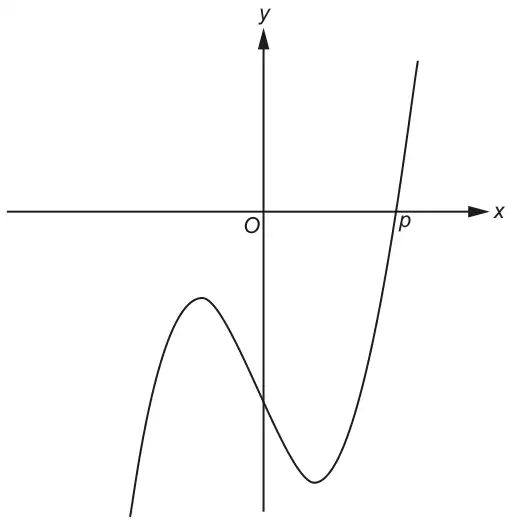
9 The graph of \(y = x^3 - 7x - 12\) is shown below. The root of the equation \(x^3 - 7x - 12 = 0\) is \(p\).
(a) Calculate \(y\) when \(x = 3\). [1]
(b) Show that \(3 \lt p \lt 4\). [2]
(c) Find a smaller interval that contains the value of \(p\). You must show calculations to support your answer. [3]
Mark scheme (a)
Answer
Marks
Part marks and guidance
−6
1
Mark scheme (b)
Answer
Marks
Part marks and guidance
[\(x = 4\),] \(y = 24\)
Change of sign, so \(p\) lies between 3 and 4 oe
2
B1 for 24 seen
If using \(3.27 \lt x \lt 4\) rather than 4: SC2 evaluate \(y\) correctly (see table in (c)), state change of sign oe and that because \(3 \lt p \lt\) their \(x\)-value, then so \(3 \lt p \lt 4\). 0 for just evaluating y.
After \(x = 4\), \(y = 24\) scored: Examples just sufficient for second mark include: change of sign \(-6 \lt 0 \lt 24\) \(x = 3\) gives an answer < 0 and \(x = 4\) gives an \(\gt 0\) Examples insufficient for second mark: so \(p\) lies between 3 and 4
Mark scheme (c)
Answer
Marks
Part marks and guidance
Examples: when \(x = 3.5\), \(y = 6.4\), so \(3 \lt p \lt 3.5\) when \(x = 3.1\), \(y = -3.9\), so \(3.1 \lt p \lt 4\) when \(x = 3.1\), \(y = -3.9\) and when \(x = 3.5\), \(y = 6.4\), so \(3.1 \lt p \lt 3.5\)
3
M2 for one further value of \(y\) evaluated correctly, possibly rot to 2 or more sf, for a value of \(x\) such that \(3 \lt x \lt 4\)
OR
M1 for working shown to calculate one further value of \(y\) for a value of \(x\) such that \(3 \lt x \lt 4\)
Note after SC considered in (b): if SC2 was awarded then they must use a value of \(x\) that produces a smaller interval than \(3 \lt x \lt\) their x-value in (b); if SC2 was not awarded then \(3 \lt x \lt 4\) applies
If 0 scored, award SC1 or SC2 if evidence for M1 or M2 has not yet been credited in (b)
Solution is approx. 3.2670
Common values:
\(x\)
\(y\)
3.1
−3.909
3.2
−1.632
3.25
−0.422
3.26
−0.174
3.27
0.0758
3.3
0.837
3.4
3.504
3.5
6.375
3.6
9.456
3.7
12.75
3.75
14.48
3.8
16.27
3.9
20.02
A correct narrower range scores 0 unless accompanied by the relevant correct calculation(s). eg M2 only for when \(x = 3.1\), \(y = -3.9\) so \(3.1 \lt p \lt 3.5\) (as 3.5 has not been correctly justified) Calculations in support of \(x = 3\) or \(x = 4\) need not be repeated from parts (a) or (b).