(ii) \(\mathrm{P}(X \gt 3.2 \mid X \gt 1.8) = \dfrac{\mathrm{P}(X \gt 3.2)}{\mathrm{P}(X \gt 1.8)}\) or \(\dfrac{\frac{4}{15}}{\frac{11}{15}}\) or \(\dfrac{0.8}{2.2}\) oe
M1
2.1
\(= \dfrac{4}{11}\)
A1
1.1b
(3)
Notes
(i) B1: for \(\frac{7}{15}\) or exact equivalent isw
(ii) M1: for a correct ratio of prob expressions (must be \(\mathrm{P}(X \gt 3.2)\) on num) or values or awrt 0.364
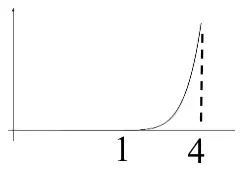
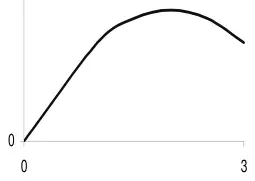
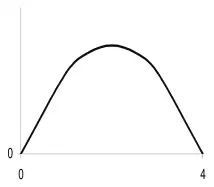
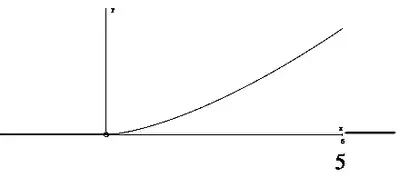
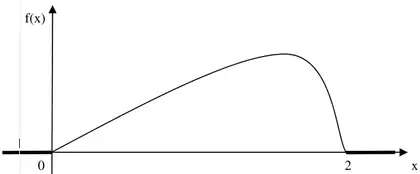
(i) \(\mathrm{f}(y) = \dfrac{\mathrm{dF}(y)}{\mathrm{d}y} = \dfrac{10}{3} \times \left(\dfrac{y-1}{3}\right)^9\) or sketch of correct shape
M1
1.1b
Correct sketch showing \(y = 1\) and 4 and \(\mathrm{f}(1) = 0\)
A1
1.1b
(ii) [From sketch mode of \(M\) is] 4
B1
2.2a
(3)
Notes
(i) M1: for correct expression or a sketch of correct shape with positive increasing gradient
A1: for a fully correct sketch with 1 and 4 correctly indicated (dashed line not needed). Condone curves which appear almost linear provided this was not the intention. Ignore any labelling of the axes or values indicated on the vertical axis.
(ii) B1: for 4
Mark scheme (d)
Scheme
Marks
AO
\(\mathrm{E}(M) = k\displaystyle\int y \times 10(y-1)^9\,\mathrm{d}y = k\int y\,\mathrm{d}(y-1)^{10}\) or \(K\displaystyle\int (3u+1)u^9\,\mathrm{d}u\)
1st M1: for a correct expression for \(\mathrm{E}(M)\) and an attempt to start to integrate. May be implied by further work. May use substitution e.g. \(3u = y - 1\) so forms the integral expression in \(u\). Allow any constant \(k\) (or \(K\))
2nd M1: for a correct first step of integration. Allow any \(k\) (or \(K\)) and still ignore limits.
3rd M1: for a correctly integrated expression including limits (need not be substituted in)
A1: dep on all previous method marks for \(\frac{41}{11}\) or exact equivalent
4. Subrat is modelling the time, \(t\) seconds, it takes for a computer to carry out a particular process. He models the time using the continuous random variable \(T\) with cumulative distribution function
\[\mathrm{F}(t) = \begin{cases} 0 & t \lt 0 \\ at^4 - \dfrac{1}{8}t^3 + bt^2 & 0 \leqslant t \leqslant 4 \\ 1 & t \gt 4 \end{cases}\]
where \(a\) and \(b\) are constants.
(a) Find, in terms of \(a\) and \(b\), the probability that the computer takes less than 2 seconds to carry out the process. (2)
(b) Find, in terms of \(a\) and \(b\), the probability density function of \(T\) for all values of \(t\) (2)
The probability that the computer takes less than 2 seconds to carry out the process is \(\dfrac{11}{16}\)
(c) Find the exact value of the mode of \(T\) You must show all stages of your working. (7)
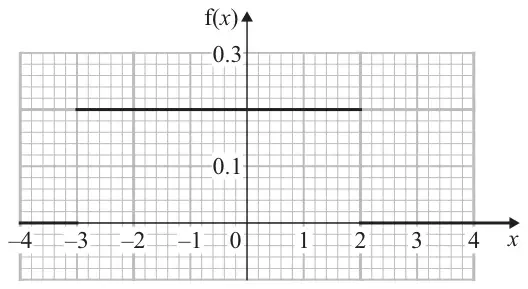
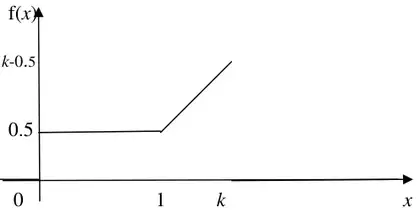
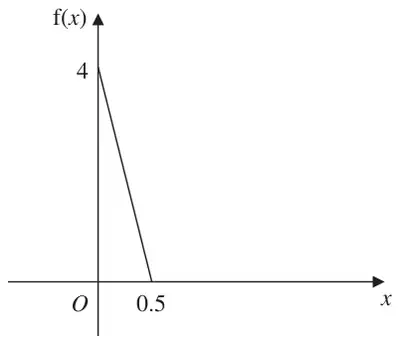
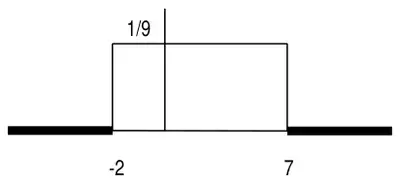
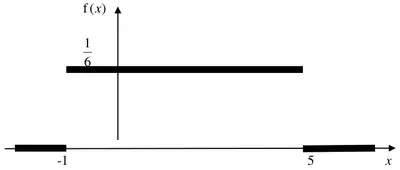
2. The graph of the probability density function \(\mathrm{f}(x)\) of the continuous uniform random variable \(X\) is shown below.
(a) Write down the value of \(\mathrm{P}(X = 1)\) (1)
(b) Find \(\mathrm{E}(X)\) (1)
(c) Find \(\mathrm{Var}(X)\) (1)
(d) Sketch the cumulative distribution function of \(X\) for \(-3 \leqslant x \leqslant 2\) You should label any points where the sketch touches or crosses the coordinate axes. (3)
8. A company packs chickpeas into small bags and large bags.
The weight of a small bag of chickpeas is normally distributed with mean 500 g and standard deviation 5 g
A random sample of 3 small bags of chickpeas is taken.
(a) Find the probability that the total weight of these 3 bags of chickpeas is between 1490 g and 1530 g (3)
The weight of a large bag of chickpeas is normally distributed with mean 1020 g and standard deviation 20 g
One large bag and one small bag of chickpeas are chosen at random.
(b) Calculate the probability that the weight of the large bag of chickpeas is at least 30 g more than twice the weight of the small bag of chickpeas. Show your working clearly. (6)
Mark scheme (a)
Scheme
Marks
AO
Let \(T = S_1 + S_2 + S_3\) then \(\mathrm{E}(T) = 1500\)
M1
3.3
\(\mathrm{Var}(T) = 75\)
M1
2.1
\(\mathrm{P}(1490 \lt T \lt 1530) = 0.8756\ldots\)
A1
1.1b
(3)
Notes
M1: Selecting and using the appropriate model and attempting \(3 \times 500\)
M1: For realising the need to use \(\mathrm{Var}(S) + \mathrm{Var}(S) + \mathrm{Var}(S) = 3 \times 5^2\)
A1: awrt 0.876
Mark scheme (b)
Scheme
Marks
AO
Let \(W = \pm(L - 2S - 30)\) then \(\mathrm{E}(W) = \pm(1020 - 2 \times 500 - 30)\) or Let \(X = \pm(L - 2S)\) then \(\mathrm{E}(X) = \pm(1020 - 2 \times 500)\)
\(\mathrm{P}(W \gt 0)\) or \(\mathrm{P}(X \gt 30)\) (or \(\mathrm{P}(W \lt 0)\) or \(\mathrm{P}(X \lt 30)\))
M1
2.1
\(= 0.3273\ldots\)
A1
1.1b
(6)
(9 marks)
Notes
M1: Selecting and using the appropriate model \(\pm(L - 2S - 30)\) or \(\pm(L - 2S)\) in an attempt to find the expected value
A1: \(-10\) or 20 (or 10 or \(-20\))
M1: For realising they need to use \(\mathrm{Var}(L) + 4\mathrm{Var}(S) = 20^2 + 4 \times 5^2\)
A1: 500 only
M1: dependent on using an appropriate model and realising that \(\mathrm{P}(W \gt 0)\) (or \(\mathrm{P}(W \lt 0)\)) or \(\mathrm{P}(X \gt 30)\) (or \(\mathrm{P}(X \lt 30)\)) is required. May be implied by awrt 0.327 Using standardisation look for e.g. \(\mathrm{P}\left(Z \gt \dfrac{0 - \text{“}-10\text{”}}{\sqrt{500}}\right)\) or \(\mathrm{P}\left(Z \gt \dfrac{30 - \text{“}20\text{”}}{\sqrt{500}}\right)\) \((= \mathrm{P}(Z \gt 0.4472\ldots))\)
M1: Attempt to integrate one term correct. Look for the power increasing by 1
M1: Integrating both terms and substitute limits the correct way round [any one of \((2, \infty)\) or \((2, 4)\) or \((4, \infty)\)] to form one expression where \(c\) is a non-zero constant. Alternatively, allow this mark for: Allow this mark for \(\mathrm{F}(x) = \left(-\dfrac{a}{x} + \dfrac{b}{2x^2}\right) - \left(-\dfrac{a}{2} + \dfrac{b}{8}\right)\) or one of \(\mathrm{F}(4)\) or \(\mathrm{F}(\infty)\)
M1: Integrating and substitute limits the correct way round [any one of \((2, \infty)\) or \((2, 4)\) or \((4, \infty)\)] to form a second expression. Alternatively, for \(\mathrm{F}(4)\) and \(\mathrm{F}(\infty)\)
dM1: Dependent on the 2nd M. For one of the expressions equal to correct value from 1, \(\dfrac{3}{8}\) or \(\dfrac{5}{8}\)
A1: Translating a problem in mathematical context into two correct equations with one \(a\) term, one \(b\) term and one number
M1: substitutes two of 2, 4 or “\(\infty\)” into their integral which must have a constant of integration eg \(-\dfrac{a}{2} + \dfrac{b}{8} + c\ (= 0)\), \(-\dfrac{a}{4} + \dfrac{b}{32} + c\ \left(= \dfrac{3}{8}\right)\) or \(-\dfrac{a}{\text{“}\infty\text{”}} + \dfrac{b}{\text{“}\infty\text{”}} + c\ (= 1)\) oe
M1: substitutes all three of 2, 4 or “\(\infty\)”
dM1: forms at least two equations involving \(c\) eg \(-\dfrac{a}{2} + \dfrac{b}{8} + c = 0\), \(-\dfrac{a}{4} + \dfrac{b}{32} + c = \dfrac{3}{8}\) or \(-\dfrac{a}{\text{“}\infty\text{”}} + \dfrac{b}{\text{“}\infty\text{”}} + c = 1\) (may just state \(c = 1\))
A1A1: As in main scheme
Mark scheme (b)
Scheme
Marks
AO
\(b = 4\)
B1
1.1b
\(\left[-\dfrac{3}{x} + \dfrac{\text{“}4\text{”}}{2x^2}\right]_2^m = 0.5\) or e.g. \(-3x^{-1} + \text{“}2\text{”}x^{-2} + 1 = 0.5\)
M1
1.2
\(m^2 - 6m + 4 = 0\) oe
A1
1.1b
\((m =)\ \ 3 + \sqrt{5}\)
A1
2.2a
(4)
(10 marks)
Notes
B1: Writing or using \(b = 4\) may be seen in (a)
M1: Equating their integral with \(b\), limits 2 and \(m\) substituted and equated to 0.5 Allow their \(\mathrm{F}(x) = 0.5\). It must be of the form \(\alpha x^{-1} + \beta x^{-2} + \gamma = 0.5\) oe May be in terms of eg \(x\) instead of \(m\)
A1: A correct 3 term quadratic = 0 Terms do not need to be collected on the same side. May be implied by ans. May be in terms of eg \(x\)
A1: \(3 + \sqrt{5}\) and any other solutions should be eliminated
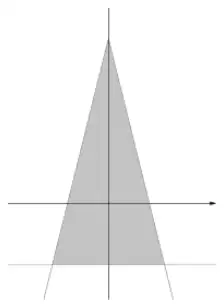
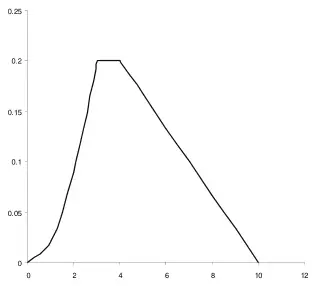
M1: Correct triangle identified. Look for a sketch of an isosceles triangle symmetrical about the \(y\)-axis with the highest point on the positive \(y\)-axis and base vertices below the \(x\)-axis. (maybe implied by a horizontal line below the \(x\)-axis. Ignore any labelling of vertices if incorrect but may help to indicate positions of vertices. Implied by all three coordinates or calculation to find the area / awrt 28.1
M1: For finding either \(x\) coordinate of base of triangle \(\pm\left(\dfrac{k+3}{4}\right)\) or implied by \(\dfrac{k+3}{2}\) Do not accept use of a numerical value for \(k\) but condone \(\mathrm{E}(K)\)
M1: Finding the area of the triangle in terms of \(k\) but condone \(\mathrm{E}(K)\)
M1: Using the model correctly, for \(\displaystyle\int_5^{10} \mathrm{f}(k) \times \text{“}\text{their area}\text{”}\,\mathrm{d}k = \int_5^{10} \frac{1}{5} \times \text{“}\text{their area}\text{”}\,\mathrm{d}k\) or \(\mathrm{E}(K) = 7.5\) and uses \(\mathrm{E}\left(K^2\right) = \mathrm{Var}(K) + \left(\mathrm{E}(K)\right)^2\) and uses their Area \(= \text{“}\frac{1}{4}\left(k^2 + 6k + 9\right)\text{”}\)
1st M1: Attempting to find roots. Can be implied by sight or use of 3 and 4.5
2nd M1: Attempt to find probability for their “outside” region from U[2, 7] Must have both correct ft probability statements and at least one correct ft probability e.g. \(\mathrm{P}(X \lt 3) = 0.2\) and \(\mathrm{P}(X \gt 4.5) = 0.5\) followed by \(0.2 \times 0.5\) is M0M1A0
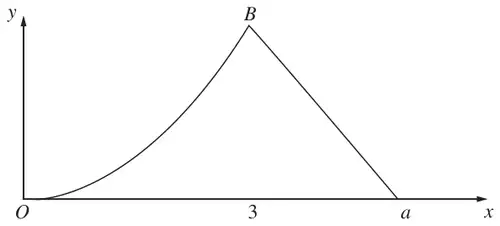
(a) Show that the mode of \(Y\) is 1, justifying your reasoning. (2)
Given that \(\mathrm{P}(Y \lt 1) = \dfrac{13}{36}\)
(b) determine whether the median of \(Y\) is less than, equal to, or greater than 2 Give a reason for your answer. (2)
Given that \(\mathrm{E}(Y^2) = \dfrac{213}{80}\)
(c) find, using algebraic integration, \(\mathrm{Var}(2Y)\) (5)
Mark scheme (a)
Scheme
Marks
AO
Sketch or differentiation to find mode of \(Y\)\(\mathrm{f}'(y) = \frac{1}{24}(2 - 2y) = 0\)
M1
3.1a
Mode occurs at \(Y = 1\) *
A1*
1.1b
(2)
Notes
M1: Attempt to find the mode e.g. diff’n, complete the square or sketch in (a)
A1*: fully correct justification, must show or explain why a max e.g. reference to negative quadratic (and 1 is in [0,3]). Allow “decreasing function”
Mark scheme (b)
Scheme
Marks
AO
By symmetry \(\mathrm{P}(Y \lt 2) = 2 \times \dfrac{13}{36} = \dfrac{13}{18}\) ( or 0.72 or better)
M1
2.1
Median is less than 2 since \(\dfrac{13}{18} \gt \dfrac{1}{2}\)
A1
2.4
(2)
Notes
M1: use of symmetry or other method e.g. calculator to determine \(\mathrm{P}(Y \lt 2)\)
A1: for median is less than 2 with correct reasoning
Alternative
M1 for attempt at \(\mathrm{F}(y) = \frac{1}{24}\left(-\dfrac{y^3}{3} + y^2 + 8y\right)\) and \(\mathrm{F}(y) = \frac{1}{2}\) Condone missing \(\frac{1}{24}\) for M1
A1 for awrt 1.37 and comment with some evidence that \(\mathrm{F}(y) = \frac{1}{2}\) attempted
M1: Attempt to differentiate 2nd line of cdf in the form \(k(x + 1)\) (oe) or 3rd line of cdf in the form \(m(4 - x)\) (oe)
A1: Correct probability density function. (Condone missing “0 otherwise” and mis-use of \(\lt\) or \(\leqslant\) etc )
Mark scheme (b)
Scheme
Marks
AO
(i) Shape: Triangle with longer slant in 1st quadrant
B1
1.1b
Labels: –1, 4 on horizontal axis and \(\frac{2}{5}\) on vertical axis
B1
1.1b
(2)
(ii) (Probability density function has a longer tail to right,) so there is positive skew.
dB1
2.4
(1)
Notes
(i) 1st B1: Correct shape. Triangle must have both ends on axis
2nd B1: Correct labels. All three needed.
(ii) dB1: Correct description of positive skew. Dep on sketch that clearly shows positive skew.
Mark scheme (c)
Scheme
Marks
AO
\(\mathrm{P}(1 \lt X \lt 2) = \mathrm{F}(2) - \mathrm{F}(1)\) or \(2\mathrm{F}(c) = \mathrm{F}(2) + \mathrm{F}(1)\) \(= \left(1 - \dfrac{4}{20}\right) - \left(1 - \dfrac{9}{20}\right) = \dfrac{5}{20}\) or \(\dfrac{1}{4}\) or stating \(\mathrm{F}(c) = 0.675\)
M1
3.1a
So e.g. \(\mathrm{P}(c \lt X \lt 2) = \dfrac{1}{8} \ \Rightarrow\ \dfrac{1}{8} = \dfrac{(4-c)^2}{20} - \dfrac{4}{20}\)
M1
1.1b
\(c = \dfrac{8 - \sqrt{26}}{2}\) or \(1.45049\ldots\) awrt 1.45
A1
1.1b
(3)
(8 marks)
Notes
1st M1: Suitable start to problem e.g. showing \(\mathrm{P}(1 \lt X \lt 2) = 0.25\) o.e. e.g. \(\mathrm{F}(c) = 0.675\) or \(2\mathrm{F}(c) = 0.8 + 0.55\)
2nd M1: Rearranging to form quadratic equation in \(c\) can ft their “0.25” e.g. \(2c^2 - 16c + 19 = 0\) Allow even if wrong part of \(\mathrm{F}(x)\) is used so M0M1A0 is possible.
A1: for awrt 1.45 only NB Other root is 6.549… and if this is not rejected score A0
M1: for realising they need to consider \(\mathrm{P}(-3 \lt X \lt 2)\)
M1: for a correct equation for \(k\) or allow \(\dfrac{2+4}{k+3} = \dfrac{1}{3}\ [\rightarrow k = 15]\) or \(k = 2 + 2 \times (2 - -4)\,[= 14]\)
A1: 12 cao [NB M0M1A0 is possible here, often implied by \(k = 15\)]
Mark scheme (b)
Scheme
Marks
AO
\(\dfrac{a+b}{2} = 6\) and \(\dfrac{1}{12}(b-a)^2 = 192\)
M1
3.1a
\(\dfrac{1}{12}\big(a - (12 - a)\big)^2 = 192\) or \(\dfrac{1}{12}\big((12 - b) - b\big)^2 = 192\) (oe)
M1
1.1b
\(a = -18\) or \(b = 30\)
A1
1.1b
\(\mathrm{P}(Y \gt 7.5) = \dfrac{\text{“}30\text{”} - 7.5}{\text{“}30\text{”} - (\text{“}-18\text{”})}\) [\(= \dfrac{15}{32}\) or 0.46875 (accept 0.469 or better)]
M1
3.4
\(R \sim \mathrm{B}(5, \text{“}0.46875\text{”})\)
M1
3.3
\(\mathrm{P}(R \geqslant 2) = 0.7710\ldots\)
A1
1.1b
(6)
(9 marks)
Notes
M1: for translating the problem into 2 correct equations (using 6 and 192)
M1: for a correct method used to eliminate \(a\) or \(b\) (e.g. an equation in \(a\) or \(b\)) also allow for \(a + b = 12\) and \(b - a = 48\)
A1: for a correct single value for \(a\) or \(b\) (\(a = 30\) and \(b = -18\) is A0)
M1: for using their model to find \(\mathrm{P}(Y \gt 7.5) = p\) [\(\mathrm{P}(Y \lt 7.5) = \frac{17}{32}\) is M0 unless it leads to 0.771]
M1: for stating or using the correct model i.e. \(\mathrm{B}(5, p)\) where \(p\) is a probability based on \(Y\) and 7.5 NB use of \(\mathrm{B}(5, \frac{17}{32})\) is OK here and typically scores M0M1A0
\(\dfrac{3}{16}x^2 = \dfrac{9}{16} \Rightarrow x = \sqrt{3}\)* and either a sketch or full statement
A1cso*
2.1
(3)
(11 marks)
Notes
M1: for differentiating \(\mathrm{f}(x)\) with at least one term correct
dM1 for setting up an equation to find the mode. Allow subst of \(\sqrt{3}\)
A1 cso* \(x = \sqrt{3}\) and either a sketch through (0, 0), (3, 0) and showing max between them or statement to show mode not on the boundary \(\mathrm{f}(\sqrt{3}) = 0.6495\ldots \gt 0.5\) \(\mathrm{f}(1) = 0.5\) and \(\mathrm{f}(3) = 0\)
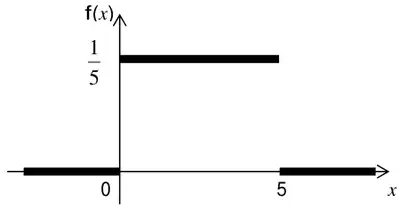
The length of the rectangle, \(L\) cm, follows a continuous uniform distribution over the interval \([4, 10]\)
Find the expected value of the perimeter of the rectangle. Use algebraic integration, rather than your calculator, to evaluate any definite integrals. (7)
M1: Finding an expression for the perimeter in terms of \(L\)
B1: Correct distribution for \(L\) (may be implied by \(\mathrm{E}(L) = 7\))
M1: Setting up integral for expectation of perimeter (allow 2 separate integrals e.g. \(2(7) + \displaystyle\int_4^{10} \tfrac{1}{6}\left(\tfrac{80}{l}\right)\mathrm{d}l\))
M1: Attempt to integrate an expression for expectation of perimeter (allow two separate expressions)
A1: Correct integration
depM1: (dep on previous M1) Use of correct limits 10 and 4
A1: awrt 26.2 Note: exact value is \(14 + \dfrac{40\ln(2.5)}{3}\)
Greta is the expected winner since she has the higher expected value \((1.6 \gt 1.5)\)
A1
2.2b
(5)
(9 marks)
Notes
B1: 1.5
M1: Attempt to set up an integral for Greta’s expectation
dM1: (dep on previous M1) for integration of expectation
A1: 1.6
A1: Greta with correct supporting reason and all previous marks scored in (c)
SC: Use of \(R = \dfrac{2}{R^2} \rightarrow R = \sqrt[3]{2} \rightarrow 1.5 \gt \sqrt[3]{2}\ (= 1.25\ldots)\) therefore Raja is more likely to win a single game, scores B1M0M0A0A1.
A1*cso: Given answer with at least one line of intermediate working.
Mark scheme (b)
Scheme
Marks
AO
(i) \(\mathrm{f}'(x) = 19.2x^{-4}\)
B1
1.1b
(ii) Since \(\mathrm{f}'(x) \gt 0\), \(\mathrm{f}(x)\) is increasing (the pdf has its maximum value at the upper end of the interval), the mode is 4
B1
2.4
(2)
Notes
(i) B1: \(19.2x^{-4}\)
(ii) B1: Correct reasoning and conclusion (allow equivalent correct reasoning e.g. no turning points with a sketch of \(\mathrm{f}(x)\)). Do not allow unsupported comments on their own to score e.g. ‘\(x = 4\) is the highest point on \(\mathrm{f}(x)\)’
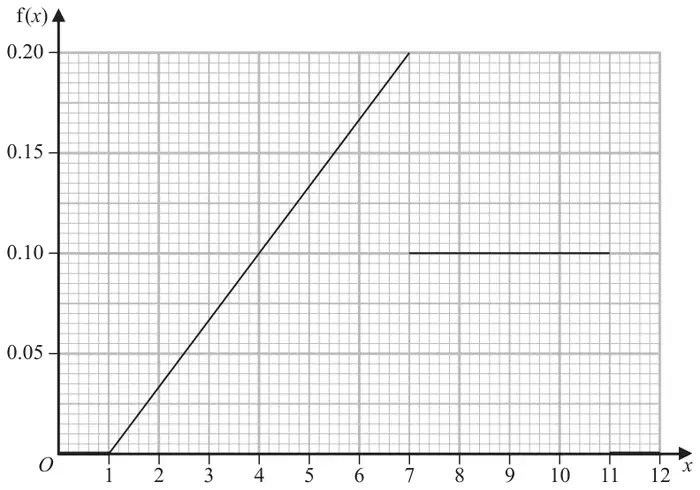
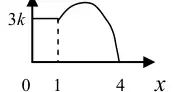
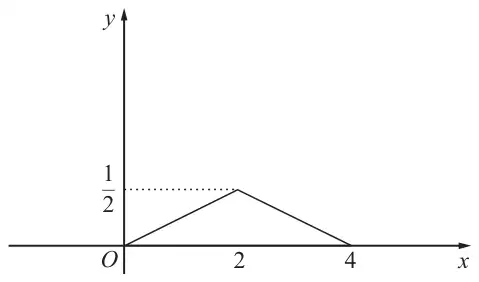
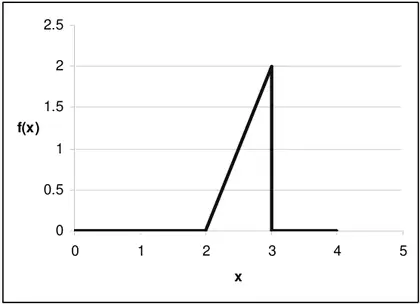
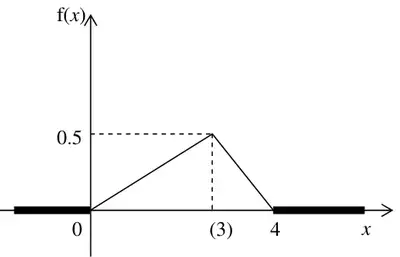
2. The graph shows the probability density function \(\mathrm{f}(x)\) of the continuous random variable \(X\)
(a) Find \(\mathrm{P}(X \lt 4)\) (2)
(b) Specify the cumulative distribution function of \(X\) for \(7 \leqslant x \leqslant 11\) (3)
Mark scheme (a)
Scheme
Marks
AO
\(\mathrm{P}(X \lt 4) = \dfrac{(4-1) \times 0.1}{2}\) or \(\displaystyle\int_1^4 \tfrac{1}{30}(x-1)\,\mathrm{d}x\)
M1
2.1
\(= 0.15\)
A1
1.1b
(2)
Notes
M1: Use of area of triangle or integration with limits to find required area Condone \(\dfrac{4 \times 0.1}{2}\) or \(\displaystyle\int_1^4 \tfrac{1}{30}(x)\,\mathrm{d}x\) for M1
M1: Using independence to calculate the \(\mathrm{E}(A)\), \(\mathrm{E}(B)\) or \(\mathrm{E}(C)\)
M1: Use of bias = \(\mathrm{E}(X) - \beta\)
A1: Correct bias for \(A\)
A1: Correct bias for \(B\)
A1: Correct bias for \(C\) [allow \(+0.5\beta\)]
Mark scheme (b)
Scheme
Marks
AO
\(\left[\mathrm{Var}(X) = \dfrac{4}{3}\beta^2\right]\) Better estimator would have the smallest bias and the least variance. \(B\) and \(C\) have equal bias, so we select the estimator with the smallest variance \(\mathrm{Var}(B) = \mathrm{Var}\left(\dfrac{X_1 + 2X_2 + 3X_3}{8}\right)\) \(= \tfrac{1}{64}[\mathrm{Var}(X) + 4\mathrm{Var}(X) + 9\mathrm{Var}(X)]\) \(\mathrm{Var}(C) = \mathrm{Var}\left(\dfrac{X_1 + 2X_2 - X_3}{8}\right)\) \(= \tfrac{1}{64}[\mathrm{Var}(X) + 4\mathrm{Var}(X) + \mathrm{Var}(X)]\)
8. A circle, centre \(O\), has radius \(x\) cm, where \(x\) is an observation from the random variable \(X\) which has a rectangular distribution on \([0, \pi]\)
(a) Find the probability that the area of the circle is greater than 10 cm2(3)
(b) State, giving a reason, whether the median area of the circle is greater or less than 10 cm2(1)
The triangle \(OAB\) is drawn inside the circle with \(OA\) and \(OB\) as radii of length \(x\) cm and angle \(AOB\) \(x\) radians.
(c) Use algebraic integration to find the expected value of the area of triangle \(OAB\). Give your answer as an exact value. (7)
7. Fence panels come in two sizes, large and small. The lengths of the large panels are normally distributed with mean 198 cm and standard deviation 5 cm. The lengths of the small panels are normally distributed with mean 74 cm and standard deviation 3 cm.
(a) Find the probability that the total length of a random sample of 3 large panels is greater than the total length of a random sample of 8 small panels. (6)
One large panel and one small panel are selected at random.
(b) Find the probability that the length of the large panel is more than \(\dfrac{8}{3}\) times the length of the small panel. (5)
Rosa needs 1000 cm of fencing. The large panels cost £80 each and the small panels cost £30 each. Rosa’s plan is to buy 5 large panels and measure the total length. If the total length is less than 1000 cm she will then buy one small panel as well.
(c) Calculate whether or not the expected cost of Rosa’s plan is cheaper than simply buying 14 small panels. (6)
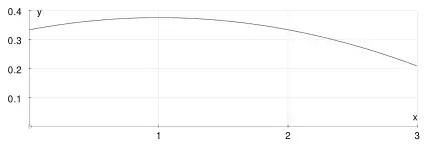
The random variable \(Y \sim \mathrm{N}(\mu, \sigma^2)\) and \(\mathrm{E}(Y) = \mathrm{E}(X)\)
The probability density function of \(Y\) is \(\mathrm{g}(y)\), where
\[\mathrm{g}(y) = \frac{1}{\sigma\sqrt{2\pi}}\mathrm{e}^{-\frac{1}{2}\left(\frac{y-\mu}{\sigma}\right)^2} \qquad -\infty \lt y \lt \infty\]
Given that \(\mathrm{g}(\mu) = \mathrm{f}(\mu)\)
(b) find the exact value of \(\sigma\) (3)
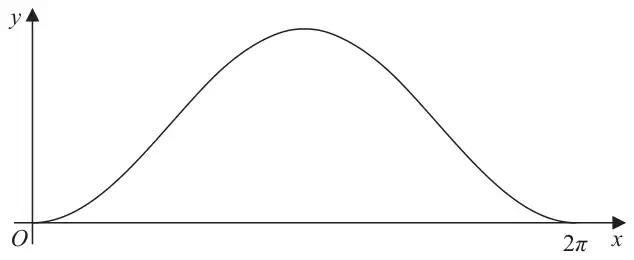
(c) Calculate the error in using \(\mathrm{P}\left(\dfrac{\pi}{2} \lt Y \lt \dfrac{3\pi}{2}\right)\) as an approximation to \(\mathrm{P}\left(\dfrac{\pi}{2} \lt X \lt \dfrac{3\pi}{2}\right)\) (4)
7. A manufacturer makes two versions of a toy. One version is made out of wood and the other is made out of plastic.
The weights, \(W\) kg, of the wooden toys are normally distributed with mean 2.5 kg and standard deviation 0.7 kg. The weights, \(X\) kg, of the plastic toys are normally distributed with mean 1.27 kg and standard deviation 0.4 kg. The random variables \(W\) and \(X\) are independent.
(a) Find the probability that the weight of a randomly chosen wooden toy is more than double the weight of a randomly chosen plastic toy. (6)
The manufacturer packs \(n\) of these wooden toys and \(2n\) of these plastic toys into the same container. The maximum weight the container can hold is 252 kg.
The probability of the contents of this container being overweight is 0.2119 to 4 decimal places.
(b) Calculate the value of \(n\). (8)
Mark scheme (a)
Scheme
Marks
AO
Let \(T = W - 2X\) then \(\mathrm{E}(T) = 2.5 - 2 \times 1.27\)
M1: selecting and using an appropriate model. ie \(\pm(W - 2X)\) May be implied by \(-0.04\)
A1: \(-0.04\) oe
M1: for realising the need to use \(\mathrm{Var}(W) + 4\,\mathrm{Var}(X)\). Allow use of 0.7 for \(\mathrm{Var}(W)\) instead of 0.72 and/or 0.4 for \(\mathrm{Var}(X)\) instead of 0.42. May be implied by 1.13
A1: 1.13 only
M1: For realising the \(\mathrm{P}(T \gt 0)\) is required and an attempt to find it. \(\dfrac{0 - \text{“}\text{their } -0.04\text{”}}{\sqrt{\text{“}\text{their } 1.13\text{”}}}\) may be implied by a correct answer. If \(\mathrm{E}(T)\) and \(\mathrm{Var}(T)\) have not been given they must be correct here
M1: Selecting and using appropriate model. May be implied by 0.81
B1: \(5.04n\) only
A1: \(0.81n\)
M1: For standardising using their mean and sd \(\pm\dfrac{252 - \text{“}5.04n\text{”}}{\sqrt{\text{“}0.81n\text{”}}}\) If mean and sd not given they must be correct here
M1: For constructing an equation and equate their standardisation to 0.8 or awrt 0.7998. Must be of form \(\dfrac{252 - an}{b\sqrt{n}} = 0.8\) or \(\dfrac{252 - an}{bn} = 0.8\)
M1: Correctly solving their 3 term quadratic equation. Condone \(n = 7\)
M1: for realising the need to square their answer or for attempting to square their quadratic equation
Or \(\dfrac{1}{2}\left(2^3 - \dfrac{3}{8}2^4\right) = 1 \quad \therefore k = \dfrac{1}{2}\) *
(B1*)
(1)
Notes
B1*: substituting \(x = 2\) into \(\mathrm{F}(x)\) and equating to 1 leading to \(k = \dfrac{1}{2}\) with no errors. Minimum subst seen is \(k(8 - 6) = 1\) or \(0.5(8 - 6) = 1\)
(b) Show that \(\mathrm{E}(T) = \dfrac{9857}{30}\) (7)
Mark scheme (a)
Scheme
Marks
AO
\(\dfrac{1}{12}(a - 5)^2 = \dfrac{27}{4}\)
M1
3.1a
\((a - 5)^2 = 81\)
\(a - 5 = 9\) or \(a - 5 = -9\)
A1
1.1b
\(\therefore\) since \(a \gt 5\) \(a = 14\)*
A1cso*
2.2a
(3)
Notes
M1: translating a problem in mathematical contexts into a correct equation. Allow \(\dfrac{a^3 - 125}{3(a - 5)} - \left(\dfrac{a + 5}{2}\right)^2 = \dfrac{27}{4}\)
A1: for \(a - 5 = 9\) or \(a - 5 = -9\) or \(a^2 - 10a - 56 = 0\) or \(a^3 - 15a^2 - 6a + 280 = 0\)
A1cso*: concluding it is 14 giving a reason why – 4 is rejected
Mark scheme (b)
Scheme
Marks
AO
Correct method for \(\mathrm{E}(Y)\), \(\mathrm{E}(X)\) and \(\mathrm{E}(X^2)\) or \(\mathrm{E}(Y)\) and \(\mathrm{E}(X^2 + X)\)
M1: For an attempt at \(\mathrm{E}(X)\) and \(\mathrm{E}(X^2)\) or \(\mathrm{E}(X^2 + X)\) or \(3\mathrm{E}(X^2 + X)\) Some sort of working must be seen for \(\mathrm{E}(X^2)\) eg \(\dfrac{27}{4} = \mathrm{E}(X^2) - \mathrm{E}(X)^2\). Allow \(\mathrm{Var}(X) = \mathrm{E}(X^2) - \mathrm{E}(X)^2\) leading to \(= \mathrm{E}(X^2)\)
A1: 319.5
M1: Method for finding \(\mathrm{E}(T)\) ft their values
A1*cso: Fully correct solution no errors, must have \(\mathrm{E}(T) = \dfrac{9857}{30}\) *
(corrected from the printed mark scheme: the two integrals for \(\mathrm{E}(X^2 + X)\) are printed as \(\displaystyle\int_5^{14} \left(\frac{x^3}{9} + \frac{x^2}{9}\right)\mathrm{d}x\) and \(3\displaystyle\int_5^{14} \left(\frac{x^3}{9} + \frac{x^2}{9}\right)\mathrm{d}x\); the integrand should be \(\dfrac{x^2}{9} + \dfrac{x}{9}\))
2. Lloyd regularly takes a break from work to go to the local cafe. The amount of time Lloyd waits to be served, in minutes, is modelled by the continuous random variable \(T\), having probability density function
(a) Show that the cumulative distribution function is given by\[\mathrm{F}(t) = \begin{cases} 0 & t \lt 4 \\ \dfrac{t^2}{240} - c & 4 \leqslant t \leqslant 16 \\ 1 & t \gt 16 \end{cases}\]where the value of \(c\) is to be found. (2)
(b) Find the exact probability that the amount of time Lloyd waits to be served is between 5 and 10 minutes. (2)
(c) Find the median of \(T\). (2)
(d) Find the value of \(k\) such that\[\mathrm{P}(T \lt k) = \frac{2}{3}\,\mathrm{P}(T \gt k)\]giving your answer to 3 significant figures. (3)
Mark scheme (a)
Scheme
Marks
AO
\(\displaystyle\int \frac{t}{120}\,\mathrm{d}t = \frac{t^2}{240}\) and use of \(\mathrm{F}(4) = 0\) or \(\mathrm{F}(16) = 1\) or limits of \(t\) and 4 or attempt at area of trapezium allow 1 mistake. \(\dfrac{1}{2} \times (t - 4)\left(\dfrac{4}{120} + \dfrac{t}{120}\right)\)
M1
2.1
\(= \dfrac{t^2}{240} - \dfrac{1}{15}\)
A1
1.1b
(2)
Notes
M1: for attempting to integrate and a correct method
A1: \(= \dfrac{t^2}{240} - \dfrac{1}{15}\) or \(= \dfrac{t^2}{240} - 0.0667\)
M1 for using the distribution of \(X\) to obtain \(\mathrm{P}(X \lt 2.5)\) or for finding the distribution of \(Y\) in the range \(-13 \leqslant y \leqslant 3\)
(a) Use integration to show that \(\mathrm{E}(X^N) = \dfrac{2^{N+1}}{N + 2}\theta^N\) (3)
(b) Hence
(i) write down an expression for \(\mathrm{E}(X)\) in terms of \(\theta\)
(ii) find \(\mathrm{Var}(X)\) in terms of \(\theta\) (3)
A random sample \(X_1, X_2, \ldots, X_n\) where \(n \geqslant 2\) is taken to estimate the value of \(\theta\)
The random variable \(S_1 = q\bar{X}\) is an unbiased estimator of \(\theta\)
(c) Write down the value of \(q\) and show that \(S_1\) is a consistent estimator of \(\theta\) (3)
The continuous random variable \(Y\) is independent of \(X\) and is uniformly distributed over the interval \(\left[0, \dfrac{2\theta}{3}\right]\), where \(\theta\) is the same unknown constant as in \(\mathrm{f}(x)\).
The random variable \(S_2 = aX + bY\) is an unbiased estimator of \(\theta\) and is based on one observation of \(X\) and one observation of \(Y\).
(d) Find the value of \(a\) and the value of \(b\) for which \(S_2\) has minimum variance. (7)
(e) Show that the minimum variance of \(S_2\) is \(\dfrac{\theta^2}{11}\) (1)
(f) Explain which of \(S_1\) or \(S_2\) is the better estimator for \(\theta\) (2)
M1 for 4/15 and attempt at differentiating third line \(x^n \to x^{n-1}\) and must have \(k\).
M1 for using their pdf equations with correct limits, adding and setting equal to 1
NB these first two marks can be implied by \(\left[\dfrac{4}{15}x\right]_1^2 + k\left[\dfrac{4x^3}{3} - \dfrac{x^4}{4}\right]_2^4 = 1\) or \(k\left[\dfrac{4x^3}{3} - \dfrac{x^4}{4}\right]_2^4 = \dfrac{11}{15}\)
dd M1 dependent of previous method marks being awarded. Correct integration and attempt to substitute limits
A1 \(k\) correct
M1 correct method for finding F(2.5) using their values for \(k\) and \(b\) or allow with the letters \(a\)(or 4), \(k\) and \(b\). May be implied by a correct answer otherwise working must be shown.
A1cso all previous method marks must be awarded \(\dfrac{623}{1280}\) or awrt 0.487
M1 correct method for finding F(2.5) using their value for \(k\) or allow with the letters \(a\)(or 4) and \(k\). May be implied by a correct answer otherwise working must be shown.
A1cso all previous method marks must be awarded \(\dfrac{623}{1280}\) or awrt 0.487
5. The weights, in kg, of cars may be assumed to follow the normal distribution \(\mathrm{N}(1000, 250^2)\). The weights, in kg, of lorries may be assumed to follow the normal distribution \(\mathrm{N}(2800, 650^2)\).
A lorry and a car are chosen at random.
(a) Find the probability that the lorry weighs more than 3 times the weight of the car. (6)
A ferry carries vehicles across a river. The ferry is designed to carry a maximum weight of 20 000 kg.
(b) One morning, 8 cars and 3 lorries drive on to the ferry. Find the probability that their total weight will exceed the recommended maximum weight of 20 000 kg. (5)
(c) State a necessary assumption needed for the calculation in part (b). (1)
4. David aims to catch the train to work each morning. The scheduled departure time of the train is 08 30
The number of minutes after 08 30 that the train departs may be modelled by the random variable \(X\). Given that \(X\) has a continuous uniform distribution over \([\alpha, \beta]\) and that \(\mathrm{E}(X) = 4\) and \(\mathrm{Var}(X) = 12\)
(a) find the value of \(\alpha\) and the value of \(\beta\). (5)
Each morning, the probability that David oversleeps is 0.05
If David oversleeps he will be late for work.
If he does not oversleep he will be in time to catch the train, but will be late for work if the train departs after 08 35
(b) Find the probability that David will be late for work. (3)
B1 A pair of correct linear equations or a correct single equation in \(\alpha\) or \(\beta\)
M1d dep on 1st B mark being awarded. Correct method to solve their simultaneous equations by eliminating \(\alpha\) or \(\beta\) or a correct method to solve their quadratic equation.
A1 cao must state it is \(\beta = 10\) not just write 10 or written as […, 10]
A1 cao must state it is \(\alpha = -2\) not just write -2 or written as [-2, …]
\(= \dfrac{107}{240}\) or \(0.4458333\ldots\) awrt 0.446
A1
(3)
Notes
M1 \(0.05 + 0.95\times(p)\) \(0 \lt p \lt 1\)
B1ft \(\left(\dfrac{10 - 5}{12}\right)\) or \(\dfrac{5}{12}\) or awrt 0.417 or \(\dfrac{\text{"their}\beta\text{"} - 5}{\text{"their}\beta\text{"} - \text{"their}\alpha\text{"}}\)
A1 awrt 0.446 or \(\dfrac{107}{240}\)
NB only award these marks in part(b)
Mark scheme (c)
Scheme
Marks
P(missed train | late) \(= \dfrac{0.05}{0.446}\)
M1
\(= \dfrac{12}{107}\) or \(0.1121\ldots\) awrt 0.112
M1: Using \(\displaystyle\int t\mathrm{f}(t)\) for both parts, attempt to multiply out and an attempt at integration. \(x^n \to x^{n+1}\) Ignore limits.
A1: correct integration for both parts
M1dep : dep on previous method being awarded. For adding the 2 parts together and substituting the correct limits in to each part.
A1: 2.5 do not ISW. You will need to check that they have used Algebriac integration
Mark scheme (b)
Scheme
Marks
\(\mathrm{Var}(T) = 6.675 - (2.5)^2\)
M1
\(= \dfrac{17}{40}\) or 0.425
A1
(2)
Notes
M1: \(\dfrac{267}{40}\) – [“their E(\(T\))”]2, NB must see \(-1^2\) if their E(\(T\)) = 1
M1: \(\displaystyle\int_1^t \frac{1}{2}(x - 1)\,\mathrm{d}x\) with correct limits or \(\displaystyle\int \frac{1}{2}(x - 1)\,\mathrm{d}x\) and F(1) = 0 There must be an attempt to integrate for either method; \(x^n \to x^{n+1}\)
A1: 2nd line oe allow in terms of \(x\). Must be in the cdf
M1: \(\displaystyle\int_2^t \frac{1}{16}(14x - 3x^2 - 8)\,\mathrm{d}x +\) using "their F(2)" or \(\displaystyle\int \frac{1}{16}(14x - 3x^2 - 8)\) and using F(4) = 1 There must be an attempt to integrate for either method; \(x^n \to x^{n+1}\)
A1: 3rd line oe allow in terms of \(x\). Correct Method must be shown to award the A1 Must be in the cdf
B1: fully correct all in terms of \(t\) (allow < instead of \(\leqslant\) and vice versa ditto > and \(\geqslant\))
NB fully correct answer with no working can gain M1A1M0A0B1
M1: their cdf for \(1 \lt t \leqslant 2\) = 0.2 or \(\displaystyle\int_1^t \frac{1}{2}(t - 1)\,\mathrm{d}t = 0.2\) and attempt at integration \(x^n \to x^{n+1}\)
M1: Correct method for solving their 3 term quadratic equation ie correct use of formula or correct completion of the square
A1: awrt 1.89 allow \(\dfrac{5 + 2\sqrt{5}}{5}\) or \(1 + \dfrac{2}{\sqrt{5}}\) oe must be only one answer given.
M1: attempt at 1 – F(1.5) must subst 1.5 into their line for \(1 \lt t \leqslant 2\) or \(\displaystyle\int_1^{1.5} \frac{1}{2}(t - 1)\,\mathrm{d}t\) and attempt at integration \(x^n \to x^{n+1}\) oe
A1: 0.9375
Mark scheme (f)
Scheme
Marks
\(\mathrm{P}(T \gt 3) = 0.25\)
\(\mathrm{P}(T \gt 3 \mid T \gt 1.5) = \dfrac{\text{"}0.25\text{"}}{\text{"}0.9375\text{"}}\)
M1
\(= \dfrac{4}{15}\) or awrt 0.267
A1
(2)
(18 marks)
Notes
M1: 0.25/ “their (e)” or [1– “their F(3)”]/ “their (e)” NB if they have written a value for P(\(T\) > 3) allow this as the numerator if 0 < P(\(T\) > 3) < 1
7. Sugar is packed into medium bags and large bags. The weights of the medium bags of sugar are normally distributed with mean 520 grams and standard deviation 10 grams. The weights of the large bags of sugar are normally distributed with mean 1510 grams and standard deviation 20 grams.
(a) Find the probability that a randomly chosen large bag of sugar weighs at least 15 grams more than the combined weight of 3 randomly chosen medium bags of sugar. (6)
(b) Find the probability that a randomly chosen large bag of sugar weighs less than 3 times the weight of a randomly chosen medium bag of sugar. (5)
A random sample of 5 medium bags of sugar is taken.
(c) Find the value of \(d\) so that the probability that all 5 bags of sugar each weigh more than 520 grams is equal to the probability that the mean weight of the 5 bags of sugar is more than \(d\) grams. (5)
Mark scheme (a)
Scheme
Marks
\(L \sim \mathrm{N}(1510, 20^2)\) and \(M \sim \mathrm{N}(520, 10^2)\)
M1,A1 Attempt \(\mathrm{Var}(W) = \mathrm{Var}(L) + 3\mathrm{Var}(M)\). Do not condone missing squares, cao.
dM1 Attempting the correct probability and standardising with their mean and sd dependent on 1st M1. If values for \(W\) is not being used or not their variance score M0. Must use 15. Accept \(\mathrm{P}(W \gt 0) \quad = \mathrm{P}\left(Z \gt \dfrac{0 - -65}{\sqrt{700}}\right)\)
\(X = 3M - L\) Can be implied by correct variance.
B1 Accept -50 if reversed.
M1,A1 Attempt \(\mathrm{Var}(X) = 3^2\mathrm{Var}(M) + \mathrm{Var}(L)\). Do not condone missing squares, cao. Condone \(10^2 + 3^2 \times 20^2\) for M1A0. (corrected from the printed mark scheme: printed as \(\mathrm{Var}(W) = 3^2\mathrm{Var}(M) + \mathrm{Var}(S)\))
dM1 Attempting the correct probability and standardising with their mean and sd.
A1 0.9172 by calc. awrt 0.917-0.918
Mark scheme (c)
Scheme
Marks
P(all 5 bags weigh more than 520 grams) \(= \left(\dfrac{1}{2}\right)^5 = \dfrac{1}{32} = 0.03125\)
B1
\(\bar{M} \sim \mathrm{N}\left(520, \dfrac{10^2}{5}\right)\) or \(\displaystyle\sum_{i=1}^{5} M_i \sim \mathrm{N}(2600, 500)\)
M1 Correct integration to find the whole area, put = 1 and an attempt to integrate, ignore limits for attempt \(x^n \to x^{n+1}\)
A1 cso Method must be shown – at least one step between integration and \(k\) = 1/3 and there must be no incorrect working.
SC For using verification they could get M1 A0 if there are no errors
Mark scheme (c)
Scheme
Marks
\(\mathrm{F}(x) = \begin{cases} 0 & x \lt 2 \\ \dfrac{x^2}{6} - \dfrac{2x}{3} + \dfrac{2}{3} & 2 \leqslant x \leqslant 3 \\ \dfrac{x}{3} - \dfrac{5}{6} & 3 \lt x \lt 5 \\ 2x - \dfrac{x^2}{6} - 5 & 5 \leqslant x \leqslant 6 \\ 1 & x \gt 6 \end{cases}\) Alternative \(\mathrm{F}(x) = \begin{cases} 0 & x \lt 2 \\ \dfrac{1}{6}(x - 2)^2 & 2 \leqslant x \leqslant 3 \\ \dfrac{x}{3} - \dfrac{5}{6} & 3 \lt x \lt 5 \\ 1 - \dfrac{1}{6}(6 - x)^2 & 5 \leqslant x \leqslant 6 \\ 1 & x \gt 6 \end{cases}\)
M1A1 M1A1 M1A1 B1
(7)
Notes
1st M1 For \(2 \leqslant x \leqslant 3\), \(\displaystyle\int_2^x \frac{1}{3}(t - 2)\,\mathrm{d}t = \left[\frac{t^2}{6} - \frac{2t}{3}\right]_2^x\) and attempt to subst 2 and \(x\) Or \(\mathrm{F}(x) = \dfrac{x^2}{6} - \dfrac{2x}{3} + C\) and using F(2) = 0
1st A1 for the second row in the above F(\(x\)) oe. Condone < instead of \(\leqslant\) and vice versa
2nd M1 For \(3 \lt x \lt 5\), \(\displaystyle\int_3^x \frac{1}{3}\,\mathrm{d}t + \text{"}\tfrac{1}{6}\text{"} = \left[\frac{t}{3}\right]_3^x + \text{"}\tfrac{1}{6}\text{"}\) and attempt to subst 3 and \(x\). Allow F(3) instead of “\(\frac{1}{6}\)” or \(\mathrm{F}(x) = \dfrac{x}{3} + C\) and using \(\mathrm{F}(3) = \dfrac{1}{6}\) or \(\mathrm{F}(5) = \dfrac{5}{6}\)
2nd A1 for the third row in the above F(\(x\)) oe. Condone \(\leqslant\) instead of < and vice versa
3rd M1 For \(5 \leqslant x \leqslant 6\), \(\displaystyle\int_5^x 2 - \frac{t}{3}\,\mathrm{d}t + \text{"}\tfrac{5}{6}\text{"} = \left[2t - \frac{t^2}{6}\right]_5^x + \text{"}\tfrac{5}{6}\text{"}\) and subst 5 and \(x\). Allow F(5) instead of “\(\frac{5}{6}\)” or \(\mathrm{F}(x) = 2x - \dfrac{x^2}{6} + C\) and using F(6) = 1
3rd A1 for the fourth row in the above F(\(x\)) oe. Condone < instead of \(\leqslant\) and vice versa
B1 For both Top line of F(\(x\)) ie 0 \(x \lt 2\) and Bottom line of F(\(x\)) ie 1 \(x \gt 6\) Condone \(\leqslant\) instead of < and vice versa. Allow one of the lines to have otherwise as its range
1st M1 using their cdf for \(5 \leqslant x \leqslant 6 = 0.9\)
2nd M1 using either the quadratic formula or completing the square or factorising or any correct method to solve their 3 term quadratic which must have been correctly rearranged. If they write the formula down then allow a slip. If no formula written down then it must be correct for their equation. May be implied by awrt 5.23 or 6.77
A1 awrt 5.23 – (allow \(\frac{30 - \sqrt{15}}{5}\)). If they have 6.77… this must be eliminated
M1 for writing or attempting to find F(5.5) – F(4) or \(\mathrm{P}(X \leqslant 5.5) - \mathrm{P}(x \leqslant 4)\) or \(\mathrm{P}(X \lt 5.5) - \mathrm{P}(x \lt 4)\) or F(5.5) – 0.5 or \(\displaystyle\int_4^5 k\,\mathrm{d}x + \int_5^{5.5} k(6 - x)\,\mathrm{d}x\) with correct limits and \(x^n \to x^{n+1}\). May be implied by a correct answer.
M1 for using \(\dfrac{1}{9}\displaystyle\int_{2.5}^4 x(4 - x)\,\mathrm{d}x\) or \(1 - \dfrac{1}{9}\displaystyle\int_1^{2.5} x(4 - x)\,\mathrm{d}x\) correct limits needed at some point Or \(1 - \left(\dfrac{2}{9}x^2 - \dfrac{1}{27}x^3 - \dfrac{5}{27}\right)\) and attempt to subst 2.5
1st A1 correct integration with correct limits at some point
2nd A1 allow equivalent fractions
Mark scheme (c)
Scheme
Marks
P(both batteries working after 25 hours) \(= (0.375)^2\)
Peter raises money by collecting paper and selling it for recycling. A bin full of paper is sold for £50 but if the weight of the staples exceeds 1.5 kg it sells for £25
(d) Find the expected amount of money Peter raises per bin full of paper. (2)
Peter could remove all the staples before the paper is sold but the time taken to remove the staples means that Peter will have 20% fewer bins full of paper to sell.
(e) Decide whether or not Peter should remove all the staples before selling the bins full of paper. Give a reason for your answer. (2)
\(= \left[\dfrac{9x^2}{20} - \dfrac{3x^3}{30}\right]_{1.5}^2\) or \(1 - \left[\dfrac{9x^2}{20} - \dfrac{3x^3}{30}\right]_0^{1.5}\)
A1
\(= \dfrac{13}{40} = 0.325\)
A1cso
(3)
Notes
M1: writing or using \(\displaystyle\int_{1.5}^2 \frac{9x}{10} - \frac{3x^2}{10}\,\mathrm{d}x\) or \(\displaystyle 1 - \int_0^{1.5} \frac{9x}{10} - \frac{3x^2}{10}\,\mathrm{d}x\) Must have correct limits or using 1 – F(1.5) for this distribution
A1 Correct Integration. Condone missing 1-
A1cso: 0.325 or 13/40 oe
NB Watch out for using 1 – f(1.5) or \(1 - \dfrac{9(1.5) - 3(1.5)^2}{10}\). This gets M0A0A0
M1 \((\textit{their}(c)) \times 25 + (1 - \textit{their}(c)) \times 50\) Allow use of their part (c) or 0.325 ie they may restart. Allow 50 – (part(c))×25
A1: awrt 41.9
Mark scheme (e)
Scheme
Marks
£\(50 \times 0.8\) or £40 or 0.4 or awrt 0.038 or awrt 0.163 Peter should not remove the staples as the expected amount earned per bin will be less.
M1 A1ft
(2)
(15 marks)
Notes
M1: Allow \((50 \times 0.8)n\) or £\(40n\) \((n \ne 0)\) NB Allow 20% off (of) 50 = £40
A1ft: Correct statement containing the word staples and one of the 4 comparisons (ft on (c) or (d)) or the difference in these values must be seen. £\(40n\) < part(d)×\(n\) or 0.4 < their part (c) or 0.6 < 1-their part(c) or awrt 0.838 > 0.8 or 0.162 < 0.2
6. A random sample of size \(n\) is taken from the random variable \(X\), which has a continuous uniform distribution over the interval \([0, a]\), \(a \gt 0\)
The sample mean is denoted by \(\bar{X}\)
(a) Show that \(Y = 2\bar{X}\) is an unbiased estimator of \(a\) (2)
The maximum value, \(M\), in the sample has probability density function
\[\mathrm{f}(m) = \begin{cases} \dfrac{nm^{n-1}}{a^n} & 0 \leqslant m \leqslant a \\ 0 & \text{otherwise} \end{cases}\]
(b) Find \(\mathrm{E}(M)\) (2)
(c) Show that \(\mathrm{Var}(M) = \dfrac{na^2}{(n + 2)(n + 1)^2}\) (4)
The estimator \(S\) is defined by \(S = \dfrac{n + 1}{n}M\)
Given that \(n \gt 1\)
(d) state which of \(Y\) or \(S\) is the better estimator for \(a\). Give a reason for your answer. (7)
M1 for attempting to integrate a correct expression for \(\mathrm{E}(X^2)\) A1 correct \(\mathrm{E}(X^2)\) M1d dependent on previous M mark, using correct formula for Var(\(M\))
Must be finding correct probability (ie \(\mathrm{P}(W \gt 800)\) or \(\mathrm{P}(Z \gt 2.3007\ldots)\) etc) and standardise with 800 and their 760 and their \(\sqrt{302.25}\)
B1: Allow \(r \lt 5\) and \(r \gt 9\) instead of 0 otherwise Allow < instead of \(\leqslant\) signs. Any letter may be used - condone mixed letters Must have f(r) – condone F(r)
\(\mathrm{E}(R) = 7, \quad \mathrm{Var}(R) = \dfrac{4}{3}\) or \(\left[\dfrac{r^3}{12}\right]_5^9\)
B1
\(= 50\tfrac{1}{3}\)
A1
\(\mathrm{E}(A) = 50\tfrac{1}{3}\pi\) oe
A1
(4)
(6 marks)
Notes
M1: Using correct formula for \(\mathrm{E}(R^2)\). This may be in any order or written in words
B1: Var \((R) = \dfrac{4}{3}\) or awrt 1.33 and \(\mathrm{E}(R) = 7\) or \(\left[\dfrac{r^3}{12}\right]_5^9\). These may be implied by a correct answer
A1: Allow awrt 50.3
A1: Allow exact multiple of \(\pi\) eg \(50.\dot{3}\pi\) or awrt 158 Do Not allow \(50.3\pi\)
NB If both \(\mathrm{E}(R)^2\) and \([\mathrm{E}(R)]^2\) are both worked out and neither is selected they lose the final A marks. The best they can get is M1 B1 A1A0
M1: Writing or using \(\displaystyle\int_0^1 kx^{n+1}\,\mathrm{d}x\), ignore limits. Allow \(\displaystyle\int_0^1 kx(x)^n\,\mathrm{d}x\) Allow substitution of their \(k\)
M1: Attempting to integrate \(\displaystyle\int_0^1 kx^{n+2}\,\mathrm{d}x\), \(x^{n+2} \to x^{n+3}\), ignore limits. Do not allow substitution of \(k\) if it has \(x\) in it. This must be on its own with no extra bits added on.
A1: correct answer only
SC if they have \(\dfrac{k}{n + 2}\) as answer to part(b) award A1 for \(\dfrac{k}{n + 3}\)
\(\mathrm{Var}(3X) = 9\,\mathrm{Var}(X)\) \(= \dfrac{27}{80}\) oe or 0.3375 or 0.338
M1 A1cso
Notes
M1: using “their(c)” − [“their(b)”]2 with \(n = 2\) or correct Var(\(X\)) Using \(\displaystyle\int_0^1 kx^4\,\mathrm{d}x - \left[\int_0^1 kx^3\,\mathrm{d}x\right]^2\) for Var(\(X\))
M1: for writing or using 9 Var(\(X\)) or \(3^2\)Var(\(X\))
(i) The volume, \(B\) ml, in a bottle of Burxton’s water has a normal distribution \(B \sim \mathrm{N}(325, 6^2)\) and the volume, \(H\) ml, in a bottle of Hargate’s water has a normal distribution \(H \sim \mathrm{N}(330, 4^2)\). Rebecca buys 5 bottles of Burxton’s water and one bottle of Hargate’s water. Find the probability that the total volume in the 5 bottles of Burxton’s water is more than 5 times the volume in the bottle of Hargate’s water. (5)
(ii) Two independent random samples \(X_1, X_2, X_3, X_4, X_5\) and \(Y_1, Y_2, Y_3, Y_4, Y_5\) are each taken from a normal population with mean \(\mu\) and standard deviation \(\sigma\).
(a) Find the distribution of the random variable \(D = Y_1 - \bar{X}\) (3)
(b) Hence show that \(\mathrm{P}(Y_1 \gt \bar{X} + \sigma) = 0.181\) correct to 3 decimal places. (2)
Ankit believes that \(\mathrm{P}(U_1 \gt \bar{U} + \sigma) = 0.181\) correct to 3 decimal places, for any random sample \(U_1, U_2, U_3, U_4, U_5\) taken from a normal population with mean \(\mu\) and standard deviation \(\sigma\).
(c) Explain briefly why the result from part (b) should not be used to confirm Ankit’s belief. (1)
(d) Find, correct to 3 decimal places, the actual value of \(\mathrm{P}(U_1 \gt \bar{U} + \sigma)\). (6)
Mark scheme (i)
Scheme
Marks
Let \(R = B_1 + B_2 + B_3 + B_4 + B_5 - 5H\) so \(\mathrm{E}(R) = -25\) (o.e.)
1st B1 for \(\mathrm{E}(R) = -25\) (or 25 if their \(R\) is defined the other way around)
1st M1 for an attempt at \(\mathrm{Var}(R) = 5\mathrm{Var}(B) + 25\mathrm{Var}(H)\). Condone swapping of \(6^2\) and \(4^2\)
1st A1 for normal and correct variance (ft their mean)
2nd dM1 for attempting the correct probability and standardising with their mean and sd. This mark is dependent on 1st M1 so if \(R\) is not being used or M0 for variance score M0 If their method is not crystal clear then they must be attempting \(\mathrm{P}(Z \gt +\text{ve value})\) o.e
M1 for expressing probability in terms of \(D\) and standardising
A1cso for seeing \(\mathrm{P}(Z \gt 0.912..)\) or prob of 1 – 0.8186 (tables) or 0.180655…(calc)
Mark scheme (ii)(c)
Scheme
Marks
Since \(U_1\) and \(\bar{U}\) are not independent (so variance formula cannot be used) Can be implied e.g. \(U_1\) used to calculate \(\bar{U}\), \(U_1\) and \(\bar{U}\) from same sample o.e.
B1
(1)
Notes
B1 correct statement that should mention \(U_1\) and \(\bar{U}\)
4. The continuous random variable \(L\) represents the error, in metres, made when a machine cuts poles to a target length. The distribution of \(L\) is a continuous uniform distribution over the interval [0, 0.5]
(a) Find \(\mathrm{P}(L \lt 0.4)\). (1)
(b) Write down \(\mathrm{E}(L)\). (1)
(c) Calculate \(\mathrm{Var}(L)\). (2)
A random sample of 30 poles cut by this machine is taken.
(d) Find the probability that fewer than 4 poles have an error of more than 0.4 metres from the target length. (3)
When a new machine cuts poles to a target length, the error, \(X\) metres, is modelled by the cumulative distribution function \(\mathrm{F}(x)\) where
(e) Using this model, find \(\mathrm{P}(X \gt 0.4)\) (2)
A random sample of 100 poles cut by this new machine is taken.
(f) Using a suitable approximation, find the probability that at least 8 of these poles have an error of more than 0.4 metres. (3)
Mark scheme (a)
Scheme
Marks
0.8
B1
Notes
B1: cao
Mark scheme (b)
Scheme
Marks
0.25
B1
Notes
B1: cao
Mark scheme (c)
Scheme
Marks
\(\dfrac{(0.5 - 0)^2}{12} = \dfrac{1}{48}\) or awrt 0.0208
M1A1
Notes
M1: for \(\dfrac{(0.5 \pm 0)^2}{12}\) or for \(\displaystyle\int_0^{0.5} 2x^2\,\mathrm{d}x - (\text{their (b)})^2\) with some integration \(x^n \to x^{n+1}\)
A1: \(\dfrac{1}{48}\) or awrt 0.0208 or awrt \(2.08 \times 10^{-2}\)
B1: using or writing B(30, their \(\mathrm{P}(L \lt 0.4)\)) or B(30, their \(\mathrm{P}(L \gt 0.4)\)). If they have not written these probabilities in this part use answer from part (a) ie \(\mathrm{P}(L \lt 0.4)\) = (a) or \(\mathrm{P}(L \gt 0.4)\) = 1 - (a)
M1: dependent on previous B mark being awarded. Using B(30, P(\(L\) > 0.4)) with \(\mathrm{P}(Y \leqslant 3)\) written or used Or B(30 P(\(L\) < 0.4)) with \(\mathrm{P}(Y \geqslant 4)\) written or used
B1ft: using or writing Po(4) NB for ft they must either write 100 × “their 0.04” and use Poison or write Po(“their \(\lambda\)”) Allow P instead of Po
M1 using or writing 1 - \(\mathrm{P}(X \leqslant 7)\) If using normal approximation, they must either write this or \(\dfrac{7.5 - 4}{2}\) or \(\dfrac{7.5 - 4}{\sqrt{3.84}}\) or \(\dfrac{7.5 - 4}{\text{awrt } 1.96}\) or \(\dfrac{7.5 - 20}{\sqrt{16}}\)
M1: for adding the two integrals, and attempting to integrate, at least one integral \(x^n \to x^{n+1}\), ignore limits and does not need to be put equal to 1. Do not award if they add before integrating
A1: correct integration, ignore limits and does not need to be put equal to 1
M1: dependent on first M being awarded, correct use of limits and putting equal to 1. This may be seen as \(\mathrm{F}(2) = \dfrac{8}{3}k\) and using \(\mathrm{F}(6) = 1\)
A1: cso answer given so need \(4k = 1\) leading to \(k = \dfrac{1}{4}\)
NB Validation – if they substitute in \(k = \frac{1}{4}\) you may award the 1st three marks as per scheme. For the Final A mark they must say “therefore \(k = \frac{1}{4}\)”
\(\mathrm{F}(x) = \begin{cases} 0 & x \lt 0 \\ \dfrac{x^3}{12} & 0 \leqslant x \leqslant 2 \\ \dfrac{x}{4} - \dfrac{x^2}{48} + \dfrac{1}{4} & 2 \lt x \leqslant 6 \\ 1 & x \gt 6 \end{cases}\)
A1 A1 B1
Notes
M1: attempting to find \(\displaystyle\int_0^x kt^2\,\mathrm{d}t\), \(t^2 \to t^3\), ignore limits, may leave in terms of \(k\)
M1: attempting to find \(\displaystyle\int k\left(1 - \frac{t}{6}\right)\mathrm{d}t\) at least one integral \(t^n \to t^{n+1}\) and either have \(+\,C\) \((C \ne 0)\) and use \(\mathrm{F}(6) = 1\) or have limits 2 and \(x\) and + “their \(\displaystyle\int_0^2 kt^2\,\mathrm{d}t\)” and attempt to integrate \(t^n \to t^{n+1}\)
NB: may use any letter, need not be \(t\), condone use of \(x\)
A1: second line correct
A1: third line correct
B1: first and fourth line correct they may use “otherwise” instead of \(x \lt 0\) or \(x \gt 6\) but not instead of both
NB: Condone use of < rather than \(\leqslant\) and vice versa
A1: The correct quadratic equation – like terms must be collected together
M1d: dep on previous M1 being awarded. A correct method for solving a 3 term quadratic equation = 0 leading to \(x = \ldots\) Use either the quadratic formula or completing the square - If they quote a correct formula and attempt to use it, award the method mark if there are small errors. Where the formula is not quoted, the method mark can be implied from correct working with values but is lost if there is a mistake. If they attempt to factorise award M1 if they have \(\left(x^2 + bx + c\right) = (x + p)(x + q)\), where \(|pq| = |c|\) leading to \(x = \ldots\) May be implied by a correct value for \(x\)
A1: awrt 2.54 or \(6 - 2\sqrt{3}\) or \(6 - \sqrt{12}\). If 2 values for \(x\) are given they must eliminate the incorrect one.
7. A piece of string \(AB\) has length 9 cm. The string is cut at random at a point \(P\) and the random variable \(X\) represents the length of the piece of string \(AP\).
(a) Write down the distribution of \(X\). (1)
(b) Find the probability that the length of the piece of string \(AP\) is more than 6 cm. (1)
The two pieces of string \(AP\) and \(PB\) are used to form two sides of a rectangle. The random variable \(R\) represents the area of the rectangle.
(c) Show that \(R = aX^2 + bX\) and state the values of the constants \(a\) and \(b\). (2)
(d) Find \(\mathrm{E}(R)\). (6)
(e) Find the probability that \(R\) is more than twice the area of a square whose side has the length of the piece of string \(AP\). (4)
Mark scheme (a)
Scheme
Marks
\(X \sim \mathrm{U}[0, 9]\)
B1
(1)
Notes
B1 for \(X \sim \mathrm{U}[0, 9]\) or “continuous uniform”/“rectangular” distribution with correct range
Or allow the pdf \(\mathrm{f}(x) = \begin{cases} \dfrac{1}{9} & 0 \leqslant x \leqslant 9 \\ 0 & \text{otherwise} \end{cases}\)
M1 for \(X(9 - X)\) or \(9X - X^2\) may be implied by a correct answer
A1 for \(9X - X^2\) or \(a = -1\) and \(b = 9\)
Mark scheme (d)
Scheme
Marks
\(\mathrm{E}(X) = 4.5\)
B1
\(\mathrm{Var}(X) = \dfrac{81}{12} = \dfrac{27}{4}\) or \(\mathrm{E}(X^2) = \displaystyle\int_0^9 \dfrac{x^2}{9}\,\mathrm{d}x\)
B1
\(\mathrm{E}(X^2) = \mathrm{Var}(X) + [\mathrm{E}(X)]^2\) or \(= \left[\dfrac{x^3}{27}\right]_0^9\)
M1
\(\mathrm{E}(X^2) = 27\)
A1
So \(\mathrm{E}(R) = 9 \times 4.5 - 27 = 13.5\)
dM1A1
(6)
Notes
1st B1 for 4.5 or may be implied
2nd B1 for \(\dfrac{81}{12}\) or \(\dfrac{27}{4}\) or \(\displaystyle\int_0^9 \dfrac{x^2}{9}\) ignore limits
1st M1 for full method for \(\mathrm{E}(X^2)\) using their Var(\(X\)) and E(\(X\)) or attempt to integrate \(x^n \to x^{n+1}\) leading to a value for \(\mathrm{E}(X^2)\). Need to be using \(\displaystyle\int_0^9 \dfrac{x^2}{9}\) ignore limits.
1st A1 for \(\mathrm{E}(X^2) = 27\), may be implied.
d2nd M1 for using \(9\mathrm{E}(X) - \mathrm{E}(X^2)\). With their E(\(X\)) and \(\mathrm{E}(X^2)\). This may be implied by a correct answer. Dep on first M
B1 \(\displaystyle\int_0^9 \dfrac{\left(9x - x^2\right)}{9}\,\mathrm{d}x\) ignore limits, ft their (c) whch must be of the form \(aX^2 + b\)
B1 \(\displaystyle\int_0^9 \dfrac{\left(9x - x^2\right)}{9}\,\mathrm{d}x\) with correct limits, ft their (c)
M1 attempt to integrate at least one \(x^n \to x^{n+1}\). Need to be using their \(\displaystyle\int_0^9 \dfrac{\left(9x - x^2\right)}{9}\,\mathrm{d}x\) condone limits missing
A1 Correct Integration
dM1 subst in limits, need to see 9 substituted. Condone missing 0
Mark scheme (e)
Scheme
Marks
\(R \gt 2X^2\) or \(9X - X^2 \gt 2X^2\)
M1
\(9X \gt 3X^2\)
A1
So \(\mathrm{P}(X \lt 3)\)
M1
\(= \dfrac{1}{3}\)
A1
(4)
(14 marks)
Notes
Allow \(\leqslant\) instead of < and \(\geqslant\) instead of > in this part
1st M1 for forming a suitable inequality in \(R\) and \(X\) or just \(X\). May be implied by a correct probability in \(X\).
1st A1 for simplifying to \(9X \gt 3X^2\) or \(3 \gt X\). May be implied by a correct probability in \(X\)
6. Emily is monitoring the level of pollution in a river. Over a period of time she has found that the amount of pollution, \(X\), in a 100 ml sample of river water has a continuous distribution with probability density function \(\mathrm{f}(x)\) given by
\[\mathrm{f}(x) = \begin{cases} \dfrac{2x}{a^2} & 0 \leqslant x \leqslant a \\ 0 & \text{otherwise} \end{cases}\]
where \(a\) is a constant.
Emily takes a random sample \(X_1, X_2, X_3, \ldots, X_n\) to try to estimate the value of \(a\).
(a) Show that \(\mathrm{E}(\bar{X}) = \dfrac{2a}{3}\) and \(\mathrm{Var}(\bar{X}) = \dfrac{a^2}{18n}\) (4)
The random variable \(S = p\bar{X}\), where \(p\) is a constant, is an unbiased estimator of \(a\).
(b) Write down the value of \(p\) and find \(\mathrm{Var}(S)\). (2)
Felix suggests using the statistic \(M = \max\{X_1, X_2, X_3, \ldots, X_n\}\) as an estimator of \(a\).
He calculates \(\mathrm{E}(M) = \dfrac{2n}{2n + 1}a\) and \(\mathrm{Var}(M) = \dfrac{n}{(n + 1)(2n + 1)^2}a^2\)
(c) State, giving your reasons, whether or not \(M\) is a consistent estimator of \(a\). (3)
The random variable \(T = qM\), where \(q\) is a constant, is an unbiased estimator of \(a\).
(d) Write down, in terms of \(n\), the value of \(q\) and find \(\mathrm{Var}(T)\). (3)
(e) State, giving your reasons, which of \(S\) or \(T\) you would recommend Emily use as an estimator of \(a\). (3)
Emily took a sample of 5 values of \(X\) and obtained the following:
5.3 4.3 5.7 7.8 6.9
(f) Calculate the estimate of \(a\) using your recommended estimator from part (e). (2)
(g) Find the standard error of your estimate, giving your answer to 2 decimal places. (2)
M1 for correct use of \(\mathrm{Var}(T) = q^2\,\mathrm{Var}(M)\) for their \(q\).
Mark scheme (e)
Scheme
Marks
\(\dfrac{a^2}{4n(n + 1)} \lt \dfrac{a^2}{8n} \iff 2 \lt n + 1 \iff 1 \lt n\) So \(\mathrm{Var}(T) \lt \mathrm{Var}(S)\)
M1 A1
So (since both are unbiased) choose \(T\) since it has the lower variance
A1cso.
(3)
Notes
M1 for attempt to compare \(\mathrm{Var}(T)\) and \(\mathrm{Var}(S)\) 1st A1 for clearly establishing that \(\mathrm{Var}(T) \lt \mathrm{Var}(S)\) 2nd A1 for choosing \(T\) and stating variance is smaller SC M0 A0 B1 for T because it has a smaller variance
Mark scheme (f)
Scheme
Marks
\(m = 7.8\) so using \(t\) gives estimate of \(\dfrac{11}{10} \times 7.8, = 8.58\) [NB \(\bar{x} = 6\) and \(s\) gives 9]
M1, A1ft
(2)
Notes
M1 for using their estimator chosen in (e)
Mark scheme (g)
Scheme
Marks
Using \(\mathrm{Var}(T) = \frac{a^2}{120}\); so standard error is \(\frac{8.58}{\sqrt{120}}\), = awrt 0.78 [NB \(s\) gives \(\frac{a}{\sqrt{40}} = 1.42\)]
M1;A1
(2)
(19 marks)
Notes
M1 for using their Variance formula to calculate std. error. subst in \(n = 5\) and their (f)
(Corrected from the printed mark scheme: the note printed “subst in \(n\)=4”; the sample has \(n = 5\), giving \(4n(n + 1) = 120\).)
6. In an experiment some children were asked to estimate the position of the centre of a circle. The random variable \(D\) represents the distance, in centimetres, between the child’s estimate and the actual position of the centre of the circle. The cumulative distribution function of \(D\) is given by
\[\mathrm{F}(d) = \begin{cases} 0 & d \lt 0 \\ \dfrac{d^2}{2} - \dfrac{d^4}{16} & 0 \leqslant d \leqslant 2 \\ 1 & d \gt 2 \end{cases}\]
(a) Find the median of \(D\). (4)
(b) Find the mode of \(D\). Justify your answer. (5)
The experiment is conducted on 80 children.
(c) Find the expected number of children whose estimate is less than 1 cm from the actual centre of the circle. (3)
M1 for identifying the symmetry. May be implied by \(\mathrm{P}(1 \lt x \lt 2) = \dfrac{11}{36}\) found by any method or writing down a correct equation (ft their \(k\)). e.g. \(0.75 - 2\times\dfrac{11}{36}\) or \(\displaystyle\int_3^4 kx(4 - x)\,\mathrm{d}x\) or \(1 - 3k - \dfrac{11}{36} - \displaystyle\int_1^2 4kx - kx^2\) with their \(k\) subst in
3. A company produces two types of milk powder, ‘Semi-Skimmed’ and ‘Full Cream’. In tests, each type of milk powder is used to make a large number of cups of coffee. The mass, \(S\) grams, of ‘Semi-Skimmed’ milk powder used in one cup of coffee is modelled by \(S \sim \mathrm{N}(4.9, 0.8^2)\). The mass, \(C\) grams, of ‘Full Cream’ milk powder used in one cup of coffee is modelled by \(C \sim \mathrm{N}(2.5, 0.4^2)\)
(a) Two cups of coffee, one with each type of milk powder, are to be selected at random. Find the probability that the mass of ‘Semi-Skimmed’ milk powder used will be at least double that of the ‘Full Cream’ milk powder used. (6)
(b) ‘Semi-Skimmed’ milk powder is sold in 500 g packs. Find the probability that one pack will be sufficient for 100 cups of coffee. (5)
M1 using \(\displaystyle\int x\mathrm{f}(x)\,\mathrm{d}x\) ignore limits. Must have at least one \(x^n \to x^{n+1}\)
They must add the 3 parts together. Do not allow division by 3.
A1 all integration correct; ignore limits
M1 dependent on previous M being awarded. Subst in correct limits – no need to see zero substituted.
A1 \(2\frac{7}{9}\) oe or awrt 2.78
Mark scheme (b)
Scheme
Marks
\(\mathrm{F}(x) = \begin{cases} 0 & x \lt 0 \\ \dfrac{x^2}{9} & 0 \leqslant x \leqslant 1 \\[1ex] \dfrac{2x}{9} - \dfrac{1}{9} & 1 \lt x \lt 4 \\[1ex] \dfrac{2x}{3} - \dfrac{x^2}{18} - 1 & 4 \leqslant x \leqslant 6 \\ 1 & x \gt 6 \end{cases}\)
B1 M1A1 M1 A1 B1
1st M1 For \(1 \lt x \lt 4\), \(\mathrm{F}(x) = \displaystyle\int_1^x \frac{2}{9}\,\mathrm{d}x + \frac{1}{9}\)
2nd M1 For \(4 \leqslant x \leqslant 6\), \(\mathrm{F}(x) = \displaystyle\int_4^x \frac{2}{3} - \frac{x}{9}\,\mathrm{d}x + \frac{7}{9}\) or use +C and F(6) =1
(6)
Notes
B1 for 2nd line- allow use of \(\lt\) instead of \(\leqslant\)
M1 For \(1 \lt x \lt 4\), \(\mathrm{F}(x) = \displaystyle\int_1^x \frac{2}{9}\,\mathrm{d}x + \frac{1}{9}\). Limits are needed. or use \(\mathrm{F}(x) = \displaystyle\int_1^x \frac{2}{9}\,\mathrm{d}x + \text{their F}(1)\) need limits or use “their \(\mathrm{F}(1)\)” \(= \displaystyle\int \frac{2}{9}\,\mathrm{d}x + C\) and subst \(x = 1\) into RHS or use “their \(\mathrm{F}(4)\)” \(= \displaystyle\int \frac{2}{9}\,\mathrm{d}x + C\) and subst \(x = 4\) into RHS
A1 for 3rd line allow use of \(\leqslant\) instead of \(\lt\)
M1 For \(4 \leqslant x \leqslant 6\), \(\mathrm{F}(x) = \displaystyle\int_4^x \frac{2}{3} - \frac{x}{9}\,\mathrm{d}x + \frac{7}{9}\). Limits are needed. or use \(\mathrm{F}(x) = \displaystyle\int_4^x \frac{2}{3} - \frac{x}{9}\,\mathrm{d}x + \text{their F}(4)\). Limits are needed. or use “their \(\mathrm{F}(4)\)” \(= \displaystyle\int \frac{2}{3} - \frac{x}{9}\,\mathrm{d}x + C\) and subst \(x = 4\) into RHS or use \(1 = \displaystyle\int \frac{2}{3} - \frac{x}{9}\,\mathrm{d}x + C\) and subst \(x = 6\) into RHS
A1 for 4th line allow use of \(\lt\) instead of \(\leqslant\)
B1 for first and last line - allow use of \(\leqslant\) instead of \(\lt\) and \(\geqslant\) instead of \(\gt\) and “otherwise” for one of \(x \lt 0\) and \(x \gt 6\)
Mark scheme (c)
Scheme
Marks
\(\mathrm{F}(x) = 0.5\)
M1
\(\dfrac{2m}{9} - \dfrac{1}{9} = 0.5\)
A1ft
\(m = 2.75\)
A1
(3)
Notes
M1 putting any one of their lines = 0.5
A1 their 3rd line = 0.5
A1 2.75
Mark scheme (d)
Scheme
Marks
Median < mean therefore positive skew Or Mean \(\approx\) median therefore no skewness
M1A1cao
(2)
(15 marks)
Notes
M1 reason must match their values / a correctly shaped and labelled sketch. Must compare the median and mean, ignore references to mode
A1 no ft Correct answer only from correct values of the mean and median or a correct and fully labelled sketch.
(a) Show that the value of \(c\) is \(\dfrac{1}{486}\) (4)
(b) Show that the cumulative distribution function \(\mathrm{F}(t)\) is given by \[\mathrm{F}(t) = \begin{cases} 0 & t \lt 0 \\ \dfrac{t}{6} - \dfrac{t^3}{1458} & 0 \leqslant t \leqslant 9 \\ 1 & t \gt 9 \end{cases}\] (2)
(c) Find the probability that a customer will queue for longer than 3 minutes. (2)
A customer has been queueing for 3 minutes.
(d) Find the probability that this customer will be queueing for at least 7 minutes. (3)
Three customers are selected at random.
(e) Find the probability that exactly 2 of them had to queue for longer than 3 minutes. (3)
1st M1 Attempting to integrate, For attempt \(x^n \to x^{n+1}\) and \(c\) must remain as \(c\) or 1/486. Ignore limits
1st A1 Correct integration. Ignore limits.
2nd M1 dependent on previous M being awarded. Putting = 1 and substitution of 9 as a limit seen. Need at least one intermediate step before getting 486 or substitution of 1/486 and 9 seen and leading to an answer of 1
A1 \(c = \dfrac{1}{486}\) cso or if verifying, the statement \(c = \dfrac{1}{486}\)
\(\mathrm{F}(t) = \begin{cases} 0 & t \lt 0 \\ \dfrac{t}{6} - \dfrac{t^3}{1458} & 0 \leqslant t \leqslant 9 \\ 1 & t \gt 9 \end{cases}\)
A1cso
(2)
Notes
M1 Attempting to integrate with correct limits or \(\displaystyle\int \mathrm{f}(t)\,\mathrm{d}t + \mathrm{C}\) and F(0) = 0 or F(9) = 1. Subst in \(c\) at some point
A1 \(\mathrm{F}(t)\) must be stated and cso. Condone use of \(\lt\) instead of \(\leqslant\) etc.
M1 using or writing 1 – F(3) or \(\dfrac{1}{486}\displaystyle\int_3^9 81 - x^2\,\mathrm{d}x\) or \(1 - \mathrm{P}(X \leqslant 3)\)
A1 awrt 0.519
Mark scheme (d)
Scheme
Marks
\(\mathrm{P}(T \gt 7 \mid T \gt 3) = \dfrac{0.068587}{0.5185}\)
M1A1ft
\(= \dfrac{25}{189}\) or awrt 0.132
A1
(3)
Notes
M1 \(\dfrac{\textit{a probability}}{\textit{their (c)}}\) where \(0 \lt\) a probability \(\lt\) their (c) \(\lt 1\). If a probability \(\geqslant\) their (c), give M0.
A1ft \(\dfrac{\;\frac{50}{729}\;}{\textit{their (c)}}\) or \(\dfrac{\text{awrt}\,0.0686}{\textit{their (c)}}\)
A1 \(\dfrac{25}{189}\) or awrt 0.132
Mark scheme (e)
Scheme
Marks
\({}^3C_2(0.5185)^2(1 - 0.5185) = \dfrac{2548}{6561}\) or awrt 0.388/ 0.387
M1A1ftA1
(3)
(14 marks)
Notes
M1 Allow (their ‘0.5185’)\(^2\)(1 – their ‘0.5185’)
A1ft Allow \({}^3\mathrm{C}_2\) (their ‘0.5185’)\(^2\)(1 – their ‘0.5185’)
8. A farmer supplies both duck eggs and chicken eggs. The weights of duck eggs, \(D\) grams, and chicken eggs, \(C\) grams, are such that
\[D \sim \mathrm{N}(54, 1.2^2) \text{ and } C \sim \mathrm{N}(44, 0.8^2).\]
(a) Find the probability that the weights of 2 randomly selected duck eggs will differ by more than 3 g. (6)
(b) Find the probability that the weight of a randomly selected chicken egg is less than \(\dfrac{4}{5}\) of the weight of a randomly selected duck egg. (5)
Eggs are packed in boxes which contain either 6 randomly selected duck eggs or 6 randomly selected chicken eggs. The weight of an empty box has distribution \(\mathrm{N}\left(28, \sqrt{5}^{\,2}\right)\).
(c) Find the probability that a full box of duck eggs weighs at least 50 g more than a full box of chicken eggs. (6)
1st M1 for explicitly defining a correct \(P\) or \(Q\). May be implied by a correct distribution for \(P\) or \(Q\)
1st A1 for a correct distribution for \(P\) 2nd A1 for a correct distribution for \(Q\)
2nd M1 for attempting \(R\) and obtaining its distribution- ft their \(P\) and \(Q\) means and variances
3rd dM1 for attempting \(\mathrm{P}(R \gt 50)\) and standardising with 50 and their \(\mathrm{E}(R)\) and their \(\sqrt{\mathrm{Var}(R)}\) Dependent on 2nd M1. Must lead to a \(\mathrm{P}(Z \gt -\text{ve})\) (o.e.)
M1 for a correct expression for \(\mathrm{Var}(X)\) in terms of \(a\) or \(\mathrm{Var}(X) = 3\)
1st A1 for normal and correct mean must be \(a + 2\) NB \(\mathrm{N}(17.2, \ldots)\) is A0 and \(\mathrm{N}\left(17.2, \tfrac{3}{50}\right)\) is M1A0A1
2nd A1ft for correct \(\mathrm{Var}(\bar{X})\), i.e. (their “3”)/50
M1 for attempt to differentiate and putting = 0. At least one correctly differentiated \(x\) term. or for an alternative method for finding the maximum such as completing the square and selecting the corresponding \(x\) value or using a sketch and symmetry.
1st M1 for clear attempt to use \(x\mathrm{f}(x)\) with an intention of integrating (Integral sign enough) Ignore limits. Must substitute in \(\mathrm{f}(x)\)
2nd M1d dependent on 1st M being awarded. For some correct integration...at least one correct term with the correct coefficient.
1st A1 for fully correct (possibly un-simplified) integration. Ignore limits
2nd A1 for answer of 5/4 or 1.25 or some other exact equivalent
Mark scheme (d)
Scheme
Marks
Mean > mode
M1
So positive skew
A1
(2)
(11 marks)
Notes
M1 for a comparison of mean and mode (ft their values of mode and mean). Do not allow median.
A1 for positive skew only (provided this is compatible with their values and comparison)
M1 for clear use of \(1 - \mathrm{F}(y)\) or attempt at integrating \(\mathrm{f}(y)\); at least one correct term with correct coefficient, and using limit of 1 and 2
5. Blumen is a perfume sold in bottles. The amount of perfume in each bottle is normally distributed. The amount of perfume in a large bottle has mean 50 ml and standard deviation 5 ml. The amount of perfume in a small bottle has mean 15 ml and standard deviation 3 ml.
One large and 3 small bottles of Blumen are chosen at random.
(a) Find the probability that the amount in the large bottle is less than the total amount in the 3 small bottles. (6)
A large bottle and a small bottle of Blumen are chosen at random.
(b) Find the probability that the large bottle contains more than 3 times the amount in the small bottle. (6)
Mark scheme (a)
Scheme
Marks
Let \(L \sim \mathrm{N}(50, 25)\) and \(S \sim \mathrm{N}(15, 9)\) Let \(X = L - (S_1 + S_2 + S_3)\)
1st B1 for forming a suitable variable \(X\) explicitly seen. Do not give for \(L - 3S\) but allow \(L - (S + S + S)\)
2nd B1 for \(\mathrm{E}(X) = 5\) (or – 5 if their \(X\) is defined the other way around)
1st M1 for an attempt at \(\mathrm{Var}(X) = \mathrm{Var}(L) + 3\mathrm{Var}(S)\). Do not condone 5 for “25” or 3 for “9”
1st A1 for 52
2nd dM1 for attempting the correct probability and standardising with their mean and sd. This mark is dependent on 1st M1 so if \(X\) is not being used or wrong variance score M0 If their method is not crystal clear then they must be attempting P(\(Z\) < -ve value) or P(\(Z\) > +ve value) i.e. their probability after standardisation should lead to a prob. < 0.5
2nd A1 for awrt 0.244 ~ 0.245
Correct ans. only scores 5/6 (or 6/6 if 1st B1) but must be clearly labelled as (a) or the first answer.
1st B1 for defining a new variable [\(Y =\) ]\(\pm\) (\(L - 3S\)). May be implied by a correct variance.
2nd B1 for \(\mathrm{E}(Y) = 5\) (or – 5 if their \(Y\) is defined as \(Y = 3S - L\) )
1st M1 for an attempt at \(\mathrm{Var}(Y) = \mathrm{Var}(L) + 3^2\,\mathrm{Var}(S)\). Do not condone 5 for “25” or 3 for “9”
1st A1 for 106 only
2nd dM1 for attempting the correct probability and standardising with their mean and sd. This mark is dependent on 1st M1 so if \(Y\) is not being used or wrong variance score M0 If their method is not crystal clear then they must be attempting P(\(Z\) > -ve value) or P(\(Z\) < +ve value) i.e. their probability after standardisation should lead to a prob. > 0.5
2nd A1 for an awrt 0.686 ~ 0.688
Correct answer only scores 6/6 but must be clearly labelled as (b) or the second answer.
1st M1 for clear attempt to use \(x\mathrm{f}(x)\) with an intention of integrating (Integral sign enough) Ignore limits. Must substitute in \(\mathrm{f}(x)\) or “their \(\mathrm{f}(x)\)”.
2nd M1d dependent on previous M being awarded for some correct integration… at least one correct term with the correct coefficient.
1st A1 for fully correct (possibly unsimplified) integration. Ignore limits
2nd A1 Accept 1.63 and 1.625 or some other exact equivalent
Mark scheme (d)
Scheme
Marks
F(1.425) = 0.24355, F(1.435) = 0.25227
M1A1
0.25 lies between F(1.425)and F(1.435) hence result.
A1
(3)
(12 marks)
Notes
M1 expression showing substitution of 1.425 or 1.435 into \(\mathrm{F}(x)\) [or into \(\mathrm{F}(x) - 0.25\)] [or putting their \(\mathrm{F}(x) = 0.25\) and attempting to solve leading to \(x = \ldots\)] May be implied by either pair of the correct answers as given below for the 1st A1
1st A1 awrt 0.244 and awrt 0.252 [or awrt -0.00645 and awrt 0.00227] [or \(x =\) awrt 1.432]
2nd A1 0.25 lies between F(1.425)and F(1.435) [or change in sign therefore root between] [or “1.432” lies between 1.425 and 1.435 therefore root between]. Statement must be true for their method
4. A random sample of size 2, \(X_1\) and \(X_2\), is taken from the random variable \(X\) which has a continuous uniform distribution over the interval \([-a, 2a]\), \(a \gt 0\)
(a) Show that \(\bar{X} = \dfrac{X_1 + X_2}{2}\) is a biased estimator of \(a\) and find the bias. (3)
The random variable \(Y = k\bar{X}\) is an unbiased estimator of \(a\).
(b) Write down the value of the constant \(k\). (1)
(c) Find \(\mathrm{Var}(Y)\). (4)
The random variable \(M\) is the maximum of \(X_1\) and \(X_2\)
The probability density function, \(m(x)\), of \(M\) is given by
\[m(x) = \begin{cases} \dfrac{2(x + a)}{9a^2} & -a \leqslant x \leqslant 2a \\ 0 & \text{otherwise} \end{cases}\]
(d) Show that \(M\) is an unbiased estimator of \(a\). (4)
Given that \(\mathrm{E}(M^2) = \dfrac{3}{2}a^2\)
(e) find \(\mathrm{Var}(M)\). (1)
(f) State, giving a reason, whether you would use \(Y\) or \(M\) as an estimator of \(a\). (2)
A random sample of two values of \(X\) are 5 and −1
(g) Use your answer to part (f) to estimate \(a\). (1)
Mark scheme (a)
Scheme
Marks
\(\mathrm{E}(X) = \mu = \dfrac{2a - a}{2} = \dfrac{a}{2};\qquad \mathrm{E}(\bar{X}) = \mu = \dfrac{a}{2}\) so biased estimator for \(a\)
M1;A1
Bias \(= \dfrac{a}{2} - a = -\dfrac{a}{2}\)
B1(accept \(\pm\))
(3)
Notes
M1 for use of formula or integration or symmetry to find \(\mathrm{E}(X)\)
So \(\mathrm{E}(M) = a\) and therefore \(M\) is an unbiased estimator for \(a\)
A1cso
(4)
Notes
1stM1 for attempt at correct integration of correct expression 1stA1 for correct integration 2ndM1d dependent on previous M, for attempting to use correct limits 2ndA1 need statement that \(M\) is therefore unbiased
NB remember the answer is given (AG) so they must show their working
1st M1 for using \(\displaystyle\int \frac{x^2}{3b}\,\mathrm{d}x\) - (their (a))\(^2\) limits not needed and condone missing d\(x\). NB need not use the letter \(x\) but if they use \(b\) instead do not award if they cancel down to \(\dfrac{b}{3}\)
NB Check they have subtracted (their(a))\(^2\)
2nd M1 dependent on previous M being awarded. For some correct integration \(x^n \to x^{n+1}\) and correct limits substituted at some point. condone \(4b^3\) instead of \((4b)^3\)
A1 for correct solution with no incorrect working seen.
Mark scheme (c)
Scheme
Marks
\(\mathrm{Var}(3 - 2X) = 4\mathrm{Var}(X)\)
M1
\(= 3b^2\)
A1
(2)
Notes
M1 for writing or using \(4\mathrm{Var}(X)\)
Mark scheme (d)
Scheme
Marks
\(\mathrm{F}(x) = \begin{cases} 0 & x \lt 1 \\ \dfrac{x - 1}{3} & 1 \leqslant x \leqslant 4 \\ 1 & x \gt 4 \end{cases}\)
B1B1
(2)
Notes
1st B1 top and bottom line. Allow use of \(\leqslant\) instead of \(\lt\) and \(\geqslant\) instead of \(\gt\)
2nd B1 middle row. Allow use of \(\lt\) instead of \(\leqslant\)
M1 using or writing (limits not needed) \(\displaystyle\int_0^5 ax + bx^2\,\mathrm{d}x = \frac{35}{12}\)
1st A1 correct integration
2nd A1 may be awarded for an unsimplified version \(\dfrac{25a}{2} + \dfrac{125b}{3} = \dfrac{35}{12}\)
Mark scheme (c)
Scheme
Marks
\(30a + 100b = 7\) \(10a + 25b = 2\)
M1
\(a = 0.1 \quad b = 0.04\)
A1,A1
(3)
Notes
M1 attempting to solve “their equations” simultaneously – either using rearranging and substitution or making one of the coefficients the ‘same’ (ignore sign) and either adding or subtracting. May be implied by correct values for \(a\) and \(b\)
M1 writing or using \(\displaystyle\int_0^m\) “their \(a\)” + “their \(b\)”\(x\,\mathrm{d}x = 0.5\): limits not needed
1st A1 correct integration for their “\(a\)” and “\(b\)”
NB the correct equation simplifies to \(m^2 + m - 25 = 0\)
A1 3.09 only. If they have both roots then they must select 3.09
Mark scheme (e)
Scheme
Marks
mean < median (< mode)
B1ft
negatively skewed
B1 dep ft
(2)
(15 marks)
Notes
1st B1ft They must compare their values for mean and median correctly. They only need to compare 2 of mean, median and mode. If they compare either the median or mean with the mode only then the value of the mode must be stated. They may draw a sketch that matches their values of ‘\(a\)’ and ‘\(b\)’ for \(0 \leqslant x \leqslant 5\). It must not go below the \(x\)-axis This may be seen in part (a).
2nd B1 dependent f.t. on the previous B being awarded.
5. The continuous random variable \(T\) is used to model the number of days, \(t\), a mosquito survives after hatching.
The probability that the mosquito survives for more than \(t\) days is
\[\frac{225}{(t + 15)^2}, \qquad t \geqslant 0\]
(a) Show that the cumulative distribution function of \(T\) is given by \[\mathrm{F}(t) = \begin{cases} 1 - \dfrac{225}{(t + 15)^2} & t \geqslant 0 \\ 0 & \text{otherwise} \end{cases}\] (1)
(b) Find the probability that a randomly selected mosquito will die within 3 days of hatching. (2)
(c) Given that a mosquito survives for 3 days, find the probability that it will survive for at least 5 more days. (3)
A large number of mosquitoes hatch on the same day.
(d) Find the number of days after which only 10% of these mosquitoes are expected to survive. (4)
B1 The line \(\mathrm{P}(T \leqslant t) = 1 - \mathrm{P}(T \gt t)\) or \(\mathrm{F}(t) = 1 - \mathrm{P}(T \gt t)\) or both of the following statements \(\mathrm{P}(T \gt t) = \dfrac{225}{(t + 15)^2}\) and \(\mathrm{P}(T \leqslant t)\) /\(\mathrm{F}(t) = 1 - \dfrac{225}{(t + 15)^2}\) must be seen and no errors. Allow equivalent in words.
Condone use of \(\lt\) instead of \(\leqslant\) or \(\gt\) instead of \(\geqslant\) and vice versa.
\(= \dfrac{324}{529}\) or \(0.612..\) awrt 0.612 / 0.6125
A1
(3)
Notes
1st M1 The conditional probability must,
be a quotient and
have \(\mathrm{P}(T \gt 3)\) or ‘their numerical equivalent’ for the denominator and
have \(\mathrm{P}(T \gt 8)\) or \(\mathrm{P}(T \gt 5)\) or \(\mathrm{P}(T \gt 8 \cap T \gt 3)\) or \(\mathrm{P}(T \gt 5 \cap T \gt 3)\) or ‘their numerical equivalent’ for the numerator.
Allow \(\geqslant\) in place of \(\gt\)
2nd M1 writing or using \(\mathrm{P}(T \gt 8)\) or \(\mathrm{P}(T \geqslant 8)\).
1st M1 writing or using \(1 - \mathrm{F}(t) = 0.1\) or \(\mathrm{P}(T \geqslant t) = 0.1\) May be implied by \(\dfrac{225}{(t + 15)^2} = 0.1\) o.e.
2nd M1 either square rooting or solving a quadratic either by factorising / completing the square / using the formula - must be correct for their quadratic.
A1 awrt 32.4 or 32 or 33. Do not accept \(15\sqrt{10} - 15\)
\(\mathrm{P}(-3 \lt X - 5 \lt 3) = \mathrm{P}(2 \lt X \lt 6)\)
M1
\(= 0.4\)
A1
(2)
Notes
M1 finding \(\mathrm{P}(2 \lt X \lt 6)\) or \(\mathrm{P}(X \gt 2)\) or \(1 - \mathrm{P}(X \lt 2)\). May be implied by a correct answer if there is no incorrect working. Do not ignore subsequent incorrect working.
NB if they change the distribution to U[-9,1] then M1 is for finding \(\mathrm{P}(-3 \lt X \lt 1)\) or \(\mathrm{P}(X \gt -3)\) or \(1 - \mathrm{P}(X \lt -3)\). May be implied by a correct answer if there is no incorrect working. Do not ignore subsequent incorrect working.
NB remember the answer is given (AG) so they must show their working
1st M1 writing or using \(\displaystyle\int_a^{4a} y^2\mathrm{f}(y)\,\mathrm{d}y\) with correct limits used at some point. Condone omission of d\(y\). \(\mathrm{f}(y)\) does not need to be correct.
2nd M1 dependent on previous M being awarded. Attempting to integrate at \(y^n \to \dfrac{y^{n+1}}{n+1}\)
1st A1 correct expression - the correct limits must be substituted.
7. The heights, in cm, of the male employees in a large company follow a normal distribution with mean 177 and standard deviation 5 The heights, in cm, of the female employees follow a normal distribution with mean 163 and standard deviation 4
A male employee and a female employee are chosen at random.
(a) Find the probability that the male employee is taller than the female employee. (5)
Six male employees and four female employees are chosen at random.
(b) Find the probability that their total height is less than 17 m. (6)
(a) and (b): 2nd M1s for identifying a correct probability and attempting to standardise with their mean and sd. Require explicit sd or accept 1156 for M1A0. This can be implied by the correct answer.
(a) Sketch \(\mathrm{f}(x)\) for \(0 \leqslant x \leqslant 10\) (4)
(b) Find the cumulative distribution function \(\mathrm{F}(x)\) for all values of \(x\). (8)
(c) Find \(\mathrm{P}(X \leqslant 8)\). (2)
Mark scheme (a)
Scheme
Marks
B1 B1 B1 B1dep 0.2,3,4,10
(4)
Notes
1st B1 for a curve. It must start at (0, 0) and have the correct curvature.
2nd B1 for a horizontal line that joins the first section of the graph (not by a dotted line)
3rd B1 for a straight line with negative gradient that joins the horizontal line and stops on the positive \(x\) axis.
4th B1 dependent on first 3 marks being gained. Fully correct graph with labels 0.2, 3,4,10 in correct places
Mark scheme (b)
Scheme
Marks
\(\mathrm{F}(x) = \begin{cases} 0 & x \lt 0 \\ \dfrac{x^3}{135} & 0 \leqslant x \leqslant 3 \\[1ex] \dfrac{x}{5} - \dfrac{2}{5} & 3 \lt x \lt 4 \\[1ex] \dfrac{x}{3} - \dfrac{x^2}{60} - \dfrac{2}{3} & 4 \leqslant x \leqslant 10 \\ 1 & x \gt 10 \end{cases}\)
M1A1 M1A1 M1A1
1st M1 For \(0 \leqslant x \leqslant 3\), \(\mathrm{F}(x) = \displaystyle\int_0^x \frac{t^2}{45}\,\mathrm{d}t = \left[\frac{t^3}{135}\right]_0^x\)
2nd M1 For \(3 \lt x \lt 4\), \(\mathrm{F}(x) = \displaystyle\int_3^x \frac{1}{5}\,\mathrm{d}t + \frac{1}{5} = \left[\frac{t}{5}\right]_3^x + \frac{1}{5}\) or \(\mathrm{F}(x) = \displaystyle\int \frac{1}{5}\,\mathrm{d}x + \mathrm{C}\) and uses \(\mathrm{F}(3) = \dfrac{1}{5}\): \(\dfrac{1}{5} = \left[\dfrac{3}{5}\right] + C\)
3rd M1 For \(4 \leqslant x \leqslant 10\), \(\mathrm{F}(x) = \displaystyle\int_4^x \frac{1}{3} - \frac{x}{30}\,\mathrm{d}t + \frac{2}{5}\) or \(\mathrm{F}(x) = \displaystyle\int \frac{1}{3} - \frac{x}{30}\,\mathrm{d}x + \mathrm{C}\) and uses \(\mathrm{F}(4) = \dfrac{2}{5}\) or \(\mathrm{F}(10) = 1\) \(\mathrm{F}(x) = \left[\dfrac{t}{3} - \dfrac{t^2}{60}\right]_4^x + \dfrac{2}{5}\) \(\dfrac{2}{5} = \dfrac{4}{3} - \dfrac{4^2}{60} + \mathrm{C}\) or \(1 = \dfrac{10}{3} - \dfrac{10^2}{60} + \mathrm{C}\)
Top line of \(\mathrm{F}(x)\) ie 0 \(x \lt 0\)
B1
Bottom line of \(\mathrm{F}(x)\) ie 1 \(x \gt 10\)
B1
(8)
Notes
For all the M marks, the attempt to integrate must have at least one \(x^n \to x^{n+1}\)
All A marks are for the correct expressions and ranges.
Do not penalise the use of \(\leqslant\) instead of \(\lt\) and \(\geqslant\) instead of \(\gt\).
1st M1 for attempt to integrate \(\displaystyle\int_0^x \frac{t^2}{45}\,\mathrm{d}t\) ignore limits
2nd M1 for attempt to integrate \(\displaystyle\int_3^x \frac{1}{5}\,\mathrm{d}t + \text{their F}(3)\) using correct limits. or for attempt to integrate \(\displaystyle\int \frac{1}{5}\,\mathrm{d}x + \mathrm{C}\) and substituting in 3 and putting = to their F(3) or substituting in 4 and putting = to their F(4) from their \(4 \leqslant x \leqslant 10\) line
3rd M1 for attempt to integrate \(\displaystyle\int_4^x \frac{1}{3} - \frac{x}{30}\,\mathrm{d}t + \text{their F}(4)\) using correct limits. or for attempt to integrate \(\displaystyle\int \frac{1}{3} - \frac{x}{30}\,\mathrm{d}t + \mathrm{C}\) and substituting in 4 and putting = to their F(4) or substituting in 10 and putting = 1
M1 substituting 8 into the 4th line of their cdf or F(3) + F(4) – F(3) + F(8) – F(4) or \(1 - \displaystyle\int_8^{10} \frac{1}{3} - \frac{x}{30}\) (attempt to integrate needed) or use areas e.g \(1 - \dfrac{1}{2} \times 2 \times \dfrac{1}{15}\) or \(1 - \dfrac{1}{15}\)
A1 14/15 awrt 0.933 from correct working.
NB If using F(3) + F(4) – F(3) + F(8) – F(4) then \(\mathrm{F}(x)\) must be correct.
1st M1 for an attempt to multiply out bracket and for attempting to integrate \(\mathrm{f}(x)\). Both \(x^n \to x^{n+1}\)
1st A1 for correct integration. Ignore limits for these two marks. Need \(\dfrac{3}{32}\left(\dfrac{kx^2}{2} - \dfrac{x^3}{3}\right)\) oe
2nd M1 Dependent on the previous M mark being awarded. For correct use of correct limits and set equal to 1. No need to see 0 substituted in. For verifying they must have \(\dfrac{3}{32}\left(\dfrac{4^3}{2} - \dfrac{4^3}{3}\right)\)
2nd A1 cso or for verifying \(\dfrac{3}{32}\left(\dfrac{4^3}{2} - \dfrac{4^3}{3}\right) = 1\) oe eg \(3(4)^3 - 2(4)^3 = 64\) and a correct comment “so \(k = 4\)”
1st M1 Multiply out brackets, attempting to integrate (both \(x^n \to x^{n+1}\)), with either limits (their(b) \(\pm\) 0.5) or (their (b) – 0.5 and 0) Accept 2 sf for their limits.
2nd M1dep on gaining 1st M1. 1 – (using limits (their(b) \(\pm\) 0.5)) or 2 \(\times\) (using limits (their(b) – 0.5 and 0)
6. A random variable \(X\) has probability density function given by
\[\mathrm{f}(x) = \begin{cases} \dfrac{1}{2} & 0 \leqslant x \lt 1 \\ x - \dfrac{1}{2} & 1 \leqslant x \leqslant k \\ 0 & \text{otherwise} \end{cases}\]
where \(k\) is a positive constant.
(a) Sketch the graph of \(\mathrm{f}(x)\). (2)
(b) Show that \(k = \dfrac{1}{2}(1 + \sqrt{5})\). (4)
(c) Define fully the cumulative distribution function \(\mathrm{F}(x)\). (6)
(d) Find \(\mathrm{P}(0.5 \lt X \lt 1.5)\). (2)
(e) Write down the median of \(X\) and the mode of \(X\). (2)
(f) Describe the skewness of the distribution of \(X\). Give a reason for your answer. (2)
Mark scheme (a)
Scheme
Marks
B1 B1
(2)
Notes
shape B1; labels B1
1st B1 Correct shape with straight lines. Must all be above the \(x\)-axis 2nd B1 A fully correct graph with the labels 1, \(k\), 0.5, \(k\) - 0.5 seen in the correct places. Allow the use of \(\dfrac{1}{2}(1 + \sqrt{5})\)/awrt 1.62 instead of \(k\).
1st M1 \(\displaystyle\int_1^k x - \frac{1}{2}\,\mathrm{d}x = 0.5\) or \(\displaystyle\int_1^k x - \frac{1}{2}\,\mathrm{d}x + 0.5 = 1\) ignore limits or \(\displaystyle\int_1^k x - \frac{1}{2}\,\mathrm{d}x + \int_1^k \frac{1}{2}\,\mathrm{d}x = 1\) or \(\dfrac{1}{2}(k - 0.5 + 0.5)(k - 1) = 0.5\) or any correct method of finding the area
1st A1 for a quadratic equation in the form \(a(k^2 - k - 1) = 0\) or \(ak^2 - ak = a\). where \(a\) is a constant. 2nd M1 correct method for solving a quadratic of the form \(ak^2 - bk + c = 0\) where \(a, b, c \neq 0\). There must be at least one correct step before the final answer. Allow substituting in \(k\) into a quadratic of the form \(ak^2 - bk + c = 0\). 2nd A1 cso for \(k = \dfrac{1}{2}\left(1 + \sqrt{5}\right)\)
Mark scheme (c)
Scheme
Marks
\(F(x) = \begin{cases} 0, & x \lt 0 \\ \dfrac{1}{2}x, & 0 \leqslant x \lt 1 \\ \dfrac{1}{2}x^2 - \dfrac{1}{2}x + \dfrac{1}{2}, & 1 \leqslant x \leqslant k \\ 1, & x \gt k \end{cases}\)
B1 M1A1A1B1 B1 1st and last
Note: Working for the M1A1A1 \(\displaystyle\int_1^k x - \frac{1}{2}\,\mathrm{d}x + \mathrm{C} = \frac{1}{2}x^2 - \frac{1}{2}x\ ; + \frac{1}{2}\)
(M1A1;A1)
(6)
Notes
1st B1 for second line. Do not penalise the use of < instead of \(\leqslant\) and vice versa M1 for use of \(\displaystyle\int_1^k x - \frac{1}{2}\,\mathrm{d}x + \mathrm{C}\) ignore limits. For use they must have \(x \to x^2\) 1st A1 correct integration \(\dfrac{1}{2}x^2 - \dfrac{1}{2}x\) 2nd A1 \(\mathrm{C} = \dfrac{1}{2}\) NB M1A1A1 may be implied by correct 3rd line in F(\(x\))
2nd B1 for 3rd line. Statement of the form \(\dfrac{1}{2}x^2 - \dfrac{1}{2}x \pm C\). Do not penalise the use of < instead of \(\leqslant\) and vice versa. Allow \(k\) or value of \(k\). \(C\) may equal 0. 3rd B1 for first and last line. Do not penalise the use of \(\leqslant\) instead of < and \(\geqslant\) instead of > . Allow \(k\) or value of \(k\)
M1Using F(1.5) - F(0.5) . 1.5 must be put into the third line of the c.d.f. and 0.5 must be put into the second line of the c.d.f.. or \(\displaystyle\int_{0.5}^{1} \frac{1}{2}x\,\mathrm{d}x + \int_1^{1.5} x - \frac{1}{2}\,\mathrm{d}x\) need to attempt integration, at least one \(x^n \to x^{n+1}\) or seeing 0.25 + 0.375 or any correct method of finding the area.. (NB if they have not used + C or C = 0 they will get 0.125. This will get M1A0). An answer of 0.125 from an incorrect method gains M0 A0.
Mark scheme (e)
Scheme
Marks
Median is \(x = 1\)
B1
Mode is \(x = k\) or \(\dfrac{1}{2}(1 + \sqrt{5})\) or awrt1.62
B1
(2)
Notes
If it is not clear which one is the mode and which one is the median assume the median is the first answer and mode the second.
Mark scheme (f)
Scheme
Marks
Negative skew Median<mode or from graph more values are to the right.
B1 B1d
(2)
(18 marks)
Notes
B1 negative/negative skew(ness). Do not allow negative correlation. B1 dependent on previous B mark being awarded. Reason must follow from their values or diagram.
1. The time in minutes that Elaine takes to checkout at her local supermarket follows a continuous uniform distribution defined over the interval [3, 9].
Find
(a) Elaine’s expected checkout time, (1)
(b) the variance of the time taken to checkout at the supermarket, (2)
(c) the probability that Elaine will take more than 7 minutes to checkout. (2)
Given that Elaine has already spent 4 minutes at the checkout,
(d) find the probability that she will take a total of less than 6 minutes to checkout. (3)
Mark scheme (a)
Scheme
Marks
\(\mathrm{E}(X) = \dfrac{9 + 3}{2} = 6\)
B1
(1)
Mark scheme (b)
Scheme
Marks
\(\mathrm{Var}(X) = \dfrac{(9 - 3)^2}{12} = 3\)
M1A1
(2)
Notes
M1 \(\dfrac{(9 - 3)^2}{12}\) or \(\dfrac{(9 + 3)^2}{12}\)
M1 \(\dfrac{\mathrm{P}(4 \lt X \lt 6)}{P(X \gt 4)}\) or \(\dfrac{\mathrm{P}(X \lt 6)}{P(X \gt 4)}\) or \(\dfrac{2/6}{5/6}\) or \(\dfrac{3/6}{5/6}\) or \(1 - \dfrac{\mathrm{P}(X \gt 6)}{P(X \gt 4)}\) or \(\dfrac{6 - 4}{9 - 4}\) or \(\dfrac{3}{5}\)
A1 \(\dfrac{\mathrm{P}(4 \lt X \lt 6)}{P(X \gt 4)}\) or \(\dfrac{2/6}{5/6}\) or \(1 - \dfrac{\mathrm{P}(X \gt 6)}{P(X \gt 4)}\) or \(\dfrac{6 - 4}{9 - 4}\)
An answer of \(\dfrac{2}{5}\) gains all 3 marks. NB \(\leqslant\) and \(\geqslant\) are accepted in the above formulae
(a) Sketch \(\mathrm{f}(x)\) showing clearly the points where it meets the \(x\)-axis. (2)
(b) Write down the value of the mean, \(\mu\), of \(X\). (1)
(c) Show that \(\mathrm{E}(X^2) = 9.8\) (4)
(d) Find the standard deviation, \(\sigma\), of \(X\). (2)
The cumulative distribution function of \(X\) is given by
\[\mathrm{F}(x) = \begin{cases} 0 & x \lt 1 \\ \dfrac{1}{32}\left(a - 15x + 9x^2 - x^3\right) & 1 \leqslant x \leqslant 5 \\ 1 & x \gt 5 \end{cases}\]
where \(a\) is a constant.
(e) Find the value of \(a\). (2)
(f) Show that the lower quartile of \(X\), \(q_1\), lies between 2.29 and 2.31 (3)
(g) Hence find the upper quartile of \(X\), giving your answer to 1 decimal place. (1)
(h) Find, to 2 decimal places, the value of \(k\) so that\[\mathrm{P}(\mu - k\sigma \lt X \lt \mu + k\sigma) = 0.5\] (2)
Mark scheme (a)
Scheme
Marks
\(\cap\) shape which does not go below the \(x\)-axis [condone missing patios] Graph must end at the points (1,0) and (5,0) and the points labelled at 1 and 5
This part is a “show that” therefore we need to see all the steps in the working 1st M1 for showing intention of doing \(\displaystyle\int x^2\mathrm{f}(x)\) and attempt to multiply out bracket 1st A1 for correct integration, cao, ignore limits for this mark. 2nd M1 for use of correct limits. Need to see evidence of subst both 5 and 1. 2nd A1 for cso leading to 9.8. Do not ignore subsequent working for this final A mark.
Mark scheme (d)
Scheme
Marks
\(\text{s.d.} = \sqrt{9.8 - \mathrm{E}(X)^2}\),
M1
\(= 0.8944\ldots\) awrt 0.894
A1
(2)
Notes
M1 for a correct expression for standard deviation, must include \(\sqrt{\ldots}\) A1 allow awrt 0.894, \(\sqrt{0.8}\), \(\dfrac{2\sqrt{5}}{5}\) oe
Mark scheme (e)
Scheme
Marks
\(\mathrm{F}(1) = 0 \Rightarrow \tfrac{1}{32}\left(a - 15 + 9 - 1\right) = 0\), leading to \(\underline{a = 7}\)
M1 A1
(2)
Notes
M1 for a correct method to find \(a\). e.g \(\mathrm{F}(5) = 1\) or \(\displaystyle\int_1^5 f(x) = 1\)
Since \(\mathrm{F}(q_1) = 0.25\) and these values are either side of 0.25 then \(2.29 \lt q_1 \lt 2.31\)
A1
(3)
Notes
M1 for an attempt at F(2.29) or F(2.31) or put \(\mathrm{F}(x) = 0.25\) (ft their value of \(a\)) 1st A1 for both values seen. awrt 0.245 and 0.252 or find 3 solutions awrt 6.76/6.75, 2.305, -0.064 2nd A1 for comparison with 0.25 and stating Q1 lies between 2.29 and 2.31 or state only 2.30 in range and stating Q1 lies between 2.29 and 2.31
Mark scheme (g)
Scheme
Marks
Since the distribution is symmetric \(q_3 = 5 - 1.3 = \underline{3.7}\) cao
B1
(1)
Mark scheme (h)
Scheme
Marks
We know \(\mathrm{P}(q_1 = 2.3 \lt X \lt 3.7 = q_3) = 0.5\) so \(k\sigma = 0.7\)
M1
so \(k = \dfrac{0.7}{0.894\ldots} = 0.7826.. = \textbf{awrt 0.78}\)
A1
(2)
(17 marks)
Notes
M1 For \(k\sigma\) = awrt 0.7 A1 Allow awrt 0.78 NB a correct awrt 0.78 gains M1 A1
6. A random sample \(X_1, X_2, \ldots, X_n\) is taken from a population where each of the \(X_i\) have a continuous uniform distribution over the interval \([0, \beta]\). The random variable \(Y = \max\{X_1, X_2, \ldots, X_n\}\). The probability density function of \(Y\) is given by
(a) Show that \(\mathrm{E}(Y^m) = \dfrac{n}{n+m}\beta^m\). (3)
(b) Write down \(\mathrm{E}(Y)\). (1)
(c) Using your answers to parts (a) and (b), or otherwise, show that \[\mathrm{Var}(Y) = \dfrac{n}{(n+1)^2(n+2)}\beta^2\] (3)
(d) State, giving your reasons, whether or not \(Y\) is a consistent estimator of \(\beta\). (3)
The random variables \(M = 2\bar{X}\), where \(\bar{X} = \dfrac{1}{n}(X_1 + X_2 + \ldots + X_n)\), and \(S = kY\), where \(k\) is a constant, are both unbiased estimators of \(\beta\).
(e) Find the value of \(k\) in terms of \(n\). (1)
(f) State, giving your reasons, which of \(M\) and \(S\) is the better estimator of \(\beta\) in this case. (3)
Five observations of \(X\) are: 8.5 6.3 5.4 9.1 7.6
(g) Calculate the better estimate of \(\beta\). (2)
M1 for attempt to integrate \(y^m\mathrm{f}(m)\) 1stA1 for correct integration (limits not needed yet) 2ndA1 for use of correct limits and proceeding to printed answer. No incorrect working seen.
M1 for use of their \(\mathrm{E}(Y)\) and \(\mathrm{E}(Y^2)\) in a correct formula for \(\mathrm{Var}(Y)\)
Mark scheme (d)
Scheme
Marks
As \(n \to \infty\) \(\mathrm{E}(Y) \to \beta\), \(\mathrm{Var}(Y) \to 0\) So \(Y\) is a consistent estimator for \(\beta\).
M1,A1 A1
(3)
Notes
M1 for examining both \(\mathrm{E}(Y)\) and \(\mathrm{Var}(Y)\) for \(n \to \infty\) 1stA1 for correct limits for both the above 2ndA1 for a correct statement following correct working
6. The lifetimes of batteries from manufacturer \(A\) are normally distributed with mean 20 hours and standard deviation 5 hours when used in a camera.
(a) Find the mean and standard deviation of the total lifetime of a pack of 6 batteries from manufacturer \(A\). (2)
Judy uses a camera that takes one battery at a time. She takes a pack of 6 batteries from manufacturer \(A\) to use in her camera on holiday.
(b) Find the probability that the batteries will last for more than 110 hours on her holiday. (2)
The lifetimes of batteries from manufacturer \(B\) are normally distributed with mean 35 hours and standard deviation 8 hours when used in a camera.
(c) Find the probability that the total lifetime of a pack of 6 batteries from manufacturer \(A\) is more than 4 times the lifetime of a single battery from manufacturer \(B\) when used in a camera. (6)
Mark scheme (a)
Scheme
Marks
\(L = A_1 + A_2 + \ldots + A_6\) Mean is \(\mathrm{E}(L) = 6 \times 20 = 120\)
B1
Standard deviation is \(\sqrt{\mathrm{Var}(W)} = \sqrt{6 \times 5^2} = 5\sqrt{6} = 12.247\ldots\) awrt 12.2
\(= P(Z \lt 0.8164\ldots)\) \(= 0.7939\) (or 0.7929 using interpolation or 0.79289 by calc)
A1
(2)
Notes
M1 for identifying a correct probability (they must have the 110) and attempting to standardise with their mean and sd. This can be implied by the correct answer.
4. In a game, players select sticks at random from a box containing a large number of sticks of different lengths. The length, in cm, of a randomly chosen stick has a continuous uniform distribution over the interval [7, 10].
A stick is selected at random from the box.
(a) Find the probability that the stick is shorter than 9.5 cm. (2)
To win a bag of sweets, a player must select 3 sticks and wins if the length of the longest stick is more than 9.5 cm.
(b) Find the probability of winning a bag of sweets. (2)
To win a soft toy, a player must select 6 sticks and wins the toy if more than four of the sticks are shorter than 7.6 cm.
(c) Find the probability of winning a soft toy. (4)
Mark scheme (a)
Scheme
Marks
\(\dfrac{9.5 - 7}{10 - 7}\)
M1
\(= \dfrac{5}{6}\) awrt 0.833
A1
(2)
Notes
M1 for an expression for the probability e.g. \(\displaystyle\int_7^{9.5} \frac{1}{3}\,\mathrm{d}x\)
M1 for \(1 - (a)^3\) or \((1 - a)^3 + 3(1 - a)^2 a + 3(1 - a)a^2\) A1 awrt 0.421
Mark scheme (c)
Scheme
Marks
P(a stick < 7.6) \(= \dfrac{0.6}{3} = 0.2\)
B1
Let \(Y\) = number of sticks (out of 6) <7.6 then \(Y \sim \mathrm{B}(6, 0.2)\) \(\mathrm{P}(Y \gt 4) = 1 - \mathrm{P}(Y \leqslant 4)\)
M1 M1
\(= 1 - 0.9984\) \(= 0.0016\) or \(\dfrac{1}{625}\)
A1
(4)
(8 marks)
Notes
B1 0.2 may be implied by at least one correct probability 1st M1 for writing or using B(6, \(p\)) may be implied by \(np^x(1 - p)^{6-x}\) using their \(p\) and \(n \geqslant 1\) 2nd M1 for writing or using \(1 - \mathrm{P}(Y \leqslant 4)\) or \(np^5(1 - p) + p^6\) (\(n\) is an integer > 1) A1 cao
Figure 1 shows a sketch of the probability density function \(\mathrm{f}(x)\) of the random variable \(X\).
For \(0 \leqslant x \leqslant 3\), \(\mathrm{f}(x)\) is represented by a curve \(OB\) with equation \(\mathrm{f}(x) = kx^2\), where \(k\) is a constant.
For \(3 \leqslant x \leqslant a\), where \(a\) is a constant, \(\mathrm{f}(x)\) is represented by a straight line passing through \(B\) and the point \((a, 0)\).
For all other values of \(x\), \(\mathrm{f}(x) = 0\).
Given that the mode of \(X\) = the median of \(X\), find
(a) the mode, (1)
(b) the value of \(k\), (4)
(c) the value of \(a\). (3)
Without calculating \(\mathrm{E}(X)\) and with reference to the skewness of the distribution
(d) state, giving your reason, whether \(\mathrm{E}(X) \lt 3\), \(\mathrm{E}(X) = 3\) or \(\mathrm{E}(X) \gt 3\). (2)
So \(\dfrac{27k}{3} - 0 = 0.5 \ \Rightarrow \underline{k = \dfrac{1}{18}}\) (using median = 3)
M1d A1
(4)
Notes
1st M1 for attempt to integrate f(\(x\)) (need \(x^3\)). Integration must be in part (b) 1st A1 for correct integration. Ignore limits for these two marks. 2nd M1 Dependent on the previous M mark being awarded. For use of correct limits and set equal to 0.5 - leading to a linear equation for \(k\). No need to see 0 substituted. 2nd A1 for \(k = \frac{1}{18}\) or exact equivalent
NB \(k = \frac{1}{18}\) with no working gains M0A0M0A0 \(k = \dfrac{1/2}{9} = \dfrac{1}{18}\) without sight of integration is M0A0M0A0
Mark scheme (c)
Scheme
Marks
Height of triangle \(= \dfrac{1}{18} \times 3^2 = \dfrac{1}{2}\)
B1ft
Area of triangle \(= \dfrac{1}{2} \times (a - 3) \times \dfrac{1}{2} = \dfrac{1}{2}\)
M1
so \(a = 5\) cao
A1
(3)
Notes
B1 for correct height of triangle using their \(k\). ie \(9k\). May be seen in working for area of triangle. Or correct gradient of line ie \(\dfrac{9k}{(3 - a)}\) o.e.
M1 for a correct linear equation for \(a\), in the form \(\pm\dfrac{1}{2} \times (a - 3) \times 9k = \dfrac{1}{2}\) (Must see the halves) NB if they have stated their height and then used their height rather than \(9k\) allow M1 A1 cao NB stating a = 5 and then verifying area of the triangle = 0.5 is acceptable. NB a = 5 on its own is B0M0A0
SC Integration of both parts = 1 or Integration of line = 0.5 leading to \(a^2 - 8a + 15 = 0\) gets B1 M1 and if they identify \(a = 5\) A1
Mark scheme (d)
Scheme
Marks
From graph distribution is negative skew (left tail is longer) \(\mu \lt\) median for negative skew so \(\mathrm{E}(X) \lt 3\)
[ N.B. \(\mathrm{E}(X) = 2\frac{23}{24}\) ]
B1 B1d
(2)
(10 marks)
Notes
1st B1 for identifying negative skew 2nd B1 dependent on previous B mark being awarded. For correct deduction \(\mathrm{E}(X) \lt 3\)
M1 putting integral = 1 ignore limits. =1 must appear at least once in the working. M1 attempting to integrate at least one part must have correct power of \(x\) (ignore limits) A1cso subst of at least 9. Allow 1/1640.25
M1 attempt to use \(x\mathrm{f}(x)\) and attempt to multiply out bracket and attempt at integration – must have \(x^3\) and \(x^5\) terms (ignore limits) A1 correct integration (ignore limits) dM1 substituting correct limits (need not explicitly see 0). Dependent on having been awarded the first M1.
M1 attempting to integrate at least one part must have correct power of \(x\) (ignore limits) M1 dep on previous M being awarded, substituting correct limits [may use \(1 - \displaystyle\int_0^5 k(81x - x^3)\) with limits 0 and 5]
Mark scheme (d)
Scheme
Marks
P(At least 2 queue for more than 5 mins) \(= 3(1 - 0.478)(0.478)^2 + 0.478^3\)
M1A1ft
\(= 0.467\)
A1
(3)
(13 marks)
Notes
M1 \(3(1 - p)p^2 + p^3\) or \(1 - (1 - p)^3 - 3(1 - p)^2 p\) 3 not needed A1 for \(\mathbf{3}(1 - p)p^2 + p^3\) \(1 - (1 - p)^3 - \mathbf{3}(1 - p)^2 p\) where \(p\) is their solution to part (c) A1 awrt 0.467
M1 for \(\pm\dfrac{4}{0.5}\) or attempt at gradient A1cso for proceeding to given expression with no incorrect working seen B1 for top line. Must have f(\(x\)) and { and more than one line. Condone use of <. B1 for 0 otherwise and no other parts.
\(\mathrm{F}(x) = \begin{cases} 0 & x \lt 0 \\ -4x^2 + 4x & 0 \leqslant x \leqslant 0.5 \\ 1 & x \gt 0.5 \end{cases}\)
A1 B1
(4)
Notes
M1 attempting to integrate (at least one \(x^n \to x^{n+1}\)) (ignore limits) M1 correct limits used or +C and either F(0) = 0 or F(0.5) = 1, may be implied by seeing \(4x - 4x^2\)
A1 middle line. May write \(4x - 4x^2\) B1 top and bottom line
Mark scheme (c)
Scheme
Marks
\(-4x^2 + 4x = 0.5\)
M1
\(x = \dfrac{1}{4}(2 - \sqrt{2}) = 0.146\)
M1A1
(3)
Notes
M1 Their \(\mathrm{F}(x) = 0.5\) M1 attempting to solve – either correct use of quadratic formula or correct completion of the square A1 awrt 0.146 or \(\dfrac{2 - \sqrt{2}}{4}\) o.e
Mark scheme (d)
Scheme
Marks
\(x = 0\)
B1
(1)
Notes
B1 for 0
Mark scheme (e)
Scheme
Marks
Positive Skew as mode<median
B1ft
(1)
(13 marks)
Notes
B1 ft their mode and median. Need direction and correct corresponding reason OR B1 positive skew from tail on right hand side in diagram
B1 For writing or using the probability of a negative = 0.25 M1 Writing or use of B(40, \(p\)) A1 Writing or use of B(40, 0.25) M1 Writing or using \(1 - \mathrm{P}(Y \leqslant 9)\) A1 awrt 0.561 or 0.560
(i) M1 for putting \(\mathrm{f}(y) \geqslant 0\) or \(\mathrm{f}(3) \geqslant 0\) or \(ky\left(a - y\right) \geqslant 0\) or \(3k(a - 3) \geqslant 0\) or \((a - y) \geqslant 0\) or \((a - 3) \geqslant 0\) or state in words the probability can not be negative o.e. A1 need one of \(ky\left(a - y\right) \geqslant 0\) or \(3k(a - 3) \geqslant 0\) or \((a - y) \geqslant 0\) or \((a - 3) \geqslant 0\) and \(a \geqslant 3\)
(ii) M1 attempting to integrate (at least one \(y^n \to y^{n+1}\)) (ignore limits) A1 Correct integration. Limits not needed. And equals 1 not needed. M1 dependent on the previous M being awarded. Putting equal to 1 and have the correct limits. Limits do not need to be substituted. A1 cso
Mark scheme (b)
Scheme
Marks
\(\displaystyle\int_0^3 k(ay^2 - y^3)\,\mathrm{d}y = 1.75\) Int \(\displaystyle\int xf(x)\)
M1 for attempting to find \(\displaystyle\int y\mathrm{f}(y)\,\mathrm{d}y\) (at least one \(y^n \to y^{n+1}\)) (ignore limits) A1 correct Integration M1 \(\displaystyle\int y\mathrm{f}(y) = 1.75\) and limits 0,3 dependent on previous M being awarded M1 subst in for \(k\). dependent on previous M being awarded A1 cso 4 B1 cao 1/9
Mark scheme (c)
Scheme
Marks
B1 B1
(2)
Notes
B1 correct shape. No straight lines. No need for patios. B1 completely correct graph. Needs to go through origin and the curve ends at 3.
Special case: If draw full parabola from 0 to 4 get B1 B0 Allow full marks if the portion between \(x = 3\) and \(x = 4\) is dotted and the rest of the curve solid.
M1 putting \(\mathrm{F}(x) = 0.5\) M1 using correct quadratic formula. If use calc need to get 1.26 (384... ) A1 cao 1.26 must reject the other root. If they use Trial and improvement they have to get the correct answer to gain the second M mark.
M1 attempt to differentiate. At least one \(x^n \to x^{n-1}\) A1 correct differentiation B1 must have both parts- follow through their \(\mathrm{F}^{\prime}(x)\) Condone <
Methods 1 and 2 B1 for 6 and 4 (allow if seen on a diagram on \(x\)-axis) M1 for \(\mathrm{P}(X \gt 6)\) or \(\mathrm{P}(6 \lt X \lt 7)\); or \(\mathrm{P}(X \lt 4)\) or \(\mathrm{P}(1 \lt X \lt 4)\) ; or \(\mathrm{P}(4 \lt X \lt 6)\) Allow \(\leqslant\) and \(\geqslant\) signs A1 \(\dfrac{1}{6}\); or \(\dfrac{1}{2}\); \(\dfrac{1}{3}\) must match the probability statement M1 for adding their “\(\mathrm{P}(X \gt 6)\)” and their “\(\mathrm{P}(X \lt 4)\)” or 1 - their “\(\mathrm{P}(4 \lt X \lt 6)\)” dep on getting first B mark A1 cao \(\dfrac{2}{3}\)
Method 3 \(Y \sim \mathrm{U}[3, 9]\) B1 for 6 with U[1,7]and 6 with U[3,9] M1 for \(\mathrm{P}(X \gt 6)\) or \(\mathrm{P}(6 \lt X \lt 7)\) or \(\mathrm{P}(6 \lt Y \lt 9)\) A1 \(\dfrac{1}{6}\); or \(\dfrac{1}{2}\); must match the probability statement M1 for adding their “\(\mathrm{P}(X \gt 6)\)” and their “\(\mathrm{P}(Y \gt 6)\)” dep on getting first B mark A1 cao \(\dfrac{2}{3}\)
2. Philip and James are racing car drivers. Philip’s lap times, in seconds, are normally distributed with mean 90 and variance 9. James’ lap times, in seconds, are normally distributed with mean 91 and variance 12. The lap times of Philip and James are independent. Before a race, they each take a qualifying lap.
(a) Find the probability that James’ time for the qualifying lap is less than Philip’s. (4)
The race is made up of 60 laps. Assuming that they both start from the same starting line and lap times are independent,
(b) find the probability that Philip beats James in the race by more than 2 minutes. (5)
1st M1 for attempting \(J - P\) and \(\mathrm{E}(J - P)\) or \(P - J\) and \(\mathrm{E}(P - J)\)
1st A1 for variance of 21 (Accept 9 + 12). Ignore any slip in \(\mu\) here.
2nd dM1 for attempting the correct probability and standardising with their mean and sd. This mark is dependent on previous M so if \(J - P\) ( or \(P - J\)) is not being used score M0 If their method is not crystal clear then they must be attempting P(\(Z\)< -ve value) or P(\(Z\) > +ve value) i.e. their probability after standardisation should lead to a prob. < 0.5 so e.g. \(\mathrm{P}(J - P \lt 0)\) leading to 0.5871 is M0A0 unless the M1 is clearly earned.
2nd A1 for awrt 0.413 or 0.414
The first 3 marks may be implied by a correct answer
1st M1 for a clear attempt to identify a correct form for \(X\). This may be implied by correct variance of 1260
B1 for \(\mathrm{E}(X) = 60\). Can be awarded even if they are using \(X = 60J - 60P\). Allow \(P - J\) and -60
1st A1 for a correct variance. If 1260 is given the M1 is scored by implication.
2nd M1 for attempting a correct probability and standardising with 120 and their 60 and 1260 If the answer is incorrect a full expression must be seen following through their values for M1 e.g. \(\mathrm{P}\left(Z \gt \dfrac{120 - \text{their } 60}{\sqrt{\text{their variance}}}\right)\). If using -60, should get \(\mathrm{P}\left(Z \lt \dfrac{-120 - -60}{\sqrt{\text{their variance}}}\right)\)
Use of means Attempt to use \(\overline{J} - \overline{P}\) for 1st M1, \(\mathrm{E}(\overline{J} - \overline{P}) = 1\) for B1 and \(\mathrm{Var}(\overline{J} - \overline{P}) = 0.35\) for A1 Then 2nd M1 for standardisation with 2, and their 1 and 0.35
1st M1 attempting to integrate at least one part (at least one \(x^n \to x^{n+1}\)) (ignore limits) 1st A1 Correct integration. Limits not needed. 2nd M1 dependent on the previous M being awarded. Adding the two answers together, putting equal to 1 and have the correct limits. 2nd A1 cso
Mark scheme (b)
Scheme
Marks
For \(0 \lt x \leqslant 3,\ \mathrm{F}(x) = \displaystyle\int_0^x \frac{1}{9}(t^2 - 2t + 2)\,\mathrm{d}t\)
For \(3 \lt x \leqslant 4,\ \mathrm{F}(x) = \displaystyle\int_3^x 3k\,\mathrm{d}t + \frac{2}{3}\)
M1
\(= \dfrac{x}{3} - \dfrac{1}{3}\)
A1
\(\mathrm{F}(x) = \begin{cases} 0 & x \leqslant 0 \\ \dfrac{1}{27}(x^3 - 3x^2 + 6x) & 0 \lt x \leqslant 3 \\ \dfrac{x}{3} - \dfrac{1}{3} & 3 \lt x \leqslant 4 \\ 1 & x \gt 4 \end{cases}\)
B1 ft B1
(6)
Notes
1st M1 Att to integrate \(\dfrac{1}{9}\left(t^2 - 2t + 2\right)\) (at least one \(x^n \to x^{n+1}\)). Ignore limits for method mark
1st A1 \(\dfrac{1}{9}\left(\dfrac{x^3}{3} - x^2 + 2x\right)\) allow use of \(t\). Must have used/implied use of limit of 0. This must be on its own without anything else added
2nd M1 attempting to find \(\displaystyle\int_3^x 3k + \ldots\) (must get \(3kt\) or \(3kx\)) and they must use the correct limits and add \(\displaystyle\int_0^3 \frac{1}{9}\left(t^2 - 2t + 2\right)\) or \(\dfrac{2}{3}\) or use \(+\,\mathrm{C}\) and use \(\mathrm{F}(4) = 1\)
2nd A1 \(\dfrac{x}{3} - \dfrac{1}{3}\) must be correct
1st B1 middle pair followed through from their answers. condone them using < or \(\leqslant\) incorrectly they do not need to match up 2nd B1 end pairs. condone them using < or \(\leqslant\). They do not need to match up
NB if they show no working and just write down the distribution. If it is correct they get full marks. If it is incorrect then they cannot get marks for any incorrect part. So if \(0 \lt x \leqslant 3\) is correct they can get M1 A1 otherwise M0 A0. If \(3 \lt x \leqslant 4\) is correct they can get M1 A1 otherwise M0 A0. you cannot award B1ft if they show no working unless the middle parts are correct.
1st M1 attempting to use integral of \(x\,\mathrm{f}(x)\) on one part 1st A1 Correct Integration for both parts added together. Ignore limits. 2nd A1 cao or awrt 2.42
(corrected from the printed mark scheme: the first integral is printed with “d\(t\)” in place of d\(x\))
2. A continuous random variable \(X\) has cumulative distribution function
\[\mathrm{F}(x) = \begin{cases} 0, & x \lt -2 \\ \dfrac{x + 2}{6}, & -2 \leqslant x \leqslant 4 \\ 1, & x \gt 4 \end{cases}\]
(a) Find \(\mathrm{P}(X \lt 0)\). (2)
(b) Find the probability density function \(\mathrm{f}(x)\) of \(X\). (3)
(c) Write down the name of the distribution of \(X\). (1)
(d) Find the mean and the variance of \(X\). (3)
(e) Write down the value of \(\mathrm{P}(X = 1)\). (1)
Mark scheme (a)
Scheme
Marks
\(\mathrm{P}(X \lt 0) = \mathrm{F}(0)\)
M1
\(= \dfrac{2}{6} = \dfrac{1}{3}\)
A1
(2)
Notes
M1 for attempting to find F(0) by a correct method eg subst 0 into F(\(x\)) or \(\displaystyle\int_{-2}^{0} \frac{1}{6}\,dx\)
Do NOT award M1 for \(\displaystyle\int_{-2}^{0} \frac{x + 2}{6}\,dx\) or \(\dfrac{1}{2} \times \dfrac{1}{3} \times 2\) both of which give the correct answer by using F(\(x\)) as the pdf
A1 1/3 o.e or awrt 0.333 Correct answer only with no incorrect working gets M1 A1
M1 for attempting to differentiate F(\(x\)). (for attempt it must have no \(x\)s in) A1 for the first line. Condone < signs B1 for the second line. – They must have 0 \(x \lt -2\) and \(x \gt 4\) only.
Mark scheme (c)
Scheme
Marks
Continuous Uniform (Rectangular) distribution
B1
(1)
Notes
B1 must have “continuous” and “uniform” or “Rectangular”
Mark scheme (d)
Scheme
Marks
Mean = 1
B1
Variance is \(\dfrac{(4 - -2)^2}{12} = 3\)
M1 A1
(3)
Notes
B1 for mean = 1
M1 for attempt to use \(\dfrac{[\pm(b - a)]^2}{12}\), they must subst in values and not just quote the formula, or using \(\displaystyle\int_{-2}^{4} x^2(\textit{their } f(x)) - (\textit{their mean})^2\), including limits. Must get \(x^3\) when they integrate.
where \(X \sim \mathrm{N}(30, 3^2)\), \(Y \sim \mathrm{N}(20, 2^2)\) and \(X\) and \(Y\) are independent.
Find
(a) \(\mathrm{E}(A)\), (2)
(b) \(\mathrm{Var}(A)\). (3)
The random variables \(Y_1\), \(Y_2\), \(Y_3\) and \(Y_4\) are independent and each has the same distribution as \(Y\). The random variable \(B\) is defined as
1st M1 for \(16\mathrm{Var}(X)\) or \(9\mathrm{Var}(Y)\) 2nd M1 for adding variances
Key points are the 16, 9 and +. Allow slip e.g using \(\mathrm{Var}(X) = 4\) etc to score Ms
Mark scheme (c)
Scheme
Marks
\(\mathrm{E}(B) = 80\)
B1
\(\mathrm{Var}(B) = 16\)
B1
\(\mathrm{E}(B - A) = 20\) \(\mathrm{E}(B) - \mathrm{E}(A)\)
M1
\(\mathrm{Var}(B - A) = 196\) ft on 180 and 16
A1ft
\(\mathrm{P}(B - A \gt 0) = \mathrm{P}\left(Z \gt \dfrac{-20}{\sqrt{196}}\right) = \left[\mathrm{P}(Z \gt -1.428\ldots)\right]\) stand. using their mean and var
dM1
\(= 0.923\ldots\) awrt 0.923 – 0.924
A1
(6)
(11 marks)
Notes
1st M1 for attempting \(B - A\) and \(\mathrm{E}(B - A)\) or \(A - B\) and \(\mathrm{E}(A - B)\) This mark may be implied by an attempt at a correct probability e.g. \(\mathrm{P}\left(Z \gt \dfrac{0 - (80 - 60)}{\sqrt{180 + 16}}\right)\). To be implied we must see the “0”
1st A1ft for \(\mathrm{Var}(B - A)\) can ft their \(\mathrm{Var}(A) = 180\) and their \(\mathrm{Var}(B) = 16\)
2nd dM1 Dependent upon the 1st M1 in part (c). for attempting a correct probability i.e. \(\mathrm{P}(B - A \gt 0)\) or \(\mathrm{P}(A - B \lt 0)\) and standardising with their mean and variance. They must standardise properly with the 0 to score this mark
Figure 1 shows a sketch of the probability density function \(\mathrm{f}(x)\) of the random variable \(X\). The part of the sketch from \(x = 0\) to \(x = 4\) consists of an isosceles triangle with maximum at (2, 0.5).
(a) Write down \(\mathrm{E}(X)\). (1)
The probability density function \(\mathrm{f}(x)\) can be written in the following form.
\[\mathrm{f}(x) = \begin{cases} ax & 0 \leqslant x \lt 2 \\ b - ax & 2 \leqslant x \leqslant 4 \\ 0 & \text{otherwise} \end{cases}\]
(b) Find the values of the constants \(a\) and \(b\). (2)
(c) Show that \(\sigma\), the standard deviation of \(X\), is 0.816 to 3 decimal places. (7)
(d) Find the lower quartile of \(X\). (3)
(e) State, giving a reason, whether \(\mathrm{P}(2 - \sigma \lt X \lt 2 + \sigma)\) is more or less than 0.5 (2)
Mark scheme (a)
Scheme
Marks
\(\mathrm{E}(X) = 2\) (by symmetry)
B1
(1)
Notes
B1 cao
Mark scheme (b)
Scheme
Marks
\(0 \leqslant x \lt 2\), gradient \(= \dfrac{\frac{1}{2}}{2} = \dfrac{1}{4}\) and equation is \(y = \tfrac{1}{4}x\) so \(a = \tfrac{1}{4}\)
B1
\(b - \tfrac{1}{4}x\) passes through (4, 0) so \(b = 1\)
1st M1 for attempt at \(\displaystyle\int ax^3\) using their \(a\). For attempt they need \(x^4\). Ignore limits.
2nd M1 for attempt at \(\displaystyle\int bx^2 - ax^3\) use their \(a\) and \(b\). For attempt need to have either \(x^3\) or \(x^4\). Ignore limits
1st A1 correct integration for both parts 3rd M1 for use of the correct limits on each part 2nd A1 for either getting 1 and \(3\dfrac{2}{3}\) or awrt 3.67 somewhere or \(4\dfrac{2}{3}\) or awrt 4.67
4th M1 for use of \(\mathrm{E}(X^2) - [\mathrm{E}(X)]^2\) must add both parts for \(\mathrm{E}(X^2)\) and only have subtracted the mean2 once. You must see this working
3rd A1 \(\sigma = \sqrt{\dfrac{2}{3}}\) or \(\sqrt{0.66667}\) or better with no incorrect working seen.
M1 for attempting to find LQ, integral of either part of \(\mathrm{f}(x)\) with their ‘\(a\)’ and ‘\(b\)’ = 0.25 Or their \(\mathrm{F}(x) = 0.25\) i.e. \(\dfrac{ax^2}{2} = 0.25\) or \(bx - \dfrac{ax^2}{2} + 4a - 2b = 0.25\) with their \(a\) and \(b\)
If they add both parts of their \(\mathrm{F}(x)\), then they will get M0. 1st A1 for a correct equation/expression using their ‘\(a\)’ 2nd A1 for \(\sqrt{2}\) or awrt 1.41
Mark scheme (e)
Scheme
Marks
\(2 - \sigma = 1.184\) so \(2 - \sigma,\ 2 + \sigma\) is wider than IQR, therefore greater than 0.5
M1,A1
(2)
(15 marks)
Notes
M1 for a reason based on their quartiles
Possible reasons are \(\mathrm{P}(2 - \sigma \lt X \lt 2 + \sigma) = 0.6498\) allow awrt 0.65
1.184 < LQ(1.414)
A1 for correct answer > 0.5
NB you must check the reason and award the method mark. A correct answer without a correct reason gets M0 A0
M1 for attempt to find \(\mathrm{P}(Y \gt 3)\). e.g. writing \(\displaystyle\int_3^5 \textit{their } f(y)\) must have correct limits or writing \(1 - \mathrm{F}(3)\)
(a) Show that the cumulative distribution function \(\mathrm{F}(x)\) can be written in the form \(ax^2 + bx + c\), for \(1 \leqslant x \leqslant 4\) where \(a\), \(b\) and \(c\) are constants. (3)
(b) Define fully the cumulative distribution function \(\mathrm{F}(x)\). (2)
(c) Show that the upper quartile of \(X\) is 2.5 and find the lower quartile. (6)
Given that the median of \(X\) is 1.88
(d) describe the skewness of the distribution. Give a reason for your answer. (2)
(corrected from the printed mark scheme: the quadratic is printed as \(4x^2 - 32^x + 55 = 0\))
Mark scheme (d)
Scheme
Marks
\(Q_3 - Q_2 \gt Q_2 - Q_1\) Or mode = 1 and mode < median Or mean = 2 and median < mean Sketch of pdf here or be referred to if in a different part of the question Box plot with \(Q_1\), \(Q_2\), \(Q_3\) values marked on
M1
Positive skew
A1
(2)
(13 marks)
Notes
(corrected from the printed mark scheme: printed “Or mean = 2 and median < mode”; here mode = 1 < median = 1.88 < mean = 2)
4. The length of a telephone call made to a company is denoted by the continuous random variable \(T\). It is modelled by the probability density function
(a) M1 attempting to integrate both parts A1 both answers correct M1 dependent on the previous M being awarded.. adding the two answers together A1 cso
\(\mathrm{F}(x) = \begin{cases} 0 & x \lt 0 \\[1mm] \dfrac{1}{4}x^2 & 0 \leqslant x \leqslant 1 \\[1mm] \dfrac{1}{20}x^4 + \dfrac{1}{5} & 1 \lt x \leqslant 2 \\[1mm] 1 & x \gt 2 \end{cases}\)
B1 ft B1
(7)
Notes
ignore limits for M; must use limit of 0; need limit of 1 and variable upper limit; need limit 0 and 1; B1 ft middle pair, B1 ends
(c) M1 Att to integrate \(\dfrac{1}{2}t\) (they need to increase the power by 1). Ignore limits for method mark
A1 \(\dfrac{1}{4}x^2\) allow use of t. must have used/implied use of limit of 0. This must be on its own without anything else added
M1 att to integrate \(\displaystyle\int_1^x \dfrac{1}{5}t^3\ \mathrm{d}t\) and correct limits.
M1 \(\displaystyle\int_0^1 \dfrac{1}{2}t\ \mathrm{d}t +\) Att to integrate using limits 0 and 1. no need to see them put 0 in. they must add this to their \(\displaystyle\int_1^x \dfrac{1}{5}t^3\ \mathrm{d}t\). may be given if they add 1/4
(Alternative method for these last two M marks M1 for att to \(\displaystyle\int \dfrac{1}{5}t^3\ \mathrm{d}t\) and putting + C M1 use of F(2) = 1 to find C)
A1 \(\dfrac{1}{20}x^4 + \dfrac{1}{5}\) must be correct
B1 middle pair followed through from their answers. condone them using < or \(\leqslant\) incorrectly they do not need to match up
B1 end pairs. condone them using < or \(\leqslant\). They do not need to match up
NB if they show no working and just write down the distribution. If it is correct they get full marks. If it is incorrect then they cannot get marks for any incorrect part. So if \(0 \lt x \lt 1\) is correct they can get M1 A1 otherwise M0 A0. if \(1 \lt x \lt 2\) is correct they can get M1 A1A1 otherwise M0 A0A0. you cannot award B1ft if they show no working unless the middle parts are correct. (corrected from the printed mark scheme: printed “if \(3 \lt x \lt 4\) is correct”)
Mark scheme (d)
Scheme
Marks
\(\mathrm{F}(m) = 0.5\)
\(\dfrac{1}{20}m^4 + \dfrac{1}{5} = 0.5\)
M1 A1ft
\(m = \sqrt[4]{6}\) or 1.57 or awrt 1.57
A1
(3)
Notes
either eq; eq for their \(1 \leqslant x \leqslant 2\)
(d) M1 either of their \(\dfrac{1}{4}x^2\) or \(\dfrac{1}{20}x^4 + \dfrac{1}{5} = 0.5\) A1 for their \(\mathrm{F}(X)\) \(1 \lt x \lt 2 = 0.5\) A1 cao
If they add both their parts together and put = 0.5 they get M0 I they work out both parts separately and do not make the answer clear they can get M1 A1 A0
Mark scheme (e)
Scheme
Marks
negative skew
B1
This depends on the previous B1 being awarded. One of the following statements which must be compatible with negative skew and their figures. If they use mode then they must have found a value for it Mean < Median Mean < mode Mean < median (< mode) Median < mode Sketch of the pdf.
dB1
(2)
(20 marks)
Notes
(e) B1 negative skew only B1 Dependent on getting the previous B1. their reason must follow through from their figures.
4. The weights of adult men are normally distributed with a mean of 84 kg and a standard deviation of 11 kg.
(a) Find the probability that the total weight of 4 randomly chosen adult men is less than 350 kg. (5)
The weights of adult women are normally distributed with a mean of 62 kg and a standard deviation of 10 kg.
(b) Find the probability that the weight of a randomly chosen adult man is less than one and a half times the weight of a randomly chosen adult woman. (6)
1st M1 for attempting to find \(Y\). Need to see \(\pm(M - 1.5W)\) or equiv. May be implied by \(\mathrm{Var}(Y)\). 1st A1 for a correct value for their \(\mathrm{E}(Y)\) i.e. usually \(\pm 9\). Do not give M1A1 for a “lucky” \(\pm 9\).
2nd M1 for attempting \(\mathrm{Var}(Y)\) e.g. \(\ldots + 1.5^2 \times 10^2\) or \(11^2 + 1.5^2 \times \ldots\)
3rd M1 for attempt to calculate the correct probability. Must be attempting a probability > 0.5. Must attempt to standardise with a relevant mean and standard deviation
Using \(\sigma^2_M = 11\) or \(\sigma^2_W = 10\) is not a misread.
1. Jean regularly takes a break from work to go to the post office. The amount of time Jean waits in the queue to be served at the post office has a continuous uniform distribution between 0 and 10 minutes.
(a) Find the mean and variance of the time Jean spends in the post office queue. (3)
(b) Find the probability that Jean does not have to wait more than 2 minutes. (2)
Jean visits the post office 5 times.
(c) Find the probability that she never has to wait more than 2 minutes. (2)
Jean is in the queue when she receives a message that she must return to work for an urgent meeting. She can only wait in the queue for a further 3 minutes.
Given that Jean has already been queuing for 5 minutes,
(d) find the probability that she must leave the post office queue without being served. (3)
Mark scheme (a)
Scheme
Marks
\(\mathrm{E}(X) = 5\)
B1
\(\mathrm{Var}(X) = \dfrac{1}{12}(10 - 0)^2\) or attempt to use \(\displaystyle\int \dfrac{x^2}{10}\,dx - \mu^2\)
M1 using the correct formula \(\dfrac{(a - b)^2}{12}\) and subst in 10 or 0 or for an attempt at the integration they must increase the power of \(x\) by 1 and subtract their \(\mathrm{E}(X)\) squared.
A1 cao
Mark scheme (b)
Scheme
Marks
\(\mathrm{P}(X \leqslant 2) = (2 - 0) \times \dfrac{1}{10} = \dfrac{1}{5}\) or \(\dfrac{2}{10}\) or 0.2
M1 A1
(2)
Notes
M1 for \(\mathrm{P}(X \leqslant 2)\) or \(\mathrm{P}(X \lt 2)\) A1 cao
Mark scheme (c)
Scheme
Marks
\(\left(\dfrac{1}{5}\right)^5 = 0.00032\) or \(\dfrac{1}{3125}\) or \(3.2 \times 10^{-4}\) o.e.
M1 A1
(2)
Notes
M1 (their b)5. If the answer is incorrect we must see this. No need to check with your calculator A1 cao
Mark scheme (d)
Scheme
Marks
\(\mathrm{P}(X \geqslant 8)\) or \(\mathrm{P}(X \gt 8)\)
M1 writing \(\mathrm{P}(X \geqslant 8)\) (may use > sign). If they do not write \(\mathrm{P}(X \geqslant 8)\) then it must be clear from their working that they are finding it. 0.2 on its own with no working gets M0
M1 For attempting to use a correct conditional probability.
A1 2/5
Full marks for 2/5 on its own with no incorrect working
alternative
Scheme
Marks
remaining time \(\sim \mathrm{U}[0,5]\) or \(\mathrm{U}[5,10]\) \(\mathrm{P}(X \geqslant 3 \text{ or } 8) = \dfrac{2}{5}\)
M1 M1 A1
M1 for \(\mathrm{P}(X \geqslant 3)\) or \(\mathrm{P}(X \geqslant 8)\) may use > sign M1 using either U[0,5] or U[5,10] A1 2/5
7. A set of scaffolding poles come in two sizes, long and short. The length \(L\) of a long pole has the normal distribution \(\mathrm{N}(19.7, 0.5^2)\). The length \(S\) of a short pole has the normal distribution \(\mathrm{N}(4.9, 0.2^2)\). The random variables \(L\) and \(S\) are independent.
A long pole and a short pole are selected at random.
(a) Find the probability that the length of the long pole is more than 4 times the length of the short pole. (7)
Four short poles are selected at random and placed end to end in a row. The random variable \(T\) represents the length of the row.
(b) Find the distribution of \(T\). (3)
(c) Find \(\mathrm{P}(|L - T| \lt 0.1)\). (5)
Mark scheme (a)
Scheme
Marks
Let \(X = L - 4S\) then \(\mathrm{E}(X) = 19.7 - 4 \times 4.9,\ = 0.1\)
1st M1 for defining \(X\) and attempting \(\mathrm{E}(X)\) 1st A1 for 0.1. Answer only will score both marks.
2nd M1 for \(\mathrm{Var}(L)\) +….. 3rd M1 for …. \(4^2\,\mathrm{Var}(S)\). For those who don’t attempt \(L - 4S\) this will be their only mark in (a). 2nd A1 for 0.89
4th M1 for attempting a correct probability, correct expression and attempt to find, which should involve some standardisation: ft their \(\sqrt{0.89}\) and their 0.1. If 0.1 is used for \(\mathrm{E}(X)\) answer should be > 0.5, otherwise M0.
Mark scheme (b)
Scheme
Marks
\(T = S_1 + S_2 + S_3 + S_4\) (May be implied by 0.16)
\(= 0.1217\) (tables) or \(0.1226..\) (calc) AWRT (0.122 – 0.123)
A1
(5)
(15 marks)
Notes
1st M1 for a correct method for \(\mathrm{E}(Y)\), ft their \(\mathrm{E}(T)\). 2nd M1 for a correct method for \(\mathrm{Var}(Y)\), ft their \(\mathrm{Var}(T)\). Must have +.
3rd M1 for dealing with the modulus and a correct probability statement. Must be modulus free. May be implied by e.g. \(\mathrm{P}\left(Z \lt \frac{0.2}{\sqrt{\text{their } 0.41}}\right) - 0.5\), or seeing both 0.378… (or 0.622…) and 0.5
4th M1 for correct expression for the correct probability, as printed or better. E.g. 0.5 + 0.378.. is M0 A1 for AWRT in range.
7. The continuous random variable \(X\) has cumulative distribution function\[\mathrm{F}(x) = \begin{cases} 0, & x \lt 0, \\ 2x^2 - x^3, & 0 \leqslant x \leqslant 1, \\ 1, & x \gt 1. \end{cases}\]
(a) Find \(\mathrm{P}(X \gt 0.3)\). (2)
(b) Verify that the median value of \(X\) lies between \(x = 0.59\) and \(x = 0.60\). (3)
(c) Find the probability density function \(\mathrm{f}(x)\). (2)
(d) Evaluate \(\mathrm{E}(X)\). (3)
(e) Find the mode of \(X\). (2)
(f) Comment on the skewness of \(X\). Justify your answer. (2)
5. The continuous random variable \(X\) is uniformly distributed over the interval \(\alpha \lt x \lt \beta\).
(a) Write down the probability density function of \(X\), for all \(x\). (2)
(b) Given that \(\mathrm{E}(X) = 2\) and \(\mathrm{P}(X \lt 3) = \dfrac{5}{8}\) find the value of \(\alpha\) and the value of \(\beta\). (4)
A gardener has wire cutters and a piece of wire 150 cm long which has a ring attached at one end. The gardener cuts the wire, at a randomly chosen point, into 2 pieces. The length, in cm, of the piece of wire with the ring on it is represented by the random variable \(X\). Find
(c) \(\mathrm{E}(X)\), (1)
(d) the standard deviation of \(X\), (2)
(e) the probability that the shorter piece of wire is at most 30 cm long. (3)
Figure 1 shows a square of side \(t\) and area \(t^2\) which lies in the first quadrant with one vertex at the origin. A point \(P\) with coordinates \((X, Y)\) is selected at random inside the square and the coordinates are used to estimate \(t^2\). It is assumed that \(X\) and \(Y\) are independent random variables each having a continuous uniform distribution over the interval \([0, t]\).
[You may assume that \(\mathrm{E}(X^nY^n) = \mathrm{E}(X^n)\mathrm{E}(Y^n)\), where \(n\) is a positive integer.]
(a) Use integration to show that \(\mathrm{E}(X^n) = \dfrac{t^n}{n + 1}\). (3)
The random variable \(S = kXY\), where \(k\) is a constant, is an unbiased estimator for \(t^2\).
(b) Find the value of \(k\). (3)
(c) Show that \(\mathrm{Var}\,S = \dfrac{7t^4}{9}\). (3)
The random variable \(U = q(X^2 + Y^2)\), where \(q\) is a constant, is also an unbiased estimator for \(t^2\).
(d) Show that the value of \(q = \dfrac{3}{2}\). (3)
(e) Find \(\mathrm{Var}\,U\). (3)
(f) State, giving a reason, which of \(S\) and \(U\) is the better estimator of \(t^2\). (1)
The point \((2, 3)\) is selected from inside the square.
(g) Use the estimator chosen in part (f) to find an estimate for the area of the square. (1)
Using \(U\) estimate is: \(\dfrac{3}{2}(2^2 + 3^2) = \dfrac{3}{2} \times 13 = \underline{\underline{\dfrac{39}{2}}}\) or \(\underline{\underline{19.5}}\)
6. The continuous random variable \(X\) has probability density function\[\mathrm{f}(x) = \begin{cases} \dfrac{1 + x}{k}, & 1 \leqslant x \leqslant 4, \\ 0, & \text{otherwise.} \end{cases}\]
(a) Show that \(k = \dfrac{21}{2}\). (3)
(b) Specify fully the cumulative distribution function of \(X\). (5)
(c) Calculate \(\mathrm{E}(X)\). (3)
(d) Find the value of the median. (3)
(e) Write down the mode. (1)
(f) Explain why the distribution is negatively skewed. (1)
5. The workers in a large office block use a lift that can carry a maximum load of 1090 kg. The weights of the male workers are normally distributed with mean 78.5 kg and standard deviation 12.6 kg. The weights of the female workers are normally distributed with mean 62.0 kg and standard deviation 9.8 kg.
Random samples of 7 males and 8 females can enter the lift.
(a) Find the mean and variance of the total weight of the 15 people that enter the lift. (4)
(b) Comment on any relationship you have assumed in part (a) between the two samples. (1)
(c) Find the probability that the maximum load of the lift will be exceeded by the total weight of the 15 people. (4)
Mark scheme (a)
Scheme
Marks
\(M\) = wt of male worker \(M \sim \mathrm{N}(78.5, 12.6^2)\) \(F\) = wt of female worker \(F \sim \mathrm{N}(62.0, 9.8^2)\)
2. The continuous random variable \(L\) represents the error, in mm, made when a machine cuts rods to a target length. The distribution of \(L\) is continuous uniform over the interval \([-4.0, 4.0]\).
Find
(a) \(\mathrm{P}(L \lt -2.6)\), (1)
(b) \(\mathrm{P}(L \lt -3.0 \text{ or } L \gt 3.0)\). (2)
A random sample of 20 rods cut by the machine was checked.
(c) Find the probability that more than half of them were within 3.0 mm of the target length. (4)
Mark scheme (a)
Scheme
Marks
\(\mathrm{P}(L \lt -2.6) = 1.4 \times \dfrac{1}{8} = \underline{\dfrac{7}{40}}\) or 0.175 or equivalent
B1
(1)
Mark scheme (b)
Scheme
Marks
\(\mathrm{P}(L \lt -3.0 \text{ or } L \gt 3.0) = 2 \times \left(1 \times \dfrac{1}{8}\right) = \dfrac{1}{4}\)
5. A continuous random variable \(X\) has probability density function \(\mathrm{f}(x)\) where\[\mathrm{f}(x) = \begin{cases} kx(x - 2), & 2 \leqslant x \leqslant 3, \\ 0, & \text{otherwise,} \end{cases}\]where \(k\) is a positive constant.
(a) Show that \(k = \dfrac{3}{4}\). (4)
Find
(b) \(\mathrm{E}(X)\), (3)
(c) the cumulative distribution function \(\mathrm{F}(x)\). (6)
(d) Show that the median value of \(X\) lies between 2.70 and 2.75. (2)
2. A workshop makes two types of electrical resistor.
The resistance, \(X\) ohms, of resistors of Type A is such that \(X \sim \mathrm{N}(20, 4)\).
The resistance, \(Y\) ohms, of resistors of Type B is such that \(Y \sim \mathrm{N}(10, 0.84)\).
When a resistor of each type is connected into a circuit, the resistance \(R\) ohms of the circuit is given by \(R = X + Y\) where \(X\) and \(Y\) are independent.
Find
(a) \(\mathrm{E}(R)\), (1)
(b) \(\mathrm{Var}(R)\), (2)
(c) \(\mathrm{P}(28.9 \lt R \lt 32.64)\) (6)
Mark scheme (a)
Scheme
Marks
\(\mathrm{E}(R) = 20 + 10 = 30\)
B1
(1)
Mark scheme (b)
Scheme
Marks
\(\mathrm{Var}(R) = 4 + 0.84,\ = 4.84\)
M1, A1
(2)
Mark scheme (c)
Scheme
Marks
\(R \sim \mathrm{N}(30, 4.84)\) (Use of normal with their (a), (b))
B1ft
\(\mathrm{P}(28.9 \lt R \lt 32.64) = \mathrm{P}(R \lt 32.64) - \mathrm{P}(R \lt 28.9)\) \(= \mathrm{P}\left(Z \lt \dfrac{32.64 - 30}{2.2}\right) - \mathrm{P}\left(Z \lt \dfrac{28.9 - 30}{2.2}\right)\) Stand their \(\sigma\) and \(\mu\)
7. A manufacturer produces two flavours of soft drink, cola and lemonade. The weights, \(C\) and \(L\), in grams, of randomly selected cola and lemonade cans are such that \(C \sim \mathrm{N}(350, 8)\) and \(L \sim \mathrm{N}(345, 17)\).
(a) Find the probability that the weights of two randomly selected cans of cola will differ by more than 6 g. (6)
One can of each flavour is selected at random.
(b) Find the probability that the can of cola weighs more than the can of lemonade. (6)
Cans are delivered to shops in boxes of 24 cans. The weights of empty boxes are normally distributed with mean 100 g and standard deviation 2 g.
(c) Find the probability that a full box of cola cans weighs between 8.51 kg and 8.52 kg. (6)
(d) State an assumption you made in your calculation in part (c). (1)
Mark scheme (a)
Scheme
Marks
Let \(W = C_1 - C_2\) \(\therefore W \sim \mathrm{N}(0, 16)\) Normal; 0; 16
6. A continuous random variable \(X\) has probability density function \(\mathrm{f}(x)\) where\[\mathrm{f}(x) = \begin{cases} k(4x - x^3), & 0 \leqslant x \leqslant 2, \\ 0, & \text{otherwise,} \end{cases}\]where \(k\) is a positive integer.
(a) Show that \(k = \dfrac{1}{4}\). (4)
Find
(b) \(\mathrm{E}(X)\), (3)
(c) the mode of \(X\), (3)
(d) the median of \(X\). (4)
(e) Comment on the skewness of the distribution. (2)
7. The random variable \(X\) has probability density function\[\mathrm{f}(x) = \begin{cases} k(-x^2 + 5x - 4), & 1 \leqslant x \leqslant 4, \\ 0, & \text{otherwise.} \end{cases}\]
(a) Show that \(k = \frac{2}{9}\). (3)
Find
(b) \(\mathrm{E}(X)\), (3)
(c) the mode of \(X\). (2)
(d) the cumulative distribution function \(\mathrm{F}(x)\) for all \(x\). (5)
(e) Evaluate \(\mathrm{P}(X \leqslant 2.5)\), (2)
(f) Deduce the value of the median and comment on the shape of the distribution. (2)
3. A rod of length \(2l\) was broken into 2 parts. The point at which the rod broke is equally likely to be anywhere along the rod. The length of the shorter piece of rod is represented by the random variable \(X\).
(a) Write down the name of the probability density function of \(X\), and specify it fully. (3)