
S2 June 2012 Q7
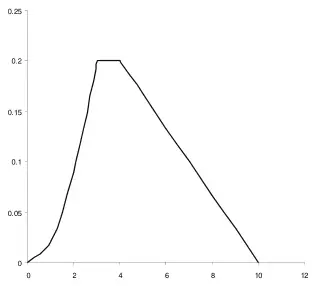
7. The continuous random variable \(X\) has probability density function \(\mathrm{f}(x)\) given by
\[\mathrm{f}(x) = \begin{cases} \dfrac{x^2}{45} & 0 \leqslant x \leqslant 3 \\[1ex] \dfrac{1}{5} & 3 \lt x \lt 4 \\[1ex] \dfrac{1}{3} - \dfrac{x}{30} & 4 \leqslant x \leqslant 10 \\[1ex] 0 & \text{otherwise} \end{cases}\]| Scheme | Marks |
|---|---|
 | B1 B1 B1 B1dep 0.2,3,4,10 |
| (4) |
Notes
1st B1 for a curve. It must start at (0, 0) and have the correct curvature.
2nd B1 for a horizontal line that joins the first section of the graph (not by a dotted line)
3rd B1 for a straight line with negative gradient that joins the horizontal line and stops on the positive \(x\) axis.
4th B1 dependent on first 3 marks being gained. Fully correct graph with labels 0.2, 3,4,10 in correct places
| Scheme | Marks |
|---|---|
| \(\mathrm{F}(x) = \begin{cases} 0 & x \lt 0 \\ \dfrac{x^3}{135} & 0 \leqslant x \leqslant 3 \\[1ex] \dfrac{x}{5} - \dfrac{2}{5} & 3 \lt x \lt 4 \\[1ex] \dfrac{x}{3} - \dfrac{x^2}{60} - \dfrac{2}{3} & 4 \leqslant x \leqslant 10 \\ 1 & x \gt 10 \end{cases}\) | M1A1 M1A1 M1A1 |
| 1st M1 For \(0 \leqslant x \leqslant 3\), \(\mathrm{F}(x) = \displaystyle\int_0^x \frac{t^2}{45}\,\mathrm{d}t = \left[\frac{t^3}{135}\right]_0^x\) | |
| 2nd M1 For \(3 \lt x \lt 4\), \(\mathrm{F}(x) = \displaystyle\int_3^x \frac{1}{5}\,\mathrm{d}t + \frac{1}{5} = \left[\frac{t}{5}\right]_3^x + \frac{1}{5}\) or \(\mathrm{F}(x) = \displaystyle\int \frac{1}{5}\,\mathrm{d}x + \mathrm{C}\) and uses \(\mathrm{F}(3) = \dfrac{1}{5}\): \(\dfrac{1}{5} = \left[\dfrac{3}{5}\right] + C\) | |
| 3rd M1 For \(4 \leqslant x \leqslant 10\), \(\mathrm{F}(x) = \displaystyle\int_4^x \frac{1}{3} - \frac{x}{30}\,\mathrm{d}t + \frac{2}{5}\) or \(\mathrm{F}(x) = \displaystyle\int \frac{1}{3} - \frac{x}{30}\,\mathrm{d}x + \mathrm{C}\) and uses \(\mathrm{F}(4) = \dfrac{2}{5}\) or \(\mathrm{F}(10) = 1\) \(\mathrm{F}(x) = \left[\dfrac{t}{3} - \dfrac{t^2}{60}\right]_4^x + \dfrac{2}{5}\) \(\dfrac{2}{5} = \dfrac{4}{3} - \dfrac{4^2}{60} + \mathrm{C}\) or \(1 = \dfrac{10}{3} - \dfrac{10^2}{60} + \mathrm{C}\) | |
| Top line of \(\mathrm{F}(x)\) ie 0 \(x \lt 0\) | B1 |
| Bottom line of \(\mathrm{F}(x)\) ie 1 \(x \gt 10\) | B1 |
| (8) |
Notes
For all the M marks, the attempt to integrate must have at least one \(x^n \to x^{n+1}\)
All A marks are for the correct expressions and ranges.
Do not penalise the use of \(\leqslant\) instead of \(\lt\) and \(\geqslant\) instead of \(\gt\).
1st M1 for attempt to integrate \(\displaystyle\int_0^x \frac{t^2}{45}\,\mathrm{d}t\) ignore limits
2nd M1 for attempt to integrate \(\displaystyle\int_3^x \frac{1}{5}\,\mathrm{d}t + \text{their F}(3)\) using correct limits. or for attempt to integrate \(\displaystyle\int \frac{1}{5}\,\mathrm{d}x + \mathrm{C}\) and substituting in 3 and putting = to their F(3) or substituting in 4 and putting = to their F(4) from their \(4 \leqslant x \leqslant 10\) line
3rd M1 for attempt to integrate \(\displaystyle\int_4^x \frac{1}{3} - \frac{x}{30}\,\mathrm{d}t + \text{their F}(4)\) using correct limits. or for attempt to integrate \(\displaystyle\int \frac{1}{3} - \frac{x}{30}\,\mathrm{d}t + \mathrm{C}\) and substituting in 4 and putting = to their F(4) or substituting in 10 and putting = 1
| Scheme | Marks |
|---|---|
| \(\mathrm{F}(8) = \dfrac{8}{3} - \dfrac{8^2}{60} - \dfrac{2}{3}\) | M1 |
| \(= \dfrac{14}{15} = 0.933\) | A1 cso |
| (2) | |
| (14 marks) |
Notes
M1 substituting 8 into the 4th line of their cdf or F(3) + F(4) – F(3) + F(8) – F(4) or \(1 - \displaystyle\int_8^{10} \frac{1}{3} - \frac{x}{30}\) (attempt to integrate needed) or use areas e.g \(1 - \dfrac{1}{2} \times 2 \times \dfrac{1}{15}\) or \(1 - \dfrac{1}{15}\)
A1 14/15 awrt 0.933 from correct working.
NB If using F(3) + F(4) – F(3) + F(8) – F(4) then \(\mathrm{F}(x)\) must be correct.