
S2 January 2011 Q5
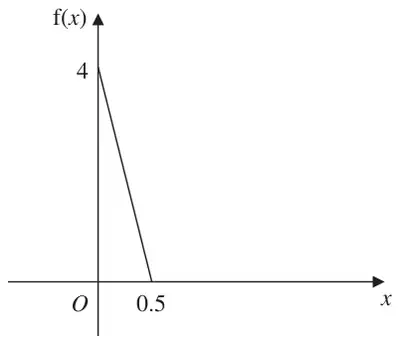
5. A continuous random variable \(X\) has the probability density function \(\mathrm{f}(x)\) shown in Figure 1.
| Scheme | Marks |
|---|---|
| \(m = -\dfrac{4}{0.5} = -8\) | M1 |
| \(\mathrm{f}(x) = 4 - 8x\) (*) | A1cso |
| \(\mathrm{f}(x) = \begin{cases} -8x + 4 & 0 \leqslant x \leqslant 0.5 \\ 0 & \textit{otherwise} \end{cases}\) | B1 B1 |
| (4) |
Notes
M1 for \(\pm\dfrac{4}{0.5}\) or attempt at gradient
A1cso for proceeding to given expression with no incorrect working seen
B1 for top line. Must have f(\(x\)) and { and more than one line. Condone use of <.
B1 for 0 otherwise and no other parts.
| Scheme | Marks |
|---|---|
| \(\mathrm{F}(x) = \displaystyle\int_0^x (-8x + 4)\,\mathrm{d}x\) | M1 |
| \(= \left[-4x^2 + 4x\right]_0^x\) | M1 |
| \(\mathrm{F}(x) = \begin{cases} 0 & x \lt 0 \\ -4x^2 + 4x & 0 \leqslant x \leqslant 0.5 \\ 1 & x \gt 0.5 \end{cases}\) | A1 B1 |
| (4) |
Notes
M1 attempting to integrate (at least one \(x^n \to x^{n+1}\)) (ignore limits)
M1 correct limits used or +C and either F(0) = 0 or F(0.5) = 1, may be implied by seeing \(4x - 4x^2\)
A1 middle line. May write \(4x - 4x^2\)
B1 top and bottom line
| Scheme | Marks |
|---|---|
| \(-4x^2 + 4x = 0.5\) | M1 |
| \(x = \dfrac{1}{4}(2 - \sqrt{2}) = 0.146\) | M1A1 |
| (3) |
Notes
M1 Their \(\mathrm{F}(x) = 0.5\)
M1 attempting to solve – either correct use of quadratic formula or correct completion of the square
A1 awrt 0.146 or \(\dfrac{2 - \sqrt{2}}{4}\) o.e
| Scheme | Marks |
|---|---|
| \(x = 0\) | B1 |
| (1) |
Notes
B1 for 0
| Scheme | Marks |
|---|---|
| Positive Skew as mode<median | B1ft |
| (1) | |
| (13 marks) |
Notes
B1 ft their mode and median. Need direction and correct corresponding reason
OR B1 positive skew from tail on right hand side in diagram