
A2 June 2024 Q4
4. The random variable \(G\) has a continuous uniform distribution over the interval \([-3, 15]\)
The random variable \(H\) has a continuous uniform distribution over the interval \([2, w]\)
The random variables \(G\) and \(H\) are independent and \(\mathrm{E}(H) = 10\)
The random variable \(A\) is the area on a coordinate grid bounded by
\[y = -3\]\[y = -4|x| + k\]where \(k\) is a value from the continuous uniform distribution over the interval \([5, 10]\)
| Scheme | Marks | AO |
|---|---|---|
| \(\mathrm{P}(G \gt 12) = \dfrac{3}{18}\left[= \dfrac{1}{6}\right]\) | B1 | 1.1b |
| (1) |
Notes
B1: Allow 0.167 or better isw
| Scheme | Marks | AO |
|---|---|---|
| \(w = 18\) | B1 | 1.1b |
| Probability both greater than 12 \(= \text{“}\frac{1}{6}\text{”} \times \dfrac{\text{“}18\text{”} - 12}{\text{“}18\text{”} - 2}\) oe | M1 | 1.1b |
| \(= \dfrac{1}{16}\)* | A1* | 1.1b |
| (3) |
Notes
B1: 18
M1: Correct calculation shown using their value for \(w\)
may be implied by use e.g. \(\dfrac{1}{6} \times \dfrac{3}{8}\)
A1*: Allow 0.0625 oe
| Scheme | Marks | AO |
|---|---|---|
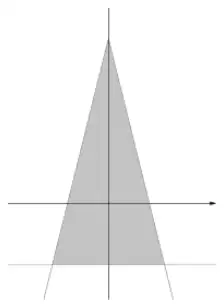 | M1 | 3.1a |
| \(x\) coordinate of Base of triangle \(= \pm\left(\dfrac{k+3}{4}\right)\) | M1 | 1.1b |
| Area \(= \dfrac{1}{2} \times 2 \times \text{“}\left(\dfrac{k+3}{4}\right)\text{”} \times (k+3)\) oe | M1 | 1.1b |
| \(\mathrm{E}(A) = \displaystyle\int_5^{10} \frac{1}{5} \times \text{“}\frac{1}{4}(k+3)^2\text{”}\,\mathrm{d}k\) | M1 | 3.4 |
| \(= \dfrac{337}{12}\) | A1cso | 1.1b |
| (5) | ||
| (9 marks) |
Notes
M1: Correct triangle identified. Look for a sketch of an isosceles triangle symmetrical about the \(y\)-axis with the highest point on the positive \(y\)-axis and base vertices below the \(x\)-axis. (maybe implied by a horizontal line below the \(x\)-axis. Ignore any labelling of vertices if incorrect but may help to indicate positions of vertices. Implied by all three coordinates or calculation to find the area / awrt 28.1
M1: For finding either \(x\) coordinate of base of triangle \(\pm\left(\dfrac{k+3}{4}\right)\) or implied by \(\dfrac{k+3}{2}\)
Do not accept use of a numerical value for \(k\) but condone \(\mathrm{E}(K)\)
M1: Finding the area of the triangle in terms of \(k\) but condone \(\mathrm{E}(K)\)
M1: Using the model correctly, for \(\displaystyle\int_5^{10} \mathrm{f}(k) \times \text{“}\text{their area}\text{”}\,\mathrm{d}k = \int_5^{10} \frac{1}{5} \times \text{“}\text{their area}\text{”}\,\mathrm{d}k\) or
\(\mathrm{E}(K) = 7.5\) and uses \(\mathrm{E}\left(K^2\right) = \mathrm{Var}(K) + \left(\mathrm{E}(K)\right)^2\) and uses their Area \(= \text{“}\frac{1}{4}\left(k^2 + 6k + 9\right)\text{”}\)
A1: awrt 28.1