
A2 October 2020 Q5
5.
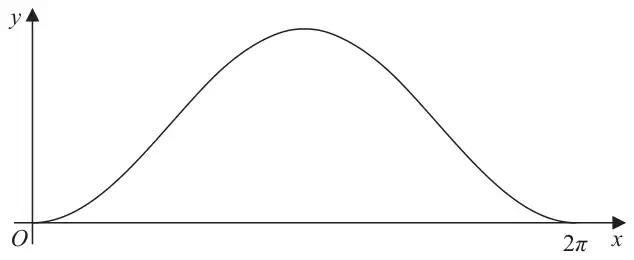
The random variable \(X\) has probability density function \(\mathrm{f}(x)\) and Figure 1 shows a sketch of \(\mathrm{f}(x)\) where
\[\mathrm{f}(x) = \begin{cases} k(1 - \cos x) & 0 \leqslant x \leqslant 2\pi \\ 0 & \text{otherwise} \end{cases}\]The random variable \(Y \sim \mathrm{N}(\mu, \sigma^2)\) and \(\mathrm{E}(Y) = \mathrm{E}(X)\)
The probability density function of \(Y\) is \(\mathrm{g}(y)\), where
\[\mathrm{g}(y) = \frac{1}{\sigma\sqrt{2\pi}}\mathrm{e}^{-\frac{1}{2}\left(\frac{y-\mu}{\sigma}\right)^2} \qquad -\infty \lt y \lt \infty\]Given that \(\mathrm{g}(\mu) = \mathrm{f}(\mu)\)
| Scheme | Marks | AO |
|---|---|---|
| \(\displaystyle\int (1 - \cos x)\,\mathrm{d}x = [x - \sin x]\) | M1 | 1.1b |
| Use of correct limits and \(\displaystyle\int \mathrm{f}(x)\,\mathrm{d}x = 1 \Rightarrow 2\pi - 0 - 0 = 1\) | M1 | 1.1b |
| so \(k = \tfrac{1}{2\pi}\) (*) | A1*cso | 1.1b |
| (3) |
Notes
1st M1 attempt to integrate \((1 - \cos x)\) – one correct term
2nd M1 for use of correct limits and correct method for \(k\)
A1* cso use of \(\displaystyle\int \mathrm{f}(x)\,\mathrm{d}x = 1\) seen and no incorrect working seen
| Scheme | Marks | AO |
|---|---|---|
| \(\mathrm{E}(X) = \pi\) (symmetry) so \(\mu = \pi\) so \(\mathrm{f}(\mu) = \dfrac{1}{2\pi}(1 - \cos\pi) = \dfrac{1}{\pi}\) | B1 | 2.2a |
| \(\dfrac{1}{\sigma\sqrt{2\pi}} = \text{“}\dfrac{1}{\pi}\text{”}\) ; so \(\sigma = \sqrt{\dfrac{\pi}{2}}\) | M1; A1 | 1.1b 1.1b |
| (3) |
Notes
B1 for correctly deducing the value of \(\mathrm{f}(\mu)\)
M1 for a correct equation for \(\sigma\) – ft their value for \(\mathrm{f}(\mu)\) [condone for sight of correct \(\mathrm{g}(\mu)\)]
A1 for \(\sqrt{\tfrac{\pi}{2}}\) or exact equivalent
| Scheme | Marks | AO |
|---|---|---|
| \(\mathrm{P}\left(\dfrac{\pi}{2} \lt X \lt \dfrac{3\pi}{2}\right) = \dfrac{1}{2\pi}[x - \sin x]_{\frac{\pi}{2}}^{\frac{3\pi}{2}} = \dfrac{1}{2\pi}\left[\left(\dfrac{3\pi}{2} - -1\right) - \left(\dfrac{\pi}{2} - 1\right)\right]\) | M1 | 3.4 |
| \(= \dfrac{2 + \pi}{2\pi}\ (= 0.81830\ldots)\) | A1 | 1.1b |
| \(\mathrm{P}\left(\dfrac{\pi}{2} \lt Y \lt \dfrac{3\pi}{2}\right) = 0.7899\ldots\) | B1 | 1.1b |
| So error is \(0.81830\ldots - 0.7899\ldots = 0.0284\) | A1 | 1.1b |
| (4) | ||
| (10 marks) |
Notes
M1 for a correct attempt to find prob – some correct integration and use of limits
1st A1 for a correct answer (exact or 0.818.. or better)
B1 for a correct probability from their calculator i.e. 0.7899 or better accept 0.79
2nd A1 for 0.0284 or better