3D Lines & Planes

Edexcel

AQA

OCR A

OCR MEI

AS June 2025 Paper 1 Q10

EdexcelCurrent spec8 marks3D Lines & PlanesMatrices

10. The plane \(\Pi_1\) has equation \(x + y - z = 3\)

The plane \(\Pi_2\) has equation \(ax + 3y + 5z = 4\) where \(a\) is an integer.

Given that \(\Pi_1\) is perpendicular to \(\Pi_2\)

(a) determine the value of \(a\). (2)

The plane \(\Pi_3\) has equation \(x + by + 13z = c\) where \(b\) and \(c\) are integers.

Given that the three planes form a sheaf,

(b) use algebra to determine the value of \(b\) and the value of \(c\). (6)

AS June 2025 Paper 1 Q9

EdexcelCurrent spec7 marks3D Lines & Planes

9. An engineer detects a source of water below the surface of the ground. The engineer models the situation relative to a fixed origin \(O\).

In the model

  • the surface of the ground is a plane \(\Pi\) with equation \(x - 2y + 8z = 1\)
  • the source of water is at a point \(W\) with coordinates \((6, -2, -4)\)

where the units are metres.

(a) Use the model to determine the shortest distance from \(W\) to the surface of the ground. (2)
(b) By considering the model, comment on whether the answer to part (a) is reliable, giving a reason for your answer. (1)

To access the water, a hole is drilled, in a straight line, from a point \(P\) on the surface of the ground to \(W\).

Given that the length of the hole needs to be as short as possible,

(c) determine the coordinates of \(P\), according to the model. (3)

Given that the actual length of the hole drilled is 2.52 metres,

(d) use the answer to part (a) to evaluate the model, giving a reason for your answer. (1)

A2 June 2025 Paper 2 Q5

EdexcelCurrent spec4 marks3D Lines & PlanesMatrices

5. Three planes are defined by the following equations

\[\begin{aligned} 2x - y + z &= 3\\ x + py - 3z &= q\\ 3x + y - 2z &= 4\end{aligned}\]

where \(p\) and \(q\) are constants.

Given that the planes form a sheaf, determine

(i) the value of \(p\)
(ii) the value of \(q\) (4)

A2 June 2025 Paper 2 Q2

EdexcelCurrent spec8 marks3D Lines & Planes

2. An archer shoots an arrow towards a target.

In a model

  • the arrow is a particle
  • the flight path of the arrow is a straight line
  • the target is part of a plane

Relative to a fixed origin \(O\)

  • the arrow is fired from the point with position vector \(3\mathbf{i} - 5\mathbf{j} + 2\mathbf{k}\)
  • the plane containing the target has equation \(2x + 4y - z = 3\)

Use the model to answer parts (a) to (d).

(a) Determine the shortest distance that the arrow must travel to reach the plane. (2)

The arrow hits the target at the point with position vector \(6\mathbf{i} - 2\mathbf{j} + \mathbf{k}\)

(b) Determine a vector equation of the flight path of the arrow. (2)
(c) Determine the acute angle that the flight path of the arrow makes with the target. Give your answer to the nearest degree. (2)
(d) Determine the distance travelled by the arrow. (1)
(e) Comment on whether the actual distance travelled by the arrow is likely to match the answer to part (d), giving a reason for your answer. (1)

A2 June 2024 Paper 2 Q8

EdexcelCurrent spec7 marks3D Lines & PlanesMatrices

8.

\[\mathbf{A} = \begin{pmatrix}3 & 1 & -1\\ 1 & 1 & 1\\ k & 3 & 6\end{pmatrix} \qquad k \neq 0\]
(a) Find, in terms of \(k\), \(\mathbf{A}^{-1}\) (4)
(b) Determine, in simplest form in terms of \(k\), the coordinates of the point where the following planes intersect.\[\begin{aligned}3x + y - z &= 3\\ x + y + z &= 1\\ kx + 3y + 6z &= 6\end{aligned}\] (3)

A2 June 2024 Paper 1 Q7

EdexcelCurrent spec10 marks3D Lines & Planes

7. The line \(l_1\) has equation

\[\mathbf{r} = \mathbf{i} - 2\mathbf{j} + 3\mathbf{k} + \lambda(2\mathbf{i} + \mathbf{j} - 4\mathbf{k})\]

and the line \(l_2\) has equation

\[\mathbf{r} = 5\mathbf{i} + p\mathbf{j} - 7\mathbf{k} + \mu(6\mathbf{i} + \mathbf{j} + 8\mathbf{k})\]

where \(\lambda\) and \(\mu\) are scalar parameters and \(p\) is a constant.

The plane \(\Pi\) contains \(l_1\) and \(l_2\)

(a) Show that the vector \(3\mathbf{i} - 10\mathbf{j} - \mathbf{k}\) is perpendicular to \(\Pi\) (2)
(b) Hence determine a Cartesian equation of \(\Pi\) (2)
(c) Hence determine the value of \(p\) (2)

Given that

  • the lines \(l_1\) and \(l_2\) intersect at the point \(A\)
  • the point \(B\) has coordinates \((12,\ -11,\ 6)\)
(d) determine, to the nearest degree, the acute angle between \(AB\) and \(\Pi\) (4)

AS June 2024 Paper 1 Q6

EdexcelCurrent spec12 marks3D Lines & Planes

6. The drainage system for a sports field consists of underground pipes.

This situation is modelled with respect to a fixed origin \(O\).

According to the model,

  • the surface of the sports field is a plane with equation \(z = 0\)
  • the pipes are straight lines
  • one of the pipes, \(P_1\), passes through the points \(A(3, 4, -2)\) and \(B(-2, -8, -3)\)
  • a different pipe, \(P_2\), has equation \(\dfrac{x - 1}{2} = \dfrac{y - 3}{4} = \dfrac{z + 1}{-2}\)
  • the units are metres
(a) Determine a vector equation of the line representing the pipe \(P_1\) (2)
(b) Determine the coordinates of the point at which the pipe \(P_1\) meets the surface of the playing field, according to the model. (2)

Determine, according to the model,

(c) the acute angle between pipes \(P_1\) and \(P_2\), giving your answer in degrees to 3 significant figures, (3)
(d) the shortest distance between pipes \(P_1\) and \(P_2\) (5)

AS June 2024 Paper 1 Q2

EdexcelCurrent spec10 marks3D Lines & PlanesMatrices

2.

With respect to the right-hand rule, a rotation through \(\theta^\circ\) anticlockwise about the \(z\)-axis is represented by the matrix\[\begin{pmatrix}\cos\theta & -\sin\theta & 0\\ \sin\theta & \cos\theta & 0\\ 0 & 0 & 1\end{pmatrix}\]

Given that the matrix \(\mathbf{M}\), where

\[\mathbf{M} = \begin{pmatrix}-\dfrac{\sqrt{3}}{2} & \dfrac{1}{2} & 0\\[4pt] -\dfrac{1}{2} & -\dfrac{\sqrt{3}}{2} & 0\\[4pt] 0 & 0 & 1\end{pmatrix}\]

represents a rotation through \(\alpha^\circ\) anticlockwise about the \(z\)-axis with respect to the right-hand rule,

(a) determine the value of \(\alpha\). (1)
(b) Hence determine the smallest possible positive integer value of \(k\) for which \(\mathbf{M}^k = \mathbf{I}\) (2)

The \(3 \times 3\) matrix \(\mathbf{N}\) represents a reflection in the plane with equation \(y = 0\)

(c) Write down the matrix \(\mathbf{N}\). (1)

The point \(A\) has coordinates \((-2, 4, 3)\)

The point \(B\) is the image of the point \(A\) under the transformation represented by matrix \(\mathbf{M}\) followed by the transformation represented by matrix \(\mathbf{N}\).

(d) Show that the coordinates of \(B\) are \(\left(2 + \sqrt{3},\ 2\sqrt{3} - 1,\ 3\right)\) (2)

Given that \(O\) is the origin,

(e) show that, to 3 significant figures, the size of angle \(AOB\) is 66.9° (2)
(f) Hence determine the area of triangle \(AOB\), giving your answer to 3 significant figures. (2)

AS June 2023 Paper 1 Q6

EdexcelCurrent spec11 marks3D Lines & Planes

6. The line \(l_1\) has equation \(\mathbf{r} = \begin{pmatrix}-2\\ 2\\ 0\end{pmatrix} + \lambda\begin{pmatrix}3\\ 0\\ 1\end{pmatrix}\) where \(\lambda\) is a scalar parameter.

The line \(l_2\) is parallel to \(\begin{pmatrix}1\\ 2\\ -3\end{pmatrix}\)

(a) Show that \(l_1\) and \(l_2\) are perpendicular. (2)

The plane \(\Pi\) contains the line \(l_1\) and is perpendicular to \(\begin{pmatrix}1\\ 2\\ -3\end{pmatrix}\)

(b) Determine a Cartesian equation of \(\Pi\) (2)
(c) Verify that the point \(A(3, 1, 1)\) lies on \(\Pi\) (1)

Given that

  • the point of intersection of \(\Pi\) and \(l_2\) has coordinates \((2, 3, 2)\)
  • the point \(B(p, q, r)\) lies on \(l_2\)
  • the distance \(AB\) is \(2\sqrt{5}\)
  • \(p\), \(q\) and \(r\) are positive integers
(d) determine the coordinates of \(B\). (6)

A2 June 2023 Paper 1 Q5

EdexcelCurrent spec12 marks3D Lines & Planes

5. The line \(l_1\) has equation \(\dfrac{x + 5}{1} = \dfrac{y + 4}{-3} = \dfrac{z - 3}{5}\)

The plane \(\Pi_1\) has equation \(2x + 3y - 2z = 6\)

(a) Find the point of intersection of \(l_1\) and \(\Pi_1\) (2)

The line \(l_2\) is the reflection of the line \(l_1\) in the plane \(\Pi_1\)

(b) Show that a vector equation for the line \(l_2\) is\[\mathbf{r} = \begin{pmatrix}-7\\ 2\\ -7\end{pmatrix} + \mu\begin{pmatrix}10\\ 6\\ 2\end{pmatrix}\]where \(\mu\) is a scalar parameter. (5)

The plane \(\Pi_2\) contains the line \(l_1\) and the line \(l_2\)

(c) Determine a vector equation for the line of intersection of \(\Pi_1\) and \(\Pi_2\) (2)

The plane \(\Pi_3\) has equation \(\mathbf{r}.\begin{pmatrix}1\\ 1\\ a\end{pmatrix} = b\) where \(a\) and \(b\) are constants.

Given that the planes \(\Pi_1\), \(\Pi_2\) and \(\Pi_3\) form a sheaf,

(d) determine the value of \(a\) and the value of \(b\). (3)

A2 June 2022 Paper 2 Q8

EdexcelCurrent spec13 marks3D Lines & Planes

8. Two birds are flying towards their nest, which is in a tree.

Relative to a fixed origin, the flight path of each bird is modelled by a straight line.

In the model, the equation for the flight path of the first bird is

\[\mathbf{r}_1 = \begin{pmatrix}-1\\ 5\\ 2\end{pmatrix} + \lambda\begin{pmatrix}2\\ a\\ 0\end{pmatrix}\]

and the equation for the flight path of the second bird is

\[\mathbf{r}_2 = \begin{pmatrix}4\\ -1\\ 3\end{pmatrix} + \mu\begin{pmatrix}0\\ 1\\ -1\end{pmatrix}\]

where \(\lambda\) and \(\mu\) are scalar parameters and \(a\) is a constant.

In the model, the angle between the birds’ flight paths is 120°

(a) Determine the value of \(a\). (4)
(b) Verify that, according to the model, there is a common point on the flight paths of the two birds and find the coordinates of this common point. (5)

The position of the nest is modelled as being at this common point.

The tree containing the nest is in a park.

The ground level of the park is modelled by the plane with equation

\[2x - 3y + z = 2\]
(c) Hence determine the shortest distance from the nest to the ground level of the park. (3)
(d) By considering the model, comment on whether your answer to part (c) is reliable, giving a reason for your answer. (1)

AS June 2022 Paper 1 Q6

EdexcelCurrent spec13 marks3D Lines & Planes

6. The surface of a horizontal tennis court is modelled as part of a horizontal plane, with the origin on the ground at the centre of the court, and

  • \(\mathbf{i}\) and \(\mathbf{j}\) are unit vectors directed across the width and length of the court respectively
  • \(\mathbf{k}\) is a unit vector directed vertically upwards
  • units are metres

After being hit, a tennis ball, modelled as a particle, moves along the path with equation

\[\mathbf{r} = \left(-4.1 + 9\lambda - 2.3\lambda^2\right)\mathbf{i} + (-10.25 + 15\lambda)\mathbf{j} + \left(0.84 + 0.8\lambda - \lambda^2\right)\mathbf{k}\]

where \(\lambda\) is a scalar parameter with \(\lambda \geqslant 0\)

Assuming that the tennis ball continues on this path until it hits the ground,

(a) find the value of \(\lambda\) at the point where the ball hits the ground. (2)

The direction in which the tennis ball is moving at a general point on its path is given by

\[(9 - 4.6\lambda)\mathbf{i} + 15\mathbf{j} + (0.8 - 2\lambda)\mathbf{k}\]
(b) Write down the direction in which the tennis ball is moving as it hits the ground. (1)
(c) Hence find the acute angle at which the tennis ball hits the ground, giving your answer in degrees to one decimal place. (4)

The net of the tennis court lies in the plane \(\mathbf{r}.\mathbf{j} = 0\)

(d) Find the position of the tennis ball at the point where it is in the same plane as the net. (3)

The maximum height above the court of the top of the net is 0.9 m.

Modelling the top of the net as a horizontal straight line,

(e) state whether the tennis ball will pass over the net according to the model, giving a reason for your answer. (1)

With reference to the model,

(f) decide whether the tennis ball will actually pass over the net, giving a reason for your answer. (2)

AS June 2022 Paper 1 Q3

EdexcelCurrent spec8 marks3D Lines & PlanesMatrices

3.

With respect to the right-hand rule, a rotation through \(\theta^\circ\) anticlockwise about the \(y\)-axis is represented by the matrix\[\begin{pmatrix}\cos\theta & 0 & \sin\theta\\ 0 & 1 & 0\\ -\sin\theta & 0 & \cos\theta\end{pmatrix}\]

The point \(P\) has coordinates (8, 3, 2)

The point \(Q\) is the image of \(P\) under the transformation reflection in the plane \(y = 0\)

(a) Write down the coordinates of \(Q\) (1)

The point \(R\) is the image of \(P\) under the transformation rotation through 120° anticlockwise about the \(y\)-axis, with respect to the right-hand rule.

(b) Determine the exact coordinates of \(R\) (2)
(c) Hence find \(\left|\overrightarrow{PR}\right|\) giving your answer as a simplified surd. (2)
(d) Show that \(\overrightarrow{PR}\) and \(\overrightarrow{PQ}\) are perpendicular. (1)
(e) Hence determine the exact area of triangle \(PQR\), giving your answer as a surd in simplest form. (2)

A2 October 2021 Paper 1 Q7

EdexcelCurrent spec8 marks3D Lines & Planes

7. The plane \(\Pi\) has equation

\[\mathbf{r} = \begin{pmatrix}3\\ 3\\ 2\end{pmatrix} + \lambda\begin{pmatrix}-1\\ 2\\ 1\end{pmatrix} + \mu\begin{pmatrix}2\\ 0\\ 1\end{pmatrix}\]

where \(\lambda\) and \(\mu\) are scalar parameters.

(a) Show that vector \(2\mathbf{i} + 3\mathbf{j} - 4\mathbf{k}\) is perpendicular to \(\Pi\). (2)
(b) Hence find a Cartesian equation of \(\Pi\). (2)

The line \(l\) has equation

\[\mathbf{r} = \begin{pmatrix}4\\ -5\\ 2\end{pmatrix} + t\begin{pmatrix}1\\ 6\\ -3\end{pmatrix}\]

where \(t\) is a scalar parameter.

The point \(A\) lies on \(l\).

Given that the shortest distance between \(A\) and \(\Pi\) is \(2\sqrt{29}\)

(c) determine the possible coordinates of \(A\). (4)

A2 October 2020 Paper 2 Q6

EdexcelCurrent spec14 marks3D Lines & PlanesMatrices

6.

\[\mathbf{M} = \begin{pmatrix}k & 5 & 7\\ 1 & 1 & 1\\ 2 & 1 & -1\end{pmatrix} \qquad \text{where } k \text{ is a constant}\]
(a) Given that \(k \neq 4\), find, in terms of \(k\), the inverse of the matrix \(\mathbf{M}\). (4)
(b) Find, in terms of \(p\), the coordinates of the point where the following planes intersect.\[\begin{aligned} 2x + 5y + 7z &= 1\\ x + y + z &= p\\ 2x + y - z &= 2 \end{aligned}\] (3)
(c)
(i) Find the value of \(q\) for which the following planes intersect in a straight line.\[\begin{aligned} 4x + 5y + 7z &= 1\\ x + y + z &= q\\ 2x + y - z &= 2 \end{aligned}\]
(ii) For this value of \(q\), determine a vector equation for the line of intersection.
(7)

AS October 2020 Paper 1 Q4

EdexcelCurrent spec13 marks3D Lines & Planes

4.

All units in this question are in metres.

A lawn is modelled as a plane that contains the points \(L(-2, -3, -1)\), \(M(6, -2, 0)\) and \(N(2, 0, 0)\), relative to a fixed origin \(O\).

(a) Determine a vector equation of the plane that models the lawn, giving your answer in the form \(\mathbf{r} = \mathbf{a} + \lambda\mathbf{b} + \mu\mathbf{c}\) (3)
(b)
(i) Show that, according to the model, the lawn is perpendicular to the vector \(\begin{pmatrix}1\\ 2\\ -10\end{pmatrix}\)
(ii) Hence determine a Cartesian equation of the plane that models the lawn.
(4)

There are two posts set in the lawn.
There is a washing line between the two posts.
The washing line is modelled as a straight line through points at the top of each post with coordinates \(P(-10, 8, 2)\) and \(Q(6, 4, 3)\).

(c) Determine a vector equation of the line that models the washing line. (2)
(d) State a limitation of one of the models. (1)

The point \(R(2, 5, 2.75)\) lies on the washing line.

(e) Determine, according to the model, the shortest distance from the point \(R\) to the lawn, giving your answer to the nearest cm. (2)

Given that the shortest distance from the point \(R\) to the lawn is actually 1.5 m,

(f) use your answer to part (e) to evaluate the model, explaining your reasoning. (1)

A2 October 2020 Paper 1 Q4

EdexcelCurrent spec9 marks3D Lines & Planes

4. The plane \(\Pi_1\) has equation

\[\mathbf{r} = 2\mathbf{i} + 4\mathbf{j} - \mathbf{k} + \lambda(\mathbf{i} + 2\mathbf{j} - 3\mathbf{k}) + \mu(-\mathbf{i} + 2\mathbf{j} + \mathbf{k})\]

where \(\lambda\) and \(\mu\) are scalar parameters.

(a) Find a Cartesian equation for \(\Pi_1\) (4)

The line \(l\) has equation

\[\frac{x - 1}{5} = \frac{y - 3}{-3} = \frac{z + 2}{4}\]
(b) Find the coordinates of the point of intersection of \(l\) with \(\Pi_1\) (3)

The plane \(\Pi_2\) has equation

\[\mathbf{r}.(2\mathbf{i} - \mathbf{j} + 3\mathbf{k}) = 5\]
(c) Find, to the nearest degree, the acute angle between \(\Pi_1\) and \(\Pi_2\) (2)

AS October 2020 Paper 1 Q1

EdexcelCurrent spec6 marks3D Lines & PlanesMatrices

1. A system of three equations is defined by

\[\begin{aligned}kx + 3y - z &= 3\\ 3x - y + z &= -k\\ -16x - ky - kz &= k\end{aligned}\]

where \(k\) is a positive constant.

Given that there is no unique solution to all three equations,

(a) show that \(k = 2\) (2)

Using \(k = 2\)

(b) determine whether the three equations are consistent, justifying your answer. (3)
(c) Interpret the answer to part (b) geometrically. (1)

AS June 2019 Paper 1 Q8

EdexcelCurrent spec12 marks3D Lines & Planes

8. A gas company maintains a straight pipeline that passes under a mountain.

The pipeline is modelled as a straight line and one side of the mountain is modelled as a plane.

There are accessways from a control centre to two access points on the pipeline.

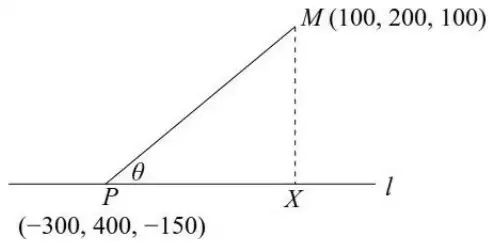
Modelling the control centre as the origin \(O\), the two access points on the pipeline have coordinates \(P(-300, 400, -150)\) and \(Q(300, 300, -50)\), where the units are metres.

(a) Find a vector equation for the line \(PQ\), giving your answer in the form \(\mathbf{r} = \mathbf{a} + \lambda\mathbf{b}\), where \(\lambda\) is a scalar parameter. (2)

The equation of the plane modelling the side of the mountain is \(2x + 3y - 5z = 300\)

The company wants to create a new accessway from this side of the mountain to the pipeline.

The accessway will consist of a tunnel of shortest possible length between the pipeline and the point \(M(100, k, 100)\) on this side of the mountain, where \(k\) is a constant.

(b) Using the model, find
(i) the coordinates of the point at which this tunnel will meet the pipeline,
(ii) the length of this tunnel.
(7)

It is only practical to construct the new accessway if it will be significantly shorter than both of the existing accessways, \(OP\) and \(OQ\).

(c) Determine whether the company should build the new accessway. (2)
(d) Suggest one limitation of the model. (1)

A2 June 2019 Paper 1 Q7

EdexcelCurrent spec7 marks3D Lines & Planes

7. The line \(l_1\) has equation

\[\frac{x - 1}{2} = \frac{y + 1}{-1} = \frac{z - 4}{3}\]

The line \(l_2\) has equation

\[\mathbf{r} = \mathbf{i} + 3\mathbf{k} + t(\mathbf{i} - \mathbf{j} + 2\mathbf{k})\]

where \(t\) is a scalar parameter.

(a) Show that \(l_1\) and \(l_2\) lie in the same plane. (3)
(b) Write down a vector equation for the plane containing \(l_1\) and \(l_2\) (1)
(c) Find, to the nearest degree, the acute angle between \(l_1\) and \(l_2\) (3)

A2 June 2019 Paper 2 Q7

EdexcelCurrent spec11 marks3D Lines & PlanesMatrices

7.

\[\mathbf{M} = \begin{pmatrix}2 & -1 & 1\\ 3 & k & 4\\ 3 & 2 & -1\end{pmatrix} \qquad \text{where } k \text{ is a constant}\]
(a) Find the values of \(k\) for which the matrix \(\mathbf{M}\) has an inverse. (2)
(b) Find, in terms of \(p\), the coordinates of the point where the following planes intersect\[\begin{aligned}2x - y + z &= p\\ 3x - 6y + 4z &= 1\\ 3x + 2y - z &= 0\end{aligned}\] (5)
(c)
(i) Find the value of \(q\) for which the set of simultaneous equations\[\begin{aligned}2x - y + z &= 1\\ 3x - 5y + 4z &= q\\ 3x + 2y - z &= 0\end{aligned}\]can be solved.
(ii) For this value of \(q\), interpret the solution of the set of simultaneous equations geometrically. (4)

AS June 2019 Paper 1 Q4

EdexcelCurrent spec5 marks3D Lines & Planes

4. The line \(l\) has equation

\[\frac{x + 2}{1} = \frac{y - 5}{-1} = \frac{z - 4}{-3}\]

The plane \(\mathit{\Pi}\) has equation

\[\mathbf{r}.(\mathbf{i} - 2\mathbf{j} + \mathbf{k}) = -7\]

Determine whether the line \(l\) intersects \(\mathit{\Pi}\) at a single point, or lies in \(\mathit{\Pi}\), or is parallel to \(\mathit{\Pi}\) without intersecting it. (5)

AS June 2018 Paper 1 Q4

EdexcelCurrent spec11 marks3D Lines & Planes

4. Part of the mains water system for a housing estate consists of water pipes buried beneath the ground surface. The water pipes are modelled as straight line segments. One water pipe, \(W\), is buried beneath a particular road. With respect to a fixed origin \(O\), the road surface is modelled as a plane with equation \(3x - 5y - 18z = 7\), and \(W\) passes through the points \(A(-1, -1, -3)\) and \(B(1, 2, -3)\). The units are in metres.

(a) Use the model to calculate the acute angle between \(W\) and the road surface. (5)

A point \(C(-1, -2, 0)\) lies on the road. A section of water pipe needs to be connected to \(W\) from \(C\).

(b) Using the model, find, to the nearest cm, the shortest length of pipe needed to connect \(C\) to \(W\). (6)

AS June 2018 Paper 1 Q1

EdexcelCurrent spec5 marks3D Lines & PlanesMatrices

1.

\[\mathbf{M} = \begin{pmatrix}2 & 1 & -3\\ 4 & -2 & 1\\ 3 & 5 & -2\end{pmatrix}\]
(a) Find \(\mathbf{M}^{-1}\) giving each element in exact form. (2)
(b) Solve the simultaneous equations\[\begin{aligned}2x + y - 3z &= -4\\ 4x - 2y + z &= 9\\ 3x + 5y - 2z &= 5\end{aligned}\] (2)
(c) Interpret the answer to part (b) geometrically. (1)

A2 June 2025 Paper 1 Q15

AQACurrent spec9 marks3D Lines & PlanesMatrices

15 Three planes have equations

\[\begin{alignedat}{4} x &\; + \;& 2y &\; - \;& z &\; = \;& 9& \\ x &\; - \;& 3y &\; + \;& 3z &\; = \;& t& \\ 3x &\; + \;& y &\; + \;& z &\; = \;& 4t& \end{alignedat}\]

where \(t\) is a constant.

The planes meet along a line of intersection.

(a) Find the value of \(t\) [4 marks]
(b) Find a vector equation of the line of intersection.

Fully justify your answer. [5 marks]

A2 June 2025 Paper 2 Q11

AQACurrent spec12 marks3D Lines & Planes

11 The line \(L\) has vector equation

\[\mathbf{r} = \begin{bmatrix} 5 \\ 2 \\ 11 \end{bmatrix} + \lambda\begin{bmatrix} 2 \\ -1 \\ 3 \end{bmatrix}\]

The point \(A\) has coordinates \((1, -1, -6)\)

(a) Find the coordinates of the point on \(L\) which is closest to the point \(A\) [5 marks]
(b) The point \(B\) has coordinates \((3, -2, -1)\)

The point \(C\) has coordinates \((4, 0, 1)\)

The points \(A\), \(B\) and \(C\) all lie in the plane \(\Pi\)

Find a Cartesian equation of \(\Pi\) [4 marks]

(c) Find the coordinates of the point where the line \(L\) meets the plane \(\Pi\) [3 marks]

AS June 2025 Paper 1 Q10

AQACurrent spec8 marks3D Lines & PlanesMatrices

10 The \(3 \times 3\) matrix \(\mathbf{M}\) represents a reflection in the plane \(z = 0\)

The point \(A\) has position vector \(\begin{bmatrix} 2 \\ 5 \\ 4 \end{bmatrix}\)

The point \(A^{\prime}\) is the image of \(A\) under the reflection represented by the matrix \(\mathbf{M}\)

Line \(l\) passes through \(A\) and \(A^{\prime}\)

(a) Write down the matrix \(\mathbf{M}\) [1 mark]
(b) Find the position vector of \(A^{\prime}\) [1 mark]
(c) Write down a vector equation of \(l\) [2 marks]
(d) The point \(B\) has coordinates \((3, 7, -2)\)
(i) Write down the coordinates of the point on \(l\) which is closest to \(B\) [1 mark]
(ii) Calculate the shortest distance between \(l\) and \(B\) [1 mark]
(iii) Calculate the area of the triangle \(ABA^{\prime}\) [2 marks]

A2 June 2025 Paper 1 Q9

AQACurrent spec4 marks3D Lines & Planes

9 The vectors \(\mathbf{a}\) and \(\mathbf{b}\) are such that

\[\begin{aligned} &|\mathbf{a} \times \mathbf{b}| = 12 \\ &\mathbf{a} \bullet \mathbf{b} = -\sqrt{3} \\ &|\mathbf{a}| = 7 \end{aligned}\]

Find the value of \(|\mathbf{b}|\) [4 marks]

A2 June 2025 Paper 2 Q1

AQACurrent spec1 mark3D Lines & Planes

1 The vectors \(\begin{bmatrix} a \\ b \end{bmatrix}\) and \(\begin{bmatrix} c \\ 1 \end{bmatrix}\) are perpendicular.

Which one of the following statements must be true?

Tick (✓) one box. [1 mark]

  • \(a = bc\)
  • \(b = ac\)
  • \(a = -bc\)
  • \(b = -ac\)

A2 June 2024 Paper 1 Q12

AQACurrent spec10 marks3D Lines & PlanesMatrices

12 The line \(L_1\) has equation

\[\mathbf{r} = \begin{bmatrix}4 \\ 2 \\ 1\end{bmatrix} + \lambda\begin{bmatrix}1 \\ 3 \\ -1\end{bmatrix}\]

The transformation T is represented by the matrix

\[\begin{bmatrix} 2 & 1 & 0 \\ 3 & 4 & 6 \\ -5 & 2 & -3 \end{bmatrix}\]

The transformation T transforms the line \(L_1\) to the line \(L_2\)

(a) Show that the angle between \(L_1\) and \(L_2\) is 0.701 radians, correct to three decimal places. [4 marks]
(b) Find the shortest distance between \(L_1\) and \(L_2\)

Give your answer in an exact form. [6 marks]

A2 June 2024 Paper 2 Q8

AQACurrent spec4 marks3D Lines & Planes

8 The vectors \(\mathbf{a}\), \(\mathbf{b}\), and \(\mathbf{c}\) are such that \(\mathbf{a} \times \mathbf{b} = \begin{bmatrix} 2 \\ 1 \\ 0 \end{bmatrix}\) and \(\mathbf{a} \times \mathbf{c} = \begin{bmatrix} 0 \\ 0 \\ 3 \end{bmatrix}\)

Work out \((\mathbf{a} - 4\mathbf{b} + 3\mathbf{c}) \times (2\mathbf{a})\) [4 marks]

A2 June 2024 Paper 1 Q5

AQACurrent spec5 marks3D Lines & Planes

5 The points \(A\), \(B\) and \(C\) have coordinates \(A(5, 3, 4)\), \(B(8, -1, 9)\) and \(C(12, 5, 10)\)

The points \(A\), \(B\) and \(C\) lie in the plane \(\Pi\)

(a) Find a vector that is normal to the plane \(\Pi\) [3 marks]
(b) Find a Cartesian equation of the plane \(\Pi\) [2 marks]

AS June 2024 Paper 1 Q5

AQACurrent spec5 marks3D Lines & Planes

5 The vectors \(\mathbf{a}\) and \(\mathbf{b}\) are given by

\[\mathbf{a} = 3\mathbf{i} + 4\mathbf{j} - 2\mathbf{k} \qquad \text{and} \qquad \mathbf{b} = 2\mathbf{i} - \mathbf{j} - 5\mathbf{k}\]
(a) Calculate \(\mathbf{a}.\mathbf{b}\) [1 mark]
(b) Calculate \(|\mathbf{a}|\) and \(|\mathbf{b}|\) [2 marks]
(c) Calculate the acute angle between \(\mathbf{a}\) and \(\mathbf{b}\)

Give your answer to the nearest degree. [2 marks]

AS June 2024 Paper 1 Q4

AQACurrent spec1 mark3D Lines & Planes

4 The line \(L\) has vector equation

\[\mathbf{r} = \begin{bmatrix} 4 \\ -7 \\ 0 \end{bmatrix} + \lambda\begin{bmatrix} -9 \\ 1 \\ 3 \end{bmatrix}\]

Give the equation of \(L\) in Cartesian form.

Tick (✓) one box. [1 mark]

  • \(\dfrac{x + 4}{-9} = \dfrac{y - 7}{1} = \dfrac{z}{3}\)
  • \(\dfrac{x - 4}{-9} = \dfrac{y + 7}{1} = \dfrac{z}{3}\)
  • \(\dfrac{x + 9}{4} = \dfrac{y - 1}{-7}\), \(z = 3\)
  • \(\dfrac{x - 9}{4} = \dfrac{y + 1}{-7}\), \(z = 3\)

A2 June 2024 Paper 2 Q1

AQACurrent spec1 mark3D Lines & Planes

1 It is given that

\[\begin{bmatrix} 2 \\ 1 \\ 3 \end{bmatrix} \bullet \begin{bmatrix} 5 \\ \lambda \\ -6 \end{bmatrix} = 0\]

where \(\lambda\) is a constant.

Find the value of \(\lambda\)

Circle your answer. [1 mark]

  • \(-28\)
  • \(-8\)
  • \(8\)
  • \(28\)

A2 June 2023 Paper 2 Q11

AQACurrent spec9 marks3D Lines & Planes

11 The line \(l_1\) passes through the points \(A(6, 2, 7)\) and \(B(4, -3, 7)\)

(a) Find a Cartesian equation of \(l_1\) [2 marks]
(b) The line \(l_2\) has vector equation \(\mathbf{r} = \begin{bmatrix} 8 \\ 9 \\ c \end{bmatrix} + \mu\begin{bmatrix} 1 \\ 1 \\ 2 \end{bmatrix}\) where \(c\) is a constant.
(i) Explain how you know that the lines \(l_1\) and \(l_2\) are not perpendicular. [2 marks]
(ii) The lines \(l_1\) and \(l_2\) both lie in the same plane.

Find the value of \(c\) [5 marks]

A2 June 2023 Paper 1 Q9

AQACurrent spec9 marks3D Lines & Planes

9 The position vectors of the points \(A\), \(B\) and \(C\) are

\[\begin{aligned} \mathbf{a} &= 2\mathbf{i} + \mathbf{j} + 2\mathbf{k} \\ \mathbf{b} &= -\mathbf{i} - 8\mathbf{j} + 2\mathbf{k} \\ \mathbf{c} &= -2\mathbf{j} \end{aligned}\]

respectively.

(a) Find the area of the triangle \(ABC\) [4 marks]
(b) The points \(A\), \(B\) and \(C\) all lie in the plane \(\Pi\)

Find an equation of the plane \(\Pi\), in the form \(\mathbf{r} \bullet \mathbf{n} = d\) [2 marks]

(c) The point \(P\) has position vector \(\mathbf{p} = \mathbf{i} + 4\mathbf{j} + 2\mathbf{k}\)

Find the exact distance of \(P\) from \(\Pi\) [3 marks]

AS June 2023 Paper 1 Q2

AQACurrent spec1 mark3D Lines & Planes

2 The two vectors \(\mathbf{a}\) and \(\mathbf{b}\) are such that \(\mathbf{a}.\mathbf{b} = 0\)

State the angle between the vectors \(\mathbf{a}\) and \(\mathbf{b}\)

Circle your answer. [1 mark]

  • \(0^\circ\)
  • \(45^\circ\)
  • \(90^\circ\)
  • \(180^\circ\)

A2 June 2022 Paper 1 Q10

AQACurrent spec12 marks3D Lines & Planes

10 In this question all measurements are in centimetres.

A small, thin laser pen is set up with one end at \(A(7, 2, -3)\) and the other end at \(B(9, -3, -2)\)

A laser beam travels from \(A\) to \(B\) and continues in a straight line towards a large thin sheet of glass.

The sheet of glass lies within a plane \(\Pi_1\) which is modelled by the equation

\[4x + py + 5z = 9\]

where \(p\) is an integer.

(a) The laser beam hits \(\Pi_1\) at an acute angle \(\alpha\), where \(\sin\alpha = \dfrac{\sqrt{15}}{75}\)

Find the value of \(p\) [6 marks]

(b) A second large sheet of glass lies on the other side of \(\Pi_1\)

This second sheet lies within a plane \(\Pi_2\) which is modelled by the equation

\[4x + py + 5z = -5\]

Calculate the distance between the sheets of glass. [2 marks]

(c) The point \(A(7, 2, -3)\) is reflected in \(\Pi_1\)

Find the coordinates of the image of \(A\) after reflection in \(\Pi_1\) [4 marks]

AS June 2022 Paper 1 Q7

AQACurrent spec9 marks3D Lines & Planes

7 The lines \(l_1\) and \(l_2\) have equations

\[l_1 : \mathbf{r} = \begin{bmatrix} 3 \\ 1 \\ -2 \end{bmatrix} + \lambda\begin{bmatrix} 3 \\ -4 \\ 1 \end{bmatrix}\]\[l_2 : \mathbf{r} = \begin{bmatrix} -12 \\ a \\ -3 \end{bmatrix} + \mu\begin{bmatrix} 3 \\ 2 \\ -1 \end{bmatrix}\]
(a) Show that the point \(P(-3, 9, -4)\) lies on \(l_1\) [2 marks]
(b) Show that \(l_1\) is perpendicular to \(l_2\) [2 marks]
(c) Given that the lines \(l_1\) and \(l_2\) intersect, calculate the value of the constant \(a\) [4 marks]
(d) Hence, find the coordinates of the point of intersection of \(l_1\) and \(l_2\) [1 mark]

AS June 2021 Paper 1 Q15

AQACurrent spec8 marks3D Lines & Planes

15 Two submarines are travelling on different straight lines.
The two lines are described by the equations

\[\mathbf{r} = \begin{bmatrix}2 \\ -1 \\ 4\end{bmatrix} + \lambda\begin{bmatrix}5 \\ 3 \\ -2\end{bmatrix} \quad \text{and} \quad \frac{x - 5}{4} = \frac{y}{2} = 4 - z\]
(a)
(i) Show that the two lines intersect. [3 marks]
(ii) Find the position vector of the point of intersection. [1 mark]
(b) Tracey says that the submarines will collide because there is a common point on the two lines.

Explain why Tracey is not necessarily correct. [1 mark]

(c) Calculate the acute angle between the lines\[\mathbf{r} = \begin{bmatrix}2 \\ -1 \\ 4\end{bmatrix} + \lambda\begin{bmatrix}5 \\ 3 \\ -2\end{bmatrix} \quad \text{and} \quad \frac{x - 5}{4} = \frac{y}{2} = 4 - z\]

Give your angle to the nearest \(0.1^\circ\) [3 marks]

A2 June 2021 Paper 1 Q12

AQACurrent spec14 marks3D Lines & PlanesMatrices

12 The matrix \(\mathbf{A} = \begin{bmatrix} 1 & 5 & 3 \\ 4 & -2 & p \\ 8 & 5 & -11 \end{bmatrix}\), where \(p\) is a constant.

(a) Given that \(\mathbf{A}\) is a non-singular matrix, find \(\mathbf{A}^{-1}\) in terms of \(p\).

State any restrictions on the value of \(p\). [6 marks]

(b) The equations below represent three planes.\[\begin{aligned} x + 5y + 3z &= 5 \\ 4x - 2y + pz &= 24 \\ 8x + 5y - 11z &= -30 \end{aligned}\]
(i) Find, in terms of \(p\), the coordinates of the point of intersection of the three planes. [4 marks]
(ii) In the case where \(p = 2\), show that the planes are mutually perpendicular. [4 marks]

A2 June 2021 Paper 2 Q11

AQACurrent spec9 marks3D Lines & PlanesMatrices

11 The Cartesian equation of the line \(L_1\) is

\[\frac{x + 1}{3} = \frac{-y + 5}{2} = \frac{2z + 5}{3}\]

The Cartesian equation of the line \(L_2\) is

\[\frac{2x - 1}{2} = \frac{y - 14}{m} = \frac{z + 12}{p}\]

The non-singular matrix \(\mathbf{N} = \begin{bmatrix} -0.5 & 1 & 2 \\ 1 & b & 4 \\ -3 & -2 & c \end{bmatrix}\) maps the line \(L_1\) onto the line \(L_2\)

Calculate the values of the constants \(b\), \(c\), \(m\) and \(p\)

Fully justify your answers. [9 marks]

A2 June 2021 Paper 1 Q11

AQACurrent spec12 marks3D Lines & Planes

11 The line \(L_1\) has equation \(\mathbf{r} = \begin{bmatrix}2 \\ 2 \\ 3\end{bmatrix} + \lambda\begin{bmatrix}2 \\ 3 \\ -1\end{bmatrix}\)

The line \(L_2\) has equation \(\mathbf{r} = \begin{bmatrix}6 \\ 4 \\ 1\end{bmatrix} + \mu\begin{bmatrix}-2 \\ 1 \\ 1\end{bmatrix}\)

(a) Find the acute angle between the lines \(L_1\) and \(L_2\), giving your answer to the nearest \(0.1^\circ\) [3 marks]
(b) The lines \(L_1\) and \(L_2\) lie in the plane \(\Pi_1\)
(i) Find the equation of \(\Pi_1\), giving your answer in the form \(\mathbf{r} \cdot \mathbf{n} = d\) [4 marks]
(ii) Hence find the shortest distance of the plane \(\Pi_1\) from the origin. [1 mark]
(c) The points \(A(4, -1, -1)\), \(B(1, 5, -7)\) and \(C(3, 4, -8)\) lie in the plane \(\Pi_2\)

Find the angle between the planes \(\Pi_1\) and \(\Pi_2\), giving your answer to the nearest \(0.1^\circ\) [4 marks]

AS June 2021 Paper 1 Q5

AQACurrent spec2 marks3D Lines & Planes

5 Show that the vectors \(\begin{bmatrix}1 \\ -3 \\ 5\end{bmatrix}\) and \(\begin{bmatrix}7 \\ 4 \\ 1\end{bmatrix}\) are perpendicular. [2 marks]

A2 June 2021 Paper 2 Q3

AQACurrent spec1 mark3D Lines & Planes

3 The line \(L\) has equation \(\mathbf{r} = \begin{bmatrix} 3 \\ 2 \\ 0 \end{bmatrix} + \lambda\begin{bmatrix} -1 \\ -2 \\ 5 \end{bmatrix}\)

Which of the following lines is perpendicular to the line \(L\)?

Tick (✓) one box. [1 mark]

  • \[\mathbf{r} = \begin{bmatrix} 2 \\ -3 \\ 4 \end{bmatrix} + \mu\begin{bmatrix} 1 \\ 2 \\ -5 \end{bmatrix}\]
  • \[\mathbf{r} = \begin{bmatrix} 1 \\ 0 \\ 1 \end{bmatrix} + \mu\begin{bmatrix} 2 \\ -3 \\ 1 \end{bmatrix}\]
  • \[\mathbf{r} = \begin{bmatrix} 1 \\ 2 \\ 1 \end{bmatrix} + \mu\begin{bmatrix} 1 \\ 1 \\ 2 \end{bmatrix}\]
  • \[\mathbf{r} = \begin{bmatrix} 0 \\ 3 \\ 2 \end{bmatrix} + \mu\begin{bmatrix} 4 \\ 3 \\ 2 \end{bmatrix}\]

A2 June 2020 Paper 2 Q15

AQACurrent spec16 marks3D Lines & Planes

15 The points \(A(7, 2, 8)\), \(B(7, -4, 0)\) and \(C(3, 3.2, 9.6)\) all lie in the plane \(\Pi\).

(a) Find a Cartesian equation of the plane \(\Pi\). [3 marks]
(b) The line \(L_1\) has equation \(\mathbf{r} = \begin{bmatrix} 5 \\ -0.4 \\ 4.8 \end{bmatrix} + \mu\begin{bmatrix} 15 \\ 3 \\ 4 \end{bmatrix}\)
(i) Show that \(L_1\) lies in the plane \(\Pi\). [2 marks]
(ii) Show that every point on \(L_1\) is equidistant from \(B\) and \(C\). [4 marks]
(c) The line \(L_2\) lies in the plane \(\Pi\), and every point on \(L_2\) is equidistant from \(A\) and \(B\).

Find an equation of the line \(L_2\) [4 marks]

(d) The points \(A\), \(B\) and \(C\) all lie on a circle \(G\).

The point \(D\) is the centre of circle \(G\).

Find the coordinates of \(D\). [3 marks]

AS June 2020 Paper 1 Q13

AQACurrent spec9 marks3D Lines & Planes

13 Line \(l_1\) has equation

\[\frac{x - 2}{3} = \frac{1 - 2y}{4} = -z\]

and line \(l_2\) has equation

\[\mathbf{r} = \begin{bmatrix}-7 \\ 4 \\ -2\end{bmatrix} + \mu\begin{bmatrix}12 \\ a + 3 \\ 2b\end{bmatrix}\]
(a) In the case when \(l_1\) and \(l_2\) are parallel, show that \(a = -11\) and find the value of \(b\). [4 marks]
(b) In a different case, the lines \(l_1\) and \(l_2\) intersect at exactly one point, and the value of \(b\) is 3

Find the value of \(a\). [5 marks]

A2 June 2020 Paper 1 Q11

AQACurrent spec11 marks3D Lines & Planes

11 The lines \(l_1\), \(l_2\) and \(l_3\) are defined as follows.

\[l_1 : \left(\mathbf{r} - \begin{bmatrix} 1 \\ 5 \\ -1 \end{bmatrix}\right) \times \begin{bmatrix} -2 \\ 1 \\ -3 \end{bmatrix} = \mathbf{0}\]\[l_2 : \left(\mathbf{r} - \begin{bmatrix} -3 \\ 2 \\ 7 \end{bmatrix}\right) \times \begin{bmatrix} 2 \\ -1 \\ 3 \end{bmatrix} = \mathbf{0}\]\[l_3 : \left(\mathbf{r} - \begin{bmatrix} -5 \\ 12 \\ -4 \end{bmatrix}\right) \times \begin{bmatrix} 4 \\ 0 \\ 9 \end{bmatrix} = \mathbf{0}\]
(a)
(i) Explain how you know that two of the lines are parallel. [1 mark]
(ii) Show that the perpendicular distance between these two parallel lines is 7.95 units, correct to three significant figures. [5 marks]
(b) Show that the lines \(l_1\) and \(l_3\) meet, and find the coordinates of their point of intersection. [5 marks]

A2 June 2020 Paper 1 Q7

AQACurrent spec7 marks3D Lines & PlanesMatrices

7 Three planes have equations

\[\begin{alignedat}{3} (4k + 1)x &\;-\; & 3y &\;+\; & (k - 5)z &= 3 \\ (k - 1)x &\;+\; & (3 - k)y &\;+\; & 2z &= 1 \\ 7x &\;-\; & 3y &\;+\; & 4z &= 2 \end{alignedat}\]
(a) The planes do not meet at a unique point.

Show that \(k = 4.5\) is one possible value of \(k\), and find the other possible value of \(k\). [3 marks]

(b) For each value of \(k\) found in part (a), identify the configuration of the given planes.

In each case fully justify your answer, stating whether or not the equations of the planes form a consistent system. [4 marks]

A2 June 2020 Paper 2 Q1

AQACurrent spec1 mark3D Lines & Planes

1 Three of the four expressions below are equivalent to each other.

Which of the four expressions is not equivalent to any of the others?

Circle your answer. [1 mark]

  • \(\mathbf{a} \times (\mathbf{a} + \mathbf{b})\)
  • \((\mathbf{a} + \mathbf{b}) \times \mathbf{b}\)
  • \((\mathbf{a} - \mathbf{b}) \times \mathbf{b}\)
  • \(\mathbf{a} \times (\mathbf{a} - \mathbf{b})\)

AS June 2019 Paper 1 Q13

AQACurrent spec10 marks3D Lines & Planes

13 Line \(l_1\) has Cartesian equation

\[x - 3 = \frac{2y + 2}{3} = 2 - z\]
(a) Write the equation of line \(l_1\) in the form\[\mathbf{r} = \mathbf{a} + \lambda\mathbf{b}\]

where \(\lambda\) is a parameter and \(\mathbf{a}\) and \(\mathbf{b}\) are vectors to be found. [2 marks]

(b) Line \(l_2\) passes through the points \(P(3, 2, 0)\) and \(Q(n, 5, n)\), where \(n\) is a constant.
(i) Show that the lines \(l_1\) and \(l_2\) are not perpendicular. [3 marks]
(ii) Explain briefly why lines \(l_1\) and \(l_2\) cannot be parallel. [2 marks]
(iii) Given that \(\theta\) is the acute angle between lines \(l_1\) and \(l_2\), show that\[\cos\theta = \frac{p}{\sqrt{34n^2 + qn + 306}}\]

where \(p\) and \(q\) are constants to be found. [3 marks]

A2 June 2019 Paper 1 Q12

AQACurrent spec8 marks3D Lines & PlanesMatrices

12 Three planes have equations

\[\begin{aligned} 4x - 5y + z &= 8 \\ 3x + 2y - kz &= 6 \\ (k - 2)x + ky - 8z &= 6 \end{aligned}\]

where \(k\) is a real constant.

The planes do not meet at a unique point.

(a) Find the possible values of \(k\). [3 marks]
(b) For each value of \(k\) found in part (a), identify the configuration of the given planes.

Fully justify your answer, stating in each case whether or not the equations of the planes form a consistent system. [5 marks]

A2 June 2019 Paper 2 Q11

AQACurrent spec8 marks3D Lines & Planes

11 The line \(L_1\) has equation

\[\frac{x - 2}{3} = \frac{y + 4}{8} = \frac{4z - 5}{5}\]

The line \(L_2\) has equation

\[\left(\mathbf{r} - \begin{bmatrix} -2 \\ 0 \\ 3 \end{bmatrix}\right) \times \begin{bmatrix} 2 \\ 1 \\ 3 \end{bmatrix} = \mathbf{0}\]

Find the shortest distance between the two lines, giving your answer to three significant figures. [8 marks]

A2 June 2019 Paper 1 Q10

AQACurrent spec8 marks3D Lines & Planes

10 The points \(A(5, -4, 6)\) and \(B(6, -6, 8)\) lie on the line \(L\). The point \(C\) is \((15, -5, 9)\).

(a) \(D\) is the point on \(L\) that is closest to \(C\).

Find the coordinates of \(D\). [6 marks]

(b) Hence find, in exact form, the shortest distance from \(C\) to \(L\). [2 marks]

A2 June 2019 Paper 2 Q7

AQACurrent spec6 marks3D Lines & Planes

7 The points \(A\), \(B\) and \(C\) have coordinates \(A(4, 5, 2)\), \(B(-3, 2, -4)\) and \(C(2, 6, 1)\)

(a) Use a vector product to show that the area of triangle \(ABC\) is \(\dfrac{5\sqrt{11}}{2}\) [4 marks]
(b) The points \(A\), \(B\) and \(C\) lie in a plane.

Find a vector equation of the plane in the form \(\mathbf{r}.\mathbf{n} = k\) [1 mark]

(c) Hence find the exact distance of the plane from the origin. [1 mark]

A2 June 2019 Paper 1 Q5

AQACurrent spec3 marks3D Lines & Planes

5 A plane has equation \(\mathbf{r}.\begin{bmatrix} 1 \\ 1 \\ 1 \end{bmatrix} = 7\)

A line has equation \(\mathbf{r} = \begin{bmatrix} 2 \\ 0 \\ 1 \end{bmatrix} + \mu\begin{bmatrix} 1 \\ 0 \\ 1 \end{bmatrix}\)

Calculate the acute angle between the line and the plane.

Give your answer to the nearest \(0.1^\circ\) [3 marks]

AS June 2018 Paper 1 Q19

AQACurrent spec8 marks3D Lines & Planes

19 A theme park has two zip wires.

Sarah models the two zip wires as straight lines using coordinates in metres.

The ends of one wire are located at \((0, 0, 0)\) and \((0, 100, -20)\)

The ends of the other wire are located at \((10, 0, 20)\) and \((-10, 100, -5)\)

(a) Use Sarah’s model to find the shortest distance between the zip wires. [7 marks]
(b) State one way in which Sarah’s model could be refined. [1 mark]

A2 June 2025 Paper 1 Q7

OCR ACurrent spec8 marks3D Lines & Planes

7 A 3-D coordinate system, whose units are metres, is set up to model a street containing telephone cables \(T_1\) and \(T_2\).

The cables are modelled as straight lines with vector equations

\(T_1: \mathbf{r} = \begin{pmatrix} 3 \\ 1 \\ 1 \end{pmatrix} + \lambda\begin{pmatrix} 5 \\ 4 \\ 1 \end{pmatrix}\) and \(T_2: \mathbf{r} = \begin{pmatrix} 8 \\ 2 \\ 4 \end{pmatrix} + \mu\begin{pmatrix} 2 \\ -1 \\ 1 \end{pmatrix}\).

(a) Show that the cables do not intersect. [3]

To access the cables for maintenance, a ladder can be used. The base of the ladder is placed at a fixed point on the ground.

The ladder is modelled as a straight-line segment. The base of the ladder is modelled as being located at the point \((4, 5, 0)\).

(b) Determine the minimum length of the ladder required so that it reaches cable \(T_1\). Give your answer in centimetres to the nearest centimetre. [4]
(c) Identify a modelling assumption used in part (a) that is unrealistic, and which could affect your answer to this part. [1]

AS June 2025 Paper 1 Q6

OCR ACurrent spec7 marks3D Lines & Planes

6 The equations of two lines, \(l_1\) and \(l_2\), are \(l_1 : \mathbf{r} = \begin{pmatrix} 16 \\ -1 \\ 3 \end{pmatrix} + \lambda\begin{pmatrix} 2 \\ -27 \\ -19 \end{pmatrix}\) and \(l_2 : \mathbf{r} = \begin{pmatrix} 3 \\ 10 \\ -10 \end{pmatrix} + \mu\begin{pmatrix} 1 \\ 10 \\ 10 \end{pmatrix}\).

(a) Show that \(l_1\) and \(l_2\) intersect at a single point, \(P\), giving the coordinates of \(P\). [5]

\(O\) is the origin of the coordinate system. The point \(Q\) lies on the line segment \(OP\).

(b) Comment on the claim that the distance \(OQ\) is less than 100. [2]

A2 June 2025 Paper 1 Q5

OCR ACurrent spec8 marks3D Lines & PlanesMatrices

5 A vector equation of the plane \(\Pi_1\) is \(\mathbf{r} = \begin{pmatrix} 1 \\ 4 \\ 3 \end{pmatrix} + \lambda\begin{pmatrix} 3 \\ 1 \\ -1 \end{pmatrix} + \mu\begin{pmatrix} 1 \\ 1 \\ 0 \end{pmatrix}\).

(a) Verify that a cartesian equation of \(\Pi_1\) is \(x - y + 2z = 3\). [1]

For some real constant \(a\), cartesian equations of planes \(\Pi_2\) and \(\Pi_3\) are

\(\begin{aligned} \Pi_2&: \quad x \phantom{{}-y} - 3z = 1 \\ \Pi_3&: \quad ax - y - z = 4 \end{aligned}\)

(b) By considering a suitable matrix, show that \(\Pi_1\), \(\Pi_2\) and \(\Pi_3\) intersect at a single point for all values of \(a\) except \(a = 2\). [3]
(c) Use the matrix from part (b) to find the coordinates of the point of intersection of \(\Pi_1\), \(\Pi_2\) and \(\Pi_3\) in the case where \(a = 3\). [2]
(d) In the case where \(a = 2\), determine the geometrical arrangement of \(\Pi_1\), \(\Pi_2\) and \(\Pi_3\). [2]

AS June 2025 Paper 1 Q2

OCR ACurrent spec5 marks3D Lines & Planes

2 Two vectors, \(\mathbf{a}\) and \(\mathbf{b}\), are given by \(\mathbf{a} = \begin{pmatrix} 2 \\ -3 \\ 13 \end{pmatrix}\) and \(\mathbf{b} = \begin{pmatrix} -4 \\ 6 \\ p \end{pmatrix}\) where \(p\) is a constant.

(a) Find expressions in terms of \(p\) for each of the following.
  • \(\mathbf{a}.\mathbf{b}\)
  • \(\mathbf{a} \times \mathbf{b}\)
[3]
(b) Hence or otherwise find the value of \(p\) in each of the following cases.
  • \(\mathbf{a}\) and \(\mathbf{b}\) are perpendicular
  • \(\mathbf{a}\) and \(\mathbf{b}\) are parallel
[2]

A2 June 2025 Paper 2 Q1

OCR ACurrent spec3 marks3D Lines & Planes

1 In this question you must show detailed reasoning.

Vectors \(\mathbf{a}\) and \(\mathbf{b}\) are given by \(\mathbf{a} = \begin{pmatrix} 2 \\ -4 \\ 3 \end{pmatrix}\) and \(\mathbf{b} = \begin{pmatrix} -1 \\ 3 \\ -2 \end{pmatrix}\).

Determine, in either order

  • \(\mathbf{a}.\mathbf{b}\)
  • \(\mathbf{a} \times \mathbf{b}\). [3]

A2 June 2024 Paper 1 Q11

OCR ACurrent spec7 marks3D Lines & Planes

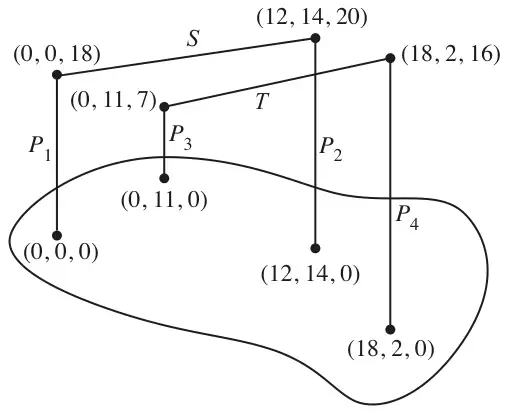
11 A 3-D coordinate system, whose units are metres, is set up to model a construction site. The construction site contains four vertical poles \(P_1\), \(P_2\), \(P_3\) and \(P_4\). The floor of the construction site is modelled as lying in the \(x\)-\(y\) plane and the poles are modelled as vertical line segments. One end of each pole lies on the floor of the construction site, and the other end of each pole is modelled by the points (0, 0, 18), (12, 14, 20), (0, 11, 7) and (18, 2, 16) respectively.

A wire, \(S\), runs from the top of \(P_1\) to the top of \(P_2\). A second wire, \(T\), runs from the top of \(P_3\) to the top of \(P_4\). The wires are modelled by straight lines segments. The layout of the construction site is illustrated on the diagram below which is not drawn to scale.

Sketch of the site floor with four vertical poles: P1 from (0, 0, 0) to (0, 0, 18), P2 from (12, 14, 0) to (12, 14, 20), P3 from (0, 11, 0) to (0, 11, 7) and P4 from (18, 2, 0) to (18, 2, 16); wire S joins the tops of P1 and P2 and wire T joins the tops of P3 and P4

A vector equation of the line segment that represents the wire \(S\) is given by

\(\mathbf{r} = \begin{pmatrix} 0 \\ 0 \\ 18 \end{pmatrix} + \lambda\begin{pmatrix} 6 \\ 7 \\ 1 \end{pmatrix}, 0 \leqslant \lambda \leqslant 2.\)

(a) Find, in the same form, a vector equation of the line segment that represents the wire \(T\). The components of the direction vector should be integers whose only positive common factor is 1. [2]

For the construction site to be considered safe, it must pass two tests.

Test 1: The wires \(S\) and \(T\) need to be at least 5 metres apart at all positions on \(S\) and \(T\).

(b) By using an appropriate formula, determine whether the construction site passes Test 1. [2]

A security camera is placed at a point \(Q\) on wire \(S\).

Test 2: To ensure sufficient visibility of the construction site, the distance between the security camera and the top of \(P_3\) must be at least 19 m.

(c) Determine whether it is possible to find point \(Q\) on \(S\) such that the construction site passes Test 2. [3]

A2 June 2024 Paper 2 Q5

OCR ACurrent spec6 marks3D Lines & Planes

5 Vectors, \(\mathbf{a}\), \(\mathbf{b}\) and \(\mathbf{c}\), are given by \(\mathbf{a} = \mathbf{i} + (1 - p)\mathbf{j} + (p + 2)\mathbf{k}\), \(\mathbf{b} = 2\mathbf{i} + \mathbf{j} + \mathbf{k}\) and \(\mathbf{c} = \mathbf{i} + 14\mathbf{j} + (p - 3)\mathbf{k}\) where \(p\) is a constant.

You are given that \(\mathbf{a} \times \mathbf{b}\) is perpendicular to \(\mathbf{c}\).

Determine the possible values of \(p\). [6]

AS June 2024 Paper 1 Q5

OCR ACurrent spec10 marks3D Lines & Planes

5 The line through points \(A(8, -7, -2)\) and \(B(11, -9, 0)\) is denoted by \(L_1\).

(a) Find a vector equation for \(L_1\). [2]
(b) Determine whether the point \((26, -19, -14)\) lies on \(L_1\). [2]

The line \(L_2\) passes through the origin, \(O\), and intersects \(L_1\) at the point \(C\). The lines \(L_1\) and \(L_2\) are perpendicular.

(c) By using the fact that \(C\) lies on \(L_1\), find a vector equation for \(L_2\). [4]
(d) Hence find the shortest distance from \(O\) to \(L_1\). [2]

AS June 2024 Paper 1 Q3

OCR ACurrent spec7 marks3D Lines & Planes

3

(a)
(i) Find \(\begin{pmatrix} 1 \\ 2 \\ -1 \end{pmatrix} \times \begin{pmatrix} 3 \\ 5 \\ -2 \end{pmatrix}\). [1]
(ii) State a geometrical relationship between the answer to part (a)(i) and the vectors \(\begin{pmatrix} 1 \\ 2 \\ -1 \end{pmatrix}\) and \(\begin{pmatrix} 3 \\ 5 \\ -2 \end{pmatrix}\). [1]
(iii) Verify the relationship stated in part (a)(ii). [2]
(b) Find the angle between the vectors \(2\mathbf{i} - 2\mathbf{j} + \mathbf{k}\) and \(4\mathbf{i} - \mathbf{j} + 8\mathbf{k}\). [3]

A2 June 2023 Paper 1 Q8

OCR ACurrent spec15 marks3D Lines & PlanesMatrices

8 The points \(P\), \(Q\) and \(R\) have coordinates \((0, 2, 3)\), \((2, 0, 1)\) and \((1, 3, 0)\) respectively.

The acute angle between the line segments \(PQ\) and \(PR\) is \(\theta\).

(a) Show that \(\sin\theta = \dfrac{2}{11}\sqrt{22}\). [3]

The triangle \(PQR\) lies in the plane \(\Pi\).

(b) Determine an equation for \(\Pi\), giving your answer in the form \(ax + by + cz = d\), where \(a\), \(b\), \(c\) and \(d\) are integers. [3]

The point \(S\) has coordinates \((5, 3, -1)\).

(c) By finding the shortest distance between \(S\) and the plane \(\Pi\), show that the volume of the tetrahedron \(PQRS\) is \(\dfrac{14}{3}\).
[The volume of a tetrahedron is \(\dfrac{1}{3} \times \text{area of base} \times \text{perpendicular height}\)] [4]

The tetrahedron \(PQRS\) is transformed to the tetrahedron \(P^{\prime}Q^{\prime}R^{\prime}S^{\prime}\) by a rotation about the \(y\)-axis.

The \(x\)-coordinate of \(S^{\prime}\) is \(2\sqrt{2}\).

(d) By using the matrix for a rotation by angle \(\theta\) about the \(y\)-axis, as given in the Formulae Booklet, determine in exact form the possible coordinates of \(R^{\prime}\). [5]

A2 June 2023 Paper 2 Q6

OCR ACurrent spec8 marks3D Lines & Planes

6 The equation of the plane \(\Pi\) is \(\mathbf{r} = \begin{pmatrix} -1 \\ 2 \\ 1 \end{pmatrix} + \lambda\begin{pmatrix} 4 \\ 4 \\ 3 \end{pmatrix} + \mu\begin{pmatrix} -2 \\ 3 \\ 1 \end{pmatrix}\).

(a) Find the acute angle between \(\Pi\) and the plane with equation \(\mathbf{r} \cdot \begin{pmatrix} 2 \\ 0 \\ 3 \end{pmatrix} = 4\). [4]

The point \(A\) has coordinates \((9, -7, 20)\).

The point \(F\) is the point of intersection between \(\Pi\) and the perpendicular from \(A\) to \(\Pi\).

(b) Determine the coordinates of \(F\). [4]

AS June 2023 Paper 1 Q4

OCR ACurrent spec4 marks3D Lines & Planes

4 The vector \(\mathbf{p}\), all of whose components are positive, is given by \(\mathbf{p} = \begin{pmatrix} a^2 \\ a - 5 \\ 26 \end{pmatrix}\) where \(a\) is a constant.

You are given that \(\mathbf{p}\) is perpendicular to the vector \(\begin{pmatrix} 2 \\ 6 \\ -3 \end{pmatrix}\).

Determine the value of \(a\). [4]

AS June 2023 Paper 1 Q2

OCR ACurrent spec8 marks3D Lines & Planes

2 The lines \(L_1\) and \(L_2\) have the following equations.

\(L_1 : \mathbf{r} = \begin{pmatrix} -5 \\ 6 \\ 15 \end{pmatrix} + \lambda\begin{pmatrix} 5 \\ -2 \\ -2 \end{pmatrix}\)

\(L_2 : \mathbf{r} = \begin{pmatrix} 24 \\ 1 \\ -5 \end{pmatrix} + \mu\begin{pmatrix} 3 \\ 1 \\ -4 \end{pmatrix}\)

(a) Show that \(L_1\) and \(L_2\) intersect, giving the position vector of the point of intersection. [5]
(b) Find the equation of the line which intersects \(L_1\) and \(L_2\) and is perpendicular to both. Give your answer in cartesian form. [3]

A2 June 2022 Paper 2 Q10

OCR ACurrent spec8 marks3D Lines & Planes

10 The coordinates of the points \(A\) and \(B\) are \((3, -2, -1)\) and \((13, 10, 9)\) respectively.

  • The plane \(\Pi_A\) contains \(A\) and the plane \(\Pi_B\) contains \(B\).
  • The planes \(\Pi_A\) and \(\Pi_B\) are parallel.
  • The \(x\) and \(y\) components of any normal to plane \(\Pi_A\) are equal.
  • The shortest distance between \(\Pi_A\) and \(\Pi_B\) is 2.

There are two possible solution planes for \(\Pi_A\) which satisfy the above conditions.

Determine the acute angle between these two possible solution planes. [8]

AS June 2022 Paper 1 Q8

OCR ACurrent spec9 marks3D Lines & Planes

8 The line segment \(AB\) is a diameter of a sphere, \(S\). The point \(C\) is any point on the surface of \(S\).

(a) Explain why \(\overrightarrow{AC} \cdot \overrightarrow{BC} = 0\) for all possible positions of \(C\). [3]

You are now given that \(A\) is the point \((11, 12, -14)\) and \(B\) is the point \((9, 13, 6)\).

(b) Given that the coordinates of \(C\) have the form \((2p, p, 1)\), where \(p\) is a constant, determine the coordinates of the possible positions of \(C\). [6]

A2 June 2022 Paper 1 Q4

OCR ACurrent spec4 marks3D Lines & Planes

4 Determine the acute angle between the line \(\mathbf{r} = \begin{pmatrix} -\sqrt{3} \\ 1 \\ 3 \end{pmatrix} + \lambda\begin{pmatrix} 1 \\ 2\sqrt{3} \\ -\sqrt{3} \end{pmatrix}\) and the \(y\)-axis. [4]

A2 June 2022 Paper 2 Q1

OCR ACurrent spec6 marks3D Lines & Planes

1

(a) Find a vector which is perpendicular to both \(3\mathbf{i} - 5\mathbf{j} - \mathbf{k}\) and \(\mathbf{i} + 3\mathbf{j} - 4\mathbf{k}\). [1]

The equations of two lines are \(\mathbf{r} = 2\mathbf{i} + 3\mathbf{j} + 3\mathbf{k} + \lambda(\mathbf{i} - 2\mathbf{j} + \mathbf{k})\) and \(\mathbf{r} = \mathbf{i} + 11\mathbf{j} - 4\mathbf{k} + \mu(-\mathbf{i} + 3\mathbf{j} - 2\mathbf{k})\).

(b) Show that the lines intersect, stating the point of intersection. [5]

AS June 2022 Paper 1 Q1

OCR ACurrent spec8 marks3D Lines & Planes

1

(a) Determine whether the point \((19, -12, 17)\) lies on the line \(\mathbf{r} = \begin{pmatrix} 4 \\ -2 \\ 7 \end{pmatrix} + \lambda\begin{pmatrix} 3 \\ -2 \\ 4 \end{pmatrix}\). [3]

Vectors \(\mathbf{a}\) and \(\mathbf{b}\) are given by \(\mathbf{a} = \begin{pmatrix} 1 \\ -2 \\ 2 \end{pmatrix}\) and \(\mathbf{b} = \begin{pmatrix} -3 \\ 6 \\ 2 \end{pmatrix}\).

(b)
(i) Find, in degrees, the angle between \(\mathbf{a}\) and \(\mathbf{b}\). [3]
(ii) Find a vector which is perpendicular to both \(\mathbf{a}\) and \(\mathbf{b}\). [2]

AS October 2021 Paper 1 Q9

OCR ACurrent spec13 marks3D Lines & Planes

9 The points \(P(3, 5, -21)\) and \(Q(-1, 3, -16)\) are on the ceiling of a long straight underground tunnel. A ventilation shaft must be dug from the point \(M\) on the ceiling of the tunnel midway between \(P\) and \(Q\) to horizontal ground level (where the \(z\)-coordinate is 0). The ventilation shaft must be perpendicular to the tunnel.

The path of the ventilation shaft is modelled by the vector equation \(\mathbf{r} = \mathbf{a} + \lambda\mathbf{b}\), where \(\mathbf{a}\) is the position vector of \(M\).

You are given that \(\mathbf{b} = \begin{pmatrix} 1 \\ s \\ t \end{pmatrix}\) where \(s\) and \(t\) are real numbers.

(a) Show that \(s = 2.5t - 2\). [3]
(b) Show that at the point where the ventilation shaft reaches the ground \(\lambda = \dfrac{c}{t}\), where \(c\) is a constant to be determined. [3]
(c) Using the results in parts (a) and (b), determine the shortest possible length of the ventilation shaft. [6]
(d) Explain what the fact that \(\mathbf{b} \times \begin{pmatrix} 0 \\ 0 \\ 1 \end{pmatrix} \ne \mathbf{0}\) means about the direction of the ventilation shaft. [1]

A2 October 2021 Paper 1 Q4

OCR ACurrent spec11 marks3D Lines & Planes

4 Points \(A\), \(B\) and \(C\) have coordinates \((4, 2, 0)\), \((1, 5, 3)\) and \((1, 4, -2)\) respectively.
The line \(l\) passes through \(A\) and \(B\).

(a) Find a cartesian equation for \(l\). [3]

\(M\) is the point on \(l\) that is closest to \(C\).

(b) Find the coordinates of \(M\). [4]
(c) Find the exact area of the triangle \(ABC\). [4]

A2 October 2021 Paper 2 Q3

OCR ACurrent spec9 marks3D Lines & Planes

3 The line \(l_1\) has equation \(\mathbf{r} = \begin{pmatrix} 1 \\ -3 \\ 3 \end{pmatrix} + \lambda\begin{pmatrix} 3 \\ 2 \\ -2 \end{pmatrix}\).

The plane \(\Pi\) has equation \(\mathbf{r}.\begin{pmatrix} 2 \\ -5 \\ -3 \end{pmatrix} = 4\).

(a) Find the position vector of the point of intersection of \(l_1\) and \(\Pi\). [3]
(b) Find the acute angle between \(l_1\) and \(\Pi\). [3]

\(A\) is the point on \(l_1\) where \(\lambda = 1\).

\(l_2\) is the line with the following properties.

  • \(l_2\) passes through \(A\)
  • \(l_2\) is perpendicular to \(l_1\)
  • \(l_2\) is parallel to \(\Pi\)
(c) Find, in vector form, the equation of \(l_2\). [3]

AS October 2021 Paper 1 Q1

OCR ACurrent spec5 marks3D Lines & Planes

1 The lines \(l_1\) and \(l_2\) have the following equations.

\[\begin{aligned} l_1 &: \mathbf{r} = \begin{pmatrix} 8 \\ -11 \\ -2 \end{pmatrix} + \lambda\begin{pmatrix} -2 \\ 5 \\ 3 \end{pmatrix} \\ l_2 &: \mathbf{r} = \begin{pmatrix} -6 \\ 11 \\ 8 \end{pmatrix} + \mu\begin{pmatrix} -3 \\ 1 \\ -1 \end{pmatrix} \end{aligned}\]
(a) Show that \(l_1\) and \(l_2\) intersect. [4]
(b) Write down the point of intersection of \(l_1\) and \(l_2\). [1]

AS October 2020 Paper 1 Q7

OCR ACurrent spec6 marks3D Lines & Planes

7 The equations of two intersecting lines are

\[\mathbf{r} = \begin{pmatrix} -12 \\ a \\ -1 \end{pmatrix} + \lambda\begin{pmatrix} 2 \\ 2 \\ 1 \end{pmatrix} \qquad \mathbf{r} = \begin{pmatrix} 2 \\ 0 \\ 5 \end{pmatrix} + \mu\begin{pmatrix} -3 \\ 1 \\ -1 \end{pmatrix}\]

where \(a\) is a constant.

(a) Find a vector, \(\mathbf{b}\), which is perpendicular to both lines. [2]
(b) Show that \(\mathbf{b}.\begin{pmatrix} -12 \\ a \\ -1 \end{pmatrix} = \mathbf{b}.\begin{pmatrix} 2 \\ 0 \\ 5 \end{pmatrix}\). [2]
(c) Hence, or otherwise, find the value of \(a\). [2]

A2 October 2020 Paper 1 Q6

OCR ACurrent spec5 marks3D Lines & Planes

6 The equations of two non-intersecting lines, \(l_1\) and \(l_2\), are

\[l_1 : \mathbf{r} = \begin{pmatrix} 1 \\ 2 \\ -1 \end{pmatrix} + \lambda\begin{pmatrix} 2 \\ 1 \\ -2 \end{pmatrix}, \qquad l_2 : \mathbf{r} = \begin{pmatrix} 2 \\ 2 \\ -3 \end{pmatrix} + \mu\begin{pmatrix} 1 \\ -1 \\ 4 \end{pmatrix}.\]

Find the shortest distance between lines \(l_1\) and \(l_2\). [5]

A2 October 2020 Paper 2 Q4

OCR ACurrent spec9 marks3D Lines & Planes

4 The equations of two intersecting lines \(l_1\) and \(l_2\) are

\[l_1 : \mathbf{r} = \begin{pmatrix} 1 \\ 0 \\ a \end{pmatrix} + \lambda\begin{pmatrix} 2 \\ 1 \\ -3 \end{pmatrix} \qquad l_2 : \mathbf{r} = \begin{pmatrix} 7 \\ 9 \\ -2 \end{pmatrix} + \mu\begin{pmatrix} -1 \\ 1 \\ 2 \end{pmatrix}\]

where \(a\) is a constant.

The equation of the plane \(\Pi\) is

\[\mathbf{r}.\begin{pmatrix} 1 \\ 5 \\ 3 \end{pmatrix} = -14.\]

\(l_1\) and \(\Pi\) intersect at \(Q\).

\(l_2\) and \(\Pi\) intersect at \(R\).

(a) Verify that the coordinates of \(R\) are \((13, 3, -14)\). [2]
(b) Determine the exact value of the length of \(QR\). [7]

A2 June 2019 Paper 1 Q8

OCR ACurrent spec6 marks3D Lines & Planes

8 The equation of a plane is \(4x + 2y + z = 7\).
The point \(A\) has coordinates \((9, 6, 1)\) and the point \(B\) is the reflection of \(A\) in the plane.

Find the coordinates of the point \(B\). [6]

AS June 2019 Paper 1 Q3

OCR ACurrent spec10 marks3D Lines & Planes

3 The position vector of point \(A\) is \(\mathbf{a} = -9\mathbf{i} + 2\mathbf{j} + 6\mathbf{k}\).
The line \(l\) passes through \(A\) and is perpendicular to \(\mathbf{a}\).

(a) Determine the shortest distance between the origin, \(O\), and \(l\). [2]

\(l\) is also perpendicular to the vector \(\mathbf{b}\) where \(\mathbf{b} = -2\mathbf{i} + \mathbf{j} + \mathbf{k}\).

(b) Find a vector which is perpendicular to both \(\mathbf{a}\) and \(\mathbf{b}\). [1]
(c) Write down an equation of \(l\) in vector form. [1]

\(P\) is a point on \(l\) such that \(PA = 2OA\).

(d) Find angle \(POA\) giving your answer to 3 significant figures. [3]

\(C\) is a point whose position vector, \(\mathbf{c}\), is given by \(\mathbf{c} = p\mathbf{a}\) for some constant \(p\). The line \(m\) passes through \(C\) and has equation \(\mathbf{r} = \mathbf{c} + \mu\mathbf{b}\). The point with position vector \(9\mathbf{i} + 8\mathbf{j} - 12\mathbf{k}\) lies on \(m\).

(e) Find the value of \(p\). [3]

A2 June 2019 Paper 2 Q2

OCR ACurrent spec8 marks3D Lines & Planes

2

(a) A plane \(\Pi\) has the equation \(\mathbf{r}.\begin{pmatrix} 3 \\ 6 \\ -2 \end{pmatrix} = 15\). \(C\) is the point \((4, -5, 1)\).
Find the shortest distance between \(\Pi\) and \(C\). [3]
(b) Lines \(l_1\) and \(l_2\) have the following equations.\[l_1 : \mathbf{r} = \begin{pmatrix} 4 \\ 3 \\ 1 \end{pmatrix} + \lambda\begin{pmatrix} -2 \\ 4 \\ -2 \end{pmatrix}\]\[l_2 : \mathbf{r} = \begin{pmatrix} 5 \\ 2 \\ 4 \end{pmatrix} + \mu\begin{pmatrix} 1 \\ -2 \\ 1 \end{pmatrix}\]Find, in exact form, the distance between \(l_1\) and \(l_2\). [5]

AS June 2018 Paper 1 Q1

OCR ACurrent spec5 marks3D Lines & Planes

1

(i) Find a vector which is perpendicular to both \(\begin{pmatrix} 1 \\ 3 \\ -2 \end{pmatrix}\) and \(\begin{pmatrix} -3 \\ -6 \\ 4 \end{pmatrix}\). [2]
(ii) The cartesian equation of a line is \(\dfrac{x}{2} = y - 3 = 2z + 4\).
Express the equation of this line in vector form. [3]

A2 June 2025 Paper 1 Q11

OCR MEICurrent spec14 marks3D Lines & Planes

11 The lines \(l_1\) and \(l_2\) have equations

\(l_1: \dfrac{x - 3}{a} = \dfrac{y + 1}{b} = \dfrac{z - 2}{1} \qquad l_2: \mathbf{r} = 2\mathbf{i} + \mathbf{j} + 3\mathbf{k} + \lambda(-\mathbf{i} + c\mathbf{j} + 2\mathbf{k})\)

where \(a\), \(b\) and \(c\) are constants.

(a) In the case where \(c = 0\) and \(l_1\) and \(l_2\) intersect at right angles, determine the coordinates of the point of intersection of the two lines. [6]
(b) Now consider the case where \(c = 4\) and lines \(l_1\) and \(l_2\) are parallel.
(i) Find the values of \(a\) and \(b\). [3]
(ii) Determine the distance between the two lines. [5]

AS June 2025 Paper 1 Q4

OCR MEICurrent spec8 marks3D Lines & PlanesMatrices

4

(a) The transformation T is represented by the matrix \(\mathbf{M} = \begin{pmatrix} 1 & -2 & 2 \\ 2 & 1 & 0 \\ 1 & 2 & -1 \end{pmatrix}\).
A shape \(\mathrm{S_1}\) is mapped to a shape \(\mathrm{S_2}\) by the transformation T.
Show that volume of \(\mathrm{S_1}\) is the same as the volume of \(\mathrm{S_2}\). [2]
(b) Three planes have equations\[\begin{aligned} x - 2y + 2z &= \lambda, \\ 2x + y \phantom{{}+2z} &= 2, \\ x + 2y - z &= 0, \end{aligned}\]where \(\lambda\) is a constant.
(i) Explain why the three planes intersect at a point for any value of \(\lambda\). [2]
(ii) Use a matrix method to determine, in terms of \(\lambda\), the coordinates of this point. [4]

A2 June 2025 Paper 1 Q2

OCR MEICurrent spec4 marks3D Lines & Planes

2 In this question you must show detailed reasoning.

Find the acute angle between the planes \(2x - y + 2z = 5\) and \(x + 2y + z = 8\). [4]

AS June 2025 Paper 1 Q2

OCR MEICurrent spec4 marks3D Lines & Planes

2 In this question you must show detailed reasoning.

Find the acute angle between the vector \(3\mathbf{i} + 2\mathbf{j} - \mathbf{k}\) and the normal vector to the plane \(2x + 3y + z = 6\). [4]

A2 June 2024 Paper 1 Q15

OCR MEICurrent spec10 marks3D Lines & PlanesMatrices

15 Three planes have equations

\[\begin{aligned} x + ky + 3z &= 1, \\ 3x + 4y + 2z &= 3, \\ x + 3y - z &= -k, \end{aligned}\]

where \(k\) is a constant.

(a) Show that the planes meet at a point except for one value of \(k\), which should be determined. [4]
(b) Show that, when the planes do meet at a point, the \(y\)-coordinate of this point is independent of \(k\). [6]

A2 June 2024 Paper 1 Q11

OCR MEICurrent spec14 marks3D Lines & Planes

11 The plane \(\Pi\) has equation \(2x - y + 2z = 4\). The point P has coordinates (8, 4, 5).

(a) Calculate the shortest distance from P to \(\Pi\). [2]

The line L has equation \(\dfrac{x - 2}{3} = \dfrac{y}{2} = \dfrac{z + 3}{4}\).

(b) Verify that P lies on L. [2]
(c) Find the coordinates of the point of intersection of L and \(\Pi\). [3]
(d) Determine the acute angle between L and \(\Pi\). [4]
(e) Use the results of parts (b), (c) and (d) to verify your answer to part (a). [3]

AS June 2024 Paper 1 Q9

OCR MEICurrent spec8 marks3D Lines & Planes

9 In this question you must show detailed reasoning.

Find a vector \(\mathbf{v}\) which has the following properties.

  • It is a unit vector.
  • It is parallel to the plane \(2x + 2y + z = 10\).
  • It makes an angle of \(45^\circ\) with the normal to the plane \(x + z = 5\). [8]

AS June 2024 Paper 1 Q7

OCR MEICurrent spec6 marks3D Lines & PlanesMatrices

7 Three planes have equations

\[\begin{aligned} x + 2y - 3z &= 0, \\ -x + 3y - 2z &= 0, \\ x - 2y + kz &= k, \end{aligned}\]

where \(k\) is a constant.

(a) For the case \(k = 0\), the origin lies on all three planes.
Use a determinant to explain whether there are any other points that lie on all three planes in this case. [2]
(b) You are now given that \(k = 1\).
(i) Show that there are no points that lie on all three planes. [3]
(ii) Describe the geometrical arrangement of the three planes. [1]

A2 June 2024 Paper 1 Q5

OCR MEICurrent spec6 marks3D Lines & Planes

5

(a) Given that \(\mathbf{u} = \begin{pmatrix} -2 \\ 1 \\ 2 \end{pmatrix}\), \(\mathbf{v} = \begin{pmatrix} a \\ 0 \\ 1 \end{pmatrix}\) and \(\mathbf{u} \times \mathbf{v} = \begin{pmatrix} 1 \\ b \\ 3 \end{pmatrix}\), find \(a\) and \(b\). [3]
(b) Using \(\mathbf{u} \times \mathbf{v}\), determine the angle between the vectors \(\mathbf{u}\) and \(\mathbf{v}\), given that this angle is acute. [3]

A2 June 2023 Paper 1 Q16

OCR MEICurrent spec10 marks3D Lines & Planes

16 The point P \((4, 1, 0)\) is equidistant from the plane \(2x + y + 2z = 0\) and the line \(\dfrac{x - 3}{2} = \dfrac{y - 1}{b} = \dfrac{z + 5}{3}\), where \(b \gt 0\).

Determine the value of \(b\). [10]

A2 June 2023 Paper 1 Q14

OCR MEICurrent spec13 marks3D Lines & PlanesMatrices

14 Three planes have equations

\[\begin{aligned} kx \phantom{{}+ky} - z &= 2, \\ -x + ky + 2z &= 1, \\ 2kx + 2y + 3z &= 0, \end{aligned}\]

where \(k\) is a constant.

(a) By considering a suitable determinant, show that the three planes meet at a point for all values of \(k\). [5]
(b) Using a matrix method, find, in terms of \(k\), the coordinates of the point of intersection of the planes. [8]

AS June 2023 Paper 1 Q10

OCR MEICurrent spec7 marks3D Lines & Planes

10 The plane P has normal vector \(2\mathbf{i} + a\mathbf{j} - \mathbf{k}\), where \(a\) is a positive constant, and the point \((3, -1, 1)\) lies in P. The plane \(x - z = 3\) makes an angle of \(45^\circ\) with P.

Find the cartesian equation of P. [7]

AS June 2023 Paper 1 Q8

OCR MEICurrent spec6 marks3D Lines & PlanesMatrices

8 The equations of three planes are

\[\begin{aligned} 2x + y + 3z &= 3, \\ 3x - y - 2z &= 2, \\ -4x + 3y + 7z &= k, \end{aligned}\]

where \(k\) is a constant.

(a) By considering a suitable determinant, show that the planes do not meet at a single point. [2]
(b) Given that the planes form a sheaf, determine the value of \(k\). [4]

A2 June 2023 Paper 1 Q2

OCR MEICurrent spec5 marks3D Lines & Planes

2 In this question you must show detailed reasoning.

Find the angle between the vector \(3\mathbf{i} + 2\mathbf{j} + \mathbf{k}\) and the plane \(-x + 3y + 2z = 8\). [5]

A2 June 2022 Paper 1 Q13

OCR MEICurrent spec17 marks3D Lines & Planes

13 The points A and B have coordinates \((4, 0, -1)\) and \((10, 4, -3)\) respectively. The planes \(\Pi_1\) and \(\Pi_2\) have equations \(x - 2y = 5\) and \(2x + 3y - z = -4\) respectively.

(a) Find the acute angle between the line AB and the plane \(\Pi_1\). [4]
(b) Show that the line AB meets \(\Pi_1\) and \(\Pi_2\) at the same point, whose coordinates should be specified. [5]
(c)
(i) Find \((\mathbf{i} - 2\mathbf{j}) \times (2\mathbf{i} + 3\mathbf{j} - \mathbf{k})\). [1]
(ii) Hence find the acute angle between the planes \(\Pi_1\) and \(\Pi_2\). [3]
(iii) Find the shortest distance between the point A and the line of intersection of the planes \(\Pi_1\) and \(\Pi_2\). [4]

AS June 2022 Paper 1 Q2

OCR MEICurrent spec7 marks3D Lines & Planes

2

(a) Show that the vector \(\mathbf{i} + 4\mathbf{j} + 2\mathbf{k}\) is parallel to the plane \(2x + y - 3z = 10\). [3]
(b) Determine the acute angle between the planes \(2x + y - 3z = 10\) and \(x - y - 3z = 3\). [4]

A2 October 2021 Paper 1 Q15

OCR MEICurrent spec6 marks3D Lines & PlanesMatrices

15 The equations of three planes are

\(\begin{aligned} -4x + ky + 7z &= 4, \\ x - 2y + 5z &= l, \\ 2x + 3y + z &= 2. \end{aligned}\)

Given that the planes form a sheaf, determine the values of \(k\) and \(l\). [6]

A2 October 2021 Paper 1 Q11

OCR MEICurrent spec9 marks3D Lines & Planes

11

(a) Given that \(\mathbf{u} = \lambda\mathbf{i} + \mathbf{j} - 3\mathbf{k}\) and \(\mathbf{v} = \mathbf{i} + 2\mathbf{j} - 2\mathbf{k}\), find the following, giving your answers in terms of \(\lambda\).
(i) \(\mathbf{u}.\mathbf{v}\) [1]
(ii) \(\mathbf{u} \times \mathbf{v}\) [2]
(b) Hence determine
(i) the acute angle between the planes \(2x + y - 3z = 10\) and \(x + 2y - 2z = 10\), [3]
(ii) the shortest distance between the lines \(\dfrac{x - 3}{3} = \dfrac{y}{1} = \dfrac{z - 2}{-3}\) and \(\dfrac{x}{1} = \dfrac{y - 4}{2} = \dfrac{z + 2}{-2}\), giving your answer as a multiple of \(\sqrt{2}\). [3]

AS October 2021 Paper 1 Q3

OCR MEICurrent spec7 marks3D Lines & PlanesMatrices

3 Three planes have the following equations.

\[\begin{aligned} 2x - 3y + z &= -3, \\ x - 4y + 2z &= 1, \\ -3x - 2y + 3z &= 14. \end{aligned}\]
(a)
(i) Write the system of equations in matrix form. [1]
(ii) Hence find the point of intersection of the planes. [2]
(b) In this question you must show detailed reasoning.
Find the acute angle between the planes \(2x - 3y + z = -3\) and \(x - 4y + 2z = 1\). [4]

A2 October 2020 Paper 1 Q15

OCR MEICurrent spec17 marks3D Lines & PlanesMatrices

15

(a) Show that the three planes with equations\[\begin{aligned} x + \lambda y + 3z &= -12 \\ 2x + y + 5z &= -11 \\ x - 2y + 2z &= -9 \end{aligned}\]where \(\lambda\) is a constant, meet at a unique point except for one value of \(\lambda\) which is to be determined. [3]
(b) In the case \(\lambda = -2\), use matrices to find the point of intersection P of the planes, showing your method clearly. [3]

The line \(l\) has equation \(\dfrac{x - 1}{2} = \dfrac{y - 1}{-1} = \dfrac{z + 2}{-2}\).

(c) Find a vector equation of \(l\). [2]
(d) Find the shortest distance between the point P and \(l\). [4]
(e)
(i) Show that \(l\) is parallel to the plane \(x - 2y + 2z = -9\). [3]
(ii) Find the distance between \(l\) and the plane \(x - 2y + 2z = -9\). [2]

AS October 2020 Paper 1 Q10

OCR MEICurrent spec7 marks3D Lines & Planes

10 A vector \(\mathbf{v}\) has magnitude 1 unit. The angle between \(\mathbf{v}\) and the positive \(z\)-axis is \(60^\circ\), and \(\mathbf{v}\) is parallel to the plane \(x - 2y = 0\).

Given that \(\mathbf{v} = a\mathbf{i} + b\mathbf{j} + c\mathbf{k}\), where \(a\), \(b\) and \(c\) are all positive, find \(\mathbf{v}\). [7]

AS October 2020 Paper 1 Q9

OCR MEICurrent spec7 marks3D Lines & PlanesMatrices

9 Three planes have equations

\[\begin{aligned} kx + y - 2z &= 0 \\ 2x + 3y - 6z &= -5 \\ 3x - 2y + 5z &= 1 \end{aligned}\]

where \(k\) is a constant.

Investigate the arrangement of the planes for each of the following cases. If in either case the planes meet at a unique point, find the coordinates of that point.

(a) \(k = -1\) [3]
(b) \(k = \tfrac{2}{3}\) [4]

A2 October 2020 Paper 1 Q8

OCR MEICurrent spec9 marks3D Lines & Planes

8

(a) Given that the lines \(\mathbf{r} = \begin{pmatrix} 0 \\ 2 \\ 2 \end{pmatrix} + \lambda\begin{pmatrix} -1 \\ 1 \\ 3 \end{pmatrix}\) and \(\mathbf{r} = \begin{pmatrix} -1 \\ 2 \\ k \end{pmatrix} + \mu\begin{pmatrix} 2 \\ 3 \\ 4 \end{pmatrix}\) meet, determine \(k\). [5]
(b) In this question you must show detailed reasoning.
Find the acute angle between the two lines. [4]

A2 June 2019 Paper 1 Q14

OCR MEICurrent spec13 marks3D Lines & PlanesMatrices

14 Three planes have equations

\[\begin{aligned} -x + ay \phantom{{}+ z} &= 2 \\ 2x + 3y + z &= -3 \\ x + by + z &= c \end{aligned}\]

where \(a\), \(b\) and \(c\) are constants.

(a) In the case where the planes do not intersect at a unique point,
(i) find \(b\) in terms of \(a\), [4]
(ii) find the value of \(c\) for which the planes form a sheaf. [3]
(b) In the case where \(b = a\) and \(c = 1\), find the coordinates of the point of intersection of the planes in terms of \(a\). [6]

A2 June 2019 Paper 1 Q12

OCR MEICurrent spec9 marks3D Lines & Planes

12 Three intersecting lines \(L_1\), \(L_2\) and \(L_3\) have equations

\[L_1\!: \frac{x}{2} = \frac{y}{3} = \frac{z}{1}, \quad L_2\!: \frac{x}{1} = \frac{y}{2} = \frac{z}{-4} \quad \text{and} \quad L_3\!: \frac{x - 1}{1} = \frac{y - 2}{1} = \frac{z + 4}{5}.\]

Find the area of the triangle enclosed by these lines. [9]

AS June 2019 Paper 1 Q4

OCR MEICurrent spec8 marks3D Lines & PlanesMatrices

4

(a) Find \(\mathbf{M}^{-1}\), where \(\mathbf{M} = \begin{pmatrix} 1 & 2 & 3 \\ -1 & 1 & 2 \\ -2 & 1 & 2 \end{pmatrix}\). [1]
(b) Hence find, in terms of the constant \(k\), the point of intersection of the planes\[\begin{aligned} x + 2y + 3z &= 19, \\ -x + y + 2z &= 4, \\ -2x + y + 2z &= k. \end{aligned}\][3]
(c) In this question you must show detailed reasoning.
Find the acute angle between the planes \(x + 2y + 3z = 19\) and \(-x + y + 2z = 4\). [4]

A2 June 2019 Paper 1 Q2

OCR MEICurrent spec3 marks3D Lines & Planes

2 The plane \(x + 2y + cz = 4\) is perpendicular to the plane \(2x - cy + 6z = 9\), where \(c\) is a constant. Find the value of \(c\). [3]

AS June 2018 Paper 1 Q10

OCR MEICurrent spec8 marks3D Lines & PlanesMatrices

10 Three planes have equations

\[\begin{aligned} -x + 2y + z &= 0 \\ 2x - y - z &= 0 \\ x + y \phantom{{}- z} &= a \end{aligned}\]

where \(a\) is a constant.

(i) Investigate the arrangement of the planes:
  • when \(a = 0\);
  • when \(a \neq 0\). [6]
(ii) Chris claims that the position vectors \(-\mathbf{i} + 2\mathbf{j} + \mathbf{k}\), \(2\mathbf{i} - \mathbf{j} - \mathbf{k}\) and \(\mathbf{i} + \mathbf{j}\) lie in a plane. Determine whether or not Chris is correct. [2]

AS June 2018 Paper 1 Q2

OCR MEICurrent spec3 marks3D Lines & Planes

2 Find, to the nearest degree, the angle between the vectors \(\begin{pmatrix} 1 \\ 0 \\ -2 \end{pmatrix}\) and \(\begin{pmatrix} -2 \\ 3 \\ -3 \end{pmatrix}\). [3]