
A2 June 2024 Paper 1 Q11
11 A 3-D coordinate system, whose units are metres, is set up to model a construction site. The construction site contains four vertical poles \(P_1\), \(P_2\), \(P_3\) and \(P_4\). The floor of the construction site is modelled as lying in the \(x\)-\(y\) plane and the poles are modelled as vertical line segments. One end of each pole lies on the floor of the construction site, and the other end of each pole is modelled by the points (0, 0, 18), (12, 14, 20), (0, 11, 7) and (18, 2, 16) respectively.
A wire, \(S\), runs from the top of \(P_1\) to the top of \(P_2\). A second wire, \(T\), runs from the top of \(P_3\) to the top of \(P_4\). The wires are modelled by straight lines segments. The layout of the construction site is illustrated on the diagram below which is not drawn to scale.
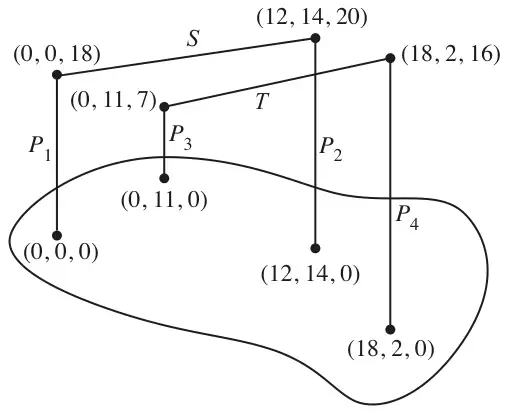
A vector equation of the line segment that represents the wire \(S\) is given by
\(\mathbf{r} = \begin{pmatrix} 0 \\ 0 \\ 18 \end{pmatrix} + \lambda\begin{pmatrix} 6 \\ 7 \\ 1 \end{pmatrix}, 0 \leqslant \lambda \leqslant 2.\)
For the construction site to be considered safe, it must pass two tests.
Test 1: The wires \(S\) and \(T\) need to be at least 5 metres apart at all positions on \(S\) and \(T\).
A security camera is placed at a point \(Q\) on wire \(S\).
Test 2: To ensure sufficient visibility of the construction site, the distance between the security camera and the top of \(P_3\) must be at least 19 m.
| Scheme | Marks | AO |
|---|---|---|
| \(\mathbf{r} = \begin{pmatrix} 0 \\ 11 \\ 7 \end{pmatrix} + \ldots\) or \(\mathbf{r} = \begin{pmatrix} 18 \\ 2 \\ 16 \end{pmatrix} + \ldots\) or \(\mathbf{r} = \ldots + \mu\begin{pmatrix} 2 \\ -1 \\ 1 \end{pmatrix}\) or \(\ldots\begin{pmatrix} 0 \\ 11 \\ 7 \end{pmatrix} + \mu\begin{pmatrix} 2 \\ -1 \\ 1 \end{pmatrix}\) | B1* | 3.3 |
| \(\mathbf{r} = \begin{pmatrix} 0 \\ 11 \\ 7 \end{pmatrix} + \mu\begin{pmatrix} 2 \\ -1 \\ 1 \end{pmatrix}\) | B1dep* | 3.3 |
| [2] |
Notes
B1*: For two correct components – the components are
• \(\mathbf{r} = \ldots\) or \(\vec{r} = \ldots\) ONLY
• position vector,
• direction vector in lowest terms with parameter.
B1dep*: For a correct equation with direction vector in lowest terms. Condone lack of (or incorrect) range of values for parameter. Other common answers are: \(\mathbf{r} = \begin{pmatrix} 0 \\ 11 \\ 7 \end{pmatrix} + \mu\begin{pmatrix} -2 \\ 1 \\ -1 \end{pmatrix}\), \(\mathbf{r} = \begin{pmatrix} 18 \\ 2 \\ 16 \end{pmatrix} + \mu\begin{pmatrix} -2 \\ 1 \\ -1 \end{pmatrix}\), \(\mathbf{r} = \begin{pmatrix} 18 \\ 2 \\ 16 \end{pmatrix} + \mu\begin{pmatrix} 2 \\ -1 \\ 1 \end{pmatrix}\),
There are other possible answers, e.g. \(\mathbf{r} = \begin{pmatrix} 6 \\ 8 \\ 10 \end{pmatrix} + \mu\begin{pmatrix} 2 \\ -1 \\ 1 \end{pmatrix}\),
| Scheme | Marks | AO |
|---|---|---|
| \(\begin{pmatrix} 6 \\ 7 \\ 1 \end{pmatrix} \times \begin{pmatrix} 2 \\ -1 \\ 1 \end{pmatrix} = \begin{pmatrix} 8 \\ -4 \\ -20 \end{pmatrix}\) \((D =) \dfrac{\left|\left(\begin{pmatrix} 0 \\ 0 \\ 18 \end{pmatrix} - \begin{pmatrix} 0 \\ 11 \\ 7 \end{pmatrix}\right) \bullet \begin{pmatrix} 8 \\ -4 \\ -20 \end{pmatrix}\right|}{\left|\begin{pmatrix} 8 \\ -4 \\ -20 \end{pmatrix}\right|}\) | M1 | 3.4 |
| \(= \dfrac{22\sqrt{30}}{15} \;(= 8.033264\ldots) \gt 5\) so yes (the site) passes Test 1. | A1 | 2.2a |
| [2] |
Notes
M1: Calculate vector product \(\mathbf{n}\) with \(\begin{pmatrix} 6 \\ 7 \\ 1 \end{pmatrix}\) and the direction vector of their \(T\) from part (a) with at least one component correct (following through their vectors), and setting up the equation \(D = \dfrac{\left|\left(\begin{pmatrix} 0 \\ 0 \\ 18 \end{pmatrix} - \mathbf{a}\right) \bullet \mathbf{n}\right|}{|\mathbf{n}|}\) where \(\mathbf{a}\) is a point on their \(T\) from part (a) and their vector \(\mathbf{n}\). Condone lack of modulus signs in equation. Note that \(\pm\) these vectors are valid as are scalar multiples of \(\mathbf{n}\).
A1: Correct calculation (either exact e.g. \(\dfrac{176}{4\sqrt{30}}\)) or at least 2 significant figures), including reference to 5 and conclusion.
| Scheme | Marks | AO |
|---|---|---|
| \((\overrightarrow{PQ} =) \pm\left(\begin{pmatrix} 0 \\ 0 \\ 18 \end{pmatrix} + \lambda\begin{pmatrix} 6 \\ 7 \\ 1 \end{pmatrix} - \begin{pmatrix} 0 \\ 11 \\ 7 \end{pmatrix}\right) \quad \left(= \pm\begin{pmatrix} 6\lambda \\ 7\lambda - 11 \\ \lambda + 11 \end{pmatrix}\right)\) | B1 | 3.4 |
| \(\left(|\overrightarrow{PQ}| =\right) \sqrt{(6\lambda)^2 + (7\lambda - 11)^2 + (\lambda + 11)^2}\) | B1 | 3.4 |
| \((6\lambda)^2 + (7\lambda - 11)^2 + (\lambda + 11)^2 \geqslant 19^2 \quad (86\lambda^2 - 132\lambda - 119 \geqslant 0)\) \(\Rightarrow \lambda \geqslant 2.17\ldots\) or \(\lambda \leqslant -0.637\ldots\) but \(0 \leqslant \lambda \leqslant 2\) so no, it’s not possible. | B1 | 3.1b |
| [3] |
Notes
No MR in this part.
B1: For \((0, 11, 7)\) to a general point on \(S\). Allow correct un-simplified. Can be implied by a correct expression for the distance (or distance squared)
B1: Expression for \(|\overrightarrow{PQ}|\) or \(|\overrightarrow{PQ}|^2\) - allow un-simplified.
B1: Solving inequality/equation for \(\lambda\) and concluding no + reason. Condone “no” as conclusion. Critical values of \(\lambda\) correct to at least 2 sf. Allow strict inequalities.
Alternative method
| Scheme | Marks |
|---|---|
| Distance between \((0, 11, 7)\) and \((0, 0, 18)\) is \(\sqrt{11^2 + (7 - 18)^2}\) | B1 |
| Distance between \((0, 11, 7)\) and \((12, 14, 20)\) is \(\sqrt{12^2 + (14 - 11)^2 + (20 - 7)^2}\) | B1 |
| \(11\sqrt{2} = 15.5563\ldots\) and \(\sqrt{322} = 17.9443\ldots\) which are both less than 19 and the two point (0, 0, 18) and (12, 14, 20) are the points furthest from (0, 11, 7) so no, it’s not possible. | B1 |
| [3] |
B1: Find distance (or distance squared) between (0, 11, 7) and (0, 0, 18) – allow un-simplified.
B1: Find distance (or distance squared) between (0, 11, 7) and (12, 14, 20) – allow un-simplified
B1: Correct values given to at least 3 sf (or in a form in which all three can be compared e.g. \(\sqrt{322}, \sqrt{242}\) and \(\sqrt{361}\)) and some indication that these two points are the furthest from the camera and conclude no.